The Present Simple


                         By:

    English teacher: B.tungalagtuya
                          
The Usages of the Present Simple

       USE 1: Repeated Actions   


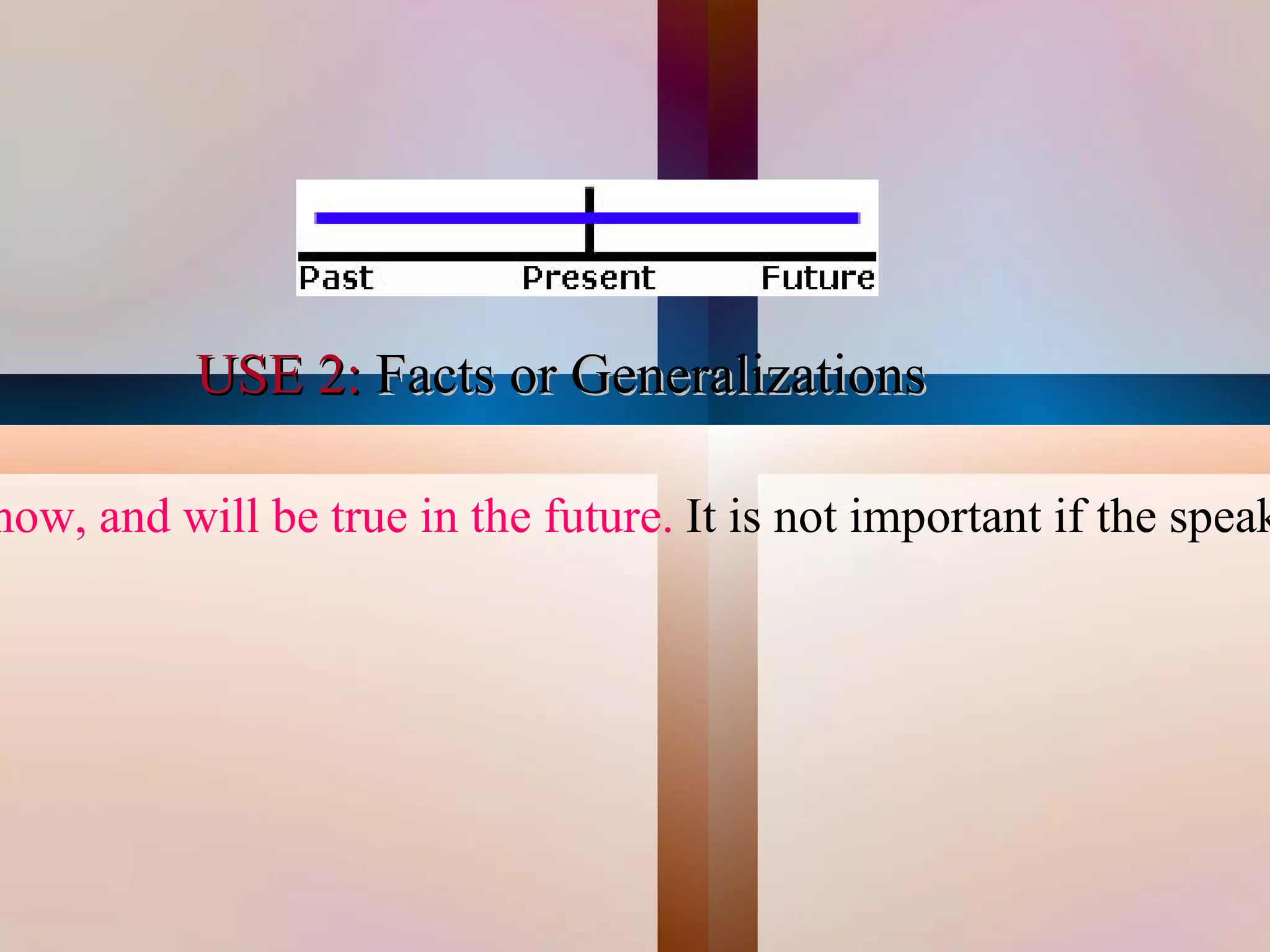
    USE 2: Facts or Generalizations    


Use 1

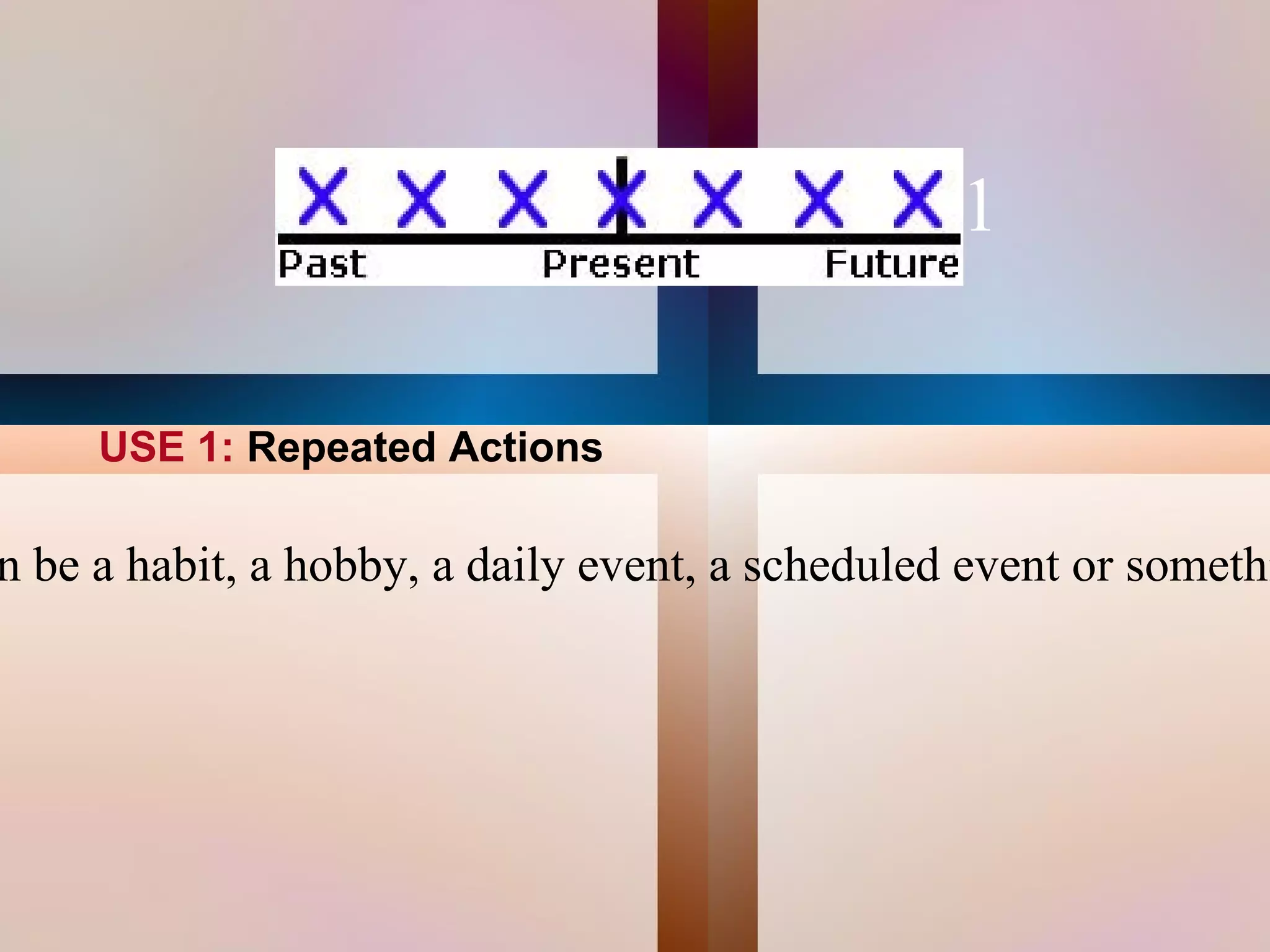
       USE 1: Repeated Actions   

n be a habit, a hobby, a daily event, a scheduled event or somethi


Examples
        Subject + (Verb) + (s, es) + Object

    - play
      I          tennis.

    - She not
       does           play tennis.
     
             leaves
    - The train            every morning at 8 am.

 
             does not 
     - The train             leave at 9am.
USE 2: Facts or Generalizations      

now, and will be true in the future. It is not important if the speak


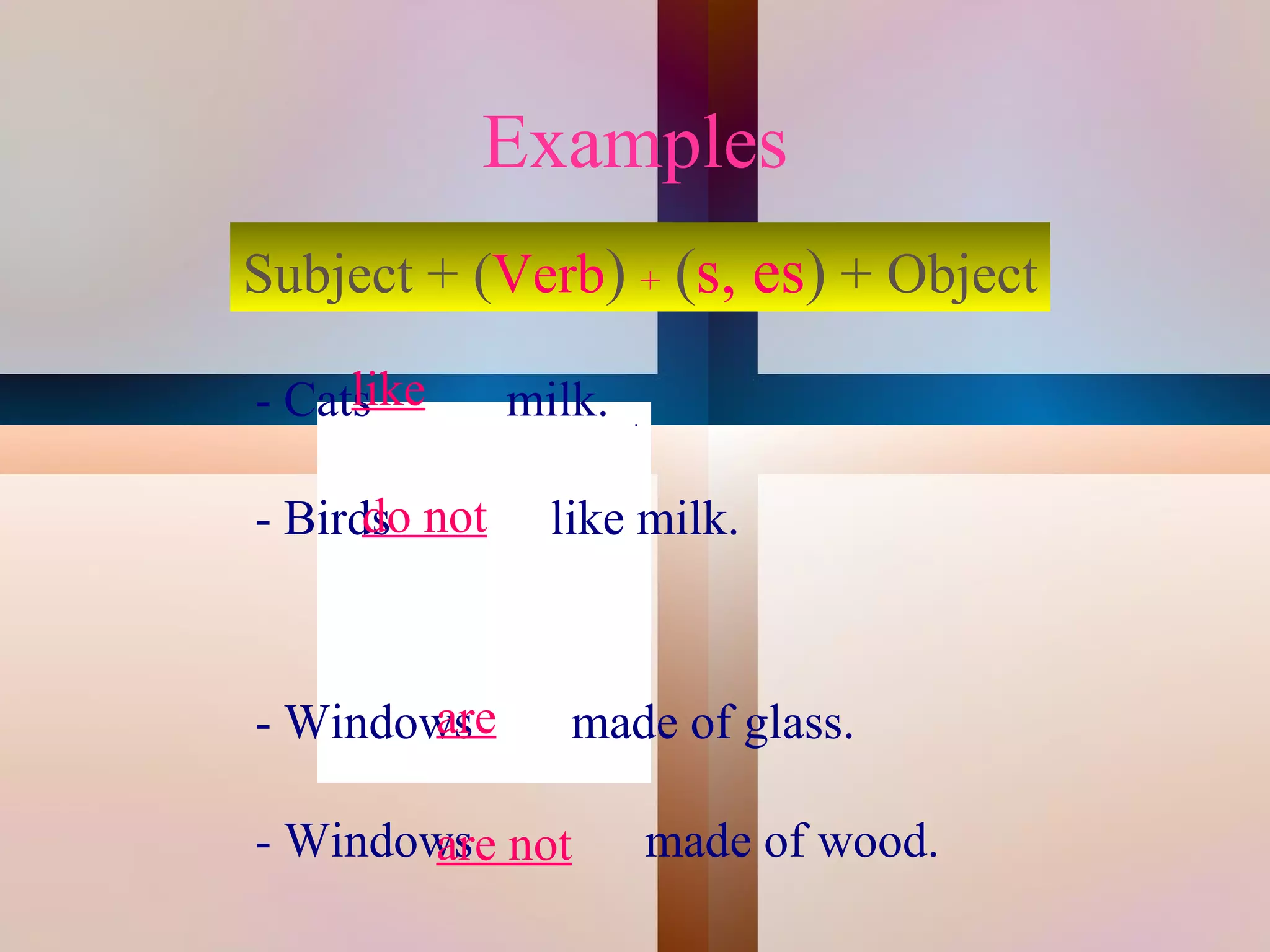
Examples
    Subject + (Verb) + (s, es) + Object

         like
    - Cats        milk.   .


    - Birds not
          do        like milk.


            are
    - Windows        made of glass.

    - Windows not
            are               made of wood. 
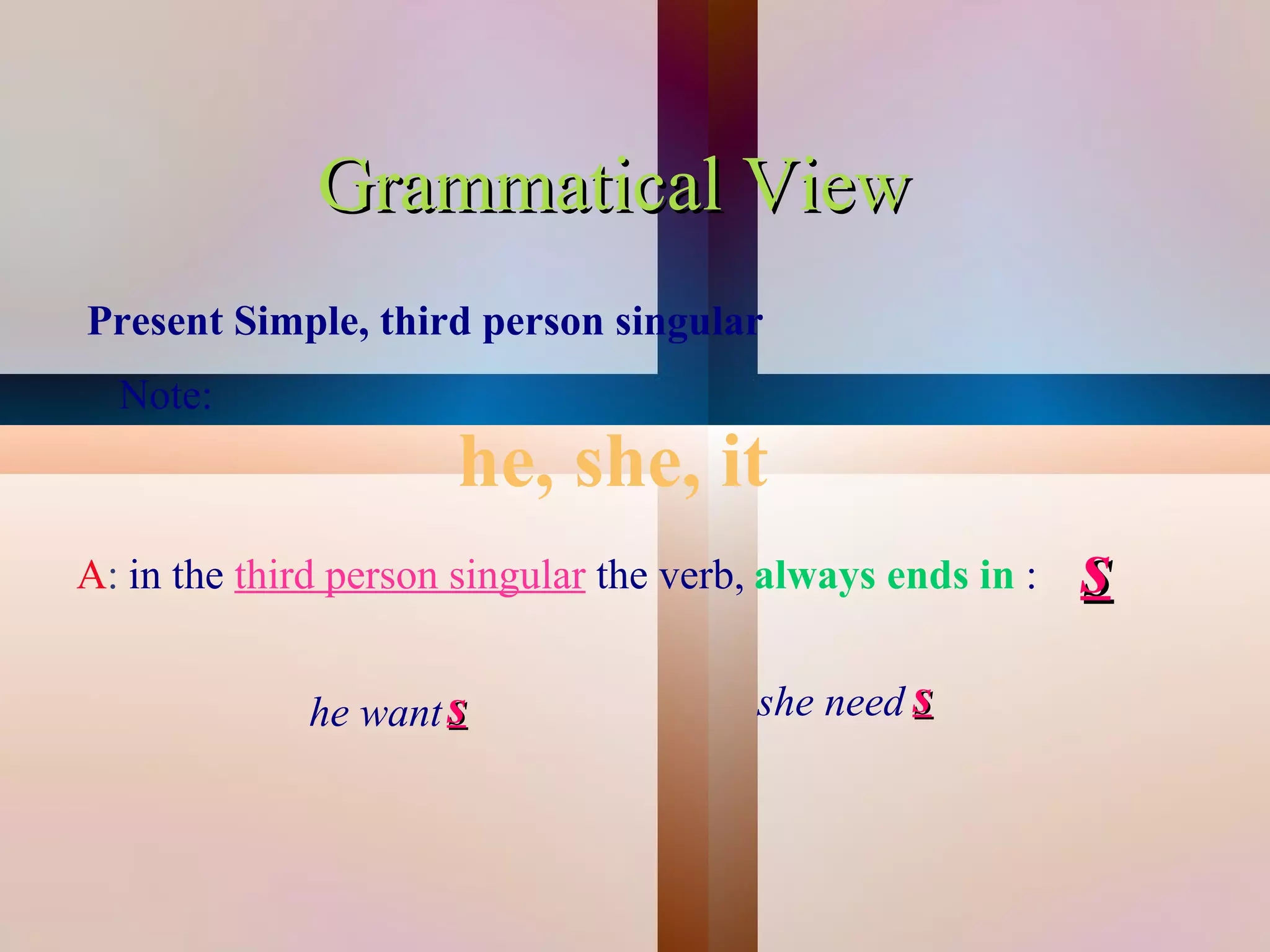
Grammatical View
    Present Simple, third person singular
      Note:
                          he, she, it
    A: in the third person singular the verb, always ends in :   s
                  he want s                  she need s


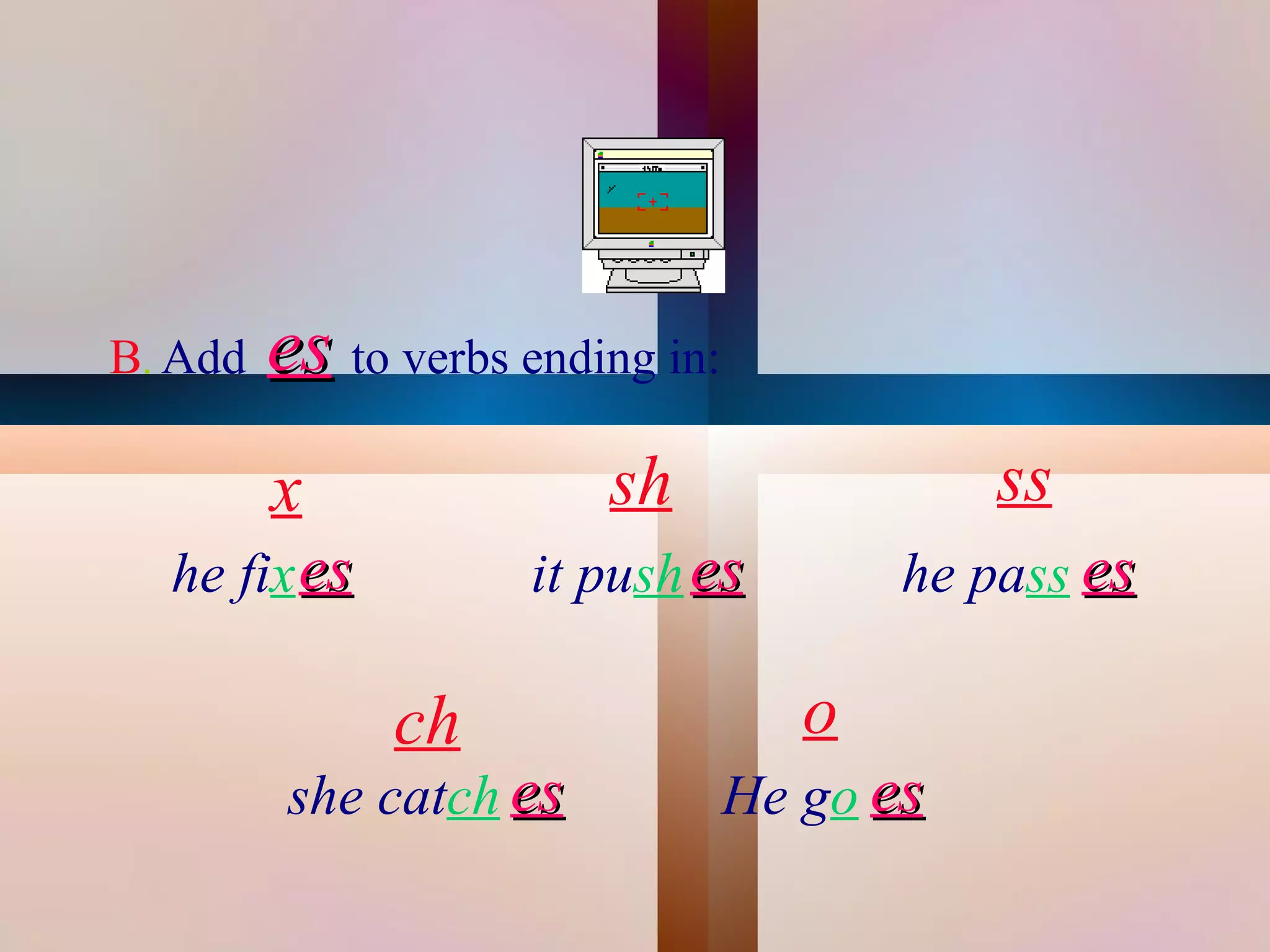
B. Add   es to verbs ending in:
             x               sh                  ss
      he fix es          it push es          he pass es

                   ch                    o
              she catch es            He go es
                               
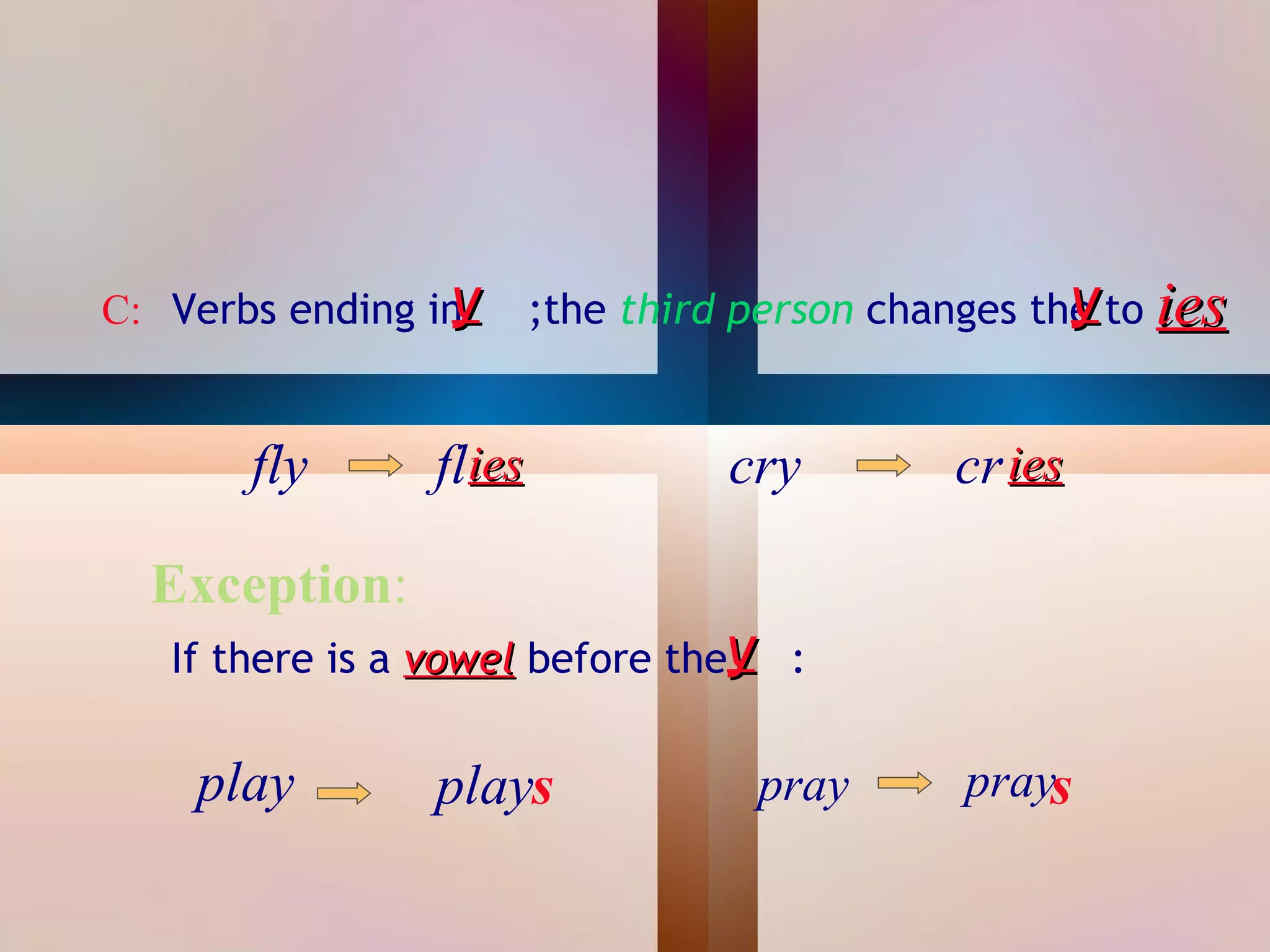
C: Verbs ending iny                                 y
                            ;the third person changes the to ies


           fly      flies             cry        cr ies

      Exception:
       If there is a vowel before they :


        play        plays              pray       prays
                                  
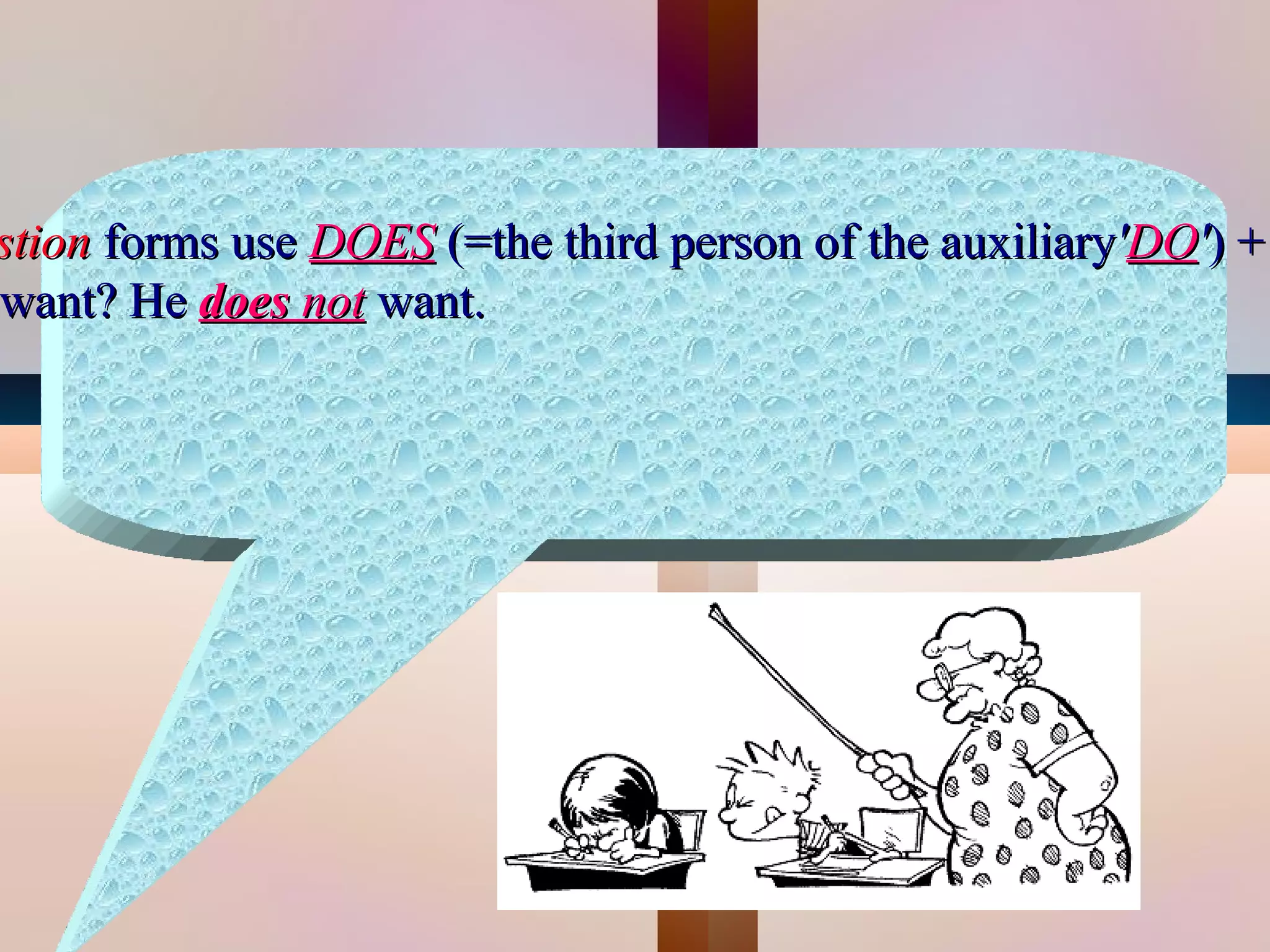
stion forms use DOES (=the third person of the auxiliary'DO') +
want? He does not want.


Examples:

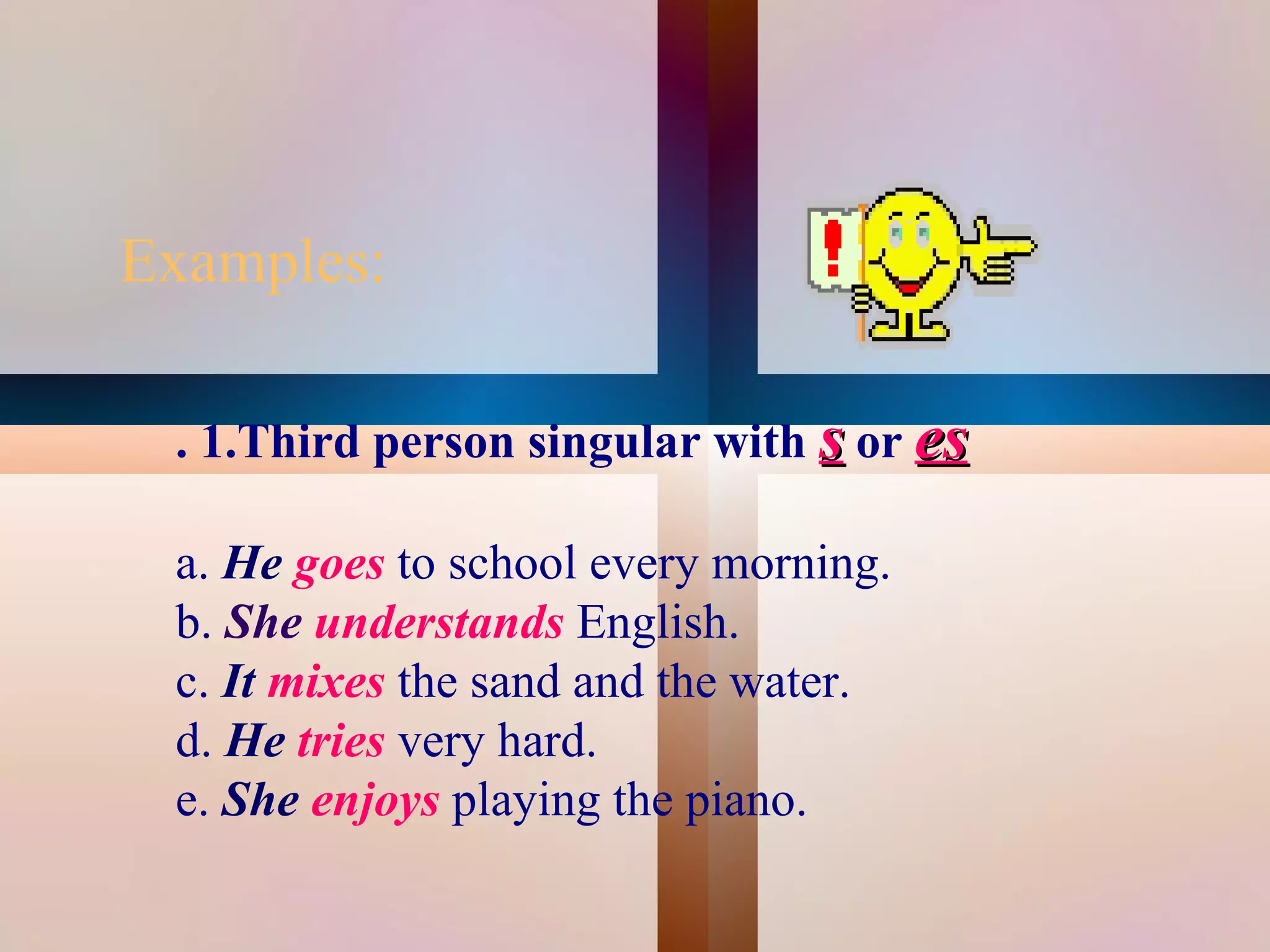
     . 1.Third person singular with s or es

     a. He goes to school every morning.
     b. She understands English.
     c. It mixes the sand and the water.
     d. He tries very hard.
     e. She enjoys playing the piano.
                            
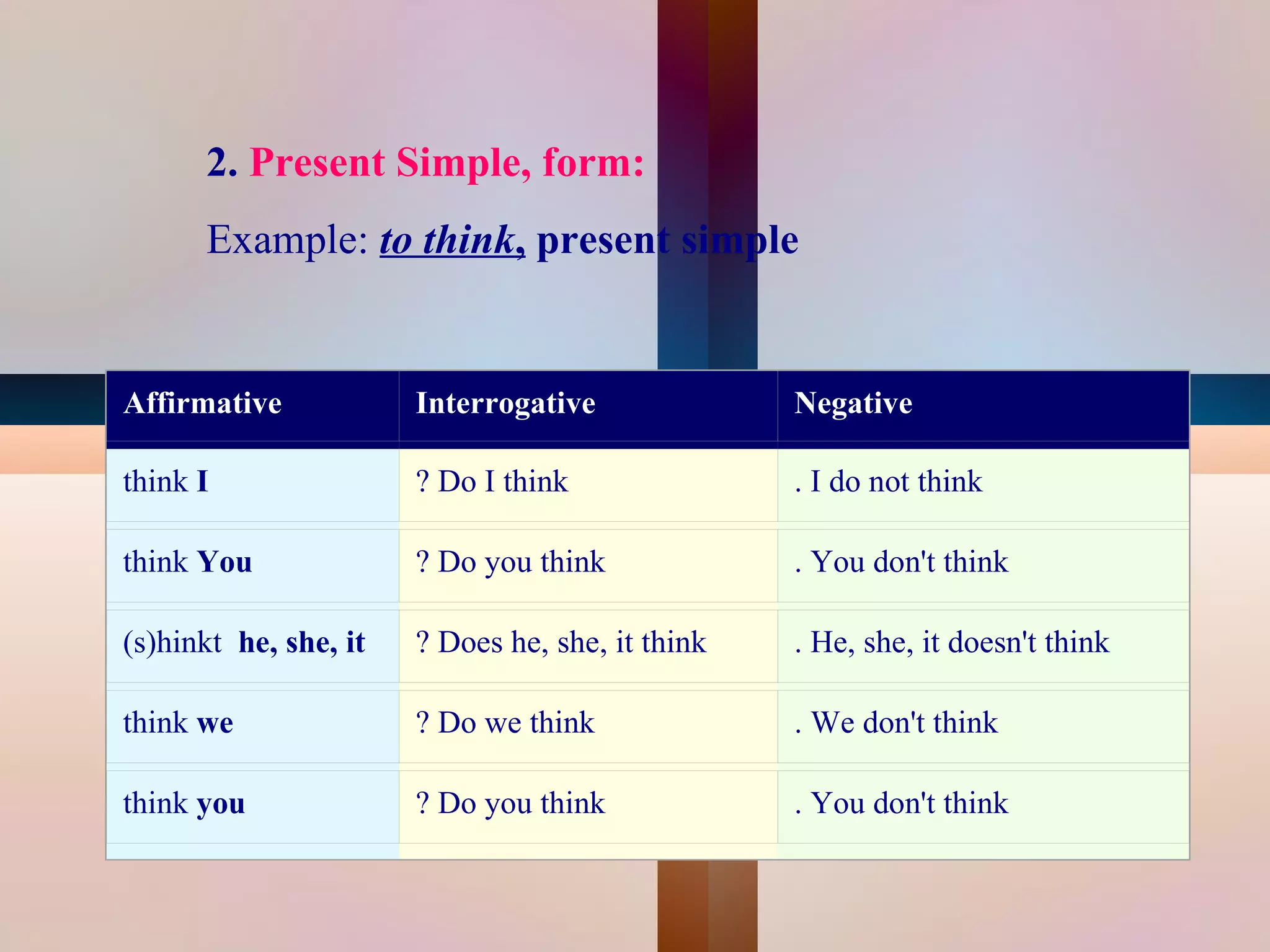
2. Present Simple, form:
          Example: to think, present simple


    Affirmative            Interrogative              Negative

    think I                ? Do I think               . I do not think

    think You              ? Do you think             . You don't think

    (s)hinkt he, she, it   ? Does he, she, it think   . He, she, it doesn't think

    think we               ? Do we think              . We don't think

    think you              ? Do you think             . You don't think
                                             
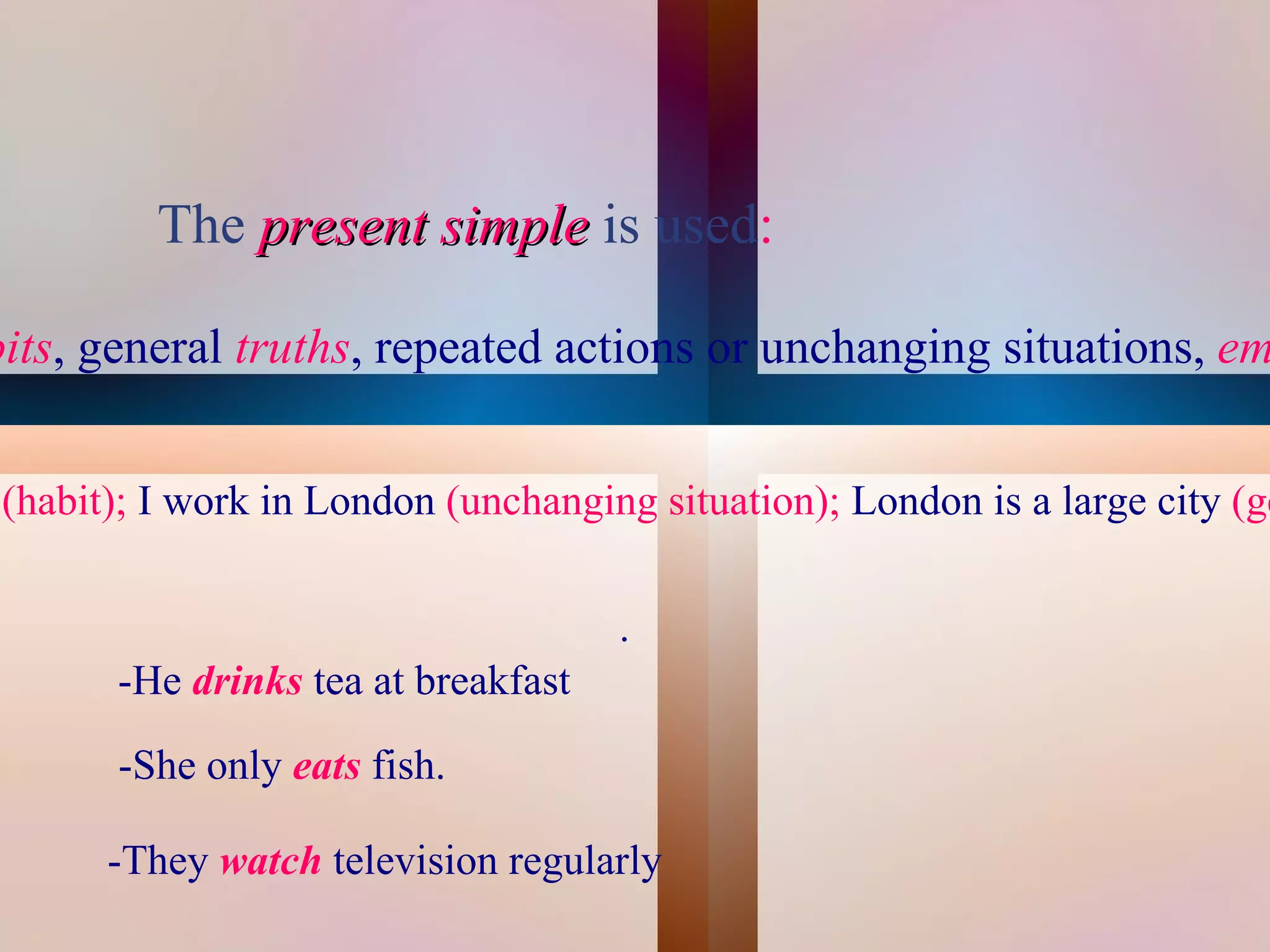
The present simple is used:

bits, general truths, repeated actions or unchanging situations, em


 (habit); I work in London (unchanging situation); London is a large city (ge

                                      .
        -He drinks tea at breakfast

        -She only eats fish.
        -They watch television regularly
                                       
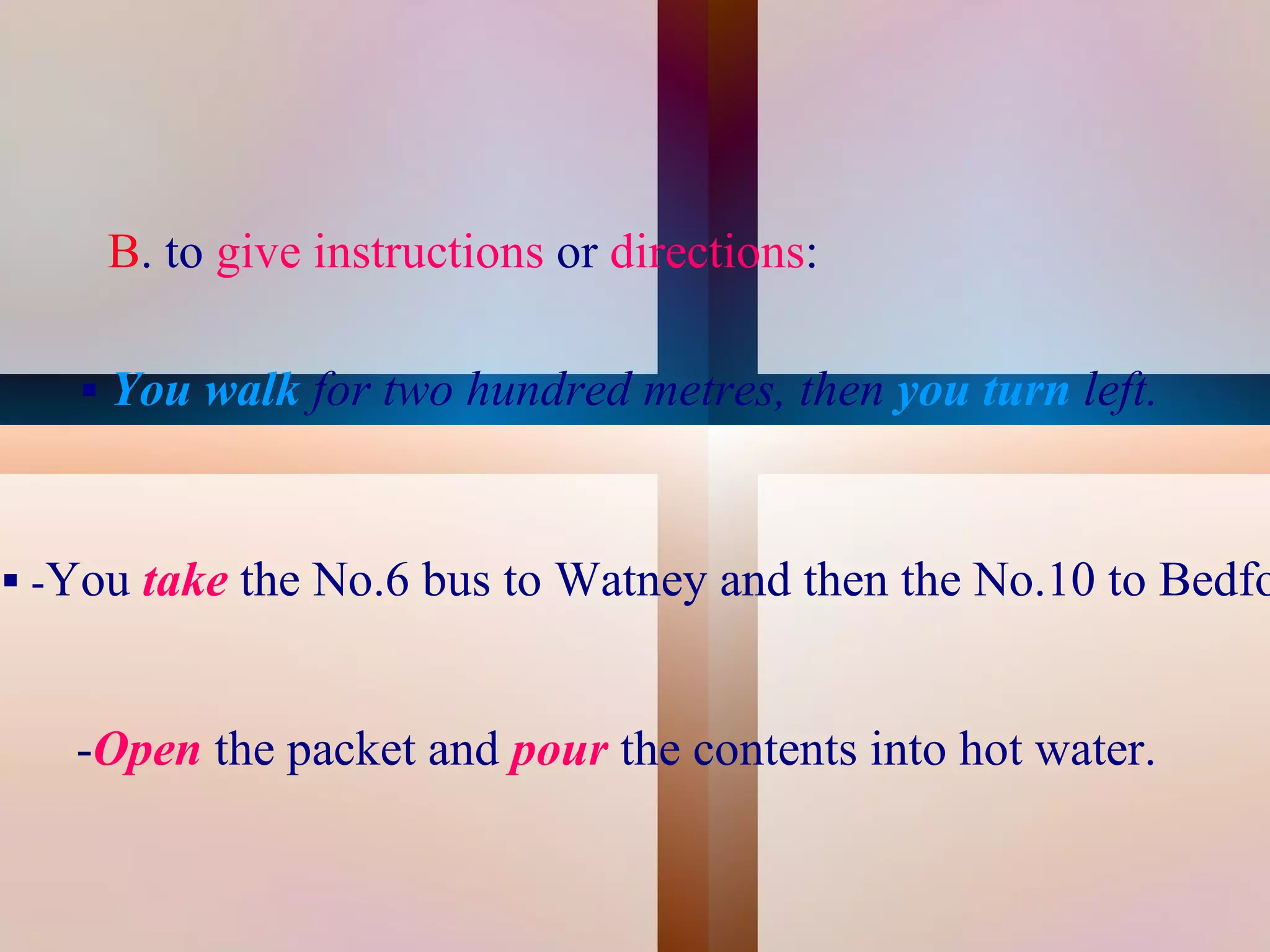
B. to give instructions or directions:

        You walk for two hundred metres, then you turn left.


 -You take the No.6 bus to Watney and then the No.10 to Bedfo


       -Open the packet and pour the contents into hot water.
                                     
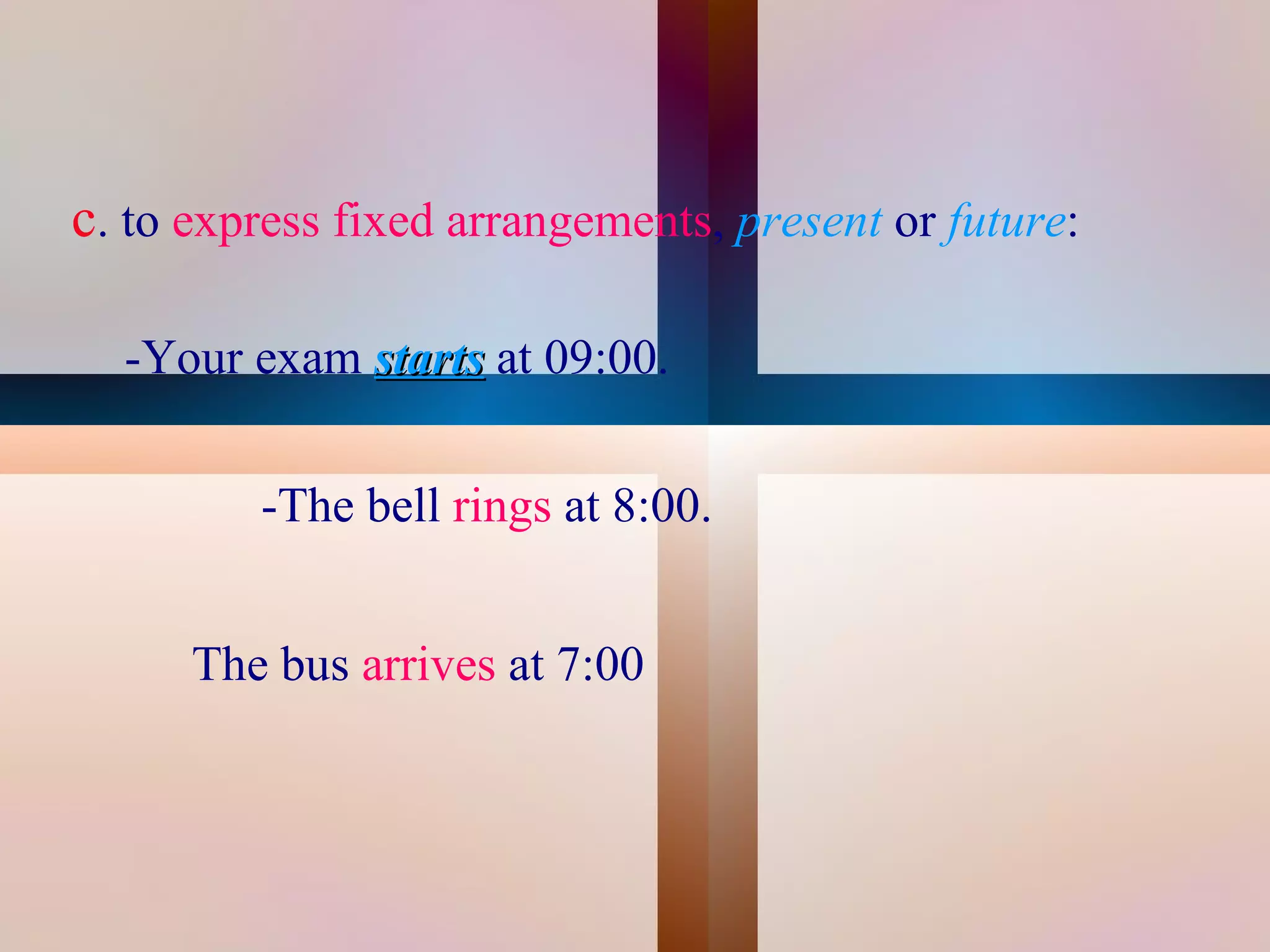
c. to express fixed arrangements, present or future:

      -Your exam starts at 09:00.


             -The bell rings at 8:00.


          The bus arrives at 7:00


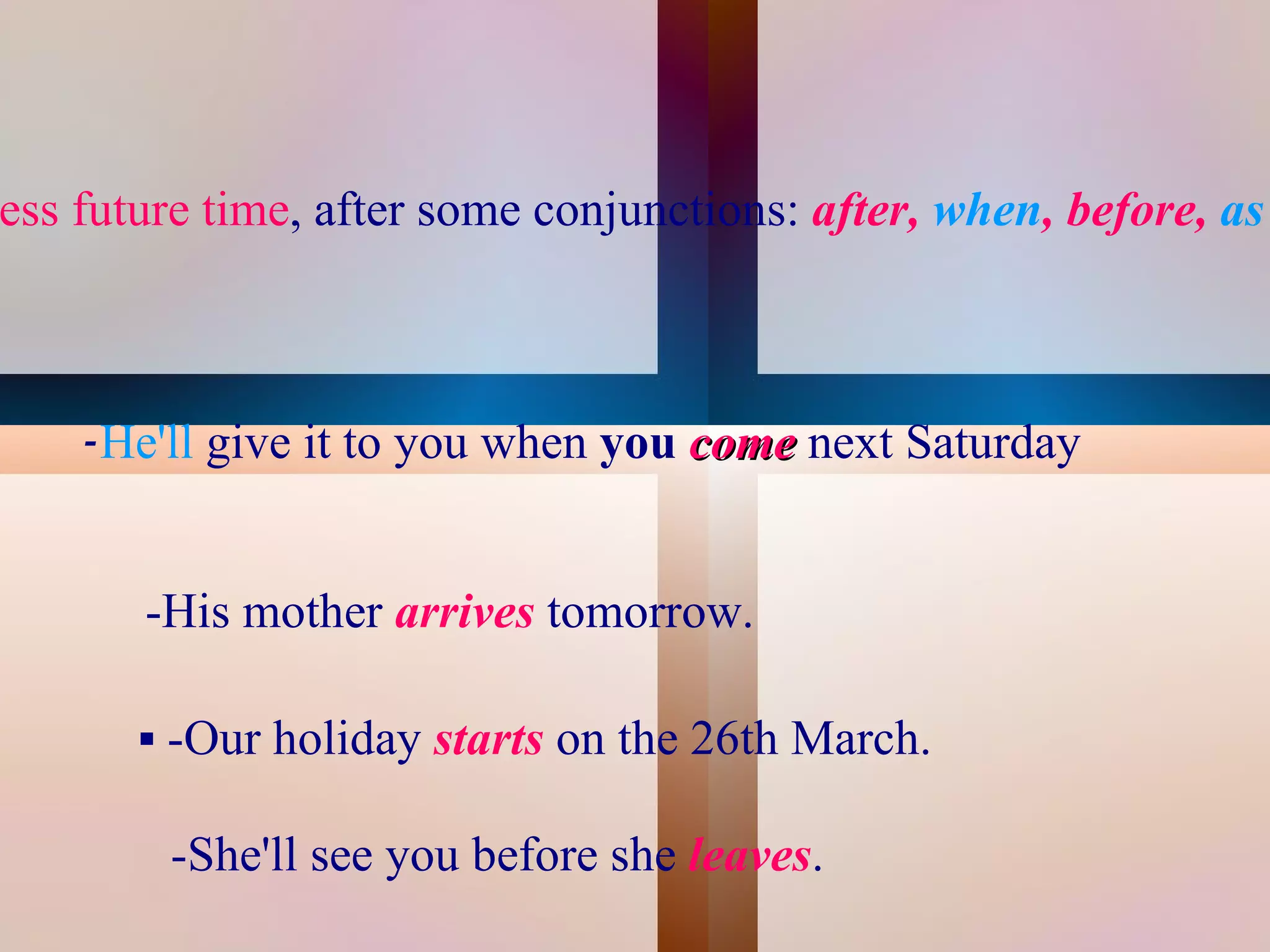
ess future time, after some conjunctions: after, when, before, as


       -He'll give it to you when you come next Saturday


          -His mother arrives tomorrow.

          -Our holiday starts on the 26th March.

           -She'll see you before she leaves.
                                    
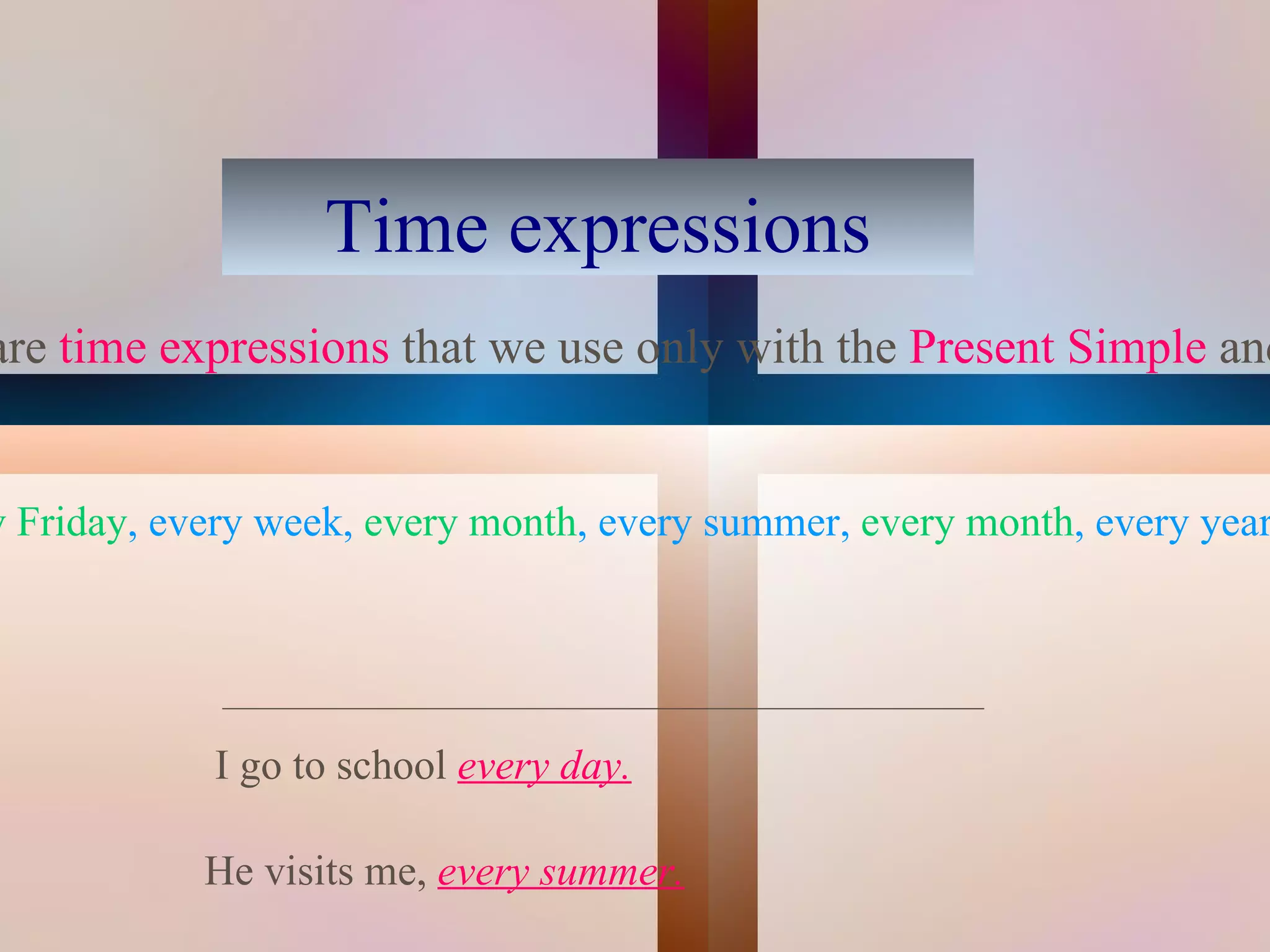
Time expressions
are time expressions that we use only with the Present Simple and


y Friday, every week, every month, every summer, every month, every year


            I go to school every day.
                                         
            He visits me, every summer.
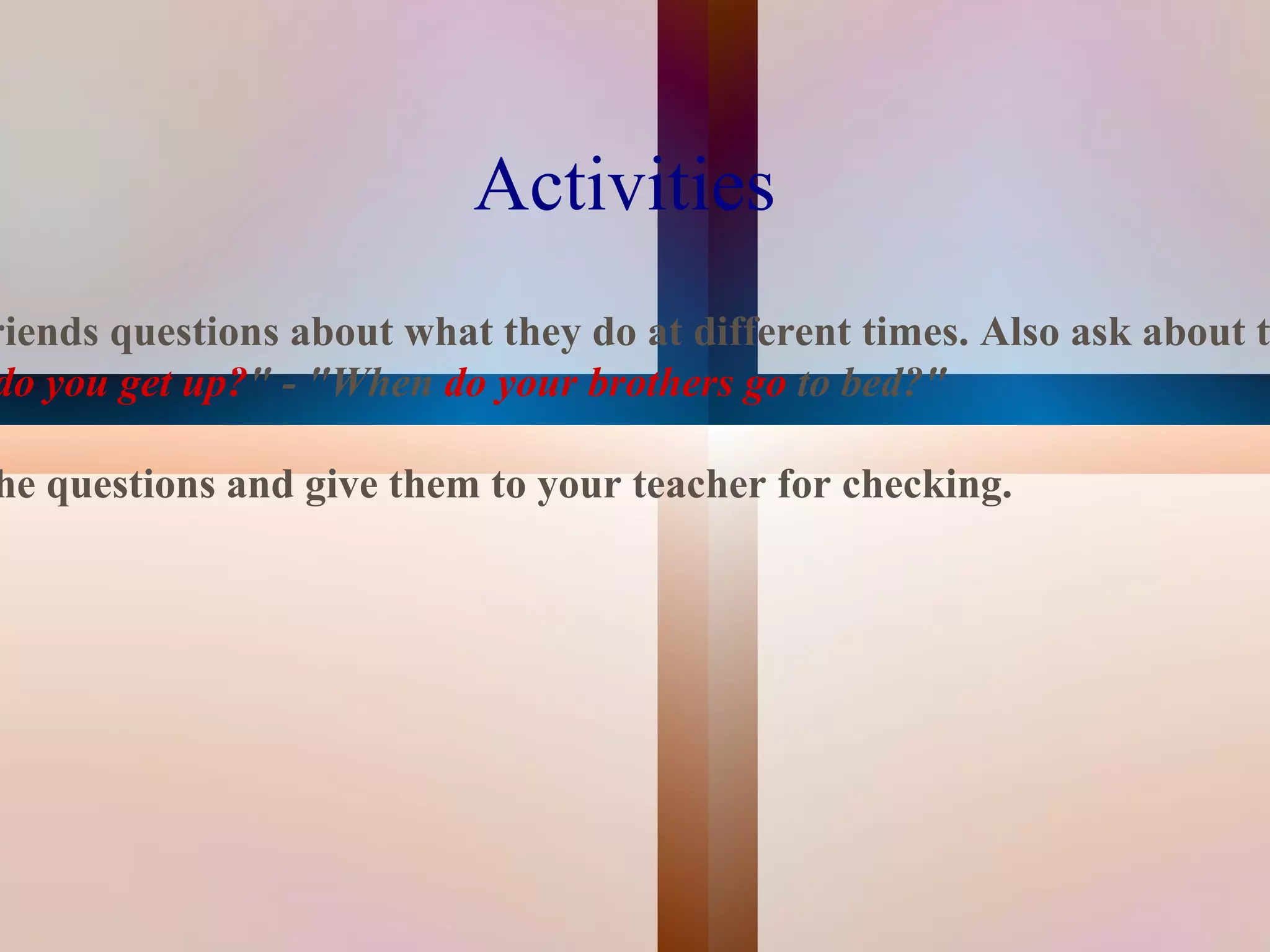
Activities
riends questions about what they do at different times. Also ask about t
do you get up?" - "When do your brothers go to bed?"

he questions and give them to your teacher for checking.


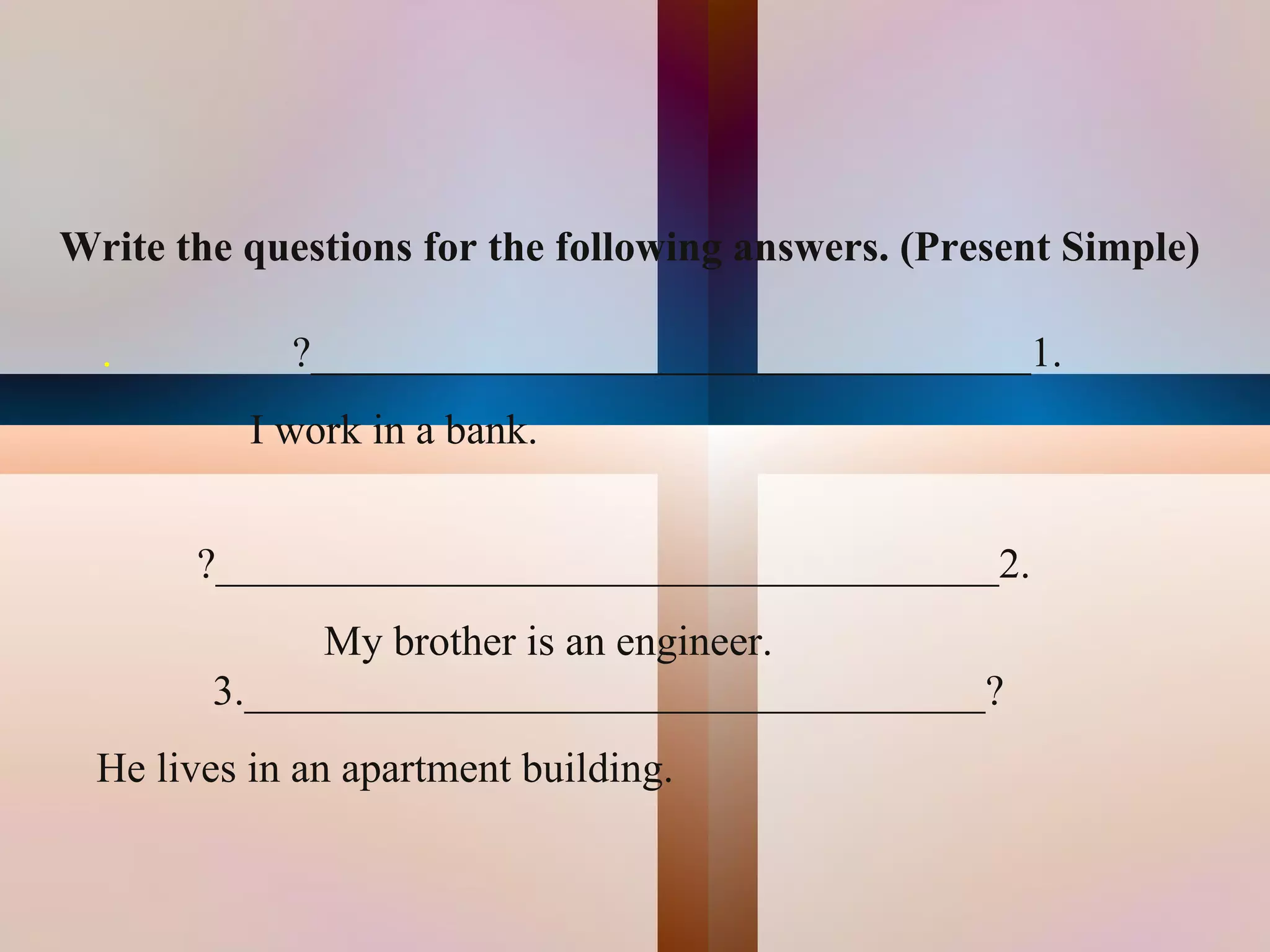
Write the questions for the following answers. (Present Simple)

    .          ?__________________________________1.
             I work in a bank.


         ?_____________________________________2.
                My brother is an engineer.
          3.___________________________________?
    He lives in an apartment building.
                                    
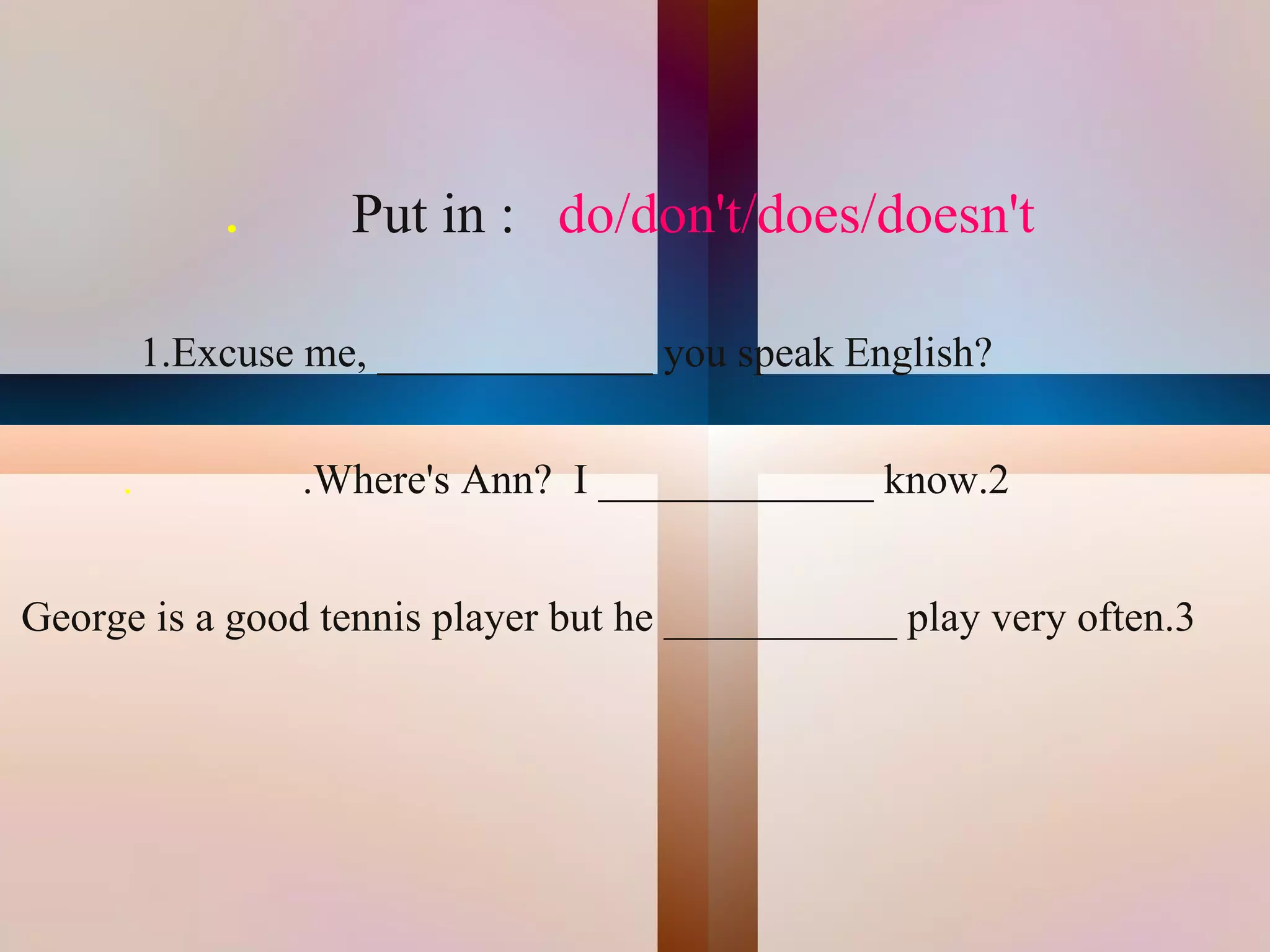
.      Put in : do/don't/does/doesn't

          1.Excuse me, _____________ you speak English?


      .           .Where's Ann? I _____________ know.2


George is a good tennis player but he ___________ play very often.3


The present simple

  • 1.
    The Present Simple By: English teacher: B.tungalagtuya    
  • 2.
    The Usages ofthe Present Simple USE 1: Repeated Actions    USE 2: Facts or Generalizations        
  • 3.
    Use 1 USE 1: Repeated Actions    n be a habit, a hobby, a daily event, a scheduled event or somethi    
  • 4.
    Examples Subject + (Verb) + (s, es) + Object - play I tennis. - She not does play tennis.   leaves - The train every morning at 8 am.   does not   - The train leave at 9am.
  • 5.
    USE 2: Factsor Generalizations       now, and will be true in the future. It is not important if the speak    
  • 6.
    Examples Subject + (Verb) + (s, es) + Object like - Cats milk. . - Birds not do like milk. are - Windows made of glass.   - Windows not are   made of wood. 
  • 7.
    Grammatical View Present Simple, third person singular Note: he, she, it A: in the third person singular the verb, always ends in : s he want s she need s    
  • 8.
    B. Add es to verbs ending in: x sh ss he fix es it push es he pass es ch o she catch es He go es    
  • 9.
    C: Verbs endinginy y ;the third person changes the to ies fly flies cry cr ies Exception: If there is a vowel before they : play plays pray prays    
  • 10.
    stion forms useDOES (=the third person of the auxiliary'DO') + want? He does not want.    
  • 11.
    Examples: . 1.Third person singular with s or es a. He goes to school every morning. b. She understands English. c. It mixes the sand and the water. d. He tries very hard. e. She enjoys playing the piano.    
  • 12.
    2. Present Simple,form: Example: to think, present simple Affirmative Interrogative Negative think I ? Do I think . I do not think think You ? Do you think . You don't think (s)hinkt he, she, it ? Does he, she, it think . He, she, it doesn't think think we ? Do we think . We don't think think you ? Do you think . You don't think    
  • 13.
    The present simpleis used: bits, general truths, repeated actions or unchanging situations, em (habit); I work in London (unchanging situation); London is a large city (ge . -He drinks tea at breakfast -She only eats fish.   -They watch television regularly  
  • 14.
    B. to giveinstructions or directions:  You walk for two hundred metres, then you turn left.  -You take the No.6 bus to Watney and then the No.10 to Bedfo -Open the packet and pour the contents into hot water.    
  • 15.
    c. to expressfixed arrangements, present or future: -Your exam starts at 09:00. -The bell rings at 8:00. The bus arrives at 7:00    
  • 16.
    ess future time,after some conjunctions: after, when, before, as -He'll give it to you when you come next Saturday -His mother arrives tomorrow.  -Our holiday starts on the 26th March.   -She'll see you before she leaves.  
  • 17.
    Time expressions are timeexpressions that we use only with the Present Simple and y Friday, every week, every month, every summer, every month, every year I go to school every day.     He visits me, every summer.
  • 18.
    Activities riends questions aboutwhat they do at different times. Also ask about t do you get up?" - "When do your brothers go to bed?" he questions and give them to your teacher for checking.    
  • 19.
    Write the questionsfor the following answers. (Present Simple) . ?__________________________________1. I work in a bank. ?_____________________________________2. My brother is an engineer. 3.___________________________________? He lives in an apartment building.    
  • 20.
    . Put in : do/don't/does/doesn't 1.Excuse me, _____________ you speak English? . .Where's Ann? I _____________ know.2 George is a good tennis player but he ___________ play very often.3    
  • 21.