
PRESENT
SIMPLE
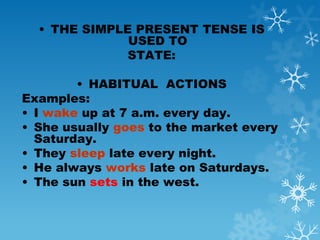
• THE SIMPLE PRESENT TENSE IS
USED TO
STATE:
• HABITUAL ACTIONS
Examples:
• I wake up at 7 a.m. every day.
• She usually goes to the market every
Saturday.
• They sleep late every night.
• He always works late on Saturdays.
• The sun sets in the west.
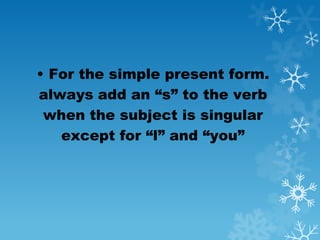
• For the simple present form.
always add an “s” to the verb
when the subject is singular
except for “l” and “you”
• To show that an action is done often
or everyday
Example
• I go to school every day.
• You drink milk every day.
• We have six meals a day.
• They take their baths in the
mornings and evenings.
• He sleeps at ten every night.
• She drinks water every day.
• Ali eats fish every day.
• Boon Seng takes a bath every
morning.
• Have and has are used to show
possessions, in the simple
present tense:
• has is used with a singular
subject
Examples:
He
She
Mary
has
a hobby.
Everyone
Each of them
• have is used with a plural subject
except for “ I’
and “you”
I
You
We
They
Peter and Jane
All of them

have

a hobby.
Fill in the blanks with the correct words
from the box.
walk
like
likes
is
has
have
am
wants
write
comes
want
are
1. I ………. to school every day.
2. Robin ….. a hamster.
3. Shanti ….. to wear saris.
4. I ….. to read a storybook.
5. Do you….. to dance.
6. Sing Fatt ….. to call his friend.
7. My father ….. home from work at 6.00
p.m.
Underline the correct words.
1. Halim ( cycles , cycle ) to his tuition
class every day.
2. Leopards ( hunt, hunts) smaller animals
for food.
3. Thunder always ( follow , follows )
lightning.
4. Please ( write, writes ) your name on
the top right-hand corner of the answer
sheet.
5. Jaspreet ( water, waters ) all the plants
every evening.
6. Electricians( use, uses ) pliers to cut or
bend
wires.
7. Padi ( grow, grows ) well in Kedah
Darul Aman.
PRESENT
CONTINUOUS
(BE +VERB+ING)
• Positive Form

I am waiting for the bus.
I must go back to the office,
we are working on a project.
 I am playing tennis with Jim
tomorrow.


• Negative Form

I am not waiting for the bus.
We are not working on the
project.
 He is not playing tennis with
Jim tomorrow


• Questions

Are you waiting for the bus?
Are they working on the
project?
 Is he playing tennis with Jim
tomorrow?


• We use the present Continuous
to say we are in the middle of
an action (It’s going on at that
very moment.)

I am waiting for the bus at
the moment. (I’m at the station



now.)
Present simple

Present simple

  • 1.
  • 2.
    • THE SIMPLEPRESENT TENSE IS USED TO STATE: • HABITUAL ACTIONS Examples: • I wake up at 7 a.m. every day. • She usually goes to the market every Saturday. • They sleep late every night. • He always works late on Saturdays. • The sun sets in the west.
  • 3.
    • For thesimple present form. always add an “s” to the verb when the subject is singular except for “l” and “you”
  • 4.
    • To showthat an action is done often or everyday Example • I go to school every day. • You drink milk every day. • We have six meals a day. • They take their baths in the mornings and evenings. • He sleeps at ten every night. • She drinks water every day. • Ali eats fish every day. • Boon Seng takes a bath every morning.
  • 5.
    • Have andhas are used to show possessions, in the simple present tense: • has is used with a singular subject Examples: He She Mary has a hobby. Everyone Each of them
  • 6.
    • have isused with a plural subject except for “ I’ and “you” I You We They Peter and Jane All of them have a hobby.
  • 7.
    Fill in theblanks with the correct words from the box. walk like likes is has have am wants write comes want are 1. I ………. to school every day. 2. Robin ….. a hamster. 3. Shanti ….. to wear saris. 4. I ….. to read a storybook. 5. Do you….. to dance. 6. Sing Fatt ….. to call his friend. 7. My father ….. home from work at 6.00 p.m.
  • 8.
    Underline the correctwords. 1. Halim ( cycles , cycle ) to his tuition class every day. 2. Leopards ( hunt, hunts) smaller animals for food. 3. Thunder always ( follow , follows ) lightning. 4. Please ( write, writes ) your name on the top right-hand corner of the answer sheet. 5. Jaspreet ( water, waters ) all the plants every evening. 6. Electricians( use, uses ) pliers to cut or bend wires. 7. Padi ( grow, grows ) well in Kedah Darul Aman.
  • 9.
  • 10.
    (BE +VERB+ING) • PositiveForm I am waiting for the bus. I must go back to the office, we are working on a project.  I am playing tennis with Jim tomorrow.  
  • 11.
    • Negative Form Iam not waiting for the bus. We are not working on the project.  He is not playing tennis with Jim tomorrow  
  • 12.
    • Questions Are youwaiting for the bus? Are they working on the project?  Is he playing tennis with Jim tomorrow?  
  • 13.
    • We usethe present Continuous to say we are in the middle of an action (It’s going on at that very moment.) I am waiting for the bus at the moment. (I’m at the station  now.)