Communicative Grammar II


Mgs. Paola A. Cabrera Solano


                               1
THE SIMPLE PRESENT
It is used to tell about things
 that happen again and again
 (habits, regular occurrences,
 customs, and routines)

Facts, non – action verbs, in
 affirmative   and   negative
 statements.
THE SIMPLE PRESENT
It is used to tell about things
 that happen again and again
 (habits, regular occurrences,
 customs, and routines)

Facts, non – action verbs, in
 affirmative   and   negative
 statements.
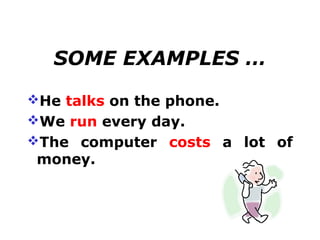
SOME EXAMPLES …

He talks on the phone.
We run every day.
The computer costs a lot of
 money.
USES
Facts
Affirmative statements
Negative statements
Third person singular
The verbs have, do, and go are
 not regular.
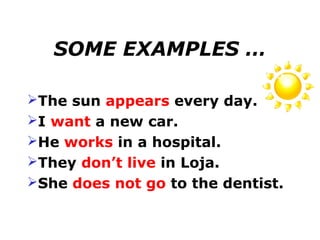
SOME EXAMPLES …

The sun appears every day.
I want a new car.
He works in a hospital.
They don’t live in Loja.
She does not go to the dentist.
YES / NO QUESTIONS AND
        ANSWERS
We use do or does before the
 subject. Use the base form of
 the verb after the subject.

Do not use do or does for
 Yes/No questions with be.
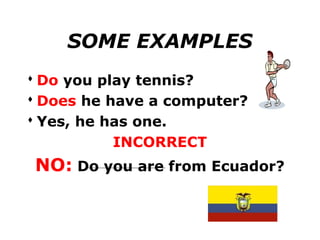
SOME EXAMPLES
 Do you play tennis?
 Does he have a computer?
 Yes, he has one.
           INCORRECT
 NO: Do you are from Ecuador?
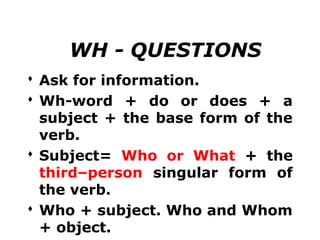
WH - QUESTIONS
 Ask for information.
 Wh-word + do or does + a
  subject + the base form of the
  verb.
 Subject= Who or What + the
  third–person singular form of
  the verb.
 Who + subject. Who and Whom
  + object.
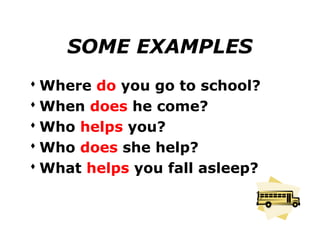
SOME EXAMPLES
 Where do you go to school?
 When does he come?
 Who helps you?
 Who does she help?
 What helps you fall asleep?
THANK YOU


 GOOD LUCK


             11

Simple present

  • 1.
    Communicative Grammar II Mgs.Paola A. Cabrera Solano 1
  • 2.
    THE SIMPLE PRESENT Itis used to tell about things that happen again and again (habits, regular occurrences, customs, and routines) Facts, non – action verbs, in affirmative and negative statements.
  • 3.
    THE SIMPLE PRESENT Itis used to tell about things that happen again and again (habits, regular occurrences, customs, and routines) Facts, non – action verbs, in affirmative and negative statements.
  • 4.
    SOME EXAMPLES … Hetalks on the phone. We run every day. The computer costs a lot of money.
  • 5.
    USES Facts Affirmative statements Negative statements Thirdperson singular The verbs have, do, and go are not regular.
  • 6.
    SOME EXAMPLES … Thesun appears every day. I want a new car. He works in a hospital. They don’t live in Loja. She does not go to the dentist.
  • 7.
    YES / NOQUESTIONS AND ANSWERS We use do or does before the subject. Use the base form of the verb after the subject. Do not use do or does for Yes/No questions with be.
  • 8.
    SOME EXAMPLES  Doyou play tennis?  Does he have a computer?  Yes, he has one. INCORRECT NO: Do you are from Ecuador?
  • 9.
    WH - QUESTIONS Ask for information.  Wh-word + do or does + a subject + the base form of the verb.  Subject= Who or What + the third–person singular form of the verb.  Who + subject. Who and Whom + object.
  • 10.
    SOME EXAMPLES  Wheredo you go to school?  When does he come?  Who helps you?  Who does she help?  What helps you fall asleep?
  • 11.