Silicone Elastomers 20121st Edition Ismithers
pdf download
https://ebookfinal.com/download/silicone-elastomers-2012-1st-
edition-ismithers/
Explore and download more ebooks or textbooks
at ebookfinal.com
2.
Here are somerecommended products for you. Click the link to
download, or explore more at ebookfinal
Silicone Elastomers 2011 1st Edition Ismithers
https://ebookfinal.com/download/silicone-elastomers-2011-1st-edition-
ismithers/
Silicone Elastomers 2009 third international Conference 7
8 October 2009 Hamburg Germany conference proceedings 1st
Edition Ismithers Rapra
https://ebookfinal.com/download/silicone-elastomers-2009-third-
international-conference-7-8-october-2009-hamburg-germany-conference-
proceedings-1st-edition-ismithers-rapra/
RubberChem 2010 1st Edition Ismithers
https://ebookfinal.com/download/rubberchem-2010-1st-edition-ismithers/
Castable Polyurethane Elastomers First Edition I.R.
Clemitson
https://ebookfinal.com/download/castable-polyurethane-elastomers-
first-edition-i-r-clemitson/
3.
Handbook of CondensationThermoplastic Elastomers Stoyko
Fakirov
https://ebookfinal.com/download/handbook-of-condensation-
thermoplastic-elastomers-stoyko-fakirov/
Handbook of Specialty Elastomers 1st Edition Klingender
Robert C. (Ed.)
https://ebookfinal.com/download/handbook-of-specialty-elastomers-1st-
edition-klingender-robert-c-ed/
High Performance Thermoplastics and Composites for Oil and
Gas Applications 2011 1st Edition Ismithers
https://ebookfinal.com/download/high-performance-thermoplastics-and-
composites-for-oil-and-gas-applications-2011-1st-edition-ismithers/
Tribology of Elastomers Volume 47 Tribology and Interface
Engineering 1st Edition Si-Wei Zhang
https://ebookfinal.com/download/tribology-of-elastomers-
volume-47-tribology-and-interface-engineering-1st-edition-si-wei-
zhang/
OECD Economic Surveys Turkey 2012 Edition 2012 Oecd
Organisation For Economic Co-Operation And Development
https://ebookfinal.com/download/oecd-economic-surveys-
turkey-2012-edition-2012-oecd-organisation-for-economic-co-operation-
and-development/
Silicone Elastomers 2012
Contents
Paper1 Winning against functional competition – the success story of silicones
Oliver Franssen & Heiko Bayerl, Momentive Performance Materials GmbH, Germany
SESSION 1: APPLICATION OF SILICONES
Paper 2 Application of highly transparent liquid silicone rubber in automotive headlamps
Marc Kaup, L-LAB Hella KGaA Hueck & Co, Germany
Paper 3 Fluorosilicone elastomers – innovations for automotive industry challenges
Dr Hans Peter Wolf, Dr P Beyer, F Magnan & B Cuocci, Dow Corning GmbH, Germany
Paper 4 LSR – closing the gap in the medical grade offering
Simone Marquardt & Joel Valencony, Dow Corning GmbH Healthcare, Germany
- unavailable at time of print
Paper 5 Advantages of silicones and future challenges in the world of T&D
Jens Lambrecht & Michael Bünnig, Wacker Chemie AG, Germany
Paper 6 Silicones for technical textile applications
Johann Müller & Dr Martin Bortenschlager, Wacker Chemie AG, Germany
Paper 7 Silicones for fabric strain and soft pressure sensors
Dr Yangyong Wang & Dr Guangfeng Wang, AdvanPro Limited, Hong Kong
SESSION 2: PROCESSING OF SILICONES
Paper 8 Continuous compounding shown on the example of silicone sealants
Johannes Donner & T Stirner , Coperion GmbH, Germany
Paper 9 Procedural implementation of superhydrophobic LSR surfaces
Clemens Behmenburg, Christian Hopmann, Jan Peter Dering & Maximilian Schöngart,
Institute of Plastics Processing (IKV) at RWTH Aachen University, Germany
10.
Paper 10 Siliconemixing concepts
Dr Ubaldo Colombo, COLMEC SpA, Italy
Paper 11 Extrusion equipment
Christian Köhler, Rubicon, Germany - unavailable at time of print
Paper 12 Tailor-made machines for LSR and HTV moulding
Leopold Praher, Engel Austria GmbH, Austria
Paper 13 Advanced production methods for medium and large-sized silicone articles
Harald Schmid, Klöckner DESMA Elastomertechnik GmbH, Germany
Paper 14 Processing of LSRs for insulators with silicone vacuum treatment
Michel Gehrig, Hübers Verfahrenstechnik Maschinenbau GmbH, Germany
Paper 15 Measurements to produce economic high quality parts from LSR
Kurt Manigatter, Elmet Elastomere Produktions- und Dienstleistungs GmbH, Germany
SESSION 3: MODIFICATION OF SILICONES
Paper 16 Protection and marking – a new additive for silicone caoutchoucs
Rüdiger Wissemborski, Hendrik Wermter, David Kummet & Rolf Klein, Chemische Fabrik
Budenheim, Germany
Paper 17 Statil ™ an award winning antimicrobial platform
Dr Burkhard Ledig, Momentive Performance Materials GmbH, Germany
Paper 18 Mineral flame retardants for silicone elastomers – an option with many features
Dr Annika Luks & Dr Oliver Töpfer, Nabaltec AG, Germany
Paper 19 Effect of UV/ozone irradiation on the surface properties of thermoplastic silicone
elastomer films and fibers
Emel Yilgor , Iskender Yilgor,Sevilay Bilgin & Mehmet Isik, Koc University, Turkey
11.
Silicone Elastomers 201227-28 March 2012 – Berlin, Germany
Page 1 of 8 pages Paper 1 - Franssen
WINNING AGAINST FUNCTIONAL COMPETITION –
THE SUCCESS-STORY OF SILICONES
Oliver Franssen, Global Marketing Director Elastomers Transportation
Heiko Bayerl, Marketing Manager Elastomers Automotive Europe
Momentive Performance Materials GmbH, 51368 Leverkusen, Germany
oliver.franssen@momentive.com
BIOGRAPHICAL NOTE
Oliver Franssen studied Mechanical Engineering and Plastics Technology at the
University of Technology RWTH Aachen / IKV and received his engineering degree
in 1990. He started his professional career 1990 at Dätwyler / Switzerland as
project leader for rubber precision parts for the Automotive Industry. In 1996, Oliver
joined DuPont-Dow Elastomers as Market Development Manager for Automotive.
Between 2001 and 2003 he was the commercial director at Omnexus in Europe. In
2004 he joined Momentive Performance Materials (formerly GE Bayer Silicones) in
Automotive Marketing for Elastomers. Since 2008 he is the Global Marketing
Director of this segment.
ABSTRACT
In the global elastomers market, Silicone Elastomers continue to be a niche with approx. 1.5% of the global
demand in rubber. However Silicones grow faster than many industries and economies. Due to megatrends
including aging population for healthcare applications, environmental awareness in automotive and energy or
consumer perception and legislation for example in consumer good applications.
While silicones have an almost universal set of physical properties for rubber applications, based on material
cost considerations they are often not immediately selected - instead of judging by system costs. Successful
Silicone Elastomer applications can be achieved, when engineers understand the Silicone product features
and creatively apply their benefits for new applications and designs.
This paper will help to position Silicone Elastomers vs. functionally competing materials including rubber
materials like FKM, ACM, EPDM or natural rubber and metal in a spring or thermoplastics and glass in
optical applications. Examples show how specific properties of Silicone Elastomers lead to successful new
applications winning against functional competition.
Overview on Elastomers
In comparison to the global rubber market, Silicone Elastomers continues to play a niche role and represent
only approx. 1.5% of the global elastomers market. [1,2] Due to their -Si-O- backbone, Silicones are
considered as an inorganic elastomers as opposed to all other synthetic elastomers and natural rubber
which are based on a –C-C- backbone. This difference is root-cause reason for the various single
advantages and disadvantages of silicone elastomers against their functional competitors.
25.8 MM
tons in
2011
12.
27-28 March 2012– Berlin, Germany Silicone Elastomers 2012
Paper 1 - Franssen Page 2 of 8 pages
Natural Rubber
Synthetic Rubber
Silicone
Elastomers
Figure 1 Global rubber market 2011
Figure 2: the structure of silicones
Positioning
The ASTM D 2000 was created to make elastomeric materials easier to specify and to standardize for a
variety of properties and specifications. Plotting typical performance of standard elastomers in the defined
classes on heat-stability and oil-resistance, the position of silicones vs. organic elastomers is visualized. The
oil-swell test differentiates the elastomers more or less by polarity (and their capability to handle unipolar
Figure 3: Graphical position according to ASTM D 2000
13.
Silicone Elastomers 201227-28 March 2012 – Berlin, Germany
Page 3 of 8 pages Paper 1 - Franssen
media such as oils, grease or fuel). The heat-resistant position is often a consequence of double-bonds (to
the low end) or strong bonding energies (on the high end).
A universal elastomer doesn’t exist. Ideal properties like
The dynamic flexibility and strength of NR
The barrier properties of BR or FKM
The heat-stability and acid resistance of FKM
The low temperature performance and stable physical properties of a silicone elastomer
can’t be realized in one rubber product. However certain design changes and optimization on critical
properties of an application often opens a window for material alternatives. Silicone Elastomers are not the
optimum material selection for all individual needs. When many different properties are important at the
same time and in the same product, there is a good chance that silicone elastomer is a suitable choice for
the application.
Markets for Silicone applications
The main market areas for Silicone Elastomers are
Transportation (Automotive, Aviation and Aerospace, Railway and Marine)
Energy (High Voltage Insulation, Wire & Cable)
Consumer Goods (E&E, Baby-care, Kitchenware and other)
Healthcare
Within those market segments a variety of specialized formulations have been developed which often add
value vs. a standard elastomers. Examples include
Self-bonding formulations with primer-less adhesion to many plastic and metal substrates
Self-lubricating LSR which exude a bleeding oil to ease assembly
Antimicrobial Silicone Elastomers for Healthcare applications
Conductive compounds for Energy-applications
High transparent Silicone Rubber for optical applications
Winning against functional competition
The decision drivers for new rubber material can be grouped under these headlines:
Integration of functionality
Example: A new part design is based on 2-component molding. It safes the manufacturing and
assembly of seals or dampening elements as well as assembly mistakes. Silicone LSR is available
in self-bonding formulations and is compatible in cycle time to molding of many engineering
Thermoplastics. In many cases LSR can outperform lower cost organic elastomer materials.
Specification limits
Example: Globalization drives part and system specifications to wider application windows. In the
transportation sector, functionality has to be maintained at very low and relatively high temperatures
(from starting the engine at -40°C to full speed performance on German motorway). Here, the
engineers need elastomers which are flexible far below freezing point and have a good heat
resistance for under the hood applications, preferably with little change of mechanical properties.
Silicone elastomers are the only available products for this range
Lower System costs
Example: Classical rubber manufacturing is consuming a lot of machine and labor time. The amount
of raw material is often much smaller than the costs for conversion, de-flashing, final inspection plus
added costs for scrap (of final parts plus the cured material of the runner-systems). Cycle times in
the minute range make investment and payoff of decent automation equipment a financial challenge.
The LSR- injection molding process enables full automated, flash-less, waste-less molding with short
cycle times. For those processes, material costs are the biggest share of a part calculation. For high
volume part-series LSR can often outperform organic elastomers
14.
27-28 March 2012– Berlin, Germany Silicone Elastomers 2012
Paper 1 - Franssen Page 4 of 8 pages
New Technologies
Example: Lighting is one of the global drivers in innovation. Energy saving, CO2-reduction and
safety accelerate the transformation to LED light. The share of LED in lighting is forecasted to grow
from 15% in 2010 to 45% in 2015, substituting traditional lighting like the historical Edison lamp. [5]
The light power of LEDs are developing rapidly, in combination with emission of strong blue light and
increasing temperatures. High transparent Silicones combine resistance against high temperatures
and against UV-light at high optical transparency.
For a winning development with Silicone Elastomers, a pure material replacement calculation from an
existing drawing / application is often not enough. In Silicone LSR, elastomer innovations allow redesigning
of parts and systems benefitting from values resulting from simple feature differences to individual organic
elastomers. Those include
Low viscosity enables very thin walls and long thin flow paths
Low hardness without plasticizers
Easy to color, even glass-clear products are available
Silicones mechanics are almost linear / similar to a Hooke-spring
Hydrophobicity
Excellent insulation properties
Those features enhance the number of functional competitors (and application potentials) significantly and
Silicone elastomers therefore find usage in
insulators for high voltage, replacing porcelain
replacements of metal springs
replacements of transparent plastics and glass in optical applications
as illustrated in following examples.
Ultra-transparent LSR vs Glass and Plastics
Dispensable, high transparent Silicones replaced engineering thermoplastic resins in packaging of the
semiconductors in LEDs for some years. The higher temperatures and the hard blue light radiation of high
efficient, new generation LEDs requires UV-light resistance and low yellowing for the optical packaging
material. These properties combined with improved crack resistance are provided by silicone based
packaging materials which are basically used in LED packaging nowadays.
Figure 4: plastics and LSR 7000 after heat aging 6480 h 150°C [6]
15.
Silicone Elastomers 201227-28 March 2012 – Berlin, Germany
Page 5 of 8 pages Paper 1 - Franssen
Innovation in lighting design and the success of high efficient LEDs are
driving the research for new materials which can be processed by
injection molding, enabling high complex design at high production
volumes. The new LSR 7000 family by Momentive provides high optical
transparency, excellent UV- and blue- light resistance. The new ultra-
transparent LSR is a good candidate to replace transparent plastics like
PC and PMMA in lighting applications which require high temperature
resistance and flexibility in design.
An obvious next step is to use high transparent LSR for secondary
optical lenses which can be directly assembled to the LED. The light of
a semiconductor is spread in a very simple way by the packaging
material, e.g. a globe-top. In order to form and to guide the light
secondary lenses and light guides are needed. So far such optics are
mainly made from PC or PMMA. In order to protect
these materials against the high temperature of a high
power LED, those optical elements can’t be
assembled directly onto the light source - a 1-2 mm
gap is necessary to reduce the junction temperature.
Resulting reflections from plastic to air and from air to
plastic reduce the efficiency of such optical
components. Secondary lenses and light guides
made out of high transparent, temperature resistant
LSRs can be assembled directly to the LED and
higher efficiency can be achieved. Additionally LSR
allows a higher freedom of design than PC and
PMMA.
LSR vs NR in Babycare
When LSR was brought to the market some 30 years ago, baby bottle nipples were one of the first
application, the industry immediately started to work on. LSR brought a transparent appearance, was easy to
injection-mold at high yield and neutral in odor and taste. At the time the market was dominated by pacifiers
and bottle nipples made from natural rubber latices. Studies show that LSRs not only fulfill necessary food
compliancy, their allergene potential is far less than the natural rubber product. LSR is UV-resistant and will
survive cooking water without significant change of appearance or physical properties. The decision to
choose LSR in baby-care at the end
was a decision from many mothers
and even more babies, which
preferred the silicone elastomer vs.
natural rubber. The baby-care
market today is amongst the biggest
LSR application volumes globally.
Also in this mature segment the
elastomer innovation continues to
fulfill expectations for the next
generation of products e.g. with
higher tear resistance. A new
development is for example
Momentive’s LSR 2645 with
improved hot tear resistance
according to EN 1400-2.
Figure 5: Multifunctional Lens
based on LSR 7070 [4]
Figure 7: LSR 2645 in comparison [6]
Figure 6: Transparency over wavelength of LSR
7070 [6]
16.
27-28 March 2012– Berlin, Germany Silicone Elastomers 2012
Paper 1 - Franssen Page 6 of 8 pages
Silicone vs Porcelain in High Voltage Applications
Silicone Elastomers in High Voltage Applications came up in the late 60s when experts tried to find a lighter
and maintenance free solution to replace glass and porcelain in composite insulators like hollow cores.
Key expectations for this application are:
Low weight - high mechanical strength
Easy Handling
Pollution performance - low maintenance costs
Flexibility / Explosion Safety (seismic behavior)
A functional elastomer competitor to Silicones is EPDM with as good weatherability and insulation properties.
Silicone insulators benefit from standard silicone features, the most important are:
Flexibility
Low density
Hydrophobicity
Low Viscosity
Hydrophobicity (which prevents contaminations and flashovers on the insulator surface) and low viscosity
(enables casting of big shapes) are key properties differentiating Silicones vs. EPDM. Silicone also has the
ability to transfer it’s water repellent properties into contamination layers that might be built up in heavily
polluted environments. A good example here is Momentive’s Silopren Electro 242-0, that additionally
features excellent tracking and erosion resistance (1A 4.5 kV according to IEC 60587). Looking at
manufacturing costs, Silicone leads to the most expensive part. However in system costs which include
assembly, long-term maintenance and disassembly, Silicone insulators are the most cost efficient solution.
[3] One of the main reasons is the need for regular cleaning of conventional insulators including those made
with EPDM which is unnecessary with the hydrophobic Silicones.
Heat-resistant LSR against ACM and FKM in charge-air-cooler gaskets
The demand for more efficient vehicles continues to drive the share of turbo-charged engines. Since
turbochargers are running in a loss-oil lubrication with engine oil, their compressed hot charge air contains
oil. The compressed air passes a through a cooler to increase the density. The charge-air-cooler-gasket is
normally a big square seal. In manufacturing, the necessary flow length of the thin shape can cause
problems in mold and process-design with organic elastomers being high in viscosity. Materials had to
combine necessary oil-resistance with high temperature performance and acceptable static low temperature
performance. Most specified materials have been FKM (expensive and problematic in low temperatures) and
ACM (better in low temperatures and cheaper, but limited in heat-resistance). HCR silicone compounds
Figure 9 Silicone Hollow Core Insulator
$/YR
Figure 8: Life cycle cost for insulators
17.
Silicone Elastomers 201227-28 March 2012 – Berlin, Germany
Page 7 of 8 pages Paper 1 - Franssen
came up (modified with mineral fillers to achieve lower oil swell), but also these compounds had same
potential scorch-problems in traditional rubber molding. In the early 2000s, a major OEM qualified LSR 2670
black from Momentive. The LSR features fit perfectly to the difficult to manufacture geometry, however LSR
has higher swell in oil than any of the mentioned functional competitors.
The very low viscosity of the shear-thinning LSR allows fast filling
The inhibition of LSR prevents scorch of the material
The platinum catalyzed addition cure makes full automation affordable
No material losses with automated a waste-less and trim-free molding system
Good high temperature resistance and compression set
LSR 2670 contributed to significant cost savings in this application and is in successful mass-production.
LSR against a metal spring - Silicone HCR against NR in engine mounts
Movement is creating
vibration and noise. Electrical
motors as well as combustion
engines need to be fixed and
in the same time decoupled.
The ideal material provides
constant rebound resilience
combined with good
mechanical properties along
the working temperature
range of the application.
Silicone Elastomers are
relatively constant in modulus
and spring properties from
very low temperatures –40°C and up to high temperatures above 150 °C. Thanks to such outstanding
properties LSR substituted thermoplastic TPE as the decoupling element in the fixing device of the electrical
cooling van under the hood. A special self-bonding LSR allows the 2K-injection molding of a thermoplastic
fixing device with chemically bonded dampening elements made out of silicone rubber to keep the device in
place to dampen the noise and vibration over a wide range of
temperature.
Another example is the substitution of NR by a special, low dampening
Silicone Rubber used in the engine mount of the combustion engine of a
power station. NR is destroyed at temperatures above 120 °C, high
efficient combustion engines have to be encapsulated for noise
reduction. As a consequence the temperatures around the engine are
increasing and new materials are required to replace NR as dampening
material. Engine mounts made out of Silicone Elastomer work
consistently at temperatures of 150 °C.
Outlook
The next successful application of Silicone replacing a functional
competitor requires bright engineers and innovative raw material suppliers teaming up with each other.
Unique Silicone formulations can add value in use above and beyond just higher processing efficiency. More
important are creative innovators who can think outside of the box and utilize necessary freedom of design to
function..
Figure 12: Dampening cage
for cooling fan motor
Figure 11: DMA LIM 8040 [6]
Figure 10´: Silicone Engine
Mounts
18.
27-28 March 2012– Berlin, Germany Silicone Elastomers 2012
Paper 1 - Franssen Page 8 of 8 pages
References
[1] Dr. Stephen Evans, IRSG, Presentation on China Rubber Conference, Mar 2011
[2] Momentive Market Estimates 2011
[3] EPRI, Transmission Line Reference Book, 115-138kV Compact Line Design, RP 260, pp:29.
[4] Foto by KIMW Lüdenscheid / Germany
[5] Philips Global Lighting Market Study
[6] Momentive Lab Data
DISCLAIMER: THE MATERIALS, PRODUCTS AND SERVICES OF MOMENTIVE PERFORMANCE MATERIALS INC., MOMENTIVE
PERFORMANCE MATERIALS USA INC., MOMENTIVE PERFORMANCE MATERIALS ASIA PACIFIC PTE. LTD., MOMENTIVE
PERFORMANCE MATERIALS WORLDWIDE INC., MOMENTIVE PERFORMANCE MATERIALS GmbH, THEIR SUBSIDIARIES AND
AFFILIATES DOING BUSINESS IN LOCAL JURISDICTIONS (collectively “SUPPLIERS”), ARE SOLD BY THE RESPECTIVE LEGAL
ENTITY OF THE SUPPLIER SUBJECT TO SUPPLIERS’ STANDARD CONDITIONS OF SALE, WHICH ARE INCLUDED IN THE
APPLICABLE DISTRIBUTOR OR OTHER SALES AGREEMENT, PRINTED ON THE BACK OF ORDER ACKNOWLEDGMENTS AND
INVOICES, AND AVAILABLE UPON REQUEST. ALTHOUGH ANY INFORMATION, RECOMMENDATIONS, OR ADVICE
CONTAINED HEREIN IS GIVEN IN GOOD FAITH, SUPPLIERS MAKE NO WARRANTY OR GUARANTEE, EXPRESS OR IMPLIED,
(i) THAT THE RESULTS DESCRIBED HEREIN WILL BE OBTAINED UNDER END-USE CONDITIONS, OR (ii) AS TO THE
EFFECTIVENESS OR SAFETY OF ANY DESIGN INCORPORATING SUPPLIERS’ PRODUCTS, MATERIALS, SERVICES,
RECOMMENDATIONS OR ADVICE. AFOREMENTIONED EXCLUSIONS OR LIMITATION OF LIABILITY ARE NOT APPLICABLE TO
THE EXTENT THAT THE END-USE CONDITIONS AND/OR INCORPORATION CONDITIONS CORRESPOND TO THE
RECOMMENDED CONDITIONS OF USE AND/OR OF INCORPORATION AS DESCRIBED BY SUPPLIER IN ITS PRODUCT DATA
SHEET AND/OR PRODUCT SPECIFICATIONS. EXCEPT AS PROVIDED IN SUPPLIERS’ STANDARD CONDITIONS OF SALE,
SUPPLIERS AND THEIR REPRESENTATIVES SHALL IN NO EVENT BE RESPONSIBLE FOR ANY LOSS RESULTING FROM ANY
USE OF ITS MATERIALS, PRODUCTS OR SERVICES DESCRIBED HEREIN.
Each user bears full responsibility for making its own determination as to the suitability of Suppliers’ materials, services,
recommendations, or advice for its own particular use. Each user must identify and perform all tests and analyses necessary to assure
that its finished parts incorporating Suppliers’ products, materials, or services will be safe and suitable for use under end-use conditions.
Nothing in this or any other document, nor any oral recommendation or advice, shall be deemed to alter, vary, supersede, or waive any
provision of Suppliers’ Standard Conditions of Sale or this Disclaimer, unless any such modification is specifically agreed to in a writing
signed by Suppliers. No statement contained herein concerning a possible or suggested use of any material, product, service or design
is intended, or should be construed, to grant any license under any patent or other intellectual property right of Suppliers or any of its
subsidiaries or affiliates covering such use or design, or as a recommendation for the use of such material, product, service or design in
the infringement of any patent or other intellectual property right.
19.
Silicone Elastomers 201227-28 March 2012 – Berlin, Germany
Page 1 of 6 pages Paper 2 - Kaup
APPLICATION OF HIGHLY TRANSPARENT LIQUID SILICONE
RUBBER IN AUTOMOTIVE HEADLAMPS
Marc Kaup
L-LAB / Hella KGaA Hueck & Co.
Rixbecker Straße 75, 59552 Lippstadt, Germany
Tel.: +49 (0) 2941 38 31267, Fax: +49 (0) 2941 38 47 31267, e-mail: Marc.Kaup@L-LAB.de
BIOGRAPHICAL NOTE
Marc Kaup studied mechanical engineering with focus on polymer and process engineering
at the University of Paderborn and already wrote his thesis (diploma) in the L-LAB, short for
“light laboratory”. The L-LAB is a research institute concerned with automotive lighting and
mechatronics that is supported by the University of Paderborn and Hella KGaA in a Public
Private Partnership. Since January 2011 Kaup is employee of Hella KGaA Hueck & Co. and
works in the L-LAB with the aim of doing a doctor's degree. Kaup evaluates adaptive
headlight distributions and checks e.g. the potential usage of flexible lens systems,
consisting of highly transparent liquid silicone rubber (LSR).
ABSTRACT
Dynamic light distributions, adjusting adaptively and automatically to different driving and lighting conditions,
are already state of the art. One way to implement variable light distributions in one system is a projection
module with a shaped cylinder. This cylinder, rotating around its longitudinal axis, has different outlines on its
lateral surface. The cylinder is located in the pathway of rays between the module’s reflector and its lens.
Thus, it uses a subtractive way to implement different light distributions. In contrast, future cars will feature
adaptive and active light functions realized by activating additional light sources in LED matrix headlamps.
To implement variable light functions such as glare-free high beam, marking light or bending light, in LED
matrix headlamps the luminous flux emitted is being split up into discrete solid angles. This way, the
illumination of the motor vehicle’s foreground is not forced into fixed patterns but can be adjusted freely to fit
the demands of the particular driving situation. So-called primary optics, directly put onto the LED-chip, are
being used to prevent the Lambert characteristic of the light-emitting diodes in a close matrix structure.
This paper should prove LED matrix systems do not only enhance the possibilities with regards to light
distribution and appearance of headlamps. They also demand the application of “new” materials and
concepts. Among those, liquid silicone rubber (LSR) stands out for being resistant against high
temperatures, violet and ultraviolet radiation while at the same time providing excellent transmission
characteristics. When used as light guidance elements LSRs can directly be exposed to white LEDs.
Compared to glass, transparent LSRs offer further technical advantages, especially for industrial mass
production.
On top of the afore mentioned advantages of LSRs compared to glass and thermoplastic polymers, the
flexibility of the elastomer can be used to control optical characteristics of secondary optics in a headlamp
mechanically. Light distributions could be controlled by flexible lens systems. The lens in the human eye
serves as a natural prototype, changing its focal length by contracting a circular muscle. An actuator system
similar to the human eye could therefore contribute to the realization of an accommodating headlamp.
Key words: automotive headlamp, light functions, adaptive light distributions, LED, primary optics, secondary
optics, highly transparent liquid silicone rubber (LSR), light guide, flexible lenses.
20.
27-28 March 2012– Berlin, Germany Silicone Elastomers 2012
Paper 2 - Kaup Page 2 of 6 pages
INTRODUCTION
The development of automotive headlamps was affected by important enhancements of technologies,
particularly with regard on the last decade. There were different directions of development since the
beginning of the century. Functionalities like AFS (Adaptive Front-lighting System) were integrated.
Afterwards with the usage of more and more sensor technology, e.g. cameras, it was possible to implement
high beam assistant, adaptive and vertical cut-off-lines.
The implementation of AFS based on the discussions of the EUREKA Workgroup 1403 was divided in two
steps. First, 2003 bend lighting functionalities were integrated in the existing regulations and separated from
overall AFS discussion. Close to this, first cars with dynamic and static bend lighting entered the market.
Since initiation of the AFS regulation ECE123 in 2007 several cars integrated Full-AFS headlamps,
containing motorway light, country light, town light and even a light distribution for severe weather conditions
(Figure 1). Bend light and AFS light distributions enable a road situation adapted illumination. Those Front-
lighting systems use standard car sensor signals like steering wheel angle, speed, gear level etc. for system
control. The possibility to use GPS data for headlamp control is not integrated in most AFS systems. Thus,
light distributions are not direct associated to the environment [ECE, 2007], [Schmidt, 2011].
Figure 1 - AFS light distributions & VarioX projection module [Hella, 2011]
Next tremendous step was the launch of camera technologies in headlamp functionalities. If the sensor
detects other road users, it is possible to switch between high and low beam automatically, so called high
beam assistant. Further development offers the ‘Adaptive Cut-Off Line’. The aCOL controls the light range
depending on the distance to oncoming traffic and to traffic ahead. The visibility range of the driver is
increased and glare of the traffic is avoided. With an additional ‘Vertical Cut-Off Line’ glare-free high beam
and in most traffic situations a light distribution comparable to high beam is available for the driver. In case of
oncoming or heading traffic the glaring parts of the high beam lighting distribution are automatically faded
out. Today such functions are realized by leveling and swiveling projection modules (Figure 1). HID-lamps
with high luminous flux are usually the medium of choice.
In recent years, the luminous efficiency of phosphor-based white light-emitting diodes has improved rapidly.
Moreover LEDs have many features including energy-savings, long life, short rise and fall times and low
impact on the environment. Thus, they are well suited to be one of the main light sources in the current and
next generation of automotive headlamps. Furthermore design freedom is an advantage LEDs and polymer
optics have in common. In this context Figure 2 illustrates the milestones of headlamp development since
the beginning of the 21
st
century.
21.
Silicone Elastomers 201227-28 March 2012 – Berlin, Germany
Page 3 of 6 pages Paper 2 - Kaup
Figure 2 - Headlamp-Milestones from 2000 on [Hella, 2011]
The chain of reasoning is the conclusion of adaptive light functionalities and the integration of LED light
sources and polymer optics. One high-end solution can be LED-array headlamps. The core is a matrix of
high-power LED-chips. Each chip has an own power supply. It can be activated or deactivated without
interacting with other chips. By turning on certain regions of the matrix, various light distributions can be
generated. Thus, it is possible to realize e.g. glare-free high beam or marking light with a non-mechanical
unit.
TRANSPARENT POLYMER OPTICS IN AUTOMOTIVE HEADLAMPS
The automotive industry and its suppliers know how to make use of new technologies. With the introduction
of Full-LED headlamps the car’s frontend styling changes obviously, like e.g. Audi A8 an A6 have shown.
With the LED as a “cold” light source the use of plastic material for thick, high precision lenses is now
possible. This offers a wide range of styling freedom. There are also advantages in weight, complexity and
integration compared to glass lenses.
Adaptive headlamps utilizing LED-arrays represent a special challenge. Well known are PC and PMMA
materials. On the one hand injection moulding and injection-compression moulding allow a comparatively
cheap one-step-manufacturing of high precision optical polymer lenses. On the other hand thermoplastic
polymers reach their limits relating to temperatures beyond 100°C or high irradiance. A promising material
for high precision and high performance optics is optical silicone. Highly transparent liquid silicone rubber
(LSR) stands out for being resistant against high temperatures, violet and ultraviolet radiation while providing
excellent transmission characteristics at the same time. When used as light guidance elements or primary
optics LSRs can directly be exposed to white LEDs. In contrast to that thermoplastics have to keep a safety
distance to the light source, so optical disadvantages are the result.
Silicone lenses can withstand permanent temperatures beyond 150°C. Obviously, LSR is the only
transparent polymeric material capable to withstand the high temperatures occurring at and close to the LED
junction (Figure 3).
22.
27-28 March 2012– Berlin, Germany Silicone Elastomers 2012
Paper 2 - Kaup Page 4 of 6 pages
Figure 3 - Transparency behavior of various transparent polymers during and
after aging at elevated temperatures [Luce, 2009].
Furthermore LSR’s injection mouldability is excellent, even undercuts can be demoulded with this flexible
material. In comparison to thermoplastics the injection moulding process of LSR gets by without high post
pressure, long cooling time and anisotropic end product properties. A significant cycle time advantage can
be realized when manufacturing LSR-parts even with excellent isotropic properties [Luce, 2009], [Bayerl,
2010]. LUCE ET AL. already proofed the suitability of LSR lenses under very severe conditions in a headlamp.
But they did not consider the thermal expansion and the fact that the refractive index is a function of
temperature (dn/dT ≈ -0,0003 K-1
). In case of imaging secondary optics the change of optical performance
has a wide influence on resulting light distribution. Thus, a sharply bounded cut-off line can be destructed. In
case of collecting primary optics it is less critical from optical point of view.
FLEXIBLE LENSES
Expansion with rising temperature and simultaneous decreasing refractive index are polymeric properties. In
a wide range of temperature you have to deform a lens exactly so that the thermally induced change in the
refractive index and the shape of the optically active surfaces are compensated. On top of that, it can be
possible to control light distributions in this manner. Already described adaptive front-lighting systems enable
generation of different light functions in automotive applications by use of only one projection module and a
halogen or HID-lamp. Usually subtractive systems are used as in the case of variable apertures. By contrast,
the use of white LEDs offers new possibilities for additive AFS functions. For example you can combine
LEDs with primary optics and projection lenses consisting of LSR. A change in focal distance is obtained by
deforming the elastomer. This is the decisive step to the realization of an accommodating headlamp. In order
to apply the specific force on the side surface of the lens an appropriate actuator is needed. But first of all
there is an iterative process of optical and mechanical simulation.
Figure 4 - Simulation of deformation with the finite elements method [ABAQUS, 2012]
23.
Silicone Elastomers 201227-28 March 2012 – Berlin, Germany
Page 5 of 6 pages Paper 2 - Kaup
Simulations with the finite elements method (FEM) have shown that spherical lens surfaces keep up after
deformation under compressive force, only their curvature radiuses change. A continuously vertical and/or
horizontal modification of automotive light distributions will be possible in this manner.
CONCLUSION AND OUTLOOK
In first applications thermoplastic lenses for headlamp main functions have already proven their capability to
provide optical quality while braving the high environmental stress in an automotive headlamp.
Polycarbonate is actual the material of choice. For primary optics, thermoplastics are suitable as well, but
depending on the LED performance. By the use of high power LED-Chips it is often inevitable to employ
transparent silicones with their superior temperature and radiation stability.
In a feasibility study the main principle of an accommodating headlamp will be proven by deformable LSR-
lenses. Test setups have to corroborate the promising results of simulation now.
REFERENCES
Bayerl, H., 2010 Ultratransparente Flüssigsilikone – ein neuer Werkstoff für optische
Technologien. VDI-Konferenz Technologien in der Fahrzeugtechnik, Karlsruhe.
ECE, 2007 Uniform provisions concerning the approval of adaptive front-lighting systems
(AFS) for motor vehicles. Economic Commission for Europe, Regulation No. 123
Luce, T., 2009 The Advent of Polymer Projector Headlamp Lenses. 8
th
International Symposium
on Automotive Lighting (ISAL), Darmstadt.
Schmidt, C., 2011 Fully Adaptive Headlamp, the next step in intelligent lighting functionality. 9th
International Symposium on Automotive Lighting (ISAL), Darmstadt.
24.
27-28 March 2012– Berlin, Germany Silicone Elastomers 2012
Paper 2 - Kaup Page 6 of 6 pages
25.
Silicone Elastomers 201227-28 March 2012 – Berlin, Germany
Page 1 of 12 pages Paper 3 – Wolf
FLUOROSILICONE ELASTOMERS – INNOVATIONS FOR
AUTOMOTIVE INDUSTRY CHALLENGES
Dr Hans Peter Wolf, P Beyer, F Magnan and B Cuocci
Dow Corning GmbH
Rheingaustr.34, D 65201 Wiesbaden, Germany
Tel: 0049(0)611-237-293 Fax: 0049(0)611-237-627 Email: hans.peter.wolf@dowcorning.com
BIOGRAPHICAL NOTE
Dr. Hans Peter Wolf studied Chemistry at the University Frankfurt and
completed his Ph-D. in inorganic Chemistry 1988 with the dissertation work
about „Gasphase reactions on Raney Nickel and with shock cooled zinc“.
He started his career at Dow Corning in November 1988 and worked as
research and TS&D chemist for direct process and automotive market until
1991. From 1992 -1996 he worked in the supply chain organization as Upgrade
Engineer and later as Elastomer Production Leader in Wiesbaden.
Between 1997- 2007 he was Manager of the application technology and
technical service team for silicone rubber in Europe.
Since 2008 he is Global Research and Development Manager for Silicone
Rubber.
ABSTRACT
This presentation aims to demonstrate the various ways Fluorosilicone Elastomers can offer innovations to
the Automotive Industry and provide answers for new challenges.
After an introduction of Fluorosilicone chemistry and definitions, we will present benefits of this material class
and show typical applications in the automotive industry that can make the most out of this technology, in the
current environments and in the future. To design emission reduction technologies, we need new materials,
such as the new Silastic 100% F-LSR: a range of products combining Fluorosilicone rubber properties
(broad temperature range + fluid resistance) and Liquid Injection molding technologies (LSR productivity).
Developments for Turbo charger Hoses and Exhaust gas Recirculation will demonstrate the progress made
in terms of fluid and temperature resistance in combination with optimized processing behavior. Sustainable
Innovation is not only a matter of offering new products or improved material performances, it should
combine material improvements and intimate market understanding to offer solutions responding exactly to
new application challenges.
I. FVMQ DEFINITION AND BENEFITS
Fluorosilicone elastomers are very competitive in applications operating under wide ranges of temperatures
and in contact with aggressive fluids. In applications like turbocharger hose liners, the combined needs of
high temperature stability, adhesion to dimethyl silicones and fluid resistance make fluorosilicone elastomers
the natural choice. They are equally competitive in harsh application environments that combine low
temperatures and presence of fluids.
Replacing one CH3 with CH2CH2CF3 gives:
Improved resistance to non-polar hydrocarbon fuels, oils, and solvents
Increased specific gravity
Improved solubility in polar fluids such as esters and ketones
Improved lubricity
Lower use temperature by eliminating polymer Tm crystallization
About the yearof our Lord 1496, when James IV. King of
Scotland, upon a truce with King Henry VII. of England, had
expulsed from Scotland that counterfeit sham Prince, Perkin
Warbeck (the pretended Richard of Shrewsbury, youngest son of
King Edward IV. who had before been murdered in the Tower), to
whom he had given in marriage his near kinswoman the Lady
Katherine Gordon; he, together with his wife and family, sailed from
thence over into Ireland, to seek friendship there of the rebels and
all others well affected to the House of York; where being arrived,
and fortune favouring him according to his expectation, news was
brought him there that the Cornish rebels were ready to renew their
former hostility, and venture their lives in battle upon the title of the
house of York against that of Lancaster, had they a valiant and able
General to lead them, notwithstanding Flammock and his
confederates under the same engagement were defeated and
executed in 1495.
These tidings were very acceptable to Perkin; who thereupon
consulted his privy councillors, Hearn, Astley, and Skelton, a mercer,
a tailor, and a scrivener, all bankrupts; these all agree, nemine
contradicente, that his four ships of war should forthwith be rigged
and manned for an expedition into Cornwall; which accordingly
being prepared, himself with his lady, and 120 soldiers, embarked
thereon, and being favoured with a fair wind, took his leave of his
Irish friends, and in the month of September, 1499, 15th Henry VII.
(Carew’s Survey of Cornwall, p. 98,) came safely to anchor in St.
Michael’s Mount’s Bay; where soon after he landed, and went up to
the Mount, and made himself known to the monks and other
inhabitants, publishing himself to be the true and real Richard of
Shrewsbury aforesaid, the true heir of the House of York; which the
monks, greatly affected to that title, were so very ready to believe,
that they yielded the Mount and garrison without resistance into his
hands; who presently renewed the old fortifications, and put the
same into a better posture of defence.
28.
Which having done,himself with a band of soldiers marched from
thence to Bodmin (where the rendezvous of Flammock’s rebels in
those parts formerly was,) in which place, by false words and
promises, he so prevailed with the discontented rebels of that town
and contiguous country, that he soon got together, without money or
reward, at least three thousand men that could bear arms; these he
divided into companies, and bands, and regiments, under Captains,
Majors, and Colonels expert in war to instruct them in military
discipline, till at length his army grew to six thousand well-armed
soldiers. Whereupon King Henry VII. having notice of Perkin’s
landing and formidableness in these parts, ordered Sir Peter
Edgecombe, Knight, then Sheriff of Cornwall (whose father, Sir
Richard Edgecombe, Knight, was one of that King’s Privy Councillors,
and had comparatively been raised to his great estate by his boon
and favour), that he should forthwith, by virtue of his office, raise
the country, and give battle to this counterfeit Richard of Shrewsbury
and his confederate rebels. Whereupon, the Sheriff did as he was
commanded, and raised an army of twenty thousand men, as
tradition saith, and led them towards Bodmin; but when they
approached near, and saw Perkin entrenched at Castle Keynock, on
the east hill of Bodmin Downs, with the body of his army, and divers
troops of horse and bands of foot placed towards Lanhydrock and
the roads from Cardenham, in order to resist and oppose the Sheriff,
his men resolved to march no further, but to return from whence
they came without giving battle. Which accordingly they did
(notwithstanding the Sheriff’s threats and commands to the
contrary), in great terror and confusion and astonishment; but
whether this fear proceeded from the cowardice of the Sheriff and
his men, or their disaffection to the Lancastrian dominion of King
Henry, is uncertain, for the like fact was committed two years before
by the posse comitatus of John Basset, of Tehidy, then Sheriff, which
he had raised to suppress Flammock’s rebellion.
Upon news of this flight and disbanding of the Sheriff’s men,
Perkin was saluted by his soldiers and confederates as King of
England: and soon after, not only in his camp, but in divers places of
29.
Bodmin town, wasproclaimed by a trumpeter and others, King of
England and France, and Lord of Ireland, with great shouts and
acclamations of the people, and bonefires, by the name of Richard
IV. And it is reported he assumed majesty with such a boon grace
and affable deportment, that immediately he won the affections and
admiration of all who made addresses unto him; in which art of
kingship he had long before been educated and instructed by his
pretended aunt, Margaret Duchess of Burgundy, sister to King
Edward IV. which he had also acted to the good liking of all that saw
him in Burgundian, Irish, Scots, and French courts. And, moreover,
besides his magisterial port and mien, being an incomparable
counterfeit, natural crafty, liar and dissembler, “Qui nescit
dissimulare, nescit regnare,” as the old proverb saith; so that in
short time he grew to be so popular and formidable about Bodmin
that no power durst oppose him there. But, alas! this Cornish
regniculum gave him not content, for his pride and ambition put him
upon further expedients, viz. to get possession of the whole
kingdom of England, and reduce it also to his obedience; in order to
which, with a well-prepared army of four thousand men and two
thousand of other sorts, he marched out of Cornwall into Devon,
where met him also great numbers of volunteers of that county and
Somerset, that joined with his forces; the dread whereof so terrified
James Chudleigh, Esq. then Sheriff of Devon, and the power of his
bailiwick raised to stop his march to Exeter, that they durst not give
him battle or obstruct his passage till he came before that city,
pitched his camp, and laid siege thereto.
Upon whose approaches the citizens shut their gates and
prepared to defend themselves; when soon after he sent a message
or summons to them in the name of Richard IV. King of England,
commanding them to surrender the same to him upon their
allegiance: but the citizens so ridiculed his pretended title, and
slighted his summons, that by his own messenger they gave him
defiance; at which time Dr. Richard Redman was Lord Bishop of
Exeter; William Burgoigne, Esq. Recorder; William Frost, Mayor;
Francis Gilbert, Sword-bearer; John Bucknam, William Wilkinson,
30.
John Doncaster, andRichard Howse, were Stewards, or Bailiffs; John
Clodworthy, John Bonifant, Philip Bullock, John Wilkin, Nicholas
Auburne, John Atwell, William York, Thomas Lanwordaby, Philip
Binks, John Slugg, Thomas Andrews, Thomas Oliver, and others,
Aldermen. See Isaack’s Memorials of Exeter, 1499.
Soon after this defiance given, Perkin and his soldiers surrounded
the city walls, and attempted to scale the same in several places
daily for some time, but always were repulsed with considerable loss
by the valour of the citizens. During which siege they sent to King
Henry for his aid and assistance in this great distress; whereupon
the Lord Daubeny was ordered to raise forces and march towards
Exeter therewith, in order to remove the siege thereof; but before he
came, Edward Courtenay, sixteenth Earl of Devon, and the Lord
William his son, accompanied with Sir Edmund Carew, Sir Thomas
Fulford, Sir William Courtenay, Sir John Halwell, Sir John Croker,
Walter Courtenay, Peter Edgecombe, William St. Maur, Richard
Whiteleigh of Efford (Sheriff of Devon the year after), Richard Hals
of Kenedon, John Fortescue of Vallapit, James Chudleigh aforesaid,
and other gentlemen of those parts, had raised a considerable army
of soldiers, with which they marched towards the rebels. At the sight
of whose approach Perkin and his host were as much dispirited then
as they were elevated before; whereupon he called a council of war,
in which it was unanimously agreed upon, that it was not advisable
to give them battle, being at least ten thousand fighting men, but to
dislodge from their trenches, and leave the siege of that place, and
forthwith to march into Somersetshire, a country better affected to
King Perkin, where he might raise more soldiers. Accordingly, this
order of council was observed and put in practice, so that the night
after Perkin and all his army marched towards Taunton; where he
mustered his men as if he intended to give battle; but when, by the
muster-roll, he saw what numbers of men had deserted him in his
nightly march from Exeter, falling then much short of six thousand,
and further, notice being brought him that King Henry was in pursuit
of him with a much greater army, he foresaw the worst, and
doubted that fortune would favour him no longer in his military and
31.
regal practices; andtherefore contrived, for the preservation of
himself, with sixty horse troopers, to forsake his army by night, and
fly to the Abbey of Beauley, in Southampton, as resting upon the
name and privilege of the place, where he took sanctuary. As soon
as King Henry understood Perkin had deserted his soldiers and had
taken sanctuary at Beauley, he forthwith ordered a band of soldiers
to guard and surround that Abbey to prevent his escape beyond the
seas (from whence it appears that at that time the privilege of
sanctuary was allowed to traitors). So that Perkin, despairing of
getting thence, submitted to the King’s mercy, and was committed
prisoner to the Tower of London; from whence he made an escape,
and fled to the Priory of Sheen, at Richmond; where, on condition of
making a true confession who he was, in a pair of stocks set before
Westminster Hall door, and true answer make to such questions as
should be demanded of him, the Prior got the King’s pardon for him.
And accordingly, he sat in the stocks a whole day before
Westminster Hall door, afterwards on a scaffold in Cheapside, openly
reading, declaring, and giving manuscripts under his own hand,
wherein he told his parentage, the place of his birth, the passages of
his life; that he was a cheat, an impostor, and by what ways and
means he was drawn into those treasonable and bloody attempts
and practices, &c. After which he was again committed to the Tower
of London, where endeavouring to make an escape, he was
afterwards, with others, executed at Tyburn.
After Perkin took sanctuary at Beauley, his soldiers from about
Taunton and elsewhere, were all brought to Exeter; where King
Henry, in St. Peter’s church-yard, pardoned them all, on their
promise of being good subjects afterwards. But some of them were
not so good as their word. King Henry also then sent the Lord
Daubeny to St. Michael’s Mount for Perkin’s wife, the Lady Katherine
Gordon, whom he brought to King Henry; who commiserating her
youth, birth, and beauty, bestowed a competent maintenance upon
her, which she enjoyed during that King’s life and long after, to her
dying day.
32.
PART V.
This Priory,or Abbey, being dissolved by act of Parliament, and
given to the King, 33d Henry VIII. 1542, he gave the revenues and
government of the place to Humphry Arundell, Esq. of the Lanherne
family, who enjoyed the same till the first year of King Edward VI.
1549; at which time that King set forth several injunctions about
religion: amongst others, this was one, viz. that all images found in
churches, for divine worship or otherwise, should be pulled down
and cast forth out of those churches; and that all preachers should
perswade the people from praying to saints or for the dead; and
from the use of beads, ashes, processions, masses, dirges, and
praying to God publicly in an unknown tongue; and least there
should be a defect of preachers as to those points, homilies were
made and ordered to be read in all churches. Pursuant to this
injunction one Mr. Body, a commissioner for pulling down images in
the churches of Cornwall, going to do his duty in Helston church, a
priest, in company with Killtor of Kevorne and others, at unawares
stabbed him in the body with a knife; of which wound he instantly
fell dead in that place. And though the murderer was taken and sent
up to London, tried, found guilty of wilful murder in Westminster
Hall, and executed in Smithfield, yet the Cornish people flocked
together in a tumultuous and rebellious manner by the instigation of
their priests in diverse parts of the shire or county, and committed
many barbarities and outrages in the same; and though the justices
of the peace apprehended several of them, and sent them to jail, yet
they could not with all their power suppress the growth of their
insurrection; for soon after Humphry Arundell aforesaid, Governor of
this Mount, sided with those mutineers, and broke out into actual
rebellion against his and their Prince. The mutineers chose him for
the General of their army, and for inferior officers as Captains,
Majors, and Colonels,—John Rosogan, James Rosogan, Will.
Winslade of Tregarrick or St. Agnes at Mithian, John Payne of St.
Ives, Robert Bochym of Bochym, and his brother, Thomas Underhill,
John Salmon, William Segar; together with several priests, rectors,
vicars, and curates of churches, as John Thompson, Roger Barret,
33.
John Woolcock, WilliamAsa, James Mourton, John Barrow, Richard
Bennet, and others, who mustered their soldiers according to the
rules of military discipline at Bodmin, where the general rendezvous
was appointed. But no sooner was the General Arundell departed
from St. Michael’s Mount to exert his power in the camp and field
aforesaid, but diverse gentlemen, with their wives and families, in
his absence possessed themselves thereof; whereupon he
dispatched a party of horse and foot to reduce his old garrison;
which quickly they effected, by reason the besieged wanted
provision and ammunition, and were distracted with the women and
children’s fears and cries, and so they yielded the possession to their
enemies on condition of free liberty of departing forthwith from
thence with life, though not without being plundered.
The retaking of St. Michael’s Mount by the general Arundell
proved much to the content and satisfaction of his army at Bodmin,
consisting of about six thousand men, which they looked upon as a
good omen of their future success, and the first-fruits of the valour
and conduct of their general. Whereupon the confederates daily
increased his army with great numbers of men from all parts, who
listed themselves under his banner, which was not only pourtrayed,
but by a cart brought into the field for their encouragement, viz. the
pyx under its canopy, that is to say, the vessel containing the Roman
host, or sacramental sacrifice, or body of Christ, together with
crosses, banners, candlesticks, holy bread and water, to defend them
from devils and the adverse power; (see Fox’s Martyrology, p. 669,)
which was carried wheresoever the camp removed; which camp
grew so tremendously formidable at Bodmin, that Job Militon, Esq.
then Sheriff of Cornwall, with all the power of his bailiwick, durst not
encounter with it during the time of the general’s stay in that place,
which gave him and his rebels opportunity to consult together for
the good of their public interest, and to make out a declaration, or
manifesto, of the justice of their cause, and grounds of taking up
arms; but the army, in general, consisting of a mixed multitude of
men of diverse professions, trades, and employments, could not
easily agree upon the subject matter and form thereof. Some would
34.
have no justiceof the peace, for that generally they were ignorant of
the laws, and could not construe or English a Latin bill of indictment
without the clerk of the peace’s assistance, who imposed upon them,
with other attornies, for gain, wrong sense, and judgment; besides,
in themselves, they were corrupt and partial in determining cases;
others would have no lawyers nor attornies, for that the one cheated
the people in wrong advice or counsel, and the other of their money
by extravagant bills of costs; others would have no court leets, or
court barons, for that the cost and expense in prosecuting an action
at law therein was many times greater than the debt or profit. But
generally it was agreed upon amongst them, that no inclosure
should be left standing, but that all lands should be held in common;
yet what expedients should be found out and placed in the room of
those several orders and degrees of men and officers, none could
prescribe.
However, the priests, rectors, vicars, and curates, the priors,
monks, friars, and other dissolved collegiates, hammered out seven
articles of address for the King’s majesty; upon grant of which they
declared their bodies, arms, and goods should all be at his disposal,
viz.
1. That curates should administer baptism at all times of need, as
well week days as holy days.
2. That their children might be confirmed by the Bishop.
3. That mass might be celebrated, no man communicating with
the priest.
4. That they might have reservation of the Lord’s body in
churches.
5. That they might have holy bread and water in remembrance of
Christ’s body and blood.
6. That priests might not be married.
35.
7. That thesix articles set forth by King Henry VIII. might be
continued at least till the King came of age.
Now those six articles were invented by Stephen Gardiner, Bishop
of Winchester (who was the bastard son of Lionel Woodvill, Bishop
of Salisbury, by his concubine, Elizabeth Gardiner; the which Lionel
was fifth son of Richard Woodvill, Earl Rivers, 1470), and therefore
called his creed, viz.
1. That the body of Christ is really present in the sacrament after
consecration.
2. That the sacrament cannot truly be administered under both
kinds.
3. That priests entered into holy orders might not marry.
4. That vows of chastity entered into upon mature deliberation,
were to be kept.
5. That private masses were not to be omitted.
6. That auricular confession was necessary in the church of God.
To those demands of the Cornish rebels the King so far
condescended as to send an answer in writing to every article, and
also a general pardon to every one of them if they would lay down
arms. (See Fox’s Acts and Monuments, Book ix. p. 668.) But, alas!
those overtures of the King were not only rejected by the rebels, but
made them the more bold and desperate; especially finding
themselves unable longer to subsist upon their own estates and
money, or the bounty of the country, which hitherto they had done.
The general therefore resolved, as the fox who seldom chucks at
home, to prey upon other men’s goods and estates further off, for
his army’s better subsistence. Whereupon he dislodged from
Bodmin, and marched with his soldiers into Devon, where Sir Peter
Carew, Knight, was ready to obstruct their passage with his posse
comitatus. But when they saw the order and discipline of the rebels,
and that their army consisted of above six thousand fighting men,
36.
desperate, well-armed, andprepared for battle, the Sheriff and his
troops permitted them quietly to pass through the heart of that
country to Exeter; where the citizens, upon notice of their
approaches (as formerly done), shut the gates, and put themselves
in a posture of defence. At which time Dr. John Voysey was Bishop
of Exeter, viz. 10th July, 1549, John Blacaler was Mayor, William
Tothill was Sheriff, Lewis Pollard, Recorder, William Beaumont,
Sword-bearer; John Drake, Geffery Arundell, Henry Maunder, and
John Tooker, were Bailiffs or Stewards; Thomas Prestwood, John
Maynard, John Webb, William Hals, Hugh Pope, William Hurst,
Nicholas Limmet, Robert Midwinter, Henry Booth, John Berry, John
Britnall, John Tuckfield, John Stawell, Edward Bridgman, Thomas
Grigg, John Drake, Thomas Skidmore, John Bodley, and others (all
which had before that time been Mayors), Stewards or Bailiffs of the
city.—See Isaack’s Memorials of Exeter, p. 122.
Things being in this posture, the general Arundell summoned the
citizens to deliver their town and castle to his dominion; but they
sent him a flat denial. Whereupon, forthwith he ordered his men to
fire the gates of the city, which accordingly they did; but the citizens
on the inside supplied those fires with such quantities of combustible
matter, so long till they had cast up a half-moon on the inside
thereof, upon which, when the rebels attempted to enter, they were
shot to death or cut in pieces. Their entrance being thus obstructed
at the gates, they put in practice other expedients, viz. either to
undermine the walls or blow them up with barrels of gunpowder,
which they had placed in the same; but the citizens also prevented
this their design, by countermining their mines and casting so much
water on the places where their powder barrels were lodged, that
the powder would not take fire. Thus stratagems of war were daily
practised between the besieged and besiegers, to the great hurt and
damage of each other.
King Edward being informed by his council of this siege, and that
there was little or no dependance upon the valour and conduct of
the Sheriff of Devon, and his bailiwick, to suppress this rebellion or
37.
raise the siegeof Exeter, granted his commission to John Lord
Russell, created Baron Russell of Tavistock by King Henry, and Lord
High Admiral and Lord Privy Seal, an old experienced soldier who
had lost an eye at the siege of Montrueil in France, to be his general
for raising soldiers to fight those rebels; who forthwith, pursuant
thereto, raised a considerable army and marched with them to
Honiton; but when he came there he was informed that the enemy
consisted of ten thousand able fighting men armed; which
occasioned his halting there longer than he intended, expecting
greater supplies of men, that were coming to his aid under conduct
of the Lord Grey; which at length arrived and joined his forces,
whereupon he dislodged from thence and marched towards Exeter;
where on the way he had several sharp conflicts with the rebels with
various success, sometimes the better and sometimes the worse;
though at length, after much fatigue of war, maugre all opposition
and resistance of the rebels, he forced them to raise their siege, and
entered the city of Exeter with relief, 6th August, 1549, after thirty-
two days’ siege; wherein the inhabitants had valiantly defended
themselves, though in that extremity they were necessitated by
famine to eat horses, moulded cloth, and bread made of bran; in
reward of whose loyalty King Edward gave to the city for ever the
manor of Evyland, since sold by the city for making the river Exe
navigable.
After raising the siege as aforesaid, the general Arundell rallied
his routed forces of rebels, and gave battle to the Lord Russell and
the King’s army, with that inveterate courage, animosity, and
resolution, that the greatest part of his men were slain upon the
spot, others threw down their arms on mercy, the remainder fled,
and were afterwards many of them taken and executed. Sir Anthony
Kingston, Knight, a Gloucestershire man, after this rebellion was
made Provost Marshal for executing such western rebels as could be
taken, or were made prisoners in Cornwall and Devon, together with
all such who had been aiders or assisters of them in that rebellion;
upon whom, according to his power and office, he executed martial
law with sport and justice (as Mr. Carew and other historians tell us);
38.
and the principalpersons that have come to my knowledge, over
whose misery he triumphed, was Boyer the Mayor of Bodmin;
Mayow of Clevyan, in St. Colomb Major, whom he hanged at the
tavern sign-post in that town, of whom tradition saith his crime was
not capital; and therefore his wife was advised by her friends to
hasten to the town after the Marshal and his men, who had him in
custody, and beg his life. Which accordingly she prepared to do, and
to render herself the more amiable petitioner before the Marshal’s
eyes, this dame spent so much time in attiring herself and putting on
her French hood then in fashion, that her husband was put to death
before her arrival. In like manner the Marshal hanged one John
Payne, the Mayor, or Portreeve of St. Ives, on a gallows erected in
the middle of that town, whose arms are still to be seen in one of
the fore-seats in that church, viz. in a plain field three pine apples.
Besides those he executed many more in other places in Cornwall,
that had been actors, assisters, or promoters of this rebellion. Lastly,
it is further memorable of this Sir Anthony Kingston, that in Sir John
Heywood’s Chronicle he is taxed of extreme cruelty in doing his
Marshal’s office aforesaid. Of whom Fuller, in Gloucestershire, gives
us this further account of him: that afterwards, in the reign of Queen
Mary, being detected, with several others, of a design to rob her
exchequer, though he made his escape and fled into his own
country, yet there he was apprehended and taken into custody by a
messenger, who was bringing him up to London in order to have
justice done upon him for his crime, but he being conscious of his
guilt, and despairing of pardon, so effectually poisoned himself that
he died on the way, without having the due reward of his desert.
After the death of Humphrey Arundell, Governor of St. Michael’s
Mount, executed for treason as aforesaid, King Edward VI. sold or
gave the government and revenues thereof to Job Militon, Esq.
aforesaid, then Sheriff of Cornwall, during his life; but his son dying
without issue male, the government, by what title I know not,
devolved upon the Bassets of Tihidy, from some of whom, as I am
informed, it came by purchase to Sir John St. Aubyn, Bart. now in
possession thereof.
39.
In the monthof July, 1676, at St. Michael’s Mount, about four of
the clock in the afternoon, came from the British ocean, or sea, a
ball of fire, seen by the inhabitants and fishermen at sea, which
struck against the south moorstone wall of this Mount’s church or
chapel; where, meeting resistance from the wall, it glanced through
the stones thereof with some rebounds, making a path, or strake,
through the same, in some places about four inches broad and two
inches deep, from one end of the long side wall almost to the other;
and from thence, by another rebound, it struck the strong oak durns
of the dwelling-house entry, and broke the same in two or three
pieces, and so flew into the hall, where it fell to the ground, having
spent its force and strength as aforesaid, and then brake asunder in
pieces, by the side of Mrs. Catherine St. Aubyn, without doing her
any manner of hurt, leaving a sulphurous smoke behind it in the
room; which ball of fire then appeared to consist of a black-blue
metally matter, congealed or melted by fire like as coal and cinders
may be, as Sir John St. Aubyn, the elder, and other spectators told
me.
TONKIN.
Mr. Tonkin has not any thing in addition to Mr. Hals, except an
uninteresting dissertation to prove that St. Michael’s Mount is not the
Ocrinum of Ptolemy.
WHITAKER.
Mr. Whitaker has given several notes and comments on the
narrative of Mr. Hals, which will here be placed, together with
references to the passages to which they relate.
p. 170. (a) The name is Mara-zion, or zien, on the sea, I believe,
and Market-Jew is merely a similar appellation in English. A Jew, in
Cornish language, is Ethow, and Edheuon, Ethchan, are Jews.
p. 170. (b) This corrects Mr. Willis, in ii. 3, who there says of the
Market-Jew, and other towns expressly, “none of them ever sent
40.
Members to Parliament,or were ever summoned so to do.” Yet it
coincides exactly with what Dr. Brady remarks in his very valuable
treatise on Boroughs, p. 57, 59, and adds one more to his few
returns, and instances of very many more which might have been
produced “if needful,” p. 59.
p. 172. (c) Sel, sil, or sul is merely a view, or prospect, from the
Welsh sylly, to look or behold, and the Armorick sell, a look or sight;
and din-sil, or din-sul, means only the hill of prospect.
(d) The real name of St. Michael’s Mount in Cornish is this, Carreg
luz en kuz, a hoary rock in a wood. Borlase’s Scilly Isles, p. 94.
p. 178. (e) This notice, unobserved by the noticer himself, lets us
into a part of the history of this Mount, which has never been
unfolded yet. There was plainly a nunnery here, as well as a
monastery. Accordingly we find before what this circumstance alone
explains, that there were two chapels upon the Mount. One is
described before as “a little chapel yet standing, and dedicated to
the Archangel St. Michael, part whereof is now converted to a
dwelling-house.” The other is thus, as “that which renders this place
most famous, the present church or chapel, yet extant, and kept in
good repair with pews; upon the tower of this church or chapel, for
it is bigger than many other Cornish parish churches, is that
celebrated place called Kader-Migell, i. e. Michael’s chair.” So distinct
are these chapels! The monastery I apprehend to have been,
“where, towards the north-west, is a kind of level plain about four or
six landyards,” with “a downright precipice of rocks towards the sea,
at least twenty fathoms high.” And where, about the greater chapel,
are “cells cut in the rocks for hermitical monks of the aforesaid
order.” And the nunnery I suppose to have been where, “from this
little square, or plain, there is an artificial kind of ascent going
towards the east, which offers you a full sight of the outer walls of
the castle, and brings you to Porth Horne (Hourn), part of which is
yet to be seen.”
41.
Thus do weget a glimpse of a nunnery that is invisible from every
other point. Tanner, that witness for all other authors upon monastic
notices, gives us no intimation from any of them concerning this
nunnery. Yet Leland confirms what I have observed in Mr. Hals
before, the existence of two churches, or chapels, upon the summit
of the Mount. “The way to the church,” he says, concerning the
ascent to the top, “entereth at the north side from half ebb to half
flood, to the foot of the Mount, and so ascendeth by steps and
grices westward, and thence returneth eastward to the utterward of
the church,” or Mount. Within the said ward is a court strongly
walled, “wherein on the south side is the Chapel of St. Michael, and
in the east side a chapel of our Lady. The Captain and priest’s
lodgings be in the south side of St. Michael’s Chapel.” (Itin. VII.
118.) When this Captain was fixed there with a garrison, as we shall
soon see when he was, the nuns were obliged to relinquish their
cells to him and them. For this reason we have not a hint in all the
ages afterwards of a nunnery here. Only the chapel was continued
for the use of the garrison, while the church itself was still left to the
monks. Such an union as this, of a monastery and a nunnery upon
the summit of a pyramidal hill, and amid the sequestrations of
solitude, carries a strange appearance with it to our Protestant
suspiciousness; yet it was not very uncommon in the reign of
popery. It seems to have been peculiarly calculated for that purpose
for which both monastery and nunnery were generally calculated, to
shew the triumph of faith over the impulses of sense, and to shew
that triumph more conspicuously, by the association of monks and
nuns in monastic vicinity to each other. “This little fortress,” as Mr.
Hals has told us before, “comprehendeth sufficient rooms and
lodgings for the Captain, or Governor, and his soldiers to reside in,”
which I have supposed above “to have been the original habitations
of the nuns and their Abbess; to which adjoining are several other
houses, or cells, heretofore pertaining to the monks that dwell here,
all admirable for their strength, buildings, and contrivance,” and all
probably therefore contemporary or nearly so.
42.
p. 180. (f)This account of St. Michael’s Mount is in a strain of
intelligence and judiciousness much superior to the general tenor of
Mr. Hals’s writings. To it I wish to add some useful notices, in
accompaniment of some that I have given before.
Upon the very crown and summit of this pyramidal hill, stands
proudly eminent the church, stretching from east to west, and
having a tower in the middle. It was built by Edward the Confessor,
who was the first to consecrate the Mount to religion, and erected
the church on the little plain at the top of it. Having done this, and
erected habitations for the clergy attending it, he gave them, by
charter still existing in recital, the whole of the Mount, and many
lands beside. “Ego Edwardus, Dei gracia Anglorum Rex, dare volans
pretium redemptionis animæ meæ vel parentum meorum, sub
consensu et testimonio bonorum virorum, tradidi Sancto Michaeli
Archangelo, in usum fratrum Deo servientium in eodem loco,
Sanctum Michaelem,” the church, “qui est juxta mare.” He also gives
them “totam terram de Venefire;” and proceeds “portum addere qui
vocatur Ruminella.” Romney, in Kent. Then came Robert Earl of
Mortaigne, the falsely reputed founder, merely to associate this
church with another of the same appellation in Normandy, and to
enlarge its endowments. In a new charter, equally as the old without
a date, he, “habens in bello Sancti Michaelis vexillum,” says, “do et
concedo Montem Sancti Michaelis de Cornubiâ Deo et monachis
ecclesiæ Sancti Michaelis de Periculo Maris servientibus, cum dimidiâ
terræ hidâ.” But, as he adds, “postea autem ut certissime comperi,
Beati Michaelis meritis monachorumque suffragiis michi a Deo ex
propriâ conjuge mea filio concesso, auxi donum ipsi beato militiæ
celestis principi, dedi et dono in Amaneth (Quere, where?) tres acras
terræ, Travalaboth videlicet, Lismanoch, Trequaners, Carmailoc,” &c.
2. And, finally, comes the Bishop of Exeter, in a charter dated
expressly 1085, to free “ecclesiam Beati Michaelis Archangeli de
Cornubiâ,” from all episcopal jurisdiction. 3. Thus erected and thus
privileged, the church remained till the day of William of Worcester,
and he thus notes the dimensions of it: “Memorandum, longitudo
ecclesiæ Montis Sancti Michaelis continet 30 steppys, latitudo
43.
continet 12 steppys.”4. Carew also speaks of it as “a chapel for
devotion, builded by William Earl of Morton,” (Carew so speaking
with the multitude, when he ought to have given the building to the
Confessor,) “and greatly haunted while folk endured (endeared) their
merits by farre travailing.” 5. Carew thus refers obscurely, perhaps
unconsciously, to a particular privilege annexed to the church, which
was given by one decree from Pope Gregory, and confirmed by
another from Bishop Leofric. “Universis Sanctæ Matris ecclesiæ
presentes literas inspecturis vel audituris salutem,” cries the former,
“noverit universitas vestra quod sanctissimus Papa Gregorius, anno
ab incarnatione Domini millesimo septuagesimo,” the very year,
therefore, in which Earl Montaign gave this church to the other in
Normandy, “ad ecclesiam Montis Sancti Michaelis, in comitatu
Cornubiæ, gerens eximiæ devocionis affectum, piè concessit
ecclesiæ predictæ, [et] omnibus fidelibus, qui illam cum suis
beneficiis et elemosinis,” (with alms and oblations, so that “folke
endeared their merits,” not merely “by farre travailing,” but by a tax
upon their purse,) “exepecierint seu visitaverint, tertiam partem
penetenciarum suarum eis condonari,” a third of all those acts being
remitted, which penitents were enjoined to perform, in order to
prove the sincerity of their penitence to God, and to themselves. The
same privilege is repeated by the Bishop of Exeter in 1085, thus:
“omnibus illis, qui illum ecclesiam suis cum beneficiis et elemosinis
expetierint et visitaverint, tertiam partem penitentiarum
condonamus.” Yet, what is surprising, the privilege became nearly as
much unknown afterwards as it is at present, and was therefore
promulgated by the clergy of the church at the beginning of the
fifteenth century: “Tota verba,” adds the reciter, “in antiquis registris
de novo,” a little before William’s visit, “in hâc ecclesiâ repertis,
inventa,” being then unknown to the very clergy themselves, and
only discovered by the discovery of some registers equally unknown,
“prout his in valvis ecclesiæ publicè ponuntur,” were exhibited to
public view by being posted upon the folding-doors of the church.
“Et quia pluribus istud est incognitum, ideo nos, in Christo Dei famuli
et ministri hujus ecclesiæ, universitatem vestram qui regimen
animarum possidetis,” all the rectors and vicars of the kingdom, “ob
44.
mutuæ vicissitudinis obtentumrequirimus et rogamus, quatenus ista
publicetis in ecclesiis vestris, ut vestri subditi et subjecti ad majorem
exoracionem devocionis attentius animentur, et locum istum
gloriosius peregrinando frequentent ad dona et indulgencias predicta
graciosè consequenda.” From this republication of the privilege,
undoubtedly, did the numerous resort of pilgrims to the church
begin. Then too was formed assuredly that seat on the tower, which
is so ridiculously described by Carew, as “a little without the castle—
a bad seat in a craggy place—somewhat dangerous for access;”
when it is only a chair, composed of stones, projecting from the two
sides of the tower battlements, and uniting into a seat without the
south-western angle, but elevated above the battlements on each
side. It thus appears somewhat dangerous from the elevation or
projection only, is an evident addition to the tower, and was
assuredly made at this period for the pilgrims, that they might
complete their devotions at the Mount by sitting in this St. Michael’s
Chair, as denominated, and by showing themselves as pilgrims to the
country round. Hence, in an author[6]
who alludes to customs
without feeling the force of his allusion, we read this intimation:
Who knowes not Michael’s Mount and Chaire,
The pilgrim’s holy vaunt?
We thus find a reason for the construction of such a chair, that
comports with all the purposes of the church on the tower of which
it is constructed, and that shows it ministered equally with this to
the uses of religion then predominant; making it not, as Carew most
extravagantly makes it, “somewhat dangerous for access, and
therefore holy for the adventure,” but holy in itself, as on the church-
tower, holy in its purposes, as the seat of the pilgrims, and doubly
holy as the seat of accomplishment to all their vows, as the seat of
invitation to all the country. And the whole church remains to this
day, beaten by the rains and buffeted by the winds, yet a venerable
monument of Saxon architecture.
This Mount appears decisively, from the charter of the Confessor,
to have been in his time not surrounded with the sea during all the
45.
flood tide, andnot accessible by land only during some hours of the
ebb-tide, as it is at present. It was then not surrounded at all. It was
only near the sea then. Thus the Confessor describes it expressly, as
“Sanctum Michaelem qui est juxta mare.” But as Worcestre adds,
with a range back into the past that is very striking, yet is in general
confirmed by the charter above, “the space of ground upon Mount
St. Michael is two hundred cubits, surrounded with the ocean,” at
flood tide; “the place aforesaid was originally inclosed with a very
thick wood, distant from the ocean six miles, affording the finest
shelter for wild beasts.”
THE EDITOR.
Nothing is known with any certainty respecting the ancient state
of St. Michael’s Mount.
It may have been the seat of a Celtic superstition somewhat
similar to that imagined and described by Dr. William Borlase. Sir
Christopher Hawkins has adduced many arguments for proving this
semi-island to have been the Ictis of Diodorus Siculus; and its
situation, united to its sea-port, may well have recommended such a
place for a factory to the merchants of any civilized nation engaged
in commercial transactions with people so rude as were the Britons
of those remote times. The universal practice in our days, is to
establish fortified stations under similar circumstances, since neither
person or property can be effectually protected in any other way.
The earliest definite tradition of a Christian establishment dates
with the pilgrimage of St. Kenna, in consequence of the appearance
of the Arch-angel at that place. No particular circumstances are ever
related of this extraordinary vision, neither as to the occasion nor as
to the persons so eminently favoured as to behold the celestial glory,
nor as to the time, nor of the exact spot, since it could not have
taken place on the top of the tower, that building having been
constructed in honour of the vision itself.
46.
It may beremarked that lofty and elevated situations throughout
Europe are dedicated to St. Michael, probably on account of the
Archangel being uniformly painted with wings, and therefore tacitly
imagined to have habits similar to birds; and perhaps the dedication
of the largest of our domestic fowls to the celebration of his festival,
may owe its origin to a similar analogy.
Saint Kenna is believed to have imparted the same identical virtue
to the chair which overhangs the tower, as she bestowed on the
celebrated well near Liskeard, and since no one obtains a seat in this
chair without much resolution and steadiness of head, one may be
inclined to anticipate the supposed effect with greater certainty from
the achievement of sitting in St. Michael’s chair, than from drinking
water from St. Kenna’s well. The time of St. Kenna’s visitation is not
accurately known. She is supposed to be the same St. Keyna,
daughter of a prince of Brecknockshire, who lived a recluse life for
many years near a town situated midway between Bristol and Bath,
since called Cainsbarn, after her name, where she founded a
monastery in the beginning of the sixth century, and cleaned the
neighbourhood from snakes and vipers by converting them all into
Cornua Ammonis, which have abounded there ever since, in
testimony of her sanctity and of the fervour of her prayers.
The supposed ancient site of St. Michael’s Mount, its being the
hoary monk in a wood surrounded by forests, is deduced from
arguments very similar to those which prove the miraculous power
of St. Kenna in converting serpents into stones.
Trees have been found buried under the sand and silt in the
Mount’s Bay, as they are frequently found in every similar inlet of the
sea on the southern coast of England. And the tradition, if a term so
respectable may be applied to such vague conjectures, applies
equally to Mount St. Michael; or they may have been derived from a
common origin. See Le Grand Dictionaire Historique, par M. Moreri,
Paris edition of 1188, with the Supplement of 1735. In the 5th folio
volume of the Dictionary, p. 193, and in the 2d. folio volume of the
Supplement, p. 261, will be found these passages:
47.
“Saint Michel ouMont Saint Michel, en Latin Mons Sancti
Michaelis in periculo Maris. Bourg de France en Normandie,
avec une Abbaie celebre et un chateau. Sa situation est assez
particuliere, sur un rocher qui s’etend au milieu d’une grand
greve, que la mer couvre de son reflux. On dit qu’ Augustin,
evêque d’Avranches, qui vivait au commencement du
huitieme siecle, y suit des chanoines apres une apparition de
l’Archange Seint Michel.
“Ce mont s’appelloit le Mont de Tombe à cause de sa
figure. On pretend qu’une foret occupoit autrefois sont le
terrain depuis le mont jusques aux Paroisses de Tanis et
d’Ardevon; que la mer a detruit cette foret, et qu’elle en a pris
la place; et c’est de la, dit on, que le Mont Saint Michel est
surnomme, ‘Au peril de la mer,’ Mons in periculo Maris.”
The first authentic document relative to St. Michael’s Mount is the
charter of Saint Edward the Confessor, the original of which
remained among the archives of Mount St. Michael.
In the recent edition of Dugdale’s Monasticon Anglicanum, vol. vii.
p. 988:
Priory of St. Michael’s Mount, in Cornwall.—A priory of Benedictine
monks was placed here by King Edward the Confessor. Before A.D.
1085, however, it was annexed by Robert Earl of Moreton and
Cornwall, to the Abbey of St. Michael in Periculo Maris, in Normandy.
The following entry relating to the property of St. Michael’s Priory,
in Cornwall, occurs in the Domesday Survey:
“Terra Sancti Michaelis.—Ecclesia S. Michaelis tenet
Treiwal, Brismar tenebat tempore regis Edwardi. Ibi sunt ii
hidæ quæ numquam geldaverunt. Terra est viii car. Ibi est i.
car. cum uno villano, et ii. bord. et x. acr. pasturæ. Val. xx.
solid. De hiis ii. hid. abstulit Comes Moriton i. hidam. Val. xx.
sol.”
48.
In Hampshire, Domesday,tom. i. fol. 43, there is another entry
concerning St. Michael’s Priory:
In Basingstoches Hund.—Ecclesia S. Michaelis de Monte
tenet de lege unam ecclesiam cum i. hida et decima M. de
Basingestoches. Ibi est presbyter et ii. villani et iiii. bord. cum
i. car. et molin. de xx. sol. et ii. acr. prati. Tot. val. iiii. lib. et v.
sol.
Oliver, in his Historic Collections relating to the monasteries of
Devon, p. 147, gives the following list of Priors of St. Michael’s
Mount:—
Ralph de Carteret, admitted Dec. 21, 1260.
Richard Perer, April 11, 1275.
Geoffrey de Gernon, July 8, 1283.
Peter de Cara Villa, Sept. 12, 1316.
John Hardy, Oct. 3, 1349.
John de Volant, April 24, 1362.
Richard Auncell, Dec. 7, 1385.
William Lambert, Oct. 1, 1410.
As the alien priories were suppressed by Henry V. who began his
reign in 1413, William Lambert was probably the last Prior.
Bishop Tanner says, in his Notitia Monastica:—After the
suppression of the alien priories, this was first given by King Henry
VI. to King’s College, Cambridge, and afterwards by King Edward IV.
to the nunnery of Sion, in Middlesex. At the first seizure by King
Edward III. the farm was rated but at 10l. per annum, but at the
general dissolution by Henry VIII. the lands belonging to this house,
as parcel of Sion Abbey, were valued at 110l. 12s. per annum.
The charter of Saint Edward may be thus translated:
49.
“In the nameof the holy and indivisible Trinity. I Edward,
by the grace of God King of the English, willing to give the
price of the redemption of my own soul, or of the souls of my
parents, with the consent and attestation of good men, have
delivered to St. Michael the Archangel, for the use of the
brethren serving God in that place, Saint Michael, which is
near the sea, with all its appendages, that is to say, with its
towns, castles, lands, and other appurtenances. I have
added, moreover, all the land of Vennefire, with its towns,
villages, fields, meadows, and grounds, cultivated or
uncultivated, with their proceeds. And I have joined, as an
addition to the things already given, the harbour called
Ruminella, with all things belonging to it, that is, with mills
and establishments for fisheries and with their proceeds.
“But if any one shall endeavour to interpose subtile
impediments against these gifts, let him be made an
anathema, and incur the perpetual anger of God.
“And that the authority of our donation may be held the
more truly and firmly hereafter, I have, in confirming it,
underwritten with my own hand, which many also of the
witnesses have done.
Signum Regis Edwardi ✠
Roberti Archiepiscopi Rothomagensis ✠
Herberti Episcopi Lexoviensis ✠
Roberti Episcopi Constantiensis ✠
Radulphi ✠
Vinfredi ✠ Nigelli Vicecomitis.
Anschitelli Choschet. Turstini.
The next charter:
“In the name of the holy and indivisible Trinity, I Robert, by
the grace of God Earl of Moriton, influenced with the fire of
divine love, supporting in battle the standard of St. Michael,
50.
do make knownto all the sons of our holy mother church,
that for the salvation of the souls of myself and of my wife,
also for the salvation, the prosperity, and safety of the most
glorious King William, and for obtaining the reward of eternal
life, do give and grant Mount Saint Michael, of Cornwall, to
God and to the monks serving (God) of the church of Saint
Michael in danger of the sea; with half a hide of land, so
unbound, and peaceable and free from all customs,
complaints, and suits, as I hold them. And I appoint, the King
my Lord consenting, that they may hold a market on every
Friday. Lastly, as I have most certainly ascertained that a son
has been given me from God by my wife, through the merits
of the blessed Michael, by the prayers of the monks, I have
increased the gift to him the blessed chief of the heavenly
host. I have given and do give in Amaneth three acres of
land; that is to say, Trevelaboth, Lismanoch, Trequaners,
Carmailoc, my most pious Lord King William assenting,
together with the Queen Mathilde, and their noble sons the
Earl Robert, William Rufus, and Henry yet a boy, to be quiet
and free from all pleas, complaints, and forfeits, so that the
monks shall not answer in any matter to the King’s justice,
homicide alone excepted.
“And I Robert Earl of Moriton have made this donation,
which William the glorious King of the English, and the
Queen, and their children, have permitted and testified.
Signum Willielmi Regis ✠
Reginæ Mathildis ✠
Roberti Comitis ✠
Willielmi Rufi filii Regis ✠
Henrici Pueri ✠
Roberti Comitis Moritoni ✠
Matildis Comitissæ ✠
Willielmi filii eorum ✠
51.
This charter isratified and confirmed in the year one
thousand and eighty-five from the Incarnation of our Lord.
Signum Liurici Essecestriæ Episcopi ✠”
Among several other charters there is one from Richard King of
the Romans, granting to the Prior three annual fairs, to be holden
near their Grange, now the Long Barn.
“Richard by the grace of God King of the Romans, and
always Augustus, to the Bishops, Abbats, Priors, Earls,
Barons, and to all holding free tenures, and to others his
lieges in the county of Cornwall, health, and every good. May
you all know that we, by this our present confirmation, have
granted and confirmed to the Prior of the blessed Michael, in
Cornwall, and to his successors, that they may have and hold,
and for ever possess, the three fairs and three markets on
their own proper ground in Marchadyon, near their Barn;
which three fairs and three markets they have hitherto held
by the concession of our predecessors Kings of England, in
Marghasbigan, on ground belonging to others; that is to say,
on the middle day in Lent, and on the following day; and on
the eve of the blessed Michael, and on the following day; and
on the eve of the blessed Michael in monte tumbæ, and on
the following day, provided that these fairs and markets may
not cause any damage or injury to other fairs or markets, in
conformity with the laws and customs of this kingdom of
England.
“In witness of all which things we have thought fit to
certify this present confirmation with our royal seal.”
There is also a bull of Pope Adrian, in the year 1155, confirming
all their possessions to the Abbat and monks of Mount St. Michael,
and among them Saint Michael’s Mount, in Cornwall; which,
previously to its subjugation, had been exempted from all episcopal
interference by Liuricus Bishop of Exeter, as he states by the
52.
exhortation and commandof his Lord, Pope Gregory, and in
compliance with the wishes of the King, of the Queen, and of all the
magnates in the realm. And he also grants a release from a third
part of their penances to all such persons as may visit this church of
St. Michael with oblations and alms.
The Mount appears never to have received a religious society
after its suppression as an alien priory in the reign of King Henry the
Fifth. At the period of the general dissolution it must have been let
at an annual rent, for in the abstract roll preserved in the
Augmentation Office this entry occurs under Syon Abbey: “Cornub.—
S. Michael. ad Montem, Firma 26l. 13s. 4d.”
The history of St. Michael’s Mount since its dissolution, as a parcel
of Sion Abbey, is very far from being clear. It appears to have been
granted at first for terms of years to different gentlemen of the
neighbourhood. To Millington, supposed of Pengersick, in Breage; to
Harris, of Kenegie, in Gulval; and perhaps jointly with Millington to a
Billett or Bennett. A person of that name, half-deranged, who died
about the middle of the last century, continued during the whole of
his life to shoot rabbits on the Mount one day in the year by way of
maintaining a supposed right, which, being utterly groundless, was
humanely allowed to pass unobserved.
Queen Elizabeth, or King James I. appears to have granted the
whole in fee to Robert Cecil, created Earl of Salisbury May 4, 1605.
But the Mount was seised into his own hands by King Charles I. just
at the breaking out of the civil war, probably on account of the great
military importance of this hold, when William Cecil, son of the
former, having subscribed the Declaration made at York, on the 13th
of June, 1642, left the party of which the King was at the head, and
joined the opposite party in London.
An order was soon after given to Sir Francis Basset, then Sheriff
of Cornwall, to place the Mount in a state of defence, and to supply
it with ammunition and provisions; and it is not improbable that a
grant was made of the castle and Mount to Sir Francis Basset at
53.
Welcome to ourwebsite – the ideal destination for book lovers and
knowledge seekers. With a mission to inspire endlessly, we offer a
vast collection of books, ranging from classic literary works to
specialized publications, self-development books, and children's
literature. Each book is a new journey of discovery, expanding
knowledge and enriching the soul of the reade
Our website is not just a platform for buying books, but a bridge
connecting readers to the timeless values of culture and wisdom. With
an elegant, user-friendly interface and an intelligent search system,
we are committed to providing a quick and convenient shopping
experience. Additionally, our special promotions and home delivery
services ensure that you save time and fully enjoy the joy of reading.
Let us accompany you on the journey of exploring knowledge and
personal growth!
ebookfinal.com




![Silicone Elastomers 2012 27-28 March 2012 – Berlin, Germany
Page 1 of 8 pages Paper 1 - Franssen
WINNING AGAINST FUNCTIONAL COMPETITION –
THE SUCCESS-STORY OF SILICONES
Oliver Franssen, Global Marketing Director Elastomers Transportation
Heiko Bayerl, Marketing Manager Elastomers Automotive Europe
Momentive Performance Materials GmbH, 51368 Leverkusen, Germany
oliver.franssen@momentive.com
BIOGRAPHICAL NOTE
Oliver Franssen studied Mechanical Engineering and Plastics Technology at the
University of Technology RWTH Aachen / IKV and received his engineering degree
in 1990. He started his professional career 1990 at Dätwyler / Switzerland as
project leader for rubber precision parts for the Automotive Industry. In 1996, Oliver
joined DuPont-Dow Elastomers as Market Development Manager for Automotive.
Between 2001 and 2003 he was the commercial director at Omnexus in Europe. In
2004 he joined Momentive Performance Materials (formerly GE Bayer Silicones) in
Automotive Marketing for Elastomers. Since 2008 he is the Global Marketing
Director of this segment.
ABSTRACT
In the global elastomers market, Silicone Elastomers continue to be a niche with approx. 1.5% of the global
demand in rubber. However Silicones grow faster than many industries and economies. Due to megatrends
including aging population for healthcare applications, environmental awareness in automotive and energy or
consumer perception and legislation for example in consumer good applications.
While silicones have an almost universal set of physical properties for rubber applications, based on material
cost considerations they are often not immediately selected - instead of judging by system costs. Successful
Silicone Elastomer applications can be achieved, when engineers understand the Silicone product features
and creatively apply their benefits for new applications and designs.
This paper will help to position Silicone Elastomers vs. functionally competing materials including rubber
materials like FKM, ACM, EPDM or natural rubber and metal in a spring or thermoplastics and glass in
optical applications. Examples show how specific properties of Silicone Elastomers lead to successful new
applications winning against functional competition.
Overview on Elastomers
In comparison to the global rubber market, Silicone Elastomers continues to play a niche role and represent
only approx. 1.5% of the global elastomers market. [1,2] Due to their -Si-O- backbone, Silicones are
considered as an inorganic elastomers as opposed to all other synthetic elastomers and natural rubber
which are based on a –C-C- backbone. This difference is root-cause reason for the various single
advantages and disadvantages of silicone elastomers against their functional competitors.
25.8 MM
tons in
2011](https://image.slidesharecdn.com/82807-250404180808-1e66c688/85/Silicone-Elastomers-2012-1st-Edition-Ismithers-11-320.jpg)
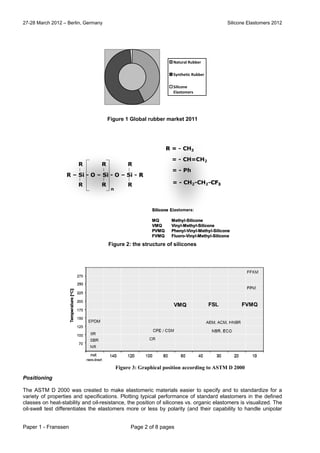
![27-28 March 2012 – Berlin, Germany Silicone Elastomers 2012
Paper 1 - Franssen Page 4 of 8 pages
New Technologies
Example: Lighting is one of the global drivers in innovation. Energy saving, CO2-reduction and
safety accelerate the transformation to LED light. The share of LED in lighting is forecasted to grow
from 15% in 2010 to 45% in 2015, substituting traditional lighting like the historical Edison lamp. [5]
The light power of LEDs are developing rapidly, in combination with emission of strong blue light and
increasing temperatures. High transparent Silicones combine resistance against high temperatures
and against UV-light at high optical transparency.
For a winning development with Silicone Elastomers, a pure material replacement calculation from an
existing drawing / application is often not enough. In Silicone LSR, elastomer innovations allow redesigning
of parts and systems benefitting from values resulting from simple feature differences to individual organic
elastomers. Those include
Low viscosity enables very thin walls and long thin flow paths
Low hardness without plasticizers
Easy to color, even glass-clear products are available
Silicones mechanics are almost linear / similar to a Hooke-spring
Hydrophobicity
Excellent insulation properties
Those features enhance the number of functional competitors (and application potentials) significantly and
Silicone elastomers therefore find usage in
insulators for high voltage, replacing porcelain
replacements of metal springs
replacements of transparent plastics and glass in optical applications
as illustrated in following examples.
Ultra-transparent LSR vs Glass and Plastics
Dispensable, high transparent Silicones replaced engineering thermoplastic resins in packaging of the
semiconductors in LEDs for some years. The higher temperatures and the hard blue light radiation of high
efficient, new generation LEDs requires UV-light resistance and low yellowing for the optical packaging
material. These properties combined with improved crack resistance are provided by silicone based
packaging materials which are basically used in LED packaging nowadays.
Figure 4: plastics and LSR 7000 after heat aging 6480 h 150°C [6]](https://image.slidesharecdn.com/82807-250404180808-1e66c688/85/Silicone-Elastomers-2012-1st-Edition-Ismithers-14-320.jpg)
![Silicone Elastomers 2012 27-28 March 2012 – Berlin, Germany
Page 5 of 8 pages Paper 1 - Franssen
Innovation in lighting design and the success of high efficient LEDs are
driving the research for new materials which can be processed by
injection molding, enabling high complex design at high production
volumes. The new LSR 7000 family by Momentive provides high optical
transparency, excellent UV- and blue- light resistance. The new ultra-
transparent LSR is a good candidate to replace transparent plastics like
PC and PMMA in lighting applications which require high temperature
resistance and flexibility in design.
An obvious next step is to use high transparent LSR for secondary
optical lenses which can be directly assembled to the LED. The light of
a semiconductor is spread in a very simple way by the packaging
material, e.g. a globe-top. In order to form and to guide the light
secondary lenses and light guides are needed. So far such optics are
mainly made from PC or PMMA. In order to protect
these materials against the high temperature of a high
power LED, those optical elements can’t be
assembled directly onto the light source - a 1-2 mm
gap is necessary to reduce the junction temperature.
Resulting reflections from plastic to air and from air to
plastic reduce the efficiency of such optical
components. Secondary lenses and light guides
made out of high transparent, temperature resistant
LSRs can be assembled directly to the LED and
higher efficiency can be achieved. Additionally LSR
allows a higher freedom of design than PC and
PMMA.
LSR vs NR in Babycare
When LSR was brought to the market some 30 years ago, baby bottle nipples were one of the first
application, the industry immediately started to work on. LSR brought a transparent appearance, was easy to
injection-mold at high yield and neutral in odor and taste. At the time the market was dominated by pacifiers
and bottle nipples made from natural rubber latices. Studies show that LSRs not only fulfill necessary food
compliancy, their allergene potential is far less than the natural rubber product. LSR is UV-resistant and will
survive cooking water without significant change of appearance or physical properties. The decision to
choose LSR in baby-care at the end
was a decision from many mothers
and even more babies, which
preferred the silicone elastomer vs.
natural rubber. The baby-care
market today is amongst the biggest
LSR application volumes globally.
Also in this mature segment the
elastomer innovation continues to
fulfill expectations for the next
generation of products e.g. with
higher tear resistance. A new
development is for example
Momentive’s LSR 2645 with
improved hot tear resistance
according to EN 1400-2.
Figure 5: Multifunctional Lens
based on LSR 7070 [4]
Figure 7: LSR 2645 in comparison [6]
Figure 6: Transparency over wavelength of LSR
7070 [6]](https://image.slidesharecdn.com/82807-250404180808-1e66c688/85/Silicone-Elastomers-2012-1st-Edition-Ismithers-15-320.jpg)
![27-28 March 2012 – Berlin, Germany Silicone Elastomers 2012
Paper 1 - Franssen Page 6 of 8 pages
Silicone vs Porcelain in High Voltage Applications
Silicone Elastomers in High Voltage Applications came up in the late 60s when experts tried to find a lighter
and maintenance free solution to replace glass and porcelain in composite insulators like hollow cores.
Key expectations for this application are:
Low weight - high mechanical strength
Easy Handling
Pollution performance - low maintenance costs
Flexibility / Explosion Safety (seismic behavior)
A functional elastomer competitor to Silicones is EPDM with as good weatherability and insulation properties.
Silicone insulators benefit from standard silicone features, the most important are:
Flexibility
Low density
Hydrophobicity
Low Viscosity
Hydrophobicity (which prevents contaminations and flashovers on the insulator surface) and low viscosity
(enables casting of big shapes) are key properties differentiating Silicones vs. EPDM. Silicone also has the
ability to transfer it’s water repellent properties into contamination layers that might be built up in heavily
polluted environments. A good example here is Momentive’s Silopren Electro 242-0, that additionally
features excellent tracking and erosion resistance (1A 4.5 kV according to IEC 60587). Looking at
manufacturing costs, Silicone leads to the most expensive part. However in system costs which include
assembly, long-term maintenance and disassembly, Silicone insulators are the most cost efficient solution.
[3] One of the main reasons is the need for regular cleaning of conventional insulators including those made
with EPDM which is unnecessary with the hydrophobic Silicones.
Heat-resistant LSR against ACM and FKM in charge-air-cooler gaskets
The demand for more efficient vehicles continues to drive the share of turbo-charged engines. Since
turbochargers are running in a loss-oil lubrication with engine oil, their compressed hot charge air contains
oil. The compressed air passes a through a cooler to increase the density. The charge-air-cooler-gasket is
normally a big square seal. In manufacturing, the necessary flow length of the thin shape can cause
problems in mold and process-design with organic elastomers being high in viscosity. Materials had to
combine necessary oil-resistance with high temperature performance and acceptable static low temperature
performance. Most specified materials have been FKM (expensive and problematic in low temperatures) and
ACM (better in low temperatures and cheaper, but limited in heat-resistance). HCR silicone compounds
Figure 9 Silicone Hollow Core Insulator
$/YR
Figure 8: Life cycle cost for insulators](https://image.slidesharecdn.com/82807-250404180808-1e66c688/85/Silicone-Elastomers-2012-1st-Edition-Ismithers-16-320.jpg)
![Silicone Elastomers 2012 27-28 March 2012 – Berlin, Germany
Page 7 of 8 pages Paper 1 - Franssen
came up (modified with mineral fillers to achieve lower oil swell), but also these compounds had same
potential scorch-problems in traditional rubber molding. In the early 2000s, a major OEM qualified LSR 2670
black from Momentive. The LSR features fit perfectly to the difficult to manufacture geometry, however LSR
has higher swell in oil than any of the mentioned functional competitors.
The very low viscosity of the shear-thinning LSR allows fast filling
The inhibition of LSR prevents scorch of the material
The platinum catalyzed addition cure makes full automation affordable
No material losses with automated a waste-less and trim-free molding system
Good high temperature resistance and compression set
LSR 2670 contributed to significant cost savings in this application and is in successful mass-production.
LSR against a metal spring - Silicone HCR against NR in engine mounts
Movement is creating
vibration and noise. Electrical
motors as well as combustion
engines need to be fixed and
in the same time decoupled.
The ideal material provides
constant rebound resilience
combined with good
mechanical properties along
the working temperature
range of the application.
Silicone Elastomers are
relatively constant in modulus
and spring properties from
very low temperatures –40°C and up to high temperatures above 150 °C. Thanks to such outstanding
properties LSR substituted thermoplastic TPE as the decoupling element in the fixing device of the electrical
cooling van under the hood. A special self-bonding LSR allows the 2K-injection molding of a thermoplastic
fixing device with chemically bonded dampening elements made out of silicone rubber to keep the device in
place to dampen the noise and vibration over a wide range of
temperature.
Another example is the substitution of NR by a special, low dampening
Silicone Rubber used in the engine mount of the combustion engine of a
power station. NR is destroyed at temperatures above 120 °C, high
efficient combustion engines have to be encapsulated for noise
reduction. As a consequence the temperatures around the engine are
increasing and new materials are required to replace NR as dampening
material. Engine mounts made out of Silicone Elastomer work
consistently at temperatures of 150 °C.
Outlook
The next successful application of Silicone replacing a functional
competitor requires bright engineers and innovative raw material suppliers teaming up with each other.
Unique Silicone formulations can add value in use above and beyond just higher processing efficiency. More
important are creative innovators who can think outside of the box and utilize necessary freedom of design to
function..
Figure 12: Dampening cage
for cooling fan motor
Figure 11: DMA LIM 8040 [6]
Figure 10´: Silicone Engine
Mounts](https://image.slidesharecdn.com/82807-250404180808-1e66c688/85/Silicone-Elastomers-2012-1st-Edition-Ismithers-17-320.jpg)
![27-28 March 2012 – Berlin, Germany Silicone Elastomers 2012
Paper 1 - Franssen Page 8 of 8 pages
References
[1] Dr. Stephen Evans, IRSG, Presentation on China Rubber Conference, Mar 2011
[2] Momentive Market Estimates 2011
[3] EPRI, Transmission Line Reference Book, 115-138kV Compact Line Design, RP 260, pp:29.
[4] Foto by KIMW Lüdenscheid / Germany
[5] Philips Global Lighting Market Study
[6] Momentive Lab Data
DISCLAIMER: THE MATERIALS, PRODUCTS AND SERVICES OF MOMENTIVE PERFORMANCE MATERIALS INC., MOMENTIVE
PERFORMANCE MATERIALS USA INC., MOMENTIVE PERFORMANCE MATERIALS ASIA PACIFIC PTE. LTD., MOMENTIVE
PERFORMANCE MATERIALS WORLDWIDE INC., MOMENTIVE PERFORMANCE MATERIALS GmbH, THEIR SUBSIDIARIES AND
AFFILIATES DOING BUSINESS IN LOCAL JURISDICTIONS (collectively “SUPPLIERS”), ARE SOLD BY THE RESPECTIVE LEGAL
ENTITY OF THE SUPPLIER SUBJECT TO SUPPLIERS’ STANDARD CONDITIONS OF SALE, WHICH ARE INCLUDED IN THE
APPLICABLE DISTRIBUTOR OR OTHER SALES AGREEMENT, PRINTED ON THE BACK OF ORDER ACKNOWLEDGMENTS AND
INVOICES, AND AVAILABLE UPON REQUEST. ALTHOUGH ANY INFORMATION, RECOMMENDATIONS, OR ADVICE
CONTAINED HEREIN IS GIVEN IN GOOD FAITH, SUPPLIERS MAKE NO WARRANTY OR GUARANTEE, EXPRESS OR IMPLIED,
(i) THAT THE RESULTS DESCRIBED HEREIN WILL BE OBTAINED UNDER END-USE CONDITIONS, OR (ii) AS TO THE
EFFECTIVENESS OR SAFETY OF ANY DESIGN INCORPORATING SUPPLIERS’ PRODUCTS, MATERIALS, SERVICES,
RECOMMENDATIONS OR ADVICE. AFOREMENTIONED EXCLUSIONS OR LIMITATION OF LIABILITY ARE NOT APPLICABLE TO
THE EXTENT THAT THE END-USE CONDITIONS AND/OR INCORPORATION CONDITIONS CORRESPOND TO THE
RECOMMENDED CONDITIONS OF USE AND/OR OF INCORPORATION AS DESCRIBED BY SUPPLIER IN ITS PRODUCT DATA
SHEET AND/OR PRODUCT SPECIFICATIONS. EXCEPT AS PROVIDED IN SUPPLIERS’ STANDARD CONDITIONS OF SALE,
SUPPLIERS AND THEIR REPRESENTATIVES SHALL IN NO EVENT BE RESPONSIBLE FOR ANY LOSS RESULTING FROM ANY
USE OF ITS MATERIALS, PRODUCTS OR SERVICES DESCRIBED HEREIN.
Each user bears full responsibility for making its own determination as to the suitability of Suppliers’ materials, services,
recommendations, or advice for its own particular use. Each user must identify and perform all tests and analyses necessary to assure
that its finished parts incorporating Suppliers’ products, materials, or services will be safe and suitable for use under end-use conditions.
Nothing in this or any other document, nor any oral recommendation or advice, shall be deemed to alter, vary, supersede, or waive any
provision of Suppliers’ Standard Conditions of Sale or this Disclaimer, unless any such modification is specifically agreed to in a writing
signed by Suppliers. No statement contained herein concerning a possible or suggested use of any material, product, service or design
is intended, or should be construed, to grant any license under any patent or other intellectual property right of Suppliers or any of its
subsidiaries or affiliates covering such use or design, or as a recommendation for the use of such material, product, service or design in
the infringement of any patent or other intellectual property right.](https://image.slidesharecdn.com/82807-250404180808-1e66c688/85/Silicone-Elastomers-2012-1st-Edition-Ismithers-18-320.jpg)
![27-28 March 2012 – Berlin, Germany Silicone Elastomers 2012
Paper 2 - Kaup Page 2 of 6 pages
INTRODUCTION
The development of automotive headlamps was affected by important enhancements of technologies,
particularly with regard on the last decade. There were different directions of development since the
beginning of the century. Functionalities like AFS (Adaptive Front-lighting System) were integrated.
Afterwards with the usage of more and more sensor technology, e.g. cameras, it was possible to implement
high beam assistant, adaptive and vertical cut-off-lines.
The implementation of AFS based on the discussions of the EUREKA Workgroup 1403 was divided in two
steps. First, 2003 bend lighting functionalities were integrated in the existing regulations and separated from
overall AFS discussion. Close to this, first cars with dynamic and static bend lighting entered the market.
Since initiation of the AFS regulation ECE123 in 2007 several cars integrated Full-AFS headlamps,
containing motorway light, country light, town light and even a light distribution for severe weather conditions
(Figure 1). Bend light and AFS light distributions enable a road situation adapted illumination. Those Front-
lighting systems use standard car sensor signals like steering wheel angle, speed, gear level etc. for system
control. The possibility to use GPS data for headlamp control is not integrated in most AFS systems. Thus,
light distributions are not direct associated to the environment [ECE, 2007], [Schmidt, 2011].
Figure 1 - AFS light distributions & VarioX projection module [Hella, 2011]
Next tremendous step was the launch of camera technologies in headlamp functionalities. If the sensor
detects other road users, it is possible to switch between high and low beam automatically, so called high
beam assistant. Further development offers the ‘Adaptive Cut-Off Line’. The aCOL controls the light range
depending on the distance to oncoming traffic and to traffic ahead. The visibility range of the driver is
increased and glare of the traffic is avoided. With an additional ‘Vertical Cut-Off Line’ glare-free high beam
and in most traffic situations a light distribution comparable to high beam is available for the driver. In case of
oncoming or heading traffic the glaring parts of the high beam lighting distribution are automatically faded
out. Today such functions are realized by leveling and swiveling projection modules (Figure 1). HID-lamps
with high luminous flux are usually the medium of choice.
In recent years, the luminous efficiency of phosphor-based white light-emitting diodes has improved rapidly.
Moreover LEDs have many features including energy-savings, long life, short rise and fall times and low
impact on the environment. Thus, they are well suited to be one of the main light sources in the current and
next generation of automotive headlamps. Furthermore design freedom is an advantage LEDs and polymer
optics have in common. In this context Figure 2 illustrates the milestones of headlamp development since
the beginning of the 21
st
century.](https://image.slidesharecdn.com/82807-250404180808-1e66c688/85/Silicone-Elastomers-2012-1st-Edition-Ismithers-20-320.jpg)
![Silicone Elastomers 2012 27-28 March 2012 – Berlin, Germany
Page 3 of 6 pages Paper 2 - Kaup
Figure 2 - Headlamp-Milestones from 2000 on [Hella, 2011]
The chain of reasoning is the conclusion of adaptive light functionalities and the integration of LED light
sources and polymer optics. One high-end solution can be LED-array headlamps. The core is a matrix of
high-power LED-chips. Each chip has an own power supply. It can be activated or deactivated without
interacting with other chips. By turning on certain regions of the matrix, various light distributions can be
generated. Thus, it is possible to realize e.g. glare-free high beam or marking light with a non-mechanical
unit.
TRANSPARENT POLYMER OPTICS IN AUTOMOTIVE HEADLAMPS
The automotive industry and its suppliers know how to make use of new technologies. With the introduction
of Full-LED headlamps the car’s frontend styling changes obviously, like e.g. Audi A8 an A6 have shown.
With the LED as a “cold” light source the use of plastic material for thick, high precision lenses is now
possible. This offers a wide range of styling freedom. There are also advantages in weight, complexity and
integration compared to glass lenses.
Adaptive headlamps utilizing LED-arrays represent a special challenge. Well known are PC and PMMA
materials. On the one hand injection moulding and injection-compression moulding allow a comparatively
cheap one-step-manufacturing of high precision optical polymer lenses. On the other hand thermoplastic
polymers reach their limits relating to temperatures beyond 100°C or high irradiance. A promising material
for high precision and high performance optics is optical silicone. Highly transparent liquid silicone rubber
(LSR) stands out for being resistant against high temperatures, violet and ultraviolet radiation while providing
excellent transmission characteristics at the same time. When used as light guidance elements or primary
optics LSRs can directly be exposed to white LEDs. In contrast to that thermoplastics have to keep a safety
distance to the light source, so optical disadvantages are the result.
Silicone lenses can withstand permanent temperatures beyond 150°C. Obviously, LSR is the only
transparent polymeric material capable to withstand the high temperatures occurring at and close to the LED
junction (Figure 3).](https://image.slidesharecdn.com/82807-250404180808-1e66c688/85/Silicone-Elastomers-2012-1st-Edition-Ismithers-21-320.jpg)
![27-28 March 2012 – Berlin, Germany Silicone Elastomers 2012
Paper 2 - Kaup Page 4 of 6 pages
Figure 3 - Transparency behavior of various transparent polymers during and
after aging at elevated temperatures [Luce, 2009].
Furthermore LSR’s injection mouldability is excellent, even undercuts can be demoulded with this flexible
material. In comparison to thermoplastics the injection moulding process of LSR gets by without high post
pressure, long cooling time and anisotropic end product properties. A significant cycle time advantage can
be realized when manufacturing LSR-parts even with excellent isotropic properties [Luce, 2009], [Bayerl,
2010]. LUCE ET AL. already proofed the suitability of LSR lenses under very severe conditions in a headlamp.
But they did not consider the thermal expansion and the fact that the refractive index is a function of
temperature (dn/dT ≈ -0,0003 K-1
). In case of imaging secondary optics the change of optical performance
has a wide influence on resulting light distribution. Thus, a sharply bounded cut-off line can be destructed. In
case of collecting primary optics it is less critical from optical point of view.
FLEXIBLE LENSES
Expansion with rising temperature and simultaneous decreasing refractive index are polymeric properties. In
a wide range of temperature you have to deform a lens exactly so that the thermally induced change in the
refractive index and the shape of the optically active surfaces are compensated. On top of that, it can be
possible to control light distributions in this manner. Already described adaptive front-lighting systems enable
generation of different light functions in automotive applications by use of only one projection module and a
halogen or HID-lamp. Usually subtractive systems are used as in the case of variable apertures. By contrast,
the use of white LEDs offers new possibilities for additive AFS functions. For example you can combine
LEDs with primary optics and projection lenses consisting of LSR. A change in focal distance is obtained by
deforming the elastomer. This is the decisive step to the realization of an accommodating headlamp. In order
to apply the specific force on the side surface of the lens an appropriate actuator is needed. But first of all
there is an iterative process of optical and mechanical simulation.
Figure 4 - Simulation of deformation with the finite elements method [ABAQUS, 2012]](https://image.slidesharecdn.com/82807-250404180808-1e66c688/85/Silicone-Elastomers-2012-1st-Edition-Ismithers-22-320.jpg)



![continet 12 steppys.” 4. Carew also speaks of it as “a chapel for
devotion, builded by William Earl of Morton,” (Carew so speaking
with the multitude, when he ought to have given the building to the
Confessor,) “and greatly haunted while folk endured (endeared) their
merits by farre travailing.” 5. Carew thus refers obscurely, perhaps
unconsciously, to a particular privilege annexed to the church, which
was given by one decree from Pope Gregory, and confirmed by
another from Bishop Leofric. “Universis Sanctæ Matris ecclesiæ
presentes literas inspecturis vel audituris salutem,” cries the former,
“noverit universitas vestra quod sanctissimus Papa Gregorius, anno
ab incarnatione Domini millesimo septuagesimo,” the very year,
therefore, in which Earl Montaign gave this church to the other in
Normandy, “ad ecclesiam Montis Sancti Michaelis, in comitatu
Cornubiæ, gerens eximiæ devocionis affectum, piè concessit
ecclesiæ predictæ, [et] omnibus fidelibus, qui illam cum suis
beneficiis et elemosinis,” (with alms and oblations, so that “folke
endeared their merits,” not merely “by farre travailing,” but by a tax
upon their purse,) “exepecierint seu visitaverint, tertiam partem
penetenciarum suarum eis condonari,” a third of all those acts being
remitted, which penitents were enjoined to perform, in order to
prove the sincerity of their penitence to God, and to themselves. The
same privilege is repeated by the Bishop of Exeter in 1085, thus:
“omnibus illis, qui illum ecclesiam suis cum beneficiis et elemosinis
expetierint et visitaverint, tertiam partem penitentiarum
condonamus.” Yet, what is surprising, the privilege became nearly as
much unknown afterwards as it is at present, and was therefore
promulgated by the clergy of the church at the beginning of the
fifteenth century: “Tota verba,” adds the reciter, “in antiquis registris
de novo,” a little before William’s visit, “in hâc ecclesiâ repertis,
inventa,” being then unknown to the very clergy themselves, and
only discovered by the discovery of some registers equally unknown,
“prout his in valvis ecclesiæ publicè ponuntur,” were exhibited to
public view by being posted upon the folding-doors of the church.
“Et quia pluribus istud est incognitum, ideo nos, in Christo Dei famuli
et ministri hujus ecclesiæ, universitatem vestram qui regimen
animarum possidetis,” all the rectors and vicars of the kingdom, “ob](https://image.slidesharecdn.com/82807-250404180808-1e66c688/85/Silicone-Elastomers-2012-1st-Edition-Ismithers-43-320.jpg)
![mutuæ vicissitudinis obtentum requirimus et rogamus, quatenus ista
publicetis in ecclesiis vestris, ut vestri subditi et subjecti ad majorem
exoracionem devocionis attentius animentur, et locum istum
gloriosius peregrinando frequentent ad dona et indulgencias predicta
graciosè consequenda.” From this republication of the privilege,
undoubtedly, did the numerous resort of pilgrims to the church
begin. Then too was formed assuredly that seat on the tower, which
is so ridiculously described by Carew, as “a little without the castle—
a bad seat in a craggy place—somewhat dangerous for access;”
when it is only a chair, composed of stones, projecting from the two
sides of the tower battlements, and uniting into a seat without the
south-western angle, but elevated above the battlements on each
side. It thus appears somewhat dangerous from the elevation or
projection only, is an evident addition to the tower, and was
assuredly made at this period for the pilgrims, that they might
complete their devotions at the Mount by sitting in this St. Michael’s
Chair, as denominated, and by showing themselves as pilgrims to the
country round. Hence, in an author[6]
who alludes to customs
without feeling the force of his allusion, we read this intimation:
Who knowes not Michael’s Mount and Chaire,
The pilgrim’s holy vaunt?
We thus find a reason for the construction of such a chair, that
comports with all the purposes of the church on the tower of which
it is constructed, and that shows it ministered equally with this to
the uses of religion then predominant; making it not, as Carew most
extravagantly makes it, “somewhat dangerous for access, and
therefore holy for the adventure,” but holy in itself, as on the church-
tower, holy in its purposes, as the seat of the pilgrims, and doubly
holy as the seat of accomplishment to all their vows, as the seat of
invitation to all the country. And the whole church remains to this
day, beaten by the rains and buffeted by the winds, yet a venerable
monument of Saxon architecture.
This Mount appears decisively, from the charter of the Confessor,
to have been in his time not surrounded with the sea during all the](https://image.slidesharecdn.com/82807-250404180808-1e66c688/85/Silicone-Elastomers-2012-1st-Edition-Ismithers-44-320.jpg)