Silicon Nanowires for Biomedical
          Applications


           Ke Jiang, Ph.D


                                   1
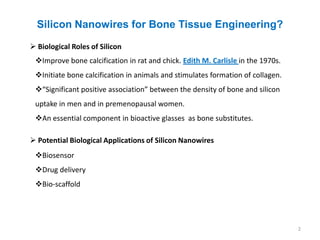
Silicon Nanowires for Bone Tissue Engineering?
 Biological Roles of Silicon
 Improve bone calcification in rat and chick. Edith M. Carlisle in the 1970s.
 Initiate bone calcification in animals and stimulates formation of collagen.
 “Significant positive association” between the density of bone and silicon
 uptake in men and in premenopausal women.
 An essential component in bioactive glasses as bone substitutes.

 Potential Biological Applications of Silicon Nanowires
 Biosensor
 Drug delivery
 Bio-scaffold


                                                                                 2
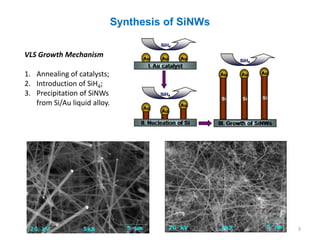
Synthesis of SiNWs

VLS Growth Mechanism

1. Annealing of catalysts;
2. Introduction of SiH4;
3. Precipitation of SiNWs
   from Si/Au liquid alloy.


                                                   3
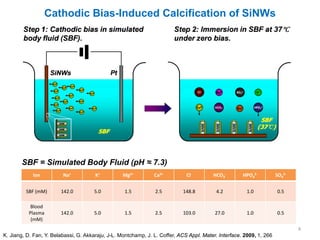
Cathodic Bias-Induced Calcification of SiNWs


       SBF = Simulated Body Fluid (pH ≈ 7.3)
            Ion          Na+           K+          Mg2+         Ca2+          Cl-        HCO3-        HPO42-          SO42-


         SBF (mM)       142.0         5.0          1.5          2.5         148.8          4.2          1.0           0.5

           Blood
          Plasma        142.0         5.0          1.5          2.5         103.0         27.0          1.0           0.5
           (mM)
                                                                                                                              4
K. Jiang, D. Fan, Y. Belabassi, G. Akkaraju, J-L. Montchamp, J. L. Coffer, ACS Appl. Mater. Interface. 2009, 1, 266
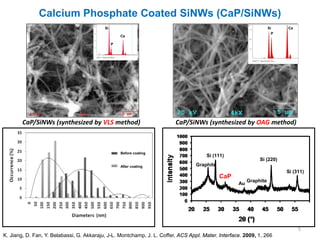
Calcium Phosphate Coated SiNWs (CaP/SiNWs)
                                           Si                                                                       Si    Ca
                                                                                                                      P
                                                    Ca

                                                P


        CaP/SiNWs (synthesized by VLS method)                            CaP/SiNWs (synthesized by OAG method)


                                                    Before coating
                                                                                      Si (111)
                                                                                                              Si (220)
                                                    After coating                 Graphite
                                                                                                                          Si (311)
                                                                                             CaP
                                                                                                         Graphite
                                                                                                    Au


                                                                                                                               5
K. Jiang, D. Fan, Y. Belabassi, G. Akkaraju, J-L. Montchamp, J. L. Coffer, ACS Appl. Mater. Interface. 2009, 1, 266
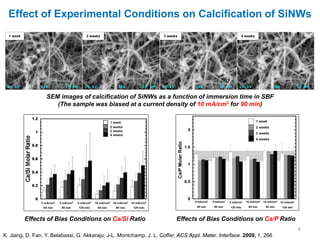
Effect of Experimental Conditions on Calcification of SiNWs
  1 week                           2 weeks                          3 weeks                          4 weeks


                  SEM images of calcification of SiNWs as a function of immersion time in SBF
                     (The sample was biased at a current density of 10 mA/cm2 for 90 min)


           Effects of Bias Conditions on Ca/Si Ratio                      Effects of Bias Conditions on Ca/P Ratio
                                                                                                                      6
K. Jiang, D. Fan, Y. Belabassi, G. Akkaraju, J-L. Montchamp, J. L. Coffer, ACS Appl. Mater. Interface. 2009, 1, 266
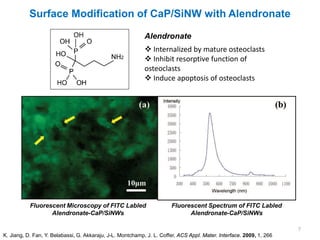
Surface Modification of CaP/SiNW with Alendronate

                                                            Alendronate
                                                             Internalized by mature osteoclasts
                                                             Inhibit resorptive function of
                                                            osteoclasts
                                                             Induce apoptosis of osteoclasts


           Fluorescent Microscopy of FITC Labled                       Fluorescent Spectrum of FITC Labled
                  Alendronate-CaP/SiNWs                                      Alendronate-CaP/SiNWs

                                                                                                                      7
K. Jiang, D. Fan, Y. Belabassi, G. Akkaraju, J-L. Montchamp, J. L. Coffer, ACS Appl. Mater. Interface. 2009, 1, 266
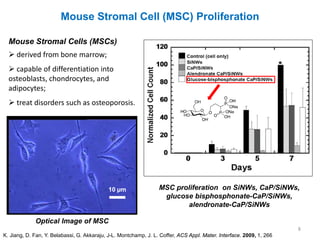
Mouse Stromal Cell (MSC) Proliferation

  Mouse Stromal Cells (MSCs)
   derived from bone marrow;
   capable of differentiation into
  osteoblasts, chondrocytes, and
  adipocytes;
   treat disorders such as osteoporosis.


                                             10 µm                MSC proliferation on SiNWs, CaP/SiNWs,
                                                                   glucose bisphosphonate-CaP/SiNWs,
                                                                         alendronate-CaP/SiNWs

             Optical Image of MSC
                                                                                                                      8
K. Jiang, D. Fan, Y. Belabassi, G. Akkaraju, J-L. Montchamp, J. L. Coffer, ACS Appl. Mater. Interface. 2009, 1, 266
Silicon Nanowire/Polycaprolactone (PCL) Nanocomposites as
     Biocompatible Scaffolds for Bone Tissue Engineering


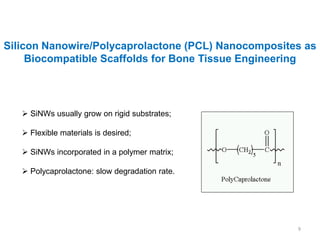
    SiNWs usually grow on rigid substrates;

    Flexible materials is desired;

    SiNWs incorporated in a polymer matrix;

    Polycaprolactone: slow degradation rate.


                                                     9
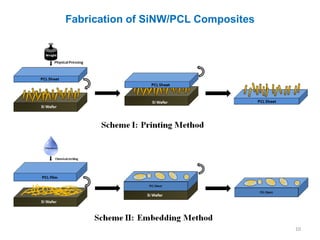
Fabrication of SiNW/PCL Composites


                                     10
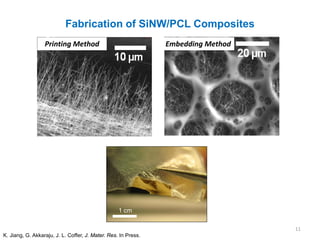
Fabrication of SiNW/PCL Composites
                  Printing Method                               Embedding Method


                                                   1 cm

                                                                                   11
K. Jiang, G. Akkaraju, J. L. Coffer, J. Mater. Res. In Press.
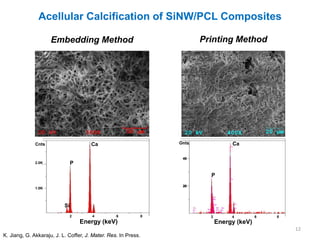
Acellular Calcification of SiNW/PCL Composites

                     Embedding Method                                      Printing Method


              Cnts                     Ca                           Cnts              Ca

                                                                     40
              2.0K              P

                                                                             P
                                                                     20
              1.0K


                           Si
                                2       4         6             8            2        4         6   8
                                    Energy (keV)                                 Energy (keV)
                                                                                                        12
K. Jiang, G. Akkaraju, J. L. Coffer, J. Mater. Res. In Press.
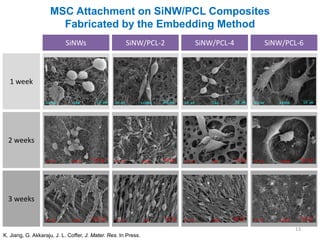
MSC Attachment on SiNW/PCL Composites
                      Fabricated by the Embedding Method
                           SiNWs                      SiNW/PCL-2   SiNW/PCL-4   SiNW/PCL-6


  1 week


  2 weeks


  3 weeks


                                                                                       13
K. Jiang, G. Akkaraju, J. L. Coffer, J. Mater. Res. In Press.
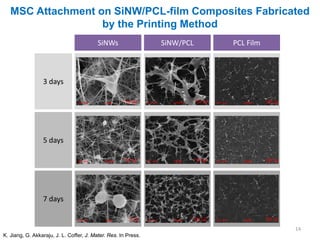
MSC Attachment on SiNW/PCL-film Composites Fabricated
                   by the Printing Method
                                          SiNWs                 SiNW/PCL   PCL Film


                 3 days


                 5 days


                 7 days


                                                                                      14
K. Jiang, G. Akkaraju, J. L. Coffer, J. Mater. Res. In Press.
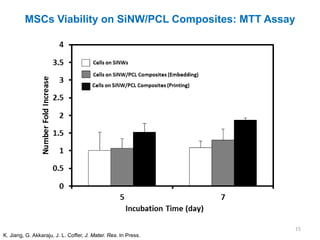
MSCs Viability on SiNW/PCL Composites: MTT Assay


                                                                15
K. Jiang, G. Akkaraju, J. L. Coffer, J. Mater. Res. In Press.
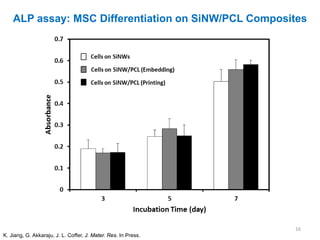
ALP assay: MSC Differentiation on SiNW/PCL Composites


                                                                16
K. Jiang, G. Akkaraju, J. L. Coffer, J. Mater. Res. In Press.
SiNWs as Delivery Vehicles for Boron Neutron
                    Capture Therapy (BNCT)

 1935 H. J. Taylor; 1936 G. L. Locher.
   10
    5B   + 1 n → [11B] → 4 He2+ + 7Li3+ + γ0.48 MeV + 2.31 MeV
           0       5     2        3

 Both α–particles and lithium ions have pathlength
of several micrometers;

 Boron-containing agents:                    BSH


 Nanomaterials as Delivery Vehicles:


         Dendrimer                     Liposome                  Dextran     17
                                                                           17
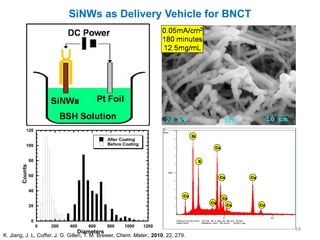
SiNWs as Delivery Vehicle for BNCT


            120

                                             After Coating
            100                              Before Coating


                 80
        Counts


                 60


                 40


                 20


                  0
                      0   200   400   600    800     1000     1200
                                                                                   18
                                   Diameters
K. Jiang, J. L. Coffer, J. G. Gillen, T. M. Brewer, Chem. Mater., 2010, 22, 279.
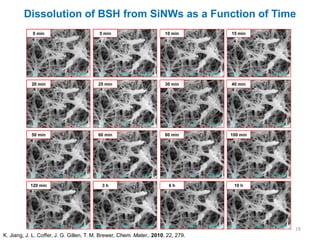
Dissolution of BSH from SiNWs as a Function of Time
             0 min                        5 min                        10 min      15 min


            20 min                       25 min                        30 min      40 min


            50 min                       60 min                        80 min      100 min


           120 min                         3h                           6h          10 h


                                                                                             19
K. Jiang, J. L. Coffer, J. G. Gillen, T. M. Brewer, Chem. Mater., 2010, 22, 279.
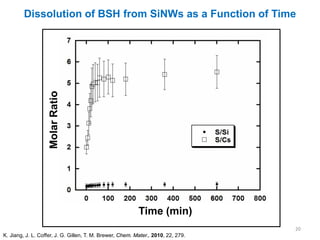
Dissolution of BSH from SiNWs as a Function of Time


                    Molar Ratio


                                                           Time (min)
                                                                                   20
K. Jiang, J. L. Coffer, J. G. Gillen, T. M. Brewer, Chem. Mater., 2010, 22, 279.
Remarks
 Catalyst-assisted chemical vapor deposition methods were employed
to synthesize SiNWs, which were coated with calcium phosphate by an
electrochemically induced method.

 The alendronate modified CaP/SiNWs exhibit a cytotoxic behavior,
while deliberate subtle modification of the exposed primary amine with
glucose sensitively improves the cytocompatibility of the nanowire vector.

 SiNW/PCL composites with a variety of surface topography were
fabricated and their cytocompatibility were tested in vitro. These
composite materials show supportive behavior of directing mouse stromal
cells attachment, proliferation, and differentiation functions.

 SiNWs can be used as potential delivery vehicles for boron-containing
agents, therefore exhibited some properties favorable for possible use in
Boron Neutron Capture Therapy.


                                                                             21

Silicon nanowires

  • 1.
    Silicon Nanowires forBiomedical Applications Ke Jiang, Ph.D 1
  • 2.
    Silicon Nanowires forBone Tissue Engineering?  Biological Roles of Silicon Improve bone calcification in rat and chick. Edith M. Carlisle in the 1970s. Initiate bone calcification in animals and stimulates formation of collagen. “Significant positive association” between the density of bone and silicon uptake in men and in premenopausal women. An essential component in bioactive glasses as bone substitutes.  Potential Biological Applications of Silicon Nanowires Biosensor Drug delivery Bio-scaffold 2
  • 3.
    Synthesis of SiNWs VLSGrowth Mechanism 1. Annealing of catalysts; 2. Introduction of SiH4; 3. Precipitation of SiNWs from Si/Au liquid alloy. 3
  • 4.
    Cathodic Bias-Induced Calcificationof SiNWs SBF = Simulated Body Fluid (pH ≈ 7.3) Ion Na+ K+ Mg2+ Ca2+ Cl- HCO3- HPO42- SO42- SBF (mM) 142.0 5.0 1.5 2.5 148.8 4.2 1.0 0.5 Blood Plasma 142.0 5.0 1.5 2.5 103.0 27.0 1.0 0.5 (mM) 4 K. Jiang, D. Fan, Y. Belabassi, G. Akkaraju, J-L. Montchamp, J. L. Coffer, ACS Appl. Mater. Interface. 2009, 1, 266
  • 5.
    Calcium Phosphate CoatedSiNWs (CaP/SiNWs) Si Si Ca P Ca P CaP/SiNWs (synthesized by VLS method) CaP/SiNWs (synthesized by OAG method) Before coating Si (111) Si (220) After coating Graphite Si (311) CaP Graphite Au 5 K. Jiang, D. Fan, Y. Belabassi, G. Akkaraju, J-L. Montchamp, J. L. Coffer, ACS Appl. Mater. Interface. 2009, 1, 266
  • 6.
    Effect of ExperimentalConditions on Calcification of SiNWs 1 week 2 weeks 3 weeks 4 weeks SEM images of calcification of SiNWs as a function of immersion time in SBF (The sample was biased at a current density of 10 mA/cm2 for 90 min) Effects of Bias Conditions on Ca/Si Ratio Effects of Bias Conditions on Ca/P Ratio 6 K. Jiang, D. Fan, Y. Belabassi, G. Akkaraju, J-L. Montchamp, J. L. Coffer, ACS Appl. Mater. Interface. 2009, 1, 266
  • 7.
    Surface Modification ofCaP/SiNW with Alendronate Alendronate  Internalized by mature osteoclasts  Inhibit resorptive function of osteoclasts  Induce apoptosis of osteoclasts Fluorescent Microscopy of FITC Labled Fluorescent Spectrum of FITC Labled Alendronate-CaP/SiNWs Alendronate-CaP/SiNWs 7 K. Jiang, D. Fan, Y. Belabassi, G. Akkaraju, J-L. Montchamp, J. L. Coffer, ACS Appl. Mater. Interface. 2009, 1, 266
  • 8.
    Mouse Stromal Cell(MSC) Proliferation Mouse Stromal Cells (MSCs)  derived from bone marrow;  capable of differentiation into osteoblasts, chondrocytes, and adipocytes;  treat disorders such as osteoporosis. 10 µm MSC proliferation on SiNWs, CaP/SiNWs, glucose bisphosphonate-CaP/SiNWs, alendronate-CaP/SiNWs Optical Image of MSC 8 K. Jiang, D. Fan, Y. Belabassi, G. Akkaraju, J-L. Montchamp, J. L. Coffer, ACS Appl. Mater. Interface. 2009, 1, 266
  • 9.
    Silicon Nanowire/Polycaprolactone (PCL)Nanocomposites as Biocompatible Scaffolds for Bone Tissue Engineering  SiNWs usually grow on rigid substrates;  Flexible materials is desired;  SiNWs incorporated in a polymer matrix;  Polycaprolactone: slow degradation rate. 9
  • 10.
  • 11.
    Fabrication of SiNW/PCLComposites Printing Method Embedding Method 1 cm 11 K. Jiang, G. Akkaraju, J. L. Coffer, J. Mater. Res. In Press.
  • 12.
    Acellular Calcification ofSiNW/PCL Composites Embedding Method Printing Method Cnts Ca Cnts Ca 40 2.0K P P 20 1.0K Si 2 4 6 8 2 4 6 8 Energy (keV) Energy (keV) 12 K. Jiang, G. Akkaraju, J. L. Coffer, J. Mater. Res. In Press.
  • 13.
    MSC Attachment onSiNW/PCL Composites Fabricated by the Embedding Method SiNWs SiNW/PCL-2 SiNW/PCL-4 SiNW/PCL-6 1 week 2 weeks 3 weeks 13 K. Jiang, G. Akkaraju, J. L. Coffer, J. Mater. Res. In Press.
  • 14.
    MSC Attachment onSiNW/PCL-film Composites Fabricated by the Printing Method SiNWs SiNW/PCL PCL Film 3 days 5 days 7 days 14 K. Jiang, G. Akkaraju, J. L. Coffer, J. Mater. Res. In Press.
  • 15.
    MSCs Viability onSiNW/PCL Composites: MTT Assay 15 K. Jiang, G. Akkaraju, J. L. Coffer, J. Mater. Res. In Press.
  • 16.
    ALP assay: MSCDifferentiation on SiNW/PCL Composites 16 K. Jiang, G. Akkaraju, J. L. Coffer, J. Mater. Res. In Press.
  • 17.
    SiNWs as DeliveryVehicles for Boron Neutron Capture Therapy (BNCT)  1935 H. J. Taylor; 1936 G. L. Locher. 10 5B + 1 n → [11B] → 4 He2+ + 7Li3+ + γ0.48 MeV + 2.31 MeV 0 5 2 3  Both α–particles and lithium ions have pathlength of several micrometers;  Boron-containing agents: BSH  Nanomaterials as Delivery Vehicles: Dendrimer Liposome Dextran 17 17
  • 18.
    SiNWs as DeliveryVehicle for BNCT 120 After Coating 100 Before Coating 80 Counts 60 40 20 0 0 200 400 600 800 1000 1200 18 Diameters K. Jiang, J. L. Coffer, J. G. Gillen, T. M. Brewer, Chem. Mater., 2010, 22, 279.
  • 19.
    Dissolution of BSHfrom SiNWs as a Function of Time 0 min 5 min 10 min 15 min 20 min 25 min 30 min 40 min 50 min 60 min 80 min 100 min 120 min 3h 6h 10 h 19 K. Jiang, J. L. Coffer, J. G. Gillen, T. M. Brewer, Chem. Mater., 2010, 22, 279.
  • 20.
    Dissolution of BSHfrom SiNWs as a Function of Time Molar Ratio Time (min) 20 K. Jiang, J. L. Coffer, J. G. Gillen, T. M. Brewer, Chem. Mater., 2010, 22, 279.
  • 21.
    Remarks  Catalyst-assisted chemicalvapor deposition methods were employed to synthesize SiNWs, which were coated with calcium phosphate by an electrochemically induced method.  The alendronate modified CaP/SiNWs exhibit a cytotoxic behavior, while deliberate subtle modification of the exposed primary amine with glucose sensitively improves the cytocompatibility of the nanowire vector.  SiNW/PCL composites with a variety of surface topography were fabricated and their cytocompatibility were tested in vitro. These composite materials show supportive behavior of directing mouse stromal cells attachment, proliferation, and differentiation functions.  SiNWs can be used as potential delivery vehicles for boron-containing agents, therefore exhibited some properties favorable for possible use in Boron Neutron Capture Therapy. 21