Silhouettes and Outlines
Jesse Harrison
Objective
●

To obtain outlines and silhouettes from each
individual object in real time using various
techniques.
Outlines in Image Space
●

●

A simple way to generate outlines would be to
render the scene from a desired point of view,
detect the edges in the image and then display
them.
However, the edges of a photograph do not
typically correspond to the silhouettes that we
want to illustrate. For instance highly textured
surfaces will generate edges irrelevant to the
objects shape and further more no edge would
be detected between two overlapping objects
with the same color
Depth Map
●

●

●

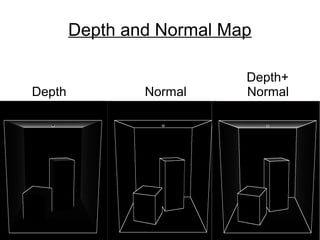
A better way to generate silhouettes is to render
the image, extract the depth map and apply an
edge detection to that map.
The idea is that the variation in depth between
adjacent pixels is usually small while the
variation between objects is large.
The problem is that the depth map does not
detect boundaries between objects that are at
the same depth, nor does it detect creases
Normal Map
●

●

●

We can augment the silhouette edges
computed with the depth map by using surface
normals as well.
The surface normals will detect changes in
surface orientation i.e. give us what depth can't
So we apply an edge detection algorithm to our
normal map and combine it with our depth map
to produce our silhouette edge.
Depth and Normal Map

Depth

Normal

Depth+
Normal
What is a Silhouette
●

●

Concerning polygonal meshes, the silhouette
consists of all edges that connect back-facing
polygons to front-facing polygons.
For smooth surfaces it can be defined as the
surface points with a surface normal
perpendicular to the view vector.
Smooth Surfaces
●

●

The first step in finding the silhouette of a
smooth surface, in our case one that is
defined by a triangular mesh, it to compute the
normalized dot product of the normal
of the
mesh at every vertex with the view vector.

We are also interested in the sign of the dot
product.
Smooth Surfaces
●

●

Recalling our goal is to find
and noting
that since both the view vector and surface
normal are continuous over the surface their
dot product must be as well. We can
determine the point where a silhouette lies by
observing a change in signs over a vertex.
I.E. between points and
if
We can approximate the silhouette point by
linearly interpolating between the two
vertecies:
Smooth Surfaces
●

●

●

Finally we can connect the silhouette points into a
silhouette curve.
We do this by observing sign changes between a
triangles vertecies. If one of the three vertecies has a
different sign then the others we can compute the
silhouette point on the two sides with opposites signs
and connect those points with a line segment.
We do this for every triangle with a sign change and
connect the line segments that share an endpoint and
this produces a piecewise linear approximation of the
silhouettes of a smooth surface.
Smooth Surfaces
Visibility
●

●

Now we just need to determine which portions of our
curve is visible.
There are three situations where the visibility of a
surface curve can change.
1) It passes under a silhouette, boundary or crease
in the image plane.
2) It intersects a silhouette, crease, or self
intersection curve on the surface.
3) It is a silhouette or boundary and has a cusp.
Visibility
●

●

The basic algorithm is to break all curves at
potential changes in visibility, producing a new
set of curves.
We then determine which of these new sets of
curves are visible are not by casting a ray from
the view vector. If the ray intersects any
surfaces before the curve, then the curve is
invisible.
The End

Silhouettes and Outlines

  • 1.
  • 2.
    Objective ● To obtain outlinesand silhouettes from each individual object in real time using various techniques.
  • 3.
    Outlines in ImageSpace ● ● A simple way to generate outlines would be to render the scene from a desired point of view, detect the edges in the image and then display them. However, the edges of a photograph do not typically correspond to the silhouettes that we want to illustrate. For instance highly textured surfaces will generate edges irrelevant to the objects shape and further more no edge would be detected between two overlapping objects with the same color
  • 4.
    Depth Map ● ● ● A betterway to generate silhouettes is to render the image, extract the depth map and apply an edge detection to that map. The idea is that the variation in depth between adjacent pixels is usually small while the variation between objects is large. The problem is that the depth map does not detect boundaries between objects that are at the same depth, nor does it detect creases
  • 5.
    Normal Map ● ● ● We canaugment the silhouette edges computed with the depth map by using surface normals as well. The surface normals will detect changes in surface orientation i.e. give us what depth can't So we apply an edge detection algorithm to our normal map and combine it with our depth map to produce our silhouette edge.
  • 6.
    Depth and NormalMap Depth Normal Depth+ Normal
  • 7.
    What is aSilhouette ● ● Concerning polygonal meshes, the silhouette consists of all edges that connect back-facing polygons to front-facing polygons. For smooth surfaces it can be defined as the surface points with a surface normal perpendicular to the view vector.
  • 8.
    Smooth Surfaces ● ● The firststep in finding the silhouette of a smooth surface, in our case one that is defined by a triangular mesh, it to compute the normalized dot product of the normal of the mesh at every vertex with the view vector. We are also interested in the sign of the dot product.
  • 9.
    Smooth Surfaces ● ● Recalling ourgoal is to find and noting that since both the view vector and surface normal are continuous over the surface their dot product must be as well. We can determine the point where a silhouette lies by observing a change in signs over a vertex. I.E. between points and if We can approximate the silhouette point by linearly interpolating between the two vertecies:
  • 10.
    Smooth Surfaces ● ● ● Finally wecan connect the silhouette points into a silhouette curve. We do this by observing sign changes between a triangles vertecies. If one of the three vertecies has a different sign then the others we can compute the silhouette point on the two sides with opposites signs and connect those points with a line segment. We do this for every triangle with a sign change and connect the line segments that share an endpoint and this produces a piecewise linear approximation of the silhouettes of a smooth surface.
  • 11.
  • 12.
    Visibility ● ● Now we justneed to determine which portions of our curve is visible. There are three situations where the visibility of a surface curve can change. 1) It passes under a silhouette, boundary or crease in the image plane. 2) It intersects a silhouette, crease, or self intersection curve on the surface. 3) It is a silhouette or boundary and has a cusp.
  • 13.
    Visibility ● ● The basic algorithmis to break all curves at potential changes in visibility, producing a new set of curves. We then determine which of these new sets of curves are visible are not by casting a ray from the view vector. If the ray intersects any surfaces before the curve, then the curve is invisible.
  • 14.

Editor's Notes