SILENT SOUND
TECHNOLOGY
By
Moumita Deb
Class Roll No: 134
WBUT Roll No: 1090113129
Stream: CSE
CONTENT
 Introduction
 Need of Silent Sound
 Methods
 Electromyography
 Image Processing
i) Analog Image Processing
ii) Digital Image Processing
 Applications
 Restriction
 Conclusion
“talking
without
talking”
INTRODUCTION
• Amazing solution for those who had lost
their voice but wish to speak over phone.
• Developed at the Karlsruhe Institute of
Technology, Germany.
• Detects every lip movement and Internally
converts the electrical pulses into sounds
signals and sends them neglecting all other
surrounding noise.
NEED FOR SILENT SOUND
An end to embarrassed situations such as:
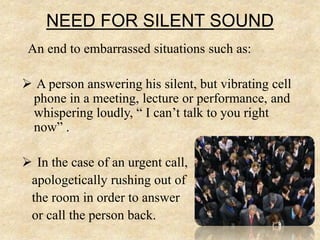
 A person answering his silent, but vibrating cell
phone in a meeting, lecture or performance, and
whispering loudly, “ I can’t talk to you right
now” .
 In the case of an urgent call,
apologetically rushing out of
the room in order to answer
or call the person back.
METHODS
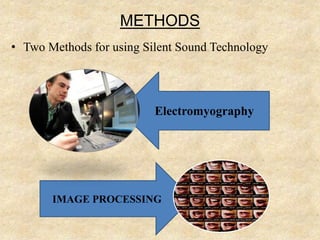
• Two Methods for using Silent Sound Technology
Electromyography
IMAGE PROCESSING
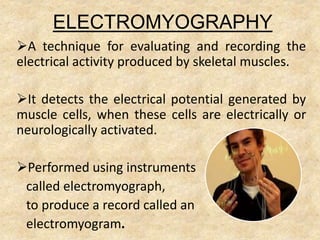
ELECTROMYOGRAPHY
A technique for evaluating and recording the
electrical activity produced by skeletal muscles.
It detects the electrical potential generated by
muscle cells, when these cells are electrically or
neurologically activated.
Performed using instruments
called electromyograph,
to produce a record called an
electromyogram.
ELECTROMYOGRAPHY
PROCESS
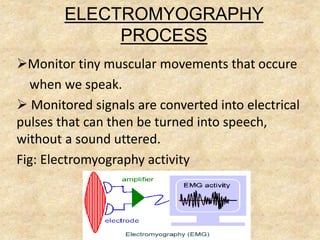
Monitor tiny muscular movements that occure
when we speak.
 Monitored signals are converted into electrical
pulses that can then be turned into speech,
without a sound uttered.
Fig: Electromyography activity
IMAGE PROCESSING
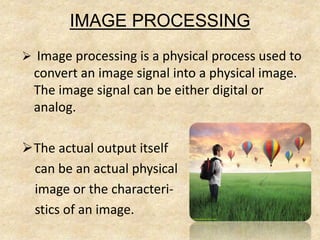
 Image processing is a physical process used to
convert an image signal into a physical image.
The image signal can be either digital or
analog.
The actual output itself
can be an actual physical
image or the characteri-
stics of an image.
ANALOG IMAGE PROCESSING
It applied to hardcopy of data such as photographs.It
includes optical photogrammetric techniques
allowing for precise measurement of
height,width,location etc.
Elements of image interpretation:
 Primary elements : black and white tone,colour
tone.
Spatial arrangement of tone : size,shape,texture
pattern.
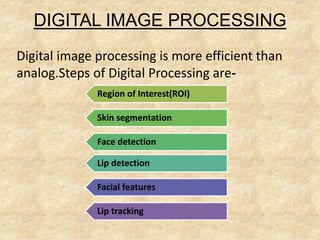
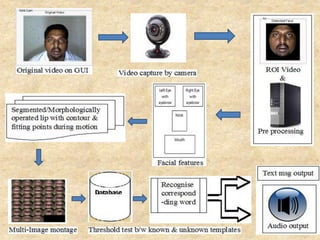
DIGITAL IMAGE PROCESSING
Digital image processing is more efficient than
analog.Steps of Digital Processing are-
Region of Interest(ROI)
Skin segmentation
Face detection
Lip detection
Facial features
Lip tracking
APPLICATION
 People can communicate in different languages
by translating the output of SST.
 Helps to Analyse and understand the people
who have lost voice to speak or stuttering
problem.
 Silent Sound Techniques is applied in Military for
communicating secret/confidential matters to
others.
 Software can be installed in wrist watch, wrist
tag or display/Mobile/Pc and etc.
RESTRICTIONS
 Translation into majority of languages but for
languages such as Chinese different tone holds
different meaning, facial movements being the
same. Hence this technology is difficult to apply in
such situations.
 From security point of view recognizing who you are
talking to gets complicated . Even differentiating
between people and emotions cannot be done. This
means you will always feel you are talking to a robot.
CONCLUSION
Software can be integrated onto mobile oriented or
hand-held devices.
Lip read for Chinese language Mandarin is highly
personalized.
Systems are still preliminary need improvement.
The software is being trained based on the lip
structure, complexion and features of the lip area.
REFERERENCES
http://www.ijettjournal.org/volume-9
http://en.wikipedia.org/wiki/Silent_speech_in
terface
http://www.ijera.com/papers/Vol4_issue4/Ve
rsion%209/K44095156.pdf

Silent Sound Technology

  • 1.
    SILENT SOUND TECHNOLOGY By Moumita Deb ClassRoll No: 134 WBUT Roll No: 1090113129 Stream: CSE
  • 2.
    CONTENT  Introduction  Needof Silent Sound  Methods  Electromyography  Image Processing i) Analog Image Processing ii) Digital Image Processing  Applications  Restriction  Conclusion “talking without talking”
  • 3.
    INTRODUCTION • Amazing solutionfor those who had lost their voice but wish to speak over phone. • Developed at the Karlsruhe Institute of Technology, Germany. • Detects every lip movement and Internally converts the electrical pulses into sounds signals and sends them neglecting all other surrounding noise.
  • 4.
    NEED FOR SILENTSOUND An end to embarrassed situations such as:  A person answering his silent, but vibrating cell phone in a meeting, lecture or performance, and whispering loudly, “ I can’t talk to you right now” .  In the case of an urgent call, apologetically rushing out of the room in order to answer or call the person back.
  • 5.
    METHODS • Two Methodsfor using Silent Sound Technology Electromyography IMAGE PROCESSING
  • 6.
    ELECTROMYOGRAPHY A technique forevaluating and recording the electrical activity produced by skeletal muscles. It detects the electrical potential generated by muscle cells, when these cells are electrically or neurologically activated. Performed using instruments called electromyograph, to produce a record called an electromyogram.
  • 7.
    ELECTROMYOGRAPHY PROCESS Monitor tiny muscularmovements that occure when we speak.  Monitored signals are converted into electrical pulses that can then be turned into speech, without a sound uttered. Fig: Electromyography activity
  • 8.
    IMAGE PROCESSING  Imageprocessing is a physical process used to convert an image signal into a physical image. The image signal can be either digital or analog. The actual output itself can be an actual physical image or the characteri- stics of an image.
  • 9.
    ANALOG IMAGE PROCESSING Itapplied to hardcopy of data such as photographs.It includes optical photogrammetric techniques allowing for precise measurement of height,width,location etc. Elements of image interpretation:  Primary elements : black and white tone,colour tone. Spatial arrangement of tone : size,shape,texture pattern.
  • 10.
    DIGITAL IMAGE PROCESSING Digitalimage processing is more efficient than analog.Steps of Digital Processing are- Region of Interest(ROI) Skin segmentation Face detection Lip detection Facial features Lip tracking
  • 12.
    APPLICATION  People cancommunicate in different languages by translating the output of SST.  Helps to Analyse and understand the people who have lost voice to speak or stuttering problem.  Silent Sound Techniques is applied in Military for communicating secret/confidential matters to others.  Software can be installed in wrist watch, wrist tag or display/Mobile/Pc and etc.
  • 13.
    RESTRICTIONS  Translation intomajority of languages but for languages such as Chinese different tone holds different meaning, facial movements being the same. Hence this technology is difficult to apply in such situations.  From security point of view recognizing who you are talking to gets complicated . Even differentiating between people and emotions cannot be done. This means you will always feel you are talking to a robot.
  • 14.
    CONCLUSION Software can beintegrated onto mobile oriented or hand-held devices. Lip read for Chinese language Mandarin is highly personalized. Systems are still preliminary need improvement. The software is being trained based on the lip structure, complexion and features of the lip area.
  • 15.