Sound Movies By: Marc Blasco Gallego Alejandro López Fayula Ferran Bertomeu Castells
Index Steps from silent to sound movies Introduction Advance sound-on-disc The first sound movie Racism in movies Bibliography Outtakes
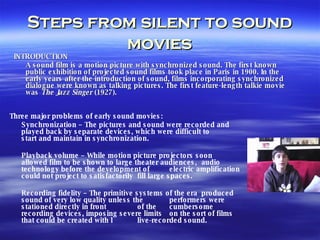
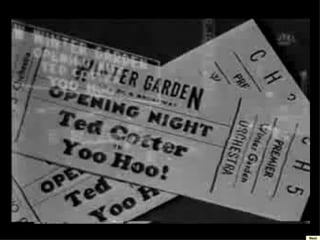
Steps from silent to sound movies INTRODUCTION A sound film is a motion picture with synchronized sound. The first known public exhibition of projected sound films took place in Paris in 1900. In the early years after the introduction of sound, films incorporating synchronized dialogue were known as talking pictures. The first feature-length talkie movie was  The Jazz Singer  (1927).   Three major problems of early sound movies: Synchronization   – The pictures and sound were recorded and  played back by separate devices, which were difficult to  start and maintain in synchronization. Playback volume – While motion picture projectors soon  allowed film to be shown to large theater audiences,  audio technology before the development of  electric amplification could not project to satisfactorily  fill large spaces.  Recording fidelity – The primitive systems of the era  produced sound of very low quality unless the  performers were stationed directly in front  of the  cumbersome recording devices, imposing severe limits  on the sort of films that could be created with l live-recorded sound.
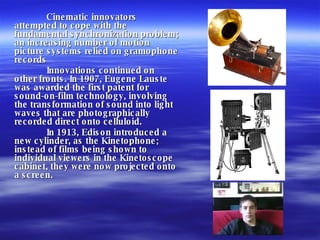
Cinematic innovators attempted to cope with the fundamental synchronization problem; an increasing number of motion picture systems relied on gramophone records Innovations continued on other fronts. In 1907, Eugene Lauste was awarded the first patent for sound-on-film technology, involving the transformation of sound into light waves that are photographically recorded direct onto celluloid. In 1913, Edison introduced a new cylinder, as the Kinetophone; instead of films being shown to individual viewers in the Kinetoscope cabinet, they were now projected onto a screen.
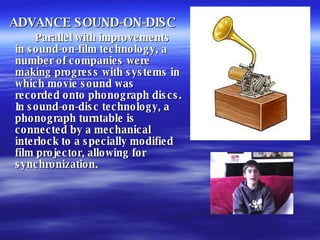
ADVANCE SOUND-ON-DISC Parallel with improvements in sound-on-film technology, a number of companies were making progress with systems in which movie sound was recorded onto phonograph discs. In sound-on-disc technology, a phonograph turntable is connected by a mechanical interlock to a specially modified film projector, allowing for synchronization.
In 1925, Warner Bros began experimenting with sound-on-disc systems at New York's Vitagraph Studios. The Warner Bros. technology, named Vitaphone, was publicly introduced on August 6, 1926, with the premiere of the nearly three-hour-long  Don Juan ; the first feature-length movie to employ a synchronized sound system of any type throughout, its soundtrack contained a musical score and sound effects, but no recorded dialogue—in other words, it had been staged and shot as a silent film.
The first sound movie The jazz singer DIRECTOR : Alan Crosland PLOT : Cantor Rabinowitz is concerned and upset because his son Jakie shows so little interest in carrying on the family's traditions and heritage. For five generations, men in the family have been Cantors in the synagogue, but Jakie is more interested in jazz and ragtime music. One day, they have such a bitter argument that Jakie leaves home for good. After a few years on his own, now calling himself Jack Robin, he gets an important opportunity through the help of well-known stage performer Mary Dale. But Jakie finds that in order to balance his career, his relationship with Mary, and his memories of his family, he will be forced to make some difficult choices.  Written by Snow Leopard
Next
Racism in movies In Hollywood, as in all United States, there had been racism for years. In  The Jazz singer,  as you have seen, the actor isn’t a black man, is a white man painted of black. We have interview one normal afro American person. Let’s see the video.
Next
Bibliography www.wikipedia.uk www.google.es Other web pages that we don’t remember
Outtakes

Sound Movies

  • 1.
    Sound Movies By:Marc Blasco Gallego Alejandro López Fayula Ferran Bertomeu Castells
  • 2.
    Index Steps fromsilent to sound movies Introduction Advance sound-on-disc The first sound movie Racism in movies Bibliography Outtakes
  • 3.
    Steps from silentto sound movies INTRODUCTION A sound film is a motion picture with synchronized sound. The first known public exhibition of projected sound films took place in Paris in 1900. In the early years after the introduction of sound, films incorporating synchronized dialogue were known as talking pictures. The first feature-length talkie movie was The Jazz Singer (1927). Three major problems of early sound movies: Synchronization – The pictures and sound were recorded and played back by separate devices, which were difficult to start and maintain in synchronization. Playback volume – While motion picture projectors soon allowed film to be shown to large theater audiences, audio technology before the development of electric amplification could not project to satisfactorily fill large spaces. Recording fidelity – The primitive systems of the era produced sound of very low quality unless the performers were stationed directly in front of the cumbersome recording devices, imposing severe limits on the sort of films that could be created with l live-recorded sound.
  • 4.
    Cinematic innovators attemptedto cope with the fundamental synchronization problem; an increasing number of motion picture systems relied on gramophone records Innovations continued on other fronts. In 1907, Eugene Lauste was awarded the first patent for sound-on-film technology, involving the transformation of sound into light waves that are photographically recorded direct onto celluloid. In 1913, Edison introduced a new cylinder, as the Kinetophone; instead of films being shown to individual viewers in the Kinetoscope cabinet, they were now projected onto a screen.
  • 5.
    ADVANCE SOUND-ON-DISC Parallelwith improvements in sound-on-film technology, a number of companies were making progress with systems in which movie sound was recorded onto phonograph discs. In sound-on-disc technology, a phonograph turntable is connected by a mechanical interlock to a specially modified film projector, allowing for synchronization.
  • 6.
    In 1925, WarnerBros began experimenting with sound-on-disc systems at New York's Vitagraph Studios. The Warner Bros. technology, named Vitaphone, was publicly introduced on August 6, 1926, with the premiere of the nearly three-hour-long Don Juan ; the first feature-length movie to employ a synchronized sound system of any type throughout, its soundtrack contained a musical score and sound effects, but no recorded dialogue—in other words, it had been staged and shot as a silent film.
  • 7.
    The first soundmovie The jazz singer DIRECTOR : Alan Crosland PLOT : Cantor Rabinowitz is concerned and upset because his son Jakie shows so little interest in carrying on the family's traditions and heritage. For five generations, men in the family have been Cantors in the synagogue, but Jakie is more interested in jazz and ragtime music. One day, they have such a bitter argument that Jakie leaves home for good. After a few years on his own, now calling himself Jack Robin, he gets an important opportunity through the help of well-known stage performer Mary Dale. But Jakie finds that in order to balance his career, his relationship with Mary, and his memories of his family, he will be forced to make some difficult choices. Written by Snow Leopard
  • 8.
  • 9.
    Racism in moviesIn Hollywood, as in all United States, there had been racism for years. In The Jazz singer, as you have seen, the actor isn’t a black man, is a white man painted of black. We have interview one normal afro American person. Let’s see the video.
  • 10.
  • 11.
    Bibliography www.wikipedia.uk www.google.esOther web pages that we don’t remember
  • 12.