PRESENTED BY
N.SINDHU SRI (19C61A0420)
CONTENTS
•Introduction
•Need of Silent Sound Technology
•Methods
•Features
• Applications
•Conclusion
•References
 It is a technology that helps you to transmit
information without using your vocal cords.
 This technology aims to notice lip movements &
transform them into a computer generated sound that
can be transmitted over a phone.
 Hence person on other end of phone receives the
information in audio
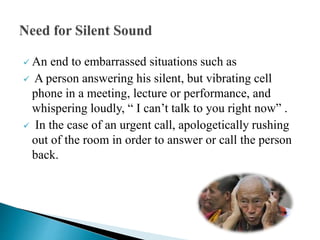
 An end to embarrassed situations such as
 A person answering his silent, but vibrating cell
phone in a meeting, lecture or performance, and
whispering loudly, “ I can’t talk to you right now” .
 In the case of an urgent call, apologetically rushing
out of the room in order to answer or call the person
back.
HOW WE SPEAK……….?
 When we generally speak aloud, air passes through larynx &
the tongue. Words are produced using articulator muscle in
the mouth & jaw region.
 Recently it is proved that when we are about to speak
due to reflex action of muscles the articulate muscle
becomes active irrespective of wheter air is passed through
them or not
 Even by saying words without producing sound weak
electric currents are sent from brain to speech muscles. This
phenomenon is called ELECTROMYOGRAPHS
1. Electromyography
Monitoring tiny muscular movements that occur when we speak.
Signals are converted into electrical pulses that can then be turned
into speech, without a sound uttered.
2. Image Processing
Converting digital data tape into a film image with minimal
corrections and calibrations.
 Large mainframe computers employed for sophisticated
interactive manipulation of the data.
Some of the features of silent sound technology are
Native speakers can silently utter a sentence in their language, and the receivers
can hear the translated sentence in their language.
It appears as if the native speaker produced speech in a foreign language.
The translation technology works for languages like English, French and German,
except Chinese, where different tones can hold many different meanings.
 Allow people to make silent calls without bothering others.
The Technology opens up a host of application such as mentioned below
Helping people who have lost their voice due to illness or accident.
Telling a trusted friend your PIN number over the phone without
anyone eavesdropping — assuming no lip-readers are around.
Silent Sound Techniques is applied in Military for communicating
secret/confidential matters to others.
CONCLUSION
• Thus Silent Sound Technology, one of the recent
trends in the field of Information technology
implements ‘Talking Without Talking’.
• It will be one of the innovative and useful
technology and in mere future this technology will
be of use in day to day life.
silent sound technology.pptx

silent sound technology.pptx

  • 1.
  • 2.
    CONTENTS •Introduction •Need of SilentSound Technology •Methods •Features • Applications •Conclusion •References
  • 3.
     It isa technology that helps you to transmit information without using your vocal cords.  This technology aims to notice lip movements & transform them into a computer generated sound that can be transmitted over a phone.  Hence person on other end of phone receives the information in audio
  • 5.
     An endto embarrassed situations such as  A person answering his silent, but vibrating cell phone in a meeting, lecture or performance, and whispering loudly, “ I can’t talk to you right now” .  In the case of an urgent call, apologetically rushing out of the room in order to answer or call the person back.
  • 6.
    HOW WE SPEAK……….? When we generally speak aloud, air passes through larynx & the tongue. Words are produced using articulator muscle in the mouth & jaw region.
  • 7.
     Recently itis proved that when we are about to speak due to reflex action of muscles the articulate muscle becomes active irrespective of wheter air is passed through them or not  Even by saying words without producing sound weak electric currents are sent from brain to speech muscles. This phenomenon is called ELECTROMYOGRAPHS
  • 8.
    1. Electromyography Monitoring tinymuscular movements that occur when we speak. Signals are converted into electrical pulses that can then be turned into speech, without a sound uttered. 2. Image Processing Converting digital data tape into a film image with minimal corrections and calibrations.  Large mainframe computers employed for sophisticated interactive manipulation of the data.
  • 9.
    Some of thefeatures of silent sound technology are Native speakers can silently utter a sentence in their language, and the receivers can hear the translated sentence in their language. It appears as if the native speaker produced speech in a foreign language. The translation technology works for languages like English, French and German, except Chinese, where different tones can hold many different meanings.  Allow people to make silent calls without bothering others.
  • 10.
    The Technology opensup a host of application such as mentioned below Helping people who have lost their voice due to illness or accident. Telling a trusted friend your PIN number over the phone without anyone eavesdropping — assuming no lip-readers are around. Silent Sound Techniques is applied in Military for communicating secret/confidential matters to others.
  • 11.
    CONCLUSION • Thus SilentSound Technology, one of the recent trends in the field of Information technology implements ‘Talking Without Talking’. • It will be one of the innovative and useful technology and in mere future this technology will be of use in day to day life.