Department of Electronics and Communication Engineering
Technical Seminar
on
Silent Sound Technology
CONTENTS
• Introduction
• Need for Silent Sound
• History
• Methods
• Advantages
• Disadvantages
• Applications
• Future prospects
• Conclusion
• References
INTRODUCTION
o It is a technology that helps you to transmit information without using
your vocal cords.
o This technology aims to notice lip movements & transform them into a
computer generated sound that can be transmitted over a phone.
o Hence the person on other end of phone receives the information in
audio.
NEED FOR SILENT SOUND
 For a better way of communication in noisy public places.
 As the electronic pulses are universal, so they can be immediately converted into
any other language of your choice.
 Helps to share confidential information using phone.
 Gives a better and new way of communication for those people who lost their voice.
HISTORY
• This technology is being developed by scientists of Karlsruhe Institute of
Technology (KIT), Germany.
• In 2010, at CEBIT one of the largest trade fair, a new concept called “SILENT
SOUND TECHNOLOGY” was demonstrated.
• The idea of interpreting silent speech electronically or with a computer was
popularized in 1968.
METHODS
• Silent Sound Technology is Processed Through Two ways
 Electromyography.
Image processing.
ELECTROMYOGRAPHY (EMG)
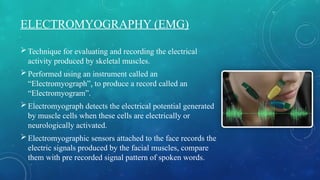
Technique for evaluating and recording the electrical
activity produced by skeletal muscles.
Performed using an instrument called an
“Electromyograph”, to produce a record called an
“Electromyogram”.
Electromyograph detects the electrical potential generated
by muscle cells when these cells are electrically or
neurologically activated.
Electromyographic sensors attached to the face records the
electric signals produced by the facial muscles, compare
them with pre recorded signal pattern of spoken words.
HOW WE SPEAK….?
• When we generally speak aloud, air passes through larynx & tongue. Words are produced
using articulator muscle in the mouth & jaw region.
• Recently it is proved that the articulator muscle become active
irrespective of whether air passes through them or not.
• Even by saying words without producing sound, weak electric currents
are sent from your brain to the speech muscle. This phenomenon is called
ELECTROMYOGRAPHS.
• These electric signals are known as ELECTROGRAMS.
ELECTROMYOGRAPHY PROCESS
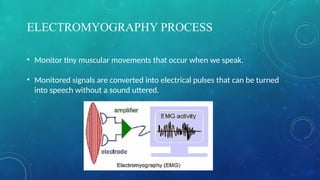
• Monitor tiny muscular movements that occur when we speak.
• Monitored signals are converted into electrical pulses that can be turned
into speech without a sound uttered.
IMAGE PROCESSING
• Image processing is a physical process used to convert an image signal into a
physical image. The image signal can be digital or analog.
• The actual output itself can be the actual physical image or the characteristics
of an image with minimal corrections and calibrations.
• Imaging technique is a method to obtain direct information on the vocal tract
configuration.
• Ultrasound imagery is a non-invasive and clinically safe procedure.
• An ultrasound transducer, placed beneath the chin, can provide a partial view
of the tongue surface.
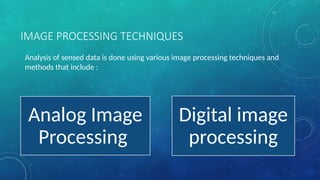
IMAGE PROCESSING TECHNIQUES
Analog Image
Processing
Digital image
processing
Analysis of sensed data is done using various image processing techniques and
methods that include :
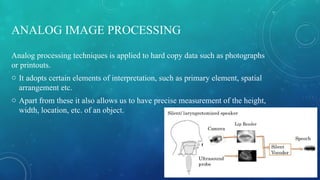
ANALOG IMAGE PROCESSING
Analog processing techniques is applied to hard copy data such as photographs
or printouts.
o It adopts certain elements of interpretation, such as primary element, spatial
arrangement etc.
o Apart from these it also allows us to have precise measurement of the height,
width, location, etc. of an object.
DIGITAL IMAGE PROCESSING
• Digital image processing involves a collection of techniques for the
manipulation of the digital image by computers. It contains some flaws. To
overcome the flaws and deficiencies in order to get the originality of the
data, it needs to undergo several steps of processing.
• Digital Image processing undergoes three general steps:
• Pre-processing
• Display and Enhancement
• Information extraction
Pre-processing:
Pre-processing consists of those operations that prepare data for subsequent
analysis that attempts to correct or compensate for systematic errors.
Image enhancement:
The aim of image enhancement is to improve the interpretability or perception of
information in digital data for human viewers.
Information extraction:
In this remotely sensed data is subjected to quantitative analysis.
IE is used in evaluating and comparing different natural language processing
technologies.
The final result of the analysis consists of maps or images, data and a report.
Then these are converted to corresponding signals
ADVANTAGES
• We can make silent calls even if we are standing in a crowded place.
• Since the electric signals are universal they can be translated to any
language.
• The communication is done without any disturbance.
• Helping people who have lost their voice due to illness or an accident.
DISADVANTAGES
• Translation into languages such as Chinese different tone hols different
meanings, facial movements being the same. Hence this technology is difficult
to apply in such situations.
• From security point of view recognising who you are talking to gets
complicated.
• Differentiating between people and emotions cannot be done. This means you
will always feel like talking to a robot
• This device needs nine leads to be attached tp the face which is quite
impractical to make it usable.
APPLICATIONS
• As we know in space there is no medium of sound to travel
therefore this technology can be utilised by the astronauts.
• It is utilised in the Military for communicating secret/confidential
information among them.
• The password/pin number can be shared with the friends with no
fear of eavesdroppers.
FUTURE PROSPECTS
Silent sound technology gives way to a bright future to speech
recognition technology from simple voice commands to
memorandum dictated over the phone i.e. possible in noisy places.
Without hanging electrodes all around face, these electrodes will be
incorporated into cell phones
Nano technology will be a mentionable step towards making the
device handy.
CONCLUSION
• Silent sound technology, one of the recent trends in the field that implements
‘talking without talking’.
• Engineers claim that the device is working with 99% efficiency.
• It will be one of the innovative and useful technology and in mere future this
technology will be of use in day to day life.
• Provide easier communication for people with the speech disabilities by
identified lip movements directly to speech.
REFERENCES
• Vibhu Varshney, Deeksha Singh, Ayush Tiwari, "Deep learning and its applications in Silent
Sound Technology", international conference on computing for sustainable global
development, 978-9- 3805-4421-2/16, pages 2719-2720, IEEE 2016
• Honey Brijwani et al int. Journal of engineering research and applications ISSN: 2248-9622,
vol. 4, issue 4( version 9), April 2014
• International journal of engineering trends and technology (IJETT) volume 9 number14 mar
2014
• Shehjar Safayas, Kameshwar Sharma, silent sound technology- an end to noisy
communication, speech communication vol. 1, issue 9, November 2013
• Michael Wand & Tanja Schultz, voice conversion for silent sound technology, (icassp) KIT
Germany 2011
• Priya jethani and Bharat Choudhari, "Silent Sound Technology: A solution to noisy
communication".
ANY QUESTIONS ?
THANK YOU

Silent_Sound_Technology_using _electromyography & image processing [1].pptx

  • 1.
    Department of Electronicsand Communication Engineering Technical Seminar on Silent Sound Technology
  • 2.
    CONTENTS • Introduction • Needfor Silent Sound • History • Methods • Advantages • Disadvantages • Applications • Future prospects • Conclusion • References
  • 3.
    INTRODUCTION o It isa technology that helps you to transmit information without using your vocal cords. o This technology aims to notice lip movements & transform them into a computer generated sound that can be transmitted over a phone. o Hence the person on other end of phone receives the information in audio.
  • 4.
    NEED FOR SILENTSOUND  For a better way of communication in noisy public places.  As the electronic pulses are universal, so they can be immediately converted into any other language of your choice.  Helps to share confidential information using phone.  Gives a better and new way of communication for those people who lost their voice.
  • 5.
    HISTORY • This technologyis being developed by scientists of Karlsruhe Institute of Technology (KIT), Germany. • In 2010, at CEBIT one of the largest trade fair, a new concept called “SILENT SOUND TECHNOLOGY” was demonstrated. • The idea of interpreting silent speech electronically or with a computer was popularized in 1968.
  • 6.
    METHODS • Silent SoundTechnology is Processed Through Two ways  Electromyography. Image processing.
  • 7.
    ELECTROMYOGRAPHY (EMG) Technique forevaluating and recording the electrical activity produced by skeletal muscles. Performed using an instrument called an “Electromyograph”, to produce a record called an “Electromyogram”. Electromyograph detects the electrical potential generated by muscle cells when these cells are electrically or neurologically activated. Electromyographic sensors attached to the face records the electric signals produced by the facial muscles, compare them with pre recorded signal pattern of spoken words.
  • 8.
    HOW WE SPEAK….? •When we generally speak aloud, air passes through larynx & tongue. Words are produced using articulator muscle in the mouth & jaw region.
  • 9.
    • Recently itis proved that the articulator muscle become active irrespective of whether air passes through them or not. • Even by saying words without producing sound, weak electric currents are sent from your brain to the speech muscle. This phenomenon is called ELECTROMYOGRAPHS. • These electric signals are known as ELECTROGRAMS.
  • 10.
    ELECTROMYOGRAPHY PROCESS • Monitortiny muscular movements that occur when we speak. • Monitored signals are converted into electrical pulses that can be turned into speech without a sound uttered.
  • 11.
    IMAGE PROCESSING • Imageprocessing is a physical process used to convert an image signal into a physical image. The image signal can be digital or analog. • The actual output itself can be the actual physical image or the characteristics of an image with minimal corrections and calibrations. • Imaging technique is a method to obtain direct information on the vocal tract configuration. • Ultrasound imagery is a non-invasive and clinically safe procedure. • An ultrasound transducer, placed beneath the chin, can provide a partial view of the tongue surface.
  • 12.
    IMAGE PROCESSING TECHNIQUES AnalogImage Processing Digital image processing Analysis of sensed data is done using various image processing techniques and methods that include :
  • 13.
    ANALOG IMAGE PROCESSING Analogprocessing techniques is applied to hard copy data such as photographs or printouts. o It adopts certain elements of interpretation, such as primary element, spatial arrangement etc. o Apart from these it also allows us to have precise measurement of the height, width, location, etc. of an object.
  • 14.
    DIGITAL IMAGE PROCESSING •Digital image processing involves a collection of techniques for the manipulation of the digital image by computers. It contains some flaws. To overcome the flaws and deficiencies in order to get the originality of the data, it needs to undergo several steps of processing. • Digital Image processing undergoes three general steps: • Pre-processing • Display and Enhancement • Information extraction
  • 15.
    Pre-processing: Pre-processing consists ofthose operations that prepare data for subsequent analysis that attempts to correct or compensate for systematic errors. Image enhancement: The aim of image enhancement is to improve the interpretability or perception of information in digital data for human viewers. Information extraction: In this remotely sensed data is subjected to quantitative analysis. IE is used in evaluating and comparing different natural language processing technologies. The final result of the analysis consists of maps or images, data and a report. Then these are converted to corresponding signals
  • 16.
    ADVANTAGES • We canmake silent calls even if we are standing in a crowded place. • Since the electric signals are universal they can be translated to any language. • The communication is done without any disturbance. • Helping people who have lost their voice due to illness or an accident.
  • 17.
    DISADVANTAGES • Translation intolanguages such as Chinese different tone hols different meanings, facial movements being the same. Hence this technology is difficult to apply in such situations. • From security point of view recognising who you are talking to gets complicated. • Differentiating between people and emotions cannot be done. This means you will always feel like talking to a robot • This device needs nine leads to be attached tp the face which is quite impractical to make it usable.
  • 18.
    APPLICATIONS • As weknow in space there is no medium of sound to travel therefore this technology can be utilised by the astronauts. • It is utilised in the Military for communicating secret/confidential information among them. • The password/pin number can be shared with the friends with no fear of eavesdroppers.
  • 19.
    FUTURE PROSPECTS Silent soundtechnology gives way to a bright future to speech recognition technology from simple voice commands to memorandum dictated over the phone i.e. possible in noisy places. Without hanging electrodes all around face, these electrodes will be incorporated into cell phones Nano technology will be a mentionable step towards making the device handy.
  • 20.
    CONCLUSION • Silent soundtechnology, one of the recent trends in the field that implements ‘talking without talking’. • Engineers claim that the device is working with 99% efficiency. • It will be one of the innovative and useful technology and in mere future this technology will be of use in day to day life. • Provide easier communication for people with the speech disabilities by identified lip movements directly to speech.
  • 21.
    REFERENCES • Vibhu Varshney,Deeksha Singh, Ayush Tiwari, "Deep learning and its applications in Silent Sound Technology", international conference on computing for sustainable global development, 978-9- 3805-4421-2/16, pages 2719-2720, IEEE 2016 • Honey Brijwani et al int. Journal of engineering research and applications ISSN: 2248-9622, vol. 4, issue 4( version 9), April 2014 • International journal of engineering trends and technology (IJETT) volume 9 number14 mar 2014 • Shehjar Safayas, Kameshwar Sharma, silent sound technology- an end to noisy communication, speech communication vol. 1, issue 9, November 2013 • Michael Wand & Tanja Schultz, voice conversion for silent sound technology, (icassp) KIT Germany 2011 • Priya jethani and Bharat Choudhari, "Silent Sound Technology: A solution to noisy communication".
  • 22.
  • 23.