SILENT
SOUND
TECHNOLOG
Y
A SEMINAR PRESENTATION
- BY NAGMA PARWEEN
REG NO:-16900118013
(ACADEMY OF
TECHNOLOGY)
CONTENTS
 COVER PAGE
 TABLE OF CONTENT
 ABSTRACT
 PROBLEM STATEMENT
 ORIGINATION
 WHAT IS SILENT SOUND TECHNOLOGY?
 METHODS
 ELECTROMYOGRAPHY
 WORKING OF ELECTROMYOGRAPHY
 IMAGE PROCESSING
 APPLICATION
 RESEARCH AND FUTURE PROSPECTS
 CONCLUSION
ABSTRACT
 The Silent sound technology is an amazing solution for
those who had lost their voice but wish to communicate
over the phone. This technology basically allows people to
make calls without producing sounds.
 It is developed at the Karlsruhe Institute of Technology.
This technology basically detect every lip movement and
internally converts the electrical pulses into sounds signals
and sends them neglecting all other surrounding noise.
 This report outlines the history associated with this
technology presenting the method or techniques used in
achieving silent sounds, which are electromyography and
Image processing.
 This research reviews the underlined futures of the
technology that immediately transforms into the language
of the user's choice but, for the languages like Chinese
different tones can hold many different meanings. This
technology basically works with 99% efficiency, and can be
PROBLEM STATEMENT
Embarrassing situation such as :-
 1. A person answering his silent, but vibrating cell
phone in a meeting, lecture or performance, and
whispering loudly, “I can’t talk to you right now”.
 2. In the case of an urgent call, apologetically
rushing out of the room in order to answer or call
the person back.
 3. Need to answer and understand calls which is
in a different language.
ORIGINATION
 The idea of interpreting silent speech electronically or with a
computer has been around for a long time, and was
popularized in the 1968 Stanley Kubrick science-fiction film
‘‘2001-A Space Odyssey.” (Brumberg, 2010).
 A major focal point was the DARPA Advanced Speech
Encoding Program (ASE ) of the early 2000’s, which funded
research on low bit rate speech synthesis ‘‘with acceptable
intelligibility, quality , and aural speaker recognisability in
acoustically harsh environments”.
 In the 2010 CeBIT's "future park", a concept (Schultz, 2010)
"Silent Sound" Technology demonstrated which aims to
notice every movement of the lips and transform them into
sounds, which could help people who lose voices to speak,
and allow people to make silent calls without bothering
others.
 The technology, developed by the Karlsruhe Institute of
Technology (KIT) scientist,Germany.
WHAT IS SILENT SOUND TECHNOLOGY
?
 It is a technology that helps you to transmit information
without using your vocal cords. This technology aims to
notice lip movements & transform them into a computer
generated sound that can be transmitted over a phone.
Hence person on other end of phone receives the
information in audio.
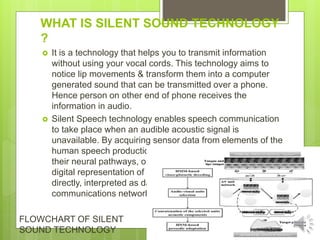
 Silent Speech technology enables speech communication
to take place when an audible acoustic signal is
unavailable. By acquiring sensor data from elements of the
human speech production process – from the articulators,
their neural pathways, or the brain itself – it produces a
digital representation of speech which can be synthesized
directly, interpreted as data, or routed into a
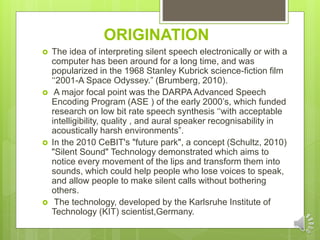
communications network.
FLOWCHART OF SILENT
SOUND TECHNOLOGY
METHODS
Silent Sound Technology is processed through some ways or
methods. They are –
 Electromyography (EMG).
 Image Processing.
 ELECTROMYOGRAPHY :
Electromyography (EMG) is a technique for
evaluating and recording the electrical
activity produced by skeletal muscles.
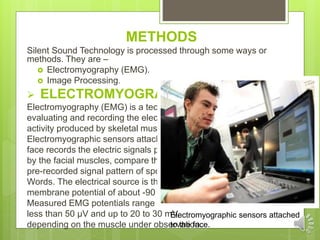
Electromyographic sensors attached to the
face records the electric signals produced
by the facial muscles, compare them with
pre-recorded signal pattern of spoken
Words. The electrical source is the muscle
membrane potential of about -90 mV.
Measured EMG potentials range between
less than 50 μV and up to 20 to 30 mV,
depending on the muscle under observation.
Electromyographic sensors attached
to the face.
 WORKING OF ELECTROMYOGRAPHY
 A needle containing two fine-wired electrodes is inserted
through the skin into the muscle tissue.
 Then the electrical activity when the muscle is at rest is
observed. Each electrode track gives only a very local picture
of the activity of the whole muscle
 Because skeletal muscles differ in the inner structure, the
electrode has to be placed at various locations to obtain an
accurate signal.
Thus by this way the speech can be communicated without
sound
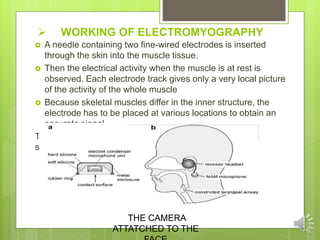
THE CAMERA
ATTATCHED TO THE
 IMAGE PROCESSING
Analysis of remotely sensed data is done using various image
processing techniques and methods that includes :
 Analog image processing.
 Digital image processing.
Analog technique processing : is applied to hard copy
data such as photographs or printouts.It adopts certain
elements of interpretation, such as primary element, spatial
arrangement etc.
Digital Image Processing : involves a collection of
techniques for the manipulation of digital images by
computers. It contain some flaws. To overcome the flaws and
deficiencies in order to get the originality of the data, it needs
to undergo several steps of processing.
Digital Image Processing undergoes three general steps :
 1. Pre-processing
 2. Display and enhancement
APPLICATION
 As we know in space there is no medium for sound to travel
therefore this technology can be best utilized by astronauts.
 This technology is helpful for people without vocal cord or
those who are suffering from Aphasia (speaking disorder).
 We can make silent calls even if we are standing in a
crowded place.
 Silent Sound Techniques is applied in Military for
communicating secret/confidential matters to others.
 Silent sound technology gives way to a bright future to
speech recognition technology from simple voice commands
to memorandum dictated over the phone all this is fairly
possible in noisy public places.
 Nano technology will be a mentionable step towards making
the device handy.
RESEARCH AND FUTURE
PROSPECT
CONCLUSION
 Silent Sound Technology, one of the recent trends in
the field of information technology implements “Talking
without Actually Talking”.
 Engineers claim that the device is working with 99
percent efficiency.
 ‘Silent Sound’ technology aims to notice every
movements of the lips and transform them into sounds,
which couldhelp people who lose voices to speak, and
allow people to make silent calls without bothering
others.
 Rather than making any sounds, your handset would
decipher the movements your mouth makes by
measuring muscle activity, then convert this into
speech that the person on the other end of the call can
hear.
THANK YOU…

SILENT SOUND TECHNOLOGY

  • 1.
    SILENT SOUND TECHNOLOG Y A SEMINAR PRESENTATION -BY NAGMA PARWEEN REG NO:-16900118013 (ACADEMY OF TECHNOLOGY)
  • 2.
    CONTENTS  COVER PAGE TABLE OF CONTENT  ABSTRACT  PROBLEM STATEMENT  ORIGINATION  WHAT IS SILENT SOUND TECHNOLOGY?  METHODS  ELECTROMYOGRAPHY  WORKING OF ELECTROMYOGRAPHY  IMAGE PROCESSING  APPLICATION  RESEARCH AND FUTURE PROSPECTS  CONCLUSION
  • 3.
    ABSTRACT  The Silentsound technology is an amazing solution for those who had lost their voice but wish to communicate over the phone. This technology basically allows people to make calls without producing sounds.  It is developed at the Karlsruhe Institute of Technology. This technology basically detect every lip movement and internally converts the electrical pulses into sounds signals and sends them neglecting all other surrounding noise.  This report outlines the history associated with this technology presenting the method or techniques used in achieving silent sounds, which are electromyography and Image processing.  This research reviews the underlined futures of the technology that immediately transforms into the language of the user's choice but, for the languages like Chinese different tones can hold many different meanings. This technology basically works with 99% efficiency, and can be
  • 4.
    PROBLEM STATEMENT Embarrassing situationsuch as :-  1. A person answering his silent, but vibrating cell phone in a meeting, lecture or performance, and whispering loudly, “I can’t talk to you right now”.  2. In the case of an urgent call, apologetically rushing out of the room in order to answer or call the person back.  3. Need to answer and understand calls which is in a different language.
  • 5.
    ORIGINATION  The ideaof interpreting silent speech electronically or with a computer has been around for a long time, and was popularized in the 1968 Stanley Kubrick science-fiction film ‘‘2001-A Space Odyssey.” (Brumberg, 2010).  A major focal point was the DARPA Advanced Speech Encoding Program (ASE ) of the early 2000’s, which funded research on low bit rate speech synthesis ‘‘with acceptable intelligibility, quality , and aural speaker recognisability in acoustically harsh environments”.  In the 2010 CeBIT's "future park", a concept (Schultz, 2010) "Silent Sound" Technology demonstrated which aims to notice every movement of the lips and transform them into sounds, which could help people who lose voices to speak, and allow people to make silent calls without bothering others.  The technology, developed by the Karlsruhe Institute of Technology (KIT) scientist,Germany.
  • 6.
    WHAT IS SILENTSOUND TECHNOLOGY ?  It is a technology that helps you to transmit information without using your vocal cords. This technology aims to notice lip movements & transform them into a computer generated sound that can be transmitted over a phone. Hence person on other end of phone receives the information in audio.  Silent Speech technology enables speech communication to take place when an audible acoustic signal is unavailable. By acquiring sensor data from elements of the human speech production process – from the articulators, their neural pathways, or the brain itself – it produces a digital representation of speech which can be synthesized directly, interpreted as data, or routed into a communications network. FLOWCHART OF SILENT SOUND TECHNOLOGY
  • 7.
    METHODS Silent Sound Technologyis processed through some ways or methods. They are –  Electromyography (EMG).  Image Processing.  ELECTROMYOGRAPHY : Electromyography (EMG) is a technique for evaluating and recording the electrical activity produced by skeletal muscles. Electromyographic sensors attached to the face records the electric signals produced by the facial muscles, compare them with pre-recorded signal pattern of spoken Words. The electrical source is the muscle membrane potential of about -90 mV. Measured EMG potentials range between less than 50 μV and up to 20 to 30 mV, depending on the muscle under observation. Electromyographic sensors attached to the face.
  • 8.
     WORKING OFELECTROMYOGRAPHY  A needle containing two fine-wired electrodes is inserted through the skin into the muscle tissue.  Then the electrical activity when the muscle is at rest is observed. Each electrode track gives only a very local picture of the activity of the whole muscle  Because skeletal muscles differ in the inner structure, the electrode has to be placed at various locations to obtain an accurate signal. Thus by this way the speech can be communicated without sound THE CAMERA ATTATCHED TO THE
  • 9.
     IMAGE PROCESSING Analysisof remotely sensed data is done using various image processing techniques and methods that includes :  Analog image processing.  Digital image processing. Analog technique processing : is applied to hard copy data such as photographs or printouts.It adopts certain elements of interpretation, such as primary element, spatial arrangement etc. Digital Image Processing : involves a collection of techniques for the manipulation of digital images by computers. It contain some flaws. To overcome the flaws and deficiencies in order to get the originality of the data, it needs to undergo several steps of processing. Digital Image Processing undergoes three general steps :  1. Pre-processing  2. Display and enhancement
  • 10.
    APPLICATION  As weknow in space there is no medium for sound to travel therefore this technology can be best utilized by astronauts.  This technology is helpful for people without vocal cord or those who are suffering from Aphasia (speaking disorder).  We can make silent calls even if we are standing in a crowded place.  Silent Sound Techniques is applied in Military for communicating secret/confidential matters to others.  Silent sound technology gives way to a bright future to speech recognition technology from simple voice commands to memorandum dictated over the phone all this is fairly possible in noisy public places.  Nano technology will be a mentionable step towards making the device handy. RESEARCH AND FUTURE PROSPECT
  • 11.
    CONCLUSION  Silent SoundTechnology, one of the recent trends in the field of information technology implements “Talking without Actually Talking”.  Engineers claim that the device is working with 99 percent efficiency.  ‘Silent Sound’ technology aims to notice every movements of the lips and transform them into sounds, which couldhelp people who lose voices to speak, and allow people to make silent calls without bothering others.  Rather than making any sounds, your handset would decipher the movements your mouth makes by measuring muscle activity, then convert this into speech that the person on the other end of the call can hear. THANK YOU…