VISVESVARAYA TECHNOLOGICAL UNIVERS
BELAGAVI, KARNATAKA-590018
GOVERNMENT ENGINEERING COLLEGE
Mosalehosahalli-573212,Hassan
Department of Electronics and Communication Engineering
Presentation on
“Silent Sound Technology”
Presentation By:
Yamuna N R 4HG21EC429
Under the guidance of
Prof. veerbadhraswamy
Head of the Department
Electronics and communication Engineering
CONTENTS
1. INTRUDUTION
2. NEED FOR SILENT SOUND
3. METHED
4. ADVANTAGES
5. DISADVATAGES
6. APPILICATIONS
7. FUTURE PROSPECT
8. CONCLUSION
9. REFERENCES
INTRUDUCTION
❑Amazing solution for those who had lost their voice but wish speak over phone.
❑ it is a technology that helps you to transmit information without using your vocal
cords.
❑Detects every lip movement and internally converts the electrical pulses into
sounds signals and sends them neglecting all other surrounding noise.
❑ Hence person on other end of phone receivers the information in audio.
❑ Development at the Karlsruhe Institute of Technology, Germany
❑ Expected in the next 5-10 years. Once launched, will have a drastic effect and
with no doubt, will be widely used.
NEED FOR SILENT SOUND
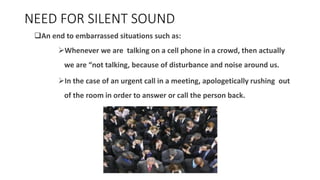
❑An end to embarrassed situations such as:
➢Whenever we are talking on a cell phone in a crowd, then actually
we are “not talking, because of disturbance and noise around us.
➢In the case of an urgent call in a meeting, apologetically rushing out
of the room in order to answer or call the person back.
METHODS
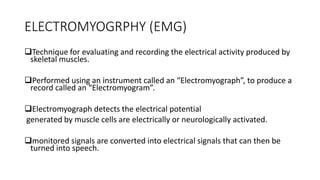
❑ Two Methods for using Silent Sound Technology
1.Electromyography
2.Image processing
ELECTROMYOGRPHY (EMG)
❑Technique for evaluating and recording the electrical activity produced by
skeletal muscles.
❑Performed using an instrument called an “Electromyograph”, to produce a
record called an “Electromyogram”.
❑Electromyograph detects the electrical potential
generated by muscle cells are electrically or neurologically activated.
❑monitored signals are converted into electrical signals that can then be
turned into speech.
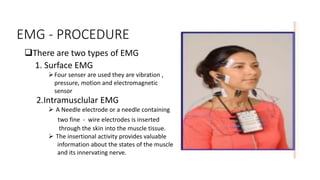
EMG - PROCEDURE
❑There are two types of EMG
1. Surface EMG
➢Four senser are used they are vibration ,
pressure, motion and electromagnetic
sensor
2.Intramusclular EMG
➢ A Needle electrode or a needle containing
two fine - wire electrodes is inserted
through the skin into the muscle tissue.
➢ The insertional activity provides valuable
information about the states of the muscle
and its innervating nerve.
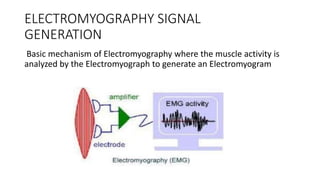
ELECTROMYOGRAPHY SIGNAL
GENERATION
Basic mechanism of Electromyography where the muscle activity is
analyzed by the Electromyograph to generate an Electromyogram
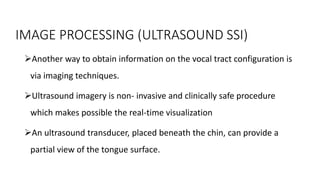
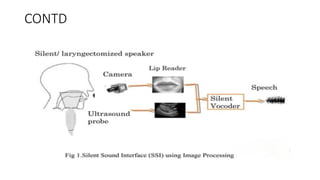
IMAGE PROCESSING (ULTRASOUND SSI)
➢Another way to obtain information on the vocal tract configuration is
via imaging techniques.
➢Ultrasound imagery is non- invasive and clinically safe procedure
which makes possible the real-time visualization
➢An ultrasound transducer, placed beneath the chin, can provide a
partial view of the tongue surface.
CONTD
ADVANTAGES
➢Helping people who have lost their voice due to illness or accident.
➢We can make silent cells even if we are standing in crowded place.
➢Very useful for sharing confidential information like secret PIN
number on phone at public place.
DISADVANTAGES
➢It will be like always talking to robot.
➢This technology will be very costly for a common man.
APPLICATIONS
➢Silent Sound Techniques is applied in military for communicating
secret/confidential matters to others.
➢ This technology can be best utilized by astronauts & dumb
peoples.
FUTURE PROSPECT
➢Without having electrodes & sensors hanging all around the face,
these electrodes & sensors will incorporated in to cell phone.
➢Features like lip reading based on image processing & recognition
these are incorporated in to cell phones rather then using computers
(ultrasound SSI).
CONCLUSION
➢Silent Sound Technology, one of the recent trends in the field of
information technology implements “Talking Without Talking”.
➢It will be one of the innovation and useful technology will be use in
our day to day life.
REFERENCES
❑Honey brijwani et al Int. Journal of engineering Research and
Applications ISSN:2248-9622,Vol. 4, Issue 4(Version 9),April 2014
❑Internation Journal of Engineering Trends and Technology (IJETT) –
Volume 9 Number 14 Mar 2014
❑Shehjar safayas ,kameshwar Sharma , Silent Sound Technology –An
End to Noisy Communication Vol. 1, Issue 9, November 2013
❑Michael Wand & Tanja Schultz, Voice conversion for silent sound
technology, (ICASSP) KIT Germany 2011
THANK YOU

Presentation on silent sound technology ppt

  • 1.
    VISVESVARAYA TECHNOLOGICAL UNIVERS BELAGAVI,KARNATAKA-590018 GOVERNMENT ENGINEERING COLLEGE Mosalehosahalli-573212,Hassan Department of Electronics and Communication Engineering Presentation on “Silent Sound Technology” Presentation By: Yamuna N R 4HG21EC429 Under the guidance of Prof. veerbadhraswamy Head of the Department Electronics and communication Engineering
  • 2.
    CONTENTS 1. INTRUDUTION 2. NEEDFOR SILENT SOUND 3. METHED 4. ADVANTAGES 5. DISADVATAGES 6. APPILICATIONS 7. FUTURE PROSPECT 8. CONCLUSION 9. REFERENCES
  • 3.
    INTRUDUCTION ❑Amazing solution forthose who had lost their voice but wish speak over phone. ❑ it is a technology that helps you to transmit information without using your vocal cords. ❑Detects every lip movement and internally converts the electrical pulses into sounds signals and sends them neglecting all other surrounding noise. ❑ Hence person on other end of phone receivers the information in audio. ❑ Development at the Karlsruhe Institute of Technology, Germany ❑ Expected in the next 5-10 years. Once launched, will have a drastic effect and with no doubt, will be widely used.
  • 4.
    NEED FOR SILENTSOUND ❑An end to embarrassed situations such as: ➢Whenever we are talking on a cell phone in a crowd, then actually we are “not talking, because of disturbance and noise around us. ➢In the case of an urgent call in a meeting, apologetically rushing out of the room in order to answer or call the person back.
  • 5.
    METHODS ❑ Two Methodsfor using Silent Sound Technology 1.Electromyography 2.Image processing
  • 6.
    ELECTROMYOGRPHY (EMG) ❑Technique forevaluating and recording the electrical activity produced by skeletal muscles. ❑Performed using an instrument called an “Electromyograph”, to produce a record called an “Electromyogram”. ❑Electromyograph detects the electrical potential generated by muscle cells are electrically or neurologically activated. ❑monitored signals are converted into electrical signals that can then be turned into speech.
  • 7.
    EMG - PROCEDURE ❑Thereare two types of EMG 1. Surface EMG ➢Four senser are used they are vibration , pressure, motion and electromagnetic sensor 2.Intramusclular EMG ➢ A Needle electrode or a needle containing two fine - wire electrodes is inserted through the skin into the muscle tissue. ➢ The insertional activity provides valuable information about the states of the muscle and its innervating nerve.
  • 8.
    ELECTROMYOGRAPHY SIGNAL GENERATION Basic mechanismof Electromyography where the muscle activity is analyzed by the Electromyograph to generate an Electromyogram
  • 9.
    IMAGE PROCESSING (ULTRASOUNDSSI) ➢Another way to obtain information on the vocal tract configuration is via imaging techniques. ➢Ultrasound imagery is non- invasive and clinically safe procedure which makes possible the real-time visualization ➢An ultrasound transducer, placed beneath the chin, can provide a partial view of the tongue surface.
  • 10.
  • 11.
    ADVANTAGES ➢Helping people whohave lost their voice due to illness or accident. ➢We can make silent cells even if we are standing in crowded place. ➢Very useful for sharing confidential information like secret PIN number on phone at public place.
  • 12.
    DISADVANTAGES ➢It will belike always talking to robot. ➢This technology will be very costly for a common man.
  • 13.
    APPLICATIONS ➢Silent Sound Techniquesis applied in military for communicating secret/confidential matters to others. ➢ This technology can be best utilized by astronauts & dumb peoples.
  • 14.
    FUTURE PROSPECT ➢Without havingelectrodes & sensors hanging all around the face, these electrodes & sensors will incorporated in to cell phone. ➢Features like lip reading based on image processing & recognition these are incorporated in to cell phones rather then using computers (ultrasound SSI).
  • 15.
    CONCLUSION ➢Silent Sound Technology,one of the recent trends in the field of information technology implements “Talking Without Talking”. ➢It will be one of the innovation and useful technology will be use in our day to day life.
  • 16.
    REFERENCES ❑Honey brijwani etal Int. Journal of engineering Research and Applications ISSN:2248-9622,Vol. 4, Issue 4(Version 9),April 2014 ❑Internation Journal of Engineering Trends and Technology (IJETT) – Volume 9 Number 14 Mar 2014 ❑Shehjar safayas ,kameshwar Sharma , Silent Sound Technology –An End to Noisy Communication Vol. 1, Issue 9, November 2013 ❑Michael Wand & Tanja Schultz, Voice conversion for silent sound technology, (ICASSP) KIT Germany 2011
  • 17.