BY: Matt, Ezra, Sloan, Alexis, Kelly
In Sikhism there are two sacred texts, the Guru Granth Sahib and the Dasven Padshah Da Granth. The Guru Granth Sahib thought the Sikh people what god was like and the correct way to live. The five Major points it makes are “1) all peoples of the world are equal. 2) Women are equal 3)one god for all 4)speak and live truthfully 5)control the five vices” The five vices are Pride, Anger, Greed, Attachment, and lust.  The second book the Dasven Padshah Da Granth describes how to praise the Sikh god.
Each day before sunrise, Guru Nanak would go to the river to bathe in the cold water and sing God's praises. But one day he disappeared and could not be found. His clothes were still lying next to the riverbank, but there was no sign of Nanak. His friends walked up and down calling , "Nanak, Nanak," hoping against hope that they would find him. They grew afraid that he had drowned. But Nanak was far from the reach of any of them. He was in a divine trance in which he was sitting in God's own presence. God gave him a cup of nectar and said, "I am with you. Go and repeat My Name, and teach others to do the same." Nanak was so filled with love for God that
he sang the first part of the Japji: "Ek Ong Kaar, Sat Naam, Kartaa Purakh, Nirbhao, Nirvair, Akaal Moorat, Ajoonee, Saibhang, Gurprasaad, Jap. Aad Sach, Jugaad Sach, Haibee Sach, Naanak Hosee Bhee Sach!" God looked upon him with infinite kindness and said, "My Name is God, and you are the divine Guru." After three days, Nanak came out of the river. The villagers gasped in disbelief. They had given up any hope of ever seeing him again. For a long time, he said nothing. Finally, when he did speak, he said, "There is no Hindu, there is no Muslim." From that day on, he spread the message to everyone that all are equal, and equally loved by God, no matter how they worship him. He also taught that the best way to show their love for God is by praising His Name.
The place of worship is called the Golden Temple or Prayer Hall.  -They worship once a week.  -They have a morning prayer and evening prayer. -The services may last for about 2 hrs or more. -They also have a worship called the Kirtan.
In Sikhism they only worship one God, that is in abstract form. They believe that all religions have the same God. People in Sikhism get up early to meditate to their God. They have individual prayers, where you pray at anytime and place. Or the have community prayers, where you go to the Sikh temple, called the Gurdwara (which means ‘door to God’). In the Gurdwara there is no priest. Some of the prayers that people say in the individual prayer and the community prayers are: jabi sabhi, jap sahib, sudha swayas, rehra sahbi, kirtan sohila, asa di var, anand sahbi and vak. One thing all those prayers have in common is they are all hymns.
In Sikhism religion there are four rites of passage the first is the birth and naming of a newborn baby, then a marriage ceremony when the grow up, there is also an initiation where men have to start doing the five K’s and when you die there is also a cremation ceremony.  When a baby is first born it goes to a ceremony at which Hymns are sung and after that the baby is named.  When you are old enough you may decide to marry when you decide this, your family and you will try to pick a partner for you but you have ultimate say in the matter. .
All Sikhs eventually join the Kasha but most usually later in life.  When a Sikh joins the Kasha there is an initiation ceremony where the Sikh  or Sikhs joining the Kasha take vows to obey the 5 K’s.  The 5 K’s are Kesh: you cannot cut your hair or beard at any time. Kanga: to comb your hair every day. Kara: to always wear a steel bangle symbolizing god and strength. Kirpan: to always wear a small dagger symbolizing that they are always ready to fight oppression and last is Kacchera: to wear short trousers symbolizing readiness to ride into battle.  The Sikhs believe that when a family member dies you should not grieve to much because they will be resurrected as a superior form. After a Sikh dies he is always cremated never buried.
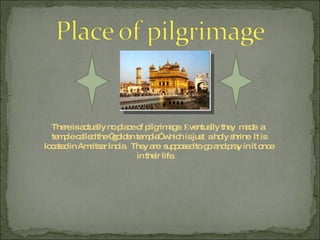
There is actually no place of pilgrimage.  E ventually they  made  a  temple called the “golden temple” which is just  a holy shrine  It is located in Amritsar India.  They are  supposed to go and pray in it once in their life.
Sikhs did not view one holiday as being more special as another. All traditional festivals were considered sacred and a time that was meant to be spent with family and friends.
 
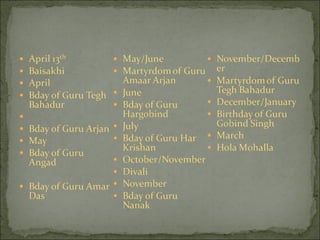
Gurupurabs are the anniversaries and days of historical importance in Sikhism. They may even be the birthdays of different Guru’s! Baisakhi is the equivalent to New Years Day, except Baisakhi is the first day of the Indian Calendar. It is also the beginning of the baisakh month. During this day, people come from all across India to gather near the Golden Temple which is located in Amritsar. It’s celebrated as a social, political, and religious holiday. It also marks the beginning of the harvesting season.
Divali is usually celebrated around the same time as Christmas and Hanukkah. It’s meant to celebrate when the goddess Lakshmi (goddess of wealth and prosperity) came, and to remember when King Rama and Queen Sita returned to their kingdom after 14 years in exile. Diviali is celebrated for 3 days, and during those three days, people try to head to the Golden Temple (in Amritsar). Sikh people may also paint or whitewash their houses as well as decorating their houses with string lights and candles. The lights are meant to symbolize joy and peace. It’s also traditional to exchange gifts such as clothing or candy around this time as well.
Hola Mohalla is the Sikh spring festival. Considered to be one of the more fun and playful festivals, it includes activities where the whole town may go out and thrown brightly colour paint and dye at each other. Some of those colours may include yellow, green, red and blue to symbolize the new things that will grow and become once the festival is done. Hola Mohalla is to celebrate the playful presence of their dark god Lord Krishna.
Sangrand is the first day of each month according to the Indian Solar Calendar. During these days, Sikhs may add extra hopes and wishes to their daily prayers such as good health, prosperity, and peace in their lives. This is usually the followers that don’t regularly attend the gurudwara’s (Sikh place of worship). In the village temples, they may replace the cotton puffs that they usually use during regular sacrament with warm Karahprosad which is equal amounts of flour, sugar, water, and butter.
Masia is celebrated as the darkest night of the month. It is a time that is thought to be the best time to bathe in the Holy Pools (especially the Dukhniwaran Sahib in Patiala). At around 10 o’clock at night a procession starts in Guru Granth then moves onto Akal Takht to finally move towards the gurudwara in Tarn Taran. When the procession is moving, followers casually join in and start to chant and sing the hymns from their holy scripture. The procession is also offered snacks and meals from other followers as well!  When the parade finally reaches the shrine in Tarn Taran, it is quite early in the morning and from there almost everyone bathes in the holy pool. Sikhs belive that Sandgrand and Masia help you stay in harmony and keep up with the natural rhythms that each month brings to you.
Basant is another spring festival that Sikhs choose to celebrate. During this time everyone eats such things as yellow rice, and wear yellow clothing. It is basically a very colourful and festive event. A favourite activity that children take part in is the kite flying. Kids take their kites and see how high they can fly them while standing on their house roofs, but the real “fun” comes from seeing how badly they can sabotage and wreck the other children’s kites. So, by tying glass shards, knives or other sharp objects to their own kites they try to fly them across other children’s kites, hoping to tear the kite or cut the strings.
Sikhism is the youngest of all world traditions. It began about 500 years ago in the 15 th  century in the Punjab region of India and is now the 5 th  largest organized religion in the world. The word Sikhism was taken from the word “Sikh” which was taken from “sisya” which means disciple or learner.
-This symbol is called the Sikh Emblem. It is the main symbol. The middle sword has 2 edges and it stands for truth and justice. -The outside sword is crossed with 2 swords and this stands for the power of god. -The round weapon in the middle is a throwing weapon and it is called a achakram.
People of Sikh faith have 5 Basic thing s that they believe they are  “1) all peoples of the world are equal. 2) Women are equal 3)one god for all 4)speak and live truthfully 5)control the five vices” The Sikh people also believe that they should protect the weak from Oppression.
 

Sikhism +

  • 1.
    BY: Matt, Ezra,Sloan, Alexis, Kelly
  • 2.
    In Sikhism thereare two sacred texts, the Guru Granth Sahib and the Dasven Padshah Da Granth. The Guru Granth Sahib thought the Sikh people what god was like and the correct way to live. The five Major points it makes are “1) all peoples of the world are equal. 2) Women are equal 3)one god for all 4)speak and live truthfully 5)control the five vices” The five vices are Pride, Anger, Greed, Attachment, and lust. The second book the Dasven Padshah Da Granth describes how to praise the Sikh god.
  • 3.
    Each day beforesunrise, Guru Nanak would go to the river to bathe in the cold water and sing God's praises. But one day he disappeared and could not be found. His clothes were still lying next to the riverbank, but there was no sign of Nanak. His friends walked up and down calling , "Nanak, Nanak," hoping against hope that they would find him. They grew afraid that he had drowned. But Nanak was far from the reach of any of them. He was in a divine trance in which he was sitting in God's own presence. God gave him a cup of nectar and said, "I am with you. Go and repeat My Name, and teach others to do the same." Nanak was so filled with love for God that
  • 4.
    he sang thefirst part of the Japji: "Ek Ong Kaar, Sat Naam, Kartaa Purakh, Nirbhao, Nirvair, Akaal Moorat, Ajoonee, Saibhang, Gurprasaad, Jap. Aad Sach, Jugaad Sach, Haibee Sach, Naanak Hosee Bhee Sach!" God looked upon him with infinite kindness and said, "My Name is God, and you are the divine Guru." After three days, Nanak came out of the river. The villagers gasped in disbelief. They had given up any hope of ever seeing him again. For a long time, he said nothing. Finally, when he did speak, he said, "There is no Hindu, there is no Muslim." From that day on, he spread the message to everyone that all are equal, and equally loved by God, no matter how they worship him. He also taught that the best way to show their love for God is by praising His Name.
  • 5.
    The place ofworship is called the Golden Temple or Prayer Hall. -They worship once a week. -They have a morning prayer and evening prayer. -The services may last for about 2 hrs or more. -They also have a worship called the Kirtan.
  • 6.
    In Sikhism theyonly worship one God, that is in abstract form. They believe that all religions have the same God. People in Sikhism get up early to meditate to their God. They have individual prayers, where you pray at anytime and place. Or the have community prayers, where you go to the Sikh temple, called the Gurdwara (which means ‘door to God’). In the Gurdwara there is no priest. Some of the prayers that people say in the individual prayer and the community prayers are: jabi sabhi, jap sahib, sudha swayas, rehra sahbi, kirtan sohila, asa di var, anand sahbi and vak. One thing all those prayers have in common is they are all hymns.
  • 7.
    In Sikhism religionthere are four rites of passage the first is the birth and naming of a newborn baby, then a marriage ceremony when the grow up, there is also an initiation where men have to start doing the five K’s and when you die there is also a cremation ceremony. When a baby is first born it goes to a ceremony at which Hymns are sung and after that the baby is named. When you are old enough you may decide to marry when you decide this, your family and you will try to pick a partner for you but you have ultimate say in the matter. .
  • 8.
    All Sikhs eventuallyjoin the Kasha but most usually later in life. When a Sikh joins the Kasha there is an initiation ceremony where the Sikh or Sikhs joining the Kasha take vows to obey the 5 K’s. The 5 K’s are Kesh: you cannot cut your hair or beard at any time. Kanga: to comb your hair every day. Kara: to always wear a steel bangle symbolizing god and strength. Kirpan: to always wear a small dagger symbolizing that they are always ready to fight oppression and last is Kacchera: to wear short trousers symbolizing readiness to ride into battle. The Sikhs believe that when a family member dies you should not grieve to much because they will be resurrected as a superior form. After a Sikh dies he is always cremated never buried.
  • 9.
    There is actuallyno place of pilgrimage. E ventually they made a temple called the “golden temple” which is just a holy shrine It is located in Amritsar India. They are supposed to go and pray in it once in their life.
  • 10.
    Sikhs did notview one holiday as being more special as another. All traditional festivals were considered sacred and a time that was meant to be spent with family and friends.
  • 11.
  • 12.
    Gurupurabs are theanniversaries and days of historical importance in Sikhism. They may even be the birthdays of different Guru’s! Baisakhi is the equivalent to New Years Day, except Baisakhi is the first day of the Indian Calendar. It is also the beginning of the baisakh month. During this day, people come from all across India to gather near the Golden Temple which is located in Amritsar. It’s celebrated as a social, political, and religious holiday. It also marks the beginning of the harvesting season.
  • 13.
    Divali is usuallycelebrated around the same time as Christmas and Hanukkah. It’s meant to celebrate when the goddess Lakshmi (goddess of wealth and prosperity) came, and to remember when King Rama and Queen Sita returned to their kingdom after 14 years in exile. Diviali is celebrated for 3 days, and during those three days, people try to head to the Golden Temple (in Amritsar). Sikh people may also paint or whitewash their houses as well as decorating their houses with string lights and candles. The lights are meant to symbolize joy and peace. It’s also traditional to exchange gifts such as clothing or candy around this time as well.
  • 14.
    Hola Mohalla isthe Sikh spring festival. Considered to be one of the more fun and playful festivals, it includes activities where the whole town may go out and thrown brightly colour paint and dye at each other. Some of those colours may include yellow, green, red and blue to symbolize the new things that will grow and become once the festival is done. Hola Mohalla is to celebrate the playful presence of their dark god Lord Krishna.
  • 15.
    Sangrand is thefirst day of each month according to the Indian Solar Calendar. During these days, Sikhs may add extra hopes and wishes to their daily prayers such as good health, prosperity, and peace in their lives. This is usually the followers that don’t regularly attend the gurudwara’s (Sikh place of worship). In the village temples, they may replace the cotton puffs that they usually use during regular sacrament with warm Karahprosad which is equal amounts of flour, sugar, water, and butter.
  • 16.
    Masia is celebratedas the darkest night of the month. It is a time that is thought to be the best time to bathe in the Holy Pools (especially the Dukhniwaran Sahib in Patiala). At around 10 o’clock at night a procession starts in Guru Granth then moves onto Akal Takht to finally move towards the gurudwara in Tarn Taran. When the procession is moving, followers casually join in and start to chant and sing the hymns from their holy scripture. The procession is also offered snacks and meals from other followers as well! When the parade finally reaches the shrine in Tarn Taran, it is quite early in the morning and from there almost everyone bathes in the holy pool. Sikhs belive that Sandgrand and Masia help you stay in harmony and keep up with the natural rhythms that each month brings to you.
  • 17.
    Basant is anotherspring festival that Sikhs choose to celebrate. During this time everyone eats such things as yellow rice, and wear yellow clothing. It is basically a very colourful and festive event. A favourite activity that children take part in is the kite flying. Kids take their kites and see how high they can fly them while standing on their house roofs, but the real “fun” comes from seeing how badly they can sabotage and wreck the other children’s kites. So, by tying glass shards, knives or other sharp objects to their own kites they try to fly them across other children’s kites, hoping to tear the kite or cut the strings.
  • 18.
    Sikhism is theyoungest of all world traditions. It began about 500 years ago in the 15 th century in the Punjab region of India and is now the 5 th largest organized religion in the world. The word Sikhism was taken from the word “Sikh” which was taken from “sisya” which means disciple or learner.
  • 19.
    -This symbol iscalled the Sikh Emblem. It is the main symbol. The middle sword has 2 edges and it stands for truth and justice. -The outside sword is crossed with 2 swords and this stands for the power of god. -The round weapon in the middle is a throwing weapon and it is called a achakram.
  • 20.
    People of Sikhfaith have 5 Basic thing s that they believe they are “1) all peoples of the world are equal. 2) Women are equal 3)one god for all 4)speak and live truthfully 5)control the five vices” The Sikh people also believe that they should protect the weak from Oppression.
  • 21.