Through zeal, knowledge is gotten; through
lack of zeal, knowledge is lost.
GAUTAMA BUDDHA
BUDDHIST PHILOSOPHY
PRESENTED BY
Ms. Angeline
Msc(N) Previous year
Choithram college of nursing , Indore
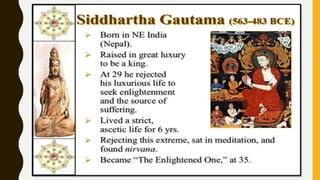
HISTORY OF PHILOSOPHY :
• The Buddha was the first most active missionary in the world .
• He wandered from place to place forty –five years preaching his doctrine
to the masses and the intelligentsia. Till his last moment , He serve
humanity both by example and by percept .
• “Strive on with diligence” were the last words of the Buddha no
emancipation or purification can be gained without personal striving .As
such or intercessory prayers are denounced in Buddhism and in their
Stead is meditation which leads to self-control, purification and
enlightenment .
• The Buddha indicate the path and it is left for us to follow that path to
obtain our purification . Self exertion plays an important part in
Buddhism .
EXPONENTS OF BUDDHIST
PHILOSOPHY
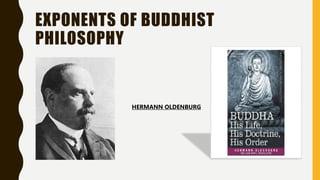
HERMANN OLDENBURG
Dr. A. S ALTEKAR
FA-HIEN S
MAJOR AREA OF PHILOSOPHY
1) There is suffering in the world , to live is to suffer ( DUKHA).The Buddha
found this out when he was young and experienced suffering and death in
others.
2) The cause of suffering is self centered desire and attachments (TANHA )
3) The solution is to eliminate desire and attachment ( NIRAVANA)
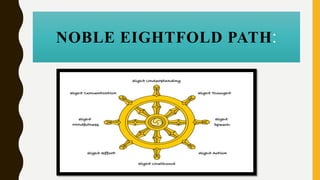
4) To reach NIRAVANA , one must follow the eightfold path
MEANING OF BUDDHIST PHILOSOPHY
•Buddhist philosophy refers to the philosophical investigation and
systems of inquiry that developed among various Buddhist schools in
India following the death of the Buddha and later spread throughout
Asia .
•Buddhism is a philosophy that explains the meaning of life and the
world we live in it’s a way to cultivate one’s mind.
GOAL /AIMS OF PHILOSOPHY:
1) To follow the moral values of Buddhist religion.
2) To achieve the final goal of nirvana.
3) To give up caste system.
4) To emphasize the progress and development of the society rather
the individual.
5) To provide education through the new system this was started by
Buddha.
6) To leave yajna and sacrifices for achieving knowledge.
BELIEF / VALUES /ASSERTATION
• The principles of Buddhist philosophy (The Core Beliefs in Buddhism) in
practice are:
• The Four Noble Truths, the Noble Eightfold Path and the Five Precepts
FOUR NOBLE TRUTH :
1.SUFFERING
2.CAUSE OF
SUFFERING
3.END OF
SUFFERING
4.PATH THAT
LEADS TO THE
END OF
SUFFERING
NOBLE EIGHTFOLD PATH:
THE WORD “INTENDING” HERE IS THE
GREEK WORD THELO, WHICH MEANS “TO
WILL, TO PURPOSE, TO DETERMINE, OR TO
RESOLVE.”
“Your future is an act of will, not an act
of skill”.
However, making a difference, doing
something better, or being able to
improve the quality of your life is not a
skill, it’s an act of the will.
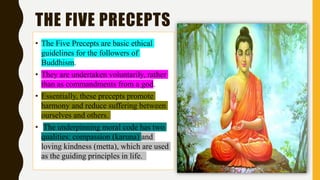
THE FIVE PRECEPTS
• The Five Precepts are basic ethical
guidelines for the followers of
Buddhism.
• They are undertaken voluntarily, rather
than as commandments from a god.
• Essentially, these precepts promote
harmony and reduce suffering between
ourselves and others.
• The underpinning moral code has two
qualities: compassion (karuna) and
loving kindness (metta), which are used
as the guiding principles in life.
CURRICULUM ACCORDING TO
PHILOSOPHY :
EDUCATIONAL SYSTEM
1. HIGHER EDUCATION
2. ELEMENTARY EDUCATION
CURRICULUM OF ELEMENTARY
EDUCATION :
Through learning of
Grammar
1.Hetu vidya (logic)
2.Nyaya (science of
reasoning).
3.Adyatma vidya
(philosophy)
4.silpa sthan (arts and
crafts) and
5.chikitsya vidya
(medicine)
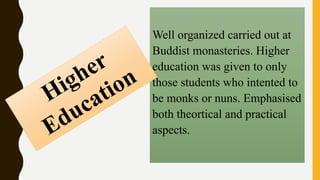
Well organized carried out at
Buddist monasteries. Higher
education was given to only
those students who intented to
be monks or nuns. Emphasised
both theortical and practical
aspects.
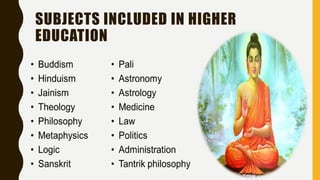
SUBJECTS INCLUDED IN HIGHER
EDUCATION
METHODS OF TEACHING
• Although art of writing was developed but due to shortage of writing
material the methods of teaching was most verbal
•Questions, answers, discussion and debates.
•Travelling and nature study method
•Book method
• Preaching and conference method
• Teacher taught relationship
• Seminars
• Mental and moral development were emphasized to attain
Bodhisattva.
• The medium of instruction was common language
• The centres of education were Takshshila, Nalanda , Kashi .
ROLES OF TEACHER STUDENTS AND
LEARNER :
• Teacher besides being scholar of repute must have in himself
inspiring ideals .
• Like students teachers also used to spend life in simplicity , constant
study , following ideals and strength of character.
• Maintain self restrained life.
• Both teacher and students were required the authority of reasons and
experience.
ADVANTAGES:
 Develops ethics, mindfulness, calm and insight meditation and
wisdom
 Endorses widespread inquiry through knowledge, discourses,
ancient texts, dialogue, diverse methods and environments such as
monasteries, centers and forests for practice
 Ends rebirth (rebecoming, renewal) of the ego, of personality issues.
 Explores relative/ultimate truth.
• It lead much emphasis on the physical , mental and spiritual
development of students.
• Free from communal narrowness
• Disciplined life
• Well organized centres.
• Ideal student teacher relationship
APPLICATION OF PHILOSOPHY IN
NURSING EDUCATION:
• The follower of Buddha should be thought of as individual as
the religion has no single creed , authority or sacred book .
• In Buddhism ,suffering is that which arises in our human
form by our attachment and craving ,and from which we can
break free by choosing a path of wisdom , moratility and
mental culture .
• Buddhism has no belief . instead , it has teaching to guide one
through daily life . these focus on individual effort and commend
reflective practice .
• The aim of the Buddhist is to achieve Nirvana .This is a state of
liberation , which is characterised by freedom from suffering ,death
and rebirth .
• Like all patient , Buddhist should be cared for holistically and with
sensitivity to their individual needs , and nurses should avoid
making assumption about any aspects of their lives .
• According to philosophy one should ensure that you have the
information you need to provide appropriate care , ask the patient ,
his or her family and loved ones or a Buddhist chaplain , a lay
adviser or elder of the relevant Buddhist community.
• Caring for Buddhists means that health care professionals must
address the issues of variability and difference. Like all patients,
each Buddhist has individual needs. Nurses should remember to be
‘mindful’ of each person they care for, and to explore and try to
meet their needs and wishes.
CONCLUSION :
• Buddhist philosophy is the elaboration and explanation of the
delivered teachings of the Buddha as found in the TRIPITAKA.
• Buddhist philosophy immerged due to unsatisfactory Hindu
activities on that time.
• Buddhism is a philosophy , a moral code and for some a religious
faith which originated 2,500 years ago .
• It offers a diagnosis of the suffering of mankind and provides a
formula for individuals to resolve that suffering .
• It offers a moral code based on compassion and non violence , and
through meditation a way to achieve spiritual insight .
• Buddhism philosophy avoided speculative thought on metaphysics ,
ethics and epistemology but was based instead on empirical
evidence gained by the sense
BIBLIOGRAPHY:
• Biswal U.N .(2005).Buddhist philosophy .1st edition .New Delhi
:Dominant publisher and distributors .
• http://www.buddha.net/pdf_file/buddha-teachingsurw6.pdf
• http://www.ahandfulofleaves.org/document/The%20Buddhist%20
Philosophy
• http://www.reaserchgate.net/profile/William_Edelglass/publication

Buddhist philosophy ppt

  • 1.
    Through zeal, knowledgeis gotten; through lack of zeal, knowledge is lost. GAUTAMA BUDDHA
  • 2.
    BUDDHIST PHILOSOPHY PRESENTED BY Ms.Angeline Msc(N) Previous year Choithram college of nursing , Indore
  • 7.
    HISTORY OF PHILOSOPHY: • The Buddha was the first most active missionary in the world . • He wandered from place to place forty –five years preaching his doctrine to the masses and the intelligentsia. Till his last moment , He serve humanity both by example and by percept . • “Strive on with diligence” were the last words of the Buddha no emancipation or purification can be gained without personal striving .As such or intercessory prayers are denounced in Buddhism and in their Stead is meditation which leads to self-control, purification and enlightenment . • The Buddha indicate the path and it is left for us to follow that path to obtain our purification . Self exertion plays an important part in Buddhism .
  • 8.
  • 9.
    Dr. A. SALTEKAR
  • 10.
  • 11.
    MAJOR AREA OFPHILOSOPHY 1) There is suffering in the world , to live is to suffer ( DUKHA).The Buddha found this out when he was young and experienced suffering and death in others. 2) The cause of suffering is self centered desire and attachments (TANHA ) 3) The solution is to eliminate desire and attachment ( NIRAVANA) 4) To reach NIRAVANA , one must follow the eightfold path
  • 12.
    MEANING OF BUDDHISTPHILOSOPHY •Buddhist philosophy refers to the philosophical investigation and systems of inquiry that developed among various Buddhist schools in India following the death of the Buddha and later spread throughout Asia . •Buddhism is a philosophy that explains the meaning of life and the world we live in it’s a way to cultivate one’s mind.
  • 13.
    GOAL /AIMS OFPHILOSOPHY: 1) To follow the moral values of Buddhist religion. 2) To achieve the final goal of nirvana. 3) To give up caste system. 4) To emphasize the progress and development of the society rather the individual. 5) To provide education through the new system this was started by Buddha. 6) To leave yajna and sacrifices for achieving knowledge.

  • 14.
    BELIEF / VALUES/ASSERTATION • The principles of Buddhist philosophy (The Core Beliefs in Buddhism) in practice are: • The Four Noble Truths, the Noble Eightfold Path and the Five Precepts
  • 15.
    FOUR NOBLE TRUTH: 1.SUFFERING 2.CAUSE OF SUFFERING 3.END OF SUFFERING 4.PATH THAT LEADS TO THE END OF SUFFERING
  • 16.
  • 18.
    THE WORD “INTENDING”HERE IS THE GREEK WORD THELO, WHICH MEANS “TO WILL, TO PURPOSE, TO DETERMINE, OR TO RESOLVE.” “Your future is an act of will, not an act of skill”. However, making a difference, doing something better, or being able to improve the quality of your life is not a skill, it’s an act of the will.
  • 27.
    THE FIVE PRECEPTS •The Five Precepts are basic ethical guidelines for the followers of Buddhism. • They are undertaken voluntarily, rather than as commandments from a god. • Essentially, these precepts promote harmony and reduce suffering between ourselves and others. • The underpinning moral code has two qualities: compassion (karuna) and loving kindness (metta), which are used as the guiding principles in life.
  • 28.
  • 29.
    EDUCATIONAL SYSTEM 1. HIGHEREDUCATION 2. ELEMENTARY EDUCATION
  • 31.
    CURRICULUM OF ELEMENTARY EDUCATION: Through learning of Grammar 1.Hetu vidya (logic) 2.Nyaya (science of reasoning). 3.Adyatma vidya (philosophy) 4.silpa sthan (arts and crafts) and 5.chikitsya vidya (medicine)
  • 32.
    Well organized carriedout at Buddist monasteries. Higher education was given to only those students who intented to be monks or nuns. Emphasised both theortical and practical aspects.
  • 33.
    SUBJECTS INCLUDED INHIGHER EDUCATION
  • 34.
    METHODS OF TEACHING •Although art of writing was developed but due to shortage of writing material the methods of teaching was most verbal •Questions, answers, discussion and debates. •Travelling and nature study method •Book method
  • 35.
    • Preaching andconference method • Teacher taught relationship • Seminars • Mental and moral development were emphasized to attain Bodhisattva. • The medium of instruction was common language • The centres of education were Takshshila, Nalanda , Kashi .
  • 36.
    ROLES OF TEACHERSTUDENTS AND LEARNER : • Teacher besides being scholar of repute must have in himself inspiring ideals . • Like students teachers also used to spend life in simplicity , constant study , following ideals and strength of character. • Maintain self restrained life. • Both teacher and students were required the authority of reasons and experience.
  • 37.
    ADVANTAGES:  Develops ethics,mindfulness, calm and insight meditation and wisdom  Endorses widespread inquiry through knowledge, discourses, ancient texts, dialogue, diverse methods and environments such as monasteries, centers and forests for practice  Ends rebirth (rebecoming, renewal) of the ego, of personality issues.  Explores relative/ultimate truth.
  • 38.
    • It leadmuch emphasis on the physical , mental and spiritual development of students. • Free from communal narrowness • Disciplined life • Well organized centres. • Ideal student teacher relationship
  • 40.
    APPLICATION OF PHILOSOPHYIN NURSING EDUCATION: • The follower of Buddha should be thought of as individual as the religion has no single creed , authority or sacred book . • In Buddhism ,suffering is that which arises in our human form by our attachment and craving ,and from which we can break free by choosing a path of wisdom , moratility and mental culture .
  • 41.
    • Buddhism hasno belief . instead , it has teaching to guide one through daily life . these focus on individual effort and commend reflective practice . • The aim of the Buddhist is to achieve Nirvana .This is a state of liberation , which is characterised by freedom from suffering ,death and rebirth .
  • 42.
    • Like allpatient , Buddhist should be cared for holistically and with sensitivity to their individual needs , and nurses should avoid making assumption about any aspects of their lives . • According to philosophy one should ensure that you have the information you need to provide appropriate care , ask the patient , his or her family and loved ones or a Buddhist chaplain , a lay adviser or elder of the relevant Buddhist community.
  • 43.
    • Caring forBuddhists means that health care professionals must address the issues of variability and difference. Like all patients, each Buddhist has individual needs. Nurses should remember to be ‘mindful’ of each person they care for, and to explore and try to meet their needs and wishes.
  • 44.
    CONCLUSION : • Buddhistphilosophy is the elaboration and explanation of the delivered teachings of the Buddha as found in the TRIPITAKA. • Buddhist philosophy immerged due to unsatisfactory Hindu activities on that time. • Buddhism is a philosophy , a moral code and for some a religious faith which originated 2,500 years ago .
  • 45.
    • It offersa diagnosis of the suffering of mankind and provides a formula for individuals to resolve that suffering . • It offers a moral code based on compassion and non violence , and through meditation a way to achieve spiritual insight . • Buddhism philosophy avoided speculative thought on metaphysics , ethics and epistemology but was based instead on empirical evidence gained by the sense
  • 46.
    BIBLIOGRAPHY: • Biswal U.N.(2005).Buddhist philosophy .1st edition .New Delhi :Dominant publisher and distributors . • http://www.buddha.net/pdf_file/buddha-teachingsurw6.pdf • http://www.ahandfulofleaves.org/document/The%20Buddhist%20 Philosophy • http://www.reaserchgate.net/profile/William_Edelglass/publication