Why Religion and Spirituality is Practiced in
Social Work Studies?
• Findings from surveys of qualified social work practitioners and students indicate a need for
social work education and practice to focus attention both on the importance of religious
and spiritual beliefs in the lives of many service users and on the potential usefulness of
religious and spiritual interventions. In this British study, undertaken in 2003 and 2004,
students were less likely than their qualified colleagues to consider religious or spiritually
sensitive interventions as appropriate. Attitudes varied little between those students who
held religious beliefs and those who did not, but Muslim students and qualified social
workers were more likely to view these types of interventions as appropriate. The authors
conclude that there is a clear need for all social work practitioners and educators to give
greater priority to exploring the potential significance of religious and spiritual beliefs in
their training, in their professional practice and in the lives and perspectives of service users
and colleagues. Social workers need to be able to respond appropriately to the needs of all
service users, including those for whom religious and spiritual beliefs are crucial.
Religions in Order
• Hinduism (precursor..2nd millenium BC)
• Judaism (precursor..1st millenium BC..arnd 500BC)
• Buddhism (between 400BC-600BC)
• Christianity (1st century AD)
• Islam (Start of 7th century AD)
• Sikhism (15th century AD.
SikhismBelieves in Equality of Mankind
What is Sikhism?
• Sikhism is a monotheistic religion, and the basic Sikh belief is represented
in the phrase Ik Onkar meaning “One God.” .
• The principles of universal equality and brotherhood are important pillars
of Sikhism.
• Equality: All humans are equal before God – no discrimination is allowed
on the basis of caste, race, gender, creed, origin, color, education, status,
wealth, etc…
• It had unequivocal words that the Sikhs are "neither Hindus nor Muslims".
Where & why was
Sikh religion
formed?
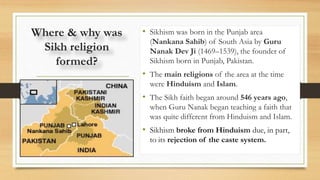
• Sikhism was born in the Punjab area
(Nankana Sahib) of South Asia by Guru
Nanak Dev Ji (1469–1539), the founder of
Sikhism born in Punjab, Pakistan.
• The main religions of the area at the time
were Hinduism and Islam.
• The Sikh faith began around 546 years ago,
when Guru Nanak began teaching a faith that
was quite different from Hinduism and Islam.
• Sikhism broke from Hinduism due, in part,
to its rejection of the caste system.
Code & Symbol
Ik Onkar
Ik – One, Oang – Creator, Kar – Creation.
Salutation Principles
• SAT – “Truth”
• SRI – “Respectful word”
• AKAAL – “the timeless being, GOD”
"True is the name of God"
SAT SRI AKAAL • KIRAT KARO – Work hard and
living Honestly.
• NAAM JAPO – Always remember
The GOD.
• WANND CHHAKO – Share
with the Needy.
Which is the holy
book of Sikhs?
• The Guru Granth Sahib is a
collection of teachings and writings
by Guru Nanak and other Gurus
as well as Sikh, Hindu and Muslim
saints.
• These scriptures are written in
Punjabi and are greatly respected
by all Sikhs as the living word of
God.
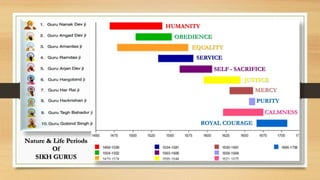
HUMANITY
OBEDIENCE
EQUALITY
SERVICE
SELF - SACRIFICE
JUSTICE
MERCY
PURITY
CALMNESS
ROYAL COURAGE
Nature & Life Periods
Of
SIKH GURUS
1. Guru Nanak (1469 - 1539)
His teachings are composed in Granth Sahib.
2. Guru Angad (1538 - 1552)
Invented a new script called "Guru-Mukhi".(translating Sahib to Punjabi).
3. Guru Amardas (1552 - 1574)
Started the Langar. (a place where free meal is served).
Led struggle against Sati and Purdah System.
4. Guru Ramdas (1574 - 1581)
Founded Amritsar in 1577 on the land granted by Akbar.
5. Guru Arjun Dev (1581 - 1606)
Founded the Golden Temple at Amritsar.
Composed Granth Sahib in 1604.
6. Guru Hargobind (1606 - 1645)
Transformed the Sikh into a militant community.
7. Guru Har Rai (1645 - 1661)
A man of peace, always preached Nanak’s sacred thoughts.
8. Guru Har Kishan (1661 - 1664)
He is the youngest Sikh Guru
Amazed the Brahmin Pundits with his knowledge and spiritual powers.
9. Guru Teg Bahadur (1664 - 1675)
He laid down his life for the protection of the Hindu religion in the right of people to the freedom of
worship.
10. Guru Gobind Singh (1675 - 1708)
He founded the Khalsa (a complete Sikh) in 1699.
He compiled a supplementary Granth & created a complete HOLY BOOK of SIKH (GURU
GRANTH SAHIB).
Is Guru Nanak a God?
• Nanak's teachings can be found in
the Sikh scripture Guru Granth
Sahib.
• According to Singha, "Sikhism
does not subscribe to the theory of
incarnation. But it has a pivotal
concept of Guru.
• He is not an incarnation of God.
The 5 Ks
• Kesh – Uncut Hair
• Kangha – Wooden Comb
• Kirpan - strapped curved sword
• Kara - metal bracelet
• Kachera - cotton undergarments
Types of Sikh People
• The Amritdhari – True Sikh
• Kesdari – Partial Devotee
• Sahajdhari – Slow Adopter
• Patit – The Apostate
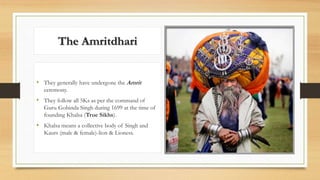
The Amritdhari
• They generally have undergone the Amrit
ceremony.
• They follow all 5Ks as per the command of
Guru Gobinda Singh during 1699 at the time of
founding Khalsa (True Sikhs).
• Khalsa means a collective body of Singh and
Kaurs (male & female)-lion & Lioness.
Kesdari
• They wear the Kesh, uncut hair as required one of the five keys.
• It is not bound on them, but they will at least wear the wrist ring(the kara).
• The men will have beards and wear the Sikh turbans. In some cases, they secretary
trim the beards. In some cases instead of wearing a standard Kripan
(sword),members may carry a tiny replica(exact copy) measuring barely one
centimeter in length, closed to the comb under turban.
• They may keep or may not keep the other four external symbols of the faith. It is up
to their decisions.
Sahajdhari
• Those who believes their Guru’s teachings, but do not keep their keys, and have not
under gone the Amrit ceremony.
• Sahaj means easy or slow. Hence, other Sikhs consider those types of Sikhs are slow
adopters.
• In other words, Sahaja means a state of mental and spiritual balance.
Patit
• Those who have undergone the Amrit ceremony ( A syrup considered divine by
Sikhs, and they take it in religious observances),but failed to observe Khalsa (a
perfect Sikh) code of conduct.
• They smoke, consume intoxicants, committing adultery etc. Other Sikhs may call
them as Patit.
Sikhism

Sikhism

  • 1.
    Why Religion andSpirituality is Practiced in Social Work Studies? • Findings from surveys of qualified social work practitioners and students indicate a need for social work education and practice to focus attention both on the importance of religious and spiritual beliefs in the lives of many service users and on the potential usefulness of religious and spiritual interventions. In this British study, undertaken in 2003 and 2004, students were less likely than their qualified colleagues to consider religious or spiritually sensitive interventions as appropriate. Attitudes varied little between those students who held religious beliefs and those who did not, but Muslim students and qualified social workers were more likely to view these types of interventions as appropriate. The authors conclude that there is a clear need for all social work practitioners and educators to give greater priority to exploring the potential significance of religious and spiritual beliefs in their training, in their professional practice and in the lives and perspectives of service users and colleagues. Social workers need to be able to respond appropriately to the needs of all service users, including those for whom religious and spiritual beliefs are crucial.
  • 2.
    Religions in Order •Hinduism (precursor..2nd millenium BC) • Judaism (precursor..1st millenium BC..arnd 500BC) • Buddhism (between 400BC-600BC) • Christianity (1st century AD) • Islam (Start of 7th century AD) • Sikhism (15th century AD.
  • 3.
  • 4.
    What is Sikhism? •Sikhism is a monotheistic religion, and the basic Sikh belief is represented in the phrase Ik Onkar meaning “One God.” . • The principles of universal equality and brotherhood are important pillars of Sikhism. • Equality: All humans are equal before God – no discrimination is allowed on the basis of caste, race, gender, creed, origin, color, education, status, wealth, etc… • It had unequivocal words that the Sikhs are "neither Hindus nor Muslims".
  • 5.
    Where & whywas Sikh religion formed? • Sikhism was born in the Punjab area (Nankana Sahib) of South Asia by Guru Nanak Dev Ji (1469–1539), the founder of Sikhism born in Punjab, Pakistan. • The main religions of the area at the time were Hinduism and Islam. • The Sikh faith began around 546 years ago, when Guru Nanak began teaching a faith that was quite different from Hinduism and Islam. • Sikhism broke from Hinduism due, in part, to its rejection of the caste system.
  • 6.
    Code & Symbol IkOnkar Ik – One, Oang – Creator, Kar – Creation.
  • 7.
    Salutation Principles • SAT– “Truth” • SRI – “Respectful word” • AKAAL – “the timeless being, GOD” "True is the name of God" SAT SRI AKAAL • KIRAT KARO – Work hard and living Honestly. • NAAM JAPO – Always remember The GOD. • WANND CHHAKO – Share with the Needy.
  • 8.
    Which is theholy book of Sikhs? • The Guru Granth Sahib is a collection of teachings and writings by Guru Nanak and other Gurus as well as Sikh, Hindu and Muslim saints. • These scriptures are written in Punjabi and are greatly respected by all Sikhs as the living word of God.
  • 9.
  • 10.
    1. Guru Nanak(1469 - 1539) His teachings are composed in Granth Sahib. 2. Guru Angad (1538 - 1552) Invented a new script called "Guru-Mukhi".(translating Sahib to Punjabi). 3. Guru Amardas (1552 - 1574) Started the Langar. (a place where free meal is served). Led struggle against Sati and Purdah System. 4. Guru Ramdas (1574 - 1581) Founded Amritsar in 1577 on the land granted by Akbar. 5. Guru Arjun Dev (1581 - 1606) Founded the Golden Temple at Amritsar. Composed Granth Sahib in 1604.
  • 11.
    6. Guru Hargobind(1606 - 1645) Transformed the Sikh into a militant community. 7. Guru Har Rai (1645 - 1661) A man of peace, always preached Nanak’s sacred thoughts. 8. Guru Har Kishan (1661 - 1664) He is the youngest Sikh Guru Amazed the Brahmin Pundits with his knowledge and spiritual powers. 9. Guru Teg Bahadur (1664 - 1675) He laid down his life for the protection of the Hindu religion in the right of people to the freedom of worship. 10. Guru Gobind Singh (1675 - 1708) He founded the Khalsa (a complete Sikh) in 1699. He compiled a supplementary Granth & created a complete HOLY BOOK of SIKH (GURU GRANTH SAHIB).
  • 12.
    Is Guru Nanaka God? • Nanak's teachings can be found in the Sikh scripture Guru Granth Sahib. • According to Singha, "Sikhism does not subscribe to the theory of incarnation. But it has a pivotal concept of Guru. • He is not an incarnation of God.
  • 13.
    The 5 Ks •Kesh – Uncut Hair • Kangha – Wooden Comb • Kirpan - strapped curved sword • Kara - metal bracelet • Kachera - cotton undergarments
  • 14.
    Types of SikhPeople • The Amritdhari – True Sikh • Kesdari – Partial Devotee • Sahajdhari – Slow Adopter • Patit – The Apostate
  • 15.
    The Amritdhari • Theygenerally have undergone the Amrit ceremony. • They follow all 5Ks as per the command of Guru Gobinda Singh during 1699 at the time of founding Khalsa (True Sikhs). • Khalsa means a collective body of Singh and Kaurs (male & female)-lion & Lioness.
  • 16.
    Kesdari • They wearthe Kesh, uncut hair as required one of the five keys. • It is not bound on them, but they will at least wear the wrist ring(the kara). • The men will have beards and wear the Sikh turbans. In some cases, they secretary trim the beards. In some cases instead of wearing a standard Kripan (sword),members may carry a tiny replica(exact copy) measuring barely one centimeter in length, closed to the comb under turban. • They may keep or may not keep the other four external symbols of the faith. It is up to their decisions.
  • 17.
    Sahajdhari • Those whobelieves their Guru’s teachings, but do not keep their keys, and have not under gone the Amrit ceremony. • Sahaj means easy or slow. Hence, other Sikhs consider those types of Sikhs are slow adopters. • In other words, Sahaja means a state of mental and spiritual balance.
  • 18.
    Patit • Those whohave undergone the Amrit ceremony ( A syrup considered divine by Sikhs, and they take it in religious observances),but failed to observe Khalsa (a perfect Sikh) code of conduct. • They smoke, consume intoxicants, committing adultery etc. Other Sikhs may call them as Patit.