Chemistry 1
Lesson #1
Scientific Measurements
SUBTOPICS:
 Mass, Volume and Density
Scientific Measurements
 Accuracy and Precision
 Error in Experiment
 Scientific Notation
 Significant Figures
OBJECTIVES:
1. explain the difference between mass,
volume, and density of a solid using the
correct and appropriate units;
2. investigate the density of commonly used
solids using laboratory equipment, including
writing a scientific report;
3. explain that accuracy and precision are
important to assess the quality of
experimental results;
OBJECTIVES:
4. identify sources of error and propose
improvements to enhance measurement
reliability;
5. apply scientific notation and explain how to
determine the proper number of significant
figures in calculations;
What are mass
volume, and
density?
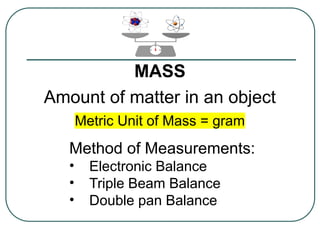
MASS
Amount of matter in an object
Metric Unit of Mass = gram
Method of Measurements:
• Electronic Balance
• Triple Beam Balance
• Double pan Balance
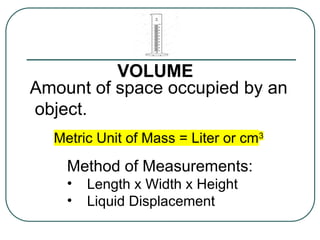
VOLUME
Amount of space occupied by an
object.
Metric Unit of Mass = Liter or cm3
Method of Measurements:
• Length x Width x Height
• Liquid Displacement
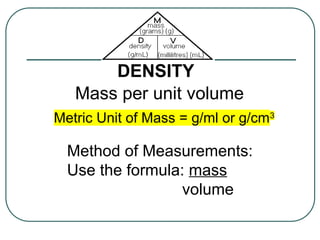
DENSITY
Mass per unit volume
Metric Unit of Mass = g/ml or g/cm3
Method of Measurements:
Use the formula: mass
volume
I. Accuracy, Precision, & Error
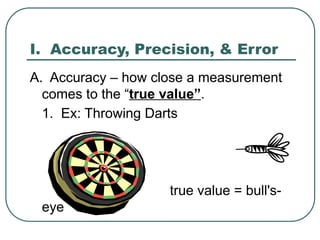
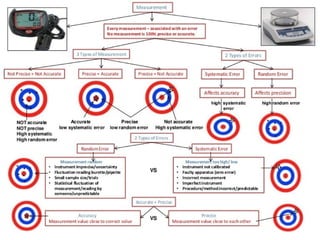
A. Accuracy – how close a measurement
comes to the “true value”.
1. Ex: Throwing Darts
true value = bull's-
eye
Precision
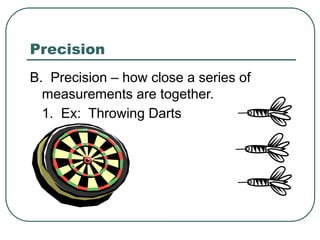
B. Precision – how close a series of
measurements are together.
1. Ex: Throwing Darts
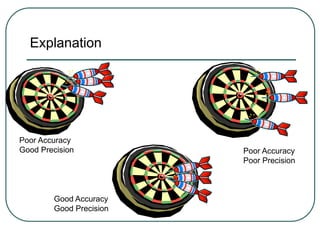
Explanation
Poor Accuracy
Good Precision
Good Accuracy
Good Precision
Poor Accuracy
Poor Precision
Error
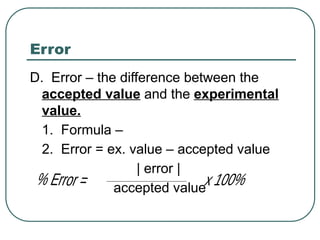
D. Error – the difference between the
accepted value and the experimental
value.
1. Formula –
2. Error = ex. value – accepted value
| error |
accepted value
Example:
1. In class you determine the melting
point of salt is 755 deg C. The actual
value is 805 deg C. What is your
percent error?
 [|755 - 805| / 805] x 100 =
 6.2% error
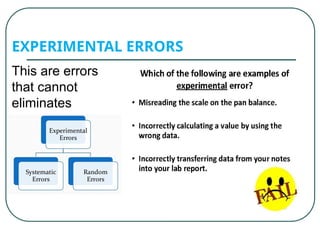
EXPERIMENTAL ERRORS
This are errors
that cannot
eliminates
SCIENTIFIC NOTATION
A QUICK WAY TO WRITE
REALLY, REALLY BIG
OR
REALLY, REALLY SMALL NUMBERS.
Scientists
are Lazy!!!
They decided that by
using powers of 10, they
can create short versions
of long numbers.
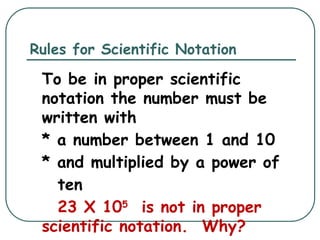
Rules for Scientific Notation
To be in proper scientific
notation the number must be
written with
* a number between 1 and 10
* and multiplied by a power of
ten
23 X 105
is not in proper
scientific notation. Why?
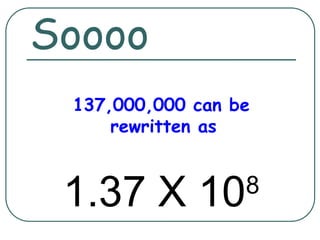
Soooo
137,000,000 can be
rewritten as
1.37 X 10⁸
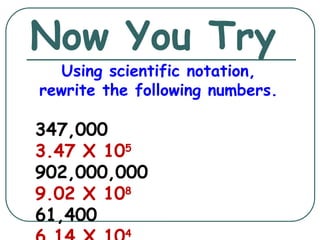
Now You Try
Using scientific notation,
rewrite the following numbers.
347,000
3.47 X 10⁵
902,000,000
9.02 X 10⁸
61,400
4
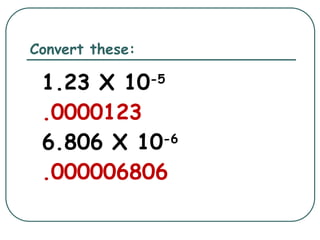
Convert these:
1.23 X 10⁻⁵
.0000123
6.806 X 10⁻⁶
.000006806
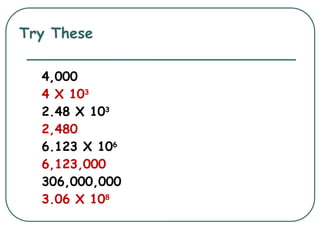
Try These
4,000
4 X 10³
2.48 X 10³
2,480
6.123 X 10⁶
6,123,000
306,000,000
3.06 X 10⁸
Significant Figures
 Scientist use significant figures to
determine how precise a measurement
is
 Significant digits in a measurement
include all of the known digits plus one
estimated digit
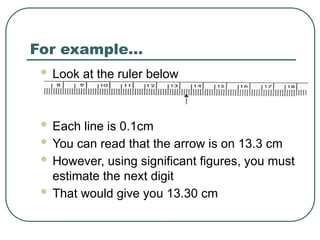
For example…
 Look at the ruler below
 Each line is 0.1cm
 You can read that the arrow is on 13.3 cm
 However, using significant figures, you must
estimate the next digit
 That would give you 13.30 cm
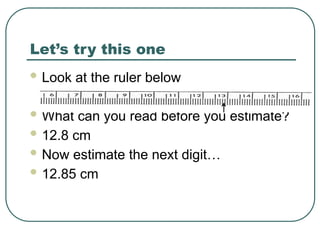
Let’s try this one
 Look at the ruler below
 What can you read before you estimate?
 12.8 cm
 Now estimate the next digit…
 12.85 cm
The same rules apply with all
instruments
 The same rules apply
 Read to the last digit that you know
 Estimate the final digit
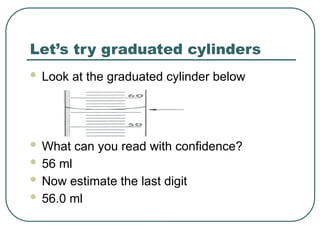
Let’s try graduated cylinders
 Look at the graduated cylinder below
 What can you read with confidence?
 56 ml
 Now estimate the last digit
 56.0 ml
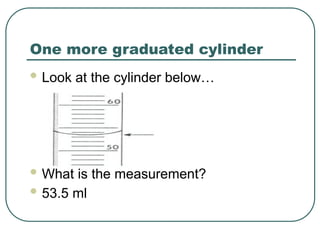
One more graduated cylinder
 Look at the cylinder below…
 What is the measurement?
 53.5 ml
Rules for Significant figures
Rule #1
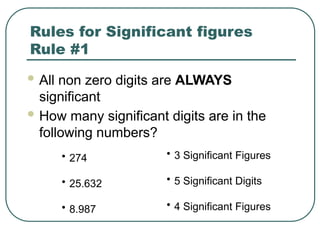
 All non zero digits are ALWAYS
significant
 How many significant digits are in the
following numbers?
• 274
• 25.632
• 8.987
• 3 Significant Figures
• 5 Significant Digits
• 4 Significant Figures
Rule #2
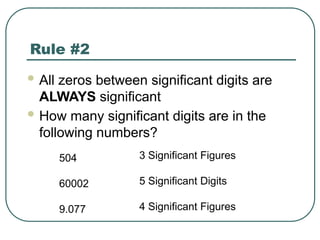
 All zeros between significant digits are
ALWAYS significant
 How many significant digits are in the
following numbers?
504
60002
9.077
3 Significant Figures
5 Significant Digits
4 Significant Figures
Rule #3
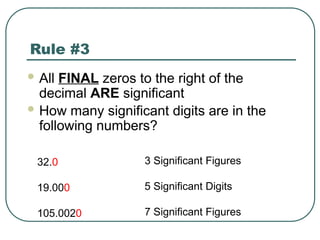
 All FINAL zeros to the right of the
decimal ARE significant
 How many significant digits are in the
following numbers?
32.0
19.000
105.0020
3 Significant Figures
5 Significant Digits
7 Significant Figures
Rule #4
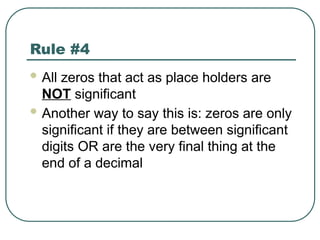
 All zeros that act as place holders are
NOT significant
 Another way to say this is: zeros are only
significant if they are between significant
digits OR are the very final thing at the
end of a decimal
For example
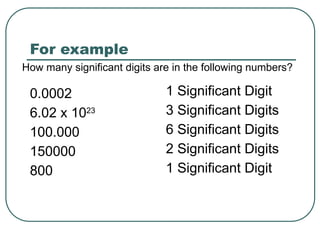
0.0002
6.02 x 10²³
100.000
150000
800
1 Significant Digit
3 Significant Digits
6 Significant Digits
2 Significant Digits
1 Significant Digit
How many significant digits are in the following numbers?
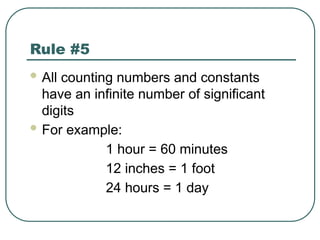
Rule #5
 All counting numbers and constants
have an infinite number of significant
digits
 For example:
1 hour = 60 minutes
12 inches = 1 foot
24 hours = 1 day
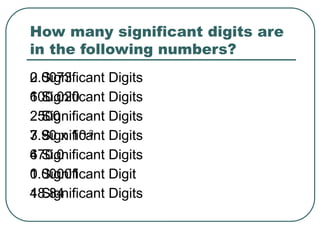
How many significant digits are
in the following numbers?
0.0073
100.020
2500
7.90 x 10⁻³
670.0
0.00001
18.84
2 Significant Digits
6 Significant Digits
2 Significant Digits
3 Significant Digits
4 Significant Digits
1 Significant Digit
4 Significant Digits
Rules Rounding Significant
Digits
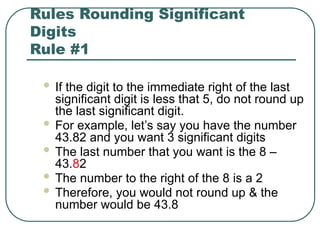
Rule #1
 If the digit to the immediate right of the last
significant digit is less that 5, do not round up
the last significant digit.
 For example, let’s say you have the number
43.82 and you want 3 significant digits
 The last number that you want is the 8 –
43.82
 The number to the right of the 8 is a 2
 Therefore, you would not round up & the
number would be 43.8
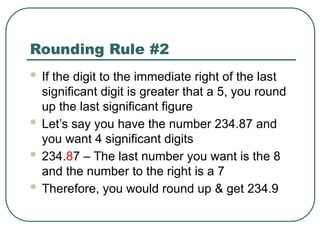
Rounding Rule #2
 If the digit to the immediate right of the last
significant digit is greater that a 5, you round
up the last significant figure
 Let’s say you have the number 234.87 and
you want 4 significant digits
 234.87 – The last number you want is the 8
and the number to the right is a 7
 Therefore, you would round up & get 234.9
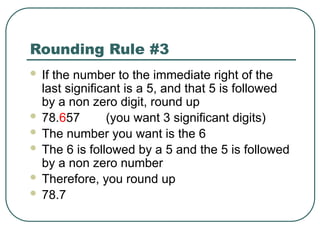
Rounding Rule #3
 If the number to the immediate right of the
last significant is a 5, and that 5 is followed
by a non zero digit, round up
 78.657 (you want 3 significant digits)
 The number you want is the 6
 The 6 is followed by a 5 and the 5 is followed
by a non zero number
 Therefore, you round up
 78.7
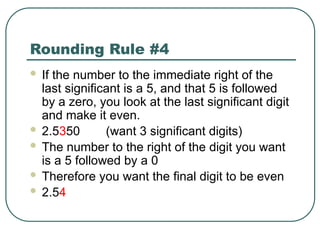
Rounding Rule #4
 If the number to the immediate right of the
last significant is a 5, and that 5 is followed
by a zero, you look at the last significant digit
and make it even.
 2.5350 (want 3 significant digits)
 The number to the right of the digit you want
is a 5 followed by a 0
 Therefore you want the final digit to be even
 2.54
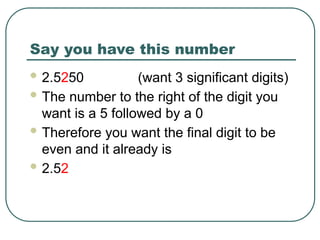
Say you have this number
 2.5250 (want 3 significant digits)
 The number to the right of the digit you
want is a 5 followed by a 0
 Therefore you want the final digit to be
even and it already is
 2.52
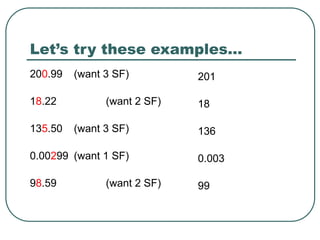
Let’s try these examples…
200.99 (want 3 SF)
18.22 (want 2 SF)
135.50 (want 3 SF)
0.00299 (want 1 SF)
98.59 (want 2 SF)
201
18
136
0.003
99
Scientific Notation
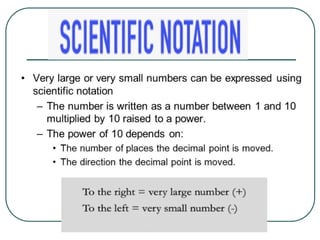
 Scientific notation is used to express
very large or very small numbers
 I consists of a number between 1 & 10
followed by x 10 to an exponent
 The exponent can be determined by the
number of decimal places you have to
move to get only 1 number in front of the
decimal
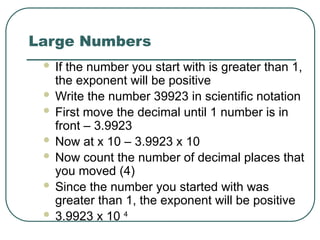
Large Numbers
 If the number you start with is greater than 1,
the exponent will be positive
 Write the number 39923 in scientific notation
 First move the decimal until 1 number is in
front – 3.9923
 Now at x 10 – 3.9923 x 10
 Now count the number of decimal places that
you moved (4)
 Since the number you started with was
greater than 1, the exponent will be positive
 3.9923 x 10 4
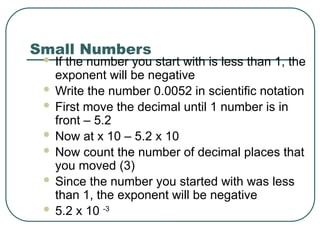
Small Numbers
 If the number you start with is less than 1, the
exponent will be negative
 Write the number 0.0052 in scientific notation
 First move the decimal until 1 number is in
front – 5.2
 Now at x 10 – 5.2 x 10
 Now count the number of decimal places that
you moved (3)
 Since the number you started with was less
than 1, the exponent will be negative
 5.2 x 10 -3
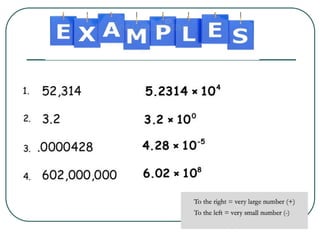
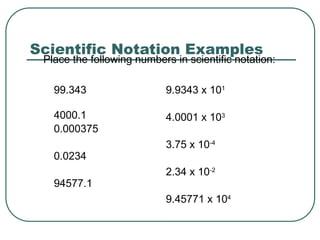
Scientific Notation Examples
99.343
4000.1
0.000375
0.0234
94577.1
9.9343 x 101
4.0001 x 10³
3.75 x 10⁻⁴
2.34 x 10⁻²
9.45771 x 10⁴
Place the following numbers in scientific notation:
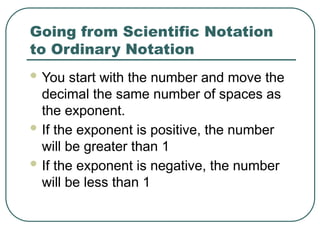
Going from Scientific Notation
to Ordinary Notation
 You start with the number and move the
decimal the same number of spaces as
the exponent.
 If the exponent is positive, the number
will be greater than 1
 If the exponent is negative, the number
will be less than 1
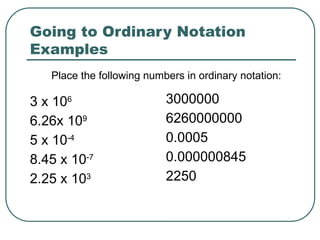
Going to Ordinary Notation
Examples
3 x 10⁶
6.26x 10⁹
5 x 10⁻⁴
8.45 x 10⁻⁷
2.25 x 10³
3000000
6260000000
0.0005
0.000000845
2250
Place the following numbers in ordinary notation:
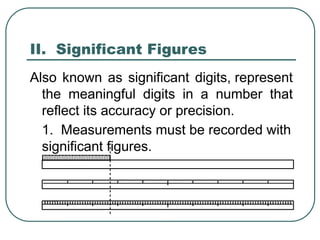
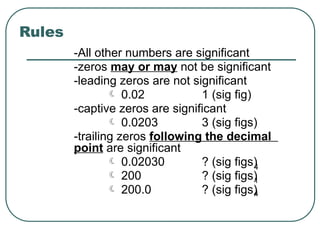
II. Significant Figures
Also known as significant digits, represent
the meaningful digits in a number that
reflect its accuracy or precision.
1. Measurements must be recorded with
significant figures.
-All other numbers are significant
-zeros may or may not be significant
-leading zeros are not significant
 0.02 1 (sig fig)
-captive zeros are significant
 0.0203 3 (sig figs)
-trailing zeros following the decimal
point are significant
 0.02030 ? (sig figs)
 200 ? (sig figs)
 200.0 ? (sig figs)
4
1
4
Rules
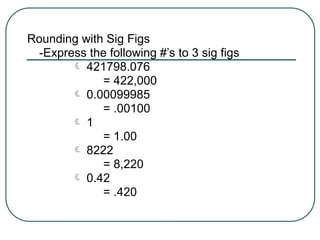
Rounding with Sig Figs
-Express the following #’s to 3 sig figs
 421798.076
= 422,000
 0.00099985
= .00100
 1
= 1.00
 8222
= 8,220
 0.42
= .420
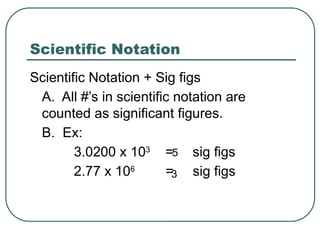
Scientific Notation
Scientific Notation + Sig figs
A. All #’s in scientific notation are
counted as significant figures.
B. Ex:
3.0200 x 103
= sig figs
2.77 x 106
= sig figs
5
3
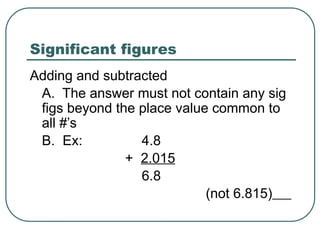
Significant figures
Adding and subtracted
A. The answer must not contain any sig
figs beyond the place value common to
all #’s
B. Ex: 4.8
+ 2.015
6.8
(not 6.815)
Significant figures
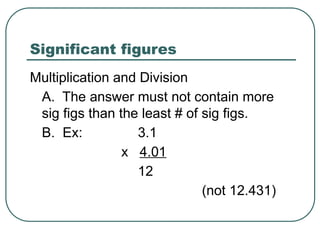
Multiplication and Division
A. The answer must not contain more
sig figs than the least # of sig figs.
B. Ex: 3.1
x 4.01
12
(not 12.431)
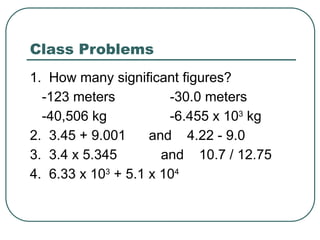
Class Problems
1. How many significant figures?
-123 meters -30.0 meters
-40,506 kg -6.455 x 10³
kg
2. 3.45 + 9.001 and 4.22 - 9.0
3. 3.4 x 5.345 and 10.7 / 12.75
4. 6.33 x 10³
+ 5.1 x 10⁴
Lesson #1: Scientific Measurements
QUIZ #2
GENERAL CHEMISTRY
1
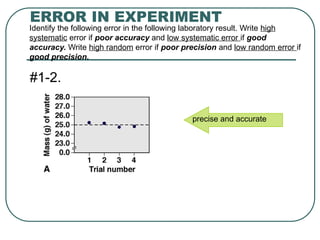
ERROR IN EXPERIMENT
#1-2.
Identify the following error in the following laboratory result. Write high
systematic error if poor accuracy and low systematic error if good
accuracy. Write high random error if poor precision and low random error if
good precision.
precise and accurate
ERROR IN EXPERIMENT
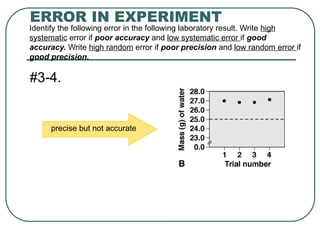
#3-4.
Identify the following error in the following laboratory result. Write high
systematic error if poor accuracy and low systematic error if good
accuracy. Write high random error if poor precision and low random error if
good precision.
precise but not accurate
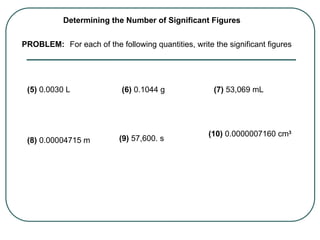
Determining the Number of Significant Figures
PROBLEM: For each of the following quantities, write the significant figures
(6) 0.1044 g
(5) 0.0030 L (7) 53,069 mL
(9) 57,600. s
(8) 0.00004715 m
(10) 0.0000007160 cm3
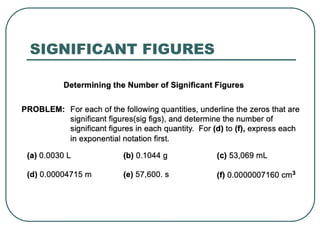
SIGNIFICANT FIGURES
Chemistry 1
Laboratory Performance
THANK YOU

Chemistry 3.1 Notes (Accuracy, precision, error and sig figs).pptx

  • 1.
  • 2.
    SUBTOPICS:  Mass, Volumeand Density Scientific Measurements  Accuracy and Precision  Error in Experiment  Scientific Notation  Significant Figures
  • 3.
    OBJECTIVES: 1. explain thedifference between mass, volume, and density of a solid using the correct and appropriate units; 2. investigate the density of commonly used solids using laboratory equipment, including writing a scientific report; 3. explain that accuracy and precision are important to assess the quality of experimental results;
  • 4.
    OBJECTIVES: 4. identify sourcesof error and propose improvements to enhance measurement reliability; 5. apply scientific notation and explain how to determine the proper number of significant figures in calculations;
  • 5.
  • 6.
    MASS Amount of matterin an object Metric Unit of Mass = gram Method of Measurements: • Electronic Balance • Triple Beam Balance • Double pan Balance
  • 7.
    VOLUME Amount of spaceoccupied by an object. Metric Unit of Mass = Liter or cm3 Method of Measurements: • Length x Width x Height • Liquid Displacement
  • 8.
    DENSITY Mass per unitvolume Metric Unit of Mass = g/ml or g/cm3 Method of Measurements: Use the formula: mass volume
  • 9.
    I. Accuracy, Precision,& Error A. Accuracy – how close a measurement comes to the “true value”. 1. Ex: Throwing Darts true value = bull's- eye
  • 10.
    Precision B. Precision –how close a series of measurements are together. 1. Ex: Throwing Darts
  • 11.
    Explanation Poor Accuracy Good Precision GoodAccuracy Good Precision Poor Accuracy Poor Precision
  • 12.
    Error D. Error –the difference between the accepted value and the experimental value. 1. Formula – 2. Error = ex. value – accepted value | error | accepted value
  • 13.
    Example: 1. In classyou determine the melting point of salt is 755 deg C. The actual value is 805 deg C. What is your percent error?  [|755 - 805| / 805] x 100 =  6.2% error
  • 14.
    EXPERIMENTAL ERRORS This areerrors that cannot eliminates
  • 17.
    SCIENTIFIC NOTATION A QUICKWAY TO WRITE REALLY, REALLY BIG OR REALLY, REALLY SMALL NUMBERS.
  • 18.
    Scientists are Lazy!!! They decidedthat by using powers of 10, they can create short versions of long numbers.
  • 19.
    Rules for ScientificNotation To be in proper scientific notation the number must be written with * a number between 1 and 10 * and multiplied by a power of ten 23 X 105 is not in proper scientific notation. Why?
  • 20.
  • 22.
    Now You Try Usingscientific notation, rewrite the following numbers. 347,000 3.47 X 10⁵ 902,000,000 9.02 X 10⁸ 61,400 4
  • 23.
    Convert these: 1.23 X10⁻⁵ .0000123 6.806 X 10⁻⁶ .000006806
  • 24.
    Try These 4,000 4 X10³ 2.48 X 10³ 2,480 6.123 X 10⁶ 6,123,000 306,000,000 3.06 X 10⁸
  • 25.
    Significant Figures  Scientistuse significant figures to determine how precise a measurement is  Significant digits in a measurement include all of the known digits plus one estimated digit
  • 26.
    For example…  Lookat the ruler below  Each line is 0.1cm  You can read that the arrow is on 13.3 cm  However, using significant figures, you must estimate the next digit  That would give you 13.30 cm
  • 27.
    Let’s try thisone  Look at the ruler below  What can you read before you estimate?  12.8 cm  Now estimate the next digit…  12.85 cm
  • 28.
    The same rulesapply with all instruments  The same rules apply  Read to the last digit that you know  Estimate the final digit
  • 29.
    Let’s try graduatedcylinders  Look at the graduated cylinder below  What can you read with confidence?  56 ml  Now estimate the last digit  56.0 ml
  • 30.
    One more graduatedcylinder  Look at the cylinder below…  What is the measurement?  53.5 ml
  • 31.
    Rules for Significantfigures Rule #1  All non zero digits are ALWAYS significant  How many significant digits are in the following numbers? • 274 • 25.632 • 8.987 • 3 Significant Figures • 5 Significant Digits • 4 Significant Figures
  • 32.
    Rule #2  Allzeros between significant digits are ALWAYS significant  How many significant digits are in the following numbers? 504 60002 9.077 3 Significant Figures 5 Significant Digits 4 Significant Figures
  • 33.
    Rule #3  AllFINAL zeros to the right of the decimal ARE significant  How many significant digits are in the following numbers? 32.0 19.000 105.0020 3 Significant Figures 5 Significant Digits 7 Significant Figures
  • 34.
    Rule #4  Allzeros that act as place holders are NOT significant  Another way to say this is: zeros are only significant if they are between significant digits OR are the very final thing at the end of a decimal
  • 35.
    For example 0.0002 6.02 x10²³ 100.000 150000 800 1 Significant Digit 3 Significant Digits 6 Significant Digits 2 Significant Digits 1 Significant Digit How many significant digits are in the following numbers?
  • 36.
    Rule #5  Allcounting numbers and constants have an infinite number of significant digits  For example: 1 hour = 60 minutes 12 inches = 1 foot 24 hours = 1 day
  • 37.
    How many significantdigits are in the following numbers? 0.0073 100.020 2500 7.90 x 10⁻³ 670.0 0.00001 18.84 2 Significant Digits 6 Significant Digits 2 Significant Digits 3 Significant Digits 4 Significant Digits 1 Significant Digit 4 Significant Digits
  • 38.
    Rules Rounding Significant Digits Rule#1  If the digit to the immediate right of the last significant digit is less that 5, do not round up the last significant digit.  For example, let’s say you have the number 43.82 and you want 3 significant digits  The last number that you want is the 8 – 43.82  The number to the right of the 8 is a 2  Therefore, you would not round up & the number would be 43.8
  • 39.
    Rounding Rule #2 If the digit to the immediate right of the last significant digit is greater that a 5, you round up the last significant figure  Let’s say you have the number 234.87 and you want 4 significant digits  234.87 – The last number you want is the 8 and the number to the right is a 7  Therefore, you would round up & get 234.9
  • 40.
    Rounding Rule #3 If the number to the immediate right of the last significant is a 5, and that 5 is followed by a non zero digit, round up  78.657 (you want 3 significant digits)  The number you want is the 6  The 6 is followed by a 5 and the 5 is followed by a non zero number  Therefore, you round up  78.7
  • 41.
    Rounding Rule #4 If the number to the immediate right of the last significant is a 5, and that 5 is followed by a zero, you look at the last significant digit and make it even.  2.5350 (want 3 significant digits)  The number to the right of the digit you want is a 5 followed by a 0  Therefore you want the final digit to be even  2.54
  • 42.
    Say you havethis number  2.5250 (want 3 significant digits)  The number to the right of the digit you want is a 5 followed by a 0  Therefore you want the final digit to be even and it already is  2.52
  • 43.
    Let’s try theseexamples… 200.99 (want 3 SF) 18.22 (want 2 SF) 135.50 (want 3 SF) 0.00299 (want 1 SF) 98.59 (want 2 SF) 201 18 136 0.003 99
  • 44.
    Scientific Notation  Scientificnotation is used to express very large or very small numbers  I consists of a number between 1 & 10 followed by x 10 to an exponent  The exponent can be determined by the number of decimal places you have to move to get only 1 number in front of the decimal
  • 45.
    Large Numbers  Ifthe number you start with is greater than 1, the exponent will be positive  Write the number 39923 in scientific notation  First move the decimal until 1 number is in front – 3.9923  Now at x 10 – 3.9923 x 10  Now count the number of decimal places that you moved (4)  Since the number you started with was greater than 1, the exponent will be positive  3.9923 x 10 4
  • 46.
    Small Numbers  Ifthe number you start with is less than 1, the exponent will be negative  Write the number 0.0052 in scientific notation  First move the decimal until 1 number is in front – 5.2  Now at x 10 – 5.2 x 10  Now count the number of decimal places that you moved (3)  Since the number you started with was less than 1, the exponent will be negative  5.2 x 10 -3
  • 47.
    Scientific Notation Examples 99.343 4000.1 0.000375 0.0234 94577.1 9.9343x 101 4.0001 x 10³ 3.75 x 10⁻⁴ 2.34 x 10⁻² 9.45771 x 10⁴ Place the following numbers in scientific notation:
  • 48.
    Going from ScientificNotation to Ordinary Notation  You start with the number and move the decimal the same number of spaces as the exponent.  If the exponent is positive, the number will be greater than 1  If the exponent is negative, the number will be less than 1
  • 49.
    Going to OrdinaryNotation Examples 3 x 10⁶ 6.26x 10⁹ 5 x 10⁻⁴ 8.45 x 10⁻⁷ 2.25 x 10³ 3000000 6260000000 0.0005 0.000000845 2250 Place the following numbers in ordinary notation:
  • 50.
    II. Significant Figures Alsoknown as significant digits, represent the meaningful digits in a number that reflect its accuracy or precision. 1. Measurements must be recorded with significant figures.
  • 51.
    -All other numbersare significant -zeros may or may not be significant -leading zeros are not significant  0.02 1 (sig fig) -captive zeros are significant  0.0203 3 (sig figs) -trailing zeros following the decimal point are significant  0.02030 ? (sig figs)  200 ? (sig figs)  200.0 ? (sig figs) 4 1 4 Rules
  • 52.
    Rounding with SigFigs -Express the following #’s to 3 sig figs  421798.076 = 422,000  0.00099985 = .00100  1 = 1.00  8222 = 8,220  0.42 = .420
  • 53.
    Scientific Notation Scientific Notation+ Sig figs A. All #’s in scientific notation are counted as significant figures. B. Ex: 3.0200 x 103 = sig figs 2.77 x 106 = sig figs 5 3
  • 54.
    Significant figures Adding andsubtracted A. The answer must not contain any sig figs beyond the place value common to all #’s B. Ex: 4.8 + 2.015 6.8 (not 6.815)
  • 55.
    Significant figures Multiplication andDivision A. The answer must not contain more sig figs than the least # of sig figs. B. Ex: 3.1 x 4.01 12 (not 12.431)
  • 56.
    Class Problems 1. Howmany significant figures? -123 meters -30.0 meters -40,506 kg -6.455 x 10³ kg 2. 3.45 + 9.001 and 4.22 - 9.0 3. 3.4 x 5.345 and 10.7 / 12.75 4. 6.33 x 10³ + 5.1 x 10⁴
  • 57.
    Lesson #1: ScientificMeasurements QUIZ #2 GENERAL CHEMISTRY 1
  • 58.
    ERROR IN EXPERIMENT #1-2. Identifythe following error in the following laboratory result. Write high systematic error if poor accuracy and low systematic error if good accuracy. Write high random error if poor precision and low random error if good precision. precise and accurate
  • 59.
    ERROR IN EXPERIMENT #3-4. Identifythe following error in the following laboratory result. Write high systematic error if poor accuracy and low systematic error if good accuracy. Write high random error if poor precision and low random error if good precision. precise but not accurate
  • 60.
    Determining the Numberof Significant Figures PROBLEM: For each of the following quantities, write the significant figures (6) 0.1044 g (5) 0.0030 L (7) 53,069 mL (9) 57,600. s (8) 0.00004715 m (10) 0.0000007160 cm3
  • 61.
  • 62.
  • 63.