Significant Figures
Significant figuresare digits that carrying
meaning contributing to its measurement
resolution.
It includes all digits except leading zeros.
The number of significant figures in an
expression indicates the confidence or precision
which an engineer or scientist states a quantity.
3.
Rules in CountingSig Fig
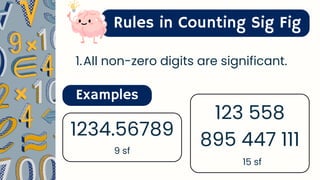
1.All non-zero digits are significant.
Examples
1234.56789
9 sf
123 558
895 447 111
15 sf
4.
Rules in CountingSig Fig
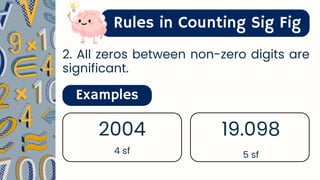
2. All zeros between non-zero digits are
significant.
Examples
2004
4 sf
19.098
5 sf
5.
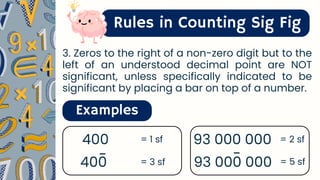
Rules in CountingSig Fig
3. Zeros to the right of a non-zero digit but to the
left of an understood decimal point are NOT
significant, unless specifically indicated to be
significant by placing a bar on top of a number.
Examples
400 = 1 sf
400
- = 3 sf
93 000 000 = 2 sf
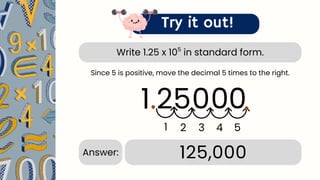
93 000 000
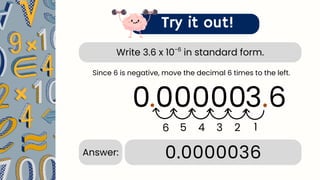
- = 5 sf
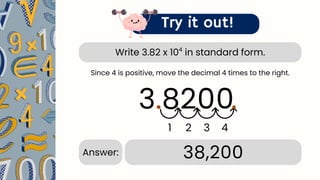
6.
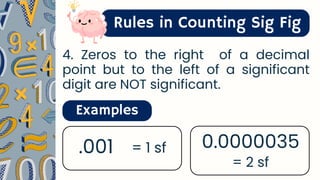
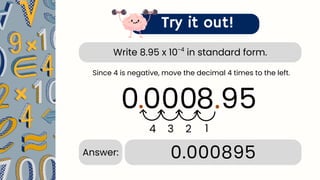
Rules in CountingSig Fig
4. Zeros to the right of a decimal
point but to the left of a significant
digit are NOT significant.
Examples
.001 = 1 sf 0.0000035
= 2 sf
7.
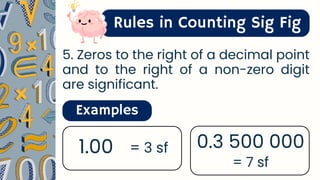
Rules in CountingSig Fig
5. Zeros to the right of a decimal point
and to the right of a non-zero digit
are significant.
Examples
1.00 = 3 sf 0.3 500 000
= 7 sf
8.
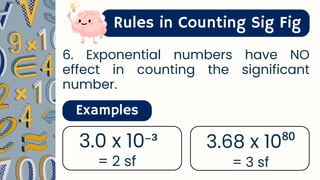
Rules in CountingSig Fig
6. Exponential numbers have NO
effect in counting the significant
number.
Examples
3.0 x 10⁻³
= 2 sf
3.68 x 10⁸⁰
= 3 sf
9.
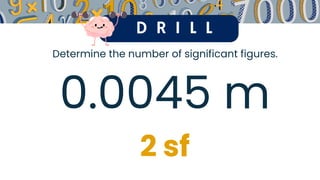
D R IL L
Determine the number of significant figures.
0.0045 m
2 sf
10.
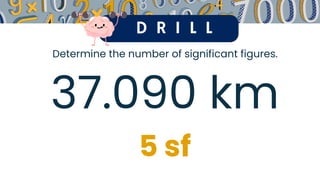
D R IL L
Determine the number of significant figures.
37.090 km
5 sf
11.
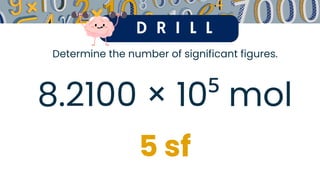
D R IL L
Determine the number of significant figures.
8.2100 × 10⁵ mol
5 sf
12.
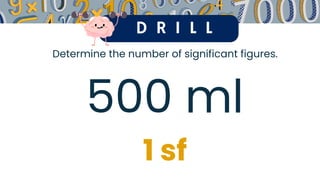
D R IL L
Determine the number of significant figures.
500 ml
1 sf
13.
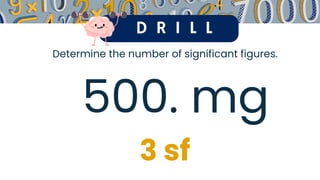
D R IL L
Determine the number of significant figures.
500. mg
3 sf
14.
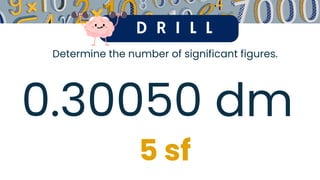
D R IL L
Determine the number of significant figures.
0.30050 dm
5 sf
15.
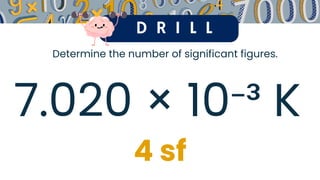
D R IL L
Determine the number of significant figures.
7.020 × 10⁻³ K
4 sf
16.
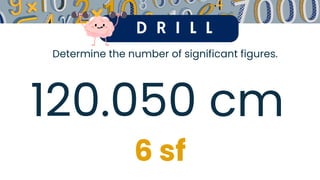
D R IL L
Determine the number of significant figures.
120.050 cm
6 sf
17.
D R IL L
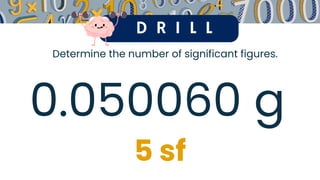
Determine the number of significant figures.
0.050060 g
5 sf
18.
D R IL L
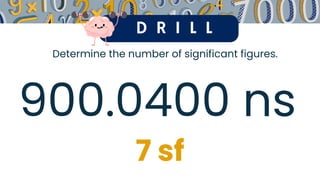
Determine the number of significant figures.
900.0400 ns
7 sf
19.
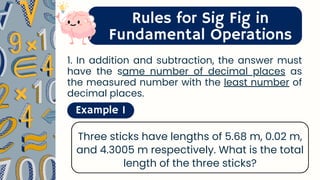
Rules for SigFig in
Fundamental Operations
1. In addition and subtraction, the answer must
have the same number of decimal places as
the measured number with the least number of
decimal places.
Example 1
Three sticks have lengths of 5.68 m, 0.02 m,
and 4.3005 m respectively. What is the total
length of the three sticks?
20.
Rules for SigFig in Fundamental Operations
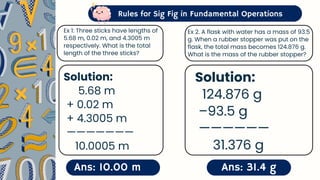
Ans: 10.00 m
Ex 1: Three sticks have lengths of
5.68 m, 0.02 m, and 4.3005 m
respectively. What is the total
length of the three sticks?
Solution:
5.68 m
+ 0.02 m
+ 4.3005 m
———————
10.0005 m
Ex 2. A flask with water has a mass of 93.5
g. When a rubber stopper was put on the
flask, the total mass becomes 124.876 g.
What is the mass of the rubber stopper?
Solution:
124.876 g
–93.5 g
——————
31.376 g
Ans: 31.4 g
21.
Rules for SigFig in
Fundamental Operations
2. In multiplication and division, the answer
must have the same number of significant
figures as the measured number with the lowest
number of significant figures.
Example 1
A student measured the length, width, and
height of a block of wood as 3.388 m, 3.12 m,
and 4.0 m, respectively. What is the volume of
the wood?
22.
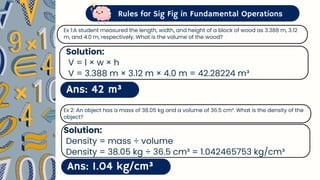
Rules for SigFig in Fundamental Operations
Ans: 42 m³
Ex 1:A student measured the length, width, and height of a block of wood as 3.388 m, 3.12
m, and 4.0 m, respectively. What is the volume of the wood?
Solution:
V = l × w × h
V = 3.388 m × 3.12 m × 4.0 m = 42.28224 m³
Ans: 1.04 kg/cm³
Ex 2: An object has a mass of 38.05 kg and a volume of 36.5 cm³. What is the density of the
object?
Solution:
Density = mass ÷ volume
Density = 38.05 kg ÷ 36.5 cm³ = 1.042465753 kg/cm³
23.
Try it out!
1
Agraduated cylinder contains 45.60
mL of water. After adding a salt
sample, the new volume is 48.234
mL. What is the volume of the salt?
24.
Try it out!
2
Aspectrophotometer detects that
0.006500 g of substance is present
in a 2.50 mL sample.
Calculate concentration in g/mL.
25.
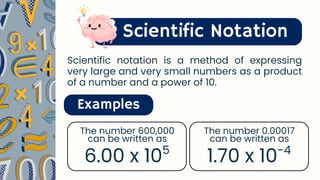
Scientific Notation
Examples
6.00 x10⁵
The number 600,000
can be written as
1.70 x 10⁻⁴
The number 0.00017
can be written as
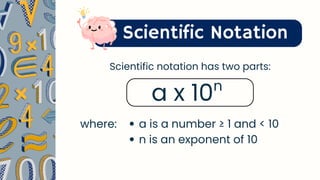
Scientific notation is a method of expressing
very large and very small numbers as a product
of a number and a power of 10.
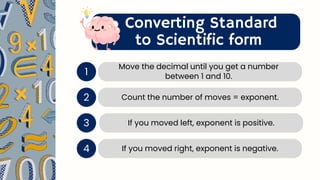
Converting Standard
to Scientificform
1
Move the decimal until you get a number
between 1 and 10.
2 Count the number of moves = exponent.
If you moved left, exponent is positive.
3
If you moved right, exponent is negative.
4
28.
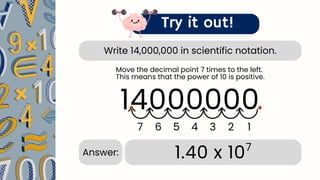
Write 14,000,000 inscientific notation.
Try it out!
14000000.
1
2
3
4
5
6
7
.
1.40 x 10⁷
Answer:
Move the decimal point 7 times to the left.
This means that the power of 10 is positive.
29.
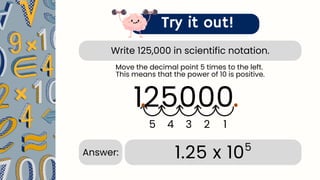
Write 125,000 inscientific notation.
Try it out!
125000.
1
2
3
4
5
.
1.25 x 10⁵
Answer:
Move the decimal point 5 times to the left.
This means that the power of 10 is positive.
30.
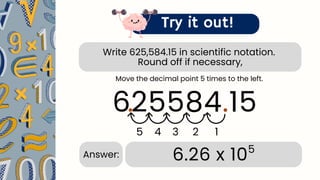
Write 625,584.15 inscientific notation.
Round off if necessary,
Try it out!
625584.15
.
1
2
3
4
5
.
6.26 x 10⁵
Answer:
Move the decimal point 5 times to the left.
31.
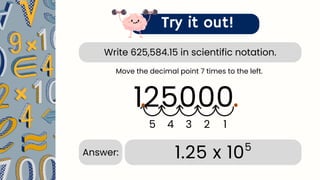
Write 625,584.15 inscientific notation.
Try it out!
125000.
1
2
3
4
5
.
1.25 x 10⁵
Answer:
Move the decimal point 7 times to the left.
32.
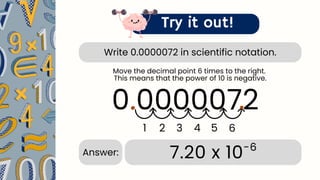
Write 0.0000072 inscientific notation.
Try it out!
0.0000072
.
1 2 3 4 5 6
.
7.20 x 10⁻⁶
Answer:
Move the decimal point 6 times to the right.
This means that the power of 10 is negative.
33.
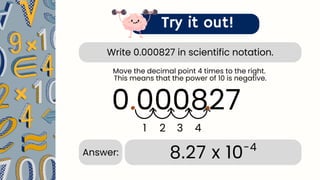
Write 0.000827 inscientific notation.
Try it out!
0.000827
.
1 2 3 4
.
8.27 x 10⁻⁴
Answer:
Move the decimal point 4 times to the right.
This means that the power of 10 is negative.
34.
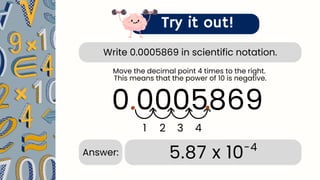
Write 0.0005869 inscientific notation.
Try it out!
0.0005869
.
1 2 3 4
.
5.87 x 10⁻⁴
Answer:
Move the decimal point 4 times to the right.
This means that the power of 10 is negative.
35.
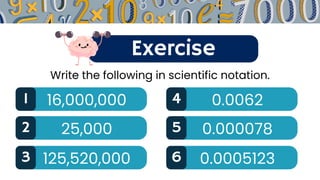
Exercise
1 16,000,000 40.0062
Write the following in scientific notation.
2 25,000 5 0.000078
3 125,520,000 6 0.0005123
36.
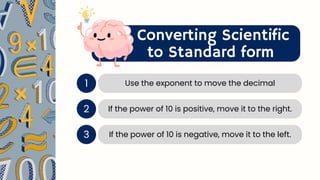
Converting Scientific
to Standardform
1 Use the exponent to move the decimal
2 If the power of 10 is positive, move it to the right.
If the power of 10 is negative, move it to the left.
3
37.
Write 1.25 x10 in standard form.
5
Try it out!
1.25
.
1 2 3 4
125,000
Answer:
Since 5 is positive, move the decimal 5 times to the right.
0 0
0
5
.
38.
Write 3.6 x10 in standard form.
-6
Try it out!
3.6
.
6 5 4 3
0.0000036
Answer:
Since 6 is negative, move the decimal 6 times to the left.
0 0
0
2
.
1
00
0
39.
Write 3.82 x10 in standard form.
4
Try it out!
3.82
.
1 2 3 4
38,200
Answer:
Since 4 is positive, move the decimal 4 times to the right.
00.
40.
Write 8.95 x10 in standard form.
-4
Try it out!
8.95
.
4 3
0.000895
Answer:
Since 4 is negative, move the decimal 4 times to the left.
0
2
.
1
00
0
41.
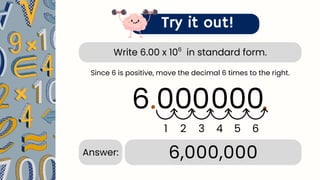
Write 6.00 x10 in standard form.
6
Try it out!
6.00
.
1 2 3 4
6,000,000
Answer:
Since 6 is positive, move the decimal 6 times to the right.
0 0
0
5
.
6
0
42.
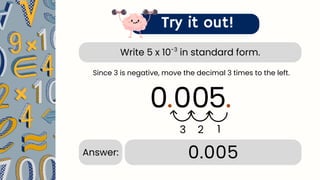
Write 5 x10 in standard form.
-3
Try it out!
5.
3
0.005
Answer:
Since 3 is negative, move the decimal 3 times to the left.
2
.
1
00
0
43.
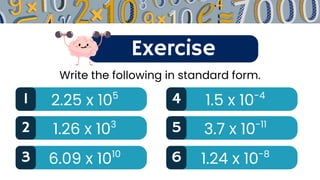
Exercise
1 2.25 x10⁵ 4 1.5 x 10⁻⁴
Write the following in standard form.
2 1.26 x 10³ 5 3.7 x 10⁻¹¹
3 6.09 x 10¹⁰ 6 1.24 x 10⁻⁸



![Tro3 lecture 02[1]](https://cdn.slidesharecdn.com/ss_thumbnails/tro3lecture021-100902124808-phpapp02-thumbnail.jpg?width=640&height=640&fit=bounds)


