Crashworthiness and Occupant Protection in
Transportation Systems I
ME 8020
Test No.4
SIDE IMPACT and
Effect of frontal crash on Steel and Composite rail
Analysis
Presented By: Suravi Banik (fz4276)
Objective
• Side impact test with pole
• Side Impact test with Moving Deformable Barrier
• Steel analysis in rails
• Composite Analysis in rails &
• What if Analysis
Side Impact
The National Safety Council reports side-impact crashes, also referred to as
roadside, or T-bone collisions, are second only to head-on collisions in the
number of serious injuries and fatalities they cause each year. During a side-
impact collision, one car hits the other in a perpendicular direction.
The purpose of side impact test is
• To reduce the risk of serious and fatal injury to occupants of passenger cars,
multipurpose passenger vehicles, trucks, and buses during side impacts.
• To obtain vehicle crashworthiness test data for different types of side impact
tests.
Model Description
Car Model Selected:
1. Small SUV; Weight of the truck= 1345 kg
2. Dummy: weight: 79 kg
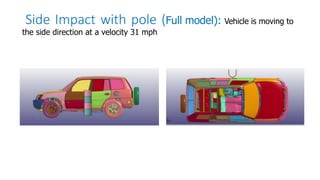
Side Impact with pole (Full model): Vehicle is moving to
the side direction at a velocity 31 mph
Consequences after Side Impact with pole
60 ms
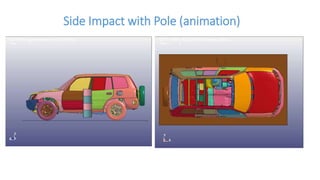
Side Impact with Pole (animation)
Energy plot without dummy (matsum & gstat) [pole]
Kinetic
Energy
Internal
Energy
Energy plot with dummy (matsum & gstat) [pole]
Kinetic Energy
Internal Energy
Velocity and displacement vs time plot [pole]
What if analysis [pole] (1): changing the thickness of door and B-pillar
Originally, thickness of F-OB-DOOR-DRVR-INNER-
SILL-LEFT=1.95 mm;
for what if analysis it is 6 mm
Originally, thickness of F-CH-B-PILL-INNR3 =1.10 mm;
for what if analysis it is 5 mm
Given
Modified
Given
Modified
What if Analysis -video[pole]
Comparison between main and what if file
[pole]
Main file What if
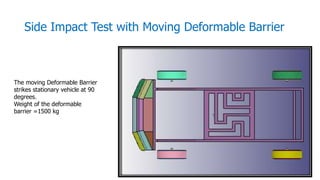
Side Impact Test with Moving Deformable Barrier
The moving Deformable Barrier
strikes stationary vehicle at 90
degrees.
Weight of the deformable
barrier =1500 kg
Side Impact with Barrier (Full model)
Scenario after the side impact with barrier
Side Impact with barrier (animation)
Energy plot (matsum & gstat) [side impact with barrier]
Total energy
Kinetic energy
Internal energy
Kinetic energy
Velocity and displacement vs time plot [barrier]
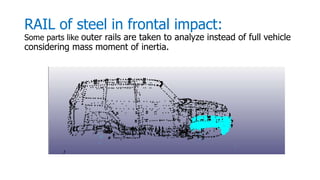
RAIL of steel in frontal impact:
Some parts like outer rails are taken to analyze instead of full vehicle
considering mass moment of inertia.
RAIL of steel in frontal impact (video)
After frontal impact with steel materials of rails
Energy plot (matsum & gstat) [steel]
What if Analysis: changing the thickness of
outer rail (steel)
Original file
Changing the thickness
What if Analysis in steel (video)
What if Analysis in steel after frontal impact
Composite Analysis:
Some parts of rails are changed to composite materials.
Composite Analysis
Scenario of the rails with composite materials parts after
frontal impact
Energy plot (matsum & gstat) [composite]
What if composite (changing the angle and thickness of the composite
materials)
Original file
Changing the angle and thickness
What if [composite analysis]
What if [composite analysis] : scenario after the
frontal impact
Conclusion
• Side impact with pole and moving deformable barrier causes more or less injuries to the
occupants whether it has restraint system or not.
• Side airbag also plays an important role to protect the occupants from the side impact
crash.
• The energy plots of both the side impact tests are balanced.
• Changing thickness of door and B-pillar causes a little change of impact but not very
significant.
• From the frontal test with steel materials in rails, we can see that due to frontal crash
intrusion occurs to the occupants which is really dangerous.
• From the composite analysis we can see parts are separated from the rail due to the
frontal crash so that less intrusion occurs.
• Using composite materials rather than steel reduces the weight of the vehicle and
absorbs more energy.
• Using composite is less costly than using steel or aluminum.
• Composite materials are more safe than any other metals.
Side Impact and composite rail analysis using LS-DYNA

Side Impact and composite rail analysis using LS-DYNA

  • 1.
    Crashworthiness and OccupantProtection in Transportation Systems I ME 8020 Test No.4 SIDE IMPACT and Effect of frontal crash on Steel and Composite rail Analysis Presented By: Suravi Banik (fz4276)
  • 2.
    Objective • Side impacttest with pole • Side Impact test with Moving Deformable Barrier • Steel analysis in rails • Composite Analysis in rails & • What if Analysis
  • 3.
    Side Impact The NationalSafety Council reports side-impact crashes, also referred to as roadside, or T-bone collisions, are second only to head-on collisions in the number of serious injuries and fatalities they cause each year. During a side- impact collision, one car hits the other in a perpendicular direction. The purpose of side impact test is • To reduce the risk of serious and fatal injury to occupants of passenger cars, multipurpose passenger vehicles, trucks, and buses during side impacts. • To obtain vehicle crashworthiness test data for different types of side impact tests.
  • 4.
    Model Description Car ModelSelected: 1. Small SUV; Weight of the truck= 1345 kg 2. Dummy: weight: 79 kg
  • 5.
    Side Impact withpole (Full model): Vehicle is moving to the side direction at a velocity 31 mph
  • 6.
    Consequences after SideImpact with pole 60 ms
  • 7.
    Side Impact withPole (animation)
  • 8.
    Energy plot withoutdummy (matsum & gstat) [pole] Kinetic Energy Internal Energy
  • 9.
    Energy plot withdummy (matsum & gstat) [pole] Kinetic Energy Internal Energy
  • 10.
    Velocity and displacementvs time plot [pole]
  • 11.
    What if analysis[pole] (1): changing the thickness of door and B-pillar Originally, thickness of F-OB-DOOR-DRVR-INNER- SILL-LEFT=1.95 mm; for what if analysis it is 6 mm Originally, thickness of F-CH-B-PILL-INNR3 =1.10 mm; for what if analysis it is 5 mm Given Modified Given Modified
  • 12.
    What if Analysis-video[pole]
  • 13.
    Comparison between mainand what if file [pole] Main file What if
  • 14.
    Side Impact Testwith Moving Deformable Barrier The moving Deformable Barrier strikes stationary vehicle at 90 degrees. Weight of the deformable barrier =1500 kg
  • 15.
    Side Impact withBarrier (Full model)
  • 16.
    Scenario after theside impact with barrier
  • 17.
    Side Impact withbarrier (animation)
  • 18.
    Energy plot (matsum& gstat) [side impact with barrier] Total energy Kinetic energy Internal energy Kinetic energy
  • 19.
    Velocity and displacementvs time plot [barrier]
  • 20.
    RAIL of steelin frontal impact: Some parts like outer rails are taken to analyze instead of full vehicle considering mass moment of inertia.
  • 21.
    RAIL of steelin frontal impact (video)
  • 22.
    After frontal impactwith steel materials of rails
  • 23.
    Energy plot (matsum& gstat) [steel]
  • 24.
    What if Analysis:changing the thickness of outer rail (steel) Original file Changing the thickness
  • 25.
    What if Analysisin steel (video)
  • 26.
    What if Analysisin steel after frontal impact
  • 27.
    Composite Analysis: Some partsof rails are changed to composite materials.
  • 28.
  • 29.
    Scenario of therails with composite materials parts after frontal impact
  • 30.
    Energy plot (matsum& gstat) [composite]
  • 31.
    What if composite(changing the angle and thickness of the composite materials) Original file Changing the angle and thickness
  • 32.
  • 33.
    What if [compositeanalysis] : scenario after the frontal impact
  • 34.
    Conclusion • Side impactwith pole and moving deformable barrier causes more or less injuries to the occupants whether it has restraint system or not. • Side airbag also plays an important role to protect the occupants from the side impact crash. • The energy plots of both the side impact tests are balanced. • Changing thickness of door and B-pillar causes a little change of impact but not very significant. • From the frontal test with steel materials in rails, we can see that due to frontal crash intrusion occurs to the occupants which is really dangerous. • From the composite analysis we can see parts are separated from the rail due to the frontal crash so that less intrusion occurs. • Using composite materials rather than steel reduces the weight of the vehicle and absorbs more energy. • Using composite is less costly than using steel or aluminum. • Composite materials are more safe than any other metals.