1
2
Origin
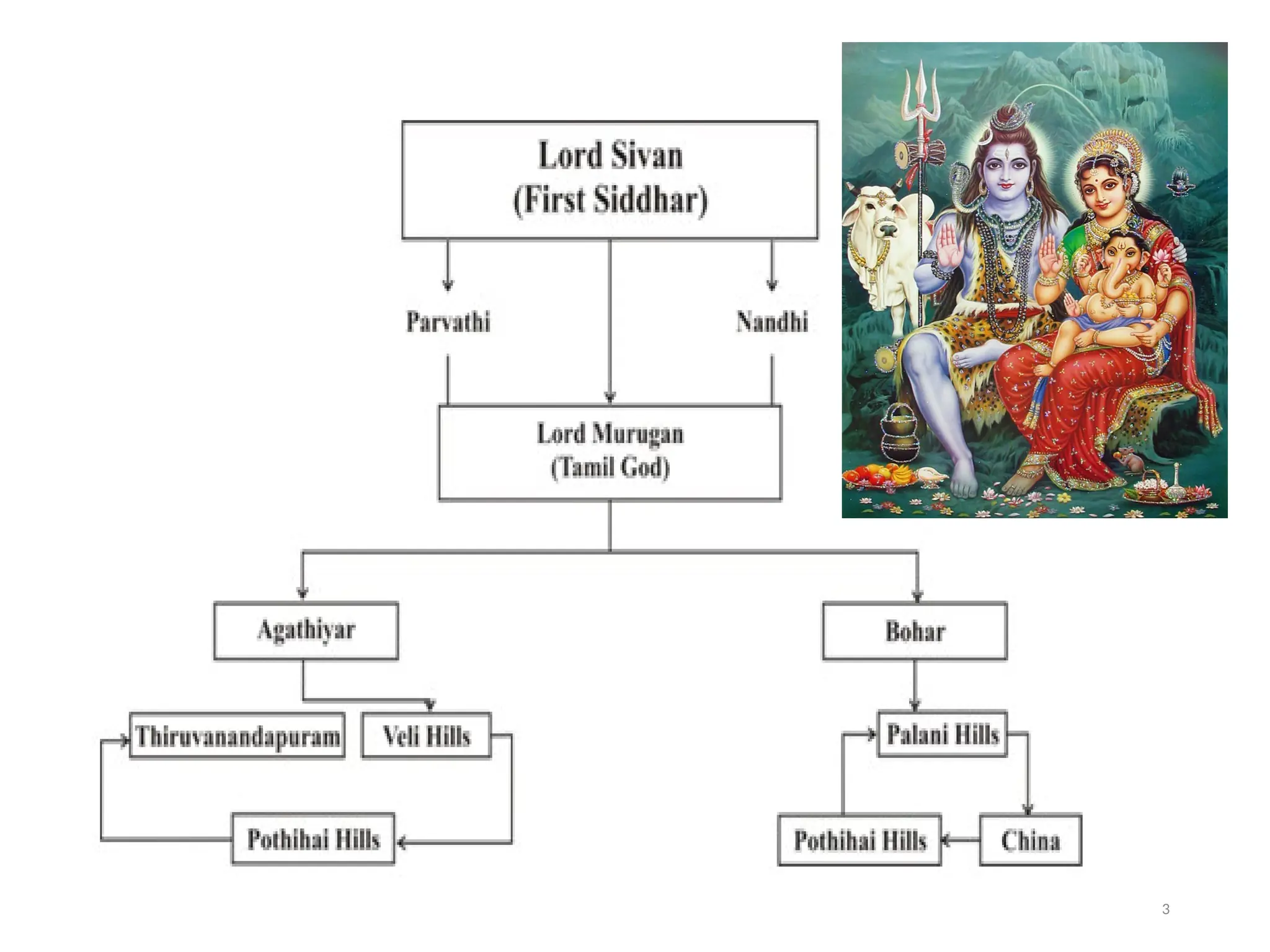
• The origin of Siddha is attributed to Lord Siva, who is supposed to have
handed it down to his consort Parvathi (Shakthi), who in turn passed on
the sacred knowledge to Nandi, from whom it was transmitted to the
first of "Siddhars“.
• Tradition lists a total number of eighteen siddhars, beginning with Nandi
and the semi-legendary-Agattiyar through to the final Siddhar-
Kudhambai.
• They were the ancient supernatural spiritual saints of India.
3
4
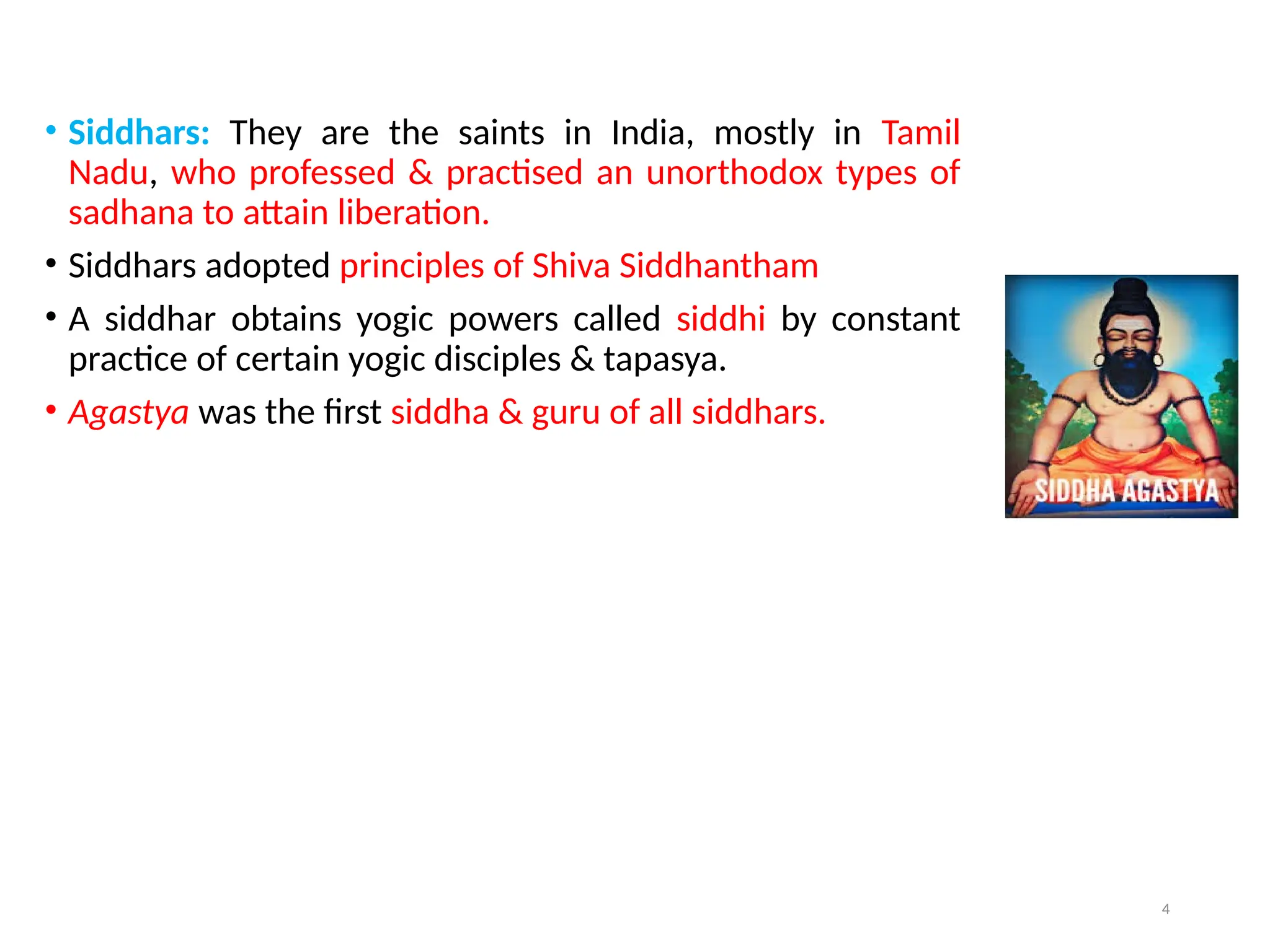
• Siddhars: They are the saints in India, mostly in Tamil
Nadu, who professed & practised an unorthodox types of
sadhana to attain liberation.
• Siddhars adopted principles of Shiva Siddhantham
• A siddhar obtains yogic powers called siddhi by constant
practice of certain yogic disciples & tapasya.
• Agastya was the first siddha & guru of all siddhars.
5
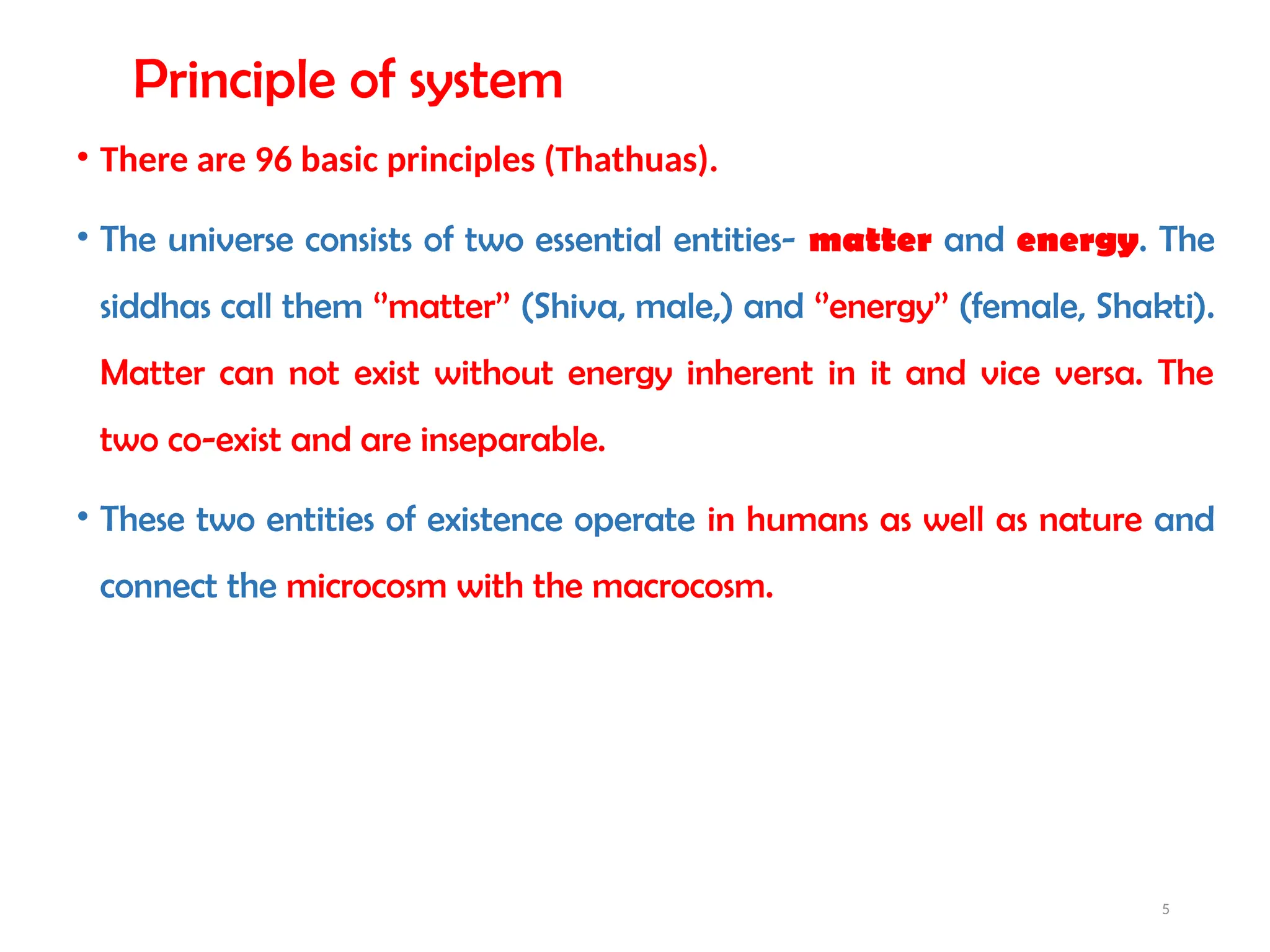
Principle of system
• There are 96 basic principles (Thathuas).
• The universe consists of two essential entities- matter and energy. The
siddhas call them ‘’matter’’ (Shiva, male,) and ‘’energy’’ (female, Shakti).
Matter can not exist without energy inherent in it and vice versa. The
two co-exist and are inseparable.
• These two entities of existence operate in humans as well as nature and
connect the microcosm with the macrocosm.
6
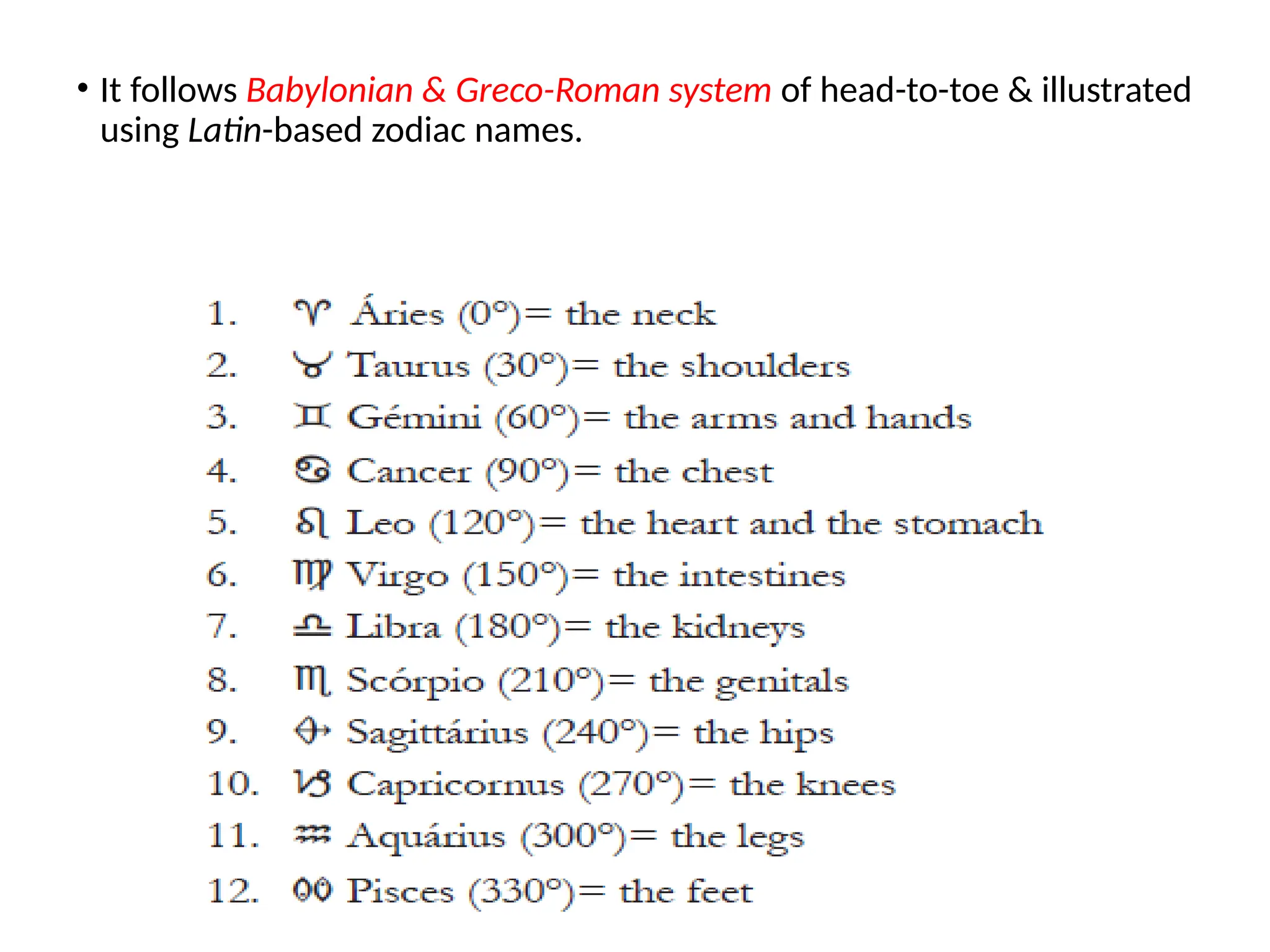
• It follows Babylonian & Greco-Roman system of head-to-toe & illustrated
using Latin-based zodiac names.
7
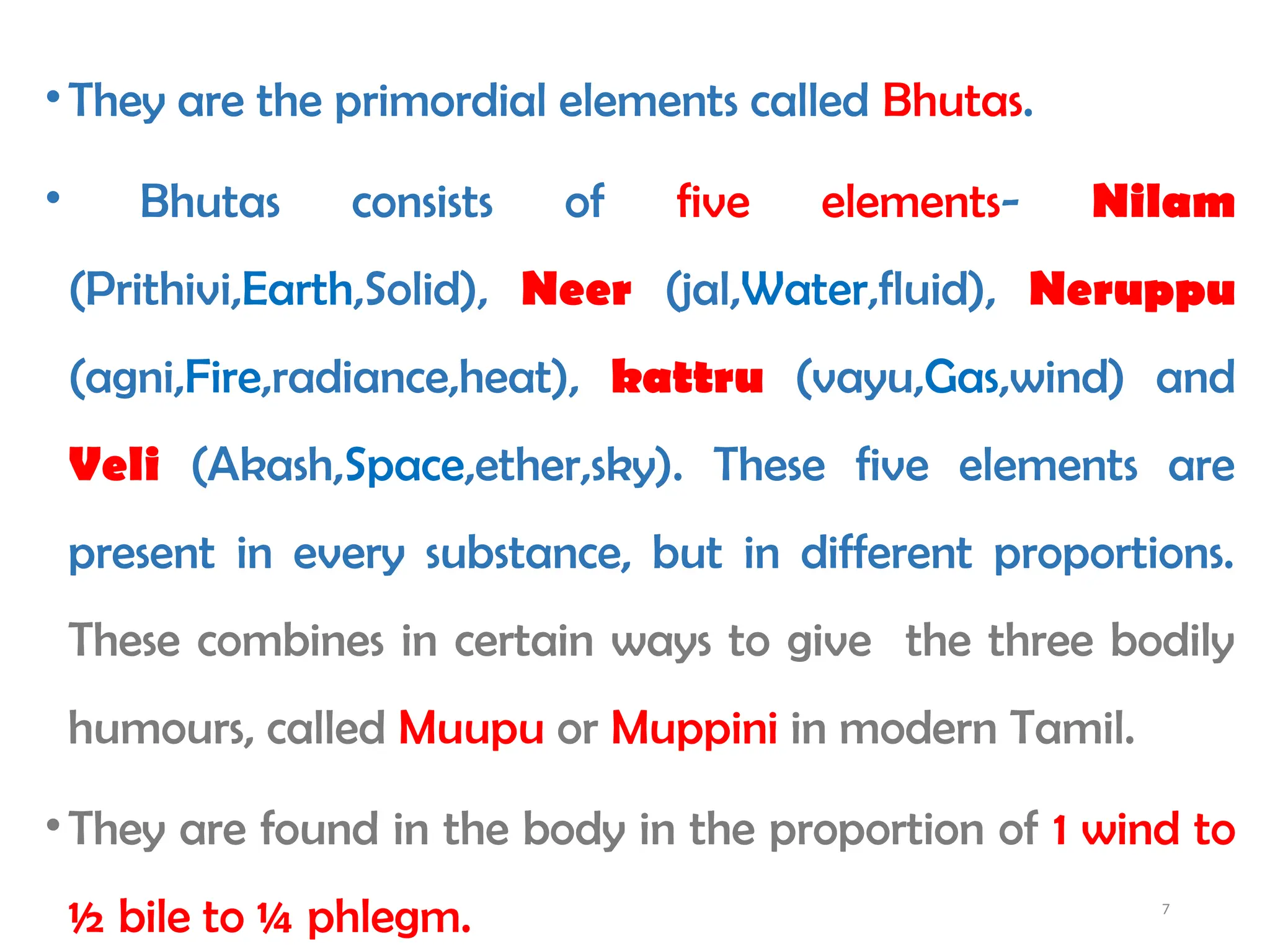
•They are the primordial elements called Bhutas.
• Bhutas consists of five elements- Nilam
(Prithivi,Earth,Solid), Neer (jal,Water,fluid), Neruppu
(agni,Fire,radiance,heat), kattru (vayu,Gas,wind) and
Veli (Akash,Space,ether,sky). These five elements are
present in every substance, but in different proportions.
These combines in certain ways to give the three bodily
humours, called Muupu or Muppini in modern Tamil.
•They are found in the body in the proportion of 1 wind to
½ bile to ¼ phlegm.
8
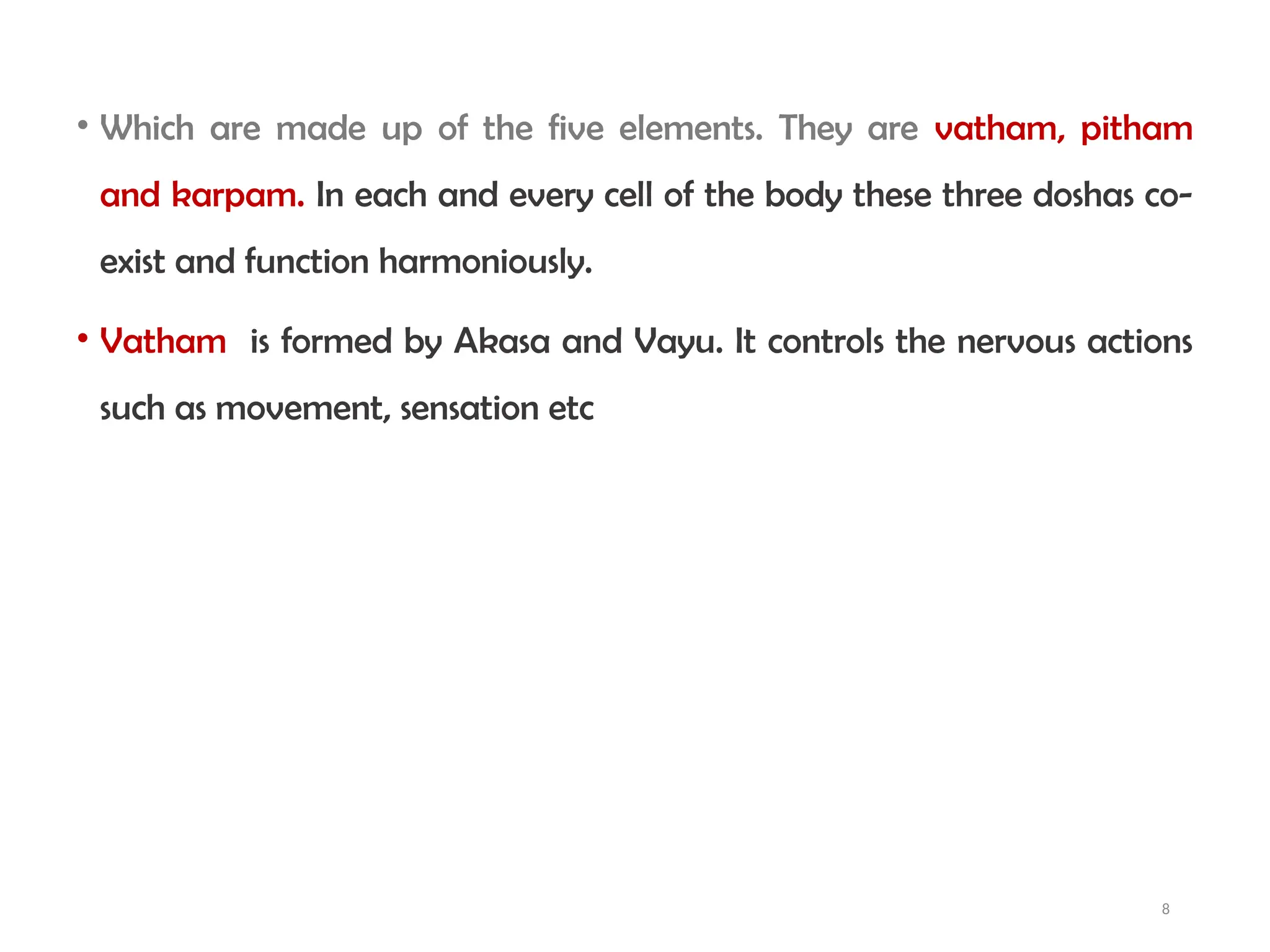
• Which are made up of the five elements. They are vatham, pitham
and karpam. In each and every cell of the body these three doshas co-
exist and function harmoniously.
• Vatham is formed by Akasa and Vayu. It controls the nervous actions
such as movement, sensation etc
9
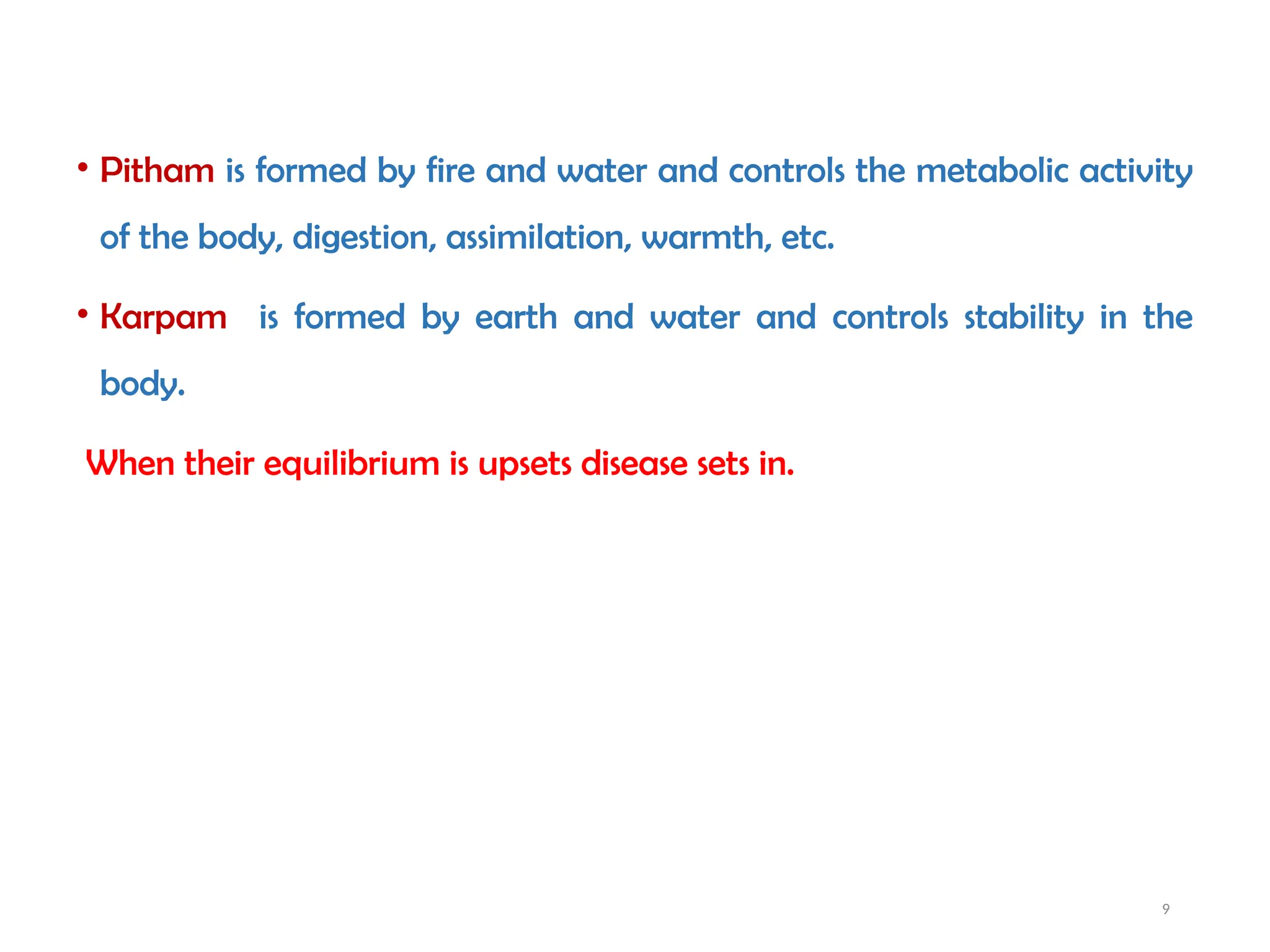
• Pitham is formed by fire and water and controls the metabolic activity
of the body, digestion, assimilation, warmth, etc.
• Karpam is formed by earth and water and controls stability in the
body.
When their equilibrium is upsets disease sets in.
10
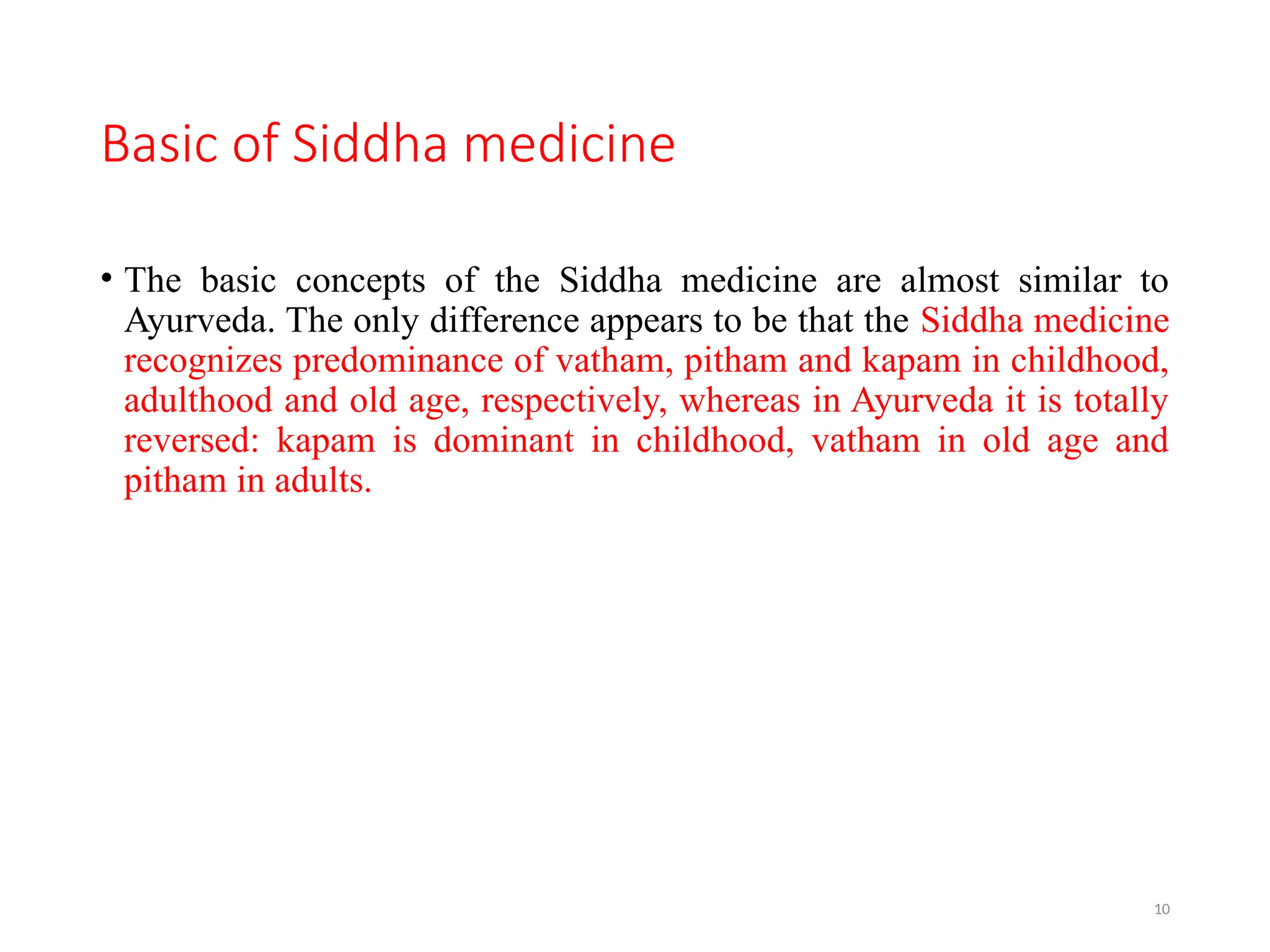
Basic of Siddha medicine
• The basic concepts of the Siddha medicine are almost similar to
Ayurveda. The only difference appears to be that the Siddha medicine
recognizes predominance of vatham, pitham and kapam in childhood,
adulthood and old age, respectively, whereas in Ayurveda it is totally
reversed: kapam is dominant in childhood, vatham in old age and
pitham in adults.
11
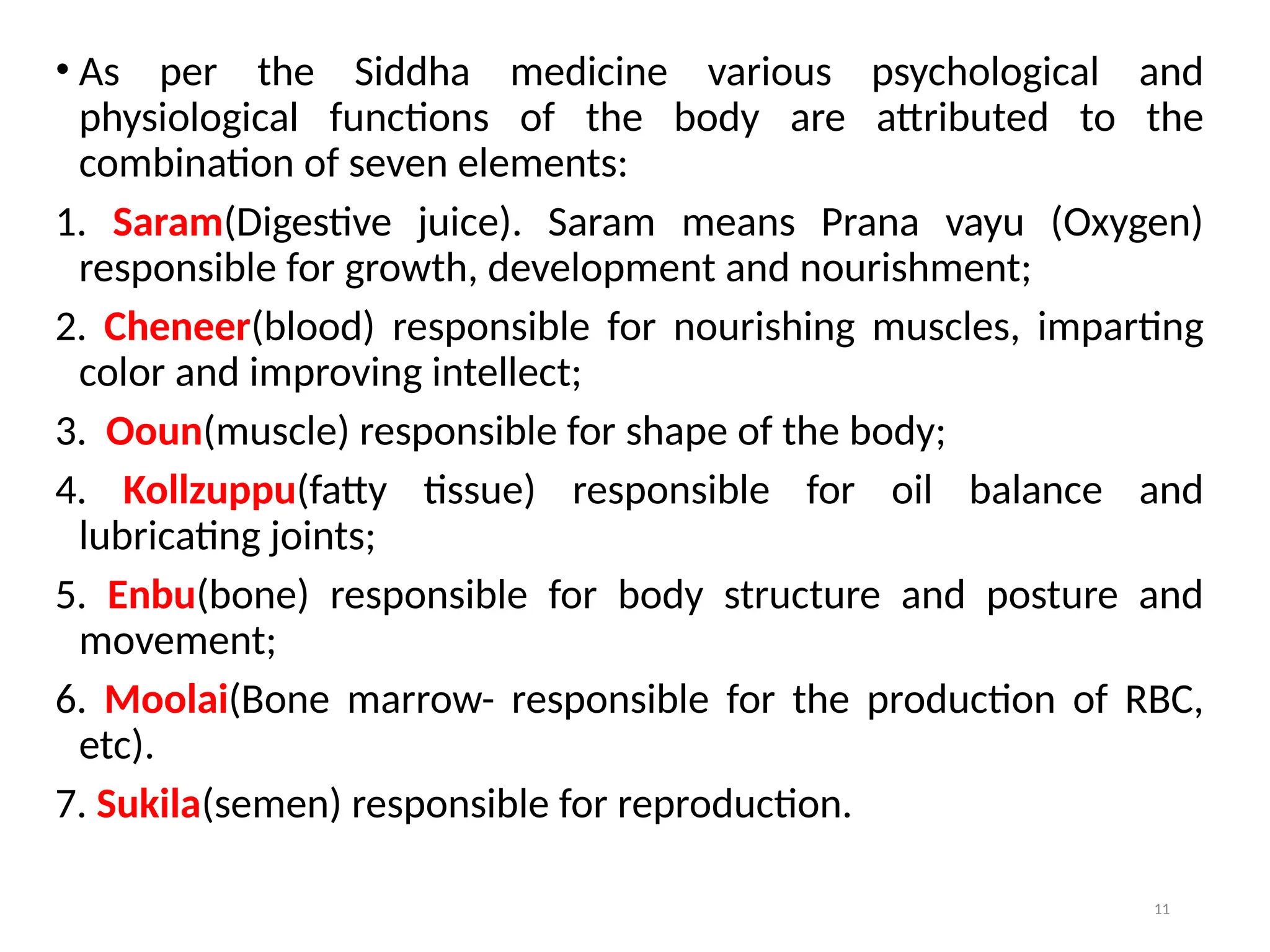
• As per the Siddha medicine various psychological and
physiological functions of the body are attributed to the
combination of seven elements:
1. Saram(Digestive juice). Saram means Prana vayu (Oxygen)
responsible for growth, development and nourishment;
2. Cheneer(blood) responsible for nourishing muscles, imparting
color and improving intellect;
3. Ooun(muscle) responsible for shape of the body;
4. Kollzuppu(fatty tissue) responsible for oil balance and
lubricating joints;
5. Enbu(bone) responsible for body structure and posture and
movement;
6. Moolai(Bone marrow- responsible for the production of RBC,
etc).
7. Sukila(semen) responsible for reproduction.
12
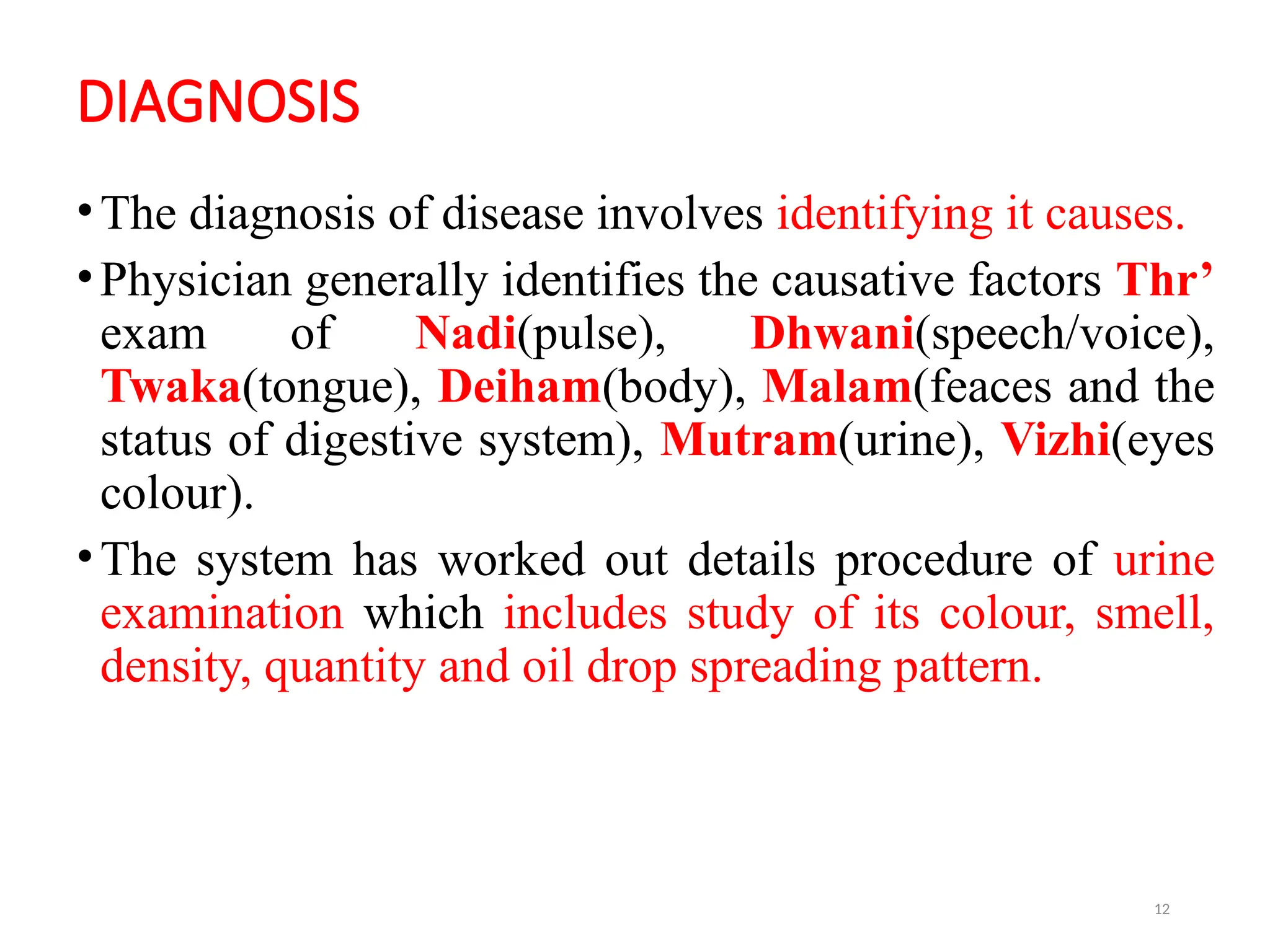
DIAGNOSIS
•The diagnosis of disease involves identifying it causes.
•Physician generally identifies the causative factors Thr’
exam of Nadi(pulse), Dhwani(speech/voice),
Twaka(tongue), Deiham(body), Malam(feaces and the
status of digestive system), Mutram(urine), Vizhi(eyes
colour).
•The system has worked out details procedure of urine
examination which includes study of its colour, smell,
density, quantity and oil drop spreading pattern.
13
PULSE EXAMINATION
• Pulse reading is important & helpful in diagnosis. Pulse changes with
balance of triguna(tri-dosha).
• Full Nadi indicates asthama & ½ or ¼ nadi denotes pain, arthrities &
swelling.
• Abnormal intense pulse shows T.B
• If pulse propagates to left side it denotes loss of self control while
propagation to right side shows sign of coma.
14
URINE EXAMINATION
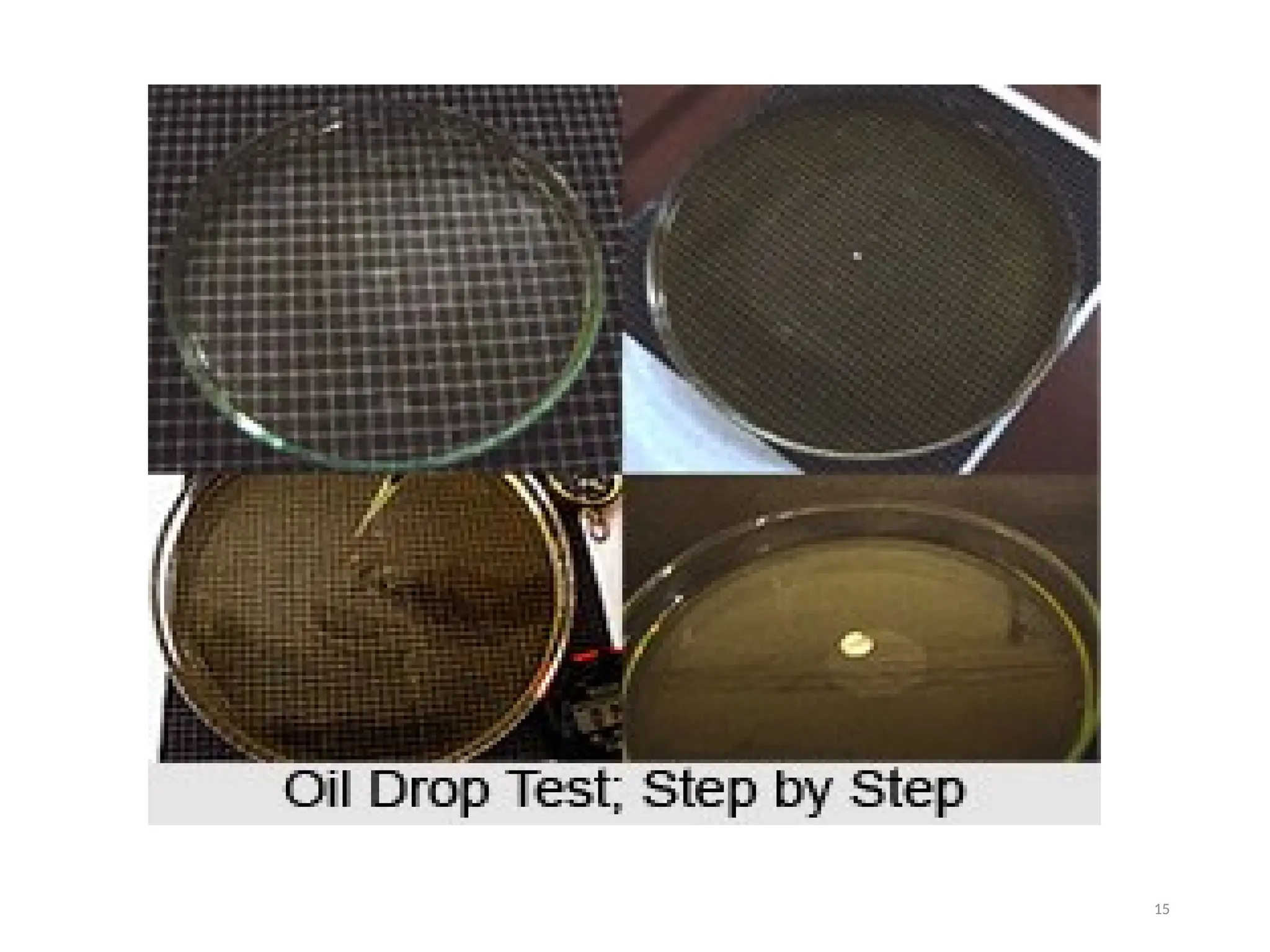
•Oil drop Test: With a dropper, there is a necessary to place
one drop of sesame oil in a sample of urine. If the drop spreads
immediately, the physical disorder is easy to cure. If the drop
sinks to the middle of the urine sample, this indicates illness is
difficult to cure. If the drop sinks to the bottom, illness may be
very difficult to cure.
• If drop of sesame oil spreads on the surface in wave-like
movements, this indicates the Vata disorder in human body. If
the drop of sesame oil spreads on the surface with multiple
colours visible like a rainbow, this indicates Pitta disorder. If
drop of the sesame oil breaks up into pearl-like droplets on the
surface of urine, this indicates Kapha disorder.
15
16
•The normal urine has a typical uremic smell. However,
if the urine has a foul odour, this indicates that there
are toxins in the system. An acidic smell which creates
a burning sensation indicates excess Pitta.
•A sweet smell of the urine indicates a possible diabetic
condition in human body. In this condition, the
individual experiences goose bumps (small raised
areas that appear on the skin because of cold, fear, or
excitement) on the skin while passing urine.
•The gravel in the urine indicates the likelihood of
stones in the urinary tract.
17
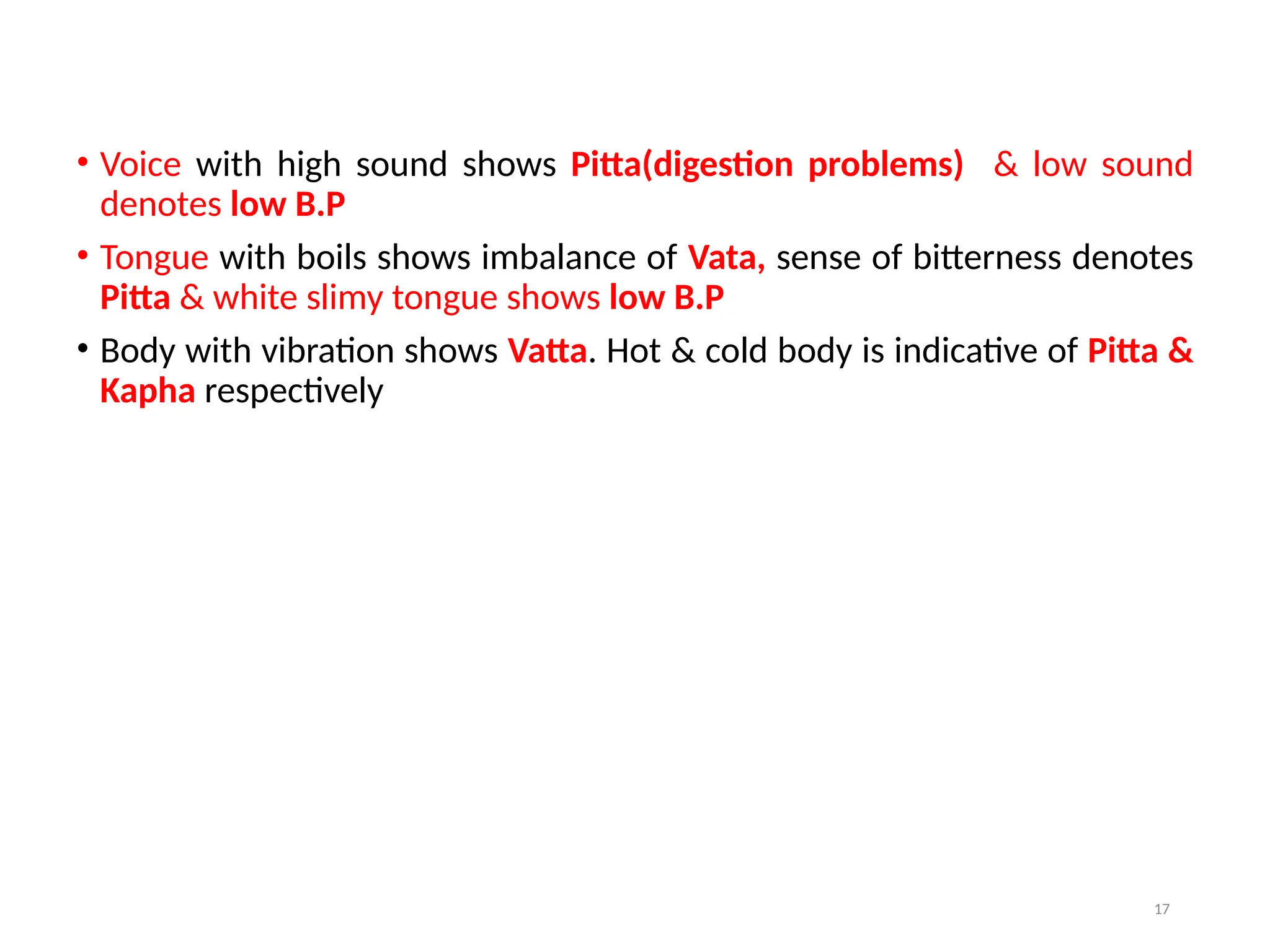
• Voice with high sound shows Pitta(digestion problems) & low sound
denotes low B.P
• Tongue with boils shows imbalance of Vata, sense of bitterness denotes
Pitta & white slimy tongue shows low B.P
• Body with vibration shows Vatta. Hot & cold body is indicative of Pitta &
Kapha respectively
18
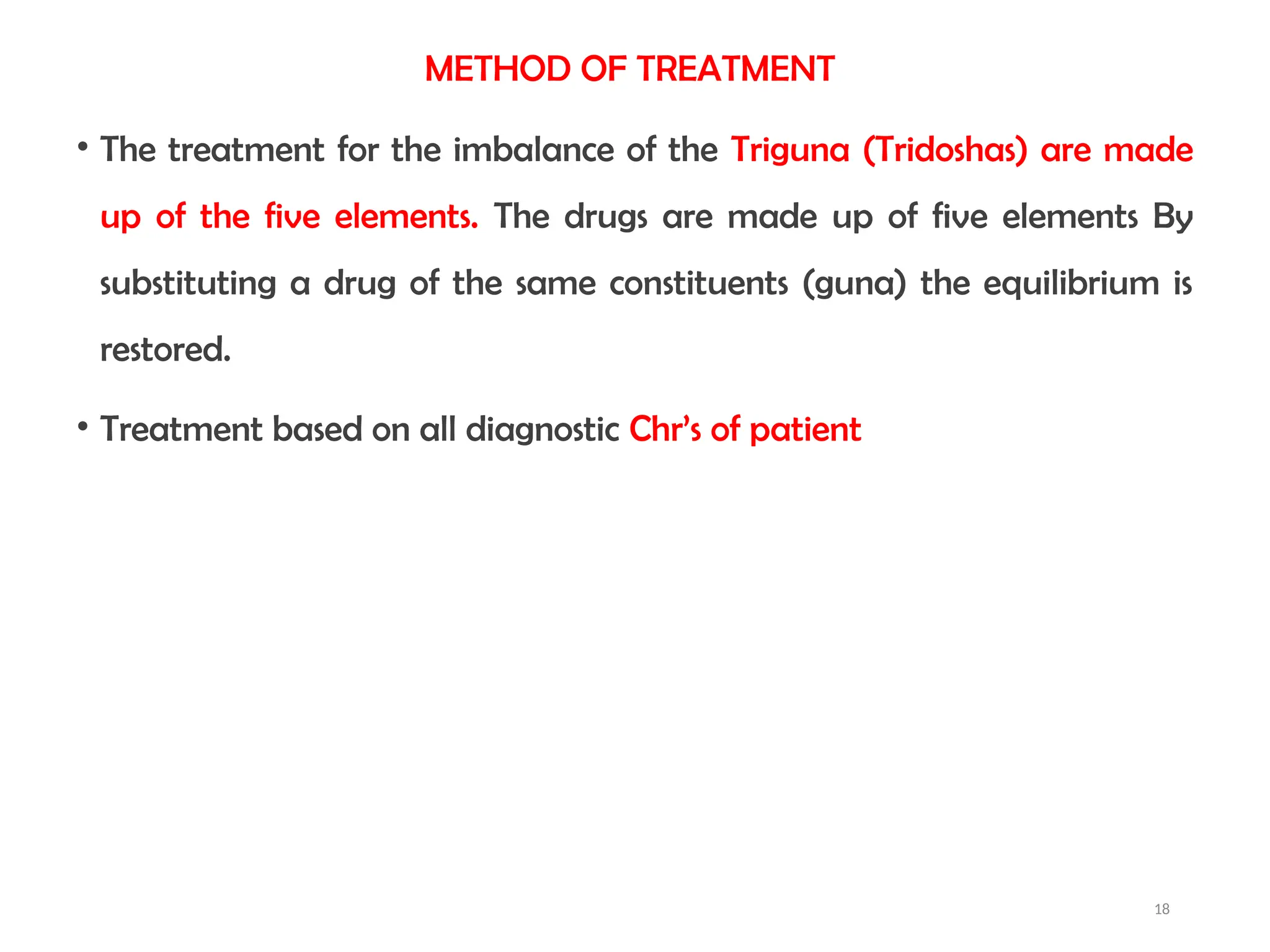
METHOD OF TREATMENT
• The treatment for the imbalance of the Triguna (Tridoshas) are made
up of the five elements. The drugs are made up of five elements By
substituting a drug of the same constituents (guna) the equilibrium is
restored.
• Treatment based on all diagnostic Chr’s of patient
19
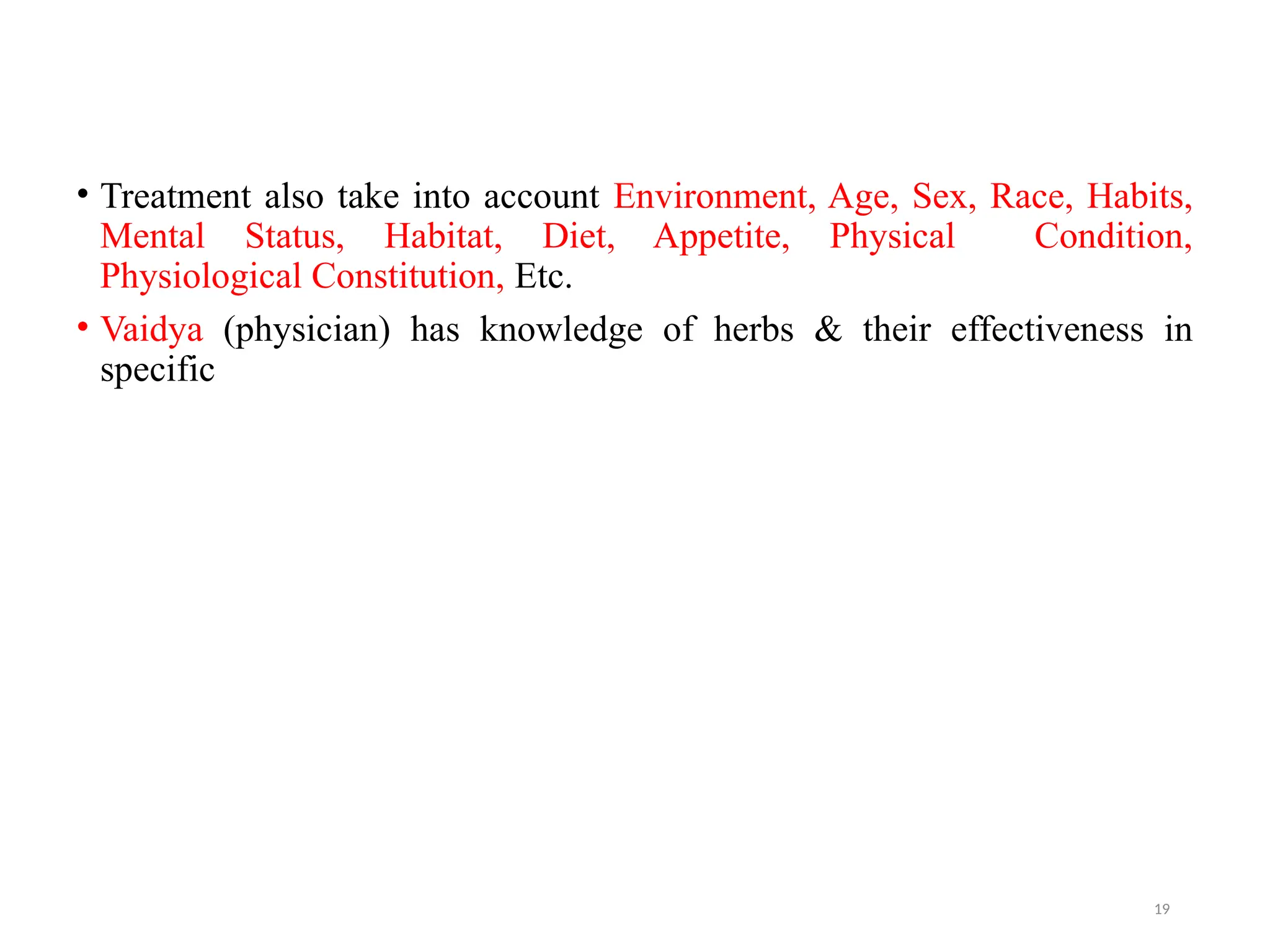
• Treatment also take into account Environment, Age, Sex, Race, Habits,
Mental Status, Habitat, Diet, Appetite, Physical Condition,
Physiological Constitution, Etc.
• Vaidya (physician) has knowledge of herbs & their effectiveness in
specific
20
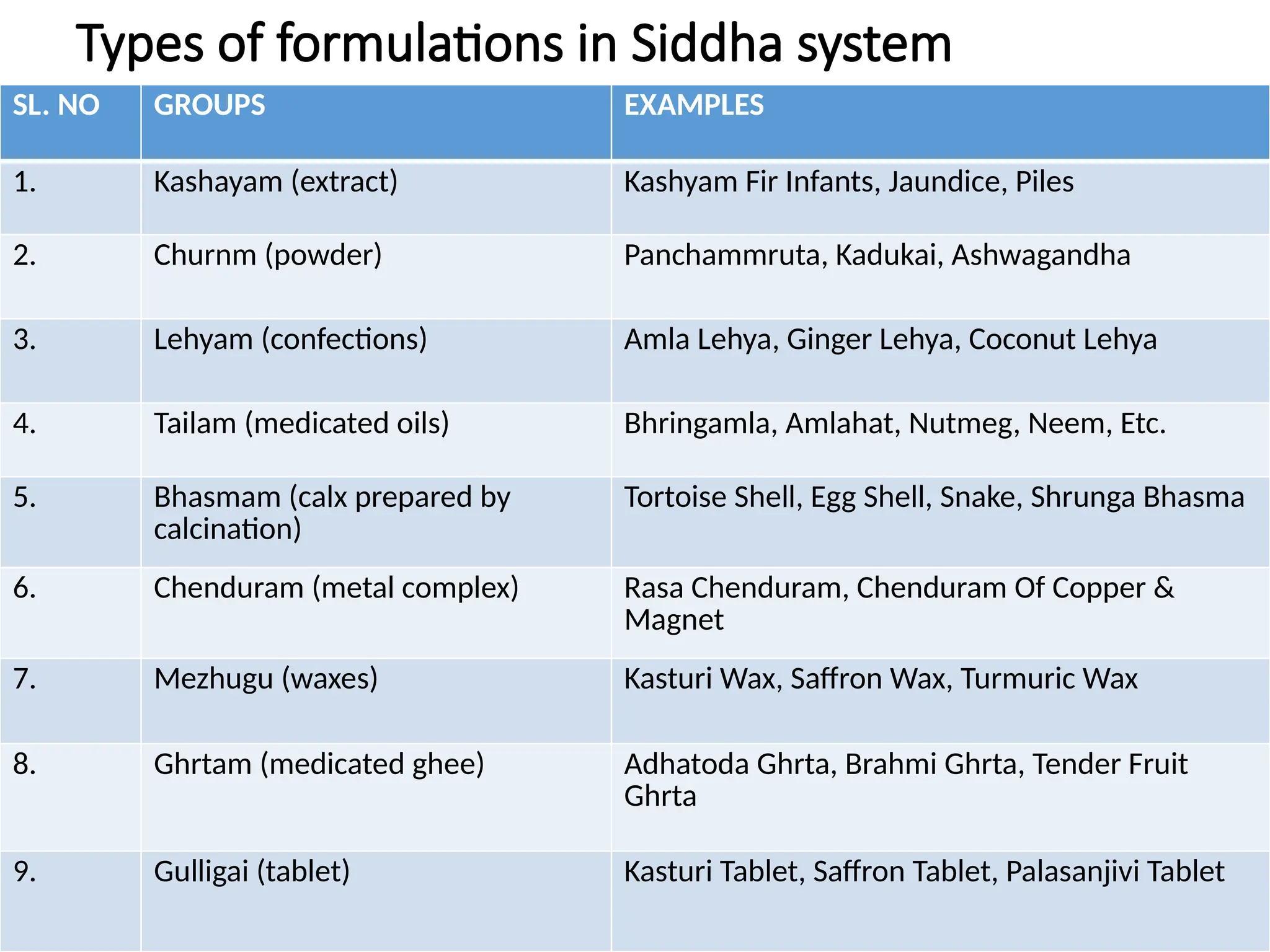
Types of formulations in Siddha system
SL. NO GROUPS EXAMPLES
1. Kashayam (extract) Kashyam Fir Infants, Jaundice, Piles
2. Churnm (powder) Panchammruta, Kadukai, Ashwagandha
3. Lehyam (confections) Amla Lehya, Ginger Lehya, Coconut Lehya
4. Tailam (medicated oils) Bhringamla, Amlahat, Nutmeg, Neem, Etc.
5. Bhasmam (calx prepared by
calcination)
Tortoise Shell, Egg Shell, Snake, Shrunga Bhasma
6. Chenduram (metal complex) Rasa Chenduram, Chenduram Of Copper &
Magnet
7. Mezhugu (waxes) Kasturi Wax, Saffron Wax, Turmuric Wax
8. Ghrtam (medicated ghee) Adhatoda Ghrta, Brahmi Ghrta, Tender Fruit
Ghrta
9. Gulligai (tablet) Kasturi Tablet, Saffron Tablet, Palasanjivi Tablet
21
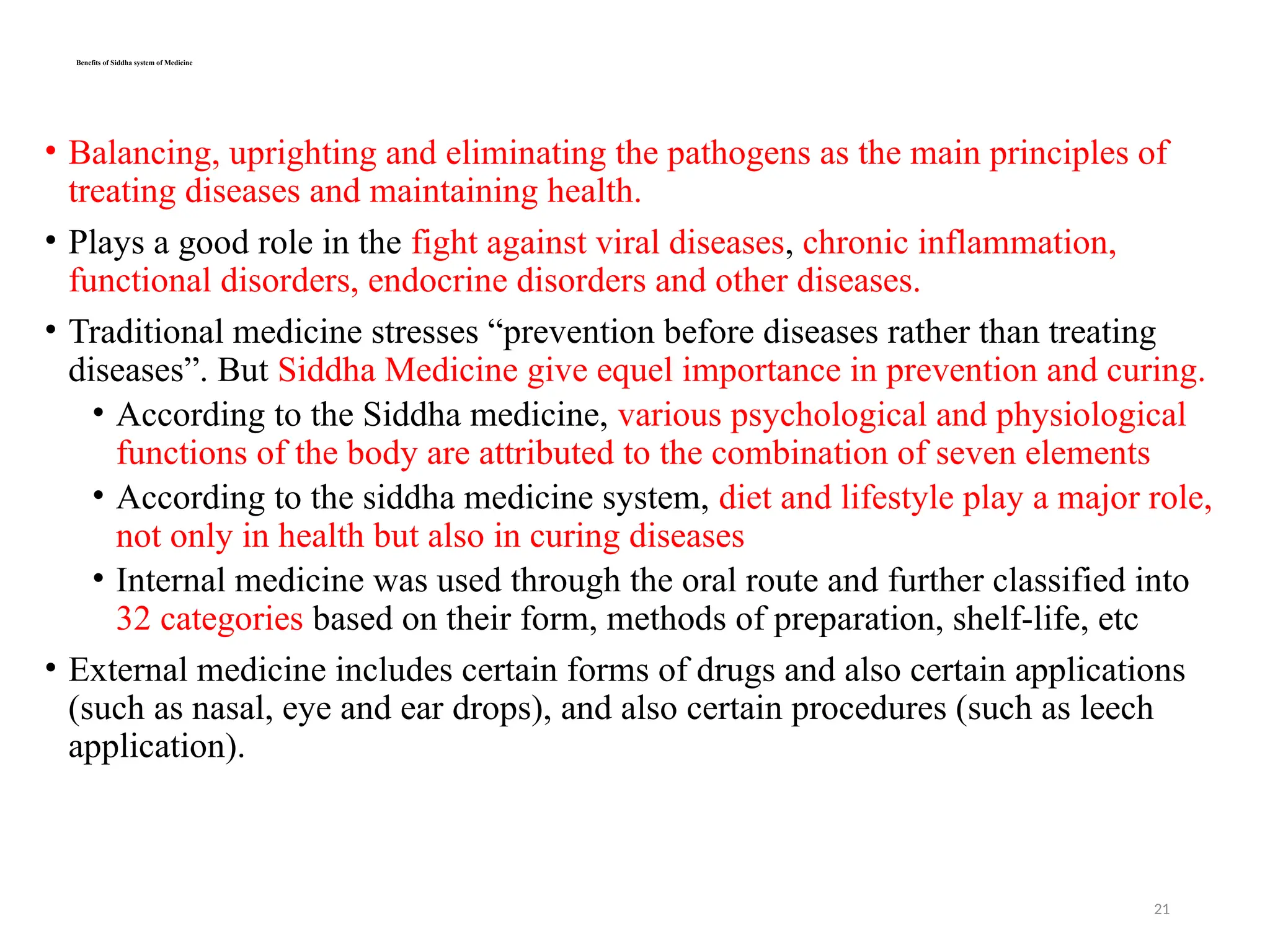
Benefits of Siddha system of Medicine
• Balancing, uprighting and eliminating the pathogens as the main principles of
treating diseases and maintaining health.
• Plays a good role in the fight against viral diseases, chronic inflammation,
functional disorders, endocrine disorders and other diseases.
• Traditional medicine stresses “prevention before diseases rather than treating
diseases”. But Siddha Medicine give equel importance in prevention and curing.
• According to the Siddha medicine, various psychological and physiological
functions of the body are attributed to the combination of seven elements
• According to the siddha medicine system, diet and lifestyle play a major role,
not only in health but also in curing diseases
• Internal medicine was used through the oral route and further classified into
32 categories based on their form, methods of preparation, shelf-life, etc
• External medicine includes certain forms of drugs and also certain applications
(such as nasal, eye and ear drops), and also certain procedures (such as leech
application).

Origin of siddha medicine basic of siddha

  • 1.
  • 2.
    2 Origin • The originof Siddha is attributed to Lord Siva, who is supposed to have handed it down to his consort Parvathi (Shakthi), who in turn passed on the sacred knowledge to Nandi, from whom it was transmitted to the first of "Siddhars“. • Tradition lists a total number of eighteen siddhars, beginning with Nandi and the semi-legendary-Agattiyar through to the final Siddhar- Kudhambai. • They were the ancient supernatural spiritual saints of India.
  • 3.
  • 4.
    4 • Siddhars: Theyare the saints in India, mostly in Tamil Nadu, who professed & practised an unorthodox types of sadhana to attain liberation. • Siddhars adopted principles of Shiva Siddhantham • A siddhar obtains yogic powers called siddhi by constant practice of certain yogic disciples & tapasya. • Agastya was the first siddha & guru of all siddhars.
  • 5.
    5 Principle of system •There are 96 basic principles (Thathuas). • The universe consists of two essential entities- matter and energy. The siddhas call them ‘’matter’’ (Shiva, male,) and ‘’energy’’ (female, Shakti). Matter can not exist without energy inherent in it and vice versa. The two co-exist and are inseparable. • These two entities of existence operate in humans as well as nature and connect the microcosm with the macrocosm.
  • 6.
    6 • It followsBabylonian & Greco-Roman system of head-to-toe & illustrated using Latin-based zodiac names.
  • 7.
    7 •They are theprimordial elements called Bhutas. • Bhutas consists of five elements- Nilam (Prithivi,Earth,Solid), Neer (jal,Water,fluid), Neruppu (agni,Fire,radiance,heat), kattru (vayu,Gas,wind) and Veli (Akash,Space,ether,sky). These five elements are present in every substance, but in different proportions. These combines in certain ways to give the three bodily humours, called Muupu or Muppini in modern Tamil. •They are found in the body in the proportion of 1 wind to ½ bile to ¼ phlegm.
  • 8.
    8 • Which aremade up of the five elements. They are vatham, pitham and karpam. In each and every cell of the body these three doshas co- exist and function harmoniously. • Vatham is formed by Akasa and Vayu. It controls the nervous actions such as movement, sensation etc
  • 9.
    9 • Pitham isformed by fire and water and controls the metabolic activity of the body, digestion, assimilation, warmth, etc. • Karpam is formed by earth and water and controls stability in the body. When their equilibrium is upsets disease sets in.
  • 10.
    10 Basic of Siddhamedicine • The basic concepts of the Siddha medicine are almost similar to Ayurveda. The only difference appears to be that the Siddha medicine recognizes predominance of vatham, pitham and kapam in childhood, adulthood and old age, respectively, whereas in Ayurveda it is totally reversed: kapam is dominant in childhood, vatham in old age and pitham in adults.
  • 11.
    11 • As perthe Siddha medicine various psychological and physiological functions of the body are attributed to the combination of seven elements: 1. Saram(Digestive juice). Saram means Prana vayu (Oxygen) responsible for growth, development and nourishment; 2. Cheneer(blood) responsible for nourishing muscles, imparting color and improving intellect; 3. Ooun(muscle) responsible for shape of the body; 4. Kollzuppu(fatty tissue) responsible for oil balance and lubricating joints; 5. Enbu(bone) responsible for body structure and posture and movement; 6. Moolai(Bone marrow- responsible for the production of RBC, etc). 7. Sukila(semen) responsible for reproduction.
  • 12.
    12 DIAGNOSIS •The diagnosis ofdisease involves identifying it causes. •Physician generally identifies the causative factors Thr’ exam of Nadi(pulse), Dhwani(speech/voice), Twaka(tongue), Deiham(body), Malam(feaces and the status of digestive system), Mutram(urine), Vizhi(eyes colour). •The system has worked out details procedure of urine examination which includes study of its colour, smell, density, quantity and oil drop spreading pattern.
  • 13.
    13 PULSE EXAMINATION • Pulsereading is important & helpful in diagnosis. Pulse changes with balance of triguna(tri-dosha). • Full Nadi indicates asthama & ½ or ¼ nadi denotes pain, arthrities & swelling. • Abnormal intense pulse shows T.B • If pulse propagates to left side it denotes loss of self control while propagation to right side shows sign of coma.
  • 14.
    14 URINE EXAMINATION •Oil dropTest: With a dropper, there is a necessary to place one drop of sesame oil in a sample of urine. If the drop spreads immediately, the physical disorder is easy to cure. If the drop sinks to the middle of the urine sample, this indicates illness is difficult to cure. If the drop sinks to the bottom, illness may be very difficult to cure. • If drop of sesame oil spreads on the surface in wave-like movements, this indicates the Vata disorder in human body. If the drop of sesame oil spreads on the surface with multiple colours visible like a rainbow, this indicates Pitta disorder. If drop of the sesame oil breaks up into pearl-like droplets on the surface of urine, this indicates Kapha disorder.
  • 15.
  • 16.
    16 •The normal urinehas a typical uremic smell. However, if the urine has a foul odour, this indicates that there are toxins in the system. An acidic smell which creates a burning sensation indicates excess Pitta. •A sweet smell of the urine indicates a possible diabetic condition in human body. In this condition, the individual experiences goose bumps (small raised areas that appear on the skin because of cold, fear, or excitement) on the skin while passing urine. •The gravel in the urine indicates the likelihood of stones in the urinary tract.
  • 17.
    17 • Voice withhigh sound shows Pitta(digestion problems) & low sound denotes low B.P • Tongue with boils shows imbalance of Vata, sense of bitterness denotes Pitta & white slimy tongue shows low B.P • Body with vibration shows Vatta. Hot & cold body is indicative of Pitta & Kapha respectively
  • 18.
    18 METHOD OF TREATMENT •The treatment for the imbalance of the Triguna (Tridoshas) are made up of the five elements. The drugs are made up of five elements By substituting a drug of the same constituents (guna) the equilibrium is restored. • Treatment based on all diagnostic Chr’s of patient
  • 19.
    19 • Treatment alsotake into account Environment, Age, Sex, Race, Habits, Mental Status, Habitat, Diet, Appetite, Physical Condition, Physiological Constitution, Etc. • Vaidya (physician) has knowledge of herbs & their effectiveness in specific
  • 20.
    20 Types of formulationsin Siddha system SL. NO GROUPS EXAMPLES 1. Kashayam (extract) Kashyam Fir Infants, Jaundice, Piles 2. Churnm (powder) Panchammruta, Kadukai, Ashwagandha 3. Lehyam (confections) Amla Lehya, Ginger Lehya, Coconut Lehya 4. Tailam (medicated oils) Bhringamla, Amlahat, Nutmeg, Neem, Etc. 5. Bhasmam (calx prepared by calcination) Tortoise Shell, Egg Shell, Snake, Shrunga Bhasma 6. Chenduram (metal complex) Rasa Chenduram, Chenduram Of Copper & Magnet 7. Mezhugu (waxes) Kasturi Wax, Saffron Wax, Turmuric Wax 8. Ghrtam (medicated ghee) Adhatoda Ghrta, Brahmi Ghrta, Tender Fruit Ghrta 9. Gulligai (tablet) Kasturi Tablet, Saffron Tablet, Palasanjivi Tablet
  • 21.
    21 Benefits of Siddhasystem of Medicine • Balancing, uprighting and eliminating the pathogens as the main principles of treating diseases and maintaining health. • Plays a good role in the fight against viral diseases, chronic inflammation, functional disorders, endocrine disorders and other diseases. • Traditional medicine stresses “prevention before diseases rather than treating diseases”. But Siddha Medicine give equel importance in prevention and curing. • According to the Siddha medicine, various psychological and physiological functions of the body are attributed to the combination of seven elements • According to the siddha medicine system, diet and lifestyle play a major role, not only in health but also in curing diseases • Internal medicine was used through the oral route and further classified into 32 categories based on their form, methods of preparation, shelf-life, etc • External medicine includes certain forms of drugs and also certain applications (such as nasal, eye and ear drops), and also certain procedures (such as leech application).