A REVIEW OF SICKLE CELL DISEASE
AND ITS PUBLIC HEALTH
SIGNIFICANCE
BY
AGATSA DAVID TERNA
BSU/SC/BIO/12/16667
SEMINAR
OCTOBER, 2016
INTRODUCTION
Sickle-cell disease (SCD) is a group of
genetically passed down blood disorders. The
most common type is known as sickle-cell
anaemia (SCA).
It results in an abnormality in the oxygen-
carrying protein haemoglobin (Hb) found in red
blood cells. This leads to a rigid, sickle-like shape
under certain circumstances.
Sickle-cell disease occurs when a person
inherits two abnormal copies of the haemoglobin
gene, one from each parent. (Rees et al., 2010).
AIM
To review sickle cell disease and its public health
significance.
OBJECTIVES
To describe the effects of Sickle cell disease on
affected persons.
To relate effects of the disease to the public
health impact on affected persons.
To discuss the general public health
significance of sickle cell disease.
EFFECTS OF SICKLE CELL DISEASE
Sickle Cell Disease Pain
The hallmark feature of SCD is frequent and
unpredictable pain, termed vaso-occlusive crises
(VOCs) (Shapiro and Ballas, 1994), which account
for approximately 25% of hospital visits in
children with SCD (Rees et al., 2003).
VOCs are the result of “sickling” of the blood
vessels leading to a lack of flexibility.
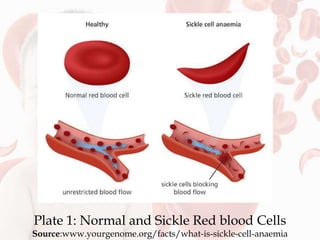
Specifically, the red blood cells become sickle-
shaped and sticky, blocking blood flow through
the vessels which results in pain, ischemia, and
infarction (Ballas, 1998).
Psychological effects of Sickle Cell Disease
Sickle Cell Disease, especially the pain
episodes, can have widespread impact on both
the psychological functioning of the individual
diagnosed with the illness and their families.
Specifically, SCD has been associated with
several indicators of psychological
maladjustment including emotional and
behavioral problems, poor self concept and
interpersonal functioning, limited athletic
abilities (due in part to illness restrictions), and
poor academic performance (Shapiro et al., 1995;
Thompson et al., 1993).
Children with SCD are at risk for
maladjustment in almost every area of daily
functioning.
With respect to the family, caregivers of
children with SCD are burdened with missed
work, increased family stress, and increased
disease care demands, which is due in part to the
unpredictability of pain crises care in SCD ( Anie
et al., 2002).
Health Related Quality of Life (QOL)of HbS
Patients
Research has demonstrated that there is a
unique interplay between the patient’s
psychosocial adjustment and the
pathophysiology of SCD (Hays, 1995).
Although there are few studies, findings
suggest that QOL outcomes in children with SCD
are generally poor. For example, Kater et al.
(1999) found that a pediatric population with
Sickle Cell Disease had lower daily functioning
and general physical limitations than parents of
healthy children.
 Palermo et al. (2002), found that children with
SCD were experiencing more psychosocial
maladjustment compared to the healthy controls.
Moreover, children with SCD had significantly
more limited general health and physical
functioning, more limitations in their academic
functioning and social activities attributed to
their physical health, and more behavior and
emotional problems when compared to a healthy
control group.
Anie et al. (2002) also found that sickle cell pain
epidsodes had a significant impact on the quality
of life of patients involved.
Plate 1: Normal and Sickle Red blood Cells
Source:www.yourgenome.org/facts/what-is-sickle-cell-anaemia
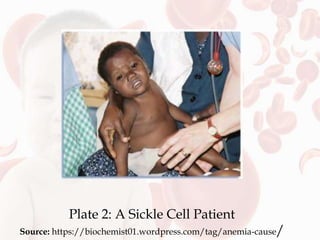
Plate 2: A Sickle Cell Patient
Source: https://biochemist01.wordpress.com/tag/anemia-cause/
Biological Benefits of HbS: Protection from
Malaria
Sickle cell trait, HbAS, produces mild
hematological symptoms but provides protection
against malaria mortality and severe malaria
symptoms (Akide-Ndunge et al., 2003).
In a heterozygous state (HbAS or HbAC), it
does not result in the life shortening condition,
that is, sickle cell disease; instead the subject
benefits from reduced mortality related to
malaria (Serjeant, 2001).
RESULTS
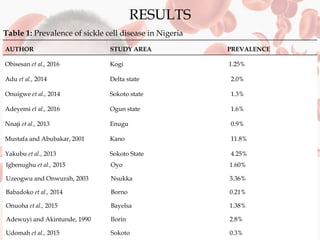
Table 1: Prevalence of sickle cell disease in Nigeria
AUTHOR STUDY AREA PREVALENCE
Obisesan et al., 2016 Kogi 1.25%
Adu et al., 2014 Delta state 2.0%
Onuigwe et al., 2014 Sokoto state 1.3%
Adeyemi et al., 2016 Ogun state 1.6%
Nnaji et al., 2013 Enugu 0.9%
Mustafa and Abubakar, 2001 Kano 11.8%
Yakubu et al., 2013 Sokoto State 4.25%
Igbenughu et al., 2015 Oyo 1.60%
Uzeogwu and Onwurah, 2003 Nsukka 3.36%
Babadoko et al., 2014 Borno 0.21%
Onuoha et al., 2015 Bayelsa 1.38%
Adewuyi and Akintunde, 1990 Ilorin 2.8%
Udomah et al., 2015 Sokoto 0.3%
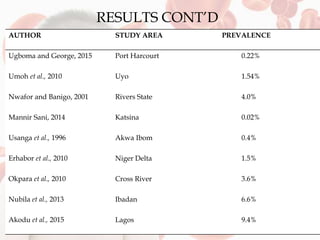
RESULTS CONT’D
AUTHOR STUDY AREA PREVALENCE
Ugboma and George, 2015 Port Harcourt 0.22%
Umoh et al., 2010 Uyo 1.54%
Nwafor and Banigo, 2001 Rivers State 4.0%
Mannir Sani, 2014 Katsina 0.02%
Usanga et al., 1996 Akwa Ibom 0.4%
Erhabor et al., 2010 Niger Delta 1.5%
Okpara et al., 2010 Cross River 3.6%
Nubila et al., 2013 Ibadan 6.6%
Akodu et al., 2015 Lagos 9.4%
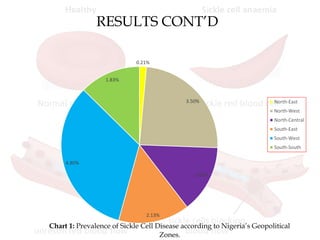
RESULTS CONT’D
0.21%
3.50%
2.03%
2.13%
4.80%
1.83%
Chart 1: Prevalence of Sickle Cell Disease according to Nigeria’s Geopolitical
Zones.
North-East
North-West
North-Central
South-East
South-West
South-South
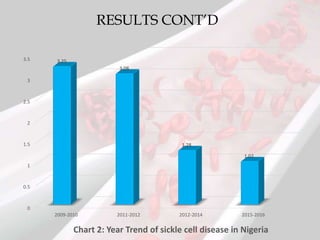
RESULTS CONT’D
0
0.5
1
1.5
2
2.5
3
3.5
2009-2010 2011-2012 2012-2014 2015-2016
3.25
3.08
1.28
1.02
Chart 2: Year Trend of sickle cell disease in Nigeria
CONCLUSION
Sickle cell disease is still a noticeable
phenomenon in the world today with Nigeria as
one of the most significant regions affected.
Sickle cell disease results in a number of
physiological disorders in patients with the
disease (those homozygous recessive) and this
results in reduced performance, psychological
traumas, feeling of inferiority and fear of death
among other threats to the sickle cell patient.
RECOMMENDATION
 Hospitals should increase the people’s
awareness about SCD and how to reduce the
incidence of the disease via videos, hand-outs
and programs that show the problem and
treatment options available.
Prevention which entails setting up sickle-cell
screening and genetic counselling programmes in
high prevalence states should be ensured.
 Simple, affordable technology that are
accessible to a large proportion of the community
should be made available for management of
sickle-cell disease at different levels of the health-
care system.

Sickle Cell Disease

  • 1.
    A REVIEW OFSICKLE CELL DISEASE AND ITS PUBLIC HEALTH SIGNIFICANCE BY AGATSA DAVID TERNA BSU/SC/BIO/12/16667 SEMINAR OCTOBER, 2016
  • 2.
    INTRODUCTION Sickle-cell disease (SCD)is a group of genetically passed down blood disorders. The most common type is known as sickle-cell anaemia (SCA). It results in an abnormality in the oxygen- carrying protein haemoglobin (Hb) found in red blood cells. This leads to a rigid, sickle-like shape under certain circumstances. Sickle-cell disease occurs when a person inherits two abnormal copies of the haemoglobin gene, one from each parent. (Rees et al., 2010).
  • 3.
    AIM To review sicklecell disease and its public health significance. OBJECTIVES To describe the effects of Sickle cell disease on affected persons. To relate effects of the disease to the public health impact on affected persons. To discuss the general public health significance of sickle cell disease.
  • 4.
    EFFECTS OF SICKLECELL DISEASE Sickle Cell Disease Pain The hallmark feature of SCD is frequent and unpredictable pain, termed vaso-occlusive crises (VOCs) (Shapiro and Ballas, 1994), which account for approximately 25% of hospital visits in children with SCD (Rees et al., 2003). VOCs are the result of “sickling” of the blood vessels leading to a lack of flexibility. Specifically, the red blood cells become sickle- shaped and sticky, blocking blood flow through the vessels which results in pain, ischemia, and infarction (Ballas, 1998).
  • 5.
    Psychological effects ofSickle Cell Disease Sickle Cell Disease, especially the pain episodes, can have widespread impact on both the psychological functioning of the individual diagnosed with the illness and their families. Specifically, SCD has been associated with several indicators of psychological maladjustment including emotional and behavioral problems, poor self concept and interpersonal functioning, limited athletic abilities (due in part to illness restrictions), and poor academic performance (Shapiro et al., 1995; Thompson et al., 1993).
  • 6.
    Children with SCDare at risk for maladjustment in almost every area of daily functioning. With respect to the family, caregivers of children with SCD are burdened with missed work, increased family stress, and increased disease care demands, which is due in part to the unpredictability of pain crises care in SCD ( Anie et al., 2002).
  • 7.
    Health Related Qualityof Life (QOL)of HbS Patients Research has demonstrated that there is a unique interplay between the patient’s psychosocial adjustment and the pathophysiology of SCD (Hays, 1995). Although there are few studies, findings suggest that QOL outcomes in children with SCD are generally poor. For example, Kater et al. (1999) found that a pediatric population with Sickle Cell Disease had lower daily functioning and general physical limitations than parents of healthy children.
  • 8.
     Palermo etal. (2002), found that children with SCD were experiencing more psychosocial maladjustment compared to the healthy controls. Moreover, children with SCD had significantly more limited general health and physical functioning, more limitations in their academic functioning and social activities attributed to their physical health, and more behavior and emotional problems when compared to a healthy control group. Anie et al. (2002) also found that sickle cell pain epidsodes had a significant impact on the quality of life of patients involved.
  • 9.
    Plate 1: Normaland Sickle Red blood Cells Source:www.yourgenome.org/facts/what-is-sickle-cell-anaemia
  • 10.
    Plate 2: ASickle Cell Patient Source: https://biochemist01.wordpress.com/tag/anemia-cause/
  • 11.
    Biological Benefits ofHbS: Protection from Malaria Sickle cell trait, HbAS, produces mild hematological symptoms but provides protection against malaria mortality and severe malaria symptoms (Akide-Ndunge et al., 2003). In a heterozygous state (HbAS or HbAC), it does not result in the life shortening condition, that is, sickle cell disease; instead the subject benefits from reduced mortality related to malaria (Serjeant, 2001).
  • 12.
    RESULTS Table 1: Prevalenceof sickle cell disease in Nigeria AUTHOR STUDY AREA PREVALENCE Obisesan et al., 2016 Kogi 1.25% Adu et al., 2014 Delta state 2.0% Onuigwe et al., 2014 Sokoto state 1.3% Adeyemi et al., 2016 Ogun state 1.6% Nnaji et al., 2013 Enugu 0.9% Mustafa and Abubakar, 2001 Kano 11.8% Yakubu et al., 2013 Sokoto State 4.25% Igbenughu et al., 2015 Oyo 1.60% Uzeogwu and Onwurah, 2003 Nsukka 3.36% Babadoko et al., 2014 Borno 0.21% Onuoha et al., 2015 Bayelsa 1.38% Adewuyi and Akintunde, 1990 Ilorin 2.8% Udomah et al., 2015 Sokoto 0.3%
  • 13.
    RESULTS CONT’D AUTHOR STUDYAREA PREVALENCE Ugboma and George, 2015 Port Harcourt 0.22% Umoh et al., 2010 Uyo 1.54% Nwafor and Banigo, 2001 Rivers State 4.0% Mannir Sani, 2014 Katsina 0.02% Usanga et al., 1996 Akwa Ibom 0.4% Erhabor et al., 2010 Niger Delta 1.5% Okpara et al., 2010 Cross River 3.6% Nubila et al., 2013 Ibadan 6.6% Akodu et al., 2015 Lagos 9.4%
  • 14.
    RESULTS CONT’D 0.21% 3.50% 2.03% 2.13% 4.80% 1.83% Chart 1:Prevalence of Sickle Cell Disease according to Nigeria’s Geopolitical Zones. North-East North-West North-Central South-East South-West South-South
  • 15.
    RESULTS CONT’D 0 0.5 1 1.5 2 2.5 3 3.5 2009-2010 2011-20122012-2014 2015-2016 3.25 3.08 1.28 1.02 Chart 2: Year Trend of sickle cell disease in Nigeria
  • 16.
    CONCLUSION Sickle cell diseaseis still a noticeable phenomenon in the world today with Nigeria as one of the most significant regions affected. Sickle cell disease results in a number of physiological disorders in patients with the disease (those homozygous recessive) and this results in reduced performance, psychological traumas, feeling of inferiority and fear of death among other threats to the sickle cell patient.
  • 17.
    RECOMMENDATION  Hospitals shouldincrease the people’s awareness about SCD and how to reduce the incidence of the disease via videos, hand-outs and programs that show the problem and treatment options available. Prevention which entails setting up sickle-cell screening and genetic counselling programmes in high prevalence states should be ensured.  Simple, affordable technology that are accessible to a large proportion of the community should be made available for management of sickle-cell disease at different levels of the health- care system.