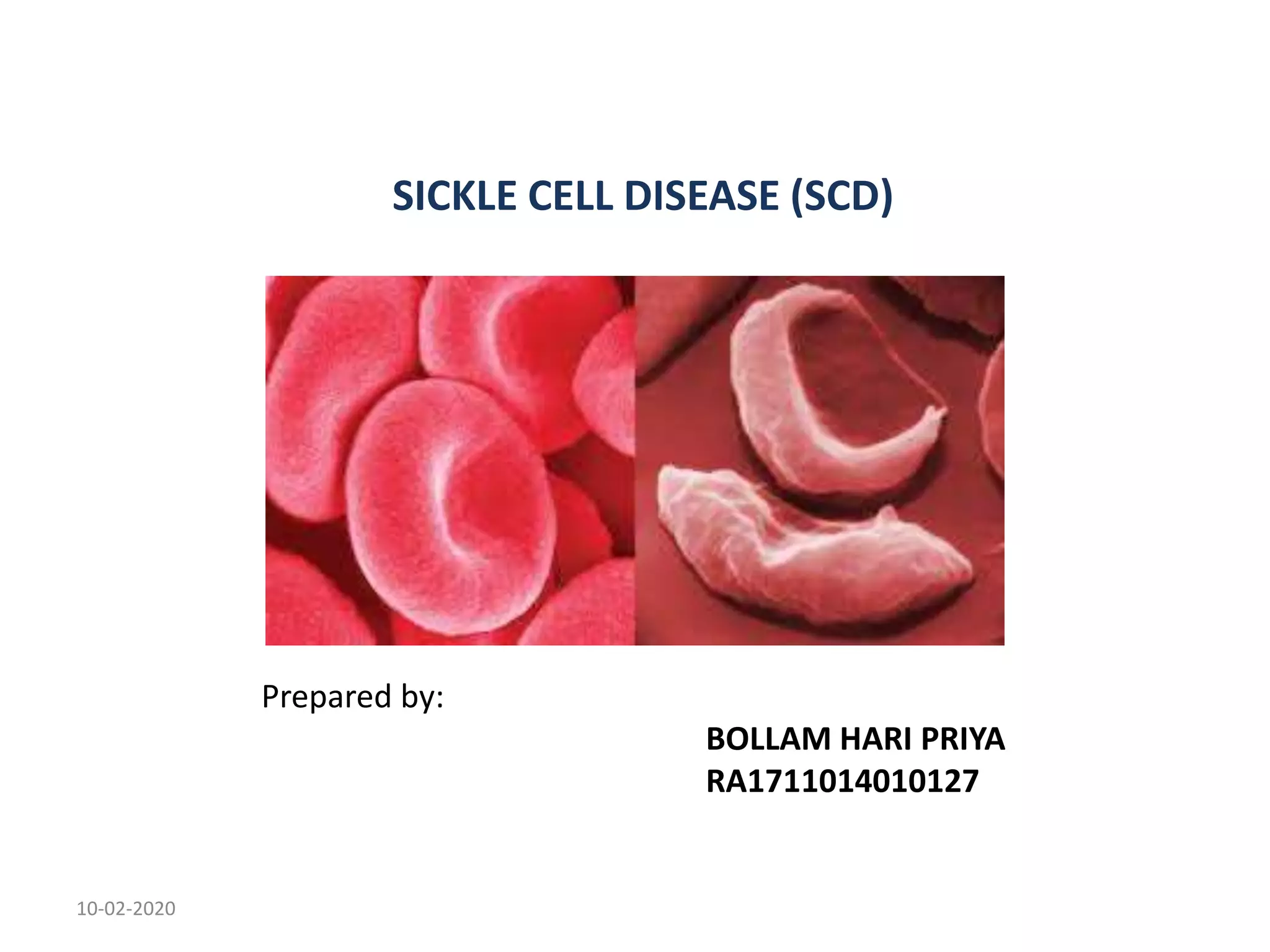

SICKLE CELL DISEASE (SCD)
Prepared by:
BOLLAM HARI PRIYA
RA1711014010127
10-02-2020
INTRODUCTION
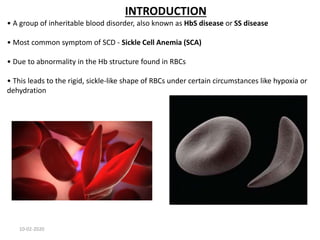
• A group of inheritable blood disorder, also known as HbS disease or SS disease
• Most common symptom of SCD - Sickle Cell Anemia (SCA)
• Due to abnormality in the Hb structure found in RBCs
• This leads to the rigid, sickle-like shape of RBCs under certain circumstances like hypoxia or
dehydration
10-02-2020
HISTORY OF SCD
• SCD has been known to the people of Africa for hundreds of years. In west Africa ,
various ethic groups gave the condition different names
• 1910: Dr. James Bryan Herrick, a Chicago physician, noted that a patient of his from the
West Indies had an anemia characterized by unusual RBCs that were “sickle-shaped”.
• 1927: Hahn and Gillespie showed that the sickling of RBCs was due to hypoxic
conditions.
• 1940: Sherman, a student at JHMS, noted optical anisotropy of deoxygenated RBCs
suggesting that low oxygen altered the structure of the Hb.
• 1948: Janet Watson, a pediatric hematologist, suggested that the “paucity of sickle cells”
in the peripheral blood of new born was due to the presence of Fetal Hb (HbF) in the
RBCs, which did not have the abnormal sickle Hb seen in adults.
• 1948: Linus Pauling & Harvey showed by a “protein electrophoresis” that the Hb from
patients with SCD is different than that of normal. This made SCD, the first disorder in
which an abnormality in a protein was known to be at fault.
10-02-2020
HISTORY OF SCD
:
• 1956: Vernon Ingram & J. A. Hunt sequenced the sickle Hb and showed that a Glu
position at position 6 was replaced by Val in SCD. This made the SCD the first genetic
disorder whose molecular basis was known.
• 1984: Bone marrow transplantation as cure
• 1995: Hydroxyurea (also known as hydroxycarbamide) became the first and only
drug proven to prevent complications of SCD.
10-02-2020
PREVALANCE
 According to WHO:
• SCD predominates in Africans – 1 in 13 black or African American babies are born with
sickle cell trait; 1 in 365 black or African American babies are born with SCD
• ~250 million people worldwide are carriers for SCD and other Hb diseases
• 70,000-80,000 individuals with SCD in the US ( 10% of the population is at risk for SCD)-
most common inherited blood disorder in the US.
• 1 in 1000-1400 Hispanic-Americans
 According to the study of tribal population of India by Bhatia et.al and Colah et.al; the
prevalence of SCD in them is estimated is ~40%. In Indian population, <1 million cases
per year.
*The above details are based on 2015 statistics
10-02-2020
CLINICAL SYMPTOMS
Anaemia
Swelling in the hands and feet, especially the joints due to inflammation
Bacterial infections
Silent Stroke
Aseptic bone necrosis
Pulmonary hypertension and cardio-pulmonary complications
Vision problems
Renal problems
Long term pain
Splenic Sequestration Crisis and Asplenia
Jaundice and hepatitis
Gallstones, etc.
Usual onset: 5-6 months of age; life expectancy: 40-60 years
10-02-2020
10-02-2020
HbA
GENETICS AND GENES INVOLVED IN SCD
• SCD is a autosomal recessive condition
• SCD gene mutation probably occurs spontaneously in different geographical areas
• A point mutation in HBB gene cause SCD
• Chr# 11 (11p15.5) - SCD allele
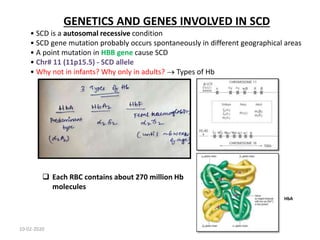
• Why not in infants? Why only in adults?  Types of Hb
 Each RBC contains about 270 million Hb
molecules
10-02-2020
Glutamic acid, rich in –ve
charges, hydrophilic
Valine, a branched amino
acid, has hydrophobic R
groups.
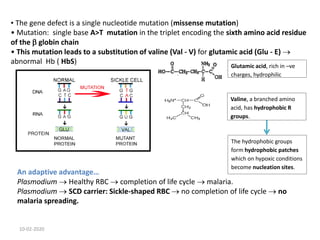
• The gene defect is a single nucleotide mutation (missense mutation)
• Mutation: single base A>T mutation in the triplet encoding the sixth amino acid residue
of the  globin chain
• This mutation leads to a substitution of valine (Val - V) for glutamic acid (Glu - E) 
abnormal Hb ( HbS)
An adaptive advantage…
Plasmodium  Healthy RBC  completion of life cycle  malaria.
Plasmodium  SCD carrier: Sickle-shaped RBC  no completion of life cycle  no
malaria spreading.
The hydrophobic groups
form hydrophobic patches
which on hypoxic conditions
become nucleation sites.
10-02-2020
WHAT CAUSES SICKLING???
THE MUTATION HAS NO DIRECT EFFECT ON SICKLING…
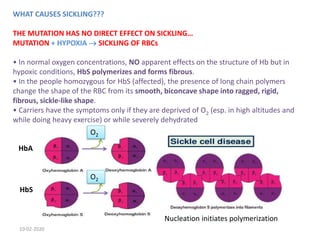
MUTATION + HYPOXIA  SICKLING OF RBCs
• In normal oxygen concentrations, NO apparent effects on the structure of Hb but in
hypoxic conditions, HbS polymerizes and forms fibrous.
• In the people homozygous for HbS (affected), the presence of long chain polymers
change the shape of the RBC from its smooth, biconcave shape into ragged, rigid,
fibrous, sickle-like shape.
• Carriers have the symptoms only if they are deprived of O2 (esp. in high altitudes and
while doing heavy exercise) or while severely dehydrated
HbA
HbS
O2
O2
Nucleation initiates polymerization
10-02-2020
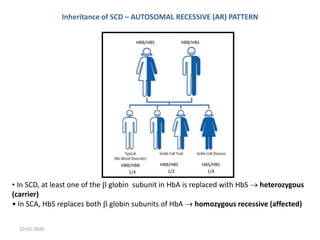
HBB/HBS HBB/HBS
HBB/HBB
1/4
HBB/HBS
1/2
HBS/HBS
1/4
Inheritance of SCD – AUTOSOMAL RECESSIVE (AR) PATTERN
• In SCD, at least one of the  globin subunit in HbA is replaced with HbS  heterozygous
(carrier)
• In SCA, HbS replaces both  globin subunits of HbA  homozygous recessive (affected)
10-02-2020
SCD: DIAGNOSIS, TREATMENT AND MANAGEMENT
DIAGNOSIS AND TESTS
• Complete Blood Count:
SCD: - Hb levels - 6-8g/dL with a high RBC count.
Normal Hb levels: for men,13.5-17.5 g/dL; for women,12-15.5 g/dL(4.7 - 6.1 million /mm3)
• Induction of sickling of RBCs on a blood film by sodium metabisulfite
• Genetic testing by sequencing of SCD loci 11p15.5
• Urinalysis for renal function testing
• Chest X-ray for pulmonary functions
• Prenatal Tests for SCD: done by foetal blood or amniotic fluid sampling
TREATMENT AND MANAGEMENT OF SCD
• Avoid tough exercise and high altitudes
• Consumption of diet rich in Calcium, Vit D and folic acid
• L- glutamine – starting at the age of 5 yrs
• Simple blood transfusion or exchange transfusion
• Hydroxyurea: increases HbF production, interferes with HbS polymerization
• Bone marrow transplantation, bone grafting, joint-replacement surgery
DRUGS:
Diclofenac, Naproxen – non-steroidal anti-inflammatory drugs
Hydroxyurea – anti-neoplastic drug polymerisation
Intravenous opioids
Diphenhydramine – anti-histamine
Voxelotor - the first haemoglobin oxygen-affinity modulator10-02-2020
FAMOUS PEOPLE AFFECTED
Miles Davis: American Jazz Trumpeter
SOCIETIES WORKING ON SCD IN INDIA
•Fortis Memorial Research Institute, Gurgaon
•Indian Council of Medical Research (ICMR), New Delhi
•National Institute of Immunohematology, Mumbai
REFERENCES
•https://www.intechopen.com/books/thalassemia-and-other-hemolytic-anemias/sickle-cell-disease-a-genetic-disorder-of-beta-globin
•https://www.cdc.gov/ncbddd/sicklecell/traits.html
•http://www.ijmr.org.in/article.asp?issn=0971-5916;year=2015;volume=141;issue=5;spage=509;epage=515;aulast=Colah;type=3
•https://sickle.bwh.harvard.edu/scd_history.html
10-02-2020
THANK YOU 
10-02-2020

Sickle Cell Disease (SCD)

  • 1.
    SICKLE CELL DISEASE(SCD) Prepared by: BOLLAM HARI PRIYA RA1711014010127 10-02-2020
  • 2.
    INTRODUCTION • A groupof inheritable blood disorder, also known as HbS disease or SS disease • Most common symptom of SCD - Sickle Cell Anemia (SCA) • Due to abnormality in the Hb structure found in RBCs • This leads to the rigid, sickle-like shape of RBCs under certain circumstances like hypoxia or dehydration 10-02-2020
  • 3.
    HISTORY OF SCD •SCD has been known to the people of Africa for hundreds of years. In west Africa , various ethic groups gave the condition different names • 1910: Dr. James Bryan Herrick, a Chicago physician, noted that a patient of his from the West Indies had an anemia characterized by unusual RBCs that were “sickle-shaped”. • 1927: Hahn and Gillespie showed that the sickling of RBCs was due to hypoxic conditions. • 1940: Sherman, a student at JHMS, noted optical anisotropy of deoxygenated RBCs suggesting that low oxygen altered the structure of the Hb. • 1948: Janet Watson, a pediatric hematologist, suggested that the “paucity of sickle cells” in the peripheral blood of new born was due to the presence of Fetal Hb (HbF) in the RBCs, which did not have the abnormal sickle Hb seen in adults. • 1948: Linus Pauling & Harvey showed by a “protein electrophoresis” that the Hb from patients with SCD is different than that of normal. This made SCD, the first disorder in which an abnormality in a protein was known to be at fault. 10-02-2020
  • 4.
    HISTORY OF SCD : •1956: Vernon Ingram & J. A. Hunt sequenced the sickle Hb and showed that a Glu position at position 6 was replaced by Val in SCD. This made the SCD the first genetic disorder whose molecular basis was known. • 1984: Bone marrow transplantation as cure • 1995: Hydroxyurea (also known as hydroxycarbamide) became the first and only drug proven to prevent complications of SCD. 10-02-2020
  • 5.
    PREVALANCE  According toWHO: • SCD predominates in Africans – 1 in 13 black or African American babies are born with sickle cell trait; 1 in 365 black or African American babies are born with SCD • ~250 million people worldwide are carriers for SCD and other Hb diseases • 70,000-80,000 individuals with SCD in the US ( 10% of the population is at risk for SCD)- most common inherited blood disorder in the US. • 1 in 1000-1400 Hispanic-Americans  According to the study of tribal population of India by Bhatia et.al and Colah et.al; the prevalence of SCD in them is estimated is ~40%. In Indian population, <1 million cases per year. *The above details are based on 2015 statistics 10-02-2020
  • 6.
    CLINICAL SYMPTOMS Anaemia Swelling inthe hands and feet, especially the joints due to inflammation Bacterial infections Silent Stroke Aseptic bone necrosis Pulmonary hypertension and cardio-pulmonary complications Vision problems Renal problems Long term pain Splenic Sequestration Crisis and Asplenia Jaundice and hepatitis Gallstones, etc. Usual onset: 5-6 months of age; life expectancy: 40-60 years 10-02-2020
  • 7.
  • 8.
    HbA GENETICS AND GENESINVOLVED IN SCD • SCD is a autosomal recessive condition • SCD gene mutation probably occurs spontaneously in different geographical areas • A point mutation in HBB gene cause SCD • Chr# 11 (11p15.5) - SCD allele • Why not in infants? Why only in adults?  Types of Hb  Each RBC contains about 270 million Hb molecules 10-02-2020
  • 9.
    Glutamic acid, richin –ve charges, hydrophilic Valine, a branched amino acid, has hydrophobic R groups. • The gene defect is a single nucleotide mutation (missense mutation) • Mutation: single base A>T mutation in the triplet encoding the sixth amino acid residue of the  globin chain • This mutation leads to a substitution of valine (Val - V) for glutamic acid (Glu - E)  abnormal Hb ( HbS) An adaptive advantage… Plasmodium  Healthy RBC  completion of life cycle  malaria. Plasmodium  SCD carrier: Sickle-shaped RBC  no completion of life cycle  no malaria spreading. The hydrophobic groups form hydrophobic patches which on hypoxic conditions become nucleation sites. 10-02-2020
  • 10.
    WHAT CAUSES SICKLING??? THEMUTATION HAS NO DIRECT EFFECT ON SICKLING… MUTATION + HYPOXIA  SICKLING OF RBCs • In normal oxygen concentrations, NO apparent effects on the structure of Hb but in hypoxic conditions, HbS polymerizes and forms fibrous. • In the people homozygous for HbS (affected), the presence of long chain polymers change the shape of the RBC from its smooth, biconcave shape into ragged, rigid, fibrous, sickle-like shape. • Carriers have the symptoms only if they are deprived of O2 (esp. in high altitudes and while doing heavy exercise) or while severely dehydrated HbA HbS O2 O2 Nucleation initiates polymerization 10-02-2020
  • 11.
    HBB/HBS HBB/HBS HBB/HBB 1/4 HBB/HBS 1/2 HBS/HBS 1/4 Inheritance ofSCD – AUTOSOMAL RECESSIVE (AR) PATTERN • In SCD, at least one of the  globin subunit in HbA is replaced with HbS  heterozygous (carrier) • In SCA, HbS replaces both  globin subunits of HbA  homozygous recessive (affected) 10-02-2020
  • 12.
    SCD: DIAGNOSIS, TREATMENTAND MANAGEMENT DIAGNOSIS AND TESTS • Complete Blood Count: SCD: - Hb levels - 6-8g/dL with a high RBC count. Normal Hb levels: for men,13.5-17.5 g/dL; for women,12-15.5 g/dL(4.7 - 6.1 million /mm3) • Induction of sickling of RBCs on a blood film by sodium metabisulfite • Genetic testing by sequencing of SCD loci 11p15.5 • Urinalysis for renal function testing • Chest X-ray for pulmonary functions • Prenatal Tests for SCD: done by foetal blood or amniotic fluid sampling TREATMENT AND MANAGEMENT OF SCD • Avoid tough exercise and high altitudes • Consumption of diet rich in Calcium, Vit D and folic acid • L- glutamine – starting at the age of 5 yrs • Simple blood transfusion or exchange transfusion • Hydroxyurea: increases HbF production, interferes with HbS polymerization • Bone marrow transplantation, bone grafting, joint-replacement surgery DRUGS: Diclofenac, Naproxen – non-steroidal anti-inflammatory drugs Hydroxyurea – anti-neoplastic drug polymerisation Intravenous opioids Diphenhydramine – anti-histamine Voxelotor - the first haemoglobin oxygen-affinity modulator10-02-2020
  • 13.
    FAMOUS PEOPLE AFFECTED MilesDavis: American Jazz Trumpeter SOCIETIES WORKING ON SCD IN INDIA •Fortis Memorial Research Institute, Gurgaon •Indian Council of Medical Research (ICMR), New Delhi •National Institute of Immunohematology, Mumbai REFERENCES •https://www.intechopen.com/books/thalassemia-and-other-hemolytic-anemias/sickle-cell-disease-a-genetic-disorder-of-beta-globin •https://www.cdc.gov/ncbddd/sicklecell/traits.html •http://www.ijmr.org.in/article.asp?issn=0971-5916;year=2015;volume=141;issue=5;spage=509;epage=515;aulast=Colah;type=3 •https://sickle.bwh.harvard.edu/scd_history.html 10-02-2020
  • 14.