Sickle Cell Anemia
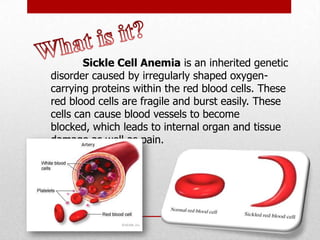
What is it?Sickle Cell Anemia is an inherited genetic disorder caused by irregularly shaped oxygen-carrying proteins within the red blood cells. These red blood cells are fragile and burst easily. These cells can cause blood vessels to become blocked, which leads to internal organ and tissue damage as well as pain.
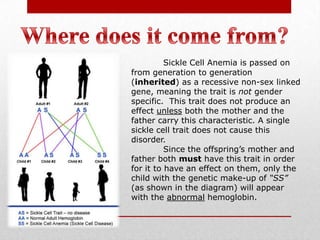
Where does it come from?Sickle Cell Anemia is passed on from generation to generation (inherited) as a recessive non-sex linked gene, meaning the trait is not gender specific.  This trait does not produce an effect unlessboth the mother and the father carry this characteristic. A single sickle cell trait does not cause this disorder.Since the offspring’s mother and father both must have this trait in order for it to have an effect on them, only the child with the genetic make-up of “SS” (as shown in the diagram) will appear with the abnormal hemoglobin.
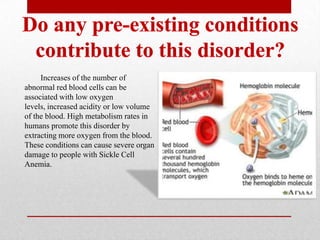
Do any pre-existing conditions contribute to this disorder?	Increases of the number of abnormal red blood cells can be associated with low oxygen levels, increased acidity or low volume of the blood. High metabolism rates in humans promote this disorder by extracting more oxygen from the blood.  These conditions can cause severe organ damage to people with Sickle Cell Anemia.
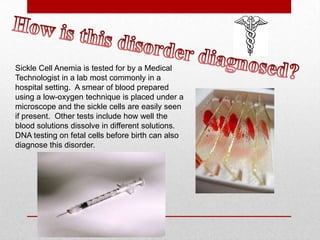
How is this disorder diagnosed?Sickle Cell Anemia is tested for by a Medical Technologist in a lab most commonly in a hospital setting.  A smear of blood prepared using a low-oxygen technique is placed under a microscope and the sickle cells are easily seen if present.  Other tests include how well the blood solutions dissolve in different solutions. DNA testing on fetal cells before birth can also diagnose this disorder.
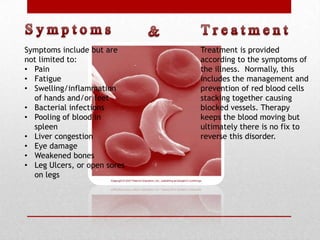
S y m p t o m sT r e a t m e n t&Symptoms include but are not limited to:Pain
Fatigue
Swelling/inflammation of hands and/or feet

Sickle cell anemia

  • 1.
  • 2.
    What is it?SickleCell Anemia is an inherited genetic disorder caused by irregularly shaped oxygen-carrying proteins within the red blood cells. These red blood cells are fragile and burst easily. These cells can cause blood vessels to become blocked, which leads to internal organ and tissue damage as well as pain.
  • 3.
    Where does itcome from?Sickle Cell Anemia is passed on from generation to generation (inherited) as a recessive non-sex linked gene, meaning the trait is not gender specific. This trait does not produce an effect unlessboth the mother and the father carry this characteristic. A single sickle cell trait does not cause this disorder.Since the offspring’s mother and father both must have this trait in order for it to have an effect on them, only the child with the genetic make-up of “SS” (as shown in the diagram) will appear with the abnormal hemoglobin.
  • 4.
    Do any pre-existingconditions contribute to this disorder? Increases of the number of abnormal red blood cells can be associated with low oxygen levels, increased acidity or low volume of the blood. High metabolism rates in humans promote this disorder by extracting more oxygen from the blood. These conditions can cause severe organ damage to people with Sickle Cell Anemia.
  • 5.
    How is thisdisorder diagnosed?Sickle Cell Anemia is tested for by a Medical Technologist in a lab most commonly in a hospital setting. A smear of blood prepared using a low-oxygen technique is placed under a microscope and the sickle cells are easily seen if present. Other tests include how well the blood solutions dissolve in different solutions. DNA testing on fetal cells before birth can also diagnose this disorder.
  • 6.
    S y mp t o m sT r e a t m e n t&Symptoms include but are not limited to:Pain
  • 7.
  • 8.