Page 302 of 349
Page 303 of 349
PIVOT 4A BUDGET OF WORK (BOW) FOR SENIOR HIGH SCHOOL – CORE SUBJECTS
The PIVOT 4A Budget of Work (BOW) for Senior High School – Core Subjects is a
resource material in teaching SHS core subjects that contain and highlight the most
essential learning competencies (MELCs) as mapped from the K to 12 Basic Education
Curriculum for Senior High School.
How to Use this BOW?
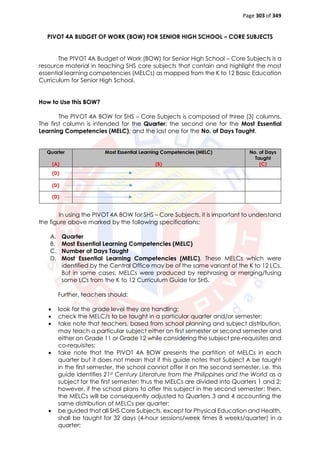
The PIVOT 4A BOW for SHS – Core Subjects is composed of three (3) columns.
The first column is intended for the Quarter; the second one for the Most Essential
Learning Competencies (MELC); and the last one for the No. of Days Taught.
Quarter
(A)
Most Essential Learning Competencies (MELC)
(B)
No. of Days
Taught
(C)
(D)
(D)
(D)
In using the PIVOT 4A BOW for SHS – Core Subjects, it is important to understand
the figure above marked by the following specifications:
A. Quarter
B. Most Essential Learning Competencies (MELC)
C. Number of Days Taught
D. Most Essential Learning Competencies (MELC). These MELCs which were
identified by the Central Office may be of the same variant of the K to 12 LCs.
But in some cases, MELCs were produced by rephrasing or merging/fusing
some LCs from the K to 12 Curriculum Guide for SHS.
Further, teachers should:
 look for the grade level they are handling;
 check the MELC/s to be taught in a particular quarter and/or semester;
 take note that teachers, based from school planning and subject distribution,
may teach a particular subject either on first semester or second semester and
either on Grade 11 or Grade 12 while considering the subject pre-requisites and
co-requisites;
 take note that the PIVOT 4A BOW presents the partition of MELCs in each
quarter but it does not mean that if this guide notes that Subject A be taught
in the first semester, the school cannot offer it on the second semester, i.e. this
guide identifies 21st Century Literature from the Philippines and the World as a
subject for the first semester; thus the MELCs are divided into Quarters 1 and 2;
however, if the school plans to offer this subject in the second semester; then,
the MELCs will be consequently adjusted to Quarters 3 and 4 accounting the
same distribution of MELCs per quarter;
 be guided that all SHS Core Subjects, except for Physical Education and Health,
shall be taught for 32 days (4-hour sessions/week times 8 weeks/quarter) in a
quarter;
Page 304 of 349
 observe that Physical Education and Health shall be taught for eight (8)
meetings (1-hour session/week times 8 weeks) per quarter; and
 design their lessons on the MELC and/or clustered MELCs using the IDEA
instructional delivery process.
clmd/jsc
Page 305 of 349
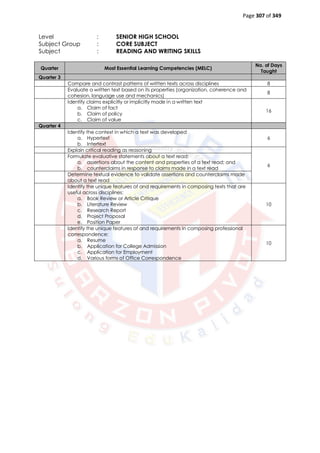
Level : SENIOR HIGH SCHOOL
Subject Group : CORE SUBJECT
Subject : 21ST CENTURY LITERATURE FROM THE PHILIPPINES
AND THE WORLD
Quarter Most Essential Learning Competencies (MELC)
No. of Days
Taught
Quarter 1
Writing a close analysis and critical interpretation of literary texts and doing
an adaptation of these require from the learner the ability to identify:
a. the geographic, linguistic, and ethnic dimensions of Philippine
literary history from pre-colonial to the contemporary
b. representative texts and authors from each region (e.g. engage in
oral history research with focus on key personalities from the students’
region/province/town)
8
Compare and contrast the various 21st century literary genres and the ones
from the earlier genres/periods citing their elements, structures and traditions
4
Discuss how different contexts enhance the text’s meaning and enrich the
reader’s understanding
4
Produce a creative representation of a literary text by applying multi-media
and ICT skills
8
Do self- and/or peer-assessment of the creative adaptation of a literary text,
based on rationalized criteria, prior to presentation
8
Quarter 2
Writing a close analysis and critical interpretation of literary texts, applying a
reading approach, and doing an adaptation of these, require from the
learner the ability to identify: representative texts and authors from Asia,
North America, Europe, Latin America, and Africa
12
Compare and contrast the various 21st century literary genres and their
elements, structures, and traditions from across the globe
4
Produce a creative representation of a literary text by applying multimedia
and ICT skills
8
Do self- and/or peer-assessment of the creative adaptation of a literary text,
based on rationalized criteria, prior to presentation
8
Page 306 of 349
Level : SENIOR HIGH SCHOOL
Subject Group : CORE SUBJECT
Subject : ORAL COMMUNICATION IN CONTEXT
Quarter Most Essential Learning Competencies (MELC)
No. of Days
Taught
Quarter 1
Explains the functions, nature and process of communication 4
Differentiates the various models of communication 4
Uses various strategies in order to avoid communication breakdown 4
Examines sample oral communication activities 6
Identifies the various types of speech context.
4
Distinguishes types of speeches and speech style
Responds appropriately and effectively to a speech act
10
Employs various communicative strategies in different situations
Quarter 2
Explains that a shift in speech context, speech style, speech act and
communicative strategy affects the following:
Language form
Duration of interaction
Relationship of speaker
Role and responsibilities of the speaker
Message
Delivery
16
Uses principles of effective speech writing focusing on:
Audience profile
Logical organization
Duration
Word choice
Grammatical correctness
and
Articulation
Modulation
Stage Presence
Facial Expressions, Gestures and Movements
Rapport with the audience
16
Page 307 of 349
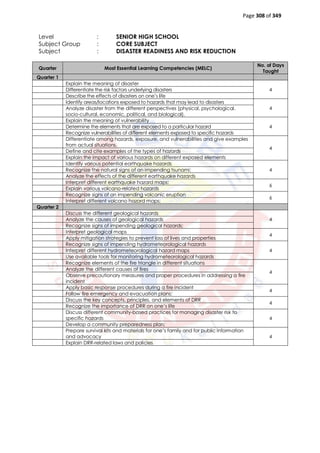
Level : SENIOR HIGH SCHOOL
Subject Group : CORE SUBJECT
Subject : READING AND WRITING SKILLS
Quarter Most Essential Learning Competencies (MELC)
No. of Days
Taught
Quarter 3
Compare and contrast patterns of written texts across disciplines 8
Evaluate a written text based on its properties (organization, coherence and
cohesion, language use and mechanics)
8
Identify claims explicitly or implicitly made in a written text
a. Claim of fact
b. Claim of policy
c. Claim of value
16
Quarter 4
Identify the context in which a text was developed
a. Hypertext
b. Intertext
6
Explain critical reading as reasoning
6
Formulate evaluative statements about a text read:
a. assertions about the content and properties of a text read; and
b. counterclaims in response to claims made in a text read
Determine textual evidence to validate assertions and counterclaims made
about a text read
Identify the unique features of and requirements in composing texts that are
useful across disciplines:
a. Book Review or Article Critique
b. Literature Review
c. Research Report
d. Project Proposal
e. Position Paper
10
Identify the unique features of and requirements in composing professional
correspondence:
a. Resume
b. Application for College Admission
c. Application for Employment
d. Various forms of Office Correspondence
10
Page 308 of 349
Level : SENIOR HIGH SCHOOL
Subject Group : CORE SUBJECT
Subject : DISASTER READINESS AND RISK REDUCTION
Quarter Most Essential Learning Competencies (MELC)
No. of Days
Taught
Quarter 1
Explain the meaning of disaster
4
Differentiate the risk factors underlying disasters
Describe the effects of disasters on one’s life
Identify areas/locations exposed to hazards that may lead to disasters
4
Analyze disaster from the different perspectives (physical, psychological,
socio-cultural, economic, political, and biological).
Explain the meaning of vulnerability
4
Determine the elements that are exposed to a particular hazard
Recognize vulnerabilities of different elements exposed to specific hazards
Differentiate among hazards, exposure, and vulnerabilities and give examples
from actual situations.
4
Define and cite examples of the types of hazards
Explain the impact of various hazards on different exposed elements
Identify various potential earthquake hazards
4
Recognize the natural signs of an impending tsunami;
Analyze the effects of the different earthquake hazards
Interpret different earthquake hazard maps;
6
Explain various volcano-related hazards
Recognize signs of an impending volcanic eruption
6
Interpret different volcano hazard maps;
Quarter 2
Discuss the different geological hazards
4
Analyze the causes of geological hazards
Recognize signs of impending geological hazards;
Interpret geological maps
4
Apply mitigation strategies to prevent loss of lives and properties
Recognize signs of impending hydrometeorological hazards
4
Interpret different hydrometeorological hazard maps
Use available tools for monitoring hydrometeorological hazards
Recognize elements of the fire triangle in different situations
4
Analyze the different causes of fires
Observe precautionary measures and proper procedures in addressing a fire
incident
Apply basic response procedures during a fire incident
4
Follow fire emergency and evacuation plans;
Discuss the key concepts, principles, and elements of DRR
4
Recognize the importance of DRR on one’s life
Discuss different community-based practices for managing disaster risk to
specific hazards 4
Develop a community preparedness plan;
Prepare survival kits and materials for one’s family and for public information
and advocacy 4
Explain DRR-related laws and policies
Page 309 of 349
Level : SENIOR HIGH SCHOOL
Subject Group : CORE SUBJECT
Subject : EARTH AND LIFE SCIENCE
Quarter Most Essential Learning Competencies (MELC)
No. of Days
Taught
Quarter 1
Recognize the uniqueness of Earth, being the only planet in the solar system
with properties necessary to support life.
4
Explain that the Earth consists of four subsystems, across whose boundaries matter
and energy flow.
Identify common rock-forming minerals using their physical and chemical
properties. 4
Classify rocks into igneous, sedimentary, and metamorphic
Describe where the Earth’s internal heat comes from.
4
Describe the changes in mineral components and texture of rocks due to
changes in pressure and temperature (metamorphism)
Describe how rocks behave under different types of stress such as
compression, pulling apart, and shearing 4
Explain how the movement of plates leads to the formation of folds and faults
Describe how layers of rocks (stratified rocks) are formed
4
Describe the different methods (relative and absolute dating) to determine
the age of stratified rocks
Explain how relative and absolute dating were used to determine the
subdivisions of geologic time
Describe how the Earth’s history can be interpreted from the geologic time
scale
4
Describe the various hazards that may happen in the event of earthquakes,
volcanic eruptions, and landslides
Using hazard maps, identify areas prone to hazards brought about by
earthquakes, volcanic eruptions, and landslides 4
Identify human activities that speed up or trigger landslides
Using hazard maps, identify areas prone to hazards brought about by tropical
cyclones, monsoons, floods, or ipo-ipo
4
Describe how coastal processes result in coastal erosion, submersion, and
saltwater intrusion
Quarter 2
Explain the evolving concept of life based on emerging pieces of evidence 4
Describe how unifying themes (e.g., structure and function, evolution, and
ecosystems) in the study of life show the connections among living things and
how they interact with each other and with their environment
4
Describe the different ways of how representative animals reproduce
4
Describe the process of genetic engineering
Evaluate the benefits and risks of using GMOs 4
Describe the general and unique characteristics of the different organ systems
in representative animals
4
Analyze and appreciate the functional relationships of the different organ
systems in ensuring animal survival
Explain how populations of organisms have changed and continue to change
over time showing patterns of descent with modification from common
ancestors to produce the organismal diversity observed today
4
Describe how the present system of classification of organisms is based on
evolutionary relationships
4
Categorize the different biotic potential and environmental resistance (e.g.,
diseases, availability of food, and predators) that affect population explosion
4
Page 310 of 349
Level : SENIOR HIGH SCHOOL
Subject Group : CORE SUBJECT
Subject : EARTH SCIENCE
Quarter Most Essential Learning Competencies (MELC)
No. of Days
Taught
Quarter 1
Describe the characteristics of Earth that are necessary to support life 4
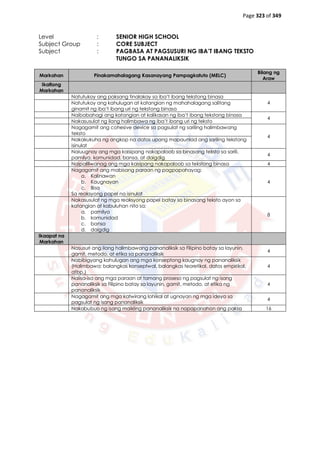
Explain that the Earth consists of four subsystems, across whose boundaries
matter and energy flow
4
Identify common rock-forming minerals using their physical and chemical
properties
Classify rocks into igneous, sedimentary, and metamorphic 4
Identify the minerals important to society
4
Describe how ore minerals are found, mined, and processed for human use
Describe how fossil fuels are formed 4
Explain how heat from inside the Earth (geothermal) and from flowing
water (hydroelectric) is tapped as a source of energy for human use 4
Identify the various water resources on Earth
Explain how different activities affect the quality and availability of water for
human use
4
Identify human activities, such as farming, construction of structures, and
waste disposal, that affect the quality and quantity of soil
Describe how people generate different types of waste (solid, liquid, and
gaseous) as they make use of various materials and resources in everyday
life 4
Explain how different types of waste affect people’s health and the
environment
Quarter 2
Describe how rocks undergo weathering 4
Explain why the Earth’s interior is hot 4
Describe what happens after magma is formed 4
Describe how rocks behave under different types of stress such as
compression, pulling apart, and shearing 4
Describe the structure and evolution of ocean basins
Describe how layers of rocks (stratified rocks) are formed
4
Describe the different methods (relative and absolute dating) of
determining the age of stratified rocks
Explain how relative and absolute dating were used to determine the
subdivisions of geologic time
4
Describe how index fossils (also known as guide fossils) are used to define
and identify subdivisions of the geologic time scale
4
Describe the history of the Earth through geologic time 4
Page 311 of 349
Level : SENIOR HIGH SCHOOL
Subject Group : CORE SUBJECT
Subject : PHYSICAL SCIENCE
Quarter Most Essential Learning Competencies (MELC)
No. of Days
Taught
Quarter 1
Give evidence for and describe the formation of heavier elements during
star formation and evolution
4
Explain how the concept of atomic number led to the synthesis of new
elements in the laboratory
Determine if a molecule is polar or non-polar given its structure
4
Relate the polarity of a molecule to its properties
Describe the general types of intermolecular forces
4
Explain the effect of intermolecular forces on the properties of substances
Explain how the structures of biological macromolecules such as
carbohydrates, lipids, nucleic acid, and proteins determine their properties and
functions
4
Use simple collision theory to explain the effects of concentration, temperature,
and particle size on the rate of reaction 4
Define catalyst and describe how it affects reaction rate
Determine the limiting reactant in a reaction and calculate the amount of
product formed
4
Describe how energy is harnessed from different sources:
a. Fossil fuels
b. Biogas
c. Geothermal
d. Hydrothermal
e. Batteries
f. Solar cells
g. Biomass
4
From product labels, identify the active ingredient(s) of cleaning products
used at home 4
Give the use of the other ingredients in cleaning agents
Quarter 2
Explain how the Greeks knew that the Earth is spherical
4
Cite examples of astronomical phenomena known to astronomers before
the advent of telescopes
Explain how Brahe’s innovations and extensive collection of data in
observational astronomy paved the way for Kepler’s discovery of his laws of
planetary motion
Explain the subtle distinction between Newton’s 1st Law of Motion (or Law of
Inertia) and Galileo’s assertion that force is not necessary to sustain horizontal
motion
4
Describe how the propagation of light, reflection, and refraction are
explained by the wave model and the particle model of light
Explain how the photon concept and the fact that the energy of a photon is
directly proportional to its frequency can be used to explain why red light is
used in photographic dark rooms, why we get easily sunburned in ultraviolet
light but not in visible light, and how we see colors
Cite experimental evidence showing that electrons can behave like waves
4
Differentiate dispersion, scattering, interference, and diffraction
Explain various light phenomena such as:
a. Your reflection on the concave and convex sides of a spoon looks
different
b. Mirages
c. Light from a red laser passes more easily though red cellophane
than green cellophane
d. Clothing of certain colors appear different in artificial light and in
sunlight
e. Haloes, sundogs, primary rainbows, secondary rainbows, and
supernumerary bows
f. Why clouds are usually white and rainclouds dark
g. Why the sky is blue and sunsets are reddish
8
Describe how Hertz produced radio pulses 4
Page 312 of 349
Quarter Most Essential Learning Competencies (MELC)
No. of Days
Taught
Explain how special relativity resolved the conflict between Newtonian
mechanics and Maxwell’s electromagnetic theory
Explain the consequences of the postulates of Special Relativity (e.g.,
relativity of simultaneity, time dilation, length contraction, mass-energy
equivalence, and cosmic speed limit)
4
Explain the consequences of the postulates of General Relativity (e.g.,
correct predictions of shifts in the orbit of Mercury, gravitational bending of
light, and black holes)
Explain how the speeds and distances of far-off objects are estimated (e.g.,
doppler effect and cosmic distance ladder)
4
Explain how we know that we live in an expanding universe, which used to
be hot and is approximately 14 billion years old
Page 313 of 349
Level : SENIOR HIGH SCHOOL
Subject Group : CORE SUBJECT
Subject : GENERAL MATHEMATICS
Quarter Most Essential Learning Competencies (MELC)
No. of Days
Taught
Quarter 1
represents real-life situations using functions, including piece-wise functions.
4
evaluates a function.
performs addition, subtraction, multiplication, division, and composition of
functions
solves problems involving functions.
represents real-life situations using rational functions.
4
distinguishes rational function, rational equation, and rational inequality.
solves rational equations and inequalities.
represents a rational function through its: (a) table of values, (b) graph, and
(c) equation.
finds the domain and range of a rational function.
determines the: (a) intercepts; (b) zeroes; and (c) asymptotes of rational
functions 4
solves problems involving rational functions, equations, and inequalities.
represents real-life situations using one-to one functions.
4
determines the inverse of a one-to-one function.
represents an inverse function through its: (a) table of values, and (b) graph.
finds the domain and range of an inverse function.
solves problems involving inverse functions.
4
represents real-life situations using exponential functions.
distinguishes between exponential function, exponential equation, and
exponential inequality.
solves exponential equations and inequalities.
4
represents an exponential function through its: (a) table of values, (b) graph,
and (c) equation.
finds the domain and range of an exponential function.
determinestheintercepts,zeroes,and asymptotesof anexponential function.
solves problems involving exponential functions, equations, and inequalities.
represents real-life situations using logarithmic functions.
4
distinguishes logarithmic function, logarithmic equation, and logarithmic
inequality.
solves logarithmic equations and inequalities.
represents a logarithmic function through its: (a) table of values, (b) graph,
and (c) equation.
4
finds the domain and range of a logarithmic function.
determines the intercepts, zeroes, and asymptotes of logarithmic functions.
solves problems involving logarithmic functions, equations, and inequalities.
Quarter 2
illustrates simple and compound interests.
4
distinguishes between simple and compound interests.
computes interest, maturity value, future value, and present value in simple
interest and compound interest environment.
solves problems involving simple and compound interests.
illustrates simple and general annuities.
8
distinguishes between simple and general annuities.
finds the future value and present value of both simple annuities and general
annuities.
calculates the fair market value of a cash flow stream that includes an
annuity.
calculates the present value and period of deferral of a deferred annuity.
illustrate stocks and bonds.
4
distinguishes between stocks and bonds.
describes the different markets for stocks and bonds.
analyzes the different market indices for stocks and bonds.
illustrates business and consumer loans.
4
distinguishes between business and consumer loans.
Page 314 of 349
Quarter Most Essential Learning Competencies (MELC)
No. of Days
Taught
solves problems involving business and consumer loans (amortization,
mortgage).
illustrates and symbolizes propositions.
4
distinguishes between simple and compound propositions.
performs the different types of operations on propositions.
determines the truth values of propositions.
4
illustrates the different forms of conditional propositions.
illustrates different types of tautologies and fallacies.
4
determines the validity of categorical syllogisms.
establishes the validity and falsity of real-life arguments using logical
propositions, syllogisms, and fallacies.
Page 315 of 349
Level : SENIOR HIGH SCHOOL
Subject Group : CORE SUBJECT
Subject : STATISTICS AND PROBABILITY
Quarter Most Essential Learning Competencies (MELC)
No. of Days
Taught
Quarter 3
illustrates a random variable (discrete and continuous).
4
distinguishes between a discrete and a continuous random variable.
finds the possible values of a random variable.
illustrates a probability distribution for a discrete random variable and its
properties.
computes probabilities corresponding to a given random variable.
illustrates the mean and variance of a discrete random variable.
calculates the mean and the variance of a discrete random variable.
interprets the mean and the variance of a discrete random variable.
4
solves problems involving mean and variance of probability distributions.
illustrates a normal random variable and its characteristics.
identifies regions under the normal curve corresponding to different standard
normal values.
4
converts a normal random variable to a standard normal variable and vice
versa.
computes probabilities and percentiles using the standard normal table.
illustrates random sampling.
4
distinguishes between parameter and statistic.
identifies sampling distributions of statistics (sample mean).
finds the mean and variance of the sampling distribution of the sample
mean.
4
defines the sampling distribution of the sample mean for normal population
when the variance is: (a) known; (b) unknown
illustrates the Central Limit Theorem.
4
defines the sampling distribution of the sample mean using the Central Limit
Theorem.
solves problems involving sampling distributions of the sample mean.
illustrates the t-distribution.
4
identifies percentiles using the t-table.
identifies the length of a confidence interval.
4
computes for the length of the confidence interval.
computes for an appropriate sample size using the length of the interval.
solves problems involving sample size determination.
Quarter 4
illustrates: (a) null hypothesis; (b) alternative hypothesis; (c) level of
significance; (d) rejection region; and (e) types of errors in hypothesis testing.
4
identifies the parameter to be tested given a real-life problem.
formulates the appropriate null and alternative hypotheses on a population
mean.
identifies the appropriate form of the test-statistic when: (a) the population
variance is assumed to be known; (b) the population variance is assumed to
be unknown; and (c) the Central Limit Theorem is to be used.
4
identifies the appropriate rejection region for a given level of significance
when: (a) the population variance is assumed to be known; (b) the
population variance is assumed to be unknown; and (c) the Central Limit
Theorem is to be used.
computes for the test-statistic value (population mean).
4
draws conclusion about the population mean based on the test-statistic
value and the rejection region.
solves problems involving test of hypothesis on the population mean.
4
formulates the appropriate null and alternative hypotheses on a population
proportion.
identifies the appropriate form of the test-statistic when the Central Limit
Theorem is to be used.
identifies the appropriate rejection region for a given level of significance
when the Central Limit Theorem is to be used.
computes for the test-statistic value (population proportion).
Page 316 of 349
Quarter Most Essential Learning Competencies (MELC)
No. of Days
Taught
draws conclusion about the population proportion based on the test-statistic
value and the rejection region.
solves problems involving test of hypothesis on the population proportion.
4
illustrates the nature of bivariate data.
constructs a scatter plot.
describes shape (form), trend (direction), and variation (strength) based on a
scatter plot.
calculates the Pearson’s sample correlation coefficient.
4
solves problems involving correlation analysis.
identifies the independent and dependent variables.
4
calculates the slope and y-intercept of the regression line.
interprets the calculated slope and y-intercept of the regression line.
predicts the value of the dependent variable given the value of the
independent variable. 4
solves problems involving regression analysis.
Page 317 of 349
Level : SENIOR HIGH SCHOOL
Subject Group : CORE SUBJECT
Subject : INTRODUCTION TO PHILOSOPHY OF THE HUMAN PERSON/
PAMBUNGAD SA PILOSOPIYA NG TAO
Quarter Most Essential Learning Competencies (MELC)
No. of Days
Taught
Quarter 1
Distinguish a holistic perspective from a partial point of view
Nakikilala ang pagkakaiba ng pangkabuuang pananaw mula sa pananaw
ng mga bahagi lamang
8
Realize the value of doing philosophy in obtaining a broad perspective on
life
Nahihinuha na: Mahalaga ang pamimilosopiya upang magkaroon ng
malawakang pananaw sa buhay.
Do a philosophical reflection on a concrete situation from a holistic
perspective
Nakapagmumuni-muni sa isang suliranin sa isang pilosopikong paraan at
nakagagawa ng pamimiloosopiya sa buhay
Distinguish opinion from truth
Nakikilala ang pagkakaiba ng katotohanan sa opinyon
8
Realize that the methods of philosophy lead to wisdom and truth
Nahihinuha na patungo sa katotohanan ang mga pamamaraan ng
pamimilosopiya
Evaluate truth from opinions in different situations using the methods of
philosophizing
Natataya ang katotohanan at opinyon sa iba’t ibang sitwasyon gamit ang
pamamaraan ng pamimilosopiya
Recognize how the human body imposes limits and possibilities for
transcendence
Nakikilala na: Binibigyan ako ng hangganan at posibilidad ng aking
katawan 8
Evaluate own limitations and the possibilities for their transcendence
Natataya ang mga pagkakatakda (hangganan) at pagsasaibayo
(posibilidad) ng sarili
Notice things that are not in their proper place and organize them in an
aesthetic way
Napapansin ang mga bagay na wala sa wastong lugar at naisasaayos ito
nang ayon sa kagandahan
8
Show that care for the environment contributes to health, well-being and
sustainable development
Napatutunayan na ang pagkalinga sa kapaligiran ay nakatutulong sa
pagkamit ng kalusugan, kagalingan, at likas-kayang kaunlaran
Demonstrate the virtues of prudence and frugality towards environments
Naipamamalas ang pagiging masinop sa pakikibagay sa kanyang mga
kapwa nilalang at sa kapaligiran
Quarter 2
Evaluate and exercise prudence in choices
Natatasa kung siya ay maingat sa pagpapasya o hindi
8
Realize that:
a. Choices have consequences.
b. Some things are given up while others are obtained in making
choices
Nakikilala na:
a. May kahihinatnan ang bawat pagpili.
b. May binibitawan at may makukuha sa bawat pagpili.
Show situations that demonstrate freedom of choice and the consequences
of their choices
Nakapaglalahad ng mga sitwasyon kung saan naipakikita ang pagpili at
kahihinatnan ng mga ito bawat pagpili.
Realize that intersubjectivity requires accepting differences and not imposing
on others
Nakikilala na ang pakikipagkapwa-tao ay ang pagtanggap sa pagkakaiba
ng kapwa at hindi pagpataw ng sarili
8
Page 318 of 349
Quarter Most Essential Learning Competencies (MELC)
No. of Days
Taught
Explain that authentic dialogue means accepting others even if they are
different from themselves
Nakapagpapaliwanag na ang tunay na diyalogo ay ang pagtanggap sa
kapwa bilang kapwa kahit na siya ay iba sa akin
Performs activities that demonstrate an appreciation for the talents of
persons with disabilities and those from the underprivileged sectors of society
Nakapagsasagawa ng isang gawain na nagpapamalas ng mga talento ng
mga may kapansanan at kapus-palad
Recognize how individuals form societies and how individuals are
transformed by societies
Nakikilala kung paano nahuhubog ng tao ang lipunan at kung paano
nahuhubog ng lipunan ang tao
8
Compare different forms of societies and individualities (eg. Agrarian,
industrial and virtual)
Nakapaghahambing ng iba’t ibang uri ng lipunan (hal. agraryo, industriyal
at birtwal)
Explain how human relations are transformed by social systems
Nakapagpapaliwanang na nagbabago ang mga ugnayan ng tao dahil sa
sistema ng lipunan na kinabibilangan niya
Enumerate the objectives he/she really wants to achieve and to define the
projects he/she really wants to do in his/her life
Nakapagtatala ng mga bagay na tunay na gusto niyang gawin (Ano ang
gusto niyang maging?)
8
Reflect on the meaning of his/her own life
Nakapagsusulat ng pagninilay tungkol sa kahulugan ng kanyang buhay sa
konteksto ng tao bilang tumutungo sa kamatayan (Saan hahantong ang
lahat ng ito?)
Page 319 of 349
Level : SENIOR HIGH SCHOOL
Subject Group : CORE SUBJECT
Subject : PERSONAL DEVELOPMENT
Quarter Most Essential Learning Competencies (MELC)
No. of Days
Taught
Quarter 1
explain that knowing oneself can make a person accept his/her strengths
and limitations and dealing with others better
4
share his/her unique characteristics, habits, and experiences
discuss the relationship among physiological, cognitive, psychological,
spiritual, and social development
evaluate his/her own thoughts, feelings, and behaviors
show the connections between thoughts, feelings, and behaviors in actual
life situations
Discuss developmental tasks and challenges being experienced during
adolescence
4
Evaluate one’s development through the help of significant people around
him/her ( peers, parents, siblings, friends, teachers, community leaders)
Identify ways that help one become capable and responsible adolescent
prepared for adult life
Discuss understanding of mental health and psychological well-being to
identify ways to cope with stress during adolescence
4
Identify causes and effects of stress in one’s life
Demonstrate personal ways to cope with stress and maintain mental health
Discuss that understanding the different parts of the brain, processes and
functions may help in improving thoughts, behaviour and feelings.
4
Explore ways on how to improve brain functions for personal development
Develop a personal plan to enhance brain functions
discuss that understanding the intensity and differentiation of emotions may
help in communicating emotional expressions
4
explore one’s positive and negative emotions and how one expresses or
hides them
demonstrate and create ways to manage various emotions
discuss an understanding of teen-age relationships, including the
acceptable and unacceptable expressions of attractions
4
express his/her ways of showing attraction, love, and commitment
identify ways to become responsible in a relationship
distinguish the various roles of different individuals in society and how they
can influence people through their leadership or followership
4
compare one’s perception of himself/herself and how others see him/her
conduct a mini-survey on Filipino relationships (family, school, and
community)
appraise one’s family structure and the type of care he/she gives and
receives, which may help in understanding himself/herself better
4
make a genogram and trace certain physical, personality, or behavioral
attributes through generations
prepare a plan on how to make the family members firmer and gentler with
each other
Quarter 2
Explain that understanding different factors, career development concepts
and personal life goals influence career planning and decision-making.
16
Identify career options based on different factors, career development
concepts and personal life goals
Prepare a career plan based on the identified career options to attain
personal life’s goals
explain the factors in personal development that may guide him/her in
making important career decisions as adolescents
16
share insights that make him/her realize the importance of personal
development in making a career decision as adolescent
construct a creative visualization of his/her personal development through of
the various stages he/she went through, stressors, influences, and decision-
making points, and a personal profile analysis
Page 320 of 349
Level : SENIOR HIGH SCHOOL
Subject Group : CORE SUBJECT
Subject : UNDERSTANDING CULTURE, SOCIETY AND POLITICS
Quarter Most Essential Learning Competencies (MELC)
No. of Days
Taught
Quarter 1
Discuss the nature, goals and perspectives in/of anthropology, sociology and
political science*
4
Analyze the concept, aspects and changes in/of culture and society* 6
Explain the importance of cultural relativism in attaining cultural
understanding*
4
Analyze the significance of cultural, social, political and economic
symbols and practices*
6
Explain the context, content, processes, and consequences of socialization* 6
Analyze the forms and functions of social organizations* 6
Quarter 2
Explain the forms and functions of state and non-state institutions* 4
Examine the functions and importance of education in the society* 6
Examine the concept, characteristics and forms of stratification systems using
sociological perspectives*
6
Explain government programs and initiatives in addressing social inequalities
e.g. local, national, global
4
Suggest ways to address social inequalities (local, national and global)* 6
Examine human responses to emerging challenges in contemporary societies* 6
*These learning competencies were rephrased and deemed most essential in the achievement of content and performance
standards.
Page 321 of 349
Level : SENIOR HIGH SCHOOL
Subject Group : CORE SUBJECT
Subject : KOMUNIKASYON AT PANANALIKSIK SA WIKA
AT KULTURANG PILIPINO
Markahan Pinakamahalagang Kasanayang Pampagkatuto (MELC)
Bilang ng
Araw
Unang
Markahan
Naiuugnay ang mga konseptong pangwika sa mga napakinggang
sitwasyong pangkomunikasyon sa radyo, talumpati, at mga panayam
4
Natutukoy ang mga kahulugan at kabuluhan ng mga konseptong
pangwika
Naiuugnay ang mga konseptong pangwika sa mga napanood na
sitwasyong pang komunikasyon sa telebisyon (Halimbawa: Tonight with
Arnold Clavio, State of the Nation, Mareng Winnie,Word of the Lourd
(http://lourddeveyra.blogspot.com)
4
Naiuugnay ang mga konseptong pangwika sa sariling kaalaman, pananaw,
at mga karanasan
Nagagamit ang kaalaman sa modernong teknolohiya (facebook, google,
at iba pa) sa pag-unawa sa mga konseptong pangwika
4
Nabibigyang kahulugan ang mga komunikatibong gamit ng wika sa lipunan
(Ayon kay M. A. K. Halliday)
Natutukoy ang iba’t ibang gamit ng wika sa lipunan sa pamamagitan ng
napanood na palabas sa telebisyon at pelikula (Halimbawa: Be Careful with
My Heart, Got to Believe, Ekstra, On The Job, Word of the
Lourd(http://lourddeveyra.blogspot.com))
4
Naipaliliwanag nang pasalita ang gamit ng wika sa lipunan sa
pamamagitan ng mga pagbibigay halimbawa
Nagagamit ang mga cohesive device sa pagpapaliwanag at pagbibigay
halimbawa sa mga gamit ng wika sa lipunan
4
Nakapagsasaliksik ng mga halimbawang sitwasyon na nagpapakita ng
gamit ng wika sa lipunan
Nakapagbibigay ng opinyon o pananaw kaugnay sa mga napakinggang
pagtalakay sa wikang pambansa
4
Nasusuri ang mga pananaw ng iba’t ibang awtor sa isinulat na kasaysayan
ng wika
Natutukoy ang mga pinagdaanang pangyayari / kaganapan tungo sa
pagkabuo at pag-unlad ng Wikang Pambansa
4
Nakasusulat ng sanaysay na tumatalunton sa isang partikular na yugto ng
kasaysayan ng Wikang Pambansa
Natitiyak ang mga sanhi at bunga ng mga pangyayaring may kaugnayan
sa pag-unlad ng Wikang Pambansa
4
Nakagagawa ng isang sanaysay batay sa isang panayam tungkol sa
aspektong kultural o lingguwistiko ng napiling komunidad
Ikalawang
Markahan
Natutukoy ang iba’t ibang paggamit ng wika sa mga napakinggang
pahayag mula sa mga panayam at balita sa radyo at telebisyon
2
Natutukoy ang iba’t ibang paggamit ng wika sa nabasang pahayag mula
sa mga blog, social media posts at iba pa
Nasusuri at naisasaalang-alang ang mga lingguwistiko at kultural na
pagkakaiba-iba sa lipunang Pilipino sa mga pelikula at dulang napanood
4
Naipapaliwanag nang pasalita ang iba’t ibang dahilan, anyo, at
pamaraan ng paggamit ng wika sa iba’t ibang sitwasyon
Nakasusulat ng mga tekstong nagpapakita ng mga kalagayang pangwika
sa kulturang Pilipino
4
Natutukoy ang iba’t ibang register at barayti ng wika na ginagamit sa iba’t
ibang sitwasyon (Halimbawa: Medisina, Abogasya, Media, Social Media,
Enhinyerya, Negosyo, at iba pa) sa pamamagitan ng pagtatala ng mga
terminong ginamit sa mga larangang ito
Nakagagawa ng pag-aaral gamit ang social media sa pagsusuri at
pagsulat ng mga tekstong nagpapakita ng iba’t ibang sitwasyon ng
paggamit sa wika
4
Page 322 of 349
Markahan Pinakamahalagang Kasanayang Pampagkatuto (MELC)
Bilang ng
Araw
Natutukoy ang mga angkop na salita, pangungusap ayon sa konteksto ng
paksang napakinggan sa mga balita sa radyo at telebisyon
Nabibigyang kahulugan ang mga salitang ginamit sa talakayan
2
Napipili ang angkop na mga salita at paraan ng paggamit nito sa mga
usapan o talakayan batay sa kausap, pinag-uusapan, lugar, panahon,
layunin, at grupong kinabibilangan
Nahihinuha ang layunin ng isang kausap batay sa paggamit ng mga salita
at paraan ng pagsasalita
4
Nakabubuo ng mga kritikal na sanaysay ukol sa iba’t ibang paraan ng
paggamit ng wika ng iba’t ibang grupong sosyal at kultural sa Pilipinas
Nasusuri ang ilang pananaliksik na pumapaksa sa wika at kulturang Pilipino
4
Naiisa-isa ang mga hakbang sa pagbuo ng isang makabuluhang
pananaliksik
Nagagamit ang angkop na mga salita at pangungusap upang mapag-
ugnay-ugnay ang mga ideya sa isang sulatin
8
Nakasusulat ng isang panimulang pananaliksik sa mga penomenang kultural
at panlipunan sa bansa
Page 323 of 349
Level : SENIOR HIGH SCHOOL
Subject Group : CORE SUBJECT
Subject : PAGBASA AT PAGSUSURI NG IBA’T IBANG TEKSTO
TUNGO SA PANANALIKSIK
Markahan Pinakamahalagang Kasanayang Pampagkatuto (MELC)
Bilang ng
Araw
Ikatlong
Markahan
Natutukoy ang paksang tinalakay sa iba’t ibang tekstong binasa
4
Natutukoy ang kahulugan at katangian ng mahahalagang salitang
ginamit ng iba’t ibang uri ng tekstong binasa
Naibabahagi ang katangian at kalikasan ng iba’t ibang tekstong binasa
4
Nakasusulat ng ilang halimbawa ng iba’t ibang uri ng teksto
Nagagamit ang cohesive device sa pagsulat ng sariling halimbawang
teksto
4
Nakakukuha ng angkop na datos upang mapaunlad ang sariling tekstong
isinulat
Naiuugnay ang mga kaisipang nakapaloob sa binasang teksto sa sarili,
pamilya, komunidad, bansa, at daigdig
4
Naipaliliwanag ang mga kaisipang nakapaloob sa tekstong binasa 4
Nagagamit ang mabisang paraan ng pagpapahayag:
a. Kalinawan
b. Kaugnayan
c. Bisa
Sa reaksyong papel na isinulat
4
Nakasusulat ng mga reaksyong papel batay sa binasang teksto ayon sa
katangian at kabuluhan nito sa:
a. pamilya
b. komunidad
c. bansa
d. daigdig
8
Ikaapat na
Markahan
Nasusuri ang ilang halimbawang pananaliksik sa Filipino batay sa layunin,
gamit, metodo, at etika sa pananaliksik
4
Nabibigyang kahulugan ang mga konseptong kaugnay ng pananaliksik
(Halimbawa: balangkas konseptwal, balangkas teoretikal, datos empirikal,
atbp.)
4
Naiisa-isa ang mga paraan at tamang proseso ng pagsulat ng isang
pananaliksik sa Filipino batay sa layunin, gamit, metodo, at etika ng
pananaliksik
4
Nagagamit ang mga katwirang lohikal at ugnayan ng mga ideya sa
pagsulat ng isang pananaliksik
4
Nakabubuo ng isang maikling pananaliksik na napapanahon ang paksa 16
Page 324 of 349
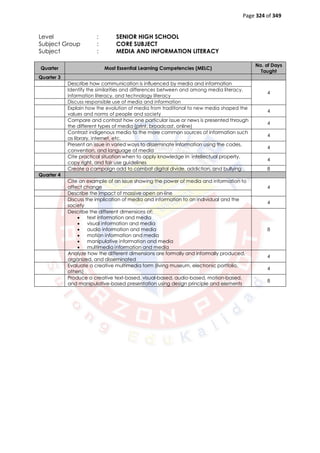
Level : SENIOR HIGH SCHOOL
Subject Group : CORE SUBJECT
Subject : MEDIA AND INFORMATION LITERACY
Quarter Most Essential Learning Competencies (MELC)
No. of Days
Taught
Quarter 3
Describe how communication is influenced by media and information
4
Identify the similarities and differences between and among media literacy,
information literacy, and technology literacy
Discuss responsible use of media and information
Explain how the evolution of media from traditional to new media shaped the
values and norms of people and society
4
Compare and contrast how one particular issue or news is presented through
the different types of media (print, broadcast, online)
4
Contrast indigenous media to the more common sources of information such
as library, internet, etc.
4
Present an issue in varied ways to disseminate information using the codes,
convention, and language of media
4
Cite practical situation when to apply knowledge in intellectual property,
copy right, and fair use guidelines
4
Create a campaign add to combat digital divide, addiction, and bullying 8
Quarter 4
Cite an example of an issue showing the power of media and information to
affect change 4
Describe the impact of massive open on-line
Discuss the implication of media and information to an individual and the
society
4
Describe the different dimensions of:
 text information and media
 visual information and media
 audio information and media
 motion information and media
 manipulative information and media
 multimedia information and media
8
Analyze how the different dimensions are formally and informally produced,
organized, and disseminated
4
Evaluate a creative multimedia form (living museum, electronic portfolio,
others)
4
Produce a creative text-based, visual-based, audio-based, motion-based,
and manipulative-based presentation using design principle and elements
8
Page 325 of 349
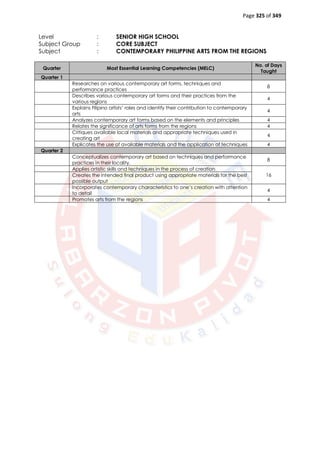
Level : SENIOR HIGH SCHOOL
Subject Group : CORE SUBJECT
Subject : CONTEMPORARY PHILIPPINE ARTS FROM THE REGIONS
Quarter Most Essential Learning Competencies (MELC)
No. of Days
Taught
Quarter 1
Researches on various contemporary art forms, techniques and
performance practices
8
Describes various contemporary art forms and their practices from the
various regions
4
Explains Filipino artists’ roles and identify their contribution to contemporary
arts
4
Analyzes contemporary art forms based on the elements and principles 4
Relates the significance of arts forms from the regions 4
Critiques available local materials and appropriate techniques used in
creating art
4
Explicates the use of available materials and the application of techniques 4
Quarter 2
Conceptualizes contemporary art based on techniques and performance
practices in their locality.
8
Applies artistic skills and techniques in the process of creation
16
Creates the intended final product using appropriate materials for the best
possible output
Incorporates contemporary characteristics to one’s creation with attention
to detail
4
Promotes arts from the regions 4
Page 326 of 349
Level : SENIOR HIGH SCHOOL
Subject Group : CORE SUBJECT
Subject : PHYSICAL EDUCATION AND HEALTH (GRADE 11)
Quarter Most Essential Learning Competencies (MELC)
No. of Days
Taught
Quarter 1
Self-assesses health-related fitness (HRF). status, barriers to physical activity
assessment participation and one’s diet
4
Sets Frequency Intensity Time Type (FITT) goals based on training principles to
achieve and/or maintain health-related fitness (HRF).
Engages in moderate to vigorous physical activities (MVPAs) for at least 60
minutes most days of the week in a variety of settings in- and out-of-school
Analyzes physiological indicators such as heart rate, rate of perceived
exertion and pacing associated with MVPAs to monitor and/or adjust
participation or effort. 4
Observes personal safety protocol to avoid dehydration, overexertion, hypo-
and hyperthermia during MVPA participation
Quarter 2
Demonstrates proper etiquette and safety in the use of facilities and
equipment
2
Participates in an organized event that addresses health/fitness issues and
concerns
2
Recognizes the value of optimizing one’s health through participation in
physical activity assessments
2
Organizes fitness event for a target health issue or concern 2
Second
Semester
Quarter 3
Describes the role of physical activity assessments in managing one’s stress 2
Self-assesses health-related fitness (HRF) status, barriers to physical activity
assessment participation and one’s diet
2
Sets FITT goals based on training principles to achieve and/or maintain HRF. 2
Engages in moderate to vigorous physical activities (MVPAs) for at least 60
minutes most days of the week in a variety of settings in- and out-of school
2
Quarter 4
Observes personal safety protocol to avoid dehydration, overexertion, hypo-
and hyperthermia during MVPA participation
2
Participates in an organized event that addresses health/fitness issues and
concerns
3
Organizes sports event for a target health issue or concern 3
Page 327 of 349
Level : SENIOR HIGH SCHOOL
Subject Group : CORE SUBJECT
Subject : PHYSICAL EDUCATION AND HEALTH (GRADE 12)
Quarter Most Essential Learning Competencies (MELC)
No. of Days
Taught
Quarter 1
Self-assesses health-related fitness (HRF). status, barriers to physical activity
assessment participation and one’s diet
2
Sets FITT goals based on training principles to achieve and/or maintain HRF 2
Engages in moderate to vigorous physical activities (MVPAs) for at least 60
minutes most days of the week in a variety of settings in- and out-of-school
2
Analyzes physiological indicators such as heart rate, rate of perceived
exertion and pacing associated with MVPAs to monitor and/or adjust
participation or effort
2
Quarter 2
Observes personal safety protocol to avoid dehydration, overexertion,
hypo- and hyperthermia during MVPA participation
2
Demonstrates proper etiquette and safety in the use of facilities and
equipment
2
Participates in an organized event that addresses health/fitness issues and
concerns
2
Organizes fitness event for a target health issue or concern 2
Second
Semester
Quarter 3
Self-assesses health-related fitness (HRF) status, barriers to physical activity
assessment participation and one’s diet
2
Sets FITT goals based on training principles to achieve and/or maintain HRF 2
Engages in moderate to vigorous physical activities (MVPAs) for at least 60
minutes most days of the week in a variety of settings in- and out-of-school
2
Analyzes physiological indicators such as heart rate, rate of perceived
exertion and pacing associated with MVPAs to monitor and/or adjust
participation or effort
2
Quarter 4
Observes personal safety protocol to avoid dehydration, overexertion,
hypo- and hyperthermia during MVPA participation
2
Demonstrates proper etiquette and safety in the use of facilities and
equipment
2
Participates in an organized event that addresses health/fitness issues and
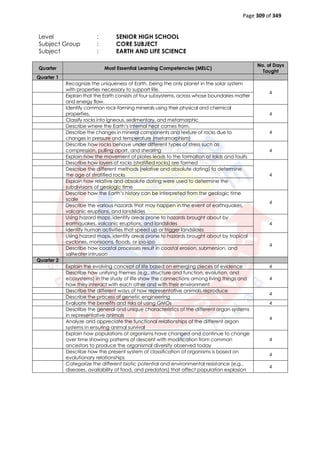
concerns
2
Organizes fitness event for a target health issue or concern 2

SHS CORE SUBJECTS DBOW for science high school

  • 1.
  • 2.
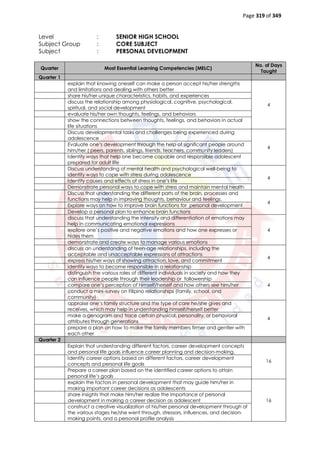
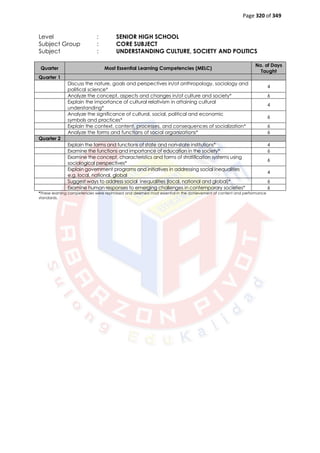
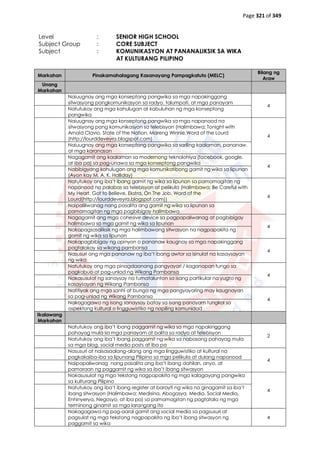
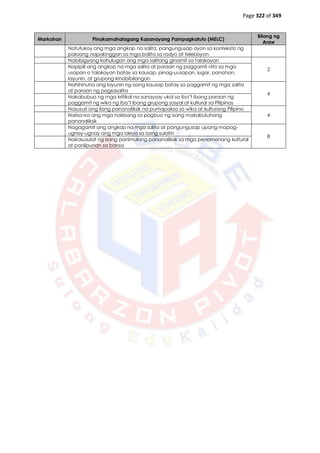
    Page 303 of349 PIVOT 4A BUDGET OF WORK (BOW) FOR SENIOR HIGH SCHOOL – CORE SUBJECTS The PIVOT 4A Budget of Work (BOW) for Senior High School – Core Subjects is a resource material in teaching SHS core subjects that contain and highlight the most essential learning competencies (MELCs) as mapped from the K to 12 Basic Education Curriculum for Senior High School. How to Use this BOW? The PIVOT 4A BOW for SHS – Core Subjects is composed of three (3) columns. The first column is intended for the Quarter; the second one for the Most Essential Learning Competencies (MELC); and the last one for the No. of Days Taught. Quarter (A) Most Essential Learning Competencies (MELC) (B) No. of Days Taught (C) (D) (D) (D) In using the PIVOT 4A BOW for SHS – Core Subjects, it is important to understand the figure above marked by the following specifications: A. Quarter B. Most Essential Learning Competencies (MELC) C. Number of Days Taught D. Most Essential Learning Competencies (MELC). These MELCs which were identified by the Central Office may be of the same variant of the K to 12 LCs. But in some cases, MELCs were produced by rephrasing or merging/fusing some LCs from the K to 12 Curriculum Guide for SHS. Further, teachers should:  look for the grade level they are handling;  check the MELC/s to be taught in a particular quarter and/or semester;  take note that teachers, based from school planning and subject distribution, may teach a particular subject either on first semester or second semester and either on Grade 11 or Grade 12 while considering the subject pre-requisites and co-requisites;  take note that the PIVOT 4A BOW presents the partition of MELCs in each quarter but it does not mean that if this guide notes that Subject A be taught in the first semester, the school cannot offer it on the second semester, i.e. this guide identifies 21st Century Literature from the Philippines and the World as a subject for the first semester; thus the MELCs are divided into Quarters 1 and 2; however, if the school plans to offer this subject in the second semester; then, the MELCs will be consequently adjusted to Quarters 3 and 4 accounting the same distribution of MELCs per quarter;  be guided that all SHS Core Subjects, except for Physical Education and Health, shall be taught for 32 days (4-hour sessions/week times 8 weeks/quarter) in a quarter;
  • 3.
    Page 304 of349  observe that Physical Education and Health shall be taught for eight (8) meetings (1-hour session/week times 8 weeks) per quarter; and  design their lessons on the MELC and/or clustered MELCs using the IDEA instructional delivery process. clmd/jsc
  • 4.
    Page 305 of349 Level : SENIOR HIGH SCHOOL Subject Group : CORE SUBJECT Subject : 21ST CENTURY LITERATURE FROM THE PHILIPPINES AND THE WORLD Quarter Most Essential Learning Competencies (MELC) No. of Days Taught Quarter 1 Writing a close analysis and critical interpretation of literary texts and doing an adaptation of these require from the learner the ability to identify: a. the geographic, linguistic, and ethnic dimensions of Philippine literary history from pre-colonial to the contemporary b. representative texts and authors from each region (e.g. engage in oral history research with focus on key personalities from the students’ region/province/town) 8 Compare and contrast the various 21st century literary genres and the ones from the earlier genres/periods citing their elements, structures and traditions 4 Discuss how different contexts enhance the text’s meaning and enrich the reader’s understanding 4 Produce a creative representation of a literary text by applying multi-media and ICT skills 8 Do self- and/or peer-assessment of the creative adaptation of a literary text, based on rationalized criteria, prior to presentation 8 Quarter 2 Writing a close analysis and critical interpretation of literary texts, applying a reading approach, and doing an adaptation of these, require from the learner the ability to identify: representative texts and authors from Asia, North America, Europe, Latin America, and Africa 12 Compare and contrast the various 21st century literary genres and their elements, structures, and traditions from across the globe 4 Produce a creative representation of a literary text by applying multimedia and ICT skills 8 Do self- and/or peer-assessment of the creative adaptation of a literary text, based on rationalized criteria, prior to presentation 8
  • 5.
    Page 306 of349 Level : SENIOR HIGH SCHOOL Subject Group : CORE SUBJECT Subject : ORAL COMMUNICATION IN CONTEXT Quarter Most Essential Learning Competencies (MELC) No. of Days Taught Quarter 1 Explains the functions, nature and process of communication 4 Differentiates the various models of communication 4 Uses various strategies in order to avoid communication breakdown 4 Examines sample oral communication activities 6 Identifies the various types of speech context. 4 Distinguishes types of speeches and speech style Responds appropriately and effectively to a speech act 10 Employs various communicative strategies in different situations Quarter 2 Explains that a shift in speech context, speech style, speech act and communicative strategy affects the following: Language form Duration of interaction Relationship of speaker Role and responsibilities of the speaker Message Delivery 16 Uses principles of effective speech writing focusing on: Audience profile Logical organization Duration Word choice Grammatical correctness and Articulation Modulation Stage Presence Facial Expressions, Gestures and Movements Rapport with the audience 16
  • 6.
    Page 307 of349 Level : SENIOR HIGH SCHOOL Subject Group : CORE SUBJECT Subject : READING AND WRITING SKILLS Quarter Most Essential Learning Competencies (MELC) No. of Days Taught Quarter 3 Compare and contrast patterns of written texts across disciplines 8 Evaluate a written text based on its properties (organization, coherence and cohesion, language use and mechanics) 8 Identify claims explicitly or implicitly made in a written text a. Claim of fact b. Claim of policy c. Claim of value 16 Quarter 4 Identify the context in which a text was developed a. Hypertext b. Intertext 6 Explain critical reading as reasoning 6 Formulate evaluative statements about a text read: a. assertions about the content and properties of a text read; and b. counterclaims in response to claims made in a text read Determine textual evidence to validate assertions and counterclaims made about a text read Identify the unique features of and requirements in composing texts that are useful across disciplines: a. Book Review or Article Critique b. Literature Review c. Research Report d. Project Proposal e. Position Paper 10 Identify the unique features of and requirements in composing professional correspondence: a. Resume b. Application for College Admission c. Application for Employment d. Various forms of Office Correspondence 10
  • 7.
    Page 308 of349 Level : SENIOR HIGH SCHOOL Subject Group : CORE SUBJECT Subject : DISASTER READINESS AND RISK REDUCTION Quarter Most Essential Learning Competencies (MELC) No. of Days Taught Quarter 1 Explain the meaning of disaster 4 Differentiate the risk factors underlying disasters Describe the effects of disasters on one’s life Identify areas/locations exposed to hazards that may lead to disasters 4 Analyze disaster from the different perspectives (physical, psychological, socio-cultural, economic, political, and biological). Explain the meaning of vulnerability 4 Determine the elements that are exposed to a particular hazard Recognize vulnerabilities of different elements exposed to specific hazards Differentiate among hazards, exposure, and vulnerabilities and give examples from actual situations. 4 Define and cite examples of the types of hazards Explain the impact of various hazards on different exposed elements Identify various potential earthquake hazards 4 Recognize the natural signs of an impending tsunami; Analyze the effects of the different earthquake hazards Interpret different earthquake hazard maps; 6 Explain various volcano-related hazards Recognize signs of an impending volcanic eruption 6 Interpret different volcano hazard maps; Quarter 2 Discuss the different geological hazards 4 Analyze the causes of geological hazards Recognize signs of impending geological hazards; Interpret geological maps 4 Apply mitigation strategies to prevent loss of lives and properties Recognize signs of impending hydrometeorological hazards 4 Interpret different hydrometeorological hazard maps Use available tools for monitoring hydrometeorological hazards Recognize elements of the fire triangle in different situations 4 Analyze the different causes of fires Observe precautionary measures and proper procedures in addressing a fire incident Apply basic response procedures during a fire incident 4 Follow fire emergency and evacuation plans; Discuss the key concepts, principles, and elements of DRR 4 Recognize the importance of DRR on one’s life Discuss different community-based practices for managing disaster risk to specific hazards 4 Develop a community preparedness plan; Prepare survival kits and materials for one’s family and for public information and advocacy 4 Explain DRR-related laws and policies
  • 8.
    Page 309 of349 Level : SENIOR HIGH SCHOOL Subject Group : CORE SUBJECT Subject : EARTH AND LIFE SCIENCE Quarter Most Essential Learning Competencies (MELC) No. of Days Taught Quarter 1 Recognize the uniqueness of Earth, being the only planet in the solar system with properties necessary to support life. 4 Explain that the Earth consists of four subsystems, across whose boundaries matter and energy flow. Identify common rock-forming minerals using their physical and chemical properties. 4 Classify rocks into igneous, sedimentary, and metamorphic Describe where the Earth’s internal heat comes from. 4 Describe the changes in mineral components and texture of rocks due to changes in pressure and temperature (metamorphism) Describe how rocks behave under different types of stress such as compression, pulling apart, and shearing 4 Explain how the movement of plates leads to the formation of folds and faults Describe how layers of rocks (stratified rocks) are formed 4 Describe the different methods (relative and absolute dating) to determine the age of stratified rocks Explain how relative and absolute dating were used to determine the subdivisions of geologic time Describe how the Earth’s history can be interpreted from the geologic time scale 4 Describe the various hazards that may happen in the event of earthquakes, volcanic eruptions, and landslides Using hazard maps, identify areas prone to hazards brought about by earthquakes, volcanic eruptions, and landslides 4 Identify human activities that speed up or trigger landslides Using hazard maps, identify areas prone to hazards brought about by tropical cyclones, monsoons, floods, or ipo-ipo 4 Describe how coastal processes result in coastal erosion, submersion, and saltwater intrusion Quarter 2 Explain the evolving concept of life based on emerging pieces of evidence 4 Describe how unifying themes (e.g., structure and function, evolution, and ecosystems) in the study of life show the connections among living things and how they interact with each other and with their environment 4 Describe the different ways of how representative animals reproduce 4 Describe the process of genetic engineering Evaluate the benefits and risks of using GMOs 4 Describe the general and unique characteristics of the different organ systems in representative animals 4 Analyze and appreciate the functional relationships of the different organ systems in ensuring animal survival Explain how populations of organisms have changed and continue to change over time showing patterns of descent with modification from common ancestors to produce the organismal diversity observed today 4 Describe how the present system of classification of organisms is based on evolutionary relationships 4 Categorize the different biotic potential and environmental resistance (e.g., diseases, availability of food, and predators) that affect population explosion 4
  • 9.
    Page 310 of349 Level : SENIOR HIGH SCHOOL Subject Group : CORE SUBJECT Subject : EARTH SCIENCE Quarter Most Essential Learning Competencies (MELC) No. of Days Taught Quarter 1 Describe the characteristics of Earth that are necessary to support life 4 Explain that the Earth consists of four subsystems, across whose boundaries matter and energy flow 4 Identify common rock-forming minerals using their physical and chemical properties Classify rocks into igneous, sedimentary, and metamorphic 4 Identify the minerals important to society 4 Describe how ore minerals are found, mined, and processed for human use Describe how fossil fuels are formed 4 Explain how heat from inside the Earth (geothermal) and from flowing water (hydroelectric) is tapped as a source of energy for human use 4 Identify the various water resources on Earth Explain how different activities affect the quality and availability of water for human use 4 Identify human activities, such as farming, construction of structures, and waste disposal, that affect the quality and quantity of soil Describe how people generate different types of waste (solid, liquid, and gaseous) as they make use of various materials and resources in everyday life 4 Explain how different types of waste affect people’s health and the environment Quarter 2 Describe how rocks undergo weathering 4 Explain why the Earth’s interior is hot 4 Describe what happens after magma is formed 4 Describe how rocks behave under different types of stress such as compression, pulling apart, and shearing 4 Describe the structure and evolution of ocean basins Describe how layers of rocks (stratified rocks) are formed 4 Describe the different methods (relative and absolute dating) of determining the age of stratified rocks Explain how relative and absolute dating were used to determine the subdivisions of geologic time 4 Describe how index fossils (also known as guide fossils) are used to define and identify subdivisions of the geologic time scale 4 Describe the history of the Earth through geologic time 4
  • 10.
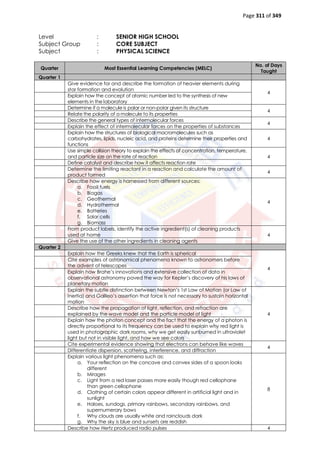
    Page 311 of349 Level : SENIOR HIGH SCHOOL Subject Group : CORE SUBJECT Subject : PHYSICAL SCIENCE Quarter Most Essential Learning Competencies (MELC) No. of Days Taught Quarter 1 Give evidence for and describe the formation of heavier elements during star formation and evolution 4 Explain how the concept of atomic number led to the synthesis of new elements in the laboratory Determine if a molecule is polar or non-polar given its structure 4 Relate the polarity of a molecule to its properties Describe the general types of intermolecular forces 4 Explain the effect of intermolecular forces on the properties of substances Explain how the structures of biological macromolecules such as carbohydrates, lipids, nucleic acid, and proteins determine their properties and functions 4 Use simple collision theory to explain the effects of concentration, temperature, and particle size on the rate of reaction 4 Define catalyst and describe how it affects reaction rate Determine the limiting reactant in a reaction and calculate the amount of product formed 4 Describe how energy is harnessed from different sources: a. Fossil fuels b. Biogas c. Geothermal d. Hydrothermal e. Batteries f. Solar cells g. Biomass 4 From product labels, identify the active ingredient(s) of cleaning products used at home 4 Give the use of the other ingredients in cleaning agents Quarter 2 Explain how the Greeks knew that the Earth is spherical 4 Cite examples of astronomical phenomena known to astronomers before the advent of telescopes Explain how Brahe’s innovations and extensive collection of data in observational astronomy paved the way for Kepler’s discovery of his laws of planetary motion Explain the subtle distinction between Newton’s 1st Law of Motion (or Law of Inertia) and Galileo’s assertion that force is not necessary to sustain horizontal motion 4 Describe how the propagation of light, reflection, and refraction are explained by the wave model and the particle model of light Explain how the photon concept and the fact that the energy of a photon is directly proportional to its frequency can be used to explain why red light is used in photographic dark rooms, why we get easily sunburned in ultraviolet light but not in visible light, and how we see colors Cite experimental evidence showing that electrons can behave like waves 4 Differentiate dispersion, scattering, interference, and diffraction Explain various light phenomena such as: a. Your reflection on the concave and convex sides of a spoon looks different b. Mirages c. Light from a red laser passes more easily though red cellophane than green cellophane d. Clothing of certain colors appear different in artificial light and in sunlight e. Haloes, sundogs, primary rainbows, secondary rainbows, and supernumerary bows f. Why clouds are usually white and rainclouds dark g. Why the sky is blue and sunsets are reddish 8 Describe how Hertz produced radio pulses 4
  • 11.
    Page 312 of349 Quarter Most Essential Learning Competencies (MELC) No. of Days Taught Explain how special relativity resolved the conflict between Newtonian mechanics and Maxwell’s electromagnetic theory Explain the consequences of the postulates of Special Relativity (e.g., relativity of simultaneity, time dilation, length contraction, mass-energy equivalence, and cosmic speed limit) 4 Explain the consequences of the postulates of General Relativity (e.g., correct predictions of shifts in the orbit of Mercury, gravitational bending of light, and black holes) Explain how the speeds and distances of far-off objects are estimated (e.g., doppler effect and cosmic distance ladder) 4 Explain how we know that we live in an expanding universe, which used to be hot and is approximately 14 billion years old
  • 12.
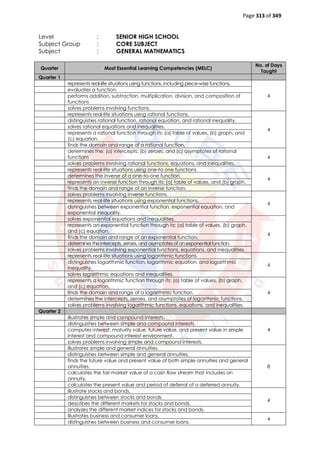
    Page 313 of349 Level : SENIOR HIGH SCHOOL Subject Group : CORE SUBJECT Subject : GENERAL MATHEMATICS Quarter Most Essential Learning Competencies (MELC) No. of Days Taught Quarter 1 represents real-life situations using functions, including piece-wise functions. 4 evaluates a function. performs addition, subtraction, multiplication, division, and composition of functions solves problems involving functions. represents real-life situations using rational functions. 4 distinguishes rational function, rational equation, and rational inequality. solves rational equations and inequalities. represents a rational function through its: (a) table of values, (b) graph, and (c) equation. finds the domain and range of a rational function. determines the: (a) intercepts; (b) zeroes; and (c) asymptotes of rational functions 4 solves problems involving rational functions, equations, and inequalities. represents real-life situations using one-to one functions. 4 determines the inverse of a one-to-one function. represents an inverse function through its: (a) table of values, and (b) graph. finds the domain and range of an inverse function. solves problems involving inverse functions. 4 represents real-life situations using exponential functions. distinguishes between exponential function, exponential equation, and exponential inequality. solves exponential equations and inequalities. 4 represents an exponential function through its: (a) table of values, (b) graph, and (c) equation. finds the domain and range of an exponential function. determinestheintercepts,zeroes,and asymptotesof anexponential function. solves problems involving exponential functions, equations, and inequalities. represents real-life situations using logarithmic functions. 4 distinguishes logarithmic function, logarithmic equation, and logarithmic inequality. solves logarithmic equations and inequalities. represents a logarithmic function through its: (a) table of values, (b) graph, and (c) equation. 4 finds the domain and range of a logarithmic function. determines the intercepts, zeroes, and asymptotes of logarithmic functions. solves problems involving logarithmic functions, equations, and inequalities. Quarter 2 illustrates simple and compound interests. 4 distinguishes between simple and compound interests. computes interest, maturity value, future value, and present value in simple interest and compound interest environment. solves problems involving simple and compound interests. illustrates simple and general annuities. 8 distinguishes between simple and general annuities. finds the future value and present value of both simple annuities and general annuities. calculates the fair market value of a cash flow stream that includes an annuity. calculates the present value and period of deferral of a deferred annuity. illustrate stocks and bonds. 4 distinguishes between stocks and bonds. describes the different markets for stocks and bonds. analyzes the different market indices for stocks and bonds. illustrates business and consumer loans. 4 distinguishes between business and consumer loans.
  • 13.
    Page 314 of349 Quarter Most Essential Learning Competencies (MELC) No. of Days Taught solves problems involving business and consumer loans (amortization, mortgage). illustrates and symbolizes propositions. 4 distinguishes between simple and compound propositions. performs the different types of operations on propositions. determines the truth values of propositions. 4 illustrates the different forms of conditional propositions. illustrates different types of tautologies and fallacies. 4 determines the validity of categorical syllogisms. establishes the validity and falsity of real-life arguments using logical propositions, syllogisms, and fallacies.
  • 14.
    Page 315 of349 Level : SENIOR HIGH SCHOOL Subject Group : CORE SUBJECT Subject : STATISTICS AND PROBABILITY Quarter Most Essential Learning Competencies (MELC) No. of Days Taught Quarter 3 illustrates a random variable (discrete and continuous). 4 distinguishes between a discrete and a continuous random variable. finds the possible values of a random variable. illustrates a probability distribution for a discrete random variable and its properties. computes probabilities corresponding to a given random variable. illustrates the mean and variance of a discrete random variable. calculates the mean and the variance of a discrete random variable. interprets the mean and the variance of a discrete random variable. 4 solves problems involving mean and variance of probability distributions. illustrates a normal random variable and its characteristics. identifies regions under the normal curve corresponding to different standard normal values. 4 converts a normal random variable to a standard normal variable and vice versa. computes probabilities and percentiles using the standard normal table. illustrates random sampling. 4 distinguishes between parameter and statistic. identifies sampling distributions of statistics (sample mean). finds the mean and variance of the sampling distribution of the sample mean. 4 defines the sampling distribution of the sample mean for normal population when the variance is: (a) known; (b) unknown illustrates the Central Limit Theorem. 4 defines the sampling distribution of the sample mean using the Central Limit Theorem. solves problems involving sampling distributions of the sample mean. illustrates the t-distribution. 4 identifies percentiles using the t-table. identifies the length of a confidence interval. 4 computes for the length of the confidence interval. computes for an appropriate sample size using the length of the interval. solves problems involving sample size determination. Quarter 4 illustrates: (a) null hypothesis; (b) alternative hypothesis; (c) level of significance; (d) rejection region; and (e) types of errors in hypothesis testing. 4 identifies the parameter to be tested given a real-life problem. formulates the appropriate null and alternative hypotheses on a population mean. identifies the appropriate form of the test-statistic when: (a) the population variance is assumed to be known; (b) the population variance is assumed to be unknown; and (c) the Central Limit Theorem is to be used. 4 identifies the appropriate rejection region for a given level of significance when: (a) the population variance is assumed to be known; (b) the population variance is assumed to be unknown; and (c) the Central Limit Theorem is to be used. computes for the test-statistic value (population mean). 4 draws conclusion about the population mean based on the test-statistic value and the rejection region. solves problems involving test of hypothesis on the population mean. 4 formulates the appropriate null and alternative hypotheses on a population proportion. identifies the appropriate form of the test-statistic when the Central Limit Theorem is to be used. identifies the appropriate rejection region for a given level of significance when the Central Limit Theorem is to be used. computes for the test-statistic value (population proportion).
  • 15.
    Page 316 of349 Quarter Most Essential Learning Competencies (MELC) No. of Days Taught draws conclusion about the population proportion based on the test-statistic value and the rejection region. solves problems involving test of hypothesis on the population proportion. 4 illustrates the nature of bivariate data. constructs a scatter plot. describes shape (form), trend (direction), and variation (strength) based on a scatter plot. calculates the Pearson’s sample correlation coefficient. 4 solves problems involving correlation analysis. identifies the independent and dependent variables. 4 calculates the slope and y-intercept of the regression line. interprets the calculated slope and y-intercept of the regression line. predicts the value of the dependent variable given the value of the independent variable. 4 solves problems involving regression analysis.
  • 16.
    Page 317 of349 Level : SENIOR HIGH SCHOOL Subject Group : CORE SUBJECT Subject : INTRODUCTION TO PHILOSOPHY OF THE HUMAN PERSON/ PAMBUNGAD SA PILOSOPIYA NG TAO Quarter Most Essential Learning Competencies (MELC) No. of Days Taught Quarter 1 Distinguish a holistic perspective from a partial point of view Nakikilala ang pagkakaiba ng pangkabuuang pananaw mula sa pananaw ng mga bahagi lamang 8 Realize the value of doing philosophy in obtaining a broad perspective on life Nahihinuha na: Mahalaga ang pamimilosopiya upang magkaroon ng malawakang pananaw sa buhay. Do a philosophical reflection on a concrete situation from a holistic perspective Nakapagmumuni-muni sa isang suliranin sa isang pilosopikong paraan at nakagagawa ng pamimiloosopiya sa buhay Distinguish opinion from truth Nakikilala ang pagkakaiba ng katotohanan sa opinyon 8 Realize that the methods of philosophy lead to wisdom and truth Nahihinuha na patungo sa katotohanan ang mga pamamaraan ng pamimilosopiya Evaluate truth from opinions in different situations using the methods of philosophizing Natataya ang katotohanan at opinyon sa iba’t ibang sitwasyon gamit ang pamamaraan ng pamimilosopiya Recognize how the human body imposes limits and possibilities for transcendence Nakikilala na: Binibigyan ako ng hangganan at posibilidad ng aking katawan 8 Evaluate own limitations and the possibilities for their transcendence Natataya ang mga pagkakatakda (hangganan) at pagsasaibayo (posibilidad) ng sarili Notice things that are not in their proper place and organize them in an aesthetic way Napapansin ang mga bagay na wala sa wastong lugar at naisasaayos ito nang ayon sa kagandahan 8 Show that care for the environment contributes to health, well-being and sustainable development Napatutunayan na ang pagkalinga sa kapaligiran ay nakatutulong sa pagkamit ng kalusugan, kagalingan, at likas-kayang kaunlaran Demonstrate the virtues of prudence and frugality towards environments Naipamamalas ang pagiging masinop sa pakikibagay sa kanyang mga kapwa nilalang at sa kapaligiran Quarter 2 Evaluate and exercise prudence in choices Natatasa kung siya ay maingat sa pagpapasya o hindi 8 Realize that: a. Choices have consequences. b. Some things are given up while others are obtained in making choices Nakikilala na: a. May kahihinatnan ang bawat pagpili. b. May binibitawan at may makukuha sa bawat pagpili. Show situations that demonstrate freedom of choice and the consequences of their choices Nakapaglalahad ng mga sitwasyon kung saan naipakikita ang pagpili at kahihinatnan ng mga ito bawat pagpili. Realize that intersubjectivity requires accepting differences and not imposing on others Nakikilala na ang pakikipagkapwa-tao ay ang pagtanggap sa pagkakaiba ng kapwa at hindi pagpataw ng sarili 8
  • 17.
    Page 318 of349 Quarter Most Essential Learning Competencies (MELC) No. of Days Taught Explain that authentic dialogue means accepting others even if they are different from themselves Nakapagpapaliwanag na ang tunay na diyalogo ay ang pagtanggap sa kapwa bilang kapwa kahit na siya ay iba sa akin Performs activities that demonstrate an appreciation for the talents of persons with disabilities and those from the underprivileged sectors of society Nakapagsasagawa ng isang gawain na nagpapamalas ng mga talento ng mga may kapansanan at kapus-palad Recognize how individuals form societies and how individuals are transformed by societies Nakikilala kung paano nahuhubog ng tao ang lipunan at kung paano nahuhubog ng lipunan ang tao 8 Compare different forms of societies and individualities (eg. Agrarian, industrial and virtual) Nakapaghahambing ng iba’t ibang uri ng lipunan (hal. agraryo, industriyal at birtwal) Explain how human relations are transformed by social systems Nakapagpapaliwanang na nagbabago ang mga ugnayan ng tao dahil sa sistema ng lipunan na kinabibilangan niya Enumerate the objectives he/she really wants to achieve and to define the projects he/she really wants to do in his/her life Nakapagtatala ng mga bagay na tunay na gusto niyang gawin (Ano ang gusto niyang maging?) 8 Reflect on the meaning of his/her own life Nakapagsusulat ng pagninilay tungkol sa kahulugan ng kanyang buhay sa konteksto ng tao bilang tumutungo sa kamatayan (Saan hahantong ang lahat ng ito?)
  • 18.
    Page 319 of349 Level : SENIOR HIGH SCHOOL Subject Group : CORE SUBJECT Subject : PERSONAL DEVELOPMENT Quarter Most Essential Learning Competencies (MELC) No. of Days Taught Quarter 1 explain that knowing oneself can make a person accept his/her strengths and limitations and dealing with others better 4 share his/her unique characteristics, habits, and experiences discuss the relationship among physiological, cognitive, psychological, spiritual, and social development evaluate his/her own thoughts, feelings, and behaviors show the connections between thoughts, feelings, and behaviors in actual life situations Discuss developmental tasks and challenges being experienced during adolescence 4 Evaluate one’s development through the help of significant people around him/her ( peers, parents, siblings, friends, teachers, community leaders) Identify ways that help one become capable and responsible adolescent prepared for adult life Discuss understanding of mental health and psychological well-being to identify ways to cope with stress during adolescence 4 Identify causes and effects of stress in one’s life Demonstrate personal ways to cope with stress and maintain mental health Discuss that understanding the different parts of the brain, processes and functions may help in improving thoughts, behaviour and feelings. 4 Explore ways on how to improve brain functions for personal development Develop a personal plan to enhance brain functions discuss that understanding the intensity and differentiation of emotions may help in communicating emotional expressions 4 explore one’s positive and negative emotions and how one expresses or hides them demonstrate and create ways to manage various emotions discuss an understanding of teen-age relationships, including the acceptable and unacceptable expressions of attractions 4 express his/her ways of showing attraction, love, and commitment identify ways to become responsible in a relationship distinguish the various roles of different individuals in society and how they can influence people through their leadership or followership 4 compare one’s perception of himself/herself and how others see him/her conduct a mini-survey on Filipino relationships (family, school, and community) appraise one’s family structure and the type of care he/she gives and receives, which may help in understanding himself/herself better 4 make a genogram and trace certain physical, personality, or behavioral attributes through generations prepare a plan on how to make the family members firmer and gentler with each other Quarter 2 Explain that understanding different factors, career development concepts and personal life goals influence career planning and decision-making. 16 Identify career options based on different factors, career development concepts and personal life goals Prepare a career plan based on the identified career options to attain personal life’s goals explain the factors in personal development that may guide him/her in making important career decisions as adolescents 16 share insights that make him/her realize the importance of personal development in making a career decision as adolescent construct a creative visualization of his/her personal development through of the various stages he/she went through, stressors, influences, and decision- making points, and a personal profile analysis
  • 19.
    Page 320 of349 Level : SENIOR HIGH SCHOOL Subject Group : CORE SUBJECT Subject : UNDERSTANDING CULTURE, SOCIETY AND POLITICS Quarter Most Essential Learning Competencies (MELC) No. of Days Taught Quarter 1 Discuss the nature, goals and perspectives in/of anthropology, sociology and political science* 4 Analyze the concept, aspects and changes in/of culture and society* 6 Explain the importance of cultural relativism in attaining cultural understanding* 4 Analyze the significance of cultural, social, political and economic symbols and practices* 6 Explain the context, content, processes, and consequences of socialization* 6 Analyze the forms and functions of social organizations* 6 Quarter 2 Explain the forms and functions of state and non-state institutions* 4 Examine the functions and importance of education in the society* 6 Examine the concept, characteristics and forms of stratification systems using sociological perspectives* 6 Explain government programs and initiatives in addressing social inequalities e.g. local, national, global 4 Suggest ways to address social inequalities (local, national and global)* 6 Examine human responses to emerging challenges in contemporary societies* 6 *These learning competencies were rephrased and deemed most essential in the achievement of content and performance standards.
  • 20.
    Page 321 of349 Level : SENIOR HIGH SCHOOL Subject Group : CORE SUBJECT Subject : KOMUNIKASYON AT PANANALIKSIK SA WIKA AT KULTURANG PILIPINO Markahan Pinakamahalagang Kasanayang Pampagkatuto (MELC) Bilang ng Araw Unang Markahan Naiuugnay ang mga konseptong pangwika sa mga napakinggang sitwasyong pangkomunikasyon sa radyo, talumpati, at mga panayam 4 Natutukoy ang mga kahulugan at kabuluhan ng mga konseptong pangwika Naiuugnay ang mga konseptong pangwika sa mga napanood na sitwasyong pang komunikasyon sa telebisyon (Halimbawa: Tonight with Arnold Clavio, State of the Nation, Mareng Winnie,Word of the Lourd (http://lourddeveyra.blogspot.com) 4 Naiuugnay ang mga konseptong pangwika sa sariling kaalaman, pananaw, at mga karanasan Nagagamit ang kaalaman sa modernong teknolohiya (facebook, google, at iba pa) sa pag-unawa sa mga konseptong pangwika 4 Nabibigyang kahulugan ang mga komunikatibong gamit ng wika sa lipunan (Ayon kay M. A. K. Halliday) Natutukoy ang iba’t ibang gamit ng wika sa lipunan sa pamamagitan ng napanood na palabas sa telebisyon at pelikula (Halimbawa: Be Careful with My Heart, Got to Believe, Ekstra, On The Job, Word of the Lourd(http://lourddeveyra.blogspot.com)) 4 Naipaliliwanag nang pasalita ang gamit ng wika sa lipunan sa pamamagitan ng mga pagbibigay halimbawa Nagagamit ang mga cohesive device sa pagpapaliwanag at pagbibigay halimbawa sa mga gamit ng wika sa lipunan 4 Nakapagsasaliksik ng mga halimbawang sitwasyon na nagpapakita ng gamit ng wika sa lipunan Nakapagbibigay ng opinyon o pananaw kaugnay sa mga napakinggang pagtalakay sa wikang pambansa 4 Nasusuri ang mga pananaw ng iba’t ibang awtor sa isinulat na kasaysayan ng wika Natutukoy ang mga pinagdaanang pangyayari / kaganapan tungo sa pagkabuo at pag-unlad ng Wikang Pambansa 4 Nakasusulat ng sanaysay na tumatalunton sa isang partikular na yugto ng kasaysayan ng Wikang Pambansa Natitiyak ang mga sanhi at bunga ng mga pangyayaring may kaugnayan sa pag-unlad ng Wikang Pambansa 4 Nakagagawa ng isang sanaysay batay sa isang panayam tungkol sa aspektong kultural o lingguwistiko ng napiling komunidad Ikalawang Markahan Natutukoy ang iba’t ibang paggamit ng wika sa mga napakinggang pahayag mula sa mga panayam at balita sa radyo at telebisyon 2 Natutukoy ang iba’t ibang paggamit ng wika sa nabasang pahayag mula sa mga blog, social media posts at iba pa Nasusuri at naisasaalang-alang ang mga lingguwistiko at kultural na pagkakaiba-iba sa lipunang Pilipino sa mga pelikula at dulang napanood 4 Naipapaliwanag nang pasalita ang iba’t ibang dahilan, anyo, at pamaraan ng paggamit ng wika sa iba’t ibang sitwasyon Nakasusulat ng mga tekstong nagpapakita ng mga kalagayang pangwika sa kulturang Pilipino 4 Natutukoy ang iba’t ibang register at barayti ng wika na ginagamit sa iba’t ibang sitwasyon (Halimbawa: Medisina, Abogasya, Media, Social Media, Enhinyerya, Negosyo, at iba pa) sa pamamagitan ng pagtatala ng mga terminong ginamit sa mga larangang ito Nakagagawa ng pag-aaral gamit ang social media sa pagsusuri at pagsulat ng mga tekstong nagpapakita ng iba’t ibang sitwasyon ng paggamit sa wika 4
  • 21.
    Page 322 of349 Markahan Pinakamahalagang Kasanayang Pampagkatuto (MELC) Bilang ng Araw Natutukoy ang mga angkop na salita, pangungusap ayon sa konteksto ng paksang napakinggan sa mga balita sa radyo at telebisyon Nabibigyang kahulugan ang mga salitang ginamit sa talakayan 2 Napipili ang angkop na mga salita at paraan ng paggamit nito sa mga usapan o talakayan batay sa kausap, pinag-uusapan, lugar, panahon, layunin, at grupong kinabibilangan Nahihinuha ang layunin ng isang kausap batay sa paggamit ng mga salita at paraan ng pagsasalita 4 Nakabubuo ng mga kritikal na sanaysay ukol sa iba’t ibang paraan ng paggamit ng wika ng iba’t ibang grupong sosyal at kultural sa Pilipinas Nasusuri ang ilang pananaliksik na pumapaksa sa wika at kulturang Pilipino 4 Naiisa-isa ang mga hakbang sa pagbuo ng isang makabuluhang pananaliksik Nagagamit ang angkop na mga salita at pangungusap upang mapag- ugnay-ugnay ang mga ideya sa isang sulatin 8 Nakasusulat ng isang panimulang pananaliksik sa mga penomenang kultural at panlipunan sa bansa
  • 22.
    Page 323 of349 Level : SENIOR HIGH SCHOOL Subject Group : CORE SUBJECT Subject : PAGBASA AT PAGSUSURI NG IBA’T IBANG TEKSTO TUNGO SA PANANALIKSIK Markahan Pinakamahalagang Kasanayang Pampagkatuto (MELC) Bilang ng Araw Ikatlong Markahan Natutukoy ang paksang tinalakay sa iba’t ibang tekstong binasa 4 Natutukoy ang kahulugan at katangian ng mahahalagang salitang ginamit ng iba’t ibang uri ng tekstong binasa Naibabahagi ang katangian at kalikasan ng iba’t ibang tekstong binasa 4 Nakasusulat ng ilang halimbawa ng iba’t ibang uri ng teksto Nagagamit ang cohesive device sa pagsulat ng sariling halimbawang teksto 4 Nakakukuha ng angkop na datos upang mapaunlad ang sariling tekstong isinulat Naiuugnay ang mga kaisipang nakapaloob sa binasang teksto sa sarili, pamilya, komunidad, bansa, at daigdig 4 Naipaliliwanag ang mga kaisipang nakapaloob sa tekstong binasa 4 Nagagamit ang mabisang paraan ng pagpapahayag: a. Kalinawan b. Kaugnayan c. Bisa Sa reaksyong papel na isinulat 4 Nakasusulat ng mga reaksyong papel batay sa binasang teksto ayon sa katangian at kabuluhan nito sa: a. pamilya b. komunidad c. bansa d. daigdig 8 Ikaapat na Markahan Nasusuri ang ilang halimbawang pananaliksik sa Filipino batay sa layunin, gamit, metodo, at etika sa pananaliksik 4 Nabibigyang kahulugan ang mga konseptong kaugnay ng pananaliksik (Halimbawa: balangkas konseptwal, balangkas teoretikal, datos empirikal, atbp.) 4 Naiisa-isa ang mga paraan at tamang proseso ng pagsulat ng isang pananaliksik sa Filipino batay sa layunin, gamit, metodo, at etika ng pananaliksik 4 Nagagamit ang mga katwirang lohikal at ugnayan ng mga ideya sa pagsulat ng isang pananaliksik 4 Nakabubuo ng isang maikling pananaliksik na napapanahon ang paksa 16
  • 23.
    Page 324 of349 Level : SENIOR HIGH SCHOOL Subject Group : CORE SUBJECT Subject : MEDIA AND INFORMATION LITERACY Quarter Most Essential Learning Competencies (MELC) No. of Days Taught Quarter 3 Describe how communication is influenced by media and information 4 Identify the similarities and differences between and among media literacy, information literacy, and technology literacy Discuss responsible use of media and information Explain how the evolution of media from traditional to new media shaped the values and norms of people and society 4 Compare and contrast how one particular issue or news is presented through the different types of media (print, broadcast, online) 4 Contrast indigenous media to the more common sources of information such as library, internet, etc. 4 Present an issue in varied ways to disseminate information using the codes, convention, and language of media 4 Cite practical situation when to apply knowledge in intellectual property, copy right, and fair use guidelines 4 Create a campaign add to combat digital divide, addiction, and bullying 8 Quarter 4 Cite an example of an issue showing the power of media and information to affect change 4 Describe the impact of massive open on-line Discuss the implication of media and information to an individual and the society 4 Describe the different dimensions of:  text information and media  visual information and media  audio information and media  motion information and media  manipulative information and media  multimedia information and media 8 Analyze how the different dimensions are formally and informally produced, organized, and disseminated 4 Evaluate a creative multimedia form (living museum, electronic portfolio, others) 4 Produce a creative text-based, visual-based, audio-based, motion-based, and manipulative-based presentation using design principle and elements 8
  • 24.
    Page 325 of349 Level : SENIOR HIGH SCHOOL Subject Group : CORE SUBJECT Subject : CONTEMPORARY PHILIPPINE ARTS FROM THE REGIONS Quarter Most Essential Learning Competencies (MELC) No. of Days Taught Quarter 1 Researches on various contemporary art forms, techniques and performance practices 8 Describes various contemporary art forms and their practices from the various regions 4 Explains Filipino artists’ roles and identify their contribution to contemporary arts 4 Analyzes contemporary art forms based on the elements and principles 4 Relates the significance of arts forms from the regions 4 Critiques available local materials and appropriate techniques used in creating art 4 Explicates the use of available materials and the application of techniques 4 Quarter 2 Conceptualizes contemporary art based on techniques and performance practices in their locality. 8 Applies artistic skills and techniques in the process of creation 16 Creates the intended final product using appropriate materials for the best possible output Incorporates contemporary characteristics to one’s creation with attention to detail 4 Promotes arts from the regions 4
  • 25.
    Page 326 of349 Level : SENIOR HIGH SCHOOL Subject Group : CORE SUBJECT Subject : PHYSICAL EDUCATION AND HEALTH (GRADE 11) Quarter Most Essential Learning Competencies (MELC) No. of Days Taught Quarter 1 Self-assesses health-related fitness (HRF). status, barriers to physical activity assessment participation and one’s diet 4 Sets Frequency Intensity Time Type (FITT) goals based on training principles to achieve and/or maintain health-related fitness (HRF). Engages in moderate to vigorous physical activities (MVPAs) for at least 60 minutes most days of the week in a variety of settings in- and out-of-school Analyzes physiological indicators such as heart rate, rate of perceived exertion and pacing associated with MVPAs to monitor and/or adjust participation or effort. 4 Observes personal safety protocol to avoid dehydration, overexertion, hypo- and hyperthermia during MVPA participation Quarter 2 Demonstrates proper etiquette and safety in the use of facilities and equipment 2 Participates in an organized event that addresses health/fitness issues and concerns 2 Recognizes the value of optimizing one’s health through participation in physical activity assessments 2 Organizes fitness event for a target health issue or concern 2 Second Semester Quarter 3 Describes the role of physical activity assessments in managing one’s stress 2 Self-assesses health-related fitness (HRF) status, barriers to physical activity assessment participation and one’s diet 2 Sets FITT goals based on training principles to achieve and/or maintain HRF. 2 Engages in moderate to vigorous physical activities (MVPAs) for at least 60 minutes most days of the week in a variety of settings in- and out-of school 2 Quarter 4 Observes personal safety protocol to avoid dehydration, overexertion, hypo- and hyperthermia during MVPA participation 2 Participates in an organized event that addresses health/fitness issues and concerns 3 Organizes sports event for a target health issue or concern 3
  • 26.
    Page 327 of349 Level : SENIOR HIGH SCHOOL Subject Group : CORE SUBJECT Subject : PHYSICAL EDUCATION AND HEALTH (GRADE 12) Quarter Most Essential Learning Competencies (MELC) No. of Days Taught Quarter 1 Self-assesses health-related fitness (HRF). status, barriers to physical activity assessment participation and one’s diet 2 Sets FITT goals based on training principles to achieve and/or maintain HRF 2 Engages in moderate to vigorous physical activities (MVPAs) for at least 60 minutes most days of the week in a variety of settings in- and out-of-school 2 Analyzes physiological indicators such as heart rate, rate of perceived exertion and pacing associated with MVPAs to monitor and/or adjust participation or effort 2 Quarter 2 Observes personal safety protocol to avoid dehydration, overexertion, hypo- and hyperthermia during MVPA participation 2 Demonstrates proper etiquette and safety in the use of facilities and equipment 2 Participates in an organized event that addresses health/fitness issues and concerns 2 Organizes fitness event for a target health issue or concern 2 Second Semester Quarter 3 Self-assesses health-related fitness (HRF) status, barriers to physical activity assessment participation and one’s diet 2 Sets FITT goals based on training principles to achieve and/or maintain HRF 2 Engages in moderate to vigorous physical activities (MVPAs) for at least 60 minutes most days of the week in a variety of settings in- and out-of-school 2 Analyzes physiological indicators such as heart rate, rate of perceived exertion and pacing associated with MVPAs to monitor and/or adjust participation or effort 2 Quarter 4 Observes personal safety protocol to avoid dehydration, overexertion, hypo- and hyperthermia during MVPA participation 2 Demonstrates proper etiquette and safety in the use of facilities and equipment 2 Participates in an organized event that addresses health/fitness issues and concerns 2 Organizes fitness event for a target health issue or concern 2