Page 97 of
349
Republic of the Philippines
Department of Education
CABANTIAN NATIONAL HIGH SCHOOL
Country Homes, Cabantian Davao City
PIVOT 4A BUDGET OF WORK (BOW) IN ENGLISH
A. Features/Elements
The PIVOT4ABudget of Work (BOW) in English is a resource material in teaching English that
contains and highlights the most essential learning competencies (MELCs) and the learning
competencies serving as enabling competencies in achieving the former as mapped from the K to 12
Basic Education Curriculum for Grades 1 to 10.
The K to 12 English Curriculum features domain-based learning competencies. The number of
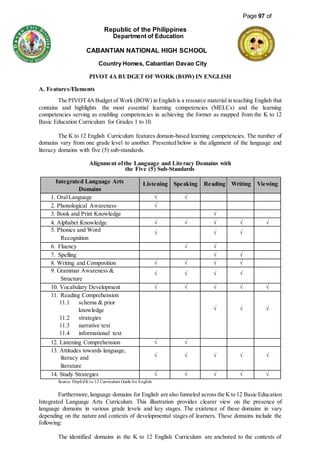
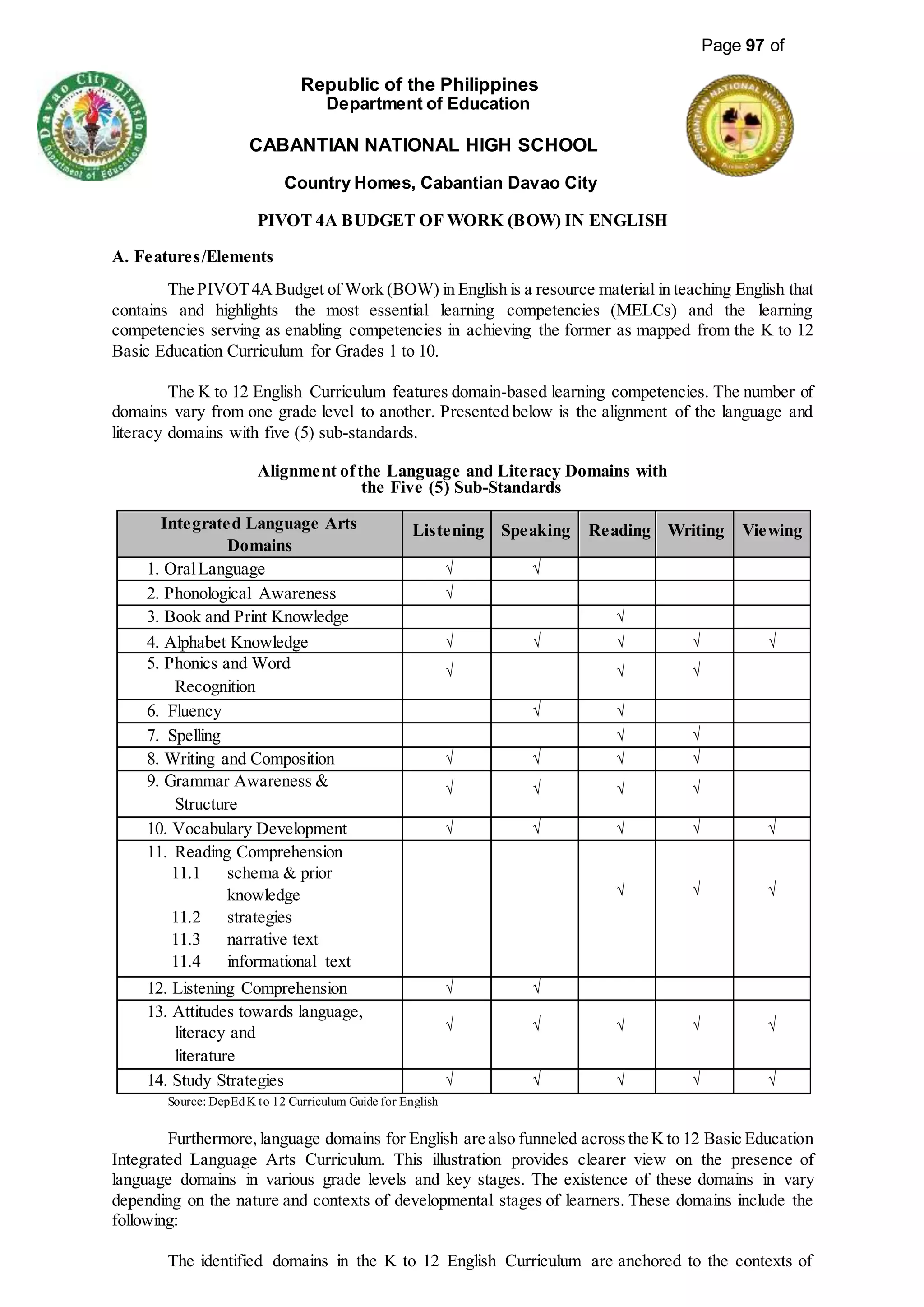
domains vary from one grade level to another. Presented below is the alignment of the language and
literacy domains with five (5) sub-standards.
Alignment ofthe Language and Literacy Domains with
the Five (5) Sub-Standards
Integrated Language Arts
Domains
Listening Speaking Reading Writing Viewing
1. OralLanguage √ √
2. Phonological Awareness √
3. Book and Print Knowledge √
4. Alphabet Knowledge √ √ √ √ √
5. Phonics and Word
Recognition
√ √ √
6. Fluency √ √
7. Spelling √ √
8. Writing and Composition √ √ √ √
9. Grammar Awareness &
Structure
√ √ √ √
10. Vocabulary Development √ √ √ √ √
11. Reading Comprehension
11.1 schema & prior
knowledge
11.2 strategies
11.3 narrative text
11.4 informational text
√ √ √
12. Listening Comprehension √ √
13. Attitudes towards language,
literacy and
literature
√ √ √ √ √
14. Study Strategies √ √ √ √ √
Source: DepEdK to 12 Curriculum Guide for English
Furthermore, language domains for English are also funneled across the Kto 12 Basic Education
Integrated Language Arts Curriculum. This illustration provides clearer view on the presence of
language domains in various grade levels and key stages. The existence of these domains in vary
depending on the nature and contexts of developmental stages of learners. These domains include the
following:
The identified domains in the K to 12 English Curriculum are anchored to the contexts of
Page 98 of
349
communicative language teaching (CLT) which is generally regarded as an approach to language
teaching (Richards and Rodgers, 2001 as cited in Richards,
Page 99 of
349
2006). CLTreflects a certain model or language paradigm, or a theory (Celce-Murcia, 2008). It is based
on the theory thatthe primary function of language use is communication. Itsprimary goal is forlearners
to develop communicative competence (Hymes, 1971 as cited in Celce-Murcia, 2008), or simply put,
communicative ability. In other words, its goal is to make use of real-life situations that necessitate
communication.
Such notion of CLT encompasses a wide range of abilities. These abilities or competences
include linguistic competence, sociocultural competence, discourse competence and strategic
competence. These four features of CLT require appropriate knowledge which will be helpful in
understanding the target concepts for the appropriate use of the target language in various situations.
Basically, the aforementioned abilities are described asfollows: the knowledge of grammar and
vocabulary (linguistic competence); the ability to say the appropriate thing in a certain social situation
(sociocultural competence); the ability to start, enter, contribute to, and end a conversation, and the
ability to do this in a consistent and coherent manner (discourse competence); and the ability to
communicate effectively and repair problems caused by communication breakdowns (strategic
competence). These CLT components are further subdivided in the different domains of language
learning in the Philippine context.
B. Howto Use this BOW?
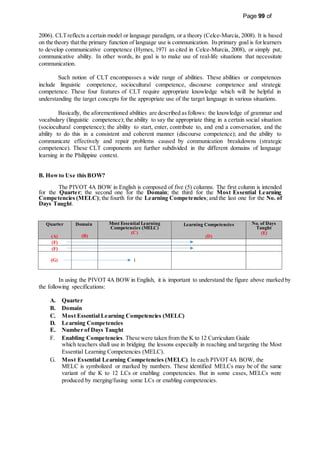
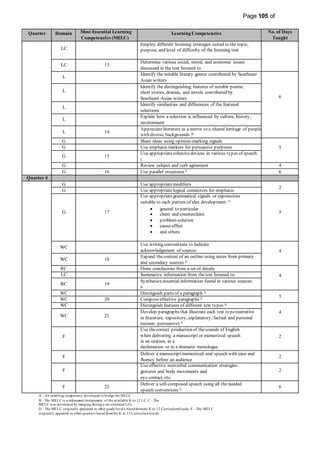
The PIVOT 4A BOW in English is composed of five (5) columns. The first column is intended
for the Quarter; the second one for the Domain; the third for the Most Essential Learning
Competencies (MELC); the fourth for the Learning Competencies; and the last one for the No. of
Days Taught.
In using the PIVOT 4A BOW in English, it is important to understand the figure above marked by
the following specifications:
A. Quarter
B. Domain
C. Most Essential Learning Competencies (MELC)
D. Learning Competencies
E. Number of Days Taught
F. Enabling Competencies. These were taken from the K to 12 Curriculum Guide
which teachers shall use in bridging the lessons especially in reaching and targeting the Most
Essential Learning Competencies (MELC).
G. Most Essential Learning Competencies (MELC). In each PIVOT 4A BOW, the
MELC is symbolized or marked by numbers. These identified MELCs may be of the same
variant of the K to 12 LCs or enabling competencies. But in some cases, MELCs were
produced by merging/fusing some LCs or enabling competencies.
Quarter Domain
(A)
(F)
(F)
(G)
(B)
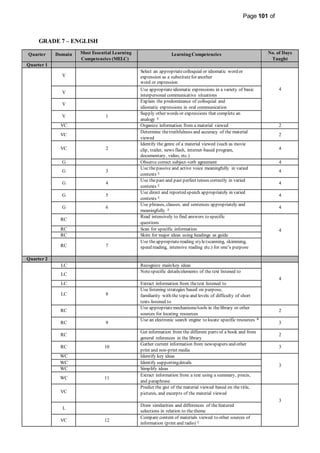
Most Essential Learning
Competencies (MELC)
(C)
Learning Competencies
(D)
No. of Days
Taught
(E)
Page 100 of
349
Further, teachers should:
 Look for the grade level they are handling.
 Check the MELC/s and/or LC/s to be taught in a particular quarter and domain.
 Be guided that the MELCs in each quarter and grade level are marked with numbers, i.e. No. 1
is the first MELC in each grade level.
 Take note that the first MELC/LC or set of LCs in the BOW becomes the first lesson to be
taught in a quarter.
 Remember that the learning competency that appears before the MELC serves as the enabling
competency that has to be taught before the MELC to carefully establish learners’ knowledge,
skills and attitude/values based from the curricular demand.
 Design their lessons using the MELC and/or clustered LCs and the identified enabling
competencies using the IDEA instructional delivery process.
 Observe the appropriate domains where MELCsand/orLCsare partof. Lessons in teaching such
MELCs and/or LCs should reflect the indicated domains. If the said MELCs or LCs fall under
Reading Comprehension or RC, lessons to be prepared should reflect the contexts of reading
comprehension. However, teachers may also add activities reflecting under domains or macro
skills but with central focus on the actual domains specified in the PIVOT 4A BOW.
 Observe and consume the allotted number of days for a particular MELC or set of LCs. Lessons
in English for Grades 1-6 are designed for 40 meetings/sessions in a quarter while 36
meetings/sessions are allocated for lessons for Grades 7-
10 considering the one day of weekly lesson is allocated for independent/cooperative learning
(ICL) as per DepEd Order No. 21, s 2019.
The MELCsfor English are identified by the CentralOffice.Such MELCsare further enhanced
by providing enabling competencies taken from the CGitself. The identified enabling competencies are
presented either individually or in group depending on the nature of the MELC.
With the inclusion of MELCs developed by the Central Office, the K to 12 LCs are mapped
and restructured in the PIVOT 4A BOW. The adjustments are explained by the following legends:
A An enabling competency developed to bridge the MELC
B The MELC is a refinement/restatement of the available K to 12 LC. C The
MELC was developed by merging/fusing a set of relatedLCs.
D The MELC originally appeared in other grade level/s based from the K to 12
Curriculum Guide.
E The MELC originally appeared in other quarter/sbased from the Kto 12
Curriculum Guide.
clmd/jsc
Page 101 of
349
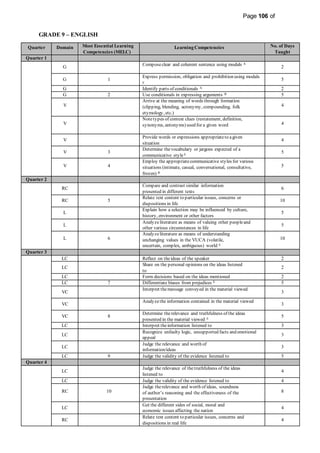
GRADE 7 – ENGLISH
Quarter Domain Most Essential Learning
Competencies (MELC)
Learning Competencies No. of Days
Taught
Quarter 1
V
Select an appropriatecolloquial or idiomatic word or
expression as a substitutefor another
word or expression
4
V
Use appropriateidiomatic expressions in a variety of basic
interpersonal communicative situations
V
Explain the predominance of colloquial and
idiomatic expressions in oral communication
V 1
Supply other words or expressions that complete an
analogy E
VC Organize information from a material viewed 2
VC
Determine thetruthfulness and accuracy of the material
viewed
2
VC 2
Identify the genre of a material viewed (such as movie
clip, trailer, news flash, internet-based program,
documentary, video, etc.)
4
G Observe correct subject-verb agreement 4
G 3
Use thepassive and active voice meaningfully in varied
contexts E
4
G 4
Use thepast and past perfect tenses correctly in varied
contexts E
4
G 5
Use direct and reported speech appropriately in varied
contexts E
4
G 6
Use phrases, clauses, and sentences appropriately and
meaningfully E
4
RC
Read intensively to find answers to specific
questions
4
RC Scan for specific information
RC Skim for major ideas using headings as guide
RC 7
Use theappropriatereading style(scanning, skimming,
speed reading, intensive reading etc.) for one’s purpose
Quarter 2
LC Recognize main/key ideas
4
LC
Notespecific details/elements of the text listened to
LC Extract information from thetext listened to
LC 8
Use listening strategies based on purpose,
familiarity with the topicand levels of difficulty of short
texts listened to
RC
Use appropriatemechanisms/tools in thelibrary or other
sources for locating resources
2
RC 9
Use an electronic search engine to locate specific resources B
3
RC
Get information from the different parts of a book and from
general references in the library
2
RC 10
Gather current information from newspapers and other
print and non-print media
3
WC Identify key ideas
3
WC Identify supportingdetails
WC Simplify ideas
WC 11
Extract information from a text using a summary, precis,
and paraphrase
VC
Predict the gist of the material viewed based on the title,
pictures, and excerpts of the material viewed
3
L
Draw similarities and differences of thefeatured
selections in relation to the theme
VC 12
Compare content of materials viewed to other sources of
information (print and radio) E
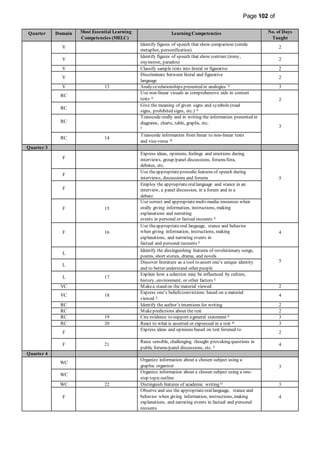
Page 102 of
349
Quarter Domain Most Essential Learning
Competencies (MELC)
Learning Competencies No. of Days
Taught
V
Identify figures of speech that show comparison (simile
metaphor, personification)
2
V
Identify figures of speech that show contrast (irony,
oxymoron, paradox)
2
V Classify sample texts into literal or figurative 2
V
Discriminate between literal and figurative
language
2
V 13 Analyzerelationships presented in analogies E 3
RC
Use non-linear visuals as comprehensive aids in content
texts A
2
RC
Give the meaning of given signs and symbols (road
signs, prohibited signs, etc.) A
RC
Transcode orally and in writing the information presented in
diagrams, charts, table, graphs, etc.
A 3
RC 14
Transcode information from linear to non-linear texts
and vice-versa D
Quarter 3
F
Express ideas, opinions, feelings and emotions during
interviews, group/panel discussions, forums/fora,
debates, etc.
5
F
Use theappropriateprosodicfeatures of speech during
interviews, discussions and forums
F
Employ the appropriateorallanguage and stance in an
interview, a panel discussion, in a forum and in a
debate
F 15
Use correct and appropriatemulti-media resources when
orally giving information, instructions, making
explanations and narrating
events in personal or factual recounts E
F 16
Use theappropriateoral language, stance and behavior
when giving information, instructions, making
explanations, and narrating events in
factual and personal recounts E
4
L
Identify the distinguishing features of revolutionary songs,
poems, short stories, drama, and novels
5
L
Discover literature as a tool to assert one’s unique identity
and to better understand other people
L 17
Explain how a selection may be influenced by culture,
history, environment, or other factors E
VC Makea stand on the material viewed 2
VC 18
Express one’s beliefs/convictions based on a material
viewed E
4
RC Identify the author’s intentions for writing 2
RC Makepredictions about the text 2
RC 19 Cite evidence to support ageneral statement E 3
RC 20 React to what is asserted or expressed in a text B 3
F
Express ideas and opinions based on text listened to
2
F 21
Raise sensible, challenging thought provoking questions in
public forums/panel discussions, etc. E
4
Quarter 4
WC
Organize information about a chosen subject using a
graphic organizer 3
WC
Organize information about a chosen subject using a one-
step topicoutline
WC 22 Distinguish features of academic writing D 3
F
Observe and use the appropriateorallanguage, stance and
behavior when giving information, instructions, making
explanations, and narrating events in factual and personal
recounts
4
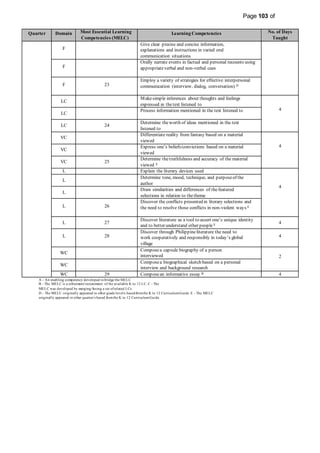
Page 103 of
349
Quarter Domain Most Essential Learning
Competencies (MELC)
Learning Competencies No. of Days
Taught
F
Give clear precise and concise information,
explanations and instructions in varied oral
communication situations
F
Orally narrate events in factual and personal recounts using
appropriateverbal and non-verbal cues
F 23
Employ a variety of strategies for effective interpersonal
communication (interview, dialog, conversation) D
LC
Makesimple inferences about thoughts and feelings
expressed in thetext listened to
4
LC
Process information mentioned in the text listened to
LC 24
Determine theworth of ideas mentioned in the text
listened to
VC
Differentiate reality from fantasy based on a material
viewed
4
VC
Express one’s beliefs/convictions based on a material
viewed
VC 25
Determine thetruthfulness and accuracy of the material
viewed E
L Explain the literary devices used
4
L
Determine tone, mood, technique, and purposeof the
author
L
Draw similarities and differences of thefeatured
selections in relation to thetheme
L 26
Discover the conflicts presented in literary selections and
the need to resolve those conflicts in non-violent ways E
L 27
Discover literature as a tool to assert one’s unique identity
and to better understand other people E
4
L 28
Discover through Philippineliterature the need to
work cooperatively and responsibly in today’s global
village
4
WC
Composea capsule biography of a person
interviewed 2
WC
Composea biographical sketch based on a personal
interview and background research
WC 29 Composean informative essay B 4
A - An enabling competency developed to bridge the MELC
B - The MELC is a refinement/restatement of the available K to 12 LC. C - The
MELC was developed by merging/fusing a set ofrelated LCs.
D - The MELC originally appeared in other grade level/s based fromthe K to 12 CurriculumGuide. E - The MELC
originally appeared in other quarter/s based fromthe K to 12 CurriculumGuide.
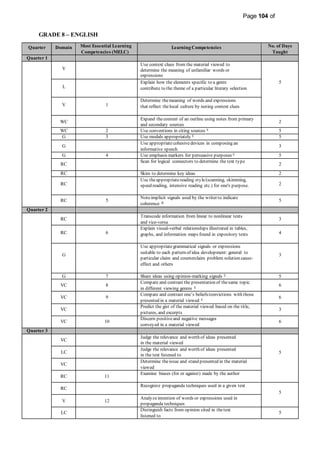
Page 104 of
349
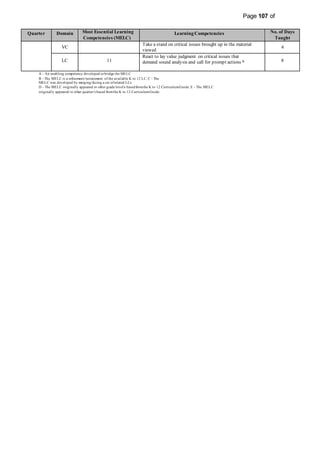
GRADE 8 – ENGLISH
Quarter Domain Most Essential Learning
Competencies (MELC)
Learning Competencies No. of Days
Taught
Quarter 1
V
Use context clues from the material viewed to
determine the meaning of unfamiliar words or
expressions
5
L
Explain how the elements specific to a genre
contribute to the theme of a particular literary selection
V 1
Determine themeaning of words and expressions
that reflect thelocal culture by noting context clues
WC
Expand thecontent of an outline using notes from primary
and secondary sources
2
WC 2 Use conventions in citing sources E 5
G 3 Use modals appropriately E 5
G
Use appropriatecohesivedevices in composing an
informative speech
3
G 4 Use emphasis markers for persuasive purposes E 5
RC
Scan for logical connectors to determine the text type
2
RC Skim to determine key ideas 2
RC
Use theappropriatereading style(scanning, skimming,
speed reading, intensive reading etc.) for one's purpose. 2
RC 5
Noteimplicit signals used by the writer to indicate
coherence B
5
Quarter 2
RC
Transcode information from linear to nonlinear texts
and vice-versa
3
RC 6
Explain visual-verbal relationships illustrated in tables,
graphs, and information maps found in expository texts 4
G
Use appropriategrammatical signals or expressions
suitable to each pattern of idea development: general to
particular claim and counterclaim problem solution cause-
effect and others
3
G 7 Share ideas using opinion-marking signals E 5
VC 8
Compare and contrast the presentation of thesame topic
in different viewing genres E
6
VC 9
Compare and contrast one’s beliefs/convictions with those
presented in a material viewed E
6
VC
Predict the gist of the material viewed based on the title,
pictures, and excerpts
3
VC 10
Discern positiveand negative messages
conveyed in a material viewed
6
Quarter 3
VC
Judge the relevance and worth of ideas presented
in the material viewed
5
LC
Judge the relevance and worth of ideas presented
in the text listened to
VC
Determine theissue and stand presented in the material
viewed
RC 11
Examine biases (for or against) made by the author
RC
Recognize propaganda techniques used in a given text
5
V 12
Analyzeintention of words or expressions used in
propaganda techniques
LC
Distinguish facts from opinion cited in thetext
listened to
5
Page 105 of
349
Quarter Domain Most Essential Learning
Competencies (MELC)
Learning Competencies No. of Days
Taught
LC
Employ different listening strategies suited to the topic,
purpose, and level of difficulty of the listening text
LC 13
Determine various social, moral, and economic issues
discussed in the text listened to
L
Identify the notable literary genres contributed by Southeast
Asian writers
6
L
Identify the distinguishing features of notable poems,
short stories, dramas, and novels contributed by
Southeast Asian writers
L
Identify similarities and differences of the featured
selections
L
Explain how a selection is influenced by culture, history,
environment
L 14
Appreciateliterature as a mirror to a shared heritage of people
with diverse backgrounds B
G Share ideas using opinion-marking signals
5
G Use emphasis markers for persuasive purposes
G 15
Use appropriatecohesivedevices in various types of speech
E
G Review subject and verb agreement 4
G 16 Use parallel structures E 6
Quarter 4
G Use appropriatemodifiers
2
G Use appropriatelogical connectors for emphasis
G 17
Use appropriategrammatical signals or expressions
suitable to each pattern of idea development: E
 general to particular
 claim and counterclaim
 problem-solution
 cause-effect
 and others
5
WC
Use writing conventions to indicate
acknowledgement of sources 4
WC 18
Expand thecontent of an outline using notes from primary
and secondary sources E
RC Draw conclusions from a set of details
4
LC Summarize information from thetext listened to.
RC 19
Synthesizeessential information found in various sources
B
WC Distinguish parts of a paragraph A
5
WC 20 Composeeffective paragraphs E
WC Distinguish features of different text types A
4
WC 21
Develop paragraphs that illustrate each text type(narrative
in literature, expository, explanatory, factual and personal
recount, persuasive) E
F
Use thecorrect production of thesounds of English
when delivering a manuscript or memorized speech
in an oration, in a
declamation or in a dramatic monologue
2
F
Deliver a manuscript/memorized oral speech with ease and
fluency before an audience
2
F
Use effective nonverbal communication strategies:
gestures and body movements and
eye contact, etc.
2
F 22
Deliver a self-composed speech using all the needed
speech conventions E
6
A - An enabling competency developed to bridge the MELC
B - The MELC is a refinement/restatement of the available K to 12 LC. C - The
MELC was developed by merging/fusing a set ofrelated LCs.
D - The MELC originally appeared in other grade level/s based fromthe K to 12 CurriculumGuide. E - The MELC
originally appeared in other quarter/s based fromthe K to 12 CurriculumGuide.
Page 106 of
349
GRADE 9 – ENGLISH
Quarter Domain Most Essential Learning
Competencies (MELC)
Learning Competencies No. of Days
Taught
Quarter 1
G
Composeclear and coherent sentence using modals A
2
G 1
Express permission, obligation and prohibition using modals
E
5
G Identify parts of conditionals A 2
G 2 Use conditionals in expressing arguments B 5
V
Arrive at the meaning of words through formation
(clipping, blending, acronymy, compounding, folk
etymology, etc.)
4
V
Notetypes of context clues (restatement, definition,
synonyms, antonyms) used for a given word 4
V
Provide words or expressions appropriateto agiven
situation
4
V 3
Determine thevocabulary or jargons expected of a
communicative style E
5
V 4
Employ the appropriatecommunicative styles for various
situations (intimate, casual, conversational, consultative,
frozen) B
5
Quarter 2
RC
Compare and contrast similar information
presented in different texts
6
RC 5
Relate text content to particular issues, concerns or
dispositions in life
10
L
Explain how a selection may be influenced by culture,
history, environment or other factors
5
L
Analyzeliterature as means of valuing other peopleand
other various circumstances in life
5
L 6
Analyzeliterature as means of understanding
unchanging values in the VUCA (volatile,
uncertain, complex, ambiguous) world E
10
Quarter 3
LC Reflect on theideas of the speaker 2
LC
Share on the personal opinions on the ideas listened
to
2
LC Form decisions based on the ideas mentioned 2
LC 7 Differentiate biases from prejudices E 5
VC
Interpret themessage conveyed in the material viewed
3
VC
Analyzethe information contained in the material viewed
3
VC 8
Determine therelevance and truthfulness of the ideas
presented in the material viewed E
5
LC Interpret theinformation listened to 3
LC
Recognize unfaulty logic, unsupported facts and emotional
appeal
3
LC
Judge the relevance and worth of
information/ideas
3
LC 9 Judge the validity of the evidence listened to 5
Quarter 4
LC
Judge the relevance of thetruthfulness of the ideas
listened to
4
LC Judge the validity of the evidence listened to 4
RC 10
Judge therelevance and worth of ideas, soundness
of author’s reasoning and the effectiveness of the
presentation
8
LC
Get the different sides of social, moral and
economic issues affecting the nation
4
RC
Relate text content to particular issues, concerns and
dispositions in real life
4
Page 107 of
349
Quarter Domain Most Essential Learning
Competencies (MELC)
Learning Competencies No. of Days
Taught
VC
Take a stand on critical issues brought up in the material
viewed
4
LC 11
React to lay value judgment on critical issues that
demand sound analysis and call for prompt actions B 8
A - An enabling competency developed to bridge the MELC
B - The MELC is a refinement/restatement of the available K to 12 LC. C - The
MELC was developed by merging/fusing a set ofrelated LCs.
D - The MELC originally appeared in other grade level/s based fromthe K to 12 CurriculumGuide. E - The MELC
originally appeared in other quarter/s based fromthe K to 12 CurriculumGuide.
Page 108 of
349
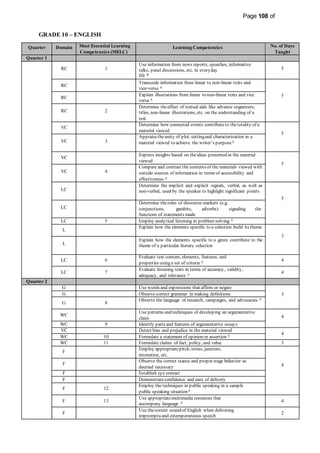
GRADE 10 – ENGLISH
Quarter Domain Most Essential Learning
Competencies (MELC)
Learning Competencies No. of Days
Taught
Quarter 1
RC 1
Use information from news reports, speeches, informative
talks, panel discussions, etc. in everyday
life B
5
RC
Transcode information from linear to non-linear texts and
vice-versa A
5
RC
Explain illustrations from linear to non-linear texts and vice
versa A
RC 2
Determine theeffect of textual aids like advance organizers,
titles, non-linear illustrations, etc. on the understanding of a
text
VC
Determine how connected events contributeto thetotality of a
material viewed
5
VC 3
Appraisetheunity of plot, settingand characterization in a
material viewed to achieve the writer’s purpose E
VC
Express insights based on theideas presented in the material
viewed
5
VC 4
Compare and contrast the contents of the materials viewed with
outside sources of information in terms of accessibility and
effectiveness E
LC
Determine the implicit and explicit signals, verbal, as well as
non-verbal, used by the speaker to highlight significant points
5
LC
Determine theroles of discourse markers (e.g.
conjunctions, gambits, adverbs) signaling the
functions of statements made
LC 5 Employ analytical listening in problem solving E
L
Explain how the elements specific to a selection build its theme
3
L
Explain how the elements specific to a genre contribute to the
theme of a particular literary selection
LC 6
Evaluate text content, elements, features, and
properties using a set of criteria E
4
LC 7
Evaluate listening texts in terms of accuracy, validity,
adequacy, and relevance E
4
Quarter 2
G Use words and expressions that affirm or negate
3
G Observe correct grammar in making definitions
G 8
Observe the language of research, campaigns, and advocacies E
WC
Use patterns and techniques of developing an argumentative
claim 4
WC 9 Identify parts and features of argumentative essays
VC Detect bias and prejudice in the material viewed
4
WC 10 Formulate a statement of opinion or assertion E
WC 11 Formulate claims of fact, policy, and value 3
F
Employ appropriatepitch, stress, juncture,
intonation, etc.
4
F
Observe the correct stance and proper stage behavior as
deemed necessary
F Establish eye contact
F Demonstrateconfidence and ease of delivery
F 12
Employ the techniques in public speaking in a sample
public speaking situation E
F 13
Use appropriatemultimedia resources that
accompany language E
4
F
Use thecorrect sound of English when delivering
impromptu and extemporaneous speech
2
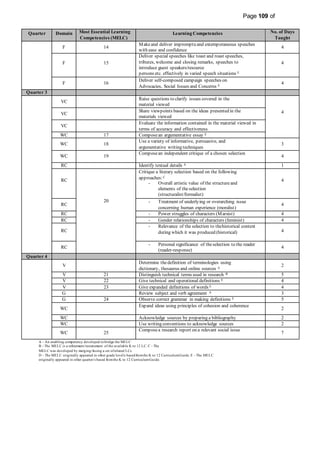
Page 109 of
349
Quarter Domain Most Essential Learning
Competencies (MELC)
Learning Competencies No. of Days
Taught
F 14
Makeand deliver impromptu and extemporaneous speeches
with ease and confidence
4
F 15
Deliver special speeches like toast and roast speeches,
tributes, welcome and closing remarks, speeches to
introduce guest speakers/resource
persons etc. effectively in varied speech situations E
4
F 16
Deliver self-composed campaign speeches on
Advocacies, Social Issues and Concerns E
4
Quarter 3
VC
Raise questions to clarify issues covered in the
material viewed
4
VC
Share viewpoints based on the ideas presented in the
materials viewed
VC
Evaluate the information contained in the material viewed in
terms of accuracy and effectiveness
WC 17 Composean argumentative essay E
WC 18
Use a variety of informative, persuasive, and
argumentative writing techniques
3
WC 19
Composean independent critique of a chosen selection
4
RC Identify textual details A 1
RC
20
Critique a literary selection based on the following
approaches:C
- Overall artistic value of the structure and
elements of the selection
(structuralist/formalist)
4
RC
- Treatment of underlying or overarching issue
concerning human experience (moralist)
4
RC - Power struggles of characters (Marxist) 4
RC - Gender relationships of characters (feminist) 4
RC
- Relevance of the selection to thehistorical context
during which it was produced (historical) 4
RC
- Personal significance of theselection to the reader
(reader-response)
4
Quarter 4
V
Determine thedefinition of terminologies using
dictionary, thesaurus and online sources A
2
V 21 Distinguish technical terms used in research B 5
V 22 Give technical and operational definitions E 4
V 23 Give expanded definitions of words E 4
G Review subject and verb agreement A 3
G 24 Observe correct grammar in making definitions E 5
WC
Expand ideas using principles of cohesion and coherence
2
WC Acknowledge sources by preparing a bibliography 2
WC Use writing conventions to acknowledge sources 2
WC 25
Composea research report on a relevant social issue
7
A - An enabling competency developed to bridge the MELC
B - The MELC is a refinement/restatement of the available K to 12 LC. C - The
MELC was developed by merging/fusing a set ofrelated LCs.
D - The MELC originally appeared in other grade level/s based fromthe K to 12 CurriculumGuide. E - The MELC
originally appeared in other quarter/s based fromthe K to 12 CurriculumGuide.

English Buget of Work.docx

  • 1.
    Page 97 of 349 Republicof the Philippines Department of Education CABANTIAN NATIONAL HIGH SCHOOL Country Homes, Cabantian Davao City PIVOT 4A BUDGET OF WORK (BOW) IN ENGLISH A. Features/Elements The PIVOT4ABudget of Work (BOW) in English is a resource material in teaching English that contains and highlights the most essential learning competencies (MELCs) and the learning competencies serving as enabling competencies in achieving the former as mapped from the K to 12 Basic Education Curriculum for Grades 1 to 10. The K to 12 English Curriculum features domain-based learning competencies. The number of domains vary from one grade level to another. Presented below is the alignment of the language and literacy domains with five (5) sub-standards. Alignment ofthe Language and Literacy Domains with the Five (5) Sub-Standards Integrated Language Arts Domains Listening Speaking Reading Writing Viewing 1. OralLanguage √ √ 2. Phonological Awareness √ 3. Book and Print Knowledge √ 4. Alphabet Knowledge √ √ √ √ √ 5. Phonics and Word Recognition √ √ √ 6. Fluency √ √ 7. Spelling √ √ 8. Writing and Composition √ √ √ √ 9. Grammar Awareness & Structure √ √ √ √ 10. Vocabulary Development √ √ √ √ √ 11. Reading Comprehension 11.1 schema & prior knowledge 11.2 strategies 11.3 narrative text 11.4 informational text √ √ √ 12. Listening Comprehension √ √ 13. Attitudes towards language, literacy and literature √ √ √ √ √ 14. Study Strategies √ √ √ √ √ Source: DepEdK to 12 Curriculum Guide for English Furthermore, language domains for English are also funneled across the Kto 12 Basic Education Integrated Language Arts Curriculum. This illustration provides clearer view on the presence of language domains in various grade levels and key stages. The existence of these domains in vary depending on the nature and contexts of developmental stages of learners. These domains include the following: The identified domains in the K to 12 English Curriculum are anchored to the contexts of
  • 2.
    Page 98 of 349 communicativelanguage teaching (CLT) which is generally regarded as an approach to language teaching (Richards and Rodgers, 2001 as cited in Richards,
  • 3.
    Page 99 of 349 2006).CLTreflects a certain model or language paradigm, or a theory (Celce-Murcia, 2008). It is based on the theory thatthe primary function of language use is communication. Itsprimary goal is forlearners to develop communicative competence (Hymes, 1971 as cited in Celce-Murcia, 2008), or simply put, communicative ability. In other words, its goal is to make use of real-life situations that necessitate communication. Such notion of CLT encompasses a wide range of abilities. These abilities or competences include linguistic competence, sociocultural competence, discourse competence and strategic competence. These four features of CLT require appropriate knowledge which will be helpful in understanding the target concepts for the appropriate use of the target language in various situations. Basically, the aforementioned abilities are described asfollows: the knowledge of grammar and vocabulary (linguistic competence); the ability to say the appropriate thing in a certain social situation (sociocultural competence); the ability to start, enter, contribute to, and end a conversation, and the ability to do this in a consistent and coherent manner (discourse competence); and the ability to communicate effectively and repair problems caused by communication breakdowns (strategic competence). These CLT components are further subdivided in the different domains of language learning in the Philippine context. B. Howto Use this BOW? The PIVOT 4A BOW in English is composed of five (5) columns. The first column is intended for the Quarter; the second one for the Domain; the third for the Most Essential Learning Competencies (MELC); the fourth for the Learning Competencies; and the last one for the No. of Days Taught. In using the PIVOT 4A BOW in English, it is important to understand the figure above marked by the following specifications: A. Quarter B. Domain C. Most Essential Learning Competencies (MELC) D. Learning Competencies E. Number of Days Taught F. Enabling Competencies. These were taken from the K to 12 Curriculum Guide which teachers shall use in bridging the lessons especially in reaching and targeting the Most Essential Learning Competencies (MELC). G. Most Essential Learning Competencies (MELC). In each PIVOT 4A BOW, the MELC is symbolized or marked by numbers. These identified MELCs may be of the same variant of the K to 12 LCs or enabling competencies. But in some cases, MELCs were produced by merging/fusing some LCs or enabling competencies. Quarter Domain (A) (F) (F) (G) (B) Most Essential Learning Competencies (MELC) (C) Learning Competencies (D) No. of Days Taught (E)
  • 4.
    Page 100 of 349 Further,teachers should:  Look for the grade level they are handling.  Check the MELC/s and/or LC/s to be taught in a particular quarter and domain.  Be guided that the MELCs in each quarter and grade level are marked with numbers, i.e. No. 1 is the first MELC in each grade level.  Take note that the first MELC/LC or set of LCs in the BOW becomes the first lesson to be taught in a quarter.  Remember that the learning competency that appears before the MELC serves as the enabling competency that has to be taught before the MELC to carefully establish learners’ knowledge, skills and attitude/values based from the curricular demand.  Design their lessons using the MELC and/or clustered LCs and the identified enabling competencies using the IDEA instructional delivery process.  Observe the appropriate domains where MELCsand/orLCsare partof. Lessons in teaching such MELCs and/or LCs should reflect the indicated domains. If the said MELCs or LCs fall under Reading Comprehension or RC, lessons to be prepared should reflect the contexts of reading comprehension. However, teachers may also add activities reflecting under domains or macro skills but with central focus on the actual domains specified in the PIVOT 4A BOW.  Observe and consume the allotted number of days for a particular MELC or set of LCs. Lessons in English for Grades 1-6 are designed for 40 meetings/sessions in a quarter while 36 meetings/sessions are allocated for lessons for Grades 7- 10 considering the one day of weekly lesson is allocated for independent/cooperative learning (ICL) as per DepEd Order No. 21, s 2019. The MELCsfor English are identified by the CentralOffice.Such MELCsare further enhanced by providing enabling competencies taken from the CGitself. The identified enabling competencies are presented either individually or in group depending on the nature of the MELC. With the inclusion of MELCs developed by the Central Office, the K to 12 LCs are mapped and restructured in the PIVOT 4A BOW. The adjustments are explained by the following legends: A An enabling competency developed to bridge the MELC B The MELC is a refinement/restatement of the available K to 12 LC. C The MELC was developed by merging/fusing a set of relatedLCs. D The MELC originally appeared in other grade level/s based from the K to 12 Curriculum Guide. E The MELC originally appeared in other quarter/sbased from the Kto 12 Curriculum Guide. clmd/jsc
  • 5.
    Page 101 of 349 GRADE7 – ENGLISH Quarter Domain Most Essential Learning Competencies (MELC) Learning Competencies No. of Days Taught Quarter 1 V Select an appropriatecolloquial or idiomatic word or expression as a substitutefor another word or expression 4 V Use appropriateidiomatic expressions in a variety of basic interpersonal communicative situations V Explain the predominance of colloquial and idiomatic expressions in oral communication V 1 Supply other words or expressions that complete an analogy E VC Organize information from a material viewed 2 VC Determine thetruthfulness and accuracy of the material viewed 2 VC 2 Identify the genre of a material viewed (such as movie clip, trailer, news flash, internet-based program, documentary, video, etc.) 4 G Observe correct subject-verb agreement 4 G 3 Use thepassive and active voice meaningfully in varied contexts E 4 G 4 Use thepast and past perfect tenses correctly in varied contexts E 4 G 5 Use direct and reported speech appropriately in varied contexts E 4 G 6 Use phrases, clauses, and sentences appropriately and meaningfully E 4 RC Read intensively to find answers to specific questions 4 RC Scan for specific information RC Skim for major ideas using headings as guide RC 7 Use theappropriatereading style(scanning, skimming, speed reading, intensive reading etc.) for one’s purpose Quarter 2 LC Recognize main/key ideas 4 LC Notespecific details/elements of the text listened to LC Extract information from thetext listened to LC 8 Use listening strategies based on purpose, familiarity with the topicand levels of difficulty of short texts listened to RC Use appropriatemechanisms/tools in thelibrary or other sources for locating resources 2 RC 9 Use an electronic search engine to locate specific resources B 3 RC Get information from the different parts of a book and from general references in the library 2 RC 10 Gather current information from newspapers and other print and non-print media 3 WC Identify key ideas 3 WC Identify supportingdetails WC Simplify ideas WC 11 Extract information from a text using a summary, precis, and paraphrase VC Predict the gist of the material viewed based on the title, pictures, and excerpts of the material viewed 3 L Draw similarities and differences of thefeatured selections in relation to the theme VC 12 Compare content of materials viewed to other sources of information (print and radio) E
  • 6.
    Page 102 of 349 QuarterDomain Most Essential Learning Competencies (MELC) Learning Competencies No. of Days Taught V Identify figures of speech that show comparison (simile metaphor, personification) 2 V Identify figures of speech that show contrast (irony, oxymoron, paradox) 2 V Classify sample texts into literal or figurative 2 V Discriminate between literal and figurative language 2 V 13 Analyzerelationships presented in analogies E 3 RC Use non-linear visuals as comprehensive aids in content texts A 2 RC Give the meaning of given signs and symbols (road signs, prohibited signs, etc.) A RC Transcode orally and in writing the information presented in diagrams, charts, table, graphs, etc. A 3 RC 14 Transcode information from linear to non-linear texts and vice-versa D Quarter 3 F Express ideas, opinions, feelings and emotions during interviews, group/panel discussions, forums/fora, debates, etc. 5 F Use theappropriateprosodicfeatures of speech during interviews, discussions and forums F Employ the appropriateorallanguage and stance in an interview, a panel discussion, in a forum and in a debate F 15 Use correct and appropriatemulti-media resources when orally giving information, instructions, making explanations and narrating events in personal or factual recounts E F 16 Use theappropriateoral language, stance and behavior when giving information, instructions, making explanations, and narrating events in factual and personal recounts E 4 L Identify the distinguishing features of revolutionary songs, poems, short stories, drama, and novels 5 L Discover literature as a tool to assert one’s unique identity and to better understand other people L 17 Explain how a selection may be influenced by culture, history, environment, or other factors E VC Makea stand on the material viewed 2 VC 18 Express one’s beliefs/convictions based on a material viewed E 4 RC Identify the author’s intentions for writing 2 RC Makepredictions about the text 2 RC 19 Cite evidence to support ageneral statement E 3 RC 20 React to what is asserted or expressed in a text B 3 F Express ideas and opinions based on text listened to 2 F 21 Raise sensible, challenging thought provoking questions in public forums/panel discussions, etc. E 4 Quarter 4 WC Organize information about a chosen subject using a graphic organizer 3 WC Organize information about a chosen subject using a one- step topicoutline WC 22 Distinguish features of academic writing D 3 F Observe and use the appropriateorallanguage, stance and behavior when giving information, instructions, making explanations, and narrating events in factual and personal recounts 4
  • 7.
    Page 103 of 349 QuarterDomain Most Essential Learning Competencies (MELC) Learning Competencies No. of Days Taught F Give clear precise and concise information, explanations and instructions in varied oral communication situations F Orally narrate events in factual and personal recounts using appropriateverbal and non-verbal cues F 23 Employ a variety of strategies for effective interpersonal communication (interview, dialog, conversation) D LC Makesimple inferences about thoughts and feelings expressed in thetext listened to 4 LC Process information mentioned in the text listened to LC 24 Determine theworth of ideas mentioned in the text listened to VC Differentiate reality from fantasy based on a material viewed 4 VC Express one’s beliefs/convictions based on a material viewed VC 25 Determine thetruthfulness and accuracy of the material viewed E L Explain the literary devices used 4 L Determine tone, mood, technique, and purposeof the author L Draw similarities and differences of thefeatured selections in relation to thetheme L 26 Discover the conflicts presented in literary selections and the need to resolve those conflicts in non-violent ways E L 27 Discover literature as a tool to assert one’s unique identity and to better understand other people E 4 L 28 Discover through Philippineliterature the need to work cooperatively and responsibly in today’s global village 4 WC Composea capsule biography of a person interviewed 2 WC Composea biographical sketch based on a personal interview and background research WC 29 Composean informative essay B 4 A - An enabling competency developed to bridge the MELC B - The MELC is a refinement/restatement of the available K to 12 LC. C - The MELC was developed by merging/fusing a set ofrelated LCs. D - The MELC originally appeared in other grade level/s based fromthe K to 12 CurriculumGuide. E - The MELC originally appeared in other quarter/s based fromthe K to 12 CurriculumGuide.
  • 8.
    Page 104 of 349 GRADE8 – ENGLISH Quarter Domain Most Essential Learning Competencies (MELC) Learning Competencies No. of Days Taught Quarter 1 V Use context clues from the material viewed to determine the meaning of unfamiliar words or expressions 5 L Explain how the elements specific to a genre contribute to the theme of a particular literary selection V 1 Determine themeaning of words and expressions that reflect thelocal culture by noting context clues WC Expand thecontent of an outline using notes from primary and secondary sources 2 WC 2 Use conventions in citing sources E 5 G 3 Use modals appropriately E 5 G Use appropriatecohesivedevices in composing an informative speech 3 G 4 Use emphasis markers for persuasive purposes E 5 RC Scan for logical connectors to determine the text type 2 RC Skim to determine key ideas 2 RC Use theappropriatereading style(scanning, skimming, speed reading, intensive reading etc.) for one's purpose. 2 RC 5 Noteimplicit signals used by the writer to indicate coherence B 5 Quarter 2 RC Transcode information from linear to nonlinear texts and vice-versa 3 RC 6 Explain visual-verbal relationships illustrated in tables, graphs, and information maps found in expository texts 4 G Use appropriategrammatical signals or expressions suitable to each pattern of idea development: general to particular claim and counterclaim problem solution cause- effect and others 3 G 7 Share ideas using opinion-marking signals E 5 VC 8 Compare and contrast the presentation of thesame topic in different viewing genres E 6 VC 9 Compare and contrast one’s beliefs/convictions with those presented in a material viewed E 6 VC Predict the gist of the material viewed based on the title, pictures, and excerpts 3 VC 10 Discern positiveand negative messages conveyed in a material viewed 6 Quarter 3 VC Judge the relevance and worth of ideas presented in the material viewed 5 LC Judge the relevance and worth of ideas presented in the text listened to VC Determine theissue and stand presented in the material viewed RC 11 Examine biases (for or against) made by the author RC Recognize propaganda techniques used in a given text 5 V 12 Analyzeintention of words or expressions used in propaganda techniques LC Distinguish facts from opinion cited in thetext listened to 5
  • 9.
    Page 105 of 349 QuarterDomain Most Essential Learning Competencies (MELC) Learning Competencies No. of Days Taught LC Employ different listening strategies suited to the topic, purpose, and level of difficulty of the listening text LC 13 Determine various social, moral, and economic issues discussed in the text listened to L Identify the notable literary genres contributed by Southeast Asian writers 6 L Identify the distinguishing features of notable poems, short stories, dramas, and novels contributed by Southeast Asian writers L Identify similarities and differences of the featured selections L Explain how a selection is influenced by culture, history, environment L 14 Appreciateliterature as a mirror to a shared heritage of people with diverse backgrounds B G Share ideas using opinion-marking signals 5 G Use emphasis markers for persuasive purposes G 15 Use appropriatecohesivedevices in various types of speech E G Review subject and verb agreement 4 G 16 Use parallel structures E 6 Quarter 4 G Use appropriatemodifiers 2 G Use appropriatelogical connectors for emphasis G 17 Use appropriategrammatical signals or expressions suitable to each pattern of idea development: E  general to particular  claim and counterclaim  problem-solution  cause-effect  and others 5 WC Use writing conventions to indicate acknowledgement of sources 4 WC 18 Expand thecontent of an outline using notes from primary and secondary sources E RC Draw conclusions from a set of details 4 LC Summarize information from thetext listened to. RC 19 Synthesizeessential information found in various sources B WC Distinguish parts of a paragraph A 5 WC 20 Composeeffective paragraphs E WC Distinguish features of different text types A 4 WC 21 Develop paragraphs that illustrate each text type(narrative in literature, expository, explanatory, factual and personal recount, persuasive) E F Use thecorrect production of thesounds of English when delivering a manuscript or memorized speech in an oration, in a declamation or in a dramatic monologue 2 F Deliver a manuscript/memorized oral speech with ease and fluency before an audience 2 F Use effective nonverbal communication strategies: gestures and body movements and eye contact, etc. 2 F 22 Deliver a self-composed speech using all the needed speech conventions E 6 A - An enabling competency developed to bridge the MELC B - The MELC is a refinement/restatement of the available K to 12 LC. C - The MELC was developed by merging/fusing a set ofrelated LCs. D - The MELC originally appeared in other grade level/s based fromthe K to 12 CurriculumGuide. E - The MELC originally appeared in other quarter/s based fromthe K to 12 CurriculumGuide.
  • 10.
    Page 106 of 349 GRADE9 – ENGLISH Quarter Domain Most Essential Learning Competencies (MELC) Learning Competencies No. of Days Taught Quarter 1 G Composeclear and coherent sentence using modals A 2 G 1 Express permission, obligation and prohibition using modals E 5 G Identify parts of conditionals A 2 G 2 Use conditionals in expressing arguments B 5 V Arrive at the meaning of words through formation (clipping, blending, acronymy, compounding, folk etymology, etc.) 4 V Notetypes of context clues (restatement, definition, synonyms, antonyms) used for a given word 4 V Provide words or expressions appropriateto agiven situation 4 V 3 Determine thevocabulary or jargons expected of a communicative style E 5 V 4 Employ the appropriatecommunicative styles for various situations (intimate, casual, conversational, consultative, frozen) B 5 Quarter 2 RC Compare and contrast similar information presented in different texts 6 RC 5 Relate text content to particular issues, concerns or dispositions in life 10 L Explain how a selection may be influenced by culture, history, environment or other factors 5 L Analyzeliterature as means of valuing other peopleand other various circumstances in life 5 L 6 Analyzeliterature as means of understanding unchanging values in the VUCA (volatile, uncertain, complex, ambiguous) world E 10 Quarter 3 LC Reflect on theideas of the speaker 2 LC Share on the personal opinions on the ideas listened to 2 LC Form decisions based on the ideas mentioned 2 LC 7 Differentiate biases from prejudices E 5 VC Interpret themessage conveyed in the material viewed 3 VC Analyzethe information contained in the material viewed 3 VC 8 Determine therelevance and truthfulness of the ideas presented in the material viewed E 5 LC Interpret theinformation listened to 3 LC Recognize unfaulty logic, unsupported facts and emotional appeal 3 LC Judge the relevance and worth of information/ideas 3 LC 9 Judge the validity of the evidence listened to 5 Quarter 4 LC Judge the relevance of thetruthfulness of the ideas listened to 4 LC Judge the validity of the evidence listened to 4 RC 10 Judge therelevance and worth of ideas, soundness of author’s reasoning and the effectiveness of the presentation 8 LC Get the different sides of social, moral and economic issues affecting the nation 4 RC Relate text content to particular issues, concerns and dispositions in real life 4
  • 11.
    Page 107 of 349 QuarterDomain Most Essential Learning Competencies (MELC) Learning Competencies No. of Days Taught VC Take a stand on critical issues brought up in the material viewed 4 LC 11 React to lay value judgment on critical issues that demand sound analysis and call for prompt actions B 8 A - An enabling competency developed to bridge the MELC B - The MELC is a refinement/restatement of the available K to 12 LC. C - The MELC was developed by merging/fusing a set ofrelated LCs. D - The MELC originally appeared in other grade level/s based fromthe K to 12 CurriculumGuide. E - The MELC originally appeared in other quarter/s based fromthe K to 12 CurriculumGuide.
  • 12.
    Page 108 of 349 GRADE10 – ENGLISH Quarter Domain Most Essential Learning Competencies (MELC) Learning Competencies No. of Days Taught Quarter 1 RC 1 Use information from news reports, speeches, informative talks, panel discussions, etc. in everyday life B 5 RC Transcode information from linear to non-linear texts and vice-versa A 5 RC Explain illustrations from linear to non-linear texts and vice versa A RC 2 Determine theeffect of textual aids like advance organizers, titles, non-linear illustrations, etc. on the understanding of a text VC Determine how connected events contributeto thetotality of a material viewed 5 VC 3 Appraisetheunity of plot, settingand characterization in a material viewed to achieve the writer’s purpose E VC Express insights based on theideas presented in the material viewed 5 VC 4 Compare and contrast the contents of the materials viewed with outside sources of information in terms of accessibility and effectiveness E LC Determine the implicit and explicit signals, verbal, as well as non-verbal, used by the speaker to highlight significant points 5 LC Determine theroles of discourse markers (e.g. conjunctions, gambits, adverbs) signaling the functions of statements made LC 5 Employ analytical listening in problem solving E L Explain how the elements specific to a selection build its theme 3 L Explain how the elements specific to a genre contribute to the theme of a particular literary selection LC 6 Evaluate text content, elements, features, and properties using a set of criteria E 4 LC 7 Evaluate listening texts in terms of accuracy, validity, adequacy, and relevance E 4 Quarter 2 G Use words and expressions that affirm or negate 3 G Observe correct grammar in making definitions G 8 Observe the language of research, campaigns, and advocacies E WC Use patterns and techniques of developing an argumentative claim 4 WC 9 Identify parts and features of argumentative essays VC Detect bias and prejudice in the material viewed 4 WC 10 Formulate a statement of opinion or assertion E WC 11 Formulate claims of fact, policy, and value 3 F Employ appropriatepitch, stress, juncture, intonation, etc. 4 F Observe the correct stance and proper stage behavior as deemed necessary F Establish eye contact F Demonstrateconfidence and ease of delivery F 12 Employ the techniques in public speaking in a sample public speaking situation E F 13 Use appropriatemultimedia resources that accompany language E 4 F Use thecorrect sound of English when delivering impromptu and extemporaneous speech 2
  • 13.
    Page 109 of 349 QuarterDomain Most Essential Learning Competencies (MELC) Learning Competencies No. of Days Taught F 14 Makeand deliver impromptu and extemporaneous speeches with ease and confidence 4 F 15 Deliver special speeches like toast and roast speeches, tributes, welcome and closing remarks, speeches to introduce guest speakers/resource persons etc. effectively in varied speech situations E 4 F 16 Deliver self-composed campaign speeches on Advocacies, Social Issues and Concerns E 4 Quarter 3 VC Raise questions to clarify issues covered in the material viewed 4 VC Share viewpoints based on the ideas presented in the materials viewed VC Evaluate the information contained in the material viewed in terms of accuracy and effectiveness WC 17 Composean argumentative essay E WC 18 Use a variety of informative, persuasive, and argumentative writing techniques 3 WC 19 Composean independent critique of a chosen selection 4 RC Identify textual details A 1 RC 20 Critique a literary selection based on the following approaches:C - Overall artistic value of the structure and elements of the selection (structuralist/formalist) 4 RC - Treatment of underlying or overarching issue concerning human experience (moralist) 4 RC - Power struggles of characters (Marxist) 4 RC - Gender relationships of characters (feminist) 4 RC - Relevance of the selection to thehistorical context during which it was produced (historical) 4 RC - Personal significance of theselection to the reader (reader-response) 4 Quarter 4 V Determine thedefinition of terminologies using dictionary, thesaurus and online sources A 2 V 21 Distinguish technical terms used in research B 5 V 22 Give technical and operational definitions E 4 V 23 Give expanded definitions of words E 4 G Review subject and verb agreement A 3 G 24 Observe correct grammar in making definitions E 5 WC Expand ideas using principles of cohesion and coherence 2 WC Acknowledge sources by preparing a bibliography 2 WC Use writing conventions to acknowledge sources 2 WC 25 Composea research report on a relevant social issue 7 A - An enabling competency developed to bridge the MELC B - The MELC is a refinement/restatement of the available K to 12 LC. C - The MELC was developed by merging/fusing a set ofrelated LCs. D - The MELC originally appeared in other grade level/s based fromthe K to 12 CurriculumGuide. E - The MELC originally appeared in other quarter/s based fromthe K to 12 CurriculumGuide.