STRATEGIC HUMAN RESOURCE MANAGEMENT
As per general opinion, strategic management means strategic planning
implemented by the management for solution of various problems arose in the area
of production, employees,& finance to the business unit.
SCOPE OF STRATEGIC MANAGEMENT
• To fix mission of the unit
• To make favourable internal environment
• Analysis & evaluation of External environment
• SWOT analysis to be made
• Selection of new alternatives to achieve mission
• To develop grand strategy
• To fix short-term annual targets
SHRM STRATEGY
• concerned with two key elements
1. Determining the strategic objective
2. Developing a plan of action
• Strategic Human Resource Management is an approach relates to decisions
about the nature of employment relationship, recruitment, training, development
performance management, reward & employee relationship,
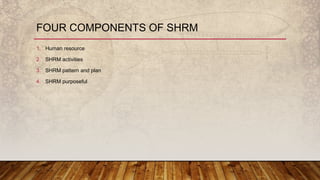
FOUR COMPONENTS OF SHRM
1. Human resource
2. SHRM activities
3. SHRM pattern and plan
4. SHRM purposeful
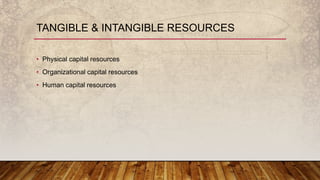
• Physical capital resources
• Organizational capital resources
• Human capital resources
TANGIBLE & INTANGIBLE RESOURCES
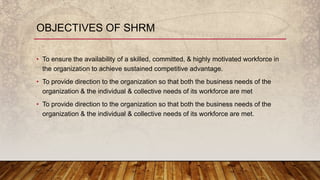
• To ensure the availability of a skilled, committed, & highly motivated workforce in
the organization to achieve sustained competitive advantage.
• To provide direction to the organization so that both the business needs of the
organization & the individual & collective needs of its workforce are met
• To provide direction to the organization so that both the business needs of the
organization & the individual & collective needs of its workforce are met.
OBJECTIVES OF SHRM
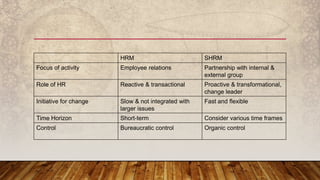
HRM SHRM
Focus of activity Employee relations Partnership with internal &
external group
Role of HR Reactive & transactional Proactive & transformational,
change leader
Initiative for change Slow & not integrated with
larger issues
Fast and flexible
Time Horizon Short-term Consider various time frames
Control Bureaucratic control Organic control
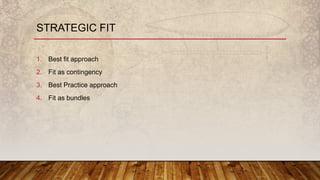
1. Best fit approach
2. Fit as contingency
3. Best Practice approach
4. Fit as bundles
STRATEGIC FIT
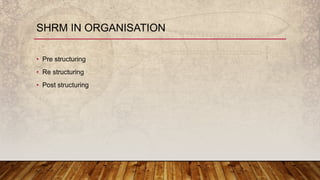
• Pre structuring
• Re structuring
• Post structuring
SHRM IN ORGANISATION
SHRM presentetion

SHRM presentetion

  • 2.
    STRATEGIC HUMAN RESOURCEMANAGEMENT As per general opinion, strategic management means strategic planning implemented by the management for solution of various problems arose in the area of production, employees,& finance to the business unit.
  • 3.
    SCOPE OF STRATEGICMANAGEMENT • To fix mission of the unit • To make favourable internal environment • Analysis & evaluation of External environment • SWOT analysis to be made • Selection of new alternatives to achieve mission • To develop grand strategy • To fix short-term annual targets
  • 4.
    SHRM STRATEGY • concernedwith two key elements 1. Determining the strategic objective 2. Developing a plan of action • Strategic Human Resource Management is an approach relates to decisions about the nature of employment relationship, recruitment, training, development performance management, reward & employee relationship,
  • 5.
    FOUR COMPONENTS OFSHRM 1. Human resource 2. SHRM activities 3. SHRM pattern and plan 4. SHRM purposeful
  • 6.
    • Physical capitalresources • Organizational capital resources • Human capital resources TANGIBLE & INTANGIBLE RESOURCES
  • 7.
    • To ensurethe availability of a skilled, committed, & highly motivated workforce in the organization to achieve sustained competitive advantage. • To provide direction to the organization so that both the business needs of the organization & the individual & collective needs of its workforce are met • To provide direction to the organization so that both the business needs of the organization & the individual & collective needs of its workforce are met. OBJECTIVES OF SHRM
  • 8.
    HRM SHRM Focus ofactivity Employee relations Partnership with internal & external group Role of HR Reactive & transactional Proactive & transformational, change leader Initiative for change Slow & not integrated with larger issues Fast and flexible Time Horizon Short-term Consider various time frames Control Bureaucratic control Organic control
  • 9.
    1. Best fitapproach 2. Fit as contingency 3. Best Practice approach 4. Fit as bundles STRATEGIC FIT
  • 10.
    • Pre structuring •Re structuring • Post structuring SHRM IN ORGANISATION