STRATEGIC HUMAN
RESOURCE MANAGEMENT
DR.M.BADMAPRIYA
STRATEGY
Strategy is the determination of the basic long-term goals of an enterprise, and the adoption of
courses of action and the allocation of resources necessary for carrying out these goals. --------
Chandler
Strategy is a mediating force between the organization and its environment: consistent patterns
in streams of organizational decisions to deal with the environment. --------Mintzberg
Strategy is more then just fit and allocation of resources. It is stretch and leveraging of resources
--------Prahlad
Strategy is a unified, comprehensive and integrated plan that relates the strategic advantages of
the firm to the challenges of the environment. It is designed to ensure that the basic objectives of
the enterprise are achieved through proper execution by the organisation -------- Jauch and
Glueck
NATURE OF STRATEGY
 Long term orientation
Proactive approach
Involves choices
Involves uncertainty
Adaptability
CONCEPT OF STRATEGY
The concept of strategy is based on three subsidiary
concepts:
 Competitive advantage
 Distinctive capabilities and
 Strategic fit.
Competitive advantage
The concept of competitive advantage was formulated by Michael
Porter (1985). Competitive advantage, Porter asserts, arises out of a
firm creating value for its customers. To achieve it, firms select
markets in which they can excel and present a moving target to their
competitors by continually improving their position.
Distinctive capabilities
A distinctive capability or competence can be described as an important
feature that confers superiority on the organization’. Kay extends this
definition by emphasizing that there is a difference between distinctive
capabilities and reproducible capabilities.
Distinctive capabilities are those characteristics that cannot be replicated
by competitors, or can only be imitated with great difficulty. Reproducible
capabilities are those that can be bought or created by any company with
reasonable management skills, diligence and financial resources. Most
technical capabilities are reproducible.
Strategic fit
The concept of strategic fit states that to maximize competitive advantage a
firm must match its capabilities and resources to the opportunities available in
the external environment.
A critical aspect of top management’s work today involves matching
organizational competences (internal resources and skills) with the
opportunities and risks created by environmental change in ways that will be
both effective and efficient over the time such resources will be deployed.
FORMULATION OF STRATEGY
 Establishing organizational objectives
Analysis of organizational environment
Forming quantitative goals
Objectives in context with the divisional plans
Performance analysis
Selection of strategy
STRATEGY IMPLEMENTATION
Developing an organization having potential of carrying out strategy
successfully.
Disbursement of abundant resources to strategy-essential activities.
Creating strategy-encouraging policies.
Employing best policies and programs for constant improvement.
Linking reward structure to accomplishment of results.
Making use of strategic leadership.
DEFINITIONS - SHRM
“Strategic human resource management means formulating and executing human resource
policies and practices that produce the employee competencies and behaviors that the company
needs to achieve its strategic aims.”- Gary Dessler
“Strategic human resource management is an approach to making decisions on the intentions
and plans of the organization concerning the employment relationship and the organization’s
recruitment, training, development, performance management, and the organization’s strategies,
policies, and practices.” – Armstrong
Strategic human resource management (SHRM) is defined as “the pattern of planned human
resource deployments and activities intended to enable an organization to achieve its goals”. –
Wright & McMahan
NATURE OF SHRM
Long term focus – As business strategies are devised for long term, therefore focus of SHRM
is also long term
Associated with goal setting – highly related with setting objectives, formulation of policy
and allocation of resources . Its carried out by top management
Interrelated with business strategies – interrelation with business strategies and SHRM
Fosters corporate excellence skills – SHRM considers employees as the strategic potential
of the organisation
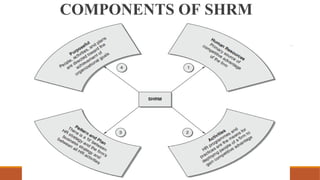
COMPONENTS OF SHRM
OBJECTIVES OF SHRM
(a) Plan for manpower requirements for its business located in national and international
markets.
(b) Conduct scientific selection and appointment of employees for business operation of right
type and right in number.
(c) Train the employees on technology in use and working procedure for developing their skills
and knowledge.
(d) Place the employees at jobs according to their areas of specialization.
(e) Provide opportunities for the employees deserving on the scientific basis.
(f) Compensate employees according to their skills, experience and contributions.
OBJECTIVES OF SHRM – Contd.,
(g) Maintain employees motivated, satisfied and cooperative in organisation.
(h) Improve industrial relations, industrial peace and harmony at workplace.
(i) Encourage employees for their cooperation, commitments and higher performance at work.
(j) Contribute through manpower in improvement of organisational performance and
organisational effectiveness in business.
(k) Contribute in profitability, progress and image of the organisation.
(l) Stay competitive and effective in business for growth and excellence in global market
NEED FOR SHRM
The first & at most concern of SHRM is to focus on actions that distinguish an
organization/firm from its competitors.
It provides idea to allocate the resources of organization to most match & capable Employee.
It design the foundation of organization to achieve efficient business benefits, structure, culture,
employees values propositions and effective communication strategic plan for HRM.
SHRM also keep track of down turns, down falls, risks and other business acquirement.
SHRM also take part in employee recruitment, hiring, training and assessments processes.
IMPORTANCE OF SHRM
1. Identifying and analysing external opportunities and threats that may be crucial to the
company’s success.
2. Provides a clear business strategy and vision for the future.
3. To supply competitive intelligence that may be useful in the strategic planning process.
4. To recruit, retain and motivate people.
5. To develop and retain highly competent people.
6. To ensure that people development issues are addressed systematically.
7. To supply information regarding the company’s internal strengths and weaknesses.
8. To meet the expectations of the customers effectively.
9. To ensure high productivity.
10. To ensure business surplus thorough competency.
ROLE OF SHRM
1. Strategic role – The strategic role of HR involves formulating business decisions, translating
corporate strategy into a human resource strategy, and training employees to concentrate on
customer needs.
2. Information and decision-making role – In this role, the HR department must inform and
advice the organisation about the various best practices like efficiency in customer services or
new product development. In the information and decision- making role, HR must take decisions
about problems in employee relations.
ROLE OF SHRM – Contd.,
3. Strategic HR functional role – This is a very important role. In this role, HR must select,
design and implement planning and appraisal systems for the employees. These systems
should fit both the strategy and the culture of the organisation concerned.
4. Administrative role – In this role, HR must implement policies and procedures for the
organisation. In addition, the HR department must try to improve the administrative system of
the organisation. SHRM organises various training and development programmes to
encourage employee involvement. It thus, motivates the employees to become flexible to
achieve the strategic goals of the organisation.
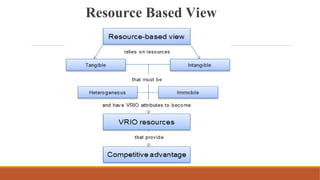
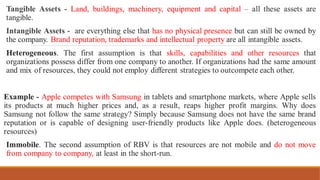
Resource Based View
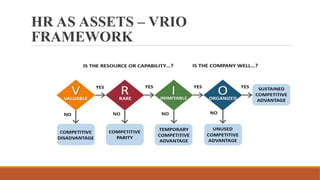
HR AS ASSETS – VRIO
FRAMEWORK
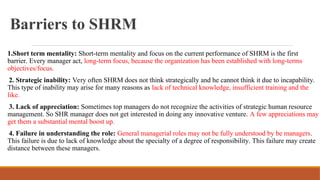
Barriers to SHRM
1.Short term mentality: Short-term mentality and focus on the current performance of SHRM is the first
barrier. Every manager act, long-term focus, because the organization has been established with long-terms
objectives/focus.
2. Strategic inability: Very often SHRM does not think strategically and he cannot think it due to incapability.
This type of inability may arise for many reasons as lack of technical knowledge, insufficient training and the
like.
3. Lack of appreciation: Sometimes top managers do not recognize the activities of strategic human resource
management. So SHR manager does not get interested in doing any innovative venture. A few appreciations may
get them a substantial mental boost up.
4. Failure in understanding the role: General managerial roles may not be fully understood by be managers.
This failure is due to lack of knowledge about the specialty of a degree of responsibility. This failure may create
distance between these managers.
Barriers to SHRM –Contd.,
5. Difficulty in quantifying outcomes: Many outcomes may not be quantified. But SHRM tries to
enjoy the contribution. This is not always possible. Participation, work etc. type function cannot be
quantified because of their intangibility.
6. Wrong perception on human assets: Investment in human assets may be regarded as high risk
than that of technology and information. Though these technologies are run by the human resources.
This wrong perception may inhibit the progress.
7. Resistance: SHR Managers may be resisted because of the incentives for change that might arise.
The change implemented demand some incentives for efforts to execute the changed program. If these
incentives are not given reasonable, they may create barriers SHRM

STRATEGIC HUMAN RESOURCE MANAGEMENT12.ppt

  • 1.
  • 2.
    STRATEGY Strategy is thedetermination of the basic long-term goals of an enterprise, and the adoption of courses of action and the allocation of resources necessary for carrying out these goals. -------- Chandler Strategy is a mediating force between the organization and its environment: consistent patterns in streams of organizational decisions to deal with the environment. --------Mintzberg Strategy is more then just fit and allocation of resources. It is stretch and leveraging of resources --------Prahlad Strategy is a unified, comprehensive and integrated plan that relates the strategic advantages of the firm to the challenges of the environment. It is designed to ensure that the basic objectives of the enterprise are achieved through proper execution by the organisation -------- Jauch and Glueck
  • 3.
    NATURE OF STRATEGY Long term orientation Proactive approach Involves choices Involves uncertainty Adaptability
  • 4.
    CONCEPT OF STRATEGY Theconcept of strategy is based on three subsidiary concepts:  Competitive advantage  Distinctive capabilities and  Strategic fit.
  • 5.
    Competitive advantage The conceptof competitive advantage was formulated by Michael Porter (1985). Competitive advantage, Porter asserts, arises out of a firm creating value for its customers. To achieve it, firms select markets in which they can excel and present a moving target to their competitors by continually improving their position.
  • 6.
    Distinctive capabilities A distinctivecapability or competence can be described as an important feature that confers superiority on the organization’. Kay extends this definition by emphasizing that there is a difference between distinctive capabilities and reproducible capabilities. Distinctive capabilities are those characteristics that cannot be replicated by competitors, or can only be imitated with great difficulty. Reproducible capabilities are those that can be bought or created by any company with reasonable management skills, diligence and financial resources. Most technical capabilities are reproducible.
  • 7.
    Strategic fit The conceptof strategic fit states that to maximize competitive advantage a firm must match its capabilities and resources to the opportunities available in the external environment. A critical aspect of top management’s work today involves matching organizational competences (internal resources and skills) with the opportunities and risks created by environmental change in ways that will be both effective and efficient over the time such resources will be deployed.
  • 8.
    FORMULATION OF STRATEGY Establishing organizational objectives Analysis of organizational environment Forming quantitative goals Objectives in context with the divisional plans Performance analysis Selection of strategy
  • 9.
    STRATEGY IMPLEMENTATION Developing anorganization having potential of carrying out strategy successfully. Disbursement of abundant resources to strategy-essential activities. Creating strategy-encouraging policies. Employing best policies and programs for constant improvement. Linking reward structure to accomplishment of results. Making use of strategic leadership.
  • 11.
    DEFINITIONS - SHRM “Strategichuman resource management means formulating and executing human resource policies and practices that produce the employee competencies and behaviors that the company needs to achieve its strategic aims.”- Gary Dessler “Strategic human resource management is an approach to making decisions on the intentions and plans of the organization concerning the employment relationship and the organization’s recruitment, training, development, performance management, and the organization’s strategies, policies, and practices.” – Armstrong Strategic human resource management (SHRM) is defined as “the pattern of planned human resource deployments and activities intended to enable an organization to achieve its goals”. – Wright & McMahan
  • 12.
    NATURE OF SHRM Longterm focus – As business strategies are devised for long term, therefore focus of SHRM is also long term Associated with goal setting – highly related with setting objectives, formulation of policy and allocation of resources . Its carried out by top management Interrelated with business strategies – interrelation with business strategies and SHRM Fosters corporate excellence skills – SHRM considers employees as the strategic potential of the organisation
  • 13.
  • 14.
    OBJECTIVES OF SHRM (a)Plan for manpower requirements for its business located in national and international markets. (b) Conduct scientific selection and appointment of employees for business operation of right type and right in number. (c) Train the employees on technology in use and working procedure for developing their skills and knowledge. (d) Place the employees at jobs according to their areas of specialization. (e) Provide opportunities for the employees deserving on the scientific basis. (f) Compensate employees according to their skills, experience and contributions.
  • 15.
    OBJECTIVES OF SHRM– Contd., (g) Maintain employees motivated, satisfied and cooperative in organisation. (h) Improve industrial relations, industrial peace and harmony at workplace. (i) Encourage employees for their cooperation, commitments and higher performance at work. (j) Contribute through manpower in improvement of organisational performance and organisational effectiveness in business. (k) Contribute in profitability, progress and image of the organisation. (l) Stay competitive and effective in business for growth and excellence in global market
  • 16.
    NEED FOR SHRM Thefirst & at most concern of SHRM is to focus on actions that distinguish an organization/firm from its competitors. It provides idea to allocate the resources of organization to most match & capable Employee. It design the foundation of organization to achieve efficient business benefits, structure, culture, employees values propositions and effective communication strategic plan for HRM. SHRM also keep track of down turns, down falls, risks and other business acquirement. SHRM also take part in employee recruitment, hiring, training and assessments processes.
  • 17.
    IMPORTANCE OF SHRM 1.Identifying and analysing external opportunities and threats that may be crucial to the company’s success. 2. Provides a clear business strategy and vision for the future. 3. To supply competitive intelligence that may be useful in the strategic planning process. 4. To recruit, retain and motivate people. 5. To develop and retain highly competent people. 6. To ensure that people development issues are addressed systematically. 7. To supply information regarding the company’s internal strengths and weaknesses. 8. To meet the expectations of the customers effectively. 9. To ensure high productivity. 10. To ensure business surplus thorough competency.
  • 18.
    ROLE OF SHRM 1.Strategic role – The strategic role of HR involves formulating business decisions, translating corporate strategy into a human resource strategy, and training employees to concentrate on customer needs. 2. Information and decision-making role – In this role, the HR department must inform and advice the organisation about the various best practices like efficiency in customer services or new product development. In the information and decision- making role, HR must take decisions about problems in employee relations.
  • 19.
    ROLE OF SHRM– Contd., 3. Strategic HR functional role – This is a very important role. In this role, HR must select, design and implement planning and appraisal systems for the employees. These systems should fit both the strategy and the culture of the organisation concerned. 4. Administrative role – In this role, HR must implement policies and procedures for the organisation. In addition, the HR department must try to improve the administrative system of the organisation. SHRM organises various training and development programmes to encourage employee involvement. It thus, motivates the employees to become flexible to achieve the strategic goals of the organisation.
  • 20.
  • 22.
    HR AS ASSETS– VRIO FRAMEWORK
  • 24.
    Barriers to SHRM 1.Shortterm mentality: Short-term mentality and focus on the current performance of SHRM is the first barrier. Every manager act, long-term focus, because the organization has been established with long-terms objectives/focus. 2. Strategic inability: Very often SHRM does not think strategically and he cannot think it due to incapability. This type of inability may arise for many reasons as lack of technical knowledge, insufficient training and the like. 3. Lack of appreciation: Sometimes top managers do not recognize the activities of strategic human resource management. So SHR manager does not get interested in doing any innovative venture. A few appreciations may get them a substantial mental boost up. 4. Failure in understanding the role: General managerial roles may not be fully understood by be managers. This failure is due to lack of knowledge about the specialty of a degree of responsibility. This failure may create distance between these managers.
  • 25.
    Barriers to SHRM–Contd., 5. Difficulty in quantifying outcomes: Many outcomes may not be quantified. But SHRM tries to enjoy the contribution. This is not always possible. Participation, work etc. type function cannot be quantified because of their intangibility. 6. Wrong perception on human assets: Investment in human assets may be regarded as high risk than that of technology and information. Though these technologies are run by the human resources. This wrong perception may inhibit the progress. 7. Resistance: SHR Managers may be resisted because of the incentives for change that might arise. The change implemented demand some incentives for efforts to execute the changed program. If these incentives are not given reasonable, they may create barriers SHRM