The Institute for Urban Education at The New SchoolNew Programs and Approaches for High School/ University Collaborations
Historic PartnershipsA range of schools, many reflecting creative and eclectic approaches to structuring education shared by Eugene Lang CollegePrograms targeted at the pre-college and college-ready levels, inadvertently but effectively excluding students not already college ready level but who could, with supports, succeed in collegeSemester-by-semester options created great flexibility for some students and schools but not enough structure for students needing more support
Re-visioning the IUEWork from our strengthsWhat is unique about The New School that might be helpful to K-12 educational efforts?Address critical K-12 needsHow can The New School be part of the city’s efforts to ensure high school success and college access for all, especially those historically underrepresented in college? Address critical college needsWhat does The New School need in order to ensure all students succeed when they matriculate, and how might those lessons translate to other colleges?Keep what worksHow do we ensure continuance of programs and programmatic aspects that work?
Structuring the New Vision
College Opportunities: Strengthening the Existing PipelineDual credit immersion in high-quality liberal arts coursework  Atypical dual credit classes—media studies, theatre, urban studies, civil rightsClasses taught by regular facultyNo more than 2 high school students per classNew community supports to mitigate risks for someCommunity building activities related to recruitment effortsAccess to financial aid and application workshopsIncreasing integration into freshman programmingSocial activities
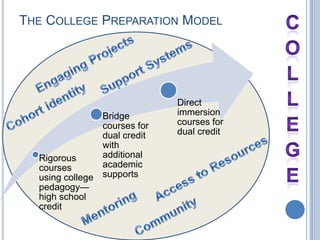
College Preparation: Deepening the PipelineSelection of “cusp” or “middle of the road” studentsTwo-year commitment to students with high-quality resourcesAcademic supports for writing, reading, speaking within college contextsContinuous development of students’ self-efficacy, leadership, and self-awareness through experiential and reflective activitiesCohort model as support networkCollege mentors as age-appropriate resources for adjusting to expectations and cultureFocused supports for college and career awareness, college searches, applications, and financial aidContinued supports for students who find The New School a strong match for them
The College Preparation ModelCollegeEngaging ProjectsSupport SystemsCohort identityAccess to ResourcesMentoringCommunity
The College Preparation  Academic Model
College Preparation:  The Extra-curricular ModelCollege Exploration Series:Social Inquiry Project-Students build investigative skills and explore college by getting to know New School students through college panels, visiting college campuses, and learning about ways of accessing college resources. College Planning Days- These interactive sessions engage students in learning about the college application and admissions processes as well skills that will support their success in college. Topics include the college search, admissions process, personal essays, financial aid, time management and improving study habits.Media Action Projects: Learning about basic media design concepts and research methods through the development of technical skills and conceptual frameworks for effective communication of ideas and information  in today's networked, multimedia environment. Learn practical skills needed for creating multimedia presentations and websites with a range of authoring/presentation toolsCritically examine social web media in terms of participation, political involvement and community formation.
K-12/College Partnership: Changing the Future High School ExperienceDeep partner sites to explore creative pedagogy in education5-6 pilot schools with school change teams of 4-6 teachers committing to a 2-year change cycleCoursework on pedagogic approaches that inspire engagement and creativity (design, project/field based work, arts integration, critical discussion)School change plans designed by teams to appropriately apply learningAction research documenting practice and providing inquiry supportIntegration with data-driven district inquiry goalsFocus on more challenged schools
IUE Learning Arm: Deepening Systemic Understandings about College AccessData-rich analytics blended with fieldworkPartnership with NYC DOE to have system data for rigorous analysisCoordinated, planned qualitative data that will allow case studies to systematically, not just anecdotally, inform hard dataPartner schools help drive interpretationSummer research hours in year 3 to interpret data across sitesChange teams lead planning of city convening around  what we learned about bringing rich pedagogy into data-driven district change processes

Showcase Session Partnership Building: Building School-College Partnerships

  • 1.
    The Institute forUrban Education at The New SchoolNew Programs and Approaches for High School/ University Collaborations
  • 2.
    Historic PartnershipsA rangeof schools, many reflecting creative and eclectic approaches to structuring education shared by Eugene Lang CollegePrograms targeted at the pre-college and college-ready levels, inadvertently but effectively excluding students not already college ready level but who could, with supports, succeed in collegeSemester-by-semester options created great flexibility for some students and schools but not enough structure for students needing more support
  • 3.
    Re-visioning the IUEWorkfrom our strengthsWhat is unique about The New School that might be helpful to K-12 educational efforts?Address critical K-12 needsHow can The New School be part of the city’s efforts to ensure high school success and college access for all, especially those historically underrepresented in college? Address critical college needsWhat does The New School need in order to ensure all students succeed when they matriculate, and how might those lessons translate to other colleges?Keep what worksHow do we ensure continuance of programs and programmatic aspects that work?
  • 4.
  • 5.
    College Opportunities: Strengtheningthe Existing PipelineDual credit immersion in high-quality liberal arts coursework Atypical dual credit classes—media studies, theatre, urban studies, civil rightsClasses taught by regular facultyNo more than 2 high school students per classNew community supports to mitigate risks for someCommunity building activities related to recruitment effortsAccess to financial aid and application workshopsIncreasing integration into freshman programmingSocial activities
  • 6.
    College Preparation: Deepeningthe PipelineSelection of “cusp” or “middle of the road” studentsTwo-year commitment to students with high-quality resourcesAcademic supports for writing, reading, speaking within college contextsContinuous development of students’ self-efficacy, leadership, and self-awareness through experiential and reflective activitiesCohort model as support networkCollege mentors as age-appropriate resources for adjusting to expectations and cultureFocused supports for college and career awareness, college searches, applications, and financial aidContinued supports for students who find The New School a strong match for them
  • 7.
    The College PreparationModelCollegeEngaging ProjectsSupport SystemsCohort identityAccess to ResourcesMentoringCommunity
  • 8.
  • 9.
    College Preparation: The Extra-curricular ModelCollege Exploration Series:Social Inquiry Project-Students build investigative skills and explore college by getting to know New School students through college panels, visiting college campuses, and learning about ways of accessing college resources. College Planning Days- These interactive sessions engage students in learning about the college application and admissions processes as well skills that will support their success in college. Topics include the college search, admissions process, personal essays, financial aid, time management and improving study habits.Media Action Projects: Learning about basic media design concepts and research methods through the development of technical skills and conceptual frameworks for effective communication of ideas and information in today's networked, multimedia environment. Learn practical skills needed for creating multimedia presentations and websites with a range of authoring/presentation toolsCritically examine social web media in terms of participation, political involvement and community formation.
  • 10.
    K-12/College Partnership: Changingthe Future High School ExperienceDeep partner sites to explore creative pedagogy in education5-6 pilot schools with school change teams of 4-6 teachers committing to a 2-year change cycleCoursework on pedagogic approaches that inspire engagement and creativity (design, project/field based work, arts integration, critical discussion)School change plans designed by teams to appropriately apply learningAction research documenting practice and providing inquiry supportIntegration with data-driven district inquiry goalsFocus on more challenged schools
  • 11.
    IUE Learning Arm:Deepening Systemic Understandings about College AccessData-rich analytics blended with fieldworkPartnership with NYC DOE to have system data for rigorous analysisCoordinated, planned qualitative data that will allow case studies to systematically, not just anecdotally, inform hard dataPartner schools help drive interpretationSummer research hours in year 3 to interpret data across sitesChange teams lead planning of city convening around what we learned about bringing rich pedagogy into data-driven district change processes

Editor's Notes