Two Summer Enrichment Programs, Two Approaches William Gellman Summerbridge Pittsburgh ◊ Sewickley Academy NPEA Annual Conference April 9, 2010
Background: Summerbridge Pittsburgh (SBP) and Kinkaid-HISD Engineering-Math-Science Institute (EMSI) SBP EMSI Carried out in K-12 independent school: Sewickley Academy (Sewickley, PA) Carried out in K-12 independent school: Kinkaid School (Houston, TX) Established in 1994 Mission: Increase high school graduation rates  and college matriculation rates for underserved students Established in 1976 Mission: Increase representation of minority students in math- and science-related careers Started as a summer-only program; now has school-year components Summer only program Member of the Breakthrough Collaborative Unaffiliated; run independently by the Kinkaid School in cooperation with HISD
The Breakthrough Collaborative (27 locations across the US)
Background: Summerbridge Pittsburgh & Kinkaid-HISD Engineering-Math-Science Institute SBP EMSI Curriculum: science (2), math (3), literature (3), foreign language (3),  Curriculum: biology (1) chemistry (3), math (3), drafting and AutoCAD (3), computer programming (3), physics (2), SAT prep (2), digital electronics (2) FTE: 3 Summer: employs 22 college-aged and high school teachers, overseen by 4 veteran educators (one for each subject area) FTE: 0 (managed internally by handful of Kinkaid faculty & staff) Summer: Employs approximately 10 teachers, all of whom are professional educators Funding: foundations (44%), individuals (25%), endowment (14%), host school (10%), state (6%), corporations (1%) Funding: corporations (60-70%), host school (30-40%), HISD (transportation is provided in kind)
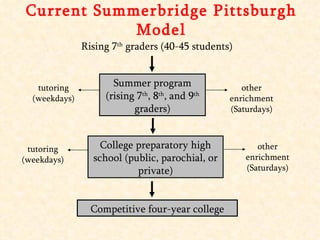
Current Summerbridge Pittsburgh Model Rising 7 th  graders (40-45 students) Summer program (rising 7 th , 8 th , and 9 th  graders) tutoring (weekdays) other enrichment (Saturdays) College preparatory high school (public, parochial, or private) tutoring (weekdays) other enrichment (Saturdays) Competitive four-year college
Selection of Incoming Students (SBP) Student selection criteria: Racial or ethnic minority Limited household income, as indicated by participation in a free and reduced-price lunch program Potential first-generation college student Single parent household or non-traditional family structure Come from an under-resourced school and/or under-resourced neighborhood. Profile of current 7th and 8th graders 87% are students of color 60% come from single-parent households 51% participate in a free or reduced-price lunch program
Current Kinkaid-HISD EMSI Model Rising 8 th  graders Level II (2 groups) Level I (3 groups) Level III 35-40 students 18-20 students 55-60 students Internship with a sponsor corporation 8-10 students
Qualitative Assessment SBP EMSI Academic preparation Decent; getting better Very rigorous Number of students served Student attrition is low, if selection process is rigorous; adaptation of a six-year model casts a wider net “ Forced attrition” model serves a small number of students very well College matriculation Appreciable numbers of students go on to college; few students attend highly competitive universities Handful of students (Level III or IV) attain scholarships; higher percentage attend more competitive schools Follow-through and data collection Membership in national organization and unique program culture encourage students to stay in touch; data collection is improving Students do not stay in close touch with program; no longitudinal information exists
Measuring SBP Effectiveness - Students Cohort: year of entrance into  Summerbridge/year  of expected high  school graduation Number of  students  in the  class Percentage of respondents  from  the class High  school  graduation  rate College degree attainment rate Matriculation rate (college graduates plus those that attended college but have yet to obtain a degree) 1994/2000 46 41% 100% 63% 89% 1995/2001 47 40% 84% 58% 58% 1996/2002 42 38% 100% 44% 69% 1997/2003 49 53% 100% 81% 92% 1998/2004 44 57% 96% 60% 72% 33% High School graduation rate for low-income students (NELS). 21% College degree attainment rate for low-income students by age 26 (NELS). 50% Current year-three benchmark for college degree attainment rate (BTC); this benchmark will increase to 65% in year-four (2010-2011).
Measuring SBP Effectiveness - Teachers Secondary mission of the program involves getting exceptional college students excited about pursuing careers in education 114 Number of teacher applicants for summer 2009 22 Number of teaching positions for summer 2009 33% Percentage of teachers from universities ranked in the top 25 of US News and World Report’s  Best National Universities for 2009 44% Percentage of teachers from universities ranked in the top 35 of US News and World Report’s  Best National Universities for 2009 35% Percentage of teachers – summer 2008 and 2009 -- that have:  enrolled or in the process of enrolling in a Master of Arts in Teaching (MAT) program; been accepted into or are in the process of applying to  Teach For America .
More Information The Breakthrough Collaborative www.breakthroughcollaborative.org Sewickley Academy www.sewickley.org Summerbridge Pittsburgh www.summerbridgepittsburgh.org William Gellman 412-741-2230 ext. 3142 [email_address]

Showcase Session: Summer Learning (Summerbridge Pittsburgh)

  • 1.
    Two Summer EnrichmentPrograms, Two Approaches William Gellman Summerbridge Pittsburgh ◊ Sewickley Academy NPEA Annual Conference April 9, 2010
  • 2.
    Background: Summerbridge Pittsburgh(SBP) and Kinkaid-HISD Engineering-Math-Science Institute (EMSI) SBP EMSI Carried out in K-12 independent school: Sewickley Academy (Sewickley, PA) Carried out in K-12 independent school: Kinkaid School (Houston, TX) Established in 1994 Mission: Increase high school graduation rates and college matriculation rates for underserved students Established in 1976 Mission: Increase representation of minority students in math- and science-related careers Started as a summer-only program; now has school-year components Summer only program Member of the Breakthrough Collaborative Unaffiliated; run independently by the Kinkaid School in cooperation with HISD
  • 3.
    The Breakthrough Collaborative(27 locations across the US)
  • 4.
    Background: Summerbridge Pittsburgh& Kinkaid-HISD Engineering-Math-Science Institute SBP EMSI Curriculum: science (2), math (3), literature (3), foreign language (3), Curriculum: biology (1) chemistry (3), math (3), drafting and AutoCAD (3), computer programming (3), physics (2), SAT prep (2), digital electronics (2) FTE: 3 Summer: employs 22 college-aged and high school teachers, overseen by 4 veteran educators (one for each subject area) FTE: 0 (managed internally by handful of Kinkaid faculty & staff) Summer: Employs approximately 10 teachers, all of whom are professional educators Funding: foundations (44%), individuals (25%), endowment (14%), host school (10%), state (6%), corporations (1%) Funding: corporations (60-70%), host school (30-40%), HISD (transportation is provided in kind)
  • 5.
    Current Summerbridge PittsburghModel Rising 7 th graders (40-45 students) Summer program (rising 7 th , 8 th , and 9 th graders) tutoring (weekdays) other enrichment (Saturdays) College preparatory high school (public, parochial, or private) tutoring (weekdays) other enrichment (Saturdays) Competitive four-year college
  • 6.
    Selection of IncomingStudents (SBP) Student selection criteria: Racial or ethnic minority Limited household income, as indicated by participation in a free and reduced-price lunch program Potential first-generation college student Single parent household or non-traditional family structure Come from an under-resourced school and/or under-resourced neighborhood. Profile of current 7th and 8th graders 87% are students of color 60% come from single-parent households 51% participate in a free or reduced-price lunch program
  • 7.
    Current Kinkaid-HISD EMSIModel Rising 8 th graders Level II (2 groups) Level I (3 groups) Level III 35-40 students 18-20 students 55-60 students Internship with a sponsor corporation 8-10 students
  • 8.
    Qualitative Assessment SBPEMSI Academic preparation Decent; getting better Very rigorous Number of students served Student attrition is low, if selection process is rigorous; adaptation of a six-year model casts a wider net “ Forced attrition” model serves a small number of students very well College matriculation Appreciable numbers of students go on to college; few students attend highly competitive universities Handful of students (Level III or IV) attain scholarships; higher percentage attend more competitive schools Follow-through and data collection Membership in national organization and unique program culture encourage students to stay in touch; data collection is improving Students do not stay in close touch with program; no longitudinal information exists
  • 9.
    Measuring SBP Effectiveness- Students Cohort: year of entrance into Summerbridge/year of expected high school graduation Number of students in the class Percentage of respondents from the class High school graduation rate College degree attainment rate Matriculation rate (college graduates plus those that attended college but have yet to obtain a degree) 1994/2000 46 41% 100% 63% 89% 1995/2001 47 40% 84% 58% 58% 1996/2002 42 38% 100% 44% 69% 1997/2003 49 53% 100% 81% 92% 1998/2004 44 57% 96% 60% 72% 33% High School graduation rate for low-income students (NELS). 21% College degree attainment rate for low-income students by age 26 (NELS). 50% Current year-three benchmark for college degree attainment rate (BTC); this benchmark will increase to 65% in year-four (2010-2011).
  • 10.
    Measuring SBP Effectiveness- Teachers Secondary mission of the program involves getting exceptional college students excited about pursuing careers in education 114 Number of teacher applicants for summer 2009 22 Number of teaching positions for summer 2009 33% Percentage of teachers from universities ranked in the top 25 of US News and World Report’s Best National Universities for 2009 44% Percentage of teachers from universities ranked in the top 35 of US News and World Report’s Best National Universities for 2009 35% Percentage of teachers – summer 2008 and 2009 -- that have: enrolled or in the process of enrolling in a Master of Arts in Teaching (MAT) program; been accepted into or are in the process of applying to Teach For America .
  • 11.
    More Information TheBreakthrough Collaborative www.breakthroughcollaborative.org Sewickley Academy www.sewickley.org Summerbridge Pittsburgh www.summerbridgepittsburgh.org William Gellman 412-741-2230 ext. 3142 [email_address]