Shock
Scott G. Sagraves, MD, FACS
Assistant Professor
Trauma & Surgical Critical Care
Associate Director of Trauma
UHS of Eastern Carolina
Objectives
•
•
•
•

Define & classify shock
Outline management principles
Discuss goals of fluid resuscitation
Understand the concepts of oxygen
supply and demand in managing shock.
• Describe the physiologic effects of
vasopressors and inotropic agents
Goals
• Review hemodynamic techniques in the ICU
• Introduce the concept of the cardiac cycle
• Review of the pulmonary artery catheter
parameters
• Utilize the presentation to analyze clinical
cases and to feel comfortable with pa-c
parameters.
Shock:
“A momentary pause in the act of
death.”
-John Collins Warren, 1800s
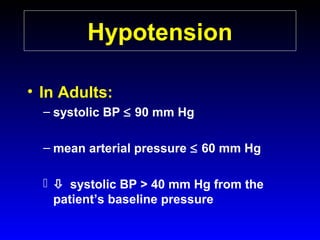
Hypotension
• In Adults:
– systolic BP ≤ 90 mm Hg
– mean arterial pressure ≤ 60 mm Hg
  systolic BP > 40 mm Hg from the
patient’s baseline pressure
Definition
SHOCK: inadequate organ perfusion
to meet the tissue’s oxygenation
demand.
“Hypoperfusion can be
present in the absence of
significant hypotension.”

-fccs course
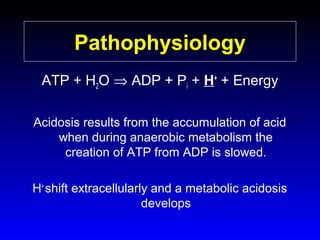
Pathophysiology
ATP + H2O ⇒ ADP + Pi + H+ + Energy
Acidosis results from the accumulation of acid
when during anaerobic metabolism the
creation of ATP from ADP is slowed.
H+ shift extracellularly and a metabolic acidosis
develops
Pathophysiology
• ATP production fails, the Na+/K+ pump
fails resulting in the inability to correct
the cell electronic potential.
• Cell swelling occurs leading to rupture
and death.
• Oxidative Phosphorylation stops &
anaerobic metabolism begins leading to
lactic acid production.
Why Monitor?
• Essential to understanding their disease
• Describe the patient’s physiologic
status
• Facilitates diagnosis and treatment of
shock
History
• 1960’s
– low BP = shock; MSOF resulted after BP
restored

• 1970’s
– Swan & Ganz - flow-directed catheter
– thermistor → cardiac output

• 1980’s
– resuscitation based on oxygen delivery,
consumption & oxygen transport balance.
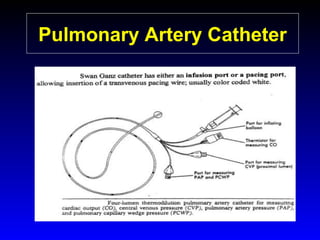
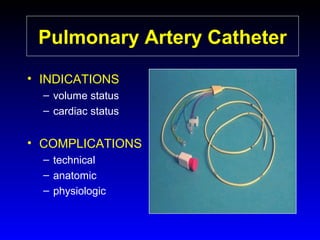
Pulmonary Artery Catheter
• INDICATIONS
– volume status
– cardiac status

• COMPLICATIONS
– technical
– anatomic
– physiologic
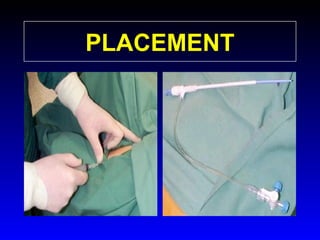
PLACEMENT
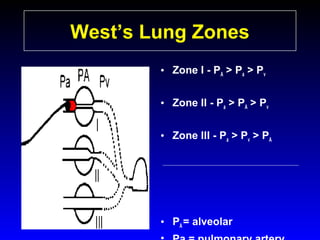
West’s Lung Zones
• Zone I - PA > Pa > Pv
• Zone II - Pa > PA > Pv
• Zone III - Pa > Pv > PA

• PA = alveolar
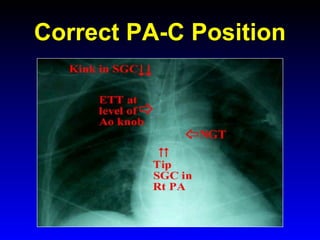
Correct PA-C Position
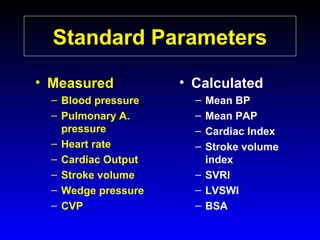
Standard Parameters
• Measured
– Blood pressure
– Pulmonary A.
pressure
– Heart rate
– Cardiac Output
– Stroke volume
– Wedge pressure
– CVP

• Calculated
–
–
–
–

Mean BP
Mean PAP
Cardiac Index
Stroke volume
index
– SVRI
– LVSWI
– BSA
Why Index?
• Body habitus and size is individual
• Inter-patient variability does not allow
“normal” ranges
• “Indexing” to patient with BSA allows for
reproducible standard
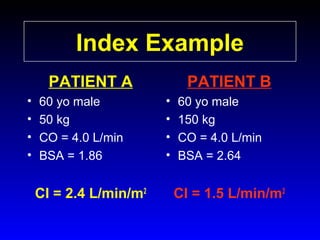
Index Example
PATIENT A
•
•
•
•

60 yo male
50 kg
CO = 4.0 L/min
BSA = 1.86

CI = 2.4 L/min/m2

PATIENT B
•
•
•
•

60 yo male
150 kg
CO = 4.0 L/min
BSA = 2.64

CI = 1.5 L/min/m2
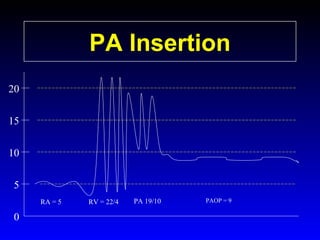
PA Insertion
20
15
10
5
RA = 5

0

RV = 22/4

PA 19/10

PAOP = 9
CVP
•
•
•
•

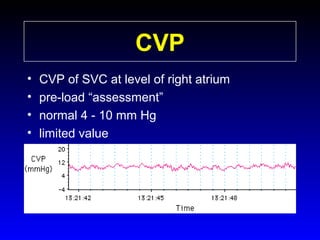
CVP of SVC at level of right atrium
pre-load “assessment”
normal 4 - 10 mm Hg
limited value
PAOP

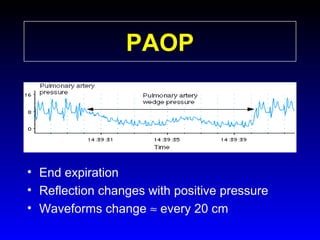
• End expiration
• Reflection changes with positive pressure
• Waveforms change ≈ every 20 cm
Waveform Analysis

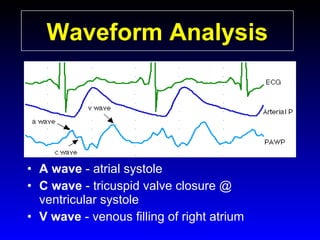
• A wave - atrial systole
• C wave - tricuspid valve closure @
ventricular systole
• V wave - venous filling of right atrium
Cardiac Cycle
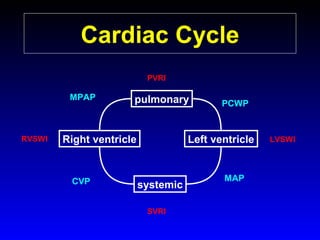
PVRI

MPAP

RVSWI

pulmonary

Right ventricle

CVP

PCWP

Left ventricle

systemic
SVRI

MAP

LVSWI
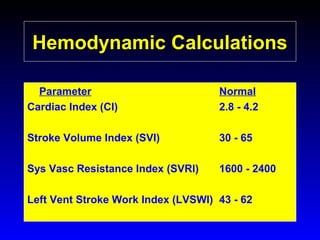
Hemodynamic Calculations
Parameter
Cardiac Index (CI)

Normal
2.8 - 4.2

Stroke Volume Index (SVI)

30 - 65

Sys Vasc Resistance Index (SVRI)

1600 - 2400

Left Vent Stroke Work Index (LVSWI) 43 - 62
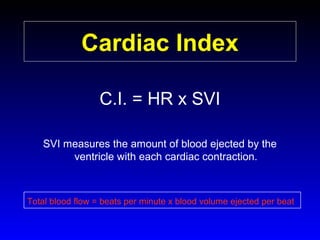
Cardiac Index
C.I. = HR x SVI
SVI measures the amount of blood ejected by the
ventricle with each cardiac contraction.

Total blood flow = beats per minute x blood volume ejected per beat
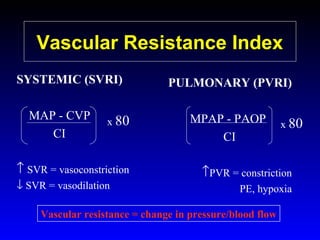
Vascular Resistance Index
SYSTEMIC (SVRI)
MAP - CVP
CI

x 80

↑ SVR = vasoconstriction
↓ SVR = vasodilation

PULMONARY (PVRI)
MPAP - PAOP
CI

x 80

↑PVR = constriction
PE, hypoxia

Vascular resistance = change in pressure/blood flow
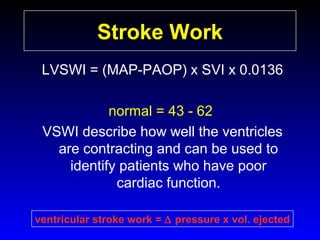
Stroke Work
LVSWI = (MAP-PAOP) x SVI x 0.0136
normal = 43 - 62
VSWI describe how well the ventricles
are contracting and can be used to
identify patients who have poor
cardiac function.
ventricular stroke work = ∆ pressure x vol. ejected
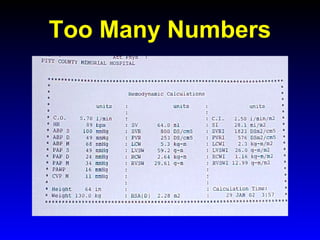
Too Many Numbers
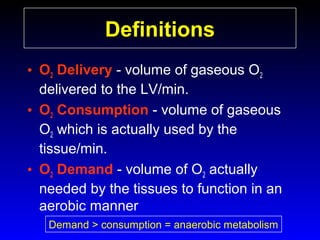
Definitions
• O2 Delivery - volume of gaseous O2
delivered to the LV/min.
• O2 Consumption - volume of gaseous
O2 which is actually used by the
tissue/min.
• O2 Demand - volume of O2 actually
needed by the tissues to function in an
aerobic manner
Demand > consumption = anaerobic metabolism
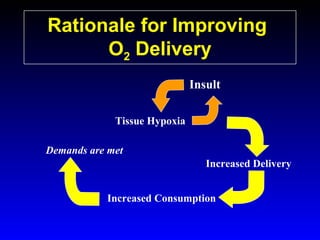
Rationale for Improving
O2 Delivery
Insult
Tissue Hypoxia
Demands are met
Increased Delivery
Increased Consumption
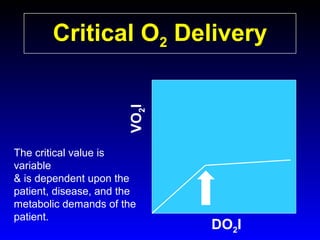
VO2I

Critical O2 Delivery

The critical value is
variable
& is dependent upon the
patient, disease, and the
metabolic demands of the
patient.

DO2I
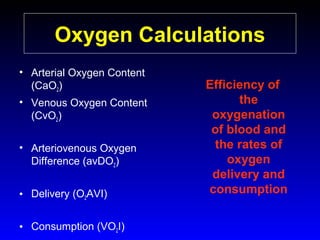
Oxygen Calculations
• Arterial Oxygen Content
(CaO2)
• Venous Oxygen Content
(CvO2)
• Arteriovenous Oxygen
Difference (avDO2)
• Delivery (O2AVI)
• Consumption (VO2I)

Efficiency of
the
oxygenation
of blood and
the rates of
oxygen
delivery and
consumption
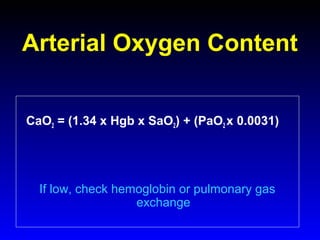
Arterial Oxygen Content
CaO2 = (1.34 x Hgb x SaO2) + (PaO2 x 0.0031)

If low, check hemoglobin or pulmonary gas
exchange
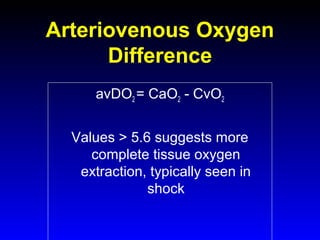
Arteriovenous Oxygen
Difference
avDO2 = CaO2 - CvO2
Values > 5.6 suggests more
complete tissue oxygen
extraction, typically seen in
shock
Oxygen Delivery (DO2I)
O2AVI = CI x CaO2 x 10
Normal values suggests that the heart
& lungs are working efficiently to
provide oxygen to the tissues.
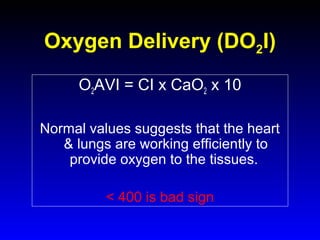
< 400 is bad sign
Oxygen Consumption
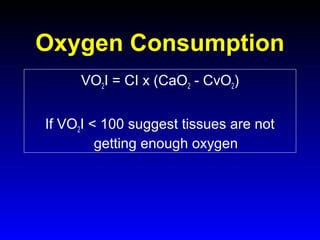
VO2I = CI x (CaO2 - CvO2)
If VO2I < 100 suggest tissues are not
getting enough oxygen
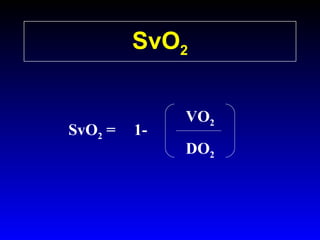
SvO2

SvO2 =

1-

VO2
DO2
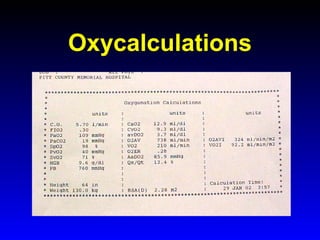
Oxycalculations
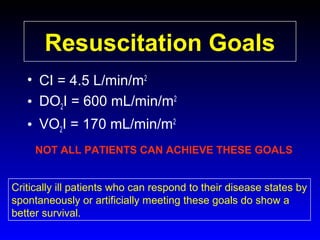
Resuscitation Goals
• CI = 4.5 L/min/m2
• DO2I = 600 mL/min/m2
• VO2I = 170 mL/min/m2
NOT ALL PATIENTS CAN ACHIEVE THESE GOALS
Critically ill patients who can respond to their disease states by
spontaneously or artificially meeting these goals do show a
better survival.
Break Time…
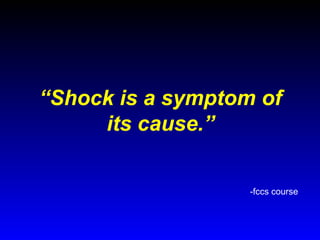
“Shock is a symptom of
its cause.”
-fccs course
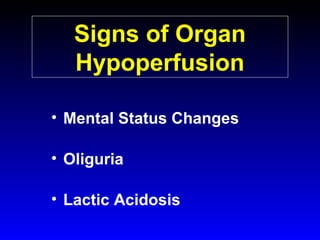
Signs of Organ
Hypoperfusion
• Mental Status Changes
• Oliguria
• Lactic Acidosis
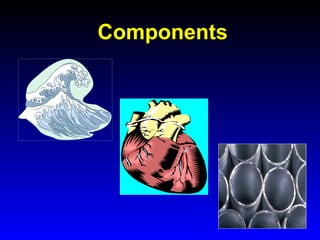
Components
Categories of Shock
• HYPOVOLEMIC
• CARDIOGENIC
• DISTRIBUTIVE
• OBSTRUCTIVE
Goals of Shock
Resuscitation
• Restore blood pressure
• Normalize systemic perfusion
• Preserve organ function
In general, treat the cause...
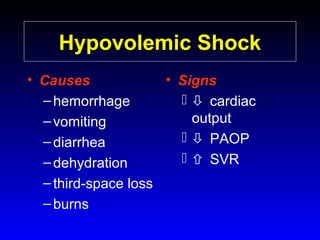
Hypovolemic Shock
• Causes
• Signs
  cardiac
– hemorrhage
output
– vomiting
  PAOP
– diarrhea
  SVR
– dehydration
– third-space loss
– burns
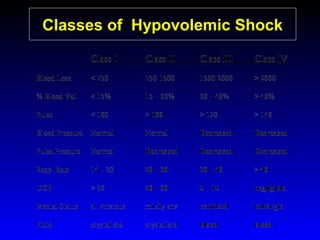
Classes of Hypovolemic Shock
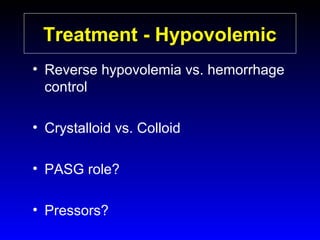
Treatment - Hypovolemic
• Reverse hypovolemia vs. hemorrhage
control
• Crystalloid vs. Colloid
• PASG role?
• Pressors?
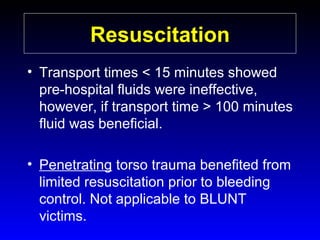
Resuscitation
• Transport times < 15 minutes showed
pre-hospital fluids were ineffective,
however, if transport time > 100 minutes
fluid was beneficial.
• Penetrating torso trauma benefited from
limited resuscitation prior to bleeding
control. Not applicable to BLUNT
victims.
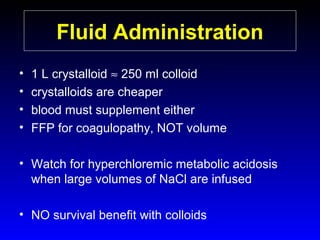
Fluid Administration
•
•
•
•

1 L crystalloid ≈ 250 ml colloid
crystalloids are cheaper
blood must supplement either
FFP for coagulopathy, NOT volume

• Watch for hyperchloremic metabolic acidosis
when large volumes of NaCl are infused
• NO survival benefit with colloids
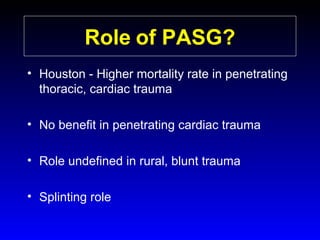
Role of PASG?
• Houston - Higher mortality rate in penetrating
thoracic, cardiac trauma
• No benefit in penetrating cardiac trauma
• Role undefined in rural, blunt trauma
• Splinting role
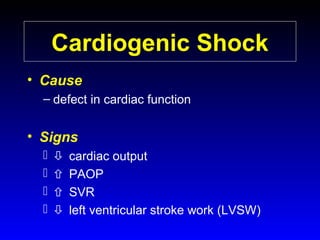
Cardiogenic Shock
• Cause
– defect in cardiac function

• Signs





 cardiac output
 PAOP
 SVR
 left ventricular stroke work (LVSW)
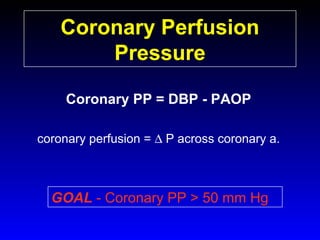
Coronary Perfusion
Pressure
Coronary PP = DBP - PAOP
coronary perfusion = ∆ P across coronary a.

GOAL - Coronary PP > 50 mm Hg
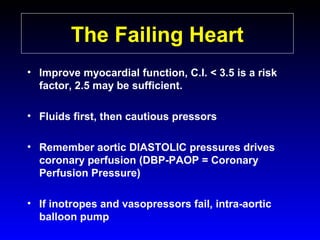
The Failing Heart
• Improve myocardial function, C.I. < 3.5 is a risk
factor, 2.5 may be sufficient.
• Fluids first, then cautious pressors
• Remember aortic DIASTOLIC pressures drives
coronary perfusion (DBP-PAOP = Coronary
Perfusion Pressure)
• If inotropes and vasopressors fail, intra-aortic
balloon pump
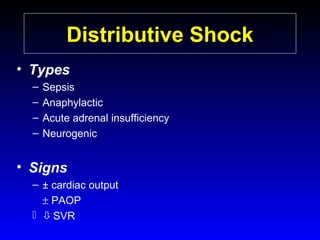
Distributive Shock
• Types
–
–
–
–

Sepsis
Anaphylactic
Acute adrenal insufficiency
Neurogenic

• Signs
– ± cardiac output
± PAOP
 SVR
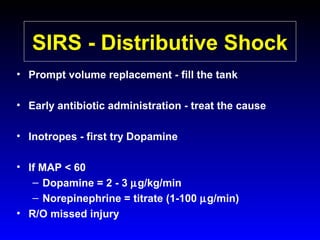
SIRS - Distributive Shock
• Prompt volume replacement - fill the tank
• Early antibiotic administration - treat the cause
• Inotropes - first try Dopamine
• If MAP < 60
– Dopamine = 2 - 3 µg/kg/min
– Norepinephrine = titrate (1-100 µg/min)
• R/O missed injury
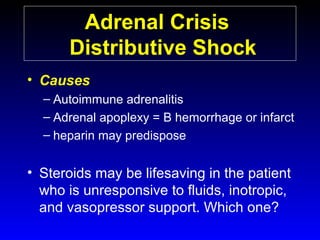
Adrenal Crisis
Distributive Shock
• Causes
– Autoimmune adrenalitis
– Adrenal apoplexy = B hemorrhage or infarct
– heparin may predispose

• Steroids may be lifesaving in the patient
who is unresponsive to fluids, inotropic,
and vasopressor support. Which one?
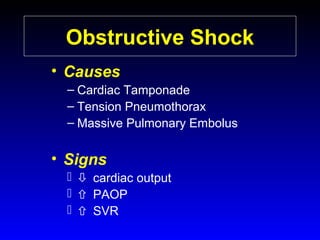
Obstructive Shock
• Causes
– Cardiac Tamponade
– Tension Pneumothorax
– Massive Pulmonary Embolus

• Signs
  cardiac output
  PAOP
  SVR
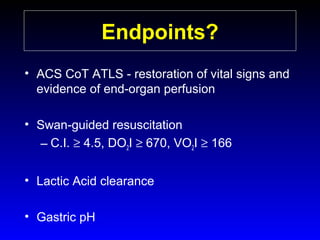
Endpoints?
• ACS CoT ATLS - restoration of vital signs and
evidence of end-organ perfusion
• Swan-guided resuscitation
– C.I. ≥ 4.5, DO2I ≥ 670, VO2I ≥ 166
• Lactic Acid clearance
• Gastric pH
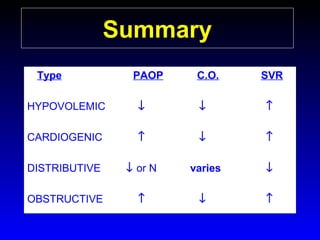
Summary
Type

PAOP

C.O.

SVR

HYPOVOLEMIC

↓

↓

↑

CARDIOGENIC

↑

↓

↑

DISTRIBUTIVE

↓ or N

OBSTRUCTIVE

↑

varies
↓

↓
↑
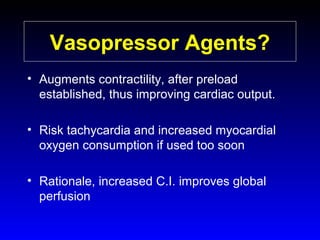
Vasopressor Agents?
• Augments contractility, after preload
established, thus improving cardiac output.
• Risk tachycardia and increased myocardial
oxygen consumption if used too soon
• Rationale, increased C.I. improves global
perfusion
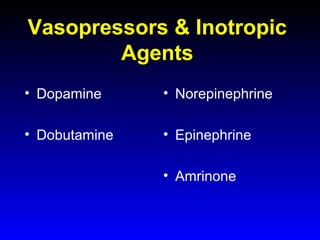
Vasopressors & Inotropic
Agents
• Dopamine

• Norepinephrine

• Dobutamine

• Epinephrine
• Amrinone
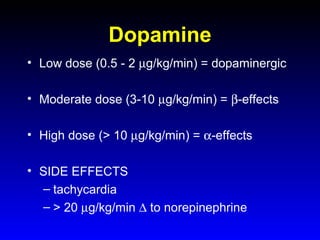
Dopamine
• Low dose (0.5 - 2 µg/kg/min) = dopaminergic
• Moderate dose (3-10 µg/kg/min) = β-effects
• High dose (> 10 µg/kg/min) = α-effects
• SIDE EFFECTS
– tachycardia
– > 20 µg/kg/min ∆ to norepinephrine
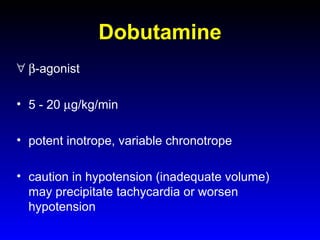
Dobutamine
∀ β-agonist
• 5 - 20 µg/kg/min
• potent inotrope, variable chronotrope
• caution in hypotension (inadequate volume)
may precipitate tachycardia or worsen
hypotension
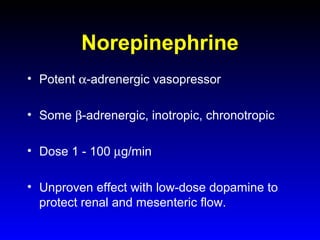
Norepinephrine
• Potent α-adrenergic vasopressor
• Some β-adrenergic, inotropic, chronotropic
• Dose 1 - 100 µg/min
• Unproven effect with low-dose dopamine to
protect renal and mesenteric flow.
Epinephrine
∀ α- and β-adrenergic effects
• potent inotrope and chronotrope
• dose 1 - 10 µg/min
• increases myocardial oxygen consumption
particularly in coronary heart disease
Amrinone
• Phosphodiesterase inhibitor, positive inotropic
and vasodilatory effects
• increased cardiac stroke output without an
increase in cardiac stroke work
• most often added with dobutamine as a second
agent
• load dose = 0.75 -1.5 mg/kg → 5 - 10 µg/kg/min
drip
• main side-effect - thrombocytopenia
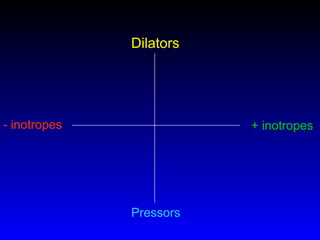
Dilators

- inotropes

+ inotropes

Pressors
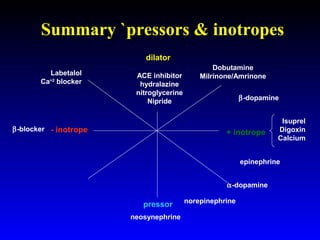
Summary `pressors & inotropes
dilator
Labetalol
+2
Ca blocker

ACE inhibitor
hydralazine
nitroglycerine
Nipride

β-blocker - inotrope

Dobutamine
Milrinone/Amrinone
β-dopamine

+ inotrope

Isuprel
Digoxin
Calcium

epinephrine
α-dopamine

pressor
neosynephrine

norepinephrine
Case Studies
GSW
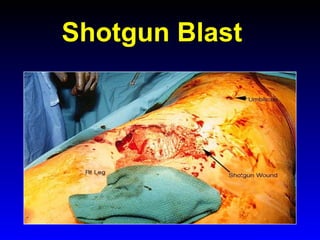
• 24 year old male victim of a
shotgun blast to his right lower
quadrant/groin at close range.
• Hemodynamically unstable in the
field and his right lower extremity
was cool and pulseless upon
arrival to the trauma resuscitation
area.
Shotgun Blast
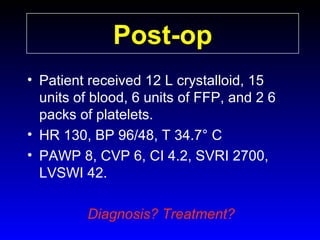
Post-op
• Patient received 12 L crystalloid, 15
units of blood, 6 units of FFP, and 2 6
packs of platelets.
• HR 130, BP 96/48, T 34.7° C
• PAWP 8, CVP 6, CI 4.2, SVRI 2700,
LVSWI 42.
Diagnosis? Treatment?
SHOCK/HYPOVOLEMIA
• FLUIDS… FLUIDS… FLUIDS…
• BLOOD & PRODUCTS TRANSFUSION
• CORRECT
– ACIDOSIS
– COAGULOPATHY
– HYPOTHERMIA
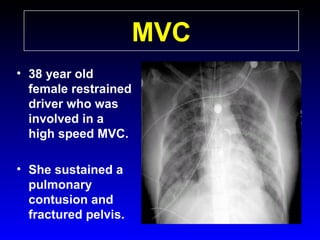
MVC
• 38 year old
female restrained
driver who was
involved in a
high speed MVC.
• She sustained a
pulmonary
contusion and
fractured pelvis.
ICU Course
• Intubated and monitored with PA-C
• PCWP = 22, CI = 3.5, SVRI = 2400,
LVSWI = 39.8
• HR = 120, BP = 110/56, SpO2 = 91,
UOP = 25 cc/hr
What do you think...
HYPOVOLEMIA
ADJUST YOUR WEDGE FOR THE
PEEP
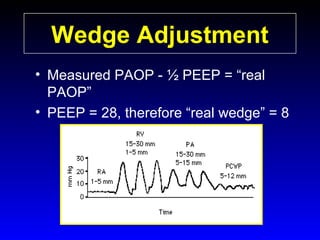
Wedge Adjustment
• Measured PAOP - ½ PEEP = “real
PAOP”
• PEEP = 28, therefore “real wedge” = 8
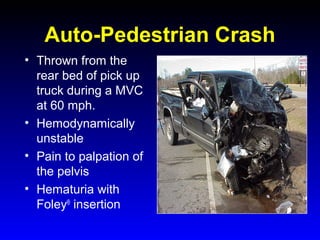
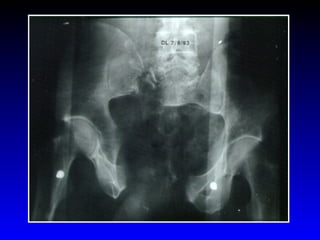
Auto-Pedestrian Crash
• Thrown from the
rear bed of pick up
truck during a MVC
at 60 mph.
• Hemodynamically
unstable
• Pain to palpation of
the pelvis
• Hematuria with
Foley® insertion
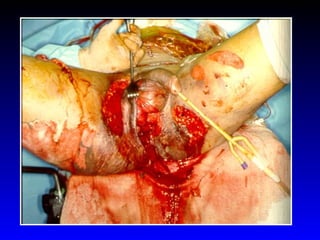
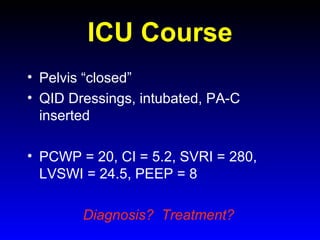
ICU Course
• Pelvis “closed”
• QID Dressings, intubated, PA-C
inserted
• PCWP = 20, CI = 5.2, SVRI = 280,
LVSWI = 24.5, PEEP = 8
Diagnosis? Treatment?
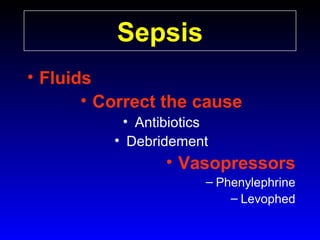
Sepsis
• Fluids
• Correct the cause
• Antibiotics
• Debridement

• Vasopressors
– Phenylephrine
– Levophed
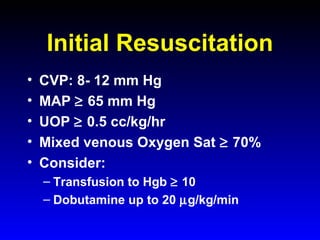
Initial Resuscitation
•
•
•
•
•

CVP: 8- 12 mm Hg
MAP ≥ 65 mm Hg
UOP ≥ 0.5 cc/kg/hr
Mixed venous Oxygen Sat ≥ 70%
Consider:
– Transfusion to Hgb ≥ 10
– Dobutamine up to 20 µg/kg/min
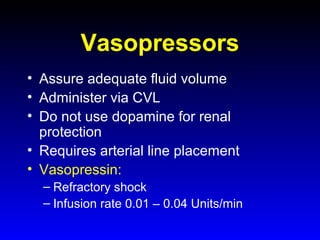
Vasopressors
• Assure adequate fluid volume
• Administer via CVL
• Do not use dopamine for renal
protection
• Requires arterial line placement
• Vasopressin:
– Refractory shock
– Infusion rate 0.01 – 0.04 Units/min
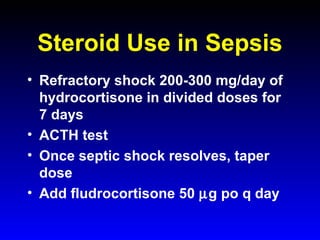
Steroid Use in Sepsis
• Refractory shock 200-300 mg/day of
hydrocortisone in divided doses for
7 days
• ACTH test
• Once septic shock resolves, taper
dose
• Add fludrocortisone 50 µg po q day
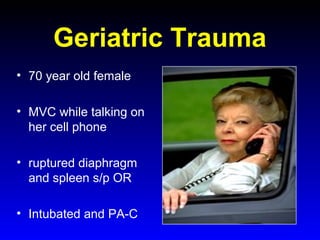
Geriatric Trauma
• 70 year old female
• MVC while talking on
her cell phone
• ruptured diaphragm
and spleen s/p OR
• Intubated and PA-C
ICU Course
• PCWP = 28, CI = 1.8, SVRI = 3150,
LVSWI = 20.7
Diagnosis? Treatment?
Cardiogenic Shock
• Preload augmentation - Consider Fluids
• Contractility
– dopamine
– dobutamine
– phosphodiesterase inhibitor

• Afterload reduction
– nitroglycerin
– dobutamine
Don’t forget...
Shock: “rude unhinging of the
machinery of life.”

-Samuel D. Gross, 1872
Shock

Shock

  • 1.
    Shock Scott G. Sagraves,MD, FACS Assistant Professor Trauma & Surgical Critical Care Associate Director of Trauma UHS of Eastern Carolina
  • 2.
    Objectives • • • • Define & classifyshock Outline management principles Discuss goals of fluid resuscitation Understand the concepts of oxygen supply and demand in managing shock. • Describe the physiologic effects of vasopressors and inotropic agents
  • 3.
    Goals • Review hemodynamictechniques in the ICU • Introduce the concept of the cardiac cycle • Review of the pulmonary artery catheter parameters • Utilize the presentation to analyze clinical cases and to feel comfortable with pa-c parameters.
  • 4.
    Shock: “A momentary pausein the act of death.” -John Collins Warren, 1800s
  • 5.
    Hypotension • In Adults: –systolic BP ≤ 90 mm Hg – mean arterial pressure ≤ 60 mm Hg   systolic BP > 40 mm Hg from the patient’s baseline pressure
  • 6.
    Definition SHOCK: inadequate organperfusion to meet the tissue’s oxygenation demand.
  • 7.
    “Hypoperfusion can be presentin the absence of significant hypotension.” -fccs course
  • 8.
    Pathophysiology ATP + H2O⇒ ADP + Pi + H+ + Energy Acidosis results from the accumulation of acid when during anaerobic metabolism the creation of ATP from ADP is slowed. H+ shift extracellularly and a metabolic acidosis develops
  • 9.
    Pathophysiology • ATP productionfails, the Na+/K+ pump fails resulting in the inability to correct the cell electronic potential. • Cell swelling occurs leading to rupture and death. • Oxidative Phosphorylation stops & anaerobic metabolism begins leading to lactic acid production.
  • 10.
    Why Monitor? • Essentialto understanding their disease • Describe the patient’s physiologic status • Facilitates diagnosis and treatment of shock
  • 11.
    History • 1960’s – lowBP = shock; MSOF resulted after BP restored • 1970’s – Swan & Ganz - flow-directed catheter – thermistor → cardiac output • 1980’s – resuscitation based on oxygen delivery, consumption & oxygen transport balance.
  • 12.
  • 13.
    Pulmonary Artery Catheter •INDICATIONS – volume status – cardiac status • COMPLICATIONS – technical – anatomic – physiologic
  • 14.
  • 15.
    West’s Lung Zones •Zone I - PA > Pa > Pv • Zone II - Pa > PA > Pv • Zone III - Pa > Pv > PA • PA = alveolar
  • 16.
  • 17.
    Standard Parameters • Measured –Blood pressure – Pulmonary A. pressure – Heart rate – Cardiac Output – Stroke volume – Wedge pressure – CVP • Calculated – – – – Mean BP Mean PAP Cardiac Index Stroke volume index – SVRI – LVSWI – BSA
  • 18.
    Why Index? • Bodyhabitus and size is individual • Inter-patient variability does not allow “normal” ranges • “Indexing” to patient with BSA allows for reproducible standard
  • 19.
    Index Example PATIENT A • • • • 60yo male 50 kg CO = 4.0 L/min BSA = 1.86 CI = 2.4 L/min/m2 PATIENT B • • • • 60 yo male 150 kg CO = 4.0 L/min BSA = 2.64 CI = 1.5 L/min/m2
  • 20.
    PA Insertion 20 15 10 5 RA =5 0 RV = 22/4 PA 19/10 PAOP = 9
  • 21.
    CVP • • • • CVP of SVCat level of right atrium pre-load “assessment” normal 4 - 10 mm Hg limited value
  • 22.
    PAOP • End expiration •Reflection changes with positive pressure • Waveforms change ≈ every 20 cm
  • 23.
    Waveform Analysis • Awave - atrial systole • C wave - tricuspid valve closure @ ventricular systole • V wave - venous filling of right atrium
  • 24.
  • 25.
    Hemodynamic Calculations Parameter Cardiac Index(CI) Normal 2.8 - 4.2 Stroke Volume Index (SVI) 30 - 65 Sys Vasc Resistance Index (SVRI) 1600 - 2400 Left Vent Stroke Work Index (LVSWI) 43 - 62
  • 26.
    Cardiac Index C.I. =HR x SVI SVI measures the amount of blood ejected by the ventricle with each cardiac contraction. Total blood flow = beats per minute x blood volume ejected per beat
  • 27.
    Vascular Resistance Index SYSTEMIC(SVRI) MAP - CVP CI x 80 ↑ SVR = vasoconstriction ↓ SVR = vasodilation PULMONARY (PVRI) MPAP - PAOP CI x 80 ↑PVR = constriction PE, hypoxia Vascular resistance = change in pressure/blood flow
  • 28.
    Stroke Work LVSWI =(MAP-PAOP) x SVI x 0.0136 normal = 43 - 62 VSWI describe how well the ventricles are contracting and can be used to identify patients who have poor cardiac function. ventricular stroke work = ∆ pressure x vol. ejected
  • 29.
  • 30.
    Definitions • O2 Delivery- volume of gaseous O2 delivered to the LV/min. • O2 Consumption - volume of gaseous O2 which is actually used by the tissue/min. • O2 Demand - volume of O2 actually needed by the tissues to function in an aerobic manner Demand > consumption = anaerobic metabolism
  • 31.
    Rationale for Improving O2Delivery Insult Tissue Hypoxia Demands are met Increased Delivery Increased Consumption
  • 32.
    VO2I Critical O2 Delivery Thecritical value is variable & is dependent upon the patient, disease, and the metabolic demands of the patient. DO2I
  • 33.
    Oxygen Calculations • ArterialOxygen Content (CaO2) • Venous Oxygen Content (CvO2) • Arteriovenous Oxygen Difference (avDO2) • Delivery (O2AVI) • Consumption (VO2I) Efficiency of the oxygenation of blood and the rates of oxygen delivery and consumption
  • 34.
    Arterial Oxygen Content CaO2= (1.34 x Hgb x SaO2) + (PaO2 x 0.0031) If low, check hemoglobin or pulmonary gas exchange
  • 35.
    Arteriovenous Oxygen Difference avDO2 =CaO2 - CvO2 Values > 5.6 suggests more complete tissue oxygen extraction, typically seen in shock
  • 36.
    Oxygen Delivery (DO2I) O2AVI= CI x CaO2 x 10 Normal values suggests that the heart & lungs are working efficiently to provide oxygen to the tissues. < 400 is bad sign
  • 37.
    Oxygen Consumption VO2I =CI x (CaO2 - CvO2) If VO2I < 100 suggest tissues are not getting enough oxygen
  • 38.
  • 39.
  • 40.
    Resuscitation Goals • CI= 4.5 L/min/m2 • DO2I = 600 mL/min/m2 • VO2I = 170 mL/min/m2 NOT ALL PATIENTS CAN ACHIEVE THESE GOALS Critically ill patients who can respond to their disease states by spontaneously or artificially meeting these goals do show a better survival.
  • 41.
  • 42.
    “Shock is asymptom of its cause.” -fccs course
  • 43.
    Signs of Organ Hypoperfusion •Mental Status Changes • Oliguria • Lactic Acidosis
  • 44.
  • 45.
    Categories of Shock •HYPOVOLEMIC • CARDIOGENIC • DISTRIBUTIVE • OBSTRUCTIVE
  • 46.
    Goals of Shock Resuscitation •Restore blood pressure • Normalize systemic perfusion • Preserve organ function
  • 47.
    In general, treatthe cause...
  • 48.
    Hypovolemic Shock • Causes •Signs   cardiac – hemorrhage output – vomiting   PAOP – diarrhea   SVR – dehydration – third-space loss – burns
  • 49.
  • 50.
    Treatment - Hypovolemic •Reverse hypovolemia vs. hemorrhage control • Crystalloid vs. Colloid • PASG role? • Pressors?
  • 51.
    Resuscitation • Transport times< 15 minutes showed pre-hospital fluids were ineffective, however, if transport time > 100 minutes fluid was beneficial. • Penetrating torso trauma benefited from limited resuscitation prior to bleeding control. Not applicable to BLUNT victims.
  • 52.
    Fluid Administration • • • • 1 Lcrystalloid ≈ 250 ml colloid crystalloids are cheaper blood must supplement either FFP for coagulopathy, NOT volume • Watch for hyperchloremic metabolic acidosis when large volumes of NaCl are infused • NO survival benefit with colloids
  • 53.
    Role of PASG? •Houston - Higher mortality rate in penetrating thoracic, cardiac trauma • No benefit in penetrating cardiac trauma • Role undefined in rural, blunt trauma • Splinting role
  • 54.
    Cardiogenic Shock • Cause –defect in cardiac function • Signs      cardiac output  PAOP  SVR  left ventricular stroke work (LVSW)
  • 55.
    Coronary Perfusion Pressure Coronary PP= DBP - PAOP coronary perfusion = ∆ P across coronary a. GOAL - Coronary PP > 50 mm Hg
  • 56.
    The Failing Heart •Improve myocardial function, C.I. < 3.5 is a risk factor, 2.5 may be sufficient. • Fluids first, then cautious pressors • Remember aortic DIASTOLIC pressures drives coronary perfusion (DBP-PAOP = Coronary Perfusion Pressure) • If inotropes and vasopressors fail, intra-aortic balloon pump
  • 57.
    Distributive Shock • Types – – – – Sepsis Anaphylactic Acuteadrenal insufficiency Neurogenic • Signs – ± cardiac output ± PAOP  SVR
  • 58.
    SIRS - DistributiveShock • Prompt volume replacement - fill the tank • Early antibiotic administration - treat the cause • Inotropes - first try Dopamine • If MAP < 60 – Dopamine = 2 - 3 µg/kg/min – Norepinephrine = titrate (1-100 µg/min) • R/O missed injury
  • 59.
    Adrenal Crisis Distributive Shock •Causes – Autoimmune adrenalitis – Adrenal apoplexy = B hemorrhage or infarct – heparin may predispose • Steroids may be lifesaving in the patient who is unresponsive to fluids, inotropic, and vasopressor support. Which one?
  • 60.
    Obstructive Shock • Causes –Cardiac Tamponade – Tension Pneumothorax – Massive Pulmonary Embolus • Signs   cardiac output   PAOP   SVR
  • 61.
    Endpoints? • ACS CoTATLS - restoration of vital signs and evidence of end-organ perfusion • Swan-guided resuscitation – C.I. ≥ 4.5, DO2I ≥ 670, VO2I ≥ 166 • Lactic Acid clearance • Gastric pH
  • 62.
  • 63.
    Vasopressor Agents? • Augmentscontractility, after preload established, thus improving cardiac output. • Risk tachycardia and increased myocardial oxygen consumption if used too soon • Rationale, increased C.I. improves global perfusion
  • 64.
    Vasopressors & Inotropic Agents •Dopamine • Norepinephrine • Dobutamine • Epinephrine • Amrinone
  • 65.
    Dopamine • Low dose(0.5 - 2 µg/kg/min) = dopaminergic • Moderate dose (3-10 µg/kg/min) = β-effects • High dose (> 10 µg/kg/min) = α-effects • SIDE EFFECTS – tachycardia – > 20 µg/kg/min ∆ to norepinephrine
  • 66.
    Dobutamine ∀ β-agonist • 5- 20 µg/kg/min • potent inotrope, variable chronotrope • caution in hypotension (inadequate volume) may precipitate tachycardia or worsen hypotension
  • 67.
    Norepinephrine • Potent α-adrenergicvasopressor • Some β-adrenergic, inotropic, chronotropic • Dose 1 - 100 µg/min • Unproven effect with low-dose dopamine to protect renal and mesenteric flow.
  • 68.
    Epinephrine ∀ α- andβ-adrenergic effects • potent inotrope and chronotrope • dose 1 - 10 µg/min • increases myocardial oxygen consumption particularly in coronary heart disease
  • 69.
    Amrinone • Phosphodiesterase inhibitor,positive inotropic and vasodilatory effects • increased cardiac stroke output without an increase in cardiac stroke work • most often added with dobutamine as a second agent • load dose = 0.75 -1.5 mg/kg → 5 - 10 µg/kg/min drip • main side-effect - thrombocytopenia
  • 70.
  • 71.
    Summary `pressors &inotropes dilator Labetalol +2 Ca blocker ACE inhibitor hydralazine nitroglycerine Nipride β-blocker - inotrope Dobutamine Milrinone/Amrinone β-dopamine + inotrope Isuprel Digoxin Calcium epinephrine α-dopamine pressor neosynephrine norepinephrine
  • 72.
  • 73.
    GSW • 24 yearold male victim of a shotgun blast to his right lower quadrant/groin at close range. • Hemodynamically unstable in the field and his right lower extremity was cool and pulseless upon arrival to the trauma resuscitation area.
  • 74.
  • 75.
    Post-op • Patient received12 L crystalloid, 15 units of blood, 6 units of FFP, and 2 6 packs of platelets. • HR 130, BP 96/48, T 34.7° C • PAWP 8, CVP 6, CI 4.2, SVRI 2700, LVSWI 42. Diagnosis? Treatment?
  • 76.
    SHOCK/HYPOVOLEMIA • FLUIDS… FLUIDS…FLUIDS… • BLOOD & PRODUCTS TRANSFUSION • CORRECT – ACIDOSIS – COAGULOPATHY – HYPOTHERMIA
  • 77.
    MVC • 38 yearold female restrained driver who was involved in a high speed MVC. • She sustained a pulmonary contusion and fractured pelvis.
  • 78.
    ICU Course • Intubatedand monitored with PA-C • PCWP = 22, CI = 3.5, SVRI = 2400, LVSWI = 39.8 • HR = 120, BP = 110/56, SpO2 = 91, UOP = 25 cc/hr What do you think...
  • 79.
  • 80.
    Wedge Adjustment • MeasuredPAOP - ½ PEEP = “real PAOP” • PEEP = 28, therefore “real wedge” = 8
  • 81.
    Auto-Pedestrian Crash • Thrownfrom the rear bed of pick up truck during a MVC at 60 mph. • Hemodynamically unstable • Pain to palpation of the pelvis • Hematuria with Foley® insertion
  • 84.
    ICU Course • Pelvis“closed” • QID Dressings, intubated, PA-C inserted • PCWP = 20, CI = 5.2, SVRI = 280, LVSWI = 24.5, PEEP = 8 Diagnosis? Treatment?
  • 85.
    Sepsis • Fluids • Correctthe cause • Antibiotics • Debridement • Vasopressors – Phenylephrine – Levophed
  • 86.
    Initial Resuscitation • • • • • CVP: 8-12 mm Hg MAP ≥ 65 mm Hg UOP ≥ 0.5 cc/kg/hr Mixed venous Oxygen Sat ≥ 70% Consider: – Transfusion to Hgb ≥ 10 – Dobutamine up to 20 µg/kg/min
  • 87.
    Vasopressors • Assure adequatefluid volume • Administer via CVL • Do not use dopamine for renal protection • Requires arterial line placement • Vasopressin: – Refractory shock – Infusion rate 0.01 – 0.04 Units/min
  • 88.
    Steroid Use inSepsis • Refractory shock 200-300 mg/day of hydrocortisone in divided doses for 7 days • ACTH test • Once septic shock resolves, taper dose • Add fludrocortisone 50 µg po q day
  • 89.
    Geriatric Trauma • 70year old female • MVC while talking on her cell phone • ruptured diaphragm and spleen s/p OR • Intubated and PA-C
  • 90.
    ICU Course • PCWP= 28, CI = 1.8, SVRI = 3150, LVSWI = 20.7 Diagnosis? Treatment?
  • 91.
    Cardiogenic Shock • Preloadaugmentation - Consider Fluids • Contractility – dopamine – dobutamine – phosphodiesterase inhibitor • Afterload reduction – nitroglycerin – dobutamine
  • 92.
    Don’t forget... Shock: “rudeunhinging of the machinery of life.” -Samuel D. Gross, 1872