
ï»ż
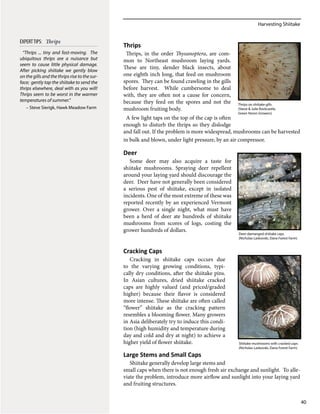
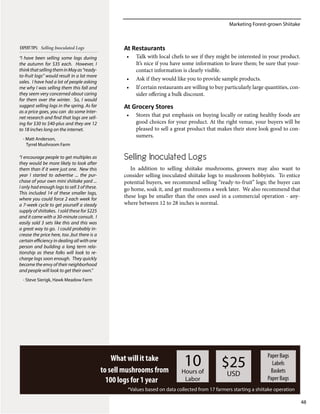
1
Best Management Practices
for Log-Based
Shiitake Cultivation
in the northeastern united states
for Log-Based
Shiitake Cultivation
ï»ż
2
Funded by a Northeast SARE Research and Education Grant
Contributing Farm Advisors
Steve Sierigk
Hawk Meadow Farm
Trumansburg, N.Y.
Nick Laskovski
Dana Forest Farm
Waitsfield, Vt.
Steve and Julie Rockcastle
Green Heron Growers
Panama, N.Y.
Steve Gabriel
Wellspring Forest Farm,
Mecklenburg N.Y.
Project Coordinators
Ken Mudge
Associate Professor
Department of Horticulture
Cornell University
Ithaca, N.Y.
Allen Matthews
Director and Instructor of
Sustainable Agriculture
Chatham University
Pittsburgh, Pa.
Ben Waterman
Beginning Farmer Coordinator
Center for Sustainable Agriculture
Burlington, Vt.
Project Manager
Bridgett (Jamison) Hilshey
Graduate Student
University of Vermont
Burlington, Vt.
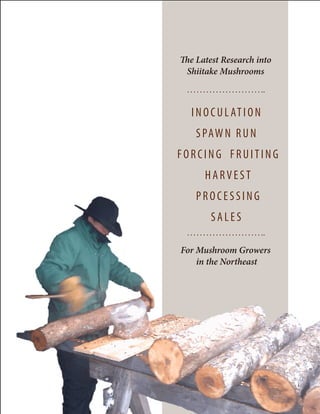
Cover Photo Credit: Steve and Julie Rockcastle;
Green Heron Growers
Copyright © 2013, UVM Center for Sustain-
able Agriculture, University of Vermont
Extension. All rights reserved. No part of
this work may be reproduced without
the prior permission of the UVM Exten-
sion Center for Sustainable Agriculture
(http://www.uvm.edu/~susagctr).
Issued in furtherance of Cooperative Exten-
sion work, Acts of May 8 and June 30, 1914, in
cooperation with the United States Depart-
ment of Agriculture. University of Vermont
Extension, Burlington, Vermont. University
of Vermont Extension, and U.S. Department
of Agriculture, cooperating, offer education
and employment to everyone without re-
gard to race, color, national origin, gender,
religion, age, disability
Any reference to commercial products, trade
names, and brand names is for information
only, and no endorsement or approval is in-
tended
The College of Agriculture and Life Sciences,
is a unit of the State University of New York,
Cornell University, Ithaca, N.Y. Cornell Univer-
sity is an equal opportunity, affirmative ac-
tion educator and employer.
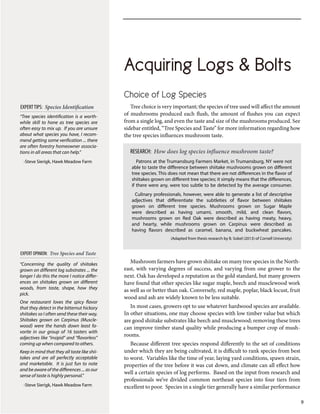
Steven and Julie Rockcastle displaying their products
(Ken Mudge, Cornell Univesity)
Table Of Contents
3
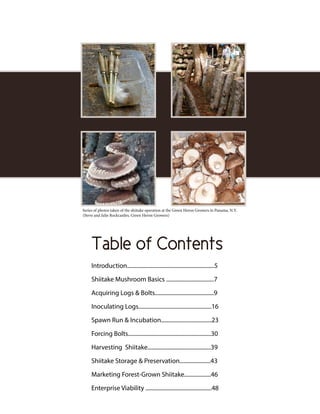
Series of photos taken of the shiitake operation at the Green Heron Growers in Panama, N.Y.
(Steve and Julie Rockcastles, Green Heron Growers)
Table of Contents
Introduction..............................................................5
Shiitake Mushroom Basics ..................................7
Acquiring Logs & Bolts..........................................9
Inoculating Logs....................................................16
Spawn Run & Incubation....................................23
Forcing Bolts...........................................................30
Harvesting Shiitake.............................................39
Shiitake Storage & Preservation......................43
Marketing Forest-Grown Shiitake...................46
Enterprise Viability ...............................................48
Table Of Contents
4
This guide introduces the principles of shiitake cultivation. It combines
insights gathered from professional growers, on-farm trial, and university-
based research all within the northeastern United States. Keep in mind that
the process presented herein may be slightly different amongst individual
growers and will benefit from personal adjustments as the cultivator gains
experience.
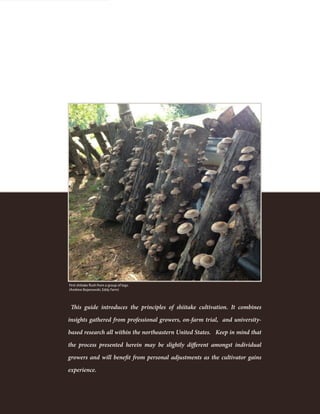
First shiitake flush from a group of logs.
(Andrew Bojanowski, Eddy Farm)
Introduction
5
To date, most forest cultivation of shiitake mushrooms has been conducted
in the southern and Midwestern regions of the U.S. where the climate, avail-
able substrate tree species and markets differ from those in the Northeast.
This manual outlines best management practices for shiitake mushroom cul-
tivation and sales in the northeastern United States. In addition, the manual
also includes anecdotes and tips from experienced growers in the region, data
gathered from farms starting their operation, and the latest academic research.
Information Sources
Expert Tips and Tricks
Some of the growers involved in this project have been growing and selling
shiitake mushrooms for many years. Wherever applicable, they have shared
helpful tidbits that helped them save time and money, and increase their own
mushroom production.
Expert Opinions
Shiitake mushrooms have been grown in the U.S. only since the early 1980s
so the process of cultivating shiitake mushrooms is still in its relative infancy.
For many topics, there is no definite “right” way. For these situations, we
have drawn on expertise from growers through their hands-on experience.
These included not only the original four expert commercial shiitake growers
involved in the SARE project that culminates in this guide, but also may others
participating in the listserv that was initiated to foster communication among
many more growers. Use this information to help yourself make informed
decisions.
Grower Results
Twenty-seven beginning growers were chosen to participate in a SARE
grant “Cultivation of Shiitake Mushrooms as an Agroforesty Crop in New
England.” After attending a series of workshops including an on-farm visit to
a shiitake grower and enterprise development training, each participant inoc-
ulated 100 bolts (logs) on their property with shiitake spawn, managed their
laying yard, harvested and sold mushrooms, all the while keeping records of
labor, expenses, production and sales. During the summer and fall of 2012
they completed their first harvest season and submitted their records. The
results were analyzed to determine realistic estimates of the time requirements
and costs of starting an operation and what profits they could expect to gen-
erate. Using their results, we were also able to draw some broad conclusions
regarding production techniques.
Introduction
Introduction
6
UVM Mushrooms Listserv
Since 2010, over 100 growers and mushroom enthusiasts have been
involved in a Northeast-based mushroom listserv. Much of the material for
this manual was drawn from valuable discussions that took place over the
listserv. We encourage you to join the ongoing discussions by following direc-
tions on the left.
Northeast Forest Mushrooms Growers Network
The Northeast Forest Mushroom Growers Network website is the official
online meeting place for the NE SARE‐funded project, Cultivation of Shii-
take Mushrooms as an Agroforestry Crop for New England. The aim is to
provide information about the cultivation of specialty forest mushrooms and
foster communication and cooperation among amateur and professional
mushroom growers. On the website, you can learn about upcoming events
and mushroom inoculation classes, download the latest fact sheets and publi-
cations, watch video demonstrations of inoculation techniques, register your
farm in your mushroom grower directory and much more. Check it out at
http://blogs.cornell.edu/mushrooms/.
Cornell University Ongoing Shiitake Research
Since 2006 Ken Mudge and coworkers at Cornell University have been
conducting research on shiitake and other specialty forest mushrooms at the
Arnot Forest near Ithaca, N.Y. This research has focused on four broad areas
including substrate tree species, seasonal consideration, laying yard manage-
ment, and cultivation of lion’s mane mushrooms. The results of some of that
research are shown in the graphs within this guide.
ExpertTip: Stay Connected
Join the “Mushroom” Listserv:
To get connected to the Mushroom listserv:
‱	 Send an e-mail to listserv@list.uvm.edu
‱	 In the Subject line type: mushrooms
‱	 In the body of the e-mail type: sub-
scribe MUSHROOMS YOUR_EMAIL_AD-
DRESS
For example: subscribe MUSHROOMS
jane.doe@gmail.com
If you receive a confirmation message from
LISTSERV asking you to verify your identity,
just follow the instructions in the message.
Join the Northeast Forest
Growers Network
On the website, you can post to the message
board and check out other useful resources
including the map of commercial mushroom
growers, the latest research and informative
videos. Go to the website located at http://
blogs.cornell.edu/mushrooms/.
Shiitake Mushroom Basics
7
Shiitake Mushroom Basics
About Shiitake Mushrooms
The origins of shiitake cultivation have been traced back thousands of
years to Japan. People often found these mushrooms growing on downed
“shii” trees (this is where the mushroom got its name). People would take
the mushroom-clad logs, place them next to logs without mushrooms and
simply wait for the wind to disperse the spores. Thankfully, since then, a lot
of research in Japan and China has gone into shiitake-growing techniques,
and we don’t have to wait for the wind anymore. In fact, shiitake is the second
most produced mushroom in the world, following the common button mush-
room.
Why Grow Shiitake
Forest cultivation of shiitake mushrooms can generate income, diversify
farm and forestry enterprises, add value to forestry by-products and create
opportunities for timber stand improvement. At the time of this publica-
tion, log-grown shiitake mushrooms were selling for $10 to $18 per pound
throughout New England. Independent blind taste tests have found forest-
grown shiitakes to be superior in flavor and freshness compared to the saw-
dust-grown shiitake mushrooms commonly found in supermarkets.
Basics of Shiitake Production
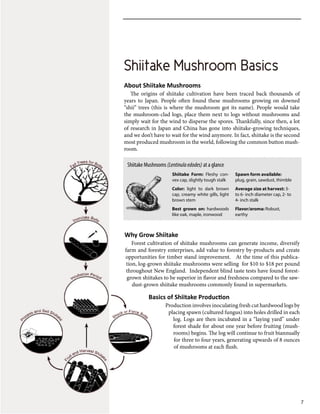
Production involves inoculating fresh cut hardwood logs by
placing spawn (cultured fungus) into holes drilled in each
log. Logs are then incubated in a “laying yard” under
forest shade for about one year before fruiting (mush-
rooms) begins. The log will continue to fruit biannually
for three to four years, generating upwards of 8 ounces
of mushrooms at each flush.
Shiitake Form: Fleshy con-
vex cap, slightly tough stalk
Color: light to dark brown
cap, creamy white gills, light
brown stem
Best grown on: hardwoods
like oak, maple, ironwood
Spawn form available:
plug, grain, sawdust, thimble
Average size at harvest: 3-
to 6- inch diameter cap, 2- to
4- inch stalk
Flavor/aroma: Robust,
earthy
Shiitake Mushrooms (Lentinulaedodes) at a glance
Introduction
8
Key Terms
‱	 Bolts: A log inoculated with spawn.
‱	 Flush: A group of mushrooms that fruited within a short period of time
after a single forcing event.
‱	 Forcing: The process used to trigger the mycelium to produce fruiting
bodies (mushrooms) predictably, within a 7- to 14- day period.
‱	 Laying Yard: The place where the logs are incubated and routine
maintenance is performed. The logs usually remain in the laying yard
for the rest of their productive lifetime, which includes both fruiting and
harvest.
‱	 Mycelium: The vegetative part of a fungus, consisting of a network of
fine white filaments (hyphae).
‱	 Shocking: Often used interchangeably with “forcing.” Means of trigger-
ing shiitake mushroom production (forcing) which involves soaking logs
in cold water for an extended period of time (12 to 24 hours) to induce
fruiting.
‱	 Spawn: Vegetative mycelium (fungal strands, NOT spores), cultured on
sawdust and a little grain under sterile conditions, and used to inoculate
logs.
‱	 Spawn Run: An incubation period bolts undergo after inoculation dur-
ing which the shiitake mycelium colonizes the wood.
Acquiring Logs & Bolts
9
Acquiring Logs & Bolts
Choice of Log Species
Tree choice is very important; the species of tree used will affect the amount
of mushrooms produced each flush, the amount of flushes you can expect
from a single log, and even the taste and size of the mushrooms produced. See
sidebar entitled, “Tree Species and Taste” for more information regarding how
the tree species influences mushroom taste.
Mushroom farmers have grown shiitake on many tree species in the North-
east, with varying degrees of success, and varying from one grower to the
next. Oak has developed a reputation as the gold standard, but many growers
have found that other species like sugar maple, beech and musclewood work
as well as or better than oak. Conversely, red maple, poplar, black locust, fruit
wood and ash are widely known to be less suitable.
In most cases, growers opt to use whatever hardwood species are available.
In other situations, one may choose species with low timber value but which
are good shiitake substrates like beech and musclewood; removing these trees
can improve timber stand quality while producing a bumper crop of mush-
rooms.
Because different tree species respond differently to the set of conditions
under which they are being cultivated, it is difficult to rank species from best
to worst. Variables like the time of year, laying yard conditions, spawn strain,
properties of the tree before it was cut down, and climate can all effect how
well a certain species of log performs. Based on the input from research and
professionals we’ve divided common northeast species into four tiers from
excellent to poor. Species in a single tier generally have a similar performance
EXPERTTIPS: Species Identification
“Tree species identification is a worth-
while skill to hone as tree species are
often easy to mix up.  If you are unsure
about what species you have, I recom-
mend getting some verification ... there
are often forestry homeowner associa-
tions in all areas that can help.”
-Steve Sierigk, Hawk Meadow Farm
EXPERT OPINION: Tree Species and Taste
“Concerning the quality of shiitakes
grown on different log substrates ... the
longer I do this the more I notice differ-
ences on shiitakes grown on different
woods, from taste, shape, how they
pick.
One restaurant loves the spicy flavor
that they detect in the bitternut hickory
shiitakes so I often send these their way.
Shiitakes grown on Carpinus (Muscle-
wood) were the hands down least fa-
vorite in our group of 16 tasters with
adjectives like “insipid” and “flavorless”
coming up when compared to others.
Keep in mind that they all taste like shii-
takes and are all perfectly acceptable
and marketable. It is just fun to note
and be aware of the differences ... as our
sense of taste is highly personal.”
-Steve Sierigk, Hawk Meadow Farm
Patrons at the Trumansburg Farmers Market, in Trumansburg, NY were not
able to taste the difference between shiitake mushrooms grown on different
tree species. This does not mean that there are not differences in the flavor of
shiitakes grown on different tree species; it simply means that the differences,
if there were any, were too subtle to be detected by the average consumer.
Culinary professionals, however, were able to generate a list of descriptive
adjectives that differentiate the subtleties of flavor between shiitakes
grown on different tree species. Mushrooms grown on Sugar Maple
were described as having umami, smooth, mild, and clean flavors,
mushrooms grown on Red Oak were described as having meaty, heavy,
and hearty, while mushrooms grown on Carpinus were described as
having flavors described as caramel, banana, and buckwheat pancakes.
(Adapted from thesis research by B. Sobel (2013) of Cornell University)
RESEARCH: How does log species influence mushroom taste?
Acquiring Logs & Bolts
10
“Developing a connection with road clearing crews, local ar-
borists, and tree companies can be an essential component of
reducing the initial costs for a shiitake operation. A thorough
description for the types and quality of logs must be made, and
sometimes even inviting these people to your operation can be
helpful so that a clear understanding for the quality and size of
log is developed. Safety is essential when/ if an arborist or state
team is approached and a phone call asking for permission to ac-
cess or work with their crew (when picking up logs) is typically
mandatory.
“State Forestry personnel sometimes allow state residents to
apply for firewood permits, which for the state, the end purpose
(firewood) of the logs is not necessarily the agenda, but rather
thinning the logs from the forest is. A mushroom grower can use
this opportunity to harvest trees at a reduced rate, or extend the
life of their own forest if acreage is minimal.”
- Nicholas Laskovski, Dana Forest Farm
“Because oak is a valuable timber species, forest owners who
include timber production as part of their woodland manage-
ment goals may be reluctant to cut large amounts of young oak
for shiitake cultivation. However, tops left after logging are often
of an appropriate size to be used as bolts (logs) although timing
of when the logs were cut might be less than optimal for mush-
room production.
“Since I prefer oak I have put the word out to tree workers in
our area that if they are ever taking down oak in our area let me
know. This has been a great option as these folks better under-
stand what I am after as what I have gotten from loggers has
been less carefully handled. I encourage any of you who may
want to source oak if you don’t have any in your woods to culti-
vate such relationships.”
-Steve Sierigk, Hawk Meadow Farm
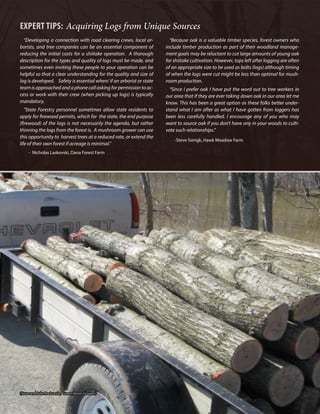
Expert TIPS: Acquiring Logs from Unique Sources
(Steve and Julie Rockcastle, Green Heron Growers)
Acquiring Logs & Bolts
11
but will outperform species in the preceding tier, but there are exceptions
where a species in a lower tier may perform better than one in an upper tier.
For example oak often out performs beech, but in our research site at the
Arnot Forest, beech frequently out performs oak.
Tier 1: Excellent Species
‱	 Oak (Quercus): Research at the Cornell University has shown that red
and white oak exhibit similar performance as substrates for shiitake.
Anecdotally, some growers claim that red oak is colonized more rapidly,
less subject to competing fungus compared to white oak. Oak tends to
be productive for more years than some other species, which means that
you typically get more mushrooms for the initial amount of work. Shii-
take mushrooms grown on oak tend to fruit within a short (weeklong)
time-frame facilitating an easier harvest.
‱	 Sugar maple (Acer saccharum): Sugar maple is a reliable substrate,
and a good choice for the Northeast where thinning of a sugarbush is a
common practice to improve stands for maple syrup production. Lesser
value trees can be thinned out and used for high-value Shiitake produc-
tion. It is an excellent producer, the shiitakes taste wonderful, and are
compatible with cold weather shiitake strains.
Tier 2. Very Good
‱	 American Hophornbeam / Ironwood (Ostrya virginiana): This species is
highly productive; some growers have found it produces equally well if
not better than oak.
‱	 American Hornbeam / Musclewood (Carpinus caroliniana): This species pro-
duces large impressive specimens, although some growers have found
that shiitakes grown on musclewood have less desirable (although still
adequate) flavor.
‱	 American Beech (Fagus grandifolia): Most people find that American
beech is less productive than oak but will still produce an adequate har-
vest. However during research trials at Cornell, beech has consistently
outperformed oak. Many landowners may have a surplus of beech as a
consequence of beech bark disease infestation. See sidebar addressing
beech bark disease for more information. Keep in mind that if you cut
“Beech Bark disease is a saprophytic
fungus that attacks the vascular tissue
of the tree and weakens the bark. The
Nectria fungus won’t pose a direct com-
petitive threat to shiitake mushroom
mycelium. The issue is, once a bolt is
inoculated, the wounds in the bark
(caused by an outer tissue deficiency)
will increase susceptibility to additional
epiphytic fungal competition, increase
moisture loss, and cause a reduction
of available surface area for shiitake
mycelia where sapwood has decayed.
Mushroom growers who want to sal-
vage beech can do so by using logs
where Beech bark disease has not yet
become serious.”
- AllanThompson, Consulting Forester
EXPERT OPINION: Beech Bark Disease
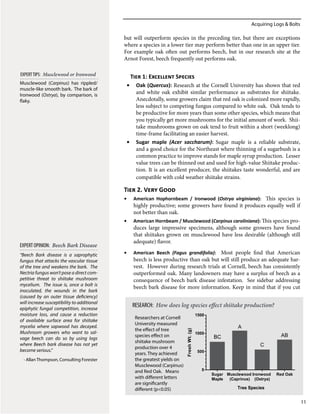
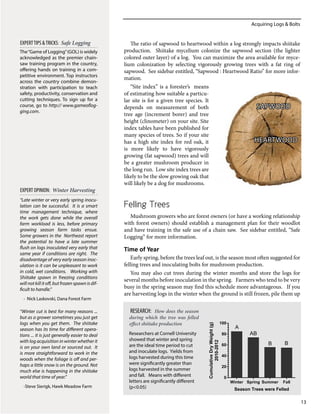
Researchers at Cornell
University measured
the effect of tree
species effect on
shiitake mushroom
production over 4
years. They achieved
the greatest yields on
Musclewood (Carpinus)
and Red Oak. Means
with different letters
are significantly
different (p<0.05)
RESEARCH: How does log species effect shiitake production?
Tree Species
FreshWt.(g)
Sugar
Maple
Musclewood
(Caprinus)
Ironwood
(Ostrya)
Red Oak
0
500
1000
1500
BCBC
A
C
AB
EXPERTTIPS: Musclewood or Ironwood
Musclewood (Carpinus) has rippled/
muscle-like smooth bark. The bark of
Ironwood (Ostrya), by comparison, is
flaky.
Acquiring Logs & Bolts
12
thin barked species like beech and red maple too late in the spring when
the buds are breaking dormancy, the bark will separate from the wood
and slide off very easily! This can be avoided but cutting in winter or early
in the spring before bud swell.
Tier 3. Good
‱	 Sweet Birch / Black Birch / Yellow Birch (Betula lenta and Bentula lutea): Both
colonize well and make nice shiitakes.
‱	 Bitternut Hickory (Carya): Hickory seems slower to colonize than other
species but once it gets going it makes some very high quality shiitakes.
Growers have reported that the yield is close to at least fifty percent of red
oak.​ They also grow fairly straight, which is a bonus when handling or
inoculating logs.
‱	 Red Maple: Red maple is not regarded highly among commercial growers
however it might be appropriate for hobby grower. Red maple has thin
bark and tends to wear out sooner than the others species. Experienced
growers claim that, from red oak logs, they expect 8 serviceable flushes;
comparatively, when fruiting from red maple, growers expect only 4 or 5
flushes with smaller yields per flush. If you chose to use red maple, note
that it is a softer wood, and tends to dry out sooner than others. Con-
sequently, more maintenance soaks may be necessary, relative to other
species. Also, be aware that if you cut red maple too late in the spring, the
bark will separate from the wood and slide off very easily! In addition,
a warm weather shiitake strain is recommended. Despite these quirks,
it can still be used as a fruiting medium, and it can be a good producer,
especially in its first year as long as moisture loss is prevented, by shading
and other cultural practices discussed below.
Tier 4: Not Suitable
‱	 White Ash: White ash is generally sluggish and not very productive.
‱	 Elm: Not very productive.
‱	 Soft Hardwoods: We do not recommend using aspen or other soft hard-
woods. These species might be appropriate for other types of mushroom
production, such as oysters.
‱	 Evergreen Species: Do not use wood from any coniferous evergreen tree
(pine, spruce, hemlock, etc.).
‱	 Fruit Wood: Apple, cherry and other fruit tree are not recommend.
Other Species
Further research is needed with chestnut, walnut, alder, elm, tupelo, and
other hardwood species.
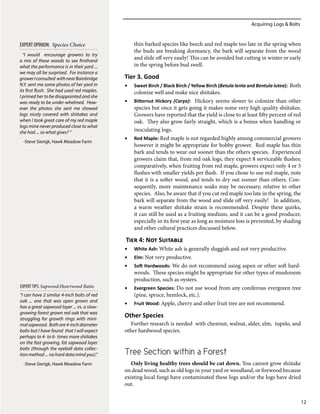
Tree Section within a Forest
Only living healthy trees should be cut down. You cannot grow shiitake
on dead wood, such as old logs in your yard or woodland, or firewood because
existing local fungi have contaminated these logs and/or the logs have dried
out.
“I can have 2 similar 4-inch bolts of red
oak ... one that was open grown and
has a great sapwood layer ... vs. a slow-
growing forest grown red oak that was
struggling for growth rings with mini-
malsapwood. Bothare4-inchdiameter
bolts but I have found that I will expect
perhaps to 4- to 6- times more shiitakes
on the fast growing, fat sapwood layer
bolts (through the eyeball data collec-
tion method ... no hard data mind you).”
-Steve Sierigk, Hawk Meadow Farm
EXPERTTIPS: Sapwood:Heartwood Ratio
“I would encourage growers to try
a mix of these woods to see firsthand
what the performance is in their yard ...
we may all be surprised. For instance a
growerIconsulted withnearBainbridge
N.Y. sent me some photos of her yard in
its first flush. She had used red maples.
I primed her to be disappointed and she
was ready to be under-whelmed. How-
ever the photos she sent me showed
logs nicely covered with shiitakes and
when I took great care of my red maple
logs mine never produced close to what
she had ... so what gives? “
-Steve Sierigk, Hawk Meadow Farm
EXPERT OPINION: Species Choice
Acquiring Logs & Bolts
13
The ratio of sapwood to heartwood within a log strongly impacts shiitake
production. Shiitake mycelium colonize the sapwood section (the lighter
colored outer layer) of a log. You can maximize the area available for myce-
lium colonization by selecting vigorously growing trees with a fat ring of
sapwood. See sidebar entitled, “Sapwood : Heartwood Ratio” for more infor-
mation.
“Site index” is a forester’s means
of estimating how suitable a particu-
lar site is for a given tree species. It
depends on measurement of both
tree age (increment borer) and tree
height (clinometer) on your site. Site
index tables have been published for
many species of trees. So if your site
has a high site index for red oak, it
is more likely to have vigorously
growing (fat sapwood) trees and will
be a greater mushroom producer in
the long run. Low site index trees are
likely to be the slow growing oak that
will likely be a dog for mushrooms.
Felling Trees
Mushroom growers who are forest owners (or have a working relationship
with forest owners) should establish a management plan for their woodlot
and have training in the safe use of a chain saw. See sidebar entitled, “Safe
Logging” for more information.
Time of Year
Early spring, before the trees leaf out, is the season most often suggested for
felling trees and inoculating bolts for mushroom production.
You may also cut trees during the winter months and store the logs for
several months before inoculation in the spring. Farmers who tend to be very
busy in the spring season may find this schedule more advantageous. If you
are harvesting logs in the winter when the ground is still frozen, pile them up
“Late winter or very early spring inocu-
lation can be successful. It is a smart
time management technique, where
the work gets done while the overall
farm workload is less, before primary
growing season farm tasks ensue.
Some growers in the Northeast report
the potential to have a late summer
flush on logs inoculated very early that
same year if conditions are right. The
disadvantage of very early season inoc-
ulation is it can be unpleasant to work
in cold, wet conditions. Working with
Shiitake spawn in freezing conditions
will not kill it off, but frozen spawn is dif-
ficult to handle.”
- Nick Laskovski, Dana Forest Farm
“Winter cut is best for many reasons ...
but as a grower sometimes you just get
logs when you get them. The shiitake
season has its time for different opera-
tions ... it is just generally easier to deal
with log acquisition in winter whether it
is on your own land or sourced out. It
is more straightforward to work in the
woods when the foliage is off and per-
haps a little snow is on the ground. Not
much else is happening in the shiitake
world that time of year.”
-Steve Sierigk, Hawk Meadow Farm
EXPERT OPINION: Winter Harvesting
The“Game of Logging”(GOL) is widely
acknowledged as the premier chain-
saw training program in the country,
offering hands on training in a com-
petitive environment. Top instructors
across the country combine demon-
stration with participation to teach
safety, productivity, conservation and
cutting techniques. To sign up for a
course, go to http:// www.gameoflog-
ging.com.
EXPERTTIPS &TRICKS: Safe Logging
Sapwood
heartwood
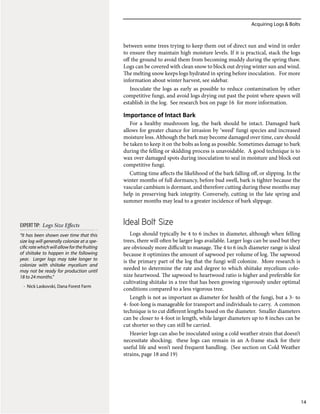
Researchers at Cornell University
showed that winter and spring
are the ideal time period to cut
and inoculate logs. Yields from
logs harvested during this time
were significantly greater than
logs harvested in the summer
and fall. Means with different
letters are significantly different
(p<0.05)
RESEARCH: How does the season
during which the tree was felled
effect shiitake production
Season Trees were Felled
CumulativeDryWeight(g)
2010-2012
Winter Spring Summer Fall
0
20
40
60
80
100
A
AB
B B
Acquiring Logs & Bolts
14
between some trees trying to keep them out of direct sun and wind in order
to ensure they maintain high moisture levels. If it is practical, stack the logs
off the ground to avoid them from becoming muddy during the spring thaw.
Logs can be covered with clean snow to block out drying winter sun and wind.
The melting snow keeps logs hydrated in spring before inoculation. For more
information about winter harvest, see sidebar.
Inoculate the logs as early as possible to reduce contamination by other
competitive fungi, and avoid logs drying out past the point where spawn will
establish in the log. See research box on page 16 for more information.
Importance of Intact Bark
For a healthy mushroom log, the bark should be intact. Damaged bark
allows for greater chance for invasion by ‘weed’ fungi species and increased
moisture loss. Although the bark may become damaged over time, care should
be taken to keep it on the bolts as long as possible. Sometimes damage to bark
during the felling or skidding process is unavoidable. A good technique is to
wax over damaged spots during inoculation to seal in moisture and block out
competitive fungi.
Cutting time affects the likelihood of the bark falling off, or slipping. In the
winter months of full dormancy, before bud swell, bark is tighter because the
vascular cambium is dormant, and therefore cutting during these months may
help in preserving bark integrity. Conversely, cutting in the late spring and
summer months may lead to a greater incidence of bark slippage.
Ideal Bolt Size
Logs should typically be 4 to 6 inches in diameter, although when felling
trees, there will often be larger logs available. Larger logs can be used but they
are obviously more difficult to manage. The 4 to 6 inch diameter range is ideal
because it optimizes the amount of sapwood per volume of log. The sapwood
is the primary part of the log that the fungi will colonize. More research is
needed to determine the rate and degree to which shiitake mycelium colo-
nize heartwood. The sapwood to heartwood ratio is higher and preferable for
cultivating shiitake in a tree that has been growing vigorously under optimal
conditions compared to a less vigorous tree.
Length is not as important as diameter for health of the fungi, but a 3- to
4- foot-long is manageable for transport and individuals to carry. A common
technique is to cut different lengths based on the diameter. Smaller diameters
can be closer to 4-foot in length, while larger diameters up to 8 inches can be
cut shorter so they can still be carried.
Heavier logs can also be inoculated using a cold weather strain that doesn’t
necessitate shocking; these logs can remain in an A-frame stack for their
useful life and won’t need frequent handling. (See section on Cold Weather
strains, page 18 and 19)
“It has been shown over time that this
size log will generally colonize at a spe-
cific rate which will allow for the fruiting
of shiitake to happen in the following
year. Larger logs may take longer to
colonize with shiitake mycelium and
may not be ready for production until
18 to 24 months.”
- Nick Laskovski, Dana Forest Farm
EXPERTTIP: Logs Size Effects
Acquiring Logs & Bolts
15
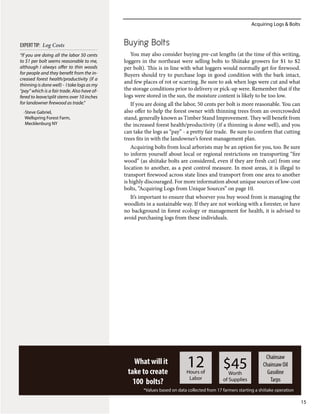
What will it
take to create
100 bolts?
12Hours of
Labor
$45Worth
of Supplies
Chainsaw
Chainsaw Oil
Gasoline
Tarps
*Values based on data collected from 17 farmers starting a shiitake operation
Buying Bolts
You may also consider buying pre-cut lengths (at the time of this writing,
loggers in the northeast were selling bolts to Shiitake growers for $1 to $2
per bolt). This is in line with what loggers would normally get for firewood.
Buyers should try to purchase logs in good condition with the bark intact,
and few places of rot or scarring. Be sure to ask when logs were cut and what
the storage conditions prior to delivery or pick-up were. Remember that if the
logs were stored in the sun, the moisture content is likely to be too low.
If you are doing all the labor, 50 cents per bolt is more reasonable. You can
also offer to help the forest owner with thinning trees from an overcrowded
stand, generally known as Timber Stand Improvement. They will benefit from
the increased forest health/productivity (if a thinning is done well), and you
can take the logs as “pay” - a pretty fair trade. Be sure to confirm that cutting
trees fits in with the landowner’s forest management plan.
Acquiring bolts from local arborists may be an option for you, too. Be sure
to inform yourself about local or regional restrictions on transporting “fire
wood” (as shiitake bolts are considered, even if they are fresh cut) from one
location to another, as a pest control measure. In most areas, it is illegal to
transport firewood across state lines and transport from one area to another
is highly discouraged. For more information about unique sources of low-cost
bolts, “Acquiring Logs from Unique Sources” on page 10.
It’s important to ensure that whoever you buy wood from is managing the
woodlots in a sustainable way. If they are not working with a forester, or have
no background in forest ecology or management for health, it is advised to
avoid purchasing logs from these individuals.
“If you are doing all the labor 50 cents
to $1 per bolt seems reasonable to me,
although I always offer to thin woods
for people and they benefit from the in-
creased forest health/productivity (if a
thinning is done well) - I take logs as my
“pay” which is a fair trade. Also have of-
fered to leave/split stems over 10 inches
for landowner firewood as trade.”
-Steve Gabriel,
Wellspring Forest Farm,
Mecklenburg NY
EXPERTTIP: Log Costs
Inoculating Logs
16
Inoculating Logs
In log-based cultivation, the spawn consists of a mixture of vegetative
mycelium (fungal strands called hypheae, NOT spores), sawdust and a little
grain to form a substrate (nutrient source). The shiitake mycelium feed on
newly dead hardwood; they can be introduced to the log through either the
dowel or sawdust inoculation methods.
When to Inoculate
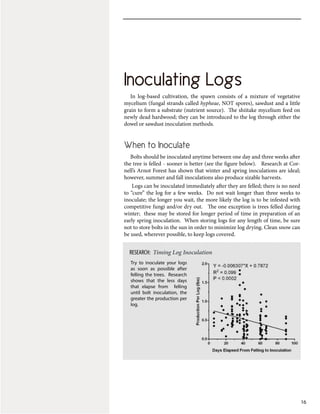
Bolts should be inoculated anytime between one day and three weeks after
the tree is felled - sooner is better (see the figure below). Research at Cor-
nell’s Arnot Forest has shown that winter and spring inoculations are ideal;
however, summer and fall inoculations also produce sizable harvests.
Logs can be inoculated immediately after they are felled; there is no need
to “cure” the log for a few weeks. Do not wait longer than three weeks to
inoculate; the longer you wait, the more likely the log is to be infested with
competitive fungi and/or dry out. The one exception is trees felled during
winter; these may be stored for longer period of time in preparation of an
early spring inoculation. When storing logs for any length of time, be sure
not to store bolts in the sun in order to minimize log drying. Clean snow can
be used, wherever possible, to keep logs covered.
Try to inoculate your logs
as soon as possible after
felling the trees. Research
shows that the less days
that elapse from felling
until bolt inoculation, the
greater the production per
log.
RESEARCH: Timing Log Inoculation
Inoculating Logs
17
Many of the required tasks, particularly
bolt inoculation, can be quite tedious.
Many growers choose to solicit help from
volunteers and friends in order to get the
job done. Some organizations or private-
ly sponsored entities charge a small fee
for an inoculation event (workshop). The
following are some tips to help to achieve
a high volunteer turnout:
‱	 Advertise the event as an informal
class in shiitake mushroom produc-
tion.Teach your volunteers enough
to begin their own small operation.
‱	 Turn the day into a party. Play mu-
sic, provide refreshments, and be
merry.
‱	 Offer a free meal.
‱	 Offer a shiitake taste-testing.
‱	 In appreciation for their help, send
each participant home with a shii-
take log that they have inoculated
themselves. They should be able to
fruit the log in their backyard.
EXPERT TIPS & TRICKS: Soliciting Volunteer Help
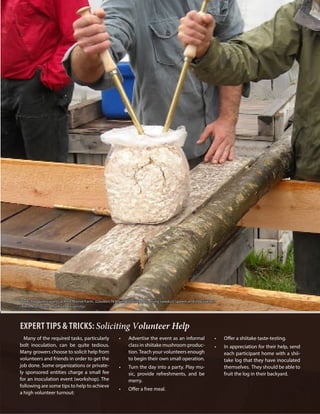
Workshop participants at Red Manse Farm, (Loudon, N.H.) inoculating logs using sawdust spawn and inoculators.
(Allen Matthews, Chatham University)
Inoculating Logs
18
Selecting Appropriate Spawn
Spawn Type
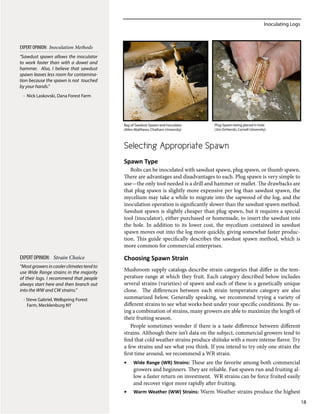
Bolts can be inoculated with sawdust spawn, plug spawn, or thumb spawn.
There are advantages and disadvantages to each. Plug spawn is very simple to
use—the only tool needed is a drill and hammer or mallet. The drawbacks are
that plug spawn is slightly more expensive per log than sawdust spawn, the
mycelium may take a while to migrate into the sapwood of the log, and the
inoculation operation is significantly slower than the sawdust spawn method.
Sawdust spawn is slightly cheaper than plug spawn, but it requires a special
tool (inoculator), either purchased or homemade, to insert the sawdust into
the hole. In addition to its lower cost, the mycelium contained in sawdust
spawn moves out into the log more quickly, giving somewhat faster produc-
tion. This guide specifically describes the sawdust spawn method, which is
more common for commercial enterprises.
Choosing Spawn Strain
Mushroom supply catalogs describe strain categories that differ in the tem-
perature range at which they fruit. Each category described below includes
several strains (varieties) of spawn and each of these is a genetically unique
clone. The differences between each strain temperature category are also
summarized below. Generally speaking, we recommend trying a variety of
different strains to see what works best under your specific conditions. By us-
ing a combination of strains, many growers are able to maximize the length of
their fruiting season.
People sometimes wonder if there is a taste difference between different
strains. Although there isn’t data on the subject, commercial growers tend to
find that cold weather strains produce shiitake with a more intense flavor. Try
a few strains and see what you think. If you intend to try only one strain the
first time around, we recommend a WR strain.
‱	 Wide Range (WR) Strains: These are the favorite among both commercial
growers and beginners. They are reliable. Fast spawn run and fruiting al-
low a faster return on investment. WR strains can be force fruited easily
and recover vigor more rapidly after fruiting.
‱	 Warm Weather (WW) Strains: Warm Weather strains produce the highest
“Mostgrowersincoolerclimatestendto
use Wide Range strains in the majority
of their logs. I recommend that people
always start here and then branch out
into the WW and CW strains.​”
- Steve Gabriel, Wellspring Forest
Farm, Mecklenburg NY
EXPERT OPINION: Strain Choice
Plug Spawn being placed in hole.
(Jim Ochterski, Cornell University)
Bag of Sawdust Spawn and Inoculator.
(Allen Matthews, Chatham University)
“Sawdust spawn allows the inoculator
to work faster than with a dowel and
hammer. Also, I believe that sawdust
spawn leaves less room for contamina-
tion because the spawn is not touched
by your hands.”
- Nick Laskovski, Dana Forest Farm
EXPERT OPINION: Inoculation Methods
Inoculating Logs
19
quality mushrooms during the hot summer months and early fall. They
respond well to soaking for commercial production, and tolerate warmer
soak water than other strains. They are also often recommended for grow-
ing Shiitakes on some of the softer hardwoods, such as red maple.
‱	 Cold-Weather (CW) Strains: These tend to fruit in early spring and late fall.
These strains require a longer spawn run than other stains. They won’t re-
liably fruit after being forced, so most people let the natural rise and fall of
wintry temperatures initiate fruiting. See side-bar for more information
about cold weather strains.
Using Cold Weather Strains to Extend Season
Cold weather strains are well suited to the Northeast where the growing
season is short and the time frame for fruiting wide range and warm weather
Shiitake strains can be limited. Since cold weather strains fruit during the
transition times from spring to summer and summer to fall, they can be used
as a strategy for season extension. Even though cold weather strains do not
respond well to shocking, Northeast-based growers with enough cold weather
strain logs can supply late spring and fall markets when other mushroom
growers can’t. Learn more about season extension using cold temperature
strains on page 31.
Inoculation Procedure Using Sawdust Spawn
Log inoculation is a three step process. First a series of small holes are
drilled into each log. Each hole is then tightly packed with spawn. Lastly, the
surface of each hole is covered with wax to ensure optimal mycelium growing
conditions and reduce contamination by other fungi species. Each step is
described in detail on pages 20 through 22.
This process can be quite repetitive and time consuming; however, many
growers have found innovative ways to speed it up. For example, you can
solicit volunteer help by hosting an inoculation party or informal mushroom
inoculation class; see page 17 for more details. You may also want to consider
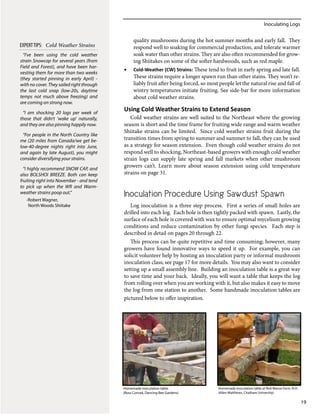
setting up a small assembly line. Building an inoculation table is a great way
to save time and your back. Ideally, you will want a table that keeps the log
from rolling over when you are working with it, but also makes it easy to move
the log from one station to another. Some handmade inoculation tables are
pictured below to offer inspiration.
“I’ve been using the cold weather
strain Snowcap for several years (from
Field and Forest), and have been har-
vesting them for more than two weeks
(they started pinning in early April) -
with no cover. They sailed right through
the last cold snap (low-20s, daytime
temps not much above freezing) and
are coming on strong now.
“I am shocking 20 logs per week of
those that didn’t ‘wake up’ naturally,
and they are also pinning happily now.
“For people in the North Country like
me (20 miles from Canada/we get be-
low-40-degree nights right into June,
and again by late August), you might
consider diversifying your strains.
“I highly recommend SNOW CAP, and
also BOLSHOI BREEZE. Both can keep
fruiting right into November - and tend
to pick up when the WR and Warm-
weather strains poop out.”
-Robert Wagner,
North Woods Shiitake
EXPERTTIPS: Cold Weather Strains
Homemade inoculation table.
(Ross Conrad, Dancing Bee Gardens)
Homemade inoculation table at Red Manse Farm, N.H.
(Allen Matthews, Chatham University)
Inoculating Logs
20
Step 1: Drill Holes in Bolt
You will need to drill a series of holes in
each log, 7/16” diameter and 1.25” deep.
This dimension matches the inoculator
tool used to plug the holes with spawn.
Start 1 inch from the end of the log,
drill holes 3 inches apart in rows along
the length of the log, with 3 to 4 inches
between rows. A general rule of thumb
is to estimate the diameter of the log, and
have as many rows of drill holes as there
are inches of diameter; for example a log
with a 6 inch diameter needs 6 rows. Plan
for a minimum of 30 to 40 drill holes per
log, depending on log diameter. The holes
should be staggered in a diamond pattern
to ensure rapid growth of the fungus
throughout the log.
Closer spacing increases the rate of colonization and results in more rapid
mushroom production; however, spawn costs are also greater. It is very
common on bolts to have small areas of bare bark where bark was damaged
or branches were cut off. Drill holes in these areas as well. Once inoculated
and waxed over, the damaged or bare areas will be sealed, increasing chances
for a thorough and successful spawn run.
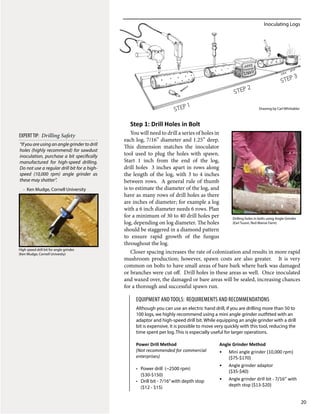
Although you can use an electric hand drill, if you are drilling more than 50 to
100 logs, we highly recommend using a mini angle grinder outfitted with an
adaptor and high-speed drill bit. While equipping an angle grinder with a drill
bit is expensive, it is possible to move very quickly with this tool, reducing the
time spent per log. This is especially useful for larger operations.
Power Drill Method
(Not recommended for commercial
enterprises)
‱	 Power drill (~2500 rpm)
($30-$150)
‱	 Drill bit - 7/16”with depth stop
($12 - $15)
Angle Grinder Method
‱	 Mini angle grinder (10,000 rpm)
($75-$170)
‱	 Angle grinder adaptor 	
($35-$40)
‱	 Angle grinder drill bit - 7/16” with
depth stop ($13-$20)
EQUIPMENT ANDTOOLS: Requirements and Recommendations
“If you are using an angle grinder to drill
holes (highly recommend) for sawdust
inoculation, purchase a bit specifically
manufactured for high-speed drilling.
Do not use a regular drill bit for a high-
speed (10,000 rpm) angle grinder as
these may shatter”.
- Ken Mudge, Cornell University
EXPERTTIP: Drilling Safety
High speed drill bit for angle grinder.
(Ken Mudge, Cornell Univesity)
Drilling holes in bolts using Angle Grinder
(Earl Tuson, Red Manse Farm)
Step
3
Step
2
Step
1 Drawing by Carl Whittakler
Inoculating Logs
21
Step 2: Inoculate the Bolts
To inoculate the logs with spawn, you will
need a tool specifically designed to inject
sawdust spawn into the hole, known as an
inoculator. After the holes are drilled, place
the spawn into the holes, bringing the shii-
take mycelium in contact with its new food
source (substrate), the log. When using
sawdust spawn, take care to avoid handling
the spawn as much as possible in order to
avoid contaminating the spawn. Stab the
inoculation tool into the spawn a couple of
times, filling the chamber with sawdust. Then place the inoculator over the
hole in the log and eject the spawn into the hole. The spawn should be tightly
packed into the hole and rest approximately 1/8 inch below the surface of the
log. Packing the spawn in below the surface enables a minimal amount of wax
to be used, and allows the wax to adhere effectively to the surface of the plug
hole.
Step 3: Waxing the Bolt
Waxing the holes helps seal in moisture
so that the spawn does not dry out and
reduces contamination by competing fungi
species. Completely seal each hole using
food grade wax. The wax should be very
hot (lightly smoking) when applied in order
to ensure an airtight, flexible seal. If the wax
turns white immediately after it is applied
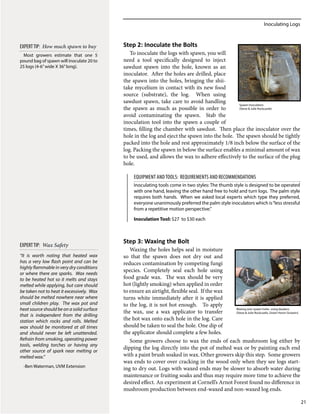
to the log, it is not hot enough. To apply
the wax, use a wax applicator to transfer
the hot wax onto each hole in the log. Care
should be taken to seal the hole. One dip of
the applicator should complete a few holes.
Some growers choose to wax the ends of each mushroom log either by
dipping the log directly into the pot of melted wax or by painting each end
with a paint brush soaked in wax. Other growers skip this step. Some growers
wax ends to cover over cracking in the wood only when they see logs start-
ing to dry out. Logs with waxed ends may be slower to absorb water during
maintenance or fruiting soaks and thus may require more time to achieve the
desired effect. An experiment at Cornell’s Arnot Forest found no difference in
mushroom production between end-waxed and non-waxed log ends.
“It is worth noting that heated wax
has a very low flash point and can be
highly flammable in very dry conditions
or where there are sparks. Wax needs
to be heated hot so it melts and stays
melted while applying, but care should
be taken not to heat it excessively. Wax
should be melted nowhere near where
small children play. The wax pot and
heat source should be on a solid surface
that is independent from the drilling
station which rocks and rolls. Melted
wax should be monitored at all times
and should never be left unattended.
Refrain from smoking, operating power
tools, welding torches or having any
other source of spark near melting or
melted wax.”
-Ben Waterman, UVM Extension
EXPERTTIP: Wax Safety
Waxing over spawn holes using daubers
(Steve & Julie Rockcastle, Green Heron Growers)
Spawn Inoculators
(Steve & Julie Rockcastle)
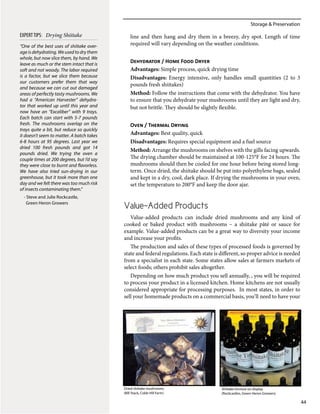
Most growers estimate that one 5
pound bag of spawn will inoculate 20 to
25 logs (4-6”wide X 36”long).
EXPERTTIP: How much spawn to buy
Inoculating tools come in two styles: The thumb style is designed to be operated
with one hand, leaving the other hand free to hold and turn logs. The palm style
requires both hands. When we asked local experts which type they preferred,
everyone unanimously preferred the palm style inoculators which is“less stressful
from a repetitive motion perspective.”
Inoculation Tool: $27 to $30 each
EQUIPMENT ANDTOOLS: Requirements and Recommendations
Inoculating Logs
22
The importance of this step may vary based on climate, which largely
governs how crucial it is to strictly manage moisture levels. Waxing the ends
will keep moisture in and prevent competitive fungi from gaining a foothold.
However, wax is also one of the main production costs and the waxing process
adds considerable time to the inoculation process. A cost-benefit analysis of
additional wax cost and shiitake yield has not yet been conducted.
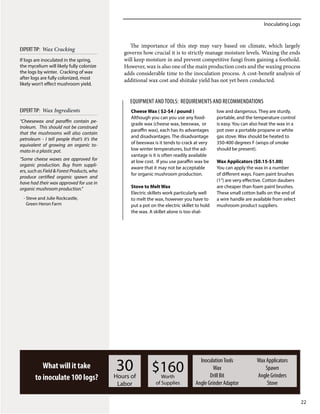
What will it take
to inoculate 100 logs?
30Hours of
Labor
$160Worth
of Supplies
InoculationTools
Wax
Drill Bit
Angle Grinder Adaptor
Wax Applicators
Spawn
Angle Grinders
Stove
Cheese Wax ( $2-$4 / pound )
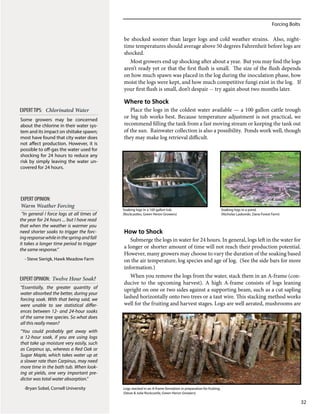
Although you can you use any food-
grade wax (cheese wax, beeswax, or
paraffin wax), each has its advantages
and disadvantages. The disadvantage
of beeswax is it tends to crack at very
low winter temperatures, but the ad-
vantage is it is often readily available
at low cost. If you use paraffin wax be
aware that it may not be acceptable
for organic mushroom production.
Stove to Melt Wax
Electric skillets work particularly well
to melt the wax, however you have to
put a pot on the electric skillet to hold
the wax. A skillet alone is too shal-
low and dangerous. They are sturdy,
portable, and the temperature control
is easy. You can also heat the wax in a
pot over a portable propane or white
gas stove. Wax should be heated to
350-400 degrees F (wisps of smoke
should be present).
Wax Applicators ($0.15-$1.00)
You can apply the wax in a number
of different ways. Foam paint brushes
(1”) are very effective. Cotton daubers
are cheaper than foam paint brushes.
These small cotton balls on the end of
a wire handle are available from select
mushroom product suppliers.
EQUIPMENT ANDTOOLS: Requirements and Recommendations
“Cheesewax and paraffin contain pe-
troleum. This should not be construed
that the mushrooms will also contain
petroleum - I tell people that’s it’s the
equivalent of growing an organic to-
mato in a plastic pot.
“Some cheese waxes are approved for
organic production. Buy from suppli-
ers, such as Field & Forest Products, who
produce certified organic spawn and
have had their wax approved for use in
organic mushroom production.”
- Steve and Julie Rockcastle,
Green Heron Farm
EXPERTTIP: Wax Ingredients
If logs are inoculated in the spring,
the mycelium will likely fully colonize
the logs by winter. Cracking of wax
after logs are fully colonized, most
likely won’t effect mushroom yield.
EXPERTTIP: Wax Cracking
Spawn Run & Incubation
23
Spawn Run & Incubation
Creating a Laying Yard
Before you begin, think about where you are going to keep all the logs once
they are inoculated with mushroom spawn. This will become the laying yard:
the place where the logs are incubated and routine maintenance is performed.
The logs usually remain in the laying yard for the rest of their productive life-
time, which includes both fruiting and harvest.
Year-round shade (75 to 100 Percent) and High Humidity
Almost nothing is more important than laying (incubating) the logs under
year-round shade in order to keep the logs from drying out due to sun and
wind. A laying yard beneath the canopy of a coniferous forest is best. Hemlock
provides especially dense shade. A deciduous canopy will suffice but it will be
necessary to protect the logs with 80% shade cloth or pine boughs during the
winter. For smaller operations in select circumstances, behind the north side
of houses, sheds or other structures can provide effective, year-round shade.
Access and Relative Location
Ideally the laying yard should be accessible by a vehicle or tractor and close to
your home/farm. You should also consider its proximity to electricity (neces-
sary to inoculate the logs) and water (necessary to irrigate and soak the logs).
You do not want to place a laying yard in any location that necessitates carry-
ing the logs over any great distance, unless you are looking for a really good
workout, or have a tractor or four-wheeler to transport them.
Proximity to Water and Water Source
A water source is necessary for forced fruiting (shocking) as well as for main-
taining a threshold moisture level in the logs. Take into consideration how
close and convenient each possible water source is. Particularly think about
moving materials through the laying yard and common use patterns. If there
is a dry spell and the logs must be wet down to maintain moisture levels, logs
may be submerged under water for a few hours or wetted under a sprinkler for
several hours. It is critical that the moisture content of the logs does not fall
below a threshold necessary for the survival of the growing mushroom. Logs
typically begin at about 40 to 45 percent moisture content and should not drop
below 30 percent.
Ideally the water should come from a well, stream or public water system.
Shocking is most successful when there is a significant temperature difference
between ambient air and water for shocking. You can’t control air temperature
in the woods, but you can choose a laying yard site that will have access to
clean, cold water.
Other Considerations
Other important aspects of the laying yard include slope, microclimate and
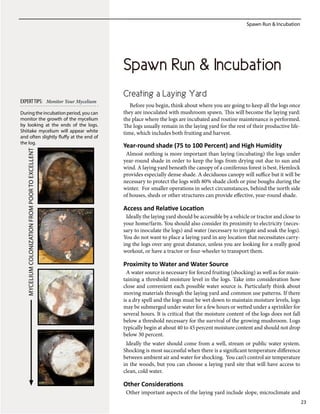
During the incubation period, you can
monitor the growth of the mycelium
by looking at the ends of the logs.
Shiitake mycelium will appear white
and often slightly fluffy at the end of
the log.
EXPERTTIPS: Monitor Your Mycelium
Myceliumcolonizationfrompoortoexcellent
Spawn Run & Incubation
24
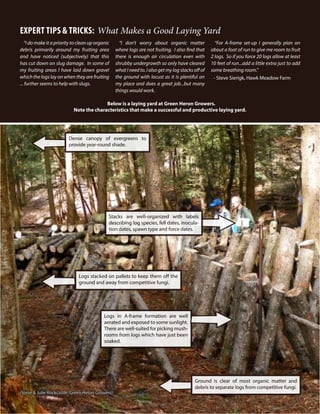
(Steve & Julie Rockcastle, Green Heron Growers)
EXPERT TIPS & TRICKS: What Makes a Good Laying Yard
“I do make it a priority to clean up organic
debris primarily around my fruiting area
and have noticed (subjectively) that this
has cut down on slug damage. In some of
my fruiting areas I have laid down gravel
which the logs lay on when they are fruiting
... further seems to help with slugs.
“I don’t worry about organic matter
where logs are not fruiting. I also find that
there is enough air circulation even with
shrubby undergrowth so only have cleared
what I need to. I also get my log stacks off of
the ground with locust as it is plentiful on
my place and does a great job...but many
things would work.
“For A-frame set-up I generally plan on
about a foot of run to give me room to fruit
2 logs. So if you force 20 logs allow at least
10 feet of run...add a little extra just to add
some breathing room.”
- Steve Sierigk, Hawk Meadow Farm
Below is a laying yard at Green Heron Growers.
Note the characteristics that make a successful and productive laying yard.
Dense canopy of evergreens to
provide year-round shade.
Stacks are well-organized with labels
describing log species, fell dates, inocula-
tion dates, spawn type and force dates.
Logs stacked on pallets to keep them off the
ground and away from competitive fungi.
Logs in A-frame formation are well
aerated and exposed to some sunlight.
There are well-suited for picking mush-
rooms from logs which have just been
soaked.
Ground is clear of most organic matter and
debris to separate logs from competitive fungi.
Spawn Run & Incubation
25
accessibility. The slope and microclimate of the laying yard will affect how you
lay the logs. For example, if it is a site with lots of exposure to wind, one may
choose to lay logs closer together to maintain log moisture. In the meantime,
you might consider planting a windbreak. It is very important that the laying
yard is accessible so that you may irrigate the logs if desired and check for
fruiting regularly during the growing season. If it is necessary to incubate logs
on a steep slope because level land is not available, the Japanese hill stacking
method described below is worth considering.
Incubation Period
After the logs are inoculated, they must go through an incubation period
or “spawn run” during which the fungus colonize the wood. During this 8- to
18-month period, the fungus colonizes and decays the log.
This doesn’t mean you can forget about your logs for years; you will need
to maintain favorable conditions for the shiitake mycelium so it can spread
through the logs as quickly and evenly as possible. This could include main-
tenance soaking to keep log moisture content well above 30 percent. Artificial
shading may be necessary if the laying yard is under a deciduous canopy. At
the same time, you will need to protect the logs against competing fungi. Your
final productivity will largely depend on how well the shiitake fungus estab-
lishes itself during spawn run, which in turn keeps competitive fungus at bay.
Providing optimum growing conditions at this time is crucial!
Stacking the Logs during the Incubation Period
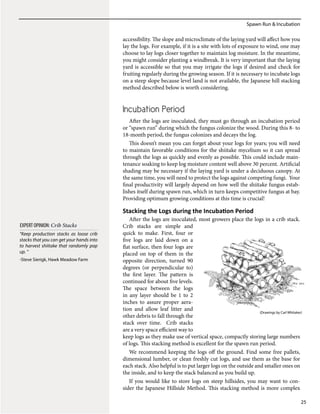
After the logs are inoculated, most growers place the logs in a crib stack.
Crib stacks are simple and
quick to make. First, four or
five logs are laid down on a
flat surface, then four logs are
placed on top of them in the
opposite direction, turned 90
degrees (or perpendicular to)
the first layer. The pattern is
continued for about five levels.
The space between the logs
in any layer should be 1 to 2
inches to assure proper aera-
tion and allow leaf litter and
other debris to fall through the
stack over time. Crib stacks
are a very space efficient way to
keep logs as they make use of vertical space, compactly storing large numbers
of logs. This stacking method is excellent for the spawn run period.
We recommend keeping the logs off the ground. Find some free pallets,
dimensional lumber, or clean freshly cut logs, and use them as the base for
each stack. Also helpful is to put larger logs on the outside and smaller ones on
the inside, and to keep the stack balanced as you build up.
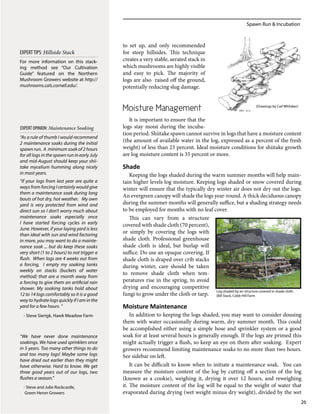
If you would like to store logs on steep hillsides, you may want to con-
sider the Japanese Hillside Method. This stacking method is more complex
“Keep production stacks as loose crib
stacks that you can get your hands into
to harvest shiitake that randomly pop
up. “
-Steve Sierigk, Hawk Meadow Farm
EXPERT OPINION: Crib Stacks
(Drawings by Carl Whitaker)
Spawn Run & Incubation
26
to set up, and only recommended
for steep hillsides. This technique
creates a very stable, aerated stack in
which mushrooms are highly visible
and easy to pick. The majority of
logs are also raised off the ground,
potentially reducing slug damage.
Moisture Management
It is important to ensure that the
logs stay moist during the incuba-
tion period. Shiitake spawn cannot survive in logs that have a moisture content
(the amount of available water in the log, expressed as a percent of the fresh
weight) of less than 23 percent. Ideal moisture conditions for shiitake growth
are log moisture content is 35 percent or more.
Shade
Keeping the logs shaded during the warm summer months will help main-
tain higher levels log moisture. Keeping logs shaded or snow covered during
winter will ensure that the typically dry winter air does not dry out the logs.
An evergreen canopy will shade the logs year-round. A thick deciduous canopy
during the summer months will generally suffice, but a shading strategy needs
to be employed for months with no leaf cover.
This can vary from a structure
covered with shade cloth (70 percent),
or simply by covering the logs with
shade cloth. Professional greenhouse
shade cloth is ideal, but burlap will
suffice. Do use an opaque covering. If
shade cloth is draped over crib stacks
during winter, care should be taken
to remove shade cloth when tem-
peratures rise in the spring, to avoid
drying and encouraging competitive
fungi to grow under the cloth or tarp.
Moisture Maintenance
In addition to keeping the logs shaded, you may want to consider dousing
them with water occasionally during warm, dry summer month. This could
be accomplished either using a simple hose and sprinkler system or a good
soak for at least several hours is generally enough. If the logs are primed this
might actually trigger a flush, so keep an eye on them after soaking. Expert
growers recommend limiting maintenance soaks to no more than two hours.
See sidebar on left.
It can be difficult to know when to initiate a maintenance soak. You can
measure the moisture content of the log by cutting off a section of the log
(known as a cookie), weighing it, drying it over 12 hours, and reweighing
it. The moisture content of the log will be equal to the weight of water that
evaporated during drying (wet weight minus dry weight), divided by the wet
“As a rule of thumb I would recommend
2 maintenance soaks during the initial
spawn run. A minimum soak of 2 hours
for all logs in the spawn run in early July
and mid-August should keep your shii-
take mycelium humming along nicely
in most years.
“If your logs from last year are quite a
ways from forcing I certainly would give
them a maintenance soak during long
bouts of hot dry, hot weather. My own
yard is very protected from wind and
direct sun so I don’t worry much about
maintenance soaks especially once
I have started forcing cycles in early
June. However, if your laying yard is less
than ideal with sun and wind factoring
in more, you may want to do a mainte-
nance soak ... but do keep these soaks
very short (1 to 2 hours) to not trigger a
flush. When logs are 4 weeks out from
a forcing, I empty my soaking tanks
weekly on stacks (buckets of water
method) that are a month away from
a forcing to give them an artificial rain
shower. My soaking tanks hold about
12 to 14 logs comfortably so it is a good
way to hydrate logs quickly if I am in the
yard for a few hours. “
- Steve Sierigk, Hawk Meadow Farm
“We have never done maintenance
soakings. We have used sprinklers once
in 5 years. Too many other things to do
and too many logs! Maybe some logs
have dried out earlier than they might
have otherwise. Hard to know. We get
three good years out of our logs, two
flushes a season.”
- Steve and Julie Rockcastle,
Green Heron Growers
EXPERT OPINION: Maintenance Soaking
For more information on this stack-
ing method see “Our Cultivation
Guide” featured on the Northern
Mushroom Growers website at http://
mushrooms.cals.cornell.edu/.
EXPERTTIPS: Hillside Stack
(Drawings by Carl Whitaker)
Log shaded by an structure covered in shade cloth.
(Bill Stack, Cobb Hill Farm
Spawn Run & Incubation
27
“For perspective I look back in amaze-
ment at my first group of 100 shiitake
logs I did back in the 1980s. I had way
too many projects going on at the time
and these logs were left to their own
fate. In retrospect the laying yard was
crummy ... a hardwood forest that let
too much light and wind in. I never ever
soaked these logs.
“These logs amazingly produced shiita-
kes for eight years, generally one flush
per year before we gave up on them.
Even though this was an impractical
set-up it taught me that the logs are
very resilient.
“NowsinceIamtryingtorelyonaweek-
ly harvest promised out to restaurants, I
try to keep the logs humming along as
best I can without going crazy about
maintaining moisture content. I always
remember my early logs and know that
disaster will not ensue if I just don’t have
the time to water. “
-Steve Sierigk, Hawk Meadow Farm
EXPERTTIPS: Putting it all in Perspective weight. [%M = FW-DW/FW]. You could use this to judge the necessity of a
maintenance soak. However this process is very time consuming and is not
often appropriate for commercial enterprises. Moreover, profession electronic
moisture meters designed for the forest products industry are not a reliable
way to determine log moisture content for mushroom logs.
Instead, most experts decide whether or not to initiate a maintenance
soaking based of the age of the log, tree species, weather and laying yard con-
ditions. When deciding for yourself when to perform a maintenance soak,
keep in mind that different wood species seem to retain moisture better than
others. Red oak logs hold their moisture fairly well; bitternut hickory logs
lose water much faster. It’s important to use your personal observations and
intuition in determining when to perform maintenance soakings.
Contamination by Competitive Fungi
Excerpt by Steve Sierigk, Hawk Meadow Farm
Avoiding Contamination
Fungal competitors of your shiitake logs are always an issue even with the
best management. It is impossible to block other wood-inhabiting fungi from
the logs used in outdoor shiitake cultivation, because the spores of competi-
tive fungi are naturally carried in the air. These spores can quickly establish a
new colony when exposed to a suitable substrate under favorable conditions.
However if the growing environment is properly managed, pest fungi should
not present a serious problem.
Good timing of log felling and timely inoculation can help minimize fungal
competitor access to your logs. If logs are felled in late winter or early spring,
fungal competitors are minimized. Keeping logs stacked out of direct sun
and wind will keep internal moisture content of logs high. At the same time,
keeping log surfaces relatively dry is helpful as competitive spores can gain a
foothold. Timely inoculation can also insure that your shiitake is the initial
colonizer of the log, a great reason to get on to inoculation early. The lower
temperatures of early spring also retards the growth of competitive fungi.
There are ideal circumstances and then there is reality; it is not always the
case that we get to inoculate all of our logs in the early spring. It is sometimes
the case that other fungal competitors get a toehold in to some of your logs.
One important factor when inoculating and prepping your logs is to try to
minimize especially the amount of direct strong sunlight that hits your log
surfaces. Especially dark-colored barks can heat up in the sun and destroy
mycelial growth, so take care to not expose your logs to excessive sunlight
especially later in the season. Competitors such as hypoxlyon are favored by
such conditions.
“Growers should be aware of the fungal
competitors that are out there, some ba-
sic ID tools, and ways to minimize their
occurrence. Even if you notice competi-
tive fungi growing on a log, don’t lose
hope; ultimately shiitakes will probably
still hang in there to some degree. Hy-
poxylon seems to be the worst and can
be largely avoided by avoiding excessive
exposure to direct sun for extended pe-
riods.”
-Steve Sierigk, Hawk Meadow Farm
EXPERTTIPS: Fungal Competitors
Spawn Run & Incubation
28
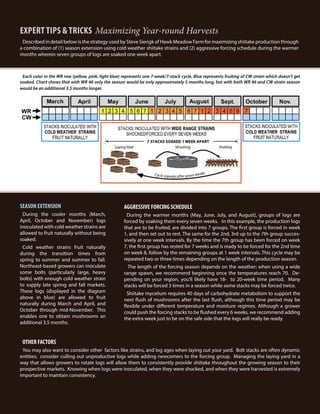
Fungal Competitors
Sometimes conditions are ideal and fungal competitors still become estab-
lished in your logs. If this is the case, all is not lost ... and your logs, in all
likelihood, will still produce shiitakes. The shiitake mycelium can coexist with
competitors to some degree and although we cannot offer you a definitive
treatise on how to deal with these competitors, we can suggest that you con-
tinue to care for your logs. It is often the case that your logs will still produce
shiitakes although their ultimate production may be somewhat compromised.
However if any production log does develop a serious fungal competitor you
may consider removing it from your yard to decrease its chance of spreading
unwanted spores.
Below, we have described a small sampling of some of some of the most
common competitors you will encounter.
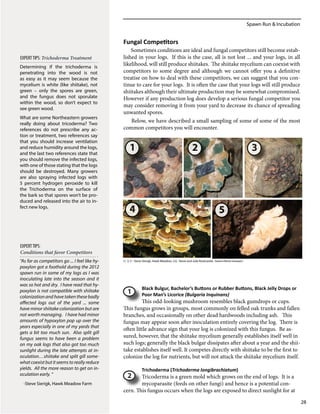
Black Bulgur, Bachelor’s Buttons or Rubber Buttons, Black Jelly Drops or
Poor Man’s Licorice (Bulgaria Inquinans)
This odd-looking mushroom resembles black gumdrops or cups.
This fungus grows in groups, most commonly on felled oak trunks and fallen
branches, and occasionally on other dead hardwoods including ash. This
fungus may appear soon after inoculation entirely covering the log. There is
often little advance sign that your log is colonized with this fungus. Be as-
sured, however, that the shiitake mycelium generally establishes itself well in
such logs; generally the black bulgar dissipates after about a year and the shii-
take establishes itself well. It competes directly with shiitake to be the first to
colonize the log for nutrients, but will not attack the shiitake mycelium itself.
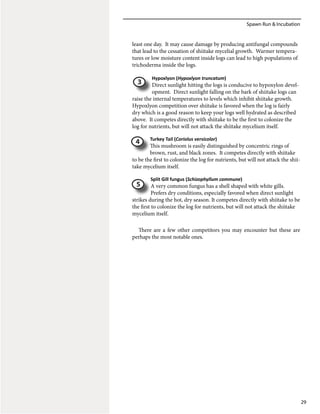
Trichoderma (Trichoderma longibrachiatum)
Tricoderma is a green mold which grows on the end of logs. It is a
mycoparasite (feeds on other fungi) and hence is a potential con-
cern. This fungus occurs when the logs are exposed to direct sunlight for at
1 2
5
3
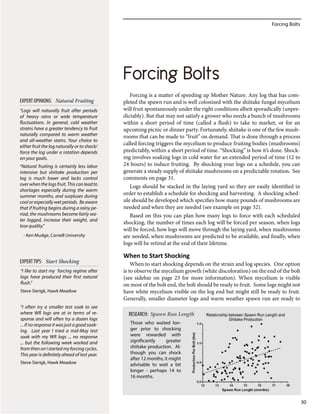
(1, 3, 5 - Steve Sierigk, Hawk Meadow; 2,4, -Steve and Julie Rockcastle, Green Heron Growers
4
Determining if the trichoderma is
penetrating into the wood is not
as easy as it may seem because the
mycelium is white (like shiitake), not
green – only the spores are green,
and the fungus does not sporulate
within the wood, so don’t expect to
see green wood.
What are some Northeastern growers
really doing about tricoderma? Two
references do not prescribe any ac-
tion or treatment, two references say
that you should increase ventilation
and reduce humidity around the logs,
and the last two references state that
you should remove the infected logs,
with one of those stating that the logs
should be destroyed. Many growers
are also spraying infected logs with
5 percent hydrogen peroxide to kill
the Trichoderma on the surface of
the bark so that spores won’t be pro-
duced and released into the air to in-
fect new logs.
EXPERTTIPS: Trichoderma Treatment
“As far as competitors go ... I feel like hy-
poxylon got a foothold during the 2012
spawn run in some of my logs as I was
inoculating late into the season and it
was so hot and dry. I have read that hy-
poxylon is not compatible with shiitake
colonization and have taken these badly
affected logs out of the yard ... some
have minor shiitake colonization but are
not worth managing. I have had minor
amounts of hypoxylon pop up over the
years especially in one of my yards that
gets a bit too much sun. Also split gill
fungus seems to have been a problem
on my oak logs that also got too much
sunlight during the late attempts at in-
oculation
shiitake and split gill some-
whatcoexistbutitseemstoreallyreduce
yields. All the more reason to get on in-
oculation early. “
-Steve Sierigk, Hawk Meadow Farm
EXPERTTIPS:
Conditions that favor Competitors
1
2
Spawn Run & Incubation
29
least one day. It may cause damage by producing antifungal compounds
that lead to the cessation of shiitake mycelial growth. Warmer tempera-
tures or low moisture content inside logs can lead to high populations of
trichoderma inside the logs.
Hypoxlyon (Hypoxlyon truncatum)
Direct sunlight hitting the logs is conducive to hypoxylon devel-
opment. Direct sunlight falling on the bark of shiitake logs can
raise the internal temperatures to levels which inhibit shiitake growth.
Hypoxlyon competition over shiitake is favored when the log is fairly
dry which is a good reason to keep your logs well hydrated as described
above. It competes directly with shiitake to be the first to colonize the
log for nutrients, but will not attack the shiitake mycelium itself.
Turkey Tail (Coriolus versicolor)
This mushroom is easily distinguished by concentric rings of
brown, rust, and black zones. It competes directly with shiitake
to be the first to colonize the log for nutrients, but will not attack the shii-
take mycelium itself.
Split Gill fungus (Schizophyllum commune)
A very common fungus has a shell shaped with white gills.
Prefers dry conditions, especially favored when direct sunlight
strikes during the hot, dry season. It competes directly with shiitake to be
the first to colonize the log for nutrients, but will not attack the shiitake
mycelium itself.
There are a few other competitors you may encounter but these are
perhaps the most notable ones.
4
5
3
Forcing Bolts
30
Forcing is a matter of speeding up Mother Nature. Any log that has com-
pleted the spawn run and is well colonized with the shiitake fungal mycelium
will fruit spontaneously under the right conditions albeit sporadically (unpre-
dictably). But that may not satisfy a grower who needs a bunch of mushrooms
within a short period of time (called a flush) to take to market, or for an
upcoming picnic or dinner party. Fortunately, shiitake is one of the few mush-
rooms that can be made to “fruit” on demand. That is done through a process
called forcing triggers the mycelium to produce fruiting bodies (mushrooms)
predictably, within a short period of time. “Shocking” is how it’s done. Shock-
ing involves soaking logs in cold water for an extended period of time (12 to
24 hours) to induce fruiting. By shocking your logs on a schedule, you can
generate a steady supply of shiitake mushrooms on a predictable rotation. See
comments on page 31.
Logs should be stacked in the laying yard so they are easily identified in
order to establish a schedule for shocking and harvesting. A shocking sched-
ule should be developed which specifies how many pounds of mushrooms are
needed and when they are needed (see example on page 32).
Based on this you can plan how many logs to force with each scheduled
shocking, the number of times each log will be forced per season, when logs
will be forced, how logs will move through the laying yard, when mushrooms
are needed, when mushrooms are predicted to be available, and finally, when
logs will be retired at the end of their lifetime.
When to Start Shocking
When to start shocking depends on the strain and log species. One option
is to observe the mycelium growth (white discoloration) on the end of the bolt
(see sidebar on page 23 for more information). When mycelium is visible
on most of the bolt end, the bolt should be ready to fruit. Some logs might not
have white mycelium visible on the log end but might still be ready to fruit.
Generally, smaller diameter logs and warm weather spawn run are ready to
Forcing Bolts
“Logs will naturally fruit after periods
of heavy rains or wide temperature
fluctuations. In general, cold weather
strains have a greater tendency to fruit
naturally compared to warm weather
and all-weather stains. Your choice to
either fruit the log naturally or to shock/
force the log under a rotation depends
on your goals.
“Natural fruiting is certainly less labor
intensive but shiitake production per
log is much lower and lacks control
overwhenthelogsfruit.Thiscanleadto
shortages especially during the warm
summer months, and surpluses during
cool or especially wet periods. Be aware
that if fruiting begins during a rainy pe-
riod, the mushrooms become fairly wa-
ter logged, increase their weight, and
lose quality.”
- Ken Mudge, Cornell University
EXPERT OPINIONS: Natural Fruiting
“I like to start my forcing regime after
logs have produced their first natural
flush.”
Steve Sierigk, Hawk Meadow
“I often try a smaller test soak to see
where WR logs are at in terms of re-
sponse and will often try a dozen logs
... if no response it was just a good soak-
ing. Last year I tried a mid-May test
soak with my WR logs ... no response
... but the following week worked and
fromthenonIstartedmyforcingcycles.
This year is definitely ahead of last year.
Steve Sierigk, Hawk Meadow
EXPERTTIPS: Start Shocking
RESEARCH: Spawn Run Length
Those who waited lon-
ger prior to shocking
were rewarded with
significantly greater
shiitake production. Al-
though you can shock
after 12 months, it might
advisable to wait a bit
longer - perhaps 14 to
16 months.
Forcing Bolts
31
AGGRESSIVE FORCING SCHEDULE
During the warmer months (May, June, July, and August), groups of logs are
forced by soaking them every seven weeks. In this example, the production logs
that are to be fruited, are divided into 7 groups. The first group is forced in week
1, and then set out to rest. The same for the 2nd, 3rd up to the 7th group succes-
sively at one week intervals. By the time the 7th group has been forced on week
7, the first group has rested for 7 weeks and is ready to be forced for the 2nd time
on week 8, follow by the remaining groups at 1 week intervals. This cycle may be
repeated two or three times depending on the length of the production season.
The length of the forcing season depends on the weather; when using a wide
range spawn, we recommend beginning once the temperatures reach 70. De-
pending on your region, you’ll likely have 18- to 20-week time period. Many
stacks will be forced 3 times in a season while some stacks may be forced twice.
Shiitake mycelium requires 40 days of carbohydrate metabolism to support the
next flush of mushrooms after the last flush, although this time period may be
flexible under different temperature and moisture regimes. Although a grower
could push the forcing stacks to be flushed every 6 weeks, we recommend adding
the extra week just to be on the safe side that the logs will really be ready.
EXPERT TIPS & TRICKS Maximizing Year-round Harvests
Described in detail below is the strategy used by Steve Sierigk of Hawk Meadow Farm for maximizing shiitake production through
a combination of (1) season extension using cold weather shiitake strains and (2) aggressive forcing schedule during the warmer
months wherein seven groups of logs are soaked one week apart.
SEASON EXTENSION
During the cooler months (March,
April, October and November) logs
inoculated with cold weather strains are
allowed to fruit naturally without being
soaked.
Cold weather strains fruit naturally
during the transition times from
spring to summer and summer to fall.
Northeast-based growers can inoculate
some bolts (particularly large, heavy
bolts) with enough cold weather strain
to supply late spring and fall markets.
These logs (displayed in the diagram
above in blue) are allowed to fruit
naturally during March and April, and
October through mid-November. This
enables one to obtain mushrooms an
additional 3.5 months.
Each color in the WR row (yellow, pink, light blue) represents one 7-week/7-stack cycle. Blue represents fruiting of CW strain which doesn’t get
soaked. Chart shows that with WR 46 only the season would be only approximately 5 months long, but with both WR 46 and CW strain season
would be an additional 3.5 months longer.
OTHER FACTORS
You may also want to consider other factors like strains, and log ages when laying out your yard. Bolt stacks are often dynamic
entities; consider culling out unproductive logs while adding newcomers to the forcing group. Managing the laying yard in a
way that allows growers to rotate logs will allow them to consistently provide shiitake throughout the growing season to their
prospective markets. Knowing when logs were inoculated, when they were shocked, and when they were harvested is extremely
important to maintain consistency.
Forcing Bolts
32
be shocked sooner than larger logs and cold weather strains. Also, night-
time temperatures should average above 50 degrees Fahrenheit before logs are
shocked.
Most growers end up shocking after about a year. But you may find the logs
aren’t ready yet or that the first flush is small. The size of the flush depends
on how much spawn was placed in the log during the inoculation phase, how
moist the logs were kept, and how much competitive fungi exist in the log. If
your first flush is small, don’t despair -- try again about two months later.
Where to Shock
Place the logs in the coldest water available — a 100 gallon cattle trough
or big tub works best. Because temperature adjustment is not practical, we
recommend filling the tank from a fast moving stream or keeping the tank out
of the sun. Rainwater collection is also a possibility. Ponds work well, though
they may make log retrieval difficult.
How to Shock
Submerge the logs in water for 24 hours. In general, logs left in the water for
a longer or shorter amount of time will not reach their production potential.
However, many growers may choose to vary the duration of the soaking based
on the air temperature, log species and age of log. (See the side bars for more
information.)
When you remove the logs from the water, stack them in an A-frame (con-
ducive to the upcoming harvest). A high A-frame consists of logs leaning
upright on one or two sides against a supporting beam, such as a cut sapling
lashed horizontally onto two trees or a taut wire. This stacking method works
well for the fruiting and harvest stages. Logs are well aerated, mushrooms are
“In general I force logs at all times of
the year for 24 hours ... but I have read
that when the weather is warmer you
need shorter soaks to trigger the forc-
ingresponsewhileinthespringandfall
it takes a longer time period to trigger
the same response.”
​- Steve Sierigk, Hawk Meadow Farm
EXPERT OPINION:
Warm Weather Forcing
EXPERT OPINION: Twelve Hour Soak?
“Essentially, the greater quantity of
water absorbed the better, during your
forcing soak. With that being said, we
were unable to see statistical differ-
ences between 12- and 24-hour soaks
of the same tree species. So what does
all this really mean?
“You could probably get away with
a 12-hour soak, if you are using logs
that take up moisture very easily, such
as Carpinus sp., whereas a Red Oak or
Sugar Maple, which takes water up at
a slower rate than Carpinus, may need
more time in the bath tub. When look-
ing at yields, one very important pre-
dictor was total water absorption.”
-Bryan Sobel, Cornell University
Some growers may be concerned
about the chlorine in their water sys-
tem and its impact on shiitake spawn;
most have found that city water does
not affect production. However, it is
possible to off-gas the water used for
shocking for 24 hours to reduce any
risk by simply leaving the water un-
covered for 24 hours.
EXPERTTIPS: Chlorinated Water
Soaking logs in a 100 gallon tub.
(Rockcastles, Green Heron Growers)
Soaking logs in a pond.
(Nicholas Laskovski, Dana Forest Farm)
Logs stacked in an A-frame formation in preparation for fruiting.
(Steve & Julie Rockcastle, Green Heron Growers)
Forcing Bolts
33
easily visible, and picking is easy, as there is maximum access to each log.
Because logs stacked in A-frames take up a lot of space in a laying yard, they
are usually not left on the A-frame for any other part of the process; this is
especially true for a forced production model.
Protect Mushrooms during Growth Phase
In 3 to 5 days, the log will begin pinning; Look for bumps about the
size of a pencil eraser. At this point, consider protecting the mushrooms
from high winds and cold weather, which can dry the mushrooms and inhibit
their growth. Mushrooms exposed to freezing conditions during growth may
either stop growing or develop an unfavorable texture.
Also try to protect budding mushrooms against rain storms, particularly
2 to 3 days before picking. Rain causes mushrooms to become soggy and
waterlogged. Wet mushrooms are significantly less valuable; many growers
discount the price by 20 to 25
percent, if they sell them at all.
Professional growers recom-
mend covering your logs with
fruiting blankets, agricultural
cloth, or tarps to keep the mush-
rooms from freezing and getting
more wet. Different types of cover
may also reduce the potential for
insects and other pests to damage
the newly fruited shiitake mush-
rooms. Read more on each of
these practices on page 35 and 36.
How Often to Shock Bolts
After fruiting, logs need to be
rested for 6 to 8 weeks before being forced again. The more often the logs are
shocked, the shorter their lifetime is likely to be. Experienced growers recom-
mend trying to fruit your logs as often as possible (two to three times a year)
for the following reasons1
:
‱	 It keeps the logs well hydrated, therefore there is little need for mainte-
nance soaks in between forcing.
‱	 It minimizes the probability of resting stacks producing mushrooms
spontaneously (which are hard to pick).
1	 Text adopted from conversations with Nick Laskovski of Dana Forest Farm
and Steve Sierigk of Hawk Meadow Farm.
“If only a few mushrooms have popped
out naturally, I generally will force
these logs after I pick the mushrooms.
Instead of a full 24-hour soak you can
just do a shorter soak to keep the my-
celium humming (4 to 6 hours) ... this
should be enough to trigger a flush.
“If it is a significant number of mush-
rooms (like more than let’s say 6- to 10)
I somewhat consider that a flush and
waitabout7to8weekstoforceagain.“
- Steve Sierigk, Hawk Meadow Farm
EXPERT OPINION:
Forcing After a Natural Flush
Mushroom sequence created from images taken 24 hours apart from initial pinning until harvest.
(Earl Tuson, Red Manse Farm)
“I suggest trying to fruit your logs
as often as possible from an eco-
nomic standpoint, within the un-
derstood guidelines of the spawn
regeneration/resting period. If your
logs are still producing and a market
still exists, you’d be maximizing your
production. While the overall years
of your logs may possibly diminish,
you’re reducing the risk of external
failures over time such as drought,
pests, other fungi, etc. It’s up to the
farmer to be very efficient with inoc-
ulation and maintain consistent shii-
take production a goal to overcome
the high cost of labor and sustain
operations.”
- Nick Laskovski, Dana Forest Farm
EXPERT OPINION: How Often to Shock
EXPERTTIPS:
Frost and Rain while Fruiting
Logs stacked in A-frames covered by agricultural cloth
(Bill Stack, Cobb Hill Farm)
Forcing Bolts
34
What will it take
to shock/force 100
logs for 1 full year?
8Hours of
Labor
$34Worth
of Supplies
Tarps
WaterTanks
Hoses
*Values based on data collected from 17 farmers starting a shiitake operation
‱	 It optimizes the ultimate yield of shiitakes from logs by reducing the
probability that external factors (drought, pests, competitive fungi) neg-
atively impact production.
‱	 It imposes a sense of order to stacks of logs so that they can be easily
managed each week.
For more information regarding how often to shock logs, see the expert tip
on page 31.
Culling Unproductive Logs
Excerpt by Steve Sierigk, Hawk Meadow Farm
When you are first starting to build the size of your shiitake yard, and your
inoculated logs are still young and productive, it is not always easy to think
about culling out unproductive logs. It is not easy to give up on logs that
have served you well, but there comes a time when your labor in moving logs
around is not justified in log productivity.
Create a criteria outlining when you might start to pull logs out of your
active forcing cycles. You will notice at some point that forced logs start to
produce shiitakes sparsely and of much smaller size: it may be time to give
up on these logs. Logs will also have a spent look; losing bark, losing weight,
starting to get more competitors and starting to get punky. For instance if you
introduce 100 new logs into your yard each year and force all logs twice a year,
by year four you will expect to see signs of your first log burnout.
There are no hard rules for how to deal with these logs. One option is
to leave them in a transition area for one year with no active management;
expect to pick occasional mushrooms off some of these logs. Experienced
growers also recommend using them around garden borders (you may even
pick occasional shiitakes from these too). Some growers also burn spent logs
in woodstoves as a heat source.
“We cull logs based on what year they
were inoculated and cull a whole year’s
worth of logs at a time after the 3rd
fruiting year. Unlike some growers, we
do not mix new logs in with older logs.
We keep each crib stack of 20-25 logs
together as a group from inoculation
tilltheyareculled.Wewanttoobserve&
record harvests per year and per strain
to track productivity and monitor lon-
gevity. It’s hard to give up on logs, so
we put the culled logs in an area out of
the way for their 4th year and get a few
mushrooms from them, but the follow-
ing year they are used for our festival
bonfires. Another thing we do different-
ly is to keep the logs in crib stack for the
incubation year and then set them in
A-frame formation the next spring and
do not ever put them back in crib stack.
So far, room to do this has not been an
issue and this method saves labor mov-
ing logs after fruiting. “
- Steve and Julie Rockcastle,
Green Heron Growers
EXPERT OPINION: Culling Logs
Forcing Bolts
35
wind and cold protection
“Agricultural Cloth moderates the effects of weather
on developing mushrooms. Developing mushroom pins
can desiccate even in protected sites from the effects of
sun and wind; agricultural cloth draped over pinning
logs can protect mushrooms from sun and wind without
effecting mushroom quality. Be aware, however, if it is
raining that ag cloth offers no protection from getting
soggy mushrooms so you might want to use plastic tarps
to cover logs in these situations.
“When it is cold, I generally cover logs with a fruiting
blanket or tarp in the late afternoon and take them off
again after it has warmed up a bit. I will use agricultural
cloth (row cover material) during a forcing if there are
steady winds as wind can especially dry out beginning
pins. I don’t mind keeping the ag cloth on for extended
periods during the forcing because it lets light through
and shiitake quality never seems to have changed when
I left ag cloth on for entire length of forcing.”
-Steve Sierigk, Hawk Meadow Farm
Expert Tips & Tricks Many Uses of Agricultural Cloth and Tarps
“Growing mushrooms outdoors on logs offers many challeng-
es, but we growers have many tools to help stack the odds in our
favor. I came upon using ag cloth early on in growing shiitakes
and it has made our crops a lot more able to withstand many
variables, especially weather. I recommend purchasing a high
quality ag cloth as light weight ones don’t hold up well and tear
easily on logs; Agribon, available through Johnny’s, is quite rea-
sonably priced.“
- Steve Sierigk, Hawk Meadow Farm
Rain Protection
“Although tarps are a great tool they can cause problems too. I
don’t like to use them more than I have to ... and have now generally
favored the ag cloth if it is too hot or windy ... and only bring out the
plastic tarps to keep off rain. I have also observed that keeping tarps
on too long favors other shiitake competitors.
“I will use plastic tarps (I prefer clear plastic so I can see what is hap-
pening) when I see the threat of rain, especially being vigilant the 2
days before picking. Wet mushrooms are a bummer ... and I usually
discount their price by 20 to 25 percent if I sell them at all. I don’t like
to leave plastic on longer than necessary because I have an intuitive
feeling that these mushrooms don’t develop as good a taste or color
whenunderatarptheirwholetime...especiallyiftarpisveryopaque
... they also seem to get on the leggy side and seem lighter in color to
me. “
- Steve Sierigk, Hawk Meadow Farm
“White plastic is what we had amongst our farm supplies, so we
started using it. First to cover fresh cut logs before inoculation and
then to protect fruiting logs from rain. We cover logs only after
they’ve been soaked and the mushrooms are about half grown.
White plastic doesn’t let much light in, so we don’t get heat built up
around the mushrooms. We have yet to try Agribon”
- Steve and Julie Rockcastle, Green Heron Growers
“Being able to cover your mushrooms prior to a heavy rain can help
save a mushroom crop from becoming too soggy. Clear tarps tend
to create a greenhouse-style effect on mushroom caps and should
be used with caution based on direct sunlight and outdoor tempera-
tures. When used, watch to make sure the logs/mushrooms are not
overheating beneath the tarp.”
- Nick Laskovski, Dana Forest Farm
“I’ve been using nursery grade shade cloth 80 percent and it’s work-
ing wonderfully; tarps seem overly oppressive, and the shade cloth
does well in sheltering from rain.”
- Steve Gabriel, Wellspring Forest Farm, Mecklenburg NY
Crib stacked logs covered by agricultural cloth.
(Ross Conrad, Dancing Bee Gardens)
Forcing Bolts
36
Expert Tips & Tricks Many Uses of Agricultural Cloth and Tarps
pest Protection
“Another use of ag cloth worth mentioning is when newly in-
oculated logs are in a tight crib stack during the spawn run. Cer-
tain log species, like Bitternut Hickory, are particularly vulnerable
to boring insects, primarily long-horned beetles, which bore into
the logs. Ag cloth draped over the crib stack can discourage the
adults from laying eggs into the logs in the first place.
Ag cloth also can help to keep pests off of developing mush-
rooms, especially if tucked in tightly. Some mammals such as
red squirrels can develop a taste for shiitake and ag cloth is an
effective tool to keep them off. All covering ... especially ag cloth
... seems also to help keep slugs at bay.”
- Steve Sierigk , Hawk Meadow Farm
“The purpose of the Agribon is too keep the humidity consistent
during pinning and fruiting, and it keeps out pests. I just drape
Argribon right over the logs and it doesn’t really interfere too
much with growth. Sometimes I’ll place a rock or old log on the
cloth and pull it away from the logs. That keeps the cloth close
to the ground and off any fruiting mushrooms. Agribon keeps my
shiitakes safe from nearly all pest damage, except slugs.
“A few weeks ago I was looking for some advice on what turned
out to be a pleasing fungus beetle attack. The infestation that
I got had essentially wiped out 25 percent to 30 percent of my
crop one week. The solution was ag cloth on the ground around
the a-frames and then we covered the logs at all times with an-
other type of ag cloth, called Agribon (row cover). That stopped
the beetles to virtually no attack. However, a few manage to get
in every now and then but they don’t cause nearly the extent of
damage as they were on the uncovered logs. This week I haven’t
seen one yet. The ag cloth also keeps the thrips to a near mini-
mum. In the end, a constant covering of ag cloth results in nearly
perfect mushrooms.”
-Matt Anderson, Tyrrel Mushroom Farm
Fruiting Logs covered with shade cloth
(Matt Anderson, Tyrrel Mushroom Farm)
Season Extension with
fruiting Blankets
“Fruiting blankets ... I bought a few of these from Field and
Forest (they are fairly heavy duty and are black) and have ex-
perimented with these especially with spring and fall wide range
forcings. After I take the logs out of the water and put them in A-
frame picking position ... I first let the surface water dry off which
will take perhaps an hour and then throw the fruiting blankets
over these logs ... the hope is that these help provide a nice warm
moist environment to give the pins a great start. I am still experi-
menting with fruiting blankets but think they help.“
“Our general procedures are fruiting blankets when pins ap-
pear, keep moisture and temp up, but slugs like this too ... gen-
erally a day or 2 with these especially in cooler weather. I then
switch to agricultural cloth as the pins grow to let in a bit more
light but keep out wind. I keep an eye on the weather and if a
rainstorm is due we do throw plastic tarps over the logs to keep
the rain off as wet shiitakes are a bummer.”
- Steve Sierigk, Hawk Meadow Farm
Fruiting Logs covered with shade cloth and agricultural cloth under a tarp structure.
(Bill Stack, Cobb Hill Farm)
Forcing Bolts
37
“As far as expected yields ... I think that it
is somewhat predictable but has so much
to do with many factors; inoculation, selec-
tion of good bolts and what tree species
are used. A bolt does not always equate
to a given amount of mushrooms. For in-
stance my bitternut hickory logs give per-
haps 30% to 50% of my oak logs and are a
management dilemma (the timing of their
production spreads out over a few weeks
rather than a discrete, quicker time). I have
some nice-looking red oak logs that have
produced little as they were so slow grow-
ing that their sapwood layer is pitiful! I am
really finding that the biggest factor in pro-
duction is really nice bolts ... but oftentimes
we are just working with material that we
have at hand. Saying this however you
can probably expect one-third to one-half
pound per bolt per forcing ... you may get
more or less. I have had great logs yield 2#
ormoreperflush...andIhavealsohaddogs
that produced little. If forcing 100 logs, 30
to 35 pounds each week is very achievable.
This is one reason I will go out of my way to
acquire superior material ... that is since we
put so much work into management. But
learning what is great material is perhaps
part of the necessary learning curve. Also
the reality of balancing what bolts we can
easily get is part of the whole idea of this as
management of our woodlots if we have
them.”
-Steve Sierigk, Hawk Meadow Farm
EXPERT TIPS: What yields to expect and how to improve yields
( Whole System Design, Mad River Valley, Vermont )
Forcing Bolts
38
Common Mushrooms Pests and Concerns
Slug Damage
Slugs cause more damage to shiitake crops than any other pest. They are
more common during cool, moist weather. There are many alleged remedies
for slugs on Shiitake logs, but there is little agreement about which is best.
Below, Northeast growers share their secrets:
‱	 “I provide lots of toad habitat which I really
believe can be good allies with slugs. Toads get
to become recognized company (live up to 40
years) as they often keep to the same hangouts
and you can start to tell individual toads apart.
They do eat slugs ... although it would take a
good-sized one to eat those big slugs.” -Steve
Sierigk, Hawk Meadow Farm
‱	 “I would go out every night “slugging” with a
flashlight and a skewer. Over time there was
much less damage.” -Sal LaFemina
‱	 “I rake under the ferns and leaf/needle litter to
locate where they are hiding/resting during the
day. Then I introduce my chickens to them. Slugs
are a great chicken delicacy, it seems. After 2 to 3 days the problem is back to being
manageable. “-Carol
‱	 “We installed angular gravel in the fruiting area, which helps keep the area well
drained for the moisture loving slug. We also use wood ash/charcoal, a by-product
from our outside furnace, and Sluggo around the outside of the structure.” -Bill
Stack, Cobb Hill Farm
‱	 “I’ve built a few simple gravel beds, framing them out with old lumber and filling
with gravel (the sharper the better). It seems to be working quite well” -Steve Ga-
briel, Wellspring Forest Farm, Mecklenburg NY “When picking shiitakes, slug check-
ing is just a part of the operation. We do specific slug checks when the shiitakes
are developing morning and night. Sometimes this is just a quick 5-minute perusal
but certainly after a rain it is more. We feel like it is worth it as otherwise we would
lose perhaps 4 to 5 pounds of shiitakes each week to slugs.” -Steve Sierigk, Hawk
Meadow Farm
Pleasing Fungus Beetle
The pleasing fungus beetle is about an eighth
inch long with a hard red-brown body. Pleas-
ing fungus beetles feed on the fruiting bodies of
fungi. These pest can seriously disrupt a shii-
take operation. If they are a problem in your
area, we recommend covering fruiting logs with
agriculture cloth (such as Agribon). See sidebar
for more information.
Squirrels and Chipmunks
If you notice that sections of your mushrooms have been eaten, squirrels may
be the culprit. Growers have noticed that some squirrels eat the mushrooms
while others simply break them off the log and nibble on them. Possible solu-
tions are to cover fruiting logs with agricultural cloth, allow dogs to roam the
laying yard, or trap and remove the offending squirrels.
Slug enjoying shiitake mushroom.
(Bill Stack, Cobb Hill Farm)
“Our first forcing area we actually went
as far a putting up copper wire encir-
cling the area aground the forced logs
... but I have watched slugs cross over it
and from what I have read you would
need about a 2-inch width of copper
for a slug barrier, impractical for most
of us. “
-Steve Sierigk, Hawk Meadow Farm
EXPERT OPINION: Copper Wire
Pleasing fungus beetle damage
(Matt Anderson, Tyrrel Mushroom Farm)
EXPERTTIPS: Pleasing Fungus Beetle
“Pleasing fungus beetles are rampant
in the Hudson Valley. As soon as they
realize that you grow mushrooms they
move in, and they move in with a ven-
geance. The solution is to cover your
logs while they are fruiting with an ag-
ricultural cloth. We use Agribon. Don’t
allow any access at all. Agribon is a
productthathasseveraladvantagesfor
growing shiitakes anyway. It prevents
the pins and eventually the mushrooms
from drying out. A lot of farmers use it.”
-Matt Anderson,
Wood Advisory Services, Inc.
“Chipmunks are a pest in the fall for us
and can take a whole bunch of shiitake
pins in a few days. They are stocking up,
we presume? We see little teeth marks
on the logs where the pins were. We’ve
also seen teeth marks up under the caps
where chipmunks or mice have eaten
their favorite parts. Harvest what you
think is a perfect shiitake, but no, the
critter got there first!”
- Steve and Julie Rockcastle,
Green Heron Growers
Harvesting Shiitake
39
When to Harvest
Shiitake mushrooms are usually ready to be har-
vested 7 to 10 days after shocking although colder
temperatures will slow their growth. It is not the
size of the mushroom that determines when it is
picked, but its growth progress. Gills should be
visible and the outer edge of the mushroom should
be slightly curled under, but not tightly so. If the
edge has flattened out, the mushroom is slightly
over-ripe, but still edible.
Shiitakes are more marketable when the cap
is still curled and somewhat closed. Wide, flat-
tened mushroom caps indicate over-maturity
and will not be as valuable as the fresher looking
forms. Many growers choose to dry overgrown
and damaged mushrooms, and report that pound
for pound at fresh stage, dried shiitakes sell for just
as much money as fresh. The advantage of dried
mushrooms is they do not have to be aesthetically
perfect, although it is suggested, especially for
mushrooms sold at retail, that they be harvested at
the right time and free of slug damage or other major defects.
For more information regarding how to dry the mushrooms, see the section
on processing.
How much to Expect
Mushroom production for a typical log will peak the second and third years.
At this time it is reasonable to expect 0.25 to 0.5 pound of mushrooms per log
or higher per flush, with the goal of doing two shockings per season. Over the
course of five years, you can expect to produce approximately 3 to 4 pounds of
fresh mushrooms per log.
Removing and Cleaning Shiitake Mushrooms
When harvesting shiitake mushrooms, the goal is to efficiently remove the
mushrooms without damaging the bark. Most experienced growers simply
twist and pull the mushrooms off the log using their hands. See sidebar for
more information. However, if you don’t feel comfortable with this method,
you can use either a curved pair of scissors or a knife in order to ensure a clean
cut on the stem. Either way, growers make the point to “not worry” because a
thoroughly colonized and well-managed log should be fine with minor pieces
of bark removed.
Gently brush off any dirt or debris, without washing the mushroom under
water, and place each mushroom into an open basket, paper sack or other
vented container.
Harvesting Shiitake
“I pick by hand ... using both hands. I
grab stem as close to base as I can and
twist. I also notice a distinct difference
between log species on how shiitakes
pick ... some come off quite easily and
some are more difficult ... so if I feel
much resistance I often make sure to
pull in a direction that goes against
the grain of the wood ... this often mini-
mizes bark tearing and makes a cleaner
pick. “
– Steve Sierigk, Hawk Meadow Farm
“I used to cut the mushrooms off - un-
til weekly harvesting began taking
too long (one at time with one hand
working the knife). I now harvest ‘two
handed’ and carefully twist the stem to
remove it cleanly without tearing the
bark. Getting a knife behind every stem
is not so easy when the mushrooms are
in clusters. And watching highly experi-
enced growers (even in Japan) work has
shown me that cutting every one off is
just too slow/tedious.”
- Bob Wagner, North Woods Shiitake
EXPERTTIPS: Picking Techniques
Shiitake mushroom ready for harvest.
(Ben Waterman, UVM Extension)
Overgrown shiitake mushroom
(Photo Ben Waterman, UVM Extension)
“On the cooler ends of the forcing sea-
son I generally allow 11 to 12 days from
forcing to picking ... even more in the
fall when I really seem to push that last
forcing.”
– Steve Sierigk, Hawk Meadow Farm
“I usually time my fruitings 10 days in
advance of when I plan to sell them. If
there are harvestable shrooms before-
hand, I’ll put them in the fridge for a
day or so, collect more, and then deliver
when the logs are fully harvested. “
- Nick Laskovski, Dana Forest Farm
EXPERTTIPS: Harvest Timing
Harvesting Shiitake
40
Thrips
Thrips, in the order Thysanoptera, are com-
mon to Northeast mushroom laying yards.
These are tiny, slender black insects, about
one eighth inch long, that feed on mushroom
spores. They can be found crawling in the gills
before harvest. While cumbersome to deal
with, they are often not a cause for concern,
because they feed on the spores and not the
mushroom fruiting body.
A few light taps on the top of the cap is often
enough to disturb the thrips so they dislodge
and fall out. If the problem is more widespread, mushrooms can be harvested
in bulk and blown, under light pressure, by an air compressor.
Deer
Some deer may also acquire a taste for
shiitake mushrooms. Spraying deer repellent
around your laying yard should discourage the
deer. Deer have not generally been considered
a serious pest of shiitake, except in isolated
incidents. One of the most extreme of these was
reported recently by an experienced Vermont
grower. Over a single night, what must have
been a herd of deer ate hundreds of shiitake
mushrooms from scores of logs, costing the
grower hundreds of dollars.
Cracking Caps
Cracking in shiitake caps occurs due
to the varying growing conditions, typi-
cally dry conditions, after the shiitake pins.
In Asian cultures, dried shiitake cracked
caps are highly valued (and priced/graded
higher) because their flavor is considered
more intense. These shiitake are often called
“flower” shiitake as the cracking pattern
resembles a blooming flower. Many growers
in Asia deliberately try to induce this condi-
tion (high humidity and temperature during
day and cold and dry at night) to achieve a
higher yield of flower shiitake.
Large Stems and Small Caps
Shiitake generally develop large stems and
small caps when there is not enough fresh air exchange and sunlight. To alle-
viate the problem, introduce more airflow and sunlight into your laying yard
and fruiting structures.
Shiitake mushrooms with cracked caps
(Nicholas Laskovski, Dana Forest Farm)
Deer-damanged shiitake caps
(Nicholas Laskovski, Dana Forest Farm)
Thrips on shiitake gills
(Steve & Julie Rockcastle,
Green Heron Growers)
“Thrips ... tiny and fast-moving. The
ubiquitous thrips are a nuisance but
seem to cause little physical damage.
After picking shiitake we gently blow
on the gills and the thrips rise to the sur-
face; gently tap the shiitake to send the
thrips elsewhere, deal with as you will!
Thrips seem to be worst in the warmer
temperatures of summer.”
– Steve Sierigk, Hawk Meadow Farm
EXPERTTIPS: Thrips
Harvesting Shiitake
41
Overgrown Shiitake
When shiitakes become overgrown, the
caps become wide and flattened. These
mushrooms, although still edible, will not
be as valuable as the fresher looking forms.
Many growers choose to dry overgrown and
damaged mushrooms.
In the fall and spring, logs have a strong urge
to produce shiitakes due to natural environ-
mental triggers, so it is good to walk through
stacks every few days to look for them. We
also recommend keeping your stacks loose
enough that you can collect naturally fruit-
ing mushrooms as they arise.
Shiitake Look-a-Likes
It is important for every grower to be certain that what is being picked, sold
or eaten is shiitake. Care should be taken to pick mushrooms only from inoc-
ulated logs free of decomposition from other fungi. Make sure you are famil-
iar with shiitake’s size, shape, cap ornamentation, growth habit and overall
appearance. If you are not sure if a brown mushroom on your log is shiitake,
make a spore print (see below) and/or consult a mycologist or other expert.
Galerina is a small brown mushroom found on very decayed wood. It is
very poisonous, and may be even fatal if ingested. It has a brown spore print,
unlike Shiitake with a white spore print. It is highly unlikely Galerina or other
look-a-like mushrooms will grow on logs managed for shiitake. Galerina is
only found on well-decayed wood, which would exclude at least one and two
year post-inoculation shiitake logs, and probably older. Whereas shiitake is
a primary decomposer that colonizes “clean” substrate (not yet colonized by
other fungi), Galerina is a seconday decomposer which requires the substrate
be already partially broken down by other fungi. If Galerina does appear after
a log has been fully utilized, decomposed or discarded, the grower will be
able to distinguish it from shiitake which s/he has been observing for the past
several years. Being familiar with the appearance of shiitake by this time, the
grower will easily note the differences between shiitake and Galerina, in size
(shiitakes are larger), cap ornamentation (absent in Galerina), annulus or ring
under the cap (usually present in Galerina), and of course spore print if any
doubt remains.
Overgrown Shiitake Mushrooms
(Ken Kelban)
EXPERTTIPS: Overgrown Shiitake
We typically eat overgrown shiitake
mushrooms grilled with melted cheese
and garlic as a sandwich ... we call
these ‘grillers’. Some of the restaurant
accounts have said that they would not
mind the overgrown ones if they are not
in bad shape ... I would discount these
a wee bit.”
–Steve Sierigk, Hawk Meadow Farm
Shiitake Mushrooms
(Steve Sierigk, Hawk Meadow Farm)
EXPERTTIPS: Shiitake Identification
“A shiitake log may sometimes sprout
a different mushroom—the log might
already have been colonized by an-
other fungus, or can be invaded in the
laying yard. By far the most danger-
ous possibilities are mushrooms in the
deadly genus Galerina.
To reliably distinguish a Galerina from
a shiitake, make a spore print. Cut off
the stem and place the cap, gills down,
on white paper. Cover it with a bowl to
keep it moist. Galerina always gives a
brown spore print after some hours to
overnight; a shiitake spore print is al-
ways white. Gill color is not a reliable
substitute for a spore print because
young Galerina gills can look pale
--they’ll darken with age.
Additionally, Galerinas usually have a
ring (annulus) around the stem, how-
ever, it may degrade as the mushroom
ages, and that is why a spore print is a
more reliable indicator. The ring is the
remnant of a membrane that covers
the gills of young Galerinas —it runs
between the edge of the cap and the
stem. As a young mushroom opens, the
membrane tears at the cap edge and
becomes the ring. In the young Galeri-
na at the back of this photo you can see
the pale membrane that is breaking to
become the ring. Shiitakes never have a
ring, no matter what age.
–Kathie T. Hodge, Cornell University Poisonous Galerina mushrooms
(Kathie T. Hodge, Cornell University)
Harvesting Shiitake
42
What will it take
to harvest mushrooms
from 100 logs for 1 year
8Hours of
Labor
$17Worth
of Supplies
Scale
Nails
Gravel
Knife
*Values based on data collected from 17 farmers starting a shiitake operation
The consensus among university mycologists who reviewed this guide is
there is very little risk a grower would confuse Galerina with shiitake, due to
reasons stated above. There are no known cases of anyone confusing shiitake
with Galerina. However unlikely, it is theoretically possible, and the informa-
tion presented here should help growers rule out any uncertainty.
To take a spore print, cut a relatively mature mushroom cap away from
the stalk, and set it gills down on a piece of glass or other surface. Leave it
covered to prevent disturbance and air moving past the gills. After one night,
lift the mushroom vertically, careful not to disturb the surface underneath.
The mushroom will have dropped its spores, and the pattern or spore print
color should be distinct. Spore printing, in conjunction with other identifica-
tion methods, is an excellent way to distinguish Shiitake (white print) from
Galerina.
Shiitake mushroom spore print
(Ken Mudge, Cornell University)
Poisonous Galerina mushroom spore print
(Permission granted to use this photograph
by owner Stephen L. Peele, Curator Florida
Mycology Research Center (FMRC) www.
mushroomsfmrc.com)
Storage & Preservation
43
Mushroom Storage Techniques
Storing the fresh mushrooms
For a high-quality mushroom, it is important to get the harvested mush-
rooms into refrigerated storage as soon as possible, certainly within one hour
of picking. These mushrooms will remain fresh and marketable for several
weeks, if kept in a cool (41°F), dry and dark place. Do not seal them in an
airtight container. A paper bag (not plastic) works very well. Keep in mind
that mushrooms will dry out and lose weight the longer they are stored. See
sidebar for more information.
Freezing Shiitake Mushrooms
Mushrooms need to be treated to stop maturation before freezing, usually
by steaming or sauteing. Soak mushrooms in a mixture containing 1 teaspoon
lemon juice or 1.5 teaspoons citric acid per pint of water for 5 minutes to
reduce darkening. Steam whole mushrooms for 5 minutes, buttons or quarters
for 3.5 minutes and slices for 3 minutes. Cool promptly, drain and package,
leaving 1/2-inch headspace. Place small packages in the freezer for fast cooling.
Drying Shiitake Mushrooms
Dry shiitakes are an excellent way to bring seconds to the market. Any
mushroom with cosmetic defects can be dried, but mushrooms that are
molding or have excessive beetle or other damage that compromises taste
should be avoided and discarded.
Drying can preserve large quantities of mushrooms up to a year. The dried
mushroom has a moisture content of approximately 13 percent and weighs
about one seventh the original fresh weight. Separate mushrooms by size and
grade. Remove stems completely, as they harden when they dry. Place mush-
rooms on trays with gills up. Avoid allowing the mushrooms to touch each
other.
Sun Drying / Outdoor Drying
Advantages: Low-cost, simple,
increased vitamin D content in
mushroom
Disadvantages: Depends on weather;
can be slow process
Method: Spread the shiitake on
shelves so that the gills are directly
exposed to sunlight. You can also
string them using thread or fishing
Stainless steel hotel pans have be-
come our preferred storage container
because they are large and come in
various sizes. To control moisture in the
bottom of the pans we put down a layer
of paper towel, but leave the top open.
If we have to hold mushrooms a week
or more, we’ll transfer them to clean
pans occasionally and replace the pa-
per towels. This helps to make sure they
have good air circulation around them,
too. We use baskets in the fridge at
times,buthavefoundthatthefiberbas-
kets start to mold pretty quickly. Those
are reserved now for harvesting. Paper
bags don’t work well for long, unless
you deliver or sell your mushrooms the
day or so after harvest. This, of course, is
the best-case scenario! One factor that I
don’t think we’ll ever be able to account
for is shrinkage from dehydration in the
fridge. What we harvest and what we
sell can be quite different depending
on how long they are refrigerated. That
brings down the “income per pound” by
some percentage unknown.
-Steve and Julie Rockcastle,
Green Heron Growers
“It’s been my experience this year that
wax-lined cardboard boxes are the best
way to store mushrooms in the refriger-
ator. I have been getting boxes from my
restaurants. They typically have several
openings to allow air flow through the
box during storage.
“One thing I’ve learned is not to put
too many mushrooms in a box. For ex-
ample, I can fit about 6 to 7 pounds in
a typical box (15”x20”x4”) and that’s
about it. Mushrooms keep very well in
a fridge, if stored properly, with some
air flow. If you overcrowd fresh mush-
rooms the bottom ones won’t get any
air flow and they’ll head south sooner
that you’d like them to.”
- Matt Anderson,
Tyrrel Mushroom Farm
EXPERTTIPS: Storing Fresh Shiitake
Storage & Preservation
Drying shiitakes outsides.
(Bill Stack, Cobb Hill Farm)
Storage & Preservation
44
line and then hang and dry them in a breezy, dry spot. Length of time
required will vary depending on the weather conditions.
Dehydrator / Home Food Dryer
Advantages: Simple process, quick drying time
Disadvantages: Energy intensive, only handles small quantities (2 to 3
pounds fresh shiitakes)
Method: Follow the instructions that come with the dehydrator. You have
to ensure that you dehydrate your mushrooms until they are light and dry,
but not brittle. They should be slightly flexible.
Oven / Thermal Drying
Advantages: Best quality, quick
Disadvantages: Requires special equipment and a fuel source
Method: Arrange the mushrooms on shelves with the gills facing upwards.
The drying chamber should be maintained at 100-125°F for 24 hours. The
mushrooms should then be cooled for one hour before being stored long-
term. Once dried, the shiitake should be put into polyethylene bags, sealed
and kept in a dry, cool, dark place. If drying the mushrooms in your oven,
set the temperature to 200°F and keep the door ajar.
Value-Added Products
Value-added products can include dried mushrooms and any kind of
cooked or baked product with mushrooms – a shiitake pĂątĂ© or sauce for
example. Value-added products can be a great way to diversity your income
and increase your profits.
The production and sales of these types of processed foods is governed by
state and federal regulations. Each state is different, so proper advice is needed
from a specialist in each state. Some states allow sales at farmers markets of
select foods; others prohibit sales altogether.
Depending on how much product you sell annually, , you will be required
to process your product in a licensed kitchen. Home kitchens are not usually
considered appropriate for processing purposes. In most states, in order to
sell your homemade products on a commercial basis, you’ll need to have your
Dried shiitake mushrooms
(Bill Stack, Cobb Hill Farm)
Shiitake tincture on display
(Rockcastles, Green Heron Growers)
“One of the best uses of shiitake over-
age is dehydrating. We used to dry them
whole, but now slice them, by hand. We
leave as much or the stem intact that is
soft and not woody. The labor required
is a factor, but we slice them because
our customers prefer them that way
and because we can cut out damaged
areas of perfectly tasty mushrooms. We
had a “American Harvester” dehydra-
tor that worked up until this year and
now have an “Excaliber” with 9 trays.
Each batch can start with 5-7 pounds
fresh. The mushrooms overlap on the
trays quite a bit, but reduce so quickly
it doesn’t seem to matter. A batch takes
6-8 hours at 95 degrees. Last year we
dried 100 fresh pounds and got 14
pounds dried. We trying the oven a
couple times at 200 degrees, but I’d say
they were close to burnt and flavorless.
We have also tried sun-drying in our
greenhouse, but it took more than one
day and we felt there was too much risk
of insects contaminating them.”
- Steve and Julie Rockcastle,
Green Heron Growers
EXPERTTIPS: Drying Shiitake
Storage & Preservation
45
kitchen meet commercial grade kitchen standards and pass a health depart-
ment inspection, like a restaurant. The process of converting a home kitchen
can easily cost upwards to $50,000. There are, however, ways around this:
Canneries and licensed kitchens
Prepare your batches in kitchen that is already licensed. Some people rent
restaurant kitchens during their off hours and do the prep and canning there.
In some cases, a local cannery is the way to go. If they are licensed as a com-
mercial kitchen (and many are), then you will be able to avoid the need and
expense to rent a restaurant kitchen.
Copackers
Copackers manufacture and package foods for other companies to sell.
These products range from nationally known brands to private labels. Entre-
preneurs choose to use the services of copackers for many reasons. Copack-
ers can provide entrepreneurs with a variety of services in addition to manu-
facturing and packaging products. They can often help in the formulation of
the product. The copacker may function only as a packer of other people’s
products or may be in business with his own product line. They may be, in
fact, manufacturing several competing products. The range of services avail-
able from a copacker will vary depending on the size and experience of the
copacker and the type of facilities and the capacity of their plant.
What will it take to
process mushrooms
from 100 logs for 1 year
4Hours of
Labor
$30Worth
of Supplies
Ingredients
Dehydrator
*Values based on data collected from 17 farmers starting a shiitake operation
“We regularly have shiitake leftover
from farmer’s markets, that are still use-
ful and flavorful, or mushrooms that
have damage from pests, that we don’t
want to sell fresh. Also, sometimes the
harvest is just more than we know what
to do with, as a fresh product, and it’s
become our solution to preserve them.
We have a separate kitchen from our
home kitchen that is licensed by New
York State Ag & Markets as a 20-C Food
Processing Facility. In order to dry and
then sell dried shiitake or cook them
and make value added products; we
must be licensed in NY State.
We have two great shiitake recipes that
we make in large batches, then freeze
in pint and quart deli containers and
transport to farmers markets. One is
Shitake Hazelnut Pate and the other
is Shiitake Barley Soup. Both sell really
well, especially when customers can
taste test them! Sometimes we don’t
have time or supplies to make the end
products and just slice 5 pound batches
of shiitake, sauté them in butter or olive
oil and freeze for later use. “Duxelle” is a
simple sauté recipe that can be made in
small batches for home use later on or
to freeze and sell also.
Tincture made with shiitake is also a
very successful product for us. An herb-
alist friend taught us how to make our
first batch of tincture. Shiitake mush-
rooms are well known as a “super food”,
but they also have medicinal benefits.
Shiitake mushroom tincture works as
a deep immune system activator. Shii-
take have been extensively studied for
use against cancers and viral infections.
Compounds found in Shiitake have
demonstrated many other actions in-
cluding liver protection, blood pressure
& cholesterol lowering, and anti-fungal
properties.
- Steve and Julie Rockcastle,
Green Heron Growers
EXPERTTIPS: Value Added Shiitake
Flavonoids, a class of chemical compounds found in foods, have
received attention for their association with beneficial health effects in
humans. The flavonoid concentration in shiitake mushrooms was found
to be comparable to the peel of apples (the peel is the site of the greatest
concentration of health promoting compounds). While the wives tale
suggests that “an apple a day keeps the doctor away”, it may be more
appropriate to say that “a mushroom a day keeps the doctor away”.
(Adapted from thesis research by B. Sobel (2013) of Cornell University)
RESEARCH: Medicinal Properties of Shiitake Mushrooms
Marketing Forest-grown Shiitake
46
Marketing Forest-Grown Shiitake
Sales Venues and Pricing
Growers can sell their mushrooms at many different venues. You can
receive the highest price per pound at farmers markets (approximately $15 to
$20 per pound, depending on your location and distance from New York and
other large cities). However, you’ll also be required to spend more time selling
the mushrooms. Most growers prefer to sell their mushrooms through direct
on-farm sales (like a farmstand), grocery stores and restaurants; through these
type of venues, growers tend to get a little less - approximately $12 to $13 per
pound when sold in wholesale volume.
Ideas to Help Develop a Market
General Tips
‱	 How to compete with $7 to $8 per pound sawdust-grown shiitake mush-
rooms? Keep communication open about the virtues of log-grown.
Better taste, higher beta-glucan levels, superior freshness and shelf life,
etc. Also, the process of growing log-grown can be highlighted. It is part
of an overall sustainable forest management strategy, not just a produc-
tion assembly line.
‱	 Make sure that the mushrooms you are selling are always top quality.
‱	 Try to be consistent with delivery times and quantities. If you have
promised a certain amount of product, make sure your rotation schedule
reflects this.
‱	 Collect e-mail addresses and keep communication flowing. Certain cus-
tomers will want to stay in the loop about your mushroom production
and availability of different types of mushrooms (e.g., “grillers” vs. small
caps for stir-frys).
‱	 Some people prefer very large mushrooms for burgers and grilling, some
Venue
MeanPricePerPound
Direct
Sales
Farmer's
Market
Grocery
Store
Other Restaurant
$0
$5
$10
$15
$20
On the right, you can see the
actual prices which farmer’s
in the Northeast sold their
mushrooms. Error bar indi-
cates one standard deviation.
On average, farmers sold their
mushrooms for $13/lb. at gro-
cery stores, restaurants and
direct sales and about $15/lb.
at farmers markets.
RESEARCH: Price Per Pound
Volume quantities do not need to
be exact in terms of weight per vol-
ume sold, whereas products sold by
weights need to have certified scales,
according to some states’regulations.
Weights can still be communicated,
but it can be stated on labels or ver-
bally that weights are rough. For
example “one basket is roughly 0.25
pound of mushrooms.
EXPERTTIPS: Product Labels
“We took advantage of our local news-
paper and had an article published this
week. Free PR. When I stopped in the vil-
lage to grab my daily dose of caffeine, I
had four people tell me they saw the ar-
ticle and each were interested. I would
recommend using your local papers for
PR to anyone on this list.”
-Matt Anderson,
Tyrrel Mushrooms Farm
EXPERTTIPS: Develop a Local Market.
“I dropped off half a dozen pint con-
tainers (about 0.25 pound each) at
a local farmstand owned by a friend
of mine (in southern Sullivan County,
N.Y.) which we priced at $6.50 (26.50
per pound), and they sold out in a few
hours.
Steve Kosmacher
EXPERTTIPS: Pricing
Marketing Forest-grown Shiitake
47
prefer smaller ones. Consumers have varying preferences.
At Farmers Markets
‱	 Offer free samples, recipes or pamphlets to help customers realize how
tasty and fun mushrooms can be.
‱	 Start with smaller price tags. For example $4 per quarter pound versus
$16 per pound.
‱	 Selling by the basket works well. Baskets can be expensive, but $5, $10,
or $20 per basket simplifies the purchasing process for consumers.
‱	 Thursdays and Fridays are days of high demand, coming into the
weekend, when people are more festive with their food.
‱	 Most growers do not separate caps from stems. Some experimented with
selling “caps-only” mushrooms for a premium price.
‱	 Consider rewarding your regular buyers.
“When I approach restaurants, I bring
along a small flyer that has photos of
the logs so they get a sense of grow-
ing methods and also text which ex-
plains some generalities of log-grown
superiority over sawdust-grown (taste,
nutrition, texture, storage). I also give
them a small sample to try with the
staff. This is often all it takes, but I only
approach restaurants that I think really
get the concept of quality ingredients.
I have approached 15 restaurants and
successfully marketed to 12, now my
“regulars”. My higher prices were the
main factor for the 3 who did not take
my shiitakes.
“You really want to make the life of the
restaurant person as easy as possible.
If you take on a restaurant account,
you have to make sure, as best you
can, that you have an assured supply
of high quality, fresh shiitakes and de-
liver when they need them. I now know
the menu-planning habits, best buying
days and best delivery times for all my
accounts and try to reasonably fit into
that the best I can. Some accounts have
come right out and said to me that they
know they can get log-grown shiitakes
cheaper elsewhere but they like my as-
sured supply and commitment to qual-
ity. WithafewaccountsIfeellikepartof
their ‘family’ now. “
- Steve Sierigk, Hawk Meadow Farm
EXPERTTIPS: Farmer’s Market Displays
“We started out displaying our shiitake
in nice baskets with a $16/pound sign,
like in this photo. Sales were slow! We
quickly switched to putting 1/4 pound
in balsa wood pint baskets for $4 and
1/2 pound in quarts for $8. Much bet-
ter! Next we quit bringing the scale to
the market and wasting time being ex-
act about weight and started selling by
volume with pint and quarters for $4 or
$8. Some days we have heavier/wetter
mushrooms and we don’t get our $16/
pound, but it averages out just fine. A
fun thing we like to do for markets is to
bring a fruiting log for display. Kids love
this and it starts many conversations!
Sometimes the customer cuts the last
pint of the day off the sample log. They
definitely go home and tell someone
about this.“
- Steve and Julie Rockcastle,
Green Heron Farms
EXPERTTIPS: Working with Restaurants
Farmer’s market mushroom display. (Steve & Julie Rockcastle, Green Heron Growers)
A survey was conducted at the Trumansburg Farmer’s Markey aimed at
exploring the perceptions and behaviors of consumers who purchase
mushrooms. Based on this survey, researchers determined the following:
‱	 Consumers indicated that they were more likely to purchase fresh
mushrooms, rather than dried.
‱	 Consumers indicated they that would be more likely to purchase and pay
more for a food with greater heath or medical benefits (functional food)
‱	 Consumers indicated they had the most confidence in a health claim
made in the scientific literature, followed by a medical professional.
This means that if a farmer in a farmer’s market is advertising the health
benefits of their products, then they should be sure to include the source
of their claims for improved authority and trustworthiness.
(Adapted from thesis research by B. Sobel (2013) of Cornell University)
RESEARCH: Consumer Preferences
Marketing Forest-grown Shiitake
48
What will it take
to sell mushrooms from
100 logs for 1 year
10Hours of
Labor
$25
USD
Paper Bags
Labels
Baskets
Paper Bags
*Values based on data collected from 17 farmers starting a shiitake operation
At Restaurants
‱	 Talk with local chefs to see if they might be interested in your product.
It’s nice if you have some information to leave them; be sure that your-
contact information is clearly visible.
‱	 Ask if they would like you to provide sample products.
‱	 If certain restaurants are willing to buy particularly large quantities, con-
sider offering a bulk discount.
At Grocery Stores
‱	 Stores that put emphasis on buying locally or eating healthy foods are
good choices for your product. At the right venue, your buyers will be
pleased to sell a great product that makes their store look good to con-
sumers.
Selling Inoculated Logs
In addition to selling shiitake mushrooms, growers may also want to
consider selling inoculated shiitake logs to mushroom hobbyists. To entice
potential buyers, we recommend selling “ready-to-fruit” logs; the buyer can
go home, soak it, and get mushrooms a week later. We also recommend that
these logs be smaller than the ones used in a commercial operation - any-
where between 12 to 28 inches is normal.
“I have been selling some logs during
the autumn for $35 each. However, I
thinkthatsellingtheminMayas“ready-
to-fruit logs” would result in a lot more
sales. I have had a lot of people asking
me why I was selling them this fall and
they seem very concerned about caring
for them over the winter. So, I would
suggest selling logs in the spring. As far
as a price goes, you can do some Inter-
net research and find that logs are sell-
ing for $30 to $40-plus and they are 12
to 18 inches long on the internet.
- Matt Anderson,
Tyrrel Mushroom Farm
“I encourage people to get multiples as
they would be more likely to look after
them than if it were just one. New this
year I started to advertise ... the pur-
chase of your own mini shiitake yard ...
I only had enough logs to sell 3 of these.
This included 14 of these smaller logs,
where you could force 2 each week for
a 7-week cycle to get yourself a steady
supply of shiitakes. I sold these for $225
and it came with a 30-minute consult. I
easily sold 3 sets like this and this was
a great way to go. I could probably in-
crease the price here, too ,but there is a
certain efficiency in dealing all with one
person and building a long term rela-
tionship as these folks will look to re-
charge logs soon enough. They quickly
become the envy of their neighborhood
and people will look to get their own.”
- Steve Sierigk, Hawk Meadow Farm
EXPERTTIPS: Selling Inoculated Logs
Enterprise Viability
49
Enterprise Viability
Forest owners and farmers interested in producing shiitake mushrooms as
a new enterprise should develop an Enterprise Assessment to analyze oppor-
tunities, examine competition, clarify resources and project expenses needed
prior to making a firm commitment to proceed with the new venture.
An Enterprise Assessment can assist us to project economic impacts from
specific management and production changes, in examining alternative
markets, in developing value-added products and in analyzing the feasibility
of adding shiitakes to an overall farm business. An Enterprise Assessment
examines revenue and expenses to be budgeted only in relation to one spe-
cific enterprise, rather than analyzing the entire farm or business operation’s
income and expenses. A broader assessment can compare the income and
expenses for multiple activities involved in diversifying your operation.
In the following pages, we’ve included two enterprise assessments. The first
is actual records from a large commercial shiitake enterprise (Green Heron
Growers). The second is an estimate of what expenses and profits a farmer
could expect beginning a smaller shiitake enterprise; the values in this esti-
mate were based on data collected from 14 beginning shiitake farmers in the
Northeast. Lastly, we’ve included a blank spreadsheet to help guide you in
completing your own Enterprise Assessment.
Enterprise Viability
50
Basic Production Information
Year 1 Year 2 Year 3 Year 4 Year 5 Year 6
Logs Inoculated 800 500 600 400 400 468
Logs Fruited 0 660 1100 1400 1100 1389
Pounds Harvested 0 150 260 662 685 696
Pounds Per Log (average) 0 0.23 0.24 0.47 0.62 0.50
Scenario One: Large Commercial Production
Between 400 and 800 logs inoculated per year with over 2,000 logs in rotation
The following data was gathered by one thriving shiitake enterprise, Green
Heron Growers. It is intended to show how much a well-organized and dedi-
cated grower can expect to make, if working with a large number of logs.
Expenses
Year 1 Year 2 Year 3 Year 4 Year 5 Year 6
Start-up $1,000 $1,203 $220 $220 $200 $200
Equipment & Fuel $82 $85 $130 $82 $77 $39
Labor $1,340 $782 $335 $500 $810 $795
Supplies: Inoculating $1,333 $603 $480 $664 $665 $652
Supplies: Other $484 $281 $447 $497 $237 $942
Total $4,239 $2,954 $1,612 $1,963 $1,989 $2,628
Farmer Labor
Year 1 Year 2 Year 3 Year 4 Year 5 Year 6
Tree/Log Cutting
Inoculation $1,500 $980 $820 $1,050 $530 $800
Shocking/Forcing $600 $750 $750 $750 $750
Harvesting & Processing $750 $850 $750 $750 $750
Value-Added $500 $500 $500
Marketing & Sales $600 $500 $400
Total $1,500 $2,330 $2,420 $3,650 $3,030 $3,200
Net Profits and Losses
Year 1 Year 2 Year 3 Year 4 Year 5 Year 6
Total Income $0 $987 $3,109 $6,969 $7,069 $7,382
Total Expenses Without Labor $4,239 $2,954 $1,612 $1,963 $1,989 $2,628
Net Profit Without Labor Costs -$4,239 -$1,967 $1,497 $5,006 $5,080 $4,754
Profit (labor subtracted) -$5,739 -$4,297 -$923 $1,356 $2,050 $1,554
Sales
Year 1 Year 2 Year 3 Year 4 Year 5 Year 6
Sales of Fresh & Value-added
Products
$- $987 $3,109 $6,969 $7,069 $7,382
Labor cost projections were made as-
suming a hourly wage of $10 was paid
to everyone working on the project
The first profits were generated
the third year
Enterprise Viability
51
Expert TIPS: Putting Profits into Prospective
Don’t be scared off as you look at the
slow and expensive start our shiitake
operation had. We started out using red
maple logs the first two years and did
not have great results. Because you never
know how the logs will produce till the
second year, we went ahead with red
maple again the second year, because
that was what we had on our land. Best
thing about this was the reduction of this
low quality tree in our woodlot! On top
of that, we inoculated with CW, WR and
WW strains the first year and mostly WW
the second year because it was recom-
mended by the supplier for red maple.
We were not impressed. Harvests seemed
good to us as newbie’s, but when our
Cornell friends said to expect close to a
pound a year/log we know something
needed to change. The third year got oak
logs from nearby state lands and used
mostly WR & CW. Since then we’re begun
harvesting sugar maple and beech from
our land one year and then oak from off
site the next year.
Our high start-up expenses also make
this enterprise not look all that “viable”.
The perfect location for our shiitake yard
is very far from our house. It was the only
hemlock grove that wasn’t in a swamp,
so we had to make it accessible by build-
ing a section of gravel road. The need for
water also required investments. Labor
for inoculating was another high cost,
but we’ve gotten better at creating work-
shops and volunteer opportunities to get
that done.
So we’ve learned a lot and enjoy our
shiitake experience immensely. Year 7
our income rose to $9,000 and costs re-
mained much the same. We wouldn’t
want to stop now!
- Steve and Julie Rockcastle,
Green Heron Farm
(Brad and Terri Jamison, Warrensburg, NY)
Enterprise Viability
52
Scenario Two: Small 100-Log Operation
100 Logs Inoculated each year for 5 years
In 2011, 21 aspiring shiitake mushroom growers inoculated 100 logs with
shiitake spawn. Over the course of the next two years, growers kept detailed
records of their labor, expenses, production and sales. Using their data, we’ve
estimated the expenses and income one could expect during the first five years
of a small shiitake commercial shiitake production operation.
The assumptions used to generate each analysis are listed to the left of each
table. Keep in mind that these values are averages (means) and that there was
substantial variation between growers. Where appropriate, we’ve included a
chart illustrating the range.
Product and Market Information
This estimate assumes that growers inoculate 100 logs per year for five
years. Beginning farmers in the study produced approximately 1 pound of
mushrooms from each log during the study’s second year. Farmers sold their
mushrooms for about $12 per pound (on average), predominately to restau-
rants and at farmers markets. Through these sales, they were able to generate
roughly $1,237 during the second year; if these trends continue, they could
expect to generate nearly $5000 per year during the fifth year of the operation
when 371 logs would be actively fruited.
The weight of mushrooms produced
by a single log varied substantially among
growers depending on the species of tree
they used, timing of inoculation and general
management scheme. There are a variety
of explanations. In this study, we observed
growers who spent more time working on
their operation had better-producing logs,
likely because they took better care of the
logs. In addition, growers that used oak and
maple realized higher yields than growers
using other tree species. Lastly, logs inoculated soon after the trees were
felled yielded more mushrooms. For more information about yield per log,
see Expert Tip on page 37.
Production & Market Information
Year 1 Year 2 Year 3 Year 4 Year 5
Logs Inoculated 100 100 100 100 100
Logs in Laying Yard 100 1971
2911
3821
4711
Logs Fruited 0 97 191 282 371
Shiitake Production (total lbs.) 0 101 199 294 386
Shiitake Production (average
lbs. per log per year)
1.04 1.042
1.042
1.042
Price per pound (average) $12.26 $12.26 $12.26 $12.26
Total Income $0.00 $1,237 $2,436 $3,600 $4,729
1
Value assumes that 3% of logs are
culled each year as a result of bark, insect
and/or competitive fungal damage.
2
Assumes that logs produce, on average,
the same amount of mushrooms each year,
over their lifetime. In reality, production will
peak during the third year and be highly vari-
able depending on a wide range of factors
(see “EXPERT TIPS: What yields to expect and
how to improve yields”on page 37).
PriceperPound(USD)
$0
$5
$10
$15
$20
ShiitakeProduction
(lbs.perLogperYear)
0.00.51.01.52.0
Enterprise Viability
53
Annual Expenses
Year 1 Year 2 Year 3 Year 4 Year 5
Tree-Cutting Supplies
Chainsaw* $363.33 $72.67 $72.67 $72.67 $72.67
Chainsaw Chain* $35.75 $7.15 $7.15 $7.15 $7.15
Chainsaw Chain Sharpening $36.67 $7.33 $7.33 $7.33 $7.33
Inoculation Supplies
Drill Bit** $29.65 $9.88 $9.88 $9.88 $9.88
Inoculation tool** $32.64 $10.88 $10.88 $10.88 $10.88
Wax $33.23 $33.23 $33.23 $33.23 $33.23
Angle Grinder Adaptor* $36.14 $7.23 $7.23 $7.23 $7.23
Spawn $110.00 $110.00 $110.00 $110.00 $110.00
Wax Applicators $7.67 $7.67 $7.67 $7.67 $7.67
Generator Gasoline $9.67 $9.67 $9.67 $9.67 $9.67
Food $15.41 $15.41 $15.41 $15.41 $15.41
Harvesting, Packaging, Sales
Shade Cloth * $123.69 $24.74 $24.74 $24.74 $24.74
Plastic & Paper Bags $20.78 $20.78 $20.78 $20.78 $20.78
Gasoline $50.74 $50.74 $50.74 $50.74 $50.74
Other Expenses
Other Non-Durable $71.00 $67.00 $67.00 $67.00 $67.00
Other Durable $65.00 $36.00 $36.00 $36.00 $36.00
Other Non-Durable Expenses
Includes business cards, chainsaw repairs,
flagging tapes, labels, organic certification
fee, propane, shipping expenses, spread
ingredients, tent and tractor Rentals
Other Durable Expenses
Includes building materials, extension cords,
baskets, generators, gravel hoses, safety
equipment, scales, signs, stoves, tables,
tents, water tanks, and wax pots
* Items are replaced every 5 years. Cost of
repurchase amortized over 5 years.
** Items are replaced every 3 years. Cost of
repurchase amortized over 3 years.
Annual Expenses
There are many ways to calculate operation expenses. Below we’ve listed
the items most commonly purchased, and the average amount participants
spent on each item. We also listed the average amount that participants spent
on other durable and non-durable expenses during years one and two.
For certain durable items, such as a chainsaw, we’ve also assumed that these
items will need to be replaced every three to five years (depending on the
item). To account for this upcoming cost, we’ve amortized the cost of the
items over the years preceding their purchase. In other words, money is put
aside each year to save up the future purchase of big-ticket items based on
how long the item is expected to last.
Using these assumptions, we find that the cost to start a small shiitake
operation is approximately $1,000. Keep in mind that for many landowners
who already own items like a chainsaw, angle grinder and shade cloth, the
up-front costs will be much lower. Ongoing cost total roughly $500 per year.
Enterprise Viability
54
LABOR (hOURS)
Year 1 Year 2 Year 3 Year 4 Year 5
Cutting/Felling Trees 12.1 12.1 12.1 12.1 12.1
Inoculating Logs 30.7 30.7 30.7 30.7 30.7
Laying Yard Maintenance 6.2 4.0 4.0 4.0 4.0
Forcing Logs 0.0 7.5 14.7 18.1 25.0
Harvesting Shiitake 0.0 7.8 15.4 19.0 26.2
Processing Shiitake 0.0 3.8 7.5 9.2 12.8
Selling Mushrooms 0.0 9.7 19.1 23.5 32.5
Other 8.4 8.4 8.4 8.4 8.4
Total Hours 57.4 84.0 111.9 125.0 151.6
Profits and Losses
Year 1 Year 2 Year 3 Year 4 Year 5
Total Enterprise Expenses $1,041 $490 $490 $490 $490
Annual Income $0 $1,237 $2,436 $3,600 $4,729
Annual Net Profit or Loss $1,041 $746 $1,946 $3,110 $4,239
Net Profit or Loss to Date $1,041 $295 $1,651 $4,761 $9,000
Labor
Participants in the research project recorded how much time they spent
performing various activities related to their shiitake mushroom operation.
We’ve compiled the data in the table below. In order to project beyond the
two-year span of this project, we’ve also made the assumption that, for certain
activities like forcing logs, and harvesting processing and selling mushrooms,
the amount of time required will increase proportionally to the number of
logs in rotation.
During the first year, expect to spend about 60 hours on shiitake mushroom
production related activities. The number of hours necessary will increase as
the number of logs handled increases.
Profits and Losses
Using the data from the “Annual Expenses” and “Production and Market
Information” we can calculate expected profits/losses for each year of the shii-
take operation. In the table below, “Annual Net Profit and Loss” is the profit/
loss from a single year. “Net Profit or Loss to Date” is the sum of the profits
and losses from the preceding years; in other words, it is the total amount
generated or loss during the enterprise’s duration.
Based on the data from the 13 farmers in this project, and using the
assumption described above, one small shiitake mushroom operation could
be expected to generate $9,000 in over five years. It would take three years to
recoup the operation’s startup costs.
Enterprise Viability
55
Create your own Enterprise Assessment
Year 1 Year 2 Year 3 Year 4 Year 5
Production Information
Number of Logs Inoculated
Number of Logs Fruited
Expected Shiitake Production Per Log
Cash Receipts
Pounds of Shiitakes sold (retail)
Pounds of Shiitakes sold (wholesale)
Avg. price per pound (retail)
Avg. price per ounce (wholesale)
Total Enterprise Receipts
Enterprise Expenses
Direct Enterprise Expenses
Mushroom Spawn
2 Brass Inoculators
Wax
Misc, supplies
Grinder (1) and Bits (2)
Fuel
Marketing, Ads
Processing, Packaging
Repairs, Maintenance
Sprinkler and Hoses
General Supplies
Refrigeration
Total Direct Expenses
Depreciation or Capital Replacement
Insurance
Interest on loan payments
Principal on loan payments
Rents, Rentals, Leases
Utilities
Other: ______________________
Total Fixed Expenses
TOTAL ENTERPRISE EXPENSES
NET PROFIT OR LOSS
Direct Enterprise Expenses are ONLY
income and expenses explicitly for
THIS enterprise.
To include what you will have to pay
whether you have this enterprise or
not - as a share for this enterprise -
put them under Fixed/Overhead Ex-
penses.
Have More Questions
56
Join the Mushroom Listserv:
Since 2010, over 100 growers and mushroom enthusiasts have been
involved in a Northeast-based mushroom listserv. Much of the material for
this manual was drawn from valuable discussions that took place over the
listserv. We encourage you to join this ongoing listserv following these direc-
tions.
To get connected to the Mushroom listserv:
‱	 Send an e-mail to listserv@list.uvm.edu
‱	 In the Subject line type: mushrooms
‱	 In the body of the e-mail, type:
subscribe mushrooms your_email_address
For example: subscribe mushrooms ane.doe@gmail.com
‱	 If you receive a confirmation message from LISTSERV asking you to ver-
ify your identity, just follow the instructions in the message.
Join the Northeast Forest Growers Network
The Northeast Forest Mushroom Growers Network website is the official
online meeting place for the NE SARE‐funded project, Cultivation of Shiitake
Mushrooms as an Agroforestry Crop for New England. The aim is to provide
information about the cultivation of specialty forest mushrooms and foster
communication and cooperation among amateur and professional mushroom
growers.
On the website, you can learn about upcoming events and mush-
room inoculation classes, download the latest factsheets and publications,
watch video demonstrations of inoculation techniques, register your farm
in your mushroom grower directory and much more. Check it out at
http://blogs.cornell.edu/mushrooms/.
Have More Questions?
Have More Questions
57
The Latest Research into
Shiitake Mushrooms
inoculation
spawn run
forcing Fruiting
harvest
processing
sales
For Mushroom Growers
in the Northeast
inoculation
spawn run
forcing Fruiting
harvest
processing
sales

Shiitake guide

  • 1.
    ï»ż 1 Best Management Practices forLog-Based Shiitake Cultivation in the northeastern united states for Log-Based Shiitake Cultivation
  • 2.
    ï»ż 2 Funded by aNortheast SARE Research and Education Grant Contributing Farm Advisors Steve Sierigk Hawk Meadow Farm Trumansburg, N.Y. Nick Laskovski Dana Forest Farm Waitsfield, Vt. Steve and Julie Rockcastle Green Heron Growers Panama, N.Y. Steve Gabriel Wellspring Forest Farm, Mecklenburg N.Y. Project Coordinators Ken Mudge Associate Professor Department of Horticulture Cornell University Ithaca, N.Y. Allen Matthews Director and Instructor of Sustainable Agriculture Chatham University Pittsburgh, Pa. Ben Waterman Beginning Farmer Coordinator Center for Sustainable Agriculture Burlington, Vt. Project Manager Bridgett (Jamison) Hilshey Graduate Student University of Vermont Burlington, Vt. Cover Photo Credit: Steve and Julie Rockcastle; Green Heron Growers Copyright © 2013, UVM Center for Sustain- able Agriculture, University of Vermont Extension. All rights reserved. No part of this work may be reproduced without the prior permission of the UVM Exten- sion Center for Sustainable Agriculture (http://www.uvm.edu/~susagctr). Issued in furtherance of Cooperative Exten- sion work, Acts of May 8 and June 30, 1914, in cooperation with the United States Depart- ment of Agriculture. University of Vermont Extension, Burlington, Vermont. University of Vermont Extension, and U.S. Department of Agriculture, cooperating, offer education and employment to everyone without re- gard to race, color, national origin, gender, religion, age, disability Any reference to commercial products, trade names, and brand names is for information only, and no endorsement or approval is in- tended The College of Agriculture and Life Sciences, is a unit of the State University of New York, Cornell University, Ithaca, N.Y. Cornell Univer- sity is an equal opportunity, affirmative ac- tion educator and employer. Steven and Julie Rockcastle displaying their products (Ken Mudge, Cornell Univesity)
  • 3.
    Table Of Contents 3 Seriesof photos taken of the shiitake operation at the Green Heron Growers in Panama, N.Y. (Steve and Julie Rockcastles, Green Heron Growers) Table of Contents Introduction..............................................................5 Shiitake Mushroom Basics ..................................7 Acquiring Logs & Bolts..........................................9 Inoculating Logs....................................................16 Spawn Run & Incubation....................................23 Forcing Bolts...........................................................30 Harvesting Shiitake.............................................39 Shiitake Storage & Preservation......................43 Marketing Forest-Grown Shiitake...................46 Enterprise Viability ...............................................48
  • 4.
    Table Of Contents 4 Thisguide introduces the principles of shiitake cultivation. It combines insights gathered from professional growers, on-farm trial, and university- based research all within the northeastern United States. Keep in mind that the process presented herein may be slightly different amongst individual growers and will benefit from personal adjustments as the cultivator gains experience. First shiitake flush from a group of logs. (Andrew Bojanowski, Eddy Farm)
  • 5.
    Introduction 5 To date, mostforest cultivation of shiitake mushrooms has been conducted in the southern and Midwestern regions of the U.S. where the climate, avail- able substrate tree species and markets differ from those in the Northeast. This manual outlines best management practices for shiitake mushroom cul- tivation and sales in the northeastern United States. In addition, the manual also includes anecdotes and tips from experienced growers in the region, data gathered from farms starting their operation, and the latest academic research. Information Sources Expert Tips and Tricks Some of the growers involved in this project have been growing and selling shiitake mushrooms for many years. Wherever applicable, they have shared helpful tidbits that helped them save time and money, and increase their own mushroom production. Expert Opinions Shiitake mushrooms have been grown in the U.S. only since the early 1980s so the process of cultivating shiitake mushrooms is still in its relative infancy. For many topics, there is no definite “right” way. For these situations, we have drawn on expertise from growers through their hands-on experience. These included not only the original four expert commercial shiitake growers involved in the SARE project that culminates in this guide, but also may others participating in the listserv that was initiated to foster communication among many more growers. Use this information to help yourself make informed decisions. Grower Results Twenty-seven beginning growers were chosen to participate in a SARE grant “Cultivation of Shiitake Mushrooms as an Agroforesty Crop in New England.” After attending a series of workshops including an on-farm visit to a shiitake grower and enterprise development training, each participant inoc- ulated 100 bolts (logs) on their property with shiitake spawn, managed their laying yard, harvested and sold mushrooms, all the while keeping records of labor, expenses, production and sales. During the summer and fall of 2012 they completed their first harvest season and submitted their records. The results were analyzed to determine realistic estimates of the time requirements and costs of starting an operation and what profits they could expect to gen- erate. Using their results, we were also able to draw some broad conclusions regarding production techniques. Introduction
  • 6.
    Introduction 6 UVM Mushrooms Listserv Since2010, over 100 growers and mushroom enthusiasts have been involved in a Northeast-based mushroom listserv. Much of the material for this manual was drawn from valuable discussions that took place over the listserv. We encourage you to join the ongoing discussions by following direc- tions on the left. Northeast Forest Mushrooms Growers Network The Northeast Forest Mushroom Growers Network website is the official online meeting place for the NE SARE‐funded project, Cultivation of Shii- take Mushrooms as an Agroforestry Crop for New England. The aim is to provide information about the cultivation of specialty forest mushrooms and foster communication and cooperation among amateur and professional mushroom growers. On the website, you can learn about upcoming events and mushroom inoculation classes, download the latest fact sheets and publi- cations, watch video demonstrations of inoculation techniques, register your farm in your mushroom grower directory and much more. Check it out at http://blogs.cornell.edu/mushrooms/. Cornell University Ongoing Shiitake Research Since 2006 Ken Mudge and coworkers at Cornell University have been conducting research on shiitake and other specialty forest mushrooms at the Arnot Forest near Ithaca, N.Y. This research has focused on four broad areas including substrate tree species, seasonal consideration, laying yard manage- ment, and cultivation of lion’s mane mushrooms. The results of some of that research are shown in the graphs within this guide. ExpertTip: Stay Connected Join the “Mushroom” Listserv: To get connected to the Mushroom listserv: ‱ Send an e-mail to listserv@list.uvm.edu ‱ In the Subject line type: mushrooms ‱ In the body of the e-mail type: sub- scribe MUSHROOMS YOUR_EMAIL_AD- DRESS For example: subscribe MUSHROOMS jane.doe@gmail.com If you receive a confirmation message from LISTSERV asking you to verify your identity, just follow the instructions in the message. Join the Northeast Forest Growers Network On the website, you can post to the message board and check out other useful resources including the map of commercial mushroom growers, the latest research and informative videos. Go to the website located at http:// blogs.cornell.edu/mushrooms/.
  • 7.
    Shiitake Mushroom Basics 7 ShiitakeMushroom Basics About Shiitake Mushrooms The origins of shiitake cultivation have been traced back thousands of years to Japan. People often found these mushrooms growing on downed “shii” trees (this is where the mushroom got its name). People would take the mushroom-clad logs, place them next to logs without mushrooms and simply wait for the wind to disperse the spores. Thankfully, since then, a lot of research in Japan and China has gone into shiitake-growing techniques, and we don’t have to wait for the wind anymore. In fact, shiitake is the second most produced mushroom in the world, following the common button mush- room. Why Grow Shiitake Forest cultivation of shiitake mushrooms can generate income, diversify farm and forestry enterprises, add value to forestry by-products and create opportunities for timber stand improvement. At the time of this publica- tion, log-grown shiitake mushrooms were selling for $10 to $18 per pound throughout New England. Independent blind taste tests have found forest- grown shiitakes to be superior in flavor and freshness compared to the saw- dust-grown shiitake mushrooms commonly found in supermarkets. Basics of Shiitake Production Production involves inoculating fresh cut hardwood logs by placing spawn (cultured fungus) into holes drilled in each log. Logs are then incubated in a “laying yard” under forest shade for about one year before fruiting (mush- rooms) begins. The log will continue to fruit biannually for three to four years, generating upwards of 8 ounces of mushrooms at each flush. Shiitake Form: Fleshy con- vex cap, slightly tough stalk Color: light to dark brown cap, creamy white gills, light brown stem Best grown on: hardwoods like oak, maple, ironwood Spawn form available: plug, grain, sawdust, thimble Average size at harvest: 3- to 6- inch diameter cap, 2- to 4- inch stalk Flavor/aroma: Robust, earthy Shiitake Mushrooms (Lentinulaedodes) at a glance
  • 8.
    Introduction 8 Key Terms ‱ Bolts:A log inoculated with spawn. ‱ Flush: A group of mushrooms that fruited within a short period of time after a single forcing event. ‱ Forcing: The process used to trigger the mycelium to produce fruiting bodies (mushrooms) predictably, within a 7- to 14- day period. ‱ Laying Yard: The place where the logs are incubated and routine maintenance is performed. The logs usually remain in the laying yard for the rest of their productive lifetime, which includes both fruiting and harvest. ‱ Mycelium: The vegetative part of a fungus, consisting of a network of fine white filaments (hyphae). ‱ Shocking: Often used interchangeably with “forcing.” Means of trigger- ing shiitake mushroom production (forcing) which involves soaking logs in cold water for an extended period of time (12 to 24 hours) to induce fruiting. ‱ Spawn: Vegetative mycelium (fungal strands, NOT spores), cultured on sawdust and a little grain under sterile conditions, and used to inoculate logs. ‱ Spawn Run: An incubation period bolts undergo after inoculation dur- ing which the shiitake mycelium colonizes the wood.
  • 9.
    Acquiring Logs &Bolts 9 Acquiring Logs & Bolts Choice of Log Species Tree choice is very important; the species of tree used will affect the amount of mushrooms produced each flush, the amount of flushes you can expect from a single log, and even the taste and size of the mushrooms produced. See sidebar entitled, “Tree Species and Taste” for more information regarding how the tree species influences mushroom taste. Mushroom farmers have grown shiitake on many tree species in the North- east, with varying degrees of success, and varying from one grower to the next. Oak has developed a reputation as the gold standard, but many growers have found that other species like sugar maple, beech and musclewood work as well as or better than oak. Conversely, red maple, poplar, black locust, fruit wood and ash are widely known to be less suitable. In most cases, growers opt to use whatever hardwood species are available. In other situations, one may choose species with low timber value but which are good shiitake substrates like beech and musclewood; removing these trees can improve timber stand quality while producing a bumper crop of mush- rooms. Because different tree species respond differently to the set of conditions under which they are being cultivated, it is difficult to rank species from best to worst. Variables like the time of year, laying yard conditions, spawn strain, properties of the tree before it was cut down, and climate can all effect how well a certain species of log performs. Based on the input from research and professionals we’ve divided common northeast species into four tiers from excellent to poor. Species in a single tier generally have a similar performance EXPERTTIPS: Species Identification “Tree species identification is a worth- while skill to hone as tree species are often easy to mix up.  If you are unsure about what species you have, I recom- mend getting some verification ... there are often forestry homeowner associa- tions in all areas that can help.” -Steve Sierigk, Hawk Meadow Farm EXPERT OPINION: Tree Species and Taste “Concerning the quality of shiitakes grown on different log substrates ... the longer I do this the more I notice differ- ences on shiitakes grown on different woods, from taste, shape, how they pick. One restaurant loves the spicy flavor that they detect in the bitternut hickory shiitakes so I often send these their way. Shiitakes grown on Carpinus (Muscle- wood) were the hands down least fa- vorite in our group of 16 tasters with adjectives like “insipid” and “flavorless” coming up when compared to others. Keep in mind that they all taste like shii- takes and are all perfectly acceptable and marketable. It is just fun to note and be aware of the differences ... as our sense of taste is highly personal.” -Steve Sierigk, Hawk Meadow Farm Patrons at the Trumansburg Farmers Market, in Trumansburg, NY were not able to taste the difference between shiitake mushrooms grown on different tree species. This does not mean that there are not differences in the flavor of shiitakes grown on different tree species; it simply means that the differences, if there were any, were too subtle to be detected by the average consumer. Culinary professionals, however, were able to generate a list of descriptive adjectives that differentiate the subtleties of flavor between shiitakes grown on different tree species. Mushrooms grown on Sugar Maple were described as having umami, smooth, mild, and clean flavors, mushrooms grown on Red Oak were described as having meaty, heavy, and hearty, while mushrooms grown on Carpinus were described as having flavors described as caramel, banana, and buckwheat pancakes. (Adapted from thesis research by B. Sobel (2013) of Cornell University) RESEARCH: How does log species influence mushroom taste?
  • 10.
    Acquiring Logs &Bolts 10 “Developing a connection with road clearing crews, local ar- borists, and tree companies can be an essential component of reducing the initial costs for a shiitake operation. A thorough description for the types and quality of logs must be made, and sometimes even inviting these people to your operation can be helpful so that a clear understanding for the quality and size of log is developed. Safety is essential when/ if an arborist or state team is approached and a phone call asking for permission to ac- cess or work with their crew (when picking up logs) is typically mandatory. “State Forestry personnel sometimes allow state residents to apply for firewood permits, which for the state, the end purpose (firewood) of the logs is not necessarily the agenda, but rather thinning the logs from the forest is. A mushroom grower can use this opportunity to harvest trees at a reduced rate, or extend the life of their own forest if acreage is minimal.” - Nicholas Laskovski, Dana Forest Farm “Because oak is a valuable timber species, forest owners who include timber production as part of their woodland manage- ment goals may be reluctant to cut large amounts of young oak for shiitake cultivation. However, tops left after logging are often of an appropriate size to be used as bolts (logs) although timing of when the logs were cut might be less than optimal for mush- room production. “Since I prefer oak I have put the word out to tree workers in our area that if they are ever taking down oak in our area let me know. This has been a great option as these folks better under- stand what I am after as what I have gotten from loggers has been less carefully handled. I encourage any of you who may want to source oak if you don’t have any in your woods to culti- vate such relationships.” -Steve Sierigk, Hawk Meadow Farm Expert TIPS: Acquiring Logs from Unique Sources (Steve and Julie Rockcastle, Green Heron Growers)
  • 11.
    Acquiring Logs &Bolts 11 but will outperform species in the preceding tier, but there are exceptions where a species in a lower tier may perform better than one in an upper tier. For example oak often out performs beech, but in our research site at the Arnot Forest, beech frequently out performs oak. Tier 1: Excellent Species ‱ Oak (Quercus): Research at the Cornell University has shown that red and white oak exhibit similar performance as substrates for shiitake. Anecdotally, some growers claim that red oak is colonized more rapidly, less subject to competing fungus compared to white oak. Oak tends to be productive for more years than some other species, which means that you typically get more mushrooms for the initial amount of work. Shii- take mushrooms grown on oak tend to fruit within a short (weeklong) time-frame facilitating an easier harvest. ‱ Sugar maple (Acer saccharum): Sugar maple is a reliable substrate, and a good choice for the Northeast where thinning of a sugarbush is a common practice to improve stands for maple syrup production. Lesser value trees can be thinned out and used for high-value Shiitake produc- tion. It is an excellent producer, the shiitakes taste wonderful, and are compatible with cold weather shiitake strains. Tier 2. Very Good ‱ American Hophornbeam / Ironwood (Ostrya virginiana): This species is highly productive; some growers have found it produces equally well if not better than oak. ‱ American Hornbeam / Musclewood (Carpinus caroliniana): This species pro- duces large impressive specimens, although some growers have found that shiitakes grown on musclewood have less desirable (although still adequate) flavor. ‱ American Beech (Fagus grandifolia): Most people find that American beech is less productive than oak but will still produce an adequate har- vest. However during research trials at Cornell, beech has consistently outperformed oak. Many landowners may have a surplus of beech as a consequence of beech bark disease infestation. See sidebar addressing beech bark disease for more information. Keep in mind that if you cut “Beech Bark disease is a saprophytic fungus that attacks the vascular tissue of the tree and weakens the bark. The Nectria fungus won’t pose a direct com- petitive threat to shiitake mushroom mycelium. The issue is, once a bolt is inoculated, the wounds in the bark (caused by an outer tissue deficiency) will increase susceptibility to additional epiphytic fungal competition, increase moisture loss, and cause a reduction of available surface area for shiitake mycelia where sapwood has decayed. Mushroom growers who want to sal- vage beech can do so by using logs where Beech bark disease has not yet become serious.” - AllanThompson, Consulting Forester EXPERT OPINION: Beech Bark Disease Researchers at Cornell University measured the effect of tree species effect on shiitake mushroom production over 4 years. They achieved the greatest yields on Musclewood (Carpinus) and Red Oak. Means with different letters are significantly different (p<0.05) RESEARCH: How does log species effect shiitake production? Tree Species FreshWt.(g) Sugar Maple Musclewood (Caprinus) Ironwood (Ostrya) Red Oak 0 500 1000 1500 BCBC A C AB EXPERTTIPS: Musclewood or Ironwood Musclewood (Carpinus) has rippled/ muscle-like smooth bark. The bark of Ironwood (Ostrya), by comparison, is flaky.
  • 12.
    Acquiring Logs &Bolts 12 thin barked species like beech and red maple too late in the spring when the buds are breaking dormancy, the bark will separate from the wood and slide off very easily! This can be avoided but cutting in winter or early in the spring before bud swell. Tier 3. Good ‱ Sweet Birch / Black Birch / Yellow Birch (Betula lenta and Bentula lutea): Both colonize well and make nice shiitakes. ‱ Bitternut Hickory (Carya): Hickory seems slower to colonize than other species but once it gets going it makes some very high quality shiitakes. Growers have reported that the yield is close to at least fifty percent of red oak.​ They also grow fairly straight, which is a bonus when handling or inoculating logs. ‱ Red Maple: Red maple is not regarded highly among commercial growers however it might be appropriate for hobby grower. Red maple has thin bark and tends to wear out sooner than the others species. Experienced growers claim that, from red oak logs, they expect 8 serviceable flushes; comparatively, when fruiting from red maple, growers expect only 4 or 5 flushes with smaller yields per flush. If you chose to use red maple, note that it is a softer wood, and tends to dry out sooner than others. Con- sequently, more maintenance soaks may be necessary, relative to other species. Also, be aware that if you cut red maple too late in the spring, the bark will separate from the wood and slide off very easily! In addition, a warm weather shiitake strain is recommended. Despite these quirks, it can still be used as a fruiting medium, and it can be a good producer, especially in its first year as long as moisture loss is prevented, by shading and other cultural practices discussed below. Tier 4: Not Suitable ‱ White Ash: White ash is generally sluggish and not very productive. ‱ Elm: Not very productive. ‱ Soft Hardwoods: We do not recommend using aspen or other soft hard- woods. These species might be appropriate for other types of mushroom production, such as oysters. ‱ Evergreen Species: Do not use wood from any coniferous evergreen tree (pine, spruce, hemlock, etc.). ‱ Fruit Wood: Apple, cherry and other fruit tree are not recommend. Other Species Further research is needed with chestnut, walnut, alder, elm, tupelo, and other hardwood species. Tree Section within a Forest Only living healthy trees should be cut down. You cannot grow shiitake on dead wood, such as old logs in your yard or woodland, or firewood because existing local fungi have contaminated these logs and/or the logs have dried out. “I can have 2 similar 4-inch bolts of red oak ... one that was open grown and has a great sapwood layer ... vs. a slow- growing forest grown red oak that was struggling for growth rings with mini- malsapwood. Bothare4-inchdiameter bolts but I have found that I will expect perhaps to 4- to 6- times more shiitakes on the fast growing, fat sapwood layer bolts (through the eyeball data collec- tion method ... no hard data mind you).” -Steve Sierigk, Hawk Meadow Farm EXPERTTIPS: Sapwood:Heartwood Ratio “I would encourage growers to try a mix of these woods to see firsthand what the performance is in their yard ... we may all be surprised. For instance a growerIconsulted withnearBainbridge N.Y. sent me some photos of her yard in its first flush. She had used red maples. I primed her to be disappointed and she was ready to be under-whelmed. How- ever the photos she sent me showed logs nicely covered with shiitakes and when I took great care of my red maple logs mine never produced close to what she had ... so what gives? “ -Steve Sierigk, Hawk Meadow Farm EXPERT OPINION: Species Choice
  • 13.
    Acquiring Logs &Bolts 13 The ratio of sapwood to heartwood within a log strongly impacts shiitake production. Shiitake mycelium colonize the sapwood section (the lighter colored outer layer) of a log. You can maximize the area available for myce- lium colonization by selecting vigorously growing trees with a fat ring of sapwood. See sidebar entitled, “Sapwood : Heartwood Ratio” for more infor- mation. “Site index” is a forester’s means of estimating how suitable a particu- lar site is for a given tree species. It depends on measurement of both tree age (increment borer) and tree height (clinometer) on your site. Site index tables have been published for many species of trees. So if your site has a high site index for red oak, it is more likely to have vigorously growing (fat sapwood) trees and will be a greater mushroom producer in the long run. Low site index trees are likely to be the slow growing oak that will likely be a dog for mushrooms. Felling Trees Mushroom growers who are forest owners (or have a working relationship with forest owners) should establish a management plan for their woodlot and have training in the safe use of a chain saw. See sidebar entitled, “Safe Logging” for more information. Time of Year Early spring, before the trees leaf out, is the season most often suggested for felling trees and inoculating bolts for mushroom production. You may also cut trees during the winter months and store the logs for several months before inoculation in the spring. Farmers who tend to be very busy in the spring season may find this schedule more advantageous. If you are harvesting logs in the winter when the ground is still frozen, pile them up “Late winter or very early spring inocu- lation can be successful. It is a smart time management technique, where the work gets done while the overall farm workload is less, before primary growing season farm tasks ensue. Some growers in the Northeast report the potential to have a late summer flush on logs inoculated very early that same year if conditions are right. The disadvantage of very early season inoc- ulation is it can be unpleasant to work in cold, wet conditions. Working with Shiitake spawn in freezing conditions will not kill it off, but frozen spawn is dif- ficult to handle.” - Nick Laskovski, Dana Forest Farm “Winter cut is best for many reasons ... but as a grower sometimes you just get logs when you get them. The shiitake season has its time for different opera- tions ... it is just generally easier to deal with log acquisition in winter whether it is on your own land or sourced out. It is more straightforward to work in the woods when the foliage is off and per- haps a little snow is on the ground. Not much else is happening in the shiitake world that time of year.” -Steve Sierigk, Hawk Meadow Farm EXPERT OPINION: Winter Harvesting The“Game of Logging”(GOL) is widely acknowledged as the premier chain- saw training program in the country, offering hands on training in a com- petitive environment. Top instructors across the country combine demon- stration with participation to teach safety, productivity, conservation and cutting techniques. To sign up for a course, go to http:// www.gameoflog- ging.com. EXPERTTIPS &TRICKS: Safe Logging Sapwood heartwood Researchers at Cornell University showed that winter and spring are the ideal time period to cut and inoculate logs. Yields from logs harvested during this time were significantly greater than logs harvested in the summer and fall. Means with different letters are significantly different (p<0.05) RESEARCH: How does the season during which the tree was felled effect shiitake production Season Trees were Felled CumulativeDryWeight(g) 2010-2012 Winter Spring Summer Fall 0 20 40 60 80 100 A AB B B
  • 14.
    Acquiring Logs &Bolts 14 between some trees trying to keep them out of direct sun and wind in order to ensure they maintain high moisture levels. If it is practical, stack the logs off the ground to avoid them from becoming muddy during the spring thaw. Logs can be covered with clean snow to block out drying winter sun and wind. The melting snow keeps logs hydrated in spring before inoculation. For more information about winter harvest, see sidebar. Inoculate the logs as early as possible to reduce contamination by other competitive fungi, and avoid logs drying out past the point where spawn will establish in the log. See research box on page 16 for more information. Importance of Intact Bark For a healthy mushroom log, the bark should be intact. Damaged bark allows for greater chance for invasion by ‘weed’ fungi species and increased moisture loss. Although the bark may become damaged over time, care should be taken to keep it on the bolts as long as possible. Sometimes damage to bark during the felling or skidding process is unavoidable. A good technique is to wax over damaged spots during inoculation to seal in moisture and block out competitive fungi. Cutting time affects the likelihood of the bark falling off, or slipping. In the winter months of full dormancy, before bud swell, bark is tighter because the vascular cambium is dormant, and therefore cutting during these months may help in preserving bark integrity. Conversely, cutting in the late spring and summer months may lead to a greater incidence of bark slippage. Ideal Bolt Size Logs should typically be 4 to 6 inches in diameter, although when felling trees, there will often be larger logs available. Larger logs can be used but they are obviously more difficult to manage. The 4 to 6 inch diameter range is ideal because it optimizes the amount of sapwood per volume of log. The sapwood is the primary part of the log that the fungi will colonize. More research is needed to determine the rate and degree to which shiitake mycelium colo- nize heartwood. The sapwood to heartwood ratio is higher and preferable for cultivating shiitake in a tree that has been growing vigorously under optimal conditions compared to a less vigorous tree. Length is not as important as diameter for health of the fungi, but a 3- to 4- foot-long is manageable for transport and individuals to carry. A common technique is to cut different lengths based on the diameter. Smaller diameters can be closer to 4-foot in length, while larger diameters up to 8 inches can be cut shorter so they can still be carried. Heavier logs can also be inoculated using a cold weather strain that doesn’t necessitate shocking; these logs can remain in an A-frame stack for their useful life and won’t need frequent handling. (See section on Cold Weather strains, page 18 and 19) “It has been shown over time that this size log will generally colonize at a spe- cific rate which will allow for the fruiting of shiitake to happen in the following year. Larger logs may take longer to colonize with shiitake mycelium and may not be ready for production until 18 to 24 months.” - Nick Laskovski, Dana Forest Farm EXPERTTIP: Logs Size Effects
  • 15.
    Acquiring Logs &Bolts 15 What will it take to create 100 bolts? 12Hours of Labor $45Worth of Supplies Chainsaw Chainsaw Oil Gasoline Tarps *Values based on data collected from 17 farmers starting a shiitake operation Buying Bolts You may also consider buying pre-cut lengths (at the time of this writing, loggers in the northeast were selling bolts to Shiitake growers for $1 to $2 per bolt). This is in line with what loggers would normally get for firewood. Buyers should try to purchase logs in good condition with the bark intact, and few places of rot or scarring. Be sure to ask when logs were cut and what the storage conditions prior to delivery or pick-up were. Remember that if the logs were stored in the sun, the moisture content is likely to be too low. If you are doing all the labor, 50 cents per bolt is more reasonable. You can also offer to help the forest owner with thinning trees from an overcrowded stand, generally known as Timber Stand Improvement. They will benefit from the increased forest health/productivity (if a thinning is done well), and you can take the logs as “pay” - a pretty fair trade. Be sure to confirm that cutting trees fits in with the landowner’s forest management plan. Acquiring bolts from local arborists may be an option for you, too. Be sure to inform yourself about local or regional restrictions on transporting “fire wood” (as shiitake bolts are considered, even if they are fresh cut) from one location to another, as a pest control measure. In most areas, it is illegal to transport firewood across state lines and transport from one area to another is highly discouraged. For more information about unique sources of low-cost bolts, “Acquiring Logs from Unique Sources” on page 10. It’s important to ensure that whoever you buy wood from is managing the woodlots in a sustainable way. If they are not working with a forester, or have no background in forest ecology or management for health, it is advised to avoid purchasing logs from these individuals. “If you are doing all the labor 50 cents to $1 per bolt seems reasonable to me, although I always offer to thin woods for people and they benefit from the in- creased forest health/productivity (if a thinning is done well) - I take logs as my “pay” which is a fair trade. Also have of- fered to leave/split stems over 10 inches for landowner firewood as trade.” -Steve Gabriel, Wellspring Forest Farm, Mecklenburg NY EXPERTTIP: Log Costs
  • 16.
    Inoculating Logs 16 Inoculating Logs Inlog-based cultivation, the spawn consists of a mixture of vegetative mycelium (fungal strands called hypheae, NOT spores), sawdust and a little grain to form a substrate (nutrient source). The shiitake mycelium feed on newly dead hardwood; they can be introduced to the log through either the dowel or sawdust inoculation methods. When to Inoculate Bolts should be inoculated anytime between one day and three weeks after the tree is felled - sooner is better (see the figure below). Research at Cor- nell’s Arnot Forest has shown that winter and spring inoculations are ideal; however, summer and fall inoculations also produce sizable harvests. Logs can be inoculated immediately after they are felled; there is no need to “cure” the log for a few weeks. Do not wait longer than three weeks to inoculate; the longer you wait, the more likely the log is to be infested with competitive fungi and/or dry out. The one exception is trees felled during winter; these may be stored for longer period of time in preparation of an early spring inoculation. When storing logs for any length of time, be sure not to store bolts in the sun in order to minimize log drying. Clean snow can be used, wherever possible, to keep logs covered. Try to inoculate your logs as soon as possible after felling the trees. Research shows that the less days that elapse from felling until bolt inoculation, the greater the production per log. RESEARCH: Timing Log Inoculation
  • 17.
    Inoculating Logs 17 Many ofthe required tasks, particularly bolt inoculation, can be quite tedious. Many growers choose to solicit help from volunteers and friends in order to get the job done. Some organizations or private- ly sponsored entities charge a small fee for an inoculation event (workshop). The following are some tips to help to achieve a high volunteer turnout: ‱ Advertise the event as an informal class in shiitake mushroom produc- tion.Teach your volunteers enough to begin their own small operation. ‱ Turn the day into a party. Play mu- sic, provide refreshments, and be merry. ‱ Offer a free meal. ‱ Offer a shiitake taste-testing. ‱ In appreciation for their help, send each participant home with a shii- take log that they have inoculated themselves. They should be able to fruit the log in their backyard. EXPERT TIPS & TRICKS: Soliciting Volunteer Help Workshop participants at Red Manse Farm, (Loudon, N.H.) inoculating logs using sawdust spawn and inoculators. (Allen Matthews, Chatham University)
  • 18.
    Inoculating Logs 18 Selecting AppropriateSpawn Spawn Type Bolts can be inoculated with sawdust spawn, plug spawn, or thumb spawn. There are advantages and disadvantages to each. Plug spawn is very simple to use—the only tool needed is a drill and hammer or mallet. The drawbacks are that plug spawn is slightly more expensive per log than sawdust spawn, the mycelium may take a while to migrate into the sapwood of the log, and the inoculation operation is significantly slower than the sawdust spawn method. Sawdust spawn is slightly cheaper than plug spawn, but it requires a special tool (inoculator), either purchased or homemade, to insert the sawdust into the hole. In addition to its lower cost, the mycelium contained in sawdust spawn moves out into the log more quickly, giving somewhat faster produc- tion. This guide specifically describes the sawdust spawn method, which is more common for commercial enterprises. Choosing Spawn Strain Mushroom supply catalogs describe strain categories that differ in the tem- perature range at which they fruit. Each category described below includes several strains (varieties) of spawn and each of these is a genetically unique clone. The differences between each strain temperature category are also summarized below. Generally speaking, we recommend trying a variety of different strains to see what works best under your specific conditions. By us- ing a combination of strains, many growers are able to maximize the length of their fruiting season. People sometimes wonder if there is a taste difference between different strains. Although there isn’t data on the subject, commercial growers tend to find that cold weather strains produce shiitake with a more intense flavor. Try a few strains and see what you think. If you intend to try only one strain the first time around, we recommend a WR strain. ‱ Wide Range (WR) Strains: These are the favorite among both commercial growers and beginners. They are reliable. Fast spawn run and fruiting al- low a faster return on investment. WR strains can be force fruited easily and recover vigor more rapidly after fruiting. ‱ Warm Weather (WW) Strains: Warm Weather strains produce the highest “Mostgrowersincoolerclimatestendto use Wide Range strains in the majority of their logs. I recommend that people always start here and then branch out into the WW and CW strains.​” - Steve Gabriel, Wellspring Forest Farm, Mecklenburg NY EXPERT OPINION: Strain Choice Plug Spawn being placed in hole. (Jim Ochterski, Cornell University) Bag of Sawdust Spawn and Inoculator. (Allen Matthews, Chatham University) “Sawdust spawn allows the inoculator to work faster than with a dowel and hammer. Also, I believe that sawdust spawn leaves less room for contamina- tion because the spawn is not touched by your hands.” - Nick Laskovski, Dana Forest Farm EXPERT OPINION: Inoculation Methods
  • 19.
    Inoculating Logs 19 quality mushroomsduring the hot summer months and early fall. They respond well to soaking for commercial production, and tolerate warmer soak water than other strains. They are also often recommended for grow- ing Shiitakes on some of the softer hardwoods, such as red maple. ‱ Cold-Weather (CW) Strains: These tend to fruit in early spring and late fall. These strains require a longer spawn run than other stains. They won’t re- liably fruit after being forced, so most people let the natural rise and fall of wintry temperatures initiate fruiting. See side-bar for more information about cold weather strains. Using Cold Weather Strains to Extend Season Cold weather strains are well suited to the Northeast where the growing season is short and the time frame for fruiting wide range and warm weather Shiitake strains can be limited. Since cold weather strains fruit during the transition times from spring to summer and summer to fall, they can be used as a strategy for season extension. Even though cold weather strains do not respond well to shocking, Northeast-based growers with enough cold weather strain logs can supply late spring and fall markets when other mushroom growers can’t. Learn more about season extension using cold temperature strains on page 31. Inoculation Procedure Using Sawdust Spawn Log inoculation is a three step process. First a series of small holes are drilled into each log. Each hole is then tightly packed with spawn. Lastly, the surface of each hole is covered with wax to ensure optimal mycelium growing conditions and reduce contamination by other fungi species. Each step is described in detail on pages 20 through 22. This process can be quite repetitive and time consuming; however, many growers have found innovative ways to speed it up. For example, you can solicit volunteer help by hosting an inoculation party or informal mushroom inoculation class; see page 17 for more details. You may also want to consider setting up a small assembly line. Building an inoculation table is a great way to save time and your back. Ideally, you will want a table that keeps the log from rolling over when you are working with it, but also makes it easy to move the log from one station to another. Some handmade inoculation tables are pictured below to offer inspiration. “I’ve been using the cold weather strain Snowcap for several years (from Field and Forest), and have been har- vesting them for more than two weeks (they started pinning in early April) - with no cover. They sailed right through the last cold snap (low-20s, daytime temps not much above freezing) and are coming on strong now. “I am shocking 20 logs per week of those that didn’t ‘wake up’ naturally, and they are also pinning happily now. “For people in the North Country like me (20 miles from Canada/we get be- low-40-degree nights right into June, and again by late August), you might consider diversifying your strains. “I highly recommend SNOW CAP, and also BOLSHOI BREEZE. Both can keep fruiting right into November - and tend to pick up when the WR and Warm- weather strains poop out.” -Robert Wagner, North Woods Shiitake EXPERTTIPS: Cold Weather Strains Homemade inoculation table. (Ross Conrad, Dancing Bee Gardens) Homemade inoculation table at Red Manse Farm, N.H. (Allen Matthews, Chatham University)
  • 20.
    Inoculating Logs 20 Step 1:Drill Holes in Bolt You will need to drill a series of holes in each log, 7/16” diameter and 1.25” deep. This dimension matches the inoculator tool used to plug the holes with spawn. Start 1 inch from the end of the log, drill holes 3 inches apart in rows along the length of the log, with 3 to 4 inches between rows. A general rule of thumb is to estimate the diameter of the log, and have as many rows of drill holes as there are inches of diameter; for example a log with a 6 inch diameter needs 6 rows. Plan for a minimum of 30 to 40 drill holes per log, depending on log diameter. The holes should be staggered in a diamond pattern to ensure rapid growth of the fungus throughout the log. Closer spacing increases the rate of colonization and results in more rapid mushroom production; however, spawn costs are also greater. It is very common on bolts to have small areas of bare bark where bark was damaged or branches were cut off. Drill holes in these areas as well. Once inoculated and waxed over, the damaged or bare areas will be sealed, increasing chances for a thorough and successful spawn run. Although you can use an electric hand drill, if you are drilling more than 50 to 100 logs, we highly recommend using a mini angle grinder outfitted with an adaptor and high-speed drill bit. While equipping an angle grinder with a drill bit is expensive, it is possible to move very quickly with this tool, reducing the time spent per log. This is especially useful for larger operations. Power Drill Method (Not recommended for commercial enterprises) ‱ Power drill (~2500 rpm) ($30-$150) ‱ Drill bit - 7/16”with depth stop ($12 - $15) Angle Grinder Method ‱ Mini angle grinder (10,000 rpm) ($75-$170) ‱ Angle grinder adaptor ($35-$40) ‱ Angle grinder drill bit - 7/16” with depth stop ($13-$20) EQUIPMENT ANDTOOLS: Requirements and Recommendations “If you are using an angle grinder to drill holes (highly recommend) for sawdust inoculation, purchase a bit specifically manufactured for high-speed drilling. Do not use a regular drill bit for a high- speed (10,000 rpm) angle grinder as these may shatter”. - Ken Mudge, Cornell University EXPERTTIP: Drilling Safety High speed drill bit for angle grinder. (Ken Mudge, Cornell Univesity) Drilling holes in bolts using Angle Grinder (Earl Tuson, Red Manse Farm) Step 3 Step 2 Step 1 Drawing by Carl Whittakler
  • 21.
    Inoculating Logs 21 Step 2:Inoculate the Bolts To inoculate the logs with spawn, you will need a tool specifically designed to inject sawdust spawn into the hole, known as an inoculator. After the holes are drilled, place the spawn into the holes, bringing the shii- take mycelium in contact with its new food source (substrate), the log. When using sawdust spawn, take care to avoid handling the spawn as much as possible in order to avoid contaminating the spawn. Stab the inoculation tool into the spawn a couple of times, filling the chamber with sawdust. Then place the inoculator over the hole in the log and eject the spawn into the hole. The spawn should be tightly packed into the hole and rest approximately 1/8 inch below the surface of the log. Packing the spawn in below the surface enables a minimal amount of wax to be used, and allows the wax to adhere effectively to the surface of the plug hole. Step 3: Waxing the Bolt Waxing the holes helps seal in moisture so that the spawn does not dry out and reduces contamination by competing fungi species. Completely seal each hole using food grade wax. The wax should be very hot (lightly smoking) when applied in order to ensure an airtight, flexible seal. If the wax turns white immediately after it is applied to the log, it is not hot enough. To apply the wax, use a wax applicator to transfer the hot wax onto each hole in the log. Care should be taken to seal the hole. One dip of the applicator should complete a few holes. Some growers choose to wax the ends of each mushroom log either by dipping the log directly into the pot of melted wax or by painting each end with a paint brush soaked in wax. Other growers skip this step. Some growers wax ends to cover over cracking in the wood only when they see logs start- ing to dry out. Logs with waxed ends may be slower to absorb water during maintenance or fruiting soaks and thus may require more time to achieve the desired effect. An experiment at Cornell’s Arnot Forest found no difference in mushroom production between end-waxed and non-waxed log ends. “It is worth noting that heated wax has a very low flash point and can be highly flammable in very dry conditions or where there are sparks. Wax needs to be heated hot so it melts and stays melted while applying, but care should be taken not to heat it excessively. Wax should be melted nowhere near where small children play. The wax pot and heat source should be on a solid surface that is independent from the drilling station which rocks and rolls. Melted wax should be monitored at all times and should never be left unattended. Refrain from smoking, operating power tools, welding torches or having any other source of spark near melting or melted wax.” -Ben Waterman, UVM Extension EXPERTTIP: Wax Safety Waxing over spawn holes using daubers (Steve & Julie Rockcastle, Green Heron Growers) Spawn Inoculators (Steve & Julie Rockcastle) Most growers estimate that one 5 pound bag of spawn will inoculate 20 to 25 logs (4-6”wide X 36”long). EXPERTTIP: How much spawn to buy Inoculating tools come in two styles: The thumb style is designed to be operated with one hand, leaving the other hand free to hold and turn logs. The palm style requires both hands. When we asked local experts which type they preferred, everyone unanimously preferred the palm style inoculators which is“less stressful from a repetitive motion perspective.” Inoculation Tool: $27 to $30 each EQUIPMENT ANDTOOLS: Requirements and Recommendations
  • 22.
    Inoculating Logs 22 The importanceof this step may vary based on climate, which largely governs how crucial it is to strictly manage moisture levels. Waxing the ends will keep moisture in and prevent competitive fungi from gaining a foothold. However, wax is also one of the main production costs and the waxing process adds considerable time to the inoculation process. A cost-benefit analysis of additional wax cost and shiitake yield has not yet been conducted. What will it take to inoculate 100 logs? 30Hours of Labor $160Worth of Supplies InoculationTools Wax Drill Bit Angle Grinder Adaptor Wax Applicators Spawn Angle Grinders Stove Cheese Wax ( $2-$4 / pound ) Although you can you use any food- grade wax (cheese wax, beeswax, or paraffin wax), each has its advantages and disadvantages. The disadvantage of beeswax is it tends to crack at very low winter temperatures, but the ad- vantage is it is often readily available at low cost. If you use paraffin wax be aware that it may not be acceptable for organic mushroom production. Stove to Melt Wax Electric skillets work particularly well to melt the wax, however you have to put a pot on the electric skillet to hold the wax. A skillet alone is too shal- low and dangerous. They are sturdy, portable, and the temperature control is easy. You can also heat the wax in a pot over a portable propane or white gas stove. Wax should be heated to 350-400 degrees F (wisps of smoke should be present). Wax Applicators ($0.15-$1.00) You can apply the wax in a number of different ways. Foam paint brushes (1”) are very effective. Cotton daubers are cheaper than foam paint brushes. These small cotton balls on the end of a wire handle are available from select mushroom product suppliers. EQUIPMENT ANDTOOLS: Requirements and Recommendations “Cheesewax and paraffin contain pe- troleum. This should not be construed that the mushrooms will also contain petroleum - I tell people that’s it’s the equivalent of growing an organic to- mato in a plastic pot. “Some cheese waxes are approved for organic production. Buy from suppli- ers, such as Field & Forest Products, who produce certified organic spawn and have had their wax approved for use in organic mushroom production.” - Steve and Julie Rockcastle, Green Heron Farm EXPERTTIP: Wax Ingredients If logs are inoculated in the spring, the mycelium will likely fully colonize the logs by winter. Cracking of wax after logs are fully colonized, most likely won’t effect mushroom yield. EXPERTTIP: Wax Cracking
  • 23.
    Spawn Run &Incubation 23 Spawn Run & Incubation Creating a Laying Yard Before you begin, think about where you are going to keep all the logs once they are inoculated with mushroom spawn. This will become the laying yard: the place where the logs are incubated and routine maintenance is performed. The logs usually remain in the laying yard for the rest of their productive life- time, which includes both fruiting and harvest. Year-round shade (75 to 100 Percent) and High Humidity Almost nothing is more important than laying (incubating) the logs under year-round shade in order to keep the logs from drying out due to sun and wind. A laying yard beneath the canopy of a coniferous forest is best. Hemlock provides especially dense shade. A deciduous canopy will suffice but it will be necessary to protect the logs with 80% shade cloth or pine boughs during the winter. For smaller operations in select circumstances, behind the north side of houses, sheds or other structures can provide effective, year-round shade. Access and Relative Location Ideally the laying yard should be accessible by a vehicle or tractor and close to your home/farm. You should also consider its proximity to electricity (neces- sary to inoculate the logs) and water (necessary to irrigate and soak the logs). You do not want to place a laying yard in any location that necessitates carry- ing the logs over any great distance, unless you are looking for a really good workout, or have a tractor or four-wheeler to transport them. Proximity to Water and Water Source A water source is necessary for forced fruiting (shocking) as well as for main- taining a threshold moisture level in the logs. Take into consideration how close and convenient each possible water source is. Particularly think about moving materials through the laying yard and common use patterns. If there is a dry spell and the logs must be wet down to maintain moisture levels, logs may be submerged under water for a few hours or wetted under a sprinkler for several hours. It is critical that the moisture content of the logs does not fall below a threshold necessary for the survival of the growing mushroom. Logs typically begin at about 40 to 45 percent moisture content and should not drop below 30 percent. Ideally the water should come from a well, stream or public water system. Shocking is most successful when there is a significant temperature difference between ambient air and water for shocking. You can’t control air temperature in the woods, but you can choose a laying yard site that will have access to clean, cold water. Other Considerations Other important aspects of the laying yard include slope, microclimate and During the incubation period, you can monitor the growth of the mycelium by looking at the ends of the logs. Shiitake mycelium will appear white and often slightly fluffy at the end of the log. EXPERTTIPS: Monitor Your Mycelium Myceliumcolonizationfrompoortoexcellent
  • 24.
    Spawn Run &Incubation 24 (Steve & Julie Rockcastle, Green Heron Growers) EXPERT TIPS & TRICKS: What Makes a Good Laying Yard “I do make it a priority to clean up organic debris primarily around my fruiting area and have noticed (subjectively) that this has cut down on slug damage. In some of my fruiting areas I have laid down gravel which the logs lay on when they are fruiting ... further seems to help with slugs. “I don’t worry about organic matter where logs are not fruiting. I also find that there is enough air circulation even with shrubby undergrowth so only have cleared what I need to. I also get my log stacks off of the ground with locust as it is plentiful on my place and does a great job...but many things would work. “For A-frame set-up I generally plan on about a foot of run to give me room to fruit 2 logs. So if you force 20 logs allow at least 10 feet of run...add a little extra just to add some breathing room.” - Steve Sierigk, Hawk Meadow Farm Below is a laying yard at Green Heron Growers. Note the characteristics that make a successful and productive laying yard. Dense canopy of evergreens to provide year-round shade. Stacks are well-organized with labels describing log species, fell dates, inocula- tion dates, spawn type and force dates. Logs stacked on pallets to keep them off the ground and away from competitive fungi. Logs in A-frame formation are well aerated and exposed to some sunlight. There are well-suited for picking mush- rooms from logs which have just been soaked. Ground is clear of most organic matter and debris to separate logs from competitive fungi.
  • 25.
    Spawn Run &Incubation 25 accessibility. The slope and microclimate of the laying yard will affect how you lay the logs. For example, if it is a site with lots of exposure to wind, one may choose to lay logs closer together to maintain log moisture. In the meantime, you might consider planting a windbreak. It is very important that the laying yard is accessible so that you may irrigate the logs if desired and check for fruiting regularly during the growing season. If it is necessary to incubate logs on a steep slope because level land is not available, the Japanese hill stacking method described below is worth considering. Incubation Period After the logs are inoculated, they must go through an incubation period or “spawn run” during which the fungus colonize the wood. During this 8- to 18-month period, the fungus colonizes and decays the log. This doesn’t mean you can forget about your logs for years; you will need to maintain favorable conditions for the shiitake mycelium so it can spread through the logs as quickly and evenly as possible. This could include main- tenance soaking to keep log moisture content well above 30 percent. Artificial shading may be necessary if the laying yard is under a deciduous canopy. At the same time, you will need to protect the logs against competing fungi. Your final productivity will largely depend on how well the shiitake fungus estab- lishes itself during spawn run, which in turn keeps competitive fungus at bay. Providing optimum growing conditions at this time is crucial! Stacking the Logs during the Incubation Period After the logs are inoculated, most growers place the logs in a crib stack. Crib stacks are simple and quick to make. First, four or five logs are laid down on a flat surface, then four logs are placed on top of them in the opposite direction, turned 90 degrees (or perpendicular to) the first layer. The pattern is continued for about five levels. The space between the logs in any layer should be 1 to 2 inches to assure proper aera- tion and allow leaf litter and other debris to fall through the stack over time. Crib stacks are a very space efficient way to keep logs as they make use of vertical space, compactly storing large numbers of logs. This stacking method is excellent for the spawn run period. We recommend keeping the logs off the ground. Find some free pallets, dimensional lumber, or clean freshly cut logs, and use them as the base for each stack. Also helpful is to put larger logs on the outside and smaller ones on the inside, and to keep the stack balanced as you build up. If you would like to store logs on steep hillsides, you may want to con- sider the Japanese Hillside Method. This stacking method is more complex “Keep production stacks as loose crib stacks that you can get your hands into to harvest shiitake that randomly pop up. “ -Steve Sierigk, Hawk Meadow Farm EXPERT OPINION: Crib Stacks (Drawings by Carl Whitaker)
  • 26.
    Spawn Run &Incubation 26 to set up, and only recommended for steep hillsides. This technique creates a very stable, aerated stack in which mushrooms are highly visible and easy to pick. The majority of logs are also raised off the ground, potentially reducing slug damage. Moisture Management It is important to ensure that the logs stay moist during the incuba- tion period. Shiitake spawn cannot survive in logs that have a moisture content (the amount of available water in the log, expressed as a percent of the fresh weight) of less than 23 percent. Ideal moisture conditions for shiitake growth are log moisture content is 35 percent or more. Shade Keeping the logs shaded during the warm summer months will help main- tain higher levels log moisture. Keeping logs shaded or snow covered during winter will ensure that the typically dry winter air does not dry out the logs. An evergreen canopy will shade the logs year-round. A thick deciduous canopy during the summer months will generally suffice, but a shading strategy needs to be employed for months with no leaf cover. This can vary from a structure covered with shade cloth (70 percent), or simply by covering the logs with shade cloth. Professional greenhouse shade cloth is ideal, but burlap will suffice. Do use an opaque covering. If shade cloth is draped over crib stacks during winter, care should be taken to remove shade cloth when tem- peratures rise in the spring, to avoid drying and encouraging competitive fungi to grow under the cloth or tarp. Moisture Maintenance In addition to keeping the logs shaded, you may want to consider dousing them with water occasionally during warm, dry summer month. This could be accomplished either using a simple hose and sprinkler system or a good soak for at least several hours is generally enough. If the logs are primed this might actually trigger a flush, so keep an eye on them after soaking. Expert growers recommend limiting maintenance soaks to no more than two hours. See sidebar on left. It can be difficult to know when to initiate a maintenance soak. You can measure the moisture content of the log by cutting off a section of the log (known as a cookie), weighing it, drying it over 12 hours, and reweighing it. The moisture content of the log will be equal to the weight of water that evaporated during drying (wet weight minus dry weight), divided by the wet “As a rule of thumb I would recommend 2 maintenance soaks during the initial spawn run. A minimum soak of 2 hours for all logs in the spawn run in early July and mid-August should keep your shii- take mycelium humming along nicely in most years. “If your logs from last year are quite a ways from forcing I certainly would give them a maintenance soak during long bouts of hot dry, hot weather. My own yard is very protected from wind and direct sun so I don’t worry much about maintenance soaks especially once I have started forcing cycles in early June. However, if your laying yard is less than ideal with sun and wind factoring in more, you may want to do a mainte- nance soak ... but do keep these soaks very short (1 to 2 hours) to not trigger a flush. When logs are 4 weeks out from a forcing, I empty my soaking tanks weekly on stacks (buckets of water method) that are a month away from a forcing to give them an artificial rain shower. My soaking tanks hold about 12 to 14 logs comfortably so it is a good way to hydrate logs quickly if I am in the yard for a few hours. “ - Steve Sierigk, Hawk Meadow Farm “We have never done maintenance soakings. We have used sprinklers once in 5 years. Too many other things to do and too many logs! Maybe some logs have dried out earlier than they might have otherwise. Hard to know. We get three good years out of our logs, two flushes a season.” - Steve and Julie Rockcastle, Green Heron Growers EXPERT OPINION: Maintenance Soaking For more information on this stack- ing method see “Our Cultivation Guide” featured on the Northern Mushroom Growers website at http:// mushrooms.cals.cornell.edu/. EXPERTTIPS: Hillside Stack (Drawings by Carl Whitaker) Log shaded by an structure covered in shade cloth. (Bill Stack, Cobb Hill Farm
  • 27.
    Spawn Run &Incubation 27 “For perspective I look back in amaze- ment at my first group of 100 shiitake logs I did back in the 1980s. I had way too many projects going on at the time and these logs were left to their own fate. In retrospect the laying yard was crummy ... a hardwood forest that let too much light and wind in. I never ever soaked these logs. “These logs amazingly produced shiita- kes for eight years, generally one flush per year before we gave up on them. Even though this was an impractical set-up it taught me that the logs are very resilient. “NowsinceIamtryingtorelyonaweek- ly harvest promised out to restaurants, I try to keep the logs humming along as best I can without going crazy about maintaining moisture content. I always remember my early logs and know that disaster will not ensue if I just don’t have the time to water. “ -Steve Sierigk, Hawk Meadow Farm EXPERTTIPS: Putting it all in Perspective weight. [%M = FW-DW/FW]. You could use this to judge the necessity of a maintenance soak. However this process is very time consuming and is not often appropriate for commercial enterprises. Moreover, profession electronic moisture meters designed for the forest products industry are not a reliable way to determine log moisture content for mushroom logs. Instead, most experts decide whether or not to initiate a maintenance soaking based of the age of the log, tree species, weather and laying yard con- ditions. When deciding for yourself when to perform a maintenance soak, keep in mind that different wood species seem to retain moisture better than others. Red oak logs hold their moisture fairly well; bitternut hickory logs lose water much faster. It’s important to use your personal observations and intuition in determining when to perform maintenance soakings. Contamination by Competitive Fungi Excerpt by Steve Sierigk, Hawk Meadow Farm Avoiding Contamination Fungal competitors of your shiitake logs are always an issue even with the best management. It is impossible to block other wood-inhabiting fungi from the logs used in outdoor shiitake cultivation, because the spores of competi- tive fungi are naturally carried in the air. These spores can quickly establish a new colony when exposed to a suitable substrate under favorable conditions. However if the growing environment is properly managed, pest fungi should not present a serious problem. Good timing of log felling and timely inoculation can help minimize fungal competitor access to your logs. If logs are felled in late winter or early spring, fungal competitors are minimized. Keeping logs stacked out of direct sun and wind will keep internal moisture content of logs high. At the same time, keeping log surfaces relatively dry is helpful as competitive spores can gain a foothold. Timely inoculation can also insure that your shiitake is the initial colonizer of the log, a great reason to get on to inoculation early. The lower temperatures of early spring also retards the growth of competitive fungi. There are ideal circumstances and then there is reality; it is not always the case that we get to inoculate all of our logs in the early spring. It is sometimes the case that other fungal competitors get a toehold in to some of your logs. One important factor when inoculating and prepping your logs is to try to minimize especially the amount of direct strong sunlight that hits your log surfaces. Especially dark-colored barks can heat up in the sun and destroy mycelial growth, so take care to not expose your logs to excessive sunlight especially later in the season. Competitors such as hypoxlyon are favored by such conditions. “Growers should be aware of the fungal competitors that are out there, some ba- sic ID tools, and ways to minimize their occurrence. Even if you notice competi- tive fungi growing on a log, don’t lose hope; ultimately shiitakes will probably still hang in there to some degree. Hy- poxylon seems to be the worst and can be largely avoided by avoiding excessive exposure to direct sun for extended pe- riods.” -Steve Sierigk, Hawk Meadow Farm EXPERTTIPS: Fungal Competitors
  • 28.
    Spawn Run &Incubation 28 Fungal Competitors Sometimes conditions are ideal and fungal competitors still become estab- lished in your logs. If this is the case, all is not lost ... and your logs, in all likelihood, will still produce shiitakes. The shiitake mycelium can coexist with competitors to some degree and although we cannot offer you a definitive treatise on how to deal with these competitors, we can suggest that you con- tinue to care for your logs. It is often the case that your logs will still produce shiitakes although their ultimate production may be somewhat compromised. However if any production log does develop a serious fungal competitor you may consider removing it from your yard to decrease its chance of spreading unwanted spores. Below, we have described a small sampling of some of some of the most common competitors you will encounter. Black Bulgur, Bachelor’s Buttons or Rubber Buttons, Black Jelly Drops or Poor Man’s Licorice (Bulgaria Inquinans) This odd-looking mushroom resembles black gumdrops or cups. This fungus grows in groups, most commonly on felled oak trunks and fallen branches, and occasionally on other dead hardwoods including ash. This fungus may appear soon after inoculation entirely covering the log. There is often little advance sign that your log is colonized with this fungus. Be as- sured, however, that the shiitake mycelium generally establishes itself well in such logs; generally the black bulgar dissipates after about a year and the shii- take establishes itself well. It competes directly with shiitake to be the first to colonize the log for nutrients, but will not attack the shiitake mycelium itself. Trichoderma (Trichoderma longibrachiatum) Tricoderma is a green mold which grows on the end of logs. It is a mycoparasite (feeds on other fungi) and hence is a potential con- cern. This fungus occurs when the logs are exposed to direct sunlight for at 1 2 5 3 (1, 3, 5 - Steve Sierigk, Hawk Meadow; 2,4, -Steve and Julie Rockcastle, Green Heron Growers 4 Determining if the trichoderma is penetrating into the wood is not as easy as it may seem because the mycelium is white (like shiitake), not green – only the spores are green, and the fungus does not sporulate within the wood, so don’t expect to see green wood. What are some Northeastern growers really doing about tricoderma? Two references do not prescribe any ac- tion or treatment, two references say that you should increase ventilation and reduce humidity around the logs, and the last two references state that you should remove the infected logs, with one of those stating that the logs should be destroyed. Many growers are also spraying infected logs with 5 percent hydrogen peroxide to kill the Trichoderma on the surface of the bark so that spores won’t be pro- duced and released into the air to in- fect new logs. EXPERTTIPS: Trichoderma Treatment “As far as competitors go ... I feel like hy- poxylon got a foothold during the 2012 spawn run in some of my logs as I was inoculating late into the season and it was so hot and dry. I have read that hy- poxylon is not compatible with shiitake colonization and have taken these badly affected logs out of the yard ... some have minor shiitake colonization but are not worth managing. I have had minor amounts of hypoxylon pop up over the years especially in one of my yards that gets a bit too much sun. Also split gill fungus seems to have been a problem on my oak logs that also got too much sunlight during the late attempts at in- oculation
shiitake and split gill some- whatcoexistbutitseemstoreallyreduce yields. All the more reason to get on in- oculation early. “ -Steve Sierigk, Hawk Meadow Farm EXPERTTIPS: Conditions that favor Competitors 1 2
  • 29.
    Spawn Run &Incubation 29 least one day. It may cause damage by producing antifungal compounds that lead to the cessation of shiitake mycelial growth. Warmer tempera- tures or low moisture content inside logs can lead to high populations of trichoderma inside the logs. Hypoxlyon (Hypoxlyon truncatum) Direct sunlight hitting the logs is conducive to hypoxylon devel- opment. Direct sunlight falling on the bark of shiitake logs can raise the internal temperatures to levels which inhibit shiitake growth. Hypoxlyon competition over shiitake is favored when the log is fairly dry which is a good reason to keep your logs well hydrated as described above. It competes directly with shiitake to be the first to colonize the log for nutrients, but will not attack the shiitake mycelium itself. Turkey Tail (Coriolus versicolor) This mushroom is easily distinguished by concentric rings of brown, rust, and black zones. It competes directly with shiitake to be the first to colonize the log for nutrients, but will not attack the shii- take mycelium itself. Split Gill fungus (Schizophyllum commune) A very common fungus has a shell shaped with white gills. Prefers dry conditions, especially favored when direct sunlight strikes during the hot, dry season. It competes directly with shiitake to be the first to colonize the log for nutrients, but will not attack the shiitake mycelium itself. There are a few other competitors you may encounter but these are perhaps the most notable ones. 4 5 3
  • 30.
    Forcing Bolts 30 Forcing isa matter of speeding up Mother Nature. Any log that has com- pleted the spawn run and is well colonized with the shiitake fungal mycelium will fruit spontaneously under the right conditions albeit sporadically (unpre- dictably). But that may not satisfy a grower who needs a bunch of mushrooms within a short period of time (called a flush) to take to market, or for an upcoming picnic or dinner party. Fortunately, shiitake is one of the few mush- rooms that can be made to “fruit” on demand. That is done through a process called forcing triggers the mycelium to produce fruiting bodies (mushrooms) predictably, within a short period of time. “Shocking” is how it’s done. Shock- ing involves soaking logs in cold water for an extended period of time (12 to 24 hours) to induce fruiting. By shocking your logs on a schedule, you can generate a steady supply of shiitake mushrooms on a predictable rotation. See comments on page 31. Logs should be stacked in the laying yard so they are easily identified in order to establish a schedule for shocking and harvesting. A shocking sched- ule should be developed which specifies how many pounds of mushrooms are needed and when they are needed (see example on page 32). Based on this you can plan how many logs to force with each scheduled shocking, the number of times each log will be forced per season, when logs will be forced, how logs will move through the laying yard, when mushrooms are needed, when mushrooms are predicted to be available, and finally, when logs will be retired at the end of their lifetime. When to Start Shocking When to start shocking depends on the strain and log species. One option is to observe the mycelium growth (white discoloration) on the end of the bolt (see sidebar on page 23 for more information). When mycelium is visible on most of the bolt end, the bolt should be ready to fruit. Some logs might not have white mycelium visible on the log end but might still be ready to fruit. Generally, smaller diameter logs and warm weather spawn run are ready to Forcing Bolts “Logs will naturally fruit after periods of heavy rains or wide temperature fluctuations. In general, cold weather strains have a greater tendency to fruit naturally compared to warm weather and all-weather stains. Your choice to either fruit the log naturally or to shock/ force the log under a rotation depends on your goals. “Natural fruiting is certainly less labor intensive but shiitake production per log is much lower and lacks control overwhenthelogsfruit.Thiscanleadto shortages especially during the warm summer months, and surpluses during cool or especially wet periods. Be aware that if fruiting begins during a rainy pe- riod, the mushrooms become fairly wa- ter logged, increase their weight, and lose quality.” - Ken Mudge, Cornell University EXPERT OPINIONS: Natural Fruiting “I like to start my forcing regime after logs have produced their first natural flush.” Steve Sierigk, Hawk Meadow “I often try a smaller test soak to see where WR logs are at in terms of re- sponse and will often try a dozen logs ... if no response it was just a good soak- ing. Last year I tried a mid-May test soak with my WR logs ... no response ... but the following week worked and fromthenonIstartedmyforcingcycles. This year is definitely ahead of last year. Steve Sierigk, Hawk Meadow EXPERTTIPS: Start Shocking RESEARCH: Spawn Run Length Those who waited lon- ger prior to shocking were rewarded with significantly greater shiitake production. Al- though you can shock after 12 months, it might advisable to wait a bit longer - perhaps 14 to 16 months.
  • 31.
    Forcing Bolts 31 AGGRESSIVE FORCINGSCHEDULE During the warmer months (May, June, July, and August), groups of logs are forced by soaking them every seven weeks. In this example, the production logs that are to be fruited, are divided into 7 groups. The first group is forced in week 1, and then set out to rest. The same for the 2nd, 3rd up to the 7th group succes- sively at one week intervals. By the time the 7th group has been forced on week 7, the first group has rested for 7 weeks and is ready to be forced for the 2nd time on week 8, follow by the remaining groups at 1 week intervals. This cycle may be repeated two or three times depending on the length of the production season. The length of the forcing season depends on the weather; when using a wide range spawn, we recommend beginning once the temperatures reach 70. De- pending on your region, you’ll likely have 18- to 20-week time period. Many stacks will be forced 3 times in a season while some stacks may be forced twice. Shiitake mycelium requires 40 days of carbohydrate metabolism to support the next flush of mushrooms after the last flush, although this time period may be flexible under different temperature and moisture regimes. Although a grower could push the forcing stacks to be flushed every 6 weeks, we recommend adding the extra week just to be on the safe side that the logs will really be ready. EXPERT TIPS & TRICKS Maximizing Year-round Harvests Described in detail below is the strategy used by Steve Sierigk of Hawk Meadow Farm for maximizing shiitake production through a combination of (1) season extension using cold weather shiitake strains and (2) aggressive forcing schedule during the warmer months wherein seven groups of logs are soaked one week apart. SEASON EXTENSION During the cooler months (March, April, October and November) logs inoculated with cold weather strains are allowed to fruit naturally without being soaked. Cold weather strains fruit naturally during the transition times from spring to summer and summer to fall. Northeast-based growers can inoculate some bolts (particularly large, heavy bolts) with enough cold weather strain to supply late spring and fall markets. These logs (displayed in the diagram above in blue) are allowed to fruit naturally during March and April, and October through mid-November. This enables one to obtain mushrooms an additional 3.5 months. Each color in the WR row (yellow, pink, light blue) represents one 7-week/7-stack cycle. Blue represents fruiting of CW strain which doesn’t get soaked. Chart shows that with WR 46 only the season would be only approximately 5 months long, but with both WR 46 and CW strain season would be an additional 3.5 months longer. OTHER FACTORS You may also want to consider other factors like strains, and log ages when laying out your yard. Bolt stacks are often dynamic entities; consider culling out unproductive logs while adding newcomers to the forcing group. Managing the laying yard in a way that allows growers to rotate logs will allow them to consistently provide shiitake throughout the growing season to their prospective markets. Knowing when logs were inoculated, when they were shocked, and when they were harvested is extremely important to maintain consistency.
  • 32.
    Forcing Bolts 32 be shockedsooner than larger logs and cold weather strains. Also, night- time temperatures should average above 50 degrees Fahrenheit before logs are shocked. Most growers end up shocking after about a year. But you may find the logs aren’t ready yet or that the first flush is small. The size of the flush depends on how much spawn was placed in the log during the inoculation phase, how moist the logs were kept, and how much competitive fungi exist in the log. If your first flush is small, don’t despair -- try again about two months later. Where to Shock Place the logs in the coldest water available — a 100 gallon cattle trough or big tub works best. Because temperature adjustment is not practical, we recommend filling the tank from a fast moving stream or keeping the tank out of the sun. Rainwater collection is also a possibility. Ponds work well, though they may make log retrieval difficult. How to Shock Submerge the logs in water for 24 hours. In general, logs left in the water for a longer or shorter amount of time will not reach their production potential. However, many growers may choose to vary the duration of the soaking based on the air temperature, log species and age of log. (See the side bars for more information.) When you remove the logs from the water, stack them in an A-frame (con- ducive to the upcoming harvest). A high A-frame consists of logs leaning upright on one or two sides against a supporting beam, such as a cut sapling lashed horizontally onto two trees or a taut wire. This stacking method works well for the fruiting and harvest stages. Logs are well aerated, mushrooms are “In general I force logs at all times of the year for 24 hours ... but I have read that when the weather is warmer you need shorter soaks to trigger the forc- ingresponsewhileinthespringandfall it takes a longer time period to trigger the same response.” ​- Steve Sierigk, Hawk Meadow Farm EXPERT OPINION: Warm Weather Forcing EXPERT OPINION: Twelve Hour Soak? “Essentially, the greater quantity of water absorbed the better, during your forcing soak. With that being said, we were unable to see statistical differ- ences between 12- and 24-hour soaks of the same tree species. So what does all this really mean? “You could probably get away with a 12-hour soak, if you are using logs that take up moisture very easily, such as Carpinus sp., whereas a Red Oak or Sugar Maple, which takes water up at a slower rate than Carpinus, may need more time in the bath tub. When look- ing at yields, one very important pre- dictor was total water absorption.” -Bryan Sobel, Cornell University Some growers may be concerned about the chlorine in their water sys- tem and its impact on shiitake spawn; most have found that city water does not affect production. However, it is possible to off-gas the water used for shocking for 24 hours to reduce any risk by simply leaving the water un- covered for 24 hours. EXPERTTIPS: Chlorinated Water Soaking logs in a 100 gallon tub. (Rockcastles, Green Heron Growers) Soaking logs in a pond. (Nicholas Laskovski, Dana Forest Farm) Logs stacked in an A-frame formation in preparation for fruiting. (Steve & Julie Rockcastle, Green Heron Growers)
  • 33.
    Forcing Bolts 33 easily visible,and picking is easy, as there is maximum access to each log. Because logs stacked in A-frames take up a lot of space in a laying yard, they are usually not left on the A-frame for any other part of the process; this is especially true for a forced production model. Protect Mushrooms during Growth Phase In 3 to 5 days, the log will begin pinning; Look for bumps about the size of a pencil eraser. At this point, consider protecting the mushrooms from high winds and cold weather, which can dry the mushrooms and inhibit their growth. Mushrooms exposed to freezing conditions during growth may either stop growing or develop an unfavorable texture. Also try to protect budding mushrooms against rain storms, particularly 2 to 3 days before picking. Rain causes mushrooms to become soggy and waterlogged. Wet mushrooms are significantly less valuable; many growers discount the price by 20 to 25 percent, if they sell them at all. Professional growers recom- mend covering your logs with fruiting blankets, agricultural cloth, or tarps to keep the mush- rooms from freezing and getting more wet. Different types of cover may also reduce the potential for insects and other pests to damage the newly fruited shiitake mush- rooms. Read more on each of these practices on page 35 and 36. How Often to Shock Bolts After fruiting, logs need to be rested for 6 to 8 weeks before being forced again. The more often the logs are shocked, the shorter their lifetime is likely to be. Experienced growers recom- mend trying to fruit your logs as often as possible (two to three times a year) for the following reasons1 : ‱ It keeps the logs well hydrated, therefore there is little need for mainte- nance soaks in between forcing. ‱ It minimizes the probability of resting stacks producing mushrooms spontaneously (which are hard to pick). 1 Text adopted from conversations with Nick Laskovski of Dana Forest Farm and Steve Sierigk of Hawk Meadow Farm. “If only a few mushrooms have popped out naturally, I generally will force these logs after I pick the mushrooms. Instead of a full 24-hour soak you can just do a shorter soak to keep the my- celium humming (4 to 6 hours) ... this should be enough to trigger a flush. “If it is a significant number of mush- rooms (like more than let’s say 6- to 10) I somewhat consider that a flush and waitabout7to8weekstoforceagain.“ - Steve Sierigk, Hawk Meadow Farm EXPERT OPINION: Forcing After a Natural Flush Mushroom sequence created from images taken 24 hours apart from initial pinning until harvest. (Earl Tuson, Red Manse Farm) “I suggest trying to fruit your logs as often as possible from an eco- nomic standpoint, within the un- derstood guidelines of the spawn regeneration/resting period. If your logs are still producing and a market still exists, you’d be maximizing your production. While the overall years of your logs may possibly diminish, you’re reducing the risk of external failures over time such as drought, pests, other fungi, etc. It’s up to the farmer to be very efficient with inoc- ulation and maintain consistent shii- take production a goal to overcome the high cost of labor and sustain operations.” - Nick Laskovski, Dana Forest Farm EXPERT OPINION: How Often to Shock EXPERTTIPS: Frost and Rain while Fruiting Logs stacked in A-frames covered by agricultural cloth (Bill Stack, Cobb Hill Farm)
  • 34.
    Forcing Bolts 34 What willit take to shock/force 100 logs for 1 full year? 8Hours of Labor $34Worth of Supplies Tarps WaterTanks Hoses *Values based on data collected from 17 farmers starting a shiitake operation ‱ It optimizes the ultimate yield of shiitakes from logs by reducing the probability that external factors (drought, pests, competitive fungi) neg- atively impact production. ‱ It imposes a sense of order to stacks of logs so that they can be easily managed each week. For more information regarding how often to shock logs, see the expert tip on page 31. Culling Unproductive Logs Excerpt by Steve Sierigk, Hawk Meadow Farm When you are first starting to build the size of your shiitake yard, and your inoculated logs are still young and productive, it is not always easy to think about culling out unproductive logs. It is not easy to give up on logs that have served you well, but there comes a time when your labor in moving logs around is not justified in log productivity. Create a criteria outlining when you might start to pull logs out of your active forcing cycles. You will notice at some point that forced logs start to produce shiitakes sparsely and of much smaller size: it may be time to give up on these logs. Logs will also have a spent look; losing bark, losing weight, starting to get more competitors and starting to get punky. For instance if you introduce 100 new logs into your yard each year and force all logs twice a year, by year four you will expect to see signs of your first log burnout. There are no hard rules for how to deal with these logs. One option is to leave them in a transition area for one year with no active management; expect to pick occasional mushrooms off some of these logs. Experienced growers also recommend using them around garden borders (you may even pick occasional shiitakes from these too). Some growers also burn spent logs in woodstoves as a heat source. “We cull logs based on what year they were inoculated and cull a whole year’s worth of logs at a time after the 3rd fruiting year. Unlike some growers, we do not mix new logs in with older logs. We keep each crib stack of 20-25 logs together as a group from inoculation tilltheyareculled.Wewanttoobserve& record harvests per year and per strain to track productivity and monitor lon- gevity. It’s hard to give up on logs, so we put the culled logs in an area out of the way for their 4th year and get a few mushrooms from them, but the follow- ing year they are used for our festival bonfires. Another thing we do different- ly is to keep the logs in crib stack for the incubation year and then set them in A-frame formation the next spring and do not ever put them back in crib stack. So far, room to do this has not been an issue and this method saves labor mov- ing logs after fruiting. “ - Steve and Julie Rockcastle, Green Heron Growers EXPERT OPINION: Culling Logs
  • 35.
    Forcing Bolts 35 wind andcold protection “Agricultural Cloth moderates the effects of weather on developing mushrooms. Developing mushroom pins can desiccate even in protected sites from the effects of sun and wind; agricultural cloth draped over pinning logs can protect mushrooms from sun and wind without effecting mushroom quality. Be aware, however, if it is raining that ag cloth offers no protection from getting soggy mushrooms so you might want to use plastic tarps to cover logs in these situations. “When it is cold, I generally cover logs with a fruiting blanket or tarp in the late afternoon and take them off again after it has warmed up a bit. I will use agricultural cloth (row cover material) during a forcing if there are steady winds as wind can especially dry out beginning pins. I don’t mind keeping the ag cloth on for extended periods during the forcing because it lets light through and shiitake quality never seems to have changed when I left ag cloth on for entire length of forcing.” -Steve Sierigk, Hawk Meadow Farm Expert Tips & Tricks Many Uses of Agricultural Cloth and Tarps “Growing mushrooms outdoors on logs offers many challeng- es, but we growers have many tools to help stack the odds in our favor. I came upon using ag cloth early on in growing shiitakes and it has made our crops a lot more able to withstand many variables, especially weather. I recommend purchasing a high quality ag cloth as light weight ones don’t hold up well and tear easily on logs; Agribon, available through Johnny’s, is quite rea- sonably priced.“ - Steve Sierigk, Hawk Meadow Farm Rain Protection “Although tarps are a great tool they can cause problems too. I don’t like to use them more than I have to ... and have now generally favored the ag cloth if it is too hot or windy ... and only bring out the plastic tarps to keep off rain. I have also observed that keeping tarps on too long favors other shiitake competitors. “I will use plastic tarps (I prefer clear plastic so I can see what is hap- pening) when I see the threat of rain, especially being vigilant the 2 days before picking. Wet mushrooms are a bummer ... and I usually discount their price by 20 to 25 percent if I sell them at all. I don’t like to leave plastic on longer than necessary because I have an intuitive feeling that these mushrooms don’t develop as good a taste or color whenunderatarptheirwholetime...especiallyiftarpisveryopaque ... they also seem to get on the leggy side and seem lighter in color to me. “ - Steve Sierigk, Hawk Meadow Farm “White plastic is what we had amongst our farm supplies, so we started using it. First to cover fresh cut logs before inoculation and then to protect fruiting logs from rain. We cover logs only after they’ve been soaked and the mushrooms are about half grown. White plastic doesn’t let much light in, so we don’t get heat built up around the mushrooms. We have yet to try Agribon” - Steve and Julie Rockcastle, Green Heron Growers “Being able to cover your mushrooms prior to a heavy rain can help save a mushroom crop from becoming too soggy. Clear tarps tend to create a greenhouse-style effect on mushroom caps and should be used with caution based on direct sunlight and outdoor tempera- tures. When used, watch to make sure the logs/mushrooms are not overheating beneath the tarp.” - Nick Laskovski, Dana Forest Farm “I’ve been using nursery grade shade cloth 80 percent and it’s work- ing wonderfully; tarps seem overly oppressive, and the shade cloth does well in sheltering from rain.” - Steve Gabriel, Wellspring Forest Farm, Mecklenburg NY Crib stacked logs covered by agricultural cloth. (Ross Conrad, Dancing Bee Gardens)
  • 36.
    Forcing Bolts 36 Expert Tips& Tricks Many Uses of Agricultural Cloth and Tarps pest Protection “Another use of ag cloth worth mentioning is when newly in- oculated logs are in a tight crib stack during the spawn run. Cer- tain log species, like Bitternut Hickory, are particularly vulnerable to boring insects, primarily long-horned beetles, which bore into the logs. Ag cloth draped over the crib stack can discourage the adults from laying eggs into the logs in the first place. Ag cloth also can help to keep pests off of developing mush- rooms, especially if tucked in tightly. Some mammals such as red squirrels can develop a taste for shiitake and ag cloth is an effective tool to keep them off. All covering ... especially ag cloth ... seems also to help keep slugs at bay.” - Steve Sierigk , Hawk Meadow Farm “The purpose of the Agribon is too keep the humidity consistent during pinning and fruiting, and it keeps out pests. I just drape Argribon right over the logs and it doesn’t really interfere too much with growth. Sometimes I’ll place a rock or old log on the cloth and pull it away from the logs. That keeps the cloth close to the ground and off any fruiting mushrooms. Agribon keeps my shiitakes safe from nearly all pest damage, except slugs. “A few weeks ago I was looking for some advice on what turned out to be a pleasing fungus beetle attack. The infestation that I got had essentially wiped out 25 percent to 30 percent of my crop one week. The solution was ag cloth on the ground around the a-frames and then we covered the logs at all times with an- other type of ag cloth, called Agribon (row cover). That stopped the beetles to virtually no attack. However, a few manage to get in every now and then but they don’t cause nearly the extent of damage as they were on the uncovered logs. This week I haven’t seen one yet. The ag cloth also keeps the thrips to a near mini- mum. In the end, a constant covering of ag cloth results in nearly perfect mushrooms.” -Matt Anderson, Tyrrel Mushroom Farm Fruiting Logs covered with shade cloth (Matt Anderson, Tyrrel Mushroom Farm) Season Extension with fruiting Blankets “Fruiting blankets ... I bought a few of these from Field and Forest (they are fairly heavy duty and are black) and have ex- perimented with these especially with spring and fall wide range forcings. After I take the logs out of the water and put them in A- frame picking position ... I first let the surface water dry off which will take perhaps an hour and then throw the fruiting blankets over these logs ... the hope is that these help provide a nice warm moist environment to give the pins a great start. I am still experi- menting with fruiting blankets but think they help.“ “Our general procedures are fruiting blankets when pins ap- pear, keep moisture and temp up, but slugs like this too ... gen- erally a day or 2 with these especially in cooler weather. I then switch to agricultural cloth as the pins grow to let in a bit more light but keep out wind. I keep an eye on the weather and if a rainstorm is due we do throw plastic tarps over the logs to keep the rain off as wet shiitakes are a bummer.” - Steve Sierigk, Hawk Meadow Farm Fruiting Logs covered with shade cloth and agricultural cloth under a tarp structure. (Bill Stack, Cobb Hill Farm)
  • 37.
    Forcing Bolts 37 “As faras expected yields ... I think that it is somewhat predictable but has so much to do with many factors; inoculation, selec- tion of good bolts and what tree species are used. A bolt does not always equate to a given amount of mushrooms. For in- stance my bitternut hickory logs give per- haps 30% to 50% of my oak logs and are a management dilemma (the timing of their production spreads out over a few weeks rather than a discrete, quicker time). I have some nice-looking red oak logs that have produced little as they were so slow grow- ing that their sapwood layer is pitiful! I am really finding that the biggest factor in pro- duction is really nice bolts ... but oftentimes we are just working with material that we have at hand. Saying this however you can probably expect one-third to one-half pound per bolt per forcing ... you may get more or less. I have had great logs yield 2# ormoreperflush...andIhavealsohaddogs that produced little. If forcing 100 logs, 30 to 35 pounds each week is very achievable. This is one reason I will go out of my way to acquire superior material ... that is since we put so much work into management. But learning what is great material is perhaps part of the necessary learning curve. Also the reality of balancing what bolts we can easily get is part of the whole idea of this as management of our woodlots if we have them.” -Steve Sierigk, Hawk Meadow Farm EXPERT TIPS: What yields to expect and how to improve yields ( Whole System Design, Mad River Valley, Vermont )
  • 38.
    Forcing Bolts 38 Common MushroomsPests and Concerns Slug Damage Slugs cause more damage to shiitake crops than any other pest. They are more common during cool, moist weather. There are many alleged remedies for slugs on Shiitake logs, but there is little agreement about which is best. Below, Northeast growers share their secrets: ‱ “I provide lots of toad habitat which I really believe can be good allies with slugs. Toads get to become recognized company (live up to 40 years) as they often keep to the same hangouts and you can start to tell individual toads apart. They do eat slugs ... although it would take a good-sized one to eat those big slugs.” -Steve Sierigk, Hawk Meadow Farm ‱ “I would go out every night “slugging” with a flashlight and a skewer. Over time there was much less damage.” -Sal LaFemina ‱ “I rake under the ferns and leaf/needle litter to locate where they are hiding/resting during the day. Then I introduce my chickens to them. Slugs are a great chicken delicacy, it seems. After 2 to 3 days the problem is back to being manageable. “-Carol ‱ “We installed angular gravel in the fruiting area, which helps keep the area well drained for the moisture loving slug. We also use wood ash/charcoal, a by-product from our outside furnace, and Sluggo around the outside of the structure.” -Bill Stack, Cobb Hill Farm ‱ “I’ve built a few simple gravel beds, framing them out with old lumber and filling with gravel (the sharper the better). It seems to be working quite well” -Steve Ga- briel, Wellspring Forest Farm, Mecklenburg NY “When picking shiitakes, slug check- ing is just a part of the operation. We do specific slug checks when the shiitakes are developing morning and night. Sometimes this is just a quick 5-minute perusal but certainly after a rain it is more. We feel like it is worth it as otherwise we would lose perhaps 4 to 5 pounds of shiitakes each week to slugs.” -Steve Sierigk, Hawk Meadow Farm Pleasing Fungus Beetle The pleasing fungus beetle is about an eighth inch long with a hard red-brown body. Pleas- ing fungus beetles feed on the fruiting bodies of fungi. These pest can seriously disrupt a shii- take operation. If they are a problem in your area, we recommend covering fruiting logs with agriculture cloth (such as Agribon). See sidebar for more information. Squirrels and Chipmunks If you notice that sections of your mushrooms have been eaten, squirrels may be the culprit. Growers have noticed that some squirrels eat the mushrooms while others simply break them off the log and nibble on them. Possible solu- tions are to cover fruiting logs with agricultural cloth, allow dogs to roam the laying yard, or trap and remove the offending squirrels. Slug enjoying shiitake mushroom. (Bill Stack, Cobb Hill Farm) “Our first forcing area we actually went as far a putting up copper wire encir- cling the area aground the forced logs ... but I have watched slugs cross over it and from what I have read you would need about a 2-inch width of copper for a slug barrier, impractical for most of us. “ -Steve Sierigk, Hawk Meadow Farm EXPERT OPINION: Copper Wire Pleasing fungus beetle damage (Matt Anderson, Tyrrel Mushroom Farm) EXPERTTIPS: Pleasing Fungus Beetle “Pleasing fungus beetles are rampant in the Hudson Valley. As soon as they realize that you grow mushrooms they move in, and they move in with a ven- geance. The solution is to cover your logs while they are fruiting with an ag- ricultural cloth. We use Agribon. Don’t allow any access at all. Agribon is a productthathasseveraladvantagesfor growing shiitakes anyway. It prevents the pins and eventually the mushrooms from drying out. A lot of farmers use it.” -Matt Anderson, Wood Advisory Services, Inc. “Chipmunks are a pest in the fall for us and can take a whole bunch of shiitake pins in a few days. They are stocking up, we presume? We see little teeth marks on the logs where the pins were. We’ve also seen teeth marks up under the caps where chipmunks or mice have eaten their favorite parts. Harvest what you think is a perfect shiitake, but no, the critter got there first!” - Steve and Julie Rockcastle, Green Heron Growers
  • 39.
    Harvesting Shiitake 39 When toHarvest Shiitake mushrooms are usually ready to be har- vested 7 to 10 days after shocking although colder temperatures will slow their growth. It is not the size of the mushroom that determines when it is picked, but its growth progress. Gills should be visible and the outer edge of the mushroom should be slightly curled under, but not tightly so. If the edge has flattened out, the mushroom is slightly over-ripe, but still edible. Shiitakes are more marketable when the cap is still curled and somewhat closed. Wide, flat- tened mushroom caps indicate over-maturity and will not be as valuable as the fresher looking forms. Many growers choose to dry overgrown and damaged mushrooms, and report that pound for pound at fresh stage, dried shiitakes sell for just as much money as fresh. The advantage of dried mushrooms is they do not have to be aesthetically perfect, although it is suggested, especially for mushrooms sold at retail, that they be harvested at the right time and free of slug damage or other major defects. For more information regarding how to dry the mushrooms, see the section on processing. How much to Expect Mushroom production for a typical log will peak the second and third years. At this time it is reasonable to expect 0.25 to 0.5 pound of mushrooms per log or higher per flush, with the goal of doing two shockings per season. Over the course of five years, you can expect to produce approximately 3 to 4 pounds of fresh mushrooms per log. Removing and Cleaning Shiitake Mushrooms When harvesting shiitake mushrooms, the goal is to efficiently remove the mushrooms without damaging the bark. Most experienced growers simply twist and pull the mushrooms off the log using their hands. See sidebar for more information. However, if you don’t feel comfortable with this method, you can use either a curved pair of scissors or a knife in order to ensure a clean cut on the stem. Either way, growers make the point to “not worry” because a thoroughly colonized and well-managed log should be fine with minor pieces of bark removed. Gently brush off any dirt or debris, without washing the mushroom under water, and place each mushroom into an open basket, paper sack or other vented container. Harvesting Shiitake “I pick by hand ... using both hands. I grab stem as close to base as I can and twist. I also notice a distinct difference between log species on how shiitakes pick ... some come off quite easily and some are more difficult ... so if I feel much resistance I often make sure to pull in a direction that goes against the grain of the wood ... this often mini- mizes bark tearing and makes a cleaner pick. “ – Steve Sierigk, Hawk Meadow Farm “I used to cut the mushrooms off - un- til weekly harvesting began taking too long (one at time with one hand working the knife). I now harvest ‘two handed’ and carefully twist the stem to remove it cleanly without tearing the bark. Getting a knife behind every stem is not so easy when the mushrooms are in clusters. And watching highly experi- enced growers (even in Japan) work has shown me that cutting every one off is just too slow/tedious.” - Bob Wagner, North Woods Shiitake EXPERTTIPS: Picking Techniques Shiitake mushroom ready for harvest. (Ben Waterman, UVM Extension) Overgrown shiitake mushroom (Photo Ben Waterman, UVM Extension) “On the cooler ends of the forcing sea- son I generally allow 11 to 12 days from forcing to picking ... even more in the fall when I really seem to push that last forcing.” – Steve Sierigk, Hawk Meadow Farm “I usually time my fruitings 10 days in advance of when I plan to sell them. If there are harvestable shrooms before- hand, I’ll put them in the fridge for a day or so, collect more, and then deliver when the logs are fully harvested. “ - Nick Laskovski, Dana Forest Farm EXPERTTIPS: Harvest Timing
  • 40.
    Harvesting Shiitake 40 Thrips Thrips, inthe order Thysanoptera, are com- mon to Northeast mushroom laying yards. These are tiny, slender black insects, about one eighth inch long, that feed on mushroom spores. They can be found crawling in the gills before harvest. While cumbersome to deal with, they are often not a cause for concern, because they feed on the spores and not the mushroom fruiting body. A few light taps on the top of the cap is often enough to disturb the thrips so they dislodge and fall out. If the problem is more widespread, mushrooms can be harvested in bulk and blown, under light pressure, by an air compressor. Deer Some deer may also acquire a taste for shiitake mushrooms. Spraying deer repellent around your laying yard should discourage the deer. Deer have not generally been considered a serious pest of shiitake, except in isolated incidents. One of the most extreme of these was reported recently by an experienced Vermont grower. Over a single night, what must have been a herd of deer ate hundreds of shiitake mushrooms from scores of logs, costing the grower hundreds of dollars. Cracking Caps Cracking in shiitake caps occurs due to the varying growing conditions, typi- cally dry conditions, after the shiitake pins. In Asian cultures, dried shiitake cracked caps are highly valued (and priced/graded higher) because their flavor is considered more intense. These shiitake are often called “flower” shiitake as the cracking pattern resembles a blooming flower. Many growers in Asia deliberately try to induce this condi- tion (high humidity and temperature during day and cold and dry at night) to achieve a higher yield of flower shiitake. Large Stems and Small Caps Shiitake generally develop large stems and small caps when there is not enough fresh air exchange and sunlight. To alle- viate the problem, introduce more airflow and sunlight into your laying yard and fruiting structures. Shiitake mushrooms with cracked caps (Nicholas Laskovski, Dana Forest Farm) Deer-damanged shiitake caps (Nicholas Laskovski, Dana Forest Farm) Thrips on shiitake gills (Steve & Julie Rockcastle, Green Heron Growers) “Thrips ... tiny and fast-moving. The ubiquitous thrips are a nuisance but seem to cause little physical damage. After picking shiitake we gently blow on the gills and the thrips rise to the sur- face; gently tap the shiitake to send the thrips elsewhere, deal with as you will! Thrips seem to be worst in the warmer temperatures of summer.” – Steve Sierigk, Hawk Meadow Farm EXPERTTIPS: Thrips
  • 41.
    Harvesting Shiitake 41 Overgrown Shiitake Whenshiitakes become overgrown, the caps become wide and flattened. These mushrooms, although still edible, will not be as valuable as the fresher looking forms. Many growers choose to dry overgrown and damaged mushrooms. In the fall and spring, logs have a strong urge to produce shiitakes due to natural environ- mental triggers, so it is good to walk through stacks every few days to look for them. We also recommend keeping your stacks loose enough that you can collect naturally fruit- ing mushrooms as they arise. Shiitake Look-a-Likes It is important for every grower to be certain that what is being picked, sold or eaten is shiitake. Care should be taken to pick mushrooms only from inoc- ulated logs free of decomposition from other fungi. Make sure you are famil- iar with shiitake’s size, shape, cap ornamentation, growth habit and overall appearance. If you are not sure if a brown mushroom on your log is shiitake, make a spore print (see below) and/or consult a mycologist or other expert. Galerina is a small brown mushroom found on very decayed wood. It is very poisonous, and may be even fatal if ingested. It has a brown spore print, unlike Shiitake with a white spore print. It is highly unlikely Galerina or other look-a-like mushrooms will grow on logs managed for shiitake. Galerina is only found on well-decayed wood, which would exclude at least one and two year post-inoculation shiitake logs, and probably older. Whereas shiitake is a primary decomposer that colonizes “clean” substrate (not yet colonized by other fungi), Galerina is a seconday decomposer which requires the substrate be already partially broken down by other fungi. If Galerina does appear after a log has been fully utilized, decomposed or discarded, the grower will be able to distinguish it from shiitake which s/he has been observing for the past several years. Being familiar with the appearance of shiitake by this time, the grower will easily note the differences between shiitake and Galerina, in size (shiitakes are larger), cap ornamentation (absent in Galerina), annulus or ring under the cap (usually present in Galerina), and of course spore print if any doubt remains. Overgrown Shiitake Mushrooms (Ken Kelban) EXPERTTIPS: Overgrown Shiitake We typically eat overgrown shiitake mushrooms grilled with melted cheese and garlic as a sandwich ... we call these ‘grillers’. Some of the restaurant accounts have said that they would not mind the overgrown ones if they are not in bad shape ... I would discount these a wee bit.” –Steve Sierigk, Hawk Meadow Farm Shiitake Mushrooms (Steve Sierigk, Hawk Meadow Farm) EXPERTTIPS: Shiitake Identification “A shiitake log may sometimes sprout a different mushroom—the log might already have been colonized by an- other fungus, or can be invaded in the laying yard. By far the most danger- ous possibilities are mushrooms in the deadly genus Galerina. To reliably distinguish a Galerina from a shiitake, make a spore print. Cut off the stem and place the cap, gills down, on white paper. Cover it with a bowl to keep it moist. Galerina always gives a brown spore print after some hours to overnight; a shiitake spore print is al- ways white. Gill color is not a reliable substitute for a spore print because young Galerina gills can look pale --they’ll darken with age. Additionally, Galerinas usually have a ring (annulus) around the stem, how- ever, it may degrade as the mushroom ages, and that is why a spore print is a more reliable indicator. The ring is the remnant of a membrane that covers the gills of young Galerinas —it runs between the edge of the cap and the stem. As a young mushroom opens, the membrane tears at the cap edge and becomes the ring. In the young Galeri- na at the back of this photo you can see the pale membrane that is breaking to become the ring. Shiitakes never have a ring, no matter what age. –Kathie T. Hodge, Cornell University Poisonous Galerina mushrooms (Kathie T. Hodge, Cornell University)
  • 42.
    Harvesting Shiitake 42 What willit take to harvest mushrooms from 100 logs for 1 year 8Hours of Labor $17Worth of Supplies Scale Nails Gravel Knife *Values based on data collected from 17 farmers starting a shiitake operation The consensus among university mycologists who reviewed this guide is there is very little risk a grower would confuse Galerina with shiitake, due to reasons stated above. There are no known cases of anyone confusing shiitake with Galerina. However unlikely, it is theoretically possible, and the informa- tion presented here should help growers rule out any uncertainty. To take a spore print, cut a relatively mature mushroom cap away from the stalk, and set it gills down on a piece of glass or other surface. Leave it covered to prevent disturbance and air moving past the gills. After one night, lift the mushroom vertically, careful not to disturb the surface underneath. The mushroom will have dropped its spores, and the pattern or spore print color should be distinct. Spore printing, in conjunction with other identifica- tion methods, is an excellent way to distinguish Shiitake (white print) from Galerina. Shiitake mushroom spore print (Ken Mudge, Cornell University) Poisonous Galerina mushroom spore print (Permission granted to use this photograph by owner Stephen L. Peele, Curator Florida Mycology Research Center (FMRC) www. mushroomsfmrc.com)
  • 43.
    Storage & Preservation 43 MushroomStorage Techniques Storing the fresh mushrooms For a high-quality mushroom, it is important to get the harvested mush- rooms into refrigerated storage as soon as possible, certainly within one hour of picking. These mushrooms will remain fresh and marketable for several weeks, if kept in a cool (41°F), dry and dark place. Do not seal them in an airtight container. A paper bag (not plastic) works very well. Keep in mind that mushrooms will dry out and lose weight the longer they are stored. See sidebar for more information. Freezing Shiitake Mushrooms Mushrooms need to be treated to stop maturation before freezing, usually by steaming or sauteing. Soak mushrooms in a mixture containing 1 teaspoon lemon juice or 1.5 teaspoons citric acid per pint of water for 5 minutes to reduce darkening. Steam whole mushrooms for 5 minutes, buttons or quarters for 3.5 minutes and slices for 3 minutes. Cool promptly, drain and package, leaving 1/2-inch headspace. Place small packages in the freezer for fast cooling. Drying Shiitake Mushrooms Dry shiitakes are an excellent way to bring seconds to the market. Any mushroom with cosmetic defects can be dried, but mushrooms that are molding or have excessive beetle or other damage that compromises taste should be avoided and discarded. Drying can preserve large quantities of mushrooms up to a year. The dried mushroom has a moisture content of approximately 13 percent and weighs about one seventh the original fresh weight. Separate mushrooms by size and grade. Remove stems completely, as they harden when they dry. Place mush- rooms on trays with gills up. Avoid allowing the mushrooms to touch each other. Sun Drying / Outdoor Drying Advantages: Low-cost, simple, increased vitamin D content in mushroom Disadvantages: Depends on weather; can be slow process Method: Spread the shiitake on shelves so that the gills are directly exposed to sunlight. You can also string them using thread or fishing Stainless steel hotel pans have be- come our preferred storage container because they are large and come in various sizes. To control moisture in the bottom of the pans we put down a layer of paper towel, but leave the top open. If we have to hold mushrooms a week or more, we’ll transfer them to clean pans occasionally and replace the pa- per towels. This helps to make sure they have good air circulation around them, too. We use baskets in the fridge at times,buthavefoundthatthefiberbas- kets start to mold pretty quickly. Those are reserved now for harvesting. Paper bags don’t work well for long, unless you deliver or sell your mushrooms the day or so after harvest. This, of course, is the best-case scenario! One factor that I don’t think we’ll ever be able to account for is shrinkage from dehydration in the fridge. What we harvest and what we sell can be quite different depending on how long they are refrigerated. That brings down the “income per pound” by some percentage unknown. -Steve and Julie Rockcastle, Green Heron Growers “It’s been my experience this year that wax-lined cardboard boxes are the best way to store mushrooms in the refriger- ator. I have been getting boxes from my restaurants. They typically have several openings to allow air flow through the box during storage. “One thing I’ve learned is not to put too many mushrooms in a box. For ex- ample, I can fit about 6 to 7 pounds in a typical box (15”x20”x4”) and that’s about it. Mushrooms keep very well in a fridge, if stored properly, with some air flow. If you overcrowd fresh mush- rooms the bottom ones won’t get any air flow and they’ll head south sooner that you’d like them to.” - Matt Anderson, Tyrrel Mushroom Farm EXPERTTIPS: Storing Fresh Shiitake Storage & Preservation Drying shiitakes outsides. (Bill Stack, Cobb Hill Farm)
  • 44.
    Storage & Preservation 44 lineand then hang and dry them in a breezy, dry spot. Length of time required will vary depending on the weather conditions. Dehydrator / Home Food Dryer Advantages: Simple process, quick drying time Disadvantages: Energy intensive, only handles small quantities (2 to 3 pounds fresh shiitakes) Method: Follow the instructions that come with the dehydrator. You have to ensure that you dehydrate your mushrooms until they are light and dry, but not brittle. They should be slightly flexible. Oven / Thermal Drying Advantages: Best quality, quick Disadvantages: Requires special equipment and a fuel source Method: Arrange the mushrooms on shelves with the gills facing upwards. The drying chamber should be maintained at 100-125°F for 24 hours. The mushrooms should then be cooled for one hour before being stored long- term. Once dried, the shiitake should be put into polyethylene bags, sealed and kept in a dry, cool, dark place. If drying the mushrooms in your oven, set the temperature to 200°F and keep the door ajar. Value-Added Products Value-added products can include dried mushrooms and any kind of cooked or baked product with mushrooms – a shiitake pĂątĂ© or sauce for example. Value-added products can be a great way to diversity your income and increase your profits. The production and sales of these types of processed foods is governed by state and federal regulations. Each state is different, so proper advice is needed from a specialist in each state. Some states allow sales at farmers markets of select foods; others prohibit sales altogether. Depending on how much product you sell annually, , you will be required to process your product in a licensed kitchen. Home kitchens are not usually considered appropriate for processing purposes. In most states, in order to sell your homemade products on a commercial basis, you’ll need to have your Dried shiitake mushrooms (Bill Stack, Cobb Hill Farm) Shiitake tincture on display (Rockcastles, Green Heron Growers) “One of the best uses of shiitake over- age is dehydrating. We used to dry them whole, but now slice them, by hand. We leave as much or the stem intact that is soft and not woody. The labor required is a factor, but we slice them because our customers prefer them that way and because we can cut out damaged areas of perfectly tasty mushrooms. We had a “American Harvester” dehydra- tor that worked up until this year and now have an “Excaliber” with 9 trays. Each batch can start with 5-7 pounds fresh. The mushrooms overlap on the trays quite a bit, but reduce so quickly it doesn’t seem to matter. A batch takes 6-8 hours at 95 degrees. Last year we dried 100 fresh pounds and got 14 pounds dried. We trying the oven a couple times at 200 degrees, but I’d say they were close to burnt and flavorless. We have also tried sun-drying in our greenhouse, but it took more than one day and we felt there was too much risk of insects contaminating them.” - Steve and Julie Rockcastle, Green Heron Growers EXPERTTIPS: Drying Shiitake
  • 45.
    Storage & Preservation 45 kitchenmeet commercial grade kitchen standards and pass a health depart- ment inspection, like a restaurant. The process of converting a home kitchen can easily cost upwards to $50,000. There are, however, ways around this: Canneries and licensed kitchens Prepare your batches in kitchen that is already licensed. Some people rent restaurant kitchens during their off hours and do the prep and canning there. In some cases, a local cannery is the way to go. If they are licensed as a com- mercial kitchen (and many are), then you will be able to avoid the need and expense to rent a restaurant kitchen. Copackers Copackers manufacture and package foods for other companies to sell. These products range from nationally known brands to private labels. Entre- preneurs choose to use the services of copackers for many reasons. Copack- ers can provide entrepreneurs with a variety of services in addition to manu- facturing and packaging products. They can often help in the formulation of the product. The copacker may function only as a packer of other people’s products or may be in business with his own product line. They may be, in fact, manufacturing several competing products. The range of services avail- able from a copacker will vary depending on the size and experience of the copacker and the type of facilities and the capacity of their plant. What will it take to process mushrooms from 100 logs for 1 year 4Hours of Labor $30Worth of Supplies Ingredients Dehydrator *Values based on data collected from 17 farmers starting a shiitake operation “We regularly have shiitake leftover from farmer’s markets, that are still use- ful and flavorful, or mushrooms that have damage from pests, that we don’t want to sell fresh. Also, sometimes the harvest is just more than we know what to do with, as a fresh product, and it’s become our solution to preserve them. We have a separate kitchen from our home kitchen that is licensed by New York State Ag & Markets as a 20-C Food Processing Facility. In order to dry and then sell dried shiitake or cook them and make value added products; we must be licensed in NY State. We have two great shiitake recipes that we make in large batches, then freeze in pint and quart deli containers and transport to farmers markets. One is Shitake Hazelnut Pate and the other is Shiitake Barley Soup. Both sell really well, especially when customers can taste test them! Sometimes we don’t have time or supplies to make the end products and just slice 5 pound batches of shiitake, sautĂ© them in butter or olive oil and freeze for later use. “Duxelle” is a simple sautĂ© recipe that can be made in small batches for home use later on or to freeze and sell also. Tincture made with shiitake is also a very successful product for us. An herb- alist friend taught us how to make our first batch of tincture. Shiitake mush- rooms are well known as a “super food”, but they also have medicinal benefits. Shiitake mushroom tincture works as a deep immune system activator. Shii- take have been extensively studied for use against cancers and viral infections. Compounds found in Shiitake have demonstrated many other actions in- cluding liver protection, blood pressure & cholesterol lowering, and anti-fungal properties. - Steve and Julie Rockcastle, Green Heron Growers EXPERTTIPS: Value Added Shiitake Flavonoids, a class of chemical compounds found in foods, have received attention for their association with beneficial health effects in humans. The flavonoid concentration in shiitake mushrooms was found to be comparable to the peel of apples (the peel is the site of the greatest concentration of health promoting compounds). While the wives tale suggests that “an apple a day keeps the doctor away”, it may be more appropriate to say that “a mushroom a day keeps the doctor away”. (Adapted from thesis research by B. Sobel (2013) of Cornell University) RESEARCH: Medicinal Properties of Shiitake Mushrooms
  • 46.
    Marketing Forest-grown Shiitake 46 MarketingForest-Grown Shiitake Sales Venues and Pricing Growers can sell their mushrooms at many different venues. You can receive the highest price per pound at farmers markets (approximately $15 to $20 per pound, depending on your location and distance from New York and other large cities). However, you’ll also be required to spend more time selling the mushrooms. Most growers prefer to sell their mushrooms through direct on-farm sales (like a farmstand), grocery stores and restaurants; through these type of venues, growers tend to get a little less - approximately $12 to $13 per pound when sold in wholesale volume. Ideas to Help Develop a Market General Tips ‱ How to compete with $7 to $8 per pound sawdust-grown shiitake mush- rooms? Keep communication open about the virtues of log-grown. Better taste, higher beta-glucan levels, superior freshness and shelf life, etc. Also, the process of growing log-grown can be highlighted. It is part of an overall sustainable forest management strategy, not just a produc- tion assembly line. ‱ Make sure that the mushrooms you are selling are always top quality. ‱ Try to be consistent with delivery times and quantities. If you have promised a certain amount of product, make sure your rotation schedule reflects this. ‱ Collect e-mail addresses and keep communication flowing. Certain cus- tomers will want to stay in the loop about your mushroom production and availability of different types of mushrooms (e.g., “grillers” vs. small caps for stir-frys). ‱ Some people prefer very large mushrooms for burgers and grilling, some Venue MeanPricePerPound Direct Sales Farmer's Market Grocery Store Other Restaurant $0 $5 $10 $15 $20 On the right, you can see the actual prices which farmer’s in the Northeast sold their mushrooms. Error bar indi- cates one standard deviation. On average, farmers sold their mushrooms for $13/lb. at gro- cery stores, restaurants and direct sales and about $15/lb. at farmers markets. RESEARCH: Price Per Pound Volume quantities do not need to be exact in terms of weight per vol- ume sold, whereas products sold by weights need to have certified scales, according to some states’regulations. Weights can still be communicated, but it can be stated on labels or ver- bally that weights are rough. For example “one basket is roughly 0.25 pound of mushrooms. EXPERTTIPS: Product Labels “We took advantage of our local news- paper and had an article published this week. Free PR. When I stopped in the vil- lage to grab my daily dose of caffeine, I had four people tell me they saw the ar- ticle and each were interested. I would recommend using your local papers for PR to anyone on this list.” -Matt Anderson, Tyrrel Mushrooms Farm EXPERTTIPS: Develop a Local Market. “I dropped off half a dozen pint con- tainers (about 0.25 pound each) at a local farmstand owned by a friend of mine (in southern Sullivan County, N.Y.) which we priced at $6.50 (26.50 per pound), and they sold out in a few hours. Steve Kosmacher EXPERTTIPS: Pricing
  • 47.
    Marketing Forest-grown Shiitake 47 prefersmaller ones. Consumers have varying preferences. At Farmers Markets ‱ Offer free samples, recipes or pamphlets to help customers realize how tasty and fun mushrooms can be. ‱ Start with smaller price tags. For example $4 per quarter pound versus $16 per pound. ‱ Selling by the basket works well. Baskets can be expensive, but $5, $10, or $20 per basket simplifies the purchasing process for consumers. ‱ Thursdays and Fridays are days of high demand, coming into the weekend, when people are more festive with their food. ‱ Most growers do not separate caps from stems. Some experimented with selling “caps-only” mushrooms for a premium price. ‱ Consider rewarding your regular buyers. “When I approach restaurants, I bring along a small flyer that has photos of the logs so they get a sense of grow- ing methods and also text which ex- plains some generalities of log-grown superiority over sawdust-grown (taste, nutrition, texture, storage). I also give them a small sample to try with the staff. This is often all it takes, but I only approach restaurants that I think really get the concept of quality ingredients. I have approached 15 restaurants and successfully marketed to 12, now my “regulars”. My higher prices were the main factor for the 3 who did not take my shiitakes. “You really want to make the life of the restaurant person as easy as possible. If you take on a restaurant account, you have to make sure, as best you can, that you have an assured supply of high quality, fresh shiitakes and de- liver when they need them. I now know the menu-planning habits, best buying days and best delivery times for all my accounts and try to reasonably fit into that the best I can. Some accounts have come right out and said to me that they know they can get log-grown shiitakes cheaper elsewhere but they like my as- sured supply and commitment to qual- ity. WithafewaccountsIfeellikepartof their ‘family’ now. “ - Steve Sierigk, Hawk Meadow Farm EXPERTTIPS: Farmer’s Market Displays “We started out displaying our shiitake in nice baskets with a $16/pound sign, like in this photo. Sales were slow! We quickly switched to putting 1/4 pound in balsa wood pint baskets for $4 and 1/2 pound in quarts for $8. Much bet- ter! Next we quit bringing the scale to the market and wasting time being ex- act about weight and started selling by volume with pint and quarters for $4 or $8. Some days we have heavier/wetter mushrooms and we don’t get our $16/ pound, but it averages out just fine. A fun thing we like to do for markets is to bring a fruiting log for display. Kids love this and it starts many conversations! Sometimes the customer cuts the last pint of the day off the sample log. They definitely go home and tell someone about this.“ - Steve and Julie Rockcastle, Green Heron Farms EXPERTTIPS: Working with Restaurants Farmer’s market mushroom display. (Steve & Julie Rockcastle, Green Heron Growers) A survey was conducted at the Trumansburg Farmer’s Markey aimed at exploring the perceptions and behaviors of consumers who purchase mushrooms. Based on this survey, researchers determined the following: ‱ Consumers indicated that they were more likely to purchase fresh mushrooms, rather than dried. ‱ Consumers indicated they that would be more likely to purchase and pay more for a food with greater heath or medical benefits (functional food) ‱ Consumers indicated they had the most confidence in a health claim made in the scientific literature, followed by a medical professional. This means that if a farmer in a farmer’s market is advertising the health benefits of their products, then they should be sure to include the source of their claims for improved authority and trustworthiness. (Adapted from thesis research by B. Sobel (2013) of Cornell University) RESEARCH: Consumer Preferences
  • 48.
    Marketing Forest-grown Shiitake 48 Whatwill it take to sell mushrooms from 100 logs for 1 year 10Hours of Labor $25 USD Paper Bags Labels Baskets Paper Bags *Values based on data collected from 17 farmers starting a shiitake operation At Restaurants ‱ Talk with local chefs to see if they might be interested in your product. It’s nice if you have some information to leave them; be sure that your- contact information is clearly visible. ‱ Ask if they would like you to provide sample products. ‱ If certain restaurants are willing to buy particularly large quantities, con- sider offering a bulk discount. At Grocery Stores ‱ Stores that put emphasis on buying locally or eating healthy foods are good choices for your product. At the right venue, your buyers will be pleased to sell a great product that makes their store look good to con- sumers. Selling Inoculated Logs In addition to selling shiitake mushrooms, growers may also want to consider selling inoculated shiitake logs to mushroom hobbyists. To entice potential buyers, we recommend selling “ready-to-fruit” logs; the buyer can go home, soak it, and get mushrooms a week later. We also recommend that these logs be smaller than the ones used in a commercial operation - any- where between 12 to 28 inches is normal. “I have been selling some logs during the autumn for $35 each. However, I thinkthatsellingtheminMayas“ready- to-fruit logs” would result in a lot more sales. I have had a lot of people asking me why I was selling them this fall and they seem very concerned about caring for them over the winter. So, I would suggest selling logs in the spring. As far as a price goes, you can do some Inter- net research and find that logs are sell- ing for $30 to $40-plus and they are 12 to 18 inches long on the internet. - Matt Anderson, Tyrrel Mushroom Farm “I encourage people to get multiples as they would be more likely to look after them than if it were just one. New this year I started to advertise ... the pur- chase of your own mini shiitake yard ... I only had enough logs to sell 3 of these. This included 14 of these smaller logs, where you could force 2 each week for a 7-week cycle to get yourself a steady supply of shiitakes. I sold these for $225 and it came with a 30-minute consult. I easily sold 3 sets like this and this was a great way to go. I could probably in- crease the price here, too ,but there is a certain efficiency in dealing all with one person and building a long term rela- tionship as these folks will look to re- charge logs soon enough. They quickly become the envy of their neighborhood and people will look to get their own.” - Steve Sierigk, Hawk Meadow Farm EXPERTTIPS: Selling Inoculated Logs
  • 49.
    Enterprise Viability 49 Enterprise Viability Forestowners and farmers interested in producing shiitake mushrooms as a new enterprise should develop an Enterprise Assessment to analyze oppor- tunities, examine competition, clarify resources and project expenses needed prior to making a firm commitment to proceed with the new venture. An Enterprise Assessment can assist us to project economic impacts from specific management and production changes, in examining alternative markets, in developing value-added products and in analyzing the feasibility of adding shiitakes to an overall farm business. An Enterprise Assessment examines revenue and expenses to be budgeted only in relation to one spe- cific enterprise, rather than analyzing the entire farm or business operation’s income and expenses. A broader assessment can compare the income and expenses for multiple activities involved in diversifying your operation. In the following pages, we’ve included two enterprise assessments. The first is actual records from a large commercial shiitake enterprise (Green Heron Growers). The second is an estimate of what expenses and profits a farmer could expect beginning a smaller shiitake enterprise; the values in this esti- mate were based on data collected from 14 beginning shiitake farmers in the Northeast. Lastly, we’ve included a blank spreadsheet to help guide you in completing your own Enterprise Assessment.
  • 50.
    Enterprise Viability 50 Basic ProductionInformation Year 1 Year 2 Year 3 Year 4 Year 5 Year 6 Logs Inoculated 800 500 600 400 400 468 Logs Fruited 0 660 1100 1400 1100 1389 Pounds Harvested 0 150 260 662 685 696 Pounds Per Log (average) 0 0.23 0.24 0.47 0.62 0.50 Scenario One: Large Commercial Production Between 400 and 800 logs inoculated per year with over 2,000 logs in rotation The following data was gathered by one thriving shiitake enterprise, Green Heron Growers. It is intended to show how much a well-organized and dedi- cated grower can expect to make, if working with a large number of logs. Expenses Year 1 Year 2 Year 3 Year 4 Year 5 Year 6 Start-up $1,000 $1,203 $220 $220 $200 $200 Equipment & Fuel $82 $85 $130 $82 $77 $39 Labor $1,340 $782 $335 $500 $810 $795 Supplies: Inoculating $1,333 $603 $480 $664 $665 $652 Supplies: Other $484 $281 $447 $497 $237 $942 Total $4,239 $2,954 $1,612 $1,963 $1,989 $2,628 Farmer Labor Year 1 Year 2 Year 3 Year 4 Year 5 Year 6 Tree/Log Cutting Inoculation $1,500 $980 $820 $1,050 $530 $800 Shocking/Forcing $600 $750 $750 $750 $750 Harvesting & Processing $750 $850 $750 $750 $750 Value-Added $500 $500 $500 Marketing & Sales $600 $500 $400 Total $1,500 $2,330 $2,420 $3,650 $3,030 $3,200 Net Profits and Losses Year 1 Year 2 Year 3 Year 4 Year 5 Year 6 Total Income $0 $987 $3,109 $6,969 $7,069 $7,382 Total Expenses Without Labor $4,239 $2,954 $1,612 $1,963 $1,989 $2,628 Net Profit Without Labor Costs -$4,239 -$1,967 $1,497 $5,006 $5,080 $4,754 Profit (labor subtracted) -$5,739 -$4,297 -$923 $1,356 $2,050 $1,554 Sales Year 1 Year 2 Year 3 Year 4 Year 5 Year 6 Sales of Fresh & Value-added Products $- $987 $3,109 $6,969 $7,069 $7,382 Labor cost projections were made as- suming a hourly wage of $10 was paid to everyone working on the project The first profits were generated the third year
  • 51.
    Enterprise Viability 51 Expert TIPS:Putting Profits into Prospective Don’t be scared off as you look at the slow and expensive start our shiitake operation had. We started out using red maple logs the first two years and did not have great results. Because you never know how the logs will produce till the second year, we went ahead with red maple again the second year, because that was what we had on our land. Best thing about this was the reduction of this low quality tree in our woodlot! On top of that, we inoculated with CW, WR and WW strains the first year and mostly WW the second year because it was recom- mended by the supplier for red maple. We were not impressed. Harvests seemed good to us as newbie’s, but when our Cornell friends said to expect close to a pound a year/log we know something needed to change. The third year got oak logs from nearby state lands and used mostly WR & CW. Since then we’re begun harvesting sugar maple and beech from our land one year and then oak from off site the next year. Our high start-up expenses also make this enterprise not look all that “viable”. The perfect location for our shiitake yard is very far from our house. It was the only hemlock grove that wasn’t in a swamp, so we had to make it accessible by build- ing a section of gravel road. The need for water also required investments. Labor for inoculating was another high cost, but we’ve gotten better at creating work- shops and volunteer opportunities to get that done. So we’ve learned a lot and enjoy our shiitake experience immensely. Year 7 our income rose to $9,000 and costs re- mained much the same. We wouldn’t want to stop now! - Steve and Julie Rockcastle, Green Heron Farm (Brad and Terri Jamison, Warrensburg, NY)
  • 52.
    Enterprise Viability 52 Scenario Two:Small 100-Log Operation 100 Logs Inoculated each year for 5 years In 2011, 21 aspiring shiitake mushroom growers inoculated 100 logs with shiitake spawn. Over the course of the next two years, growers kept detailed records of their labor, expenses, production and sales. Using their data, we’ve estimated the expenses and income one could expect during the first five years of a small shiitake commercial shiitake production operation. The assumptions used to generate each analysis are listed to the left of each table. Keep in mind that these values are averages (means) and that there was substantial variation between growers. Where appropriate, we’ve included a chart illustrating the range. Product and Market Information This estimate assumes that growers inoculate 100 logs per year for five years. Beginning farmers in the study produced approximately 1 pound of mushrooms from each log during the study’s second year. Farmers sold their mushrooms for about $12 per pound (on average), predominately to restau- rants and at farmers markets. Through these sales, they were able to generate roughly $1,237 during the second year; if these trends continue, they could expect to generate nearly $5000 per year during the fifth year of the operation when 371 logs would be actively fruited. The weight of mushrooms produced by a single log varied substantially among growers depending on the species of tree they used, timing of inoculation and general management scheme. There are a variety of explanations. In this study, we observed growers who spent more time working on their operation had better-producing logs, likely because they took better care of the logs. In addition, growers that used oak and maple realized higher yields than growers using other tree species. Lastly, logs inoculated soon after the trees were felled yielded more mushrooms. For more information about yield per log, see Expert Tip on page 37. Production & Market Information Year 1 Year 2 Year 3 Year 4 Year 5 Logs Inoculated 100 100 100 100 100 Logs in Laying Yard 100 1971 2911 3821 4711 Logs Fruited 0 97 191 282 371 Shiitake Production (total lbs.) 0 101 199 294 386 Shiitake Production (average lbs. per log per year) 1.04 1.042 1.042 1.042 Price per pound (average) $12.26 $12.26 $12.26 $12.26 Total Income $0.00 $1,237 $2,436 $3,600 $4,729 1 Value assumes that 3% of logs are culled each year as a result of bark, insect and/or competitive fungal damage. 2 Assumes that logs produce, on average, the same amount of mushrooms each year, over their lifetime. In reality, production will peak during the third year and be highly vari- able depending on a wide range of factors (see “EXPERT TIPS: What yields to expect and how to improve yields”on page 37). PriceperPound(USD) $0 $5 $10 $15 $20 ShiitakeProduction (lbs.perLogperYear) 0.00.51.01.52.0
  • 53.
    Enterprise Viability 53 Annual Expenses Year1 Year 2 Year 3 Year 4 Year 5 Tree-Cutting Supplies Chainsaw* $363.33 $72.67 $72.67 $72.67 $72.67 Chainsaw Chain* $35.75 $7.15 $7.15 $7.15 $7.15 Chainsaw Chain Sharpening $36.67 $7.33 $7.33 $7.33 $7.33 Inoculation Supplies Drill Bit** $29.65 $9.88 $9.88 $9.88 $9.88 Inoculation tool** $32.64 $10.88 $10.88 $10.88 $10.88 Wax $33.23 $33.23 $33.23 $33.23 $33.23 Angle Grinder Adaptor* $36.14 $7.23 $7.23 $7.23 $7.23 Spawn $110.00 $110.00 $110.00 $110.00 $110.00 Wax Applicators $7.67 $7.67 $7.67 $7.67 $7.67 Generator Gasoline $9.67 $9.67 $9.67 $9.67 $9.67 Food $15.41 $15.41 $15.41 $15.41 $15.41 Harvesting, Packaging, Sales Shade Cloth * $123.69 $24.74 $24.74 $24.74 $24.74 Plastic & Paper Bags $20.78 $20.78 $20.78 $20.78 $20.78 Gasoline $50.74 $50.74 $50.74 $50.74 $50.74 Other Expenses Other Non-Durable $71.00 $67.00 $67.00 $67.00 $67.00 Other Durable $65.00 $36.00 $36.00 $36.00 $36.00 Other Non-Durable Expenses Includes business cards, chainsaw repairs, flagging tapes, labels, organic certification fee, propane, shipping expenses, spread ingredients, tent and tractor Rentals Other Durable Expenses Includes building materials, extension cords, baskets, generators, gravel hoses, safety equipment, scales, signs, stoves, tables, tents, water tanks, and wax pots * Items are replaced every 5 years. Cost of repurchase amortized over 5 years. ** Items are replaced every 3 years. Cost of repurchase amortized over 3 years. Annual Expenses There are many ways to calculate operation expenses. Below we’ve listed the items most commonly purchased, and the average amount participants spent on each item. We also listed the average amount that participants spent on other durable and non-durable expenses during years one and two. For certain durable items, such as a chainsaw, we’ve also assumed that these items will need to be replaced every three to five years (depending on the item). To account for this upcoming cost, we’ve amortized the cost of the items over the years preceding their purchase. In other words, money is put aside each year to save up the future purchase of big-ticket items based on how long the item is expected to last. Using these assumptions, we find that the cost to start a small shiitake operation is approximately $1,000. Keep in mind that for many landowners who already own items like a chainsaw, angle grinder and shade cloth, the up-front costs will be much lower. Ongoing cost total roughly $500 per year.
  • 54.
    Enterprise Viability 54 LABOR (hOURS) Year1 Year 2 Year 3 Year 4 Year 5 Cutting/Felling Trees 12.1 12.1 12.1 12.1 12.1 Inoculating Logs 30.7 30.7 30.7 30.7 30.7 Laying Yard Maintenance 6.2 4.0 4.0 4.0 4.0 Forcing Logs 0.0 7.5 14.7 18.1 25.0 Harvesting Shiitake 0.0 7.8 15.4 19.0 26.2 Processing Shiitake 0.0 3.8 7.5 9.2 12.8 Selling Mushrooms 0.0 9.7 19.1 23.5 32.5 Other 8.4 8.4 8.4 8.4 8.4 Total Hours 57.4 84.0 111.9 125.0 151.6 Profits and Losses Year 1 Year 2 Year 3 Year 4 Year 5 Total Enterprise Expenses $1,041 $490 $490 $490 $490 Annual Income $0 $1,237 $2,436 $3,600 $4,729 Annual Net Profit or Loss $1,041 $746 $1,946 $3,110 $4,239 Net Profit or Loss to Date $1,041 $295 $1,651 $4,761 $9,000 Labor Participants in the research project recorded how much time they spent performing various activities related to their shiitake mushroom operation. We’ve compiled the data in the table below. In order to project beyond the two-year span of this project, we’ve also made the assumption that, for certain activities like forcing logs, and harvesting processing and selling mushrooms, the amount of time required will increase proportionally to the number of logs in rotation. During the first year, expect to spend about 60 hours on shiitake mushroom production related activities. The number of hours necessary will increase as the number of logs handled increases. Profits and Losses Using the data from the “Annual Expenses” and “Production and Market Information” we can calculate expected profits/losses for each year of the shii- take operation. In the table below, “Annual Net Profit and Loss” is the profit/ loss from a single year. “Net Profit or Loss to Date” is the sum of the profits and losses from the preceding years; in other words, it is the total amount generated or loss during the enterprise’s duration. Based on the data from the 13 farmers in this project, and using the assumption described above, one small shiitake mushroom operation could be expected to generate $9,000 in over five years. It would take three years to recoup the operation’s startup costs.
  • 55.
    Enterprise Viability 55 Create yourown Enterprise Assessment Year 1 Year 2 Year 3 Year 4 Year 5 Production Information Number of Logs Inoculated Number of Logs Fruited Expected Shiitake Production Per Log Cash Receipts Pounds of Shiitakes sold (retail) Pounds of Shiitakes sold (wholesale) Avg. price per pound (retail) Avg. price per ounce (wholesale) Total Enterprise Receipts Enterprise Expenses Direct Enterprise Expenses Mushroom Spawn 2 Brass Inoculators Wax Misc, supplies Grinder (1) and Bits (2) Fuel Marketing, Ads Processing, Packaging Repairs, Maintenance Sprinkler and Hoses General Supplies Refrigeration Total Direct Expenses Depreciation or Capital Replacement Insurance Interest on loan payments Principal on loan payments Rents, Rentals, Leases Utilities Other: ______________________ Total Fixed Expenses TOTAL ENTERPRISE EXPENSES NET PROFIT OR LOSS Direct Enterprise Expenses are ONLY income and expenses explicitly for THIS enterprise. To include what you will have to pay whether you have this enterprise or not - as a share for this enterprise - put them under Fixed/Overhead Ex- penses.
  • 56.
    Have More Questions 56 Jointhe Mushroom Listserv: Since 2010, over 100 growers and mushroom enthusiasts have been involved in a Northeast-based mushroom listserv. Much of the material for this manual was drawn from valuable discussions that took place over the listserv. We encourage you to join this ongoing listserv following these direc- tions. To get connected to the Mushroom listserv: ‱ Send an e-mail to listserv@list.uvm.edu ‱ In the Subject line type: mushrooms ‱ In the body of the e-mail, type: subscribe mushrooms your_email_address For example: subscribe mushrooms ane.doe@gmail.com ‱ If you receive a confirmation message from LISTSERV asking you to ver- ify your identity, just follow the instructions in the message. Join the Northeast Forest Growers Network The Northeast Forest Mushroom Growers Network website is the official online meeting place for the NE SARE‐funded project, Cultivation of Shiitake Mushrooms as an Agroforestry Crop for New England. The aim is to provide information about the cultivation of specialty forest mushrooms and foster communication and cooperation among amateur and professional mushroom growers. On the website, you can learn about upcoming events and mush- room inoculation classes, download the latest factsheets and publications, watch video demonstrations of inoculation techniques, register your farm in your mushroom grower directory and much more. Check it out at http://blogs.cornell.edu/mushrooms/. Have More Questions?
  • 57.
    Have More Questions 57 TheLatest Research into Shiitake Mushrooms inoculation spawn run forcing Fruiting harvest processing sales For Mushroom Growers in the Northeast inoculation spawn run forcing Fruiting harvest processing sales