8/11/2014 White Button Mushroom Cultivation
http://button-mushroom-cultivation.blogspot.in/ 1/13
Monday, April 19, 2010
Button Mushroom is the most popular
mushroom variety grown .....
BUTTON MUSHROOM
INTRODUCTION
Button Mushroom is the most popular mushroom
variety grown and consumed the world over. In India,
its production earlier was limited to the winter season,
but with technology development, these are produced
About Me
KRISHI
MITRA
View my
complete
profile
5
Search
White Button Mushroom
Cultivation
Button Mushroom is the most popular mushroom variety grown
and consumed the world over. In India, its production earlier
was limited to the winter season, but with technology
development, these are produced almost throughout the year in
small, medium and large farms, adopting different levels of
technology.
► Exam Result India ► SBI Bank Clerk ► Clerk Recruitment ► Apply Job
► Crop Production ► Growing Kits ► Farming in India ► Fruit Production
8/11/2014 White Button Mushroom Cultivation
http://button-mushroom-cultivation.blogspot.in/ 2/13
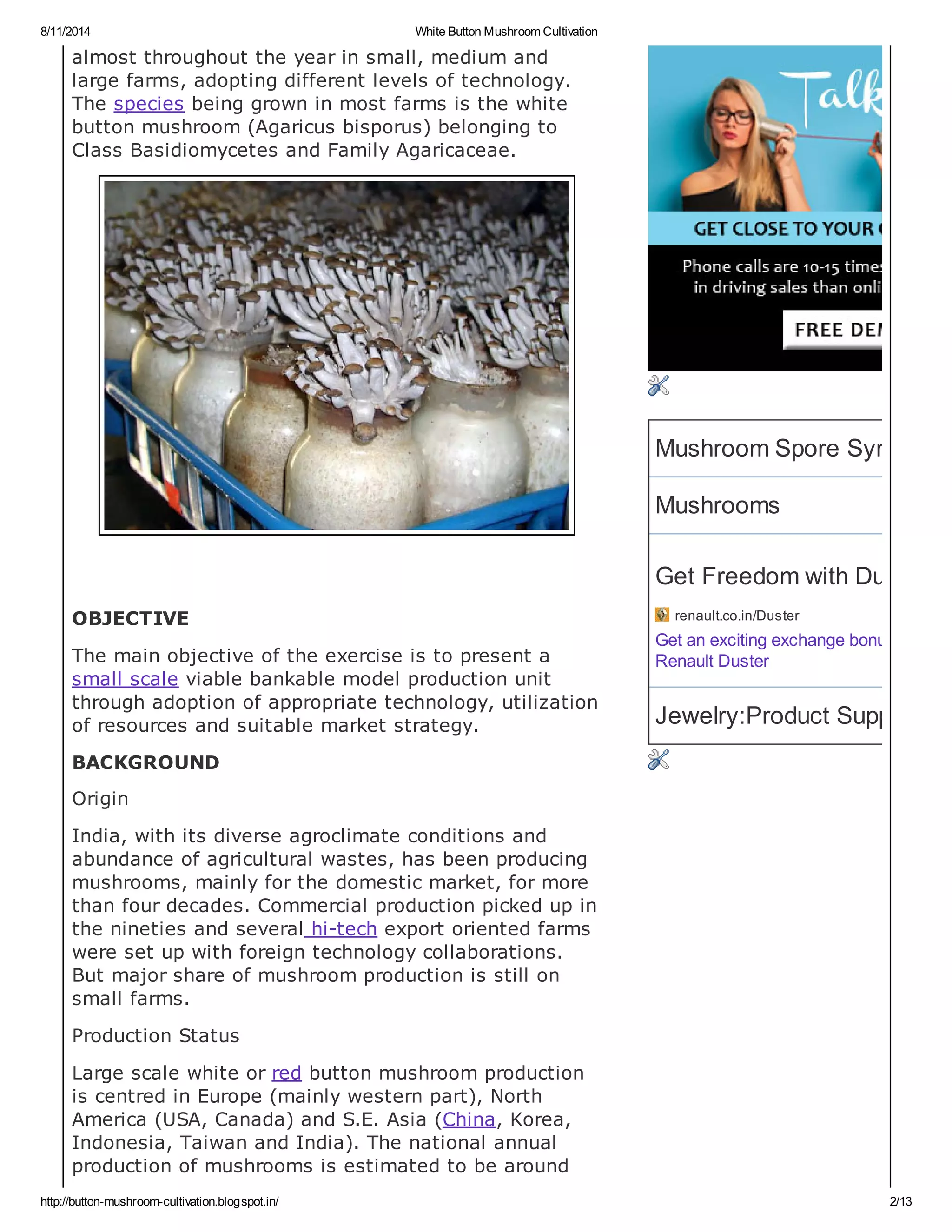
almost throughout the year in small, medium and
large farms, adopting different levels of technology.
The species being grown in most farms is the white
button mushroom (Agaricus bisporus) belonging to
Class Basidiomycetes and Family Agaricaceae.
OBJECTIVE
The main objective of the exercise is to present a
small scale viable bankable model production unit
through adoption of appropriate technology, utilization
of resources and suitable market strategy.
BACKGROUND
Origin
India, with its diverse agroclimate conditions and
abundance of agricultural wastes, has been producing
mushrooms, mainly for the domestic market, for more
than four decades. Commercial production picked up in
the nineties and several hi-tech export oriented farms
were set up with foreign technology collaborations.
But major share of mushroom production is still on
small farms.
Production Status
Large scale white or red button mushroom production
is centred in Europe (mainly western part), North
America (USA, Canada) and S.E. Asia (China, Korea,
Indonesia, Taiwan and India). The national annual
production of mushrooms is estimated to be around
Mushroom Spore Syringes
Mushrooms
Get Freedom with Duster
renault.co.in/Duster
Get an exciting exchange bonus and driv
Renault Duster
Jewelry:Product Suppliers
8/11/2014 White Button Mushroom Cultivation
http://button-mushroom-cultivation.blogspot.in/ 3/13
50,000 tonnes with 85 percent of this production being
of button mushrooms.
Economic Importance
Mushrooms are highly proteinaceous and are used as
food. The white button mushroom is sold as fresh
mushroom or is canned and made into soups, sauces
and other food products. Protein in mushrooms have
60-70 % digestibility and contains all the essential
amino acids. It has medicinal properties also. A high
amount of retene is present in the button mushroom
which is supposed to have an antagonistic effect on
some forms of tumours.
MARKET ANALYSIS AND STRATEGY
Demand and Supply Patterns
White button mushrooms are grown all over the world
and account for 35-45 % of the total mushroom
production. In India, large units with production
capacities between 2000 – 3000 tonnes / annum, have
been set up mainly as export oriented units in the
southern, western and northern regions. A large
number of small units without climatic control
equipment exist throughout India and function during
the autumn and winter months only.
More blogs for you....
A time bomb for whole
Wheat crop!
Agriculture Insurance
Basics
Aonla Cultivation
Practices.
Banana-Black Sagitoka
Control
Biodyanamic Farming
For Planting and
Growing Vegetables
Biological Control on
Plants
Brinjal and its Diseases
Brinjal Shoot Borer and
its Control
Cardamom/Ilaichi
Cultivation.
Citrus Cultivation in
India.
8/11/2014 White Button Mushroom Cultivation
http://button-mushroom-cultivation.blogspot.in/ 4/13
A big gap exists between the demand and supply
position of white button mushrooms in the United
States and European market. India exports the highest
quantity of the mushroom produced in the country to
USA. Netherlands and China account for 60% of the
export of mushrooms. Germany is the largest importer
and France and UK are large producers as well as
consumers.
The demand for fresh mushroom is increasing in the
international market while that of preserved or canned
mushrooms is decreasing. The trend in export of
mushrooms (fresh and dried/preserved form) from
India during the period 1999-2000 to 2001-2002 is
depicted in the graphs below.
The possibilities of exporting fresh mushrooms to the
markets in Middle East, Europe and USA need to be
explored. Europe is a very large producer of fresh
button mushrooms as such only some exotic varieties
of mushrooms which are high priced can be exported
to these countries. However, some inhibiting factors
are high cost of transportation and absence of proper
pre-cooling techniques and storage facilities.
Marketing problem is experienced in the winter months
(December- February) when more than 75% of the
annual production comes in market for sale in limited
duration and market area. Farmers face the
consequences of over-saturated market and are forced
to sell their produce at a cheaper price. The
Clove Cultivation -An
inside View.
Coconut Cultivation
Practices for India.
Colourful vegetables
and their Markets.
Cultivation of Bottle
Gourd
Do we Need Bt.Brinjal
?
Employer Leaving
Organisation
Fertilisers Killing Indian
Agriculture…..
Foreign Origin Crops in
Gujrat.
French Bean Cultivation
Fungicide Basics in
Agriculture
Future Crops From
Green Houses.
Ginger Cultivation
Practices
Harsh on Hubpages
Herbicides their mode
of action on Plants.
How to take care of a
Rose Garden
Humic Acid and Sea
weed extracts...their
Benefits!
Humic Acid Basics
Important Computer
Virus Information..
Krishi mitra
Mango Malformation
8/11/2014 White Button Mushroom Cultivation
http://button-mushroom-cultivation.blogspot.in/ 5/13
commercial units need to establish mushroom
processing unit so that during peak periods when
there is glut of mushrooms in the market, the growers
can resort to preservation of mushroom and as such
fluctuation in prices will not affect the project
economy.
Any mushroom unit located in and around the main
markets should be able to make sufficient profit as
they can save on transportation of produce.
Import / Export Trends
Netherlands is the leading exporter of button
mushrooms (40% share) followed by China, France,
Spain, Hong Kong, Taiwan, Indonesia and South
Korea. USA is the largest consumer accounting for one
third of World production. Other important consumers
are Germany, UK, France, Italy and Canada. The
quantity of mushrooms exported by India in
comparison to the world export is almost negligible.
The most important importers of white button
mushroom are Germany, USA, France, U.K. and
Sweden. Canned button mushrooms are imported by
UK, Germany, France, USA, Sweden etc. Asian
countries like China, Taiwan, Korea export their
produce to the American and European countries in the
form of canned mushrooms.
Analysis and Future Strategy
Marketing of mushrooms in India is not yet organized.
It is the simple system of producers selling directly to
retailer or even to the consumer. Wholesale distributor
is mostly missing. However, trade in the processed
(canned and dried) is sizeable and organized. In other
countries 10% of the total cost is earmarked for
marketing.
Production of mushrooms, especially of the white
button mushrooms, in India has gone up during recent
years creating marketing problems. The market for
processed foods has yet to develop in the country and
basically fresh fruits and vegetables are preferred.
There has not been any serious effort to promote the
product and to strengthen and expand the market in
order to increase consumption. The marginal increase
in demand is for fresh mushrooms instead of
dried/preserved mushrooms. Fresh mushrooms have
very short shelf-life and therefore cannot be
transported to long distances without refrigerated
Disease
Money Making
Ideas..........on net !!
Nursery Management
and Seedling
Production
Nutient Deficiency in
plants
Nutritional Updates for
all of us....
Paan/Betel Leaves-
Basics and Economics
in Indian Scenerio.
Paddy Cultivation with
Organics.....
Peppermint Cultivation
in Home Gardens
Pest of Fibre Crops
Pest Resistance
Developement
Potato Blight and its
Basics
Rudraksh,its
importance in
Hinduism and its
Cultivation.
Solanaceous crops-their
nutrients
requirements
Some Exotic
Fruits.......you will
Love them!
Stock Photography...A
revenue Generator!
Tomato Disease
Identifications
Tomatoes in kitchen
8/11/2014 White Button Mushroom Cultivation
http://button-mushroom-cultivation.blogspot.in/ 6/13
transport facility. They are sold in the markets in and
around the production areas.
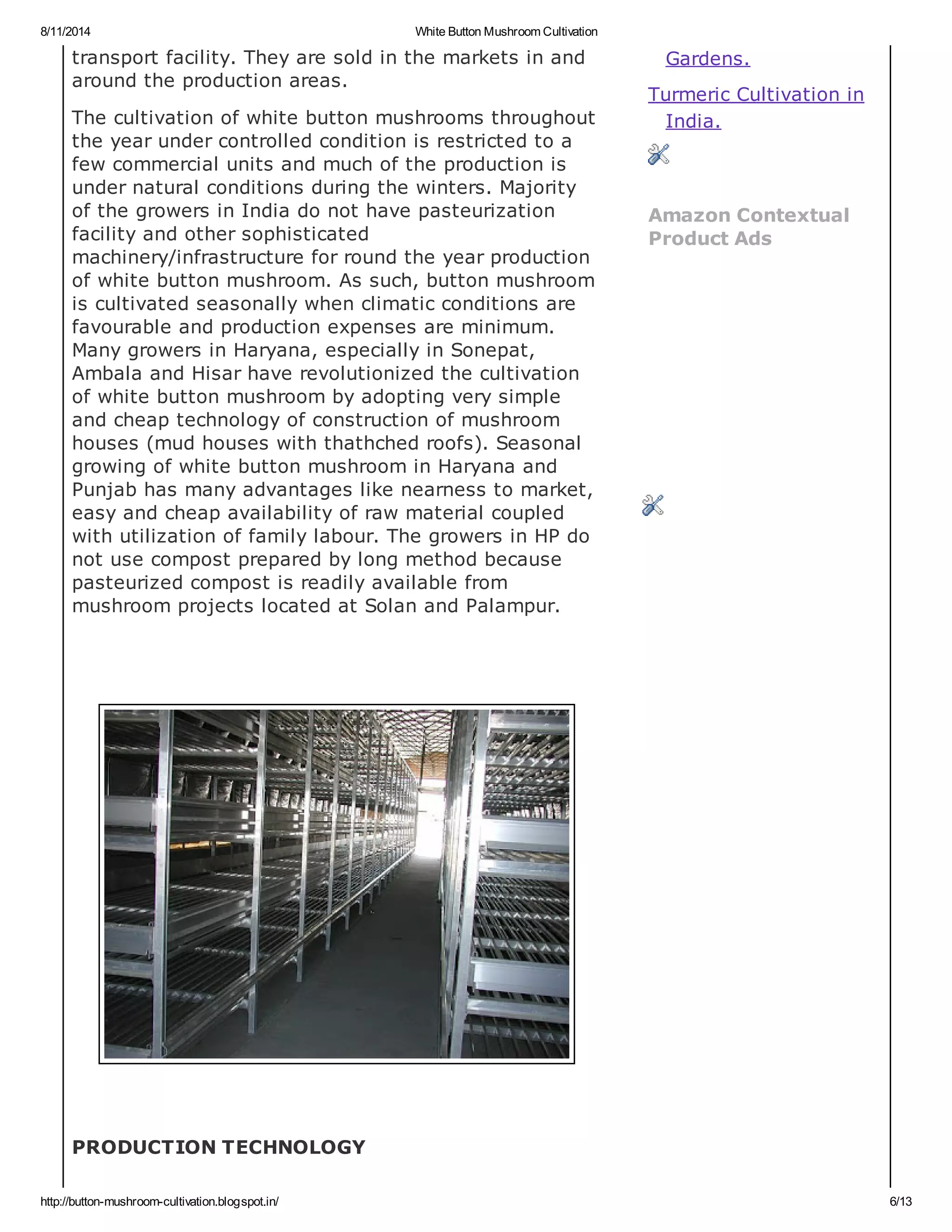
The cultivation of white button mushrooms throughout
the year under controlled condition is restricted to a
few commercial units and much of the production is
under natural conditions during the winters. Majority
of the growers in India do not have pasteurization
facility and other sophisticated
machinery/infrastructure for round the year production
of white button mushroom. As such, button mushroom
is cultivated seasonally when climatic conditions are
favourable and production expenses are minimum.
Many growers in Haryana, especially in Sonepat,
Ambala and Hisar have revolutionized the cultivation
of white button mushroom by adopting very simple
and cheap technology of construction of mushroom
houses (mud houses with thathched roofs). Seasonal
growing of white button mushroom in Haryana and
Punjab has many advantages like nearness to market,
easy and cheap availability of raw material coupled
with utilization of family labour. The growers in HP do
not use compost prepared by long method because
pasteurized compost is readily available from
mushroom projects located at Solan and Palampur.
PRODUCTION TECHNOLOGY
Gardens.
Turmeric Cultivation in
India.
Amazon Contextual
Product Ads
8/11/2014 White Button Mushroom Cultivation
http://button-mushroom-cultivation.blogspot.in/ 7/13
Agro-climatic Requirements
In India, button mushrooms are grown seasonally and
in environment controlled cropping houses. White
button mushroom requires 20-280 C for vegetative
growth (spawn run) and 12-180 C for reproductive
growth. Besides that it requires relative humidity of
80-90% and enough ventilation during cropping.
Seasonally, it is grown during the winter months in the
north-west plains of India and for 8-10 months in a
year on the hills. However, with the advent of modern
cultivation technology it is now possible to cultivate
this mushroom anywhere in India.
The growers can take on an average 3-4 crops of white
button mushrooms in a year depending upon the type
and varieties cultivated. Factors affecting the yield of
the crop both in terms of quality and quantity are
incidence of pests/pathogens and non-availability of
pure quality of spawn.
Growing and Potential Belts
The major producing states are Himachal Pradesh,
Uttar Pradesh, Punjab, Haryana, Maharashtra, Andhra
Pradesh, Tamil Nadu and Karnataka.
Varieties / Strains
Ooty 1 and Ooty (BM) 2 (released in 2002) are the two
strains of button mushrooms released for commercial
cultivation by the scientists of Horticulture Research
Station of the Tamil Nadu Agricultural University at
Vijayanagaram, Ooty. The strains which are mostly
cultivated in India are S-11, TM-79 and Horst H3..
Cultivation Technology
The whole process of mushroom production can be
divided into the following steps:
(i) Spawn production
(ii) Compost preparation
(iii) Spawning
(iv) Spawn running
(v) Casing
(vi) Fruiting
Spawn Production
8/11/2014 White Button Mushroom Cultivation
http://button-mushroom-cultivation.blogspot.in/ 8/13
Spawn is produced from fruiting culture / stocks of
selected strains of mushrooms under sterile
conditions. Stock culture may be produced in the lab or
may be obtained from other reputed sources. Fruiting
culture is mainly imported from various places
including foreign sources which give higher yield than
Indian strains and the spawn is produced in the lab.
The spawn should be of good quality in terms of
flavour, texture and size apart from having potential
for high yield and longer shelf life.
Compost Preparation
The substrate on which button mushroom grows is
mainly prepared from a mixture of plant wastes (cereal
straw/ sugarcane bagasse etc.), salts (urea ,
superphosphate / gypsum etc), supplements (rice
bran/ wheat bran) and water. In order to produce 1
kg.of mushroom, 220 g. of dry substrate materials are
required. It is recommended that each ton of compost
should contain 6.6 kg. nitrogen, 2.0 kg. phosphate and
5.0 kg. of potassium (N:P:K- 33: 10:25) which would
get converted into 1.98% N, 0.62% P and 1.5% K on a
dry weight basis. The ratio of C: N in a good substrate
should be 25-30 : 1 at the time of staking and 16-17 :
1 in the case of final compost.
(A) Short Method of composting
During the first phase of compost preparation, paddy
straw is placed in layers and sufficient water is added
to the stack along with fertilizers, wheat bran,
molasses etc. The whole thing is mixed thoroughly
with the straw and made into a stack (almost 5feet
high,5 feet wide and of any length can be made with
the help of wooden boards). The stack is turned and
again watered on the second day. On the fourth day
the stack is again turned for the second time by
adding gypsum and watered. The third and final
turning is given on the twelveth day when the colour
of the compost changes into dark brown and it starts
emitting a strong smell of ammonia.
The second phase is the pasteurization phase .The
compost prepared as a result of microbe mediated
fermentation process needs to be pasteurized in order
to kill undesirable microbes and competitors and to
convert ammonia into microbial protein.The whole
process is carried out inside a steaming room where
an air temperature of 600 C is maintained for 4 hours.
The compost finally obtained should be granular in
8/11/2014 White Button Mushroom Cultivation
http://button-mushroom-cultivation.blogspot.in/ 9/13
structure with 70% moisture content and pH 7.5. It
should have a dark brown colour, sweet unobnoxious
smell and free from ammonia, insects and nematodes.
After the process is complete, the substrate is cooled
down to 250 C.
(B) Long Method of composting
The long method of composting is usually practiced in
areas where facilities for steam pasteurization is not
available. In this method, the first turning is given
about six days after preparation of the substrate for
composting. The second turning is given on the tenth
day followed by third one on the thirteenth day when
gypsum is added. The fourth, fifth and sixth turnings
are given on the sixteenth, nineteenth and twenty-
second day. On the twenty-fifth day the seventh
turning is given by adding 10% BHC (125 g.) and the
eighth turning is given on the twenty-eighth day after
which it is checked whether there is any smell of
ammonia present in the compost. The compost is
ready for spawning only if it doesn’t have any smell of
ammonia; otherwise a few more turnings are given at
an interval of three days till there is no smell of
ammonia.
Spawning
The process of mixing spawn with compost is called
spawning. The different methods followed for
spawning are given below:
(i) Spot Spawning: Lumps of spawn are planted in 5
cm. deep holes made in the compost at a distance of
20-25 cm. The holes are later covered with compost.
(ii) Surface Spawning: The spawn is evenly spread in
the top layer of the compost and then mixed to a
depth of 3-5 cm. The top portion is covered with a thin
layer of compost.
(iii) Layer Spawning: About 3-4 layers of spawn mixed
with compost are prepared which is again covered with
a thin layer of compost like in surface spawning.
The spawn is mixed through the whole mass of
compost at the rate of 7.5 ml./ kg. compost or 500 to
750 g./ 100 kg. compost (0.5 to 0.75%).
Spawn Running
After the spawning process is over, the compost is
filled in polythene bags(90x90 cm., 150 gauge thick
8/11/2014 White Button Mushroom Cultivation
http://button-mushroom-cultivation.blogspot.in/ 10/13
having a capacity of 20-25 kg. per bag)/ trays(mostly
wooden trays 1x1/2 m. accommodating 20-30 kg.
compost) / shelves which are either covered with a
newspaper sheet or polythene. The fungal bodies grow
out from the spawn and take about two weeks (12-14
days) to colonise. The temperature maintained in
cropping room is 23 ± 20 C. Higher temperature is
detrimental for growth of the spawn and any
temperature below than that specified for the purpose
would result in slower spawn run. The relative
humidity should be around 90% and a higher than
normal CO2 concentration would be beneficial.
Casing
The compost beds after complete spawn run should be
covered with a layer of soil (casing) about 3-4 cm.
thick to induce fruiting. The casing material should be
having high porosity, water holding capacity and the
pH should range between 7-7.5. Peat moss which is
considered to be the best casing material is not
available in India, as such the mixtures like garden
loam soil and sand (4:1); decomposed cowdung and
loam soil (1:1) and spent compost (2-3 years old);
sand and lime are commonly used.
The casing soil before application should be either
pasteurized (at 66-700 C for 7-8 hours), treated with
formaldehyde (2%), formaldehyde (2%) and bavistin
(75 ppm.) or steam sterilized. The treatment needs to
be done at least 15 days before the material is used
for casing. After casing is done the temperature of the
room is again maintained at 23-280 C and relative
humidity of 85-90% for another 8-10 days. Low CO2
concentration is favourable for reproductive growth at
this stage.
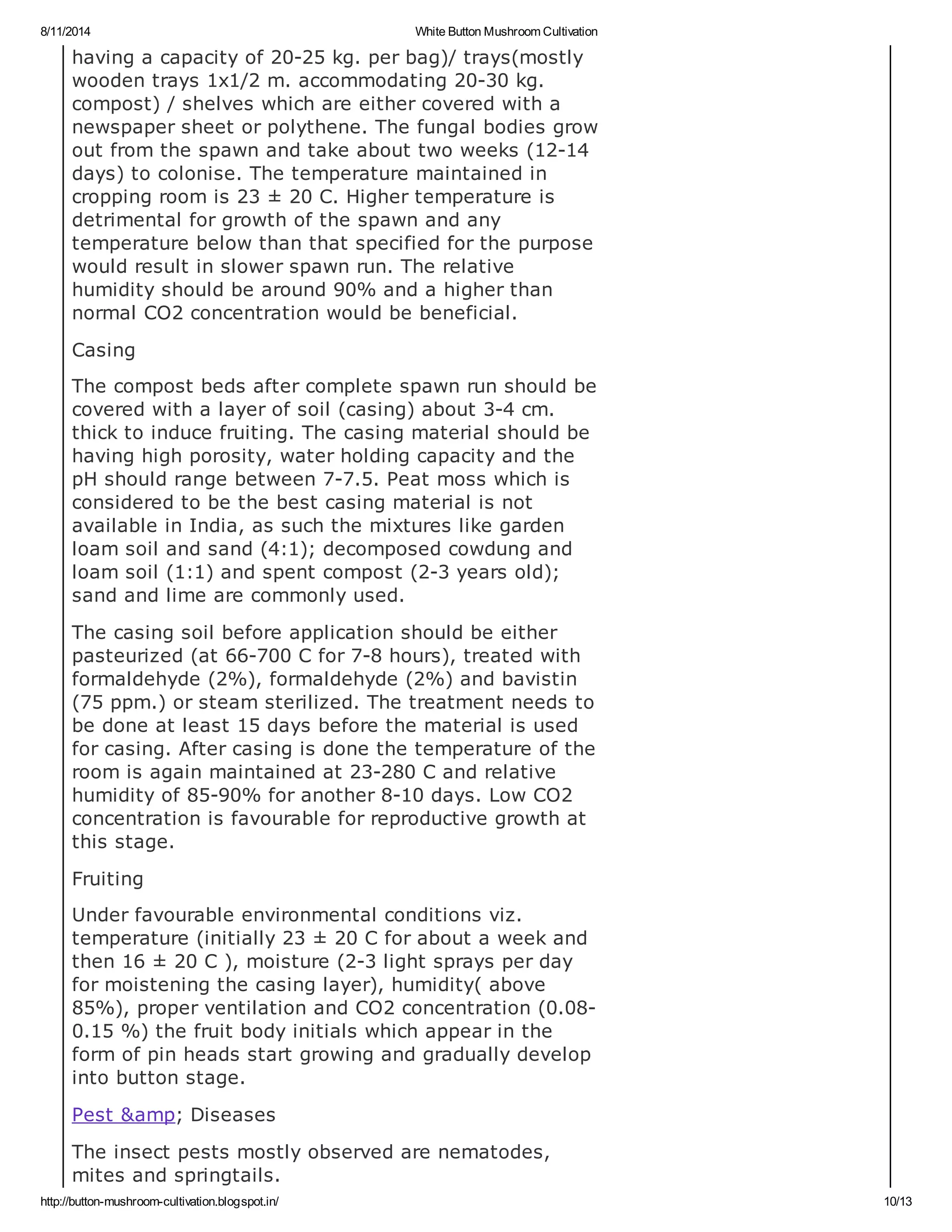
Fruiting
Under favourable environmental conditions viz.
temperature (initially 23 ± 20 C for about a week and
then 16 ± 20 C ), moisture (2-3 light sprays per day
for moistening the casing layer), humidity( above
85%), proper ventilation and CO2 concentration (0.08-
0.15 %) the fruit body initials which appear in the
form of pin heads start growing and gradually develop
into button stage.
Pest & Diseases
The insect pests mostly observed are nematodes,
mites and springtails.
8/11/2014 White Button Mushroom Cultivation
http://button-mushroom-cultivation.blogspot.in/ 11/13
The crop is suspect to several diseases like Dry Bubble
(brown spot), Wet Bubble (White Mould), Cobweb,
Green Mould, False truffle (Truffle disease), Olive
green mould, Brown plaster mould and Bacterial
blotch.
Professional help and extension advice will have to
sought by the entrepreneur to adopt appropriate and
timely control measures against pests & diseases.
Harvesting and Yield
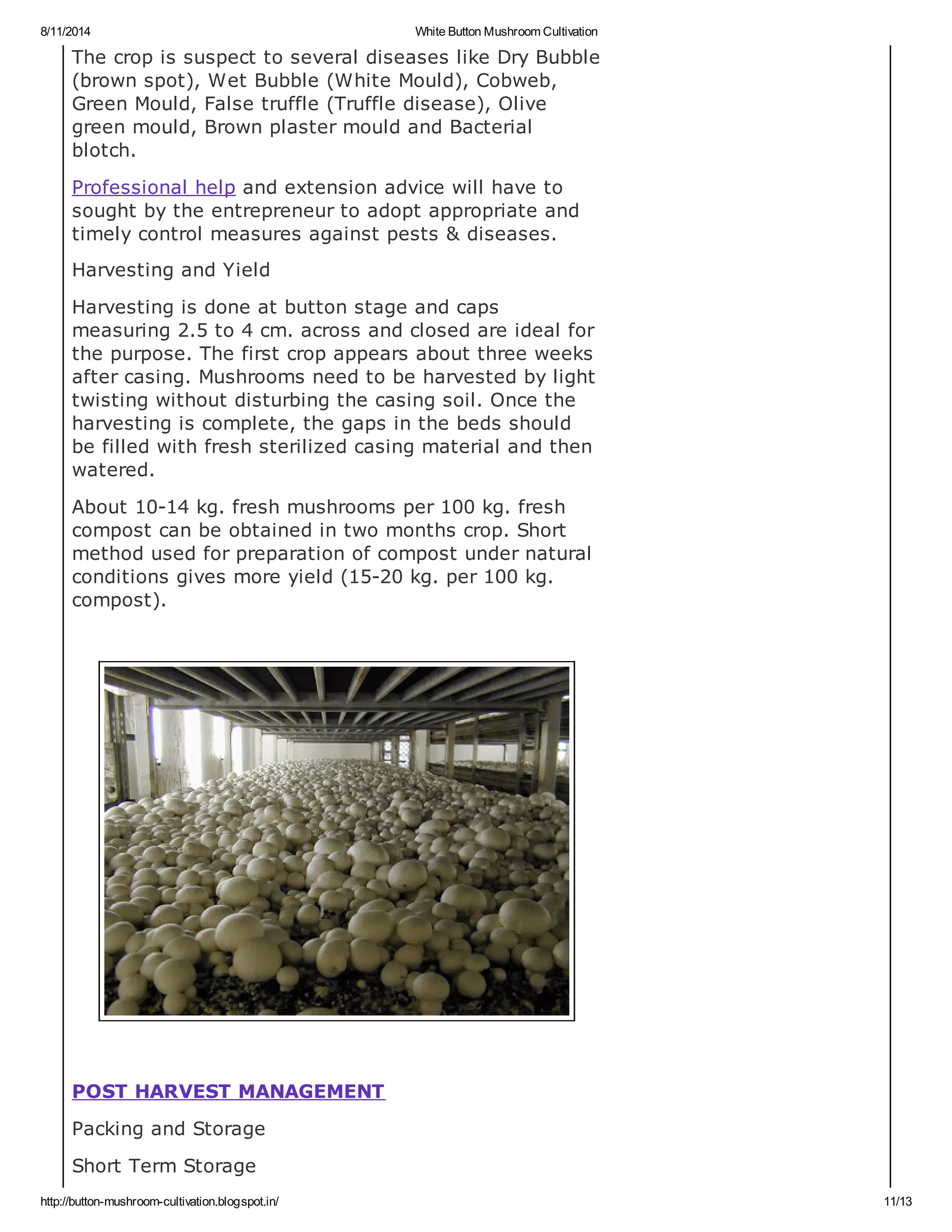
Harvesting is done at button stage and caps
measuring 2.5 to 4 cm. across and closed are ideal for
the purpose. The first crop appears about three weeks
after casing. Mushrooms need to be harvested by light
twisting without disturbing the casing soil. Once the
harvesting is complete, the gaps in the beds should
be filled with fresh sterilized casing material and then
watered.
About 10-14 kg. fresh mushrooms per 100 kg. fresh
compost can be obtained in two months crop. Short
method used for preparation of compost under natural
conditions gives more yield (15-20 kg. per 100 kg.
compost).
POST HARVEST MANAGEMENT
Packing and Storage
Short Term Storage
8/11/2014 White Button Mushroom Cultivation
http://button-mushroom-cultivation.blogspot.in/ 12/13
Button mushrooms are highly perishable. Harvested
mushrooms are cut at the soil line and washed in a
solution of 5g. KMS in 10L. of water for removing the
soil particles as well as to induce whiteness. After
removing excess water these are packed in perforated
poly bags each containing around 250-500 g. of
mushrooms. They can be stored in polythene bags at
4-50 C for a short period of 3-4 days.
The mushrooms are usually packed in unlabelled
simple polythene or polypropylene for retail sale. Bulk
packaging does not exist. In developed countries,
modified atmosphere packaging (MAP) and controlled
atmosphere packaging (CAP) are in vogue.
(B) Long Term Storage
White button mushrooms are not usually dried by
common procedures used in case of oyster, paddy and
shitake mushrooms. Canning is the most popular
method of preserving the white button mushrooms and
sizeable quantity of canned produce are exported to
international markets. Besides that, freeze drying, IQF
and pickling are also practiced by some units.
8/11/2014 White Button Mushroom Cultivation
http://button-mushroom-cultivation.blogspot.in/ 13/13
SOURCES OF TECHNOLOGY
National Centre for Mushroom, Chambaghat, Solan,
Himachal Pradesh-173213.
(Compiled by Harsh Saxena)
Back to Homepage
Posted by KRISHI MITRA at 9:04 PM 5 comments:
Home
Subscribe to: Posts (Atom)

White button mushroom cultivation

  • 1.
    8/11/2014 White ButtonMushroom Cultivation http://button-mushroom-cultivation.blogspot.in/ 1/13 Monday, April 19, 2010 Button Mushroom is the most popular mushroom variety grown ..... BUTTON MUSHROOM INTRODUCTION Button Mushroom is the most popular mushroom variety grown and consumed the world over. In India, its production earlier was limited to the winter season, but with technology development, these are produced About Me KRISHI MITRA View my complete profile 5 Search White Button Mushroom Cultivation Button Mushroom is the most popular mushroom variety grown and consumed the world over. In India, its production earlier was limited to the winter season, but with technology development, these are produced almost throughout the year in small, medium and large farms, adopting different levels of technology. ► Exam Result India ► SBI Bank Clerk ► Clerk Recruitment ► Apply Job ► Crop Production ► Growing Kits ► Farming in India ► Fruit Production
  • 2.
    8/11/2014 White ButtonMushroom Cultivation http://button-mushroom-cultivation.blogspot.in/ 2/13 almost throughout the year in small, medium and large farms, adopting different levels of technology. The species being grown in most farms is the white button mushroom (Agaricus bisporus) belonging to Class Basidiomycetes and Family Agaricaceae. OBJECTIVE The main objective of the exercise is to present a small scale viable bankable model production unit through adoption of appropriate technology, utilization of resources and suitable market strategy. BACKGROUND Origin India, with its diverse agroclimate conditions and abundance of agricultural wastes, has been producing mushrooms, mainly for the domestic market, for more than four decades. Commercial production picked up in the nineties and several hi-tech export oriented farms were set up with foreign technology collaborations. But major share of mushroom production is still on small farms. Production Status Large scale white or red button mushroom production is centred in Europe (mainly western part), North America (USA, Canada) and S.E. Asia (China, Korea, Indonesia, Taiwan and India). The national annual production of mushrooms is estimated to be around Mushroom Spore Syringes Mushrooms Get Freedom with Duster renault.co.in/Duster Get an exciting exchange bonus and driv Renault Duster Jewelry:Product Suppliers
  • 3.
    8/11/2014 White ButtonMushroom Cultivation http://button-mushroom-cultivation.blogspot.in/ 3/13 50,000 tonnes with 85 percent of this production being of button mushrooms. Economic Importance Mushrooms are highly proteinaceous and are used as food. The white button mushroom is sold as fresh mushroom or is canned and made into soups, sauces and other food products. Protein in mushrooms have 60-70 % digestibility and contains all the essential amino acids. It has medicinal properties also. A high amount of retene is present in the button mushroom which is supposed to have an antagonistic effect on some forms of tumours. MARKET ANALYSIS AND STRATEGY Demand and Supply Patterns White button mushrooms are grown all over the world and account for 35-45 % of the total mushroom production. In India, large units with production capacities between 2000 – 3000 tonnes / annum, have been set up mainly as export oriented units in the southern, western and northern regions. A large number of small units without climatic control equipment exist throughout India and function during the autumn and winter months only. More blogs for you.... A time bomb for whole Wheat crop! Agriculture Insurance Basics Aonla Cultivation Practices. Banana-Black Sagitoka Control Biodyanamic Farming For Planting and Growing Vegetables Biological Control on Plants Brinjal and its Diseases Brinjal Shoot Borer and its Control Cardamom/Ilaichi Cultivation. Citrus Cultivation in India.
  • 4.
    8/11/2014 White ButtonMushroom Cultivation http://button-mushroom-cultivation.blogspot.in/ 4/13 A big gap exists between the demand and supply position of white button mushrooms in the United States and European market. India exports the highest quantity of the mushroom produced in the country to USA. Netherlands and China account for 60% of the export of mushrooms. Germany is the largest importer and France and UK are large producers as well as consumers. The demand for fresh mushroom is increasing in the international market while that of preserved or canned mushrooms is decreasing. The trend in export of mushrooms (fresh and dried/preserved form) from India during the period 1999-2000 to 2001-2002 is depicted in the graphs below. The possibilities of exporting fresh mushrooms to the markets in Middle East, Europe and USA need to be explored. Europe is a very large producer of fresh button mushrooms as such only some exotic varieties of mushrooms which are high priced can be exported to these countries. However, some inhibiting factors are high cost of transportation and absence of proper pre-cooling techniques and storage facilities. Marketing problem is experienced in the winter months (December- February) when more than 75% of the annual production comes in market for sale in limited duration and market area. Farmers face the consequences of over-saturated market and are forced to sell their produce at a cheaper price. The Clove Cultivation -An inside View. Coconut Cultivation Practices for India. Colourful vegetables and their Markets. Cultivation of Bottle Gourd Do we Need Bt.Brinjal ? Employer Leaving Organisation Fertilisers Killing Indian Agriculture….. Foreign Origin Crops in Gujrat. French Bean Cultivation Fungicide Basics in Agriculture Future Crops From Green Houses. Ginger Cultivation Practices Harsh on Hubpages Herbicides their mode of action on Plants. How to take care of a Rose Garden Humic Acid and Sea weed extracts...their Benefits! Humic Acid Basics Important Computer Virus Information.. Krishi mitra Mango Malformation
  • 5.
    8/11/2014 White ButtonMushroom Cultivation http://button-mushroom-cultivation.blogspot.in/ 5/13 commercial units need to establish mushroom processing unit so that during peak periods when there is glut of mushrooms in the market, the growers can resort to preservation of mushroom and as such fluctuation in prices will not affect the project economy. Any mushroom unit located in and around the main markets should be able to make sufficient profit as they can save on transportation of produce. Import / Export Trends Netherlands is the leading exporter of button mushrooms (40% share) followed by China, France, Spain, Hong Kong, Taiwan, Indonesia and South Korea. USA is the largest consumer accounting for one third of World production. Other important consumers are Germany, UK, France, Italy and Canada. The quantity of mushrooms exported by India in comparison to the world export is almost negligible. The most important importers of white button mushroom are Germany, USA, France, U.K. and Sweden. Canned button mushrooms are imported by UK, Germany, France, USA, Sweden etc. Asian countries like China, Taiwan, Korea export their produce to the American and European countries in the form of canned mushrooms. Analysis and Future Strategy Marketing of mushrooms in India is not yet organized. It is the simple system of producers selling directly to retailer or even to the consumer. Wholesale distributor is mostly missing. However, trade in the processed (canned and dried) is sizeable and organized. In other countries 10% of the total cost is earmarked for marketing. Production of mushrooms, especially of the white button mushrooms, in India has gone up during recent years creating marketing problems. The market for processed foods has yet to develop in the country and basically fresh fruits and vegetables are preferred. There has not been any serious effort to promote the product and to strengthen and expand the market in order to increase consumption. The marginal increase in demand is for fresh mushrooms instead of dried/preserved mushrooms. Fresh mushrooms have very short shelf-life and therefore cannot be transported to long distances without refrigerated Disease Money Making Ideas..........on net !! Nursery Management and Seedling Production Nutient Deficiency in plants Nutritional Updates for all of us.... Paan/Betel Leaves- Basics and Economics in Indian Scenerio. Paddy Cultivation with Organics..... Peppermint Cultivation in Home Gardens Pest of Fibre Crops Pest Resistance Developement Potato Blight and its Basics Rudraksh,its importance in Hinduism and its Cultivation. Solanaceous crops-their nutrients requirements Some Exotic Fruits.......you will Love them! Stock Photography...A revenue Generator! Tomato Disease Identifications Tomatoes in kitchen
  • 6.
    8/11/2014 White ButtonMushroom Cultivation http://button-mushroom-cultivation.blogspot.in/ 6/13 transport facility. They are sold in the markets in and around the production areas. The cultivation of white button mushrooms throughout the year under controlled condition is restricted to a few commercial units and much of the production is under natural conditions during the winters. Majority of the growers in India do not have pasteurization facility and other sophisticated machinery/infrastructure for round the year production of white button mushroom. As such, button mushroom is cultivated seasonally when climatic conditions are favourable and production expenses are minimum. Many growers in Haryana, especially in Sonepat, Ambala and Hisar have revolutionized the cultivation of white button mushroom by adopting very simple and cheap technology of construction of mushroom houses (mud houses with thathched roofs). Seasonal growing of white button mushroom in Haryana and Punjab has many advantages like nearness to market, easy and cheap availability of raw material coupled with utilization of family labour. The growers in HP do not use compost prepared by long method because pasteurized compost is readily available from mushroom projects located at Solan and Palampur. PRODUCTION TECHNOLOGY Gardens. Turmeric Cultivation in India. Amazon Contextual Product Ads
  • 7.
    8/11/2014 White ButtonMushroom Cultivation http://button-mushroom-cultivation.blogspot.in/ 7/13 Agro-climatic Requirements In India, button mushrooms are grown seasonally and in environment controlled cropping houses. White button mushroom requires 20-280 C for vegetative growth (spawn run) and 12-180 C for reproductive growth. Besides that it requires relative humidity of 80-90% and enough ventilation during cropping. Seasonally, it is grown during the winter months in the north-west plains of India and for 8-10 months in a year on the hills. However, with the advent of modern cultivation technology it is now possible to cultivate this mushroom anywhere in India. The growers can take on an average 3-4 crops of white button mushrooms in a year depending upon the type and varieties cultivated. Factors affecting the yield of the crop both in terms of quality and quantity are incidence of pests/pathogens and non-availability of pure quality of spawn. Growing and Potential Belts The major producing states are Himachal Pradesh, Uttar Pradesh, Punjab, Haryana, Maharashtra, Andhra Pradesh, Tamil Nadu and Karnataka. Varieties / Strains Ooty 1 and Ooty (BM) 2 (released in 2002) are the two strains of button mushrooms released for commercial cultivation by the scientists of Horticulture Research Station of the Tamil Nadu Agricultural University at Vijayanagaram, Ooty. The strains which are mostly cultivated in India are S-11, TM-79 and Horst H3.. Cultivation Technology The whole process of mushroom production can be divided into the following steps: (i) Spawn production (ii) Compost preparation (iii) Spawning (iv) Spawn running (v) Casing (vi) Fruiting Spawn Production
  • 8.
    8/11/2014 White ButtonMushroom Cultivation http://button-mushroom-cultivation.blogspot.in/ 8/13 Spawn is produced from fruiting culture / stocks of selected strains of mushrooms under sterile conditions. Stock culture may be produced in the lab or may be obtained from other reputed sources. Fruiting culture is mainly imported from various places including foreign sources which give higher yield than Indian strains and the spawn is produced in the lab. The spawn should be of good quality in terms of flavour, texture and size apart from having potential for high yield and longer shelf life. Compost Preparation The substrate on which button mushroom grows is mainly prepared from a mixture of plant wastes (cereal straw/ sugarcane bagasse etc.), salts (urea , superphosphate / gypsum etc), supplements (rice bran/ wheat bran) and water. In order to produce 1 kg.of mushroom, 220 g. of dry substrate materials are required. It is recommended that each ton of compost should contain 6.6 kg. nitrogen, 2.0 kg. phosphate and 5.0 kg. of potassium (N:P:K- 33: 10:25) which would get converted into 1.98% N, 0.62% P and 1.5% K on a dry weight basis. The ratio of C: N in a good substrate should be 25-30 : 1 at the time of staking and 16-17 : 1 in the case of final compost. (A) Short Method of composting During the first phase of compost preparation, paddy straw is placed in layers and sufficient water is added to the stack along with fertilizers, wheat bran, molasses etc. The whole thing is mixed thoroughly with the straw and made into a stack (almost 5feet high,5 feet wide and of any length can be made with the help of wooden boards). The stack is turned and again watered on the second day. On the fourth day the stack is again turned for the second time by adding gypsum and watered. The third and final turning is given on the twelveth day when the colour of the compost changes into dark brown and it starts emitting a strong smell of ammonia. The second phase is the pasteurization phase .The compost prepared as a result of microbe mediated fermentation process needs to be pasteurized in order to kill undesirable microbes and competitors and to convert ammonia into microbial protein.The whole process is carried out inside a steaming room where an air temperature of 600 C is maintained for 4 hours. The compost finally obtained should be granular in
  • 9.
    8/11/2014 White ButtonMushroom Cultivation http://button-mushroom-cultivation.blogspot.in/ 9/13 structure with 70% moisture content and pH 7.5. It should have a dark brown colour, sweet unobnoxious smell and free from ammonia, insects and nematodes. After the process is complete, the substrate is cooled down to 250 C. (B) Long Method of composting The long method of composting is usually practiced in areas where facilities for steam pasteurization is not available. In this method, the first turning is given about six days after preparation of the substrate for composting. The second turning is given on the tenth day followed by third one on the thirteenth day when gypsum is added. The fourth, fifth and sixth turnings are given on the sixteenth, nineteenth and twenty- second day. On the twenty-fifth day the seventh turning is given by adding 10% BHC (125 g.) and the eighth turning is given on the twenty-eighth day after which it is checked whether there is any smell of ammonia present in the compost. The compost is ready for spawning only if it doesn’t have any smell of ammonia; otherwise a few more turnings are given at an interval of three days till there is no smell of ammonia. Spawning The process of mixing spawn with compost is called spawning. The different methods followed for spawning are given below: (i) Spot Spawning: Lumps of spawn are planted in 5 cm. deep holes made in the compost at a distance of 20-25 cm. The holes are later covered with compost. (ii) Surface Spawning: The spawn is evenly spread in the top layer of the compost and then mixed to a depth of 3-5 cm. The top portion is covered with a thin layer of compost. (iii) Layer Spawning: About 3-4 layers of spawn mixed with compost are prepared which is again covered with a thin layer of compost like in surface spawning. The spawn is mixed through the whole mass of compost at the rate of 7.5 ml./ kg. compost or 500 to 750 g./ 100 kg. compost (0.5 to 0.75%). Spawn Running After the spawning process is over, the compost is filled in polythene bags(90x90 cm., 150 gauge thick
  • 10.
    8/11/2014 White ButtonMushroom Cultivation http://button-mushroom-cultivation.blogspot.in/ 10/13 having a capacity of 20-25 kg. per bag)/ trays(mostly wooden trays 1x1/2 m. accommodating 20-30 kg. compost) / shelves which are either covered with a newspaper sheet or polythene. The fungal bodies grow out from the spawn and take about two weeks (12-14 days) to colonise. The temperature maintained in cropping room is 23 ± 20 C. Higher temperature is detrimental for growth of the spawn and any temperature below than that specified for the purpose would result in slower spawn run. The relative humidity should be around 90% and a higher than normal CO2 concentration would be beneficial. Casing The compost beds after complete spawn run should be covered with a layer of soil (casing) about 3-4 cm. thick to induce fruiting. The casing material should be having high porosity, water holding capacity and the pH should range between 7-7.5. Peat moss which is considered to be the best casing material is not available in India, as such the mixtures like garden loam soil and sand (4:1); decomposed cowdung and loam soil (1:1) and spent compost (2-3 years old); sand and lime are commonly used. The casing soil before application should be either pasteurized (at 66-700 C for 7-8 hours), treated with formaldehyde (2%), formaldehyde (2%) and bavistin (75 ppm.) or steam sterilized. The treatment needs to be done at least 15 days before the material is used for casing. After casing is done the temperature of the room is again maintained at 23-280 C and relative humidity of 85-90% for another 8-10 days. Low CO2 concentration is favourable for reproductive growth at this stage. Fruiting Under favourable environmental conditions viz. temperature (initially 23 ± 20 C for about a week and then 16 ± 20 C ), moisture (2-3 light sprays per day for moistening the casing layer), humidity( above 85%), proper ventilation and CO2 concentration (0.08- 0.15 %) the fruit body initials which appear in the form of pin heads start growing and gradually develop into button stage. Pest & Diseases The insect pests mostly observed are nematodes, mites and springtails.
  • 11.
    8/11/2014 White ButtonMushroom Cultivation http://button-mushroom-cultivation.blogspot.in/ 11/13 The crop is suspect to several diseases like Dry Bubble (brown spot), Wet Bubble (White Mould), Cobweb, Green Mould, False truffle (Truffle disease), Olive green mould, Brown plaster mould and Bacterial blotch. Professional help and extension advice will have to sought by the entrepreneur to adopt appropriate and timely control measures against pests & diseases. Harvesting and Yield Harvesting is done at button stage and caps measuring 2.5 to 4 cm. across and closed are ideal for the purpose. The first crop appears about three weeks after casing. Mushrooms need to be harvested by light twisting without disturbing the casing soil. Once the harvesting is complete, the gaps in the beds should be filled with fresh sterilized casing material and then watered. About 10-14 kg. fresh mushrooms per 100 kg. fresh compost can be obtained in two months crop. Short method used for preparation of compost under natural conditions gives more yield (15-20 kg. per 100 kg. compost). POST HARVEST MANAGEMENT Packing and Storage Short Term Storage
  • 12.
    8/11/2014 White ButtonMushroom Cultivation http://button-mushroom-cultivation.blogspot.in/ 12/13 Button mushrooms are highly perishable. Harvested mushrooms are cut at the soil line and washed in a solution of 5g. KMS in 10L. of water for removing the soil particles as well as to induce whiteness. After removing excess water these are packed in perforated poly bags each containing around 250-500 g. of mushrooms. They can be stored in polythene bags at 4-50 C for a short period of 3-4 days. The mushrooms are usually packed in unlabelled simple polythene or polypropylene for retail sale. Bulk packaging does not exist. In developed countries, modified atmosphere packaging (MAP) and controlled atmosphere packaging (CAP) are in vogue. (B) Long Term Storage White button mushrooms are not usually dried by common procedures used in case of oyster, paddy and shitake mushrooms. Canning is the most popular method of preserving the white button mushrooms and sizeable quantity of canned produce are exported to international markets. Besides that, freeze drying, IQF and pickling are also practiced by some units.
  • 13.
    8/11/2014 White ButtonMushroom Cultivation http://button-mushroom-cultivation.blogspot.in/ 13/13 SOURCES OF TECHNOLOGY National Centre for Mushroom, Chambaghat, Solan, Himachal Pradesh-173213. (Compiled by Harsh Saxena) Back to Homepage Posted by KRISHI MITRA at 9:04 PM 5 comments: Home Subscribe to: Posts (Atom)