Improving women's
reproductive health
through expanding
access to key health
technologies
For maximize impact, new RH
product introduction requires:
• Clear and understood health needs
• Safe and effective product/approach
• Demonstrated pilot project success
• Health systems strengthening
• Engagement of and support among
stakeholders at various levels
• Global and regional advocacy
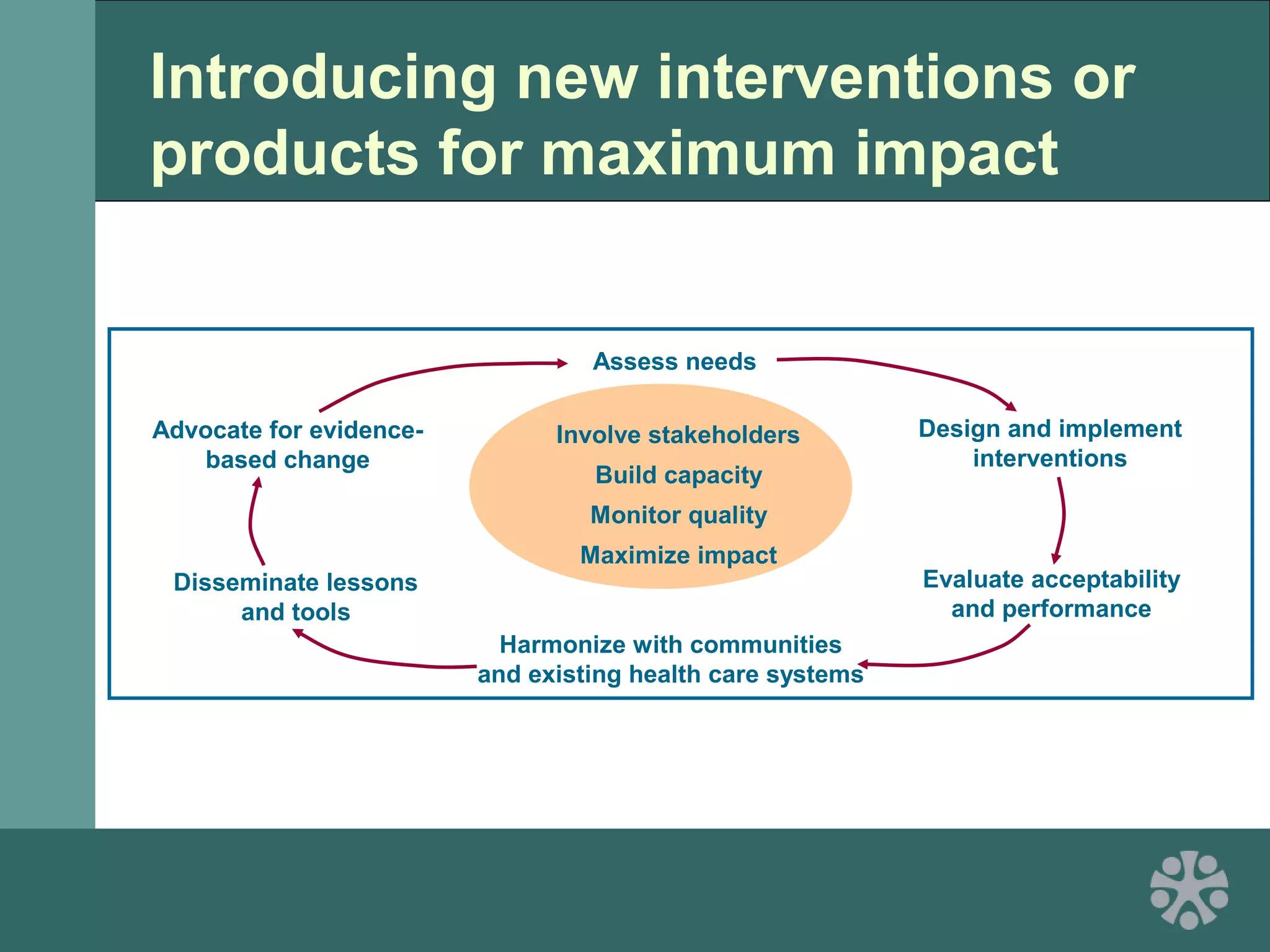
Introducing new interventions or
products for maximum impact
Advocate for evidence-
based change
Disseminate lessons
and tools
Assess needs
Harmonize with communities
and existing health care systems
Design and implement
interventions
Evaluate acceptability
and performance
Involve stakeholders
Build capacity
Monitor quality
Maximize impact
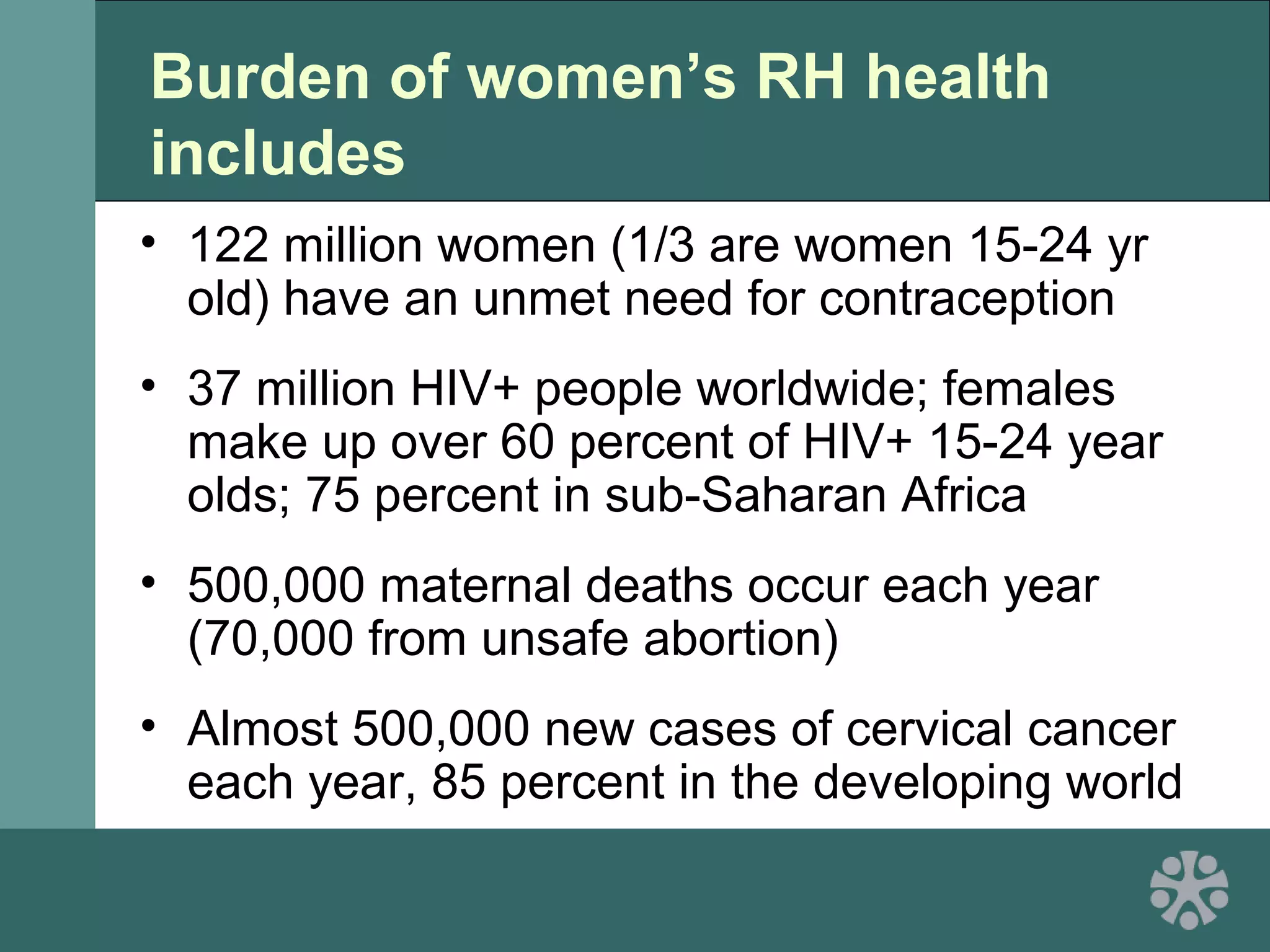
Burden of women’s RH health
includes
• 122 million women (1/3 are women 15-24 yr
old) have an unmet need for contraception
• 37 million HIV+ people worldwide; females
make up over 60 percent of HIV+ 15-24 year
olds; 75 percent in sub-Saharan Africa
• 500,000 maternal deaths occur each year
(70,000 from unsafe abortion)
• Almost 500,000 new cases of cervical cancer
each year, 85 percent in the developing world
New and/or underutilized RH
technologies and interventions
• Microbicides
• Female barrier methods
• Emergency contraception
• Cervical cancer prevention
strategies
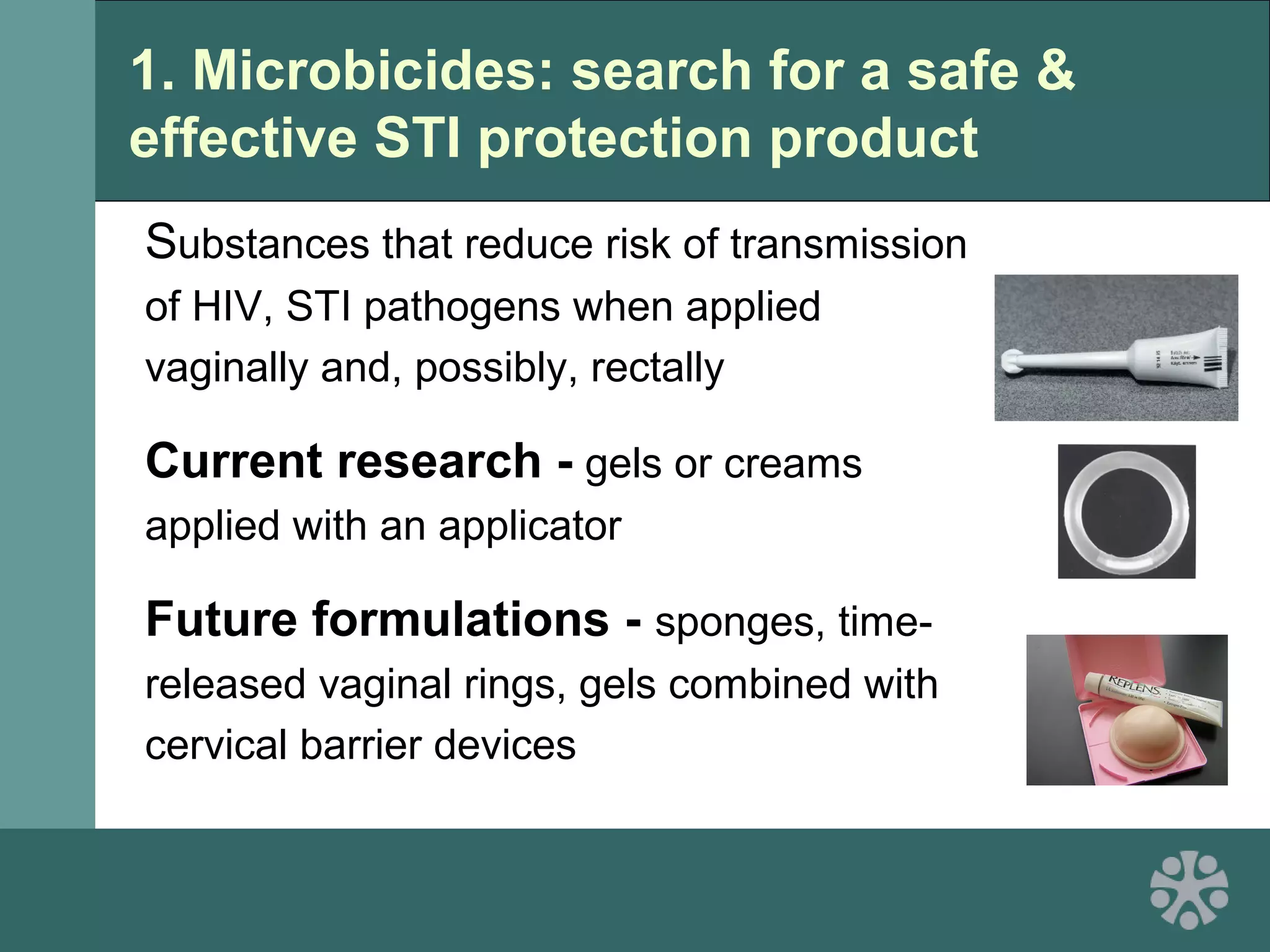
1. Microbicides: search for a safe &
effective STI protection product
Substances that reduce risk of transmission
of HIV, STI pathogens when applied
vaginally and, possibly, rectally
Current research - gels or creams
applied with an applicator
Future formulations - sponges, time-
released vaginal rings, gels combined with
cervical barrier devices
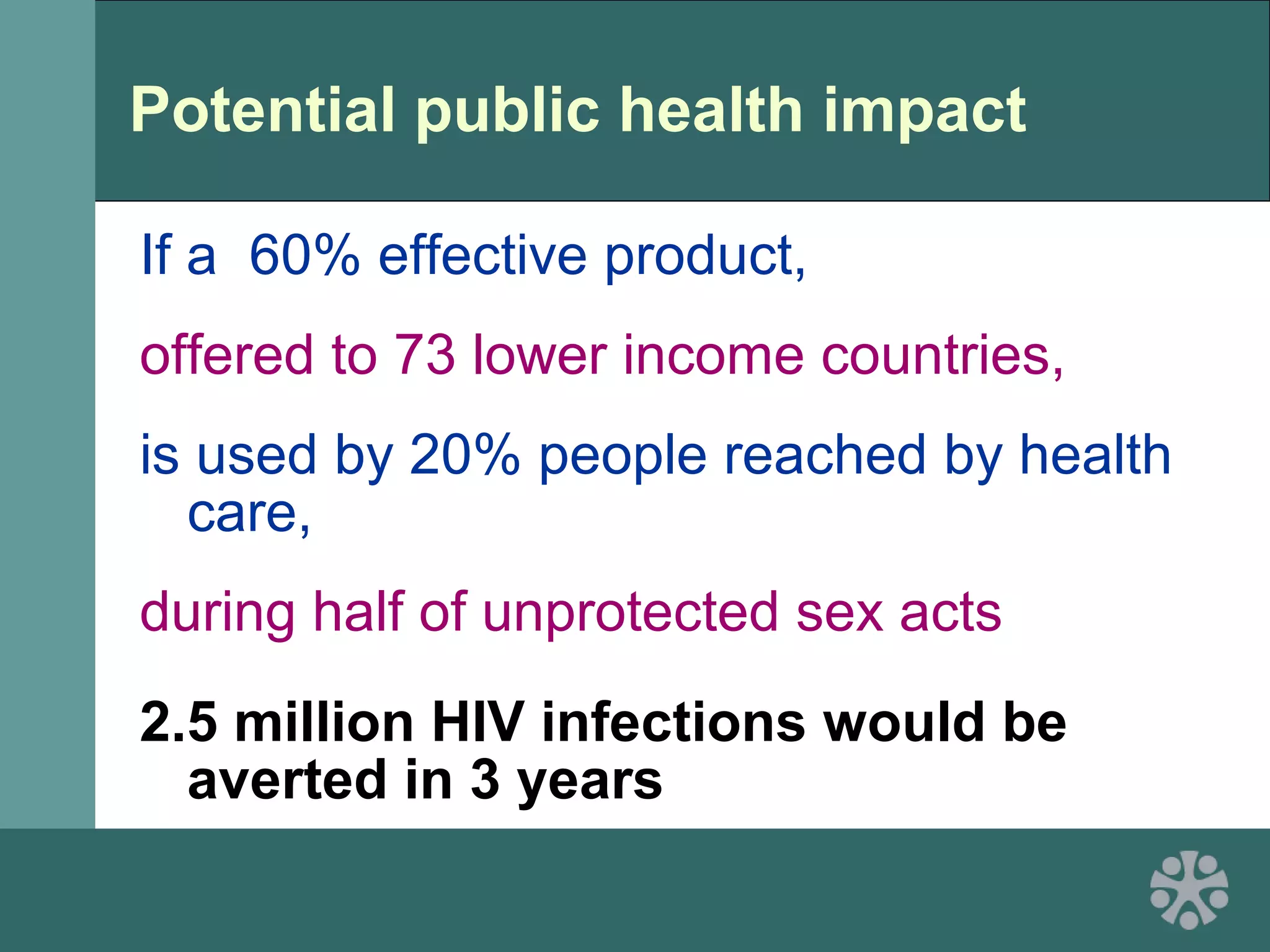
Potential public health impact
If a 60% effective product,
offered to 73 lower income countries,
is used by 20% people reached by health
care,
during half of unprotected sex acts
2.5 million HIV infections would be
averted in 3 years
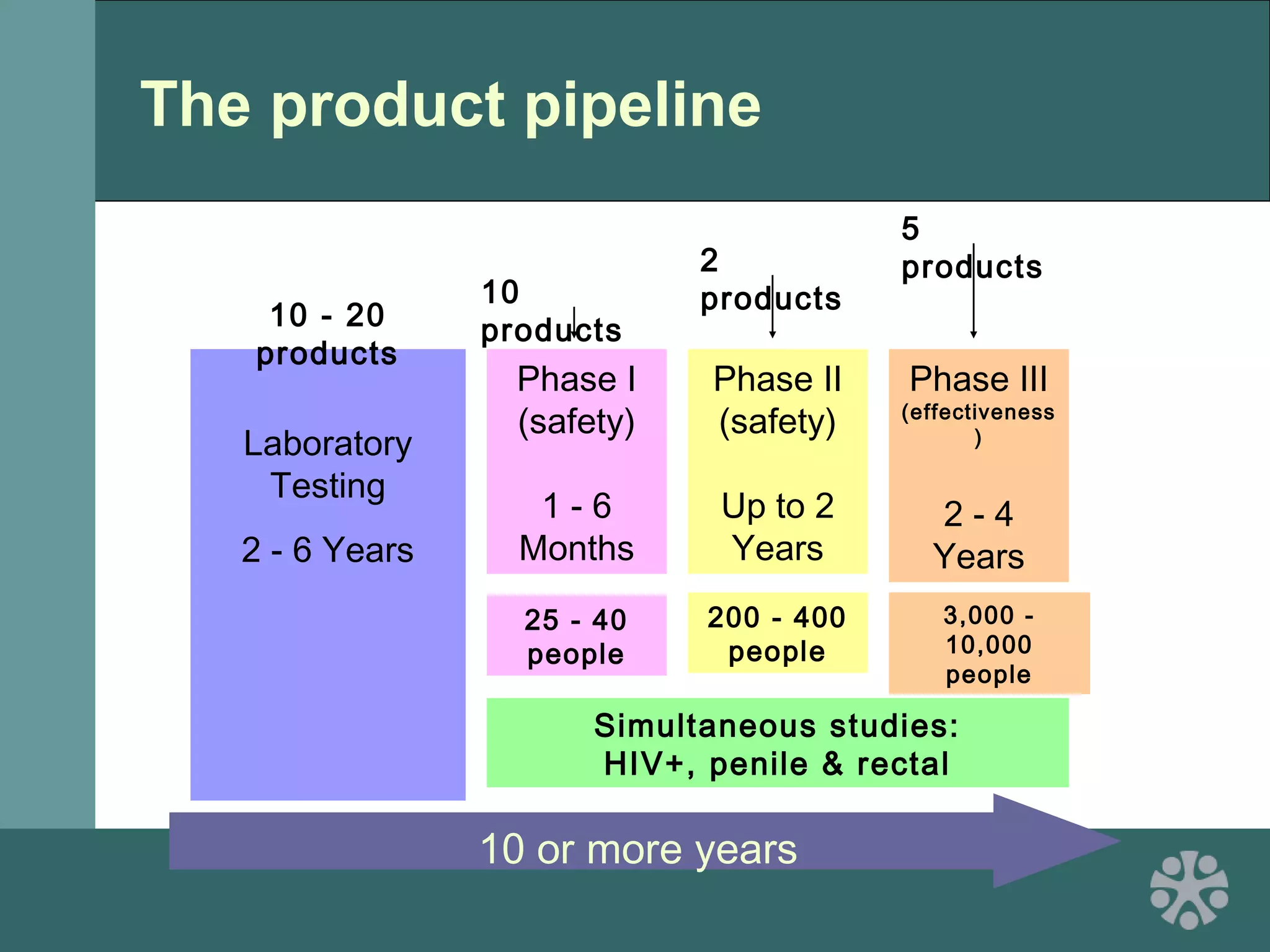
Laboratory
Testing
2 - 6 Years
Phase III
(effectiveness
)
2 - 4
Years
Simultaneous studies:
HIV+, penile & rectal
10 or more years
5
products2
products10
products10 - 20
products
Phase I
(safety)
1 - 6
Months
Phase II
(safety)
Up to 2
Years
25 - 40
people
200 - 400
people
3,000 -
10,000
people
The product pipeline
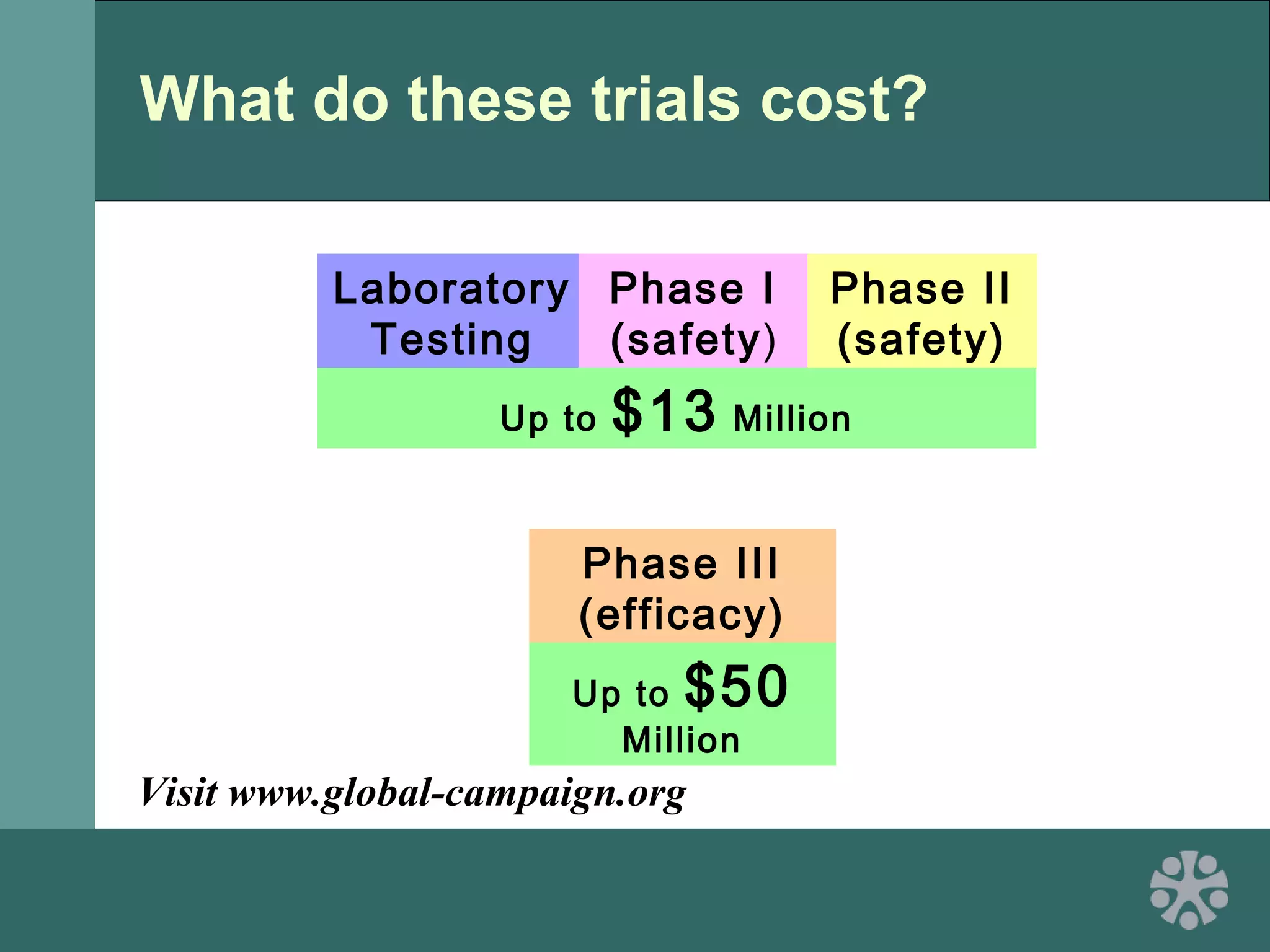
What do these trials cost?
Laboratory
Testing
Phase I
(safety)
Phase II
(safety)
Up to $13 Million
Phase III
(efficacy)
Up to $50
Million
Visit www.global-campaign.org
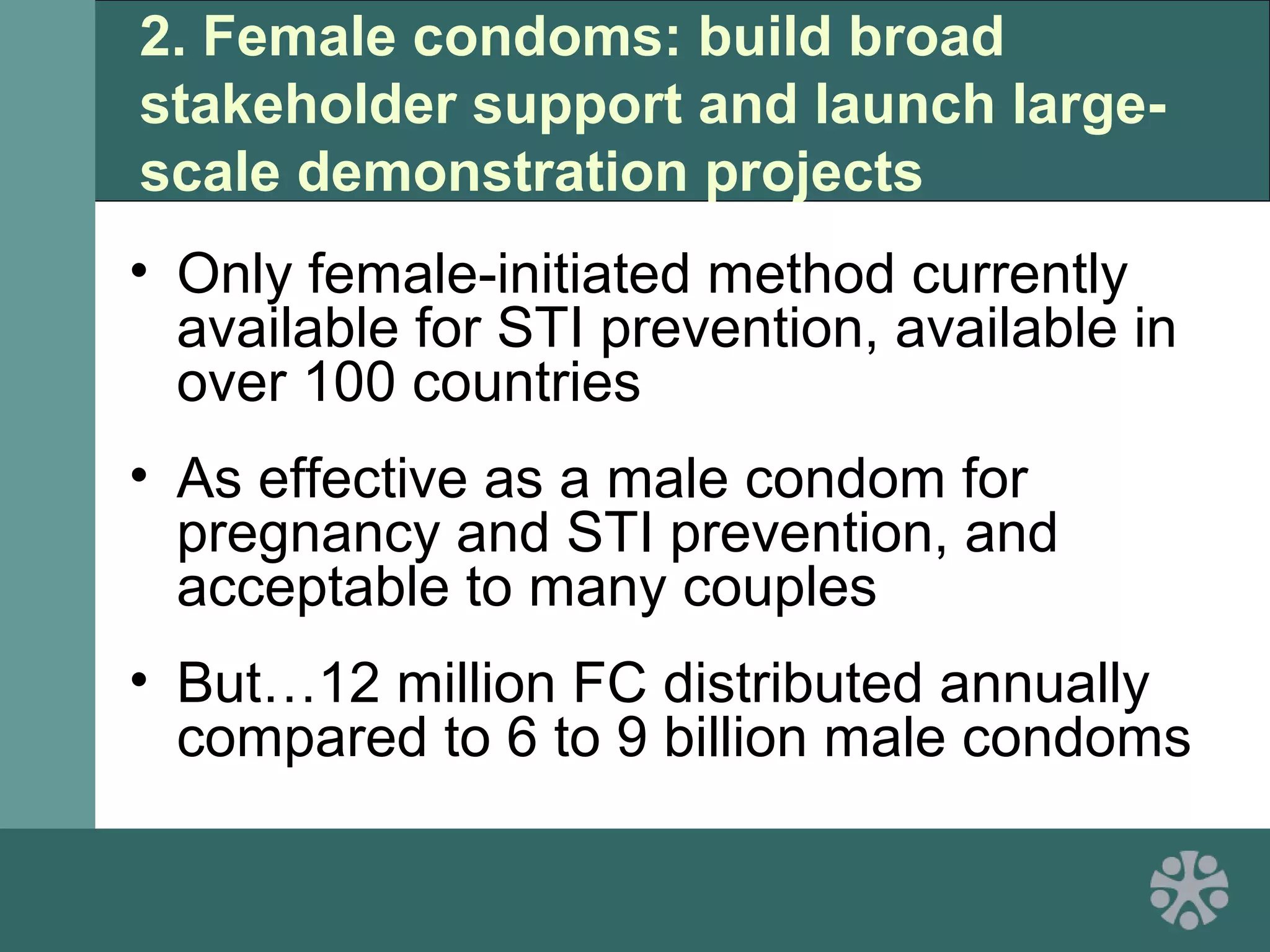
2. Female condoms: build broad
stakeholder support and launch large-
scale demonstration projects
• Only female-initiated method currently
available for STI prevention, available in
over 100 countries
• As effective as a male condom for
pregnancy and STI prevention, and
acceptable to many couples
• But…12 million FC distributed annually
compared to 6 to 9 billion male condoms
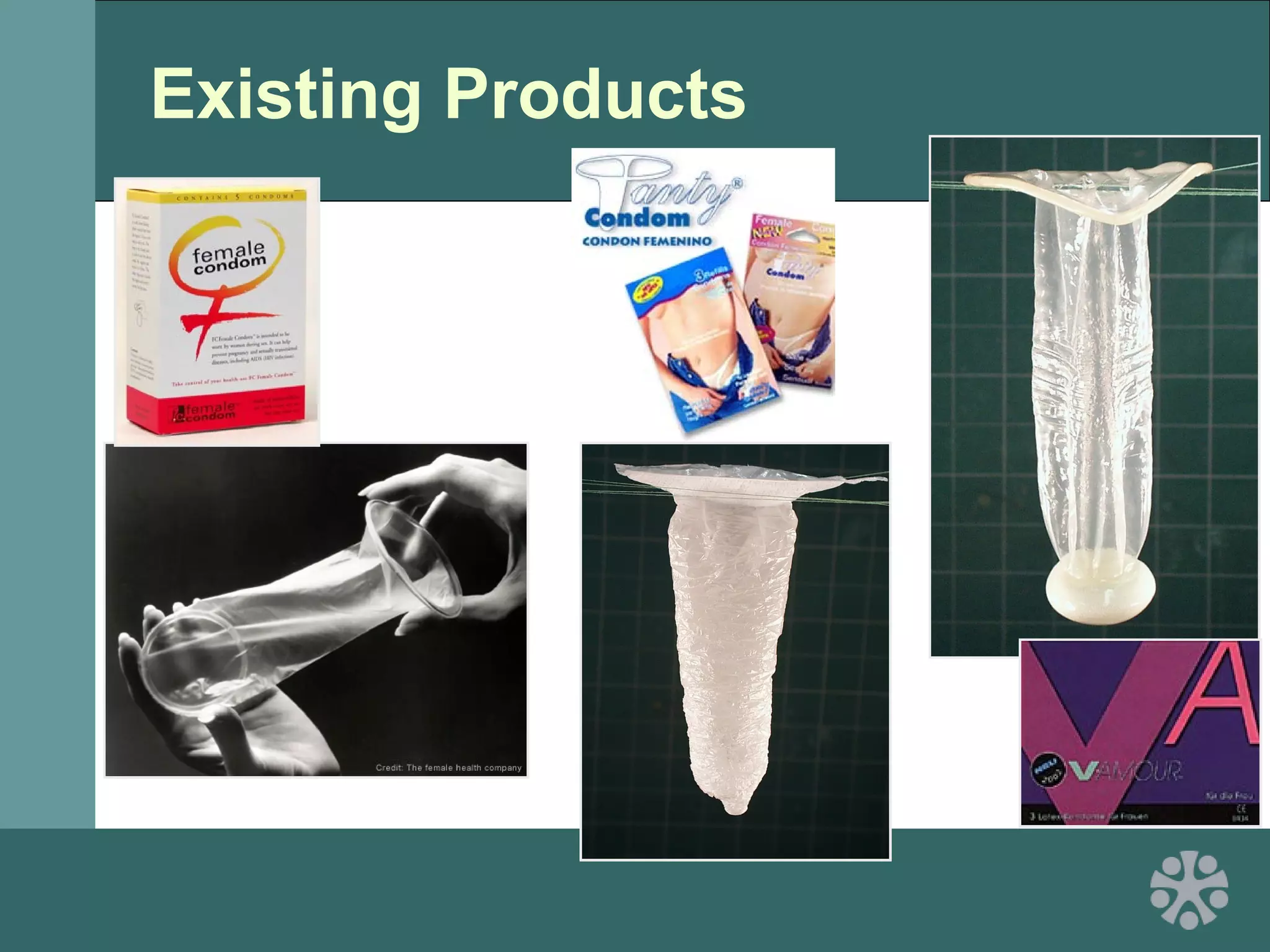
Existing Products
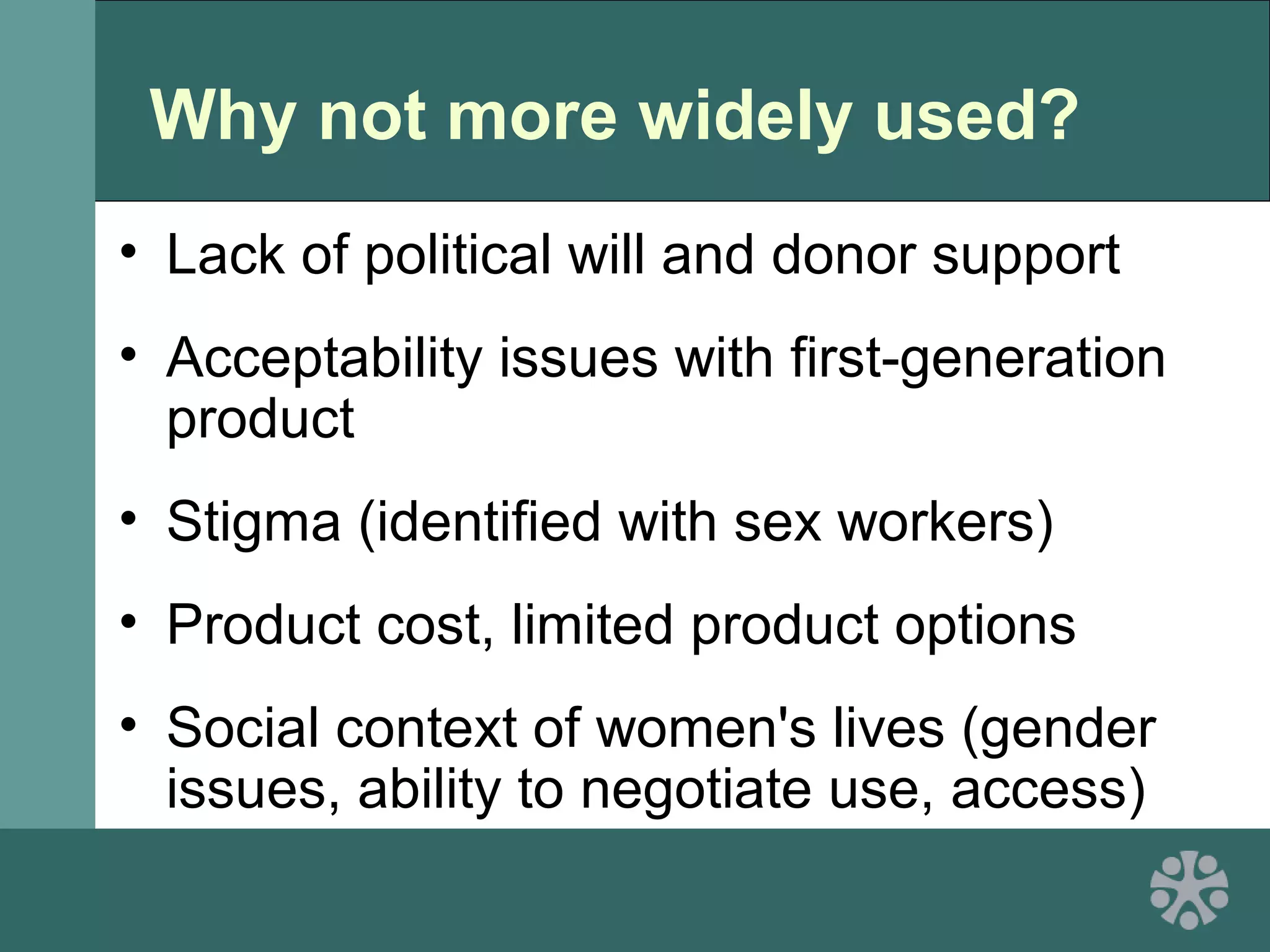
Why not more widely used?
• Lack of political will and donor support
• Acceptability issues with first-generation
product
• Stigma (identified with sex workers)
• Product cost, limited product options
• Social context of women's lives (gender
issues, ability to negotiate use, access)
How to increase impact
• Advocacy to boost funding for introduction
so women’s protection is a viable option
• Fund demonstration projects to answer
ongoing questions about impact and
acceptability
• Develop collaborations to share research
and program tools
• Accelerate development and approval of
next-generation female condoms
PATH Woman’s Condom:
Performance Objectives
• Easy to handle and insert
• Easy to use (especially for new users)
• Stable during use
• Comfortable for both partners
• Easy to remove
• Less expensive than current options
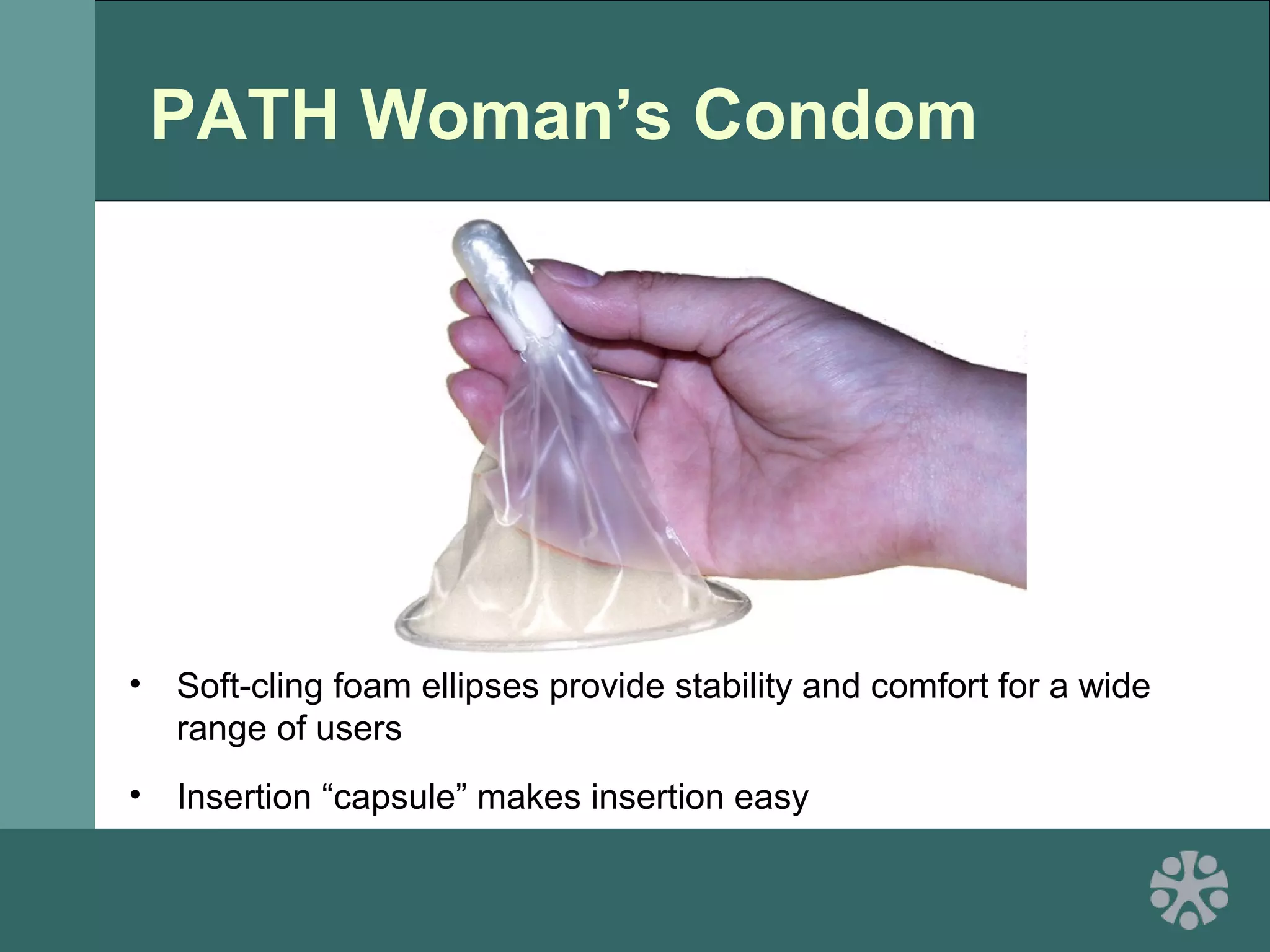
PATH Woman’s Condom
• Soft-cling foam ellipses provide stability and comfort for a wide
range of users
• Insertion “capsule” makes insertion easy
3. Emergency Contraception: build
awareness and systems support
• Emergency contraception is more effective
the sooner it is taken, up to 120 hours
after unprotected intercourse.1
• Progestin-only regimen reduces
pregnancy risk 89%
• Combined estrogen/progestin regimen
reduces pregnancy risk 75%2
1. Von Hertzen, H. et al. Low dose mifepristone and two regimens of levonorgestrel for emergency contraception:
a WHO multicentre randomized trial. Lancet 360(9348):1803-1810 (2002). 2. WHO Task Force on
Postovulatory Methods of Fertility Regulation. Randomised controlled trial of levonorgestrel versus the
Yuzpe regimen of combined oral contraceptives for emergency contraception. Lancet 352(9126):428-433 (1998).
Emergency Contraceptive Pills
(ECPs)
ECPs can prevent unintended pregnancy,
BUT
Due to low awareness:
• ECP product availability is restricted
• Health providers don’t offer it to clients
• Women don’t know to ask for it
Systems support: pharmacies as
alternative providers of RH needs
• Experience in
Cambodia, Kenya, and
Nicagagua:
• Pharmacy staff are key
primary health providers1
• Clients appreciate easy
access
• Pharmacy schools and
networks support
offering RH services
1
Data from Food and Drug Administration, Ministry of Public Health, Thailand says that 70% of patients receive services
from drugstore. PATH Thailand.Drugstore Capacity-building Programs:A Chronicle of PATH Experiences. 2000.
Increase ECP access through
building awareness
Communicate key messages to 3 key audiences:
• Evidence-based safety and effectiveness
information for policy and decision makers
• Technical information and counseling skills
for health providers and program managers
• Where to find and how to use ECPs for
women who need them.
Visit www.cecinfo.org
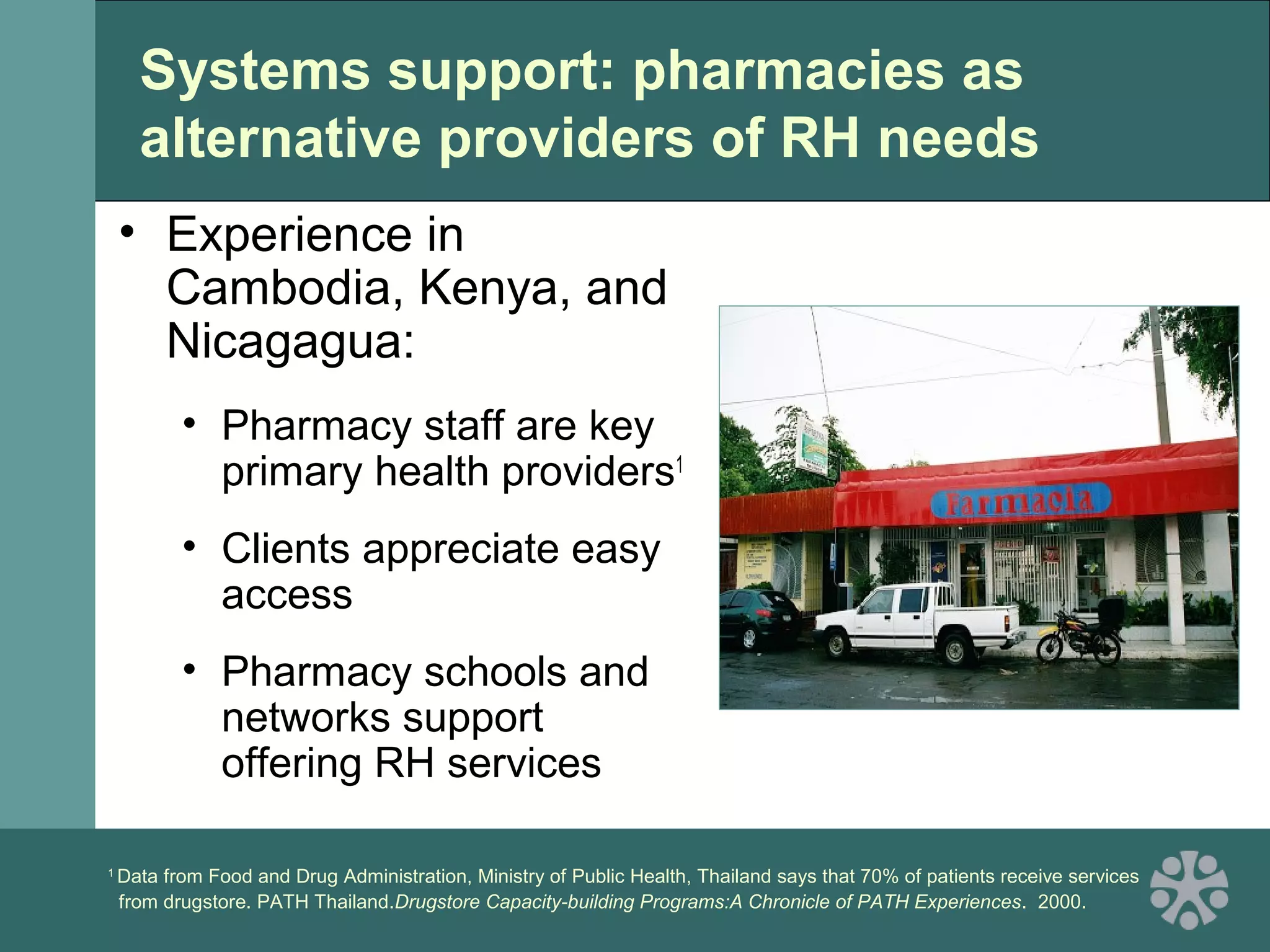
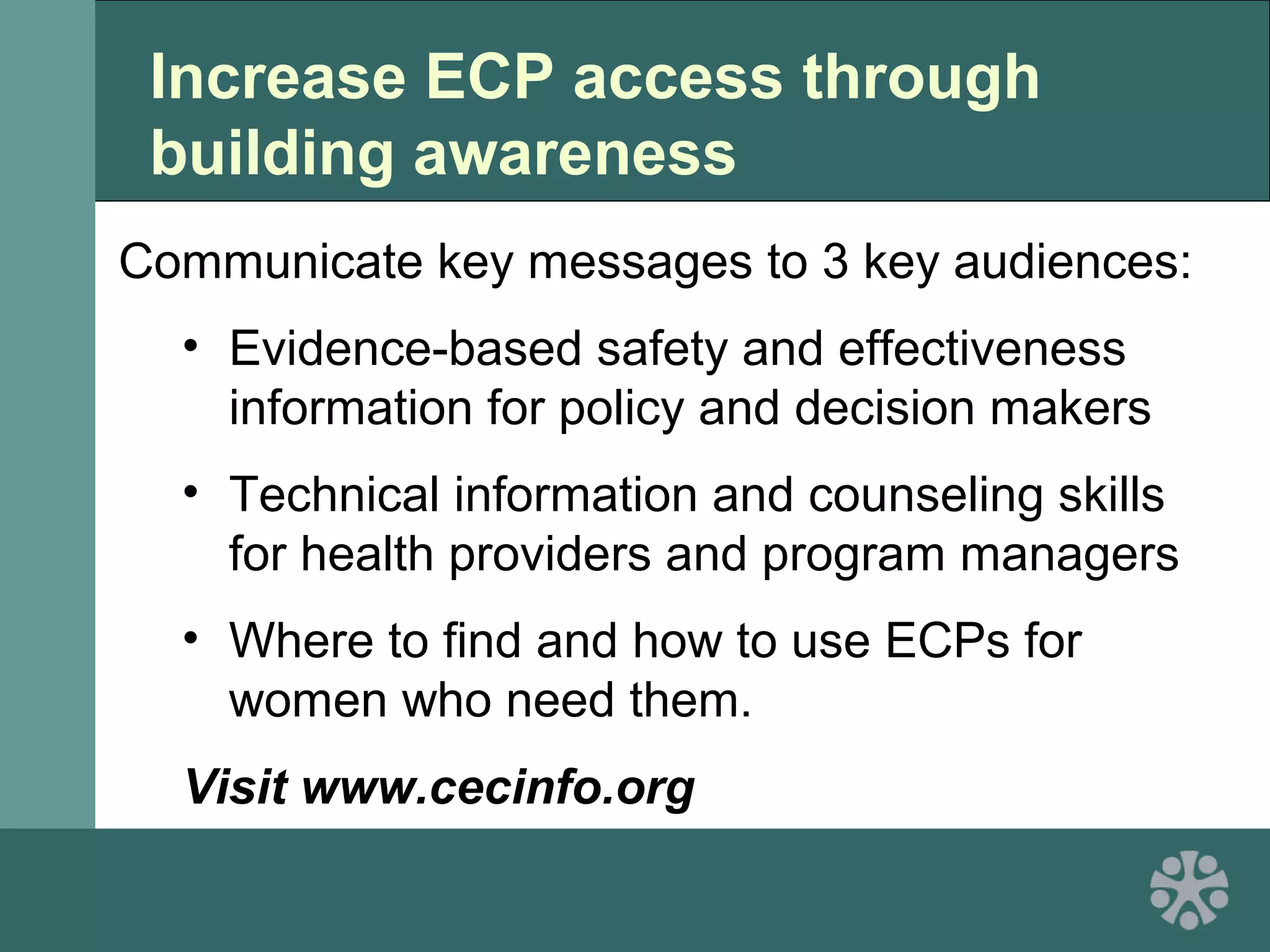
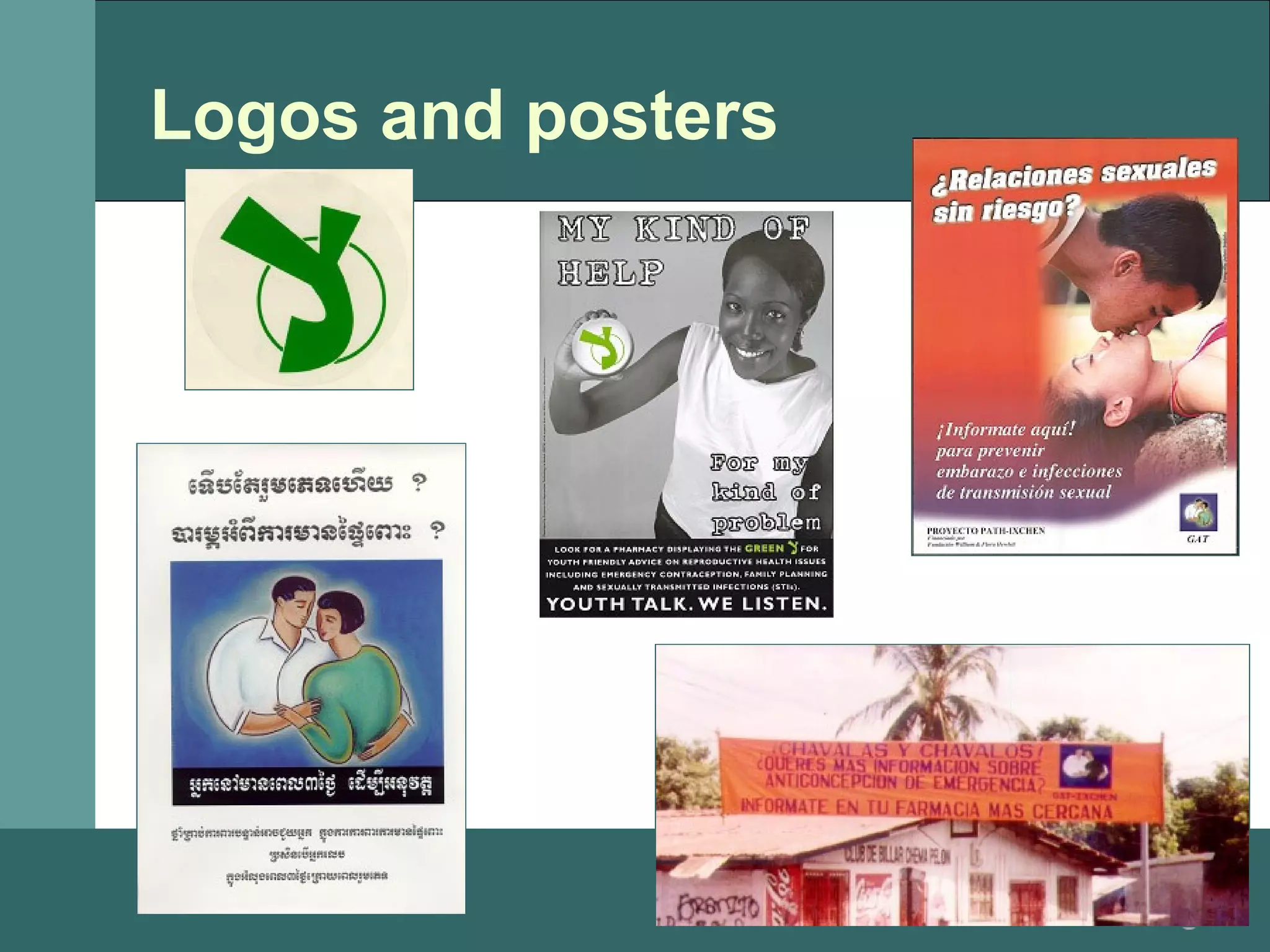
Logos and posters
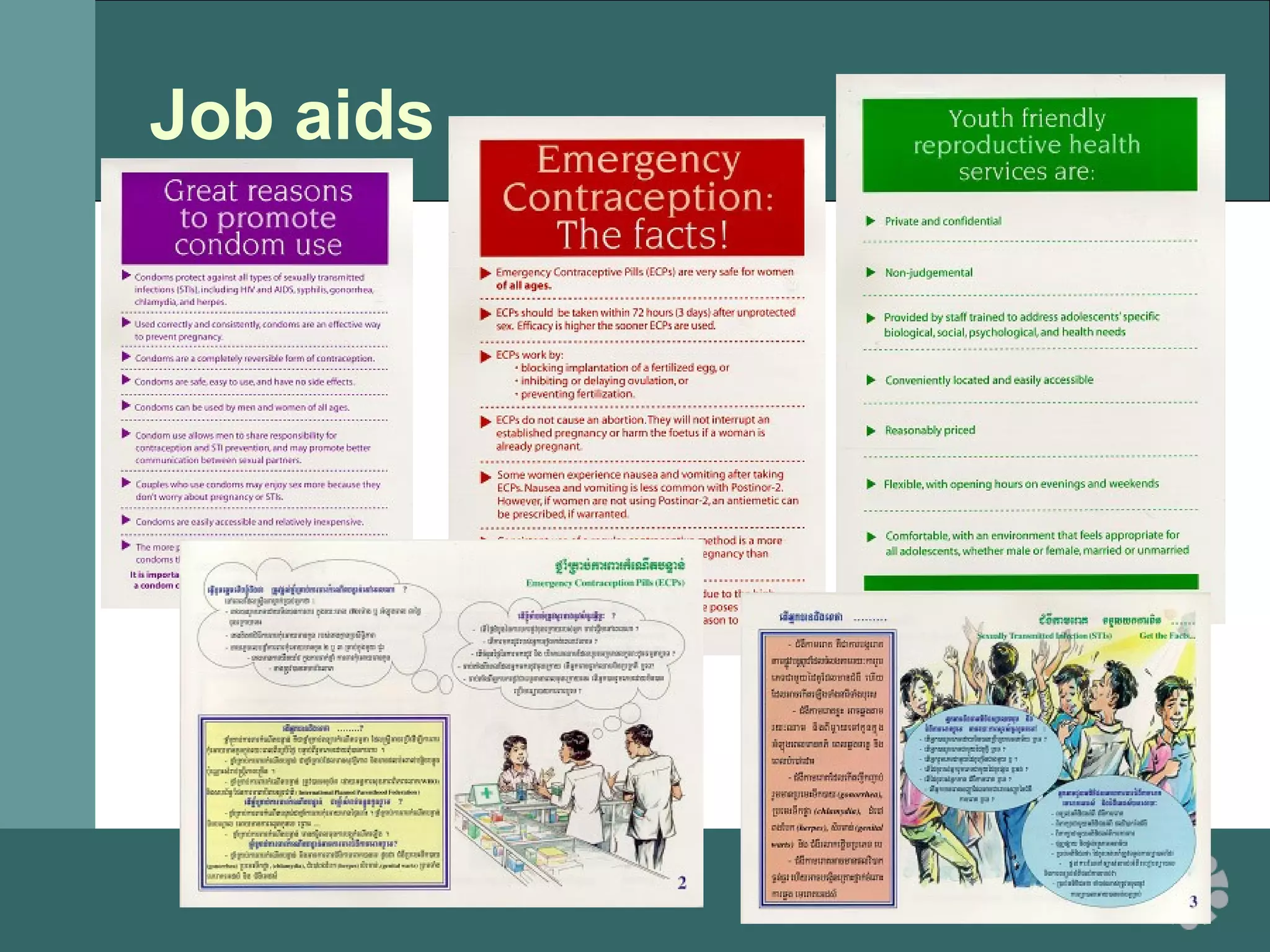
Job aids
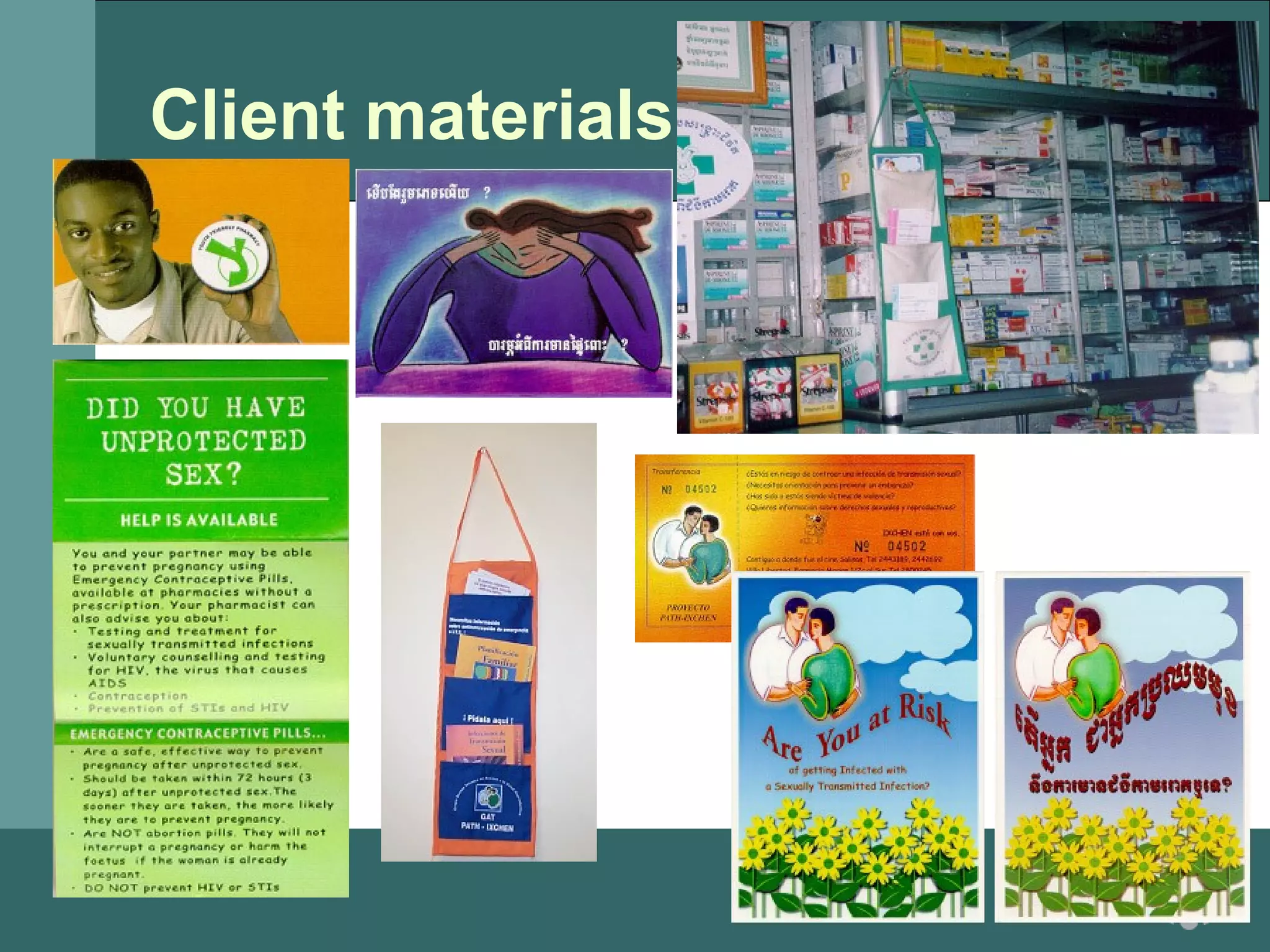
Client materials
Cervical Cancer Prevention: a
holistic approach
Focus areas:
• Screening and
treatment technologies
• Service delivery
guidelines
• Community needs and
involvement
• Advocacy
*PATH, EngenderHeatlh, PAHO, IARC, JHPIEGO
*
Visit www.alliance-cxca.org
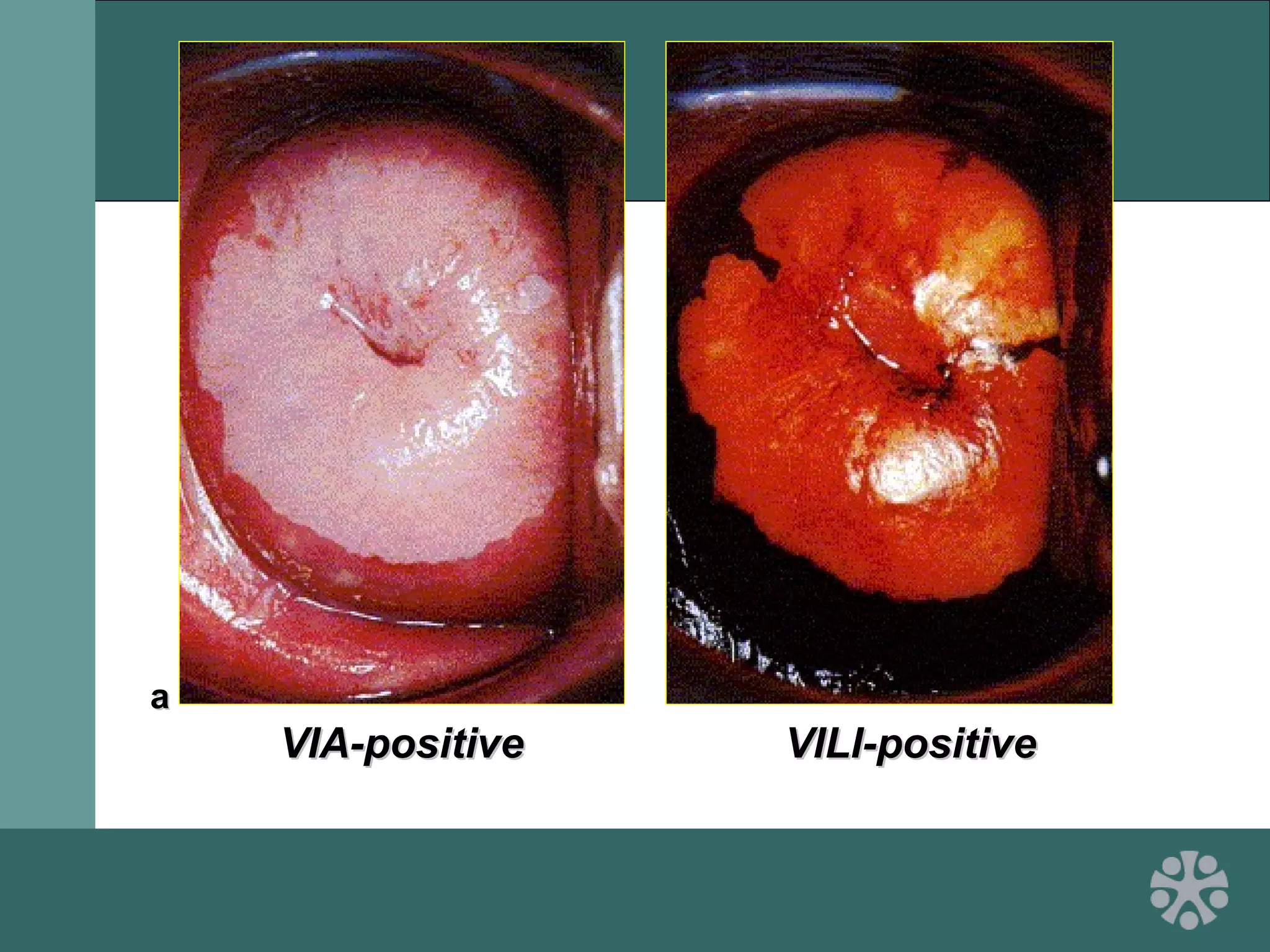
VIA-positiveVIA-positive VILI-positiveVILI-positive
aa
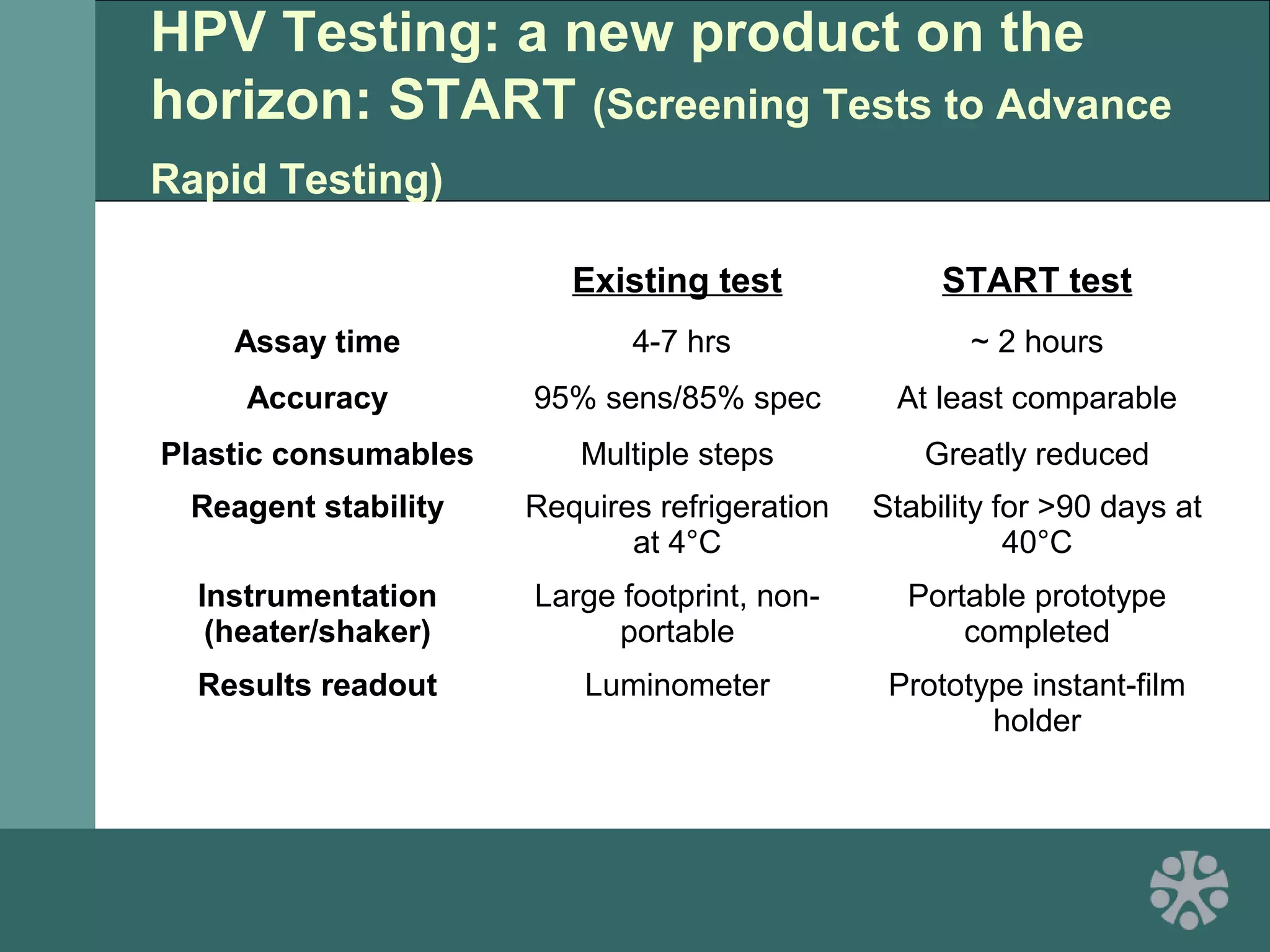
HPV Testing: a new product on the
horizon: START (Screening Tests to Advance
Rapid Testing)
Existing test START test
Assay time 4-7 hrs ~ 2 hours
Accuracy 95% sens/85% spec At least comparable
Plastic consumables Multiple steps Greatly reduced
Reagent stability Requires refrigeration
at 4°C
Stability for >90 days at
40°C
Instrumentation
(heater/shaker)
Large footprint, non-
portable
Portable prototype
completed
Results readout Luminometer Prototype instant-film
holder
Findings
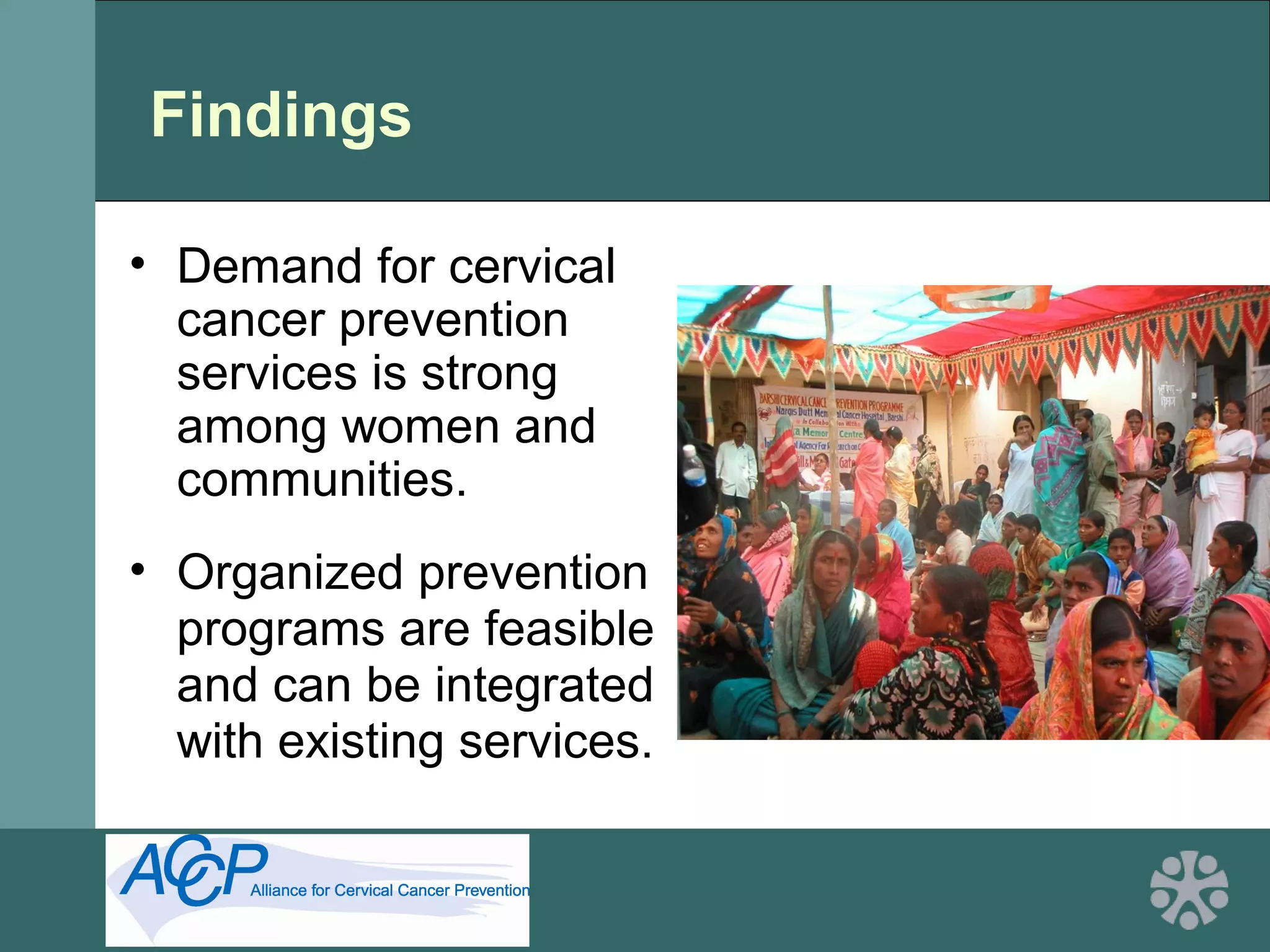
• Demand for cervical
cancer prevention
services is strong
among women and
communities.
• Organized prevention
programs are feasible
and can be integrated
with existing services.
Findings
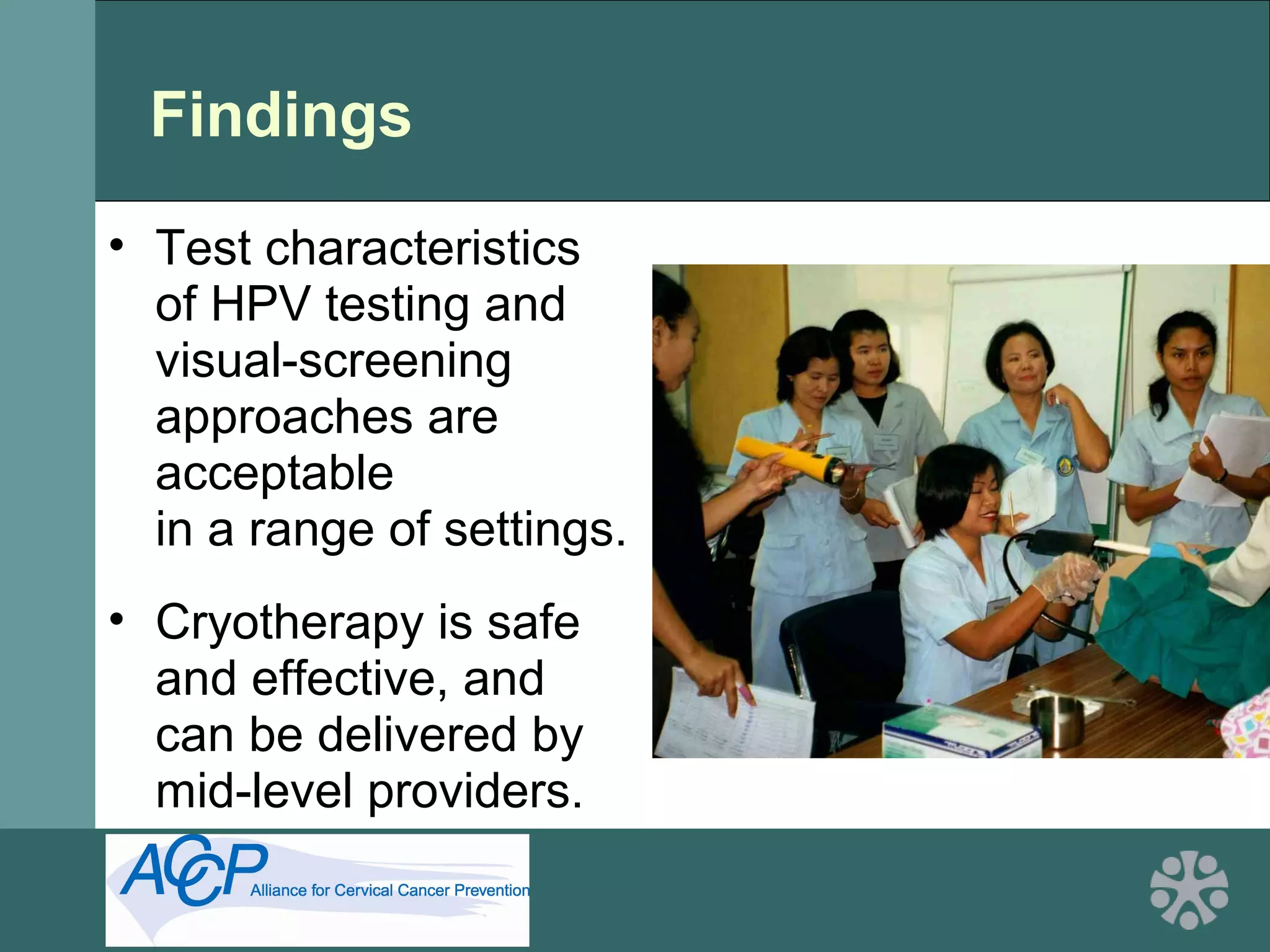
• Test characteristics
of HPV testing and
visual-screening
approaches are
acceptable
in a range of settings.
• Cryotherapy is safe
and effective, and
can be delivered by
mid-level providers.
Findings
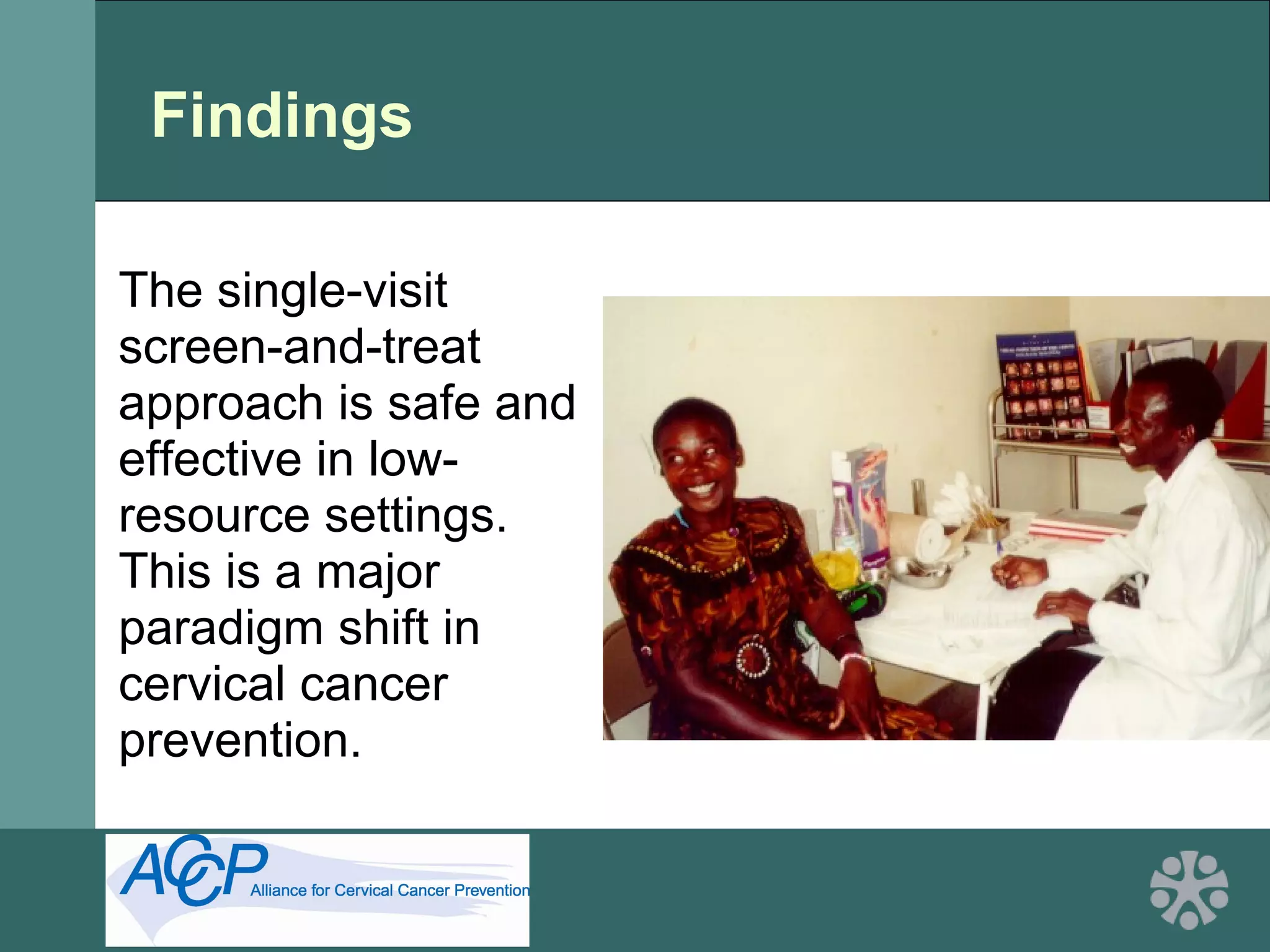
The single-visit
screen-and-treat
approach is safe and
effective in low-
resource settings.
This is a major
paradigm shift in
cervical cancer
prevention.
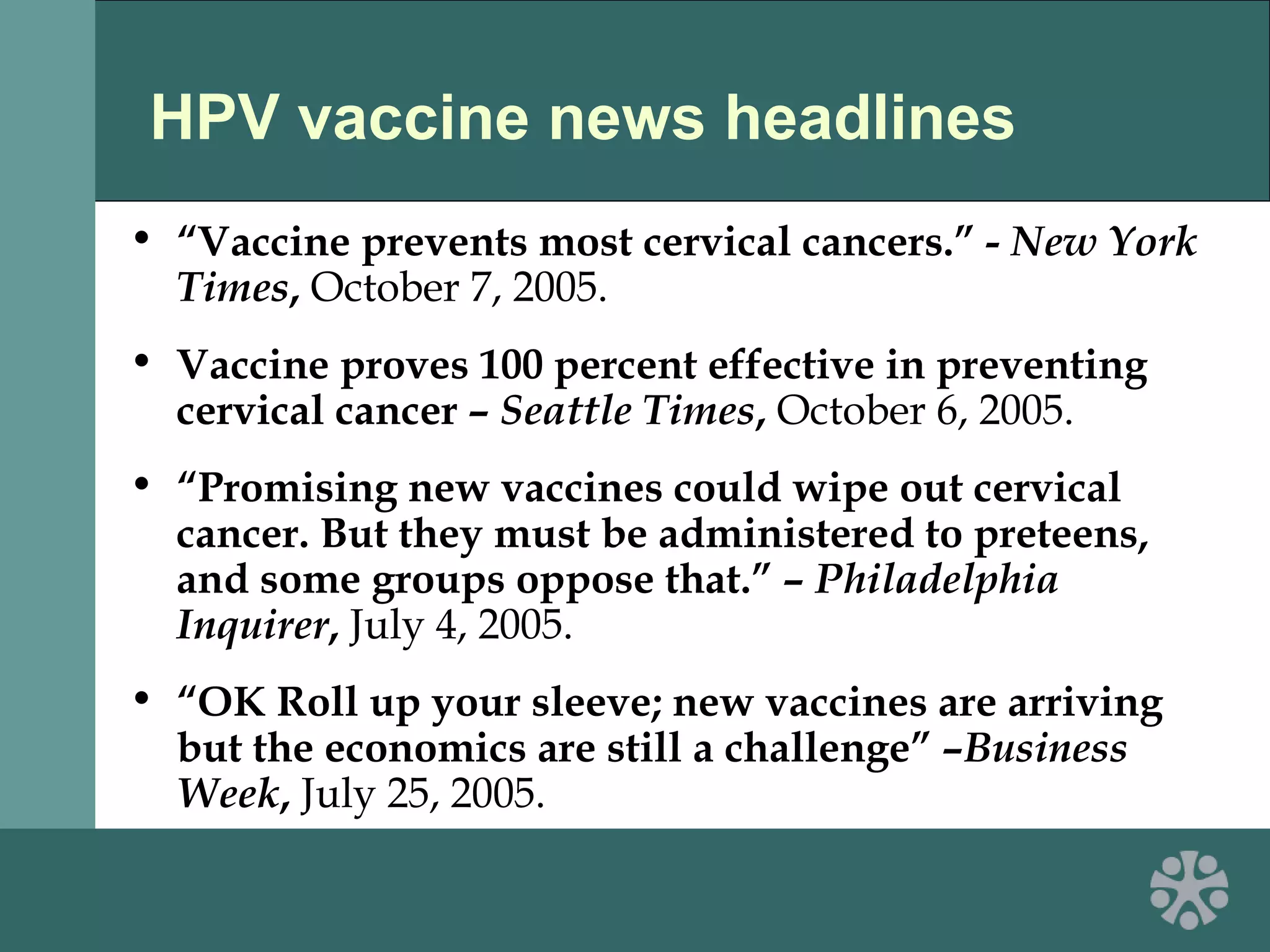
HPV vaccine news headlines
• “Vaccine prevents most cervical cancers.” - New York
Times, October 7, 2005.
• Vaccine proves 100 percent effective in preventing
cervical cancer – Seattle Times, October 6, 2005.
• “Promising new vaccines could wipe out cervical
cancer. But they must be administered to preteens,
and some groups oppose that.” – Philadelphia
Inquirer, July 4, 2005.
• “OK Roll up your sleeve; new vaccines are arriving
but the economics are still a challenge” –Business
Week, July 25, 2005.
The HPV-cervical cancer link
• Human papillomavirus (HPV) is a very common
infection (more than 50% of adults get it, in most it is a transitory
infection).
• 99.7% of cervical cancer cases are associated
with HPV.
• Progression from HPV infection to cancer
usually takes 20-30 years.
• Currently, there is no treatment for HPV
infection.
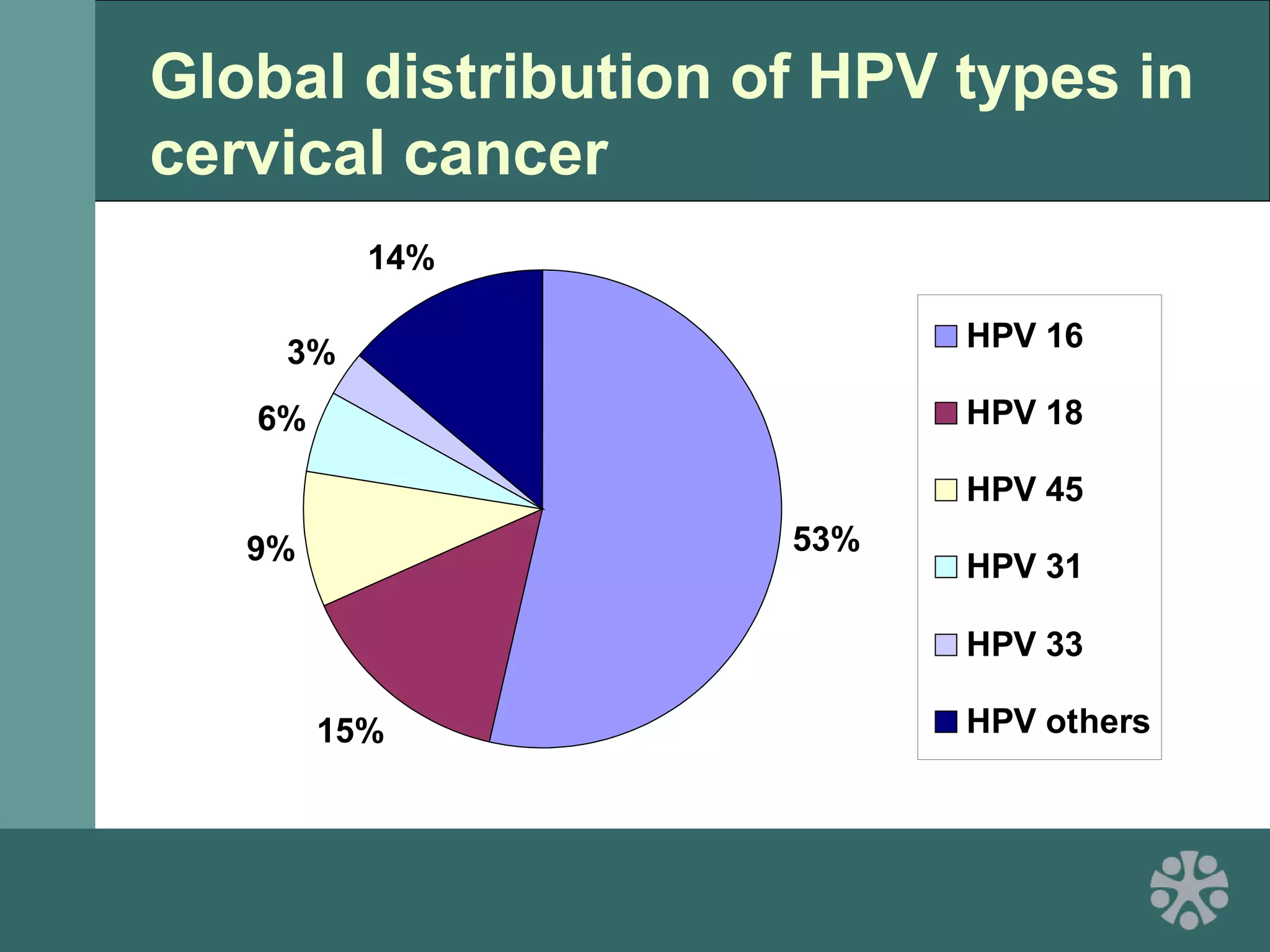
Global distribution of HPV types in
cervical cancer
53%
15%
9%
6%
3%
14%
HPV 16
HPV 18
HPV 45
HPV 31
HPV 33
HPV others
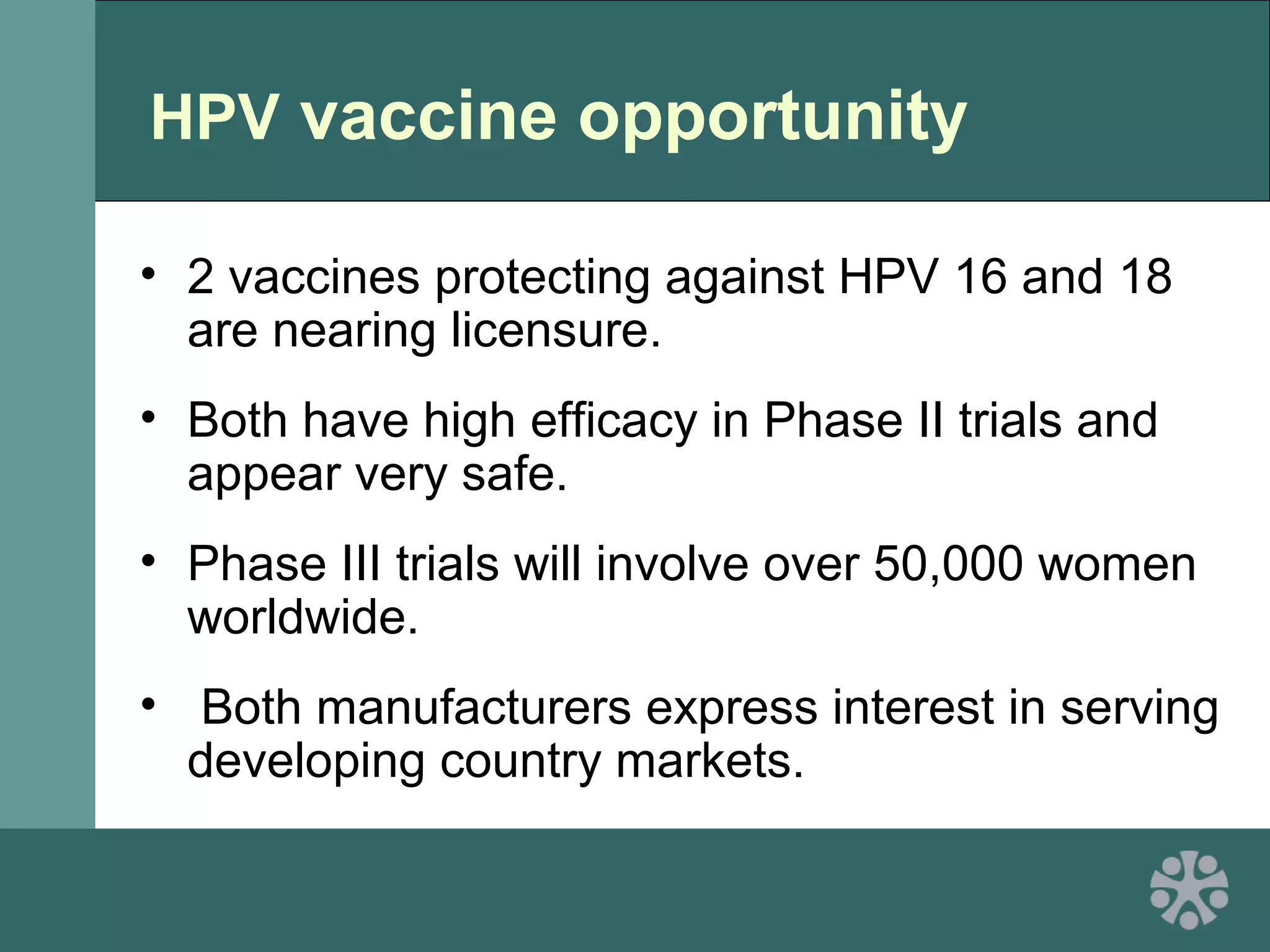
HPV vaccine opportunity
• 2 vaccines protecting against HPV 16 and 18
are nearing licensure.
• Both have high efficacy in Phase II trials and
appear very safe.
• Phase III trials will involve over 50,000 women
worldwide.
• Both manufacturers express interest in serving
developing country markets.
But….
Can vaccines be made broadly accessible
to the young women who need them the
most, given challenges around product
supply, information needs, delivery system
weaknesses, and community awareness?
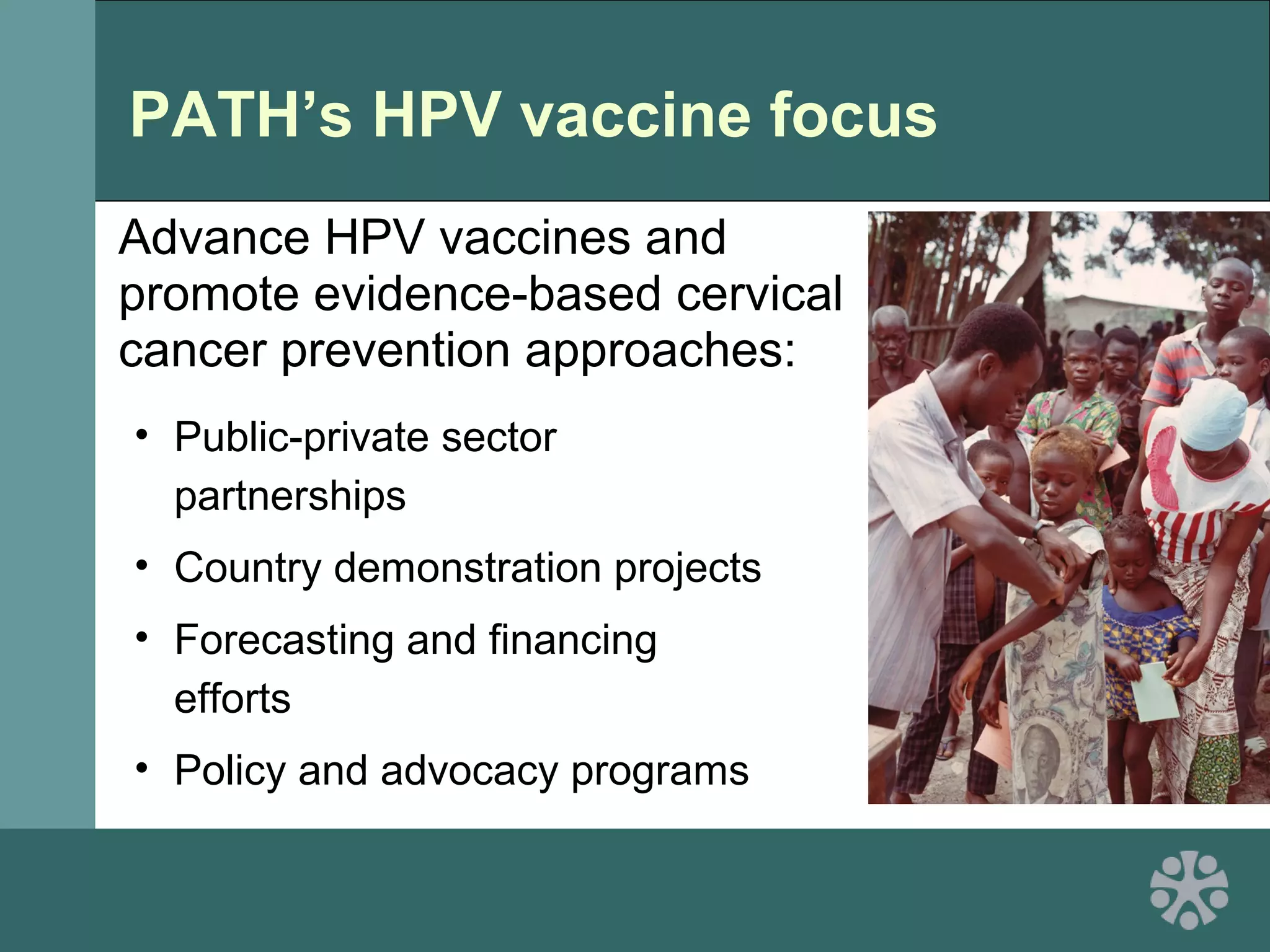
PATH’s HPV vaccine focus
Advance HPV vaccines and
promote evidence-based cervical
cancer prevention approaches:
• Public-private sector
partnerships
• Country demonstration projects
• Forecasting and financing
efforts
• Policy and advocacy programs
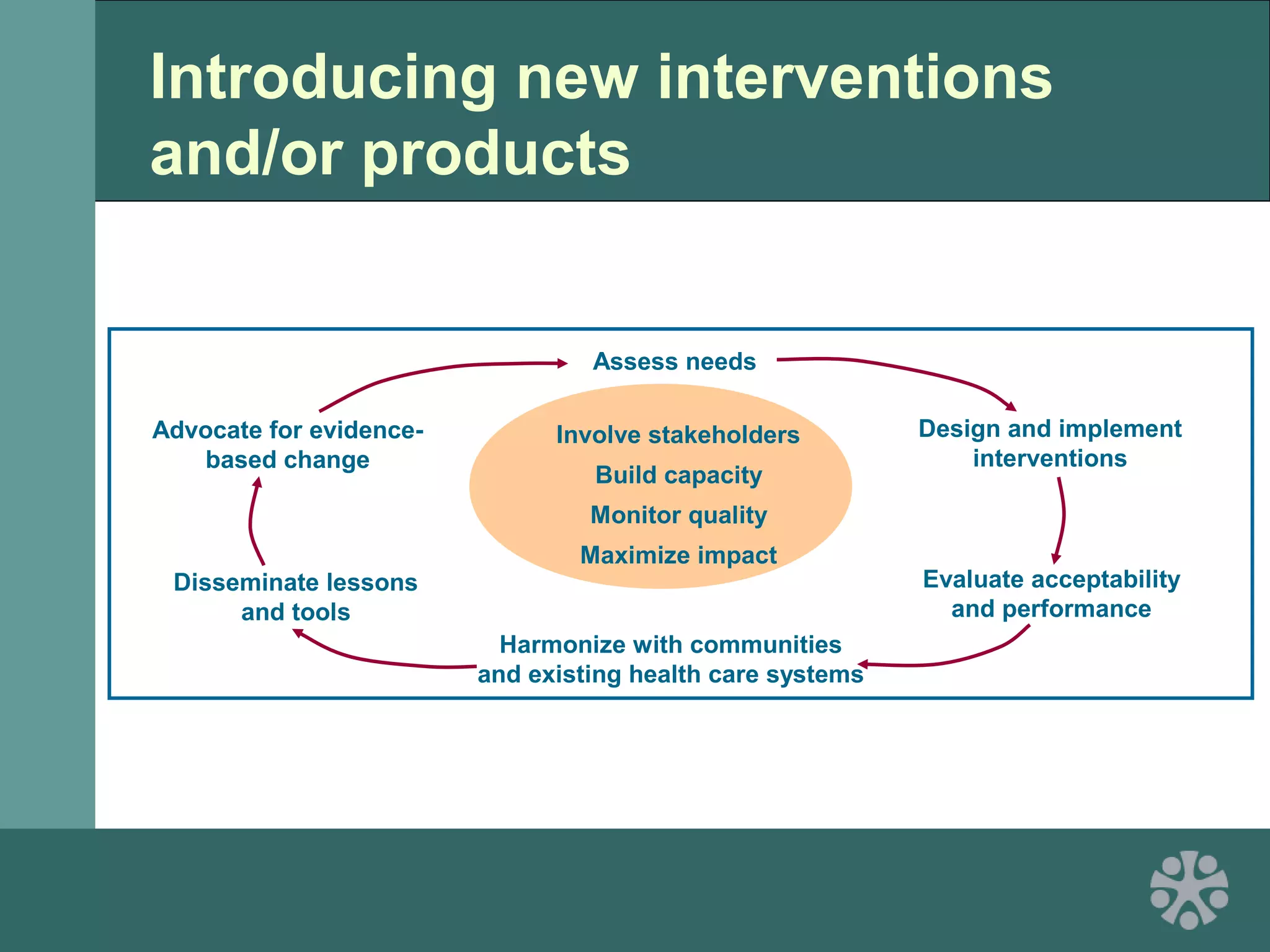
Introducing new interventions
and/or products
Advocate for evidence-
based change
Disseminate lessons
and tools
Assess needs
Harmonize with communities
and existing health care systems
Design and implement
interventions
Evaluate acceptability
and performance
Involve stakeholders
Build capacity
Monitor quality
Maximize impact
Jacqueline Sherris, PhD
Strategic Program Leader,
Reproductive Health
sherris@path.org
www.path.org

Improving Women's Reproductive Health Through Expanding Access to Key Health Technologies

  • 1.
    Improving women's reproductive health throughexpanding access to key health technologies
  • 2.
    For maximize impact,new RH product introduction requires: • Clear and understood health needs • Safe and effective product/approach • Demonstrated pilot project success • Health systems strengthening • Engagement of and support among stakeholders at various levels • Global and regional advocacy
  • 3.
    Introducing new interventionsor products for maximum impact Advocate for evidence- based change Disseminate lessons and tools Assess needs Harmonize with communities and existing health care systems Design and implement interventions Evaluate acceptability and performance Involve stakeholders Build capacity Monitor quality Maximize impact
  • 4.
    Burden of women’sRH health includes • 122 million women (1/3 are women 15-24 yr old) have an unmet need for contraception • 37 million HIV+ people worldwide; females make up over 60 percent of HIV+ 15-24 year olds; 75 percent in sub-Saharan Africa • 500,000 maternal deaths occur each year (70,000 from unsafe abortion) • Almost 500,000 new cases of cervical cancer each year, 85 percent in the developing world
  • 5.
    New and/or underutilizedRH technologies and interventions • Microbicides • Female barrier methods • Emergency contraception • Cervical cancer prevention strategies
  • 6.
    1. Microbicides: searchfor a safe & effective STI protection product Substances that reduce risk of transmission of HIV, STI pathogens when applied vaginally and, possibly, rectally Current research - gels or creams applied with an applicator Future formulations - sponges, time- released vaginal rings, gels combined with cervical barrier devices
  • 7.
    Potential public healthimpact If a 60% effective product, offered to 73 lower income countries, is used by 20% people reached by health care, during half of unprotected sex acts 2.5 million HIV infections would be averted in 3 years
  • 8.
    Laboratory Testing 2 - 6Years Phase III (effectiveness ) 2 - 4 Years Simultaneous studies: HIV+, penile & rectal 10 or more years 5 products2 products10 products10 - 20 products Phase I (safety) 1 - 6 Months Phase II (safety) Up to 2 Years 25 - 40 people 200 - 400 people 3,000 - 10,000 people The product pipeline
  • 9.
    What do thesetrials cost? Laboratory Testing Phase I (safety) Phase II (safety) Up to $13 Million Phase III (efficacy) Up to $50 Million Visit www.global-campaign.org
  • 10.
    2. Female condoms:build broad stakeholder support and launch large- scale demonstration projects • Only female-initiated method currently available for STI prevention, available in over 100 countries • As effective as a male condom for pregnancy and STI prevention, and acceptable to many couples • But…12 million FC distributed annually compared to 6 to 9 billion male condoms
  • 11.
  • 12.
    Why not morewidely used? • Lack of political will and donor support • Acceptability issues with first-generation product • Stigma (identified with sex workers) • Product cost, limited product options • Social context of women's lives (gender issues, ability to negotiate use, access)
  • 13.
    How to increaseimpact • Advocacy to boost funding for introduction so women’s protection is a viable option • Fund demonstration projects to answer ongoing questions about impact and acceptability • Develop collaborations to share research and program tools • Accelerate development and approval of next-generation female condoms
  • 14.
    PATH Woman’s Condom: PerformanceObjectives • Easy to handle and insert • Easy to use (especially for new users) • Stable during use • Comfortable for both partners • Easy to remove • Less expensive than current options
  • 15.
    PATH Woman’s Condom •Soft-cling foam ellipses provide stability and comfort for a wide range of users • Insertion “capsule” makes insertion easy
  • 16.
    3. Emergency Contraception:build awareness and systems support • Emergency contraception is more effective the sooner it is taken, up to 120 hours after unprotected intercourse.1 • Progestin-only regimen reduces pregnancy risk 89% • Combined estrogen/progestin regimen reduces pregnancy risk 75%2 1. Von Hertzen, H. et al. Low dose mifepristone and two regimens of levonorgestrel for emergency contraception: a WHO multicentre randomized trial. Lancet 360(9348):1803-1810 (2002). 2. WHO Task Force on Postovulatory Methods of Fertility Regulation. Randomised controlled trial of levonorgestrel versus the Yuzpe regimen of combined oral contraceptives for emergency contraception. Lancet 352(9126):428-433 (1998).
  • 17.
    Emergency Contraceptive Pills (ECPs) ECPscan prevent unintended pregnancy, BUT Due to low awareness: • ECP product availability is restricted • Health providers don’t offer it to clients • Women don’t know to ask for it
  • 18.
    Systems support: pharmaciesas alternative providers of RH needs • Experience in Cambodia, Kenya, and Nicagagua: • Pharmacy staff are key primary health providers1 • Clients appreciate easy access • Pharmacy schools and networks support offering RH services 1 Data from Food and Drug Administration, Ministry of Public Health, Thailand says that 70% of patients receive services from drugstore. PATH Thailand.Drugstore Capacity-building Programs:A Chronicle of PATH Experiences. 2000.
  • 19.
    Increase ECP accessthrough building awareness Communicate key messages to 3 key audiences: • Evidence-based safety and effectiveness information for policy and decision makers • Technical information and counseling skills for health providers and program managers • Where to find and how to use ECPs for women who need them. Visit www.cecinfo.org
  • 20.
  • 21.
  • 22.
  • 23.
    Cervical Cancer Prevention:a holistic approach Focus areas: • Screening and treatment technologies • Service delivery guidelines • Community needs and involvement • Advocacy *PATH, EngenderHeatlh, PAHO, IARC, JHPIEGO * Visit www.alliance-cxca.org
  • 24.
  • 25.
    HPV Testing: anew product on the horizon: START (Screening Tests to Advance Rapid Testing) Existing test START test Assay time 4-7 hrs ~ 2 hours Accuracy 95% sens/85% spec At least comparable Plastic consumables Multiple steps Greatly reduced Reagent stability Requires refrigeration at 4°C Stability for >90 days at 40°C Instrumentation (heater/shaker) Large footprint, non- portable Portable prototype completed Results readout Luminometer Prototype instant-film holder
  • 26.
    Findings • Demand forcervical cancer prevention services is strong among women and communities. • Organized prevention programs are feasible and can be integrated with existing services.
  • 27.
    Findings • Test characteristics ofHPV testing and visual-screening approaches are acceptable in a range of settings. • Cryotherapy is safe and effective, and can be delivered by mid-level providers.
  • 28.
    Findings The single-visit screen-and-treat approach issafe and effective in low- resource settings. This is a major paradigm shift in cervical cancer prevention.
  • 29.
    HPV vaccine newsheadlines • “Vaccine prevents most cervical cancers.” - New York Times, October 7, 2005. • Vaccine proves 100 percent effective in preventing cervical cancer – Seattle Times, October 6, 2005. • “Promising new vaccines could wipe out cervical cancer. But they must be administered to preteens, and some groups oppose that.” – Philadelphia Inquirer, July 4, 2005. • “OK Roll up your sleeve; new vaccines are arriving but the economics are still a challenge” –Business Week, July 25, 2005.
  • 30.
    The HPV-cervical cancerlink • Human papillomavirus (HPV) is a very common infection (more than 50% of adults get it, in most it is a transitory infection). • 99.7% of cervical cancer cases are associated with HPV. • Progression from HPV infection to cancer usually takes 20-30 years. • Currently, there is no treatment for HPV infection.
  • 31.
    Global distribution ofHPV types in cervical cancer 53% 15% 9% 6% 3% 14% HPV 16 HPV 18 HPV 45 HPV 31 HPV 33 HPV others
  • 32.
    HPV vaccine opportunity •2 vaccines protecting against HPV 16 and 18 are nearing licensure. • Both have high efficacy in Phase II trials and appear very safe. • Phase III trials will involve over 50,000 women worldwide. • Both manufacturers express interest in serving developing country markets.
  • 33.
    But…. Can vaccines bemade broadly accessible to the young women who need them the most, given challenges around product supply, information needs, delivery system weaknesses, and community awareness?
  • 34.
    PATH’s HPV vaccinefocus Advance HPV vaccines and promote evidence-based cervical cancer prevention approaches: • Public-private sector partnerships • Country demonstration projects • Forecasting and financing efforts • Policy and advocacy programs
  • 35.
    Introducing new interventions and/orproducts Advocate for evidence- based change Disseminate lessons and tools Assess needs Harmonize with communities and existing health care systems Design and implement interventions Evaluate acceptability and performance Involve stakeholders Build capacity Monitor quality Maximize impact
  • 36.
    Jacqueline Sherris, PhD StrategicProgram Leader, Reproductive Health sherris@path.org www.path.org

Editor's Notes

  • #9 if one of the 5 products now entering phase 3 trials in proven to be effective, the soonest we could see a microbicide on the market and broadly available is within 5 years (best case scenario: trial lasts 3 years + 1 year of regulatory processing + 1 year of wide-scale introduction/marketing). If none of these first generation products proves effective, we could wait much longer, and that is why we need to advocate for more microbicide funding so that we can keep the product pipeline moving as efficiently as possible..."
  • #11 References for pregnancy prevention studies are: Bounds, et al. 1992 Far et al., 1994 Trussel, 1998 WHO Multi-centric study, preliminary results, 2005 (GCFC) References for STI prevention studies are: Soper et al., 1993 Fontanet et al., 1998 Feldblum, et al., 2000 French, et al., 2003 University of Alabama at Birmingham, 1997 (unpublished) (compared STI rates and time to first infection among male and female condom users. Use of either device reduced STI risk by 70%)
  • #15 Based on an assessment of user acceptability of FC, as well as the other products in development, PATH developed these objectives based on user feedback that any new product would needs to meet. With funding from CONRAD and the Gates Foundation, PATH has been working since 1998 to develop a second-generation female condom that better meets these user-identified needs.
  • #16 Prototype designs tested by couples in four countries: 1998-2003 Final design verified in three-country acceptability study in 2004 (60 couples/180 product uses) Phase I clinical study comparing PATH Woman’s Condom to FC completed in 2005 Couples preferred the PATH Woman's Condom to the FC condom 2:1