RHIS Curriculum:
Standardizing Core
Competencies and
Training Materials
Presenter: Theo Lippeveld, MD, MPH
MEASURE Evaluation
tlippeveld@jsi.com
BBL Presentation at USAID/DC
January 10, 2017
Overview
 Need for strengthening routine health
information systems (RHIS) in low- and
middle-income countries (LMICs)
 RHIS Curriculum Consultative Meeting, in
April 2015
 Definition of RHIS core competencies
 Development of RHIS core course
 Pilot-test of draft RHIS core course
 Next steps/way forward
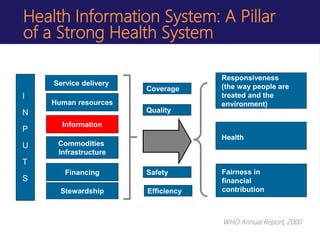
Health Information System: A Pillar
of a Strong Health System
FUNCTIONS (6 Building Blocks) GOALS / OUTCOMES OF THE
SYSTEM
Stewardship
Commodities
Infrastructure
Service delivery
Financing
I
N
P
U
T
S
Health
Responsiveness
(the way people are
treated and the
environment)
Fairness in
financial
contribution
Quality
Coverage
Efficiency
Source: WHO, 2000.
WHO Annual Report, 2000
Human resources
Information
Safety
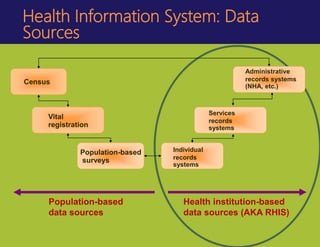
Administrative
records systems
(NHA, etc.)
Services
records
systems
Individual
records
systems
Population-based
surveys
Vital
registration
Census
Population-based
data sources
Health institution-based
data sources (AKA RHIS)
Health Information System: Data
Sources
The Role and Importance of a Decentralized
Routine Health Information System
 Facility-based and ideally also community-based
 Main (and often only) source of information for (daily)
planning and management of quality health services at
the district level and below
• Coverage and quality of health interventions
• Disease surveillance
• Commodity security
• Human resource management
• Financial information systems
 Also feeding information into national and global levels
(for example, monitoring of SDGs)
 Ideal support to integrated management of
health interventions
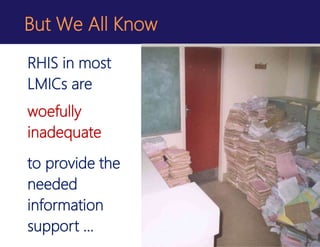
But We All Know
RHIS in most
LMICs are
woefully
inadequate
to provide the
needed
information
support ...
What Is Wrong with Existing Routine
Health Information Systems?
 Plethora, irrelevance, and poor quality of the data
collected
 Centralization of information management
without feedback to district and service- delivery
levels
 Fragmentation into “program-oriented”
information systems: duplication and waste
 Poor and inadequately used HIS resources and
infrastructure (including ICT)
AS A RESULT
Poor use of information by users at all levels
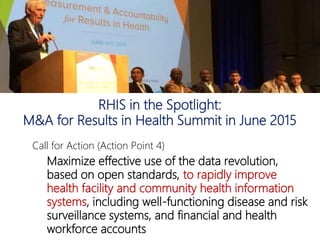
RHIS in the Spotlight:
M&A for Results in Health Summit in June 2015
Call for Action (Action Point 4)
Maximize effective use of the data revolution,
based on open standards, to rapidly improve
health facility and community health information
systems, including well-functioning disease and risk
surveillance systems, and financial and health
workforce accounts
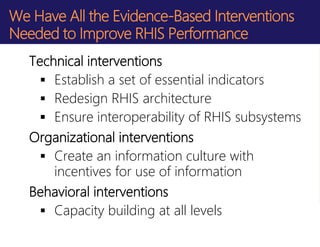
We Have All the Evidence-Based Interventions
Needed to Improve RHIS Performance
Technical interventions
 Establish a set of essential indicators
 Redesign RHIS architecture
 Ensure interoperability of RHIS subsystems
Organizational interventions
 Create an information culture with
incentives for use of information
Behavioral interventions
 Capacity building at all levels
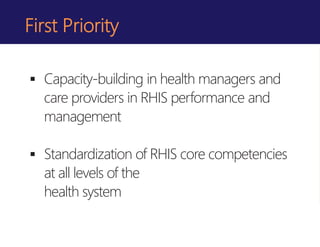
First Priority
 Capacity-building in health managers and
care providers in RHIS performance and
management
 Standardization of RHIS core competencies
at all levels of the
health system
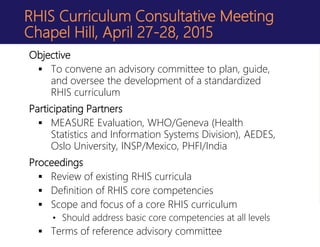
RHIS Curriculum Consultative Meeting
Chapel Hill, April 27-28, 2015
Objective
 To convene an advisory committee to plan, guide,
and oversee the development of a standardized
RHIS curriculum
Participating Partners
 MEASURE Evaluation, WHO/Geneva (Health
Statistics and Information Systems Division), AEDES,
Oslo University, INSP/Mexico, PHFI/India
Proceedings
 Review of existing RHIS curricula
 Definition of RHIS core competencies
 Scope and focus of a core RHIS curriculum
• Should address basic core competencies at all levels
 Terms of reference advisory committee
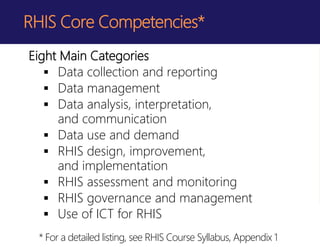
RHIS Core Competencies*
Eight Main Categories
 Data collection and reporting
 Data management
 Data analysis, interpretation,
and communication
 Data use and demand
 RHIS design, improvement,
and implementation
 RHIS assessment and monitoring
 RHIS governance and management
 Use of ICT for RHIS
* For a detailed listing, see RHIS Course Syllabus, Appendix 1
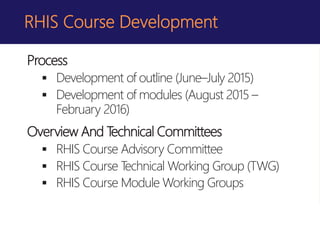
RHIS Course Development
Process
 Development of outline (June–July 2015)
 Development of modules (August 2015 –
February 2016)
Overview And Technical Committees
 RHIS Course Advisory Committee
 RHIS Course Technical Working Group (TWG)
 RHIS Course Module Working Groups
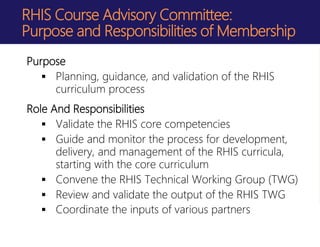
RHIS Course Advisory Committee:
Purpose and Responsibilities of Membership
Purpose
 Planning, guidance, and validation of the RHIS
curriculum process
Role And Responsibilities
 Validate the RHIS core competencies
 Guide and monitor the process for development,
delivery, and management of the RHIS curricula,
starting with the core curriculum
 Convene the RHIS Technical Working Group (TWG)
 Review and validate the output of the RHIS TWG
 Coordinate the inputs of various partners
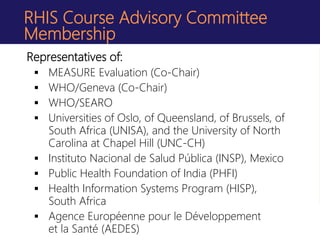
RHIS Course Advisory Committee
Membership
Representatives of:
 MEASURE Evaluation (Co-Chair)
 WHO/Geneva (Co-Chair)
 WHO/SEARO
 Universities of Oslo, of Queensland, of Brussels, of
South Africa (UNISA), and the University of North
Carolina at Chapel Hill (UNC-CH)
 Instituto Nacional de Salud Pública (INSP), Mexico
 Public Health Foundation of India (PHFI)
 Health Information Systems Program (HISP),
South Africa
 Agence Européenne pour le Développement
et la Santé (AEDES)
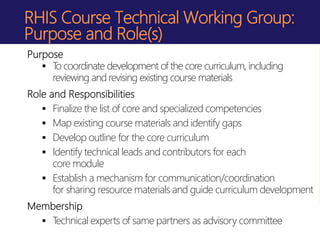
RHIS Course Technical Working Group:
Purpose and Role(s)
Purpose
 To coordinate development of the core curriculum, including
reviewing and revising existing course materials
Role and Responsibilities
 Finalize the list of core and specialized competencies
 Map existing course materials and identify gaps
 Develop outline for the core curriculum
 Identify technical leads and contributors for each
core module
 Establish a mechanism for communication/coordination
for sharing resource materials and guide curriculum development
Membership
 Technical experts of same partners as advisory committee
RHIS Course Module Groups:
Role(s) and Responsibilities
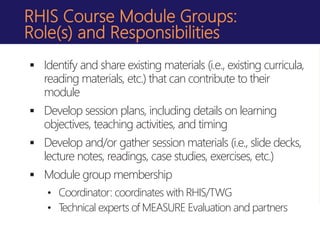
 Identify and share existing materials (i.e., existing curricula,
reading materials, etc.) that can contribute to their
module
 Develop session plans, including details on learning
objectives, teaching activities, and timing
 Develop and/or gather session materials (i.e., slide decks,
lecture notes, readings, case studies, exercises, etc.)
 Module group membership
• Coordinator: coordinates with RHIS/TWG
• Technical experts of MEASURE Evaluation and partners
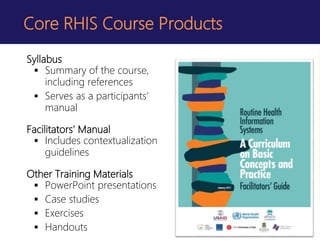
Syllabus
 Summary of the course,
including references
 Serves as a participants’
manual
Facilitators’ Manual
 Includes contextualization
guidelines
Other Training Materials
 PowerPoint presentations
 Case studies
 Exercises
 Handouts
Core RHIS Course Products
Course Title
 Routine Health Information System: A Curriculum on Basic
Concepts and Practice
Course Performance Objective
 At the end of this course, the participants will have
acquired the RHIS core competencies as listed in the
learning objectives of the course modules
Course Audience
 Targeted to the health workforce at large:
1. Policymakers and health managers
2. Care providers and health technicians
3. Students in health sciences
Core RHIS Course Syllabus
Draft Core RHIS Course Syllabus (2)
Course Content
 Builds on basic core RHIS competencies among health
workforce to enhance their work performance
 Modular organization of training materials (ten modules)
Course Duration
 60 hours: equivalent to two weeks of course work
Course Teaching Methods
 Blended learning methods directed toward
experiential learning (participatory, with lots of case studies)
Course Prerequisites
 No prerequisites, but strongly advised to have taken basic
M&E course
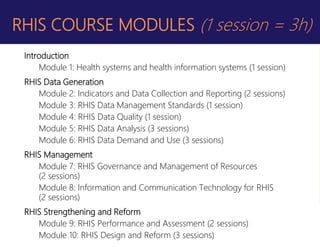
RHIS COURSE MODULES (1 session = 3h)
Introduction
Module 1: Health systems and health information systems (1 session)
RHIS Data Generation
Module 2: Indicators and Data Collection and Reporting (2 sessions)
Module 3: RHIS Data Management Standards (1 session)
Module 4: RHIS Data Quality (1 session)
Module 5: RHIS Data Analysis (3 sessions)
Module 6: RHIS Data Demand and Use (3 sessions)
RHIS Management
Module 7: RHIS Governance and Management of Resources
(2 sessions)
Module 8: Information and Communication Technology for RHIS
(2 sessions)
RHIS Strengthening and Reform
Module 9: RHIS Performance and Assessment (2 sessions)
Module 10: RHIS Design and Reform (3 sessions)
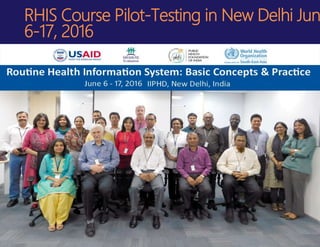
RHIS Course Pilot-Testing in New Delhi Jun
6-17, 2016
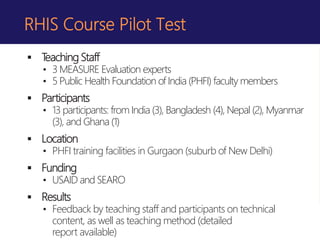
RHIS Course Pilot Test
 Teaching Staff
• 3 MEASURE Evaluation experts
• 5 Public Health Foundation of India (PHFI) faculty members
 Participants
• 13 participants: from India (3), Bangladesh (4), Nepal (2), Myanmar
(3), and Ghana (1)
 Location
• PHFI training facilities in Gurgaon (suburb of New Delhi)
 Funding
• USAID and SEARO
 Results
• Feedback by teaching staff and participants on technical
content, as well as teaching method (detailed
report available)
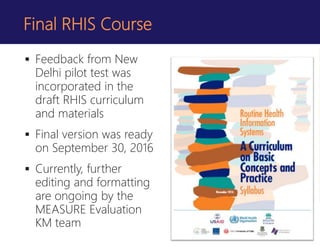
Final RHIS Course
 Feedback from New
Delhi pilot test was
incorporated in the
draft RHIS curriculum
and materials
 Final version was ready
on September 30, 2016
 Currently, further
editing and formatting
are ongoing by the
MEASURE Evaluation
KM team
Next Steps/Way Forward
 Dissemination and Contextualization of RHIS Basic Course
• Contextualization guidelines (RHIS Facilitators’ Manual, Appendix)
• Translation into French (GF) and Spanish (PAHO) — other languages
on demand
• Organization of Training of Trainers workshops
 Development of Other RHIS Courses
• Development of RHIS in-depth modules (e.g., data analysis
and ICT)
• Development of RHIS courses for particular audiences (such
as community-based RHIS, online course, etc.)
• Development of RHIS subsystem courses, such as LMIS, HRIS, etc.
How to Disseminate the RHIS Course?
 Via teaching institutions (universities and
other health sciences schools)
 Via downloads from the websites of WHO,
USAID, MEASURE Evaluation, and other
partners such as GF
 Via regional RHIS strengthening networks
(RELACSIS, AeHIN, WAHO, and others)
 Via the USAID missions in priority countries
Recent and Planned Events in 2017 on
RHIS Course Dissemination
 RHINO satellite session at the HSR symposium on
November 14th in Vancouver, Canada
 Presentation of RHIS course at GEMNet-Health
meeting, February 25, 2017 in Cuernavaca,
Mexico
 Integration of RHIS course in newly designed
MPH program at PHF/India in 2016-2018
 Presentation of RHIS course at the AeHIN General
Meeting in Myanmar, March 6-10, 2017
 Training of Trainers for RHIS course at Ghana
University, in June 2017
Thank You and Questions
For further information on the RHIS course:
 Hemali Kulatilaka,
hkulatil@email.unc.edu
 Tariq Azim tariq_azim@jsi.com
 Alimou Barry alimou_barry@jsi.com
 Theo Lippeveld, tlippeveld@jsi.com
Routine Health Information Systems: A Curriculum on
Basic Concepts and Practice – Syllabus
http://www.measureevaluation.org/resources/publi
cations/sr-16-135a
Routine Health Information Systems: A Curriculum on
Basic Concepts and Practice – Facilitators’ Guide
http://www.measureevaluation.org/resources/publi
cations/sr-16-135b
Available for Download on the
MEASURE Evaluation Website
This presentation was produced with the support of the
United States Agency for International Development
(USAID) under the terms of MEASURE Evaluation
cooperative agreement AID-OAA-L-14-00004. MEASURE
Evaluation is implemented by the Carolina Population
Center, University of North Carolina at Chapel Hill in
partnership with ICF International; John Snow, Inc.;
Management Sciences for Health; Palladium; and Tulane
University. Views expressed are not necessarily those of
USAID or the United States government.
www.measureevaluation.org

RHIS Curriculum: Standardizing Core Competencies and Training Materials

  • 1.
    RHIS Curriculum: Standardizing Core Competenciesand Training Materials Presenter: Theo Lippeveld, MD, MPH MEASURE Evaluation tlippeveld@jsi.com BBL Presentation at USAID/DC January 10, 2017
  • 2.
    Overview  Need forstrengthening routine health information systems (RHIS) in low- and middle-income countries (LMICs)  RHIS Curriculum Consultative Meeting, in April 2015  Definition of RHIS core competencies  Development of RHIS core course  Pilot-test of draft RHIS core course  Next steps/way forward
  • 3.
    Health Information System:A Pillar of a Strong Health System FUNCTIONS (6 Building Blocks) GOALS / OUTCOMES OF THE SYSTEM Stewardship Commodities Infrastructure Service delivery Financing I N P U T S Health Responsiveness (the way people are treated and the environment) Fairness in financial contribution Quality Coverage Efficiency Source: WHO, 2000. WHO Annual Report, 2000 Human resources Information Safety
  • 5.
  • 6.
    The Role andImportance of a Decentralized Routine Health Information System  Facility-based and ideally also community-based  Main (and often only) source of information for (daily) planning and management of quality health services at the district level and below • Coverage and quality of health interventions • Disease surveillance • Commodity security • Human resource management • Financial information systems  Also feeding information into national and global levels (for example, monitoring of SDGs)  Ideal support to integrated management of health interventions
  • 7.
    But We AllKnow RHIS in most LMICs are woefully inadequate to provide the needed information support ...
  • 8.
    What Is Wrongwith Existing Routine Health Information Systems?  Plethora, irrelevance, and poor quality of the data collected  Centralization of information management without feedback to district and service- delivery levels  Fragmentation into “program-oriented” information systems: duplication and waste  Poor and inadequately used HIS resources and infrastructure (including ICT) AS A RESULT Poor use of information by users at all levels
  • 9.
    RHIS in theSpotlight: M&A for Results in Health Summit in June 2015 Call for Action (Action Point 4) Maximize effective use of the data revolution, based on open standards, to rapidly improve health facility and community health information systems, including well-functioning disease and risk surveillance systems, and financial and health workforce accounts
  • 10.
    We Have Allthe Evidence-Based Interventions Needed to Improve RHIS Performance Technical interventions  Establish a set of essential indicators  Redesign RHIS architecture  Ensure interoperability of RHIS subsystems Organizational interventions  Create an information culture with incentives for use of information Behavioral interventions  Capacity building at all levels
  • 11.
    First Priority  Capacity-buildingin health managers and care providers in RHIS performance and management  Standardization of RHIS core competencies at all levels of the health system
  • 12.
    RHIS Curriculum ConsultativeMeeting Chapel Hill, April 27-28, 2015 Objective  To convene an advisory committee to plan, guide, and oversee the development of a standardized RHIS curriculum Participating Partners  MEASURE Evaluation, WHO/Geneva (Health Statistics and Information Systems Division), AEDES, Oslo University, INSP/Mexico, PHFI/India Proceedings  Review of existing RHIS curricula  Definition of RHIS core competencies  Scope and focus of a core RHIS curriculum • Should address basic core competencies at all levels  Terms of reference advisory committee
  • 13.
    RHIS Core Competencies* EightMain Categories  Data collection and reporting  Data management  Data analysis, interpretation, and communication  Data use and demand  RHIS design, improvement, and implementation  RHIS assessment and monitoring  RHIS governance and management  Use of ICT for RHIS * For a detailed listing, see RHIS Course Syllabus, Appendix 1
  • 14.
    RHIS Course Development Process Development of outline (June–July 2015)  Development of modules (August 2015 – February 2016) Overview And Technical Committees  RHIS Course Advisory Committee  RHIS Course Technical Working Group (TWG)  RHIS Course Module Working Groups
  • 15.
    RHIS Course AdvisoryCommittee: Purpose and Responsibilities of Membership Purpose  Planning, guidance, and validation of the RHIS curriculum process Role And Responsibilities  Validate the RHIS core competencies  Guide and monitor the process for development, delivery, and management of the RHIS curricula, starting with the core curriculum  Convene the RHIS Technical Working Group (TWG)  Review and validate the output of the RHIS TWG  Coordinate the inputs of various partners
  • 16.
    RHIS Course AdvisoryCommittee Membership Representatives of:  MEASURE Evaluation (Co-Chair)  WHO/Geneva (Co-Chair)  WHO/SEARO  Universities of Oslo, of Queensland, of Brussels, of South Africa (UNISA), and the University of North Carolina at Chapel Hill (UNC-CH)  Instituto Nacional de Salud Pública (INSP), Mexico  Public Health Foundation of India (PHFI)  Health Information Systems Program (HISP), South Africa  Agence Européenne pour le Développement et la Santé (AEDES)
  • 17.
    RHIS Course TechnicalWorking Group: Purpose and Role(s) Purpose  To coordinate development of the core curriculum, including reviewing and revising existing course materials Role and Responsibilities  Finalize the list of core and specialized competencies  Map existing course materials and identify gaps  Develop outline for the core curriculum  Identify technical leads and contributors for each core module  Establish a mechanism for communication/coordination for sharing resource materials and guide curriculum development Membership  Technical experts of same partners as advisory committee
  • 18.
    RHIS Course ModuleGroups: Role(s) and Responsibilities  Identify and share existing materials (i.e., existing curricula, reading materials, etc.) that can contribute to their module  Develop session plans, including details on learning objectives, teaching activities, and timing  Develop and/or gather session materials (i.e., slide decks, lecture notes, readings, case studies, exercises, etc.)  Module group membership • Coordinator: coordinates with RHIS/TWG • Technical experts of MEASURE Evaluation and partners
  • 19.
    Syllabus  Summary ofthe course, including references  Serves as a participants’ manual Facilitators’ Manual  Includes contextualization guidelines Other Training Materials  PowerPoint presentations  Case studies  Exercises  Handouts Core RHIS Course Products
  • 20.
    Course Title  RoutineHealth Information System: A Curriculum on Basic Concepts and Practice Course Performance Objective  At the end of this course, the participants will have acquired the RHIS core competencies as listed in the learning objectives of the course modules Course Audience  Targeted to the health workforce at large: 1. Policymakers and health managers 2. Care providers and health technicians 3. Students in health sciences Core RHIS Course Syllabus
  • 21.
    Draft Core RHISCourse Syllabus (2) Course Content  Builds on basic core RHIS competencies among health workforce to enhance their work performance  Modular organization of training materials (ten modules) Course Duration  60 hours: equivalent to two weeks of course work Course Teaching Methods  Blended learning methods directed toward experiential learning (participatory, with lots of case studies) Course Prerequisites  No prerequisites, but strongly advised to have taken basic M&E course
  • 22.
    RHIS COURSE MODULES(1 session = 3h) Introduction Module 1: Health systems and health information systems (1 session) RHIS Data Generation Module 2: Indicators and Data Collection and Reporting (2 sessions) Module 3: RHIS Data Management Standards (1 session) Module 4: RHIS Data Quality (1 session) Module 5: RHIS Data Analysis (3 sessions) Module 6: RHIS Data Demand and Use (3 sessions) RHIS Management Module 7: RHIS Governance and Management of Resources (2 sessions) Module 8: Information and Communication Technology for RHIS (2 sessions) RHIS Strengthening and Reform Module 9: RHIS Performance and Assessment (2 sessions) Module 10: RHIS Design and Reform (3 sessions)
  • 23.
    RHIS Course Pilot-Testingin New Delhi Jun 6-17, 2016
  • 24.
    RHIS Course PilotTest  Teaching Staff • 3 MEASURE Evaluation experts • 5 Public Health Foundation of India (PHFI) faculty members  Participants • 13 participants: from India (3), Bangladesh (4), Nepal (2), Myanmar (3), and Ghana (1)  Location • PHFI training facilities in Gurgaon (suburb of New Delhi)  Funding • USAID and SEARO  Results • Feedback by teaching staff and participants on technical content, as well as teaching method (detailed report available)
  • 25.
    Final RHIS Course Feedback from New Delhi pilot test was incorporated in the draft RHIS curriculum and materials  Final version was ready on September 30, 2016  Currently, further editing and formatting are ongoing by the MEASURE Evaluation KM team
  • 26.
    Next Steps/Way Forward Dissemination and Contextualization of RHIS Basic Course • Contextualization guidelines (RHIS Facilitators’ Manual, Appendix) • Translation into French (GF) and Spanish (PAHO) — other languages on demand • Organization of Training of Trainers workshops  Development of Other RHIS Courses • Development of RHIS in-depth modules (e.g., data analysis and ICT) • Development of RHIS courses for particular audiences (such as community-based RHIS, online course, etc.) • Development of RHIS subsystem courses, such as LMIS, HRIS, etc.
  • 27.
    How to Disseminatethe RHIS Course?  Via teaching institutions (universities and other health sciences schools)  Via downloads from the websites of WHO, USAID, MEASURE Evaluation, and other partners such as GF  Via regional RHIS strengthening networks (RELACSIS, AeHIN, WAHO, and others)  Via the USAID missions in priority countries
  • 28.
    Recent and PlannedEvents in 2017 on RHIS Course Dissemination  RHINO satellite session at the HSR symposium on November 14th in Vancouver, Canada  Presentation of RHIS course at GEMNet-Health meeting, February 25, 2017 in Cuernavaca, Mexico  Integration of RHIS course in newly designed MPH program at PHF/India in 2016-2018  Presentation of RHIS course at the AeHIN General Meeting in Myanmar, March 6-10, 2017  Training of Trainers for RHIS course at Ghana University, in June 2017
  • 29.
    Thank You andQuestions For further information on the RHIS course:  Hemali Kulatilaka, hkulatil@email.unc.edu  Tariq Azim tariq_azim@jsi.com  Alimou Barry alimou_barry@jsi.com  Theo Lippeveld, tlippeveld@jsi.com
  • 30.
    Routine Health InformationSystems: A Curriculum on Basic Concepts and Practice – Syllabus http://www.measureevaluation.org/resources/publi cations/sr-16-135a Routine Health Information Systems: A Curriculum on Basic Concepts and Practice – Facilitators’ Guide http://www.measureevaluation.org/resources/publi cations/sr-16-135b Available for Download on the MEASURE Evaluation Website
  • 31.
    This presentation wasproduced with the support of the United States Agency for International Development (USAID) under the terms of MEASURE Evaluation cooperative agreement AID-OAA-L-14-00004. MEASURE Evaluation is implemented by the Carolina Population Center, University of North Carolina at Chapel Hill in partnership with ICF International; John Snow, Inc.; Management Sciences for Health; Palladium; and Tulane University. Views expressed are not necessarily those of USAID or the United States government. www.measureevaluation.org