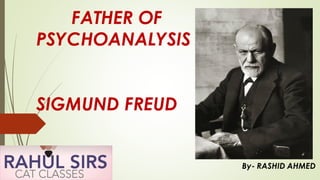
FATHER OF
PSYCHOANALYSIS
SIGMUND FREUD
By- RASHID AHMED
INTRODUCTION
Psychology’s most famous figure is
also one of the most influential and
controversial thinkers of the twentieth
century. Sigmund Freud’s theories
and work helped shape our views of
childhood, personality, memory,
sexuality, and therapy. Other major
thinkers have contributed work that
grew out of Freud’s legacy, while
others developed new theories in
opposition to his ideas.
Free Association and it’s analysis
 Free association in psychology refers to a process of discovering
your genuine thoughts, memories, and feelings by freely sharing
all the seemingly random thoughts that pass through your mind.
Usually, you are given a prompt like a word or image without
context then, you say what it makes you think of. The person
leading the exercise tries to create links between the prompt and
your response to learn about how your brain makes connections
between ideas
 After listening to his patient’s random thoughts, Freud would
analyze the information to find the hidden meaning. The goal of
psychoanalysis was to find the source of your problem and reveal
it to you. Freud’s thinking was that once you understood what was
causing you to think or behave in ill-adaptive ways, the problem
would naturally resolve for you.
Benefits of Free Association:
Bring Up Things You Didn’t Think Were Important
Uncover Hidden Thoughts
Theory about dream
 Dreams May Reflect the Unconscious
 Sigmund Freud’s theory of dreams suggests that dreams
represent unconscious desires, thoughts, wish fulfillment, and
motivations.According to Freud, people are driven by
repressed and unconscious longings, such as aggressive and
sexual instincts.
 While many of Freud’s assertions have been debunked,
research suggests there is a dream rebound effect, also
known as dream rebound theory, in which suppression of a
thought tends to result in dreaming about it.
 Dreams Help Process Emotions
 Dreams Prepare and Protect
 Dreams Reflect Your Life
 Dreams Spur Creativity
 Dreams Aid In Memory
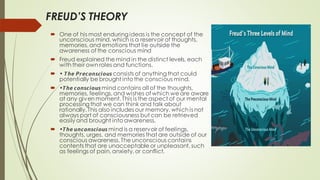
FREUD’S THEORY
 One of his most enduringideas is the concept of the
unconscious mind, which is a reservoir of thoughts,
memories, and emotions that lie outside the
awareness of the conscious mind
 Freud explained the mind in the distinct levels, each
with their own roles and functions.
 • 𝙏𝙝𝙚 𝙋𝙧𝙚𝙘𝙤𝙣𝙨𝙘𝙞𝙤𝙪𝙨 consists of anythingthat could
potentially be brought into the conscious mind.
 •𝙏𝙝𝙚 𝙘𝙤𝙣𝙨𝙘𝙞𝙤𝙪𝙨 mind contains all of the thoughts,
memories, feelings, and wishes of which we are aware
at any given moment. This is the aspect of our mental
processing that we can think and talk about
rationally. This also includes our memory, which is not
always part of consciousness but can be retrieved
easily and brought into awareness.
 •𝙏𝙝𝙚 𝙪𝙣𝙘𝙤𝙣𝙨𝙘𝙞𝙤𝙪𝙨 mind is a reservoir of feelings,
thoughts, urges, and memories that are outside of our
conscious awareness. The unconscious contains
contents that are unacceptable or unpleasant, such
as feelings of pain, anxiety, or conflict.
 Preconscious mind is responsible for our daily
activitieswe perform, though we don’t need
time table to so
 Eg. Studying, sleeping, going market for
somethingyou need etc
 But conscious mind comes to play when you
had to perform a task related to your recent
memories
 Eg. While studying you are not able to
multiply complex or I say larger no. so for
that you use your memory to retain formula
to get the solution
 Within this understanding, most of the
contents of the unconscious are considered
unacceptable or unpleasant, such as
feelings of pain, anxiety, or conflict. Freud
believedthat the unconscious continues to
influence behavioreventhough people are
unaware of these underlying influences.
THE FREUDIAN SLIP
One way to understand how the
conscious and unconscious minds operate
is to look at what is known as a slip of the
tongue. Many of us have experienced
what is commonly referred to as
a Freudian slip at some point or another.
These misstatements are believed to
reveal underlying, unconscious thoughts or
feelings.
Freud believed that while the unconscious
mind is largely inaccessible, the contents
can sometimes bubble up unexpectedly,
such as in dreams or slips of the tongue.
 𝙏𝙝𝙤𝙪𝙜𝙝𝙩 𝙎𝙪𝙥𝙥𝙧𝙚𝙨𝙨𝙞𝙤𝙣
 To explain why suppressing certain thoughts can be so difficult.
 While certain parts of the brain suppress the hidden thoughts,
another part of our minds occasionally“checks in” to make
sure that we are still not thinking about it—ironicallybringing
the very thoughts we are trying to keep hidden to the forefront
of our minds.
 In many cases, the harder we try not to think of something, the
more frequently it springs to mind—and the more likely we are
to express it verbally. This paradox of thought suppression can
be particularly disruptive for people with obsessive-compulsive
disorder (OCD).
 Repression is the unconscious blocking of unpleasant
emotions, impulses, memories, and thoughts from your
conscious mind. Introduced by SigmundFreud, the purpose of
this defense mechanism is to try to minimize feelings of guilt
and anxiety.
 According to Sigmund Freud,
human personality is complex and
has more than a single component.
In his famous psychoanalytic theory,
Freud states that personality is
composed of three elements known
as the id, the ego, and the
superego. These elements work
together to create complex human
behaviors
 The id is driven by the pleasure
principle, which strives for
immediate gratification of all
desires, wants, and needs. If these
needs are not satisfied
immediately, the result is a state
anxiety or tension. For example,
an increase in hunger or thirst
should produce an immediate
attempt to eat or drink.
 The ego operates based on the reality principle, which strives
to satisfy the id’s desires in realistic and socially appropriate
ways. The reality principle weighs the costs and benefits of an
action before deciding to act upon or abandon impulses
𝙏𝙝𝙚 𝙨𝙪𝙥𝙚𝙧𝙚𝙜𝙤 tries to
perfect and civilize our
behavior. It works to
suppress all
unacceptable urges of
the id and struggles to
make the ego act upon
idealistic standards rather
that upon realistic
principles.
Freud theory of instinct Or drive
 Life Instincts (Eros)
 Sometimes referred to as
sexual instincts, the life
instincts are those which deal
with basic survival, pleasure,
and reproduction. These
instincts are essential for
sustaining the life of the
individual as well as the
continuation of the species.
 Death Instincts (Thanatos)
 The concept of the death instincts
was initially described in Beyond the
Pleasure Principle, in which Freud
proposed that “the goal of all life is
death.” Freud believed that people
typically channel their death instincts
outwards. Aggression, for example,
arises from the death instincts.
 Sometimes these instincts towards
destruction can be directed inwards,
however, which can result in self-
harm or suicide.
Sigmund Freud.pdf
Sigmund Freud.pdf

Sigmund Freud.pdf

  • 1.
  • 2.
    INTRODUCTION Psychology’s most famousfigure is also one of the most influential and controversial thinkers of the twentieth century. Sigmund Freud’s theories and work helped shape our views of childhood, personality, memory, sexuality, and therapy. Other major thinkers have contributed work that grew out of Freud’s legacy, while others developed new theories in opposition to his ideas.
  • 4.
    Free Association andit’s analysis  Free association in psychology refers to a process of discovering your genuine thoughts, memories, and feelings by freely sharing all the seemingly random thoughts that pass through your mind. Usually, you are given a prompt like a word or image without context then, you say what it makes you think of. The person leading the exercise tries to create links between the prompt and your response to learn about how your brain makes connections between ideas  After listening to his patient’s random thoughts, Freud would analyze the information to find the hidden meaning. The goal of psychoanalysis was to find the source of your problem and reveal it to you. Freud’s thinking was that once you understood what was causing you to think or behave in ill-adaptive ways, the problem would naturally resolve for you. Benefits of Free Association: Bring Up Things You Didn’t Think Were Important Uncover Hidden Thoughts
  • 5.
    Theory about dream Dreams May Reflect the Unconscious  Sigmund Freud’s theory of dreams suggests that dreams represent unconscious desires, thoughts, wish fulfillment, and motivations.According to Freud, people are driven by repressed and unconscious longings, such as aggressive and sexual instincts.  While many of Freud’s assertions have been debunked, research suggests there is a dream rebound effect, also known as dream rebound theory, in which suppression of a thought tends to result in dreaming about it.  Dreams Help Process Emotions  Dreams Prepare and Protect  Dreams Reflect Your Life  Dreams Spur Creativity  Dreams Aid In Memory
  • 6.
    FREUD’S THEORY  Oneof his most enduringideas is the concept of the unconscious mind, which is a reservoir of thoughts, memories, and emotions that lie outside the awareness of the conscious mind  Freud explained the mind in the distinct levels, each with their own roles and functions.  • 𝙏𝙝𝙚 𝙋𝙧𝙚𝙘𝙤𝙣𝙨𝙘𝙞𝙤𝙪𝙨 consists of anythingthat could potentially be brought into the conscious mind.  •𝙏𝙝𝙚 𝙘𝙤𝙣𝙨𝙘𝙞𝙤𝙪𝙨 mind contains all of the thoughts, memories, feelings, and wishes of which we are aware at any given moment. This is the aspect of our mental processing that we can think and talk about rationally. This also includes our memory, which is not always part of consciousness but can be retrieved easily and brought into awareness.  •𝙏𝙝𝙚 𝙪𝙣𝙘𝙤𝙣𝙨𝙘𝙞𝙤𝙪𝙨 mind is a reservoir of feelings, thoughts, urges, and memories that are outside of our conscious awareness. The unconscious contains contents that are unacceptable or unpleasant, such as feelings of pain, anxiety, or conflict.
  • 7.
     Preconscious mindis responsible for our daily activitieswe perform, though we don’t need time table to so  Eg. Studying, sleeping, going market for somethingyou need etc  But conscious mind comes to play when you had to perform a task related to your recent memories  Eg. While studying you are not able to multiply complex or I say larger no. so for that you use your memory to retain formula to get the solution  Within this understanding, most of the contents of the unconscious are considered unacceptable or unpleasant, such as feelings of pain, anxiety, or conflict. Freud believedthat the unconscious continues to influence behavioreventhough people are unaware of these underlying influences.
  • 8.
    THE FREUDIAN SLIP Oneway to understand how the conscious and unconscious minds operate is to look at what is known as a slip of the tongue. Many of us have experienced what is commonly referred to as a Freudian slip at some point or another. These misstatements are believed to reveal underlying, unconscious thoughts or feelings. Freud believed that while the unconscious mind is largely inaccessible, the contents can sometimes bubble up unexpectedly, such as in dreams or slips of the tongue.
  • 9.
     𝙏𝙝𝙤𝙪𝙜𝙝𝙩 𝙎𝙪𝙥𝙥𝙧𝙚𝙨𝙨𝙞𝙤𝙣 To explain why suppressing certain thoughts can be so difficult.  While certain parts of the brain suppress the hidden thoughts, another part of our minds occasionally“checks in” to make sure that we are still not thinking about it—ironicallybringing the very thoughts we are trying to keep hidden to the forefront of our minds.  In many cases, the harder we try not to think of something, the more frequently it springs to mind—and the more likely we are to express it verbally. This paradox of thought suppression can be particularly disruptive for people with obsessive-compulsive disorder (OCD).  Repression is the unconscious blocking of unpleasant emotions, impulses, memories, and thoughts from your conscious mind. Introduced by SigmundFreud, the purpose of this defense mechanism is to try to minimize feelings of guilt and anxiety.
  • 10.
     According toSigmund Freud, human personality is complex and has more than a single component. In his famous psychoanalytic theory, Freud states that personality is composed of three elements known as the id, the ego, and the superego. These elements work together to create complex human behaviors
  • 11.
     The idis driven by the pleasure principle, which strives for immediate gratification of all desires, wants, and needs. If these needs are not satisfied immediately, the result is a state anxiety or tension. For example, an increase in hunger or thirst should produce an immediate attempt to eat or drink.
  • 12.
     The egooperates based on the reality principle, which strives to satisfy the id’s desires in realistic and socially appropriate ways. The reality principle weighs the costs and benefits of an action before deciding to act upon or abandon impulses
  • 13.
    𝙏𝙝𝙚 𝙨𝙪𝙥𝙚𝙧𝙚𝙜𝙤 triesto perfect and civilize our behavior. It works to suppress all unacceptable urges of the id and struggles to make the ego act upon idealistic standards rather that upon realistic principles.
  • 15.
    Freud theory ofinstinct Or drive  Life Instincts (Eros)  Sometimes referred to as sexual instincts, the life instincts are those which deal with basic survival, pleasure, and reproduction. These instincts are essential for sustaining the life of the individual as well as the continuation of the species.  Death Instincts (Thanatos)  The concept of the death instincts was initially described in Beyond the Pleasure Principle, in which Freud proposed that “the goal of all life is death.” Freud believed that people typically channel their death instincts outwards. Aggression, for example, arises from the death instincts.  Sometimes these instincts towards destruction can be directed inwards, however, which can result in self- harm or suicide.