SPRAY COATINGS 
Submitted by 
Jabin Mathew Benjamin 
13MY04 
Dept. Of Metallurgical Engineering 
10/16/2014 
1 
Dept. of Metallurgical 
Engineering
Need For Surface Hardening 
• Produce surfaces that 
▫ wear only a little, 
▫ resistant to tarnishing and corrosion, 
10/16/2014 
2 
Dept. of Metallurgical 
Engineering
Thermal Spray Coating 
• A group of coating processes where the coating is 
deposited on a prepared substrate by applying a 
stream of particles, metallic or nonmetallic, which 
flatten more or less forming platelets, called splats, 
with several layers of these splats forming the 
coating 
• Any material on almost any substrate 
10/16/2014 
3 
Dept. of Metallurgical 
Engineering
Spray Coatings 
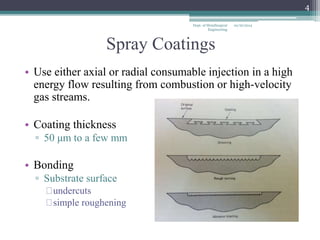
• Use either axial or radial consumable injection in a high 
energy flow resulting from combustion or high-velocity 
gas streams. 
• Coating thickness 
▫ 50 μm to a few mm 
• Bonding 
▫ Substrate surface 
undercuts 
simple roughening 
10/16/2014 
4 
Dept. of Metallurgical 
Engineering
Components 
• An energetic gas flow 
▫ An appropriate gun 
10/16/2014 
Devices for feeding, accelerating, heating, and directing the flow of a 
thermal spray material toward the substrate. 
• Feedstock 
▫ Powder, wire, rod, or cord. 
▫ Fed at a velocity allowing the spray gun to melt them 
• Auxiliary gas feed 
▫ To accelerate atomized molten material into the spray gun 
• Controlled atmosphere or a soft vacuum 
▫ In air, coating oxidation occurs, increasing with the temperature 
5 
Dept. of Metallurgical 
Engineering
Substrate 
10/16/2014 
• Should not be degraded by heat 
• Substrate should be roughened for good adhesion 
▫ Abrasive blasting – Aluminium Oxide 
▫ 2.5 μm roughness optimum 
• Difficult to spray hardened steels 
• Thin sections prone to distortion during blasting and 
heating 
6 
Dept. of Metallurgical 
Engineering
10/16/2014 
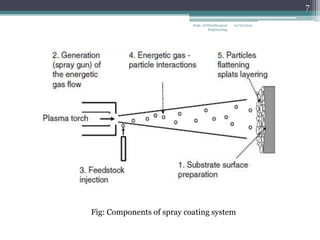
Fig: Components of spray coating system 
7 
Dept. of Metallurgical 
Engineering
Steps In Spray Coating 
1. Substrate preparation 
2. Generation of the energetic gas flow 
3. Particle or wire or rod or cord injection 
4. Energetic gas particle or droplet interaction 
5. Coating formation 
10/16/2014 
8 
Dept. of Metallurgical 
Engineering
Thermal Spray Hardening 
• Gas Combustion 
▫ Oxy fuel process using 
Wire feed 
Powder feed 
Rod feed 
Jet / powder feed 
Detonation Gun process 
• Arc process 
▫ Plasma arc with powder feed 
▫ Arc spray with wire feed 
10/16/2014 
9 
Dept. of Metallurgical 
Engineering
Wire Processes 
•Wire from reel fed to oxyacetylene 
flame 
•Metal droplets atomized by air jets 
•Atomized metal spray coats substrate 
•Gun to substrate distance 
10 – 25mm 
10/16/2014 
•Commonly sprayed materials 
•Zn, Al for corrosion resistance 
•Bronzes for wear resistance 
10 
Dept. of Metallurgical 
Engineering
•Wear application: 1.25mm 
•Corrosion resistance: 25μm 
•Max thickness : 6mm 
10/16/2014 
•Deposition rate: 93m2 per hour per 25μm 
•Flame temperature: 27600C 
11 
Dept. of Metallurgical 
Engineering
Powder Spray 
10/16/2014 
•Powder feed instead of wire 
•Oxyacetylene torch modified for powder feed 
•No high pressure air to assist atomization; low deposition rate 
•Lower bond strength and higher porosity 
•Easy method for materials that cannot be made into wire 
12 
Dept. of Metallurgical 
Engineering
More sophisticated equipment uses 
compressed air. 
Increased atomization. 
Higher deposition rate and bond 
strength. 
Flame temperature: 25000C 
Coatings 
10/16/2014 
Carbides 
High alloy steels 
Ceramics 
13 
Dept. of Metallurgical 
Engineering
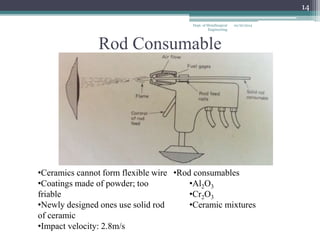
Rod Consumable 
•Ceramics cannot form flexible wire 
•Coatings made of powder; too 
friable 
•Newly designed ones use solid rod 
of ceramic 
•Impact velocity: 2.8m/s 
10/16/2014 
•Rod consumables 
•Al2O3 
•Cr2O3 
•Ceramic mixtures 
14 
Dept. of Metallurgical 
Engineering
10/16/2014 
Dept. of Metallurgical 
Engineering 
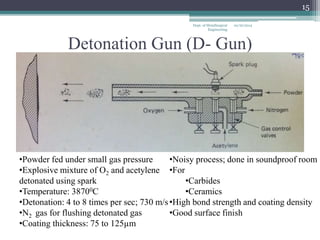
Detonation Gun (D- Gun) 
•Powder fed under small gas pressure 
•Explosive mixture of O2 and acetylene 
detonated using spark 
•Temperature: 38700C 
•Detonation: 4 to 8 times per sec; 730 m/s 
•N2 gas for flushing detonated gas 
•Coating thickness: 75 to 125μm 
15 
•Noisy process; done in soundproof room 
•For 
•Carbides 
•Ceramics 
•High bond strength and coating density 
•Good surface finish
10/16/2014 
Dept. of Metallurgical 
Engineering 
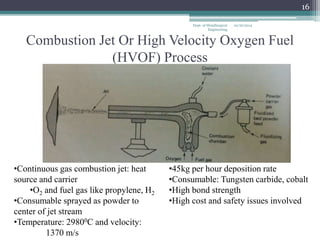
Combustion Jet Or High Velocity Oxygen Fuel 
(HVOF) Process 
•Continuous gas combustion jet: heat 
source and carrier 
•O2 and fuel gas like propylene, H2 
•Consumable sprayed as powder to 
center of jet stream 
•Temperature: 29800C and velocity: 
1370 m/s 
16 
•45kg per hour deposition rate 
•Consumable: Tungsten carbide, cobalt 
•High bond strength 
•High cost and safety issues involved
10/16/2014 
Dept. of Metallurgical 
Engineering 
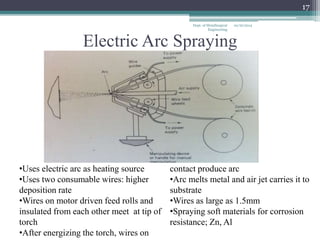
Electric Arc Spraying 
•Uses electric arc as heating source 
•Uses two consumable wires: higher 
deposition rate 
•Wires on motor driven feed rolls and 
insulated from each other meet at tip of 
torch 
•After energizing the torch, wires on 
17 
contact produce arc 
•Arc melts metal and air jet carries it to 
substrate 
•Wires as large as 1.5mm 
•Spraying soft materials for corrosion 
resistance; Zn, Al
Plasma Arc Deposition 
• Consumable powder melted and atomized in plasma 
▫ Tungsten electrodes and Ar gas 
▫ Temperature: 28000oC 
10/16/2014 
18 
Dept. of Metallurgical 
Engineering
10/16/2014 
Fig: Paper machine roll coated by NiCrBSi using two powder flame guns 
(Courtesy of Castoline) 
19 
Dept. of Metallurgical 
Engineering
10/16/2014 
20 
Dept. of Metallurgical 
Engineering 
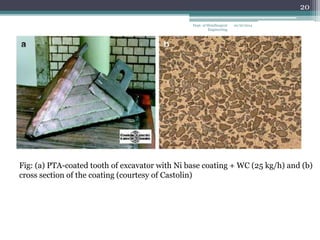
Fig: (a) PTA-coated tooth of excavator with Ni base coating + WC (25 kg/h) and (b) 
cross section of the coating (courtesy of Castolin)
Comparison 
Properties Electro/ electroless 
plating 
10/16/2014 
CVD PVD Thermal spray 
Equipment cost Low Moderate Moderate to high Moderate to high 
Operating cost Low Low to 
moderate 
Moderate to high Low to high 
Coating thickness 10 μm–mm 10 μm–mm Very thin to 
moderate 
50 μm–mm 
Adherence Moderate mechanical to 
good chemical bond 
good chemical 
to excellent 
diffusion Bond 
Moderate 
mechanical 
to good Chemical 
Bond 
Good mechanical 
bond 
Coating materials Metals Metals, 
ceramics, 
Polymers 
Metals, ceramics, 
polymers 
Metals, cermets, 
ceramics, 
polymers 
Surface finish Moderately coarse 
to glossy 
Smooth to 
glossy 
Smooth to glossy Coarse to 
Smooth (0.12 μm to 
0.5 μm) 
21 
Dept. of Metallurgical 
Engineering
Coating Evaluation 
• Destructive testing: Tensile shear tests 
▫ Ends of two strips of desired substrate are sprayed with desired 
consumable 
▫ Coated ends epoxied together 
▫ Uncoated ends put to tensile tester and pulled to failure 
▫ If epoxy fails and the coating is intact 
Good coating 
Bond strength as “greater than X”, X- tensile strength of epoxy 
82 to 138 MPa nominal 
• Non-destructive testing 
▫ Visual inspection 
Porosities, impurities, cracks 
▫ UT inspection, Thermal imaging 
10/16/2014 
22 
Dept. of Metallurgical 
Engineering
10/16/2014 
Comparison Between Spray Processes 
• Wire gun 
▫ Heavy deposits: upto 0.100 
inch 
▫ For steels, brass, bronze 
• Powder module 
▫ Minor shop repairs: upto 0.030 
inch 
▫ For nickel base alloys 
• Rod feed 
▫ Wear resistant coatings: upto 
0.020 inch 
▫ For ceramics 
• D-gun 
▫ Premier coatings: upto 0.010 
inch 
▫ Of hardfacing alloys, carbides 
▫ Densest coating 
• Electric arc 
▫ Rebuilding large areas with 
steels: upto 0.100 inch 
▫ For Al and Zn 
• Plasma arc 
▫ Applying hardfacing alloys, 
repairs: upto 0.015 inch 
▫ For metals and ceramics 
23 
Dept. of Metallurgical 
Engineering
10/16/2014 
Applications of Spray Coating 
• Wear-resistant coatings against abrasion, erosion 
• Corrosion-resistant coatings 
• Heat resistant coatings 
• Thermal insulation or conduction coatings 
• Electromagnetic shielding 
• Medical coatings 
24 
Dept. of Metallurgical 
Engineering
10/16/2014 
Do’s And Don’t’s Of Thermal Spray Coating 
• Do’s 
• Apply coating to 
undercuts to avoid end 
chipping 
• Hold gun normal while 
spraying 
• Plug keyways when 
coating 
• Don’t’s 
• Coat end of parts subject 
to chipping 
• Coat faces subject to 
impact 
• Spray at an angle < 600 
• Coat cutting edges 
25 
Dept. of Metallurgical 
Engineering
Reference 
10/16/2014 
1. Cartier M, Handbook of surface treatments and coatings. 
ASME Press, New York, NY, 2003 
2. Davis JR, Handbook of thermal spray technology. ASM 
International, Materials Park, OH, 2004 
3. Chattopadhyay R (2001), Surface wear. ASM International, 
Materials Park, OH 
4. Kenneth G. Budinski, Surface Engineering for Wear 
Resistance, Prentice Hall Inc., 1988, Pg: 221-240. 
5. ASM Handbook volume 4, Heat Treatment, 1991. 
26 
Dept. of Metallurgical 
Engineering

Thermal spray coating

  • 1.
    SPRAY COATINGS Submittedby Jabin Mathew Benjamin 13MY04 Dept. Of Metallurgical Engineering 10/16/2014 1 Dept. of Metallurgical Engineering
  • 2.
    Need For SurfaceHardening • Produce surfaces that ▫ wear only a little, ▫ resistant to tarnishing and corrosion, 10/16/2014 2 Dept. of Metallurgical Engineering
  • 3.
    Thermal Spray Coating • A group of coating processes where the coating is deposited on a prepared substrate by applying a stream of particles, metallic or nonmetallic, which flatten more or less forming platelets, called splats, with several layers of these splats forming the coating • Any material on almost any substrate 10/16/2014 3 Dept. of Metallurgical Engineering
  • 4.
    Spray Coatings •Use either axial or radial consumable injection in a high energy flow resulting from combustion or high-velocity gas streams. • Coating thickness ▫ 50 μm to a few mm • Bonding ▫ Substrate surface undercuts simple roughening 10/16/2014 4 Dept. of Metallurgical Engineering
  • 5.
    Components • Anenergetic gas flow ▫ An appropriate gun 10/16/2014 Devices for feeding, accelerating, heating, and directing the flow of a thermal spray material toward the substrate. • Feedstock ▫ Powder, wire, rod, or cord. ▫ Fed at a velocity allowing the spray gun to melt them • Auxiliary gas feed ▫ To accelerate atomized molten material into the spray gun • Controlled atmosphere or a soft vacuum ▫ In air, coating oxidation occurs, increasing with the temperature 5 Dept. of Metallurgical Engineering
  • 6.
    Substrate 10/16/2014 •Should not be degraded by heat • Substrate should be roughened for good adhesion ▫ Abrasive blasting – Aluminium Oxide ▫ 2.5 μm roughness optimum • Difficult to spray hardened steels • Thin sections prone to distortion during blasting and heating 6 Dept. of Metallurgical Engineering
  • 7.
    10/16/2014 Fig: Componentsof spray coating system 7 Dept. of Metallurgical Engineering
  • 8.
    Steps In SprayCoating 1. Substrate preparation 2. Generation of the energetic gas flow 3. Particle or wire or rod or cord injection 4. Energetic gas particle or droplet interaction 5. Coating formation 10/16/2014 8 Dept. of Metallurgical Engineering
  • 9.
    Thermal Spray Hardening • Gas Combustion ▫ Oxy fuel process using Wire feed Powder feed Rod feed Jet / powder feed Detonation Gun process • Arc process ▫ Plasma arc with powder feed ▫ Arc spray with wire feed 10/16/2014 9 Dept. of Metallurgical Engineering
  • 10.
    Wire Processes •Wirefrom reel fed to oxyacetylene flame •Metal droplets atomized by air jets •Atomized metal spray coats substrate •Gun to substrate distance 10 – 25mm 10/16/2014 •Commonly sprayed materials •Zn, Al for corrosion resistance •Bronzes for wear resistance 10 Dept. of Metallurgical Engineering
  • 11.
    •Wear application: 1.25mm •Corrosion resistance: 25μm •Max thickness : 6mm 10/16/2014 •Deposition rate: 93m2 per hour per 25μm •Flame temperature: 27600C 11 Dept. of Metallurgical Engineering
  • 12.
    Powder Spray 10/16/2014 •Powder feed instead of wire •Oxyacetylene torch modified for powder feed •No high pressure air to assist atomization; low deposition rate •Lower bond strength and higher porosity •Easy method for materials that cannot be made into wire 12 Dept. of Metallurgical Engineering
  • 13.
    More sophisticated equipmentuses compressed air. Increased atomization. Higher deposition rate and bond strength. Flame temperature: 25000C Coatings 10/16/2014 Carbides High alloy steels Ceramics 13 Dept. of Metallurgical Engineering
  • 14.
    Rod Consumable •Ceramicscannot form flexible wire •Coatings made of powder; too friable •Newly designed ones use solid rod of ceramic •Impact velocity: 2.8m/s 10/16/2014 •Rod consumables •Al2O3 •Cr2O3 •Ceramic mixtures 14 Dept. of Metallurgical Engineering
  • 15.
    10/16/2014 Dept. ofMetallurgical Engineering Detonation Gun (D- Gun) •Powder fed under small gas pressure •Explosive mixture of O2 and acetylene detonated using spark •Temperature: 38700C •Detonation: 4 to 8 times per sec; 730 m/s •N2 gas for flushing detonated gas •Coating thickness: 75 to 125μm 15 •Noisy process; done in soundproof room •For •Carbides •Ceramics •High bond strength and coating density •Good surface finish
  • 16.
    10/16/2014 Dept. ofMetallurgical Engineering Combustion Jet Or High Velocity Oxygen Fuel (HVOF) Process •Continuous gas combustion jet: heat source and carrier •O2 and fuel gas like propylene, H2 •Consumable sprayed as powder to center of jet stream •Temperature: 29800C and velocity: 1370 m/s 16 •45kg per hour deposition rate •Consumable: Tungsten carbide, cobalt •High bond strength •High cost and safety issues involved
  • 17.
    10/16/2014 Dept. ofMetallurgical Engineering Electric Arc Spraying •Uses electric arc as heating source •Uses two consumable wires: higher deposition rate •Wires on motor driven feed rolls and insulated from each other meet at tip of torch •After energizing the torch, wires on 17 contact produce arc •Arc melts metal and air jet carries it to substrate •Wires as large as 1.5mm •Spraying soft materials for corrosion resistance; Zn, Al
  • 18.
    Plasma Arc Deposition • Consumable powder melted and atomized in plasma ▫ Tungsten electrodes and Ar gas ▫ Temperature: 28000oC 10/16/2014 18 Dept. of Metallurgical Engineering
  • 19.
    10/16/2014 Fig: Papermachine roll coated by NiCrBSi using two powder flame guns (Courtesy of Castoline) 19 Dept. of Metallurgical Engineering
  • 20.
    10/16/2014 20 Dept.of Metallurgical Engineering Fig: (a) PTA-coated tooth of excavator with Ni base coating + WC (25 kg/h) and (b) cross section of the coating (courtesy of Castolin)
  • 21.
    Comparison Properties Electro/electroless plating 10/16/2014 CVD PVD Thermal spray Equipment cost Low Moderate Moderate to high Moderate to high Operating cost Low Low to moderate Moderate to high Low to high Coating thickness 10 μm–mm 10 μm–mm Very thin to moderate 50 μm–mm Adherence Moderate mechanical to good chemical bond good chemical to excellent diffusion Bond Moderate mechanical to good Chemical Bond Good mechanical bond Coating materials Metals Metals, ceramics, Polymers Metals, ceramics, polymers Metals, cermets, ceramics, polymers Surface finish Moderately coarse to glossy Smooth to glossy Smooth to glossy Coarse to Smooth (0.12 μm to 0.5 μm) 21 Dept. of Metallurgical Engineering
  • 22.
    Coating Evaluation •Destructive testing: Tensile shear tests ▫ Ends of two strips of desired substrate are sprayed with desired consumable ▫ Coated ends epoxied together ▫ Uncoated ends put to tensile tester and pulled to failure ▫ If epoxy fails and the coating is intact Good coating Bond strength as “greater than X”, X- tensile strength of epoxy 82 to 138 MPa nominal • Non-destructive testing ▫ Visual inspection Porosities, impurities, cracks ▫ UT inspection, Thermal imaging 10/16/2014 22 Dept. of Metallurgical Engineering
  • 23.
    10/16/2014 Comparison BetweenSpray Processes • Wire gun ▫ Heavy deposits: upto 0.100 inch ▫ For steels, brass, bronze • Powder module ▫ Minor shop repairs: upto 0.030 inch ▫ For nickel base alloys • Rod feed ▫ Wear resistant coatings: upto 0.020 inch ▫ For ceramics • D-gun ▫ Premier coatings: upto 0.010 inch ▫ Of hardfacing alloys, carbides ▫ Densest coating • Electric arc ▫ Rebuilding large areas with steels: upto 0.100 inch ▫ For Al and Zn • Plasma arc ▫ Applying hardfacing alloys, repairs: upto 0.015 inch ▫ For metals and ceramics 23 Dept. of Metallurgical Engineering
  • 24.
    10/16/2014 Applications ofSpray Coating • Wear-resistant coatings against abrasion, erosion • Corrosion-resistant coatings • Heat resistant coatings • Thermal insulation or conduction coatings • Electromagnetic shielding • Medical coatings 24 Dept. of Metallurgical Engineering
  • 25.
    10/16/2014 Do’s AndDon’t’s Of Thermal Spray Coating • Do’s • Apply coating to undercuts to avoid end chipping • Hold gun normal while spraying • Plug keyways when coating • Don’t’s • Coat end of parts subject to chipping • Coat faces subject to impact • Spray at an angle < 600 • Coat cutting edges 25 Dept. of Metallurgical Engineering
  • 26.
    Reference 10/16/2014 1.Cartier M, Handbook of surface treatments and coatings. ASME Press, New York, NY, 2003 2. Davis JR, Handbook of thermal spray technology. ASM International, Materials Park, OH, 2004 3. Chattopadhyay R (2001), Surface wear. ASM International, Materials Park, OH 4. Kenneth G. Budinski, Surface Engineering for Wear Resistance, Prentice Hall Inc., 1988, Pg: 221-240. 5. ASM Handbook volume 4, Heat Treatment, 1991. 26 Dept. of Metallurgical Engineering