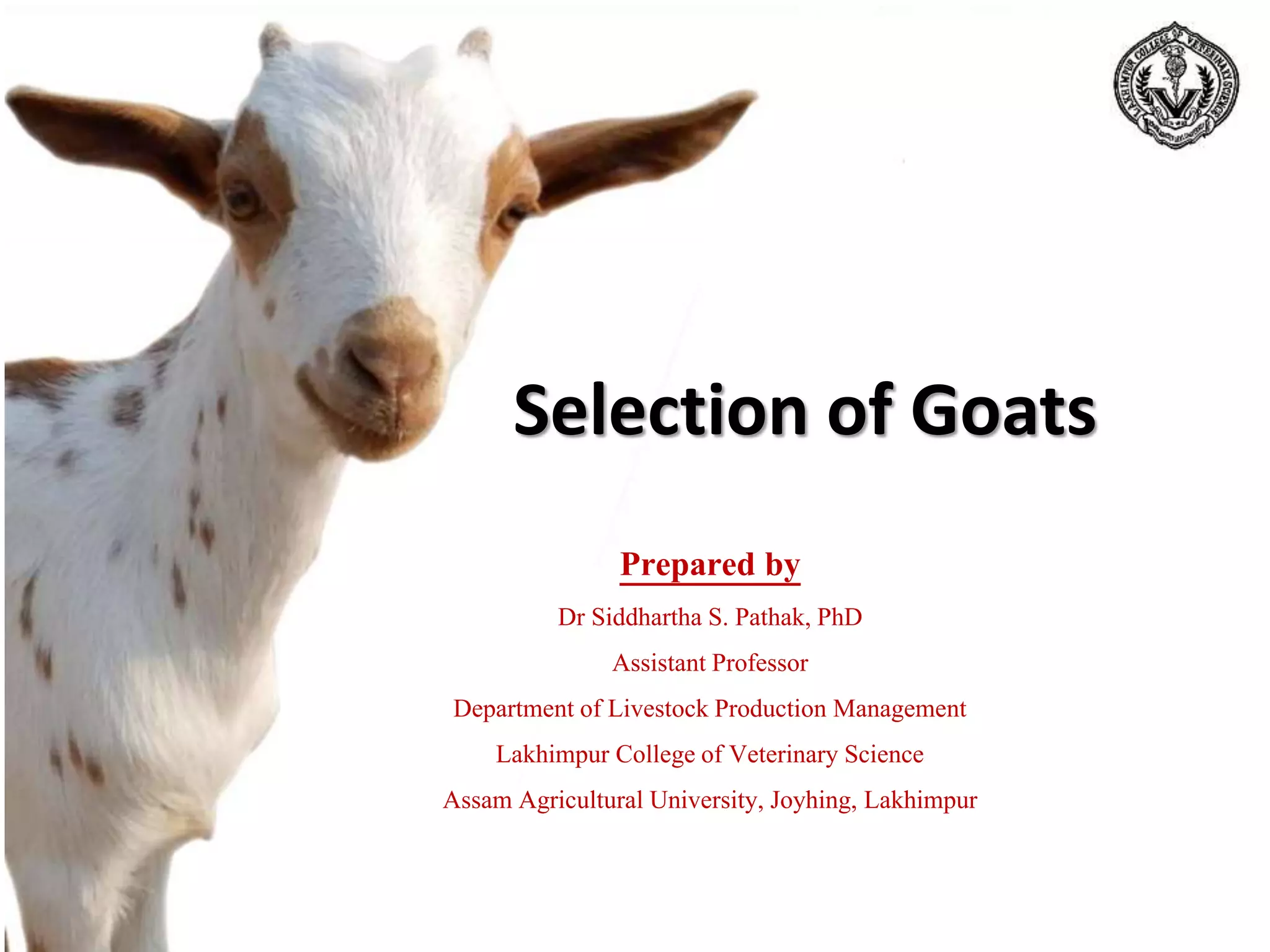

Selection of Goats
Prepared by
Dr Siddhartha S. Pathak, PhD
Assistant Professor
Department of Livestock Production Management
Lakhimpur College of Veterinary Science
Assam Agricultural University, Joyhing, Lakhimpur
Contents
• Why goat farming ?
• Where we stand ?
• Why selection ?
• Selection classes
• Selection of bucks
• Judging
• Conclusion
• Take home message
Why is goat important ??
• Goats were one of the first domesticated animal.
• Requires less space and additional facilities
• Marketing
• Easy to maintain
• Smaller in size reaches market age faster.
• Changing agro-climatic conditions, goats are ‘Future
Animal’ for prosperity in the country.
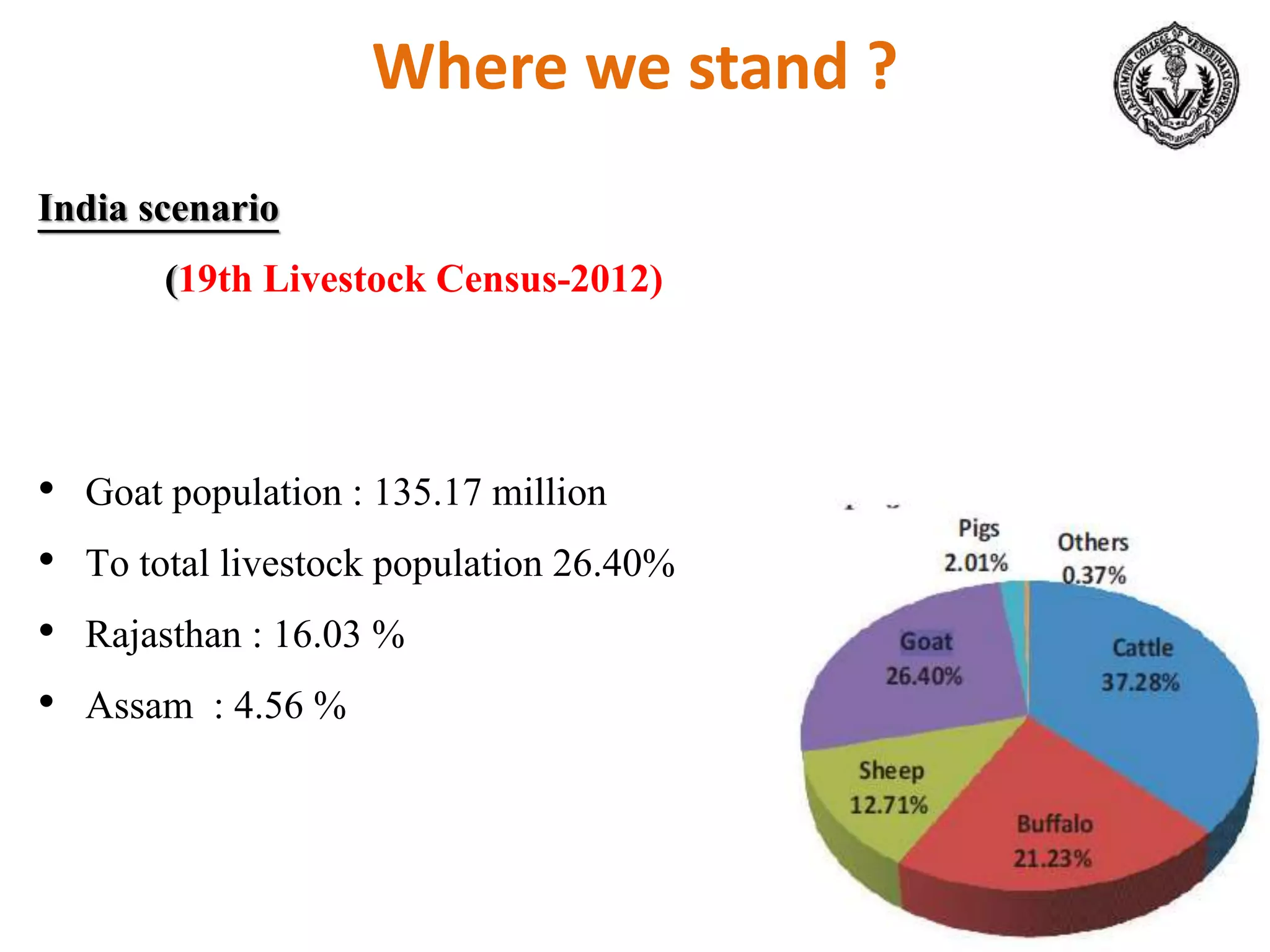
Where we stand ?
India scenario
(19th Livestock Census-2012)
• Goat population : 135.17 million
• To total livestock population 26.40%
• Rajasthan : 16.03 %
• Assam : 4.56 %
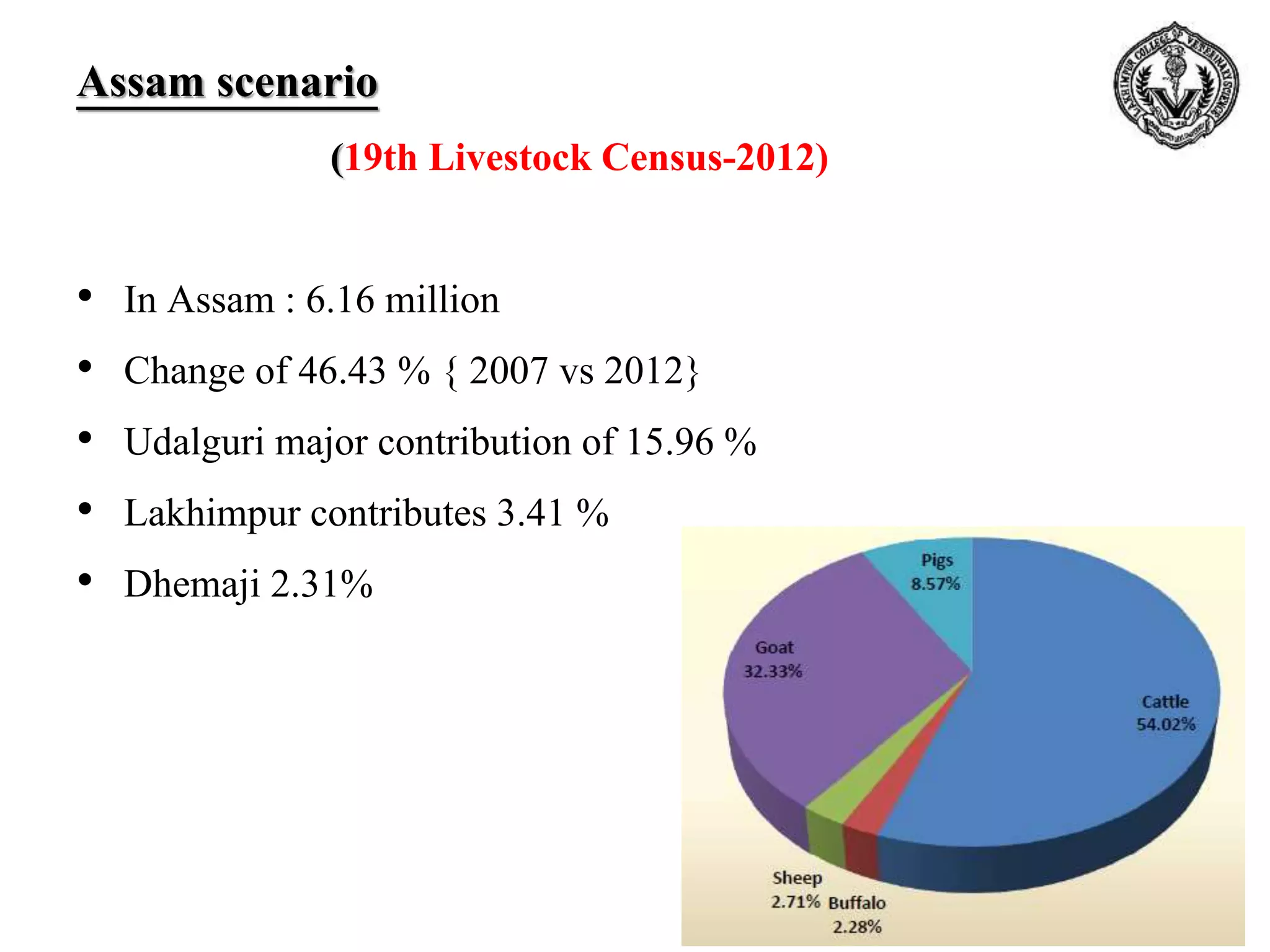
Assam scenario
(19th Livestock Census-2012)
• In Assam : 6.16 million
• Change of 46.43 % { 2007 vs 2012}
• Udalguri major contribution of 15.96 %
• Lakhimpur contributes 3.41 %
• Dhemaji 2.31%
Why selection ?
Selection Classes
SCORING BODY CONFORMATION
199 Highest conformation
150 Middle conformation
100 Lowest conformation
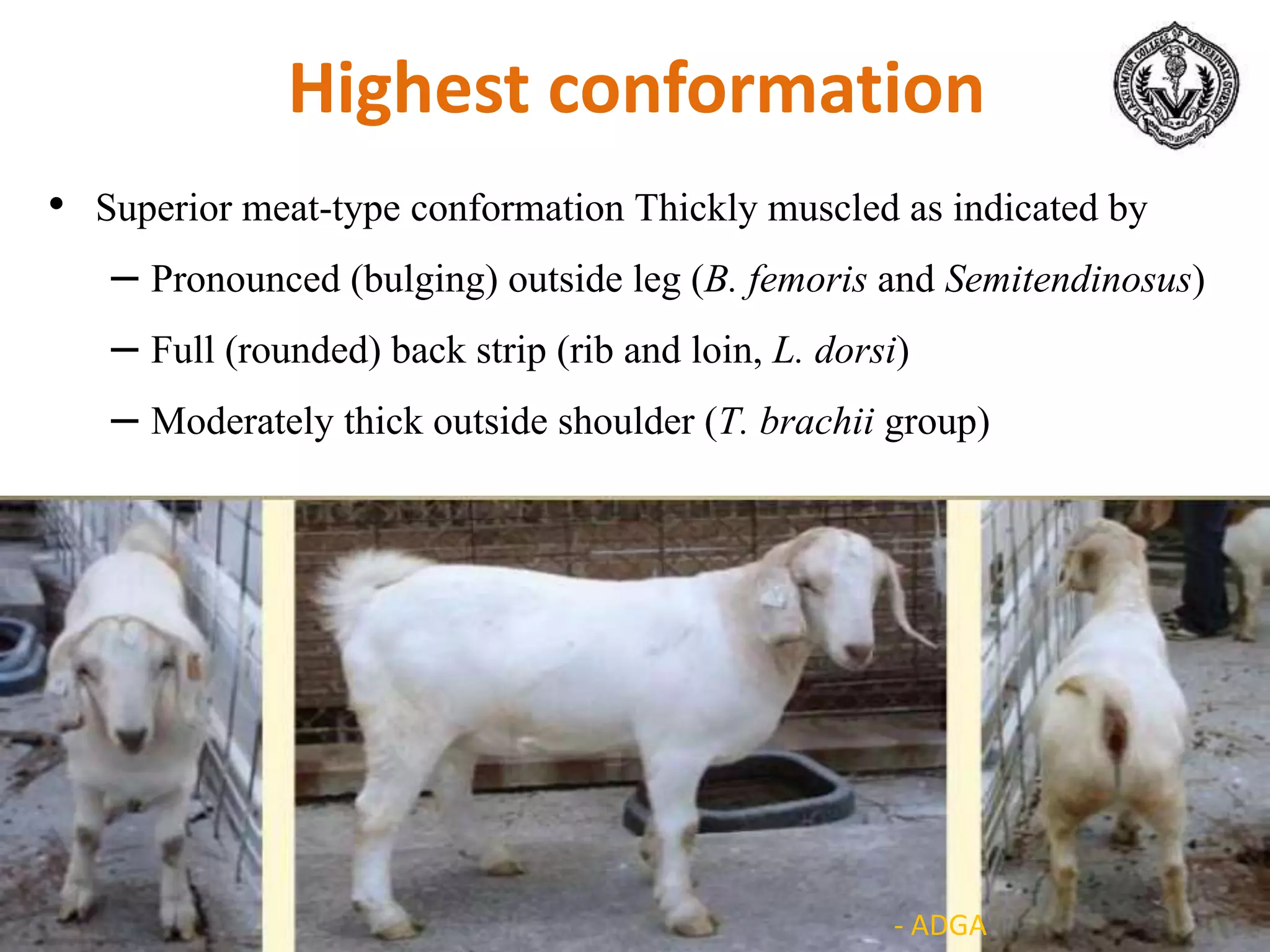
Highest conformation
• Superior meat-type conformation Thickly muscled as indicated by
– Pronounced (bulging) outside leg (B. femoris and Semitendinosus)
– Full (rounded) back strip (rib and loin, L. dorsi)
– Moderately thick outside shoulder (T. brachii group)
- ADGA
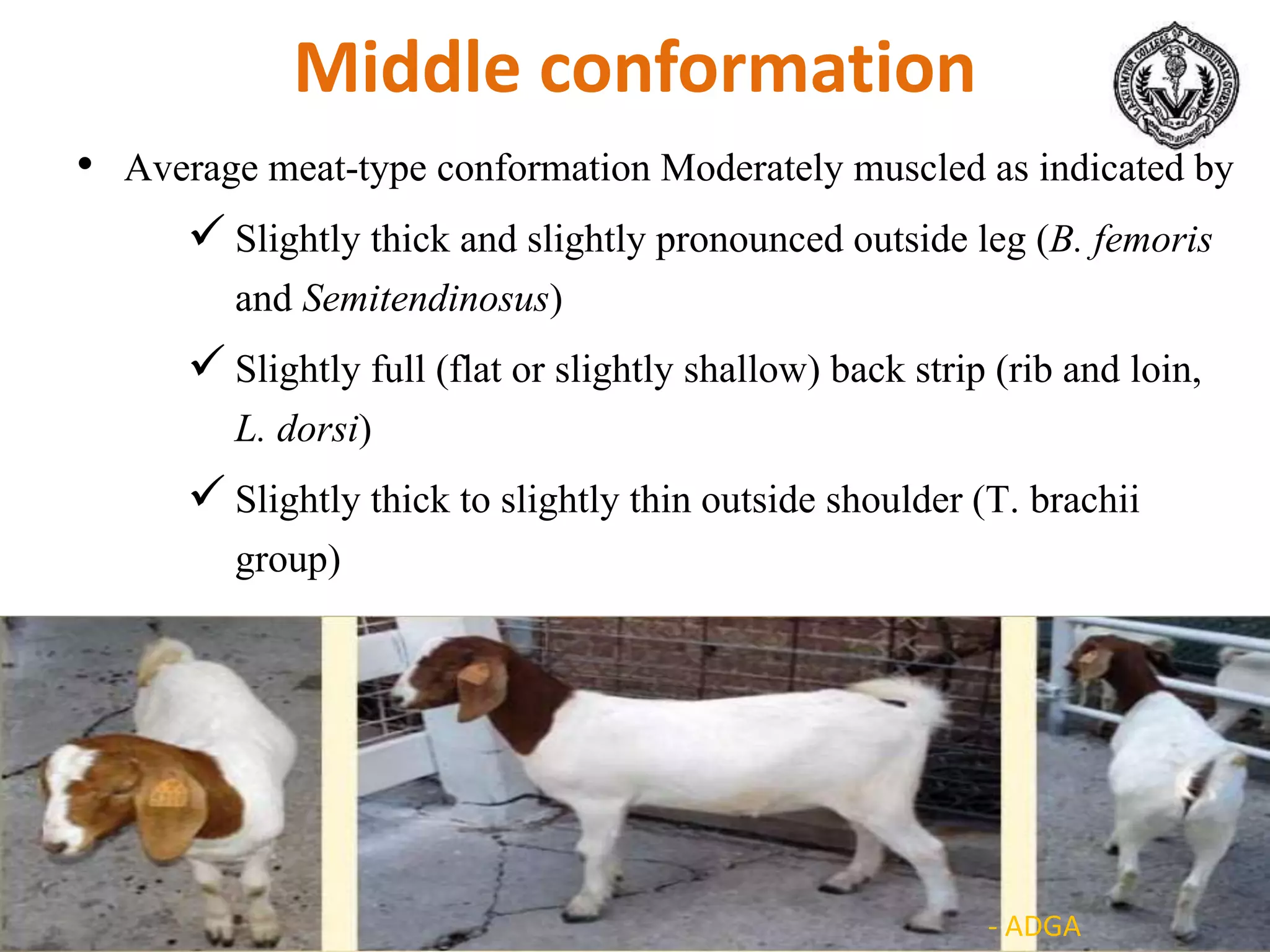
Middle conformation
• Average meat-type conformation Moderately muscled as indicated by
 Slightly thick and slightly pronounced outside leg (B. femoris
and Semitendinosus)
 Slightly full (flat or slightly shallow) back strip (rib and loin,
L. dorsi)
 Slightly thick to slightly thin outside shoulder (T. brachii
group)
- ADGA
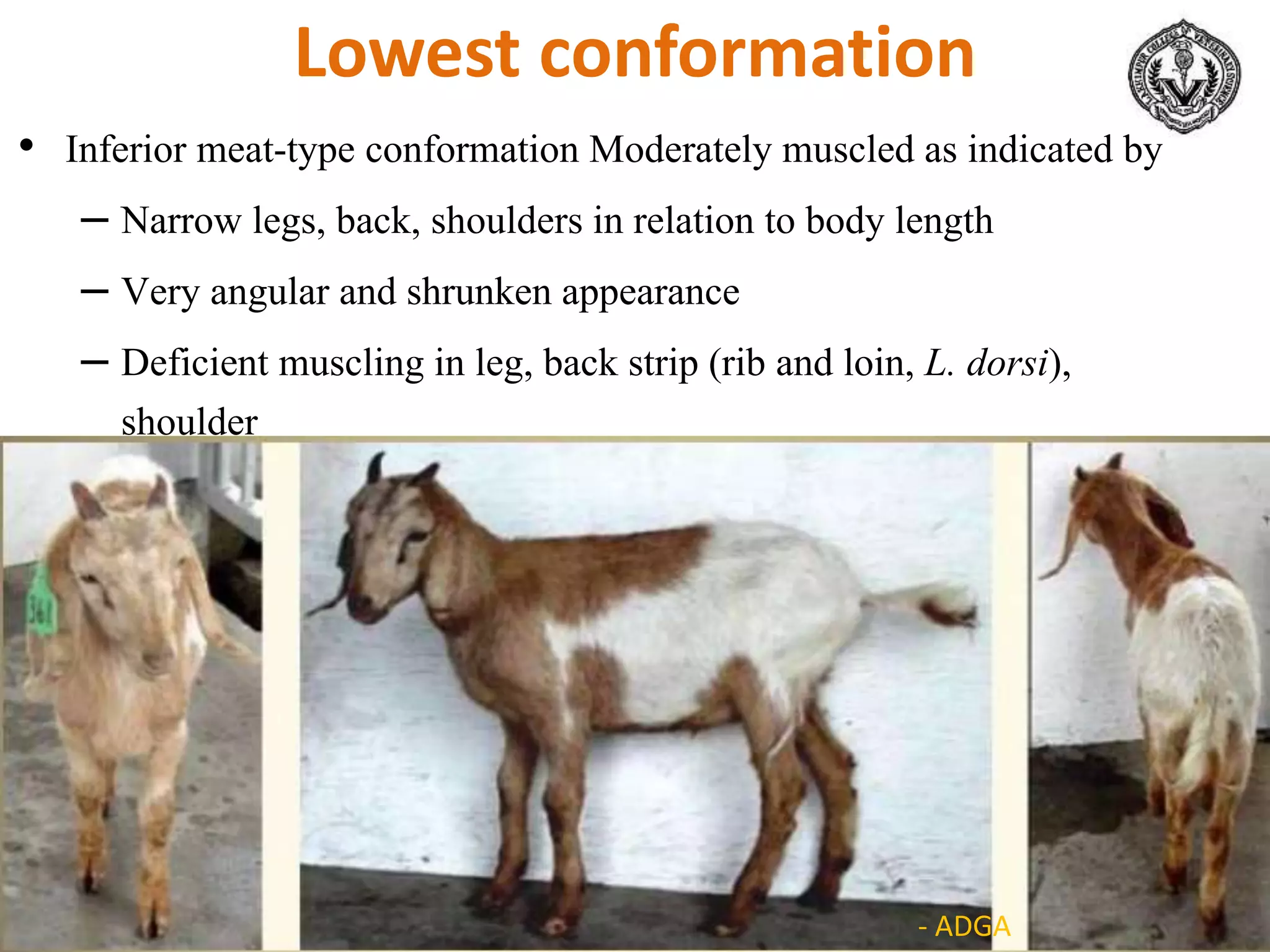
Lowest conformation
• Inferior meat-type conformation Moderately muscled as indicated by
– Narrow legs, back, shoulders in relation to body length
– Very angular and shrunken appearance
– Deficient muscling in leg, back strip (rib and loin, L. dorsi),
shoulder
- ADGA
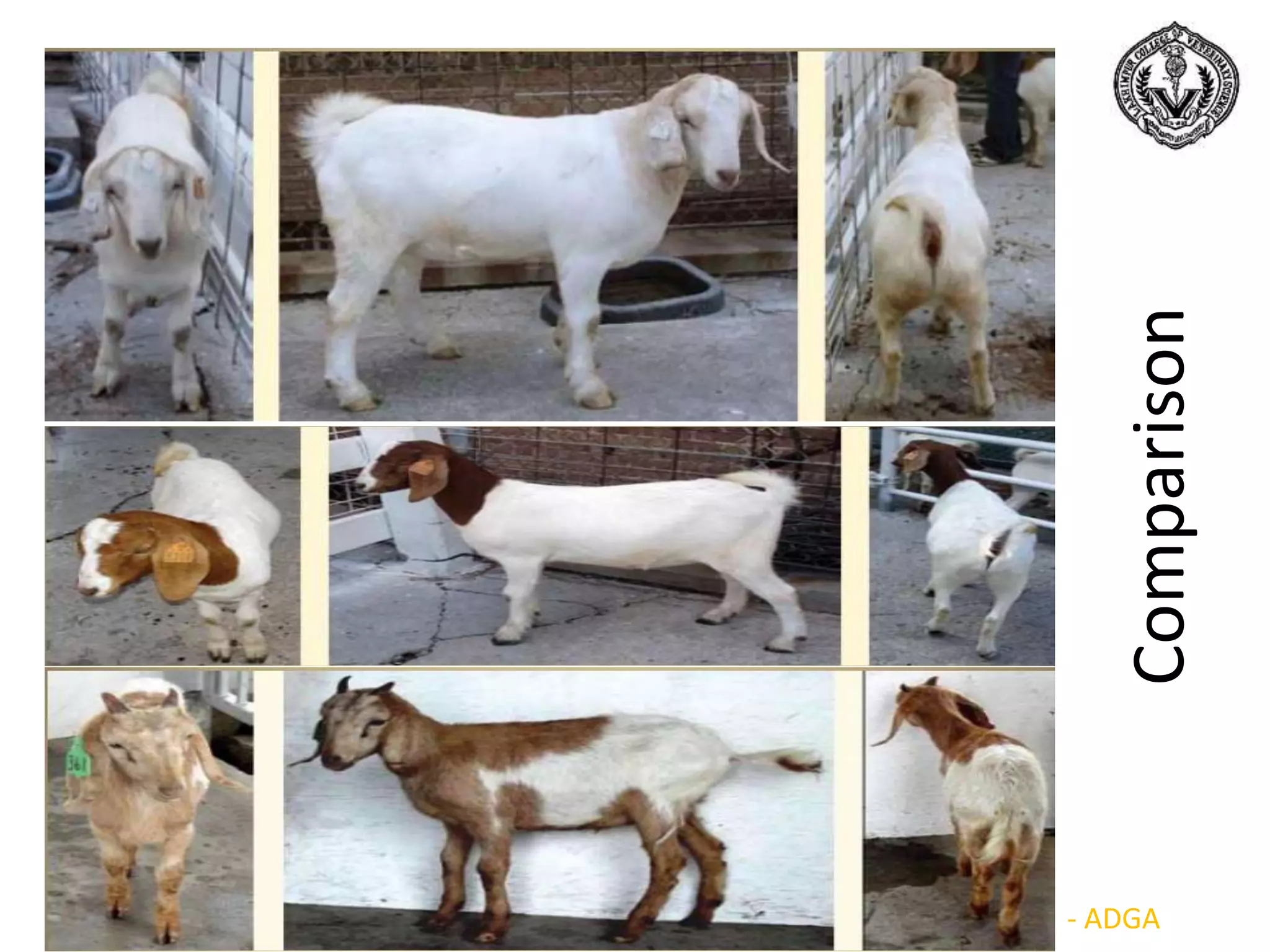
Comparison
- ADGA
Selection of bucks
• Masculinity and adequate muscling.
• The head should be masculine with a broad, strong muzzle
and horns set far apart.
• Bucks must have two large, well-formed, functional, equal-
sized testes in a single scrotum.
• More semen is produced by bucks with greater scrotal
circumference.
• Mature bucks should have a scrotum circumference of at least 25
cm or 10 inches.
• In young bucks, testicles should be of equal size and large for day of
age.
• Avoid selecting bucks that show overly Pendulous testicles.
• Testicles should be free of bumps or lumps and should be smooth.
Selection of bucks
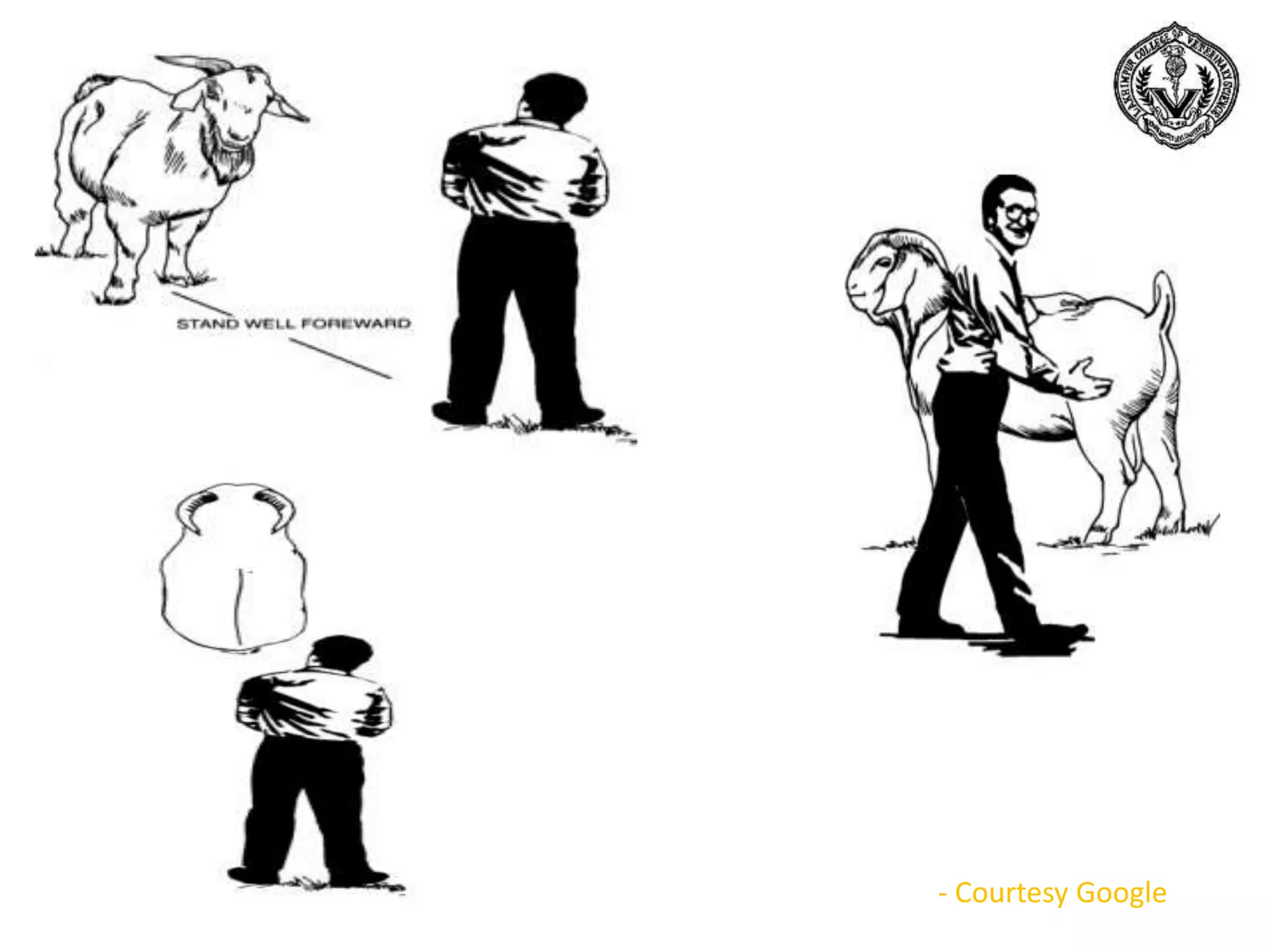
Judging a caprine
• Structural correctness (Skeleton, feet, legs)
• Muscling (examining loin, rump, quarters)
• Conformation (combination)
• Growth (overall skeletal size and development)
• Balance/symmetry (eye appeal)
• Finish/condition (fat covering the body, BCS)
- Courtesy Google
Dentition
• Mature goats have 32 teeth of which 24 are molars and 8 are
incisors.
• At 10 year or older, permanent teeth will fall out.
• An animal that has its jaws misaligned, or teeth missing may not be
as efficient in grazing.
• Deciduous Teeth Dental Formula:
2(Di 0/4; Dc 0/0; Dp 3/3) = 20
• Permanent Teeth Dental Formula
2(I0/4; C0/0; P3/3; M3/3)= 32
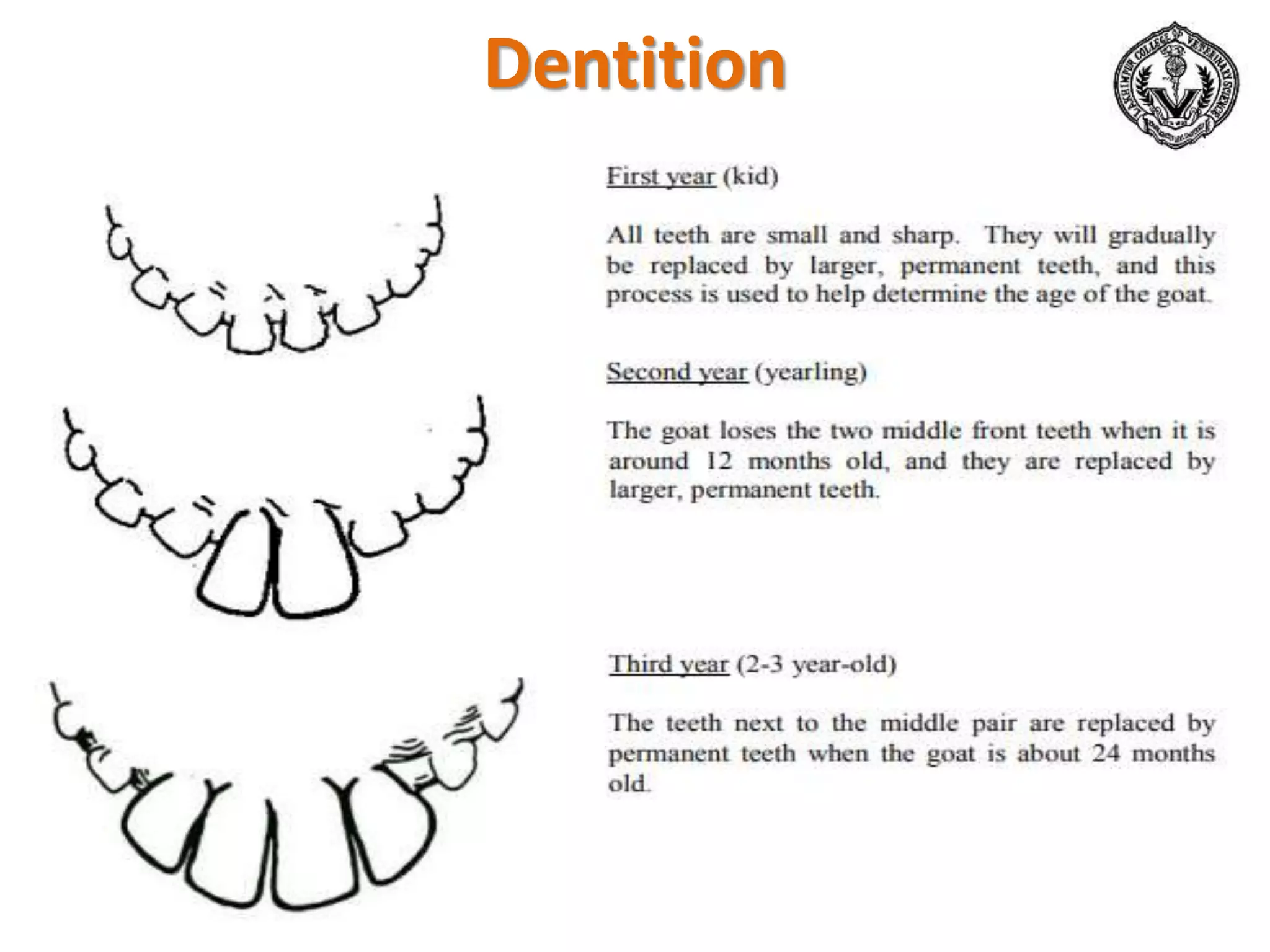
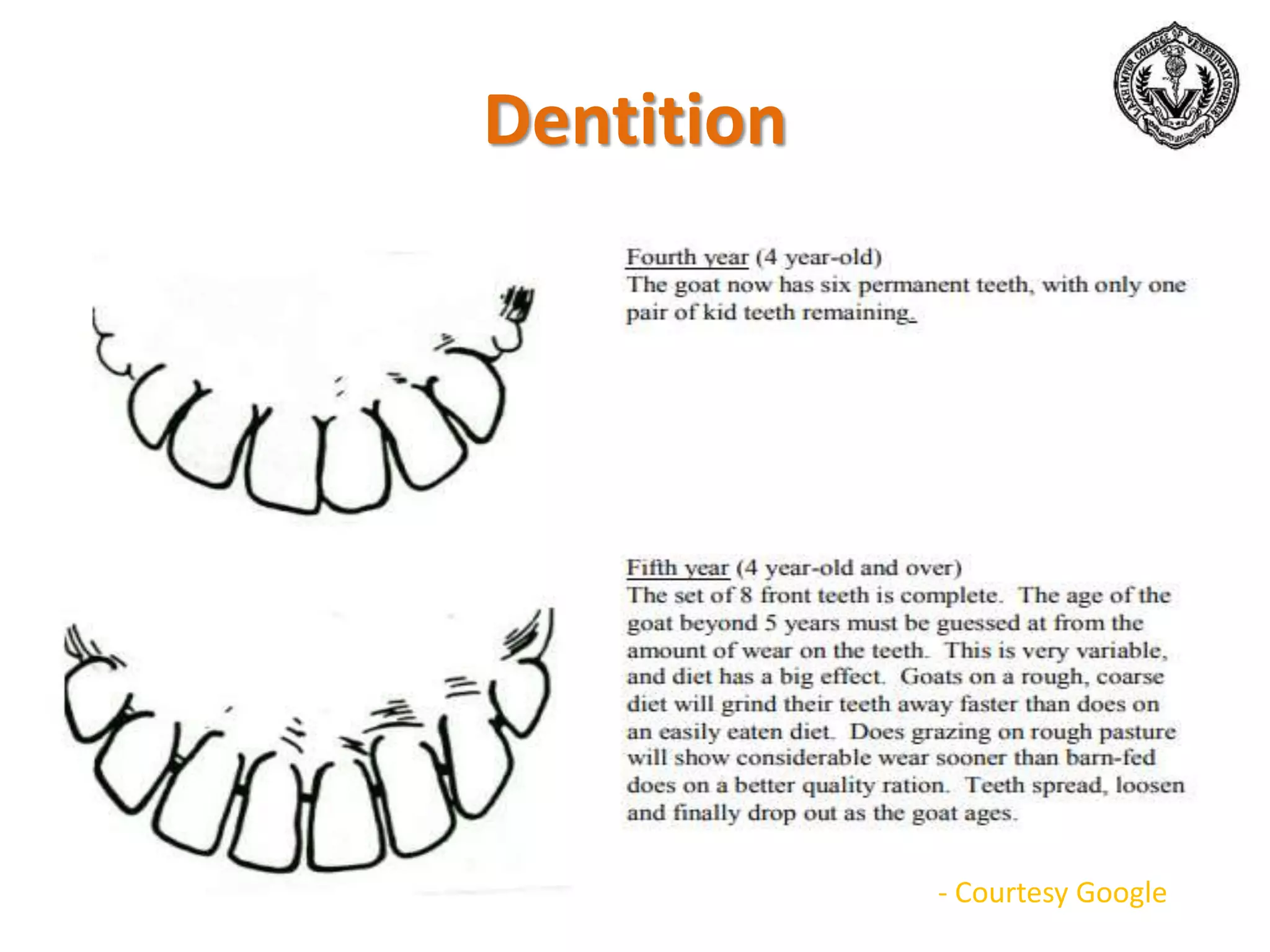
Dentition
Dentition
- Courtesy Google
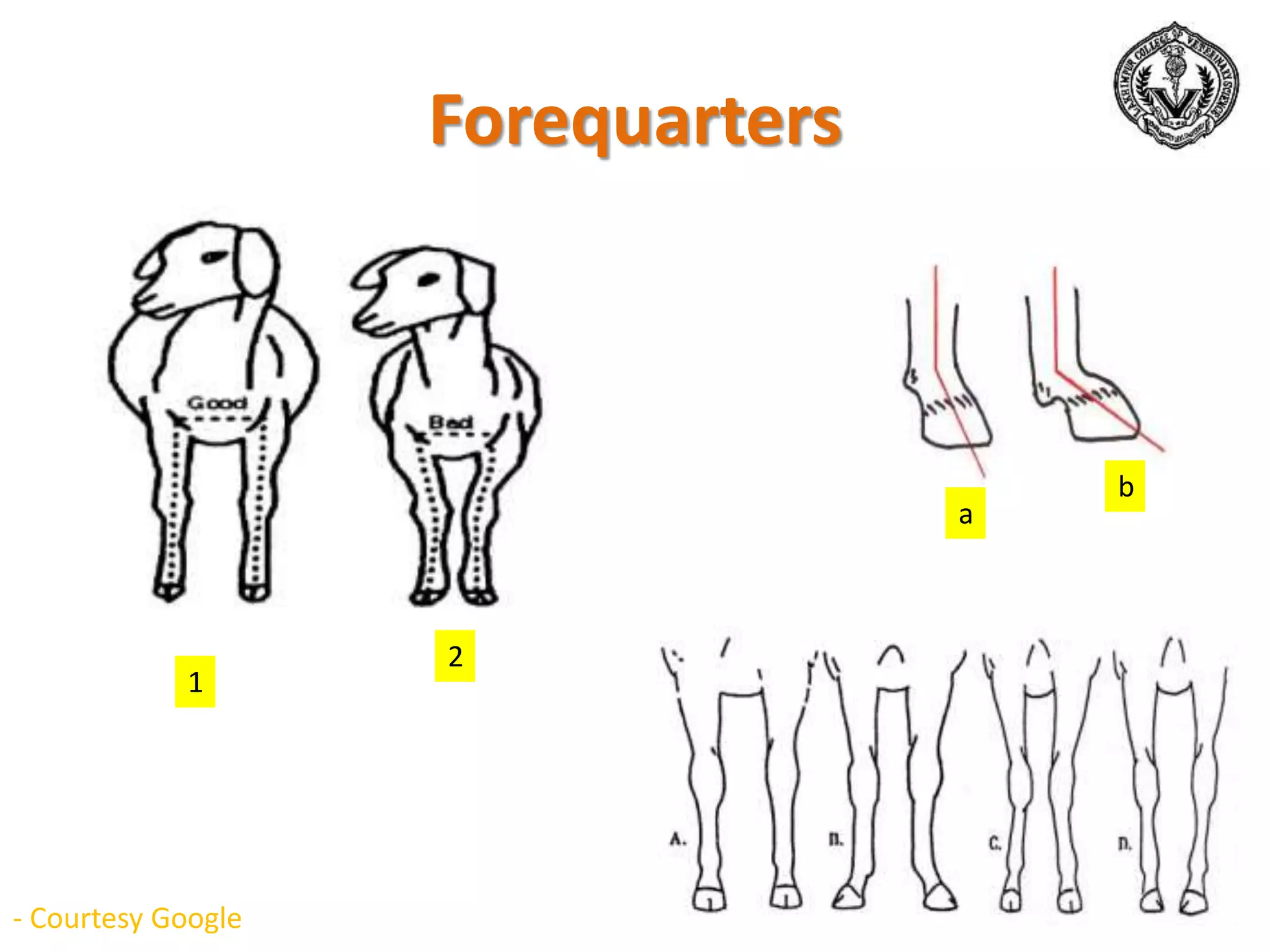
Forequarters
1
2
b
a
- Courtesy Google
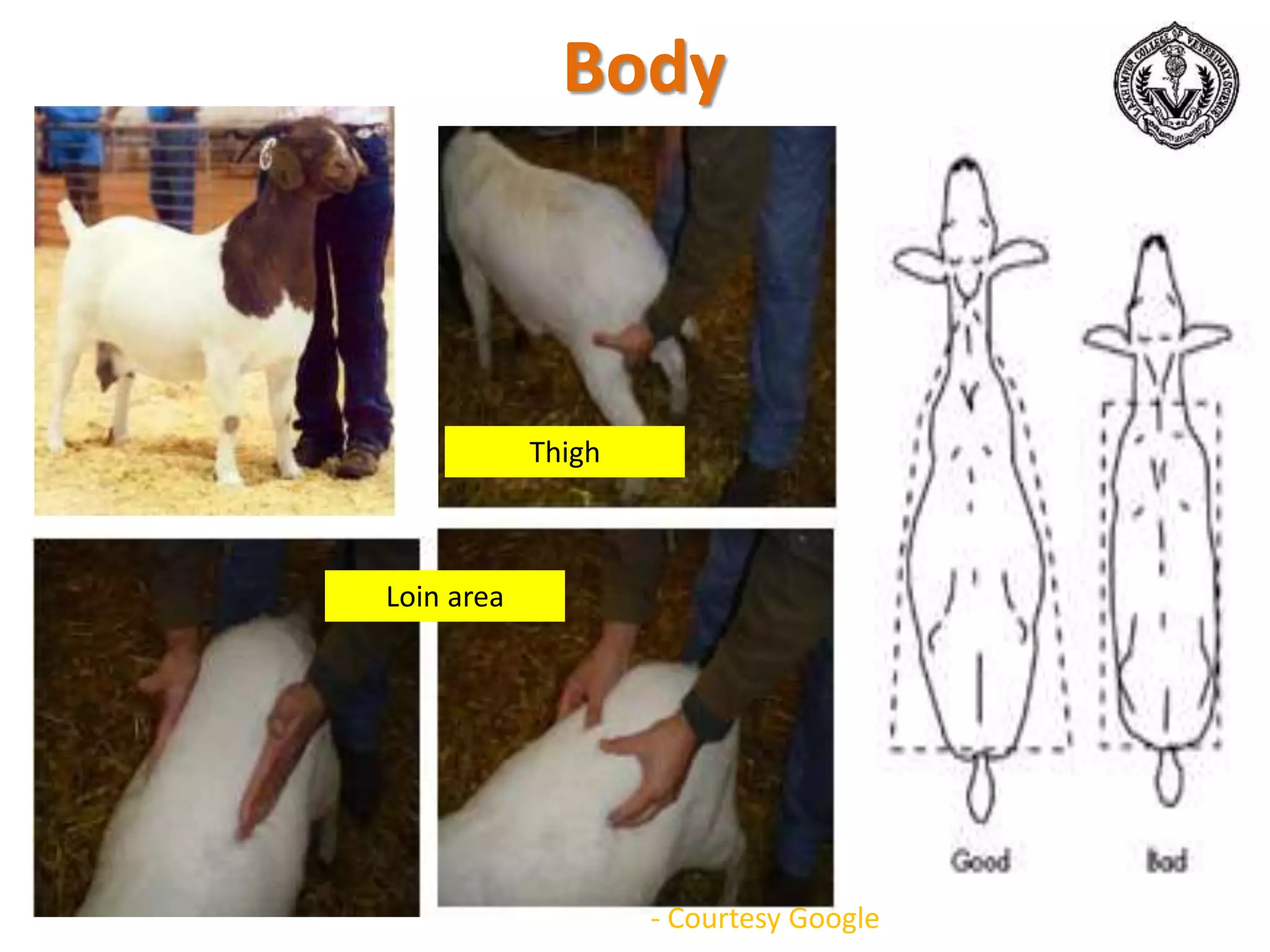
Body
Loin area
Thigh
- Courtesy Google
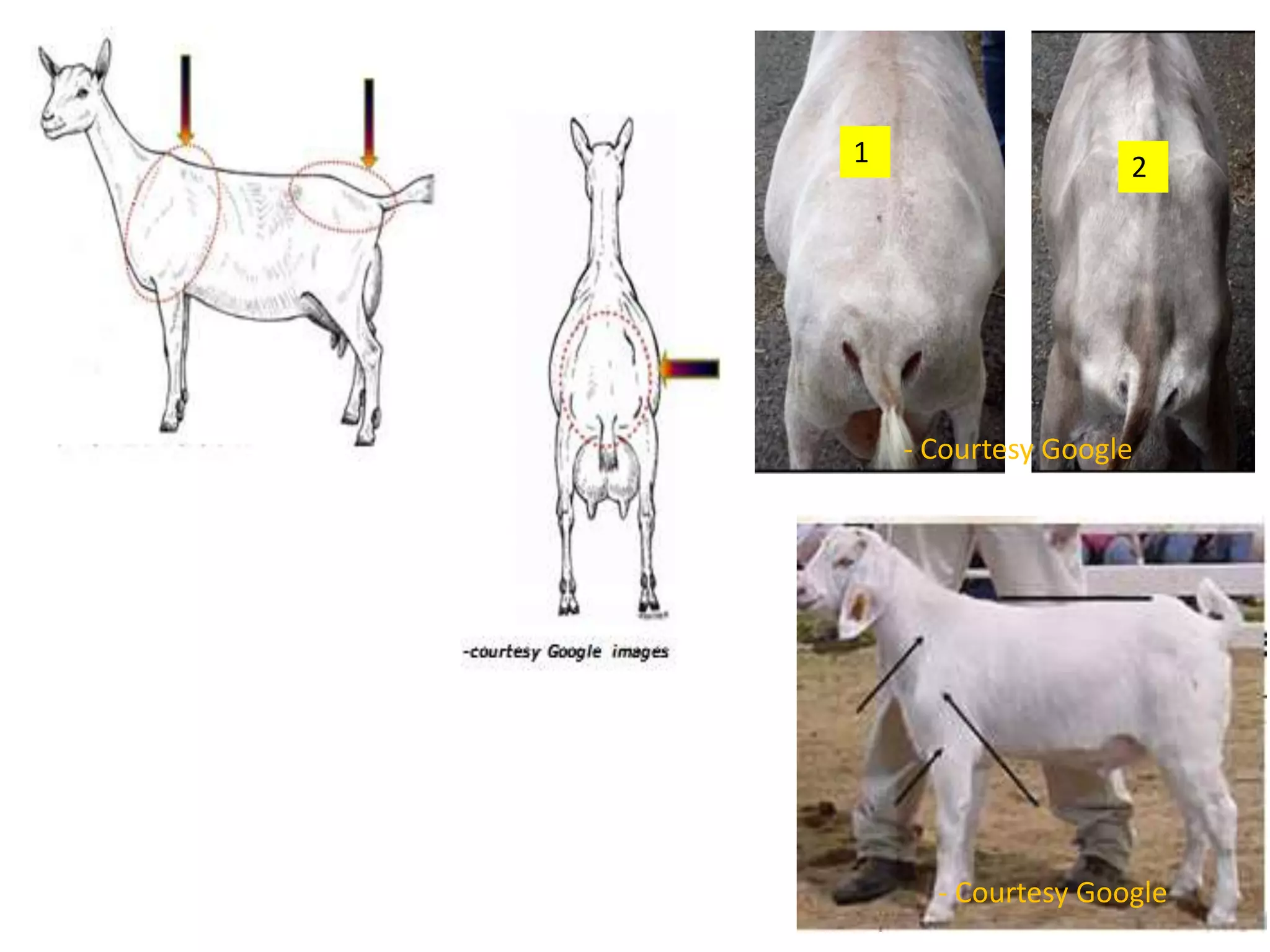
1 2
- Courtesy Google
- Courtesy Google
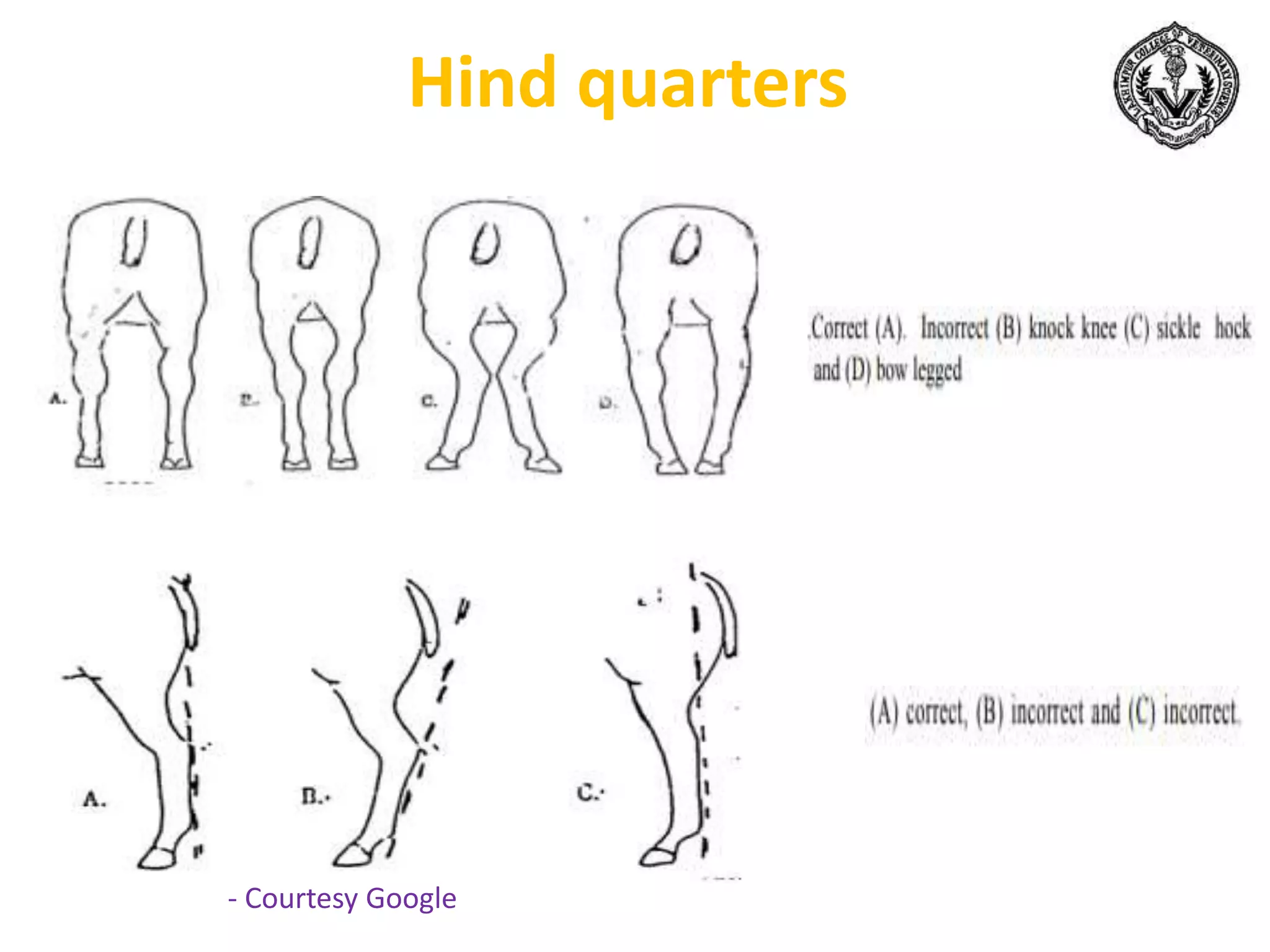
Hind quarters
- Courtesy Google
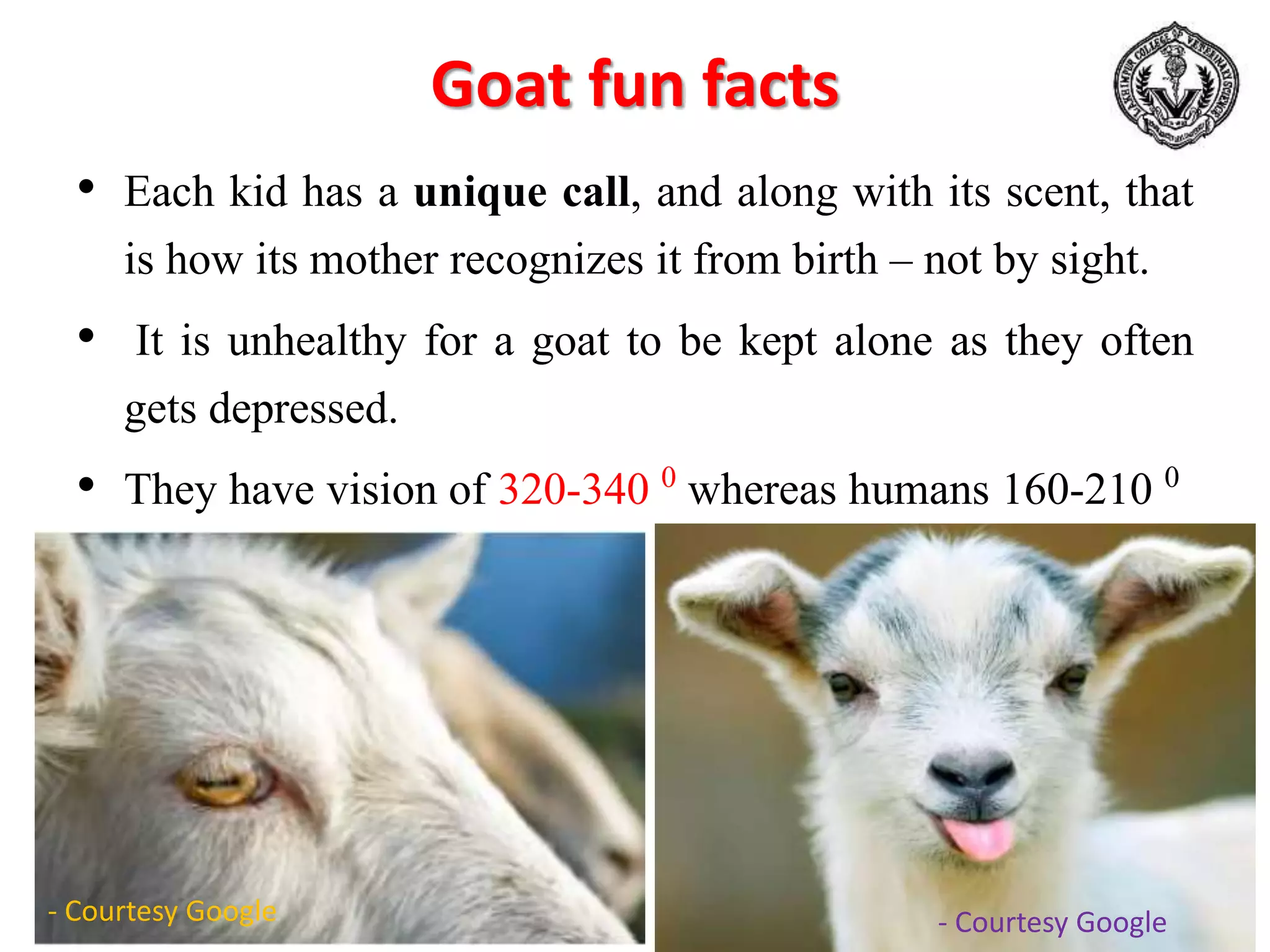
Goat fun facts
• Each kid has a unique call, and along with its scent, that
is how its mother recognizes it from birth – not by sight.
• It is unhealthy for a goat to be kept alone as they often
gets depressed.
• They have vision of 320-340 0 whereas humans 160-210 0
- Courtesy Google- Courtesy Google
Body conformation score
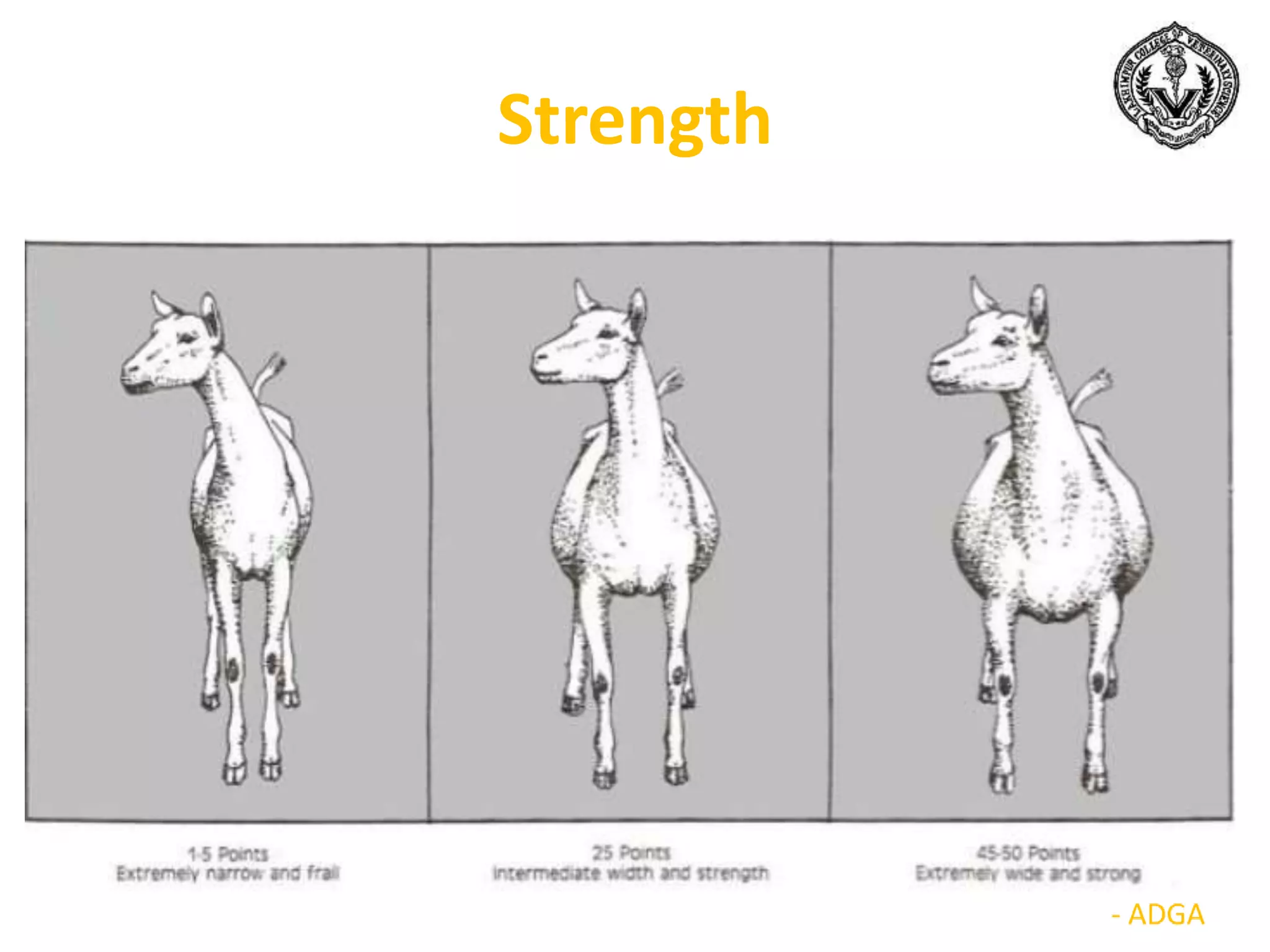
Strength
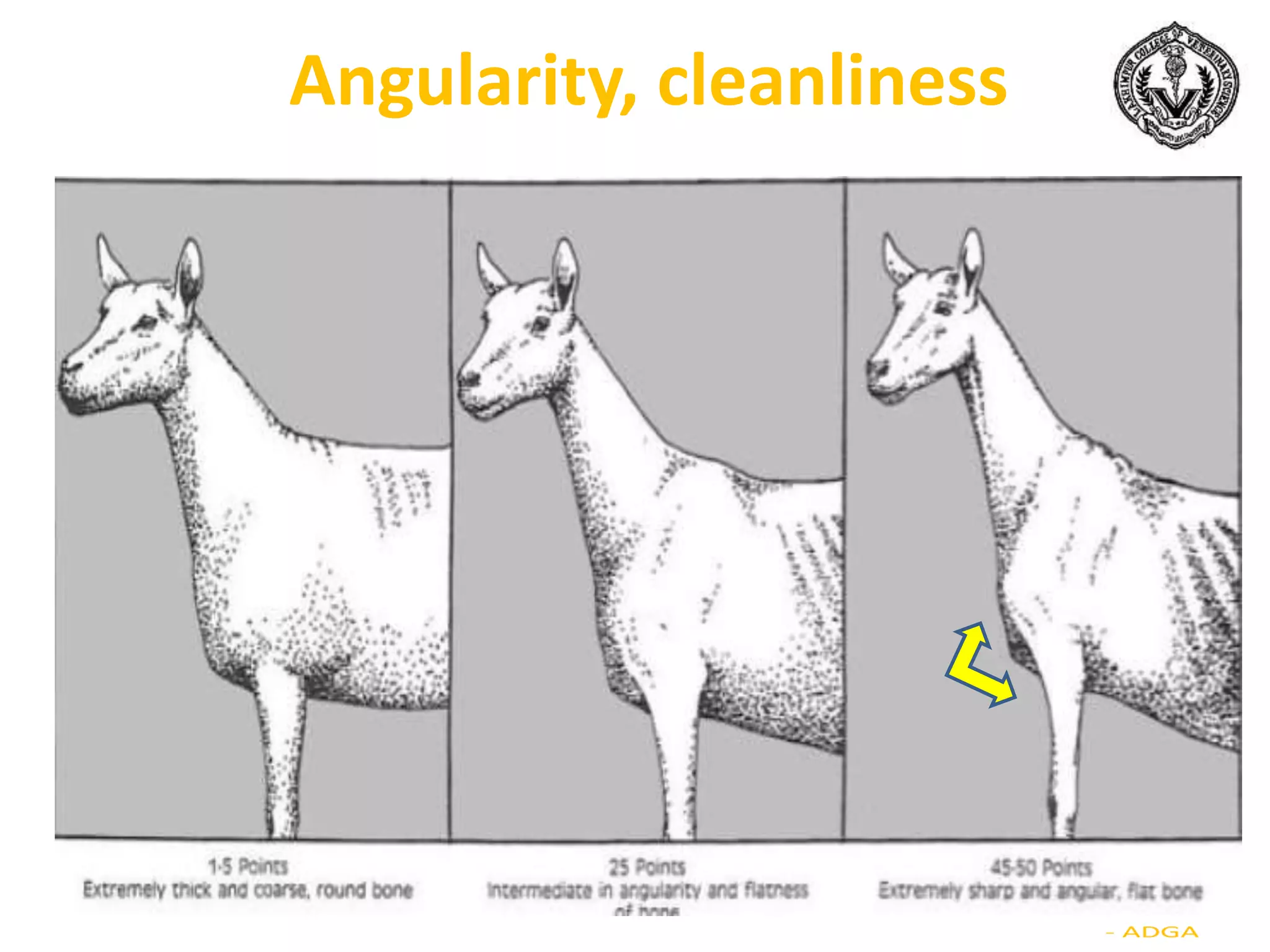
Angularity, cleanliness
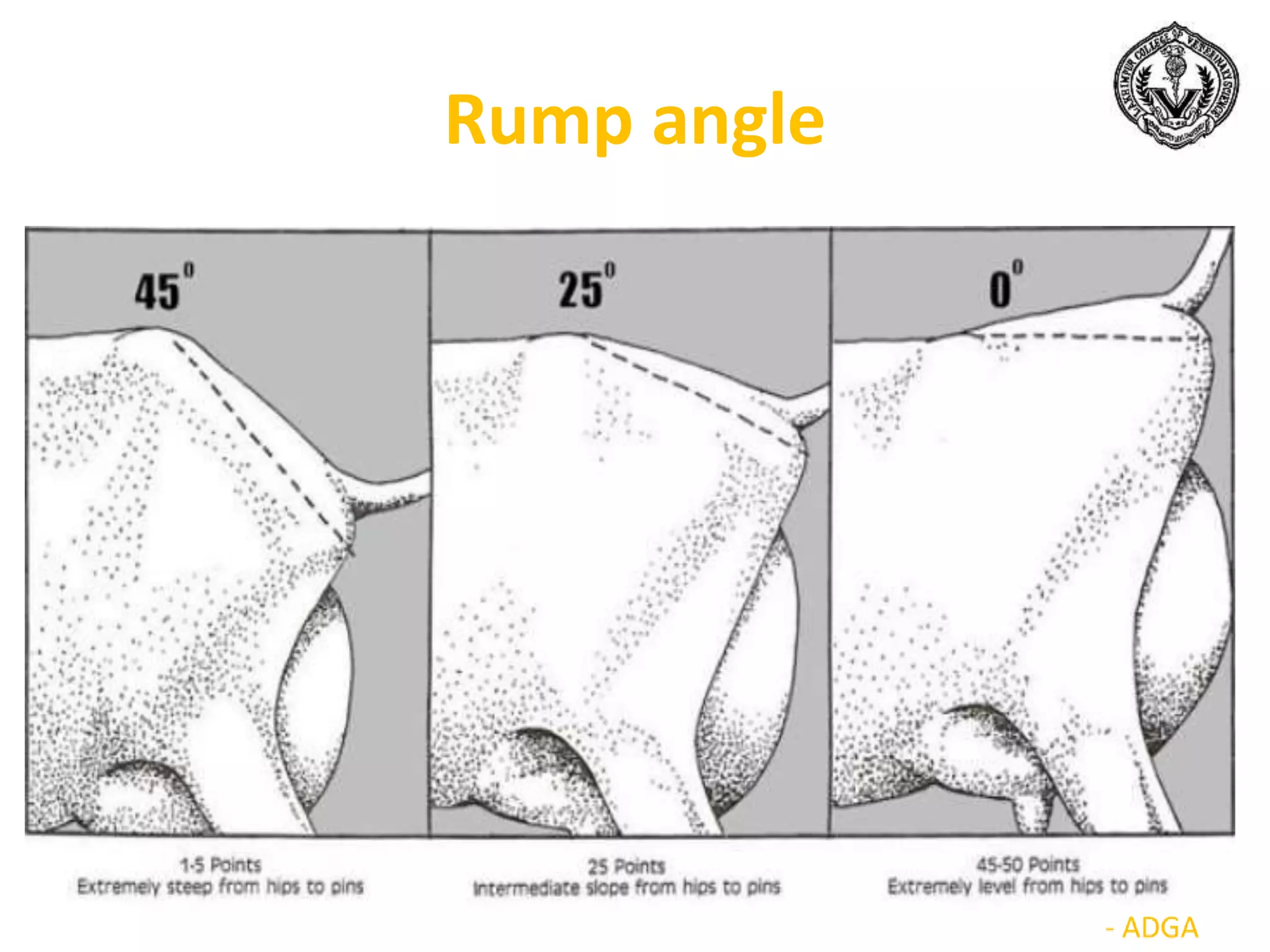
Rump angle
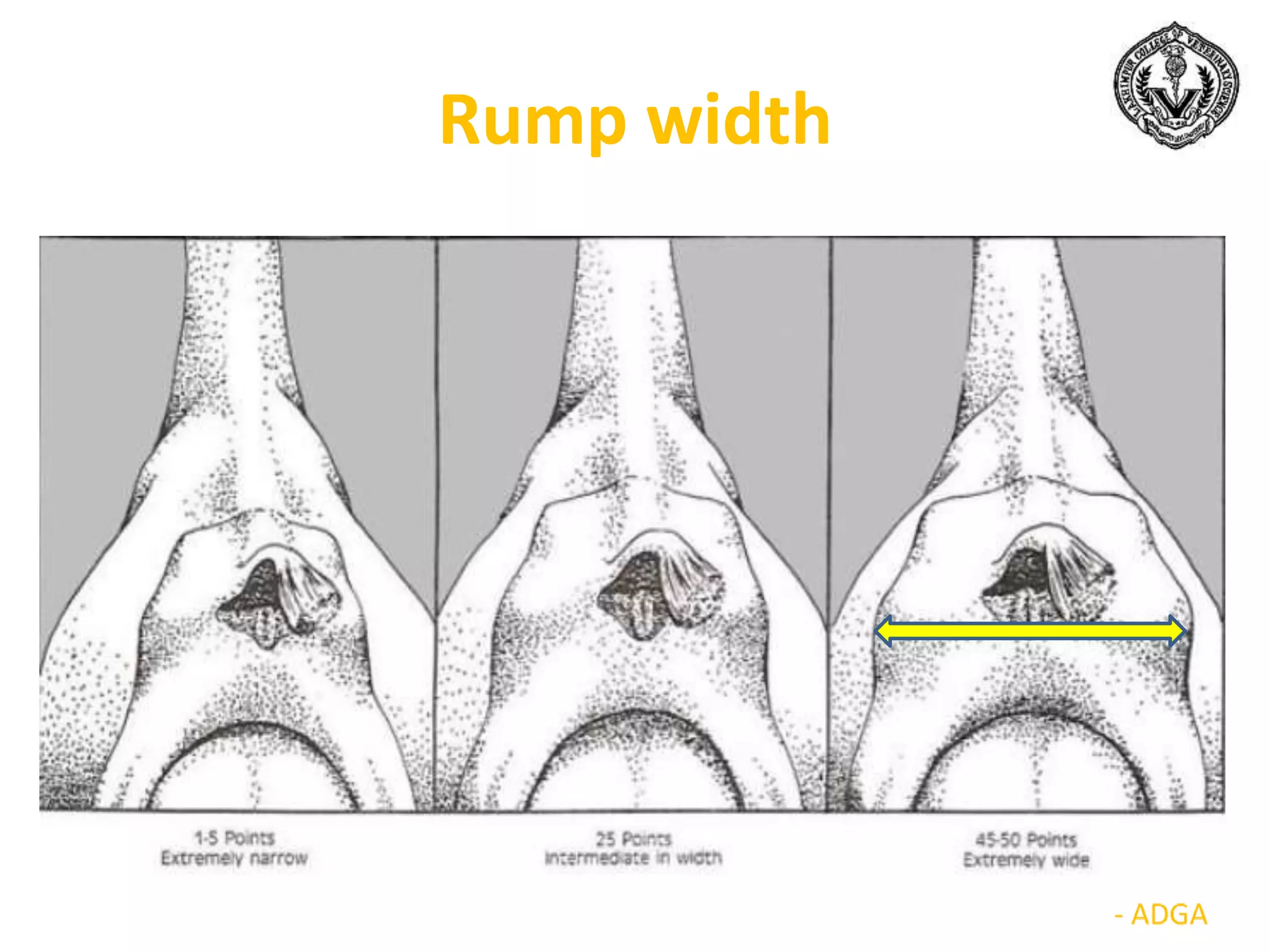
Rump width
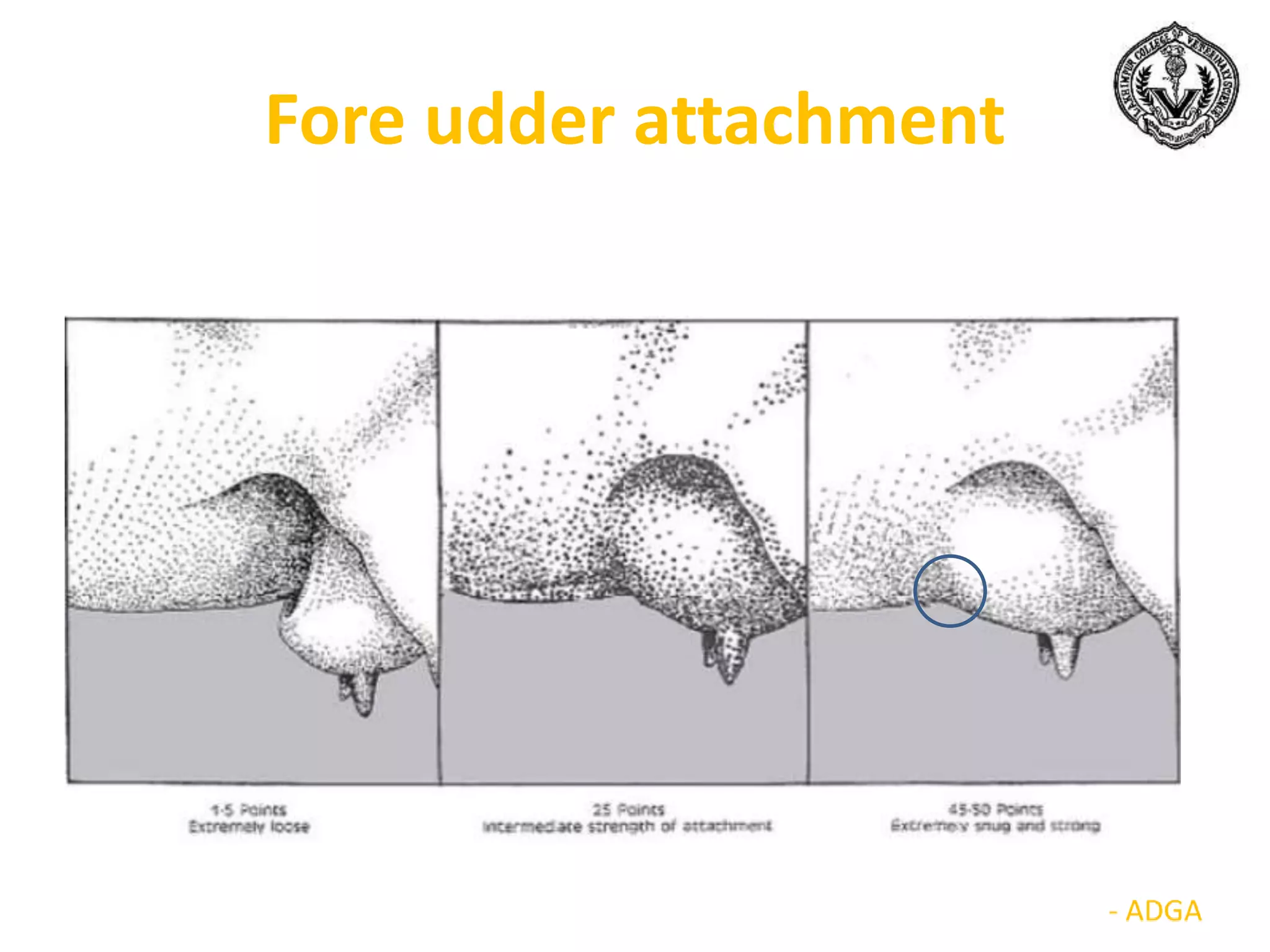
Fore udder attachment
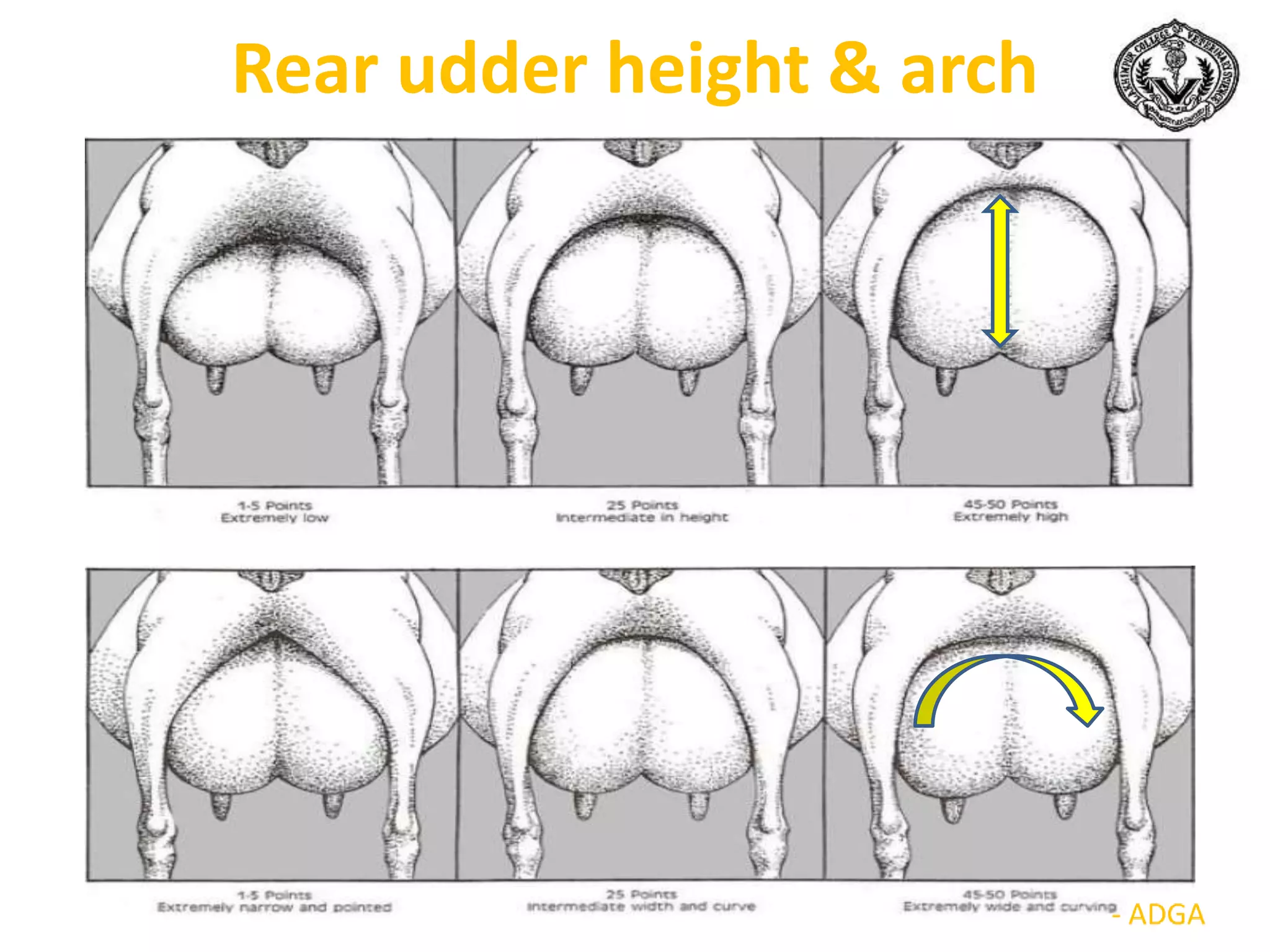
Rear udder height & arch
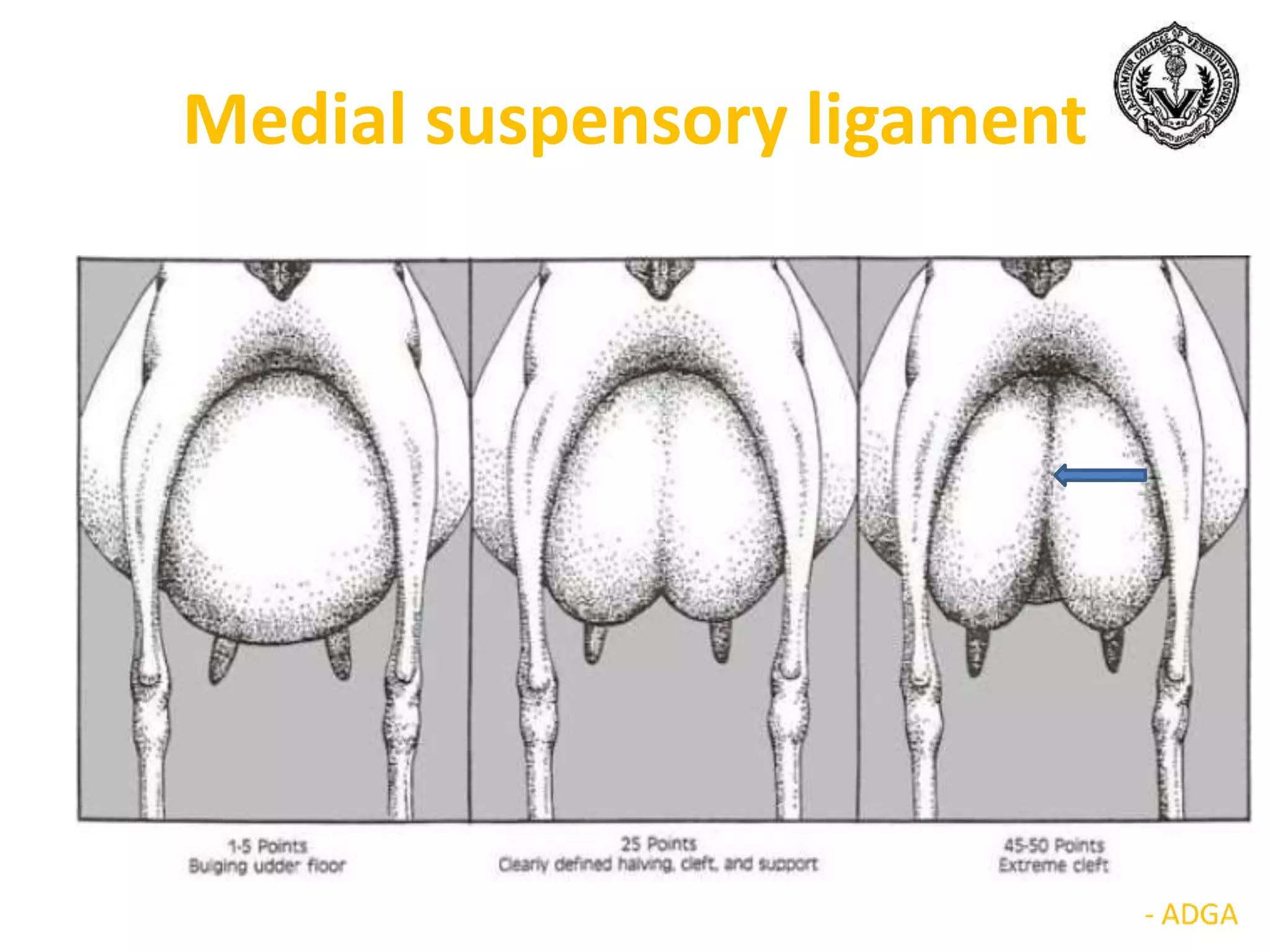
Medial suspensory ligament
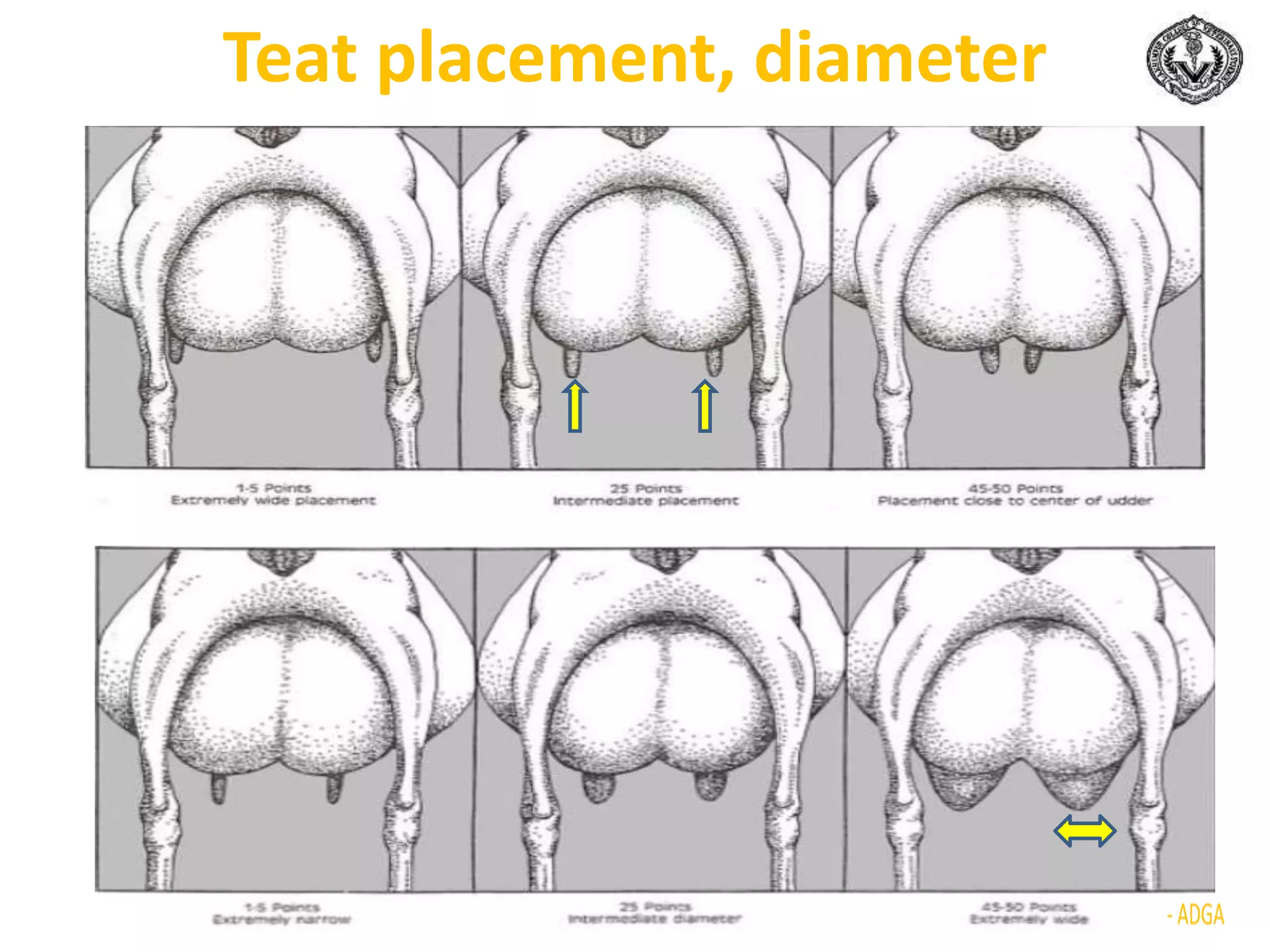
Teat placement, diameter
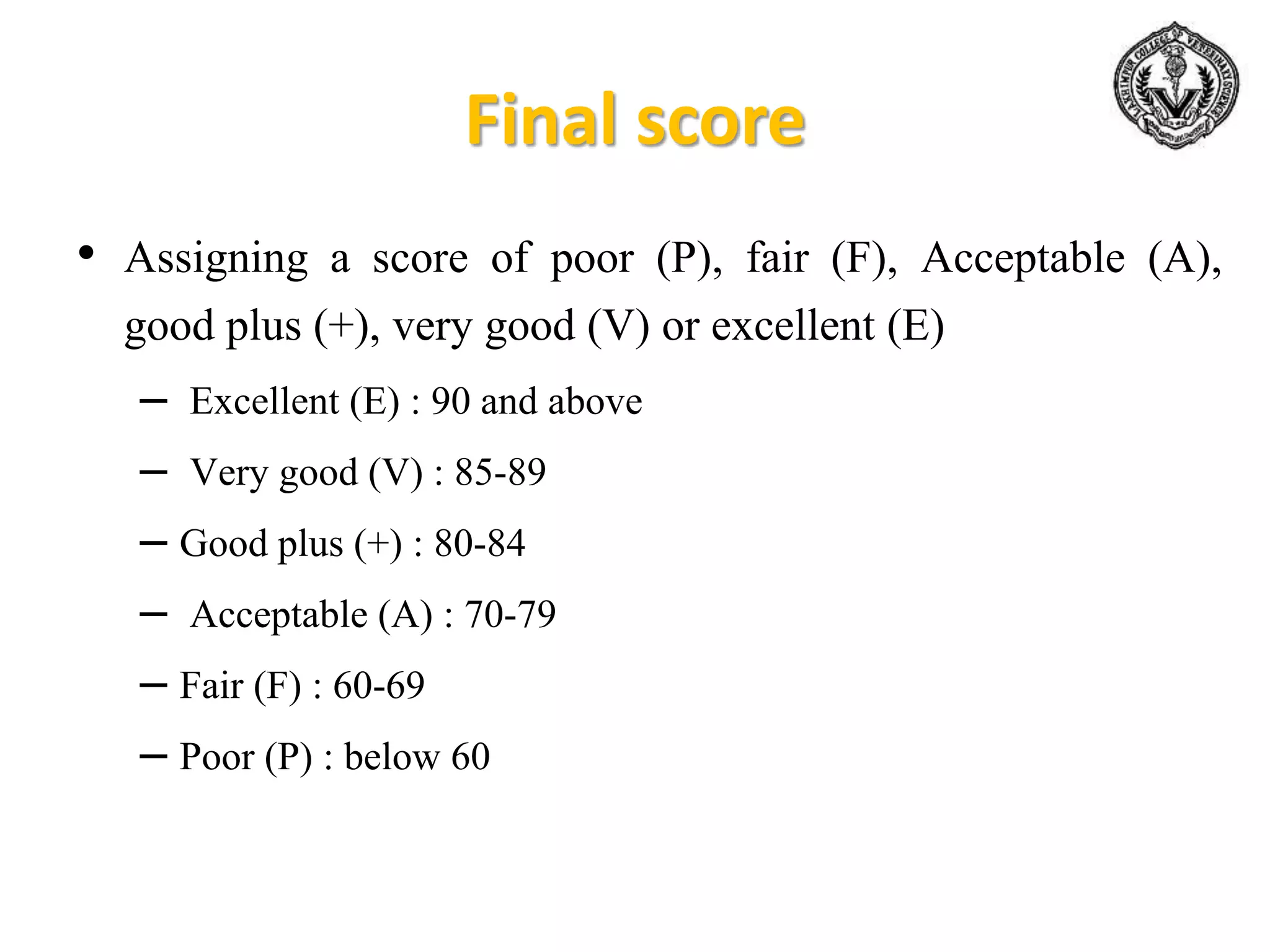
Final score
• Assigning a score of poor (P), fair (F), Acceptable (A),
good plus (+), very good (V) or excellent (E)
– Excellent (E) : 90 and above
– Very good (V) : 85-89
– Good plus (+) : 80-84
– Acceptable (A) : 70-79
– Fair (F) : 60-69
– Poor (P) : below 60
Conclusion
• Several steps for selection of goats
• Depends on production and marketing goals
• For meat production, goats must have a lengthy body,
muscling characteristics etc
• For dairy, does must have a good udder development, teat
length & diameter etc.
Take home message
Careful selection of breeding stock can enhance
milk production, carcass merit and the market value of
offspring.
THANKS
FOR
ATTENTION
References
• ADGA, America

Selection & judging of goats

  • 1.
    Selection of Goats Preparedby Dr Siddhartha S. Pathak, PhD Assistant Professor Department of Livestock Production Management Lakhimpur College of Veterinary Science Assam Agricultural University, Joyhing, Lakhimpur
  • 2.
    Contents • Why goatfarming ? • Where we stand ? • Why selection ? • Selection classes • Selection of bucks • Judging • Conclusion • Take home message
  • 3.
    Why is goatimportant ?? • Goats were one of the first domesticated animal. • Requires less space and additional facilities • Marketing • Easy to maintain • Smaller in size reaches market age faster. • Changing agro-climatic conditions, goats are ‘Future Animal’ for prosperity in the country.
  • 4.
    Where we stand? India scenario (19th Livestock Census-2012) • Goat population : 135.17 million • To total livestock population 26.40% • Rajasthan : 16.03 % • Assam : 4.56 %
  • 5.
    Assam scenario (19th LivestockCensus-2012) • In Assam : 6.16 million • Change of 46.43 % { 2007 vs 2012} • Udalguri major contribution of 15.96 % • Lakhimpur contributes 3.41 % • Dhemaji 2.31%
  • 6.
  • 7.
    Selection Classes SCORING BODYCONFORMATION 199 Highest conformation 150 Middle conformation 100 Lowest conformation
  • 8.
    Highest conformation • Superiormeat-type conformation Thickly muscled as indicated by – Pronounced (bulging) outside leg (B. femoris and Semitendinosus) – Full (rounded) back strip (rib and loin, L. dorsi) – Moderately thick outside shoulder (T. brachii group) - ADGA
  • 9.
    Middle conformation • Averagemeat-type conformation Moderately muscled as indicated by  Slightly thick and slightly pronounced outside leg (B. femoris and Semitendinosus)  Slightly full (flat or slightly shallow) back strip (rib and loin, L. dorsi)  Slightly thick to slightly thin outside shoulder (T. brachii group) - ADGA
  • 10.
    Lowest conformation • Inferiormeat-type conformation Moderately muscled as indicated by – Narrow legs, back, shoulders in relation to body length – Very angular and shrunken appearance – Deficient muscling in leg, back strip (rib and loin, L. dorsi), shoulder - ADGA
  • 11.
  • 12.
    Selection of bucks •Masculinity and adequate muscling. • The head should be masculine with a broad, strong muzzle and horns set far apart. • Bucks must have two large, well-formed, functional, equal- sized testes in a single scrotum. • More semen is produced by bucks with greater scrotal circumference.
  • 13.
    • Mature bucksshould have a scrotum circumference of at least 25 cm or 10 inches. • In young bucks, testicles should be of equal size and large for day of age. • Avoid selecting bucks that show overly Pendulous testicles. • Testicles should be free of bumps or lumps and should be smooth. Selection of bucks
  • 14.
    Judging a caprine •Structural correctness (Skeleton, feet, legs) • Muscling (examining loin, rump, quarters) • Conformation (combination) • Growth (overall skeletal size and development) • Balance/symmetry (eye appeal) • Finish/condition (fat covering the body, BCS)
  • 15.
  • 16.
    Dentition • Mature goatshave 32 teeth of which 24 are molars and 8 are incisors. • At 10 year or older, permanent teeth will fall out. • An animal that has its jaws misaligned, or teeth missing may not be as efficient in grazing. • Deciduous Teeth Dental Formula: 2(Di 0/4; Dc 0/0; Dp 3/3) = 20 • Permanent Teeth Dental Formula 2(I0/4; C0/0; P3/3; M3/3)= 32
  • 17.
  • 18.
  • 19.
  • 20.
  • 21.
    1 2 - CourtesyGoogle - Courtesy Google
  • 22.
  • 23.
    Goat fun facts •Each kid has a unique call, and along with its scent, that is how its mother recognizes it from birth – not by sight. • It is unhealthy for a goat to be kept alone as they often gets depressed. • They have vision of 320-340 0 whereas humans 160-210 0 - Courtesy Google- Courtesy Google
  • 24.
  • 25.
  • 26.
  • 27.
  • 28.
  • 29.
  • 30.
  • 31.
  • 32.
  • 33.
    Final score • Assigninga score of poor (P), fair (F), Acceptable (A), good plus (+), very good (V) or excellent (E) – Excellent (E) : 90 and above – Very good (V) : 85-89 – Good plus (+) : 80-84 – Acceptable (A) : 70-79 – Fair (F) : 60-69 – Poor (P) : below 60
  • 34.
    Conclusion • Several stepsfor selection of goats • Depends on production and marketing goals • For meat production, goats must have a lengthy body, muscling characteristics etc • For dairy, does must have a good udder development, teat length & diameter etc.
  • 35.
    Take home message Carefulselection of breeding stock can enhance milk production, carcass merit and the market value of offspring.
  • 36.
  • 37.