Bolivarian Republic of Venezuela
Maritime University of the Caribbean
Nautical School of Venezuela
Maritime Engineering
Maritime Operations
SHAPE OF THE SHIP
Cadet:
Frangi Lanza
Catia la Mar, 2018.
1
SHAPE OF THE SHIP
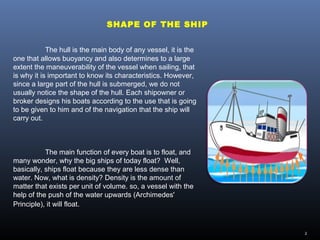
The hull is the main body of any vessel, it is the 
one that allows buoyancy and also determines to a large 
extent the maneuverability of the vessel when sailing, that 
is why it is important to know its characteristics. However, 
since a large part of the hull is submerged, we do not 
usually notice the shape of the hull. Each shipowner or 
broker designs his boats according to the use that is going 
to be given to him and of the navigation that the ship will 
carry out.
The main function of every boat is to float, and 
many wonder, why the big ships of today float?  Well, 
basically, ships float because they are less dense than 
water. Now, what is density? Density is the amount of 
matter that exists per unit of volume. so, a vessel with the 
help of the push of the water upwards (Archimedes' 
Principle), it will float.
2
SHAPE OF THE SHIP
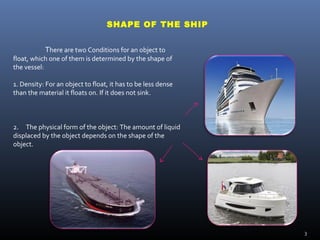
There are two Conditions for an object to
float, which one of them is determined by the shape of
the vessel:
1. Density: For an object to float, it has to be less dense
than the material it floats on. If it does not sink.
2. The physical form of the object: The amount of liquid
displaced by the object depends on the shape of the
object.
3
SHAPES OF THE TYPES VESSEL'S
HULL
When refer to the hull of the vessel by its
shape, we are refer in itself to the shape of the ship's
careenage (which is the volume limited by the hull
and by the floating surface in a vessel, that is, to the
submerged volume).
So, exist of different ship's hull or careen:
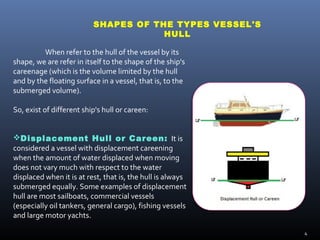
Displacement Hull or Careen: It is
considered a vessel with displacement careening
when the amount of water displaced when moving
does not vary much with respect to the water
displaced when it is at rest, that is, the hull is always
submerged equally. Some examples of displacement
hull are most sailboats, commercial vessels
(especially oil tankers, general cargo), fishing vessels
and large motor yachts.
4
SHAPES OF THE TYPES VESSEL'S HULL
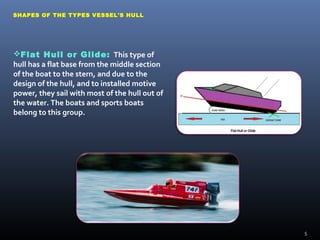
Flat Hull or Glide: This type of
hull has a flat base from the middle section
of the boat to the stern, and due to the
design of the hull, and to installed motive
power, they sail with most of the hull out of
the water. The boats and sports boats
belong to this group.
5
SHAPES OF THE TYPES VESSEL'S HULL
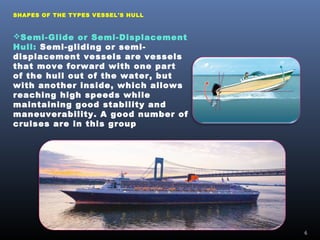
Semi-Glide or Semi-Displacement
Hull: Semi-gliding or semi-
displacement vessels are vessels
that move forward with one part
of the hull out of the water, but
with another inside, which allows
reaching high speeds while
maintaining good stability and
maneuverability. A good number of
cruises are in this group
6
SHAPES OF THE TYPES VESSEL'S HULL
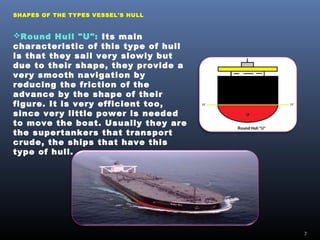
Round Hull "U": Its main
characteristic of this type of hull
is that they sail very slowly but
due to their shape, they provide a
very smooth navigation by
reducing the friction of the
advance by the shape of their
figure. It is very efficient too,
since very little power is needed
to move the boat. Usually they are
the supertankers that transport
crude, the ships that have this
type of hull.
7
SHAPES OF THE TYPES VESSEL'S HULL
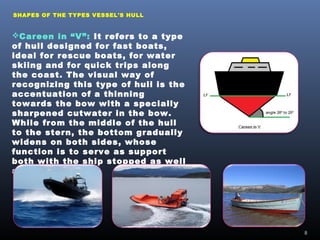
Careen in “V”: It refers to a type
of hull designed for fast boats,
ideal for rescue boats, for water
skiing and for quick trips along
the coast. The visual way of
recognizing this type of hull is the
accentuation of a thinning
towards the bow with a specially
sharpened cutwater in the bow.
While from the middle of the hull
to the stern, the bottom gradually
widens on both sides, whose
function is to serve as support
both with the ship stopped as well
as in navigation.
8
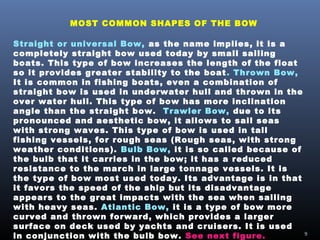
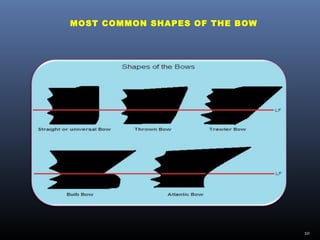
MOST COMMON SHAPES OF THE BOW
Straight or universal Bow, as the name implies, it is a
completely straight bow used today by small sailing
boats. This type of bow increases the length of the float
so it provides greater stability to the boat. Thrown Bow,
It is common in fishing boats, even a combination of
straight bow is used in underwater hull and thrown in the
over water hull. This type of bow has more inclination
angle than the straight bow. Trawler Bow, due to its
pronounced and aesthetic bow, it allows to sail seas
with strong waves. This type of bow is used in tall
fishing vessels, for rough seas (Rough seas, with strong
weather conditions). Bulb Bow, it is so called because of
the bulb that it carries in the bow; it has a reduced
resistance to the march in large tonnage vessels. It is
the type of bow most used today. Its advantage is in that
it favors the speed of the ship but its disadvantage
appears to the great impacts with the sea when sailing
with heavy seas. Atlantic Bow, it is a type of bow more
curved and thrown forward, which provides a larger
surface on deck used by yachts and cruisers. It is used
in conjunction with the bulb bow. See next figure. 9
MOST COMMON SHAPES OF THE BOW
10
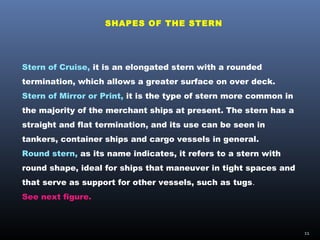
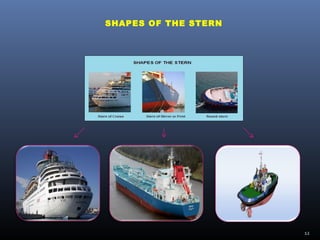
SHAPES OF THE STERN
Stern of Cruise, it is an elongated stern with a rounded
termination, which allows a greater surface on over deck.
Stern of Mirror or Print, it is the type of stern more common in
the majority of the merchant ships at present. The stern has a
straight and flat termination, and its use can be seen in
tankers, container ships and cargo vessels in general.
Round stern, as its name indicates, it refers to a stern with
round shape, ideal for ships that maneuver in tight spaces and
that serve as support for other vessels, such as tugs.
See next figure.
11
SHAPES OF THE STERN
12
thanks for your
attention
I hope that this academic material has
been of great interest and help for your
training ...
13

Shape of the ship. presentation

  • 1.
      Bolivarian Republic ofVenezuela Maritime University of the Caribbean Nautical School of Venezuela Maritime Engineering Maritime Operations SHAPE OF THE SHIP Cadet: Frangi Lanza Catia la Mar, 2018. 1
  • 2.
    SHAPE OF THESHIP The hull is the main body of any vessel, it is the  one that allows buoyancy and also determines to a large  extent the maneuverability of the vessel when sailing, that  is why it is important to know its characteristics. However,  since a large part of the hull is submerged, we do not  usually notice the shape of the hull. Each shipowner or  broker designs his boats according to the use that is going  to be given to him and of the navigation that the ship will  carry out. The main function of every boat is to float, and  many wonder, why the big ships of today float?  Well,  basically, ships float because they are less dense than  water. Now, what is density? Density is the amount of  matter that exists per unit of volume. so, a vessel with the  help of the push of the water upwards (Archimedes'  Principle), it will float. 2
  • 3.
    SHAPE OF THESHIP There are two Conditions for an object to float, which one of them is determined by the shape of the vessel: 1. Density: For an object to float, it has to be less dense than the material it floats on. If it does not sink. 2. The physical form of the object: The amount of liquid displaced by the object depends on the shape of the object. 3
  • 4.
    SHAPES OF THETYPES VESSEL'S HULL When refer to the hull of the vessel by its shape, we are refer in itself to the shape of the ship's careenage (which is the volume limited by the hull and by the floating surface in a vessel, that is, to the submerged volume). So, exist of different ship's hull or careen: Displacement Hull or Careen: It is considered a vessel with displacement careening when the amount of water displaced when moving does not vary much with respect to the water displaced when it is at rest, that is, the hull is always submerged equally. Some examples of displacement hull are most sailboats, commercial vessels (especially oil tankers, general cargo), fishing vessels and large motor yachts. 4
  • 5.
    SHAPES OF THETYPES VESSEL'S HULL Flat Hull or Glide: This type of hull has a flat base from the middle section of the boat to the stern, and due to the design of the hull, and to installed motive power, they sail with most of the hull out of the water. The boats and sports boats belong to this group. 5
  • 6.
    SHAPES OF THETYPES VESSEL'S HULL Semi-Glide or Semi-Displacement Hull: Semi-gliding or semi- displacement vessels are vessels that move forward with one part of the hull out of the water, but with another inside, which allows reaching high speeds while maintaining good stability and maneuverability. A good number of cruises are in this group 6
  • 7.
    SHAPES OF THETYPES VESSEL'S HULL Round Hull "U": Its main characteristic of this type of hull is that they sail very slowly but due to their shape, they provide a very smooth navigation by reducing the friction of the advance by the shape of their figure. It is very efficient too, since very little power is needed to move the boat. Usually they are the supertankers that transport crude, the ships that have this type of hull. 7
  • 8.
    SHAPES OF THETYPES VESSEL'S HULL Careen in “V”: It refers to a type of hull designed for fast boats, ideal for rescue boats, for water skiing and for quick trips along the coast. The visual way of recognizing this type of hull is the accentuation of a thinning towards the bow with a specially sharpened cutwater in the bow. While from the middle of the hull to the stern, the bottom gradually widens on both sides, whose function is to serve as support both with the ship stopped as well as in navigation. 8
  • 9.
    MOST COMMON SHAPESOF THE BOW Straight or universal Bow, as the name implies, it is a completely straight bow used today by small sailing boats. This type of bow increases the length of the float so it provides greater stability to the boat. Thrown Bow, It is common in fishing boats, even a combination of straight bow is used in underwater hull and thrown in the over water hull. This type of bow has more inclination angle than the straight bow. Trawler Bow, due to its pronounced and aesthetic bow, it allows to sail seas with strong waves. This type of bow is used in tall fishing vessels, for rough seas (Rough seas, with strong weather conditions). Bulb Bow, it is so called because of the bulb that it carries in the bow; it has a reduced resistance to the march in large tonnage vessels. It is the type of bow most used today. Its advantage is in that it favors the speed of the ship but its disadvantage appears to the great impacts with the sea when sailing with heavy seas. Atlantic Bow, it is a type of bow more curved and thrown forward, which provides a larger surface on deck used by yachts and cruisers. It is used in conjunction with the bulb bow. See next figure. 9
  • 10.
    MOST COMMON SHAPESOF THE BOW 10
  • 11.
    SHAPES OF THESTERN Stern of Cruise, it is an elongated stern with a rounded termination, which allows a greater surface on over deck. Stern of Mirror or Print, it is the type of stern more common in the majority of the merchant ships at present. The stern has a straight and flat termination, and its use can be seen in tankers, container ships and cargo vessels in general. Round stern, as its name indicates, it refers to a stern with round shape, ideal for ships that maneuver in tight spaces and that serve as support for other vessels, such as tugs. See next figure. 11
  • 12.
    SHAPES OF THESTERN 12
  • 13.
    thanks for your attention Ihope that this academic material has been of great interest and help for your training ... 13