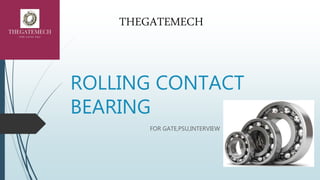

ROLLING CONTACT
BEARING
FOR GATE,PSU,INTERVIEW
THEGATEMECH
BEARING DEFINATION
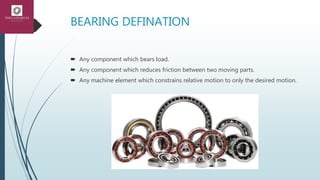
 Any component which bears load.
 Any component which reduces friction between two moving parts.
 Any machine element which constrains relative motion to only the desired motion.
Bearing classification
 Mainly bearing is classified into two broad categories :-
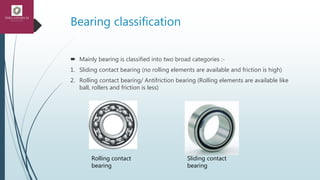
1. Sliding contact bearing (no rolling elements are available and friction is high)
2. Rolling contact bearing/ Antifriction bearing (Rolling elements are available like
ball, rollers and friction is less)
Rolling contact
bearing
Sliding contact
bearing
Types of Rolling Contact Bearing
 ACCORDING TO TYPE OS ROLLING ELEMENT :-
1. BALL BEARING
2. ROLLER BEARING
I. CYLINDRICAL ROLLER BEARING
II. SPHERICAL ROLLER BEARING
III. NEEDLE ROLLER BEARING
IV. TAPERED ROLLER BEARING
 Ball and roller bearing consist of an inner race which is mounted on the shaft or
journal and an outer race which is carried by housing. In between inner and outer
race there are balls and rollers. A number of balls or rollers are used and these are
held at proper distances by retainers so that they do not touch each other. The
retainers are thin strips and is usually in two parts which are assembled after the
balls have been properly spaced. The ball bearings are used for light loads and the
roller bearings are used for heavier loads.
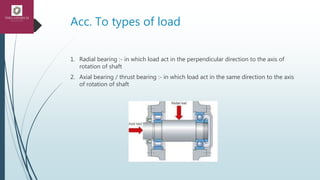
Acc. To types of load
1. Radial bearing :- in which load act in the perpendicular direction to the axis of
rotation of shaft
2. Axial bearing / thrust bearing :- in which load act in the same direction to the axis
of rotation of shaft
Types of Ball Bearing
1. Single row radial ball bearing
2. Single row radial ball bearing with tapered bore
3. Single row angular contact ball bearing
4. Single row externally aligned ball bearing
5. double row self aligned ball bearing
6. Thrust ball bearing
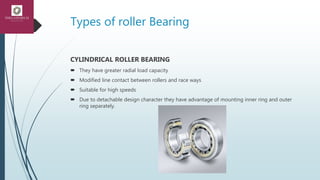
Types of roller Bearing
CYLINDRICAL ROLLER BEARING
 They have greater radial load capacity
 Modified line contact between rollers and race ways
 Suitable for high speeds
 Due to detachable design character they have advantage of mounting inner ring and outer
ring separately.
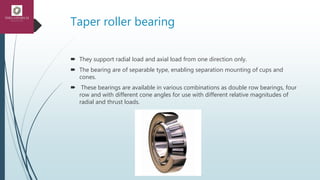
Taper roller bearing
 They support radial load and axial load from one direction only.
 The bearing are of separable type, enabling separation mounting of cups and
cones.
 These bearings are available in various combinations as double row bearings, four
row and with different cone angles for use with different relative magnitudes of
radial and thrust loads.
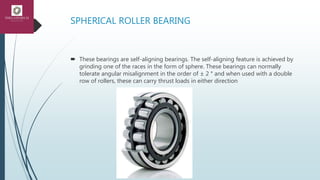
SPHERICAL ROLLER BEARING
 These bearings are self-aligning bearings. The self-aligning feature is achieved by
grinding one of the races in the form of sphere. These bearings can normally
tolerate angular misalignment in the order of ± 2 ° and when used with a double
row of rollers, these can carry thrust loads in either direction
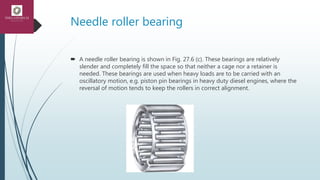
Needle roller bearing
 A needle roller bearing is shown in Fig. 27.6 (c). These bearings are relatively
slender and completely fill the space so that neither a cage nor a retainer is
needed. These bearings are used when heavy loads are to be carried with an
oscillatory motion, e.g. piston pin bearings in heavy duty diesel engines, where the
reversal of motion tends to keep the rollers in correct alignment.
THEGATEMECH
LIKE
SUBSCRIBE
& COMMENT
THANK YOU

Rolling contact bearing

  • 1.
  • 2.
    BEARING DEFINATION  Anycomponent which bears load.  Any component which reduces friction between two moving parts.  Any machine element which constrains relative motion to only the desired motion.
  • 3.
    Bearing classification  Mainlybearing is classified into two broad categories :- 1. Sliding contact bearing (no rolling elements are available and friction is high) 2. Rolling contact bearing/ Antifriction bearing (Rolling elements are available like ball, rollers and friction is less) Rolling contact bearing Sliding contact bearing
  • 4.
    Types of RollingContact Bearing  ACCORDING TO TYPE OS ROLLING ELEMENT :- 1. BALL BEARING 2. ROLLER BEARING I. CYLINDRICAL ROLLER BEARING II. SPHERICAL ROLLER BEARING III. NEEDLE ROLLER BEARING IV. TAPERED ROLLER BEARING
  • 5.
     Ball androller bearing consist of an inner race which is mounted on the shaft or journal and an outer race which is carried by housing. In between inner and outer race there are balls and rollers. A number of balls or rollers are used and these are held at proper distances by retainers so that they do not touch each other. The retainers are thin strips and is usually in two parts which are assembled after the balls have been properly spaced. The ball bearings are used for light loads and the roller bearings are used for heavier loads.
  • 6.
    Acc. To typesof load 1. Radial bearing :- in which load act in the perpendicular direction to the axis of rotation of shaft 2. Axial bearing / thrust bearing :- in which load act in the same direction to the axis of rotation of shaft
  • 7.
    Types of BallBearing 1. Single row radial ball bearing 2. Single row radial ball bearing with tapered bore 3. Single row angular contact ball bearing 4. Single row externally aligned ball bearing 5. double row self aligned ball bearing 6. Thrust ball bearing
  • 8.
    Types of rollerBearing CYLINDRICAL ROLLER BEARING  They have greater radial load capacity  Modified line contact between rollers and race ways  Suitable for high speeds  Due to detachable design character they have advantage of mounting inner ring and outer ring separately.
  • 9.
    Taper roller bearing They support radial load and axial load from one direction only.  The bearing are of separable type, enabling separation mounting of cups and cones.  These bearings are available in various combinations as double row bearings, four row and with different cone angles for use with different relative magnitudes of radial and thrust loads.
  • 10.
    SPHERICAL ROLLER BEARING These bearings are self-aligning bearings. The self-aligning feature is achieved by grinding one of the races in the form of sphere. These bearings can normally tolerate angular misalignment in the order of ± 2 ° and when used with a double row of rollers, these can carry thrust loads in either direction
  • 11.
    Needle roller bearing A needle roller bearing is shown in Fig. 27.6 (c). These bearings are relatively slender and completely fill the space so that neither a cage nor a retainer is needed. These bearings are used when heavy loads are to be carried with an oscillatory motion, e.g. piston pin bearings in heavy duty diesel engines, where the reversal of motion tends to keep the rollers in correct alignment.
  • 12.