CHAPTER-4
NAUTICAL AND ENG. TERMS- PARTS OF SHIP
NAUTICAL TERMS
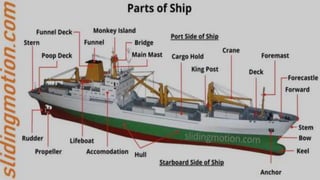
Monkey Island:
•Monkey Island is a sort of deck located at the topmost accessible height of the ship and just above the bridge.
•This part of a ship is sometimes also referred to as a flying bridge and, in the past, was used by the sailors for solar and stellar
observations. In addition, it houses a magnetic compass.
•It is an integral part of ship and houses driving units such as VDR capsule, AIS Tx/Rx antennae, Radar scanner(s) attached to the
radar mast, Sat C/F77 Tx/Rx antennae, communication equipment gear, various halyards connected to the yardarm to hoist flags,
weather vane, and the masts leading up to the ‘Christmas Tree’ (navigation lights) and the ship’s aft whistle.
Bridge:
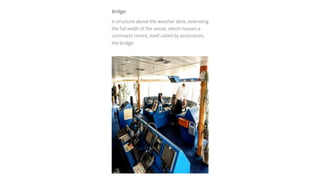
•The ship’s bridge is the commanding station of a ship. It controls the ship movement through its navigational equipment.
•It controls important deck machinery, main engine and ship’s navigation system.
•Functions that are usually performed on the ship bridge are: controls the ship’s speed and direction (navigation), monitor
weather and sea conditions, navigating and fixing the position of the ship, and facilitating internal as well as external
communication.
Funnel:
•A Funnel or Stacks is a chimney on a vessel used to discharge engine and boiler smoke.
•Lifting of the exhaust gasses, clear from the deck, is the constitutional purpose of the Funnel.
Accommodation:
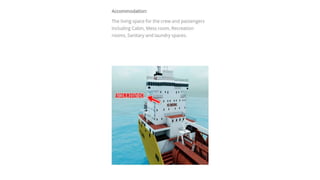
•The accommodation area is the house for crews and lives. It has all the amenities, including offices, gym, crew cabins, hospital,
salon, recreation room, common rooms, laundry, and galley.
•It is a key part of the ship and consists of the garbage disposal system, freshwater system, sewage treatment plant, refrigeration
system (domestic) and air conditioning for the accommodation block.
•It is a necessary part of a ship and facilitates space for relaxing, medical facility and food courts.
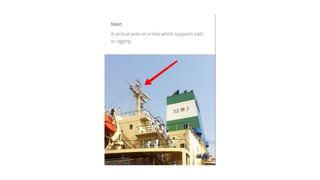
Mast:
•The mast is a rangy spar arrangement that is elevated more or less vertically to the Centreline of a ship.
•It has several purposes, including carrying derricks and giving fundamental height to the navigation light, salient yards, radio or
radar aerials, and scanners.
Stem:
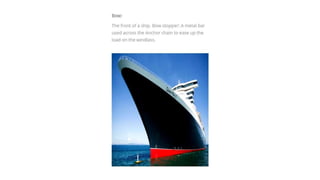
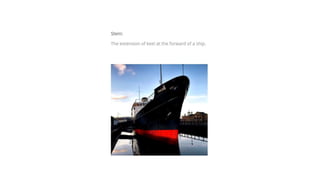
•The front-most part of the boat or ship’s bow is termed as the Stem of the ship.
•The keel itself is extended up to gunwale to form the curved edge called the ship’s stem.
•These stems can be of two styles viz. raked and plumb stems, where the former is inclined at some angle to the waterline and
later is perpendicular to the waterline.
Forecastle:
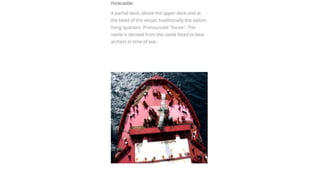
•The forecastle is one of the foremost parts of the ship of length less than 7% of the total deck length.
•It was initially used in military vessels, in which the soldiers used forecastles to take defensive positions.
•But, today, forecastle serves many functions such as holding, anchoring and securing the major parts of the ship.
Bulbous Bow:
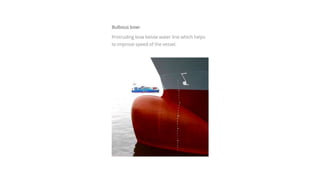
•It is a jut out bulb at the bow of the vessel just below the W/L.
•It cuts the water and tweaks the water flow around the hull, increasing the vessel’s speed, fuel efficiency and stability.
•12-15% of better fuel efficiency is observed in the vessel with the bulbous bow.
•It also increases the buoyancy of the onward part of the vessel, which reduces pitching up to some extent.
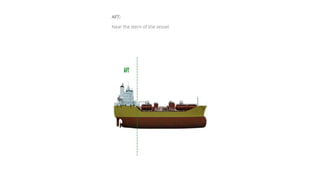
Stern:
•The stern is an aft-end structure designed to provide low resistance, high propulsion efficiency, and avoid vibrations.
•It is the rearmost part of a ship that keeps the water out. Rudders and propellers are hanged to the stern.
•The stern can be shaped flat, canoe-like, tapered, sharp to serve the purpose of cutting the water in its way.
Poop Deck:
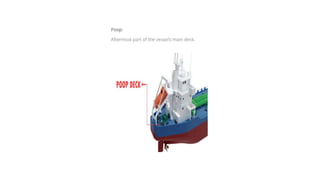
•It serves as a roof to the cabin constructed in the aft of the ship.
•It facilitates the captain and helmsman to supervise the entire working crew.
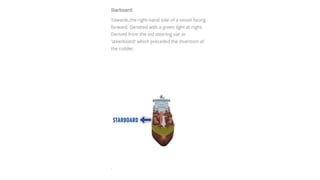
•But in modern ships, the poop decks are provided either in the centre of the ship or on the starboard.
Side Thrusters:
•These are somewhat like a propeller and fitted on either side of the bow of the ship.
•It helps in manoeuvring ships at a slow speed in congested waters near ports or canals. These are also referred to as tunnel
thrusters.
•Side thrusters influence the total running cost of a ship to a greater extent. These are either hydraulically or electrically powered.
Rudder:
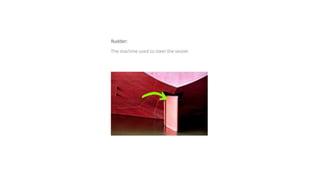
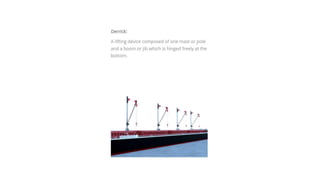
•Without steering, we can’t move a vehicle in the desired direction, so the propeller propels the ship, and the rudder steers the
ship. The rudder is a flat hollow structure housed in the aft of the propeller.
•It consists of the following parts: rudder trunk, moveable flap, main rudder blade, hinge system, links and rudder carrier bearing.
Rudders are of three types: balanced type, semi-balanced type and unbalanced type rudder.
•As a vital part of the ship, the rudder is provided with a steering gear system that controls the rudder’s movement. It works on
Newton’s Third Law of motion.
Propeller:
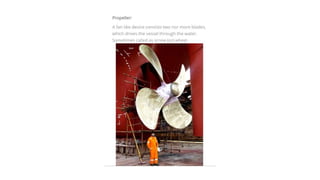
•It is a mechanical device having blades fitted on a central shaft. These blades rotate, and their rotational energy is converted
into pressure energy, and due to this, the propeller produces the thrust required for propulsion. It pushes the seawater
backwards, and, in turn, the seawater helps the ship move forward.
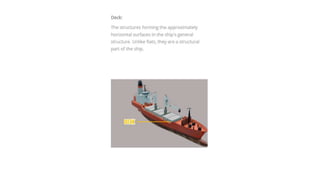
•Engine, shaft and propeller together constitute propulsion unit. The propeller should be made up of aluminium, bronze,
manganese etc., which are excellent corrosion resistant alloys. There can be one, two or three propellers.
•It is the most important part of the ship without which a ship can’t move. So, the main function of the propeller is to propel the
ship in the forward direction by producing thrust on water.
Paint Room:
•A small onboard area is required in marine vessels to handle and store paint. This room is known as the Paint room.
•Special provisions are there for the paint room to cater explosions and release of chemical gases and vapours from these
enamels.
•There should be explosion-proof lighting in the paint room, and brackets should be available to provide flexible mounting and
storage of paints.
Emergency Generator Room:
•When the main supply goes out of order, a small separate generator supplies electricity for emergency loads. This is called an
emergency generator.
•It is located above the topmost deck, away from main and secondary machinery and collision bulkhead, and has its own
switchboard in its surroundings.
•This generator should be easily operable and can be started at even 0°C
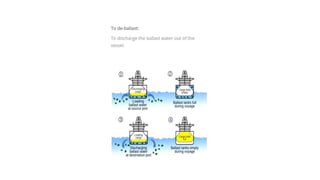
Ballast Tanks:
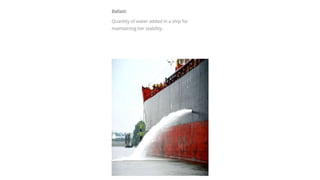
•The compartments maintained specially to carry water, which serves the purpose of ballasting and stabilizing the vessel, are
termed Ballast Tanks.
•These tanks should be provided with proper care to prevent corrosion, as seawater is highly corrosive.
•These tanks are revolutionary to the marine industry as, before their evolution, solid ballast was used, and their discharge is quite
difficult compared to easier pumping of liquid ballast.
Bunker tanks:
•The tanks on the ships used to store fuel and lube oils on ships are known as bunker tanks.
•These lube oils are required for safer machinery operations, and the fuel is used for emergency or regular operations.
•As these tanks store sludge, diesel, oils etc., which can catch fire immediately, they are provided separately and far from ignition
prone areas.
Ship Cargo gear (Derrick/Cranes etc.):
•Derricks (Cranes) are used to lift and carry the safe working load on a ship.
•These are electrically or hydraulically operated equipment for easier operations.
•The capacity of ship cargo cranes and gears for handling cargos is 15 tons to 4000 tons per hour.
Samson Post/King Post:
•It is a heavy vertical post that supports the cargo booms.
•It rests on the Keelson and supports the deck beam of a vessel.
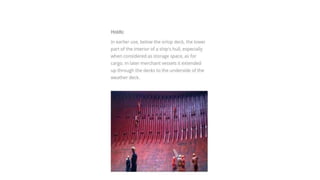
Cargo hold:
•Enclosed spaces to retain and store cargo or freight containers carrying coal, grain and salt are referred to as cargo holds.
•The cargo hold is located under the ship’s deck and has a holding capacity ranging from 20 tons to 200000 tons.
•The main function of the cargo hold is to preserve cargo when it is transported to the destination.
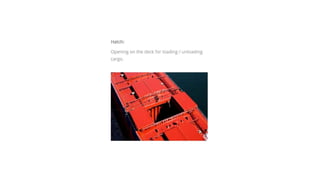
Hatch Cover:
•To prevent the cargo storage from spoilage, especially to make storage spaces airtight and watertight, hatch covers are required.
Generally, to save the food items ( or any other cargo) transported by ship from rain during the voyage.
•The design of the hatch cover changes according to the type of the vessel, but the only requirement is that it should be quick
enough to provide faster cargo handling processes.
•In the past, these hatch covers were crane or winch driven, but today, mainly hydraulically driven hatch covers are used.
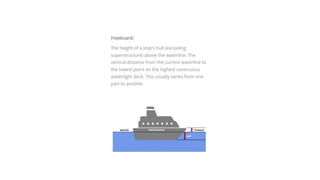
Freeboard:
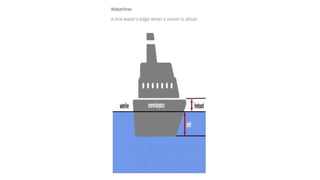
•Freeboard can be defined as the distance measured from the waterline to the higher edge of the freeboard plating/deck plating
at the sides of amidships.
•The classification society must approve the minimum freeboard calculation for a vessel.
•The calculation of freeboard plays a critical role in defining the load line marks of the vessel, which in turn, is directly related to
the cargo-carrying or the earning capacity of the vessel.
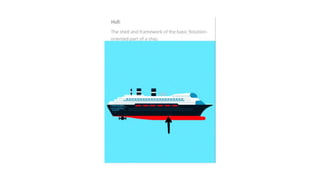
Hull:
•The hull is a watertight vessel’s body that may be open or partially covered with a deck.
•Hull has several watertight decks and bulkheads as the major transverse membrane.
•The intermediate member of the hull consists of girders, webs and stringers.
•Depending on the structural arrangements, there may be longitudinal members for strengthening purposes.
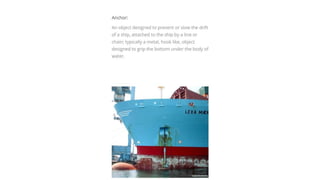
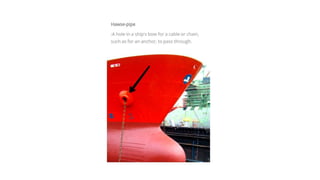
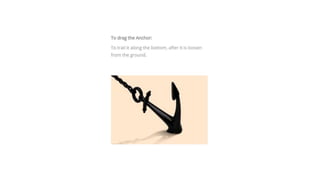
Anchor
An anchor is a hefty piece of metal that is attached to chain cables and is stowed or fastened in the hose pipe throughout the
journey or ship operation. With the extra subclass of sea anchors, it might be permanent or temporary.
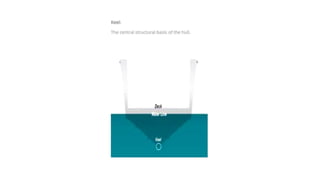
Keel
The keel of a ship can be compared to the spinal cord of a person. The keel of a ship is a flat, blade-like structure that supports
the weight of the watercraft in the same way as the spine of a human maintains the backbone erect by linking and supporting
the body. Because it is the primary longitudinal component of the ship, all of the ship’s other significant structural components
are connected to it. In other words, the ship cannot function without it.
The keel of a ship is located at the bottom of the ship’s hull’s centerline. Do you know that the keel is frequently the first
component of a ship’s hull to be built? However, large modern ships are frequently constructed from a number of prefabricated,
complete hull sections as opposed to a single keel. The shipbuilding process will then commence with the cutting of the first steel
sheet. The keel also aids in maintaining the upright position of a boat, preventing the wind from causing it to list to one side.
Engine Room:
• The engine room is the ship’s powerhouse, and it is positioned on the lowest deck, aft. It contains essential
machinery such as the main engine, the auxiliary engine (Alternator), the shafting, the boiler, the freshwater
generator, the air compressor, the calorifier, the purifier, the incinerator, the pumps, the heat exchangers, the
workshop machinery, among others.
• The primary function of the engine room is to house the essential machinery and auxiliary equipment
required for various shipboard activities. On the first deck, there are typically control panels for diesel
generators and pumps, a workshop, a storage area, settling tanks, service tanks, freshwater expansion tanks,
an Inert gas platform, a deck air compressor, air bottles, etc.

Nautical and engineering terms and concepts .pptx

  • 1.
    CHAPTER-4 NAUTICAL AND ENG.TERMS- PARTS OF SHIP
  • 2.
  • 96.
    Monkey Island: •Monkey Islandis a sort of deck located at the topmost accessible height of the ship and just above the bridge. •This part of a ship is sometimes also referred to as a flying bridge and, in the past, was used by the sailors for solar and stellar observations. In addition, it houses a magnetic compass. •It is an integral part of ship and houses driving units such as VDR capsule, AIS Tx/Rx antennae, Radar scanner(s) attached to the radar mast, Sat C/F77 Tx/Rx antennae, communication equipment gear, various halyards connected to the yardarm to hoist flags, weather vane, and the masts leading up to the ‘Christmas Tree’ (navigation lights) and the ship’s aft whistle. Bridge: •The ship’s bridge is the commanding station of a ship. It controls the ship movement through its navigational equipment. •It controls important deck machinery, main engine and ship’s navigation system. •Functions that are usually performed on the ship bridge are: controls the ship’s speed and direction (navigation), monitor weather and sea conditions, navigating and fixing the position of the ship, and facilitating internal as well as external communication. Funnel: •A Funnel or Stacks is a chimney on a vessel used to discharge engine and boiler smoke. •Lifting of the exhaust gasses, clear from the deck, is the constitutional purpose of the Funnel. Accommodation: •The accommodation area is the house for crews and lives. It has all the amenities, including offices, gym, crew cabins, hospital, salon, recreation room, common rooms, laundry, and galley. •It is a key part of the ship and consists of the garbage disposal system, freshwater system, sewage treatment plant, refrigeration system (domestic) and air conditioning for the accommodation block. •It is a necessary part of a ship and facilitates space for relaxing, medical facility and food courts.
  • 97.
    Mast: •The mast isa rangy spar arrangement that is elevated more or less vertically to the Centreline of a ship. •It has several purposes, including carrying derricks and giving fundamental height to the navigation light, salient yards, radio or radar aerials, and scanners. Stem: •The front-most part of the boat or ship’s bow is termed as the Stem of the ship. •The keel itself is extended up to gunwale to form the curved edge called the ship’s stem. •These stems can be of two styles viz. raked and plumb stems, where the former is inclined at some angle to the waterline and later is perpendicular to the waterline. Forecastle: •The forecastle is one of the foremost parts of the ship of length less than 7% of the total deck length. •It was initially used in military vessels, in which the soldiers used forecastles to take defensive positions. •But, today, forecastle serves many functions such as holding, anchoring and securing the major parts of the ship. Bulbous Bow: •It is a jut out bulb at the bow of the vessel just below the W/L. •It cuts the water and tweaks the water flow around the hull, increasing the vessel’s speed, fuel efficiency and stability. •12-15% of better fuel efficiency is observed in the vessel with the bulbous bow. •It also increases the buoyancy of the onward part of the vessel, which reduces pitching up to some extent. Stern: •The stern is an aft-end structure designed to provide low resistance, high propulsion efficiency, and avoid vibrations. •It is the rearmost part of a ship that keeps the water out. Rudders and propellers are hanged to the stern. •The stern can be shaped flat, canoe-like, tapered, sharp to serve the purpose of cutting the water in its way.
  • 98.
    Poop Deck: •It servesas a roof to the cabin constructed in the aft of the ship. •It facilitates the captain and helmsman to supervise the entire working crew. •But in modern ships, the poop decks are provided either in the centre of the ship or on the starboard. Side Thrusters: •These are somewhat like a propeller and fitted on either side of the bow of the ship. •It helps in manoeuvring ships at a slow speed in congested waters near ports or canals. These are also referred to as tunnel thrusters. •Side thrusters influence the total running cost of a ship to a greater extent. These are either hydraulically or electrically powered. Rudder: •Without steering, we can’t move a vehicle in the desired direction, so the propeller propels the ship, and the rudder steers the ship. The rudder is a flat hollow structure housed in the aft of the propeller. •It consists of the following parts: rudder trunk, moveable flap, main rudder blade, hinge system, links and rudder carrier bearing. Rudders are of three types: balanced type, semi-balanced type and unbalanced type rudder. •As a vital part of the ship, the rudder is provided with a steering gear system that controls the rudder’s movement. It works on Newton’s Third Law of motion. Propeller: •It is a mechanical device having blades fitted on a central shaft. These blades rotate, and their rotational energy is converted into pressure energy, and due to this, the propeller produces the thrust required for propulsion. It pushes the seawater backwards, and, in turn, the seawater helps the ship move forward. •Engine, shaft and propeller together constitute propulsion unit. The propeller should be made up of aluminium, bronze, manganese etc., which are excellent corrosion resistant alloys. There can be one, two or three propellers. •It is the most important part of the ship without which a ship can’t move. So, the main function of the propeller is to propel the ship in the forward direction by producing thrust on water.
  • 99.
    Paint Room: •A smallonboard area is required in marine vessels to handle and store paint. This room is known as the Paint room. •Special provisions are there for the paint room to cater explosions and release of chemical gases and vapours from these enamels. •There should be explosion-proof lighting in the paint room, and brackets should be available to provide flexible mounting and storage of paints. Emergency Generator Room: •When the main supply goes out of order, a small separate generator supplies electricity for emergency loads. This is called an emergency generator. •It is located above the topmost deck, away from main and secondary machinery and collision bulkhead, and has its own switchboard in its surroundings. •This generator should be easily operable and can be started at even 0°C Ballast Tanks: •The compartments maintained specially to carry water, which serves the purpose of ballasting and stabilizing the vessel, are termed Ballast Tanks. •These tanks should be provided with proper care to prevent corrosion, as seawater is highly corrosive. •These tanks are revolutionary to the marine industry as, before their evolution, solid ballast was used, and their discharge is quite difficult compared to easier pumping of liquid ballast. Bunker tanks: •The tanks on the ships used to store fuel and lube oils on ships are known as bunker tanks. •These lube oils are required for safer machinery operations, and the fuel is used for emergency or regular operations. •As these tanks store sludge, diesel, oils etc., which can catch fire immediately, they are provided separately and far from ignition prone areas.
  • 100.
    Ship Cargo gear(Derrick/Cranes etc.): •Derricks (Cranes) are used to lift and carry the safe working load on a ship. •These are electrically or hydraulically operated equipment for easier operations. •The capacity of ship cargo cranes and gears for handling cargos is 15 tons to 4000 tons per hour. Samson Post/King Post: •It is a heavy vertical post that supports the cargo booms. •It rests on the Keelson and supports the deck beam of a vessel. Cargo hold: •Enclosed spaces to retain and store cargo or freight containers carrying coal, grain and salt are referred to as cargo holds. •The cargo hold is located under the ship’s deck and has a holding capacity ranging from 20 tons to 200000 tons. •The main function of the cargo hold is to preserve cargo when it is transported to the destination. Hatch Cover: •To prevent the cargo storage from spoilage, especially to make storage spaces airtight and watertight, hatch covers are required. Generally, to save the food items ( or any other cargo) transported by ship from rain during the voyage. •The design of the hatch cover changes according to the type of the vessel, but the only requirement is that it should be quick enough to provide faster cargo handling processes. •In the past, these hatch covers were crane or winch driven, but today, mainly hydraulically driven hatch covers are used. Freeboard: •Freeboard can be defined as the distance measured from the waterline to the higher edge of the freeboard plating/deck plating at the sides of amidships. •The classification society must approve the minimum freeboard calculation for a vessel. •The calculation of freeboard plays a critical role in defining the load line marks of the vessel, which in turn, is directly related to the cargo-carrying or the earning capacity of the vessel.
  • 101.
    Hull: •The hull isa watertight vessel’s body that may be open or partially covered with a deck. •Hull has several watertight decks and bulkheads as the major transverse membrane. •The intermediate member of the hull consists of girders, webs and stringers. •Depending on the structural arrangements, there may be longitudinal members for strengthening purposes. Anchor An anchor is a hefty piece of metal that is attached to chain cables and is stowed or fastened in the hose pipe throughout the journey or ship operation. With the extra subclass of sea anchors, it might be permanent or temporary. Keel The keel of a ship can be compared to the spinal cord of a person. The keel of a ship is a flat, blade-like structure that supports the weight of the watercraft in the same way as the spine of a human maintains the backbone erect by linking and supporting the body. Because it is the primary longitudinal component of the ship, all of the ship’s other significant structural components are connected to it. In other words, the ship cannot function without it. The keel of a ship is located at the bottom of the ship’s hull’s centerline. Do you know that the keel is frequently the first component of a ship’s hull to be built? However, large modern ships are frequently constructed from a number of prefabricated, complete hull sections as opposed to a single keel. The shipbuilding process will then commence with the cutting of the first steel sheet. The keel also aids in maintaining the upright position of a boat, preventing the wind from causing it to list to one side.
  • 102.
    Engine Room: • Theengine room is the ship’s powerhouse, and it is positioned on the lowest deck, aft. It contains essential machinery such as the main engine, the auxiliary engine (Alternator), the shafting, the boiler, the freshwater generator, the air compressor, the calorifier, the purifier, the incinerator, the pumps, the heat exchangers, the workshop machinery, among others. • The primary function of the engine room is to house the essential machinery and auxiliary equipment required for various shipboard activities. On the first deck, there are typically control panels for diesel generators and pumps, a workshop, a storage area, settling tanks, service tanks, freshwater expansion tanks, an Inert gas platform, a deck air compressor, air bottles, etc.