“Digital Heritage” Conference, 2012

         Shani Evenstein
   Chief Editor, Project Ben-Yehuda

       editor@benyehuda.org
www.benyehuda.org
 Creating  and maintaining a free for use,
 volunteer-based, online library of Hebrew
 literature
  • Diverse Genres: prose, poetry, drama, articles,
    essays, letters, translations, etc.
  • Free: for any use, including commercial use; mostly
    public domain, not copyrighted.
  • Volunteer-Based: all texts are produced and edited
    by volunteers.
 Founded in 1999, inspired by the English
 “Project Gutenberg”
 Books   –
  • Physical and perishable
  • Bound by supply and demand rules
  • Lack of financial incentive – prevents public access to the
    full corpus of Hebrew writings
 Libraries   –
  • Withdraw books from their collections
  • Libraries abroad - limited inventory
  • Disadvantaged social groups - limited access to resources
 Preservation      institutions / government –
  • Unable [and /or uninterested] to do the work needed
 Advanced        research –
  • dependent on digital availability
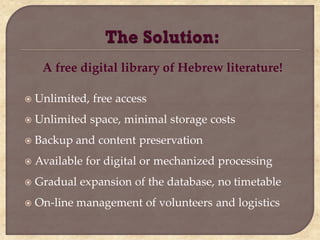
A free digital library of Hebrew literature!

   Unlimited, free access
   Unlimited space, minimal storage costs
   Backup and content preservation
   Available for digital or mechanized processing
   Gradual expansion of the database, no timetable
   On-line management of volunteers and logistics
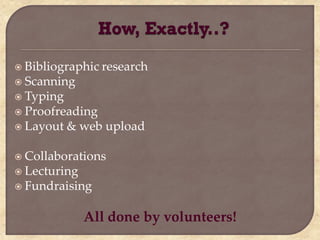
 Bibliographic research
 Scanning
 Typing
 Proofreading
 Layout   & web upload

 Collaborations
 Lecturing
 Fundraising


              All done by volunteers!
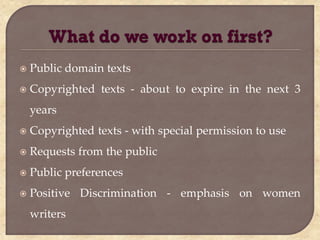
   Public domain texts
   Copyrighted texts - about to expire in the next 3
    years
   Copyrighted texts - with special permission to use
   Requests from the public
   Public preferences
   Positive Discrimination - emphasis on women
    writers
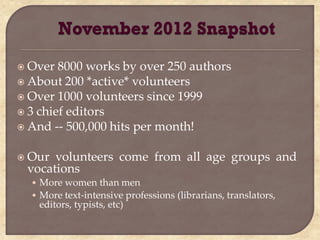
 Over  8000 works by over 250 authors
 About 200 *active* volunteers
 Over 1000 volunteers since 1999
 3 chief editors
 And -- 500,000 hits per month!


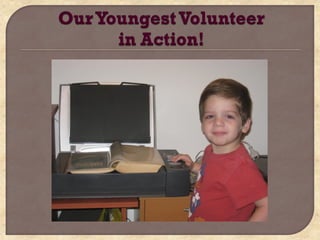
 Our volunteers come from all age groups and
 vocations
  • More women than men
  • More text-intensive professions (librarians, translators,
   editors, typists, etc)
 Teachers,  lecturers and students; cited as a
  source in both syllabi and academic papers
 Musicians and artists - choose texts to
  compose, perform or simply for inspiration
 Editors and translators
 Language lab
 But most importantly - simply people, the
  public at large, not only in Israel but around
  the world
 Main   Goals achieved - preservation, accessibility
  and exposure
 Unique achievements - compiling or publishing
  texts for the first time
 Strong presence in the Hebrew internet community
  and academic world - collaborations with NLI,
  Wikipedia, scholars and researchers
 Enabling new research in Hebrew
 New volunteers on a weekly basis without PR
 Generating good will and inspiration


            And it’s only 13 years old.. 
 Unintentional   creation of a new Hebrew
  literary canon
 Non religious texts
 Non academic project


Solutions:
- Better definition of the project and its scope
- Growing collaborations with the academic
  community – lectures, women writers project
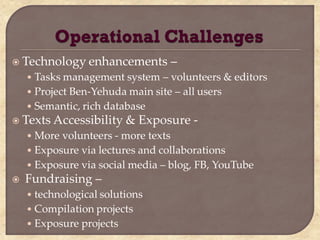
 Technology enhancements            –
    • Tasks management system – volunteers & editors
    • Project Ben-Yehuda main site – all users
    • Semantic, rich database
 Texts Accessibility     & Exposure -
    • More volunteers - more texts
    • Exposure via lectures and collaborations
    • Exposure via social media – blog, FB, YouTube
   Fundraising –
    • technological solutions
    • Compilation projects
    • Exposure projects
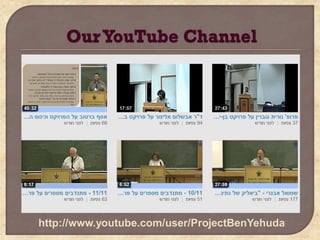
http://www.youtube.com/user/ProjectBenYehuda
Israeli Copyrights law              +
        Libraries “weeding out” collections +
        No financial incentive
                           =
       A huge portion of the Hebrew Corpus is
           unavailable, simply non-existent.
Solutions –
   Getting special permissions to publish copyrighted texts
    from copyright holders
   Efforts to publish texts that haven’t been published yet
   Copyright status can be ambiguous; an intractable status
    of some authors’ corpora copyright; pseudonyms 
    working to change the Israeli law
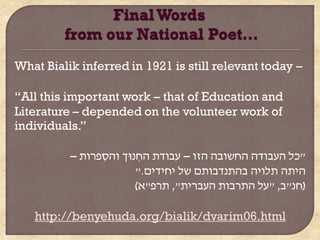
What Bialik inferred in 1921 is still relevant today –

“All this important work – that of Education and
Literature – depended on the volunteer work of
individuals.”

          – ‫"כל העבודה החשובה הזו – עבודת החנּו ך והִרוות‬
                ִ         ִ
                         ".‫היתה תלויה בהתנדבותם של יחידים‬
                         )‫(חנ"ב, "על התובות העבוית", תור"א‬

   http://benyehuda.org/bialik/dvarim06.html
Shani Evenstein

Chief Editor, Project Ben-Yehuda

    editor@benyehuda.org


    www.benyehuda.org

Shani Even - Project Ben Yehuda

  • 1.
    “Digital Heritage” Conference,2012 Shani Evenstein Chief Editor, Project Ben-Yehuda editor@benyehuda.org
  • 2.
  • 3.
     Creating and maintaining a free for use, volunteer-based, online library of Hebrew literature • Diverse Genres: prose, poetry, drama, articles, essays, letters, translations, etc. • Free: for any use, including commercial use; mostly public domain, not copyrighted. • Volunteer-Based: all texts are produced and edited by volunteers.  Founded in 1999, inspired by the English “Project Gutenberg”
  • 4.
     Books – • Physical and perishable • Bound by supply and demand rules • Lack of financial incentive – prevents public access to the full corpus of Hebrew writings  Libraries – • Withdraw books from their collections • Libraries abroad - limited inventory • Disadvantaged social groups - limited access to resources  Preservation institutions / government – • Unable [and /or uninterested] to do the work needed  Advanced research – • dependent on digital availability
  • 5.
    A free digitallibrary of Hebrew literature!  Unlimited, free access  Unlimited space, minimal storage costs  Backup and content preservation  Available for digital or mechanized processing  Gradual expansion of the database, no timetable  On-line management of volunteers and logistics
  • 6.
     Bibliographic research Scanning  Typing  Proofreading  Layout & web upload  Collaborations  Lecturing  Fundraising All done by volunteers!
  • 7.
    Public domain texts  Copyrighted texts - about to expire in the next 3 years  Copyrighted texts - with special permission to use  Requests from the public  Public preferences  Positive Discrimination - emphasis on women writers
  • 8.
     Over 8000 works by over 250 authors  About 200 *active* volunteers  Over 1000 volunteers since 1999  3 chief editors  And -- 500,000 hits per month!  Our volunteers come from all age groups and vocations • More women than men • More text-intensive professions (librarians, translators, editors, typists, etc)
  • 10.
     Teachers, lecturers and students; cited as a source in both syllabi and academic papers  Musicians and artists - choose texts to compose, perform or simply for inspiration  Editors and translators  Language lab  But most importantly - simply people, the public at large, not only in Israel but around the world
  • 11.
     Main Goals achieved - preservation, accessibility and exposure  Unique achievements - compiling or publishing texts for the first time  Strong presence in the Hebrew internet community and academic world - collaborations with NLI, Wikipedia, scholars and researchers  Enabling new research in Hebrew  New volunteers on a weekly basis without PR  Generating good will and inspiration And it’s only 13 years old.. 
  • 13.
     Unintentional creation of a new Hebrew literary canon  Non religious texts  Non academic project Solutions: - Better definition of the project and its scope - Growing collaborations with the academic community – lectures, women writers project
  • 14.
     Technology enhancements – • Tasks management system – volunteers & editors • Project Ben-Yehuda main site – all users • Semantic, rich database  Texts Accessibility & Exposure - • More volunteers - more texts • Exposure via lectures and collaborations • Exposure via social media – blog, FB, YouTube  Fundraising – • technological solutions • Compilation projects • Exposure projects
  • 15.
  • 16.
    Israeli Copyrights law + Libraries “weeding out” collections + No financial incentive = A huge portion of the Hebrew Corpus is unavailable, simply non-existent. Solutions –  Getting special permissions to publish copyrighted texts from copyright holders  Efforts to publish texts that haven’t been published yet  Copyright status can be ambiguous; an intractable status of some authors’ corpora copyright; pseudonyms  working to change the Israeli law
  • 17.
    What Bialik inferredin 1921 is still relevant today – “All this important work – that of Education and Literature – depended on the volunteer work of individuals.” – ‫"כל העבודה החשובה הזו – עבודת החנּו ך והִרוות‬ ִ ִ ".‫היתה תלויה בהתנדבותם של יחידים‬ )‫(חנ"ב, "על התובות העבוית", תור"א‬ http://benyehuda.org/bialik/dvarim06.html
  • 18.
    Shani Evenstein Chief Editor,Project Ben-Yehuda editor@benyehuda.org www.benyehuda.org