Creation And Composition 2019th Edition Jeffrey Rubenstein
1.
Creation And Composition2019th Edition Jeffrey
Rubenstein download
https://ebookbell.com/product/creation-and-composition-2019th-
edition-jeffrey-rubenstein-50822290
Explore and download more ebooks at ebookbell.com
2.
Here are somerecommended products that we believe you will be
interested in. You can click the link to download.
The Creation Composition Service And Settlement Of Roman Auxiliary
Units Raised On The Iberian Peninsula Alexander Meyer
https://ebookbell.com/product/the-creation-composition-service-and-
settlement-of-roman-auxiliary-units-raised-on-the-iberian-peninsula-
alexander-meyer-49994762
On Human Nature In Early Judaism Creation Composition And Condition
Jeffrey P Garca
https://ebookbell.com/product/on-human-nature-in-early-judaism-
creation-composition-and-condition-jeffrey-p-garca-50792190
Color And Composition For The Creative Q Improve Any Quilt With
Easytofollow Lessons Katie Pasquini Masopust
https://ebookbell.com/product/color-and-composition-for-the-creative-
q-improve-any-quilt-with-easytofollow-lessons-katie-pasquini-
masopust-4541640
The Shadow Effect Creative Lighting Posing And Composition For
Photographers David Beckstead
https://ebookbell.com/product/the-shadow-effect-creative-lighting-
posing-and-composition-for-photographers-david-beckstead-7015416
3.
Creative Composition InspirationAnd Techniques For Writing
Instruction Danita Berg
https://ebookbell.com/product/creative-composition-inspiration-and-
techniques-for-writing-instruction-danita-berg-51813528
Job Creation Job Destruction And International Competition 1st Edition
Michael W Klein Scott Schuh Robert K Triest
https://ebookbell.com/product/job-creation-job-destruction-and-
international-competition-1st-edition-michael-w-klein-scott-schuh-
robert-k-triest-51423534
Beginning Composition Tips And Techniques For Creating Wellcomposed
Works Of Art In Acrylic Watercolor Illustrated Adams
https://ebookbell.com/product/beginning-composition-tips-and-
techniques-for-creating-wellcomposed-works-of-art-in-acrylic-
watercolor-illustrated-adams-38471134
Bank Competition Efficiency And Liquidity Creation In Asia Pacific
Xiaoqing Maggie Fu
https://ebookbell.com/product/bank-competition-efficiency-and-
liquidity-creation-in-asia-pacific-xiaoqing-maggie-fu-5383008
Composition Photography Creating Structure Using Forms And Patterns
Harold Davis
https://ebookbell.com/product/composition-photography-creating-
structure-using-forms-and-patterns-harold-davis-38245838
6.
Texts and Studiesin Ancient Judaism
Texte und Studien zum Antiken Judentum
Edited by
Martin Hengel und Peter Schäfer
114
ARTIBUS
,5*2
8.
Creation and Composition
TheContribution of the Bavli Redactors
(Stammaim) to the Aggada
Edited by
Jeffrey L. Rubenstein
Mohr Siebeck
Preface
The papers collectedin this volume were presented at a conference sponsored by
the Skirball Department of Hebrew and Judaic Studies of New York University,
February 9-10, 2003.1 am grateful to Lawrence Schiffman, chairman of the de-
partment, for his support, and to Shayne Figueroa and Diane Leon-Ferdico, the
departmental administrators, for all their efforts in logistics and organization.
Many thanks to Professors Peter Schäfer and Martin Hengel for accepting
this book in their series Texts and Studies in Ancient Judaism. 1 owe a debt of
gratitude to Dr. Henning Ziebritzki of Mohr Siebeck, and to Ms. Jana Trispel,
who supervised and coordinated the publication process. I also wish to thank
Katja Vehlo for preparing the indices.
October 3, 2005
NewYork, NY
Jeffrey L. Rubenstein
12.
Table of Contents
JeffreyL. Rubenstein
Introduction 1
Parti
Texts and Topics
Alyssa M. Gray
The Power Conferred by Distance From Power: Redaction and Meaning
inb.A.Z. lOa-lla 23
Shamma Friedman
A Good Story Deserves Retelling: The Unfolding of the Akiva Legend . . 71
Jay Rovner
"Rav Assi had this old Mother": The Structure, Meaning, and Formation
of a Talmudic Story 101
Leib Moscovitz
"The Holy One Blessed be He.. .Does Not Permit the Righteous
to Stumble": Reflections on the Development of a Remarkable
BT Theologoumenon 125
Catherine Hezser
"The Slave of a Scholar is Like a Scholar": Stories About Rabbis
and Their Slaves in the Babylonian Talmud 181
Lawrence H. Schiffman
Composition and Redaction in Bavli, Pereq Heleq 201
13.
VIII Table ofContents
Part II
Historiography
Adiel Schremer
Stammaitic Historiography 219
Daniel Boyarin
The Yavneh-Cycle of the Stammaim and the Invention of the Rabbis . . . . 237
Part III
Theory and Method
Devora Steinmetz
Agada Unbound: Inter-Agadic Characterization of Sages in the Bavli
and Implications for Reading Agada 293
David Halivni
Aspects of the Formation of the Talmud 339
Joshua Levinson
The Cultural Dignity of Narrative 361
Yaakov Elman
The World of the 'Sabboraim': Cultural Aspects of Post-Redactional
Additions to the Bavli 383
Jeffrey L. Rubenstein
Criteria of Stammaitic Intervention in Aggada 417
Index of Sources 441
Index of Names and Subjects 452
14.
Introduction
by
Jeffrey L. Rubenstein
CriticalTalmud study is founded on the distinction between two primary literary
strata: meimrot, traditions attributed to named sages (the Amoraim, c. 200 450
CE), on the one hand, and setam hatalmud, the unattributed or anonymous
material, on the other. These literary strata differ in style: attributed traditions
tend to be brief, apodictic statements of law; the anonymous material contains
dialectical argumentation, commentary and analysis. Because the anonymous
material generally provides context for, and analysis of, the attributed state-
ments, it functions as a type of editing or redaction for those traditions.
The consensus of academic Talmud scholars is that the two literary strata dif-
fer not only stylistically but chronologically: the anonymous material post-dates
the attributed statements. The sages who composed that anonymous stratum are
therefore designated "post-Amoraic redactors" or "Stammaim." Scholars have
increasingly recognized the prominent role of these redactors in the composi-
tion of the Bavli. They did not act as passive conduits, merely recording the
traditions they received for posterity, nor did they limit themselves to succinct
glosses designed to provide minimal requisite explanations. On the contrary,
they added extensive discussions and commentary to the terse Amoraic tradi-
tions they received, juxtaposed them with related traditions, contextualized them
in a larger discursive framework, and created the elaborate sugyot (literary units)
that comprise the Bavli text: "Their hands were everywhere in the Talmud, and
everything derives from them."1
This characterization pertains to the halakhic portions of the Bavli. It is based
on the theories of David Weiss Halivni and Shamma Friedman, who independ-
ently proposed that the anonymous, redactional layer post-dated attributed
traditions and established criteria by which the two strata could be separated.
Their early researches and the studies of many who built upon their foundation
concentrated on halakhic sugyot, distinguishing the two strata and identifying
the pervasive redactional hand in the creation of the Bavli.
1
David Weiss Halivni, Meqorot umesorot (Jerusalem: Jewish Theological Seminary, 1982),
3:11.
15.
2 Jeffrey L.Rubenstein
Of the Bavli aggada this question - the extent of the post-Amoraic or Stam-
maitic contribution - has received much less attention. Did the redactors make
a significant contribution to the aggada of the Bavli? Did they create extensive
"aggadic sugyot" in the same way as they produced lengthy and complex
halakhic sugyotl Did they subject Amoraic aggadic traditions to the same
processes of expansion and reworking as Amoraic halakhic dicta? If so, can the
Stammaitic component of aggada be separated from the Amoraic core in the
same way as the Stammaitic halakhic stratum generally can be distinguished
from the underlying Amoraic statements? Just as certain legal terminology and
abstract concepts are found exclusively in the Stammaitic stratum, do we find
some aggadic phraseology and theological concepts only in Stammaitic aggada?
If we can sketch legal history by observing development from the Amoraic to
Stammaitic periods, can we speak of ethical, theological or historiographical
change by tracing changes in Amoraic and Stammaitic aggada?
To address these questions I organized a small conference at New York Uni-
versity. This was the Conference Statement sent to invitees:
Creation and Composition: The Contribution
of the Bavli Redactors (Stammaim) to the Aggada.
On Sunday, February 9th
and Monday, February 10"1
2003 the Skirball Department of
Hebrew and Judaic Studies of New York University will sponsor a conference, dedicated
to The Contribution of the Bavli Redactors (Stammaim) to the Aggada, that is, to all
non-legal portions of the Bavli, including midrash, narratives, theology, historiography
and liturgical texts.
A cornerstone of academic study of the Bavli is the distinction between the Amoraic and
post-Amoraic or Stammaitic strata. Most Talmudic research to date has concentrated
on halakhic portions of the Bavli where the signs of the two strata are most apparent.
However, in recent years a number of studies have identified evidence of Stammaitic
reworking of aggadic material. The purpose of this conference is to continue these efforts
to document the nature and extent of the role of the Stammaim in Bavli aggada. Presen-
tations may deal with macro or micro issues; they may be large overviews, analyses of
specific sugyot or sources, or discussions of methodological issues.
The conference will be small, consisting of 10-12 presentations by specialists for spe-
cialists. Papers will be submitted and circulated before the conference so as to allow
maximum time for discussion. The papers will hopefully be published as a volume of
collected studies.
Thirteen papers were presented at the conference, seven of which were cir-
culated beforehand, and twelve of which comprise the essays of this volume,
together with one additional paper. The schedule left ample time for questions,
comments and analysis. The extremely high level of discussion and wonderful
atmosphere of collegiality, though they cannot be reproduced exactly in this
forum, left their mark on the papers, which have been substantially revised in
light of the comments and criticisms raised at the conference. Before introducing
16.
Introduction 3
the essays,however, it is fitting to summarize some of the history of scholarship
regarding the question of the redactors and the aggada of the Bavli.
Previous Scholarship
Even before the theories of Halivni and Friedman gained widespread accept-
ance such that the question of the redactors/Stammaim and the aggada could be
posed, a number of studies, though devoted primarily to other issues, produced
insights and conclusions relevant to this topic.2
In 1982 Daniel Sperber published "On the Unfortunate Adventures of Rav
Kahana: A Passage of Saboraic Polemic from Sasanian Persia," an analysis of
the lengthy story found in bBQ 117a-b.3
Sperber dated this narrative to Sabo-
raic times largely on the basis of its content. At the conclusion of the story the
Babylonian sage Rav Kahana teaches the great Palestinian master R. Yohanan
"all his Torah" prompting R. Yohanan to concede that true mastery of Torah
is now to be found in Babylonia.4
This polemic insisting on the superiority of
Babylonian tradition resembles that of Pirkoy ben Baboy, the eighth century
tract that claimed Palestinian halakha had been hopelessly corrupted by persecu-
tions of the Byzantine era while the Babylonian tradition had been passed down
without disruption or discontinuity.5
Sperber's primary interest here was the
literary analysis of the story and the identification of Persian motifs; the article
was published in a collection entitled Irano-Judaica: studies relating to Jewish
contacts with Persian culture throughout the ages. Thus the depiction of R.
Yohanan seated atop seven cushions resembles portrayals of Persian holy men
known from seventh-eighth century Iranian art. Likewise, the description of R.
Yohanan's drooping eyebrows propped up by a silver stick is a motif attested in
Medieval Iranian literature.6
At the same time, Sperber's dating of the story has
2
Halivni first published his theory in the second volume of Meqorot umesorot, which ap-
peared in 1975. Friedman set forth his theory and methodology in an introduction to his com-
mentary on the tenth chapter of Yevamot entitled "A1 derekh heqer hasugya" ("On the Method
of Critical Research of the Sugya,"), in Mehqarim umeqorot, ed. H. Dimitrovski (New York:
Jewish Theological Seminary, 1977), 283-321. Naturally it took some time before their work
was read, absorbed and accepted by other scholars.
3
In Irano-Judaica, ed. S. Shaked (Jerusalem: Yad Izhaq Ben-Zvi, 1982), 83-100.
4
Ibid., 91-93. The sense of R. Yohanan's concession is somewhat obscure; see Sperber's
discussion p. 86 nn. 21 and 22, and pp. 96-98.
5
Pirqoy b. Baboy may have been a student of Rav Yehudai Gaon who directed the Suran
academy from 757-61 CE ; see Shalom Spiegel, "Lefarashat hapolmos shel pirqoi ben baboi,"
Harry Austryn Wolfson Jubilee Volume, eds. S. Lieberman et al. (Jerusalem: American Acad-
emy for Jewish Research, 1965), 243-74; Robert Brody, The Geonim of Babylonia and the
Shaping of Medieval Jewish Culture (New Haven and London: Yale University Press, 1998),
113-14.
6
Sperber, ibid., 90-91
17.
4 Jeffrey L.Rubenstein
tremendous implications vis-à-vis the composition of aggada in the Bavli. If the
"Saboraic" dating is accepted, then substantial portions of Bavli aggada - not
only isolated glosses and minor comments - were produced in post-Amoraic
times. Indeed, while there is some confusion about the dating of the redactors/
Stammaim and whether they predate the Saboraim or should be identified with
early Saboraim, Sperber 's locating the story in the cultural context of Pirkoy ben
Baboy and even of the controversy between Saadia Gaon and Aaron ben Meir
(tenth century) points to extensive aggadic creativity in extremely late times.7
How much the more should we then expect aggadic production in the early
post-Amoraic era.
Almost contemporaneous with Sperber's article there appeared Shaye Co-
hen's "Patriarchs and Scholarchs" ( 1981 ).s
Cohen compared the rabbinic patri-
arch (Nasi), portrayed as the head of the rabbinic school, to the Greek "schol-
arch," the leader of a philosophical academy, pointing out numerous parallels
between the two offices. At the end of the article, however, Cohen noted that
his conclusions were based on the "fundamental historicity" of the rabbinic ac-
counts, an untenable hypothesis considering that "the Babylonian Talmud has
an unfortunate habit of transmitting fictional or highly embellished accounts of
the internal affairs of the Palestinian patriarchate."9
(That "unfortunate habit"
opens fruitful avenues for study and constitutes part of the motivation for this
volume!) Indeed, Cohen's best evidence came from two lengthy Bavli narratives
that differ extensively from their Palestinian parallels. He therefore raised the
possibility that "the parallels between patriarchs and scholarchs tell us more
about the Hellenization of Babylonian Jewry in the fourth and fifth centuries
than about Hellenization of Palestinian Jewry in the second.'"0
Twenty years later this question - which I would frame more in terms of
"academization" than Hellenization - can be answered affirmatively. The issue
then centers on the identity of those responsible for the "fictional or highly em-
bellished accounts" that portray the patriarch as a "scholarch," whether the Ba-
bylonian Amoraim or Stammaim. In light of David Goodblatt's comprehensive
study demonstrating that Babylonian Amoraim congregated in small disciple
circles rather than academic institutions, we should conclude that the depiction
of the patriarch as the head of a rabbinic academy devolves from post-Amoraic
times." The Bavli redactors, operating in academic, social and institutional
7
Shamma Friedman's recent analysis, "The Further Adventures of Rav Kahana," The
Talmud Yerushalmi and Graeco-Roman Culture 111, ed P. Schäfer (Tübingen: Mohr-Siebeck,
2002), 259-63, demonstrates that the story of Rav Kahana has borrowed numerous locutions
and motifs from the story of the death of R. Eleazar b. R. Shimon of bBM 84a-b, which is itself
a late narrative. The tradition history therefore tends to confirm the late dating.
8
Shaye J. D. Cohen, "Patriarchs and Scholarchs," PAAJR 48 (1981), 57-86.
9
Ibid., 85.
10
Ibid.
" David Goodblatt, Rabbinic Instruction in Sasanian Babylonia (Leiden: Brill, 1975).
18.
Introduction 5
contexts thatdiffered from those of the Amoraim, reworked accounts of the
Palestinian patriarchs in light of their experience.
In a footnote to his observation cited above of the Bavli's "fictional or
highly embellished accounts" of the Palestinian patriarchate, Cohen adduced
bHor 13b-14a, the story of the plot of R. Meir and R. Natan to depose Rabban
Shimon b. Gamaliel, which he designated an "aggadic expansion of tSanh 7:8
and yBik 3:3, 65c.'"2
Not long after Cohen's study Goodblatt himself devoted
an extensive analysis to this text (1984).13
Goodblatt essentially concurred with
Cohen, describing the story as a "Babylonian fiction," a "Babylonian develop-
ment and expansion," and a "free literary creation.'"4
His evidence included
linguistic terms unique to the Bavli such as the Persian word qamera referring to
a decorative belt, and narrative motifs attested elsewhere in the Bavli but never
in Palestinian sources. Most importantly, the tripartite division of power among
three offices pictured in the story, namely Head of Academy, Sage and Head
of the Court, is not reflected in Palestinian traditions, but recalls the tripartite
division of offices of the Exilarch's administration known from Geonic sources.
Though not venturing a precise date, Goodblatt tended to attribute the story to
late Babylonian Amoraim, speculating that it pointed to tensions between the
sages and the exilarch in Babylonia - he seems not to have entertained the possi-
bility that the story could have originated in post-Amoraic times.15
But in light of
the theories of Halivni and Friedman, the parallels to the Geonic sources should
perhaps be taken at face value to point to a post-Amoraic date of composition.
The articles of Cohen, Goodblatt and Sperber dovetail nicely. Each scholar
recognized that the Bavli's depictions of Palestinian sages and their academy
conflict with the parallel representations in the Palestinian sources themselves.
In each case the Bavli story portrays a thriving academic institution populated
by numerous students, characterized by competition for status and governed by
a hierarchy of leaders. Convergence of this type is important as it suggests that
later sages may have reworked narratives to address central issues of importance
to them, and that dominant aspects of their cultural world may be identified.16
This realization that Bavli stories and biographical anecdotes were not reli-
able historical sources, that they could be "fictionalized or highly embellished
accounts" as Cohen put it, should also be contextualized within another trend
12
Cohen, ibid., 84 n. 68
13
David Goodblatt, "The Story of the Plot Against R. Simeon B. Gamaliel II," Zion 49
(1984), 349-74 (Hebrew).
14
Ibid., 350, 358, 371 (hamtsa'a bavlit).
15
Ibid., 371-72.
16
Subsequent research seems to confirm that depictions of highly developed academies,
though often set in Tannaitic times, are found exclusively in Bavli narratives bearing indications
of late composition, which should be attributed to the redactors. See Jeffrey L. Rubenstein,
"The Rise of the Babylonian Talmudic Academy: A Reexamination of the Talmudic Evidence,"
Jewish Studies, an Internet Journal (http://www.biu.ac.il/JS/JSIJ/jsijl.html; 2002).
19.
6 Jeffrey L.Rubenstein
of rabbinic scholarship. In the 1970s and 1980s scholars became more aware
of the "literary" character of rabbinic stories and midrashim, more sensitive
to the literary processes that created differences among "parallel" versions of
traditions found in various rabbinic compilations, and more conscious of the
problems involved in the use of rabbinic sources for historical purposes. In
a series of studies Jacob Neusner demonstrated that later rabbinic texts con-
sistently embellished versions received from earlier sources. As stories were
transmitted from generation to generation they were changed, augmented and
reworked to serve the needs of the storytellers.17
Yonah Fraenkel documented
the literary characteristics of rabbinic narratives, including paronomasia, irony
and chiastic structuring, and concluded that these texts should be seen as "liter-
ary-artistic creations," that is, fictions.18
And Joseph Heinemann's detailed study
of Leviticus Rabbah revealed the strong hand of the compiler in constructing
a midrashic work with marked ideological tendencies.19
These methodological
advances had enormous consequences. If the genre of the rabbinic story was
dramatic narrative or fiction rather than history, and if midrash could be seen
as literature as much as exegesis, then the scholar had to expect that aggadic
traditions, like much ancient oral literature, were extremely malleable, subject
to change as different "authors" or storytellers reworked their sources for their
own purposes. In the context of Bavli scholarship, the question then became:
who reworked earlier traditions and by what techniques and methods?
A long and detailed study by Shamma Friedman broke new ground on the
question, constituting a substantive advance from these tantalizing suggestions
and inferences to cogent demonstration of the workings of the redactors. An
abbreviated version of the article was published in English in 1987 followed
by the full version in Hebrew in 1993 entitled "La'aggada hahistorit batalmud
habavli" ("On the Historical Aggada of the Babylonian Talmud.")20
Friedman
17
See for example: Jacob Neusner, Development of a Legend: Studies on the Traditions
Concerning Yohanan ben Zakkai (Leiden: Brill, 1970), and The Rabbinic Traditions about the
Pharisees before 70 (3 vols; Leiden: Brill, 1971).
18
Yonah Fraenkel, "Hermeneutic Problems in the Study of the Aggadic Narrative" Tarbiz
47 (1978), 139-172 (Hebrew); "Bible Verses quoted in Tales of the Sages," Scripta Hierosol-
ymitana 22 (1971), 80-99; "Paronomasia in Aggadic Narratives," Scripta Hierosolymitana
27 (1978), 27-51; "The Structure ofTalmudic Legends," Folklore Research Center Studies 1
(1983), 45-97 (Hebrew). Much of Fraenkel's earlier work is synthesized in Darkhe ha 'aggada
vehamidrash (Masada: Yad Letalmud, 1991).
" J. Heinemann, "The Art of Composition in Leviticus Rabbah," Hasifrut 2 (1969-1971),
809-834 (Hebrew); idem, "Profile of a Midrash: The Art of Composition in Leviticus Rabba,"
JAAR31 (1971), 141-50.
20
Shamma Friedman, "Literary Development and Historicity in the Aggadic Narrative of
the Babylonian Talmud: A Study based upon B.M. 83b-86a," Community and Culture: Essays
in Jewish Studies in Honor of the Ninetieth Anniversary of the founding of Gratz College, ed.
N. Waldman (Philadelphia: Gratz College, 1987), 67-80; "La'aggada hahistorit batalmud
habavli," Saul Lieberman Memorial Volume, ed. Shamma Friedman (New York: Jewish Theo-
logical Seminary, 1993), 119-63;
20.
Introduction 7
explored thelengthy aggadic composition found at bBM 83b-86a, arguing
that the Bavli's sources included two collections of aggada extant in Palestin-
ian compilations. The sequence of traditions was therefore independent and
prior to the Bavli compilers, who had then glossed, reworked, embellished and
otherwise expanded the earlier framework. Other than identifying the "literary
sources of the rich aggadic material included in the Babylonian Talmud," the
primary thrust of the article was historiographical: Friedman argued that his-
torians must identify the "literary kernel" of rabbinic traditions before making
judgments about the historical kernel. He repeatedly pointed out how scholars
had mistakenly based conclusions on data culled from traditions within the
Bavli despite the fact that the original versions of those sources preserved in the
Palestinian documents lacked that data. These historians, in other words, based
their conclusions upon literary reworkings of no historical worth. Yet Friedman
was also interested in "the way the BT used and reworked its aggadic sources"21
and illustrated these methods in great detail. The "Bavli aggadists" (ba'alei
ha 'agadda) transferred material from elsewhere in the Bavli, duplicated motifs
found in their Palestinian sources to fashion additional episodes or new stories,
and added connecting phrases to link together disparate traditions thereby
creating a smooth narrative flow. Friedman even observed a "widespread phe-
nomenon," that the markers of the Bavli's expansions tend to be "concentrated
in another place, as if that chapter and that sugya lay open before the composer
o f t h e gemara (ba 'al hagemara)."22
As Friedman was not trying to answer the questions of who exactly was re-
sponsible for the changes and when they occurred, he used a variety of terms to
refer to the responsible parties: Aside from the "composer of the gemara" in the
citation above, he referred to "the Talmud," "composer of the Talmud/gemara
(ba'al hatalmud!gemara)" " c o m p o s e r s of t h e aggada {ba'alei ha'aggada),"
"redactor of the Bavli" (mesader habavli), "composers of the unattributed
portion of the Talmud (ba 'alei stam hatalmud')," and "late redactors of aggada
(mesadrei aggada me'uharim)."23
In the English version, however, Friedman
consistently referred to the "redactor" or "editor" of the passage.24
At all events,
the processes he describes are redactional - transferring material, joining tradi-
tions, creating transitions - and are reminiscent of the methods employed by the
redactors of halakhic sugyot. Thus, although he focused on several other issues,
Friedman's article provided powerful evidence that the Bavli redactors played a
weighty role in the creation of the Bavli aggada.
Friedman's article serves as a convenient transition to studies that focus di-
rectly on the redactors' contribution to aggada. Louis Jacobs was among the first,
21
"Literary Development and Historicity in the Aggadic Narrative," 67.
22
"La'aggada hahistorit," 139 n. 106.
23
Ibid., 139, 120, 124, 121, 128 n. 38, 137.
24
"Literary Development and Historicity in the Aggadic Narrative," 67, 69, 74, etc.
21.
8 Jeffrey L.Rubenstein
to my knowledge, to document the high literary artistry of what he termed an
"aggadic sugya" in an article entitled, "The Sugya on Sufferings in B. Berakhot
5a, b" (1981).25
Jacobs presented a literary analysis and structure of the sugya
delineating units of three, repetitions of formal phrases and an arrangement that
builds up to a "happy ending," which illustrated the "editors' striving for literary
effect and the element of contrivance." Extremely significant was his observa-
tion, "Although the sugya is aggadic, it consistently utilizes Halakhic-type
argumentation," and suggestion, "I would maintain that a careful examination of
other aggadic passages in the Babylonian Talmud exhibit similar forms, so that
the style of presentation of Aggadah, as distinct from its content, differs little
from that which is to be seen in the purely halakhic sugyot."16
This sense of the
affinities between aggadic and halakhic sugyot suggests that the same editors
contributed to both genres.
Precisely this was Jacobs' contention in a larger work published a decade
later, after the theories of Halivni and Friedman had become established {Struc-
ture and Form in the Babylonian Talmud, 1991).27
Here he analyzed numerous
sugyot, both halakhic and aggadic, as well as narratives, paying close attention
to their literary traits, structure and divergence from Palestinian parallels. The
concluding chapter summed up his findings of the techniques with which the
"author/editors" of the Bavli reworked their earlier sources, and attributed to
them a major role in shaping the material:
In the light of our investigation, it is necessary to go much further than Halivni to see
the Stammaim as far more than mere editors of earlier material. They were, in fact, crea-
tive authors who shaped the material they had to hand to provide the new literary form
evident in the passages we have examined, and, indeed, on practically every page of the
Babylonian Talmud.28
Here we see explicitly how Halivni's theory helped to account for the differ-
ences between the Bavli and its sources, an explanatory mechanism that Sperber,
Cohen and Goodblatt lacked. Yet Jacobs was actually extending Halivni's theory
in more ways than acknowledged in this paragraph: because his examples in-
cluded aggadic sugyot and narratives, his conclusion amounts to the claim that
the Stammaim were "creative authors" of these genres as well.
The focus shifted from matters of style, which preoccupied Jacobs, to content
in an important article by Yaakov Elman. As the title "Righteousness as its own
25
Louis Jacobs, "The Sugya on Sufferings in B. Berakhot 5a,b," Studies in Aggadah, Tar-
gum and Jewish Liturgy in Memory of Joseph Heineman, ed. J. J. Petuchowski and E. Fleischer
(Jerusalem: Magnes Press, 1981), 32^44.
26
Ibid., 41, 43.
27
Louis Jacobs, Structure and Form in the Babylonian Talmud (Cambridge, England:
Cambridge University Press, 1991).
28
Ibid., 105
22.
Introduction 9
reward: AnInquiry into the Theology of the Stam" (1990)29
suggests, Elman
explored whether the Stammaitic portions of various Bavli passages evinced
consistent perspectives on theodicy that differed from those attested in Amoraic
traditions. He concluded: "The difference in approach to the problem of theod-
icy between some Babylonian sources and earlier and contemporary Palestinian
sources is due in part to the work of the Stammaim, who strove to disconnect
the hitherto all-but-inseparable nexus between suffering and sin."30
In contrast
to Palestinian traditions, the Stammaim, developing ideas associated with the
Babylonian Amora Rava, suggest that "there is death without sin, and suffering
without transgression."31
Elman thus accomplished for a theological topic that which scholars had
been fruitfully demonstrating for a variety of legal issues: that one can trace
diachronic development from the Amoraic to Stammaitic periods. Just as the
Amoraim and Stammaim often differed in their legal rulings, concepts and
terminology, so they differed in their theological outlook as well. This study
illustrates the potential payoff of an analysis of the aggadic contribution of the
Stammaim. Parallel to the rich advances in our knowledge of the development
of Jewish law, we have a window into the development of Jewish theology and
culture.
In some recent work on Bavli narratives, I attempted to build on Friedman's
study of the techniques of the redactors. In detailed analyses of six of the longer
Bavli narratives, I argued that the differences between these narratives and the
earlier versions attested in Palestinian sources should be attributed to the redac-
tors, who reworked their sources with techniques similar to those with which
they created halakhic sugyot. I also continued Elman's interests in content by
identifying some of the themes and motifs that appear consistently in these
late Bavli narratives but not in the Palestinian sources, which may point to the
principal interests and cultural situation of the Stammaim. These include a hier-
archically structured and well populated rabbinic academy, verbal violence and
competitiveness among the sages, dialectical argumentation, public humiliation
and great respect for exalted lineage.32
The preceding comments are not meant to be a comprehensive survey; other
books and articles could be mentioned that recognize the role of the redactors
in narrative, midrashic and historiographic portions of the Bavli.33
But they
29
Yaakov Elman, "Righteousness as its Own Reward: An Inquiry into the Theologies of the
Stam," PAAJR 57 (1990-91), 38.
30
Ibid., 35-36.
31
Ibid., 63.
32
Jeffrey L. Rubenstein, Talmudic Stories: Narrative Art, Composition, and Culture (Bal-
timore: Johns Hopkins University Press, 1999), 268-82; idem, The Culture of the Babylonian
Talmud (Baltimore: Johns Hopkins University Press, 2003), passim.
33
See e.g. Yaakov Elman, "The Suffering of the Righteous in Palestinian and Babylonian
Sources," JQR 80 (1990), 315-^0; Michael Satlow, '"Wasted Seed,'The History of a Rabbinic
23.
10 Jeffrey L.Rubenstein
provide a sense of the history of scholarship that created the impetus for the
present volume.
Summary of Articles
The studies collected here continue these efforts to delineate the nature and
extent of the Bavli redactors' contributions to aggada and narrative. They vary in
subject and scope: some offer a literary and source-critical analysis of a lengthy
aggadic sugya or group of narratives (Gray, Friedman, Rovner, Schiffman); oth-
ers trace a certain idea or topic in various aggadic sources (Moscovitz, Hezser).
Some papers explicate aspects of the historiography of the redactors (Schremer,
Boyarin), their theological stances (Moscovitz), their social structure (Hezser),
and historical setting (Halivni). Some attempt to describe elements of the narra-
tive art and compositional methods of the Bavli through close reading of selected
aggadot (Steinmetz, Levinson), while others are devoted to elements of culture
(Elman) and scholarly method (Rubenstein). A comprehensive reading of the
papers reveals that a number of issues are still under contention. Some authors
embrace Halivni's term "Stammaim," and presumably the concomitant histori-
cal and chronological theory, while others prefer "redactors" or "anonymous
stratum," labels which leave open the precise historical and social setting.34
Some authors posit a clean break between the Amoraic and post-Amoraic peri-
ods, while others assume more of a continuum, and ascribe the initial phases of
some of the changes they examine to the late Amoraic period. Nevertheless, this
volume, in my opinion, serves as a convenient marker of the emerging scholarly
consensus regarding the prominent contribution of the redactors to the aggada of
the Bavli. The historian who looks back at scholarship on the halakhic portions
of the Bavli over the past three decades since the seminal publications of Halivni
and Friedman in the mid 1970s will be hard pressed to pinpoint one specific
moment at which the theory of the post-Amoraic/Stammaitic provenance of the
anonymous stratum became the consensus. Yet today hardly a credible scholar
can be found who does not subscribe to this theory. So too, I believe, will prove
the case with Bavli aggada.
Idea," HUCA 55, 1994), 137-75; David Kraemer, The Mind of the Talmud: An Intellectual
History of the Talmud (New York: Oxford University Press, 1990), 184-210; Shulamit Valler,
Woman and Womanhood in the Stories of the Babylonian Talmud (Tel-Aviv: Hakibbutz Hameu-
had, 1993) (Hebrew); Eliezer Segal, The Babylonian Esther Midrash: A Critical Commentary
(Atlanta: Scholars Press, 1994); Ofra Meir, Rabbi Judah the Patriarch: Palestinian and Baby-
lonian Portrait of a Leader (Tel-Aviv: Hakibbutz Hameuhad, 1999), 338^6.
34
For the latter, see the articles by Friedman, Levinson, and Steinmetz.
24.
Introduction 11
The studieshave been collected under three headings, I: "Texts and Topics"; II.
"Historiography"; III: "Theory and Method."
In the opening essay of Part I, "The Power Conferred by Distance From
Power: Redaction and Meaning in b. A.Z. 10a-11 a," Alyssa Gray analyzes a
lengthy aggadic composition which includes several famous stories of encoun-
ters between Rabbi Yehuda HaNasi and a Roman Emperor named Antoninus,
as well as the accounts of Qetiah bar Shalom and Onqelos bar Qalonymos.
Gray provides a detailed literary analysis of the composition, discerning a triple
tripartite structure and numerous wordplays. She shows how the redactors drew
on earlier traditions found elsewhere in rabbinic literature and reworked them
for their own purposes so as to construct a coherent composition. The stories
of Antoninus and Rabbi portray both leaders in negative light: Antoninus is
cruel and murderous, killing two slaves each day so that he can visit Rabbi
unobserved, while Rabbi is complicit in this cruelty, counseling the emperor
to kill Roman notables and even the emperor's own daughter. Based on proxi-
mate Talmudic passages, Gray suggests that Rabbi acted as he did on account
of eivah, the principle that one must avoid causing enmity with idolaters. But
here this policy is viewed unfavorably as it results in his own complicity with
Antoninus's evil. The stories of Qetiah bar Shalom and Onqelos bar Qalonymos,
both favorable characters, provide strong contrasts to the traditions about Rabbi.
Qetiah, a former Roman notable, converts to Judaism in order to remove himself
from the depravity of the emperor. Onqelos, also a convert to Judaism, succeeds
in converting numerous Roman soldiers to Judaism. For Gray, the juxtaposition
of these stories suggests that a key message of the composers is "the greater the
distance from the emperor, the more potent one's spiritual power."
Gray then considers the depictions of Persian emperors and their interactions
with rabbinic sages elsewhere in the Bavli. In general, Persian leaders are seen
as neutral or somewhat positive figures; they are rarely portrayed as murderous
and cruel. Babylonian sages generally do not have close relationships with
Persian emperors akin to that of Rabbi and Antoninus. This implies that the
Bavli's account of Rabbi and Antoninus here is a polemic against Palestinian
traditions that emphasize the close relationship between Jewish leaders and
Roman officials.
Finally, Gray offers some observations on the redactors' compositional meth-
ods. They organized earlier traditions into a tight structure, made profound
changes on their sources so as to integrate them into the new context, reworked
them to express a clear message, and fashioned a neat segue to link the aggadic
composition to the preceding halakhic discussion. We see that the redactors
were extremely creative and allowed themselves a great deal of freedom when
working with aggadic traditions.
Shamma Friedman begins "A Good Story Deserves Retelling - The Unfold-
ing of the Akiva Legend" with a discussion of a prominent method of talmudic
25.
12 Jeffrey L.Rubenstein
biographical composition, the transfer of motifs from one context to another, and
in particular, the duplication and reapplication of an entire story from one hero
to another. Such duplication is found already in the Yerushalmi, which suggests
that it need not be limited to the same redactors who constructed the discursive
commentary of the Bavli, but is characteristic of rabbinic creativity.
The bulk of the paper is devoted to a detailed analysis of the story of R. Akiba
and his wife, found in two versions in the Bavli, Ketubot 62b and Nedarim 50a.
Friedman suggests that the version in Nedarim is a later, expanded version of
Ketubot, though each has some parts the other lacks: Nedarim omits the shep-
herd motif but adds a lengthy scene in the barn where Akiba picks straw from
his wife's hair and wishes that he could give her a "golden Jerusalem" (a type of
diadem). The redactors of these stories borrowed numerous motifs from tradi-
tions found elsewhere in rabbinic literature. An important source was a Toseftan
tradition ofYehoshua, son of R. Akiba, who betrothed his wife on the condition
that she support him; in the version of Midrash Tehillim she holds the lamp for
him while he studies at night. These motifs are transferred to Akiba in the Bavli
and transformed into her stipulation that he leave her to learn in the house of
study. The redactors in Nedarim employed a tradition found in the Yerushalmi
that R. Akiba's wife sold her hair so that he could study; years later, when he
became rich, Akiba bought her a "golden Jerusalem" (this tradition appears in a
more rudimentary form in Avot deRabbi Nathan B). The vow of disinheritance
was borrowed from the story of the origins of R. Eliezer, found in Genesis Rab-
bah and elsewhere in the Bavli. The tradition of the 12,000 disciples of R. Akiba
also appears first in Genesis Rabbah. Friedman also traces the provenance of the
name "Rachel," attested only in Avot deRabbi Nathan A, and addresses various
textual issues relating to the biblical verse and proverb applied to R. Akiba's
wife in the two Bavli versions. He concludes that the Bavli accounts were cre-
ated by skilled artists who engineered a "radical" reworking of earlier motifs
and produced a polished and seamless composition.
Jay Rovner's '"Rav Assi had this old Mother:' The Structure, Meaning, and
Formation of a Talmudic Story," is a thorough analysis of the story found at
bQid 31a, which concludes a lengthy series of traditions concerning parental
honor. Rovner offers a close reading of the story, attending to the structure,
characterization, language and style. The artfully constructed and poignant - in
some ways tragic - tale Rovner classifies as an example of "kibbud noir. " Of
particular interest is the ambiguous ending, and Rovner suggests that a linear
reading points to an interpretation that differs from a structural analysis.
Rovner compares the story with its Yerushalmi parallel, noting that the Pal-
estinian version appears in a different tractate, not in the corresponding sugya
in Tractate Qiddushin about filial piety. Its primary concern is the permissibility
of leaving the Land of Israel and not honor of parents. He observes that the
sophisticated style and narrative artistry of the reworking suggests that the Stam-
26.
Introduction 13
maim wereresponsible. The contextualization of the story in bQid 31a makes
this conclusion a virtual certainty, as the Palestinian story was altered specifi-
cally to fit its new context and to serve as the conclusion of the extended sugya.
Rovner offers a careful analysis of the sequence of traditions of that entire sugya,
illuminating the precise arrangement of sources and the climactic culmination
with the story of Rav Assi.
Leib Moscovitz, in '"The Holy One Blessed be He...Does Not Permit the
Righteous to Stumble' - Reflections on the Development of a Remarkable BT
Theologoumenon," examines the attestations, provenance and transformation of
the theologoumenon, "If the Holy One, blessed be He, does not bring a stum-
bling block (taqqalah) by way of ('al yedei) the animals of the righteous, a forti-
ori [to] the righteous themselves." This theologoumenon appears in seven Bavli
passages, four within a complex of sugyot found at bHul 5b-7a that includes the
well-known story of the donkey of R. Pinhas b. Yair. Although two attestations
of the theologoumenon are associated with R. Zera, Moscovitz argues that a
number of considerations suggest that these actually belong to the anonymous
stratum of the Bavli. The other attestations are unambiguously anonymous.
Moscovitz points out that this theological principle of rabbinic inerrancy is an
astonishing claim in and of itself, and stands in tension with numerous Bavli
sources that concede that rabbis can and do sin. While some sources suggest
certain individuals or groups are immune from sin, none are as far-ranging as
this theologoumenon. And the claim of animal inerrancy is unique.
Moscovitz resolves many of these difficulties by comparing the parallel
sources in the Yerushalmi, which differ considerably. In the Yerushalmi's story
of the donkey of R. Pinhas b. Yair, the animal's piety is considered supereroga-
tory, not exemplary. R. Zera, for his part, expresses an idea almost diametrically
opposite to that associated with him in the Bavli, namely that rabbis can be neg-
ligent and cause others to err. Moscovitz suggests that the anonymous stratum
of the Bavli reworked and transformed these sources, possibly for apologetic
reasons (either intentionally or accidentally), and through this process pro-
duced the remarkable theologoumenon. The theologoumenon was subsequently
transferred to other passages, creating the impression of a universal principle
with widespread application. Here then is a case where the anonymous Bavli
introduces substantive changes to its Palestinian sources, not mere glosses and
embellishments. The tensions among Bavli sources on rabbinic inerrancy can
be explained, in part, diachronically: Tannaim and Amoraim believe that rabbis
make mistakes whereas the doctrine of rabbinic inerrancy is confined to some
anonymous materials. This study reveals the innovative and profound contribu-
tion of the anonymous stratum of the Bavli to rabbinic theology. Moscovitz
has also supplied another example to the cases discussed by Yaakov Elman of
theological or ideological differences between the Amoraic and anonymous
strata of the Bavli (see above).
27.
14 Jeffrey L.Rubenstein
In '"The Slave of a Scholar is Like a Scholar': Stories About Rabbis and Their
Slaves in the Babylonian Talmud," Catherine Hezser analyzes and compares sto-
ries of rabbis, patriarchs, Exilarchs and their slaves. The Yerushalmi establishes
that "the slave of a reliable person is like a reliable person," that is, that he may
be trusted in ritual matters. Yet the Yerushalmi preserves stories of slaves repre-
senting their masters in such capacities about the Patriarch alone. This suggests
to Hezser that in practice only the slaves of the Patriarch were accorded a special
status not granted to slaves of other rabbis, a situation that may be analogous to
the special status accorded slaves of the Emperor in Roman society. The Bavli,
in contrast, records several stories in which slaves of ordinary rabbis represent
their masters in ritual capacities and are expected to be treated with honor by
other members of the community. These and other traditions about slaves sug-
gest that slaves may have had a more favorable position in Babylonian than
Palestinian society, and that the rabbis themselves had higher status within the
Babylonian Jewish community.
Hezser then analyzes a long narrative complex in bQid 70a-b which tells
of tensions between prominent community members and rabbis' slaves: some
aristocrats apparently resisted according slaves of important rabbis the prestige
the rabbis believed their slaves deserved. A second collection of narratives in
bGit 67b-68a relates that slaves of the Exilarch harassed certain rabbis, which
implies that these slaves possessed even higher status than the rabbis. Both of
these extended narratives show signs of editorial reworking and composition,
and Hezser takes them as ideological constructs expressing the hopes, fears
and perspectives of the Stammaim. In their worldview society is hierarchically
ordered with the Exilarch atop the social pyramid, and below him the rabbis,
who functioned as legal and communal authorities. Slaves of the Exilarch were
intermediaries between the Exilarch and the rabbis, while slaves of the rabbis
were intermediaries between the rabbis and the Jewish community. The status of
slaves remained somewhat ambiguous and contested. Yet the evidence suggests
that there was a continuum of varied statuses distinguishing slave from free in
the Babylonian Jewish Community as opposed to the stark contrast found in
Palestinian society. Although this worldview may not correspond to the real
organization of society, this study of traditions about slaves may open a window
to aspects of the social order that prevailed in Stammaitic times.
Lawrence Schiffman's "Composition and Redaction in Bavli, Pereq Heleq"
analyzes the literary sources and redaction of an extremely lengthy aggadic com-
pilation found at the beginning of the eleventh chapter of Tractate Sanhedrin,
which deals with the derivation of the resurrection of the dead from the Torah
(bSanh 90a-92b). He identifies 47 components of the aggadic sugya and clas-
sifies them in seven categories: baraitot, Megillat Ta'anit and its scholion, the
Antoninus stories, Palestinian amoraic midrashic exegesis, Babylonian amoraic
exegesis, non-midrashic memrot, and the work of the Stam. Schiffman pays
28.
Introduction 15
careful attentionto the ways in which the redactors combined, juxtaposed and
stitched together their sources to create the lengthy aggadic composition.
Schiffman's primary conclusion is that the redactors constructed this aggadic
sugya in much the same way as they fashioned halakhic sugyot. They received
several completed literary units from their predecessors, such as a unit of four
stories of Antoninus, only the first of which relates to the context in Sanhedrin.
The bulk of the sugya, however, was composed from discrete sources and tradi-
tions that the redactors combined into a logically unfolding composition of their
own making. The aggadic and narrative material, Schiffman suggests, required
somewhat less redactorial intervention than typical of halakhic material, where
the redactors provide the "glue" that makes the discussion cohere. Yet the gen-
eral methods and techniques employed by the redactors in this aggadic sugya
resemble those that characterize the redaction of halakhic sugyot.
Part II, "Historiography," includes two essays. In "Stammaitic Historiogra-
phy" Adiel Schremer observes that despite the advances in historical research
during the last few decades, the Bavli still occupies a central role in shaping the
image of the history of the Jewish people during the first centuries of the com-
mon era. He asks, given what we now know of the process of redaction of the
Bavli and the transformation of earlier sources, is this historiography tenable?
Both Yaakov Sussman and Shamma Friedman claim that the redactors reworked
Amoraic traditions so thoroughly that their original forms cannot be recovered.
In his earlier work, David Weiss Halivni argued that Amoraic sayings could be
separated from the Stammaitic commentary, but in recent publications concedes
that the redactors sometimes completely reformulated Amoraic traditions. This
agreement among leading Talmud scholars clearly complicates the use of the
Bavli for historical purposes, as the present forms of Amoraic traditions should
really be assigned to the Stammaim.
Schremer argues that the prevailing scholarly view of the history of the Jews
in late antiquity as tantamount to the history of "the rabbis" or the history of
"rabbinic Judaism" is due to the influence of the Bavli, that is, the Stammaim.
Although Palestinian sources also tend to attribute a leading role to the rabbis
and to portray them as the leaders of the Jewish people, they generally do not
efface other groups and leaders to the same extent.
An important text that has led scholars astray is the famous account of R.
Yohanan ben Zakkai and his request from Vespasian for "Yavneh and her sages"
(Gittin 56a-b). While Gedaliah Alon and subsequent scholars were aware that
the versions of this story in Avot deRabbi Nathan and Lamentations Rabbah
differed, they could not completely free themselves from following the Bavli's
agenda. Thus Alon denied that Yavneh was a rabbinic center as the Bavli im-
plies, but still felt compelled to explain why R. Yohanan ben Zakka wound up
there. Schremer also points out that the second part of R. Yohanan ben Zakkai's
request, "Yavneh and her sages," is the critical element. The focus on the sages
29.
16 Jeffrey L.Rubenstein
communicates one of the story's crucial messages, that rescuing the Rabbis was
paramount. Schremer offers some specific evidence that points to the redactors'
role in constructing the Bavli's account. He concludes that the Bavli, through
the "Stammaitic Historiography" of its redactors, the Stammaim, systematically
presents the Rabbis as the religious and political leaders of the Jewish people.
Also concerned with historiography is Daniel Boyarin's "The Yavneh-Cycle
of the Stammaim and the Invention of the Rabbis." Boyarin notes that many of
the characteristics associated with rabbinic Judaism, including pluralism, open
ended debate, a preference for dialectical argumentation over clear-cut conclu-
sions, even scriptural polysemy or indeterminacy, should not be perceived as
some abiding essence, but in fact develop in a discrete historical period, namely
Stammaitic times. Such notions and the new episteme they represent emerge
in several longer Talmudic aggadot which should be dated to the redactional
stratum. These aggadot include the deposition of Rabban Gamaliel (Berakhot
27b-28a), the disciples reporting to R. Yehoshua what was taught in the study-
house (Hagiga 3a-b), the death of R. Eliezer (Sanhedrin 68a), the Oven of
Akhnai (Bava Metzia 59a), and the heavenly voice which stated "these and
these are the words of the living God" (Eruvin 13b). These accounts portray a
Yavneh in which endless dialectical debate replaced the problems that plague the
Yavneh represented in Tannaitic sources, namely factionalism, the exclusion of
dissidents, and a search for unilateral truth. In contrast, the Bavli's Yavneh, an
icon of the Stammaitic Yeshivah, is a "grand coalition" that includes all rabbinic
opinions not obviously heretical, and where authority is vested in the rabbis and
the Oral Torah, rather than in miracles or heavenly voices.
Boyarin compares the change in rabbinic ideology and its attitude to dispu-
tation with similar ideological developments of the Orthodox Church in the
centuries following the council of Nicaea, and sees both as manifestations of
the shift from the classical culture of late antiquity to that of the Byzantine era.
Legends about Nicaea from the fourth and fifth century portray the council as a
time when homonoia, univocality and simplicity were attained, as embodied in
creeds and catechisms. This belated conception marked a shift away from theo-
logical debate as the means for achieving truth, a view expressed by Christian
theologians in earlier times. The responses of the rabbis and the Church were
thus similarly motivated (to cope with the problem of theological debate) but
diametrically opposed: whereas the Church demonized debate, the rabbis divin-
ized it, turning God himself into one of the participants of academy.
Boyarin's conclusion that scholars have erred in taking the Stammaitic con-
struction of Yavneh as historical reality agrees with Schremer's criticisms
regarding scholarship on the destruction of the temple. Both Boyarin and
Schremer charge scholars with mistaking Stammaitic historiography for true
history and not appreciating the ideological and polemical thrust of the Stam-
maitic accounts.
30.
Introduction 17
Part III,"Theory and Method," begins with Devora Steinmetz's, "Agada
Unbound: Inter-Agadic Characterization of Sages in the Bavli and Implications
for Reading Agada," which proposes that certain Bavli aggadot participate in
a "network" of relationships with other aggadot and should be interpreted ac-
cordingly. These aggadot exhibit "intertextual" connections in the strong sense
of the term, including shared motifs, symbolism and even phrases. Steinmetz il-
lustrates this interpretive strategy by analyzing the characterization of R. Eliezer,
R. Yehoshua and Rabban Gamliel in the famous aggadot at bHag 3a-b and bBer
27b-28a. These narratives associate specific features with each sage: R. Eliezer
with received learning and the transmission of traditional teaching; R. Yehoshua
with the policy that growth of Torah occurs through debate and the incorporation
of dissenting views, and Rabban Gamliel with a policy of exclusiveness and
authoritarian control over the bet midrash.
In the second part of the paper Steinmetz reexamines the story of the "Oven of
Akhnai" by taking into account these characterizations. In particular, Steinmetz
focuses on an interpretive crux, the shift in protagonist from R. Yehoshua in the
first half of the story to Rabban Gamaliel in the second half. Awareness of the
semiotic significance of the different characters, Steinmetz argues, leads to an
enriched and more satisfying interpretation of the story. In the conclusion Stein-
metz attempts to account for this phenomenon. She suggests that the intertextual
features of a network of aggadot is compatible with the model of a group of
late redactors reworking earlier sources in light of other traditions. On the other
hand, she speculates that certain sages gradually came to be associated with
specific features as stories were transmitted across the generations. The redac-
tors may have inherited aspects of these characterizations from earlier times and
then added explicit citations and contextualization within other aggadot.
It is worth noting that Steinmetz's analysis dovetails with Boyarin's in several
respects. Both appreciate the intertextual connections between at least three late
narratives (Berakhot 27b-28a, Hagiga 3a-b, and Bava Metzia 59a). And both
see the characters (R. Yehoshua, R. Eliezer, Rabban Gamaliel) as representing
certain ideological stances toward tradition and debate. While the thrust of their
papers is quite different, this overlap should inspire some confidence in the types
of methods employed in this volume.
"Aspects of the Formation of the Talmud" is an abridged translation of David
Halivni's introduction to the latest volume of Meqorot umesorot (Bava Batra),
in which he revises and updates his theory of the Stammaim and their role in
the formation of the Bavli.35
Halivni now dates the end of the Amoraic period
to c. 550 CE, after the death of the last Amora mentioned in the Bavli, namely
Revai of Rov.36
The Stammaitic period immediately follows, from 550 CE until
35
See the footnotes to the chapter for details regarding the abridged portions.
36
Revai of Rov's name does not appear in extant manuscripts, but was found in R. Hananel's
version of the Bavli.
31.
18 Jeffrey L.Rubenstein
c. 750 CE, essentially until the time when individual authors began composing
independent books, such as the Sheiltaot of Aha b. Shabha. The Saboraim, the
Talmudic editors referred to by Rav Sherira Gaon and others, were Stammaim
who flourished at the end of the Stammaitic period, during the second third of
the eighth century CE. The Stammaim were the true authors of the Bavli in
that they composed the sugyot with their rich dialectical argumentation. The
Saboraim added brief explanatory glosses after the main body of the Talmud
was essentially complete. Halivni considers "Gaon" as an honorific title for the
Head of the Academy, not an indicator of a sage's activity. Hence the Geonic
period overlaps with the Stammaitic and Saboraic periods, as a sage could have
been a Stamma or Sabora and a Gaon at the same time.
Halivni explains that Geonim and subsequent chroniclers and historians failed
to mention the Stammaim because they tended to take the Talmudic passage
"Rav Ashi and Ravina - the end of hora 'a" (bBM 86a) as an historical fact.
They interpreted this to mean that Rav Ashi and Ravina were the editors of the
Talmud, and therefore they could not attribute a major role in its composition
to later sages.
In the final section of the paper Halivni compares the nature and quality
of anonymous material (setam) and dialectical argumentation in the Mishna,
Yerushalmi, halakhic midrashim and Bavli. He notes that the attitude of the
Stammaim to dialectical argumentation was the product of a lengthy historical
development. They were not the first to engage in dialectical argumentation,
and even before them some simple dialectical argumentation was preserved.
But they were the first to grant dialectics independent worth and to transform
it into an independent pursuit. In the Mishna an anonymous formulation is a
sign of authority. The Yerushalmi contains some brief and simple dialectical
argumentation, especially as found in Yerushalmi Neziqin, which dates to
c. 300-350 CE. The argumentation becomes somewhat more complex in the
rest of the Yerushalmi (c. 400 CE). Halivni observes that the character of the
anonymous material in Tractate Nedarim and the so-called "unusual" tractates
of the Bavli resembles that of the Yerushalmi. He therefore claims that these
tractates came to completion in about 700 CE, several generations earlier than
the other Bavli tractates, as opposed to the common scholarly view that these
tractates are late.
The aggadic portions of the halakhic midrashim contain a great deal of anony-
mous material, as aggada is not authoritative, and therefore it did not matter
who first articulated the idea. In the halakhic portions of these midrashim an
unattributed formulation, however, is a marker of authority, as in the Mishna.
Halivni concludes with a discussion of the degree of fixity of aggada as opposed
to halakha, and when and why each was preserved in writing.
Joshua Levinson, in "The Cultural Dignity ofNarrative," explores the charac-
teristics of the exegetical narrative of the Bavli. He notes important differences
32.
Introduction 19
in thequalities of the exegetical narrative of the Tannaitic and Palestinian Amo-
raic midrashim as opposed to that of the Bavli. The heart of the article analyzes
parallel versions of three exegetical narratives: Miriam's prophecy of the birth of
Moses (Mekhilta deRabbi Ishmael and bSotah 12b); the consecration of Aaron
as high priest (Sifra and bKeritot 5b); and Sarah suckling many children (Gen-
esis Rabbah and bMegilah 16a). In all three cases similar transformations can
be observed. Most importantly, there is a weakening in the exegetical dimension
- the Bavli narratives tend to lose the exegetical links to the biblical verses upon
which they are grounded in the earlier sources - and a corresponding strengthen-
ing of the narrative aspects. The Bavli doubles parts of the plot and incorporates
additional material to enhance the complexity of the narrative, in some cases
drawing on traditions found in the proximate sugyot. Thus Bavli narratives are
organized according to their own thematic unity and narrative logic more than
by the verses they serve to interpret.
Levinson argues that this shift in the nature of the exegetical narrative has
extremely important implications, as it relates to the sort of authority or evidence
required of a text to permit it to signify truth to its audience. For the Tannaitic
and Classical Amoraic Midrashim, the narrative's authority was anchored in
what Levinson calls "the dignity of exegesis." In the Bavli there is a growing
autonomous authority for the tale and teller, a new sense of the "cultural dig-
nity of narrative" based on the internal thematic coherence of the story itself.
This essentially constitutes a new epistemology in which the story becomes an
independent source of authority and narrative becomes an autonomous cultural
category. Levinson observes that it is very difficult to date this shift conclusively.
He notes that the Bavli narratives exhibit certain affinities to Stammaitic style,
including the doubling of elements of the plot, a concern for balanced struc-
tures, and the incorporation of proximate traditions. Yet they lack the formal
characteristics of the Stammaitic layer. He suggests that the Stammaim may
have inherited this newly developing form of narrative from their immediate
predecessors even as they continued to develop it.
In "The World of the 'Sabboraim': Cultural Aspects of Post-Redactional Addi-
tions to the Bavli" Yaakov Elman makes a trailblazing attempt to describe elements
of the culture reflected in the "post-redactional" portions of the Bavli, that is, to the
period after the redaction of the main body of the Bavli, c. 550-750 c.e. As is well
know, medieval traditions attribute the opening sugya of Qiddushin to the Sabo-
raim or Geonim. Avraham Weiss subsequently argued that the opening sugyot of
many tractates are also Saboraic, and these sugyot provide Elman with initial data.
Elman notes that the grammatical interest in Qiddushin (whether derekh is mas-
culine or feminine) is unattested in other rabbinic sources, and perhaps reflects the
influence of Arabic grammarians, which probably cannot be dated before the 9th
century. The character of other opening sugyot differs somewhat from Qiddushin,
potentially indicating a different audience, whose interests include lexicography,
33.
20 Jeffrey L-Rubenstein
gentile-Jewish relations, divorce, the agunah problem and partnerships with
non-Jews. The balanced structure and literary character of many of these sugyot
points to an oral lecture. Elman suggests that the head of the academy may have
delivered these lectures at the opening of the semester to an audience of knowl-
edgeable laymen, the political and financial supporters of the academy.
In the second half of the paper Elman seeks to identify other sugyot that reflect
a cultural orientation different from that of the "mainstream Bavli." Chief among
these is the long sugya about demons and "pairs" (zugot) at Pesahim 109b— 112a.
Elman observes that certain statements in the sugya attempt to neutralize or
minimize the danger of "pairs," and others betray a skeptical attitude toward
demons. It is difficult to believe that such skepticism would prevail during Sas-
sanian times, given the extent of demonology within Zoroastrian beliefs. These
passages, which resemble Geonic attitudes in certain respects, perhaps should
be seen as the product of Islamic rationalism. Although Elman's ruminations are
provisional and speculative, they point to the fascinating potential of the study
of late aggadic passages as a window into the rabbinic culture of late Sassanian
and early Islamic times.
My own contribution, "Criteria of Stammaitic Intervention in Aggada," argues
that there are compelling reasons to view the Stammaim as active producers and
creators of the aggada of the Bavli, and not merely redactors who preserved
the compositions of the Amoraim. The key question is how the contributions
of the Stammaim can be identified. In the "Methodological Introduction" to
his critical study of the tenth chapter of Yevamot, Shamma Friedman sets
forth fourteen form-critical and other criteria by which to distinguish Amoraic
from post-Amoraic layers of halakhic sugyot. In this paper I apply Friedman's
criteria to aggadic passages, regrouped as follows: (1 ) vocabulary and Geonic
forms; (2) Hebrew vs. Aramaic; (3) kernel and explanatory, dependent clause;
(4) reference to material further on in the sugya; (5) significant textual vari-
ations; (6) removing text produces a smoother reading; (7) excessive length;
(8) other criteria. Examples are brought in conjunction with each criterion to
demonstrate its utility in identifying Stammaitic additions, and source-criticism,
namely comparisons with parallels in Palestinian compilations, adduced as cor-
roborating evidence. I conclude that, despite the fact that formal characteristics
(e.g. Hebrew Amoraic dicta vs. Aramaic Stammaitic explanations) are weaker
in aggadic materials as opposed to halakhic traditions, form-critical and other
criteria can be profitably used to identify Stammaitic intervention in aggadic
sources, especially when combined with source-critical considerations.
Jeffrey L. Rubenstein
New York, NY
October, 2004
The Power Conferredby Distance From Power
Redaction and Meaning in b. A.Z. lOa-lla
by
Alyssa M. Gray
Introduction
Contemporary Talmudic scholarship has made great progress in elucidating
the role of the Bavli redactors in reworking their prior sources in the context
of halakhic sugyot.1
More recently scholars have begun to study the role of the
Bavli redactors in reworking aggadic materials as well.2
We have learned thus
far that the redactors were hardly passive recipients of Palestinian aggadot: they
added and removed details from older stories,3
added Babylonian linguistic and
cultural references, and re-ordered materials in new ways.4
In this paper I will
* The author would like to thank Profs. Yaakov Elman, Christine Hayes, Richard Kalmin,
and Jeffrey Rubenstein for their detailed comments on an earlier draft of this paper. Needless
to say the author alone bears responsibility for the content.
1
The scholars principally responsible for opening up this area of study are David Hal-
ivni and Shamma Friedman. See David Halivni, Meqorot u-Mesorot (Tel-Aviv: Devir and
Jerusalem: Jewish Theological Seminary, 1968-1994), especially the introductions to vols. 2
(Yoma-Hagiga, 1975), 3 (Shabbat, 1982), and 5 (Bava Qamma, 1993); Shamma Friedman, '"Al
Derekh Heqer ha-Sugya," in H.Z. Dimitrovsky, ed., Mehqarim u-Meqorot I (New York: Jewish
Theological Seminary, 1978), pp. 283-321.
2
E.g. Shamma Friedman, "la-Aggada ha-Historit ba-Talmud ha-Bavli," in Shamma Fried-
man, ed., Sefer ha-Zikaron le-Rabbi Shaul Lieberman (Jerusalem and New York: Jewish
Theological Seminary, 1993), pp. 119-164; Jeffrey Rubenstein, Talmudic Stories: Narrative
Art, Composition, and Culture (Baltimore: Johns Hopkins University Press, 1999), idem, "The
Thematization of Dialectics in Bavli Aggada," MS 54:1 (2003): 71-84; Louis Jacobs, Struc-
ture and Form in the Babylonian Talmud (Cambridge: Cambridge University Press, 1991),
pp. 100-106; Elizabeth Shanks Alexander, "Art, Argument and Ambiguity in the Talmud:
Conflicting Conceptions of the Evil Impulse in b. Sukkah 51b-52a," forthcoming in HUCA. 1
thank Prof. Shanks Alexander for sending me a copy of her paper prior to publication.
3
See Friedman, "la-Aggadah ha-Historit."
4
See Ofra Meir, "ha-Terumah ha-Historit Shel Aggadot Hazal: le-Or Aggadot Rabbi ve-An-
toninus," Mahanayyim 7 (1994): 8-25, who points out that unlike the Rabbi/Antoninus stories
in Palestinian compilations, which are scattered about, the Bavli organizes its Rabbi/Antoninus
materials into two large blocks, one at b. Sanh. 91b and the other at b. A.Z. lOa-b. My thanks
to Prof. Jeffrey Rubenstein for calling my attention to this article.
37.
24 Alyssa M.Gray
study an aggadic composition (b. A.Z. 10a-11 a)5
as a whole in order to show
how it yields important insights into the redactors' methods of working with
aggadah and offers clues about their religious and cultural concerns. This paper
will begin with a translation of the lengthy composition, followed by a structural
and then a detailed literary analysis. The paper will conclude by locating the
results of the literary analysis in the context of the redactors' own environment
in Sasanian Iran (as they present it to us in the Bavli).
Translation of b. A.Z. 10a-lla6
I.A.7
1. Antoninus said to Rabbi: "I desire that Asverus my son should rule after me and that
Tiberias should be made a colony.8
If I tell them [=the notables of Rome], they will do
one, but not two."
2. He [Rabbi] brought a man and seated him atop his fellow. [Rabbi] gave a dove to the
upper [man] and said to the bottom [man]: "Tell the upper to allow the dove to fly from
his hand."
3. [Antoninus] said: "Hear from this that thus is he saying to me9
: 'You request of them
that Asverus my son should rule after me, and 1 should tell Asverus that Tiberias should
be made a colony.'"
4. [Antoninus] said to [Rabbi]: "The notables of Rome are troubling me."
5. [Rabbi] brought [Antoninus] to a garden. Every day [Rabbi] uprooted a radish from
the row before [Antoninus],
6. [Antoninus] said: "Hear from this that thus is he saying to me: 'You should kill them
one at a time, and not engage in conflict with all of them [at once].'"
7. And let [Rabbi] say that to him explicitly! He said: "Perhaps the notables of Rome will
hear about it, and trouble him [on account of that advice]. " And let him say it to him
5
Although various parts of the composition have been studied previously (see n. 27, below),
the composition has not yet been studied as an integrated whole.
6
The translation is based on the text of the printed edition. Significant variants between
the text of the printed edition and those of Ms. Munich (Bayerische Staatsbibliotek Cod. Heb.
95); Ms. New York JTS 44830, Avodah Zarah, pub. Shraga Abramson (New York: JTS, 1957);
and Ms. Paris, Biblioteque Nationale, 1337 (tractates Bava Batra, Avodah Zarah, and Horayot,
unpublished) will be noted in the footnotes. Munich 95 will be designated as "M," the JTS
manuscript as "JTS," and Paris as "P."
7
In this translation, the anonymous voice of the Bavli will be italicized.
8
Per Rashi to b. A.Z. 10a (s.v. "qolonya"), the significance of making Tiberias a "colony"
was to release it from taxation. See also Jacob Levy, Neuhebräisches und Chaldäisches Wörter-
buch über die Talmudim und Midraschim, 2nd
edition, revised by Lazarus Goldschmidt (Berlin:
Benjamin Harz, 1924), 4:312.
9
This phrase "shema' minah hakhi qa 'amar Ii" is missing from M.
38.
Redaction and Meaningin b. A.Z. ¡Oa-Ila 25
in a whisper! [He did not do so] because as it is written (Qoh. 10:20): "For the birds
of the air will carry the voice."
8. [Antoninus] had a daughter named Gira. She committed a forbidden act. [Antoninus]
sent him a berry. [Rabbi] sent him a coriander. [Antoninus] sent him a leek. [Rabbi]
sent him a lettuce.10
I.B.
1. Every day [Antoninus] would send him gold dust in bags with wheat on top. [Antoni-
nus] said to [his servants]: "Bring this wheat to Rabbi."
2. [Rabbi] said to him: "1 do not need [this wheat]; I have much."
3. [Antoninus] said to him: "Leave it to the one who will come after you, who will give
it to the one who will come after me. For those who come after you, and those who
come after them, will make payments [to Rome] from it."
4. [Antoninus] had a certain underground passage that ran from his house to the house
of Rabbi." Every day [Antoninus] would bring two servants. He would kill one at the
door of Rabbi's house, and would kill one at the door of his [own] house.
5. [Antoninus] said to [Rabbi]: "At the time I come, let no man be with you." One day
he found R. Hanina b. Hama sitting [with Rabbi]. [Antoninus] said: "Didn't I tell you
that no man should be with you at the time that I come!?" [Rabbi] said to him: "This
[R. Hanina b. Hama] is not a human being."12
[Antoninus] said to [R. Hanina b. Hama]:
"Tell the servant who is sleeping at the door to rise up and come [here]." R. Hanina b.
Hama went and found that [the servant] was murdered. He said: "What should I do?
If I go and tell [Antoninus] that he is killed, [I would be acting against the principle
that messengers] do not return bad news [to those who sent them]. If I leave him and
go, I would be showing disrespect to the Imperial sovereignty." [R. Hanina b. Hama]
requested mercy on [the servant], revived him, and sent him [to Antoninus].
6. [Antoninus] said: "I knew that the little ones13
among you could revive the dead.
Nevertheless at the time that I come, let no man be with you."
7. Every day [Antoninus] would serve14
Rabbi.15
He would feed him and give him to
drink. When Rabbi wished to go up to his bed, [Antoninus] would crouch before the
bed. [Antoninus] said to [Rabbi]: "Step on me [to get] to your bed." [Rabbi] said: "It is
not proper to show disrespect to the Imperial sovereignty to this extent." [Antoninus]
said: "Oh, might I be your bed in the World to Come!"
10
The plants involved in this exchange are likely symbolic codes; the significance of which
we will explain below.
" M adds: "and he [Antoninus] served him and learned Torah from him." JTS has a marginal
note to this statement which reads: "and he served ("mashma"') him and learned Torah from
him." P adds: "for he served ("mashma"') him."
12
M, JTS, and P all read "not one born of woman."
13
Probably meaning those of lesser importance or status.
14
JTS and P read "mashma' leih" instead of "meshamesh," as in M and the printed edition.
JTS adds in the margin: "[he] would feed him and give him to drink."
15
M adds: "and would study [tannaitic] traditions from him."
39.
26 Alyssa M.Gray
I.C.
1. [Antoninus] said to [Rabbi]: "Can I enter the World to Come?"
2. [Rabbi] said to [Antoninus]: "Yes."
3. [Antoninus] said to [Rabbi]: "But isn't it written (Obad. 18): 'there will not be a rem-
nant of the house of Esau'?" [Rabbi replied: This applies to those] "Who do the acts
of Esau."
4. It is also taught thus: '"There will not be a remnant of the house of Esau.' Is it possible
that [this verse] applies to all [the house of Esau]? The verse says 'of ["le-"] the house
of Esau' - [applying only to those] who do the acts of Esau."16
5. [Antoninus] said to [Rabbi]: "But isn't it written (Ezek. 32:29): 'Edom will be bereft
of all her kings and all her princes'?"17
[Rabbi] said to [Antoninus]: '"Her kings' - but
not all her kings; 'all her princes' - but not all her noblemen."18
6. It is also taught thus: '"Her kings' - but not all her kings; 'all her princes' - but not all
her noblemen. 'Her kings' - but not all her kings; except for Antoninus bar Asverus.
'All her princes' - but not all her noblemen, except for Qetia bar Shalom."19
II.
1. What is the story of Qetia bar Shalom? There was a certain Caesar who hated the Jews.
He said to the notables of his Empire: "One who has a worm in his foot, should he cut
it off and live, or leave it be and be afflicted?"
2. They said to him: "Let him cut it off and live."
3. Qetia bar Shalom said to them: "One [you cannot kill all the Jews], for you will be
unable to [overcome] all of them, as it is written (Zech. 2:10): 'For I have spread them
[out] like the four winds of heaven.' What [is the verse] saying? If it is said that He
scattered them to the four winds, this [phrase] 'ke-arba' ruhot [like the four winds]
should be ' le-arba' ruhot [to the four winds]! Rather, just as the world cannot exist
without winds, so can't the world exist without Israel.20
And furthermore, [you cannot
kill all the Jews because] they will call you 'a cut-off Empire.'"
4. [Caesar] said to [Qetia]: "You have spoken well. Nevertheless, whoever bests the
Emperor, they throw him into a round furnace."
5. When they had seized [Qetia] and were going, a certain lady said to him: "Woe to the
ship that sails without [paying] the tax!" [Qetia] fell on the tip of his foreskin, and cut
it off.21
He said: "I have paid my tax. I will pass."
16
This tanya nami hakhi braita is missing from P.
17
M and JTS read "sareha" for "princes" instead of "nesi'eha" as in the verse.
18
M and JTS read "sareha"; P omits '"her princes'-but not all her noblemen" from Rabbi's
reply to Antoninus.
19
M and JTS use "sareha" for "princes" and "noblemen." JTS and P add "for he [Qetia]
was not one of her noblemen, for he converted."
20
This teaching is missing from M and JTS.
21
JTS adds in the margin: "with his teeth." P adds the same in the body of the text. M reads:
"he took a knife and cut his foreskin. There are those who say: he bent his head to his foreskin
and cut it with his teeth."
40.
Redaction and Meaningin b. A.Z. IQa-lla 27
6. When they were throwing him [into the furnace], he said: "All my possessions to R.
Aqiva and his companions." R. Aqiva went out and interpreted: "(Ex. 29:28): 'and it
shall be to Aaron and his sons' - half to Aaron and half to his sons."
7. A heavenly voice went out and said: "Qetia bar Shalom is invited to the life of the
World to Come." Rabbi wept and said: "There are those who acquire their world in
one instant, and there are those who acquire their world over a number of years."
I . C .
7. Antoninus served Rabbi. Adarkhan22
served Rav. When Antoninus died, Rabbi said:
"The cord is separated." When Adarkhan died, Rav said: "The cord is separated."
III.
1. Onqelos bar Qalonymos23
converted. Caesar sent a troop of Roman [soldiers] after him.
He drew them in [to Judaism] by means of scriptural verses. They converted.
2. [Caesar] again sent a troop of Roman [soldiers] after him. [Caesar] said to them: "Do
not say anything to him."
3. When they had seized him and were going, [Onqelos] said to them: "Let me tell you
something. In the world the torch-bearer carries the torch before the litter, the chief
lecticarius for the dux, the dux for the hegemon, and the hegemon for the comes. Does
the comes carry a torch before anyone?" They said to him: "No." He said to them:
"The Holy Blessed One, Blessed is He, carries a torch before Israel, as it is written
(Ex. 13:21): 'And the Lord went before them by day, etc.'" They converted.
4. [Caesar] again sent another troop after him. He said to them: "Do not converse with
him."
5. When they had seized him and were going, he saw a mezuzah. He placed his hand upon
it and said to them: "What is this?" They said to him: "You tell us." He said to them:
"The custom of the world is that a flesh-and-blood king sits within and his servants
guard him from outside. And yet the Holy One, Blessed is He - His servants are within
and He guards them from outside.24
As it is said (Ps. 121:8): 'The Lord will guard your
going out and your coming in from now to always.'"25
They converted.
6. [Caesar] did not again send [troops] after [Onqelos].
I.C.
8. (Gen. 25:23): "And the Lord said to her: 'there are two nations in your womb.'" Rav
Yehuda said in the name of Rav: "Do not read 'nations' ["goyim"], but 'powerful ones'
["gaiyyim"]. These are Antoninus and Rabbi, from whose tables neither lettuce, cucum-
bers, nor radishes ceased either in summer or winter. As the Master said: 'Radishes cut up
the food [within the body], lettuce turns the food over, and cucumbers expand the bowels."'
22
JTS reads "Artevan." P reads "Ardevan."
23
M, JTS, and P read "Qalonyqos."
24
M and P read: "and the Holy One, Blessed be He guards Israel from the outside... ." JTS
reads: "rather, He is on the outside and guards Israel... ."
25
P quotes Ps. 121:5 instead of 121:8.
41.
28 Alyssa M.Gray
9. But wasn't it taught in a braita of the house of R. Yishmael: "Why are cucumbers
called 'qishu'in'? [from "q-sh-h," "hard"]. Because they are as hard on the human
body as swords."
10. There is no difficulty. This one [the braita in I.C.10] deals with large ones; this one
[Rav's tradition in 1 .C.9] deals with small ones.
Structure
B. A.Z. lOa-lla is a carefully constructed composition formed of three large
units, each of which is further subdivided into three sections.26
The following
structural diagram illustrates this double tripartite structure.
Unit I - Rabbi and Antoninus
A. Three Questions and Three Symbolic Responses
1. Antoninus wants his son to succeed him and Tiberias to be a colony; Rabbi
responds with symbolic gestures.
2. Antoninus complains that the Roman nobles are troubling him; Rabbi responds
by uprooting radishes.
3. Antoninus has a sinful daughter and begins a plant exchange with Rabbi meant
to determine what he should do with her.
B. Three Things Antoninus Did "Every Day"
1. Antoninus would send Rabbi bags of gold dust covered with wheat.
2. Antoninus would come to Rabbi's house every day by means of an underground
passage.
3. Antoninus would provide personal service to Rabbi every day.
C. A Conversation Between Rabbi and Antoninus; Rabbi Comments on the Deceased
Antoninus; Rav Comments On Both When Deceased
1. Rabbi and Antoninus converse about the World to Come.
2. Rabbi observes that "the cord is separated" when Antoninus dies.
3. R. Yehuda in the name of Rav makes an observation about both Rabbi and An-
toninus; presumably when both are dead.
Unit II - Qetia bar Shalom
A. Qetia's audience with the emperor and verbal victory over him.
B. Qetia's Martyrdom
1. Qetia's removal for his martyrdom.
2. Qetia's self-circumcision.
3. Qetia's bequests to R. Aqiva.
C. The heavenly voice and Rabbi's weeping response.
Unit 111 - Onqelos b. Qalonymos
A. First troop of soldiers sent after him.
B. Second troop.
C. Third troop.
26
See note 28, below.
42.
Redaction and Meaningin b. A.Z. 10a-lla 29
The double tripartite structure of the composition suggests that it is a unified
work, and not the serendipitous and ultimately arbitrary juxtaposition of vari-
ous aggadot.27
The three large units are I (Antoninus and Rabbi), II (Qetia bar
Shalom), and III (Onqelos bar Qalonymos). Unit I is the most complex, and is
further subdivided into I.A (Antoninus' questions to Rabbi and Rabbi's symbolic
responses), I.B (three things Antoninus did "every day"), and I.C. (Antoninus'
and Rabbi's conversation about the World to Come, Rabbi's comment after An-
toninus' death, and Rav's comments about both - presumably following Rabbi's
death). Each of these subunits of Unit I is itself divided into three - Antoninus
asks Rabbi three questions and receives three symbolic replies; there are three
accounts of what Antoninus did "every day," and there are three moments in
I.C, as noted.
Although Unit I.C is interrupted twice, first by Unit II and then again by Unit
III, it is properly considered as one discrete unit. First, there is a temporal logic
to its internal order. The first part of I.C is a conversation between Antoninus and
Rabbi about Antoninus' possible life in the World to Come that naturally takes
place while both are alive. The second part of I.C takes place while only Rabbi
is still alive, since the Bavli explicitly refers to Antoninus' death. The third part
of I.C is about Antoninus and Rabbi, and from the fact that the tradition forming
the basis of discussion is transmitted by Rav Yehuda in the name of Rav, it is safe
to assume that Rabbi as well as Antoninus is dead at the time of this tradition.
Moreover, this three-step temporal sequence follows logically after I.A and I.B.
I.A and I.B deal with Antoninus' and Rabbi's interactions in life. It makes sense
that these subunits will be followed by I.C, which takes us through Antoninus'
anticipation of death, his actual death, and then amoraic reflection on his rela-
tionship with Rabbi, which likely stems from a period after Rabbi's death.
The distribution of Unit I.C.1-10 between Units I.A and B is also logical. Unit
I.C. 1-6 logically follows I.A and B as noted, and, as I will show, is deliberately
formulated so as to create a smooth transition to the story of Qetia in Unit II.
Unit I.C.7 logically comes right at the conclusion of Qetia's story. Qetia's story
27
Sections of this aggadic composition have received attention in earlier scholarship.
See, e.g., Saul Lieberman, "The Martyrs of Caesarea," Annuaire de ¡'Institut de Philologie
et d'Histoire Orientales et Slaves 1 (1939-1944): 395^t46; Howard Jacobson, "Ketiah Bar
Shalom," AJS Review 6 (1981): 3 9 ^ 2 ; Gary G. Porton, The Stranger Within Your Gates:
Converts and Conversion in Rabbinic Literature (Chicago and London: University of Chicago
Press, 1994), pp. 127-128; Ofra Meir, "ha-Terumahha-Historit"; Daniel Boyarin, "Homotopia:
The Feminized Jewish Man and the Lives of Women in Late Antiquity," differences: A Journal
of Feminist Cultural Studies 7.2 (1995): 41-81; Shaye J.D. Cohen, "The Conversion of An-
toninus," in Peter Schäfer, ed., The Talmud Yerushalmi in Graeco-Roman Culture I (Tübingen:
J.C.B. Mohr, 1998), pp. 141-171, esp. pp. 164-168; Daniel Boyarin, "Tricksters, Martyrs and
Collaborators: Diaspora and the Gendered Politics of Resistance," in Daniel and Jonathan Bo-
yarin, Powers of Diaspora: Two Essays on the Relevance of Jewish Culture (Minn.: University
of Minnesota Press, 2002), pp. 35-102. My thanks to Prof. Gwynn Kessler for providing me
with a copy of "Homotopia."
43.
30 Alyssa M.Gray
ends with Rabbi's weeping recognition of Qetia's attainment of the World to
Come while, as I will also show, I.C.7 also deals with the World to Come.
Finally, Unit I.C.8-10 properly follows the story of Onqelos in Unit III in order
to end the entire composition on the note with which it began - the relationship
between Antoninus and Rabbi.
Moving on, there are also three stages in Unit II - Caesar's conversation with
the nobles and Qetia's challenge to him, Qetia's martyrdom (which is subdivided
into his removal for martyrdom, his self-circumcision, and his bequest to R.
Aqiva), and the heavenly voice's affirmation of the efficacy of his martyrdom
and Rabbi's weeping response. The three stages of Unit 111 are defined by On-
qelos' encounters with the three troops of Roman soldiers successively sent to
capture him.
Literary Analysis
1. TheAggadah's Relationship To Its Halakhic Context
The first step in our literary analysis of this composition is to explore how the
redactors fit it into its halakhic context. The mishnah to which this composition
is attached (m. A.Z. 1:3) states: "... and these are the festivals of idolaters... and
the yom genusia of their emperors, and the day of birth ... ." At 10a the Bavli
begins setting the stage for this aggadah by asking "what is 'the yom genusia' of
their emperors?" R. Yehuda responds that it is the coronation day, whereupon the
Bavli asks again: "but wasn't it taught in a braita:'yom genusia and the day they
coronate their emperors'?" What is of particular interest to us is the anonymous
response to this braita: "there is no difficulty - this one (the yom genusia) is his
[the emperor's own coronation], this one (the "day they coronate their emper-
ors") is his son s (should the son be made emperor in his father's lifetime)."
The Bavli has thus subtly introduced the theme of an emperor and his son,
which of course is precisely the theme with which Unit I.A of the aggadic com-
position begins. The Bavli moves on to tie the discussion of emperor and son
more closely to the case of Rome:
And do they coronate an emperor son of an emperor? For didn't R. Yosef teach in a braita:
"(Obad. 2): 'Behold I have made you small among the nations' - [this teaches] that they
do not seat an emperor son of an emperor; 'You are very despised' - [this teaches] that
they have neither a script nor a language."
R. Yosef's braita is an exegesis of Obad. 2. The braita's exegesis of "you are very
despised" as a reference to Rome's alleged lack of script and language reflects
an authentic Palestinian polemic that Rome should be ashamed that its public
language was Greek and not its own language, Latin. This notion appears explic-
itly at Esther R. 4:12 in the name o f R . Yehuda b. R. Shimon: "It is a reproach to
44.
Redaction and Meaningin b. A.Z. IOa-Ila 31
[Rome] that it does not sign documents in its own language," and less clearly at
Ber. R. 16:4 (Theodor-Albeck, p. 148): "R. Huna said: 'Greece is ahead of the
evil empire in three things; in seafaring, painting, and language.'"
The braita's application to Rome of "you are very despised" and its allusion
to Rome's linguistic shortcomings are echoed throughout the later aggadic
composition. Rome's alleged lack of language gives an amusingly ironic twist
to Unit I.A, in which Rabbi nonverbally communicates with Antoninus in
symbolic gestures three times, and Antoninus with Rabbi once. Ber. R. 16:4's
negative assessment that Rome lacks something major also colors Qetia bar
Shalom's declaration in Unit II that destroying the Jews will leave Rome "a
cut-off (that is, a lacking) Empire." The braita's negative judgment of Rome as
an empire lacking a key element of civilization at its core also reappears in the
mass conversions of Roman soldiers made by Onqelos in Unit III. In his two
verbal encounters with the soldiers, Onqelos is able to convince them that what
he has - the God of Israel - provides something that they unquestionably lack.
Their conversions indicate their agreement with him.
The point of R. Yosef's braita is that since Rome does not have hereditary suc-
cession, the proposed solution to the meaning of m. A.Z. 1:3's yom genusia as
"this one (yom genusia) is his, this one ("the day they coronate their emperors")
is his son's" cannot work. So, the Bavli tries again: "Rather what is the yom ge-
nusia! The day of birth." Once again, the anonymous voice intervenes by citing
a braita according to which the yom genusia and birthday are two distinct occa-
sions, and again, the Bavli suggests "this one is his, and this one his son's."
The Bavli's second clear allusion here to an emperor and his son is then care-
fully maneuvered in order to bring the discussion back to R. Yehuda's original
definition of yom genusia as coronation day, and then to a swift transition to the
Antoninus and Rabbi material.
But wasn't it taught in a braita: "His yom genusia and his son's yom genusia; his birthday
and his son's birthday"?
This braita makes it impossible to claim either that the vow genusia is the birth-
day, or that the yom genusia can be ascribed to the father and the birthday to the
son. The Bavli has left itself no way out but to return to R. Yehuda's original
definition of the yom genusia (albeit anonymously):
Rather, what is the yom genusia? The day they coronate their emperors.
And, in a shorthand allusion to the earlier discussion of R. Yehuda's definition:
And there is no difficulty. This one is his; this one his son's.
The Bavli has now given us the third allusion to an emperor and his son, thus
completing a unit of three allusions. This halakhic discussion thus also follows
the tripartite structure of the aggadic composition that immediately follows
it. Although, as Shamma Friedman has pointed out, it is hardly atypical for
45.
32 Alyssa M.Gray
the Bavli to order materials in units of three,28
the Bavli's use of the tripartite
structure here in a halakhic discussion that substantively echoes the aggadic
composition that immediately follows suggests that it means to structurally
and substantively link both discussions. The Bavli did not rest content with a
merely associative link between m. A.Z. l:3's reference to "emperors" and the
aggadah's preoccupation with them. Rather, the Bavli strove to link that ag-
gadah tightly to the halakhic discussion of the mishnah by means of structural
similarity and allusion. At this point in the sugya, the Bavli segues directly into
the aggadic composition:
And ¿/"[the solution immediately above] is difficult for you because they do not coronate
an emperor son of an emperor, they do coronate [a son] through a request [of the father],
like the case of Asverus bar Antoninus, who ruled.
Now, having specifically mentioned Asverus the son of Antoninus, the Bavli
moves directly into Unit l.A of the aggadic composition.29
We can learn a number of things from this analysis of the Bavli's creation
of a link between the aggadic composition and the halakhic context at 10a.
First, on the most basic level, we see that the Bavli redactors are interested in
forging such links.30
Second, we see that the transition is well constructed, with
structural similarity and thematic links to the aggadic composition that follows.
The decision to create such a transition was a deliberate decision of the redac-
tors, and by no means inevitable. The Bavli redactors could have opted to rely
on m. A.Z. 1:3's references to the verb-root "m-l-kh" as a hook on which to
hang this aggadic composition (which refers to emperors throughout), but they
eschewed that path in favor of a more complex transition structure. We cannot
set it out as a "rule" of Bavli redactional practice that the redactors always forge
such links, because we can easily find cases in which the Bavli redactors create
weak transitions between halakhic and aggadic material, or create none at all
(e.g., b. A.Z. 8a). Nevertheless, this case at 10a is an interesting indication that
the Bavli redactors do at times replace weak or nonexistent transitions between
their prior sources with transitions that are tightly and logically structured.
We can also begin to identify patterns in how they forge such tight and logical
links. I pointed out earlier how the Bavli's transition sugya at 10a opens with
28
Shamma Friedman, "'Al Derekh Heqer ha-Sugya," in H.Z. Dimitrovsky, ed., Mehqarim
u-Meqorot I (New York: Jewish Theological Seminary, 1978): 277^141. See also Friedman's
earlier findings in "Mivneh Sifruti be-Sugyot ha-Bavli," Proceedings of the Sixth World Con-
gress of Jewish Studies (Jerusalem, 1977), 3:389^102, esp. 391-392.
29
See also Ofra Meir, "ha-Terumah ha-Historit," p. 17, who also observes that the first story
of the aggadic composition is related to part of the halakhic discussion that precedes it.
30
Compare Jeffrey Rubenstein's discussion of the redactors' creation of a link between the
sugya about the variant spelling of the key term in m. A.Z. 1:1 ("eideihen" versus '"eideihen")
and the lengthy story about the nations' trial before God at the end of the days. See Jeffrey
Rubenstein, Talmudic Stories: Narrative Art, Composition, and Culture (Baltimore: Johns
Hopkins University Press, 1999), pp. 235-238.
46.
Redaction and Meaningin b. A.Z. 10a-lla 33
R. Yehuda's definition o f y o m genusia as "coronation day," and pointed out that
the pivotal moment at which the sugya moves into the aggadic composition is
heralded by the second reference to R. Yehuda's definition - without attribu-
tion. This is not the only place in the tractate in which the redactors make a
transition in this way. At 6b, the redactors deal skillfully with a baffling lack of
transition between sources that they inherited from the Yerushalmi. In the last
part of a lengthy unit of connected sources, the Yerushalmi (y. A.Z. 1:1, 39b)
moves without any transition from a discussion of unsecured loans to a long
sugya based on m. M.Q. 1:7. This sugya has virtually nothing to do with m. A.Z.
1:1, except for a brief reference at the end to R. Yehuda's view in that mishnah
about the emotional pain a pagan will feel at having to repay a loan right before
his festival. I have demonstrated elsewhere31
how the Bavli redactors worked
to highlight the most relevant features of the M.Q. sugya and to effect a smooth
transition between it and the preceding materials. What is significant in that con-
text is that the final step in the Bavli's transition to its streamlined M.Q. sugya is
an anonymous paraphrase of R. Yehuda's view from m. A.Z. 1:1. Just as at 10a,
the Bavli at 6b deployed an anonymous paraphrase of an attributed position for
the purpose of creating a tight, logical transition between sources.
2. Rabbi and Antoninus: Questions and Symbolic Responses (Unit I.A)
Antoninus' first question to Rabbi seems more like a complaint than a question:
he wishes his son Asverus to succeed him, and he desires to give Tiberias the
status of a colony - a city free from taxation. "Qolonya" bears an aural similar-
ity to "Qalonymos," Onqelos' patronymic in Unit III; this similarity is a small
link between the two units and a way of ending the aggadic composition on a
similar note to that with which it began. Returning to Antoninus' quandary, he
points out that an anonymous collectivity will agree to one of these wishes, but
not both. Although he does not explicitly ask, the question hangs in the air: what
should I do?
Rabbi responds symbolically by placing one man on another's shoulders, giv-
ing a dove to the upper man, and telling the lower to tell the upper to release the
dove. The placing of one man on another's shoulders to indicate unity of purpose
is a familiar image found elsewhere in the Bavli in another encounter between
Rabbi and Antoninus (b. Sanh. 91b). The motif also appears at b. A.Z. 1 lb, in an
enigmatic aggada probably based on the Ludi Saeculares.32
At lib, R. Yehuda
in the name of Shmuel recounts a strange rite in which a healthy man is placed
on the shoulders of a lame man. The upper man (presumably) is then dressed
31
Alyssa Gray, A Talmud in Exile: The Influence of PTAvodah Zarah on the Formation of
BTAvodah Zarah. Ph.D. diss., Jewish Theological Seminary, 2001, pp. 52-54.
32
See Saul Lieberman, "Palestine in the Third and Fourth Centuries," Jewish Quarterly
Review 37 (July, 1946), esp. pp. 39-11.
47.
34 Alyssa M.Gray
in Adam's clothing, and the facial skin of R. Yishmael is placed on his head. A
zwz's worth of gold is hung around his neck, and the marketplaces are covered
in onyx.33
Cryers call out an enigmatic message, which closes with "woe to this
one when this one rises." The upper man rides on the lower, which indicates that
the lower man supports him, literally holding him up.34
Returning to 1 Oa, Asverus, who is to release the dove (Tiberias), symbolically
rides on the shoulders of the anonymous collectivity. He symbolically rides on
their shoulders because he is in his position through their support, for which his
father had to ask. The redactors' use of this rich symbol at the outset of their ag-
gadic composition conveys a clear message. Unlike Israel, whose position in the
world will eventually be secured by God, the Roman imperium literally rests on
a flesh-and-blood base, which cannot last forever. The Roman emperor literally
rests on others; he presumably lives in fear of the day when the one(s) on whom
he rests will rise, and thus topple him over (as in the cryer's call at lib).
Thus far, the images of Rabbi and Antoninus are neutral to good.35
This
begins to change in the second symbolic exchange between them, involving
the "uprooting of the radish." In this second encounter with Rabbi, Antoninus
complains that "the notables of Rome are troubling me." Rabbi takes him to a
garden, and each day uproots only one radish from a row. Antoninus once again
divines the lesson, which is that he is to kill them one at a time, and not attempt
to deal with all of them at once.
In order to understand the significance of Rabbi's gesture, we must understand
how the redactors have utilized the older motif of "uprooting the radish." We first
see Rabbi uprooting a radish at Ber. R. 67:6 (Theodor-Albeck, pp. 761-762). Let
us examine the text in full:
33
The reference to onyx itself has an interesting thematic resonance with the aggadah at 8b.
There, the riddle Rome poses to Greece about onyx and a Torah scroll is the very riddle which
wins Rome world-mastery instead of Greece.
34
Although certainty is impossible, it is reasonable to assume that the upper man of 1 lb
symbolizes Rome and the lower man, Israel. This notion draws support from the aggadah at 8b,
according to which Rome attained world-mastery (is "held up") only through its alliance with
Israel. Further, assuming that the upper and lower men of 11 b are Rome and Israel, respectively,
then we may understand the odd ending of the cryers' call: "woe to this one when this one rises."
If the lower man is Rome, the cryers' call makes no sense because Israel never was dominant
over Rome. Moreover, Rome had already risen up over Israel, while the cryers' call indicates
that the lower has not yet risen up from under the upper. On the other hand, if the lower man is
Israel, the upper one will certainly have woe when he rises. When Israel rises, Rome's dominion
will be at an end and the judgment colorfully portrayed at b. A.Z. 2a-3b will occur.
35
See also Meir, "ha-Terumah ha-Historit," p. 17, who opines that this story - and the
Antoninus/Rabbi interactions depicted in A.Z. generally - show Antoninus' deep feelings for
and trust in Rabbi. Yet commenting on this story specifically she notes that here "the personal
closeness between them is not explicit." The significance of this accurate observation will
become clearer in the course of our analysis, which demonstrates that in fact the personal
closeness between them is entirely one-sided: Antoninus desires closeness with Rabbi, who
does not particularly desire such closeness with him.
48.
Redaction and Meaningin b. A.Z. ¡Oa-lla 35
1. Antoninus sent [a message] to our Rabbi. He said to him: "Since the treasury is empty,
what can we do that it be filled?"
2. [Rabbi] took the messenger and brought him to a garden [pardesa], [Rabbi] began to
uproot large radishes and plant small radishes.
3. [The messenger] said to him: "Give me a written answer [to take back to Antoni-
nus]."
4. [Rabbi] said to him: "You do not need one."
5. [The messenger] went back [to Antoninus]. [Antoninus] said to him: "Where is the
written answer?" [The messenger] said to him: "He did not give me anything." "And
what did he say to you?" "He didn't say anything to me except to take me to a garden
and begin to uproot large radishes and plant small ones."
6. [Antoninus] began to remove duces and to [re]place duces until the treasury was
filled.
Unlike A.Z.'s Antoninus, Ber. R.'s Antoninus verbally asks Rabbi a question
through a messenger. The Ber. R. story highlights the symbolic nature of Rab-
bi's action by having the messenger, and later Antoninus, ask explicitly for a
written response to his question, and by having Rabbi explicitly reject Antoni-
nus' alleged need for one. Why does the story go to such pains to highlight the
necessity of a symbolic response? The answer is apparent when we consider
the nature of Rabbi's advice to Antoninus and the fact that it is being conveyed
through a messenger. Rabbi's symbolic advice is that Antoninus should remove
and replace duces. Clearly he does not want such draconian advice conveyed
in writing (or even orally) through a messenger, upon whose discretion it may
not be wise to rely. Such a message must be conveyed in a code so that only the
intended recipient (Antoninus) will understand it.
The A.Z. story claims that Antoninus is discomfited by the troubles the nota-
bles of Rome are causing him. This claim works better in context than a question
about filling the treasury, since these difficult notables were presumably the
anonymous collectivity whose approval Antoninus needed for his son's succes-
sion in the previous question. But what does not work better in context is Rabbi's
symbolic action. In A.Z. Rabbi and Antoninus are together during Antoninus'
question and Rabbi's response. The story does not mention whether or not serv-
ants were with them, but judging from the anonymous voice's discussion of the
story at 10b, we may assume that they were alone. Rabbi's symbolic action is
thus problematic, and so the anonymous voice asks:
And let [Rabbi] say that to him explicitly! He said: "the notables of Rome will hear about
it, and trouble him [Rabbi]." And let him say it to him in a whisper! [He did not do so]
because as it is written (Qoh. 10:20): "For the birds of the air will carry the voice."
The redactors' question is logical: assuming Antoninus and Rabbi were alone to-
gether, why was a symbolic gesture necessary? The anonymous voice brilliantly
responds by quoting Qoh. 10:20, the entire text of which reads: "Also in your
mind do not curse the king, and in your bedroom do not curse the rich; for the
49.
36 Alyssa M.Gray
birds of the air will carry the voice, and the masters of wings will tell the thing."
This verse, coming at the end of a chapter which mentions kings and rulers,
cautions that even inward, seemingly-private imprecations of the wealthy and
powerful will become known to them. How much more so, then, would Rabbi's
advice to Antoninus - offered outdoors - become known to the notables, even
if they were apparently alone! Thus, Qoh. 10:20 explains why a symbolic action
was needed even though Rabbi and Antoninus were alone.
The redactors thus successfully solved the problem of why Rabbi and An-
toninus had to communicate symbolically although they were together. But it
was the redactors themselves who likely created the problem to begin with by
eliminating the messenger from the older story. The redactors likely took out the
messenger in order to conform this Rabbi/Antoninus encounter to the previous
one, in which the two men were alone together. But eliminating the messenger
created the problem of why they had to communicate symbolically, which they
satisfactorily resolved through the use of Qoh. 10:20.
What exactly is Rabbi telling Antoninus? Is he counseling him to murder? The
answer in A.Z. is a clear yes, since Antoninus uses the verb root"q-t-V ("kill")
in clarifying Rabbi's advice to himself. The answer also seems to be clear at Ber.
R. 67:6, where Rabbi uproots large radishes before planting small ones. Uproot-
ing a living plant is a way to kill it; the message appears unmistakable, albeit
more softly presented. In his commentary to the Ber. R. story, Hanokh Albeck
was troubled by the nature of Rabbi's advice and offered an apologetic explana-
tion. Basing himself on the fact that the Ber. R. story does not use the verb root
"q-t-l," he claimed that Rabbi there was actually counseling exile not murder,
since in his words "a Jewish sage does not counsel the spilling of innocent blood
without judgment." But in A.Z., Albeck admits that Rabbi did indeed counsel
murder, but explains that this was because "the Roman notables were troubling
Antoninus" (emphasis in original).36
1 cite Albeck not because I agree with his
interpretation of the stories, but in order to show that his discomfort with the
stories indicates his own awareness of what they actually say, as opposed to
what he wished they meant. Rabbi is portrayed in A.Z. first as a partner with
Antoninus in securing his son's succession, and now as a partner with him in his
sanguinary consolidation of his power base as against the Roman notables.
Albeck clearly saw Rabbi's proffer of sanguinary advice as a negative. But
does the Bavli see it that way? The answer to this question depends upon the
context one uses to interpret the story. If we detach this story from its context at
b. A.Z. 10a-l la and view it through the lens of all the other Rabbi/Antoninus
stories in rabbinic literature then it is possible to see it as positive - Antoninus
sees Rabbi as a trusted advisor, and Rabbi sees him as a righteous Gentile
(however strange that designation might appear in context). If we simply read
36
Ber. R. 67:6 (Theodor-Albeck ed.), p. 762.
50.
Redaction and Meaningin b. A.Z. IQa-lIa 37
this story on its own terms, then Rabbi's proffer of advice seems neutral - the
Bavli does not explicitly comment on it one way or the other. But reading the
Rabbi/Antoninus encounters here at b. A.Z. 1 Oa 11 a in the context of this entire
aggadic composition raises the possibility that the Bavli redactors intend for us
to interpret Rabbi's proffer of sanguinary advice as negative. We will have much
more to say on this later. For now I wish to underscore the point that in looking
for the meaning to the redactors of a recontextualized Palestinian aggadic motif
in the Bavli (such as the Rabbi/Antoninus relationship) we must not only pay
attention to textual parallels and intertexts in Palestinian compilations but also
to the new context created by the redactors in the Bavli for the aggadah. The
larger context of the aggadic composition in which these Rabbi and Antoninus
stories are found includes accounts of Qetia bar Shalom and Onqelos bar Qalo-
nymos and their relationships with emperors, which the redactors linked to the
Rabbi/Antoninus stories in this tightly organized double tripartite structure.
These stories are no less important than parallels or intertexts - and perhaps even
more so - in determining the ultimate meaning of the Rabbi/Antoninus stories to
the redactors of this composition. As we will see, Qetia's and Onqelos' relation-
ships with "their" emperors are an interesting contrast to the Rabbi/Antoninus
relationship - a contrast that casts a negative light on it.
Rabbi's sanguinary advice to Antoninus is reminiscent of the other famous
Bavli reference to uprooting a radish: Aher's (Elisha ben Abuya) uprooting of
a radish at b. Hag. 15a. According to this story, which forms part of the Bavli's
lengthy Aher narrative, Aher encountered a harlot after he "went out to evil
ways." He made a demand upon her, and she asked him if he wasn't Elisha ben
Abuya. Instead of verbally responding to her, he uprooted a radish and handed
it to her, whereupon she exclaimed: "He is aher" - presumably meaning in con-
text, "he is someone else (not Elisha ben Abuya)." Alon Goshen-Gottstein has
suggested that the significance of the harlot's identification of Elisha is that she,
a figure marginal to rabbinic society, makes it clear that Elisha ben Abuya is now
also a marginal figure to rabbinic society. She does this pithily by naming him
"Aher," the "other."37
On Goshen-Gottstein's reading, then, Aher's uprooting
of the radish is the trigger for his being named the "other," the one beyond the
pale of rabbinic society. I suggest that this reading helps us see some of what the
redactors wish to accomplish by using the story of Rabbi's uprooting the radish
in A.Z. By ripping up the radishes, Rabbi is counseling Antoninus to murder,
and is thus silently participating in the less savory aspects of Antoninus' rule as
37
Alon Goshen-Gottstein, The Sinner and the Amnesiac: The Rabbinic Invention of Elisha
ben Abuya and Eleazar ben Arach (Stanford: Stanford University Press, 2000), p. 117. But see
Rubenstein, Talmudic Stories, pp. 70-71, who points out that the prostitute's "naming" of Aher
is part of an exegesis of a Toseftan passage about him, including his name.
51.
38 Alyssa M.Gray
a Roman emperor. Rabbi's uprooting of the radishes thus signifies that he has
made himself, to some extent, an "other."38
The redactors now append a third story of symbolic interaction between
Antoninus and Rabbi which concerns Antoninus' daughter, who committed
some sort of transgression. In this case, their entire correspondence takes place
in plants, the names of which carry symbolic meanings. The story itself is
opaque, and we will read it with the assistance of the medieval commentators.
In response to Antoninus' symbolic notification to him of his daughter's sin,
Rabbi sends him back a coriander - "kusbarta." Rabbenu Hananel and Rashi
understand this to mean "kits brata," or "chew the daughter," meaning, simply,
kill her. Tosafot (to b. A.Z. 10b, s.v. "shadar") is troubled by this interpretation,
partly because they cannot understand why it would have occurred to Rabbi
to offer such advice. They suggest instead the interpretation "kasah brata," or
"cover the daughter," meaning that Antoninus should cover up her transgres-
sion and punish her in private. What is even more jarring to Tosafot in this third
symbolic encounter is that Antoninus demurs, refusing to accept Rabbi's advice
to kill his daughter on the ground that this will cut off his descendants. Only then
according to Tosafot's interpretation of the story does Rabbi relent and counsel
a more merciful approach. Once again, Tosafot's (s.v. "shadar") discomfort
is a good guide to us in understanding the redactors' aims. Tosafot suggests
that "kusbarta" was not a suggestion to kill because Rabbi himself ultimately
changed his mind, as indicated by his last symbolic communication on this
issue with Antoninus. Why, they ask, would he have rushed to counsel killing,
only to change his mind? I suggest that the response to Tosafot's discomfort
is that the story is intended to mean exactly what it says. Rabbi does not only
counsel killing the daughter; that is his first response. He does reconsider, but
only after Antoninus demurs. Tosafot cannot entertain the possibility that the
Bavli is representing Rabbi as counseling murder, but that is precisely what it is
doing.39
Once again, Tosafot is disturbed by this because it sees the counseling
38
Goshen-Gottstein also compares these stories to each other, but whereas I use b. Hag. 15a
in order to shed light on b. A.Z. 1 Oa-b, he does the opposite - in keeping with his research focus
on Elisha ben Abuya. More importantly, he does not consider the nature of the advice Rabbi is
giving Antoninus, and thus how the shared motif of the uprooted radish raises the possibility of
a shared negative portrayal of Aher and Rabbi. He simply interprets that Rabbi uses symbolic
language with Antoninus as an example of how rabbis communicate with outsiders, and points
out that Aher is doing the same with the prostitute. But when one considers the overall negative
portrayal of Aher, as well as the fact that Rabbi is counseling murder in A.Z., then the possibility
of a shared negative portrayal gains plausibility. See ibid., pp. 118-119.
39
In "ha-Terumah ha-Historit," Ofra Meir reads these Rabbi/Antoninus stories as show-
ing a Babylonian perspective that what was important in their encounters was the personal
relationship (unlike the Palestinian Antoninus, who studies Torah and performs mitzvoth), and
that what we see is Antoninus' confidence in Rabbi's friendship and counsel, with accounts of
killing (especially Antoninus' killing of his slaves, to which we will come) showing the lengths
to which Rabbi will go to preserve the relationship. In my view Meir's reading is correct only
52.
Redaction and Meaningin b. A.Z. ¡Oa-lla 39
of murder as negative and cannot imagine that the Bavli would cast Rabbi in
that light. Whether or not this is what the Bavli is actually doing is an issue we
will explore below.
Demonstrating his comprehension of Rabbi's symbolism, Antoninus says:
"shema'minah hakhi qa 'amar li," or "Hear from this, thus is he saying to me."
The phrase "shema ' minah" is an old Palestinian phrase,40
but its presence in
A.Z.'s version of the story found at Ber. R. 67:6 is an addition of the Bavli redac-
tors. The redactors have appended to the Palestinian "shema 'minah" the unique
Babylonian phrase "hakhi qa'amar," which appears over 650 times only in the
Bavli. To this phrase the redactors in A.Z. have appended "//," thus yielding
"hakhi qa 'amar li" - "Thus did he say to me" since Rabbi's advice was intended
for Antoninus alone. The redactors' ascription to Antoninus of this partly Pales-
tinian and Babylonian and partly uniquely Babylonian halakhic language makes
Antoninus seem to be learning a sort of Torah from Rabbi. Rabbi is advising
Antoninus symbolically to kill, and Antoninus uses rabbinic halakhic language
in order to dutifully summarize the "lessons" that he has learned from Rabbi. The
Torah Antoninus learns from Rabbi is dark and sanguinary, and he summarizes
this Torah using language reserved for typical rabbinic discourse.41
Having reached the end of Unit I.A, let us summarize. The redactors have
juxtaposed three stories about symbolic encounters between Rabbi and Antoni-
nus. Although the first and last stories have no discernible parallel in rabbinic
literature, the second one does. As far as I can tell, b. A.Z. lOa-b is the only
place in rabbinic literature where these three stories are juxtaposed. We are thus
justified in viewing this juxtaposition as the work of the redactors. While the first
story shows Rabbi giving neutral policy advice, the second two show Rabbi to
be a man ready to counsel a Roman emperor to kill his nobles and even his own
daughter. Moreover, an intertextual allusion to Aher further suggests a negative
portrait of Rabbi as the doer of actions that render him akin to the famous rab-
binic "other." That the redactors intend the stories' audience to see this portrait
in part. She is correct that the Bavli is interested in stressing the personal relationship between
them and that Rabbi is portrayed as going to great lengths to preserve the relationship, but by
failing to read these Rabbi/Antoninus stories in the context of the entire aggadic composition,
she does not see the redactors' implicit comparisons of Rabbi/Antoninus with Qetia/his emperor
and Onqelos/his emperor and how this casts doubt on the interpretation that Rabbi's behavior
vis-à-vis Antoninus is meant to be viewed positively. Moreover her analysis is entirely literary;
she did not look at the larger Iranian legal and cultural context of the Bavli redactors' work
(which was not available to her in 1992-1994), which would have also cast doubt on the posi-
tive evaluation of Rabbi's portrayal, as we will see later.
40
According to the Bar-Han Responsa Project (Version 9), the term is attested 107 times
in the Yerushalmi.
41
1 am not claiming that the phrase "hakhi qa 'amar li" itself has negative connotations
- which it assuredly does not - but that the redactors' ascription of that language to Antoninus
makes him appear as a "disciple" of Rabbi, but a disciple whose Torah was most definitely not
within the typical parameters of rabbinic Torah.
53.
40 Alyssa M.Gray
of Rabbi as negative is evident when we study Unit I.B, the recounting of three
things that Antoninus did "every day."
3. Three Things Antoninus Did "Every Day": (Unit I.B)
This subunit is distinguished from I.A by the fact that in each of its three parts
Antoninus is said to engage in the described behaviors "kol yoma," "every
day."
The first story in I.B recounts that Antoninus sent gold-dust to Rabbi every
day in bags, with wheat covering up the dust. The people he ordered to deliver
the bags to Rabbi apparently did not know of the gold dust, for his command was
simply "Bring the wheat to Rabbi." Rabbi's response is a polite attempt to refuse
the wheat based on the fact of his own prosperity, to which Antoninus responded
in turn that Rabbi should leave the bags to his heirs, who would discharge their
financial obligations to Antoninus' own successors with them.
This small story is rich in allusions to biblical stories seen by the rabbis as
prefiguring appropriate Jewish relations with Gentile rulers. The story is also
an aggadic reworking of an earlier story - found in a halakhic context and told
with a halakhic point in mind - involving Rabbi's grandson, Rabbi Yehuda
Nesia (6b). Beginning with the biblical allusions, Antoninus' daily despatch to
Rabbi of gold-dust covered with wheat is reminiscent of Joseph's return of his
brothers' money to their sacks, together with the wheat they had purchased in
Egypt (Gen. 42:25-28; 44:1). By analogy with the Joseph narrative, Antoninus
is the Joseph figure who gives the gold and the wheat to his "brother," Rabbi.
This analogy is quite interesting because far from portraying Antoninus as a
Gentile ruler, this story seems to portray him as Rabbi's brother, a close relation
of Rabbi's who just happens to be a Roman emperor - just as the lost brother
Joseph, through circumstances, just happened to become Pharaoh's second-in-
command.42
The story contains another biblical allusion which suggests another biblical
fraternal relationship. In his reply to Antoninus, Rabbi at first politely refuses
the bags, saying that he has no need of them because he has much. Antoninus
nevertheless urges him to accept them (although it is unclear if Rabbi relents).
Rabbi's response is exceedingly similar to Esau's response to his brother Jacob
(Gen. 33:9) when Jacob wished to present Esau with a large and expensive gift.
42
See Tosafot to b. A.Z. 10b, s.v. "amar," in which Tosafot cites the story according to
which Caesar sent for the newborn Rabbi and his parents. His mother, fearing the worst, ex-
changed her child for the baby Antoninus, and suckled him until she appeared before Caesar.
Caesar, finding that the baby being suckled by Rabbi's mother was uncircumcised, let them go
free. This story does seem to indicate a fraternal relationship between Rabbi and Antoninus,
who are portrayed as essentially the same age, and who suckled (at least for a time) from the
same mother. Yet despite this "fraternal" relationship, Antoninus grows up to be a Roman
emperor, and Rabbi grows up to be R. Yehuda ha-Nasi.
54.
Redaction and Meaningin b. A.Z. I0a-lla 41
In the Torah, Esau says: "yesh li rav, achi; yehi lekha asher lakh" - "I have
much, my brother; let what is yours be yours." Rabbi's response to Antoninus
is: "lo tzarikhna; it li tuva" - "I have no need; 1 have much." The Aramaic "it li
tuva" is a literal translation of the Biblical Hebrew "yesh li rav." And, although
Esau initially refused the gift, Jacob does persuade him to accept it. Thus, while
the story portrays Antoninus first like the biblical Joseph, and then, by implica-
tion, like Jacob, Rabbi is portrayed like Esau.
How can we account for these portrayals? The positive constructions of
Antoninus as Joseph and Jacob can be explained as carryovers of the positive
images of Antoninus found in Palestinian literature and in Palestinian sources in
the Bavli.43
The portrayal of Rabbi as Esau follows logically on the heels of the
image of Rabbi as a counselor of sanguinary policy in Unit I.A: Rabbi is Edom,
just as Antoninus is. There is thus essentially no difference between Rabbi and
Antoninus. This notion is picked up again toward the end of the entire aggadic
composition, the end of Unit I.C (11a):
(Gen. 25:23): "And the Lord said to her: 'there are two nations in your womb.'" Rav
Yehuda said in the name of Rav: "Do not read 'nations' ["goyim"], but 'powerful ones'
["gaiyyim"]. These are Antoninus and Rabbi, from whose tables neither lettuce, cucum-
bers, nor radishes ceased either in summer or winter."
R. Yehuda in the name of Rav is represented as interpreting a verse that refers
to Jacob and Esau, or, to the rabbis, to Israel and Edom (Rome). Rav does not
specify which biblical twin corresponds to which ruler. Now, this omission may
not seem significant, since "everyone should know" that Rabbi is Jacob and
Antoninus Esau. But viewed in light of our analysis of Unit I.B, Rav's omission
seems more meaningful: he does not specify which twin corresponds to which
ruler because he cannot, on some level, they are virtually indistinguishable.
In what way are Rabbi and Antoninus so indistinguishable? We have already
noted that A.Z. portrays Rabbi as counseling Antoninus to kill his nobles and his
daughter. Antoninus' own sanguinary proclivities are illustrated in the second
story about what Antoninus did "every day," found at I.B.4-6.
Structurally, this story is placed exactly in the middle of the Antoninus and
Rabbi traditions at 10a-11a. The Antoninus and Rabbi traditions are grouped
into three large blocks, each of which is further subdivided into three, for a total
of nine traditions. This story, about Antoninus' daily visit to Rabbi via his pas-
sageway, is the second story of the second unit. Four stories thus precede it, and
four follow. The story's structural placement at the very center of the Antoninus
and Rabbi material marks it as having special importance. In order to elucidate
this importance, my analysis of this story will proceed in several steps. First, I
43
Such Palestinian texts include, e.g. y. Shev. 6:1,36d; y. Meg. 1:11, 72b, y. Meg. 3:2, 74a;
y. Sanh. 10:5, 29c; Ber. R. 34:10, Ber. R. 67:6; Lev. R. 3:2, Lev. R. 10:4, and Lev. R. 16:8. See
also b. Sanh. 91a and b.
The Project GutenbergeBook of Annals,
Anecdotes and Legends: A Chronicle of Life
Assurance
60.
This ebook isfor the use of anyone anywhere in the United
States and most other parts of the world at no cost and with
almost no restrictions whatsoever. You may copy it, give it away
or re-use it under the terms of the Project Gutenberg License
included with this ebook or online at www.gutenberg.org. If you
are not located in the United States, you will have to check the
laws of the country where you are located before using this
eBook.
Title: Annals, Anecdotes and Legends: A Chronicle of Life
Assurance
Author: of the Bank of England John Francis
Release date: November 4, 2015 [eBook #50380]
Most recently updated: October 22, 2024
Language: English
Credits: Produced by deaurider, Craig Kirkwood, and the Online
Distributed Proofreading Team at http://www.pgdp.net
(This
file was produced from images generously made
available
by The Internet Archive.)
*** START OF THE PROJECT GUTENBERG EBOOK ANNALS,
ANECDOTES AND LEGENDS: A CHRONICLE OF LIFE ASSURANCE
***
ANNALS,
ANECDOTES AND LEGENDS:
AChronicle
OF
LIFE ASSURANCE.
BY
JOHN FRANCIS,
AUTHOR OF
“THE HISTORY OF THE BANK OF ENGLAND,” ETC.
“Tragedy never quits the world—it surrounds us everywhere. We
have but to look, wakeful and vigilant, abroad; and, from the
age of Pelops to that of Borgia, the same crimes, though under
different garbs, will stalk in our paths.”—Sir E. Bulwer Lytton.
“Murder?”
“Murder most foul, as in the best it is;
But this most foul, strange, and unnatural.”—Shakspeare.
Dedicated, by Permission,
TO
THEMOST NOBLE
THE MARQUESS OF LANSDOWNE.
THIS NARRATIVE,
RECORDING THE PROGRESS OF LIFE ASSURANCE,
AND
RELATING THE SERVICES OF SIR WILLIAM
PETTY,
THE FATHER OF POLITICAL ECONOMY,
IN THE CAUSE OF VITAL STATISTICS,
IS, BY PERMISSION,
RESPECTFULLY DEDICATED TO HIS DESCENDANT,
THE MOST NOBLE
HENRY PETTY, THIRD MARQUESS OF
LANSDOWNE,
BY HIS LORDSHIP’S
MOST OBEDIENT AND VERY DEVOTED SERVANT,
JOHN FRANCIS.
PREFACE
The subject ofLife Assurance is so important, that any endeavour to
trace its history, however imperfect, may not be unacceptable. Men
toil, work, slave, nay, almost sin for their families; they do everything
but insure: and should this volume induce any one to avail himself of
the benefits of Life Assurance who has not hitherto done so, or
should it attract the attention of others who are ignorant of the
system, the writer will not deem his labour entirely in vain.
The many legends and traditions of the subject, form a page from
the romance of Mammon, which, remarkable as some of the stories
may appear, and fearful as many of them are, form but a small
portion of the sad and stern realities attached to the annals of Life
Assurance.
The simple fact, that the payment of a small yearly sum will at once
secure the family of the insured from want, even should he die the
day after the first premium is paid, is sufficiently singular to the
uninitiated; but it is more so, that very few avail themselves of an
opportunity within the reach of all.
70.
CONTENTS.
CHAPTER I.
Origin ofthe Doctrine of Probabilities. Essay of John de
Witt. The Plague. First Bills of Mortality. Captain John
Graunt—his Opinions, Life, and Estimates. Curious
Terms in the old Registers—their Explanation. Life of
Sir William Petty. His Career and Character Page 1
CHAP. II.
Practice of Assurance by the Romans. Saxon
Approximation to Friendly Societies. Marine Assurance.
Danger of Navigation, and its Effect on Life Assurance.
Assurance for Palmers and Pilgrims to the Holy Land.
Bulmer’s Office of Assurance. Assurance of Navigators,
Merchants, and Corporations. Uncertainty of Life.
Annuities. Audley the Usurer. His History. Anecdotes
concerning him. The Usurer’s Widow 25
CHAP. III.
Judah Manasseh Lopez, the Jew Usurer. His Trick on the
Duke of Buckingham. Suspicions concerning him. The
Increase of London. Population of London.
Proclamations. Halley’s Movement in Life Assurance.
His Tables 46
CHAP. IV.
First Trial concerning Life Assurance. The Mercers’—its
Establishment and System. The Sun—John Povey, its
Projector—his Character. Wagers on the Life of King
William. New Assurances. The Amicable—the Mode in
56
71.
which it wasestablished. New Annuity Societies—
Anecdotes concerning them—Close of their Career
CHAP. V.
Royal Exchange and London Assurance—their Rise and
Progress. Bubble Era. Epigrams. Opposition to the New
Companies. Accusations against the Attorney-General.
List of Assurance Companies. Extraordinary Character
of many. Remarkable Career of Le Brun. Directors in
Trouble 72
CHAP. VI.
Sketch of De Moivre—his Doctrine of Chances.
Kersseboom. De Parcieux. Hodgson. Dodson. First
Fraud in Life Assurance—its romantic Character.
Thomas Simpson. Calculations of De Buffon 87
CHAP. VII.
Rise and Progress of the Equitable—its Dangers and its
Difficulties. Comparative Premiums. Sketch of Mr.
Morgan—his Opinions. Singular Attempt to defraud the
Equitable—Death of the Offender. Attempt of
Government to rob the Offices 108
CHAP. VIII.
Bubble Annuity Companies—their Promises. Effect on the
People. Dr. Price—his Life. Sir John St. Aubyn. The
Yorkshire Squire—Assurances on his Life—his Suicide. 125
CHAP. IX.
Gambling in Assurances on Walpole. George II. The
Jacobite Prisoners. The German Emigrants. Admiral
Byng. John Wilkes. Young Mr. Pigot and old Mr. Pigot.
Lapland Ladies and Lapland Rein-deer. Insurance on
Cities. Gambling on the Sex of D’Eon. Public Meeting.
140
72.
Disappointment of theCitizens. Trial concerning D’Eon.
Lord Mansfield’s Decision
CHAP. X.
Fraudulent Annuities—Act to prevent them. Salvador the
Jew. David Cunningham, the Scotchman—his Career—
his Annuity Company—its Success—his double
Character—his Fate. Mortuary Registration. John
Perrott—his Passion for China—Trick played him.
Curious Fraud. Westminster Society. Pelican 157
CHAP. XI.
Legal Decisions. William Pitt, and Godsall and Co.
Romance of Life Assurance. The Globe. New
Companies. The Alliance—its Promoters. Improvement
of the Value of Life consequent on the Improvement in
Society—its Description. Trial concerning the Duke of
Saxe Gotha. Important Legal Decision 176
CHAP. XII.
Government Annuities—Opinions concerning them—Great
Loss to the State. Mr. Moses Wing’s Letter. Mr.
Finlaison. New Annuity Act—its Advantages to Jobbers.
Endeavours to procure old Lives. Anecdotes concerning
them. Philip Courtenay 199
CHAP. XIII.
Fraud in Life Assurance Companies—its Extent—its
remarkable and romantic Character. Janus
Weathercock. Helen Abercrombie—her Death. Forgery
of Wainwright—his Absence from England—his Return,
Capture, and Death. Independent and West Middlesex
—its Rise, Progress, and Ruin of all concerned 213
CHAP. XIV.
73.
Select Committee of1841. Instances of Deception.
Publication of Accounts. New Companies—Assertions
about them—their Importance—Suggestions
concerning them 252
CHAP. XV.
Extension of Assurance. Society for Assurance against
Purgatory. Commercial Credit Company. Guarantee
Society. Medical, Invalid, and General. Agricultural
Company. Rent Guarantee. Railway Passengers. Law,
Property, and Indisputable Societies. Disputed Policy 282
CHAP. XVI.
The Banker’s Mistress. The elder Napoleon. The deceived
Director. The murdered Merchant. The Corn Law
League and the Cutler. The Unburied buried. The
disappointed Suicide. A Night Adventure 295
CHAP. XVII.
Scotch Life Assurance. Scottish Widows’ Fund—its
Directors. North British. The Farmer’s Fate. Edinburgh
Life. List of Scotch Companies 317
CHAPTER I.
ORIGIN OFTHE DOCTRINE OF PROBABILITIES.—ESSAY OF JOHN DE
WITT.—THE PLAGUE.—FIRST BILLS OF MORTALITY.—CAPTAIN JOHN
GRAUNT—HIS OPINIONS, LIFE, AND ESTIMATES.—CURIOUS TERMS
IN THE OLD REGISTERS—THEIR EXPLANATIONS.—LIFE OF SIR
WILLIAM PETTY—HIS CAREER AND CHARACTER.
In the early annals of this country, there was no foundation
whatever on which to form a theory of the value of life. The wars of
succession, intestine strife, and civil discord, killed their thousands.
Disease, arising from exposure to the air, from foul dwelling-places,
and from an absence of the comforts of advanced civilisation, slew
its tens of thousands. They who were spared by the sword and
escaped the pestilence, perished too often by the fire of persecution.
Death came in forms which were governed by no known laws; and,
notwithstanding the insecurity of life, there was no possibility of
making a provision for survivors. To this we owe that kind
consideration for the widows and orphans of their members, which is
observable in many of the city corporate bodies.
Commerce was yet in its infancy, and all the capital which could be
collected, was necessary to its development. It was, indeed, on this
that the wisdom of the executive was concentrated. Every half
century brought rumours of some new land which was to enrich the
adventurers who combined to explore it. The most gallant spirits of
England sailed, and not always in the stoutest vessels, to explore a
new passage, or to trade on the shores of some new country, alike
indifferent where they went or how long they remained, provided
they could bring home some attractive article of merchandise. Every
energy was, therefore, devoted to the extension of our mercantile
interests; and although Lombards, goldsmiths, Jews, and usurers,
frequently granted annuities, there appears to have been no united
attempt to grant assurances on lives.
76.
This universal spiritof commerce produced, however, marine
assurance very early, while the gradual progressive movements
made in science and philosophy, prepared the way for assurance on
life. The rude notions of an uncultivated age were succeeded by
broader and more statesmanlike views; the Roman Church, with its
narrow notions and its denunciations of progress, ceased to exist;
men feared no longer to give a free exposition of their principles;
and the Provincial Letters of Pascal prove that a new era had arrived.
The doctrine of probabilities,—originated at a gaming-table,—so
curious, so interesting, and at the same time so necessary to the
present subject, was first popularised by this great genius; but we
are indebted to Holland for its earliest application to annuities; as
when the States-General resolved to negotiate some life payments,
the pensionary, John de Witt, added one more obligation to the
many received from this distinguished man, by employing the theory
which Pascal suggested, for the requirements of his government. His
report and treatise on the terms of life annuities is the first
document of the kind, and a most important paper it is. Step by step
it explains the grounds on which the proposition of its author was
based, and by which he arrived at the conclusion that the value of a
life annuity, in proportion to one for a term of twenty-five years, was
really “not below, but certainly above, sixteen years’ purchase.” It is
probable that from political motives this paper was suppressed; but
John de Witt was certainly the first who thought of applying
mathematical calculations to political questions, and the first who
attempted to fix the rate of annuities according to the probabilities
of life. The essay of the pensionary was, however, but little known to
the public, and had no sensible influence on the subsequent
progress of the science.
Leibnitz, whose hobby was to investigate the theory of chances[1],
first drew attention to this production; but though often alluded to,
its very title was not correctly given, and we are indebted to the
researches of Mr. Hendriks for its rescue from an unmerited oblivion,
and for the able translation of an essay which, had it been published
at the time it was written, would have exercised an important
77.
influence on itssubject.[2] Up to the end of the 17th century,
therefore, as there were no laws to calculate the chances of
mortality, life annuities were granted according to the caprice of the
usurer, or the ignorance of the annuitant; and there is no occasion to
remind the reader that the barbaric splendour of the Tudors
witnessed customs which, rendering the conditions of life terribly
uncertain, had a depressive effect on the science of assurance. The
smallpox, a frequent and fearful visitor, was only met by an attempt
to stare it out of countenance; for to effect a cure the patient was
clothed in scarlet, the bed was covered with scarlet, and the walls
were hung with scarlet; so simple and so ignorant were the leeches
of the early ages. Dysentery, then known by its Saxon synonyms of
the “flux,” “scouring,” and “griping,” daily carried off the unwashed
artificers of old London. Nor were dirty habits confined to the mere
populace; the banquetting-halls of the palace were rarely or ever
cleansed; the accumulations of months were left on the floors,
which, to hide the dirt and preserve an appearance of decency, were
periodically covered with rushes.[3] In such places disease was ever
ready to spring into vigorous life. Every few years, fevers which had
been lurking in alleys and ravaging obscure places, devastated the
city under various names. At last, that awful sickness which, even at
the present day, chills the blood but to think of it, seemed to be
naturalised in this country, under the name of the plague; but to it
we owe that the initiative step was taken in England, in founding the
first principles which govern life assurance, for to it we owe our
earliest Bills of Mortality.
Within a period of seventy years, London had been visited by it five
separate times; 145,000 having died from its collective attacks. As
the visitation had been governed by no known system, as it came
without any apparent cause and disappeared quite as capriciously,
the Londoners never felt safe from its re-appearance. It seemed
always hovering over them; and as the intervals between its
departure and return were sometimes only eleven years, and had
never exceeded twenty-nine, its harassing impressions were
constantly on the minds of the citizens. Its visits did not allow time
78.
Welcome to ourwebsite – the perfect destination for book lovers and
knowledge seekers. We believe that every book holds a new world,
offering opportunities for learning, discovery, and personal growth.
That’s why we are dedicated to bringing you a diverse collection of
books, ranging from classic literature and specialized publications to
self-development guides and children's books.
More than just a book-buying platform, we strive to be a bridge
connecting you with timeless cultural and intellectual values. With an
elegant, user-friendly interface and a smart search system, you can
quickly find the books that best suit your interests. Additionally,
our special promotions and home delivery services help you save time
and fully enjoy the joy of reading.
Join us on a journey of knowledge exploration, passion nurturing, and
personal growth every day!
ebookbell.com




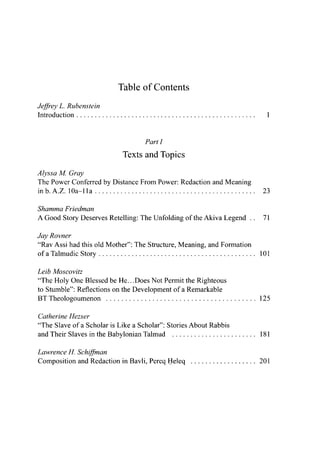
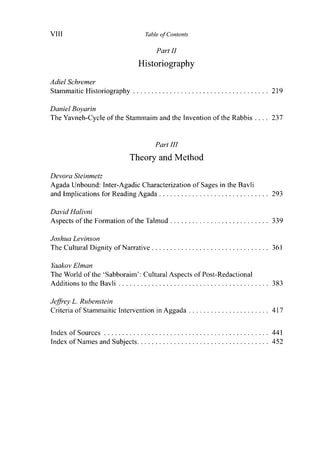
![Introduction 13
maim were responsible. The contextualization of the story in bQid 31a makes
this conclusion a virtual certainty, as the Palestinian story was altered specifi-
cally to fit its new context and to serve as the conclusion of the extended sugya.
Rovner offers a careful analysis of the sequence of traditions of that entire sugya,
illuminating the precise arrangement of sources and the climactic culmination
with the story of Rav Assi.
Leib Moscovitz, in '"The Holy One Blessed be He...Does Not Permit the
Righteous to Stumble' - Reflections on the Development of a Remarkable BT
Theologoumenon," examines the attestations, provenance and transformation of
the theologoumenon, "If the Holy One, blessed be He, does not bring a stum-
bling block (taqqalah) by way of ('al yedei) the animals of the righteous, a forti-
ori [to] the righteous themselves." This theologoumenon appears in seven Bavli
passages, four within a complex of sugyot found at bHul 5b-7a that includes the
well-known story of the donkey of R. Pinhas b. Yair. Although two attestations
of the theologoumenon are associated with R. Zera, Moscovitz argues that a
number of considerations suggest that these actually belong to the anonymous
stratum of the Bavli. The other attestations are unambiguously anonymous.
Moscovitz points out that this theological principle of rabbinic inerrancy is an
astonishing claim in and of itself, and stands in tension with numerous Bavli
sources that concede that rabbis can and do sin. While some sources suggest
certain individuals or groups are immune from sin, none are as far-ranging as
this theologoumenon. And the claim of animal inerrancy is unique.
Moscovitz resolves many of these difficulties by comparing the parallel
sources in the Yerushalmi, which differ considerably. In the Yerushalmi's story
of the donkey of R. Pinhas b. Yair, the animal's piety is considered supereroga-
tory, not exemplary. R. Zera, for his part, expresses an idea almost diametrically
opposite to that associated with him in the Bavli, namely that rabbis can be neg-
ligent and cause others to err. Moscovitz suggests that the anonymous stratum
of the Bavli reworked and transformed these sources, possibly for apologetic
reasons (either intentionally or accidentally), and through this process pro-
duced the remarkable theologoumenon. The theologoumenon was subsequently
transferred to other passages, creating the impression of a universal principle
with widespread application. Here then is a case where the anonymous Bavli
introduces substantive changes to its Palestinian sources, not mere glosses and
embellishments. The tensions among Bavli sources on rabbinic inerrancy can
be explained, in part, diachronically: Tannaim and Amoraim believe that rabbis
make mistakes whereas the doctrine of rabbinic inerrancy is confined to some
anonymous materials. This study reveals the innovative and profound contribu-
tion of the anonymous stratum of the Bavli to rabbinic theology. Moscovitz
has also supplied another example to the cases discussed by Yaakov Elman of
theological or ideological differences between the Amoraic and anonymous
strata of the Bavli (see above).](https://image.slidesharecdn.com/25411145-250521231131-519045c3/85/Creation-And-Composition-2019th-Edition-Jeffrey-Rubenstein-26-320.jpg)


![24 Alyssa M. Gray
study an aggadic composition (b. A.Z. 10a-11 a)5
as a whole in order to show
how it yields important insights into the redactors' methods of working with
aggadah and offers clues about their religious and cultural concerns. This paper
will begin with a translation of the lengthy composition, followed by a structural
and then a detailed literary analysis. The paper will conclude by locating the
results of the literary analysis in the context of the redactors' own environment
in Sasanian Iran (as they present it to us in the Bavli).
Translation of b. A.Z. 10a-lla6
I.A.7
1. Antoninus said to Rabbi: "I desire that Asverus my son should rule after me and that
Tiberias should be made a colony.8
If I tell them [=the notables of Rome], they will do
one, but not two."
2. He [Rabbi] brought a man and seated him atop his fellow. [Rabbi] gave a dove to the
upper [man] and said to the bottom [man]: "Tell the upper to allow the dove to fly from
his hand."
3. [Antoninus] said: "Hear from this that thus is he saying to me9
: 'You request of them
that Asverus my son should rule after me, and 1 should tell Asverus that Tiberias should
be made a colony.'"
4. [Antoninus] said to [Rabbi]: "The notables of Rome are troubling me."
5. [Rabbi] brought [Antoninus] to a garden. Every day [Rabbi] uprooted a radish from
the row before [Antoninus],
6. [Antoninus] said: "Hear from this that thus is he saying to me: 'You should kill them
one at a time, and not engage in conflict with all of them [at once].'"
7. And let [Rabbi] say that to him explicitly! He said: "Perhaps the notables of Rome will
hear about it, and trouble him [on account of that advice]. " And let him say it to him
5
Although various parts of the composition have been studied previously (see n. 27, below),
the composition has not yet been studied as an integrated whole.
6
The translation is based on the text of the printed edition. Significant variants between
the text of the printed edition and those of Ms. Munich (Bayerische Staatsbibliotek Cod. Heb.
95); Ms. New York JTS 44830, Avodah Zarah, pub. Shraga Abramson (New York: JTS, 1957);
and Ms. Paris, Biblioteque Nationale, 1337 (tractates Bava Batra, Avodah Zarah, and Horayot,
unpublished) will be noted in the footnotes. Munich 95 will be designated as "M," the JTS
manuscript as "JTS," and Paris as "P."
7
In this translation, the anonymous voice of the Bavli will be italicized.
8
Per Rashi to b. A.Z. 10a (s.v. "qolonya"), the significance of making Tiberias a "colony"
was to release it from taxation. See also Jacob Levy, Neuhebräisches und Chaldäisches Wörter-
buch über die Talmudim und Midraschim, 2nd
edition, revised by Lazarus Goldschmidt (Berlin:
Benjamin Harz, 1924), 4:312.
9
This phrase "shema' minah hakhi qa 'amar Ii" is missing from M.](https://image.slidesharecdn.com/25411145-250521231131-519045c3/85/Creation-And-Composition-2019th-Edition-Jeffrey-Rubenstein-37-320.jpg)
![Redaction and Meaning in b. A.Z. ¡Oa-Ila 25
in a whisper! [He did not do so] because as it is written (Qoh. 10:20): "For the birds
of the air will carry the voice."
8. [Antoninus] had a daughter named Gira. She committed a forbidden act. [Antoninus]
sent him a berry. [Rabbi] sent him a coriander. [Antoninus] sent him a leek. [Rabbi]
sent him a lettuce.10
I.B.
1. Every day [Antoninus] would send him gold dust in bags with wheat on top. [Antoni-
nus] said to [his servants]: "Bring this wheat to Rabbi."
2. [Rabbi] said to him: "1 do not need [this wheat]; I have much."
3. [Antoninus] said to him: "Leave it to the one who will come after you, who will give
it to the one who will come after me. For those who come after you, and those who
come after them, will make payments [to Rome] from it."
4. [Antoninus] had a certain underground passage that ran from his house to the house
of Rabbi." Every day [Antoninus] would bring two servants. He would kill one at the
door of Rabbi's house, and would kill one at the door of his [own] house.
5. [Antoninus] said to [Rabbi]: "At the time I come, let no man be with you." One day
he found R. Hanina b. Hama sitting [with Rabbi]. [Antoninus] said: "Didn't I tell you
that no man should be with you at the time that I come!?" [Rabbi] said to him: "This
[R. Hanina b. Hama] is not a human being."12
[Antoninus] said to [R. Hanina b. Hama]:
"Tell the servant who is sleeping at the door to rise up and come [here]." R. Hanina b.
Hama went and found that [the servant] was murdered. He said: "What should I do?
If I go and tell [Antoninus] that he is killed, [I would be acting against the principle
that messengers] do not return bad news [to those who sent them]. If I leave him and
go, I would be showing disrespect to the Imperial sovereignty." [R. Hanina b. Hama]
requested mercy on [the servant], revived him, and sent him [to Antoninus].
6. [Antoninus] said: "I knew that the little ones13
among you could revive the dead.
Nevertheless at the time that I come, let no man be with you."
7. Every day [Antoninus] would serve14
Rabbi.15
He would feed him and give him to
drink. When Rabbi wished to go up to his bed, [Antoninus] would crouch before the
bed. [Antoninus] said to [Rabbi]: "Step on me [to get] to your bed." [Rabbi] said: "It is
not proper to show disrespect to the Imperial sovereignty to this extent." [Antoninus]
said: "Oh, might I be your bed in the World to Come!"
10
The plants involved in this exchange are likely symbolic codes; the significance of which
we will explain below.
" M adds: "and he [Antoninus] served him and learned Torah from him." JTS has a marginal
note to this statement which reads: "and he served ("mashma"') him and learned Torah from
him." P adds: "for he served ("mashma"') him."
12
M, JTS, and P all read "not one born of woman."
13
Probably meaning those of lesser importance or status.
14
JTS and P read "mashma' leih" instead of "meshamesh," as in M and the printed edition.
JTS adds in the margin: "[he] would feed him and give him to drink."
15
M adds: "and would study [tannaitic] traditions from him."](https://image.slidesharecdn.com/25411145-250521231131-519045c3/85/Creation-And-Composition-2019th-Edition-Jeffrey-Rubenstein-38-320.jpg)
![26 Alyssa M. Gray
I.C.
1. [Antoninus] said to [Rabbi]: "Can I enter the World to Come?"
2. [Rabbi] said to [Antoninus]: "Yes."
3. [Antoninus] said to [Rabbi]: "But isn't it written (Obad. 18): 'there will not be a rem-
nant of the house of Esau'?" [Rabbi replied: This applies to those] "Who do the acts
of Esau."
4. It is also taught thus: '"There will not be a remnant of the house of Esau.' Is it possible
that [this verse] applies to all [the house of Esau]? The verse says 'of ["le-"] the house
of Esau' - [applying only to those] who do the acts of Esau."16
5. [Antoninus] said to [Rabbi]: "But isn't it written (Ezek. 32:29): 'Edom will be bereft
of all her kings and all her princes'?"17
[Rabbi] said to [Antoninus]: '"Her kings' - but
not all her kings; 'all her princes' - but not all her noblemen."18
6. It is also taught thus: '"Her kings' - but not all her kings; 'all her princes' - but not all
her noblemen. 'Her kings' - but not all her kings; except for Antoninus bar Asverus.
'All her princes' - but not all her noblemen, except for Qetia bar Shalom."19
II.
1. What is the story of Qetia bar Shalom? There was a certain Caesar who hated the Jews.
He said to the notables of his Empire: "One who has a worm in his foot, should he cut
it off and live, or leave it be and be afflicted?"
2. They said to him: "Let him cut it off and live."
3. Qetia bar Shalom said to them: "One [you cannot kill all the Jews], for you will be
unable to [overcome] all of them, as it is written (Zech. 2:10): 'For I have spread them
[out] like the four winds of heaven.' What [is the verse] saying? If it is said that He
scattered them to the four winds, this [phrase] 'ke-arba' ruhot [like the four winds]
should be ' le-arba' ruhot [to the four winds]! Rather, just as the world cannot exist
without winds, so can't the world exist without Israel.20
And furthermore, [you cannot
kill all the Jews because] they will call you 'a cut-off Empire.'"
4. [Caesar] said to [Qetia]: "You have spoken well. Nevertheless, whoever bests the
Emperor, they throw him into a round furnace."
5. When they had seized [Qetia] and were going, a certain lady said to him: "Woe to the
ship that sails without [paying] the tax!" [Qetia] fell on the tip of his foreskin, and cut
it off.21
He said: "I have paid my tax. I will pass."
16
This tanya nami hakhi braita is missing from P.
17
M and JTS read "sareha" for "princes" instead of "nesi'eha" as in the verse.
18
M and JTS read "sareha"; P omits '"her princes'-but not all her noblemen" from Rabbi's
reply to Antoninus.
19
M and JTS use "sareha" for "princes" and "noblemen." JTS and P add "for he [Qetia]
was not one of her noblemen, for he converted."
20
This teaching is missing from M and JTS.
21
JTS adds in the margin: "with his teeth." P adds the same in the body of the text. M reads:
"he took a knife and cut his foreskin. There are those who say: he bent his head to his foreskin
and cut it with his teeth."](https://image.slidesharecdn.com/25411145-250521231131-519045c3/85/Creation-And-Composition-2019th-Edition-Jeffrey-Rubenstein-39-320.jpg)
![Redaction and Meaning in b. A.Z. IQa-lla 27
6. When they were throwing him [into the furnace], he said: "All my possessions to R.
Aqiva and his companions." R. Aqiva went out and interpreted: "(Ex. 29:28): 'and it
shall be to Aaron and his sons' - half to Aaron and half to his sons."
7. A heavenly voice went out and said: "Qetia bar Shalom is invited to the life of the
World to Come." Rabbi wept and said: "There are those who acquire their world in
one instant, and there are those who acquire their world over a number of years."
I . C .
7. Antoninus served Rabbi. Adarkhan22
served Rav. When Antoninus died, Rabbi said:
"The cord is separated." When Adarkhan died, Rav said: "The cord is separated."
III.
1. Onqelos bar Qalonymos23
converted. Caesar sent a troop of Roman [soldiers] after him.
He drew them in [to Judaism] by means of scriptural verses. They converted.
2. [Caesar] again sent a troop of Roman [soldiers] after him. [Caesar] said to them: "Do
not say anything to him."
3. When they had seized him and were going, [Onqelos] said to them: "Let me tell you
something. In the world the torch-bearer carries the torch before the litter, the chief
lecticarius for the dux, the dux for the hegemon, and the hegemon for the comes. Does
the comes carry a torch before anyone?" They said to him: "No." He said to them:
"The Holy Blessed One, Blessed is He, carries a torch before Israel, as it is written
(Ex. 13:21): 'And the Lord went before them by day, etc.'" They converted.
4. [Caesar] again sent another troop after him. He said to them: "Do not converse with
him."
5. When they had seized him and were going, he saw a mezuzah. He placed his hand upon
it and said to them: "What is this?" They said to him: "You tell us." He said to them:
"The custom of the world is that a flesh-and-blood king sits within and his servants
guard him from outside. And yet the Holy One, Blessed is He - His servants are within
and He guards them from outside.24
As it is said (Ps. 121:8): 'The Lord will guard your
going out and your coming in from now to always.'"25
They converted.
6. [Caesar] did not again send [troops] after [Onqelos].
I.C.
8. (Gen. 25:23): "And the Lord said to her: 'there are two nations in your womb.'" Rav
Yehuda said in the name of Rav: "Do not read 'nations' ["goyim"], but 'powerful ones'
["gaiyyim"]. These are Antoninus and Rabbi, from whose tables neither lettuce, cucum-
bers, nor radishes ceased either in summer or winter. As the Master said: 'Radishes cut up
the food [within the body], lettuce turns the food over, and cucumbers expand the bowels."'
22
JTS reads "Artevan." P reads "Ardevan."
23
M, JTS, and P read "Qalonyqos."
24
M and P read: "and the Holy One, Blessed be He guards Israel from the outside... ." JTS
reads: "rather, He is on the outside and guards Israel... ."
25
P quotes Ps. 121:5 instead of 121:8.](https://image.slidesharecdn.com/25411145-250521231131-519045c3/85/Creation-And-Composition-2019th-Edition-Jeffrey-Rubenstein-40-320.jpg)
![28 Alyssa M. Gray
9. But wasn't it taught in a braita of the house of R. Yishmael: "Why are cucumbers
called 'qishu'in'? [from "q-sh-h," "hard"]. Because they are as hard on the human
body as swords."
10. There is no difficulty. This one [the braita in I.C.10] deals with large ones; this one
[Rav's tradition in 1 .C.9] deals with small ones.
Structure
B. A.Z. lOa-lla is a carefully constructed composition formed of three large
units, each of which is further subdivided into three sections.26
The following
structural diagram illustrates this double tripartite structure.
Unit I - Rabbi and Antoninus
A. Three Questions and Three Symbolic Responses
1. Antoninus wants his son to succeed him and Tiberias to be a colony; Rabbi
responds with symbolic gestures.
2. Antoninus complains that the Roman nobles are troubling him; Rabbi responds
by uprooting radishes.
3. Antoninus has a sinful daughter and begins a plant exchange with Rabbi meant
to determine what he should do with her.
B. Three Things Antoninus Did "Every Day"
1. Antoninus would send Rabbi bags of gold dust covered with wheat.
2. Antoninus would come to Rabbi's house every day by means of an underground
passage.
3. Antoninus would provide personal service to Rabbi every day.
C. A Conversation Between Rabbi and Antoninus; Rabbi Comments on the Deceased
Antoninus; Rav Comments On Both When Deceased
1. Rabbi and Antoninus converse about the World to Come.
2. Rabbi observes that "the cord is separated" when Antoninus dies.
3. R. Yehuda in the name of Rav makes an observation about both Rabbi and An-
toninus; presumably when both are dead.
Unit II - Qetia bar Shalom
A. Qetia's audience with the emperor and verbal victory over him.
B. Qetia's Martyrdom
1. Qetia's removal for his martyrdom.
2. Qetia's self-circumcision.
3. Qetia's bequests to R. Aqiva.
C. The heavenly voice and Rabbi's weeping response.
Unit 111 - Onqelos b. Qalonymos
A. First troop of soldiers sent after him.
B. Second troop.
C. Third troop.
26
See note 28, below.](https://image.slidesharecdn.com/25411145-250521231131-519045c3/85/Creation-And-Composition-2019th-Edition-Jeffrey-Rubenstein-41-320.jpg)
![30 Alyssa M. Gray
ends with Rabbi's weeping recognition of Qetia's attainment of the World to
Come while, as I will also show, I.C.7 also deals with the World to Come.
Finally, Unit I.C.8-10 properly follows the story of Onqelos in Unit III in order
to end the entire composition on the note with which it began - the relationship
between Antoninus and Rabbi.
Moving on, there are also three stages in Unit II - Caesar's conversation with
the nobles and Qetia's challenge to him, Qetia's martyrdom (which is subdivided
into his removal for martyrdom, his self-circumcision, and his bequest to R.
Aqiva), and the heavenly voice's affirmation of the efficacy of his martyrdom
and Rabbi's weeping response. The three stages of Unit 111 are defined by On-
qelos' encounters with the three troops of Roman soldiers successively sent to
capture him.
Literary Analysis
1. TheAggadah's Relationship To Its Halakhic Context
The first step in our literary analysis of this composition is to explore how the
redactors fit it into its halakhic context. The mishnah to which this composition
is attached (m. A.Z. 1:3) states: "... and these are the festivals of idolaters... and
the yom genusia of their emperors, and the day of birth ... ." At 10a the Bavli
begins setting the stage for this aggadah by asking "what is 'the yom genusia' of
their emperors?" R. Yehuda responds that it is the coronation day, whereupon the
Bavli asks again: "but wasn't it taught in a braita:'yom genusia and the day they
coronate their emperors'?" What is of particular interest to us is the anonymous
response to this braita: "there is no difficulty - this one (the yom genusia) is his
[the emperor's own coronation], this one (the "day they coronate their emper-
ors") is his son s (should the son be made emperor in his father's lifetime)."
The Bavli has thus subtly introduced the theme of an emperor and his son,
which of course is precisely the theme with which Unit I.A of the aggadic com-
position begins. The Bavli moves on to tie the discussion of emperor and son
more closely to the case of Rome:
And do they coronate an emperor son of an emperor? For didn't R. Yosef teach in a braita:
"(Obad. 2): 'Behold I have made you small among the nations' - [this teaches] that they
do not seat an emperor son of an emperor; 'You are very despised' - [this teaches] that
they have neither a script nor a language."
R. Yosef's braita is an exegesis of Obad. 2. The braita's exegesis of "you are very
despised" as a reference to Rome's alleged lack of script and language reflects
an authentic Palestinian polemic that Rome should be ashamed that its public
language was Greek and not its own language, Latin. This notion appears explic-
itly at Esther R. 4:12 in the name o f R . Yehuda b. R. Shimon: "It is a reproach to](https://image.slidesharecdn.com/25411145-250521231131-519045c3/85/Creation-And-Composition-2019th-Edition-Jeffrey-Rubenstein-43-320.jpg)
![Redaction and Meaning in b. A.Z. IOa-Ila 31
[Rome] that it does not sign documents in its own language," and less clearly at
Ber. R. 16:4 (Theodor-Albeck, p. 148): "R. Huna said: 'Greece is ahead of the
evil empire in three things; in seafaring, painting, and language.'"
The braita's application to Rome of "you are very despised" and its allusion
to Rome's linguistic shortcomings are echoed throughout the later aggadic
composition. Rome's alleged lack of language gives an amusingly ironic twist
to Unit I.A, in which Rabbi nonverbally communicates with Antoninus in
symbolic gestures three times, and Antoninus with Rabbi once. Ber. R. 16:4's
negative assessment that Rome lacks something major also colors Qetia bar
Shalom's declaration in Unit II that destroying the Jews will leave Rome "a
cut-off (that is, a lacking) Empire." The braita's negative judgment of Rome as
an empire lacking a key element of civilization at its core also reappears in the
mass conversions of Roman soldiers made by Onqelos in Unit III. In his two
verbal encounters with the soldiers, Onqelos is able to convince them that what
he has - the God of Israel - provides something that they unquestionably lack.
Their conversions indicate their agreement with him.
The point of R. Yosef's braita is that since Rome does not have hereditary suc-
cession, the proposed solution to the meaning of m. A.Z. 1:3's yom genusia as
"this one (yom genusia) is his, this one ("the day they coronate their emperors")
is his son's" cannot work. So, the Bavli tries again: "Rather what is the yom ge-
nusia! The day of birth." Once again, the anonymous voice intervenes by citing
a braita according to which the yom genusia and birthday are two distinct occa-
sions, and again, the Bavli suggests "this one is his, and this one his son's."
The Bavli's second clear allusion here to an emperor and his son is then care-
fully maneuvered in order to bring the discussion back to R. Yehuda's original
definition of yom genusia as coronation day, and then to a swift transition to the
Antoninus and Rabbi material.
But wasn't it taught in a braita: "His yom genusia and his son's yom genusia; his birthday
and his son's birthday"?
This braita makes it impossible to claim either that the vow genusia is the birth-
day, or that the yom genusia can be ascribed to the father and the birthday to the
son. The Bavli has left itself no way out but to return to R. Yehuda's original
definition of the yom genusia (albeit anonymously):
Rather, what is the yom genusia? The day they coronate their emperors.
And, in a shorthand allusion to the earlier discussion of R. Yehuda's definition:
And there is no difficulty. This one is his; this one his son's.
The Bavli has now given us the third allusion to an emperor and his son, thus
completing a unit of three allusions. This halakhic discussion thus also follows
the tripartite structure of the aggadic composition that immediately follows
it. Although, as Shamma Friedman has pointed out, it is hardly atypical for](https://image.slidesharecdn.com/25411145-250521231131-519045c3/85/Creation-And-Composition-2019th-Edition-Jeffrey-Rubenstein-44-320.jpg)
![32 Alyssa M. Gray
the Bavli to order materials in units of three,28
the Bavli's use of the tripartite
structure here in a halakhic discussion that substantively echoes the aggadic
composition that immediately follows suggests that it means to structurally
and substantively link both discussions. The Bavli did not rest content with a
merely associative link between m. A.Z. l:3's reference to "emperors" and the
aggadah's preoccupation with them. Rather, the Bavli strove to link that ag-
gadah tightly to the halakhic discussion of the mishnah by means of structural
similarity and allusion. At this point in the sugya, the Bavli segues directly into
the aggadic composition:
And ¿/"[the solution immediately above] is difficult for you because they do not coronate
an emperor son of an emperor, they do coronate [a son] through a request [of the father],
like the case of Asverus bar Antoninus, who ruled.
Now, having specifically mentioned Asverus the son of Antoninus, the Bavli
moves directly into Unit l.A of the aggadic composition.29
We can learn a number of things from this analysis of the Bavli's creation
of a link between the aggadic composition and the halakhic context at 10a.
First, on the most basic level, we see that the Bavli redactors are interested in
forging such links.30
Second, we see that the transition is well constructed, with
structural similarity and thematic links to the aggadic composition that follows.
The decision to create such a transition was a deliberate decision of the redac-
tors, and by no means inevitable. The Bavli redactors could have opted to rely
on m. A.Z. 1:3's references to the verb-root "m-l-kh" as a hook on which to
hang this aggadic composition (which refers to emperors throughout), but they
eschewed that path in favor of a more complex transition structure. We cannot
set it out as a "rule" of Bavli redactional practice that the redactors always forge
such links, because we can easily find cases in which the Bavli redactors create
weak transitions between halakhic and aggadic material, or create none at all
(e.g., b. A.Z. 8a). Nevertheless, this case at 10a is an interesting indication that
the Bavli redactors do at times replace weak or nonexistent transitions between
their prior sources with transitions that are tightly and logically structured.
We can also begin to identify patterns in how they forge such tight and logical
links. I pointed out earlier how the Bavli's transition sugya at 10a opens with
28
Shamma Friedman, "'Al Derekh Heqer ha-Sugya," in H.Z. Dimitrovsky, ed., Mehqarim
u-Meqorot I (New York: Jewish Theological Seminary, 1978): 277^141. See also Friedman's
earlier findings in "Mivneh Sifruti be-Sugyot ha-Bavli," Proceedings of the Sixth World Con-
gress of Jewish Studies (Jerusalem, 1977), 3:389^102, esp. 391-392.
29
See also Ofra Meir, "ha-Terumah ha-Historit," p. 17, who also observes that the first story
of the aggadic composition is related to part of the halakhic discussion that precedes it.
30
Compare Jeffrey Rubenstein's discussion of the redactors' creation of a link between the
sugya about the variant spelling of the key term in m. A.Z. 1:1 ("eideihen" versus '"eideihen")
and the lengthy story about the nations' trial before God at the end of the days. See Jeffrey
Rubenstein, Talmudic Stories: Narrative Art, Composition, and Culture (Baltimore: Johns
Hopkins University Press, 1999), pp. 235-238.](https://image.slidesharecdn.com/25411145-250521231131-519045c3/85/Creation-And-Composition-2019th-Edition-Jeffrey-Rubenstein-45-320.jpg)
![Redaction and Meaning in b. A.Z. ¡Oa-lla 35
1. Antoninus sent [a message] to our Rabbi. He said to him: "Since the treasury is empty,
what can we do that it be filled?"
2. [Rabbi] took the messenger and brought him to a garden [pardesa], [Rabbi] began to
uproot large radishes and plant small radishes.
3. [The messenger] said to him: "Give me a written answer [to take back to Antoni-
nus]."
4. [Rabbi] said to him: "You do not need one."
5. [The messenger] went back [to Antoninus]. [Antoninus] said to him: "Where is the
written answer?" [The messenger] said to him: "He did not give me anything." "And
what did he say to you?" "He didn't say anything to me except to take me to a garden
and begin to uproot large radishes and plant small ones."
6. [Antoninus] began to remove duces and to [re]place duces until the treasury was
filled.
Unlike A.Z.'s Antoninus, Ber. R.'s Antoninus verbally asks Rabbi a question
through a messenger. The Ber. R. story highlights the symbolic nature of Rab-
bi's action by having the messenger, and later Antoninus, ask explicitly for a
written response to his question, and by having Rabbi explicitly reject Antoni-
nus' alleged need for one. Why does the story go to such pains to highlight the
necessity of a symbolic response? The answer is apparent when we consider
the nature of Rabbi's advice to Antoninus and the fact that it is being conveyed
through a messenger. Rabbi's symbolic advice is that Antoninus should remove
and replace duces. Clearly he does not want such draconian advice conveyed
in writing (or even orally) through a messenger, upon whose discretion it may
not be wise to rely. Such a message must be conveyed in a code so that only the
intended recipient (Antoninus) will understand it.
The A.Z. story claims that Antoninus is discomfited by the troubles the nota-
bles of Rome are causing him. This claim works better in context than a question
about filling the treasury, since these difficult notables were presumably the
anonymous collectivity whose approval Antoninus needed for his son's succes-
sion in the previous question. But what does not work better in context is Rabbi's
symbolic action. In A.Z. Rabbi and Antoninus are together during Antoninus'
question and Rabbi's response. The story does not mention whether or not serv-
ants were with them, but judging from the anonymous voice's discussion of the
story at 10b, we may assume that they were alone. Rabbi's symbolic action is
thus problematic, and so the anonymous voice asks:
And let [Rabbi] say that to him explicitly! He said: "the notables of Rome will hear about
it, and trouble him [Rabbi]." And let him say it to him in a whisper! [He did not do so]
because as it is written (Qoh. 10:20): "For the birds of the air will carry the voice."
The redactors' question is logical: assuming Antoninus and Rabbi were alone to-
gether, why was a symbolic gesture necessary? The anonymous voice brilliantly
responds by quoting Qoh. 10:20, the entire text of which reads: "Also in your
mind do not curse the king, and in your bedroom do not curse the rich; for the](https://image.slidesharecdn.com/25411145-250521231131-519045c3/85/Creation-And-Composition-2019th-Edition-Jeffrey-Rubenstein-48-320.jpg)
![Redaction and Meaning in b. A.Z. I0a-lla 41
In the Torah, Esau says: "yesh li rav, achi; yehi lekha asher lakh" - "I have
much, my brother; let what is yours be yours." Rabbi's response to Antoninus
is: "lo tzarikhna; it li tuva" - "I have no need; 1 have much." The Aramaic "it li
tuva" is a literal translation of the Biblical Hebrew "yesh li rav." And, although
Esau initially refused the gift, Jacob does persuade him to accept it. Thus, while
the story portrays Antoninus first like the biblical Joseph, and then, by implica-
tion, like Jacob, Rabbi is portrayed like Esau.
How can we account for these portrayals? The positive constructions of
Antoninus as Joseph and Jacob can be explained as carryovers of the positive
images of Antoninus found in Palestinian literature and in Palestinian sources in
the Bavli.43
The portrayal of Rabbi as Esau follows logically on the heels of the
image of Rabbi as a counselor of sanguinary policy in Unit I.A: Rabbi is Edom,
just as Antoninus is. There is thus essentially no difference between Rabbi and
Antoninus. This notion is picked up again toward the end of the entire aggadic
composition, the end of Unit I.C (11a):
(Gen. 25:23): "And the Lord said to her: 'there are two nations in your womb.'" Rav
Yehuda said in the name of Rav: "Do not read 'nations' ["goyim"], but 'powerful ones'
["gaiyyim"]. These are Antoninus and Rabbi, from whose tables neither lettuce, cucum-
bers, nor radishes ceased either in summer or winter."
R. Yehuda in the name of Rav is represented as interpreting a verse that refers
to Jacob and Esau, or, to the rabbis, to Israel and Edom (Rome). Rav does not
specify which biblical twin corresponds to which ruler. Now, this omission may
not seem significant, since "everyone should know" that Rabbi is Jacob and
Antoninus Esau. But viewed in light of our analysis of Unit I.B, Rav's omission
seems more meaningful: he does not specify which twin corresponds to which
ruler because he cannot, on some level, they are virtually indistinguishable.
In what way are Rabbi and Antoninus so indistinguishable? We have already
noted that A.Z. portrays Rabbi as counseling Antoninus to kill his nobles and his
daughter. Antoninus' own sanguinary proclivities are illustrated in the second
story about what Antoninus did "every day," found at I.B.4-6.
Structurally, this story is placed exactly in the middle of the Antoninus and
Rabbi traditions at 10a-11a. The Antoninus and Rabbi traditions are grouped
into three large blocks, each of which is further subdivided into three, for a total
of nine traditions. This story, about Antoninus' daily visit to Rabbi via his pas-
sageway, is the second story of the second unit. Four stories thus precede it, and
four follow. The story's structural placement at the very center of the Antoninus
and Rabbi material marks it as having special importance. In order to elucidate
this importance, my analysis of this story will proceed in several steps. First, I
43
Such Palestinian texts include, e.g. y. Shev. 6:1,36d; y. Meg. 1:11, 72b, y. Meg. 3:2, 74a;
y. Sanh. 10:5, 29c; Ber. R. 34:10, Ber. R. 67:6; Lev. R. 3:2, Lev. R. 10:4, and Lev. R. 16:8. See
also b. Sanh. 91a and b.](https://image.slidesharecdn.com/25411145-250521231131-519045c3/85/Creation-And-Composition-2019th-Edition-Jeffrey-Rubenstein-54-320.jpg)


![This ebook is for the use of anyone anywhere in the United
States and most other parts of the world at no cost and with
almost no restrictions whatsoever. You may copy it, give it away
or re-use it under the terms of the Project Gutenberg License
included with this ebook or online at www.gutenberg.org. If you
are not located in the United States, you will have to check the
laws of the country where you are located before using this
eBook.
Title: Annals, Anecdotes and Legends: A Chronicle of Life
Assurance
Author: of the Bank of England John Francis
Release date: November 4, 2015 [eBook #50380]
Most recently updated: October 22, 2024
Language: English
Credits: Produced by deaurider, Craig Kirkwood, and the Online
Distributed Proofreading Team at http://www.pgdp.net
(This
file was produced from images generously made
available
by The Internet Archive.)
*** START OF THE PROJECT GUTENBERG EBOOK ANNALS,
ANECDOTES AND LEGENDS: A CHRONICLE OF LIFE ASSURANCE
***](https://image.slidesharecdn.com/25411145-250521231131-519045c3/85/Creation-And-Composition-2019th-Edition-Jeffrey-Rubenstein-60-320.jpg)






![This universal spirit of commerce produced, however, marine
assurance very early, while the gradual progressive movements
made in science and philosophy, prepared the way for assurance on
life. The rude notions of an uncultivated age were succeeded by
broader and more statesmanlike views; the Roman Church, with its
narrow notions and its denunciations of progress, ceased to exist;
men feared no longer to give a free exposition of their principles;
and the Provincial Letters of Pascal prove that a new era had arrived.
The doctrine of probabilities,—originated at a gaming-table,—so
curious, so interesting, and at the same time so necessary to the
present subject, was first popularised by this great genius; but we
are indebted to Holland for its earliest application to annuities; as
when the States-General resolved to negotiate some life payments,
the pensionary, John de Witt, added one more obligation to the
many received from this distinguished man, by employing the theory
which Pascal suggested, for the requirements of his government. His
report and treatise on the terms of life annuities is the first
document of the kind, and a most important paper it is. Step by step
it explains the grounds on which the proposition of its author was
based, and by which he arrived at the conclusion that the value of a
life annuity, in proportion to one for a term of twenty-five years, was
really “not below, but certainly above, sixteen years’ purchase.” It is
probable that from political motives this paper was suppressed; but
John de Witt was certainly the first who thought of applying
mathematical calculations to political questions, and the first who
attempted to fix the rate of annuities according to the probabilities
of life. The essay of the pensionary was, however, but little known to
the public, and had no sensible influence on the subsequent
progress of the science.
Leibnitz, whose hobby was to investigate the theory of chances[1],
first drew attention to this production; but though often alluded to,
its very title was not correctly given, and we are indebted to the
researches of Mr. Hendriks for its rescue from an unmerited oblivion,
and for the able translation of an essay which, had it been published
at the time it was written, would have exercised an important](https://image.slidesharecdn.com/25411145-250521231131-519045c3/85/Creation-And-Composition-2019th-Edition-Jeffrey-Rubenstein-76-320.jpg)
![influence on its subject.[2] Up to the end of the 17th century,
therefore, as there were no laws to calculate the chances of
mortality, life annuities were granted according to the caprice of the
usurer, or the ignorance of the annuitant; and there is no occasion to
remind the reader that the barbaric splendour of the Tudors
witnessed customs which, rendering the conditions of life terribly
uncertain, had a depressive effect on the science of assurance. The
smallpox, a frequent and fearful visitor, was only met by an attempt
to stare it out of countenance; for to effect a cure the patient was
clothed in scarlet, the bed was covered with scarlet, and the walls
were hung with scarlet; so simple and so ignorant were the leeches
of the early ages. Dysentery, then known by its Saxon synonyms of
the “flux,” “scouring,” and “griping,” daily carried off the unwashed
artificers of old London. Nor were dirty habits confined to the mere
populace; the banquetting-halls of the palace were rarely or ever
cleansed; the accumulations of months were left on the floors,
which, to hide the dirt and preserve an appearance of decency, were
periodically covered with rushes.[3] In such places disease was ever
ready to spring into vigorous life. Every few years, fevers which had
been lurking in alleys and ravaging obscure places, devastated the
city under various names. At last, that awful sickness which, even at
the present day, chills the blood but to think of it, seemed to be
naturalised in this country, under the name of the plague; but to it
we owe that the initiative step was taken in England, in founding the
first principles which govern life assurance, for to it we owe our
earliest Bills of Mortality.
Within a period of seventy years, London had been visited by it five
separate times; 145,000 having died from its collective attacks. As
the visitation had been governed by no known system, as it came
without any apparent cause and disappeared quite as capriciously,
the Londoners never felt safe from its re-appearance. It seemed
always hovering over them; and as the intervals between its
departure and return were sometimes only eleven years, and had
never exceeded twenty-nine, its harassing impressions were
constantly on the minds of the citizens. Its visits did not allow time](https://image.slidesharecdn.com/25411145-250521231131-519045c3/85/Creation-And-Composition-2019th-Edition-Jeffrey-Rubenstein-77-320.jpg)