co-funded by the European Union
Reasoning with Reasoning
Semantic technologies for research in the
humanities and social sciences (STRiX)
Gƶteborg, 24 November 2014
Kristin Dill, Austrian National Library (ONB)
Gerold Tschumpel, Steffen Hennicke, Christian Morbidoni, Klaus
Thoden, Alois Pichler
Outline
1. Digitised Manuscripts to Europeana (DM2E)
2. Pundit
3. Reasoning with Reasoning for Digital Humanities
STRiX24.11.2014
Outline
1. Digitised Manuscripts to Europeana (DM2E)
2. Pundit
3. Reasoning with Reasoning for Digital Humanities
STRiX24.11.2014
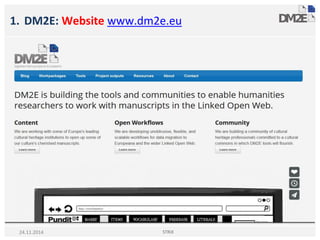
1. DM2E: Website www.dm2e.eu
STRiX24.11.2014
1. DM2E: About
ā— Digitised Manuscripts to Europeana
ā— EU-FP7 CIP-ICT-PSP.2011.2.1 - Aggregating content in
Europeana
ā— 11 consortium parnters and 10 associated Partners
ā— Duration: Feb 2012 - Jan 2015 (36 months)
STRiX24.11.2014
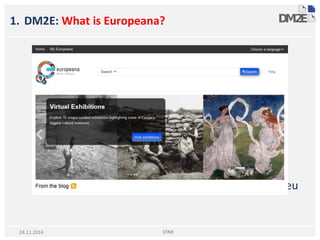
1. DM2E: What is Europeana?
www.europeana.eu
STRiX24.11.2014
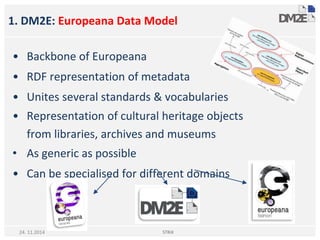
1. DM2E: Europeana Data Model
• Backbone of Europeana
• RDF representation of metadata
• Unites several standards & vocabularies
• Representation of cultural heritage objects
from libraries, archives and museums
• As generic as possible
• Can be specialised for different domains
STRiX24. 11.2014
1. DM2E: Goals of DM2E
STRiX24.11.2014
1. Aggregation of manuscript metadata &
content
2. Interoperability Infrastructure
3. Digital Humanities Applications and Research
4. Community Building
1. DM2E: Goals of DM2E
STRiX24.11.2014
1. Aggregation of manuscript metadata &
content
2. Interoperability Infrastructure
3. Digital Humanities Applications and Research
4. Community Building
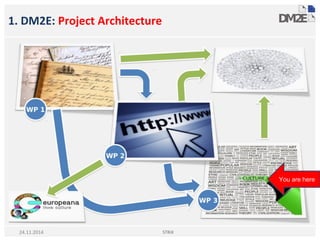
1. DM2E: Project Architecture
STRiX24.11.2014
You are here
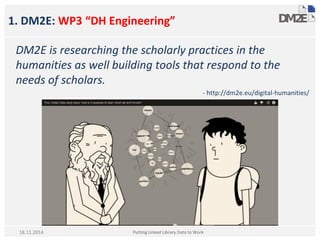
1. DM2E: WP3 ā€œDH Engineeringā€
DM2E is researching the scholarly practices in the
humanities as well building tools that respond to the
needs of scholars.
- http://dm2e.eu/digital-humanities/
Putting Linked Library Data to Work18.11.2014
1. DM2E: WP3 Tasks
•Added value of EDM
•Functional primitives of the Digital Humanities
•Outreach DH community
•Open source annotation tools
Putting Linked Library Data to Work18.11.2014
Outline
1. Digitised Manuscripts to Europeana (DM2E)
2. Pundit
3. Reasoning with Reasoning for Digital Humanities
STRiX24.11.2014
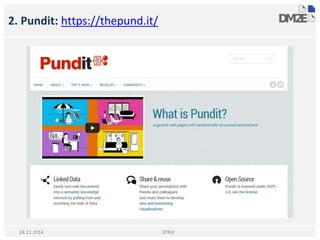
2. Pundit: https://thepund.it/
STRiX24.11.2014
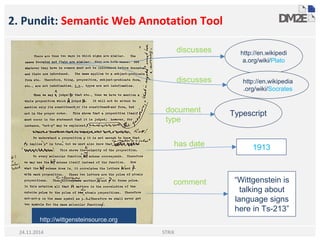
2. Pundit: Semantic Web Annotation Tool
STRiX24.11.2014
http://en.wikipedi
a.org/wiki/Plato
http://en.wikipedia
.org/wiki/Socrates
1913
Typescript
ā€œWittgenstein is
talking about
language signs
here in Ts-213ā€
discusses
discusses
document
type
has date
comment
ht
thttp://wittgensteinsource.org.org/
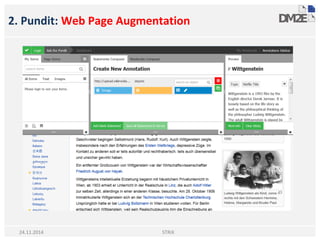
2. Pundit: Web Page Augmentation
STRiX24.11.2014
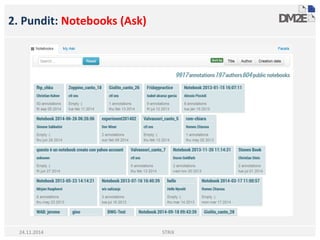
2. Pundit: Notebooks (Ask)
STRiX24.11.2014
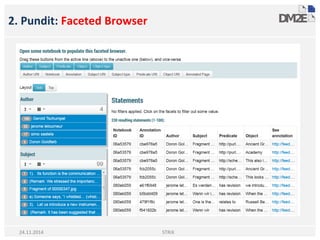
2. Pundit: Faceted Browser
STRiX24.11.2014
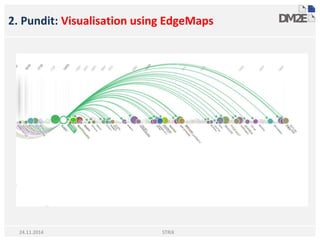
2. Pundit: Visualisation using EdgeMaps
STRiX24.11.2014
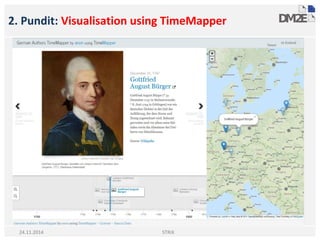
2. Pundit: Visualisation using TimeMapper
STRiX24.11.2014
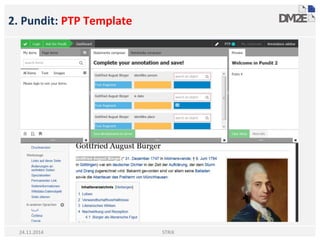
2. Pundit: PTP Template
STRiX24.11.2014
2. Pundit: Play with Pundit
STRiX24.11.2014
http://dev.thepund.it/tutorials/evaminerv
a2014/
Outline
1. Digitised Manuscripts to Europeana (DM2E)
2. Pundit
3. Reasoning with Reasoning for Digital Humanities
STRiX24.11.2014
3. Reasoning: Goals
ā€œWhat kinds of 'reasoning' do digital humanists want to
see enabled by the data and information available in
Europeana together with those that are currently not
part of the Europeana portal?ā€
- DOW DM2E (2012)
STRiX24.11.2014
3. Reasoning: What is SW Reasoning?
ā€œBroadly speaking, inference on the Semantic Web can
be characterized by discovering new relationshipsā€*...
*http://www.w3.org/standards/semanticweb/inference
STRiX24.11.2014
3. Reasoning: What is SW Reasoning?
• ...using machines!
- large-scale machine-based processing of RDF data
- uses logic and axioms
- ā€œdefined via rule sets or vocabulariesā€*
- mathematical and computational
Example*:
Flipper isA Dolphin > Flipper isA Mammal
*http://www.w3.org/standards/semanticweb/inference
STRiX24.11.2014
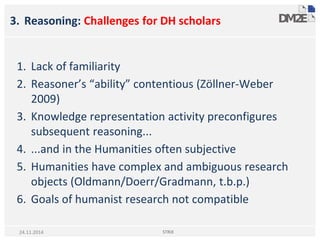
3. Reasoning: Challenges for DH scholars
1. Lack of familiarity
2. Reasoner’s ā€œabilityā€ contentious (Zƶllner-Weber
2009)
3. Knowledge representation activity preconfigures
subsequent reasoning...
4. ...and in the Humanities often subjective
5. Humanities have complex and ambiguous research
objects (Oldmann/Doerr/Gradmann, t.b.p.)
6. Goals of humanist research not compatible
STRiX24.11.2014
3. Reasoning: Humanist Reasoning?
ā€œReasoning, which has a long tradition that springs from
philosophy and logic, places emphasis on the process of
drawing inferences (conclusions) from some initial
information (premises).ā€ (Holyoak/Morrison 2012, 2)
STRiX24.11.2014
3. Reasoning: Humanist Reasoning for the SW
ā€œinference on the Semantic Web can [also] be
characterized by discovering new relationshipsā€*...
*http://www.w3.org/standards/semanticweb/inference
STRiX24.11.2014
3. Reasoning: Humanist Reasoning for the SW
...by human reasoning when looking at the graph.
STRiX24.11.2014
3. Reasoning: Methodology
1. Scholars creating Linked Data (of different complexity,
and from different perspectives)
2. Scholars use faceted browsers
3. to query the graph
4. and answer specific research questions.
5. Scholars are then asked to reflect on their methods
and results.
Low hanging fruits!
STRiX24.11.2014
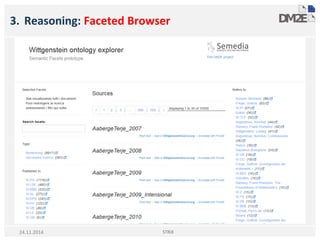
3. Reasoning: Faceted Browser
http://metasound.dibet.univpm.it/dm2e/ajax-solr-
master/examples/wab/
STRiX24.11.2014
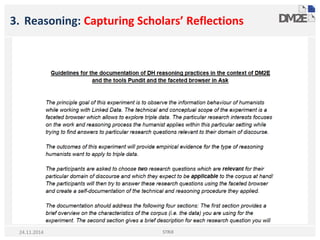
3. Reasoning: Capturing Scholars’ Reflections
http://metasound.dibet.univpm.it/dm2e/ajax-solr-
master/examples/wab/
STRiX24.11.2014
3. Reasoning: Use Cases
1. ERC AdG EUROCORR - Linked Data
2. Georg Eckert Institut - Annotation Vocabulary
3. Wittgenstein Archives Bergen - WAB Ontology
STRiX24.11.2014
3. Reasoning: Use Cases
1. ERC AdG EUROCORR - Linked Data
2. Georg Eckert Institut - Annotation Vocabulary
3. Wittgenstein Archives Bergen - WAB Ontology
STRiX24.11.2014
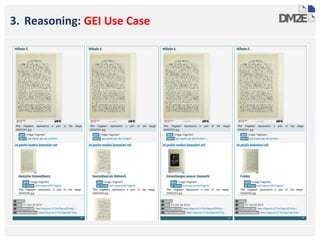
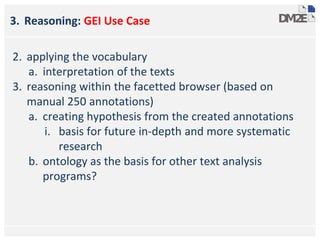
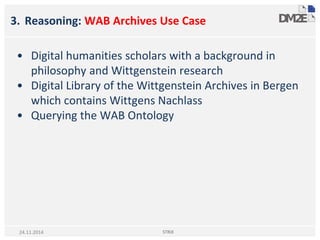
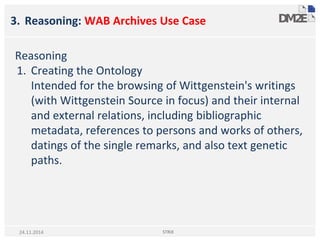
3. Reasoning: GEI Use Case
• Trained historian in educational history
• Digital Library of the Georg-Eckert-Institute which
contains digitized historical textbooks from Germany
• Research question / interest
– Identifying topoi regarding the nation and the
globalised world and how their connotation in
different types of schoolbooks (religious
orientation, school type, regional localisation etc.)
change over time
STRiX24.11.2014
3. Reasoning: GEI Use Case
Reasoning
1. creating the vocabulary for annotation
a. factual (about the book), e.g.
i. publication date and place, author, publication
house, religious orientation etc.
b. interpretative (about the topoi), e.g.
i. positive-modern connotated with / negative-
modern connotated with
ii. positive-male connotated with / negative-male
connotated with Reasoning
3. Reasoning: GEI Use Case
2. applying the vocabulary
a. interpretation of the texts
3. reasoning within the facetted browser (based on
manual 250 annotations)
a. creating hypothesis from the created annotations
i. basis for future in-depth and more systematic
research
b. ontology as the basis for other text analysis
programs?
3. Reasoning: WAB Archives Use Case
• Digital humanities scholars with a background in
philosophy and Wittgenstein research
• Digital Library of the Wittgenstein Archives in Bergen
which contains Wittgens Nachlass
• Querying the WAB Ontology
STRiX24.11.2014
3. Reasoning: WAB Archives Use Case
Reasoning
1. Creating the Ontology
Intended for the browsing of Wittgenstein's writings
(with Wittgenstein Source in focus) and their internal
and external relations, including bibliographic
metadata, references to persons and works of others,
datings of the single remarks, and also text genetic
paths.
STRiX24.11.2014
3. Reasoning: WAB Archives Use Case
Reasoning
2. Asking the Research questions with the faceted
browser
a. Find both primary and secondary literature that
helps me discuss Wittgenstein’s conception of
philosophy as a whole and with a focus on a
subarea
b. Checking whether Grammar is a popular topic
among Wittgenstein annotators
STRiX24.11.2014
3. Reasoning: WAB Archives Use Case
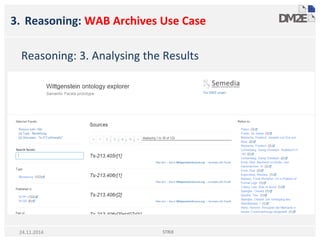
Reasoning: 3. Analysing the Results
STRiX24.11.2014
3. Reasoning: Lessons Learned
• We are still evaluating
• Raise awareness regarding these issues
– rethink the term ā€œReasoningā€
• Using facetted browsers as one possible way to
create a bridge between SW reasoning and humanist
reasoning
– three phases of ā€œReasoningā€ with browser
– new areas to model
STRiX24.11.2014
3. Reasoning: Tenative Results Use Cases
• Humanist use cases
– intermediate results in an ongoing research
process*
• GEI use case
- opinion mining
• Wittgenstein
- create a basis for the contextualisation and
comparison of the ideas of the author and his
reception
• In general
– issue of authority and (social) context = trust
STRiX24.11.2014
Thank You!
Literature
• Holyoak, K. J. and Morrison, R. G. (eds) (2012). The Oxford Handbook of
Thinking and Reasoning. Oxford: Oxford University Press.
• McCarty, W. (2005). Humanities computing. Basingstoke: Palgrave
Macmillan.
• Oldman, D., Doerr, M. and Gradmann, S. (n.d.). ZEN and the Art of Linked
Data. New Strategies for a Semantic Web of Humanist Knowledge. To be
published in Schreibman, S., Siemens, R. and Unsworth, J. (eds), A new
Companion to Digital Humanities. Oxford: Blackwell [preprint].
• Zƶllner-Weber, A. (2009). Ontologies and Logic Reasoning as Tools in
Humanities? Digital Humanities Quarterly, 3(4).
STRiX24.11.2014
Links
• http://dm2e.eu/
• https://thepund.it/
• http://mariandoerk.de/edgemaps/
• http://timemapper.okfnlabs.org/
• http://dev.thepund.it/tutorials/evaminerva2014/
• http://www.w3.org/
STRiX24.11.2014

Reasoning with Reasoning (STRiX 2014)

  • 1.
    co-funded by theEuropean Union Reasoning with Reasoning Semantic technologies for research in the humanities and social sciences (STRiX) Gƶteborg, 24 November 2014 Kristin Dill, Austrian National Library (ONB) Gerold Tschumpel, Steffen Hennicke, Christian Morbidoni, Klaus Thoden, Alois Pichler
  • 2.
    Outline 1. Digitised Manuscriptsto Europeana (DM2E) 2. Pundit 3. Reasoning with Reasoning for Digital Humanities STRiX24.11.2014
  • 3.
    Outline 1. Digitised Manuscriptsto Europeana (DM2E) 2. Pundit 3. Reasoning with Reasoning for Digital Humanities STRiX24.11.2014
  • 4.
    1. DM2E: Websitewww.dm2e.eu STRiX24.11.2014
  • 5.
    1. DM2E: About ā—Digitised Manuscripts to Europeana ā— EU-FP7 CIP-ICT-PSP.2011.2.1 - Aggregating content in Europeana ā— 11 consortium parnters and 10 associated Partners ā— Duration: Feb 2012 - Jan 2015 (36 months) STRiX24.11.2014
  • 6.
    1. DM2E: Whatis Europeana? www.europeana.eu STRiX24.11.2014
  • 7.
    1. DM2E: EuropeanaData Model • Backbone of Europeana • RDF representation of metadata • Unites several standards & vocabularies • Representation of cultural heritage objects from libraries, archives and museums • As generic as possible • Can be specialised for different domains STRiX24. 11.2014
  • 8.
    1. DM2E: Goalsof DM2E STRiX24.11.2014 1. Aggregation of manuscript metadata & content 2. Interoperability Infrastructure 3. Digital Humanities Applications and Research 4. Community Building
  • 9.
    1. DM2E: Goalsof DM2E STRiX24.11.2014 1. Aggregation of manuscript metadata & content 2. Interoperability Infrastructure 3. Digital Humanities Applications and Research 4. Community Building
  • 10.
    1. DM2E: ProjectArchitecture STRiX24.11.2014 You are here
  • 11.
    1. DM2E: WP3ā€œDH Engineeringā€ DM2E is researching the scholarly practices in the humanities as well building tools that respond to the needs of scholars. - http://dm2e.eu/digital-humanities/ Putting Linked Library Data to Work18.11.2014
  • 12.
    1. DM2E: WP3Tasks •Added value of EDM •Functional primitives of the Digital Humanities •Outreach DH community •Open source annotation tools Putting Linked Library Data to Work18.11.2014
  • 13.
    Outline 1. Digitised Manuscriptsto Europeana (DM2E) 2. Pundit 3. Reasoning with Reasoning for Digital Humanities STRiX24.11.2014
  • 14.
  • 15.
    2. Pundit: SemanticWeb Annotation Tool STRiX24.11.2014 http://en.wikipedi a.org/wiki/Plato http://en.wikipedia .org/wiki/Socrates 1913 Typescript ā€œWittgenstein is talking about language signs here in Ts-213ā€ discusses discusses document type has date comment ht thttp://wittgensteinsource.org.org/
  • 16.
    2. Pundit: WebPage Augmentation STRiX24.11.2014
  • 17.
    2. Pundit: Notebooks(Ask) STRiX24.11.2014
  • 18.
    2. Pundit: FacetedBrowser STRiX24.11.2014
  • 19.
    2. Pundit: Visualisationusing EdgeMaps STRiX24.11.2014
  • 20.
    2. Pundit: Visualisationusing TimeMapper STRiX24.11.2014
  • 21.
    2. Pundit: PTPTemplate STRiX24.11.2014
  • 22.
    2. Pundit: Playwith Pundit STRiX24.11.2014 http://dev.thepund.it/tutorials/evaminerv a2014/
  • 23.
    Outline 1. Digitised Manuscriptsto Europeana (DM2E) 2. Pundit 3. Reasoning with Reasoning for Digital Humanities STRiX24.11.2014
  • 24.
    3. Reasoning: Goals ā€œWhatkinds of 'reasoning' do digital humanists want to see enabled by the data and information available in Europeana together with those that are currently not part of the Europeana portal?ā€ - DOW DM2E (2012) STRiX24.11.2014
  • 25.
    3. Reasoning: Whatis SW Reasoning? ā€œBroadly speaking, inference on the Semantic Web can be characterized by discovering new relationshipsā€*... *http://www.w3.org/standards/semanticweb/inference STRiX24.11.2014
  • 26.
    3. Reasoning: Whatis SW Reasoning? • ...using machines! - large-scale machine-based processing of RDF data - uses logic and axioms - ā€œdefined via rule sets or vocabulariesā€* - mathematical and computational Example*: Flipper isA Dolphin > Flipper isA Mammal *http://www.w3.org/standards/semanticweb/inference STRiX24.11.2014
  • 27.
    3. Reasoning: Challengesfor DH scholars 1. Lack of familiarity 2. Reasoner’s ā€œabilityā€ contentious (Zƶllner-Weber 2009) 3. Knowledge representation activity preconfigures subsequent reasoning... 4. ...and in the Humanities often subjective 5. Humanities have complex and ambiguous research objects (Oldmann/Doerr/Gradmann, t.b.p.) 6. Goals of humanist research not compatible STRiX24.11.2014
  • 28.
    3. Reasoning: HumanistReasoning? ā€œReasoning, which has a long tradition that springs from philosophy and logic, places emphasis on the process of drawing inferences (conclusions) from some initial information (premises).ā€ (Holyoak/Morrison 2012, 2) STRiX24.11.2014
  • 29.
    3. Reasoning: HumanistReasoning for the SW ā€œinference on the Semantic Web can [also] be characterized by discovering new relationshipsā€*... *http://www.w3.org/standards/semanticweb/inference STRiX24.11.2014
  • 30.
    3. Reasoning: HumanistReasoning for the SW ...by human reasoning when looking at the graph. STRiX24.11.2014
  • 31.
    3. Reasoning: Methodology 1.Scholars creating Linked Data (of different complexity, and from different perspectives) 2. Scholars use faceted browsers 3. to query the graph 4. and answer specific research questions. 5. Scholars are then asked to reflect on their methods and results. Low hanging fruits! STRiX24.11.2014
  • 32.
    3. Reasoning: FacetedBrowser http://metasound.dibet.univpm.it/dm2e/ajax-solr- master/examples/wab/ STRiX24.11.2014
  • 33.
    3. Reasoning: CapturingScholars’ Reflections http://metasound.dibet.univpm.it/dm2e/ajax-solr- master/examples/wab/ STRiX24.11.2014
  • 34.
    3. Reasoning: UseCases 1. ERC AdG EUROCORR - Linked Data 2. Georg Eckert Institut - Annotation Vocabulary 3. Wittgenstein Archives Bergen - WAB Ontology STRiX24.11.2014
  • 35.
    3. Reasoning: UseCases 1. ERC AdG EUROCORR - Linked Data 2. Georg Eckert Institut - Annotation Vocabulary 3. Wittgenstein Archives Bergen - WAB Ontology STRiX24.11.2014
  • 36.
    3. Reasoning: GEIUse Case • Trained historian in educational history • Digital Library of the Georg-Eckert-Institute which contains digitized historical textbooks from Germany • Research question / interest – Identifying topoi regarding the nation and the globalised world and how their connotation in different types of schoolbooks (religious orientation, school type, regional localisation etc.) change over time STRiX24.11.2014
  • 37.
    3. Reasoning: GEIUse Case Reasoning 1. creating the vocabulary for annotation a. factual (about the book), e.g. i. publication date and place, author, publication house, religious orientation etc. b. interpretative (about the topoi), e.g. i. positive-modern connotated with / negative- modern connotated with ii. positive-male connotated with / negative-male connotated with Reasoning
  • 38.
  • 39.
    3. Reasoning: GEIUse Case 2. applying the vocabulary a. interpretation of the texts 3. reasoning within the facetted browser (based on manual 250 annotations) a. creating hypothesis from the created annotations i. basis for future in-depth and more systematic research b. ontology as the basis for other text analysis programs?
  • 40.
    3. Reasoning: WABArchives Use Case • Digital humanities scholars with a background in philosophy and Wittgenstein research • Digital Library of the Wittgenstein Archives in Bergen which contains Wittgens Nachlass • Querying the WAB Ontology STRiX24.11.2014
  • 41.
    3. Reasoning: WABArchives Use Case Reasoning 1. Creating the Ontology Intended for the browsing of Wittgenstein's writings (with Wittgenstein Source in focus) and their internal and external relations, including bibliographic metadata, references to persons and works of others, datings of the single remarks, and also text genetic paths. STRiX24.11.2014
  • 42.
    3. Reasoning: WABArchives Use Case Reasoning 2. Asking the Research questions with the faceted browser a. Find both primary and secondary literature that helps me discuss Wittgenstein’s conception of philosophy as a whole and with a focus on a subarea b. Checking whether Grammar is a popular topic among Wittgenstein annotators STRiX24.11.2014
  • 43.
    3. Reasoning: WABArchives Use Case Reasoning: 3. Analysing the Results STRiX24.11.2014
  • 44.
    3. Reasoning: LessonsLearned • We are still evaluating • Raise awareness regarding these issues – rethink the term ā€œReasoningā€ • Using facetted browsers as one possible way to create a bridge between SW reasoning and humanist reasoning – three phases of ā€œReasoningā€ with browser – new areas to model STRiX24.11.2014
  • 45.
    3. Reasoning: TenativeResults Use Cases • Humanist use cases – intermediate results in an ongoing research process* • GEI use case - opinion mining • Wittgenstein - create a basis for the contextualisation and comparison of the ideas of the author and his reception • In general – issue of authority and (social) context = trust STRiX24.11.2014
  • 46.
  • 47.
    Literature • Holyoak, K.J. and Morrison, R. G. (eds) (2012). The Oxford Handbook of Thinking and Reasoning. Oxford: Oxford University Press. • McCarty, W. (2005). Humanities computing. Basingstoke: Palgrave Macmillan. • Oldman, D., Doerr, M. and Gradmann, S. (n.d.). ZEN and the Art of Linked Data. New Strategies for a Semantic Web of Humanist Knowledge. To be published in Schreibman, S., Siemens, R. and Unsworth, J. (eds), A new Companion to Digital Humanities. Oxford: Blackwell [preprint]. • Zƶllner-Weber, A. (2009). Ontologies and Logic Reasoning as Tools in Humanities? Digital Humanities Quarterly, 3(4). STRiX24.11.2014
  • 48.
    Links • http://dm2e.eu/ • https://thepund.it/ •http://mariandoerk.de/edgemaps/ • http://timemapper.okfnlabs.org/ • http://dev.thepund.it/tutorials/evaminerva2014/ • http://www.w3.org/ STRiX24.11.2014