LIBRARIES FOR
DEVELOPMENT AND UNITY:
A REALITY OR PIPE-DREAM?
Ujala Satgoor
President-Elect
23 August 2012
LIASA EC AGM
OVERVIEW
•  Definitions
•  Concepts and scope
•  South African Context
•  Examples
•  Opportunities
•  Who creates this reality?
DEVELOPMENT
The public library, the local
gateway to knowledge,
provides a basic condition
for lifelong learning,
independent decision-
making and cultural
development of the
individual and social
groups.
IFLA/UNESCO Public
Libraries Manifesto
http://www.ifla.org/publications/iflaunesco-public-
library-manifesto-1994
Gradual advancement or
growth through a series of
progressive changes
http://www.brainyquote.com/words/de/
development153653.html#ixzz1nglecAmk
“If information and
knowledge are central
to democracy, they
are the conditions for
development” Kofi
Annan
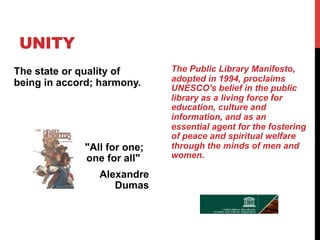
UNITY
The Public Library Manifesto,
adopted in 1994, proclaims
UNESCO's belief in the public
library as a living force for
education, culture and
information, and as an
essential agent for the fostering
of peace and spiritual welfare
through the minds of men and
women.
The state or quality of
being in accord; harmony.
"All for one;
one for all"
[ Alexandre
Dumas
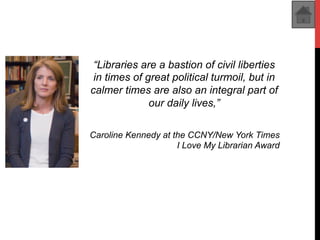
“Libraries are a bastion of civil liberties
in times of great political turmoil, but in
calmer times are also an integral part of
our daily lives,”
Caroline Kennedy at the CCNY/New York Times
I Love My Librarian Award
CONCEPTS, SCOPE &
IMPERATIVES
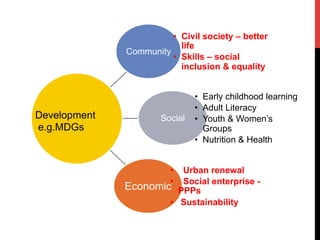
Community
•  Civil society – better
life
•  Skills – social
inclusion & equality
Social
•  Early childhood learning
•  Adult Literacy
•  Youth & Women’s
Groups
•  Nutrition & Health
Economic
•  Urban renewal
•  Social enterprise -
PPPs
•  Sustainability
Development
e.g.MDGs
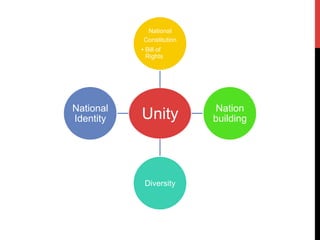
Unity
National
Constitution
•  Bill of
Rights
Nation
building
Diversity
National
Identity
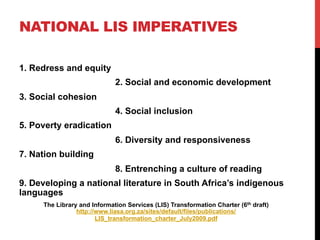
NATIONAL LIS IMPERATIVES
1. Redress and equity
2. Social and economic development
3. Social cohesion
4. Social inclusion
5. Poverty eradication
6. Diversity and responsiveness
7. Nation building
8. Entrenching a culture of reading
9. Developing a national literature in South Africa’s indigenous
languages
The Library and Information Services (LIS) Transformation Charter (6th draft)
http://www.liasa.org.za/sites/default/files/publications/
LIS_transformation_charter_July2009.pdf
TO WHAT END?
The development of an
informed nation!
WHY AN INFORMED
NATION?
•  To understand the impact of the past on the present
•  Redress iniquities of the past
•  To create an acknowledgement and appreciation of
existing diversity
•  Foster effective communication across cultures.
•  Stable democracy & progress
•  Safeguarding of human rights
WHY AN INFORMED
NATION?
•  To educate future leaders who will represent these values
•  4 cornerstones to “seed” democratic values (DoE, 2000)
•  critical thinking, creative expression through art, a critical
understanding of history & multilingualism
•  personal expression, a local sense of meaning and
expanded ways of thinking and communication
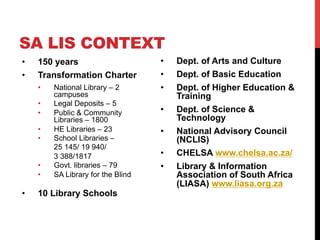
SA LIS CONTEXT
•  150 years
•  Transformation Charter
•  National Library – 2
campuses
•  Legal Deposits – 5
•  Public & Community
Libraries – 1800
•  HE Libraries – 23
•  School Libraries –
25 145/ 19 940/
3 388/1817
•  Govt. libraries – 79
•  SA Library for the Blind
•  10 Library Schools
•  Dept. of Arts and Culture
•  Dept. of Basic Education
•  Dept. of Higher Education &
Training
•  Dept. of Science &
Technology
•  National Advisory Council
(NCLIS)
•  CHELSA www.chelsa.ac.za/
•  Library & Information
Association of South Africa
(LIASA) www.liasa.org.za
OBJECTIVES OF THE
LIS SECTOR
According to the Transformation Charter…
1. Support and stimulate the socio-economic, educational, cultural,
recreational, scientific research, technological and information
development of all communities in the country
2. Provide optimal access to relevant information
to every person in an economic and cost-effective
manner
3. Promote basic and functional literacy, information literacy, and a
culture of reading
4. Strengthen democracy by encouraging critical
and independent thinking and intellectual
freedom
OBJECTIVES OF THE
LIS SECTOR
5. Harness new information and communication technologies (ICT) to
achieve improved integration, equity, cost-effectiveness and quality in
library and information services
6. Make available the national documentary heritage and
facilitate access to the world’s information resources by all,
including people with disabilities
7. Provide for the preservation of the national documentary heritage,
and provide conservation services
8. Put a premium on Indigenous Knowledge, and mainstream
this knowledge by collecting and disseminating it in book,
audio, and video formats.
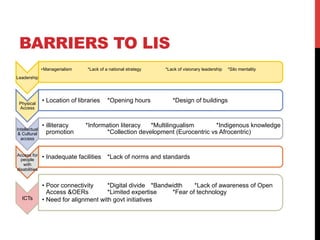
BARRIERS TO LIS
Leadership
• Managerialism *Lack of a national strategy *Lack of visionary leadership *Silo mentality
Physical
Access
•  Location of libraries *Opening hours *Design of buildings
Intellectual
& Cultural
access
•  illiteracy *Information literacy *Multilingualism *Indigenous knowledge
promotion *Collection development (Eurocentric vs Afrocentric)
Access for
people
with
disabilities
•  Inadequate facilities *Lack of norms and standards
ICTs
•  Poor connectivity *Digital divide *Bandwidth *Lack of awareness of Open
Access &OERs *Limited expertise *Fear of technology
•  Need for alignment with govt initiatives
WORST BARRIER
INDIFFERENCE
EXAMPLES OF LIBRARIES
IMPACTING ON
DEVELOPMENT & UNITY
HTTP://WWW.GATESFOUNDATION.ORG/WHAT-WE-DO/GLOBAL-DEVELOPMENT/
GLOBAL-LIBRARIES/ACCESS-TO-LEARNING-AWARD-ATLA
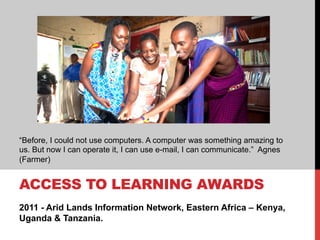
2011 - Arid Lands Information Network, Eastern Africa – Kenya,
Uganda & Tanzania.
ACCESS TO LEARNING AWARDS
“Before, I could not use computers. A computer was something amazing to
us. But now I can operate it, I can use e-mail, I can communicate.” Agnes
(Farmer)
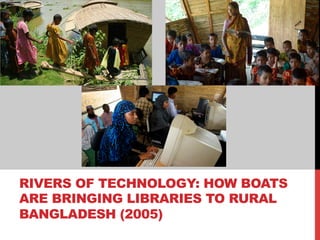
RIVERS OF TECHNOLOGY: HOW BOATS
ARE BRINGING LIBRARIES TO RURAL
BANGLADESH (2005)
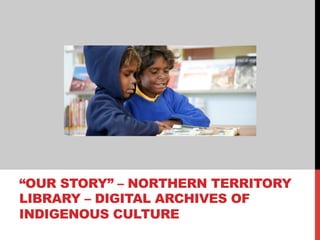
“OUR STORY” – NORTHERN TERRITORY
LIBRARY – DIGITAL ARCHIVES OF
INDIGENOUS CULTURE
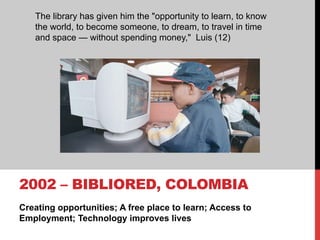
Creating opportunities; A free place to learn; Access to
Employment; Technology improves lives
2002 – BIBLIORED, COLOMBIA
The library has given him the "opportunity to learn, to know
the world, to become someone, to dream, to travel in time
and space — without spending money," Luis (12)
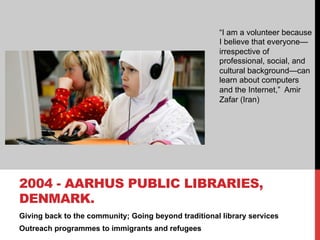
Giving back to the community; Going beyond traditional library services
Outreach programmes to immigrants and refugees
2004 - AARHUS PUBLIC LIBRARIES,
DENMARK.
“I am a volunteer because
I believe that everyone—
irrespective of
professional, social, and
cultural background—can
learn about computers
and the Internet,” Amir
Zafar (Iran)
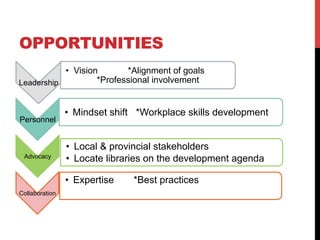
OPPORTUNITIES
Leadership
•  Vision *Alignment of goals
*Professional involvement
Personnel
•  Mindset shift *Workplace skills development
Advocacy
•  Local & provincial stakeholders
•  Locate libraries on the development agenda
Collaboration
•  Expertise *Best practices
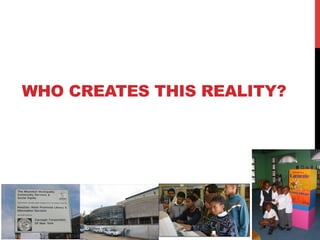
WHO CREATES THIS REALITY?
“None of these efforts would have been possible
without dedicated, committed and visionary
LIBRARIANS. Professionals who are excited about
their changing role in a changing world - who are
dedicated to serving others, who respect scholarship,
and who understand that you are our guides on a life
long journey of intellectual collaboration and
collaborative composition.
Your work is truly life changing,”
Caroline Kennedy
ARE YOU READY TO
CREATE THIS REALITY?
IF YOU WANT TO GO FAST, GO
ALONE
IF YOU WANT TO GO FAR, GO
TOGETHER
AFRICAN PROVERB

Libraries for development and unity

  • 1.
    LIBRARIES FOR DEVELOPMENT ANDUNITY: A REALITY OR PIPE-DREAM? Ujala Satgoor President-Elect 23 August 2012 LIASA EC AGM
  • 2.
    OVERVIEW •  Definitions •  Conceptsand scope •  South African Context •  Examples •  Opportunities •  Who creates this reality?
  • 3.
    DEVELOPMENT The public library,the local gateway to knowledge, provides a basic condition for lifelong learning, independent decision- making and cultural development of the individual and social groups. IFLA/UNESCO Public Libraries Manifesto http://www.ifla.org/publications/iflaunesco-public- library-manifesto-1994 Gradual advancement or growth through a series of progressive changes http://www.brainyquote.com/words/de/ development153653.html#ixzz1nglecAmk “If information and knowledge are central to democracy, they are the conditions for development” Kofi Annan
  • 4.
    UNITY The Public LibraryManifesto, adopted in 1994, proclaims UNESCO's belief in the public library as a living force for education, culture and information, and as an essential agent for the fostering of peace and spiritual welfare through the minds of men and women. The state or quality of being in accord; harmony. "All for one; one for all" [ Alexandre Dumas
  • 5.
    “Libraries are abastion of civil liberties in times of great political turmoil, but in calmer times are also an integral part of our daily lives,” Caroline Kennedy at the CCNY/New York Times I Love My Librarian Award
  • 6.
  • 7.
    Community •  Civil society– better life •  Skills – social inclusion & equality Social •  Early childhood learning •  Adult Literacy •  Youth & Women’s Groups •  Nutrition & Health Economic •  Urban renewal •  Social enterprise - PPPs •  Sustainability Development e.g.MDGs
  • 8.
  • 9.
    NATIONAL LIS IMPERATIVES 1.Redress and equity 2. Social and economic development 3. Social cohesion 4. Social inclusion 5. Poverty eradication 6. Diversity and responsiveness 7. Nation building 8. Entrenching a culture of reading 9. Developing a national literature in South Africa’s indigenous languages The Library and Information Services (LIS) Transformation Charter (6th draft) http://www.liasa.org.za/sites/default/files/publications/ LIS_transformation_charter_July2009.pdf
  • 10.
    TO WHAT END? Thedevelopment of an informed nation!
  • 11.
    WHY AN INFORMED NATION? • To understand the impact of the past on the present •  Redress iniquities of the past •  To create an acknowledgement and appreciation of existing diversity •  Foster effective communication across cultures. •  Stable democracy & progress •  Safeguarding of human rights
  • 12.
    WHY AN INFORMED NATION? • To educate future leaders who will represent these values •  4 cornerstones to “seed” democratic values (DoE, 2000) •  critical thinking, creative expression through art, a critical understanding of history & multilingualism •  personal expression, a local sense of meaning and expanded ways of thinking and communication
  • 13.
    SA LIS CONTEXT • 150 years •  Transformation Charter •  National Library – 2 campuses •  Legal Deposits – 5 •  Public & Community Libraries – 1800 •  HE Libraries – 23 •  School Libraries – 25 145/ 19 940/ 3 388/1817 •  Govt. libraries – 79 •  SA Library for the Blind •  10 Library Schools •  Dept. of Arts and Culture •  Dept. of Basic Education •  Dept. of Higher Education & Training •  Dept. of Science & Technology •  National Advisory Council (NCLIS) •  CHELSA www.chelsa.ac.za/ •  Library & Information Association of South Africa (LIASA) www.liasa.org.za
  • 14.
    OBJECTIVES OF THE LISSECTOR According to the Transformation Charter… 1. Support and stimulate the socio-economic, educational, cultural, recreational, scientific research, technological and information development of all communities in the country 2. Provide optimal access to relevant information to every person in an economic and cost-effective manner 3. Promote basic and functional literacy, information literacy, and a culture of reading 4. Strengthen democracy by encouraging critical and independent thinking and intellectual freedom
  • 15.
    OBJECTIVES OF THE LISSECTOR 5. Harness new information and communication technologies (ICT) to achieve improved integration, equity, cost-effectiveness and quality in library and information services 6. Make available the national documentary heritage and facilitate access to the world’s information resources by all, including people with disabilities 7. Provide for the preservation of the national documentary heritage, and provide conservation services 8. Put a premium on Indigenous Knowledge, and mainstream this knowledge by collecting and disseminating it in book, audio, and video formats.
  • 16.
    BARRIERS TO LIS Leadership • Managerialism*Lack of a national strategy *Lack of visionary leadership *Silo mentality Physical Access •  Location of libraries *Opening hours *Design of buildings Intellectual & Cultural access •  illiteracy *Information literacy *Multilingualism *Indigenous knowledge promotion *Collection development (Eurocentric vs Afrocentric) Access for people with disabilities •  Inadequate facilities *Lack of norms and standards ICTs •  Poor connectivity *Digital divide *Bandwidth *Lack of awareness of Open Access &OERs *Limited expertise *Fear of technology •  Need for alignment with govt initiatives
  • 17.
  • 18.
    EXAMPLES OF LIBRARIES IMPACTINGON DEVELOPMENT & UNITY HTTP://WWW.GATESFOUNDATION.ORG/WHAT-WE-DO/GLOBAL-DEVELOPMENT/ GLOBAL-LIBRARIES/ACCESS-TO-LEARNING-AWARD-ATLA
  • 19.
    2011 - AridLands Information Network, Eastern Africa – Kenya, Uganda & Tanzania. ACCESS TO LEARNING AWARDS “Before, I could not use computers. A computer was something amazing to us. But now I can operate it, I can use e-mail, I can communicate.” Agnes (Farmer)
  • 20.
    RIVERS OF TECHNOLOGY:HOW BOATS ARE BRINGING LIBRARIES TO RURAL BANGLADESH (2005)
  • 21.
    “OUR STORY” –NORTHERN TERRITORY LIBRARY – DIGITAL ARCHIVES OF INDIGENOUS CULTURE
  • 22.
    Creating opportunities; Afree place to learn; Access to Employment; Technology improves lives 2002 – BIBLIORED, COLOMBIA The library has given him the "opportunity to learn, to know the world, to become someone, to dream, to travel in time and space — without spending money," Luis (12)
  • 23.
    Giving back tothe community; Going beyond traditional library services Outreach programmes to immigrants and refugees 2004 - AARHUS PUBLIC LIBRARIES, DENMARK. “I am a volunteer because I believe that everyone— irrespective of professional, social, and cultural background—can learn about computers and the Internet,” Amir Zafar (Iran)
  • 24.
    OPPORTUNITIES Leadership •  Vision *Alignmentof goals *Professional involvement Personnel •  Mindset shift *Workplace skills development Advocacy •  Local & provincial stakeholders •  Locate libraries on the development agenda Collaboration •  Expertise *Best practices
  • 25.
  • 26.
    “None of theseefforts would have been possible without dedicated, committed and visionary LIBRARIANS. Professionals who are excited about their changing role in a changing world - who are dedicated to serving others, who respect scholarship, and who understand that you are our guides on a life long journey of intellectual collaboration and collaborative composition. Your work is truly life changing,” Caroline Kennedy
  • 27.
    ARE YOU READYTO CREATE THIS REALITY?
  • 28.
    IF YOU WANTTO GO FAST, GO ALONE IF YOU WANT TO GO FAR, GO TOGETHER AFRICAN PROVERB