SHALE GAS
Bocchinfuso F., Bresciani F., Caprio M.S., Colonnelli A.
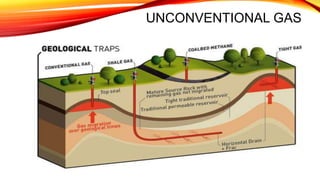
CONVENTIONAL AND
UNCONVENTIONAL GAS
Conventional Gas
 Free oil and gas
trapped in porous
reservoirs
 (usually
sandstone or
limestone)
 Relatively easy to
extract
Unconventional
Gas:
 Gas trapped in
rocks which is
more difficult to
produce from
such as :
 Tight gas
 Coal bed
methane
 Shale Gas
Why extract
unconventional
oil and gas now?
 Developments in
drilling technology
over the last 20
years have made
it economic to
extract
UNCONVENTIONAL GAS
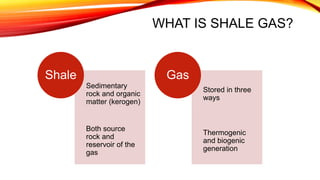
WHAT IS SHALE GAS?
Sedimentary
rock and organic
matter (kerogen)
Both source
rock and
reservoir of the
gas
Shale
Stored in three
ways
Thermogenic
and biogenic
generation
Gas
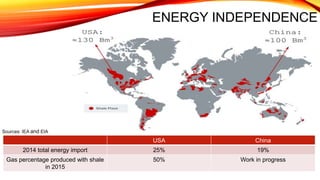
ENERGY INDEPENDENCE
Sources: IEA and EIA
USA China
2014 total energy import 25% 19%
Gas percentage produced with shale
in 2015
50% Work in progress
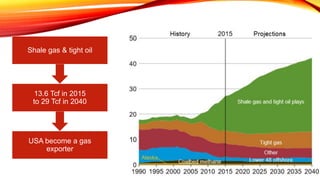
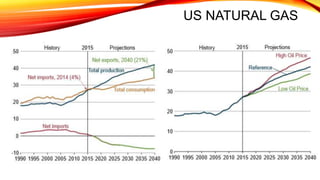
USA become a gas
exporter
Shale gas & tight oil
13.6 Tcf in 2015
to 29 Tcf in 2040
US NATURAL GAS
ECONOMICAL ISSUES
 30% fracking companies went bankrupt in 2015 due to the oil low price
 At the same time technology improvements leads to higher rates of recovery at lower costs
Oil price - WTI [USD/bbl]
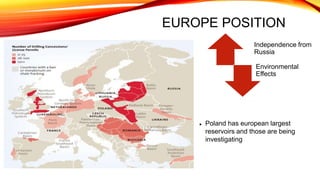
EUROPE POSITION
 Poland has european largest
reservoirs and those are being
investigating
Independence from
Russia
Environmental
Effects
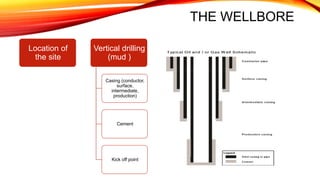
THE WELLBORE
Location of
the site
Vertical drilling
(mud )
Casing (conductor,
surface,
intermediate,
production)
Cement
Kick off point
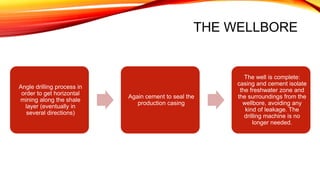
THE WELLBORE
Angle drilling process in
order to get horizontal
mining along the shale
layer (eventually in
several directions)
Again cement to seal the
production casing
The well is complete:
casing and cement isolate
the freshwater zone and
the surroundings from the
wellbore, avoiding any
kind of leakage. The
drilling machine is no
longer needed.
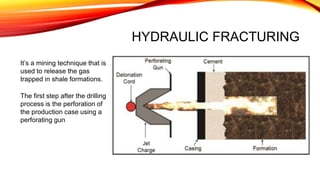
HYDRAULIC FRACTURING
It’s a mining technique that is
used to release the gas
trapped in shale formations.
The first step after the drilling
process is the perforation of
the production case using a
perforating gun
HYDRAULIC FRACTURING
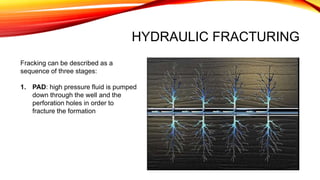
Fracking can be described as a
sequence of three stages:
1. PAD: high pressure fluid is pumped
down through the well and the
perforation holes in order to
fracture the formation
HYDRAULIC FRACTURING
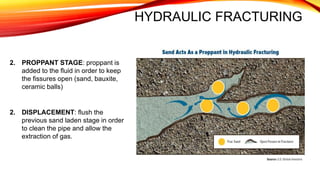
2. PROPPANT STAGE: proppant is
added to the fluid in order to keep
the fissures open (sand, bauxite,
ceramic balls)
2. DISPLACEMENT: flush the
previous sand laden stage in order
to clean the pipe and allow the
extraction of gas.
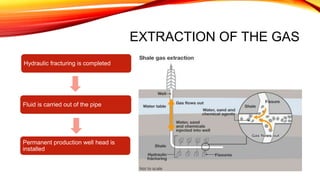
EXTRACTION OF THE GAS
Hydraulic fracturing is completed
Fluid is carried out of the pipe
Permanent production well head is
installed
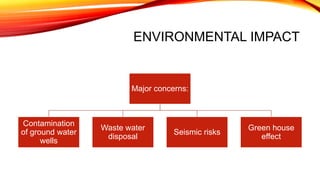
Major concerns:
Contamination
of ground water
wells
Waste water
disposal
Seismic risks
Green house
effect
ENVIRONMENTAL IMPACT
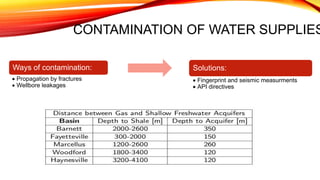
CONTAMINATION OF WATER SUPPLIES
Ways of contamination:
 Propagation by fractures
 Wellbore leakages
Solutions:
 Fingerprint and seismic measurments
 API directives
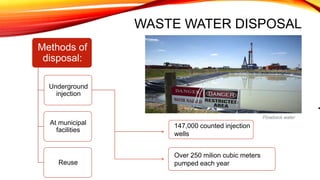
WASTE WATER DISPOSAL
•
Flowback water
Methods of
disposal:
Underground
injection
At municipal
facilities
Reuse
147,000 counted injection
wells
Over 250 milion cubic meters
pumped each year
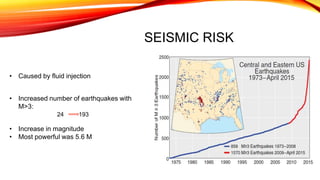
SEISMIC RISK
• Caused by fluid injection
• Increased number of earthquakes with
M>3:
• Increase in magnitude
• Most powerful was 5.6 M
24 193
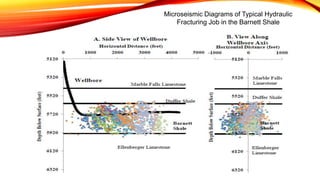
Microseismic Diagrams of Typical Hydraulic
Fracturing Job in the Barnett Shale
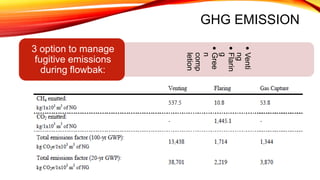
GHG EMISSION
Venti
ng
Flarin
g
Gree
n
comp
letion
3 option to manage
fugitive emissions
during flowbak:
BIBLIOGRAPHY
MIT Energy Initiative, http://energy.mit.edu/publication/future-natural-gas/.
EIA, http://www.eia.gov/outlooks/aeo/.
Treccani,
http://www.treccani.it/export/sites/default/Portale/sito/altre_aree/Tecnologia_e_Scienze_appli
cate/enciclopedia/italiano_vol_3/057-084_ita.pdf.
API guidance document first edition, Oct. 2009.
EPA, https://www.epa.gov/natural-gas-star-program.
http://science.sciencemag.org/

Shale gas review

  • 1.
    SHALE GAS Bocchinfuso F.,Bresciani F., Caprio M.S., Colonnelli A.
  • 2.
    CONVENTIONAL AND UNCONVENTIONAL GAS ConventionalGas  Free oil and gas trapped in porous reservoirs  (usually sandstone or limestone)  Relatively easy to extract Unconventional Gas:  Gas trapped in rocks which is more difficult to produce from such as :  Tight gas  Coal bed methane  Shale Gas Why extract unconventional oil and gas now?  Developments in drilling technology over the last 20 years have made it economic to extract
  • 3.
  • 4.
    WHAT IS SHALEGAS? Sedimentary rock and organic matter (kerogen) Both source rock and reservoir of the gas Shale Stored in three ways Thermogenic and biogenic generation Gas
  • 5.
    ENERGY INDEPENDENCE Sources: IEAand EIA USA China 2014 total energy import 25% 19% Gas percentage produced with shale in 2015 50% Work in progress
  • 6.
    USA become agas exporter Shale gas & tight oil 13.6 Tcf in 2015 to 29 Tcf in 2040
  • 7.
  • 8.
    ECONOMICAL ISSUES  30%fracking companies went bankrupt in 2015 due to the oil low price  At the same time technology improvements leads to higher rates of recovery at lower costs Oil price - WTI [USD/bbl]
  • 9.
    EUROPE POSITION  Polandhas european largest reservoirs and those are being investigating Independence from Russia Environmental Effects
  • 10.
    THE WELLBORE Location of thesite Vertical drilling (mud ) Casing (conductor, surface, intermediate, production) Cement Kick off point
  • 11.
    THE WELLBORE Angle drillingprocess in order to get horizontal mining along the shale layer (eventually in several directions) Again cement to seal the production casing The well is complete: casing and cement isolate the freshwater zone and the surroundings from the wellbore, avoiding any kind of leakage. The drilling machine is no longer needed.
  • 12.
    HYDRAULIC FRACTURING It’s amining technique that is used to release the gas trapped in shale formations. The first step after the drilling process is the perforation of the production case using a perforating gun
  • 13.
    HYDRAULIC FRACTURING Fracking canbe described as a sequence of three stages: 1. PAD: high pressure fluid is pumped down through the well and the perforation holes in order to fracture the formation
  • 14.
    HYDRAULIC FRACTURING 2. PROPPANTSTAGE: proppant is added to the fluid in order to keep the fissures open (sand, bauxite, ceramic balls) 2. DISPLACEMENT: flush the previous sand laden stage in order to clean the pipe and allow the extraction of gas.
  • 15.
    EXTRACTION OF THEGAS Hydraulic fracturing is completed Fluid is carried out of the pipe Permanent production well head is installed
  • 16.
    Major concerns: Contamination of groundwater wells Waste water disposal Seismic risks Green house effect ENVIRONMENTAL IMPACT
  • 17.
    CONTAMINATION OF WATERSUPPLIES Ways of contamination:  Propagation by fractures  Wellbore leakages Solutions:  Fingerprint and seismic measurments  API directives
  • 18.
    WASTE WATER DISPOSAL • Flowbackwater Methods of disposal: Underground injection At municipal facilities Reuse 147,000 counted injection wells Over 250 milion cubic meters pumped each year
  • 19.
    SEISMIC RISK • Causedby fluid injection • Increased number of earthquakes with M>3: • Increase in magnitude • Most powerful was 5.6 M 24 193
  • 20.
    Microseismic Diagrams ofTypical Hydraulic Fracturing Job in the Barnett Shale
  • 21.
    GHG EMISSION Venti ng Flarin g Gree n comp letion 3 optionto manage fugitive emissions during flowbak:
  • 22.
    BIBLIOGRAPHY MIT Energy Initiative,http://energy.mit.edu/publication/future-natural-gas/. EIA, http://www.eia.gov/outlooks/aeo/. Treccani, http://www.treccani.it/export/sites/default/Portale/sito/altre_aree/Tecnologia_e_Scienze_appli cate/enciclopedia/italiano_vol_3/057-084_ita.pdf. API guidance document first edition, Oct. 2009. EPA, https://www.epa.gov/natural-gas-star-program. http://science.sciencemag.org/