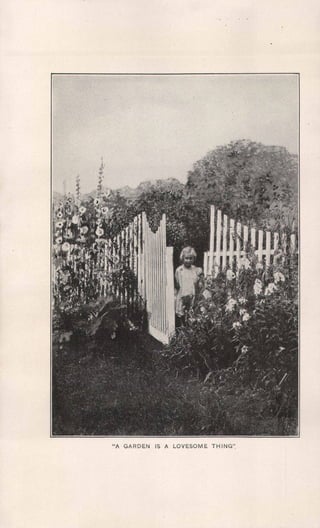
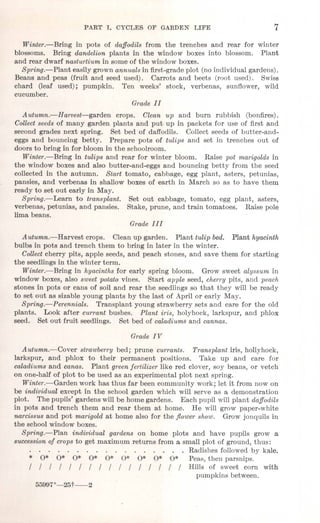
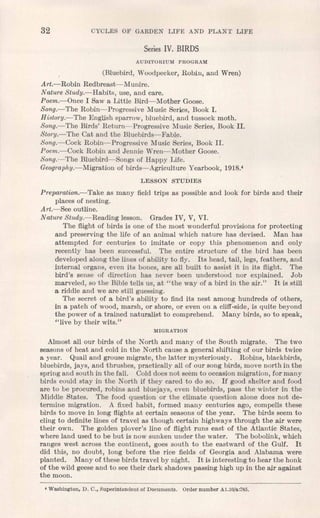
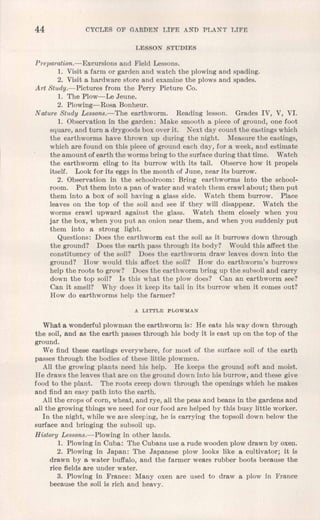
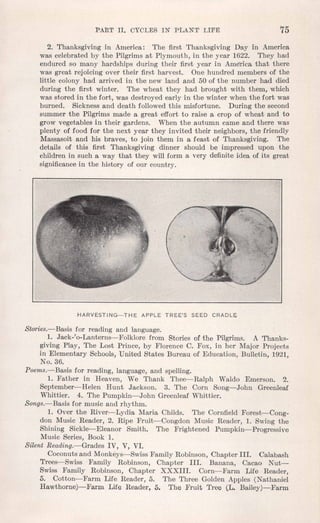
"A GARDEN IS A LOVESOME THING".
· DEPARTMENT OF THE INTERIOR
BUREAU OF EDUCATION
BULLETIN, 1925, No. 15
CYCLES OF GARDEN LIFE
AND PLANT LIFE
A SERIES OF PROJECTS IN NATURE STUDY
FOR ELEMENTARY SCHOOLS
By
FLORENCE C. FOX
ASSISTANT SPECIALIST IN CITY SCHOOLS
WASHINGTON
GOVERNMENT PRINTING OFFICE
1925
ADDI'rIONAL COPIES
OF THIS PUBLICATION MAY BE PROCURED FROM
THE SUPERINTENDENT OF DOCUMENTS
GOVERNMENT PRINTING OFFICE
WASHINGTON, D. C.
AT
25 CENTS PER COPY
LETTER OF TRANSMITTAL
DEPARTMENTOF THEINTERIOR,
BUREAUOF EDUCATION,
Washington, July 1J 1925.
SIR: In line with the movement for out-door recreation so recently
inaugurated by President Coolidge's conference, there came to the
Commissioner of Education a request from the General Federation
of Women's Clubs, through its president, Mrs. John D. Sherman,
that a curriculum on nature study for elementary schools be prepared
and issued by the Bureau of Education.
I have, therefore, asked Miss Florence C. Fox, assistant specialist
in city schools, to write the course of study herein submitted and ask
that it be printed as a bulletin of the Bureau of Education. It will
be of value in promoting a type of study much needed in our schools,
and it will offer to the primary and intermediate teacher a suggestive
series of projects on nature study which can be easily adapted to the
daily programs in schools in different localities in the United States.
JNO. J. TIGERT,
Commissioner.
The SECRETARYOF THEINTERIOR.
III
CONTENTS
Page
Letter of transmittaL -- III
Forevvord________________________________________________________ VII
Introduction:
What does nature study mean to the child? _ _ _ ______ __ ______ _____ 1
Cycles of garden life___________________________________________ 1
Cycles of plant life - - - 1
The place of nature study in the daily program___________________ 2
The recitation in nature study__________________________________ 3
How to study nature__________________________________________ 3
Use of museums in nature study________________________________ 4
Use of stereoscope - 4
Part I.-Cycles of garden life:
Series I. The garden - - - 6
II. Birds and insects in the garden_________________________ 9
III. Toads_______________________________________________ 31
IV. Birds________________________________________________ 32
V. Bees________________________________________________ 37
VI. The orchard - - - - 38
VII. Trees_______________________________________________ 39
Part II.-Cycles of plant life:
Series I. Plowing - _- - - - - 43
II. Sowing - - 46
III. Planting c
_____________ 50
IV. Grovving_____________________________________________ 52
V. Cultivating - - - - - - - - - 58
VI. Flowering - - - - - - - - - - 62
VII. Reaping_____________________________________________ 69
VIII. Harvesting - - - - - - - 72
lJe. Threshing___________________________________________ 77
Je. Storing - - - - - 81
JeI. Grinding_~__________________________________________ 85
Jell. Baking______________________________________________ 88
JeIII. Marketing - - - - - - - - - 91
JeIV. Transporting - - - - - - - - - - - - - 93
v
ILLUSTRATIONS
Page
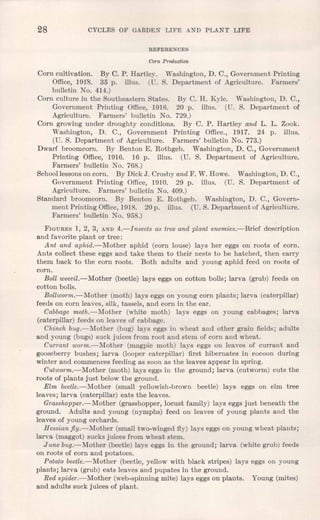
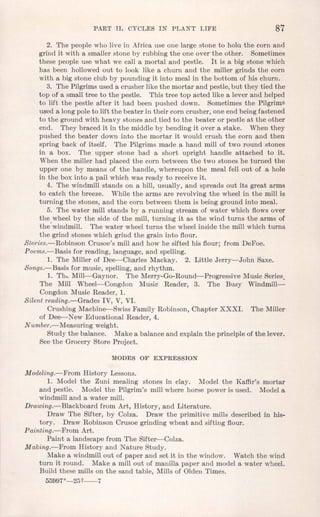
" A Garden is a lovesome thing" Frontispiece
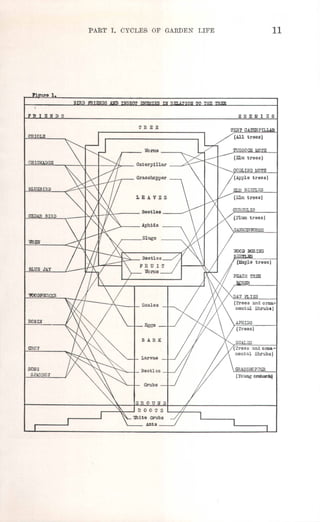
The house wren and her nest , ______________________________________ 10
What the wren eats for breakfast____________________________________ 15
Life cycle of the fall army worm. Tachina fly, parasite of the fall army
worm__________________________________________________________ 16
The blackbird and the white grub___________________________________ 17
Grasshopper eating a grain of wheat__ _______________________________ 18
Chickadee, an important enemy of the tussock moth___________________ 19
Hairy and downy woodpeckers, important enemies of the borer . , _________ 20
The white grub, enlarged about 8 diameters__________________________ 21
What the Hessian fly does to the wheat (Walton) _____________________ 22
The long-bodied ichneumon fly, parasite of the white grub_____ _________ 23
The black digger wasp, parasite of the white grub_____________________ 23
The boll weevil, greatly enlarged; ___________________________________ 24
Larvae of the boll weevil, at work in a cotton boIL____________________ 24
Dusting a cotton field to destroy the boll weevlls , ______________________ 25
The corn-ear bollworm attacking an ear of sweet corn .._ 27
Baltimore oriole and orchard oriole, enemies of the boll weevil . _________ 33
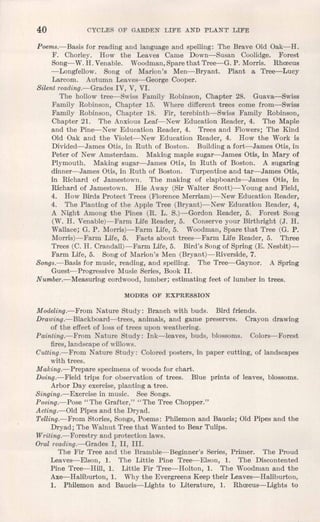
The oldest and largest elm tree in the United States. Kingsport, Tenn . , 41
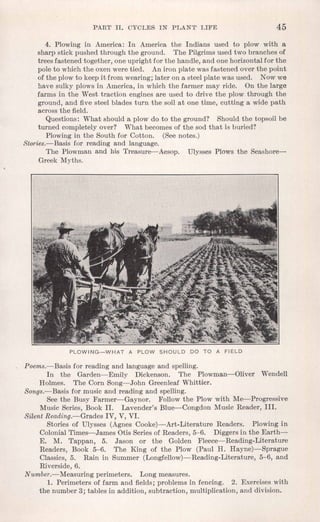
Plowing-What a plow should do to a field___________________________ 45
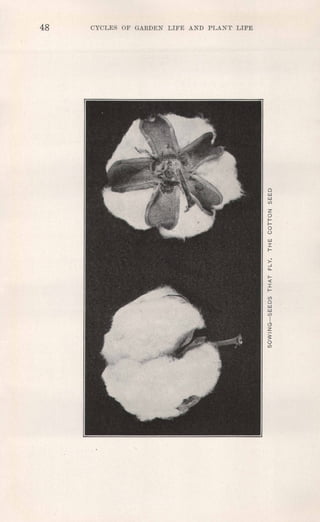
Sowing-Seeds that fly. The cotton seed.. ___________________________ 48
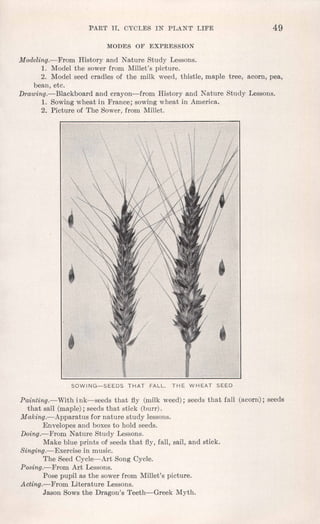
Sowing-Seeds that fall. The wheat seed. ___________________________ 49
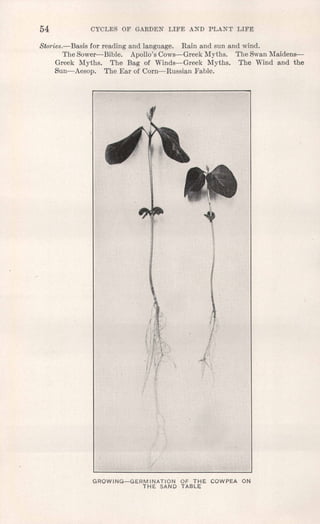
Growing-Germination of the cowpea on the sand table________________ 54
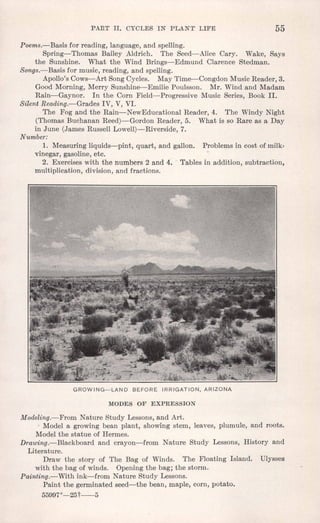
Growing-Land before irrigation. Arizona___________________________ 55
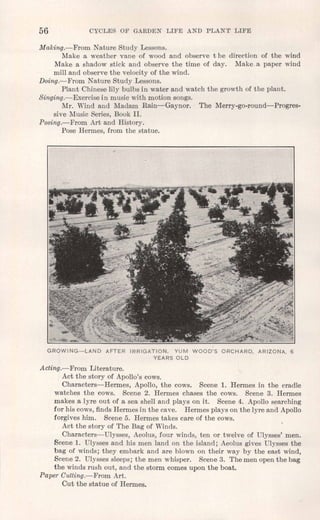
Growing-Land after irrigation. Yum Wood's Orchard, Ariz., 6 years old , 56
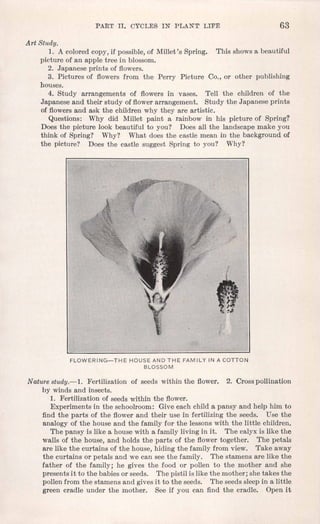
Flowering- The house and the family in a cotton blossom , _____________ 63
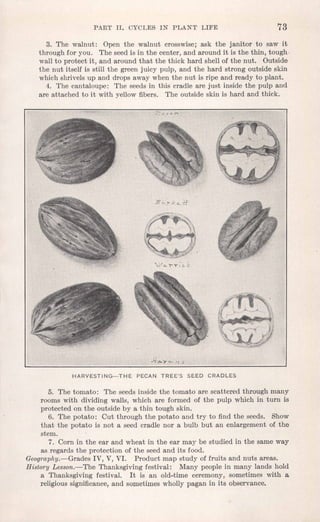
Harvesting-The pecan tree's seed cradle____________________________ 73
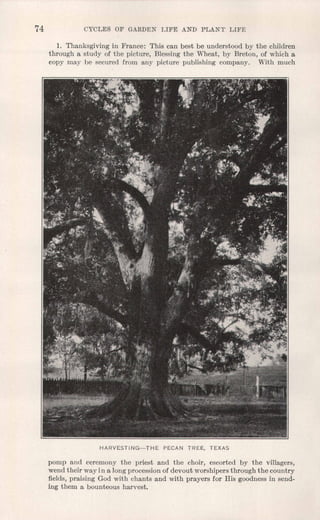
Harvesting- The pecan tree. Texas ________________________________ 74
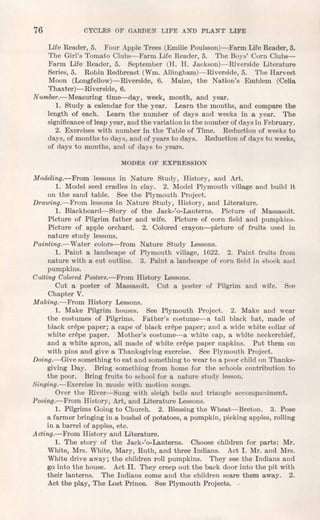
Harvesting-The apple tree's seed cradle_____________________________ 75
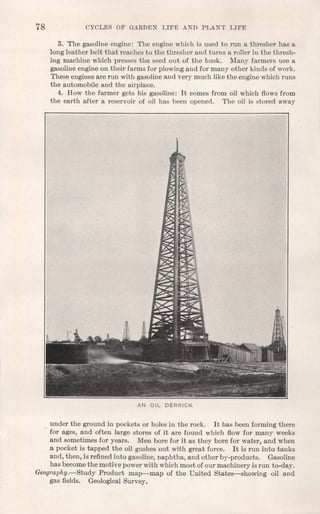
An oil derrick_ ____________________________________________________ 78
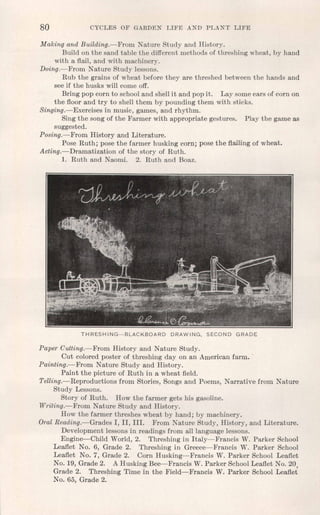
Threshing- Blackboard drawing. Second grade , _____________________ 80
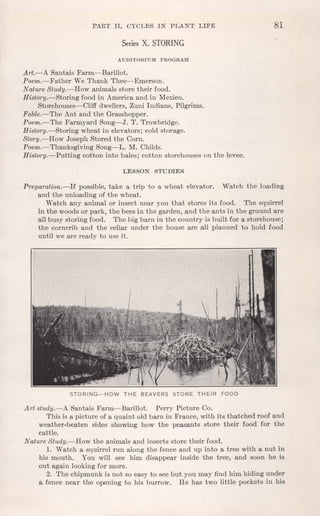
Storing-How the beavers store their f'ood . __________________________ 81
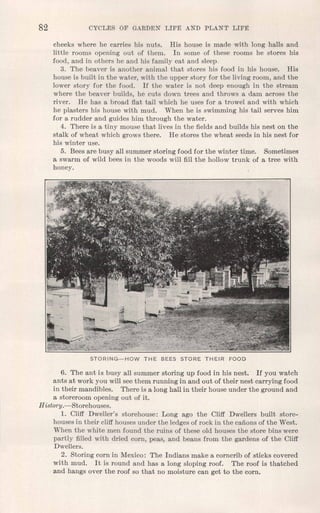
Storing-How the bees store their Iood , __ ______ _ 82
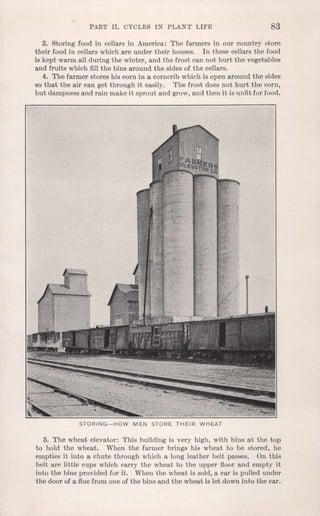
Storing- How men store their wheat ________________________________ 83
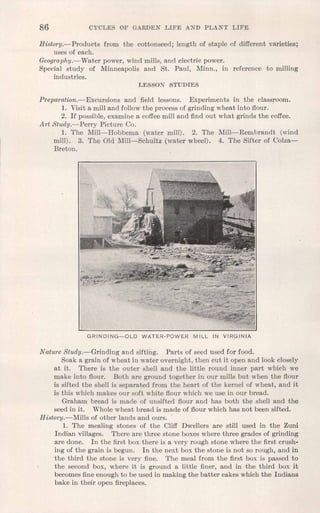
Grinding-Old water power mill in Virginia., _________________________ 86
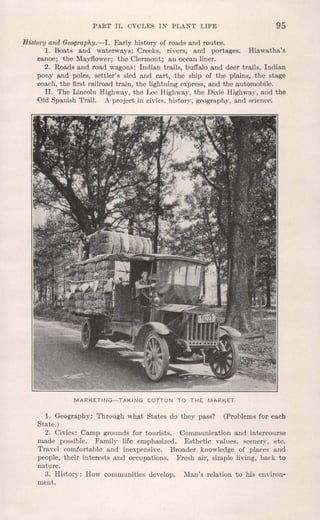
Marketing-Taking cotton to the market____________________________ 95
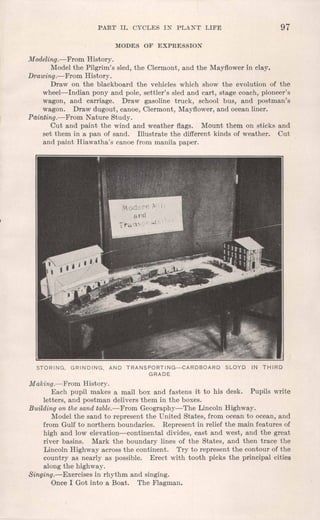
Storing, grinding, and transporting-Cardboard sloyd in third grade; ___ 97
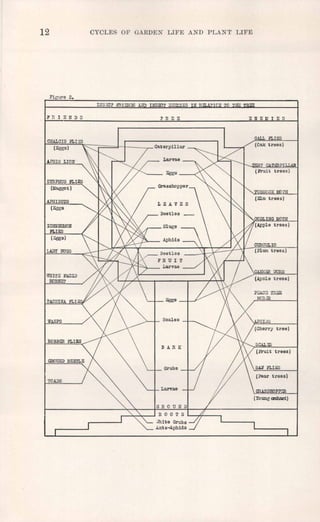
FIGURE 1. Bird friends and insect enemies in relation to the tree, _______ 11
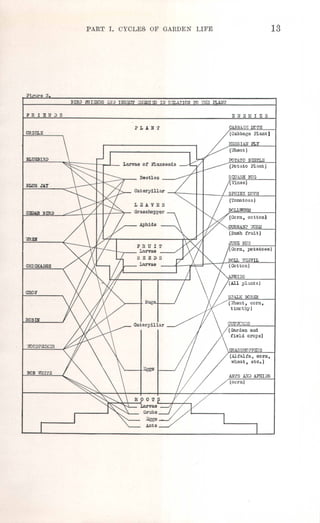
2. Insect friends and insect enemies in relation to the trce , _____ 12
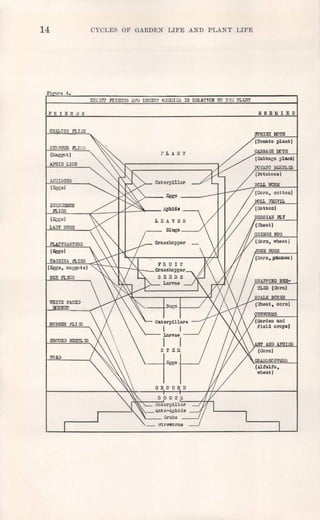
3. Bird friends and insect enemies in relation to the plant____ ___ 13
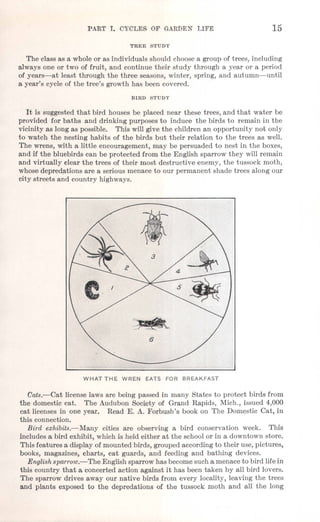
4. Insect friends and insect enemies in relation to the plant , ____ 14
5. Cultivating-Weather calendar in colored paper cutting______ 61
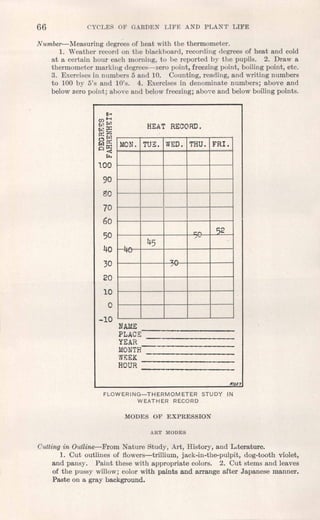
6. Flowering-Thermometer study in weather record__ _________ 66
VI
FOREWORD
This course is a detailed plan of work covering the child's ordinary
range of experience and environment, including cycles of garden life
and plant life.
It is designed for all grades and is divided into two separate units
of lower and upper grade work, the teachers in each grade to select
the material best adapted to their courses of study and their daily
programs.
Correlation of nature study with the other subject matter in use in
the schools is the principle worked out in this plan of work based on
the child's environment. All the activities of the school are included
in it, and suggestions for the use of nature study as an integral part
of the other lessons are given in the daily program. Lessons in read-
ing, language, and arithmetic are suggested; appropriate songs and
. stories are indicated; and bases for the arts and crafts and language
modes are given.
A course in natural science and nature study, by Dr. Downing,
associate professor of natural science in the University of Chicago,
has been included in this bulletin and precedes the other lines of work
presented here in the form of suggestions for various activities in the
study of natural science. It is arranged for the three seasons,
autumn, winter and spring, and covers the work of the kindergarten
and the first six grades, with appropriate data for each grade. While
correlation does not playa prominent part, a sequence of interests
runs through the subject matter from subject to subject and from
grade to grade.
VII
CYCLES OF GARDEN LIFE AND PLANT LIFE
Projects in Nature Study for Elementary Schools
INTRODUCTION
WHAT DOES NATURE STUDY MEAN TO THE CHILD
It is the month of April. Just outside the schoolroom, where the
children are busy with their books, the woods are showing a profusion
of coloring. The miracle of spring takes place under the children's
very eyes; they have spent many a holiday in the woods, and have
rejoiced, howbeit subconsciously, in all the beauty and charm and
fascination which nature holds for most of us. Shall it not find some
place in their school program ~
CYCLES OF GARDEN LIFE
Suppose a school garden is in the making. Shall it not open the
way for field lessonsin which to collect specimens of soils and to con-
duct a series of experiments~ The principles of capillarity may be
taught in this connection, and the children may determine the amount
of moisture which different soils retain, as practical lessons in the
growth of plant lifewhich may lead later to problems of irrigation
and dry farming. These experiments also call for visits to different
garden plots in the vicinity and for walks in the country, where sys-
tems of drainage have redeemed the swampy land and prepared it for
cultivation. Then there are kindred subjects related to the garden.
How many and how vital they are! Bird boxes in the garden; what
to do with the English sparrow; how is this little savage of bird life
responsible for the depredations of the tussock moth ~the household
cat and his relation to the fruit trees in the garden; the economic
value of the American toad; and so on through many phases of
natural phenomena.
CYCLES OF PLANT LIFE
Projects in plant life are based upon a series of study units which
refer especiallyto our three great staples, wheat, corn and cotton, but
which may be applied to a study of other plants as well. The lessons
under Plowing, Sowing, Planting, and Cultivating are studies in the
care which must be given the plant to insure its successful growth
1
2 CYCLES OF GARDEN LIFE AND PLANT LIFE
from seed to maturity. The series on Growing, Flowering, and
Harvesting treat of the development of the plant and the provision
which it makes for the propagation of its species. Food problems
are suggested in the study of the use of the plant, of wheat, especially,
and the activities necessary in its preparation as an article offood.
These are given in a sequence of lessons on Reaping, Threshing,
Storing, Grinding, and Baking. Finally, the economic value and the
distribution of staple products are presented under studies in Market-
ing and Transporting.
Lessons on the forces of nature, the sun and wind and rain; on the
work of the bee as a carrier of pollen; on the lowly earthworm as a
plowman; and many other contributors to the well-being of the plant
are discussed in their appropriate setting throughout this series, as an
illustration of the relationships which exist between one form of life
and another and the dependence of one upon the other. Each
fulfills its mission In its accustomed place. Each performs its accus-
tomed task which has been assigned to it throughout the ages by the
Creator.
THE PLACE OF NATURE STUDY IN THE DAILY PROGRAM
When the teacher uses nature study as an integral part of her daily
program and not as an extra study to be added to an already over-
crowded curriculum, it becomes a welcome innovation in her school
work. The subject of cotton, for instance, may be introduced during
the morning period in the form of informal conversation and discus-
sion. It may be used during the day as a basis for reading lessons
and for oral and written language, as well as a subject of study during
the art period. To substitute nature study whenever possible for the
more stereotyped lessons in the textbooks enriches the entire work of
the school.
This bulletin contains a series of projects in nature study, which are
planned with special reference to the appropriate seasons of the year
and to the needs and conditions of the grade teachers in the schools.
These lessons are so arranged that they may be adapted to the
teacher's use without necessitating an undue amount of research and
study.
Subjects are listed, references given, and outlines provided for each
subject. In addition to this a suggestive lesson which has been.
worked out in a schoolroom is presented with each subject to further
aid the teacher in adapting the work to her use. Suggestions for
handwork, for field trips, and for simple experiments in the schoolroom
will clear away the difficulties of many teachers who are trying to
work out a project in nature study.
INTRODUCTION 3
THE RECITATION IN NATURE STUDY
The entire work of the school may center around anyone of the
units of study presented in this outline on nature study. Where to
find material is clearly stated in bibliographies which follow each
subject. Detailed lessons accompany many of the topics given in the
outline, to serve as helps to the teacher in arranging for the study in
her classes. Government documents are given as references when-
ever possible, as they represent the latest expert opinion on the given
subject and are easily within the reach of any teacher, costing' but
a few cents per copy.
Numerous problems present themselves to the pupils in their dis-
cussions of these lessons. These problems should be carefully con-
sidered by the teacher, and the best of them should be selected for
detailed study in the classroom.
Lists of questions are not given here for the reason that suitable
questions can not easily be formulated before the lessons are given.
Time and place, grades and conditions, influence largely the nature of
questions to be asked of any class of children. Often they develop in
a single recitation. Furthermore, prearranged questions are often
inappropriate and their use by the teacher results in a stereotyped and
formal type of recitation which should have no place in the lesson in
nature study.
HOW TO RTUDY NATURE 1
1. Observation, the first mode of study, is almost the universal
method used by children in their field and classroom lessons on
nature. Impressions from these observations should be recorded by
the pupils in some form of expression, either painting, drawing,
modeling, cutting, or by oral or written language, and should follow
as soon as possible after the observations have been made. These
records aid the child in checking up on his study in two particulars.
They verify the accuracy of his impressions and reveal the limitations
of his observations. .
Preparation for observation.-A certain amount of preparation is
necessary before the child can observe any phenomenon of nature
profitably. How many field trips have become" time wasted" all
teachers can testify, even in their own experience, because of insuffi-
cient preparation. Anticipation is an exhilarating motive for securing
the child's interest and enthusiasm. A subject skillfully led up to,
followed by a field trip, has a far reaching influence on the child's
attitude and the value to him of subsequent excursions.
2. Reading is a second mode of study. It should be used sparingly
except as reference material or in the form of nature stories. All out-
1For organization of projects, see Bulletin (1921) No. 36, U. S. Bur. of Educ.
4 CYCLES OF GARDEN LIFE AND PLANT LIFE
doors awaits the child and offers a laboratory where he may study
first hand what the books so inadequately "present.
3. Hearing Zang1wge.-Listening to others either describe or narrate
is the third of these modes of study. Nothing can take the place of it,
for it supplements both the observation and the reading. Much use
of it is necessary to clear up the child's impressions and to lead him on
into newer fields of investigation.
USE OF MUSEUMS IN NATURE STUDY
Fortunate is the teacher whose location is near or in a large city
where she may have access to the collections of historical and scien-
tific material which a good museum offers. Trips of inspection
with the children from out of town schools should be frequent if a
museum can be reached within the space of an hour or two. In
lieu of field trips descriptive circulars may be secured from many
museums free of charge or for a small amount upon request, and
photographs of specimens may be purchased for the cost of printing.
The Buffalo Museum, 1231 Elmwood Avenue, Buffalo, N. Y., has
been arranged especially for use by the pupils in the schools of Buffalo
and is an excellent example of the service which these museums are
prepared to render. The Children's Museum League has been
organized as a protege of the Buffalo Society of Natural Sciences.
Story hours are arranged for each grade. Museum games, study
courses, nature-study hikes, lecture courses with slides, and oppor-
tunities for joining field clubs are all offered the members of the
league. The membership also carries with it certain school credits
with a diploma, medal, and a society membership when the work is
completed ..
USE OF STEREOSCOPE
Many schools are supplied with simple stereoscope lenses and with
collections of pictures which cover a wide range of subjects. The
pictures are given a wonderfully lifelike appearance when viewed
through these glasses.
REFERENCES
Nature Study
A field and laboratory guide in biological nature study. By Elliot R. Downing.
Chicago, University of Chicago Press, 1918. 16 p.
A field and laboratory guide in physical nature study. By Elliott R. Downing.
Chicago, University of Chicago Press, 1920. 109 p. illus.
Francis W. Parker school leaflets. By Jennie Hall. Chicago, Francis W. Parker
School. Second-grade series.
Handbook of nature study for teachers and parents. By Anna B. Comstock.
Ithaca, N. Y., Comstock Publishing Co., 1911. 938 p. illus.
A graphic summary of American agriculture, based largely on the census of 1920.
By O. E. Baker. Washington, D. C., Government Printing Office, 1922.
(U. S. Department of Agriculture. Bulletin no. 878.)
INTRODUCTION 5
List of Farmers' bulletins by subjects. Issued by U. S. Department of Agriculture.
Division of publications. May, 1922. 14 p.
Natural science and nature study in the school. By Mary K. Sherman. Wash-
ington, D. C., General Federation of Women's Clubs, 1920-22. 31 p.
Nature study and life. By Clifton F. Hodge. Boston, Ginn & Co., 1903. 514
p. illus.
Nature study for the common schools. By Arthur S. Jackman. New York,
Henry Holt & Co., 1892. Sec. ed. rev. 448 p.
A nature study guide. By William S. Furneaux. New York, Longmans, Green
& Co., 1912. 293 p. illus.
Nature study in elementary schools. A manual for teachers.
and William Wilson. New York, Macmillan Co., 1900.
Nature study lessons. Book 2. By David W. Hamilton.
Publishing Co., 1918. 229 p. illus.
Nature study project and seasonal pageant for rural schools. By Bert J. Ford.
Lansing, Mich., Superintendent of Public Instruction, 1923. 36 p.
The nature study review. By Anna B. Comstock. Ithaca, N. Y., Comstock
PUblishing Co., 1918. vol. 14. 2,128 p. illus,
A provisional course of study in elementary science for the elementary schools.
Issued by Boston public schools. Boston, 1911. 44 p. (School document
no. 5.)
The study of nature. By Samuel Christian Schmucker. Illus. by Katharine E.
Schmucker. Philadelphia, J. B. Lippincott Co., 1911. 315 p. (Lippin-
I'ott's educational series.)
By Lucy Langdon
272 p. illus.
Montreal, Renouf
Mines
Mines. Issued by Superintendent of Documents. Washington, D. C., Govern-
ment Printing Office, 1923. Price list 58-10th edition. 22 p.
Museums
Hobbies.
no. 5.
Buffalo, N. Y., Buffalo Society of Natural Sciences, 1924.
24 p.
vol. 5.
Weather Records
'Weather, astronomy and meteorology. Issued by Superintendent of Documents.
Washington, D. C., Government Printing Office, 1923. Price list 48-13th
edition. 9 p.
Part I. CYCLES OF GARDEN LIFE
Series I. The Garden.
11. Birds and Insects in the Garden.
111. The Toad in the Garden
IV. Bird Study.
V. Bee Study.
VI. The Orchard.
VII. The Tree.
Series I. THE GARDEN
AUDIMIUM PBWlUM '
Art.-A Dutch Garden.
Song.-The Little Plant-Podwon.
Nature Study.-Soils, d,and plank.
(Testing soils, sprouting seeds, caring for plants.)
Song.-Planting the Bulbs--Progressive Mu& Series, Book I.
Song.-In the Garden-Progressive Music Saries, Book 11.
Play.-Titty Mouse and Tatty Mouse-Fox First Reader.
Sto5-y.-The Three Gardens-Adapted from the Bible.
Song.-Mistress Mary-Progressive Music Series, Book I.
Song and Games.-Here We Go Round the D/lulbe~yBush-Prograsite Music
Series, Book I.
Ring Around the Rosy-Progressive Music Series, Book I.
Song.-Garden Song-Pr0gmmis-e M d t Sd* Manual.
Song.-A SpriBg GueetAogessive M ~ D&ries, Book II.
[From OutlInasinNatural B d e mand Natme Study, By Elliot R. Downing.]
Kindergarten
FaZ1.-Learn to recugnise garden flowers and vegetables that are growingin school
and home gardens: Asparagus, beans, beets, cabbage, carrots, cauliflower,
chard, corn, cucumber, eggplant, lettuce, onions, parsnip, peas, pumpkin,
radish, squash, tomato, turnip; alyssum, aster, candytuft,, cosmos, dahlia,
daisy, forget-me-not, geranium, gladiolus, holyhock, larkspur, marigold,
mignonette, nasturtium, pansy, petunia, phlox, poppy, mlvia, sunflower, sweet
william.
Bdng in k a t w e garden material.
Winter.-Grow paper-white h u e in wabr.
Spring.-Plant lettuee, mubhea; morning glory, dwarf nasturtium, pot - W d ,
Autumn.-Clean up garden plot. Plant bed of narcksus. Set dofodilo in
pots in trench to bring in later for winter bloom. Trmplant dandd6ow to
window boxes to furnish blooms during winter.
See Bu of Ed., Bull., 1821,no.38, for dcsaiption of auditoriumperiods.
6
PART 1. CYCL,ES OF GARDEN LIFE 7
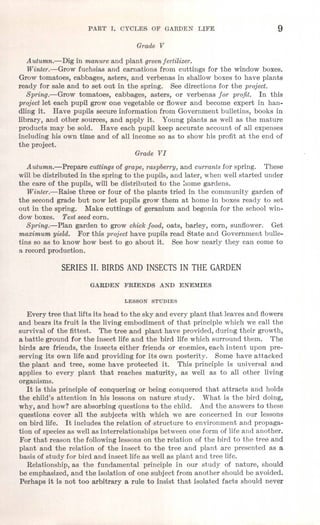
Winter.-Bring in pots of daffodils from the trenches and rear for winter
blossoms. Bring dandelion plants in the window boxes into blossom. Plant
and rear dwarf nasturtium in some of the window boxes.
Spring.-Plant easily grown annuals in first-grade plot (no individual gardens).
Beans and peas (fruit and seed used). Carrots and beets (root used). Swiss
chard (leaf used); pumpkin. Ten weeks' stock, verbenas, sunflower, wild
cucumber.
Grade II
Autumn.-Harvest-garden crops. Clean up and burn rubbish (bonfires).
Collect seeds of many garden plants and put up in packets for use of first and
second grades next spring. Set bed of daffodils. Collect seeds of butter-and-
eggs and bouncing betty. Prepare pots of tulips and set in trenches out of
doors to bring in for bloom in the schoolroom.
Winter.-Bring in tulips and rear for winter bloom. Raise pot marigolds in
the window boxes and also butter-and-eggs and bouncing betty from the seed
collected in the autumn. Start tomato, cabbage, egg plant, asters, petunias,
pansies, and verbenas in shallow boxes of earth in March so as to have them
ready to set out early in May.
Spring.-Learn to transplant.
verbenas, petunias, and pansies.
lima beans.
Set out cabbage, tomato, egg plant, asters,
Stake, prune, and train tomatoes. Raise pole
Grade III
Autumn.-Harvest crops. Clean up garden. Plant tulip bed. Plant hyacinth
bulbs in pots and trench them to bring in later in the winter.
Collect cherry pits, apple seeds, and peach stones, and save them for starting
the seedlings in the winter term.
Winter.-Bring in hyacinths for early spring bloom. Grow sweet alyssum in
window boxes, also sweet potato vines. Start apple seed, cherry pits, and peach
stones in pots or cans of soil and rear the seedlings so that they will be ready
to set out as sizable young plants by the last of April or early May.
Spring.-Perennials. Transplant young strawberry sets and care for the old
plants. Look after currant bushes. Plant iris, holyhock, larkspur, and phlox
seed. Set out fruit seedlings. Set bed of caladiums and cannas.
Grade IV
Autumn.-Cover strawberry bed; prune currants. Transplant iris, hollyhock,
larkspur, and phlox to their permanent positions. Take up and care for
caladiums and camas. Plant green fertilizer like red clover, soy beans, or vetch
on one-half of plot to be used as an experimental plot next spring.
Winter.-Garden work has thus far been community work; let it from now on
be individual except in the school garden which will serve as a demonstration
plot. The pupils' gardens will be home gardens. Each pupil will plant daffodils
in pots and trench them and rear them at home. He will grow paper-white
narcissus and pot marigold at home also for the flower show. Grow jonquils in
the school window boxes.
Spring.-Plan individual gardens on home plots and have pupils grow a
succession 0/ crops to get maximum returns from a small plot of ground, thus:
Radishes followed by kale.
* 0* 0* 0* 0* 0* 0* 0* 0* 0* Peas, then parsnips.
/ / / / / / / / / / / / / / Hills of sweet corn with
pumpkins between.
55997°--25t----2
8 CYCLES OF GAR.DEN LIFE AND PLANT LIFE
[From "Grow a Vegetable Garden." By J. H. Prost. Chicago, Ill., International Harvester Co., 1918]
PLAN FOR AN ACRE GARDEN
PART 1. CYCL~S OF GARDEN LIFE 9
Grade V
Autumn.-Dig in manure and plant green fertilizer.
Winter.-Grow fuchsias and carnations from cuttings for the window boxes.
Grow tomatoes, cabbages, asters, and verbenas in shallow boxes to have plants
ready for sale and to set out in the spring. See directions for the project.
Spring.-Grow tomatoes, cabbages, asters, or verbenas for profit. In this
project let each pupil grow one vegetable or flower and become expert in han-
dling it. Have pupils secure information from Government bulletins, books in
library, and other sources, and apply it. Young plants as well as the mature
-products may be sold. Have each pupil keep accurate account of all expenses
including his own time and of all income so as to show his profit at the end of
the project.
Grade VI
Autumn.-Prepare cuttings of grape, raspberry, and currants for spring. These
will be distributed in the spring to the pupils, and later, when well started under
the care of the pupils, will be distributed to the home gardens.
Winter.-Raise three or four of the plants tried in the community garden of
the second grade but now let pupils grow them at home in boxes ready to set
out in the spring. Make cuttings of geranium and begonia for the school win-
dow boxes. Test seed corn.
Spring.-Plan garden to grow chick food, oats, barley, corn, sunflower. Get
maximum yield. For this project have pupils read State and Government bulle-
tins so as to know how best to go about it. See how nearly they can come to
a record production.
SERIES II. BIRDS AND INSECTS IN THE GARDEN
GARDEN FRIENDS AND ENEMIES
LESSON STUDIES
Every tree that lifts its head to the sky and every plant that leaves and flowers
and bears its fruit is the living embodiment of that principle which we call the
survival of the fittest. The tree and plant have provided, during their growth,
a battle ground for the insect life and the bird life which surround them. The
birds are friends, the insects either friends or enemies, each intent upon pre-
serving its own life and providing for its own posterity. Some have attacked
the plant and tree, some have protected it. This principle is universal and
applies to every plant that reaches maturity, as well as to all other living
organisms.
It is this principle of conquering or being conquered that attracts and holds
the child's attention in his lessons on nature study. What is the bird doing,
why, and how? are absorbing questions to the child. And the answers to these
questions cover all the subjects with which we are concerned in our lessons
on bird life. It includes the relation of-structure to environment and propaga-
tion of species as well as interrelationships between one form of life and another.
For that reason the followinglessons on the relation of the bird to the tree and
plant and the relation of the insect to the tree and plant are presented as a
basis of study for bird and insect life as well as plant and tree life.
Relationship, as the fundamental principle in our study of nature, should
be emphasized, and the isolation of one subject from another should be avoided.
Perhaps it is not too arbitrary a rule to insist that isolated facts should never
10 CYCLES OF GARDEN LIFE AND PLANT LIFE
be imposed upon the child in this study as a pure act of memory. He will
learn to recognize birds, he will be able to name them accurately, and he will
know their size and color and shape much more understandingly through a study
of their function than in any other way. The child should be taught to ask,
What is it doing? Why does it do it? How does it do it? For on these three
questions hang all the law and the prophets.
THE HOUSE WREN AND HER NEST
RELATION OF THE BIRD AND INSECT TO THE TREE AND PLANT
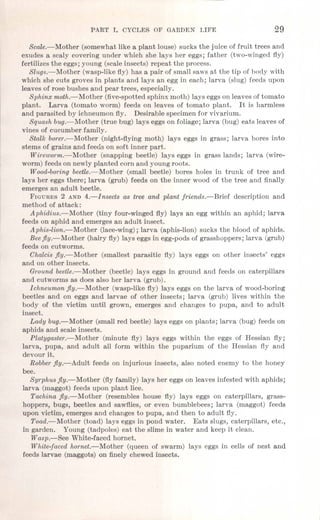
Figures 1, 2, 3, and 4. These diagrams in their present form should not be
presented to the nature-study class. They are intended for the teacher's help
in organizing the work in bird, insect, tree, and plant study, with special refer-
ence to relationships and the effects of one form of life upon another. The
subject should be developed primarily from field work, and the records of obser-
vations should be placed upon the diagrams only after the pupils have reported
on their findings in the field.
1'1 e 1.
FRIENDS
PART 1. CYCLES OF GARDEN LIFE 11
ORIOLE
ENEMIES
CHICKADEE
CEDAR BIRD
BLUE JAY
'9OODPIDKER
ROBL'i
ORO,
SONG
SPA:>30:V
12 CYCLES OF GARDEN LIFE AND PLe.NT LIFE
Figure 2.
CllALCIS FLBS
GALL FLIES
FRIENDS ~nEE 'ENEMIES
(Eggs)
(Oak trees)
AP!lIS LION
SYRPHUS FLIES
(Maggot)
APHIDIUS
(Eggs
ICIlNEUI.lON
FLIES
(Eggs)
LADY BUGS
',VIlITE FACED
HORNET
rACHINA FLrE
WASPS
tree)
TOADS
PART 1. CYCLES, OF GARDEN LIFE 13
Fi e 3.
FRIENDS ENEMIES
BIRD ffiIENDS AlID INSECT ;,;r=I~ III RELk"CION TO ~lIE PLAl/T
ORIOLE
OABBAGE MCTH
',VOODPFDKZR
(Cabbage Plant)
HESSIAN FLY
Larvae of Flaxseeds
(Wheat)
POTATO BEETLEBlUEBIRD
(Rltato Plant l
BLUE JAY
CEDAR BIRD
WREIf
CHICKADEE
CR071
ROBIN
BOB WHITE
AN~S A!Q APHIDS
(corn)
14 CYCLES OF GARDEN LIFE AND PLANT LIFE
Fi r-e 4.
FRIEl1ilS ENEMIES
nrs~C'i' FRIElmS t~rrJ IliSBO'? l-~lrEMIL5 lli RELA.TION TO 1:-[;:; PLlNT
CHALCIS FLI~S
fJPHINX lIO'I!H
?LAIl'l!
('I!omatoplant)
CABBACE IJ!)'I!H
APHIS LION
(CabbaGeplant)
Rl'rA.TO BEETLJiS
(Potatoes)
APi!ID!US
(Eg!;s)
ICHlEUMON
FLIES __ .••...•L __ ---:;j.Lr----"'~-..,.
(Ebgs)
LADY BUGS
BOLL ',VEEVIL
(cotton)
HESSIAN FLY
Flheat)
CHIIlOH BUG
(corn, wheat)
PLATYGASTillS
(Eggs)
TACHIIIA FLIES
(Eggs, mag-sots)
BEE FLICS
'IllITE FACED
~._--.,,-
ROBBER FLI;;s
GROUND BEETL;S
TOAll
PART 1. CYCLES OF GARDEN LIFE 15
TREE STUDY
The class as a whole or as individuals should choose a group of trees, including
always one or two of fruit, and continue their study through a year or a period
of years-at least through the three seasons, winter, spring, and autumn-until
a year's cycle of the tree's growth has been covered.
BIRD STUDY
It is suggested that bird houses be placed near these trees, and that water be
provided for baths and drinking purposes to induce the birds to remain in the
vicinity as long as possible. This will give the children an opportunity not only
to watch the nesting habits of the birds but their relation to the trees as well.
The wrens, with a little encouragement, may be persuaded to nest in the boxes,
and if the bluebirds can be protected from the English sparrow they will remain
and virtually clear the trees of their most destructive enemy, the tussock moth,
whose depredations are a serious menace to our permanent shade trees along our
city streets and country highways.
WHAT THE WREN EATS FOR BREAKFAST
Cats.-Cat license laws are being passed in many States to protect birds from
the domestic cat. The Audubon Society of Grand Rapids, Mich., issued 4,000
cat licenses in one year. Read E. A. Forbush's book on The Domestic Cat, in
this connection.
Bird exhibits.-Many cities are observing a bird conservation week. This
includes a bird exhibit, which is held either at the school or in a downtown store.
This features a display of mounted birds, grouped according to their use, pictures,
books, magazines, charts, cat guards, and feeding and bathing devices.
English sparrow.-The English sparrow has become such a menace to bird life in
this country that a concerted action against it has been taken by all bird lovers.
The sparrow drives away our native birds from every locality, leaving the trees
and plants exposed to the depredations of the tussock moth and all the long
16 CYCLES OF ClA1WEl< UFE Al<b PLAl<1' LIFE
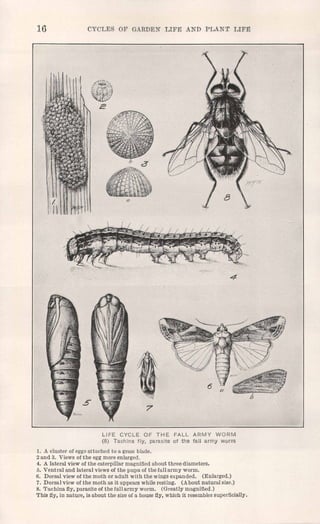
LIFE CYCLE OF THE FALL ARMY WORM
(8) Tachina fly, parasite of the fall army worm
1. A cluster of eggs attached to a grass blade.
2 and 3. Views of the egg more enlarged.
4. A lateral view of the caterpillar magnified about three diameters.
5. Ventral and lateral views of the pupa of the fall army worm.
6. Dorsal view of the moth or adult with the wings expanded. (Enlarged.)
7. Dorsal view of the moth as it appears while resting, (A bout natural size.)
8. Tachina fly, parasite of the fall army worm. (Greatly magnified.)
This fly, in nature, is about the size of a house fly, which it resembles superficially.
PART 1. CYCLES OF GARDEN LIFE 17
list of insect enemieswhich our birds have held in check for many years. Severe
measures, much as we deprecate the killing of a bird, need to be taken or our
country will be overrun with this worthless specimen of bird life.
Birds as pets in the schoolroom.-Some form of bird life should be included in
the equipment of every schoolroom, especially in the lower grades. The dove is
perhaps the most satisfactory, as it is easily cared for, easily tamed, and rears
its young with apparent unconcern as regards inspection from the children.
Canaries may be kept but need more care and are much more sensitive to sur-
roundings. A tame blackbird is a rarety in a schoolroombut makes a delightful
pet.
FIGURES 1 AND 3.-Birds as tree and plant friends.-Brief descriptions and
where they build their nests: 3
Bluebird (thrush family).-Color, blue and reddish-brown and white; nest built
in holes in trees or posts, and made of soft grass.
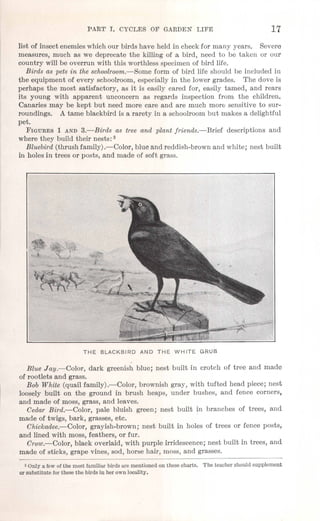
THE BLACKBIRD AND THE WHITE GRUB
Blue Jay.-Color, dark greenish blue; nest built in crotch of tree and made
of rootlets and grass.
Bob White (quail family).-Color, brownish gray, with tufted head piece; nest
loosely built on the ground in brush heaps, under bushes, and fence corners,
and made of moss, grass, and leaves.
Cedar Bird.-Color, pale bluish green; nest built in branches of trees, and
made of twigs, bark, grasses, etc. .
Chickadee.-Color, grayish-brown; nest built in holes of trees or fence posts,
and lined with moss, feathers, or fur.
Crow.-Color, black overlaid, with purple irridescence; nest built in trees, and
made of sticks, grape vines, sod, horse hair, moss, and grasses.
3 Only a few of the most familiar birds are mentioned on these charts. The teacher should supplement
or substitute for these the birds in her own locality.
1.8 CYOLES OF GAR.f>EN UFE AND PLAN'/' LIFE
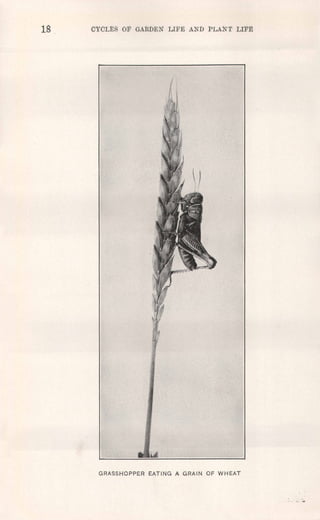
GRASSHOPPER EATING A GRAIN OF WHEAT
PART r. CYCL,ES. OF' GARDEN LIFE 19
Oriole.-Color, black and orange; nest long and pendent like a bag, and lined
with hair. It is often found in elm trees.
Redheaded Woodpecker.-Color, head and bib of red, rest of metallic black with
broad bands of white; nest built in hole of tree or stump, and made of fine chips.
Robin (thrush family).-Color, slate-brown, with black head and tail, brest
reddish-brown, throat white streaked with black; nest built in garden tree or
-shade tree, and made of grass, straw, leaves, and rootlets plastered with mud.
Song Sparrow.-Color, bluish white with brown markings; nest built on the
ground, and made of grasses, dead leaves, and bark.
Wren.-Color, wine or flesh; nest built in hollow tree or box, and made of
twigs and grass.
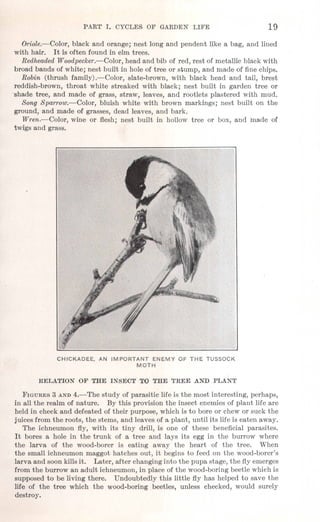
CHICKADEE, AN IMPORTANT ENEMY OF THE TUSSOCK
MOTH
RELATION OF THE INSECT TO THE TREE AND PLANT
FIGURES 3 AND 4.-The study of parasitic life is the most interesting, perhaps,
in all the realm of nature. By this provision the insect enemies of plant life are
held in check and defeated of their purpose, which is to bore or chew or suck the
juices from the roots, the stems, and leaves of a plant, until its life is eaten away.
The ichneumon fly, with its tiny drill, is one of these beneficial parasites.
It bores a hole in the trunk of a tree and lays its egg in the burrow where
the larva of the wood-borer is eating away the heart of the tree. When
the small ichneumon maggot hatches out, it begins to feed on the wood-borer's
larva and soon kills it. Later, after changing into the pupa stage, the fly emerges
from the burrow an adult ichneumon, in place of the wood-boring beetle which is
supposed to be living there. Undoubtedly this little fly has helped to save the
life of the tree which the wood-boring beetles, unless checked, would surely
destroy.
20 CYCLES OF GARDEN LIFE AND PLANT LIFE
Many of the cocoons,which the children bring into the schoolroom,have already
been stung by these flies, and often a myriad of tiny parasites appear on the
chrysalis of the cecropia, instead of the beautiful moth for which the pupils have
been watching. Some of these flies (the tachina, for instance) will lay their eggs
on the body of a live grasshopper or a bug or a beetle, and sometimes upon a
bumble bee. The victim seems powerless to rid itself of these eggs, as the tachina
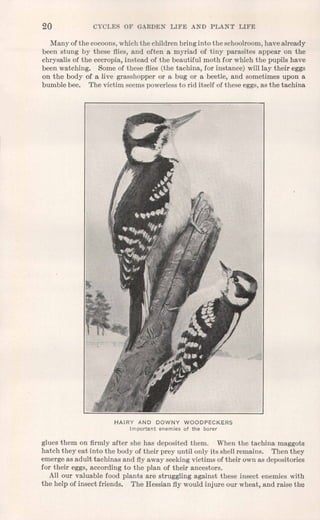
HAIRY AND DOWNY WOODPECKERS
Important enemies of the borer
glues them on firmly after she has deposited them. When the tachina maggots
hatch they eat into the body of their prey until only its shell remains. Then they
emerge as adult tachinas and flyaway seeking victims of their own as depositories
for their eggs, according to the plan of their ancestors.
All our valuable food plants are struggling against these insect enemies with
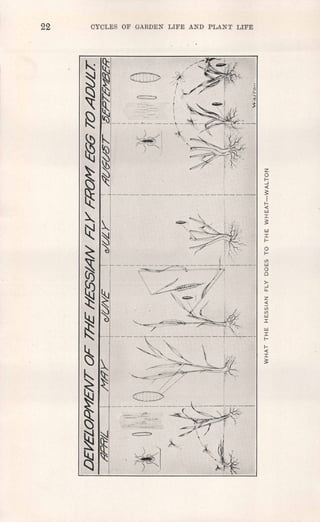
the help of insect friends. The Hessian fly would injure our wheat, and raise the
PART' 1. CYCL,ES OF' GARDEN LIFE 21
price of flour to such an extent that white bread would become a great luxury were
it not for the little platygaster that lays its egg on the fly's egg under the leaves of
wheat. Were it not for the little red lady bug that eats the boll worm eggs our
corn crop would be so seriously injured that it would fall far short of its present
production. The effect of this upon the farmer and upon the raising of cattle and
hogs would deprive most of us of our breakfast bacon and corn muffins.
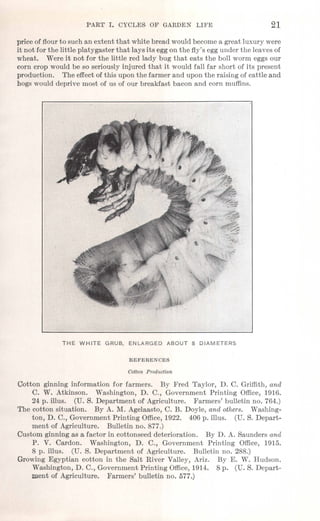
THE WHITE GRUB, ENLARGED ABOUT 8 DIAMETERS
REFERENCES
Cotton Production
Cotton ginning information for farmers. By Fred Taylor, D. C. Griffith, and
C. W. Atkinson. Washington, D. C., Government Printing Office, 1916.
24 p. illus. (D. S. Department of Agriculture. Farmers' bulletin no. 764.)
The cotton situation. By A. M. Agelaasto, C. B. Doyle, and others. Washing-
ton, D. C., Government Printing Office,1922. 406 p. illus. (D. S. Depart-
ment of Agriculture. Bulletin no. 877.)
Custom ginning as a factor in cottonseed deterioration. By D. A. Saunders and
P. V. Cardon. Washington, D. C., Government Printing Office, 1915.
8 p. illus. (D. S. Department of Agriculture. Bulletin no. 288.)
Growing Egyptian cotton in the Salt River Valley, Ariz. By E. W. Hudson.
Washington, D. C., Government Printing Office,1914. 8 p. (D. S. Depart-
ment of Agriculture. Farmers' bulletin no. 577.)
22 CYCLES OF GARDEN LIFE AND PLANT LIFE
u.J
I
I-
oI-
if)
u.J
o
o
>-
-J
u,
z<{
if)
if)
u.J
I
u.J
I
l-
I-
-c
I
3:
PAR.T 1. CYCL.ES OF GARDEN LIFE 23
The handling and marketing of the Arizona-Egyptian cotton of the Salt River
Valley. By J. G. Martin. Washington, D. C., Government Printing Office,
1915. 16 p. illus. (U. S. Department of Agriculture. Bulletin no. 311.)
Producing family and farm supplies on the cotton farm. By C. L. Goodrich.
Washington, D. C., Government Printing Office, 1919. 16 p. (U. S.
Department of Agriculture. Farmers' bulletin no. 1015.)
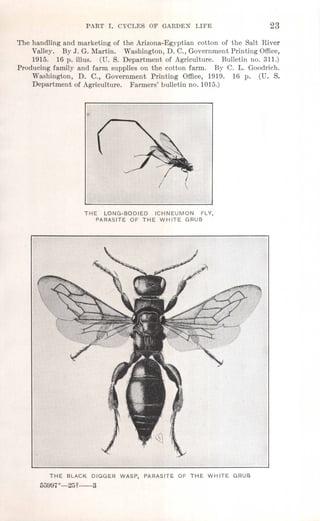
THE LONG-BODIED ICHNEUMON FLY,
PARASITE OF THE WHITE GRUB
THE BLACK DIGGER WASP, PARASITE OF THE WHITE GRUB
55997°--25t----3
24 CYCLES OF GARDEN LIFE AND PLANT LIFE
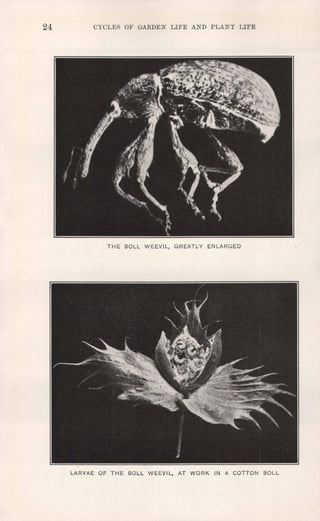
THE BOLL WEEVIL, GREATLY ENLARGED
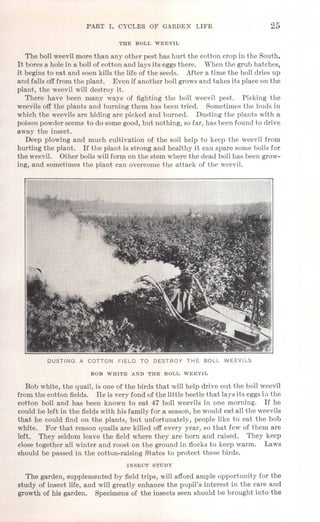
LARVAE OF THE BOLL WEEVIL, AT WORK IN A COTTON BOLL
PART 1. CYCLES OF GARDEN LIFE; 25
THE BOLL WEEVIL
The boll weevilmore than any other pest has hurt the cotton crop in the South.
It bores a hole in a boll of cotton and lays its eggsthere. When the grub hatches,
it begins to eat and soon kills the life of the seeds. After a time the boll dries up
and falls offfrom the plant. Even if another boll growsand takes its place on the
plant, the weevil will destroy it.
There have been many ways of fighting the boll weevil pest. Picking the
weevils off the plants and burning them has been tried. Sometimes the buds in
which the weevils are hiding are picked and burned. Dusting the plants with a
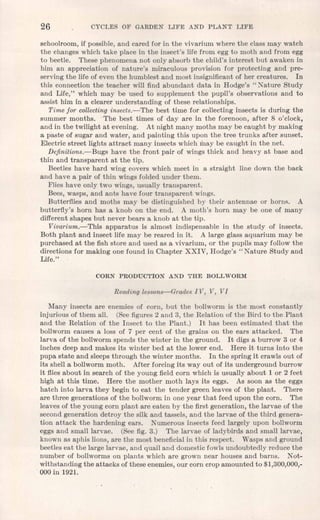
poison powder seems to do some good, but nothing, so far, has been found to drive
away the insect.
Deep plowing and much cultivation of the soil help to keep the weevil from
hurting the plant. If the plant is strong and healthy it can spare some bolls for
the weevil. Other bolls willform on the stem where the dead boll has been grow-
ing, and sometimes the plant can overcome the attack of the weevil.
DUSTING A COTTON FIELD TO DESTROY THE BOLL WEEVILS
BOB WHITE AND THE BOLL WEEVIL
Bob white, the quail, is one of the birds that will help drive out the boll weevil
from the cotton fields. He is very fond of the little beetle that lays its eggsIn the
cotton boll and has been known to eat 47 boll weevils in one morning. If he
could be left in the fieldswith his family for a season, he would eat all the weevils
that he could find on the plants, but unfortunately, people like to eat the bob
white. For that reason quails are killed off every year, so that few of them are
left. They seldom leave the field where they are born and raised. They keep
close together all winter and roost on the ground in flocks to keep warm. Laws
should be passed in the cotton-raising States to protect these birds.
INSECT STUDY
The garden, supplemented by field trips, will afford ample opportunity for the
study of insect life, and will greatly enhance the pupil's interest in the care and
growth of his garden. Specimens of the insects seen should be brought into the
26 CYCLES OF GARDEN LIFE AND PLANT LIFE
schoolroom,if possible, and cared for in the vivarium where the class may watch
the changes which take place in the insect's life from egg to moth and from egg
to beetle. These phenomena not only absorb the child's interest but awaken in
him an appreciation of nature's miraculous provision for protecting and pre-
serving the life of even the humblest and most insignificant of her creatures. In
this connection the teacher will find abundant data in Hodge's" Nature Study
and Life," which may be used to supplement the pupil's observations and to
assist him in a clearer understanding of these relationships.
Time for collectinginsects.-The best time for collecting insects is during the
summer months. "The best times of day are in the forenoon, after 8 o'clock,
and in the twilight at evening. At night many moths may be caught by making
a paste of sugar and water, and painting this upon the tree trunks after sunset.
Electric street lights attract many insects which may be caught in the net.
Dejinitions.-Bugs have the front pair of wings thick and heavy at base and
thin and transparent at the tip.
Beetles have hard wing covers which meet in a straight line down the back
and have a pair of thin wings folded under them.
Flies have only two wings, usually transparent.
Bees, wasps, and ants have four transparent wings.
Butterflies and moths may be distinguished by their antennae or horns. A
butterfly's horn has a knob on the end. A moth's horn may be one of many
different shapes but never bears a knob at the tip.
Vivarium.-This apparatus is almost indispensable in the study of insects.
Both plant and insect life may be reared in it. A large glass aquarium may be
purchased at the fish store and used as a vivarium, or the pupils may follow the
directions for making one found in Chapter XXIV, Hodge's" Nature Study and
Life."
CORN PRODUCTION AND THE BOLLWORM
Reading lessons-Grades IV, V, VI
Many insects are enemies of corn, but the bollworm is the most constantly
injurious of them all. (Seefigures 2 and 3, the Relation of the Bird to the Plant
and the Relation of the Insect to the Plant.) It has been estimated that the
bollworm causes a loss of 7 per cent of the grains on the ears attacked. The
larva of the bollworm spends the winter in the ground. It digs a burrow 3 or 4
inches deep and makes its winter bed at the lower end. Here it turns into the
pupa state and sleeps through the winter months. In the spring it crawls out of
its shell a bollworm moth. After forcing its way out of its underground burrow
it flies about in search of the young.field corn which is usually about 1 or 2 feet
high at this time. Here the mother moth lays its eggs. As soon as the eggs
hatch into larva they begin to eat the tender green leaves of the plant. 'There
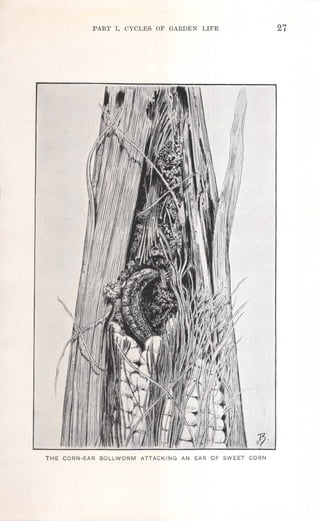
are three generations of the bollworm in one year that feed upon the corn. The
leaves of the young corn plant are eaten by the first generation, the larvae of the
second generation detroy the silk and tassels, and the larvae of the third genera-
tion attack the hardening ears. Numerous insects feed largely upon bollworm
eggs and small larvae. (See fig, 3.) The larvae of ladybirds and small larvae,
known as aphis lions, are the most beneficialin this respect. Wasps and ground
beetles eat the large larvae, and quail and domestic fowls undoubtedly reduce the
number of bollworms on plants which are grown near houses and barns. Not-
withstanding the attacks of these enemies, our corn crop amounted to $1,300,000,-
. 000 in 1921.
PART' 1. CYCLES OF GARDEN LIFE 27
THE CORN-EAR BOLLWORM ATTACKING AN EAR OF SWEET CORN
28 CYCLES OF GARDEN LIFE AND PLANT LIFE
REFERENCES
Corn Production
Corn cultivation. By C. P. Hartley. Washington, D. C., Government Printing
Office, 191'8. 35 p. illus. (U. S. Department of Agriculture. Farmers'
bulletin No. 414.)
Corn culture in the Southeastern States. By C. H. Kyle. Washington, D. C.,
Government Printing Office, 1916. 20 p. illus. (U. S. Department of
Agriculture. Farmers' bulletin No. 729.)
Corn growing under droughty conditions. By C. P. Hartley and L. L. Zook.
Washington, D. C., Government Printing Office., 1917. 24 p. illus.
(U. S. Department of Agriculture. Farmers' bulletin No. 773.)
Dwarf broomcorn. By Benton E. Rothgeb. Washington, D. C., Government
Printing Office, 1916. 16 p. illus. (U. S. Department of Agriculture.
Farmers' bulletin No. 768.)
Schoollessons on corn. By Dick J. Crosby and F. W. Howe. Washington, D. C.,
Government Printing Office, 1910. 29 p. illus. (U. S. Department of
Agriculture. Farmers' bulletin No. 409.)
Standard broomcorn. By Benton E. Rothgeb. Washington, D. C., Govern-
ment Printing Office,1918. 20 p. illus. (U. S. Department of Agriculture.
Farmers' bulletin No. 958.)
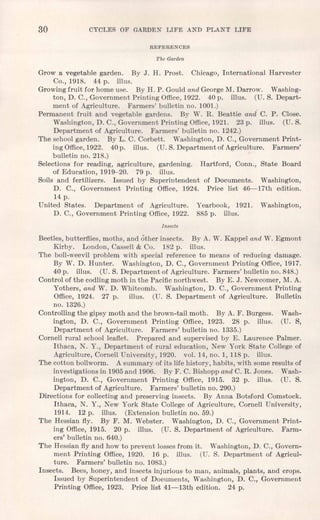
FIGURES1, 2, 3, AND4.-Insects as tree and plant enemies.-Brief description
and favorite plant or tree:
Ant and aphid.-Mother aphid (corn louse) lays her eggs on roots of corn.
Ants collect these eggs and take them to their nests to be hatched, then carry
them back to the corn roots. Both adults and young aphid feed on roots of
corn.
Boll weevil.-Mother (beetle) lays eggs on cotton bolls; larva (grub) feeds on
cotton bolls.
Bollworm.-Mother (moth) lays eggs on young corn plants; larva (caterpillar)
feeds on corn leaves, silk, tassels, and corn in the ear.
Cabbagemoth.-Mother (white moth) lays eggs on young cabbages; larva
(caterpillar) feeds on leaves of cabbage.
Chinch bug.-Mother (bug) lays eggs in wheat and other grain fields; adults
and young (bugs) suck juices from root and stem of corn and wheat.
Currant worm.-Mother (magpie moth) lays eggs on leaves of currant and
gooseberry bushes; larva (looper caterpillar) first hibernates in cocoon during
winter and commences feeding as soon as the leaves appear in spring.
Cutworm.-Mother (moth) lays eggs in the ground; larva (cutworm) cuts the
roots of plants just below the ground.
Elm beetle.- Mother (small yellowish-brown beetle) lays eggs on elm tree
leaves; larva (caterpillar) eats the leaves.
Grasshopper.-Mother (grasshopper, locust family) lays eggs just beneath the
ground. Adults and young (nymphs) feed on leaves of young plants and the
leaves of young orchards.
Hessianjly.-Mother (small two-winged fly) lays eggs on young wheat plants;
larva (maggot) sucks juices from wheat stem.
June bug.-Mother (beetle) lays eggs in the ground; larva (white grub) feeds
on roots of corn and potatoes.
Potato beetle.-Mother (beetle, yellow with black stripes) lays eggs on young
plants; larva (grub) eats leaves and pupates in the ground.
Red spider.-Mother (web-spinning mite) lays eggs on plants. Young (mites)
and adults suck juices of plant.
PART 1. CYCL,ES OF GARDEN LIFE 29
Scale.-Mother (somewhat like a plant louse) sucks the juice of fruit trees and
exudes a scaly covering under which she lays her eggs; father (two-winged fly)
fertilizes the eggs; young (scale insects) repeat the process.
Slugs.-Mother (wasp-like fly) has a pair of small saws at the tip of body with
which she cuts groves in plants and lays an egg in each; larva (slug) feeds upon
leaves of rose bushes and pear trees, especially.
Sphinx moth.-Mother (five-spotted sphinx moth) lays eggson leaves of tomato
plant. Larva (tomato worm) feeds on leaves of tomato plant. It is harmless
and parasited by ichneumon fly. Desirable specimen for vivarium.
Squash bug.-Mother (true bug) lays eggs on foliage; larva (bug) eats leaves of
vines of cucumber family.
Stalk borer.-Mother (night-flying moth) lays eggs in grass; larva bores into
stems of grains and feeds on soft inner part.
Wireworm.-Mother (snapping beetle) lays eggs in grass lands; larva (wire-
worm) feeds on newly planted corn and young roots.
Wood-boring beetle.-Mother (small beetle) bores holes in trunk of tree and
lays her eggs there; larva (grub) feeds on the inner wood of the tree and finally
emerges an adult beetle.
FIGURES 2 AND 4.-Insects as tree and plant friends.-Brief description and
method of attack:
Aphidius.-Mother (tiny four-winged fly) lays an egg within an aphid; larva
feeds on aphid and emerges an adult insect.
Aphis-lion.-Mother (lace-wing); larva (aphis-lion) sucks the blood of aphids.
Beefly.-Mother (hairy fly) lays eggs in egg-pods of grasshoppers; larva (grub)
feeds on cutworms.
Chalcis fly.-Mother (smallest parasitic fly) lays eggs on other insects' eggs
and on other insects.
Ground beetle.-Mother (beetle) lays eggs in ground and feeds on caterpillars
and cutworms as does also her larva (grub).
Ichneumon fly.-Mother (wasp-like fly) lays eggs on the larva of wood-boring
beetles and on eggs and larvae of other insects; larva (grub) lives within the
body of the victim until grown, emerges and changes to pupa, and to adult
insect.
Lady bug.-Mother (small red beetle) lays eggs on plants; larva (bug) feeds on
aphids and scale insects.
Platygaster.-Mother (minute fly) lays eggs within the eggs of Hessian fly;
larva, pupa, ·and adult all form within the puparium of the Hessian fly and
devour it.
Robberfly.-Adult feeds on injurious insects, also noted enemy to the honey
bee.
Syrphus fly.-Mother (flyfamily) lays her eggs on leaves infested with aphids;
larva (maggot) feeds upon plant lice.
Tachina fly.-Mother (resembles house fly) lays eggs on caterpillars, grass-
hoppers, bugs, beetles and sawflies, or even bumblebees; larva (maggot) feeds
upon victim, emerges and changes to pupa, and then to adult fly.
Toad.-Mother (toad) lays eggs in pond water. Eats slugs, caterpillars, etc.,
in garden. Young (tadpoles) eat the slime in water and keep it clean.
Wasp.-See White-faced hornet.
White-faced hornet.-Mother (queen of swarm) lays eggs in cells of nest and
feeds larvae (maggots) on finely chewed insects.
30 CYCLES OF GARDEN LIFE AND PLANT LIFE
REFERENCES
The Garden
Grow a vegetable garden. By J. H. Prost. Chicago, International Harvester
Co., 1918. 44 p. illus.
Growing fruit for home use. By H. P. Gould and George M. Darrow. Washing-
ton, D. C., Government Printing Office, 1922. 40 p. iflus. (U. S. Depart-
ment of Agriculture. Farmers' bulletin no. 1001.)
Permanent fruit and vegetable gardens. By W. R. Beattie ani c. P. Close.
Washington, D. C., Government Printing Office, 1921. 23 p. mus. (U. S.
Department of Agriculture. Farmers' bulletin no. 1242.)
The school garden. By L. C. Corbett. Washington, D. C., Government Print-
ing Office, 1922. 40p. illus, (U. S. Department of Agriculture. Farmers'
bulletin no. 218.)
Selections for reading, agriculture, gardening. Hartford, Conn., State Board
of Education, 1919-20. 79 p. ,mus.
Soils and fertilizers. Issued by Superintendent of Documents. Washington,
D. C., Government Printing Office, 1924. Price list 46-17th edition.
14 p.
United States. Department of Agriculture. Yearbook, 1921. Washington,
D. C., Government Printing Office, 1922. 885 p. illus.
Insects
Beetles, butterflies, moths, and other insects. By A. W. Kappel and W. Egmont
Kirby. London, Cassell & Co. 182 p. Illus,
The boll-weevil problem with special reference to means of reducing damage.
By W. D. Hunter. Washington, D. C., Government Printing Office, 1917.
40 p. illus. (U. S. Department of Agriculture.: Farmers' bulletin no. 848.)
Control of the codling moth in the Pacific northwest. By E. J. Newcomer, M. A.
Yothers, and W. D. Whitcomb. Washington, D. C., Government Printing
Office, 1924. 27 p. illus. (U. S. Department of Agriculture. Bulletin
no. 1326.)
Controlling the gipsy moth and the brown-tail moth. By A. F. Burgess. Wash-
ington, D. C., Government Printing Office, 1923. 28. p. illus, (U. S,
Department of Agriculture. Farmers' bulletin no. 1335.)
Cornell rural school leaflet. Prepared and supervised by E. Laurence Palmer.
Ithaca, N. Y., Department of rural education, New York State College of
Agriculture, Cornell University, 1920. vol. 14, no. 1, 118 p. illus,
The cotton bollworm. A summary of its life history, habits, with some results of
investigations in 1905 and 1906. By F. C. Bishopp and C. R. Jones. Wash-
ington, D. C., Government Printing Office, 1915. 32 p. illus. (U. S.
Department of Agriculture. Farmers' bulletin no. 290.)
Directions for collecting and preserving insects. By Anna Botsford Comstock.
Ithaca, N. Y., New York State College of Agriculture, Cornell University,
1914. 12 p. illus, (Extension bulletin no. 59.)
The Hessian fly. By F. M. Webster. Washington, D. C., Government Print-
ing Office, 1915. 20 p. illus, (U. S. Department of Agriculture. Farm-
ers' bulletin no. 640.)
The Hessian fly and how to prevent losses from it. 'Washington, D. C., Govern-
ment Printing Office, 1920. 16 p. illus. (U. S. Department of Agricul-
ture. Farmers' bulletin no. 1083.)
Insects. Bees, honey, and insects injurious, to man, animals, plants, and crops.
Issued by Superintendent of Documents, Washington, D. C., Government
Printing Office, 1923. Price list 41-13th edition. 24 p.
PART' 1. CYCLJilS OF GARDEN LIFE 31
The more important apple insects. By A. L. Quaintance and E. H. Siegler.
Washington, D. C., Government Printing Office, 1922. 95 p. illus.
(U. S. Department of Agriculture. Farmers' bulletin no. 1270.)
Platy gaster vernalis myers; an important parasite of the Hessian fly. By Charles
C. Hill. Washington, D. C., Government Printing Office, 1923. vol, 25,
no. 1. 42 p. illus.
The rough-headed corn stalk-beetle in the Southern States and its control. By
W. J. Phillips and Henry Fox. Washington, D. C., Government Printing
Office, 1918. 12 p. illus. (U. S. Department of Agriculture, Farmers'
bulletin no. 875.)
Some common weeds and insects of Nebraska corn fields and potato patches.
Lincoln, Nebr., Department of public instruction and Department of
farmers' institutes, University of Nebraska, 1910. 82 p. illus. (Agricul-
tural education, Nebraska boys' and girls' clubs. Bulletin no. 18, series 2.)
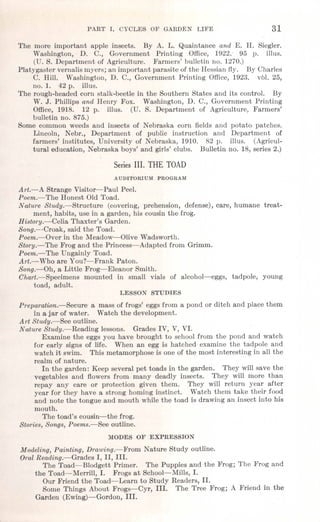
Series III. THE TOAD
A UDITORIUM PROGRAM
Art.-A Strange Visitor-Paul Peel.
Poem.-The Honest Old Toad.
Nature Study.-Structure (covering, prehension, defense), care, humane treat-
ment, habits, use in a garden, his cousin the frog.
History.-Celia Thaxter's Garden.
Song.--Croak, said the Toad.
Poem.-Over in the Meadow-Olive Wadsworth.
Story.-The Frog and the Princess-Adapted from Grimm.
Poem.-The Ungainly Toad.
Art.-Who are You?-Frank Paton.
Song.-Oh, a Little Frog-Eleanor Smith.
Chart.-Specimens mounted in small vials of alcohol-eggs, tadpole, young
toad, adult.
LESSON STUDIES
Preparation.-Secure· a mass of frogs' eggs from a pond or ditch and place them
in a jar of water. Watch the development.
Art Study.-See outline.
Nature Study.-Reading lessons. Grades IV, V, VI.
Examine the eggs you have brought to school from the pond and watch
for early signs of life. When an egg is hatched examine the tadpole and
watch it swim. This metamorphose is one of the most interesting in all the
realm of nature.
In the garden: Keep several pet toads in the garden. They will save the
vegetables and flowers from many deadly insects. They will more than
repay any care or protection given them. They will return year after
year for they have a strong homing instinct. Watch them take their food
and note the tongue and mouth while the toad is drawing an insect into his
mouth.
The toad's cousin-the frog.
Stories, Songs, Poems.r-Bee outline.
MODES OF EXPRESSION
Modeling, Painting, Drawing.-From Nature Study outline.
Oral Reading.-Grades I, II, III.
The Toad-Blodgett Primer. The Puppies and the Frog; The Frog and
the Toad-Merrill, I. Frogs at School-Mills, I.
Our Friend the Toad-Learn to Study Readers, II.
Some Things About Frogs-Cyr, III. The Tree Frog; A Friend in the
Garden (Ewing)-Gordon, III.
32 CYCLES OF GARDEN LIFE AND PLANT LIFE
Series IV. BIRDS
AUDITORIUM PROGRAM
(Bluebird, Woodpecker, Robin, and Wren)
Art.-Robin Redbreast-Munire.
Nature Study.-Habits, use, and care.
Poem.-Once I Saw a Little Bird-s-Mother Goose.
Song.-The Robin-Progressive Music Series, Book I.
History.-The English sparrow, bluebird, and tussock moth.
Song.-The Birds' Return-Progressive Music Series, Book II.
Story.-The Cat and the Bluebirds-s-Fable.
Song.-Cock Robin-Progressive Music Series, Book II.
Poem.-Cock Robin and Jennie Wren-Mother Goose.
Song.-The Bluebird-Songs of Happy Life.
Geography.-Migration of birds-Agriculture Yearbook, 1918.4
LESSON STUDIES
Preparation.-Take as many field trips as possible and look for birds and their
places of nesting.
Art.-See outline.
Nature Study.-Reading lesson. Grades IV, V, VI.
The flight of birds is one of the most wonderful provisions for protecting
and preserving the life of an animal which nature has devised. Man has
attempted for centuries to imitate or copy this phenomenon and only
recently has been successful. The entire structure of the bird has been
developed along the lines of ability to fly. Its head, tail, legs, feathers, and
internal organs, even its bones, are all built to assist it in its flight. The
bird's sense of direction has never been understood nor explained. Job
marveled, so the Bible tells us, at "the way of a bird in the air." It is still
a riddle and we are still guessing.
The secret of a bird's ability to find its nest among hundreds of others,
in a patch of wood, marsh, or shore, or even on a cliff-side, is quite beyond
the power of a trained naturalist to comprehend. Many birds, so to speak,
"live by their wits."
MIGRATION
Almost all our birds of the North and many of the South migrate. The two
seasons of heat and cold in the North cause a general shifting of our birds twice
a year. Quail and grouse migrate, the latter mysteriously. Robins, blackbirds,
bluebirds, jays, and thrushes, practically all of our song birds, move north in the
spring and south in the fall. Cold does not seem to occasion migration, for many
birds could stay in the North if they cared to do so. If good shelter and food
are to be procured, robins and bluejays, even bluebirds, pass the winter in the
Middle States. The food question or the climate question alone does not de-
termine migration. A fixed habit, formed many centuries ago, compells these
birds to move in long flights at certain seasons of the year. The birds seem to
cling to definite lines of travel as though certain highways through the air were
their own. The golden plover's line of flight runs east of the Atlantic States,
where land used to be but is now sunken under the water. The bobolink, which
ranges west across the continent, goes south to the eastward of the Gulf. It
did this, no doubt, long before the rice fields of Georgia and Alabama were
planted. Many of these birds travel by night. It is interesting to hear the honk
of the wild geese and to see their dark shadows passing high up in the air against
the moon.
• Washington, D. C., Superintendent of Documents. Order number Al.lO/a:785.
PART 1. CYCL~S OF GARD~N LIFE 33
The length of time of migration varies. Ducks can fly a thousand miles a
day, if necessary. They follow the line of the vanishing ice and go north as fast
as the waters open. Some of the strongest fliers among the large birds travel
great distances on foot, sometimes to accompany their young, sometimes because
BALTIMORE ORIOLE AND ORCHARD ORIOLE
Two important enemies of the boll weevil
they are molting. A flock of geese will march in a column, with the ranks ten
geese wide. Everyone is orderly, and no goose touches its neighbor. They hold
their heads high to get all the air possible. Possibly this habit was formed in
the olden times before their wings were developed. (Wild Geese, by C. J.
Cornish.)
34 CYCLES OF GARDEN LIFE AND PLANT LIFE
We do not know the location of the main aerial lines of travel, out we do
know that, in some strange way, the woods have become full of robins; there
are more bluejays flitting among the trees. In the fields the meadow larks are
moving about restlessly, and one day, after the first cold snap, all the covers
are bare and deserted. The birds have gone south in the nighttime; just when
and by what route no one knows.
OUR FRIENDS, THE BIRDS
How they protect the trees and the plants in our gardens and the crops in our
fields. See Insect Study.
1. Robins eat caterpillars, grasshoppers, spiders, gypsy moths, elm beetles,
and cutworms.
2. Bluebirds eat tussock moths.
3. Wrens eat tent caterpillars and gypsy moths.
4. Woodpeckerseat codling moths and apple tree borers.
5. Swallowseat mosquitoes, flies, and codling moths.
6. Owlseat potato beetles, cutworms, and field mice.
Care of birds.-To preserve the birds plant wild fruit for tnem to feed on,
such as cherries, mulberries, and June berries. Supply them with clear drinking
water. Protect them by building bird houses, by providing bird baths, by
exterminating the English sparrow, and by restricting the depredations of the
house cat.
PROGRAM FOR BIRD STUDY
(Robin, bluebird, wren, woodpecker, oriole, blue jay, chickadee, crow, and bob
white)
Art.-Robin Redbreast-Muncer.
Poem.- Robin's Come--Caldwell.
Nature study.-Structure in relation to environment-covermg, prehension of
food, means of defense.
Habits.-Nest building, raising young, song.
Care.-Houses, water, food.
Use.-Insect destroyer in fields and trees and gardens. Beautiful songsters.
Art.- The Swallows- Lanx.
Poem.-The English Sparrow-Mary Forsyth.
History.-Migration of birds.
The English sparrow and the tussock moth.
Art.-The Bird Cage--Meyer von Bremen.
Poem.-Winter Days-Henry Abbey.
Stories.-How the Robin Got His Red Breast; The Redheaded Woodpecker-
Fox's Indian Primer. The Cat and the Bluebird-Fable.
Songs.-The Bird Cycle--Art Song Cycles.
Cycles-The Stork, Bob White, Mr. Owl and Mrs. Mouse, the Cormorant,
Captain Jay, The Scarecrow.
Songs.-The Robin-Progressive Music Series, Book 1. The Bird's Return-
Progressive Music Series, Book II. Cock Robin-Progressive Music
Series, Book II .
.CollectionChart.-Specimens of nests.
Exhibit.-Bird houses, bird baths.
Oral Reading.-Grades I, II, III. Yellow bird, blue bird-Blodgett Primer.
Migration-Wooster Primer. The red bird-Wooster Primer. The blue
bird- Wooster Primer. The bluejay- Wooster Primer. One, Two
Three--Aldine, 1. The Party-Aldine, 1. Robin's Breakfast-Aldine, 1.
The Robins-Aldine, 1. The Birds' Cradle-Aldine, 1. Away to Summer
PART' 1. CYCLES OF GARDEN LIFE 35
Land-Aldine, I. Little Birdie-Aldine, I. Tom and the Birds-Aldine,
I. The Snow Birds-Finch, I. The Robin-Finch, I. The Legend of
the Robins-Finch, I. Blue Bird-Finch, I. Blue Jay-Finch, I. Bird
Day-Finch, I. Baltimore Oriole-Finch, I.-Hummingbird-Finch, I.
The Owl-Life and Literature, I. A Flying Lesson-Life and Literature, I.
Catch Me if You Can-Merrill, I. The Robin Who Sang for the King-
Merrill, I. Little Birdie (Tennyson)-Mills, I. Grapes for Eggs (Letter
from John Burroughs)-Mills, I.
The Lark and the Child-Merrill, II. The Robinand the Raven-Merrill,
II. The Partridge Family-Merrill, II. The Swallow(Christina Rossetti)
-Merrill, II. Mr. Whittier's Mocking-Bird-Cyr, II. Red Ridinghood
(Whittier)-Cyr, II. The Eagle and the Owl-Child World, II. Little
Brown Thrush-Sloan, II. Bobolink-Sloan, II. In the Springtime-
Sloan, II. Birds-The Lark's Nest, Gordon, II. Bluebird's Song-Gor-
don, II. Birds-The Redheaded Woodpecker, Gordon, II. The Brave
Blackbird-Gordon, II. The Doves-Gordon, II. How to Attract the
Birds-Learn to Study, II. The Ugly Duckling-Carroll and Brooks, III.
The Redheaded Woodpecker-Carroll and Brooks, III. Genghis Khan-
Carroll and Brooks, III. The Wren and the Bear-Carroll and Brooks,
III. Why the Chimneywas not Built-Carroll and Brooke,III. The Owl
and the Pussy Cat-E. Lear, Carroll and Brooks, III. The King of the
Birds-Carroll and Brooks, III. A Story of Bird Life-Child Life, III.
Bob White (Geo. Cooper)-Child Life, III. The White Blackbird-Child
World, III. The Brown Thrush (Lucy Larcom)-Child World, III. The
Birds of Killingworth-Child World, III. The American Eagle-Educa-
tional Reader, III. Tommy and the Crow-Educational Reader, III.
The Swallow-Educational Reader, III. The Raven and the Robin-
Educational Reader, III. The Farmer and the Larks-Educational Reader,
III. The Generousand Rich (Sandahl)-Gordon, III. CalicoPie (Edward
Lear)- Young and Field, III. The Bluebird (Emily Huntington Miller)-
Young and Field, III. The Answer to a Child's Question (Samuel Cole-
ridge)- Young a:nd Field, III. Robin Redbreast (William Allingham)-
Young and Field, III.
MODES OF EXPRESSION
Songs,Stories, Poems. Seeoutline.
Oral Reading. Seepage 34.
Silent Reading: Grades IV, V, VI.
Old Abe and the War Eagle-New Education Reader, IV. Bob White-
New Education Reader, IV. The Coming of Spring-New Education
Reader, IV. The American Robin-New Education Reader, IV. Little
Roscoe'sCanaries-New Education Reader,IV. HowBirds Protect Trees-
New Education Reader, IV. The Sandpiper (Celia Thaxter)-Young and
Field, IV. The Swallows (Sir Edwin Arnold)-Young and Field, IV.
Robert of Lincoln (W. C. Bryant)- Young and Field, IV. Spring in Ken-
tucky (James Lane Allen)-Cyr. V. The Albatross (Coleridge)-Cyr, V.
The Belfry Pigeon (N. P. Willis)-Cyr, V. To a Waterfowl (W. C. Bry-
ant)-Farm Life,V. EconomicValueof Birds-Farm Life,V. The Flicker
(D. Dandridge)-Farm Life, V. My Lady's Plumes (Audubon Society)-
Farm Life, V. Sparrowsthat Live in a Home-Gordon, V. The Ostrich-
Gordon, V.. Bird Life on the Isle of Shoals (Celia Thaxter)-Gordon, V.
The Partridge (Henry D. Thoreau)-Gordon, V. The Hunt (Told by a
Red Partridge)-Gordon, V. Robin Redbreast's Message-Sprague, V.
36 CYCLES OF GARDEN LIFE AND PLANT LIFE
The Nightingale and the Glow-worm-s-Sprague, V. Feathered Fairles-s-
Sprague, V. The Comical Chebec (Olive Thorne Millerj-e-Sprague, V.
Robert of Lincoln (William Cullen Bryantj-e-Riverslde, V. Bow the Robin
came (Whittierj-c-Reading Literature, V-VI. Robert of Lincoln (Bryantj-e--
Reading Literature, V-VI, Bob White (George Cooperj-v-Reading Litera-
ture, V-VI.. Carrier pigeons-e-Swiss Family Robinson, Chapter XXIII.
The Pigeon Bouse-Swiss Family Robinson, Chapter XXIII. The Ostriches
~Swiss Family Robinson, Chapter XXVIII. The Ostrich Eggs-e-Swiss
Family Robinson, Chapter XXIX. The Ostrich Chioks-t-Swiss Family
Robinson, Chapter XXX. The Ostrich Tamer-s-Swiss Family Robinson,
Chapter XXX. The Black Swans-e-Swiss Family Robinson, Chapter
XXXIII. Birds of Paradise-Swiss Family Robinson, Chapter XXXIII.
The Emperor's Bird's Nest-e-Longfellow, Riverside, VI. The Raven-s-
Edger Allen Poe, Riverside, VII.
REFERENCES
Birds
Bird houses and how to build them. By Ned Dearborn. Washington, D. C.,
Government Printing Office, 1923. 23 p. illus. (U. S. Department of
Agriculture. Farmers' bulletin no. 609.)
Birds and wild animals. Issued by Superintendent of Documents. Washington,
D. C., Government Printing Office, 1923. Price list 39~14th edition. 8p.
Canaries, their care and management. By Alexander Wetmore. Washington,
D. C., Government Printing Office,1916. 20 p. illus. (U. S. Department
of Agriculture. Farmers' bulletin no. 770.)
The English sparrow as a pest. By Ned Dearborn. Washington, D. C., Gov-
ernment Printing Office, 1917. 23 p. illus. (U. S. Department of Agri-
culture. Farmers' bulletin no. 493.)
Food of some well-known birds of forest, farm, and garden. By F. E. L. Beal
and W. L. McAtee. Washington, D. C., Government Printing Office,1918.
34 p. illus. (U. S. Department of Agriculture. Farmers' bulletin no. 506.)
How to attract birds in northeastern United States. By W. L. McAtee. Wash-
ington, D. C., Government Printing Office, 1917. 16 p. illus. (U. S.
Department of Agriculture. Farmers' bulletin no. 621.)
How to attract birds in the East Central States. By W. L. McAtee. Wash-
ington, D. C., Government Printing Office, 1918. 15 p. illus. (U. S.
Department of Agriculture. Farmers' bulletin no. 912.)
How to attract birds in the Middle Atlantic States. By W. L. McAtee.
Washington, D. C., Government Printing Office,1917. 16p. illus. (U. S.
Department of Agriculture. Farmers' bulletin no. 844.)
Some common birds useful to the farmer. By F. E. L. Beal. Washington, D. C..
Government Printing Office, 1918. 31 p. illus. (U. S. Department of
Agriculture. Farmers' bulletin no. 630.)
Some common game, aquatic, and rapacious birds in relation to man. By W. L.
McAtee and F. E. L. Beal. Washington, D. C., Government Printing
Office, 1917. 29 p. illus, (U. S. Department of Agriculture. Farmers'
bulletin no. 497.)
PART 1. CYCLES OF GARDEN LIFE 37
Series V. THE BEES
A UDITORIUM PROGRAM
Art.-Swarming the Bees.
Poem.-To a Honey Bee-Alice Cary.
Song.-Honey Bee and Clover-Art Song Cycles.
Nature Study.-Home, food, and use.
Song.-The Bee and the Butterfly-Progressive Music Series, BookII.
Fable.-The Bee and the Ant-Adapted from Aesop.
History.-The wild bee, a bee tree.
Fable.-The Farmer and the Apple Tree.
Song.-Honey Bees-Progressive Music Series-Book II.
NoTE.-See Cycles of Plant Life, Series VI and X, Flowering and Storing.
LESSON STUDIES
Preparation.-Visit an apiary and watch the bees working.
Art Study.-See outline.
Nature Study.-Reading Lessons. Grades IV, V, VI.
Observation bee hives in the schoolroomare easily maintained and are a
source of interest and valuable study to the pupils. Plan to have the hive
made during the winter by the older pupils so that it will be ready for the
bees in the spring. Write to the mailing room of the New York State
College of Agriculture for Bulletins F-138 and E-16. These are entitled
"Beginnings in Beekeeping" and "How to Increase the Honey Supply."
The pupils will be more than willing to take care of the hive. The Cornell
Rural School Leaflet, Vol. XIV, September, 1920, No.1, published by the
Department of Rural Education, N. Y. State College of Agriculture at
Cornell University, Ithaca, N. Y., gives full directions for the making of a
one-frame operation hive. How to build the hives, the shredded runway,
stocking the hive and operation are some of the valuable suggestions con-
tained in this pamphlet. If these directions are carefully followed any
teacher ought to be able to install and operate a swarm of bees in her school-
room. In addition to the material on bees in this leaflet are many others
which will prove invaluable in the study of natural science. Secure also
from the Department of Agriculture, Washington, D. C., its bulletins on
bee culture.
Stories, Songs, Poems.-See outlines.
Silent Reading.-Grades IV, V, VI.
The Bee and the Flower (Tennyson)- Young and Field Reader, IV.
Honey Bees-Farm Life Readers, V.
MODES OF EXPRESSION
Painting, Drawing.-From Nature Study Lessons.
Oral Reading.-Grades I, II, III.
The Bee and the Grasshopper; The Bee-Aldine, I. Bees-Finch Reader,
I. The Bee's Story; The Song of the Bee (Marion Douglas)-Merrill, II.
The Honey Bee-Gordon, II. The Bee and the Flower; The Busy Bee-
Gordon, III.
38 CYCLES OF GARDEN LIFE AND PLANT LIFE
Series VI. THE ORCHARD
AUDITORIUM LESSONS
Art.-The Apple Orchard.
Song.-The Old Apple Tree-Progressive Music Series, Book III.
NatureStudy.-Grafting, spraying, planting.
Art.- The Grafter-Millet.
Song.-What the Little Bird Said, II.
Song.-The Little Tree, II.
Song.-The Treetop Duet, III.
Song.-A Child's Fancy, Ill.
Song.-The Apples-Progressive Music Series, Book II.
Songand Game.-The Swing-Progressive Music Series, Book II.
Song.-Some One's Tapping on the Maple Tree.
Story.-The Redheaded Woodpecker-Indian Myth.
Song.-Redbreast in the Cherry Tree-Progressive Music Series, Book II.
Song.-The Swing, III.
Geography.-Apple production; fruits and nuts; product map study.
APPLE PRODUCTION AND THE CODLING MOTH
LESSON STUDIES
What insect injures apple production more than any other? See Diagram 1,
The relation of the bird to the tree. What birds are its enemies? How do they
destroy it?
Washington.-This State produced 21,500,000 bushels of apples in 1919, or
two-thirds more than New York State, which yields the next highest production
of apples in the United States. A $3,000,000damage to the apple crop is done
annually in New York by the codling moth. According to this proportion this
insect costs the State of Washington in loss of apples the sum of $4,000,000.
Here the "Delicious Apple" is grown extensively, of which the codling moth is
particularly fond.
Every method has been used to exterminate this pest. The moths lay their
eggs on the apples, and when the worms hatch they eat their way into the core
of the fruit, and there they feed until they are ready to change into larvae.
When this time comes they eat their way out and spin down from the tree to the
ground. From the ground the larvae crawl up the trunks of the trees and hide
under the bark where they spin their cocoons and wait their time to be meta-
morphosed into moths. It is during this last stage that the woodpeckers and
chickadeesfind them and eat them in large numbers.
Spraying the trees and fruit with a pois-onousmixture is the usual method
used in Northwestern States for destroying these worms. Sometimes the bark
of the trees is scraped with a sharp hoe to rid it of the larvae. Often the trees
are banded with strips of burlap, 6 inches wide, to catch the worms as they crawl
up the trunks. These bands are removed from time to time, with the worms in
their folds, and are burned.
It is interesting to imagine an apple orchard without this pest and the effect
its extermination might have on the price of the apples which we buy at the
fruit stand. If half the apple crop is killed by this pest, which often happens,
and the farmer markets twice as many apples as before, we ought to buy two
apples for 5 cents where we now pay a nickel for each. Do you think this is
possible?
PART II. CYCLES IN PLANT LIFE 39
Series VII. THE TREE
AUDITORIUM PROGRAM
Art.--Dance of the Nymphs-Corot.
Poem.-The Brave Old Oak-H. F. Chorley.
Nature Study.-Structure (bark, heart, roots, limbs, leaves, fruit. Cutting
colored posters); Care (planting and spraying); Use (food, building, shade,
effect on weathering, and effect on atmosphere).
History.-Forestry; laws for protection. Forest fires. Sand dunes. Animals,
game preserves. Fruit trees, grafting.
Art.-The WillowsNear Arras-Corat.
Poem.-The Planting of the Apple Tree-William Cullen Bryant.
Story.-The Walnut Tree that Wanted to Bear Tulips.
Song.-The Tree-Gaynor. .
Chart.-Mounted specimens, pressed leaves, nuts, and fruits.
Number.-Measuring wood and lumber.
Geography.-Where our National Parks are located in the United States. Map
study.
LESSON STUDIES
Preparation.-Select a group of trees for special study-oak, elm, pine, maple,
poplar.
Art.-Dance of the Nymphs-Corot. The Willows near Arras-Corat. The
Grafter- Millet.
Nature Study.-Parts of trees, their use, and need of care from enemies-bark,
heart, roots, limbs, leaves, buds, blossoms. See Insect Study.
Use of the trees for food, building, and shade. Effect of trees on land
weathering and on the atmosphere.
Fruit trees and the science of grafting. Sand dunes and their effect on
trees. Animals and game preserves. Parks and museums. Special topics:
Maple sugar, cocoa, turpentine, and tar.
Geography.-Where Forests and Woodlands are Located in the United States.
In Product-map study. Write to the Department of Agriculture for Bulletin
No. 878, from Yearbook, 1921,and supply each pupil with the map on page
21, Forest and Woodland. Why are forests found in the eastern half of the
United States, etc.?
References on wood: At least 90 per cent of the paper used in printing
is made from wood. Ninety-eight per cent of our rural dwellings are built
of wood. For urban dwellings,the percentage is from 59 to 98, varying from
State to State. Wooden houses are the easiest, quickest, and, ordinarily,
the cheapest to construct. This has put decent homes within the reach of
millions of people, many of whom could not have afforded brick, stone, or
concrete structures. Cheap housing and ample living space are very real
blessings. Without abundant timber supplies they would never have been
possible.
National forests: Northeastern zone-Spruce and fir (with admixture of
hardwoods). Eastern Atlantic zone-Oak, chestnut, Y. poplar, oak, and
pine. Southeastern zone-Longleaf, loblolly, and slash pine. East Middle
zone-Birch, beech, maple, hemlock, and forest white, red, and jack pine.
History--Forestry and laws for protection. Forest fires and the forest rangers.
Stories-Basis for reading and language: The Walnut that Wanted to Bear
Tulips. Philemon and Baucis, Rhmcus-Flora Cooke, in Nature Myths.
Old Pipes and the Dryad-Frank R. Stockton.
55997°-25t----4
40 CYCLES OF GARDEN LIFE AND PLANT LIFE
Poems.-Basis for reading and language and spelling: The Brave Old Oak-H.
F. Chorley. How the Leaves Came Down-Susan Coolidge. Forest
Song- W.H. Venable. Woodman,Sparethat Tree-G. P. Morris. Rhcecus
-Longfellow. Song of Marion's Men-Bryant. Plant a Tree-Lucy
Larcom. Autumn Leaves-George Cooper.
Silent reading.-Grades IV, V, VI.
The hollow tree-Swiss Family Robinson, Chapter 28. Guava-Swiss
Family Robinson, Chapter 15. Where different trees come from-Swiss
Family Robinson, Chapter 18. Fir, terebinth-Swiss Family Robinson,
Chapter 21. The Anxious Leaf-New Education Reader, 4. The Maple
and the Pine-New Education Reader, 4. Trees and Flowers; The Kind
Old Oak and the Violet-New Education Reader, 4. How the Work is
Divided-James Otis, in Ruth of Boston. Building a fort-James Otis, in
Peter of New Amsterdam. Making maple sugar-James Otis, in Mary of
Plymouth. Making sugar-James Otis, in Ruth of Boston. A sugaring
dinner-James Otis, in Ruth of Boston. Turpentine and tar-James Otis,
in Richard of Jamestown. The making of clapboards-James Otis, in
Richard of Jamestown. Hie Away (Sir Walter Scott)- Young and Field,
4. How Birds Protect Trees (Florence Merriam)-New Education Reader,
4. The Planting of the Apple Tree (Bryant)-New Education Reader, 4,
A Night Among the Pines (R. L. S.)-Gordon Reader, 5. Forest Song
(W. H. Venable)-Farm Life Reader, 5. Conserve your Birthright (J. H.
Wallace; G. P. Morris)-Farm Life, 5. Woodman, Spare that Tree (G. P.
Morris)-Farm Life, 5. Facts about trees-Farm Life Reader, 5. Three
Trees (C. H. Crandall)-Farm Life, 5. Bird's Songof Spring (E. Nesbit)-
Farm Life, 5. Song of Marion's Men (Bryant)-Riverside, 7.
Songs.-Basis for music, reading, and spelling. The Tree-Gaynor. A Spring
Guest-Progressive Music Series, Book II.
Number.-Measuring cordwood, lumber; estimating feet of lumber in trees.
MODES OF EXPRESSION
Modeling.-From Nature Study: Branch with buds. Bird friends.
Drawing.-Blackboard-trees, animals, and game preserves. Crayon drawing
of the effect of loss of trees upon weathering.
Painting.-From Nature Study: Ink-leaves, buds, blossoms. Colors-Forest
fires,landscape of willows.
Cutting.-From Nature Study: Colored posters, in paper cutting, of landscapes
with trees.
Making.-Prepare specimensof woods for chart.
Doing.-Field trips for observation of trees. Blue prints of leaves, blossoms.
Arbor Day exercise,planting a tree.
Singing.-Exercise in music. See Songs.
Posing.-Pose "The Grafter," "The Tree Chopper."
Acting.-Old Pipes and the Dryad.
Telling.-From Stories, Songs, Poems: Philemon and Baucis; Old Pipes and the
Dryad; The Walnut Tree that Wanted to Bear Tulips.
Writing.-Forestry and protection laws.
Oral reading.-Grades I, II, III.
The Fir Tree and the Bramble-Beginner's Series, Primer. The Proud
Leaves-Elson, 1. The Little Pine Tree-Elson, 1. The Discontented
Pine Tree-Hill, 1. Little Fir Tree-Holton, 1. The Woodman and the
Axe-Haliburton, 1. Why the Evergreens Keep their Leaves-Haliburton,
1. Philemon and Baucis-Lights to Literature, 1. Rhrecus-Lights to
PART II. CYCLES IN PLANT LIFE, 41
Literature, 1. The Pine and the Flax-Jones, 1. Arbor Day-Blodgett, 1.
The Trees and the Axe-Classic Fables, 1. The Leaves-Aldine, 1. The
Birds and the Leaves-Aldine, 1. Pussy Willow-Aldine, 1. How we
Got our First Pussy Willows-Aldine, 1. The Race of the Trees-Finch, 1.
Grandpa's Elm Tree-Finch, 1. Pussy Willow-e-Fineh, 1. Horse Chest-
nuts-Finch, 1. The Tree-Merrill, 1. The Fir Tree and the Bramble-
Classic Fables, 1. The Leaves Have a Party-Sloan, 2. The Anxious
Leaf-Child World, 2. Why the Pine Tree Sighs-Child World, 2. Why
Evergreens Keep their Leaves-Holton, 2. Philemon and Baucis-Child
Life, 3. The Poplar Tree-Child Life, 3. Who Loves the Trees Best?
(Alice May Douglas)-Child Life, 3. Leaves in Autumn-Child Life, 3.
The Spruce and the Maple-Carroll and Brooks,3. The Tree (Bjornsenj-c-
Young and Field, 3. Philemon and Baucis- Young and Field, 3. How the
Leaves Came Down (Susan Coolidge)- Young and Field, 3. The Little
Pine Tree-New Education, 3.
THE OLDEST AND LARGEST ELM TREE IN THE UNITED STATES-KINGSPORT,
TENN.
REFERENCES
Trees
Arbor Day. Prepared by the Forest Service. Washington, D. C., Government
Printing Office, 1922. 15 p. illus. (U. S. Department of Agriculture.
Circular 265.)
Forest trees of the District of Columbia. By Wilbur R. Mattoon and Susan S.
Albertis. Washington, D. C., American Forestry Association, 1923. 64 p.
illus.
Important forest trees of the eastern United States. By William B. Greeley.
Washington, D. C., Government Printing Office, 1922. 11 p. (U. S.
Department of Agriculture. Department circular 223.)
42 CYCLES OF GARDEN LIFE AND PLANT LIFE
Planting and care of street trees. By F. L. Mulford. Washington, D. C.,
Government Printing Office, 1921. 35 p. illus. (U. S. Department of
Agriculture. Farmers' bulletin no. 1209.)
Timber: mine or crop? By W. B. Greeley, Earle H. Clapp, Herbert A. Smith,
and others. Washington, D. C., Government Printing Office, 1923. 180 p.
diagrs, (U. S. Department of Agriculture. Bulletin no. 886.)
Parks
Crater Lake National Park, Oregon. By Hubert Work and Stephen T. Mather.
Washington, D. C., Government Printing Office, 1924. 21 p. iIlus.
Games and recreational methods for clubs, camps, and scouts. By Charles F.
Smith. New York, Dodd, Mead & Co., 1924. 463 p. illus.
Glacier National Park, Montana. By Hubert Work and Stephen T. Mather.
Washington, D. C., Government Printing Office, 1924. 53 p. illus.
Mesa Verde National Park, Colorado. By Hubert Work and Stephen T. Mather.
Washington, D. C., Government Printing Office, 1924. 61 p. illus.
Mount Ranier National Park, Washington. By Hubert Work and Stephen
T. Mather. Washington, D. C., Government Printing Office, 1924. 41 p.
illus.
Wind Cave National Park, South Dakota. By Hubert Work and Stephen T.
Mather. Washington, D. C., Government Printing Office, 1924. 20 p.
diagrs.
PART II. CYCLES IN PLANT LIFE
Series I. Plowing.
II. Sowing.
III. Planting.
IV. Growing.
V. Cultivating.
VI. Flowering.
VII. Reaping.
VIII. Harvesting.
IX. Threshing.
X. Storing.
XI. Grinding.
XII. Baking.
XIII. Marketing.
XIV. Transporting.
Unit
CYCLES IN PLANT LIFE
OutlineTopic
Earthworm _
Dissemination of seeds __
Soils _
Germination of seeds _
Soils _
Fertilization _
Tools _
Seed cradles _
Grain _
Storehouses _
Grain mills _
Yeast _
Money _
Boats, trains _
I. Plowing _
II. Sowing _
III. Planting _
IV. Growing _
V. Cultivating _
VI. Flowering _
VII Reaping _
VII I. Harvesting
IX. Threshing_
X. Storing _
XI. Grinding _
XII. Baking _
XIII. Marketing •
X IV. Transporting _
Study earthworm in school.
Seeds that fly, sail, fall, and stick.
Evaporation and condensation of moisture.
Helpers-sun, wind, and rain.
Retention of moisture. Dry farming.
Cross pollination. How bees carry pollen.
Source of materials (iron mines).
Construction and use.
Shell and germ of seed. Processes of threshing.
How animals store tbeir food.
Processes of grinding. Electric power.
Effect of heat on yeast, water, and flour.
The story of a dime (silver mine).
Wind and weather flags. Power, steam, and elec-
tricity.
Relation to orchard study-apple, cherry, peach, pear, etc.
Relation to insect study, including toads.
Relation to bird study.
Relation to bees.
Series I. PLOWING
AUDITORIUM PROGRAM
Art.-The Plow-Le Jeune. Plowing-Rosa Bonheur.
Poem.-In the Garden-Emily Dickenson.
Nature study.-The earthworm.
Poem.-The Plowman-Oliver Wendell Holmes.
Fable.-The Plowman and His Treasure.
History.-Plowing in other lands-Cuba, Japan, France, America.
Art.- Plowing-Rosa Bonheur.
History.-Plows of long ago and now-Pilgrim, an automobile plow.
Poem.-The Corn Song-J. G. Whittier.
Story.-How Ulysses Plowed the Seashore-Greek myth.
Song.-See the Busy Farmer-Gaynor.
History.-Plowing in the South for cotton.
Song.-Follow the Plow with Me-Progressive Music Series, Book II.
Geography.-The number of farms in the United States, map study.
43
44 CYCLES OF GARDEN LIFE AND PLANT LIFE
LESSON STUDIES
Preparation.-Excursions and Field Lessons.
1. Visit a farm or garden and watch the plowing and spading.
2. Visit a hardware store and examine the plows and spades.
Art Study.-Pictures from the Perry Picture Co.
1. The Plow- Le Jeune.
2. Plowing-Rosa Bonheur.
Nature Study Lessons.-The earthworm. Reading lesson. Grades IV, V, VI.
1. Observation in the garden: Make smooth a piece of ground, one foot
square, and turn a drygoods box over it. Next day count the castings which
the earthworms have thrown up during the night. Measure the castings,
which are found on this piece of ground each day, for a week, and estimate
the amount of earth the worms bring to the surface during that time. Watch
the earthworm cling to its burrow with its tail. Observe how it propels
itself. Look for its eggs in the month of June, near its burrow.
2. Observation in the schoolroom: Bring earthworms into the school-
room. Put them into a pan of water and watch them crawl about; then put
them into a box of soil having a glass side. Watch them burrow. Place
leaves on the top of the soil and see if they will disappear. Watch the
worms crawl upward against the glass. Watch them closely when you
jar the box, when you put an onion near them, and when you suddenly put
them into a strong light.
Questions: Does the earthworm eat the soil as it burrows down through
the ground? Does the earth pass through its body? Would this affect the
constituency of the soil? Does the earthworm draw leaves down into the
ground? How would this affect the soil? How do earthworm's burrows
help the roots to grow? Does the earthworm bring up the subsoil and carry
down the top soil? Is this what the plow does? Can an earthworm see?
Can it smell? Why does it keep its tail in its burrow when it comes out?
How do earthworms help the farmer?
A LITTLE PLOWMAN
What a wonderful plowman the earthworm is: He eats his way down through
the soil, and as the earth passes through his body it is cast up on the top of the
ground.
We find these castings everywhere, for most of the surface soil of the earth
passes through the bodies of these little plowmen.
All the growing plants need his help. He keeps the ground soft and moist.
He draws the leaves that are on the ground down into his burrow, and these give
food to the plant. The roots creep down through the openings which he makes
and find an easy path into the earth.
All the crops of corn, wheat, and rye, all the peas and beans in the gardens and
all the growing things we need for our food are helped by this busy little worker.
In the night, while we are sleeping, he is carrying the topsoil down below the
surface and bringing the subsoil up.
HistOTyLessons.-Plowing in other lands.
1. Plowing in Cuba: The Cubans use a rude wooden plow drawn by oxen.
2. Plowing in Japan: The Japanese plow looks like a cultivator; it is
drawn by a water buffalo, and the farmer wears rubber boots because the
rice fields are under water.
3. Plowing in France: Many oxen are used to draw a plow in France
because the soil is rich and heavy.
PART II. CYCLES IN PLANT' LIFE 45
4. Plowing in America: In America the Indians used to plow with a
sharp stick pushed through the ground. The Pilgrims used two branches of
trees fastened together, one upright for the handle, and one horizontal for the
pole to which the oxen were tied. An iron plate was fastened over the point
of the plow to keep it from wearing; later on a steel plate was used. Nowwe
have sulky plows in America, in which the farmer may ride. On the large
farms in the West traction engines are used to drive the plow through the
ground, and five steel blades turn the soil at one time, cutting a wide path
across the field.
Questions: What should a plow do to the ground? Should the topsoil be
turned completely over? What becomes of the sod that is buried?
Plowing in the South for Cotton. (See notes.)
Stories.-Basis for reading and language.
The Plowman and his Treasure-Aesop. Ulysses Plows the Seashore-
Greek Myths.
PLOWING-WHAT A PLOW SHOULD DO TO A FIELD
Poems.-Basis for reading and language and spelling.
In the Garden-Emily Dickenson. The Plowman-Oliver Wendell
Holmes. The Corn Song-John Greenleaf Whittier.
Songs.- Basis for music and reading and spelling.
See the Busy Farmer-Gaynor. Follow the Plow with Me-Progressive
Music Series, Book II. Lavender's Blue-Congdon Music Reader, III.
Silent Reading.-Grades IV, V, VI.
Stories of Ulysses (Agnes Cooke)-Art-Literature Readers. Plowing in
Colonial Times-James Otis Series of Readers, 5-6. Diggers in the Earth-
E. M. Tappan, 5. Jason or the Golden Fleece-Reading-Literature
Readers, Book 5-6. The King of the Plow (Paul H. Hayne)-Sprague
Classics, 5. Rain in Summer (Longfellow)-Reading-Literature, 5-6, and
Riverside, 6.
Number.-Measuring perimeters. Long measures.
1. Perimeters of farm and fields; problems in fencing. 2. Exercises with
the number 3; tables in addition, subtraction, multiplication, and division.
46 CYCLES OF GARDEN LIFE AND PL,ANT LIFE
MODES OF EXPRESSION
Modeling.-From History Lessons. Model in clay or plasticene.
Plows of long ago and now; Pilgrim's plow, steel plow, sulky plow.
Drawing.-Blackboard and crayon-from History, Literature, and Art.
Plowing in other lands-Cuba, Japan, America.
Pictures of Ulysses plowing; Picture of The Plow-Le Jeune.
Painting.-From Nature Study Lessons. With ink-the earthworm.
Making.-From Nature Study and History Lessons. Apparatus and models.
1. Apparatus-fitting a glass side to earthworm's box.
2. Model-a Cuban plow, tying two sticks together.
Doing.-On the sand table; in the garden.
1. Push a pointed stick through the sand; tie a string to it and pull it
through.
2. Push a three-cornered piece of wood through the sand; see if it turns a
furrow. Why?
3. Rake up the garden and make a bonfire of the refuse.
4. Spade the garden plot and rake all the stones into the bottom of the
furrow.
Singing.-Exercise in music with motion songs.
See the Busy Farmer-Gaynor.
Posing.-From Songs, Stories, Art, and Poems.
Pose The Plow-Le Jeune; Ulysses plowing; Indian and farmer plowing.
Acting.-Dramatization of the story, "Ulysses Plows the Seashore".
1. Parts-Ulysses, Penelope, two messengers, the cow, and the horse.
Six children take the parts; two girls and four boys.
2. Use a pointer for the plow; roll up a coat for the baby. See Stories of
Ulysses, by Agnes Cooke.
Paper cutting.-From History.
Colored poster of Indian plowing.
Painting.-From History, with water colors.
Landscape of plowed field-blue sky; brown earth, with furrows showing;
green trees.
Telling.-Reproduction from Stories, Songs, and Poems.
Story of Ulysses; Story of the Plowman and his Treasure. Memorize
the poem of The Corn Song.
Writing.-From Nature Study and History Lessons.
1. What the earthworm does for the plants.
2. Plows of long ago and now.
Oral Reading.-In History and Literature Lessons. Grades I, II, III.
The Pot of Gold-Life and Literature Readers, Book I.
Series II. SOWING
AUDITORIUM PROGRAM
Poem.-The Wind-R. L. Stevenson.
Nature Study.-Dissemination of seeds.
Songs.-The Seed Cycle: Seeds that Fly, Seeds that Sail, Seeds that Fall, Seeds
that Stick-Art Song Cycles, Fox-Miessner.
Art.-The Sower-Millet.
History.-Sowing wheat in France; in America.
Geography.-Where wheat is raised in the United States. Map study.
Fable.-The Sower and His Horse-Russia ..
PART II. CYCLES IN PLANT' LIFE 47
Poem.-The Builders-Henry Van Dyke.
Story.-The Pea Blossom-Adapted from Andersen.
Song.-The Wind-Art Song Cycles.
Song.-The Little Seeds-Progressive Music Series.
LESSON STUDIES
Preparation.- Excursions and field Lessons.
1. Visit a farm and watch the farmer sowing wheat.
2. Examine a grain drill; find the seat, lever, wheels, hopper, tubes;
discs, and press wheels.
Art Study.-Pictures from the Perry Picture Co.
The Sower-Millet.
Nature Study Lessons.- Dissemination of seeds.
1. Field Lessons-Gather seeds and bring them to school.
2. Mount seeds and classify them, such as seeds that fly; seeds that fall;
seeds that stick; and seeds that sail.
3. Sow seeds on the sand-table farm-wheat in the wheat field, oats
in the oats field, grass seed in the pasture, etc.
Sow garden seeds in the sand-table garden-onion seeds, lettuce, peas,
beans, beets, corn, radishes, tomato, cabbage-until they germinate, and
then transplant them to the outdoor garden. These young shoots may be
used for a study of germination of seeds.
Geography.-Where wheat, corn, and cotton are raised in United States. Product
maps, Department of Agriculture.
History Lessons.-Sowing wheat in France and America.
1. Sowingwheat in France. Use the picture of The Sowerfor these lessons.
2. The farmer in America sows wheat with a grain drill, he can sow 20
furrows at one time.
Stories.-Basis for reading and language.
The Pea Blossom-Andersen; The Sower and his Horse-Russian Fable.
Jason Sows the Dragon's Teeth-Greek Myth.
Poems.-Basis for reading, language, and spelling.
The Wind-R. L. Stevenson; The Builders-Henry Van Dyke.
Songs.-Basis for music, reading, and spelling.
The Seed Cycle-Art Song Cycle. Oats and Beans-Progressive Music
Series, Book I. The Farmer-Progressive Music Series, Book I. Little
Gypsy Dandelion-Congdon Music Reader, 3. Apples Falling-Congdon
Music Reader, 2. The Wind-Progressive Music Series. The Little Seeds-
Progressive Music Series Manual.
Silent Reading.-Grades IV, V, VI.
A Crust of Bread-New Educational Reader, 4. The Song of the Sower
(William Cullen Bryant)-Farm Life Reader, 5. To the Dandelion
(Lowell)-Riverside, 7.
Number.-Measuring surfaces. Square measures.
1. Area of farm, fields,and garden plot; problemsin cost of sowing,etc. 2.
Square measure; problems in measuring amount of seed to square surfaces.
3. Exerciseswith the number 4; tables in addition, subtraction, multiplica-
tion, and division.
48 CYCLES OF GARDEN LIFE AND PLANT LIFE
o
UJ
UJ
(j)
z
af-
f-
a
u
UJ
I
f-
t-
«
I
f-
(j)
o
UJ
UJ
(j)
I
CJ
z
5:
a(j)
PART II. CYCLES IN PLANT LIFE 49
MODES OF EXPRESSION
Modeling.-From History and Nature Study Lessons.
1. Model the sower from Millet's picture.
2. Model seed cradles of the milk weed, thistle, maple tree, acorn, pea,
bean, etc.
Drawing.-Blackboard and crayon-from History and Nature Study Lessons.
1. Sowing wheat in France; sowing wheat in America.
2. Picture of The Sower, from Millet.
SOWING-SEEDS THAT FALL. THE WHEAT SEED
Painting.- With ink-seeds that fly (milk weed); seeds that fall (acorn); seeds
that sail (maple); seeds that stick (burr).
Making.-Apparatus for nature study lessons.
Envelopes and boxes to hold seeds.
Doing.-From Nature Study Lessons,
Make blue prints of seeds that fly, fall, sail, and stick.
Singing.-Exercise in music.
The Seed Cycle-Art Song Cycle.
Posing.-From Art Lessons.
Pose pupil as the sower from Millet's picture.
Acting.-From Literature Lessons.
Jason Sows the Dragon's Teeth-Greek Myth.
50 CYCLES OF GARDEN LIFE AND PLANT LIFE
Paper Cutting.-From Literature Lessons.
Colored poster of the sower from Millet's picture.
Painting.-With water colors, from Nature Study Lessons.
Seeds that fly, fall, sail and stick.
Telling.-Reproduction from Literature Lessons.
The story of The Pea Blossom-Andersen.
Writing.-From Literature and Nature Study Lessons.
The story of The Pea Blossom-Andersen.
Oral Reading.-Supplementary readers. Grades I, II, III.
Robinson Crusoe. Mary of Plymouth-James Otis Series. The Flag-
Hans Christian Andersen. Dandelion-Life and Literature, 1. Milkweed
Seeds-Finch Reader, 1. The Treasure in the Vineyard-Classic Fables, 1.
Acorns-Finch Reader, 1. Hickory Nuts-Finch Reader, 1. Horse-
chestnut Burrs-Finch' Reader, 1. Milkweed Seeds-Finch Reader, 1.
Dandelions-Finch Reader, 1. The Dandelion-Aldine, 1. The Dandelion
(E. Erskinej-c-Merrtll, 2. The Dandelion-Child World, 2. How Seeds
Travel-Sloan Readers, 2. A September Walk with Aunt Fannie-New
Educational Readers, 3. An October Walk with Aunt Fannie-New
Educational Readers, 3. Dandelion Down (Lucy Larcom)-Cyr, 3.
Series III. PLANTING
AUDITORIUM PROGRAM
Art.-Planting Potatoes-Millet.
Poem.-The Potato-Thomas Moore.
Nature Study.-Soils, retention of moisture.
History.-A farmer dibbing.
Geography.-Where potatoes are raised in the United States. Map study.
Poem.-The Corn Song-J. G. Whittier.
Story.-Jason Plants the Dragon's Teeth-Greek Myth.
Song.-The Wind-Stevenson.
Poem.-Little Brown Seed-Margaret Sidney.
History.-Planting cotton in the South.
Geography.-Wet lands in the United States. Map study.
LESSON STUDIES
Preparatwn.-Excursions and Field Lessons.
1. Visit a farm and watch the farmer planting corn. Visit gardens and
study the plan of planting seeds.
2. Examine a corn planter; find the seat, lever, wheels, hoppers, tubes,
disks, and press wheels.
Art Study.-Pictures from the Perry Picture Co.
Study the picture, Planting Potatoes-Millet.
Nature Study Lessons.-Soils, and the retention of moisture.
1. Experiment in the schoolroom. Test gravel, sand, and loam, in order
to learn their power of retaining moisture. Class brings samples to school of
each kind of soil to be tested. Dry thoroughly, and weigh 4 ounces of each.
Knock the bottoms out of three olive bottles, fit them with notched corks,
and turn each upside down over a large glass. Put the gravel in one bottle,
the sand in another, and the loam in the third. Pour a gill of water into
each bottle. Watch the water run through the different soilsinto the glasses
below. Measure the water in each glass.
PART II. CYCLES IN PLANT LIFE 51
Questions: Through which sample of soil did the water run most rapidly?
Why? Which soil remained moist longest? In which soil would one plant
his seeds? Why?
2. Send to the United States Department of Agriculture, Washington,
D. Co,for packages of seeds for free distribution, and distribute these to the
children for their gardens at home.
3. Try and have the children make a school garden. Apply to the United
States Department of Agriculture, Washington, D. Co, for directions and
help. It will cooperate with you in your project, and render valuable
assistance.
Geoqra phq>« Where cotton is raised in the United States. Product map study.
History Lessons.-Planting rice in Japan and corn and cotton in America.
, 1. Planting corn in America, in the early days, eonsistedIn dibbing in the
corn. A large pointed stick was utilized to make the hole. As the farmer
used the dibble, the children followed on behind him, and dropped five
kernels of corn into each hole. They sometimes sang the old ryhme:
"One for the pigeon, one for the crow,
One to die, and two to grow."
2. The Pilgrims planted corn with a dib, also; and Squanto, their Indian
friend, showed them how to fertilize each hill by depositing a dead fish along
with the corn.
3. The corn planter is used on the large farms in the West. It has a seat
for the driver, for it is drawn by a horse like the sulky plow. After the hop-
pers have been filled with corn, the planter does the rest of the work, except
as the number of kernels to each hill is regulated by the driver. It plants
two rows of corn at one time much more easily and quickly than it could be
done by hand.
4. Planting cotton in the South. See notes.
5. The Japanese plant their rice in ground that is under water. After the
rice begins to grow they transplant the small plants to other fields,which are
also under water. Working under water makes the cultivation of rice a
difficultfeat in farming.
Stories.-Jason Plants the Dragon's Teeth-Greek Myths.
Poems.-Basis for reading, language, and spelling.
The Potato-Thomas Moore. The Little Brown Seed-Margaret Sidney.
The Corn Song-John Greenleaf Whittier.
Songs.-Basis for music, reading, and spelling.
The Wind-R. L. Stevenson. The Seed-Congdon Music Reader, 3.
Silent Reading.-Grades IV, V, VI.
The Planting of the Apple Tree (Bryant)-New Educational Readers,
4; Riverside, 6; Farm Life Readers, 5; Gordon Reader, 5; Cyr, 5. Cotton-
Farm Life Readers, 5. Farming in Plymouth (Mary of Plymouth)-James
Otis Series. Plant a Tree (Lucy Larcom)-Riverside, 6.
MODES OF EXPRESSION
Modeling.-From History, Nature Study, and Art Lessons.
1. Model the figures from Millet's picture, Planting Potatoes.
2. Model an ear of corn, a potato, a dib.
Drawing.-Blackboard and crayon-from History, Art, and Nature Study
Lessons.
Study of the picture-Planting Potatoes; planting Corn in America;
planting Cotton in the South.
Painting.-With ink-from Nature Study Lessons.
A stalk and an ear of corn.
52 CYCLES OF GARDEN LIFE AND PLANT LIFE
Making.- From History Lessons.
Make a dib of wood.
Doing.-From Nature Study Lessons.
Dib in the corn on your sand-table farm.
Singing.-Exercises in music.
The Wind-Robert L. Stevenson.
Posing.-From Art Lesson.
Pose two figures planting potatoes, from Millet's picture. Pose farmer
dibbing and children dropping corn.
Acting.-From Literature Lessons.
Act the story, Jason Sows the Dragon's Teeth.
Paper Cutting.-From Nature Study Lessons.
Cut a stalk of corn showing ears, leaves, and tassels.
Painting.- With water colors from History Lessons.
Paint a Pilgrim planting corn and Squanto helping. Paint a cornfield.
Telling.-From History and Literature Lessons.
Tell how Squanto helped the Pilgrims plant their corn. Tell the story of
Jason.
Writing.-From Literature and History.
Write of the Pilgrims planting corn, and the story of Jason.
Oral Reading.-Supplementary reading.
Byron Barnes-Finch Reader, 1. The Pilgrims-Finch Reader, 1.
Springtime is Here (Emily Huntington Miller)-Life and Literature, 1.
The April Rain-Aldine, 1. The Springtime-Aldine, 1. Spring (Celia
Thaxter)-Mills, 1. The Spring-Aldine, 1. The Fox and the Monkey-
Merrill, 1. Appleseed John-Gordon Reader, 3. Mary's Garden-Cyr, 2.
SeriesIV. GROWING
AUDITORIUM PROGRAM
Part 1. The Seeds
Arl.-Aurora.
Poem.-Spring-T. B. Aldrich.
Nature Study.-Germination of seeds.
Poem.-The Grass.
Story.-The Sower-Bible.
Song.-The Little Seeds-Progressive Music Series, Book I, Verse 2.
Part 2. Helpers-the Rain
Nature Study.-Evaporation and condensation of moisture.
Poem.-The Seed-Alice Cary.
Story.-Apollo's Cows-Greek Myth.
Song.---,-Apollo'sCows-Art Song Cycles.
History.-Irrigation in the West.
Geography.-Irrigation in the United States Map study.
Part 3. Helpers-the Sun
Nature Study.-Heat, relation to evaporation.
Story.-The Swan Maidens-Greek Myth.
Poem.- Wake, Says the Sunshine- Poulsson.
Song.-Good Morning, Merry Sunshine-Poulsson.
PART II. CYCLES IN PLANT LIFE 53
Part 4. Helpers-the Wind
Nature Study.- Distribution of moisture.
Poem.~ What the Wind Brings-Stedman.
Story.-The Bag of Winds-Greek Myth.
Song.-The Merry-go-round-Progressive Music Series, Book II.
History.-The Windmill on the Farm.
Song.-The Scarecrow-Art Song Cycles.
Story.-The Red-Headed Woodpecker-Indian Myth.
Play.-The Lad Who Went to the North Wind-Fox's Second Reader.
History.-How the Cotton seed Grows.
LESSON STUDIES
Preparation.-Excursions and Field Lessons.
1. Take walks with pupils, as long as possible. Observe all the signs of
growth along the way. The grass, the trees, the gardens, and the fields
will be growing rapidly during the months of May and June.
2. If possible, visit a farm and look at all the crops that are growing in
the fields.
Art Study.-Pictures from the Perry Picture Co. Aurora.
Nature Study Lessons.-Germination of seeds.
Effect of the rain, the sun, and the wind on the growth of plants.
Experiments in the schoolroom:
1. After the seeds on the sand-table farm have begun to sprout, leave
some of them without water for a few days and ask the children to watch
the effect, comparing those that have been watered with those that have
not.
2. Cover some of the sprouting seeds away from the light, and compare
these with the ones uncovered, watching closely the development of each
group.
3. Evaporation and condensation of moisture. Watch the steam from
the boiling tea kettle. Catch some of the steam on a piece of glass. What
happens to the steam? Bring a pitcher of water into a warm room. What
forms on the pitcher? Why? Wring two handkerchiefs out of water,
shake one in the air, and let the other lie quietly. Which dries first? Why?
What effect has the wind on the evaporation and condensation of moisture?
Observation in the schoolroom:
Examine the seeds that have sprouted on the sand table. Find the stem,
leaves, plumule, and roots. What function does each perform in the growth
of the plant?
History.-Man's substitutes for rain and sun; irrigation and greenhouses.
1. Irrigation in the West.
The Indians constructed irrigation plants before the white men came to
this country. They dammed up a mountain stream and held the water
back with a gate which they. could raise and allow the water to run out
over the fields.
Large tracts of our western country which are without rainfall have been
redeemed by irrigation.
2. Early in the spring, before it is warm enough to plant in the garden,
seeds are sprouted in hothouses constructed of glass, until it is time to
transplant them into the open air.
Greenhouses are like hothouses, only they are used all the year. They
are heated in the winter, and vegetables and flowers are grown in them.
3. How the cotton seed grows.
54 CYCLES OF GARDEN LIFE AND PLANT LIFE
Stories.-Basis for reading and language. Rain and sun and wind.
The Sower-Bible. Apollo'sCows-Greek Myths. The SwanMaidens-
Greek Myths. The Bag of Winds-Greek Myths. The Wind and the
Sun-Aesop. The Ear of Corn-Russian Fable.
GROWING-GERMINATION OF THE COWPEA ON
THE SAND TABLE
PART II. CYCLES IN PLANT LIFE 55
Poems.-Basis for reading, language, and spelling.
Spring-Thomas Bailey Aldrich. The Seed-Alice Cary. Wake, Says
the Sunshine, What the Wind Brings-Edmund Clarence Stedman.
Songs.-Basis for music, reading, and spelling.
Apollo'sCows-Art SongCycles. May Time-Congdon Music Reader, 3.
Good Morning, Merry Sunshine-Emilie Poulsson. Mr. Wind and Madam
Rain-Gaynor. In the Corn Field-Progressive Music Series, Book II.
Silent Reading.-Grades IV, V, VI.
The Fog and the Rain-NewEducational Reader, 4. The Windy Night
(Thomas Buchanan Reed)-Gordon Reader, 5. What is so Rare as a Day
in June (James Russell Lowell)-Riverside, 7.
Number:
1. Measuring liquids-pint, quart, and gallon. Problems in cost of milk,
vinegar, gasoline, etc.
2. Exercises with the numbers 2 and 4. Tables in addition, subtraction,
multiplication, division, and fractions.
GROWING-LAND BEFORE IRRIGATION, ARIZONA
MODES OF EXPRESSION
Modeling.-From Nature Study Lessons,and Art.
• Model a growing bean plant, showing stem, leaves, plumule, and roots.
Model the statue of Hermes.
Drawing.-Blackboard and crayon-from Nature Study Lessons, History and
Literature.
Draw the story of The Bag of Winds. The Floating Island. Ulysses
with the bag of winds. Opening the bag; the storm.
Painting.-With ink-from Nature Study Lessons.
Paint the germinated seed-the bean, maple, corn, potato.
55997°--25t----5
56 CYCLES OF GARDEN LIFE AND PLANT LIFE
Making.-From Nature Study Lessons.
Make a weather vane of wood and observe t he direction of the wind
Make a shadow stick and observe the time of day. Make..a paper wind
mill and observe the velocity of the wind.
Doing.-From Nature Study Lessons.
Plant Chinese lily bulbs in water and watch the growth of the plant.
Singing.-Exercise in music with motion songs.
Mr. Wind and Madam Rain-Gaynor. The Merry-go-round-Progres-
sive Music Series, Book II.
Posing.-From Art and History.
Pose Hermes, from the statue.
GROWING-LAND AFTER IRRIGATION, YUM WOOD'S ORCHARD, ARIZONA, 6
YEARS OLD
Acting.-From Literature.
Act the story of Apollo's cows.
Characters-Hermes, Apollo, the cows. Scene 1. Hermes in the cradle
watches the cows. Scene 2. Hermes chases the cows. Scene 3. Hermes
makes a lyre out of a sea shell and plays on it. Scene 4. Apollo searching
for his cows, finds Hermes in the cave. Hermes plays on the lyre and Apollo
forgives him. Scene 5. Hermes takes care of the cows.
Act the story of The Bag of Winds.
Characters-Ulysses, Aeolus, four winds, ten or twelve of Ulysses' men.
Scene 1. Ulysses and his men land on the island; Aeolus gives Ulysses the
bag of winds; they embark and are blown on their way by the east wind,
Scene 2. Ulysses sleeps; the men whisper. Scene 3. The men open the bag
the winds rush out, and the storm comes upon the boat.
Paper Cutting.-From Art.
Cut the statue of Hermes.
PART II. CYCLES IN PLANT LIFE 57
Painting.-With water colors-from Literature Lessons.
Paint a landscape in water colors showing Apollo's cows, and Hermes
driving them across the sky.
Telting.-From Literature, Nature Study, and History Lessons.
Tell the story of The Swan Maidens. Tell the story of The Bag of Winds.
Tell the story of Apollo'sCows. Tell the story of the Wind and Sun. Tell
how a seed beginsto grow. Tell how to plant a Chineselily bulb, and how
it grows. Tell about the Easter rabbit.
Writing.-From Literature, History and Nature Study Lessons.
Write the fable of The Wind and the Sun. Write the scenes from the
story of The Bag of Winds. Write the story of the Easter rabbit. Write
about the experiments with moisture; what the sun, rain, and wind do for
the growingplant.
Oral Reading.-Supplementary-from Nature Study, History, and Literature
Lessons. Grades I, II, III. Wind,rain, Sun. The Kite-Blodgett Primer.
The Rain-Blodgett Primer. The Wind and the Sun-Howe Primer.
The Swan Maidens (Flora Cook)-Nature Stories. Apollo's Cows (Flora Cook)
-Nature Stories. The Bag of Winds (Agnes Cooke)-Stories of Ulysses.
The Birthday Vine-Life and Literature Readers, Book I. Wind and Rain
-Life and Literature, 1. Guessing Games-Life and Literature, 1. The
Wind (R. L. Stevenson)-Mills Reader, 1. The Wind and the Sun-
Mills, I. Tom and' the Wind-Aldine, 1. An Indian Cornfield-Francis
W. Parker School Leaflets No. 44, 1 and 2. Springtime is here (Emily
Huntington Miller)-Life and Literature Readers, 1. The April Rain-
Aldine, 1. Little Raindrops-Mills Reader, 1. The Grain of Wheat-
Natural Method Reader, 1. The North Wind and the Sun-Child Classics,
1. The Sun and the North Wind-Classic Fables, 1. The North Wind
at Play-Elson Reader, 1. The Wind and the Sun-Hill Reader, 1. The
Wind and the Sun-Haliburton Reader, 1. The Windand the Sun-Lights
to Literature, 1. The Wind and the Sun-Jones Reader, 1. The Wind
and the Sun-Child's Word Garden. The Sun and the Wind-Beginner's
Series, 1. The Lad who went to the North Wind-Fox Second Reader.
Do What you Can-Child World Reader, Book 2. Windy Nights (R. L.
Stevenson)-Child World Reader, 2. The Story of the Morning Glory
Seed (M. Eytinge)-Merrill, 2. The Rain (Longfellow)-Merrill, 2.
Who Has Seen the Wind? (Christina Rosetti)-Gordon, 2. Nimbus, the
Rain Cloud-Cyr, 2. The Story of a Seed-Cyr, 2. The Sun and the
Wind-Carroll and Brooks, 2. The Wind and the Sun-Appleton, 2.
The Wind and the Sun-Life and Literature, 2. The Morning Glory Seed
(Margaret Eytinge)-Merrill Reader, 2. The Wind (R. L. Stevenson)-
Merrill,2. Five Peas in a Pod-Educational Readers, 3. How the Flowers
Grow (Gabriel Seloun)-Child World Reader, 3. Little by Little-Beacon
Readers, 3. Seed Friends-Carroll and Brooks,3. Whichwas Stronger?-
Educational Readers, 3. Who Has Seen the Wind? (Christina Rosetti)
Beacon,3. The North Wind-Carroll and Brooks, 3. The Boy and the
North Wind-Carroll and Brooks Reader, 3. March (W. C. Bryant)-
Educational Readers, 3. May (Helen B. Curtis)-Educational Readers, 3.
The Elf and the Dormouse (Oliver Herford)-Child World, 3. The Wind
(R. L. Stevenson)-Carroll and Brooks, 3. Bay Seed Song-Young and
Field, 3. The Sweet Pea Story-Cyr. 3.
58 CYCL,ES OF GARDEN LIFE AND PLANT LIFE
REFERENCES
Irrigation
The border method of irrigation. By Samuel Fortier. Washington, D. C.,
Government Printing Office, 1923. 42 p. illus. (U. S. Department of
Agriculture. Farmer's bulletin no. 1243.)
Effect of fall irrigation on crop yields at Belle Fourche, S. Dak. By Wm. A.
Taylor. Washington, D. C., Government Printing Office, 1917. 15 p.
(U. S. Department of Agriculture. Bulletin no. 546.)
Irrigation drainage and water power. Issued by Superintendent of Documents.
Washington, D. C., Government Printing Office,1923. Price list 42-14th
edition. 22 p.
Irrigation in the Yakima Valley, Wash. By S. O. Jayne, Washington, D. C.,
Government Printing Office,1907. 89p. (U. S. Department of Agriculture.
Bulletin no. 188.)
Irrigation of grain. By Walter W. McLaughlin. Washington, D. C., Govern-
ment Printing Office,1917. 22p. illus. (U. S. Department of Agriculture.
Farmers' bulletin no. 863.)
Irrigation of orchards. By Samuel Fortier. Washington, D. C., Government
Printing Office, 1917. 40 p. illus. (U. S. Department of Agriculture.
Farmers' bulletin no. 882.)
Potato culture under irrigation. By William Stuart, C. F. Clark, and George
W. Dewey. Washington, D. C., Government Printing Office,1918. 24 p.
illus. (U. S. Department of Agriculture. Farmers' bulletin no. 953.)
Practical 'information for beginners in irrigation. By Samuel Fortier. Wash-
ington, D. C., Government Printing Office, 1917. 38 p. illus. (U. S
Department of Agriculture. Farmers' bulletin no. 864.)
Progress report on experiments in supplemental irrigation with small water sup-
plies at Cheyenne and New Castle, Wyo., 1905-1908. By O. W. Bryant.
Washington, D. C., Government Printing Office, 1910. 51 p. (U. S.
Department of Agriculture. Circular no. 92.)
Sheep on irrigated farms in the Northwest. By Stephen O. Jayne. Washington,
D. C., Government Printing Office,1919. 32 p. illus. (U. S. Department
of Agriculture. Farmers' bulletin no. 1051.)
Spray irrigation. By Milo B. Williams. Washington, D. 9., Government Print-
ing Office,1917. 40p. illus. (U. S. Department of Agriculture. Bulletin
no. 495.)
Surface irrigation for eastern farms. By F. W. Stanley. Washington, D. C.
Government Printing Office, 1924. 30 p. illus. (U. S. Department of
Agriculture. Farmers' bulletin no. 899.)
Series V. CULTIVATING
AUDITORIUM PROGRAM
Art.-The Man with the Hoe-Millet.
Poem.-Work-Alice Cary.
Fable.-The Ear of Corn-Russian.
Nature Study.-Capillarity; dry farming.
History.-Cultivating with Old Dobbin; cultivating in Syria; in America (corn).
Art.-The Return of Proserpina-Lord Leighton.
Poem.-Proserpina-E. B. Browning.
Story.-Ceres-Greek Myth.
Song.-With Scythe and Sickle---ProgressiveMusic Series.
History.-How cotton is cultivated in the South.
PART II. CYCLES IN PLANT LIFE 59
LESSON STUDIES
Preparation.-Excursions and Field Lessons.
1. Visit a farm and watch the farmer cultivate his corn. How does a
cultivator differ from a plow? What does the cultivator do to the ground?
Watch the farmer hoe his corn. What does he do to the ground.
2. When do you use a hoe in the garden? What plants need hoeing?
Why?
Art Study.-Pictures from Perry Picture Co.
1. The Man with the Hoe-Millet. Why did Millet paint this picture?
Is it a beautiful picture? Why? Does it teach a lesson? Do you enjoy
this picture? Why?
2. Proserpina-Leighton. Who was Proserpina? Who was her mother?
What did her mother do? How was Proserpina lost? What nature story
does this old Greek myth tell us?
Nature Study Lessons.-Capillarity.
1. Experiments in the schoolroom: Dip a corner of a handkerchief in
water and watch the water spread through the cloth. Drop a little ink on
a lump of sugar and watch the ink spread through the sugar. Pour water
into the dry sand on the sand table and watch the sand "take up" the
water. Explain to the children that the little particles of cloth, which
touch each other closely, are able to carry moisture from one particle to
another, and in this way the moisture spreads through the whole piece of
cloth. This is also true of the lump of sugar. The ink is carried from one
particle or grain of sugar to another until the whole lump is saturated with
the ink. The sand on the sand table acts in the same way. One grain of
sand takes up the moisture and passes it to the grains that touch it, and
these, in turn, to other grains until all the sand on the table is moist and
ready to model. This power which particles have of passing moisture from
one to the other is called capillarity, because the little p articles of cloth
the grains of sand, and of sugar are called capillaries.
Application: If the particles of sand or sugar or soil are loosely put to-
gether and do not touch each other closely,they willnot pass on the moisture
from one particle to another. For example,if the top ofthe ground is allowed
to harden and a crust to form on the surface, the moisture in the ground
rises easily to the top and is carried away on the air, leaving the earth dry
and parched. On the other hand, if the top of the ground is cultivated the
particles of earth on the surface are separated and the moisture can not
reach the surface. This is the principle of dry farming. A constant stirring
of the surface of the earth forms a dust blanket and keeps the moisture down
in the ground, where it feeds the roots of the plants and prevents them
from withering and drying up.
2. Experiments in the garden: Try an experiment in the garden with dry
farming, if possible. Select some plot that is covered from the rain, plant
seeds in it, and keep stirring the soilaround the roots without watering them.
This experiment might be tried on the sand table.
Questions: How does cultivation help a plant to grow? Why does stirring
the soil prevent evaporation? What is a dust blanket? Why does a dust
blanket prevent evaporation?
CORN PRODUCTION
Corn is the great American cereal. Its tonnage equals 70 per cent of all
cereals grown in the United States. Its value equals 50 per cent of all cereals
grown in this country. It leads all other crops, both in the Wheat Belt and in
60 CYCLJilS OF GARDEN LIFE AND PLANT LIFE
the Cotton Belt. Corn yields twice as much to the acre as wheat, oats, barley,
or rye. The climate of the Corn Belt is peculiarly suited to it. There is no
other area in the world of the same size which produces so much food to the
square foot as the Corn Belt.
Over two-thirds of the corn acreage of the world is in the United States, and
90 per cent of the acreage of corn for grain in the United States is in the Corn
Belt. Here most of the corn is fed to hogs, cattle, and horses on the same farm
that it is grown. For this reason over two-fifths of the hogs and pigs in the
United States are in the Corn Belt. Iowa, the leading corn State, has the
greatest number of swine, is second in cattle raising, and leads in the number
of horses raised in the United States.
History lessons.-Cultivating in the West.
1. Small fields are cultivated with the hoe. The farmer hoes the earth
up around the roots of the plants. He breaks up the lumps of earth and
makes the soil fine and dry.
2. Sometimesa farmer cultivates with a hand cultivator. The old family
horse drags the cultivator through the rows of corn. This stirs up the soil
and pulverizes it very much as the hoe does.
3. On the large farms in the West a traction engine drags the cultivator
across the fields, just as it drags the traction plow. Many rows of corn
are cultivated at one time with the traction cultivator.
4. Dry farming in the West: In dry countries, where little rain falls
during the year, the plants die for lack of moisture. A continued stirring of
the soil, with hoe or cultivator, forms a dust blanket over the field, and
prevents the moisture in the ground from rising to the surface and evap-
orating. Large tracts of barren land in the West have been reclaimed and
made valuable by the process of dry farming.
Stories.-Basis for reading and language:
The story of Ceres-Greek Myths.
Poems.-Basis for reading and spelling:
Work. Proserpina-E. B. Browning.
Songs.-Basis for music, games, and rythm:
With Scythe and Sickle-Progressive Music Series.
Silent Reading.-Grades IV, V, VI.
Persephone (Flora Cook)-Nature Myths, IV. (Demeter, Persephone,
Hades, and Phoebus are Greek words. Their equivalents in Latin are,
respectively, Ceres, Proserpina, Pluto, and Apollo.) In Time's Swing (Lucy
Larcom)-New Educational Reader, 4. The Sun-New Educational
Reader, 4. The Man in the Moon-New Educational Reader, 4. The
New Moon (Mrs. Follen)-New Educational Reader, 4. Seven Times One
(Jean Ingelow)-New Educational Reader, 4. Daisies (Frank Demster
Sherman)-New Educational Reader, 4. The Shadow (John Tabb)-
Young and Field, 4. Cotton-Farm Life Readers, 5. Summer (James R.
Lowell)- Farm Life Readers, 5.
Number.-Measuring time with the calendar.
1. Pupils make calendars by cutting up old calendars, and learning to
replace the figures in the proper places.
2. Learn to read and write numbers from these calendars.
3. Make weather records on their calendars, noting the sunny days, the
cloudy.days, the rainy days, and the snowy days. These are represented
by circles of colored paper-yellow for sun; dark blue for rain; light blue
for cloud; white for snow; upper half of circle, a. m.; lower half, p. m.
PART 11.- CYCLES IN PLANT LIFE 61
MODES OF EXPRESSION
Modeling.-From History and Art.
1. Model a hoe, rake, and cultivator. 2. Model the man with the hoe
from Millet's picture.
Drawing.-From History, Literature, and Nature Study Lessons.'
1. Blackboard-draw a picture of cultivating in America. Draw a picture
of the Man with the Hoe.
Painting.-With ink-from Nature Study Lessons.
1. Paint a hoe, a rake, and a cultivator. 2. Paint the pose of a man hoe-
ing, raking, and cultivating.
Cutting ColoredPosters.-From History Lessons.
Little boy cultivating with Old Dobbin. Grandfather drives the cultivator
and little boy rides on the back of Old Dobbin. See Cutting Colored Poster.
Yellow NOVEMBER
@
SUNNY
WED. THUR. FRI.SUN. MON. TUES.
RAINY
WhiM
@])
SNOWY
SUNNY DAYS. CLOUDY DAYS. PAINY DAYS. SNOWY DAYS.
CULTIVATING-WEATHER CALENDAR IN COLORED PAPER CUTTING
Making.-With manilla paper, from History Lessons.
Make a cultivator with manilla paper and pins, wood, and nails.
Doing.-Cultivate the sand on the sand table with wooden cultivator.
Singing.- Exercise in music with motion songs.
With Scythe and Sickle-Progressive Music Series.
Posing.-From Art, History, and Literature Lessons.
Millet's Man with the Hoe. Ceres, from the story. Pose a man hoeing,
raking, and cultivating.
Acting.-From Art and Literature.
Act the story of Ceres.
Characters-Mother Ceres, Proserpina, Apollo, Pluto, Mercury. Scene 1.
Ceres comes to cultivate the fields; she leaves Proserpina, Scene 2. Pluto
carries Proserpina to his palace. Scene 3. Ceres returns and weeping
searches for her daughter. Scene 4. The crops dry up and the people beg
62 CYCLES OF GARDEN LIFE AND PLANT LIFE
Ceres to cultivate the fields, which she promises to do if they will find
Proserpina, Scene 5. Apollosings a song to tell Ceres where Proserpina is.
Scene 6. Mercury goes to Pluto and brings Proserpina back to her mother.
Telling.-From History, Literature, and Nature Study.
Tell the story of the Ear of Corn from the Russian fable. Tell the story
of Ceresfrom the Greekmyth. Tell howwater seepsthrough a handkerchief,
how it seeps through the soil, and how stirring the top soil will keep the
moisture in the earth. Tell about the dust blanket. Tell about the recla-
mation of the Bad Lands in the West. Tell how people in other lands do
their cultivating.
Writing.-From History, Literature, and Nature Study.
Write the story of the Ear of Corn. Write the story of Ceres. Write
about the experiment with the handkerchief and the water, the lump of sugar
and the ink, the sand and the water. Write about dry farming in the West.
Write about the way cultivating is done in America.
Oral Reading.-Grades I, II, III. Supplementary, from Nature Study, History,
and Literature.
Sunshine---Mills Reader, 1. Little Raindrops-Merrill, 1. Hidden
Treasure-s-Child World Readers, Book 3. That's How-Educational
Readers, Book 3. March-Educational Readers, Book 3. The Sun's
Travels (R. L. Stevenson)-Gordon Reader, 3. How the Flowers Went and
Came Again (Ceres)- Young and Field, 3. Marjorie's Almanac (Thomas
Bailey Aldrich)- Young and Field, 3.
Series VI. FLOWERING
A UDITORIUM PROGRAM
Art.-Spring- Millet.
Poem.-The Apple Orchard in the Spring.
Song.-The Violet-Art Song Cycles.
Nature Study.-Cross pollination.
Poem.-A Rose-s-Emily Dickenson.
Nature Study.-How the bees carry pollen.
Song.-Roses and Butterflies-Art Song Cycles.
Story.-Philemon and Baucis-Greek Myths.
Song.-The Trillium-Art Song Cycles.
Nature Study.-The white blackberry.
Poem.- What the Wind Brings-Stedman.
Song.-Clytie-Art Song Cycles.
Story.-Clytie---Greek Myths.
History.-The cotton blossom.
Poem.-When the Cotton Blossomsin the South-Florence C. Fox.
History.-The corn, wheat, and potato blossom.
Geography.-Where cotton is raised in the United States-Product map study.
LESSON STUDIES
Preparation.-Excursions and Field Lessons.
1. Visit the woods. Arrange a picnic, if possible. After the lunch has
been eaten the empty baskets may be filled with flowers. Gather specimens
of as many varieties as possible, and later they may be mounted for a
collection. Find where the lily and the members of its family love to grow.
Gather the trillium, jack-in-the-pulpit, dog-tooth violet, and any other of
these varieties you can find.
2. Visit an apiary. Watch the bees coming and going from the hive. If
possiblefind a clover blossom with a bee sucking honey.
PART II. CYCLES IN PLANT LIFE 63
Art Study.
1. A colored copy, if possible, of Millet's Spring. This shows a beautiful
picture of an apple tree in blossom.
2. Japanese prints of flowers.
3. Pictures of flowers from the Perry Picture Co., or other publishing
houses.
4. Study arrangements of flowers in vases. Tell the children of the
Japanese and their study of flower arrangement. Study the Japanese prints
of flowers and ask the children why they are artistic.
Questions: Why did Millet paint a rainbow in his picture of Spring?
Does the picture look beautiful to you? Does all the landscape make you
think of Spring? Why? What does the castle mean in the background of
the picture? Does the castle suggest Spring to you? Why?'
FLOWERING-THE HOUSE AND THE FAMILY IN A COTTON
BLOSSOM
Nature study.-1. Fertilization of seeds within the flower. 2. Cross pollination
by winds and insects.
1. Fertilization of seeds within the flower.
Experiments in the schoolroom: Give each child a pansy and help him to
find the parts of the flower and their use in fertilizing the seeds. Use the
analogy of the house and the family for the lessons with the little children.
The pansy is like a house with a family living in it. The calyx is like the
walls of the house, and holds the parts of the flower together. The petals
are like the curtains 'Ofthe house, hiding the family from view. Take away
the curtains or petals and we can see the family. The stamens are like the
father of the family; he gives the food or pollen to the mother and she
presents it to the babies or seeds. The pistil is like the mother; she takes the
pollen from the stamens and gives it to the seeds. The seeds sleep in a little
green cradle under the mother. See if you can find the cradle. Open it
64 CYCLES OF GARDEN LIFE AND PLANT LIFE
with a pin and find the seeds. When the seeds are ripe the cradle will
open, and out will come each little seed to be planted in the ground. Then
they will grow in the spring and become little pansy plants.
Examine the trillium, apple blossoms,and other flowersand find their parts.
Find the cradle in each and the seeds.
2. Cross pollination.
Experiments in the schoolroom. Catch bees in a net and bring them to
school. Watch a bee under a glass tumbler. Find the pollen on his legs.
How the bees carry pollen. Some flowers do not have pollen, and the
bees bring it to them when they come for honey. They carry the pollen
on their legs and leave it in the flowers when they flyaway with the honey.
"Flowers rank among the most beautiful productions of nature; and they
become -through natural selection beautiful, or rather conspicuous, in con-
trast with green leaves, that they may be easily observed and visited by
insects, so that their fertilization may be favored. I have come to this
conclusion from finding it an invariable rule that when a flower is fertilized
by the wind it never has a gayly-colored corolla.
"I have found that the visits of bees are necessary for the fertilization
of some kinds of clover. * * * Bumble bees alone visit the red clover,
as other bees can not reach the nectar.-Darwin: Origin of Species, etc.
In order to discover how the wind carries pollen, visit, if possible; a corn-
field when the corn is in tassel, or bring a stalk of corn into the schoolroom
and examine the pollen on the tassels and on the silk in the ears of corn.
"With plants having separate sexes, some aid is necessary for their fer-
tilization. With several kinds this is effected by pollen grains, which are
light and incoherent, being blown by the wind through mere chance onto
the stigma, and this is the simplest plan that can well be conceived."-
Darwin: Origin of Species, etc.
Questions: Why is the blossom of a plant like a family? What is the
calyx for? What are the petals for? What do the stamens do for the seeds?
What member of our family are they like? What does the pistil do for the
seeds? What member of the family is it like? What is pollen? What is the
cradle? Where is it? What does the pollen do for the seeds? How long do
the seeds stay in the cradle? Has every flower a family living in it? What
does the bee get from the flower? What does the bee give to the flower?
How does it carry pollen? How does it carry honey? Does the wind some-
times carry pollen? How do tho corn seeds get pollen? How do the
blossoms on some trees get the necessary pollen?
"Some holly trees bear only male flowers which have four stamens pro-
ducing a rather small quantity of pollen, and a rudimentary pistil; other
holly trees bear only female flowers; these have full-sized pistil, and four
stamens with shriveled anthers, in which not a grain of pollen can be detected
* * * Every female which I examined had been effectually fertilized by
the bees, which had flown from tree to tree in search of nectar. "-Darwin:
Origin of Species, etc.
3. Luther Burbank's garden.
Burbank has an experimental farm in the West where he cultivates many
different species of flowers, fruits, and vegetables. Many of the changes
which he has wrought in the size and shape and flavor of our garden products
have been accomplished through cross pollination and careful selection.
He carries bits of pollen from one flower to another and cross fertilizes one
type of berry with another, one type of fruit with another, and sometimes one
flower with another. In this way Burbank has developed the white black-
PART II. CYCLES IN PLANT LIFE 65
berry, the large daisy, the thin-skinned nut, and a plum which is a cross
between a plum and an apricot.
Question: How does Mr. Burbank work in his garden to change the
flowers and fruits and vegetables? How has he changed the blackberry?
How has he changed'<the daisy? The plum? What benefit has Mr. Bur-
bank's work been to us?
History lessons.-The Festival of the Springtime.
1. In the olden time the awakening of Spring was celebrated by pageants
and festivals. Processions of youths and maidens, wearing wreaths and
carrying garlands of flowers, danced and sang through the village streets.
They entered the houses,passing through from the front door to the rear door
singing the old May songs, and bringing with them the promise of youth and
good health for the year to come.
2. The May Queen and the Maypole dance were a form of the Springtime
festival. The Queen and her attendants were supposed to bring the renewal
of youth in their train.
3. While the Easter celebration commemorates the resurrection, it is also
symbolic of the renewal of plant and animal life which appears in the spring.
4. May baskets. The children leave May baskets of flowers on the door
knobs of the houses, ring the bell, and run away.
Stories.- Basis for reading and language.
Clytie-from Greek Myths. Goldenrod and Aster-Greek Myths.
Philemon and Baucis-Greek Myths.
Poems-Basis for reading, language, and spelling.
The Violet-Art Song Cycles. A Rose-Emily Dickenson. What the
Wind Brings-Edmund Clarence Stedman.
Songs-Basis for music and rhythm.
The Flower Cycle-Art Song Cycles. An Arbor Day Song-Progressive
Music Series, II. A Spring Guest-Progressive Music Series, II. Morning
Glories-Congdon Music Reader, 1. The Waking Flowers-s-Congdon
Music Reader, 1.
Silent Reading.-Grades IV, V, VI.
The Violet (Jane Taylor)-New Educational Reader, 4. The Apple
Branch-New Educational Reader, 4. The Flax Flower (Andersen)-New
Educational Reader, 4. Buttercup Gold (Laura E. Richards)- Young and
Field, 4. King Solomon and the Bees (Flora J. Cook)-New Educational
Reader, 4. The Apple Blossoms (W. W. Martin)-Farm Life Readers, 5.
To Blossoms (Robert Herrick)-Farm Life Readers, 5. A Song of Clover
(S. Holm)-Farm Life Readers, 5. The Fringed Gentian (William Cullen
Bryant)-Sprague Classics, 5. To the Small Celandine (William Words-
worth)-Cyr,5. Daffodils (William Wordsworth)-Cyr, 5. Trailing Arbu-
tus (Henry Ward Beecher)-Cyr, 5. White Clover (Dora Goodale)-
Sprague Classics, 5. The Daffodils (William Wordsworth)-Riverside, 6.
Apple Orchard in the Spring (William Martin)-Reading Literature, 5-6.
To a Mountain Daisy (Robert Burns)-Riverside, 7. To the Dandelion
(James Russell Lowell)-Riverside, 7.
66 CYCLES OF GARDEN LIFE AND PLANT LIFE
Number-Measuring degrees of heat with the thermometer.
1. Weather record on the blackboard, recording degrees of heat and cold
at a certain hour each morning, to be reported by the pupils. 2. Draw a
thermometer marking degrees-zero point, freezing point, boiling point, etc.
3. Exercises in numbers 5 and 10. Counting, reading, and writing numbers
to 100 by 5's and 10's. 4. Exercises in denominate numbers; above and
below zero point; above and below freezing; above and below boiling points.
E-<
~~
~:x::
n:~
CJn:
12'l;I::
~~
(:x,
100
90
gO
70
60
50
40
30
20
10
o
-10
HEAT RECORD.
MON. TUE. WED. THU. FRI.
I
,..." S2
45
.J~
rv
~"
-'
RItEr
Cutting in Outline-From Nature Study, Art, History, and Literature.
1. Cut outlines of flowers-trillium, [ack-in-the-pulpit, dog-tooth violet,
and pansy. Paint these with appropriate colors. 2. Cut stems and leaves
of the pussy willow; color with paints and arrange after Japanese manner.
Paste on a gray background.
NAME
PLACE
YEAR
MONTH
WF.EK
HOUR
FLOWERING-THERMOMETER STUDY IN
WEATHER RECORD
MODES OF EXPRESSION
ART MODES
PART' II. CYCLES IN PLANT LIFE 67
Cutting ColoredPosters-From History Lessons.
Cut a Maypole and streamers from white drawing paper. Cut boys and
girls dancing. Color with paints. Paste on a background a landscape of
spring with green sward and blue sky. Outline the figuresin India ink.
Drawing-On the blackboard-from Art, History, Nature Study, and Literature
Lessons.
Draw a flower with stem and leaves after the Japanese manner. Draw
the Maypole dance. Draw the baskets of flowersthat were hung on doors.
Draw the stories of Clytie and of Philemon and Baucis.
Painting-From Nature Study, Art, History and Literature. See Cutting.
Modeling-From Nature Study and History.
Model the lily showing pistil and stamens. Model the trillium showing
pistil and stamens. Modelthe bee's leg showingwhere he carries the pollen.
CRAFT MODES
Building-On the sand table from History Lessons.
Maypole and the May Queen pageant arranged with dolls.
Making-From Nature Study Lessons.
Mount specimens of wild flowers on sheets of drawing paper. Write a
poem about each flowerand arrange a book with leaves alternating, a flower
specimen and a poem.
Make blue prints of specimens of flowers. Write a description of the
families that live in flowers. Make a book of these exercises.
Cover for books. Make a cover of blue blotting paper and paste a blue
print of some flower on the cover. Bind the leaves together.
Doing-In the garden.
Thin out the plants in the garden and let a few go on to blossoming.
Sprout beans and peas in a crock and let them blossom. Bring home from
the woods a few plants of wild flowersand put them in crocks and let them
grow in the schoolroom.
Cooking.- We eat the blossoms of a few plants. The caulifloweris one of these.
Bring a cauliflowerto school. Examine it with the pupils. Cookit in water
and serve with a cream dressing.
LANGUAGE MODES
Telling-From History, Literature and Nature Study Lessons.
1. Tell about the festival of the Springtime. Tell about the Easter time.
2. Tell about Clytie. Tell the story of Goldenrod and Aster. Tell the story
of Philemon and Baucis. 3. Tell how flowersare formed and the use of the
different parts. Tell how the wind and the bees carry pollen. Tell how
Mr. Burbank pollinizes the flowers in his garden.
Posing-From Art, History and Literature Lessons.
1. Pose the festival of the Springtime. Pose the May Queen and the
Maypole dance. 2. Pose the story of Clytie. Pose the story of Goldenrod
and Aster. Pose the story of Philemon and Baucis. Pose the May Queen.
Singing-Exercises in music and rhythm.
The Flower Cycle-s-Art Song Cycles. Come Lassies and Lads-Pro-
gressive Music Series. Dancing Song in May-Progressive Music Series.
The Maypole-Progressive Music Series.
Writing-From History, Literature and Nature Study Lessons.
Write about the festival of the Springtime. Write about the May Queen
and the Maypole dance. Write about the picnic and the visit to the bees.
68 CYCLES OF GARDEN LIFE AND PLANT LIFE
Write about the Japanese and their arrangements of flowers. Write about
the flowerfamiliesand the arrangement of the different parts. Write about
cross pollination of flowers, by the bees and by the wind. Write about
Mr. Burbank's garden. Write a little play about the May Queen from
Tennyson's poem.
Acting.-From History and Literature. In the woods, if possible.
Form a pageant for the festival of the Springtime. Act the pageant of
the May Queenwith the Maypole dance. Act the stories of Clytie, Golden-
rod and Aster, and Philemon and Baucis.
Oral Reading.-Grades I, II, III. Supplementary, from Nature Study, History
and Literature Lessons.
Flower Stories from Nature Myths-Flora Cooke. Tree Stories-from
same. The May Queen-Tennyson. (Typewritten copies.) The Dande-
lion-Blodgett Primer. Daisies-Blodgett Primer. Summer is Coming-
Aldine, 1. Little Violet-Aldine, 1. Making the Flowers-Aldine, 1.
The Rose--Aldine, 1. The White Lily-Aldine, 1. Why the Clover is
Sweet-AIdine,1. Apple Blossoms-Finch, 1. Pansies-Finch,1. Clover
Blossoms-Finch, 1. Spring Flowers-Sloan, 2. Flower Fairies-Cyr, 2.
Flower Dolls-Cyr, 2. May Day-Cyr, 2. The Message of the Cherry
Blossoms-Cyr, 2. Bessie and the Flowers-Cyr, 2. The Story of Rose
Petals-Cyr, 2. The Parts of a Flower-Cyr, 2. September (Helen Hunt
Jackson)-Educational Reader, 3. April (Celia Thaxter)-Educational
Reader,3. May (Helen H. Curtis)-Educational Reader, 3. The Trailing
Arbutus-Child World, 3. The Story of Clytie-Educational Reader, 3.
Goldenrodand Aster-Educational Reader, 3. A Forest Flower (Goethe)-
Young and Field, 3. Spring (Celia Thaxter)-Young and Field, 3. Little
Strawberry Blossom-Cyr, 3. The Daisies' First Winter (Harriet Beecher
Stowe)-Cyr, 3. The Little Brown Brother-Child World, 3. Who Told
The News-Child World, 3.
THE CAMERA CLUB AND BLUE PRINTS
If a pupil or a teacher has a camera, a camera club may be organized. Pictures
may be taken of points of interest which it is desirable to include in the booklets
described in the foregoing.
After the negative has been developedit can be used by the schoolfor printing
blue prints. Each child can in this way secure a copy of the picture. The
camera-club idea leads to field lessons and to an outdoor study of nature which
is most desirable. Trees may be photographed and studied from season to
season. Landscapes of winter, spring, and autumn may be preserved in this
way; and bridges, highways, lakes, and rivers be reproduced by the camera and
the prints be brought into the class for a detailed study.
Blue prints may be used for printing an object without recourse to the camera
by laying a flower or leaf over the sensitive paper and exposingit to the light in
the usual way.
Nature study lessons, where specimens are collected, should be followed by
the mounting of specimenson sheets of paper and the binding of the leaves into
books. A seed book may be made in this way by collecting sprays of plants
and weeds bearing seeds and mounting them on paper by pasting narrow strips
of paper over the stems. They should be classifiedas seeds that fall, seeds that
sail, seeds that fly, and seeds that stick. Early language lessons may be de-
veloped from this field lesson, both in oral and written language. A collection
of wild flowersmay be mounted in the same way and bound into a flowerbook.
PART II. CYCLES IN PLANT LIFE 69
Series VII. REAPING
AUDrToRIUM PROGRAM
Art.-The Harvester's Return-Siefort.
Poem.-Harvest Song--Eliza Cook.
Art.-The Village Blacksmith.
Poem.-The Village Blacksmith-Longfellow.
Nature Study.-Iron and steel.
Song.-The Song of Iron-Gaynor.
Art.-The Song of the Lark-Breton.
Song.-Little Seeds-Progressive Music Series Manual.
Art.-The Gleaners-Millet.
Art.-Recall of the Gleaners-Breton.
Story.-The King and the Reapers-Folk Tale.
Art.-Bundling the Wheat-Millet.
History.-Cutting rice in Japan, clover in America, and wheat in America.
Poem.-Cornfields- Mary Howitt.
Story.-Ruth, from the Bible.
Song.-Alice's Supper-Eleanor Smith, Verse 1.
Poem.-My Maid Mary-Old Song.
Geogr~phy.-Where wheat is raised in the United States. Product map study.
LESSON STUDIES
Preparation.- Excursions and field lessons.
1. Visit a farm and watch the cutting of hay or wheat.
2. Visit a hardware shop and examine the scythe, the sickle, the reaper,
and the harvester.
3. Visit a blacksmith's shop and watch the smithy fit a shoe to a horse,
or the rim on a wheel of a vehicle.
Art Study.-1. The Harvester's Return-Siefert. 2. The Village Blacksmith-
Herring. 3. The Song of the Lark-Breton. 4. The Gleaners-Millet.
5. Recall of the Gleaners-Breton. 6. Bundling the Wheat-Millet.
7. Ruth.
Nature Study.-1. The farmer's tools. 2. The iron mine. 3. The smelting
furnace.
(1) The blacksmith was of great service to the farmer.in the days when
tools were not made by machinery, but were made by hand to fill special
orders. The tempering of steel and iron in a blacksmith's shop can be seen
to-day by the children, and will give them an idea of the process as carried
on in the great iron and steel manufactories.
(2) The iron mine should be presented to the children through the study
of pictures, and the work of the miner made as vivid as possible. The daily
life of the iron miner and what he does from hour to hour throughout the
day will be an effective way of presenting this subject to a class of little
children.
(3) A smelting furnace must be presented through pictures. It can be
made most effectiveif the teacher has her subject well in hand and a fund of
information ready from which to draw as various phases of the subject come
up for discussion in the class. These lessons make the very best material
for the socialized recitation and will prove of absorbing interest to the
children if properly conducted. Any goodencyclopediawill give the teacher
the desired information.
70 CYCL,ES OF GARDEN LIFE AND PL,ANT LIFE
Geography.-See Bulletin No. 58, United States Bureau of Mines, Government
Printing Office,Washington, D. C.
History Lessons.-Reaping in other lands and in America.
1. Reaping and gleaning in France. Study the methods of reaping and
gleaning in this country through the pictures in the Art Study. They will
tell the story well if the art study is supplemented with descriptions and
skillful questions by the teacher. Gleaning in a field of wheat is an old
time custom still in use in France. The laws governing the custom of glean-
ing, as given in the Bible, will be of great interest to the children, for it is
one of the oldest and most humane of all the old statutes. Emphasize the
thrift of the French people, their kindness to the poor, their industry, and
their skill as tillers of the soil. Call attention to primitive tools in use in
these pictures and the old-fashioned methods of reaping as compared with
modern ones.
2. Cutting rice in Japan. The growing of rice is an interesting subject to
children, and the Japanese method of cultivation especially so, because it
is so different from our own farmers' methods of raising grain. Give the
children some idea of the thrift of the Japanese, and how skillful they are
in the cultivation of small areas of ground.
3. Cutting clover in America. Children will be interested in the clover
crop on a farm, its value as a food, and the ways in which the farmer sowsand
harvests his crop of clover. A study of the scythe as a tool for cutting grain
is well worth a little time, as every curve of the handle and the knife, and
the set of the short handles on the long have been all evolved from long
years of use and experimentation.
4. Reaping wheat in America. The evolution of the reaper will be of
interest to the children. All the different parts of the latest model have
their counterpart in the earlier and simpler tools that were first used for
cutting grain. These lessons should be based on observation of a reaper,
either at work in the field or in a store in the town. Any salesman in one of
these stores will be glad to explain the machinery of a late model of reaper
to a class of little children. .
Questions: What is the difference between reaping and gleaning? What
are some of the laws regarding gleaning? Why have the French peasants
become a thrifty people? Why have the Japanese become a thrifty people?
How is the culture of rice different from that of wheat? What States in the
United States produce rice? How is it used as an article of food?-in the
North?-in the South? How in Japan? Of what value is a clover crop to
the farmer? What animals eat it? Describe a sickle, a scythe, a cradle,
and a reaper. Of what importance is iron and steel to the farmer when he
reaps his grain? What does the farmer do with his bundles of wheat?
Stories.-Basis for reading and language.
1. The Farmer of Liddesdale--Joseph Jacobs. 2. The Town Mouse and
the Country Mouse-Fables. 3. The Farmer and his Helpers-Fables.
4. The King and his Reapers-Folk Tale.
Poems.-Basis for reading, language, and spelling.
Harvest Song-Eliza Cook. Harvest Song-Heinrich Holty, A Boy's
Song-James Hogg. Scythe Song-Andrew Lang. Cornfields-Mary
Howitt. My Maid Mary-Old Song.
Songs.- Basis for music and rhythm.
The Songof Iron-Gaynor. Alice's Supper-Eleanor Smith. The Farmer
(Old English Game)-Progressive Music Series. The Blacksmith-P. M.,
Series Book II. Mowing-Congdon Music Reader, 2. Haying-Congdon
Music Reader, 2.
PART II. CYCLES IN PLANT LIFE 71
Silent Reading.-Grades IV, V, VI.
Reaping the Grain-Swiss Family Robinson, Chapter XXXI. The
VillageBlacksmith; Old Time Haying-Sprague Classics,5. Ruth (Thomas
Hood)-Sprague Classics, 5. Tampa Robins (Sidney Lanier)-Reading
Literature, 5-6. Autumn (Edmund Spencer)-Farm Life Reader, 5. The
VillageBlacksmith-Reading Literature, 5-6.
Number.-Measuring time with the clock; the second, minute, hour, and day.
1. Pupils make a clock face with movable hands and use for exercises.
2. Exercisesin the number 60; the l's in 60; the 5's in 60; the 10's in 60;
the 15's in 60; the 30's in 60; how many minutes in a quarter of an hour,
in a half hour, in three-quarters of an hour? 3. Telling time.
MODES OF EXPRESSION
Telling.-From Art, History, Literature, and Nature Study Lessons.
1. Tell about the pictures in this group of lessons. 2. Tell how the farm-
er's tools were made in the olden time. Tell about the iron miner and
his work. Name a list of things that are made of iron. 3. Tell about the
reapers and gleaners in France. Tell about the cutting of rice in Japan.
Tell how wheat is reaped in America. Tell how hay and clover are cut by
hand in America. Tell how the reaper has developed from the sickle.
Tell about the different parts of a reaper, and try and find them on a cradle.
4. Tell the story of the Farmer of Liddesdale. Tell the story of the Town
Mouseand the Country Mouse. Tell the story of the King and his Reapers.
Posing.-From Art, History, Literature, and Nature Study Lessons.
1. Pose The Harvesters' Return, The Village Blacksmith, The Song of
the Lark, The Gleaners, The Recall of the Gleaners, Bundling the Wheat,
and Ruth. 2. Pose the farmer using the sickle, the scythe, the cradle,
and the reaper. Pose the Japanese cutting rice. Pose the cutting of clover
in America and the little girl bringing water to the reapers. 3. Pose the
blacksmith; the iron miner at work.
Singing.-Exercises in music and rhythm.
1. Sing the Song of Iron, with appropriate gestures. 2. Sing the first
verse of Alice's Supper, with the motions of the reapers keeping time to the
music. Make this a class exercise. 3. Sing The Farmer, from the Pro-
gressive Music Series, Book I, making gestures and keeping time with the
music.
Writing.-From Art, History, Literature, and Nature Study Lessons.
1. Write a story about the pictures in these lessons. 2. Write about
gleaning in France; about reaping in France. 3. Write about the cutting
of rice in Japan. 4. Write a list of the things that are made from iron.
5. Write about the reaping of wheat on a large farm in America. 6. Write
about the iron miner and the smelting furnace. 7. Write a little play about
The King and his Reapers.
Oral Reading.-Grades I, II, III. Supplementary, from Nature Study Lessons,
History, Literature, and Art Lessons.
Read the fables from Classic Fables. Read the Country Mouse and the
Town Mouse-Fox Third Reader. How to Carry Sharp Things-Learn to
Study Readers, 1. The Fairy Horseshoe (A. M. Keyes)-Child World, 2.
How Thor got the Hammer-Young and Field, 3. Nahun Prince-vCarroll
and Brooks, 3. The Village Blacksmith (Longfellow)-Cyr, 2. Hanun
Prince-s-ChildWorld, 3.
55997°-25t----6
72 OYOLES OF GARDEN LIFE AND PLANT LIFE
REFERENCES
Wheat Production
The durum wheat. By J. Allen Clark and John H. Martin. Washington, D. C.,
Government Printing Office, 1923. 16 p. illus. (U. S. Department of
Agriculture. Farmer's bulletin no. 1304.)
The hard red spring wheats. By J. H. Clark and John H. Martin. Washington,
D. C., Government Printing Office,1922. 28 p. illus. (U. S. Department
of Agriculture. Farmer's bulletin no. 1281.)
Wheat production and marketing. By C. R. Ball, C. E. Leighty, O. C. Stine,
and O. E. Baker. Washington, D. C., Government Printing Office, 1922.
160p. illus. (U. S. Department of Agriculture. Bulletin no. 873.)
Series VIII. HARVESTING
AUDITORIUM PROGRAM
Art.-The Harvest Moon-Mason.
Poem.-September-Helen Hunt.
Nature Study.-Seed cradles.
Poem.-The Corn Song-J. G. Whittier.
History.-Corn and pumpkins.
Art.-Under the Apple Tree-Beyschlag.
History.-Thanksgiving-the Pilgrims; Thanksgiving in France, in America
to-day.
Song.-Over the River-L. M. Childs.
Story.-Jack o'Lanterns-Folklore.
Song.-Swing the Shining Sickle-Eo Smith.
Play.-The Lost Prince-Florence C. Fox. (Major Projects for Elementary
Schools. U. S. Bureau of Education, Bulletin 1921, No. 36.)
History.-Picking cotton in the South.
Poem.-Open Your Cradle Wide-Florence C. Fox.
Geography.-Where fruits and nuts are raised in the United States-Product
map study.
LESSON STUDIES
Preparation.-Excursions and Field Lessons.
1. Visit a farm and watch the gathering in of the harvest. 2. Visit an
orchard and watch the fruit gathering there. 3. Visit the garden and see
how the vegetables are gathered.
Art Study.-1. The Harvest Moon-Mason. 2. Under the Apple Tree-Bey-
schlag, 3. Blessingthe Wheat-Breton. 4. Autumn-Thorwaldsen.
Nature Study.-Seed cradles-apple, pear, walnut, muskmelon, tomato, potato,
corn in the ear, pumpkin.
1. Observation of the fruits in the schoolroom. These are the cradles
which the plant has wrapped her seeds in during the growing time. Two
things the seeds need: (1) They must be sheltered from the wind, the sun,
and the rain; (2) they must be fed so they will grow. Show how each plant
has done this.
2. The apple: Cut the apple open crosswise. Find the little brown seeds
and the five rooms in which the seeds live. Notice how hard and tough the
walls of these rooms are. Notice the thick juicy pulp around the core of the
apple which feeds the seeds while they are growing. Notice the tough,
smooth skin that is stretched over the pulp to keep the juices in the apple.
PART II. CYCLES IN PLANT' LIFE 73
3. The walnut: Open the walnut crosswise; ask the janitor to saw it
through for you. The seed is in the center, and around it is the thin, tough.
wall to protect it, and around that the thick hard shell of the nut. Outside
the nut itself is still the green juicy pulp, and the hard strong outside skin
which shrivels up and drops away when the nut is ripe and ready to plant.
4. The cantaloupe: The seeds in this cradle are just inside the pulp and
are attached to it with yellow fibers. The outside skin is hard and thick.
HARVESTING-THE PECAN TREE'S SEED CRADLES
5. The tomato: The seeds inside the tomato are scattered through many
rooms with dividing walls, which are formed of the pulp which in turn is
protected on the outside by a thin tough skin.
6. The potato: Cut through the potato and try to find the seeds. Show
that the potato is not a seed cradle nor a bulb but an enlargement of the
stem.
7. Corn in the ear and wheat in the ear may be studied in the same way
as regards the protection of the seed and its food.
Geography.-Grades IV, V, VI. Product map study of fruits and nuts areas.
History Lesson.-The Thanksgiving festival: Many people in many lands hold
a Thanksgiving festival. It is an old-time ceremony, sometimes with a
religious significance, and sometimes wholly pagan in its observance.
74 CYCLES OF GARDEN LIFE AND PLANT LIFE
1. Thanksgiving in France: This can best be understood by the children
through a study of the picture, Blessing the Wheat, by Breton, of which a
copy may be secured from any picture publishing company. With much
HARVESTING-THE PECAN TREE, TEXAS
pomp and ceremony the priest and the choir, escorted by the villagers,
wend their way in a long procession of devout worshipers through the country
fields, praising God with chants and with prayers for His goodness in send-
ing them a bounteous harvest.
PART II. CYCLES IN PLANT LIFE 75
2. Thanksgiving in America: The first Thanksgiving Day in America
was celebrated by the Pilgrims at Plymouth, in the year 1622. They had
endured so many hardships during their first year in America that there
was great rejoicing over their first harvest. One hundred members of the
little colony had arrived in the new land and 50 of the number had died
during the first winter. The wheat they had brought with them, which
was stored in the fort, was destroyed early in the winter when the fort was
burned. Sickness and death followed this misfortune. During the second
summer the Pilgrims made a great effort to raise a crop of wheat and to
grow vegetables in their gardens. When the autumn came and there was
plenty of food for the next year they invited their neighbors, the friendly
Massasoit and his braves, to join them in a feast of Thanksgiving. The
details of this first Thanksgiving dinner should be impressed upon the
children in such a way that they will form a very definite idea of its great
significancein the history of o~r country.
HARVESTING-THE APPLE TREE'S SEED CRADLE
Stories.-Basis for reading and language.
1. Jack-'o-Lanterns-Folklore from Stories of the Pilgrims. A Thanks-
giving Play, The Lost Prince, by Florence C. Fox, in her Major Projects
in Elementary Schools, United States Bureau of Education, Bulletin, 1921,
No. 36.
Poems.-Basis for reading, language, and spelling.
1. Father in Heaven, We Thank Thee-Ralph Waldo Emerson. 2.
September-Helen Hunt Jackson. 3. The Corn Song-John Greenleaf
Whittier. 4. The Pumpkin-John Greenleaf Whittier.
Songs.-Basis for music and rhythm.
1. Over the River-Lydia Maria Childs. The Cornfield Forest-Cong-
don Music Reader, 2. Ripe Fruit-Congdon Music Reader, 1. Swing the
Shining Sickle-Eleanor Smith. The Frightened Pumpkin-Progressive
Music Series, Book 1.
Silent Reading.-Grades IV, V, VI.
Coconuts and Monkeys-Swiss Family Robinson, Chapter III. Calabash
Trees-Swiss Family Robinson, Chapter III. Banana, Cacao Nut-
Swiss Family Robinson, Chapter XXXIII. Corn-Farm Life Reader,
5. Cotton-Farm Life Reader, 5. The Three Golden Apples (Nathaniel
Hawthorne)-Farm Life Reader, 5. The Fruit Tree (L. Bailey)-Farm
76 CYCLES OF GARDEN LIFE AND PLANT LIFE
Life Reader, 5. Four Apple Trees (Emilie Poulsson)-Farm Life Reader, 5.
The Girl's Tomato Clubs-Farm Life Reader, 5. The Boys' Corn Clubs-
Farm Life Reader, 5. September (H. H. Jackson)-Riverside Literature
Series,5. Robin Redbreast (Wm. Allingham)-Riverside, 5. The Harvest
Moon (Longfellow)-Riverside, 6. Maize, the Nation's Emblem (Celia
Thaxter)-Riverside, 6.
Number.-Measuring time-day, week, month, and year.
1. Study a calendar for the year. Learn the months, and compare the
length of each. Learn the number of days and weeks in a year. The
significanceofleap year, and the variation in the number of days in February.
2. Exercises with number in the Table of Time. Reduction of weeks to
days, of months to days, and of years to days. Reduction of days to weeks,
of days to months, and of days to years.
MODES OF EXPRESSION
Modeling.-From lessons in Nature Study, History, and Art.
1. Model seed cradles in clay. 2. Model Plymouth village and build it
on the sand table. See the Plymouth Project.
Drawing.-From lessons in Nature Study, History, and Literature.
1. Blackboard-Story of the Jack-'o-Lanterns. Picture of Massasoit.
Picture of Pilgrim father and wife. Picture of corn field and pumpkins.
Picture of apple orchard. 2. Colored crayon-picture of fruits used in
nature study lessons.
Painting.-Water colors-from
1. Paint a landscape of
nature with a cut outline.
pumpkins.
Cutting ColoredPosters.-From History Lessons.
Cut a poster of Massasoit. Cut a poster of Pilgrim and wife. See
Chapter V.
Ma7cing.-From History Lessons.
1. Make Pilgrim houses. See Plymouth Project. 2. Make and wear
the costumes of Pilgrims. Father's costume-a tall black hat, made of
black crepe paper; a cape of black crepe paper; and a wide white collar of
white crepe paper. Mother's costume-a white cap, a white neckerchief,
and a white apron, all made of white crepe paper napkins. Put them on
with pins and give a Thanksgiving exercise. See Plymouth Project.
Doing.-Give something to eat and something to wear to a poor child on Thanks-
giving Day. Bring something from home for the schools contribution to
the poor. Bring fruits to school for a nature study lesson.
Singing.-Exercise in music with motion songs.
Over the River-Sung with sleigh bells and triangle accompaniment.
Posing.-From History, Art, and Literature Lessons.
1. Pilgrims Going to Church. 2. Blessingthe Wheat-Breton. 3. Pose
a farmer bringing in a bushel of potatoes, a pumpkin, picking apples, rolling
in a barrel of apples, etc.
Acting.-From History and Literature.
1. The story of the Jack-'o-Lanterns. Choose children for parts: Mr.
White, Mrs. White, Mary, Ruth, and three Indians. Act I. Mr. and Mrs.
White drive away; the children roll pumpkins. They see the Indians and
go into the house. Act II. They creep out the back door into the pit with
their lanterns. The Indians come and the children scare them away. 2.
Act the play, The Lost Prince. See Plymouth Projects. /
Nature Study Lessons.
Plymouth village, 1622. 2. Paint fruits from
3. Paint a landscape of corn field in shock and
PART II. CYCLES IN PL,ANT LIFE 77
Telling.-From Art, History, Literature, and Nature Study Lessons.
Tell of some of the things for which you are thankful. Tell of the things
in the country that are a blessing. Which of these do we enjoy with our
eyes, with our sense of touch, with our hearing. Tell the story of the
Jack-'o-Lanterns.
Writing.-From History, Nature Study, and Literature.
Write a little play with the story of Jack '0 Lanterns. Write about seed
cradles and how they grow. Write about Blessing the Wheat, by Breton.
Write about the first Thanksgiving Day.
Oral Reading.-Supplementary from readers. Development lessonsfrom Nature
Study, History, and Literature. The Story of the Apples (Louise Smyth)-
Old Time Stories. The Jack '0 Lanterns and the First Thanksigiving
(Pratt)-Colonial Children. The Appletree-Blodgett Primer. Winter-
Life and Literature Readers, Book I. October-Finch Reader, 1.
Peaches-Finch Reader, 1. Apples-Finch Reader, 1. Grapes-Finch
Reader, 1. Corn-Howe Reader, 1. Fox and Grapes-Classic Fables, 1.
The Goat's in the Turnip Field-Elson Reader, 1. The Sleeping Apple-
Elson Reader, 1. The Fox and the Grapes-Halton Reader, 1. The Fox
and the Grapes-Carroll and Brooks, 2. In the Moonlight-Francis W.
Parker SchoolLeaflet, No. 45, Grade 2. Indian River Harvest-Francis W.
Parker School Leaflet No. 21, Grade 2. Corn Tents-Francis W. Parker
School Leaflet No. 43, Grade 2. A Boy's Song (James Hogg)-Sloan
Readers, 2. A Merry Christmas (Gertrude Smith)-Child WorldReaders-2.
The Brownies-Sloan Reader, 2. Little Pumpkin's Thanksgiving-Child
World, 2. Rollo's Garden (Jacob Abbott)-Gordon, 3. Pumpkins-
Gordon, 3. The Tomato Story-Carroll and Brooks, 3. Sour Grapes-
New Educational Readers, 3. The Applesof Idun- Youngand Field, 3. A
Green Cornfield (Christina Rosetti)- Young and Field, 3. The Birds of
Killingworth-Child Life, 3.
Series IX. THRESHING
AUDITORIUM PROGRAM
Art.- Ruth-Stoddard.
Song.-October-Progressive Music Series, Book IV.
Nature Study.-Traction engine on the farm. Petroleum: gasoline. Where
found and use by the farmer.
History.-Shelling corn in Egypt; threshing rice in Japan; threshing wheat in
Syria and America.
Poem.-Cornfields- Mary Howitt.
Story.-Ruth-from the Bible.
Song.-Shall I Tell You How the Farmer-Old Song.
Poem.-All Busy-Old Song.
History.-Eli Whitney and the cotton gin.
Geography.-Map study of petroleum and gas production. GeologicalSurvey,
1922.
LESSON STUDIES
Preparation.-Visit a farm, if possible, and watch the farmer thresh his wheat.
Watch the work of the gasolineengine. Watch the husking of corn.
Nature study.-1. Threshing: Bring an ear of wheat to school. Take off the
seeds and strip the husk from the kernel. This husking of the wheat is the
work which the threshing machine does.
2. Husking corn: Bring ears of pop corn to school. Husk them and pop
them.
78 CYCLJ!lS OF GARDEN LIFE AND PLANT LIFE
3. The gasoline engine: The engine which is used to run a thresher has a
long leather belt that reaches to the thresher and turns a roller in the thresh-
.ing machine which presses the seed out of the husk. Many farmers use a
gasoline engine on their farms for plowing and for many other kinds of work.
These engines are run with gasoline and very much like the engine which runs
the automobile and the airplane.
4. How the farmer gets his gasoline: It comes from oil which flows from
the earth after a reservoir of oil has been opened. The oil is stored away
AN OIL DERRICK
under the ground in pockets or holes in the rock. It has been forming there
for ages, and often large stores of it are found which flow for many weeks
and sometimes for years. Men bore for it as they bore for water, and when
a pocket is tapped the oil gushes out with great force. It is run into tanks
and, then, is refined into gasoline, naphtha, and other by-products. Gasoline
has become the motive power with which most of our machinery is run to-day.
Geography.-Study Product map-map of the United States-showing oil and
gas fields. Geological Survey.
PART II. CYCLES IN PLANT LIFE 79
History.-Threshing wheat in many lands. Husking corn in many lands.
1. In most countries in the East wheat is threshed by hand. In these
countries a flail is used to beat out the kernels of wheat after the sheaves
have been spread out on the barn floor or on a hard, dry piece of ground.
Sometimes oxen are driven over it, and as they walk back and forth over the
wheat they tread out the grains with their feet. Then the straw is raked
away and the seeds and chaff are tossed up into the air. The wind blows
away the chaff and the seeds fall to the ground. After the wheat has been
winnowedin this way it is washed and dried and is ready for market.
2. Corn is shelled in Eastern countries in much the same way. When the
corn is spread out on the ground the farmers sit around it in a circleand beat
it with sticks. They rake away the cobs and sift the corn through a hand
sifter until it is clean and ready for market.
3. Threshing day on one of our large farms in the West is a great day both
for the women and the men. Extra help is called in to assist the women in
the house to prepare the meals and to help the men in the field with the
threshing. The threshing machine stands in the field or in the farmyard,
attached by a belt to the traction engine. The farmer drives up with a load
of wheat and pitches a sheaf into the thresher. The belt on the engine
begins to move, the roller in the thresher begins to turn, and out from a
long pipe the straw comestumbling while the wheat seedspour out of a small
tube into the bags that are waiting to receive them. The straw is tossed
away and is stacked up in the field; the bags of wheat are tied with strings
and are drawn away to be stored until they are carried away to the market.
4. On some of our great farms in the West the farmer has a mowing
machine which cuts the wheat and threshes it at the same time. He drives
around his field of standing grain, and, as he cuts through the wheat, he
leaves behind him a long row of bags of threshed wheat which are all ready
for the market.
Art Study.-Pictures from a picture publishing house.
Ruth-Stoddard.
Stories.-Basis for reading and language.
The Story of Ruth, from the Bible.
Poems.-Basis for reading and spelling.
Cornfields- Mary Howitt.
Songs.-Basis for music, games, and rythm,
The Farmer-Old Song and Game.
Silent Reading.-Grades IV, V, VI.
Threshing-Robinson Crusoe, 4. Threshing grain-Swiss Family Robin-
son, Chapter XXXI, Grades V-VI, Cotton Ginning-Farm Life Reader, 5.
Number.-Measuring weight. Sixteen ounces make one pound.
1. Visit a grocery store and weigh each pupil in the class. 2. Make a
record of pupils' weights. Compare the weight of pupils and get the class
average. 3. Weigh flour, corn meal, etc., in the schoolroom.
Spelling.-Based on the song, The Farmer.
MODES OF EXPRESSION
Modeling.-From Nature Study Lessons and History Lessons.
Model a threshing machine and an engine; men and women.
Drawing.-From Nature Study.
Draw on the blackboard the engine and the threshing machine, with the
men at work threshing wheat.
80 CYCL,ES OF GARDEN LIFE AND PLANT LIFE
Making and Building.-From Nature Study and History.
Build on the sand table the different methods of threshing wheat, by hand
with a flail, and with machinery.
Doing.-From Nature Study lessons.
Rub the grains of wheat before they are threshed between the hands and
see if the husks will come off.
Bring pop corn to school and shell it and pop it. Lay some ears of corn on
the floor and try to shell them by pounding them with sticks.
Singing.-Exercises in music, games, and rhythm.
Sing the song of the Farmer with appropriate gestures. Play the game as
suggested.
Posing.-From History and Literature.
Pose Ruth; pose the farmer husking corn; pose the flailing of wheat.
Acting.- Dramatization of the story of Ruth.
1. Ruth and Naomi. 2. Ruth and Boaz.
THRESHING-BLACKBOARD DRAWING, SECOND GRADE
Paper Cutting.-From History and Nature Study.
Cut colored poster of threshing day on an American farm..
Painting.-From Nature Study and History.
Paint the picture of Ruth in a wheat field.
Telling.-Reproductions from Stories, Songs and Poems, Narrative from Nature
Study Lessons. .
Story of Ruth. How the farmer gets his gasoline.
Writing.-From Nature Study and History.
How the farmer threshes wheat by hand; by machinery.
Oral Reading.-Grades I, II, III. From Nature Study, History, and Literature.
Development lessons in readings from all language lessons.
Engine-Child World, 2. Threshing in Italy-Francis W. Parker School
Leaflet No.6, Grade 2. Threshing in Greece-Francis W. Parker School
Leaflet No.7, Grade 2. Corn Husking-Francis W. Parker School Leaflet
No. 19, Grade 2. A Husking Bee-Francis W. Parker SchoolLeaflet No. 20
Grade 2. Threshing Time in the Field-Francis W. Parker School Leaflet
No. 65, Grade 2.
PART II. CYCLES IN PLAN"T LIFE 81
Series X. STORING
AUDITORIUM PROGRAM
Art.-A Santais Farm-Barillot.
Poem.-Father We Thank Thee--Emerson.
Nature Study.-How animals store their food.
History.-Storing food in America and in Mexico.
Storehouses-Cliff dwellers, Zuni Indians, Pilgrims.
Fable.-The Ant and the Grasshopper.
Poem.-The Farmyard Song-J. T. Trowbridge.
History.-Storing wheat in elevators; cold storage.
Story.-How Joseph Stored the Corn.
Poem.-Thanksgiving Song-L. M. Childs.
History.-Putting cotton into bales; cotton storehouses on the levee.
LESSON STUDIES
Preparation.-If possible, take a trip to a wheat elevator. Watch the loading
and the unloading of the wheat.
Watch any animal or insect near you that stores its food. The squirrel
in the woods or park, the bees in the garden, and the ants in the ground are
all busy storing food. The .bigbarn in the country is built for a storehouse;
the corncrib and the cellar under the house are all planned to hold food
until we are ready to use it.
STORING-HOW THE BEAVERS STORE THEIR FOOD
Art study.-A Santais Farm-Barillot. Perry Picture Co.
This is a picture of a quaint old barn in France, with its thatched roof and
weather-beaten sides showing how the peasants store their food for the
cattle.
Nature Study.-How the animals and insects store their food.
1. Watch a squirrel run along the fence and up into a tree with a nut in
his mouth. You will see him disappear inside the tree, and soon he is
out again looking for more.
2. The chipmunk is not so easy to see but you may find him hiding under
a fence near the opening to his burrow. He has two little pockets in his
82 OYCL88 OF GARDEN LIFE AND PLA1:'<'I' LIFE
cheeks where he carries his nuts. His house is made with long halls and
little rooms opening out of them. In some of these rooms he stores his
food, and in others he and his family eat and sleep.
3. The beaver is another animal that stores his food in his house. His
house is built in the water, with the upper story for the living room, and the
lower story for the food. If the water is not deep enough in the stream
where the beaver builds, he cuts down trees and throws a dam across the
river. He has a broad fiat tail which he uses for a trowel and with which
he plasters his house with mud. When he is swimming his tail serves him
for a rudder and guides him through the water.
4. There is a tiny mouse that lives in the fields and builds his nest on the
stalk of wheat which grows there. He stores the wheat seeds in his nest for
his winter use.
5. Bees are busy all summer storing food for the winter time. Sometimes
a swarm of wild bees in the woods will fill the hollow trunk of a tree with
honey.
STORING-HOW THE BEES STORE THEIR FOOD
6. The ant is busy all summer storing up food in his nest. If you watch
ants at work you will see them running in and out of their nest carrying food
in their mandibles. There is a long hall in their house under the ground and
a storeroom opening out of it.
History.-Storehouses.
1. Cliff Dweller's storehouse: Long ago the Cliff Dwellers built store-
houses in their cliffhouses under the ledges of rock in the canons of the West.
When the white men found the ruins of these old houses the store bins were
partly filled with dried corn, peas, and beans from the gardens of the Cliff
Dwellers.
2. Storing corn in Mexico: The Indians make a corncrib of sticks covered
with mud. It is round and has a long sloping roof. The roof is thatched
and hangs over the roof so that no moisture can get to the corn.
PART II. CYCLES IN PL,ANT LIFE 83
3. Storing food in cellars in America: The farmers in our country store
their food in cellars which are under their houses. In these cellars the food
is kept warm all during the winter, and the frost can not hurt the vegetables
and fruits which fill the bins around the sides of the cellars.
4. The farmer stores his corn in a corncrib which is open around the sides
so that the air can get through it easily. The frost does not hurt the corn,
but dampness and rain make it sprout and grow, and then it is unfit for food.
STORING-HOW MEN STORE THEIR WHEAT
5. The wheat elevator: This building is very high, with bins at the top
to hold the wheat. When the farmer brings his wheat to be stored, he
empties it into a chute through which a long leather belt passes. On this
belt are little cups which carry the wheat to the upper floor and empty it
into the bins provided for it. When the wheat is sold, a car is pulled under
the door of a flue from one of the bins and the wheat is let down into the car.
84 CYCLES OF GARDEN LIFE AND PLANT LIFE
Stories.-Basis for reading and language.
1. How Joseph Stored the Corn-Bible. 1. The Ant and the Grass-
hopper- Fable.
Poems.-Basis for reading and spelling.
1. Father We Thank Thee--Emerson. 2. The Farmyard Song-Trow-
bridge. 3. Thanksgiving Song-Lydia Avery Coonley.
Songs.-Thanksgiving Songs-Eleanor Smith, Gaynor, Niedeker, etc. The
Squirrel-Congdon Music Reader, 1. The Meadow Mouse-Congdon
Music Reader, 2. Haystacks-Congdon Music Reader, 2. The Thrifty
Squirrels-Congdon Music Reader, 3.
Silent Reading.-Grades IV, V, VI.
The Muskrats-Swiss Family Robinson, Chapter XXVII. The Bee and
the Flower (Tennyson)-Young and Field, 4. The Biography of a Beaver
(Hulbert)-Farm Life Reader, 5. How Insects Live and Grow-Farm
Life Reader, 5. Honey Bees-Farm Life Reader, 5. Woodchuck (Silas A.
Lottridge)-Sprague Classic, 5. The Story of Joseph-Reading Literature,
5-6. The Bee and the Flower (Tennyson)-Reading Literature, 5-6.
The Mountain and the Squirrel (Emerson)-Riverside, 7.
Number.-Measuring length, breadth, and thickness.
Capacity of bins, barrels, boxes, barns, corncribs, etc. Cubic measure
illustrated with I-inch cubes. Emphasize the fact that the unit in this
measure is the cube; that the contents of a box is found by counting the rows
of I-inch cubes along one side of the box, which will give the number of cubes
in one layer. Then counting the number of layers in the box will give the
number of cubic inches in the box. Apply this to bins of wheat using cubic
feet as the unit of measurement, etc.
Table of I2's developed. Rule for finding cubic contents developed.
MODES OF EXPRESSION
Modeling.-Model the squirrel and the chipmunk, showing how they carry their
food. Model the beaver showing how he uses his tail for a trowel.
Drawing.-From Nature Study and History Lessons.
1. Draw on the blackboard the beaver building his storehouse in a stream
of water. Draw on the blackboard the Cliff Dweller's house.
2. Draw on the blackboard a wheat elevator, a flour mill, and a train of
cars running from the elevator to the mill.
Painting.-From Nature Study Lessons and History Lessons.
1. Paint with water colors the vegetables the farmer stores in his cellar-
a potato, beet, carrot, turnip, onion, and squash. 2. Paint with charcoal
gray the chipmunk with the nuts in his mouth. 3. Paint the elevator, the
train of cars, and the flour mill.
Making.-From History Lessons.
Make an elevator of manila paper. Class project. One pupil can cut
and fold the high middle part of the elevator; another can cut the windows
in it. Two can make the sheds at the sides of the elevator. Five or six
can make the chutes out of which the grain pours. One can make the roof
and put it on. Make a train of freight cars; each pupil can construct one.
Make the flour mill of manila paper.
Building.-On the sand table, from History Lessons, and the mill.
Place the elevator on the sand table. Place the train of cars running from
the elevator to the flour mill.
Posing.-From History and Literature.
Pose Joseph receiving his brethren. Pose the Cliff Dweller climbing the
ladder to his house, with baskets of corn for his storehouse.
PART II. 'CYCLES IN PLANT' LIFE 85
Acting.-Dramatization of the story, How Joseph Stored the Corn.
Read this account in the Book of Genesis and have the pupils write a
little play about it.
Paper Cutting.-From History Lessons.
Cut coloredposters of the elevator, the mill, and the train of cars.
Telling.-Reproduction from Stories, Nature Study, and History Lessons.
The Story of Joseph. How the animals store their food; how men store
food.
Writing.-From Literature.
Write the play of Joseph and the corn famine. Each pupil writes on each
part and the best is chosenfor the finalplay.
OralReading.-Development lesson in reading from Science, History, and
Literature. Grades I, II, III.
The Squirrels-Blodgett Primer.• Mrs. Spider's House-Blodgett Primer.
The Country Mouse and the Town Mouse-Baker and Carpenter Primer.
The Hen and the Squirrel-Elson Reader, 1. A Locust and an Ant-
Language Book, 1. The Bees and the Grasshopper-Beginner's Series, 1.
The Country Mouse and the Town Mouse-Progressive Road, 1. The
Field Mouse and the Town Mouse-Classic Fables, 1. The Field Mouse
and the Town Mouse-Haliburton, 1. The WiseAnt-Beginner's Series, 1.
Feeding the Squirrels-Merrill, 1. The Picnic-Life and Literature, 1.
The Rabbit's Nest-Life and Literature, 1. The Best Children-Aldine, 1.
Feedingthe Squirrels-Aldine, 1. The Beeand the Grasshopper-Aldine, 1.
The Bee-Aldine, 1. Squirrels-Finch Reader, 1. Bees-Finch Reader, 1.
The Best Children-Aldine, 1. The Ant and the Grasshopper-Blodgett
Reader, 1. The Ant and the Grasshopper-Howe Reader, 1. The Dove
and the Bee-Classic Fables, 1. The Ant and the Grasshopper-Classic
Fables, 1. The Bees and the Drones-Classic Fables, 1. The Bee that
Wished a Sting-Classic Fables, 1. Two Little Squirrels-Sloan, 2. The
Little Chipmunk-Sloan, 2. Two Little Squirrels-Sloan, 2. Summer
Hours-Sloan, 2. Mr. Whittier at Oak Knoll (squirrel)-Cyr, 2. Nellie's
Little Friend (squirrel)-Cyr, 2. The Ant and the Grasshopper-Holton
and Curry, 2. The Country Mice and the City Mice-New Educational
Reader, 1-2. Winter Stores-Francis W. Parker School Leaflet No. 66,
Grade 2. The Ant and the Cricket-Aldine, 3. The Squirrels that Live
in the House (H. B. Stowe)-Cyr, 3. The Beeand the Flower-Educational
Reader, 3. The Monkey and the Nuts-Gordon, 3. The Woodchuck
(Agnes Ord)-Gordon, 3. Dwellers in the Meadow-Gordon, 3. The
Busy Bee-Gordon, 3. Indian storehouses-Fox's Indian Primer, 3.
Series XI. GRINDING
AUDITORIUM PROGRAM
Art.-The Mill-Hobbema.
Poem.-The Miller of Dee-Charles Mackay.
Art.-The Sifter of Colza-Breton.
Nature Study.-Grinding and sifting, by water power, wind, and steam.
History.-Mills of olden times and now-Cliff Dwellers, Kaffirs, Phitippiuos,
and Pilgrims.
Art.- The Mill-Rembrandt.
Art.- The Old Mill-Schultz.
Poem.-Little Jerry-John Saxe.
Story.-Robinson Crusoe's Mill.
Song.-The Mill-Gaynor.
Poem.-Blow, Wind, Blow-Old Song.
86 CYCLES OF GARDEN LIFE A'ND PLANT LIFE
History.-Products from the cottonseed; length of staple of different varieties;
uses of each.
Geography.-Water power, wind mills, and electric power.
Special study of Minneapolis and St. Paul, Minn., in reference to milling
industries.
LESSON STUDIES
Preparation.- Excursions and field lessons. Experiments in the classroom.
1. Visit a mill and follow the process of grinding wheat into flour.
2. If possible, examine a coffee mill and find out what grinds the coffee.
Art Study.-Perry Picture Co.
1. The Mill-Hobbema (water mill). 2. The Mill-Rembrandt (wind
mill). 3. The Old Mill-Schultz (water wheel). 4. The Sifter of Colza-
Breton.
GRINDING-OLD WATER-POWER MILL IN VIRGINIA
Nature Study.-Grinding and sifting. Parts of seed used for food.
Soak a grain of wheat in water overnight, then cut it open and look closely
at it. There is the outer shell and the little round inner part which we
make into flour. Both are ground together in our mills but when the flour
is sifted the shell is separated from the heart of the kernel of wheat, and it
is this which makes our soft white flour which we use in our bread.
Graham bread is made of unsifted flour and has both the shell and the
seed in it. Whole wheat bread is made of flour which has not been sifted.
History.-Mills of other lands and ours.
1. The mealing stones of the Cliff Dwellers are still used in the Zuni
Indian villages. There are three stone boxes where three grades of grinding
are done. In the first box there is a very rough stone where the first crush-
ing of the grain is begun. In the next box the stone is not so rough, and in
the third the stone is very fine. The meal from the first box is passed to
the second box, where it is ground a little finer, and in the third box it
becomes fine enough to be used in making the batter cakes which the Indians
bake in their open fireplaces.
PART II. CYCLES IN PLANT' LIFE 87
2. The people who live in Africa use one large stone to holu the corn and
grind it with a smaller stone by rubbing the one over'the other. Sometimes
these people use what we call a mortal and pestle. It is a big stone which
has been hollowed out to look like a churn and the miller grinds the corn
with a big stone club by pounding it into meal in the bottom of his churn.
3. The Pilgrims used a crusher like the mortar and pestle, but they tied the
top of a small tree to the pestle. This tree top acted like a lever and helped
to lift the pestle after it had been pushed down. Sometimes the Pilgrims
used a long pole to lift the beater in their corn crusher, one end being fastened
to the ground with heavy stones and tied to the beater or pestle at the other
end. They braced it in the middle by bending it over a stake. When they
pushed the beater down into the mortar it would crush the corn and then
spring back of itself. The Pilgrims made a hand mill of two round stones
in a box. The upper stone had a short upright handle attached to it.
When the miller had placed the corn between the two stones he turned the
upper one by means of the handle, whereupon the meal fell out of a hole
in the box into a pail which was ready to receive it.
4. The windmill stands on a hill, usually, and spreads out its great arms
to catch the breeze. While the arms are revolving the wheel in the mill is
turning the stones, and the corn between them is being ground into meal.
5. The water mill stands by a running stream of water which flows over
the wheel by the side of the mill, turning it as the wind turns the arms of
the' windmill. The water wheel turns the wheel inside the mill which turns
the grind stones which grind the grain into flour.
Stories.-Robinson Crusoe's mill and how he sifted his flour; from DeFoe.
Poems.-Basis for reading, language, and spelling.
1. The Miller of Dee--Charles Mackay. 2. Little Jerry-John Saxe.
Songs.-Basis for music, spelling, and rhythm.
1. Th-. Mill-Gaynor. The Merry-Go-Round-Progressive Music Series,
The Mill Wheel-Congdon Music Reader, 3. The Busy Windmill-
Congdon Music Reader, 1.
Silent reading.-Grades IV, V, VI.
Crushing Machine--Swiss Family Robinson, Chapter XXXI. The Miller
of Dee-New Educational Reader, 4.
Number.-Measuring weight.
Study the balance. Make a balance and explain the principle of the lever.
See the Grocery Store Project.
MODES OF EXPRESSION
Modeling.-From History Lessons.
1. Model the Zuni mealing stones in clay. Model the Kaffir's mortar
and pestle. Model the Pilgrim's mill where horse power is used. Model a
windmill and a water mill.
Drawing.-Blackboard from Art, History, and Literature.
Draw The Sifter, by Colza. Draw the primitive mills described in his-
tory. Draw Robinson Crusoe grinding wheat and sifting flour.
Painting.-From Art.
Paint a landscape from The Sifter-Colza.
Making.-From History and Nature Study.
Make a windmill out of paper and set it in the window. Watch the wind
turn it round. Make a mill out of manilla paper and model a water wheel.
Build these mills on the sand table, Mills of Olden Times.
55997°--25t----7
88 CYCLES OF GARDEN LIFE AND PLANT LIFE
Doing.-From History Lessons.
Bring a mortar and pestle to school. Put some corn in the mortar.
Pupils take turns grinding the corn in the mortar.
Singing.-Exercise in music with motion songs. The Mill-Gaynor.
Posing.-From Art, History, and Literature.
Pose The Sifter, by Colza; Robinson Crusoe grinding wheat; and primi-
tive modes of grinding.
Acting.-From Robinson Crusoe.
1. Robinson Crusoe shipwrecked. 2. His food is gone; he raises wheat
from the grains he has saved. 3. He builds a mill. 4. He makes a sieve.
Paper cutting.-From Art.
The Sifter, by COlza; a colored poster.
Telling.-From History and Literature.
Tell the story of Robinson Crusoe. Find the Cliff Dwellers' country on
the map, and tell how these Indians ground their corn. Find the Kaffir
country, and tell how the Kaffirs grind their corn.
Writing.-From History.
Write a story about the hand mills of the Pilgrims.
Oral Reading.-History and Literature Lessons.
1. Development lessons on the blackboard: Robinson Crusoe-Baldwin.
Mary of Plymouth-James Otis Series. Fox's Indian Primer. The Miller,
His Son and Their Donkey-Classic Fables, 1. The Mill Stream-Sloan, 2.
Mills-Francis W. Parker School Leaflet No. 36, 2. An Old Flour Mill-
Francis W. Parker School Leaflet No. 37, Grade 2. Acorn Flour-Francis
W. Parker School Leaflet No. 46, Grade 2. The Miller's Guest-Child
World, 3. The Mill (Dinah Mulock Craik)-Young and Field, 3. The
Sprite of the Mill-Aldine, 3.
Series XII. BAKING
AUDITORIUM PROGRAM
Art.-Dutch Kitchen-Maes.
Poem.-Baker Man-Mother Goose.
Nature Study.- Yeast plants and how they grow.
History.-Baking in many lands-Cliff Dweller baking on hot stone; hoe cake;
Mexican oven; Pilgrim's out-of-door oven and brick oven.
Art.-Angel's Kitchen-Murillo.
Pcem.-Sing-a-Song 0' Sixpence-Mother Goose.
Story.-King Alfred and the Cakes-Folk Lore.
Song.-Alice's Supper-Smith, verse 4.
History.-Baking with cottonseed products, cottaline.
Play.-The Pancake-Fox First Reader.
LESSON STUDIES
Preparation.- Field lessons.
1. Visit a bakery and watch the process of baking bread. 2. Watch
the baking of bread in your own home. 3. Bake bread in school.
ATt Study.-Pictures from any picture publishing house.
1. Dutch Kitchen-Maes. 2. The Angel's Kitchen-Murillo.
Nature Study.-Yeast plants and how they grow. Effect of heat on dough.
1. The yeast cake is full of little plants. These plants will bud and
blossom and grow but not quite as other plants grow. They contain a
little sac of gas which feeds upon the sweet part of the flour. When a bud
comes on the side of this sac it grows larger and larger, and then it leaves
PART II. CYCLES IN PLANT LIFE 89
the old plant and becomes a plant itself. It. is the gas in the yeast plant that
makes our bread so light, and which makes the foam on a glass of beer.
Wild yeast plants are floating about in the air and sometimes they get into
the bread dough and give it a sour bitter taste. The yeast that comes in
cakes is made with potatoes and hops. If it is fresh it will make the bread
sweet and light.
2. When the light dough is put into the hot oven it rises still more in the
pan; a brown crust forms over the top and it is ready to be taken out and
set away to cool. What has the heat done to the soft bread dough? It
has cooked the starch in the flour and has cooked the yeast plant. If you
look at a loaf of bread you will see where the hot air i~ the bread has left
little open places all through the loaf.
Geography.-Product map study on wheat and corn. Product map study on
coal.
History Lessons.-Fires and ovens. Baking in many lands.
1. Cliff Dwellers baking: These early dwellers in the canons of the West
baked their corn cakes on hot stones in front of the open fire, very much as
the Pilgrims baked their hoe cakes and as the negro slaves baked their corn
pone in the South before the Civil War.
2. Dutch oven: A Dutch oven is a covered kettle which is placed over a
bed of coals. When the bread is ready to bake it is put into the kettle and
hot coals are sprinkled over the cover of the receptacle. This bread when
baked has a fine brown crust over it and is deliciousto eat.
3. Mexican oven: Clay ovens are built out of doors in Mexico and are
made of clay mixed with water. When they are dried in the sun they bake
as well as any ovens we use in our own homes. These ovens look like the
snow houses which the Eskimos build, only they are much smaller. Some-
times three or four will stand in a row so that many loaves of bread can be
baked at one time. When baking day comes, a hot fire is built in the oven.
After it has burned down and the walls and floor of the oven are well heated
the coals are raked out through the door and the bread is set in on the floor
to bake. The heat which is given off from the clay bakes the bread and
browns it over with a crust.
4. Pilgrim oven: The Pilgrims built their ovens out of doors and used
stones and mud for the walls and floors. They made a fire in the oven to
heat it just as the Mexicans do to-day. These ovens were used on the first
Thanksgiving Day when Massasoit and his Indian braves came to eat
dinner with the Pilgrims. Later the Pilgrim oven was built into the wall
of the chimney near the fire place, but it was still heated by building a fire
in it.
5. To-day in our large bakeries .and hotels hundreds of loaves of bread:
pies, and cakes are baked in the most up-to-date manner. Sometimes coal
is used for fuel under these ovens, sometimes gasoline, and sometimes
electricity. The baker lays six loaves of bread on his long shovel and slips
them on to a shelf in the oven, then another shovelful and another, until
all the shelves are filled. In this way he can bake many dozens of loaves
at one time.
Poems.-Sing a Song 0' Sixpence-Mother Goose. Hiawatha's Wedding Feast-
Longfellow. The Legend of Corn-Songs of Hiawatha.
Stories.-Basis for reading and language.
Cinderella, the Little Cook. King Alfred and the Cakes-Baldwin.
Redheaded Woodpecker-Cooke. How Robinson Crusoe made his oven.
90 CYCL,ES OF GARDEN LIFE AND PLANT LIFE
Songs.-Basis for music, rhythm, and spelling.
Bread and Butter-Progressive Music Series. Back of the Bread-Old
Song. The Pancake. The Recipe-Progressive Music Series, Book I.
Sing-a-Song-Progressive Music Manual.
Silent Reading.-Grades IV, V, VI.
Mary of Plymouth-James Otis Series, IV. Robinson Crusoe-James
Otis Series, IV. The Porcelain Stove-Carroll and Brooks, 4. Cassava
Cakes Made of Yams-Swiss Family Robinson, Chapter XII. A Forest
Fire (Joaquin Miller)- Young and Field, 4. The Secret of Fire Among the
Trees-New Educational Reader, 4. The Brownieand the Cook-Appleton,
4. Our Great Grandmother's Kitchen-Sprague Classics, 5. The Origin of
Roast Pig (Charles Lamb)-Farm Life Reader, 5. Early Days in New
England (Lucy Larcom)-Gordon Reader, 5. What is Coal?-Gordon
Reader, 5.
Number.-Counting single things.
What things are counted by the dozen?-by the gross?-by the score?-
by the crate? Examples in buying and sellingby the dozen, gross, and crate.
What does four score and ten amount to?
MODES OF EXPRESSION
Modeling.-From History.
Model a Mexican oven and a Dutch oven. Build them on the sand
table.
Drawing.-On the board, from History, Stories, and Poems.
Draw a Cliff Dweller's firepalce; a Pilgrim fireplace and oven. Draw the
picture of King Alfred and the Cakes; Mondamin, the Spirit of Corn; and
scenes from Cinderella, where she cooks before the fireplace.
Painting.-From Art, History, and Literature.
Paint a picture of the Dutch Kitchen, by Maes. Paint a row of Mexican
ovens.
Cutting coloredposters.-From Art.
Cut a picture of the Dutch Kitchen, by Maes. See Cutting Project.
Making.-Make an outdoor oven of bricks or stones.
Doing.-Make bread in the schoolroom and take it home. See Project, P.
Make a fire in the outdoor oven. Bake some corn cakes in it. Have
a picnic with your class and serve a supper. Visit a bakery and watch the
baker at work.
Singing.-Exercise in music with motions.
Bake a pancake. Pat-a-cake, pat-a-cake. Sing a Song 0' Sixpence.
Posing.-From History Lessons.
Pose the farmer's wife at work making bread.
Acting.-From Literature.
Act the story of King Alfred and his cakes.
Telling.-From Literature, History, and Nature Study.
Tell the story of King Alfred and the cakes. Tell about yeast and baking
bread. Tell about ovens in many lands.
Writing.-From Literature.
Write a little play about King Alfred and his cakes.
Oral Reading.-Grades I, II, III. From all subjects.
Development lessons in all subjects.
The Gingerbread Boy-Baker and Carpenter, Primer. Little Ginger-
bread Boy-Language Reader, 1. The Gingerbread Boy-Progressive
Road, 1. The Story of Johnny Cake-Fox Readers, 1. The Pancake-Fox
PART II. CYCL,ES IN PLANT LIFE 91
Readers, 1. Guessing Game-Life and Literature Reader, 1. The Wee
Woman-Baker and Carpenter, 1. Johnny Cake-American School
Reader, 1. The Pancake-Beacon, 1. The Gingerbread Boy-Beacon, 1.
Johnny Cake-Child Classics, 1. King Alfred and the Cakes-Child
Classics, 1. The Cook and the Pearl-Classic Fables, 1. The Two Pots-
Classic Fables, 1. Sweet Porridge-Elson Reader, 1. Johnny Cake-
Elson Reader, 1. Stone Stew-Graded Classics, 1. The Pancake-Horace
Mann Reader, 1. The Gingerbread Boy-Haliburton, 1. The Gingerbread
Boy-Riverside, 1. Johnny Cake-Progressive Road, 2. A New Kind of
Stew-Child World, 2. Mary's Home-Gordon, 2. Coal-Child World, 2.
The Wonderful Pot-Child World, 2. The Baker Boys and the Bees-
Beacon,2. Johnny Cake-Holton and Curry Reader, 2. The first Thanks-
giving-Holton and Curry, 2. Fox's Indian Primer, III. The Old Woman
and Her Cakes-Carrroll and Brooks Reader, 3. The Little Cook's Re-
ward-Child Work, 3. Zelda's Bear-Carroll and Brooks, 3. The Straw,
the Coal, and the Bean-Carroll and Brooks, 3. How Fire Came to the
Indians-Beacon, 3. Johnny Cake-Aldine, 3.
SeriesXIII. MARKETING
AUDITORIUM PROGRAM
Art.-Paying the Harvesters-L'Hermitte.
Nature Study.-The story of a dime.
Poem.-Hot Cross Buns-Old Song.
History.-Sel1ing in many lands-hot corn in Italy; chestnuts in Italy; African
mother going to market; going to market in Spain, in the Philippines.
Story.--Honest Abe-Adapted.
Poem.-The Baker Man.
Song.-Of Things You Can Buy-Progressive Music Series, Book I.
Geography.-Vorld markets for wheat, cotton, and corn. Routes of trade for
each; map study of products.
Play.-All Change-Fox Second Reader.
Geography.-Where silver mines are found in the United States. Map study
from mines.
LESSON STUDIES
Preparation.-Visit all the places where articles of food are sold.
1. The city market. 2. The corner grocery. 3. The meat market.
Find what goods are exchanged for other goods.
Art Study.-A picture publishing house.
Paying the Harvesters-L'Hermitte.
Nature Study.-How money is made.
The story of a dime: (a) The silver mine; (b) The ore mill; (c) The United
States Mint.
A study of the silver mine. The miner and his work. The miner's
family and the way they live. The processes of taking out the ore.
A study of the ore mill. How the silver is pounded, ground, and washed
out of the rock. The use of quicksilver to separate the silver from the
soil. Melting the silver and casting it into bars.
A study of the United States Mint. Rolling the silver bars into sheets.
Cutting out the dimes. Stamping the dimes. Sending them out into cir-
culation.
92 CYCLES OF GARDEN LIFE AND PLANT LIFE
Geography.-Routes of trade and principal markets in United States. What is
sold? Where is it sent?
History and Geography.-Wheat markets, home and foreign.
1. Wheat markets in America. Where located. How wheat is sold.
The farmer, the middleman, and the miller. The baker. Wheat markets
in Australia, China, and Argentina.
2. Bread and cakes sold by street venders. Selling sweet cakes in Italy.
The baker man in Italy. Selling hot corn in Italy. Selling hot waffles in
America. Macaroni in Italy.
3. Going to market in America, Africa, Spain, Japan, the Philippines.
4. Corn markets (follow the same method).
Ports of entry and tariff on imported goods. How the railroads handle
wheat and corn. Where it is raised in the United States and why. Com-
pare with the cotton area (United States). Why is Australia a great wheat-
raising State? Argentina?
Ethics.-Pure food; keeping food clean.
Stories.-Basis for reading and language.
1. The Story of Honest Abe-Life of Lincoln. 2. Going to Market, or
the Old Woman and her Pig. 3. The Honest Penny-Dasent's Tales of
the Norse.
Poems.-Basis for spelling and language.
1. Hot Cross Buns-Old Street Song. 2. Simple Simon Going to the
Fair-Old Song.
Songs.-Basis for rhythmic exercises and for singing.
Hot Cross Buns-Old Song. The Penny-Progressive Music Series,
Book II. Gypsy Peddler-Progressive Music Series, Book I. A Penny to
Spend-Progressive Music Series, Book II. The Ragman-Progressive
Music, Manual. The Jolly Holly Farm-Progressive Music, Manual.
See-Saw, Margery Daw-Congdon Music Reader, 3. I Have a Sixpence-
Congdon Music Reader, 3. The Apple Man-Congdon Music Reader, 1.
Buy a Broom-Congdon Music Reader, 3.
Silent Reading.-Graaes IV, V, VI.
The Old Apple Dealer (Nathaniel Hawthorne)-New Educational
Reader, 4. King Midas' Ears-Carroll and Brooks, 4. Moses at the Fair
(Oliver Goldsmith)-Cyr, 5. The Pine Tree Shillings (Nathaniel Haw-
thorne)-Riverside,6.
Number.-Use of United States money.
Buying and selling at the grocery store. Making change, with real money
and with paper money. Exercises with the number 10. Table of United
States money. (See Grocery store project.) Problems in buying and
selling wheat and bread.
MODES OF EXPRESSION
1VIodeling.-From Nature Study.
Make bars of clay to represent the bars of silver. Roll them fiat and cut
the dime, penny, nickle, and dollar. Stamp them with pieces of money.
Drawing.-From pose in art.
Pose the harvesters and draw the picture on the blackboard. Pose the
miner and draw picture on the blackboard. Pose the Old Voman and Her
Pig going home from market, and draw.
Painting.-From Nature Study. Paint a landscape with miner on. his way to
work.
PART II. CYCLES IN PLANT' LIFE 93
:CuttingColoredPosters.-From Literature.
Cut a landscape from coloredpaper of Honest Abetaking back the change.
Cut United States money out of paper.
Acting.-From Literature. Act the story of All Change-Fox Second Reader.
Telling.-Tell how a dime is made, how wheat is bought and sold, and the stories
given in this outline.
Writing.-From History.
Write a little play about the Story of Honest Abe.
Outline: Characters-Abraham Lincoln, Customer, and Others in the
Store.
Act. I. Customers come into the store to buy and Abe waits on them.
The lady comes in, buys, and goes out. Abe finds he has made a mistake;
closesstore and goesout. Act. II. Abe calls at the lady's home and returns
the money.
Ask pupils to imagine conversation during these scenesand suggest appro-
priate lines for each character. Class discusseseach pupil's suggestion until
the best contributions are accepted. Teacher and class together work out a
complete play.
Oral Reading.-Grades I, II, III. Development lessons on all subject. Supple-
mentary reading.
The Old Woman and Her Pig-Fox First Reader. My Money-Beacon
Primer. The Play Basket-Life and Literature Reader, 1. King Midas-
Howe Reader, 1. The Touch of Gold-Graded Classics, 1. King Midas-
Lights to Literature, 1. The Golden Touch-Carroll and Brooks, 2. All
Change-Fox Second Reader. The Golden Touch-Beacon Reader, 2.
Only a Penny-Merrill Reader, 2. Two Little Wooden Shoes-Merrill, 2.
The Honest Penny-Fox Second Reader. Market Day-Silent Reading
Hour, 2. Biddy Gets Lost-Silent Reading Hour, 2. Saddle to Rags-
Child World, 3. Luck and Wealth-Aldine, 3. The Gold Dollar-Cyr, 3.
The Wise Men of Gotham-Child World, 3.
Series XIV. TRANSPORTING
AUDITORIUM PROGRAM
Poem.-The One Hoss Shay-Oliver Wendell Holmes.
Art.-Landais Peasants-Rosa Bonheur.
Nature Study.-Wind and weather flags.
Art.-Crossing the Channel-Turner.
History.-Boats and waterways.
Poem.- Hiawatha's Sailing-Longfellow.
History.-Father Marquette's journey into America.
Poem.- Hiawatha's Canoe-Longfellow.
Art.--The Mayflowerin Plymouth Harbor-Hallsall.
History.-The Mayflower.
Poem.-Landing of the Pilgrims-Hemans.
Art.- Washington Crossingthe Delaware- Leutze.
History.-The Clermont.
Poem.-The Song of Steam.
History.-An ocean liner.
Art.-The Old Temeraire-Turner.
Song.-A Songfor Hal-Progressive Music Series, Book III.
History.-Roads and road wagons.
Poem.-A Song of the Road-Stevenson.
94 CYCLES OF GARDEN LIFE AND PLANT LIFE
History.-The Indian and his pony.
Art.-Road Through the Woods-Corot.
History.-The settler's sled; the settler's cart.
Song.-Driver and Boatman-Progressive Music Series, Book II.
History.-The ship of the plains, the stage coach, the first railroad train.
Song.-The Flagman-Gaynor.
Poem.-Riding on a Rail-Saxe. (Song-Progressive Music Series, Book II.)
Story.-Phaethon-Greek Myth.
History.-Sending cotton away to the mill.
Geography.-The Lincoln Highway, The Appian Way, Map study.
Play.-The Honest Penny-Fox Second Reader.
LESSON STUDIES
Preparation.-Visit the post office, the express office, and the freight office.
Find out who owns them, who handles the goods, and what kind of goods
passes through each office.
Visit the railroad station and ask the ticket agent to what points he has
sold tickets that day. Ask the freight agent to what points he has shipped
goods that day. Inquire as to the kind of goods and the kind of cars.
Ask what was the cost per pound per mile for shipping the goods.
Find out how the goods were drawn to the station, over what kind of
roads, and how they were packed for shipment.
Art.-May be ordered from any picture dealer.
1. Landais Peasant-Rosa Bonheur. 2. The Mayflower-Hallsall. 3.
Washington Crossingthe Delaware- Leutz. 4. The Old Temeraire- Turner.
5. Road Through the Woods-Corot.
Nature Study.-Wind and weather signals.
1. White flag means fair weather.
2. Blue flag means rain or snow.
3. White flag, with blue square in center, means cold wave.
4. Yellow flag, with white square in center, means to the seamen, "Look
out; a storm is coming."
5. Black triangular flag, used with the others, means warmer or colder
(above for warmer and below for colder).
7. Combinations are: Black above white means fair and warmer. Black
below white means fair and colder. Black above yellow means warm and
stormy. Black below yellow means cold and stormy.
8. There are two more flagsfor wind. Oneis white and one is red. They
are long and sharp-pointed triangles. The white means westerly winds.
The red means easterly winds.
9. Combinations are: Black above white flag means warm westerly winds.
Black flag below white means cold easterly winds. Black flag above red
means warm easterly winds. Black flag belowred means cold easterly winds.
Roads and Road Making. (Secure Bulletin, 1923, No. 38, United States
Bureau of Education, for this study.)
1. Construction of roads and bridges. 2. Trees along. the road.
3. Markers and signs along the road. 4. Lights along the road.
5. Problems of drainage. 6. Problems of grading. 7. Use of equip-
ment. 8. Kinds of roads: Brick, macadam, asphalt, and concrete.
9. Kinds of bridges: Single span, swing, and bascule.
PART II. CYCLES IN PLANT LIFE 95
History and Geography.-I. Early history of roads and routes.
1. Boats and waterways: Creeks, rivers, and portages. Hiawatha's
canoe; the Mayflower; the Clermont; an ocean liner.
2. Roads and road wagons: Indian trails, buffalo and deer trails, Indian
pony and poles, settler's sled and cart, the ship of the plains, the stage
coach, the first railroad train, the lightning express, and the automobile.
II. The Lincoln Highway, the Lee Highway, the Dixie Highway, and the
Old Spanish Trail. A project in civics, history, geography, and science.
MARKETING-TAKING COTTON TO THE MARKET
1. Geography: Through what States do they pass? (Problems for each
State.)
2. Civics: Camp grounds for tourists. Communication and intercourse
made possible. Family life emphasized. Esthetic values, scenery, etc.
Travel comfortable and inexpensive. Broader knowledge of places and
people, their interests and occupations. Fresh air, simple living, back to
nature.
3. History: How communities develop. Man's relation to his environ-
ment.
96 CYCLES OF GARDEN LIFE AND PLANT LIFE
4. Science: Road construction, roadside beauty, safety. Crops, soils,
water, wind, and weather.
III. Rural-school routes, consolidated schools.
1. Length of route, character of road, means of conveyance, character
of driver, effect on school attendance. 2. General rules, supervision,
finance.
IV. Rural mail routes.
1. Length of route, character of road, means of conveyance, character
of postman and how selected. 2. General rules, supervision, finance,
relation to United States Government.
Stories.-Basis for reading and language.
1. Phrethon-Greek Myth. 2. Play-The Honest Penny; Fox Second
Reader.
Poems.-Basis for reading, spelling, and language.
1. The One Hoss Shay-Holmes. 2. Hiawatha's Sailing-Longfellow.
3. Hiawatha's Canoe-Longfellow. 4. The Landing of the Pilgrims-
Hemans. 5. The Song of Steam Cutter. 6. A Song of the Road-Steven-
son. 7. Riding on the Rail-Saxe.
Songs.-Basis for Music and Language.
OnceI Got into a Boat. Driver and Boatman-Progressive Music Series,
Book II. The Flagman-Gaynor. The Train-Congdon Music Reader, 3.
The Airman-Congdon Music Reader, 3. The Aviator-Congdun Music
Reader, 3. Train A-Corning-Congdon Music Reader, 3. Auto-Cong-
don MusicReader, 3. Choo,Choo, Choo-Progressive Music Manual. The
Trolley Ride-Congdon Music Reader, 2. The Train-Congdon Music
Reader,2. Hoof Beats-Progressive Music Series, Book II.
Phonic8.-Basis for word study. Type words-road, shay, coach, etc.
Silent Reading.-Grades IV, V, VI.
The Little Postboy (Bayard Taylor)- Young and Field, 4. The Landing
of the Pilgrims-Young and Field. The India-Rubber Tree-Swiss Family
Robinson, Chapters XVIII, XVI. Making Boats-Swiss Family Robinson,
Chapter XXII. The New Cart-Swiss Family Robinson, Chapter XVII.
Robinson Crusoe-New Education Reader, 4. From the Apennines to the
Andes-Young and Field, 4. The Vikings of Old-Haliburton, 4. The
Northern Seas (Mary Howitt)-Haliburton, 4. Don Quixote-Haliburton,
4. Christopher Columbus-Haliburton, 4. Columbus (Joaquin Miller)-
Sprague, 5. Alec Yeaton's Son (Thomas Bailey Aldrich)-Riverside, 5.
Ballad of the Tempest (James T. Field)-Riverside, 5. Last Voyage of
Sinbad the Sailor-Gordon Reader, 5. The Flying Machine (Samuel
Johnson)-Gordon Reader, 5. Sir Isaac Newton-Gordon Reader, 5.
Excelsior (Longfellow)-Reading Literature, 5-6. The Raft of Ulysses-
Reading Literature, 5~6. Phreton-e-Josephine Preston Peabody, Riverside,
6. The Story of the Enchanted Horse-Riverside, 6. John Gilpin (Wm.
Cooper)-Riverside, 6. The Gray Swan (Alice Cary)-Riverside, 6. The
One-Hess Shay (Oliver Wendell Holmes)-Riverside, 6. Young Lochinvar
(Sir Walter Scott)-Riverside, 6. The Cruise of the Dolphin (Thomas
Bailey Aldrich)-Riverside, 7. The Golden Spurs Now Bring to Me
(Lowell)-Riverside, 7. Chesuncook (Henry D. Thoreau)-Riverside, 7.
The Sailing of the Mayflower-Riverside, 7.
PART II. CYCLJDS IN PLANT LIFJD 97
MODJDS OF EXPRESSION
Modeling.-From History.
Model the Pilgrim's sled, the Clermont, and the Mayflowerin clay.
Drawing.-From History.
Draw on the blackboard the vehicles which show the evolution of the
wheel-Indian pony and pole, settler's sled and cart, stage coach, pioneer's
wagon, and carriage. Draw gasoline truck, school bus, and postman's
wagon. Draw dugout, canoe, Clermont, Mayflower,and ocean liner.
Painting.-From Nature Study.
Cut and paint the wind and weather flags. Mount them on sticks and
set them in a pan of sand. Illustrate the different kinds of weather. Cut
and paint Hiawatha's canoe from manila paper.
STORING, GRINDING, AND TRANSPORTING-CARDBOARD SLOYD IN THIRD
GRADE
Making.-From History.
Each pupil makes a mail box and fastens it to his desk. Pupils write
letters, and postman delivers them in the boxes.
Building on the sand table.-From Geography-The Lincoln Highway.
Model the sand to represent the United States, from ocean to ocean, and
from Gulf to northern boundaries. Represent in relief the main features of
high and low elevation-continental divides, east and west, and the great
river basins. Mark the boundary lines of the States, and then trace the
Lincoln Highway across the continent. Try to represent the contour of the
country as nearly as possible. Erect with tooth picks the principal cities
along the highway.
Singing.-Exercises in rhythm and singing.
Once I Got into a Boat. The Flagman.
98 CYCLES OF GARDEN LIFE AND PLANT LIFE
Posing and acting.-From Literature: The Story of Phrethon,
Pose Phrethon driving the sun horses.
Act the story. The characters are Phrethon, his Mother, He.ios, the
Days, the Months, the Hours, the Water Nymphs, the Horses.
Act 1. Phsethon watches the sun chariot. He begs to go with his father.
His mother sends him to his father.
Act II. He comes to his father's throne. His father greets him. The
horses are harnessed to the chariot and Phsethon drives away. He falls
into a pool, and the nymphs cover him with seaweed.
Cutting.-From art.
Cut the picture of Washington Crossing the Delaware out of colored
paper and outline in black India ink. See Colored Posters.
Telling.-From all subjects. Tell about the offices visited, the art pictures
used in each lesson, the wind and weather flags, the old-time means of
travel, the Lincoln Highway, and the stories used in the lessons.
Writing.-From Nature Study: What the wind and weather flags mean.
Oral reading.-Grades I, II, III.
Ooglit's Sled-Fishing and Hunting. Ooglit's Canoe-Fishing and
Hunting. The Crane Express-Elson Reader, 1. The Crane Express-
Graded Classics, 1. The Land of Play (Stevenson)-Mills, 1. The Post-
man- Merrill, 1. Play Fire Engine and Railroad-Merrill, 1. Columbus-
Finch Reader, 1. Venice (Letter from Phillips Brooks)-Mills, 1. Jeypore
(Letter from Phillips Brooks)- Mills, 1. Aden (Letter from Phillips
Brooks)-Mills,1. How the Fox Traveled-Haliburton, 2. Boats Sailon the
River-Merrill,2. Where Go the Boats (Robert Louis Stevenson)-Merrill,
2. Windy Nights (Robert Louis Stevenson)-Merrill, 2. Thanksgiving Day
(Lydia Maria Child)-Merrill, 2. A Good Play (Robert Louis Stevenson)-
Merrill,2. Dick's Birthday-Silent Reading Hour, 2. More Thana Penny's
Worth-Silent Reading Hour, 2. Up Hill and Down-Silent Reading
Hour,2. Gudbrand on the Hillside-Fox Reader, 2. The Honest Penny-
Fox Readers, 2. Three Years without Wages, 2. Where Gothe Boats
(Robert Louis Stevenson)-Child World, 2. The Nail-Child World, 2.
A Morning Walk-Sloan, 2. The Peddler's Pack-s-Al dine, 3. The Flying
Trunk-Aldine, 3. The Jumblies (Edward Lear)-Young and Field, 3.
How the Horses of the Sun Ran Away-Young and Field, 3. The First
Locomotive-Carroll and Brooks, 3. The Ocean Voyage-Beacon, 3. The
Little Lame Prince-Beacon, 3. North Windand the Ship-Cyr, 3. Landing
of the Pilgrims-e-Cyr. 3. One-HossShay (Holmes)-Cyr, 3. Ali, the Boy
Camel Driver-Cyr,3. How Andy Saved the Train (Fanny Fern)-Cyr, 3.
o

Projects in Nature Study for Elementary Schools

  • 2.
    "A GARDEN ISA LOVESOME THING".
  • 3.
    · DEPARTMENT OFTHE INTERIOR BUREAU OF EDUCATION BULLETIN, 1925, No. 15 CYCLES OF GARDEN LIFE AND PLANT LIFE A SERIES OF PROJECTS IN NATURE STUDY FOR ELEMENTARY SCHOOLS By FLORENCE C. FOX ASSISTANT SPECIALIST IN CITY SCHOOLS WASHINGTON GOVERNMENT PRINTING OFFICE 1925
  • 4.
    ADDI'rIONAL COPIES OF THISPUBLICATION MAY BE PROCURED FROM THE SUPERINTENDENT OF DOCUMENTS GOVERNMENT PRINTING OFFICE WASHINGTON, D. C. AT 25 CENTS PER COPY
  • 5.
    LETTER OF TRANSMITTAL DEPARTMENTOFTHEINTERIOR, BUREAUOF EDUCATION, Washington, July 1J 1925. SIR: In line with the movement for out-door recreation so recently inaugurated by President Coolidge's conference, there came to the Commissioner of Education a request from the General Federation of Women's Clubs, through its president, Mrs. John D. Sherman, that a curriculum on nature study for elementary schools be prepared and issued by the Bureau of Education. I have, therefore, asked Miss Florence C. Fox, assistant specialist in city schools, to write the course of study herein submitted and ask that it be printed as a bulletin of the Bureau of Education. It will be of value in promoting a type of study much needed in our schools, and it will offer to the primary and intermediate teacher a suggestive series of projects on nature study which can be easily adapted to the daily programs in schools in different localities in the United States. JNO. J. TIGERT, Commissioner. The SECRETARYOF THEINTERIOR. III
  • 7.
    CONTENTS Page Letter of transmittaL-- III Forevvord________________________________________________________ VII Introduction: What does nature study mean to the child? _ _ _ ______ __ ______ _____ 1 Cycles of garden life___________________________________________ 1 Cycles of plant life - - - 1 The place of nature study in the daily program___________________ 2 The recitation in nature study__________________________________ 3 How to study nature__________________________________________ 3 Use of museums in nature study________________________________ 4 Use of stereoscope - 4 Part I.-Cycles of garden life: Series I. The garden - - - 6 II. Birds and insects in the garden_________________________ 9 III. Toads_______________________________________________ 31 IV. Birds________________________________________________ 32 V. Bees________________________________________________ 37 VI. The orchard - - - - 38 VII. Trees_______________________________________________ 39 Part II.-Cycles of plant life: Series I. Plowing - _- - - - - 43 II. Sowing - - 46 III. Planting c _____________ 50 IV. Grovving_____________________________________________ 52 V. Cultivating - - - - - - - - - 58 VI. Flowering - - - - - - - - - - 62 VII. Reaping_____________________________________________ 69 VIII. Harvesting - - - - - - - 72 lJe. Threshing___________________________________________ 77 Je. Storing - - - - - 81 JeI. Grinding_~__________________________________________ 85 Jell. Baking______________________________________________ 88 JeIII. Marketing - - - - - - - - - 91 JeIV. Transporting - - - - - - - - - - - - - 93 v
  • 8.
    ILLUSTRATIONS Page " A Gardenis a lovesome thing" Frontispiece The house wren and her nest , ______________________________________ 10 What the wren eats for breakfast____________________________________ 15 Life cycle of the fall army worm. Tachina fly, parasite of the fall army worm__________________________________________________________ 16 The blackbird and the white grub___________________________________ 17 Grasshopper eating a grain of wheat__ _______________________________ 18 Chickadee, an important enemy of the tussock moth___________________ 19 Hairy and downy woodpeckers, important enemies of the borer . , _________ 20 The white grub, enlarged about 8 diameters__________________________ 21 What the Hessian fly does to the wheat (Walton) _____________________ 22 The long-bodied ichneumon fly, parasite of the white grub_____ _________ 23 The black digger wasp, parasite of the white grub_____________________ 23 The boll weevil, greatly enlarged; ___________________________________ 24 Larvae of the boll weevil, at work in a cotton boIL____________________ 24 Dusting a cotton field to destroy the boll weevlls , ______________________ 25 The corn-ear bollworm attacking an ear of sweet corn .._ 27 Baltimore oriole and orchard oriole, enemies of the boll weevil . _________ 33 The oldest and largest elm tree in the United States. Kingsport, Tenn . , 41 Plowing-What a plow should do to a field___________________________ 45 Sowing-Seeds that fly. The cotton seed.. ___________________________ 48 Sowing-Seeds that fall. The wheat seed. ___________________________ 49 Growing-Germination of the cowpea on the sand table________________ 54 Growing-Land before irrigation. Arizona___________________________ 55 Growing-Land after irrigation. Yum Wood's Orchard, Ariz., 6 years old , 56 Flowering- The house and the family in a cotton blossom , _____________ 63 Harvesting-The pecan tree's seed cradle____________________________ 73 Harvesting- The pecan tree. Texas ________________________________ 74 Harvesting-The apple tree's seed cradle_____________________________ 75 An oil derrick_ ____________________________________________________ 78 Threshing- Blackboard drawing. Second grade , _____________________ 80 Storing-How the beavers store their f'ood . __________________________ 81 Storing-How the bees store their Iood , __ ______ _ 82 Storing- How men store their wheat ________________________________ 83 Grinding-Old water power mill in Virginia., _________________________ 86 Marketing-Taking cotton to the market____________________________ 95 Storing, grinding, and transporting-Cardboard sloyd in third grade; ___ 97 FIGURE 1. Bird friends and insect enemies in relation to the tree, _______ 11 2. Insect friends and insect enemies in relation to the trce , _____ 12 3. Bird friends and insect enemies in relation to the plant____ ___ 13 4. Insect friends and insect enemies in relation to the plant , ____ 14 5. Cultivating-Weather calendar in colored paper cutting______ 61 6. Flowering-Thermometer study in weather record__ _________ 66 VI
  • 9.
    FOREWORD This course isa detailed plan of work covering the child's ordinary range of experience and environment, including cycles of garden life and plant life. It is designed for all grades and is divided into two separate units of lower and upper grade work, the teachers in each grade to select the material best adapted to their courses of study and their daily programs. Correlation of nature study with the other subject matter in use in the schools is the principle worked out in this plan of work based on the child's environment. All the activities of the school are included in it, and suggestions for the use of nature study as an integral part of the other lessons are given in the daily program. Lessons in read- ing, language, and arithmetic are suggested; appropriate songs and . stories are indicated; and bases for the arts and crafts and language modes are given. A course in natural science and nature study, by Dr. Downing, associate professor of natural science in the University of Chicago, has been included in this bulletin and precedes the other lines of work presented here in the form of suggestions for various activities in the study of natural science. It is arranged for the three seasons, autumn, winter and spring, and covers the work of the kindergarten and the first six grades, with appropriate data for each grade. While correlation does not playa prominent part, a sequence of interests runs through the subject matter from subject to subject and from grade to grade. VII
  • 11.
    CYCLES OF GARDENLIFE AND PLANT LIFE Projects in Nature Study for Elementary Schools INTRODUCTION WHAT DOES NATURE STUDY MEAN TO THE CHILD It is the month of April. Just outside the schoolroom, where the children are busy with their books, the woods are showing a profusion of coloring. The miracle of spring takes place under the children's very eyes; they have spent many a holiday in the woods, and have rejoiced, howbeit subconsciously, in all the beauty and charm and fascination which nature holds for most of us. Shall it not find some place in their school program ~ CYCLES OF GARDEN LIFE Suppose a school garden is in the making. Shall it not open the way for field lessonsin which to collect specimens of soils and to con- duct a series of experiments~ The principles of capillarity may be taught in this connection, and the children may determine the amount of moisture which different soils retain, as practical lessons in the growth of plant lifewhich may lead later to problems of irrigation and dry farming. These experiments also call for visits to different garden plots in the vicinity and for walks in the country, where sys- tems of drainage have redeemed the swampy land and prepared it for cultivation. Then there are kindred subjects related to the garden. How many and how vital they are! Bird boxes in the garden; what to do with the English sparrow; how is this little savage of bird life responsible for the depredations of the tussock moth ~the household cat and his relation to the fruit trees in the garden; the economic value of the American toad; and so on through many phases of natural phenomena. CYCLES OF PLANT LIFE Projects in plant life are based upon a series of study units which refer especiallyto our three great staples, wheat, corn and cotton, but which may be applied to a study of other plants as well. The lessons under Plowing, Sowing, Planting, and Cultivating are studies in the care which must be given the plant to insure its successful growth 1
  • 12.
    2 CYCLES OFGARDEN LIFE AND PLANT LIFE from seed to maturity. The series on Growing, Flowering, and Harvesting treat of the development of the plant and the provision which it makes for the propagation of its species. Food problems are suggested in the study of the use of the plant, of wheat, especially, and the activities necessary in its preparation as an article offood. These are given in a sequence of lessons on Reaping, Threshing, Storing, Grinding, and Baking. Finally, the economic value and the distribution of staple products are presented under studies in Market- ing and Transporting. Lessons on the forces of nature, the sun and wind and rain; on the work of the bee as a carrier of pollen; on the lowly earthworm as a plowman; and many other contributors to the well-being of the plant are discussed in their appropriate setting throughout this series, as an illustration of the relationships which exist between one form of life and another and the dependence of one upon the other. Each fulfills its mission In its accustomed place. Each performs its accus- tomed task which has been assigned to it throughout the ages by the Creator. THE PLACE OF NATURE STUDY IN THE DAILY PROGRAM When the teacher uses nature study as an integral part of her daily program and not as an extra study to be added to an already over- crowded curriculum, it becomes a welcome innovation in her school work. The subject of cotton, for instance, may be introduced during the morning period in the form of informal conversation and discus- sion. It may be used during the day as a basis for reading lessons and for oral and written language, as well as a subject of study during the art period. To substitute nature study whenever possible for the more stereotyped lessons in the textbooks enriches the entire work of the school. This bulletin contains a series of projects in nature study, which are planned with special reference to the appropriate seasons of the year and to the needs and conditions of the grade teachers in the schools. These lessons are so arranged that they may be adapted to the teacher's use without necessitating an undue amount of research and study. Subjects are listed, references given, and outlines provided for each subject. In addition to this a suggestive lesson which has been. worked out in a schoolroom is presented with each subject to further aid the teacher in adapting the work to her use. Suggestions for handwork, for field trips, and for simple experiments in the schoolroom will clear away the difficulties of many teachers who are trying to work out a project in nature study.
  • 13.
    INTRODUCTION 3 THE RECITATIONIN NATURE STUDY The entire work of the school may center around anyone of the units of study presented in this outline on nature study. Where to find material is clearly stated in bibliographies which follow each subject. Detailed lessons accompany many of the topics given in the outline, to serve as helps to the teacher in arranging for the study in her classes. Government documents are given as references when- ever possible, as they represent the latest expert opinion on the given subject and are easily within the reach of any teacher, costing' but a few cents per copy. Numerous problems present themselves to the pupils in their dis- cussions of these lessons. These problems should be carefully con- sidered by the teacher, and the best of them should be selected for detailed study in the classroom. Lists of questions are not given here for the reason that suitable questions can not easily be formulated before the lessons are given. Time and place, grades and conditions, influence largely the nature of questions to be asked of any class of children. Often they develop in a single recitation. Furthermore, prearranged questions are often inappropriate and their use by the teacher results in a stereotyped and formal type of recitation which should have no place in the lesson in nature study. HOW TO RTUDY NATURE 1 1. Observation, the first mode of study, is almost the universal method used by children in their field and classroom lessons on nature. Impressions from these observations should be recorded by the pupils in some form of expression, either painting, drawing, modeling, cutting, or by oral or written language, and should follow as soon as possible after the observations have been made. These records aid the child in checking up on his study in two particulars. They verify the accuracy of his impressions and reveal the limitations of his observations. . Preparation for observation.-A certain amount of preparation is necessary before the child can observe any phenomenon of nature profitably. How many field trips have become" time wasted" all teachers can testify, even in their own experience, because of insuffi- cient preparation. Anticipation is an exhilarating motive for securing the child's interest and enthusiasm. A subject skillfully led up to, followed by a field trip, has a far reaching influence on the child's attitude and the value to him of subsequent excursions. 2. Reading is a second mode of study. It should be used sparingly except as reference material or in the form of nature stories. All out- 1For organization of projects, see Bulletin (1921) No. 36, U. S. Bur. of Educ.
  • 14.
    4 CYCLES OFGARDEN LIFE AND PLANT LIFE doors awaits the child and offers a laboratory where he may study first hand what the books so inadequately "present. 3. Hearing Zang1wge.-Listening to others either describe or narrate is the third of these modes of study. Nothing can take the place of it, for it supplements both the observation and the reading. Much use of it is necessary to clear up the child's impressions and to lead him on into newer fields of investigation. USE OF MUSEUMS IN NATURE STUDY Fortunate is the teacher whose location is near or in a large city where she may have access to the collections of historical and scien- tific material which a good museum offers. Trips of inspection with the children from out of town schools should be frequent if a museum can be reached within the space of an hour or two. In lieu of field trips descriptive circulars may be secured from many museums free of charge or for a small amount upon request, and photographs of specimens may be purchased for the cost of printing. The Buffalo Museum, 1231 Elmwood Avenue, Buffalo, N. Y., has been arranged especially for use by the pupils in the schools of Buffalo and is an excellent example of the service which these museums are prepared to render. The Children's Museum League has been organized as a protege of the Buffalo Society of Natural Sciences. Story hours are arranged for each grade. Museum games, study courses, nature-study hikes, lecture courses with slides, and oppor- tunities for joining field clubs are all offered the members of the league. The membership also carries with it certain school credits with a diploma, medal, and a society membership when the work is completed .. USE OF STEREOSCOPE Many schools are supplied with simple stereoscope lenses and with collections of pictures which cover a wide range of subjects. The pictures are given a wonderfully lifelike appearance when viewed through these glasses. REFERENCES Nature Study A field and laboratory guide in biological nature study. By Elliot R. Downing. Chicago, University of Chicago Press, 1918. 16 p. A field and laboratory guide in physical nature study. By Elliott R. Downing. Chicago, University of Chicago Press, 1920. 109 p. illus. Francis W. Parker school leaflets. By Jennie Hall. Chicago, Francis W. Parker School. Second-grade series. Handbook of nature study for teachers and parents. By Anna B. Comstock. Ithaca, N. Y., Comstock Publishing Co., 1911. 938 p. illus. A graphic summary of American agriculture, based largely on the census of 1920. By O. E. Baker. Washington, D. C., Government Printing Office, 1922. (U. S. Department of Agriculture. Bulletin no. 878.)
  • 15.
    INTRODUCTION 5 List ofFarmers' bulletins by subjects. Issued by U. S. Department of Agriculture. Division of publications. May, 1922. 14 p. Natural science and nature study in the school. By Mary K. Sherman. Wash- ington, D. C., General Federation of Women's Clubs, 1920-22. 31 p. Nature study and life. By Clifton F. Hodge. Boston, Ginn & Co., 1903. 514 p. illus. Nature study for the common schools. By Arthur S. Jackman. New York, Henry Holt & Co., 1892. Sec. ed. rev. 448 p. A nature study guide. By William S. Furneaux. New York, Longmans, Green & Co., 1912. 293 p. illus. Nature study in elementary schools. A manual for teachers. and William Wilson. New York, Macmillan Co., 1900. Nature study lessons. Book 2. By David W. Hamilton. Publishing Co., 1918. 229 p. illus. Nature study project and seasonal pageant for rural schools. By Bert J. Ford. Lansing, Mich., Superintendent of Public Instruction, 1923. 36 p. The nature study review. By Anna B. Comstock. Ithaca, N. Y., Comstock PUblishing Co., 1918. vol. 14. 2,128 p. illus, A provisional course of study in elementary science for the elementary schools. Issued by Boston public schools. Boston, 1911. 44 p. (School document no. 5.) The study of nature. By Samuel Christian Schmucker. Illus. by Katharine E. Schmucker. Philadelphia, J. B. Lippincott Co., 1911. 315 p. (Lippin- I'ott's educational series.) By Lucy Langdon 272 p. illus. Montreal, Renouf Mines Mines. Issued by Superintendent of Documents. Washington, D. C., Govern- ment Printing Office, 1923. Price list 58-10th edition. 22 p. Museums Hobbies. no. 5. Buffalo, N. Y., Buffalo Society of Natural Sciences, 1924. 24 p. vol. 5. Weather Records 'Weather, astronomy and meteorology. Issued by Superintendent of Documents. Washington, D. C., Government Printing Office, 1923. Price list 48-13th edition. 9 p.
  • 16.
    Part I. CYCLESOF GARDEN LIFE Series I. The Garden. 11. Birds and Insects in the Garden. 111. The Toad in the Garden IV. Bird Study. V. Bee Study. VI. The Orchard. VII. The Tree. Series I. THE GARDEN AUDIMIUM PBWlUM ' Art.-A Dutch Garden. Song.-The Little Plant-Podwon. Nature Study.-Soils, d,and plank. (Testing soils, sprouting seeds, caring for plants.) Song.-Planting the Bulbs--Progressive Mu& Series, Book I. Song.-In the Garden-Progressive Music Saries, Book 11. Play.-Titty Mouse and Tatty Mouse-Fox First Reader. Sto5-y.-The Three Gardens-Adapted from the Bible. Song.-Mistress Mary-Progressive Music Series, Book I. Song and Games.-Here We Go Round the D/lulbe~yBush-Prograsite Music Series, Book I. Ring Around the Rosy-Progressive Music Series, Book I. Song.-Garden Song-Pr0gmmis-e M d t Sd* Manual. Song.-A SpriBg GueetAogessive M ~ D&ries, Book II. [From OutlInasinNatural B d e mand Natme Study, By Elliot R. Downing.] Kindergarten FaZ1.-Learn to recugnise garden flowers and vegetables that are growingin school and home gardens: Asparagus, beans, beets, cabbage, carrots, cauliflower, chard, corn, cucumber, eggplant, lettuce, onions, parsnip, peas, pumpkin, radish, squash, tomato, turnip; alyssum, aster, candytuft,, cosmos, dahlia, daisy, forget-me-not, geranium, gladiolus, holyhock, larkspur, marigold, mignonette, nasturtium, pansy, petunia, phlox, poppy, mlvia, sunflower, sweet william. Bdng in k a t w e garden material. Winter.-Grow paper-white h u e in wabr. Spring.-Plant lettuee, mubhea; morning glory, dwarf nasturtium, pot - W d , Autumn.-Clean up garden plot. Plant bed of narcksus. Set dofodilo in pots in trench to bring in later for winter bloom. Trmplant dandd6ow to window boxes to furnish blooms during winter. See Bu of Ed., Bull., 1821,no.38, for dcsaiption of auditoriumperiods. 6
  • 17.
    PART 1. CYCL,ESOF GARDEN LIFE 7 Winter.-Bring in pots of daffodils from the trenches and rear for winter blossoms. Bring dandelion plants in the window boxes into blossom. Plant and rear dwarf nasturtium in some of the window boxes. Spring.-Plant easily grown annuals in first-grade plot (no individual gardens). Beans and peas (fruit and seed used). Carrots and beets (root used). Swiss chard (leaf used); pumpkin. Ten weeks' stock, verbenas, sunflower, wild cucumber. Grade II Autumn.-Harvest-garden crops. Clean up and burn rubbish (bonfires). Collect seeds of many garden plants and put up in packets for use of first and second grades next spring. Set bed of daffodils. Collect seeds of butter-and- eggs and bouncing betty. Prepare pots of tulips and set in trenches out of doors to bring in for bloom in the schoolroom. Winter.-Bring in tulips and rear for winter bloom. Raise pot marigolds in the window boxes and also butter-and-eggs and bouncing betty from the seed collected in the autumn. Start tomato, cabbage, egg plant, asters, petunias, pansies, and verbenas in shallow boxes of earth in March so as to have them ready to set out early in May. Spring.-Learn to transplant. verbenas, petunias, and pansies. lima beans. Set out cabbage, tomato, egg plant, asters, Stake, prune, and train tomatoes. Raise pole Grade III Autumn.-Harvest crops. Clean up garden. Plant tulip bed. Plant hyacinth bulbs in pots and trench them to bring in later in the winter. Collect cherry pits, apple seeds, and peach stones, and save them for starting the seedlings in the winter term. Winter.-Bring in hyacinths for early spring bloom. Grow sweet alyssum in window boxes, also sweet potato vines. Start apple seed, cherry pits, and peach stones in pots or cans of soil and rear the seedlings so that they will be ready to set out as sizable young plants by the last of April or early May. Spring.-Perennials. Transplant young strawberry sets and care for the old plants. Look after currant bushes. Plant iris, holyhock, larkspur, and phlox seed. Set out fruit seedlings. Set bed of caladiums and cannas. Grade IV Autumn.-Cover strawberry bed; prune currants. Transplant iris, hollyhock, larkspur, and phlox to their permanent positions. Take up and care for caladiums and camas. Plant green fertilizer like red clover, soy beans, or vetch on one-half of plot to be used as an experimental plot next spring. Winter.-Garden work has thus far been community work; let it from now on be individual except in the school garden which will serve as a demonstration plot. The pupils' gardens will be home gardens. Each pupil will plant daffodils in pots and trench them and rear them at home. He will grow paper-white narcissus and pot marigold at home also for the flower show. Grow jonquils in the school window boxes. Spring.-Plan individual gardens on home plots and have pupils grow a succession 0/ crops to get maximum returns from a small plot of ground, thus: Radishes followed by kale. * 0* 0* 0* 0* 0* 0* 0* 0* 0* Peas, then parsnips. / / / / / / / / / / / / / / Hills of sweet corn with pumpkins between. 55997°--25t----2
  • 18.
    8 CYCLES OFGAR.DEN LIFE AND PLANT LIFE [From "Grow a Vegetable Garden." By J. H. Prost. Chicago, Ill., International Harvester Co., 1918] PLAN FOR AN ACRE GARDEN
  • 19.
    PART 1. CYCL~SOF GARDEN LIFE 9 Grade V Autumn.-Dig in manure and plant green fertilizer. Winter.-Grow fuchsias and carnations from cuttings for the window boxes. Grow tomatoes, cabbages, asters, and verbenas in shallow boxes to have plants ready for sale and to set out in the spring. See directions for the project. Spring.-Grow tomatoes, cabbages, asters, or verbenas for profit. In this project let each pupil grow one vegetable or flower and become expert in han- dling it. Have pupils secure information from Government bulletins, books in library, and other sources, and apply it. Young plants as well as the mature -products may be sold. Have each pupil keep accurate account of all expenses including his own time and of all income so as to show his profit at the end of the project. Grade VI Autumn.-Prepare cuttings of grape, raspberry, and currants for spring. These will be distributed in the spring to the pupils, and later, when well started under the care of the pupils, will be distributed to the home gardens. Winter.-Raise three or four of the plants tried in the community garden of the second grade but now let pupils grow them at home in boxes ready to set out in the spring. Make cuttings of geranium and begonia for the school win- dow boxes. Test seed corn. Spring.-Plan garden to grow chick food, oats, barley, corn, sunflower. Get maximum yield. For this project have pupils read State and Government bulle- tins so as to know how best to go about it. See how nearly they can come to a record production. SERIES II. BIRDS AND INSECTS IN THE GARDEN GARDEN FRIENDS AND ENEMIES LESSON STUDIES Every tree that lifts its head to the sky and every plant that leaves and flowers and bears its fruit is the living embodiment of that principle which we call the survival of the fittest. The tree and plant have provided, during their growth, a battle ground for the insect life and the bird life which surround them. The birds are friends, the insects either friends or enemies, each intent upon pre- serving its own life and providing for its own posterity. Some have attacked the plant and tree, some have protected it. This principle is universal and applies to every plant that reaches maturity, as well as to all other living organisms. It is this principle of conquering or being conquered that attracts and holds the child's attention in his lessons on nature study. What is the bird doing, why, and how? are absorbing questions to the child. And the answers to these questions cover all the subjects with which we are concerned in our lessons on bird life. It includes the relation of-structure to environment and propaga- tion of species as well as interrelationships between one form of life and another. For that reason the followinglessons on the relation of the bird to the tree and plant and the relation of the insect to the tree and plant are presented as a basis of study for bird and insect life as well as plant and tree life. Relationship, as the fundamental principle in our study of nature, should be emphasized, and the isolation of one subject from another should be avoided. Perhaps it is not too arbitrary a rule to insist that isolated facts should never
  • 20.
    10 CYCLES OFGARDEN LIFE AND PLANT LIFE be imposed upon the child in this study as a pure act of memory. He will learn to recognize birds, he will be able to name them accurately, and he will know their size and color and shape much more understandingly through a study of their function than in any other way. The child should be taught to ask, What is it doing? Why does it do it? How does it do it? For on these three questions hang all the law and the prophets. THE HOUSE WREN AND HER NEST RELATION OF THE BIRD AND INSECT TO THE TREE AND PLANT Figures 1, 2, 3, and 4. These diagrams in their present form should not be presented to the nature-study class. They are intended for the teacher's help in organizing the work in bird, insect, tree, and plant study, with special refer- ence to relationships and the effects of one form of life upon another. The subject should be developed primarily from field work, and the records of obser- vations should be placed upon the diagrams only after the pupils have reported on their findings in the field.
  • 21.
    1'1 e 1. FRIENDS PART1. CYCLES OF GARDEN LIFE 11 ORIOLE ENEMIES CHICKADEE CEDAR BIRD BLUE JAY '9OODPIDKER ROBL'i ORO, SONG SPA:>30:V
  • 22.
    12 CYCLES OFGARDEN LIFE AND PLe.NT LIFE Figure 2. CllALCIS FLBS GALL FLIES FRIENDS ~nEE 'ENEMIES (Eggs) (Oak trees) AP!lIS LION SYRPHUS FLIES (Maggot) APHIDIUS (Eggs ICIlNEUI.lON FLIES (Eggs) LADY BUGS ',VIlITE FACED HORNET rACHINA FLrE WASPS tree) TOADS
  • 23.
    PART 1. CYCLES,OF GARDEN LIFE 13 Fi e 3. FRIENDS ENEMIES BIRD ffiIENDS AlID INSECT ;,;r=I~ III RELk"CION TO ~lIE PLAl/T ORIOLE OABBAGE MCTH ',VOODPFDKZR (Cabbage Plant) HESSIAN FLY Larvae of Flaxseeds (Wheat) POTATO BEETLEBlUEBIRD (Rltato Plant l BLUE JAY CEDAR BIRD WREIf CHICKADEE CR071 ROBIN BOB WHITE AN~S A!Q APHIDS (corn)
  • 24.
    14 CYCLES OFGARDEN LIFE AND PLANT LIFE Fi r-e 4. FRIEl1ilS ENEMIES nrs~C'i' FRIElmS t~rrJ IliSBO'? l-~lrEMIL5 lli RELA.TION TO 1:-[;:; PLlNT CHALCIS FLI~S fJPHINX lIO'I!H ?LAIl'l! ('I!omatoplant) CABBACE IJ!)'I!H APHIS LION (CabbaGeplant) Rl'rA.TO BEETLJiS (Potatoes) APi!ID!US (Eg!;s) ICHlEUMON FLIES __ .••...•L __ ---:;j.Lr----"'~-..,. (Ebgs) LADY BUGS BOLL ',VEEVIL (cotton) HESSIAN FLY Flheat) CHIIlOH BUG (corn, wheat) PLATYGASTillS (Eggs) TACHIIIA FLIES (Eggs, mag-sots) BEE FLICS 'IllITE FACED ~._--.,,- ROBBER FLI;;s GROUND BEETL;S TOAll
  • 25.
    PART 1. CYCLESOF GARDEN LIFE 15 TREE STUDY The class as a whole or as individuals should choose a group of trees, including always one or two of fruit, and continue their study through a year or a period of years-at least through the three seasons, winter, spring, and autumn-until a year's cycle of the tree's growth has been covered. BIRD STUDY It is suggested that bird houses be placed near these trees, and that water be provided for baths and drinking purposes to induce the birds to remain in the vicinity as long as possible. This will give the children an opportunity not only to watch the nesting habits of the birds but their relation to the trees as well. The wrens, with a little encouragement, may be persuaded to nest in the boxes, and if the bluebirds can be protected from the English sparrow they will remain and virtually clear the trees of their most destructive enemy, the tussock moth, whose depredations are a serious menace to our permanent shade trees along our city streets and country highways. WHAT THE WREN EATS FOR BREAKFAST Cats.-Cat license laws are being passed in many States to protect birds from the domestic cat. The Audubon Society of Grand Rapids, Mich., issued 4,000 cat licenses in one year. Read E. A. Forbush's book on The Domestic Cat, in this connection. Bird exhibits.-Many cities are observing a bird conservation week. This includes a bird exhibit, which is held either at the school or in a downtown store. This features a display of mounted birds, grouped according to their use, pictures, books, magazines, charts, cat guards, and feeding and bathing devices. English sparrow.-The English sparrow has become such a menace to bird life in this country that a concerted action against it has been taken by all bird lovers. The sparrow drives away our native birds from every locality, leaving the trees and plants exposed to the depredations of the tussock moth and all the long
  • 26.
    16 CYCLES OFClA1WEl< UFE Al<b PLAl<1' LIFE LIFE CYCLE OF THE FALL ARMY WORM (8) Tachina fly, parasite of the fall army worm 1. A cluster of eggs attached to a grass blade. 2 and 3. Views of the egg more enlarged. 4. A lateral view of the caterpillar magnified about three diameters. 5. Ventral and lateral views of the pupa of the fall army worm. 6. Dorsal view of the moth or adult with the wings expanded. (Enlarged.) 7. Dorsal view of the moth as it appears while resting, (A bout natural size.) 8. Tachina fly, parasite of the fall army worm. (Greatly magnified.) This fly, in nature, is about the size of a house fly, which it resembles superficially.
  • 27.
    PART 1. CYCLESOF GARDEN LIFE 17 list of insect enemieswhich our birds have held in check for many years. Severe measures, much as we deprecate the killing of a bird, need to be taken or our country will be overrun with this worthless specimen of bird life. Birds as pets in the schoolroom.-Some form of bird life should be included in the equipment of every schoolroom, especially in the lower grades. The dove is perhaps the most satisfactory, as it is easily cared for, easily tamed, and rears its young with apparent unconcern as regards inspection from the children. Canaries may be kept but need more care and are much more sensitive to sur- roundings. A tame blackbird is a rarety in a schoolroombut makes a delightful pet. FIGURES 1 AND 3.-Birds as tree and plant friends.-Brief descriptions and where they build their nests: 3 Bluebird (thrush family).-Color, blue and reddish-brown and white; nest built in holes in trees or posts, and made of soft grass. THE BLACKBIRD AND THE WHITE GRUB Blue Jay.-Color, dark greenish blue; nest built in crotch of tree and made of rootlets and grass. Bob White (quail family).-Color, brownish gray, with tufted head piece; nest loosely built on the ground in brush heaps, under bushes, and fence corners, and made of moss, grass, and leaves. Cedar Bird.-Color, pale bluish green; nest built in branches of trees, and made of twigs, bark, grasses, etc. . Chickadee.-Color, grayish-brown; nest built in holes of trees or fence posts, and lined with moss, feathers, or fur. Crow.-Color, black overlaid, with purple irridescence; nest built in trees, and made of sticks, grape vines, sod, horse hair, moss, and grasses. 3 Only a few of the most familiar birds are mentioned on these charts. The teacher should supplement or substitute for these the birds in her own locality.
  • 28.
    1.8 CYOLES OFGAR.f>EN UFE AND PLAN'/' LIFE GRASSHOPPER EATING A GRAIN OF WHEAT
  • 29.
    PART r. CYCL,ES.OF' GARDEN LIFE 19 Oriole.-Color, black and orange; nest long and pendent like a bag, and lined with hair. It is often found in elm trees. Redheaded Woodpecker.-Color, head and bib of red, rest of metallic black with broad bands of white; nest built in hole of tree or stump, and made of fine chips. Robin (thrush family).-Color, slate-brown, with black head and tail, brest reddish-brown, throat white streaked with black; nest built in garden tree or -shade tree, and made of grass, straw, leaves, and rootlets plastered with mud. Song Sparrow.-Color, bluish white with brown markings; nest built on the ground, and made of grasses, dead leaves, and bark. Wren.-Color, wine or flesh; nest built in hollow tree or box, and made of twigs and grass. CHICKADEE, AN IMPORTANT ENEMY OF THE TUSSOCK MOTH RELATION OF THE INSECT TO THE TREE AND PLANT FIGURES 3 AND 4.-The study of parasitic life is the most interesting, perhaps, in all the realm of nature. By this provision the insect enemies of plant life are held in check and defeated of their purpose, which is to bore or chew or suck the juices from the roots, the stems, and leaves of a plant, until its life is eaten away. The ichneumon fly, with its tiny drill, is one of these beneficial parasites. It bores a hole in the trunk of a tree and lays its egg in the burrow where the larva of the wood-borer is eating away the heart of the tree. When the small ichneumon maggot hatches out, it begins to feed on the wood-borer's larva and soon kills it. Later, after changing into the pupa stage, the fly emerges from the burrow an adult ichneumon, in place of the wood-boring beetle which is supposed to be living there. Undoubtedly this little fly has helped to save the life of the tree which the wood-boring beetles, unless checked, would surely destroy.
  • 30.
    20 CYCLES OFGARDEN LIFE AND PLANT LIFE Many of the cocoons,which the children bring into the schoolroom,have already been stung by these flies, and often a myriad of tiny parasites appear on the chrysalis of the cecropia, instead of the beautiful moth for which the pupils have been watching. Some of these flies (the tachina, for instance) will lay their eggs on the body of a live grasshopper or a bug or a beetle, and sometimes upon a bumble bee. The victim seems powerless to rid itself of these eggs, as the tachina HAIRY AND DOWNY WOODPECKERS Important enemies of the borer glues them on firmly after she has deposited them. When the tachina maggots hatch they eat into the body of their prey until only its shell remains. Then they emerge as adult tachinas and flyaway seeking victims of their own as depositories for their eggs, according to the plan of their ancestors. All our valuable food plants are struggling against these insect enemies with the help of insect friends. The Hessian fly would injure our wheat, and raise the
  • 31.
    PART' 1. CYCL,ESOF' GARDEN LIFE 21 price of flour to such an extent that white bread would become a great luxury were it not for the little platygaster that lays its egg on the fly's egg under the leaves of wheat. Were it not for the little red lady bug that eats the boll worm eggs our corn crop would be so seriously injured that it would fall far short of its present production. The effect of this upon the farmer and upon the raising of cattle and hogs would deprive most of us of our breakfast bacon and corn muffins. THE WHITE GRUB, ENLARGED ABOUT 8 DIAMETERS REFERENCES Cotton Production Cotton ginning information for farmers. By Fred Taylor, D. C. Griffith, and C. W. Atkinson. Washington, D. C., Government Printing Office, 1916. 24 p. illus. (D. S. Department of Agriculture. Farmers' bulletin no. 764.) The cotton situation. By A. M. Agelaasto, C. B. Doyle, and others. Washing- ton, D. C., Government Printing Office,1922. 406 p. illus. (D. S. Depart- ment of Agriculture. Bulletin no. 877.) Custom ginning as a factor in cottonseed deterioration. By D. A. Saunders and P. V. Cardon. Washington, D. C., Government Printing Office, 1915. 8 p. illus. (D. S. Department of Agriculture. Bulletin no. 288.) Growing Egyptian cotton in the Salt River Valley, Ariz. By E. W. Hudson. Washington, D. C., Government Printing Office,1914. 8 p. (D. S. Depart- ment of Agriculture. Farmers' bulletin no. 577.)
  • 32.
    22 CYCLES OFGARDEN LIFE AND PLANT LIFE u.J I I- oI- if) u.J o o >- -J u, z<{ if) if) u.J I u.J I l- I- -c I 3:
  • 33.
    PAR.T 1. CYCL.ESOF GARDEN LIFE 23 The handling and marketing of the Arizona-Egyptian cotton of the Salt River Valley. By J. G. Martin. Washington, D. C., Government Printing Office, 1915. 16 p. illus. (U. S. Department of Agriculture. Bulletin no. 311.) Producing family and farm supplies on the cotton farm. By C. L. Goodrich. Washington, D. C., Government Printing Office, 1919. 16 p. (U. S. Department of Agriculture. Farmers' bulletin no. 1015.) THE LONG-BODIED ICHNEUMON FLY, PARASITE OF THE WHITE GRUB THE BLACK DIGGER WASP, PARASITE OF THE WHITE GRUB 55997°--25t----3
  • 34.
    24 CYCLES OFGARDEN LIFE AND PLANT LIFE THE BOLL WEEVIL, GREATLY ENLARGED LARVAE OF THE BOLL WEEVIL, AT WORK IN A COTTON BOLL
  • 35.
    PART 1. CYCLESOF GARDEN LIFE; 25 THE BOLL WEEVIL The boll weevilmore than any other pest has hurt the cotton crop in the South. It bores a hole in a boll of cotton and lays its eggsthere. When the grub hatches, it begins to eat and soon kills the life of the seeds. After a time the boll dries up and falls offfrom the plant. Even if another boll growsand takes its place on the plant, the weevil will destroy it. There have been many ways of fighting the boll weevil pest. Picking the weevils off the plants and burning them has been tried. Sometimes the buds in which the weevils are hiding are picked and burned. Dusting the plants with a poison powder seems to do some good, but nothing, so far, has been found to drive away the insect. Deep plowing and much cultivation of the soil help to keep the weevil from hurting the plant. If the plant is strong and healthy it can spare some bolls for the weevil. Other bolls willform on the stem where the dead boll has been grow- ing, and sometimes the plant can overcome the attack of the weevil. DUSTING A COTTON FIELD TO DESTROY THE BOLL WEEVILS BOB WHITE AND THE BOLL WEEVIL Bob white, the quail, is one of the birds that will help drive out the boll weevil from the cotton fields. He is very fond of the little beetle that lays its eggsIn the cotton boll and has been known to eat 47 boll weevils in one morning. If he could be left in the fieldswith his family for a season, he would eat all the weevils that he could find on the plants, but unfortunately, people like to eat the bob white. For that reason quails are killed off every year, so that few of them are left. They seldom leave the field where they are born and raised. They keep close together all winter and roost on the ground in flocks to keep warm. Laws should be passed in the cotton-raising States to protect these birds. INSECT STUDY The garden, supplemented by field trips, will afford ample opportunity for the study of insect life, and will greatly enhance the pupil's interest in the care and growth of his garden. Specimens of the insects seen should be brought into the
  • 36.
    26 CYCLES OFGARDEN LIFE AND PLANT LIFE schoolroom,if possible, and cared for in the vivarium where the class may watch the changes which take place in the insect's life from egg to moth and from egg to beetle. These phenomena not only absorb the child's interest but awaken in him an appreciation of nature's miraculous provision for protecting and pre- serving the life of even the humblest and most insignificant of her creatures. In this connection the teacher will find abundant data in Hodge's" Nature Study and Life," which may be used to supplement the pupil's observations and to assist him in a clearer understanding of these relationships. Time for collectinginsects.-The best time for collecting insects is during the summer months. "The best times of day are in the forenoon, after 8 o'clock, and in the twilight at evening. At night many moths may be caught by making a paste of sugar and water, and painting this upon the tree trunks after sunset. Electric street lights attract many insects which may be caught in the net. Dejinitions.-Bugs have the front pair of wings thick and heavy at base and thin and transparent at the tip. Beetles have hard wing covers which meet in a straight line down the back and have a pair of thin wings folded under them. Flies have only two wings, usually transparent. Bees, wasps, and ants have four transparent wings. Butterflies and moths may be distinguished by their antennae or horns. A butterfly's horn has a knob on the end. A moth's horn may be one of many different shapes but never bears a knob at the tip. Vivarium.-This apparatus is almost indispensable in the study of insects. Both plant and insect life may be reared in it. A large glass aquarium may be purchased at the fish store and used as a vivarium, or the pupils may follow the directions for making one found in Chapter XXIV, Hodge's" Nature Study and Life." CORN PRODUCTION AND THE BOLLWORM Reading lessons-Grades IV, V, VI Many insects are enemies of corn, but the bollworm is the most constantly injurious of them all. (Seefigures 2 and 3, the Relation of the Bird to the Plant and the Relation of the Insect to the Plant.) It has been estimated that the bollworm causes a loss of 7 per cent of the grains on the ears attacked. The larva of the bollworm spends the winter in the ground. It digs a burrow 3 or 4 inches deep and makes its winter bed at the lower end. Here it turns into the pupa state and sleeps through the winter months. In the spring it crawls out of its shell a bollworm moth. After forcing its way out of its underground burrow it flies about in search of the young.field corn which is usually about 1 or 2 feet high at this time. Here the mother moth lays its eggs. As soon as the eggs hatch into larva they begin to eat the tender green leaves of the plant. 'There are three generations of the bollworm in one year that feed upon the corn. The leaves of the young corn plant are eaten by the first generation, the larvae of the second generation detroy the silk and tassels, and the larvae of the third genera- tion attack the hardening ears. Numerous insects feed largely upon bollworm eggs and small larvae. (See fig, 3.) The larvae of ladybirds and small larvae, known as aphis lions, are the most beneficialin this respect. Wasps and ground beetles eat the large larvae, and quail and domestic fowls undoubtedly reduce the number of bollworms on plants which are grown near houses and barns. Not- withstanding the attacks of these enemies, our corn crop amounted to $1,300,000,- . 000 in 1921.
  • 37.
    PART' 1. CYCLESOF GARDEN LIFE 27 THE CORN-EAR BOLLWORM ATTACKING AN EAR OF SWEET CORN
  • 38.
    28 CYCLES OFGARDEN LIFE AND PLANT LIFE REFERENCES Corn Production Corn cultivation. By C. P. Hartley. Washington, D. C., Government Printing Office, 191'8. 35 p. illus. (U. S. Department of Agriculture. Farmers' bulletin No. 414.) Corn culture in the Southeastern States. By C. H. Kyle. Washington, D. C., Government Printing Office, 1916. 20 p. illus. (U. S. Department of Agriculture. Farmers' bulletin No. 729.) Corn growing under droughty conditions. By C. P. Hartley and L. L. Zook. Washington, D. C., Government Printing Office., 1917. 24 p. illus. (U. S. Department of Agriculture. Farmers' bulletin No. 773.) Dwarf broomcorn. By Benton E. Rothgeb. Washington, D. C., Government Printing Office, 1916. 16 p. illus. (U. S. Department of Agriculture. Farmers' bulletin No. 768.) Schoollessons on corn. By Dick J. Crosby and F. W. Howe. Washington, D. C., Government Printing Office, 1910. 29 p. illus. (U. S. Department of Agriculture. Farmers' bulletin No. 409.) Standard broomcorn. By Benton E. Rothgeb. Washington, D. C., Govern- ment Printing Office,1918. 20 p. illus. (U. S. Department of Agriculture. Farmers' bulletin No. 958.) FIGURES1, 2, 3, AND4.-Insects as tree and plant enemies.-Brief description and favorite plant or tree: Ant and aphid.-Mother aphid (corn louse) lays her eggs on roots of corn. Ants collect these eggs and take them to their nests to be hatched, then carry them back to the corn roots. Both adults and young aphid feed on roots of corn. Boll weevil.-Mother (beetle) lays eggs on cotton bolls; larva (grub) feeds on cotton bolls. Bollworm.-Mother (moth) lays eggs on young corn plants; larva (caterpillar) feeds on corn leaves, silk, tassels, and corn in the ear. Cabbagemoth.-Mother (white moth) lays eggs on young cabbages; larva (caterpillar) feeds on leaves of cabbage. Chinch bug.-Mother (bug) lays eggs in wheat and other grain fields; adults and young (bugs) suck juices from root and stem of corn and wheat. Currant worm.-Mother (magpie moth) lays eggs on leaves of currant and gooseberry bushes; larva (looper caterpillar) first hibernates in cocoon during winter and commences feeding as soon as the leaves appear in spring. Cutworm.-Mother (moth) lays eggs in the ground; larva (cutworm) cuts the roots of plants just below the ground. Elm beetle.- Mother (small yellowish-brown beetle) lays eggs on elm tree leaves; larva (caterpillar) eats the leaves. Grasshopper.-Mother (grasshopper, locust family) lays eggs just beneath the ground. Adults and young (nymphs) feed on leaves of young plants and the leaves of young orchards. Hessianjly.-Mother (small two-winged fly) lays eggs on young wheat plants; larva (maggot) sucks juices from wheat stem. June bug.-Mother (beetle) lays eggs in the ground; larva (white grub) feeds on roots of corn and potatoes. Potato beetle.-Mother (beetle, yellow with black stripes) lays eggs on young plants; larva (grub) eats leaves and pupates in the ground. Red spider.-Mother (web-spinning mite) lays eggs on plants. Young (mites) and adults suck juices of plant.
  • 39.
    PART 1. CYCL,ESOF GARDEN LIFE 29 Scale.-Mother (somewhat like a plant louse) sucks the juice of fruit trees and exudes a scaly covering under which she lays her eggs; father (two-winged fly) fertilizes the eggs; young (scale insects) repeat the process. Slugs.-Mother (wasp-like fly) has a pair of small saws at the tip of body with which she cuts groves in plants and lays an egg in each; larva (slug) feeds upon leaves of rose bushes and pear trees, especially. Sphinx moth.-Mother (five-spotted sphinx moth) lays eggson leaves of tomato plant. Larva (tomato worm) feeds on leaves of tomato plant. It is harmless and parasited by ichneumon fly. Desirable specimen for vivarium. Squash bug.-Mother (true bug) lays eggs on foliage; larva (bug) eats leaves of vines of cucumber family. Stalk borer.-Mother (night-flying moth) lays eggs in grass; larva bores into stems of grains and feeds on soft inner part. Wireworm.-Mother (snapping beetle) lays eggs in grass lands; larva (wire- worm) feeds on newly planted corn and young roots. Wood-boring beetle.-Mother (small beetle) bores holes in trunk of tree and lays her eggs there; larva (grub) feeds on the inner wood of the tree and finally emerges an adult beetle. FIGURES 2 AND 4.-Insects as tree and plant friends.-Brief description and method of attack: Aphidius.-Mother (tiny four-winged fly) lays an egg within an aphid; larva feeds on aphid and emerges an adult insect. Aphis-lion.-Mother (lace-wing); larva (aphis-lion) sucks the blood of aphids. Beefly.-Mother (hairy fly) lays eggs in egg-pods of grasshoppers; larva (grub) feeds on cutworms. Chalcis fly.-Mother (smallest parasitic fly) lays eggs on other insects' eggs and on other insects. Ground beetle.-Mother (beetle) lays eggs in ground and feeds on caterpillars and cutworms as does also her larva (grub). Ichneumon fly.-Mother (wasp-like fly) lays eggs on the larva of wood-boring beetles and on eggs and larvae of other insects; larva (grub) lives within the body of the victim until grown, emerges and changes to pupa, and to adult insect. Lady bug.-Mother (small red beetle) lays eggs on plants; larva (bug) feeds on aphids and scale insects. Platygaster.-Mother (minute fly) lays eggs within the eggs of Hessian fly; larva, pupa, ·and adult all form within the puparium of the Hessian fly and devour it. Robberfly.-Adult feeds on injurious insects, also noted enemy to the honey bee. Syrphus fly.-Mother (flyfamily) lays her eggs on leaves infested with aphids; larva (maggot) feeds upon plant lice. Tachina fly.-Mother (resembles house fly) lays eggs on caterpillars, grass- hoppers, bugs, beetles and sawflies, or even bumblebees; larva (maggot) feeds upon victim, emerges and changes to pupa, and then to adult fly. Toad.-Mother (toad) lays eggs in pond water. Eats slugs, caterpillars, etc., in garden. Young (tadpoles) eat the slime in water and keep it clean. Wasp.-See White-faced hornet. White-faced hornet.-Mother (queen of swarm) lays eggs in cells of nest and feeds larvae (maggots) on finely chewed insects.
  • 40.
    30 CYCLES OFGARDEN LIFE AND PLANT LIFE REFERENCES The Garden Grow a vegetable garden. By J. H. Prost. Chicago, International Harvester Co., 1918. 44 p. illus. Growing fruit for home use. By H. P. Gould and George M. Darrow. Washing- ton, D. C., Government Printing Office, 1922. 40 p. iflus. (U. S. Depart- ment of Agriculture. Farmers' bulletin no. 1001.) Permanent fruit and vegetable gardens. By W. R. Beattie ani c. P. Close. Washington, D. C., Government Printing Office, 1921. 23 p. mus. (U. S. Department of Agriculture. Farmers' bulletin no. 1242.) The school garden. By L. C. Corbett. Washington, D. C., Government Print- ing Office, 1922. 40p. illus, (U. S. Department of Agriculture. Farmers' bulletin no. 218.) Selections for reading, agriculture, gardening. Hartford, Conn., State Board of Education, 1919-20. 79 p. ,mus. Soils and fertilizers. Issued by Superintendent of Documents. Washington, D. C., Government Printing Office, 1924. Price list 46-17th edition. 14 p. United States. Department of Agriculture. Yearbook, 1921. Washington, D. C., Government Printing Office, 1922. 885 p. illus. Insects Beetles, butterflies, moths, and other insects. By A. W. Kappel and W. Egmont Kirby. London, Cassell & Co. 182 p. Illus, The boll-weevil problem with special reference to means of reducing damage. By W. D. Hunter. Washington, D. C., Government Printing Office, 1917. 40 p. illus. (U. S. Department of Agriculture.: Farmers' bulletin no. 848.) Control of the codling moth in the Pacific northwest. By E. J. Newcomer, M. A. Yothers, and W. D. Whitcomb. Washington, D. C., Government Printing Office, 1924. 27 p. illus. (U. S. Department of Agriculture. Bulletin no. 1326.) Controlling the gipsy moth and the brown-tail moth. By A. F. Burgess. Wash- ington, D. C., Government Printing Office, 1923. 28. p. illus, (U. S, Department of Agriculture. Farmers' bulletin no. 1335.) Cornell rural school leaflet. Prepared and supervised by E. Laurence Palmer. Ithaca, N. Y., Department of rural education, New York State College of Agriculture, Cornell University, 1920. vol. 14, no. 1, 118 p. illus, The cotton bollworm. A summary of its life history, habits, with some results of investigations in 1905 and 1906. By F. C. Bishopp and C. R. Jones. Wash- ington, D. C., Government Printing Office, 1915. 32 p. illus. (U. S. Department of Agriculture. Farmers' bulletin no. 290.) Directions for collecting and preserving insects. By Anna Botsford Comstock. Ithaca, N. Y., New York State College of Agriculture, Cornell University, 1914. 12 p. illus, (Extension bulletin no. 59.) The Hessian fly. By F. M. Webster. Washington, D. C., Government Print- ing Office, 1915. 20 p. illus, (U. S. Department of Agriculture. Farm- ers' bulletin no. 640.) The Hessian fly and how to prevent losses from it. 'Washington, D. C., Govern- ment Printing Office, 1920. 16 p. illus. (U. S. Department of Agricul- ture. Farmers' bulletin no. 1083.) Insects. Bees, honey, and insects injurious, to man, animals, plants, and crops. Issued by Superintendent of Documents, Washington, D. C., Government Printing Office, 1923. Price list 41-13th edition. 24 p.
  • 41.
    PART' 1. CYCLJilSOF GARDEN LIFE 31 The more important apple insects. By A. L. Quaintance and E. H. Siegler. Washington, D. C., Government Printing Office, 1922. 95 p. illus. (U. S. Department of Agriculture. Farmers' bulletin no. 1270.) Platy gaster vernalis myers; an important parasite of the Hessian fly. By Charles C. Hill. Washington, D. C., Government Printing Office, 1923. vol, 25, no. 1. 42 p. illus. The rough-headed corn stalk-beetle in the Southern States and its control. By W. J. Phillips and Henry Fox. Washington, D. C., Government Printing Office, 1918. 12 p. illus. (U. S. Department of Agriculture, Farmers' bulletin no. 875.) Some common weeds and insects of Nebraska corn fields and potato patches. Lincoln, Nebr., Department of public instruction and Department of farmers' institutes, University of Nebraska, 1910. 82 p. illus. (Agricul- tural education, Nebraska boys' and girls' clubs. Bulletin no. 18, series 2.) Series III. THE TOAD A UDITORIUM PROGRAM Art.-A Strange Visitor-Paul Peel. Poem.-The Honest Old Toad. Nature Study.-Structure (covering, prehension, defense), care, humane treat- ment, habits, use in a garden, his cousin the frog. History.-Celia Thaxter's Garden. Song.--Croak, said the Toad. Poem.-Over in the Meadow-Olive Wadsworth. Story.-The Frog and the Princess-Adapted from Grimm. Poem.-The Ungainly Toad. Art.-Who are You?-Frank Paton. Song.-Oh, a Little Frog-Eleanor Smith. Chart.-Specimens mounted in small vials of alcohol-eggs, tadpole, young toad, adult. LESSON STUDIES Preparation.-Secure· a mass of frogs' eggs from a pond or ditch and place them in a jar of water. Watch the development. Art Study.-See outline. Nature Study.-Reading lessons. Grades IV, V, VI. Examine the eggs you have brought to school from the pond and watch for early signs of life. When an egg is hatched examine the tadpole and watch it swim. This metamorphose is one of the most interesting in all the realm of nature. In the garden: Keep several pet toads in the garden. They will save the vegetables and flowers from many deadly insects. They will more than repay any care or protection given them. They will return year after year for they have a strong homing instinct. Watch them take their food and note the tongue and mouth while the toad is drawing an insect into his mouth. The toad's cousin-the frog. Stories, Songs, Poems.r-Bee outline. MODES OF EXPRESSION Modeling, Painting, Drawing.-From Nature Study outline. Oral Reading.-Grades I, II, III. The Toad-Blodgett Primer. The Puppies and the Frog; The Frog and the Toad-Merrill, I. Frogs at School-Mills, I. Our Friend the Toad-Learn to Study Readers, II. Some Things About Frogs-Cyr, III. The Tree Frog; A Friend in the Garden (Ewing)-Gordon, III.
  • 42.
    32 CYCLES OFGARDEN LIFE AND PLANT LIFE Series IV. BIRDS AUDITORIUM PROGRAM (Bluebird, Woodpecker, Robin, and Wren) Art.-Robin Redbreast-Munire. Nature Study.-Habits, use, and care. Poem.-Once I Saw a Little Bird-s-Mother Goose. Song.-The Robin-Progressive Music Series, Book I. History.-The English sparrow, bluebird, and tussock moth. Song.-The Birds' Return-Progressive Music Series, Book II. Story.-The Cat and the Bluebirds-s-Fable. Song.-Cock Robin-Progressive Music Series, Book II. Poem.-Cock Robin and Jennie Wren-Mother Goose. Song.-The Bluebird-Songs of Happy Life. Geography.-Migration of birds-Agriculture Yearbook, 1918.4 LESSON STUDIES Preparation.-Take as many field trips as possible and look for birds and their places of nesting. Art.-See outline. Nature Study.-Reading lesson. Grades IV, V, VI. The flight of birds is one of the most wonderful provisions for protecting and preserving the life of an animal which nature has devised. Man has attempted for centuries to imitate or copy this phenomenon and only recently has been successful. The entire structure of the bird has been developed along the lines of ability to fly. Its head, tail, legs, feathers, and internal organs, even its bones, are all built to assist it in its flight. The bird's sense of direction has never been understood nor explained. Job marveled, so the Bible tells us, at "the way of a bird in the air." It is still a riddle and we are still guessing. The secret of a bird's ability to find its nest among hundreds of others, in a patch of wood, marsh, or shore, or even on a cliff-side, is quite beyond the power of a trained naturalist to comprehend. Many birds, so to speak, "live by their wits." MIGRATION Almost all our birds of the North and many of the South migrate. The two seasons of heat and cold in the North cause a general shifting of our birds twice a year. Quail and grouse migrate, the latter mysteriously. Robins, blackbirds, bluebirds, jays, and thrushes, practically all of our song birds, move north in the spring and south in the fall. Cold does not seem to occasion migration, for many birds could stay in the North if they cared to do so. If good shelter and food are to be procured, robins and bluejays, even bluebirds, pass the winter in the Middle States. The food question or the climate question alone does not de- termine migration. A fixed habit, formed many centuries ago, compells these birds to move in long flights at certain seasons of the year. The birds seem to cling to definite lines of travel as though certain highways through the air were their own. The golden plover's line of flight runs east of the Atlantic States, where land used to be but is now sunken under the water. The bobolink, which ranges west across the continent, goes south to the eastward of the Gulf. It did this, no doubt, long before the rice fields of Georgia and Alabama were planted. Many of these birds travel by night. It is interesting to hear the honk of the wild geese and to see their dark shadows passing high up in the air against the moon. • Washington, D. C., Superintendent of Documents. Order number Al.lO/a:785.
  • 43.
    PART 1. CYCL~SOF GARD~N LIFE 33 The length of time of migration varies. Ducks can fly a thousand miles a day, if necessary. They follow the line of the vanishing ice and go north as fast as the waters open. Some of the strongest fliers among the large birds travel great distances on foot, sometimes to accompany their young, sometimes because BALTIMORE ORIOLE AND ORCHARD ORIOLE Two important enemies of the boll weevil they are molting. A flock of geese will march in a column, with the ranks ten geese wide. Everyone is orderly, and no goose touches its neighbor. They hold their heads high to get all the air possible. Possibly this habit was formed in the olden times before their wings were developed. (Wild Geese, by C. J. Cornish.)
  • 44.
    34 CYCLES OFGARDEN LIFE AND PLANT LIFE We do not know the location of the main aerial lines of travel, out we do know that, in some strange way, the woods have become full of robins; there are more bluejays flitting among the trees. In the fields the meadow larks are moving about restlessly, and one day, after the first cold snap, all the covers are bare and deserted. The birds have gone south in the nighttime; just when and by what route no one knows. OUR FRIENDS, THE BIRDS How they protect the trees and the plants in our gardens and the crops in our fields. See Insect Study. 1. Robins eat caterpillars, grasshoppers, spiders, gypsy moths, elm beetles, and cutworms. 2. Bluebirds eat tussock moths. 3. Wrens eat tent caterpillars and gypsy moths. 4. Woodpeckerseat codling moths and apple tree borers. 5. Swallowseat mosquitoes, flies, and codling moths. 6. Owlseat potato beetles, cutworms, and field mice. Care of birds.-To preserve the birds plant wild fruit for tnem to feed on, such as cherries, mulberries, and June berries. Supply them with clear drinking water. Protect them by building bird houses, by providing bird baths, by exterminating the English sparrow, and by restricting the depredations of the house cat. PROGRAM FOR BIRD STUDY (Robin, bluebird, wren, woodpecker, oriole, blue jay, chickadee, crow, and bob white) Art.-Robin Redbreast-Muncer. Poem.- Robin's Come--Caldwell. Nature study.-Structure in relation to environment-covermg, prehension of food, means of defense. Habits.-Nest building, raising young, song. Care.-Houses, water, food. Use.-Insect destroyer in fields and trees and gardens. Beautiful songsters. Art.- The Swallows- Lanx. Poem.-The English Sparrow-Mary Forsyth. History.-Migration of birds. The English sparrow and the tussock moth. Art.-The Bird Cage--Meyer von Bremen. Poem.-Winter Days-Henry Abbey. Stories.-How the Robin Got His Red Breast; The Redheaded Woodpecker- Fox's Indian Primer. The Cat and the Bluebird-Fable. Songs.-The Bird Cycle--Art Song Cycles. Cycles-The Stork, Bob White, Mr. Owl and Mrs. Mouse, the Cormorant, Captain Jay, The Scarecrow. Songs.-The Robin-Progressive Music Series, Book 1. The Bird's Return- Progressive Music Series, Book II. Cock Robin-Progressive Music Series, Book II . .CollectionChart.-Specimens of nests. Exhibit.-Bird houses, bird baths. Oral Reading.-Grades I, II, III. Yellow bird, blue bird-Blodgett Primer. Migration-Wooster Primer. The red bird-Wooster Primer. The blue bird- Wooster Primer. The bluejay- Wooster Primer. One, Two Three--Aldine, 1. The Party-Aldine, 1. Robin's Breakfast-Aldine, 1. The Robins-Aldine, 1. The Birds' Cradle-Aldine, 1. Away to Summer
  • 45.
    PART' 1. CYCLESOF GARDEN LIFE 35 Land-Aldine, I. Little Birdie-Aldine, I. Tom and the Birds-Aldine, I. The Snow Birds-Finch, I. The Robin-Finch, I. The Legend of the Robins-Finch, I. Blue Bird-Finch, I. Blue Jay-Finch, I. Bird Day-Finch, I. Baltimore Oriole-Finch, I.-Hummingbird-Finch, I. The Owl-Life and Literature, I. A Flying Lesson-Life and Literature, I. Catch Me if You Can-Merrill, I. The Robin Who Sang for the King- Merrill, I. Little Birdie (Tennyson)-Mills, I. Grapes for Eggs (Letter from John Burroughs)-Mills, I. The Lark and the Child-Merrill, II. The Robinand the Raven-Merrill, II. The Partridge Family-Merrill, II. The Swallow(Christina Rossetti) -Merrill, II. Mr. Whittier's Mocking-Bird-Cyr, II. Red Ridinghood (Whittier)-Cyr, II. The Eagle and the Owl-Child World, II. Little Brown Thrush-Sloan, II. Bobolink-Sloan, II. In the Springtime- Sloan, II. Birds-The Lark's Nest, Gordon, II. Bluebird's Song-Gor- don, II. Birds-The Redheaded Woodpecker, Gordon, II. The Brave Blackbird-Gordon, II. The Doves-Gordon, II. How to Attract the Birds-Learn to Study, II. The Ugly Duckling-Carroll and Brooks, III. The Redheaded Woodpecker-Carroll and Brooks, III. Genghis Khan- Carroll and Brooks, III. The Wren and the Bear-Carroll and Brooks, III. Why the Chimneywas not Built-Carroll and Brooke,III. The Owl and the Pussy Cat-E. Lear, Carroll and Brooks, III. The King of the Birds-Carroll and Brooks, III. A Story of Bird Life-Child Life, III. Bob White (Geo. Cooper)-Child Life, III. The White Blackbird-Child World, III. The Brown Thrush (Lucy Larcom)-Child World, III. The Birds of Killingworth-Child World, III. The American Eagle-Educa- tional Reader, III. Tommy and the Crow-Educational Reader, III. The Swallow-Educational Reader, III. The Raven and the Robin- Educational Reader, III. The Farmer and the Larks-Educational Reader, III. The Generousand Rich (Sandahl)-Gordon, III. CalicoPie (Edward Lear)- Young and Field, III. The Bluebird (Emily Huntington Miller)- Young and Field, III. The Answer to a Child's Question (Samuel Cole- ridge)- Young a:nd Field, III. Robin Redbreast (William Allingham)- Young and Field, III. MODES OF EXPRESSION Songs,Stories, Poems. Seeoutline. Oral Reading. Seepage 34. Silent Reading: Grades IV, V, VI. Old Abe and the War Eagle-New Education Reader, IV. Bob White- New Education Reader, IV. The Coming of Spring-New Education Reader, IV. The American Robin-New Education Reader, IV. Little Roscoe'sCanaries-New Education Reader,IV. HowBirds Protect Trees- New Education Reader, IV. The Sandpiper (Celia Thaxter)-Young and Field, IV. The Swallows (Sir Edwin Arnold)-Young and Field, IV. Robert of Lincoln (W. C. Bryant)- Young and Field, IV. Spring in Ken- tucky (James Lane Allen)-Cyr. V. The Albatross (Coleridge)-Cyr, V. The Belfry Pigeon (N. P. Willis)-Cyr, V. To a Waterfowl (W. C. Bry- ant)-Farm Life,V. EconomicValueof Birds-Farm Life,V. The Flicker (D. Dandridge)-Farm Life, V. My Lady's Plumes (Audubon Society)- Farm Life, V. Sparrowsthat Live in a Home-Gordon, V. The Ostrich- Gordon, V.. Bird Life on the Isle of Shoals (Celia Thaxter)-Gordon, V. The Partridge (Henry D. Thoreau)-Gordon, V. The Hunt (Told by a Red Partridge)-Gordon, V. Robin Redbreast's Message-Sprague, V.
  • 46.
    36 CYCLES OFGARDEN LIFE AND PLANT LIFE The Nightingale and the Glow-worm-s-Sprague, V. Feathered Fairles-s- Sprague, V. The Comical Chebec (Olive Thorne Millerj-e-Sprague, V. Robert of Lincoln (William Cullen Bryantj-e-Riverslde, V. Bow the Robin came (Whittierj-c-Reading Literature, V-VI. Robert of Lincoln (Bryantj-e-- Reading Literature, V-VI, Bob White (George Cooperj-v-Reading Litera- ture, V-VI.. Carrier pigeons-e-Swiss Family Robinson, Chapter XXIII. The Pigeon Bouse-Swiss Family Robinson, Chapter XXIII. The Ostriches ~Swiss Family Robinson, Chapter XXVIII. The Ostrich Eggs-e-Swiss Family Robinson, Chapter XXIX. The Ostrich Chioks-t-Swiss Family Robinson, Chapter XXX. The Ostrich Tamer-s-Swiss Family Robinson, Chapter XXX. The Black Swans-e-Swiss Family Robinson, Chapter XXXIII. Birds of Paradise-Swiss Family Robinson, Chapter XXXIII. The Emperor's Bird's Nest-e-Longfellow, Riverside, VI. The Raven-s- Edger Allen Poe, Riverside, VII. REFERENCES Birds Bird houses and how to build them. By Ned Dearborn. Washington, D. C., Government Printing Office, 1923. 23 p. illus. (U. S. Department of Agriculture. Farmers' bulletin no. 609.) Birds and wild animals. Issued by Superintendent of Documents. Washington, D. C., Government Printing Office, 1923. Price list 39~14th edition. 8p. Canaries, their care and management. By Alexander Wetmore. Washington, D. C., Government Printing Office,1916. 20 p. illus. (U. S. Department of Agriculture. Farmers' bulletin no. 770.) The English sparrow as a pest. By Ned Dearborn. Washington, D. C., Gov- ernment Printing Office, 1917. 23 p. illus. (U. S. Department of Agri- culture. Farmers' bulletin no. 493.) Food of some well-known birds of forest, farm, and garden. By F. E. L. Beal and W. L. McAtee. Washington, D. C., Government Printing Office,1918. 34 p. illus. (U. S. Department of Agriculture. Farmers' bulletin no. 506.) How to attract birds in northeastern United States. By W. L. McAtee. Wash- ington, D. C., Government Printing Office, 1917. 16 p. illus. (U. S. Department of Agriculture. Farmers' bulletin no. 621.) How to attract birds in the East Central States. By W. L. McAtee. Wash- ington, D. C., Government Printing Office, 1918. 15 p. illus. (U. S. Department of Agriculture. Farmers' bulletin no. 912.) How to attract birds in the Middle Atlantic States. By W. L. McAtee. Washington, D. C., Government Printing Office,1917. 16p. illus. (U. S. Department of Agriculture. Farmers' bulletin no. 844.) Some common birds useful to the farmer. By F. E. L. Beal. Washington, D. C.. Government Printing Office, 1918. 31 p. illus. (U. S. Department of Agriculture. Farmers' bulletin no. 630.) Some common game, aquatic, and rapacious birds in relation to man. By W. L. McAtee and F. E. L. Beal. Washington, D. C., Government Printing Office, 1917. 29 p. illus, (U. S. Department of Agriculture. Farmers' bulletin no. 497.)
  • 47.
    PART 1. CYCLESOF GARDEN LIFE 37 Series V. THE BEES A UDITORIUM PROGRAM Art.-Swarming the Bees. Poem.-To a Honey Bee-Alice Cary. Song.-Honey Bee and Clover-Art Song Cycles. Nature Study.-Home, food, and use. Song.-The Bee and the Butterfly-Progressive Music Series, BookII. Fable.-The Bee and the Ant-Adapted from Aesop. History.-The wild bee, a bee tree. Fable.-The Farmer and the Apple Tree. Song.-Honey Bees-Progressive Music Series-Book II. NoTE.-See Cycles of Plant Life, Series VI and X, Flowering and Storing. LESSON STUDIES Preparation.-Visit an apiary and watch the bees working. Art Study.-See outline. Nature Study.-Reading Lessons. Grades IV, V, VI. Observation bee hives in the schoolroomare easily maintained and are a source of interest and valuable study to the pupils. Plan to have the hive made during the winter by the older pupils so that it will be ready for the bees in the spring. Write to the mailing room of the New York State College of Agriculture for Bulletins F-138 and E-16. These are entitled "Beginnings in Beekeeping" and "How to Increase the Honey Supply." The pupils will be more than willing to take care of the hive. The Cornell Rural School Leaflet, Vol. XIV, September, 1920, No.1, published by the Department of Rural Education, N. Y. State College of Agriculture at Cornell University, Ithaca, N. Y., gives full directions for the making of a one-frame operation hive. How to build the hives, the shredded runway, stocking the hive and operation are some of the valuable suggestions con- tained in this pamphlet. If these directions are carefully followed any teacher ought to be able to install and operate a swarm of bees in her school- room. In addition to the material on bees in this leaflet are many others which will prove invaluable in the study of natural science. Secure also from the Department of Agriculture, Washington, D. C., its bulletins on bee culture. Stories, Songs, Poems.-See outlines. Silent Reading.-Grades IV, V, VI. The Bee and the Flower (Tennyson)- Young and Field Reader, IV. Honey Bees-Farm Life Readers, V. MODES OF EXPRESSION Painting, Drawing.-From Nature Study Lessons. Oral Reading.-Grades I, II, III. The Bee and the Grasshopper; The Bee-Aldine, I. Bees-Finch Reader, I. The Bee's Story; The Song of the Bee (Marion Douglas)-Merrill, II. The Honey Bee-Gordon, II. The Bee and the Flower; The Busy Bee- Gordon, III.
  • 48.
    38 CYCLES OFGARDEN LIFE AND PLANT LIFE Series VI. THE ORCHARD AUDITORIUM LESSONS Art.-The Apple Orchard. Song.-The Old Apple Tree-Progressive Music Series, Book III. NatureStudy.-Grafting, spraying, planting. Art.- The Grafter-Millet. Song.-What the Little Bird Said, II. Song.-The Little Tree, II. Song.-The Treetop Duet, III. Song.-A Child's Fancy, Ill. Song.-The Apples-Progressive Music Series, Book II. Songand Game.-The Swing-Progressive Music Series, Book II. Song.-Some One's Tapping on the Maple Tree. Story.-The Redheaded Woodpecker-Indian Myth. Song.-Redbreast in the Cherry Tree-Progressive Music Series, Book II. Song.-The Swing, III. Geography.-Apple production; fruits and nuts; product map study. APPLE PRODUCTION AND THE CODLING MOTH LESSON STUDIES What insect injures apple production more than any other? See Diagram 1, The relation of the bird to the tree. What birds are its enemies? How do they destroy it? Washington.-This State produced 21,500,000 bushels of apples in 1919, or two-thirds more than New York State, which yields the next highest production of apples in the United States. A $3,000,000damage to the apple crop is done annually in New York by the codling moth. According to this proportion this insect costs the State of Washington in loss of apples the sum of $4,000,000. Here the "Delicious Apple" is grown extensively, of which the codling moth is particularly fond. Every method has been used to exterminate this pest. The moths lay their eggs on the apples, and when the worms hatch they eat their way into the core of the fruit, and there they feed until they are ready to change into larvae. When this time comes they eat their way out and spin down from the tree to the ground. From the ground the larvae crawl up the trunks of the trees and hide under the bark where they spin their cocoons and wait their time to be meta- morphosed into moths. It is during this last stage that the woodpeckers and chickadeesfind them and eat them in large numbers. Spraying the trees and fruit with a pois-onousmixture is the usual method used in Northwestern States for destroying these worms. Sometimes the bark of the trees is scraped with a sharp hoe to rid it of the larvae. Often the trees are banded with strips of burlap, 6 inches wide, to catch the worms as they crawl up the trunks. These bands are removed from time to time, with the worms in their folds, and are burned. It is interesting to imagine an apple orchard without this pest and the effect its extermination might have on the price of the apples which we buy at the fruit stand. If half the apple crop is killed by this pest, which often happens, and the farmer markets twice as many apples as before, we ought to buy two apples for 5 cents where we now pay a nickel for each. Do you think this is possible?
  • 49.
    PART II. CYCLESIN PLANT LIFE 39 Series VII. THE TREE AUDITORIUM PROGRAM Art.--Dance of the Nymphs-Corot. Poem.-The Brave Old Oak-H. F. Chorley. Nature Study.-Structure (bark, heart, roots, limbs, leaves, fruit. Cutting colored posters); Care (planting and spraying); Use (food, building, shade, effect on weathering, and effect on atmosphere). History.-Forestry; laws for protection. Forest fires. Sand dunes. Animals, game preserves. Fruit trees, grafting. Art.-The WillowsNear Arras-Corat. Poem.-The Planting of the Apple Tree-William Cullen Bryant. Story.-The Walnut Tree that Wanted to Bear Tulips. Song.-The Tree-Gaynor. . Chart.-Mounted specimens, pressed leaves, nuts, and fruits. Number.-Measuring wood and lumber. Geography.-Where our National Parks are located in the United States. Map study. LESSON STUDIES Preparation.-Select a group of trees for special study-oak, elm, pine, maple, poplar. Art.-Dance of the Nymphs-Corot. The Willows near Arras-Corat. The Grafter- Millet. Nature Study.-Parts of trees, their use, and need of care from enemies-bark, heart, roots, limbs, leaves, buds, blossoms. See Insect Study. Use of the trees for food, building, and shade. Effect of trees on land weathering and on the atmosphere. Fruit trees and the science of grafting. Sand dunes and their effect on trees. Animals and game preserves. Parks and museums. Special topics: Maple sugar, cocoa, turpentine, and tar. Geography.-Where Forests and Woodlands are Located in the United States. In Product-map study. Write to the Department of Agriculture for Bulletin No. 878, from Yearbook, 1921,and supply each pupil with the map on page 21, Forest and Woodland. Why are forests found in the eastern half of the United States, etc.? References on wood: At least 90 per cent of the paper used in printing is made from wood. Ninety-eight per cent of our rural dwellings are built of wood. For urban dwellings,the percentage is from 59 to 98, varying from State to State. Wooden houses are the easiest, quickest, and, ordinarily, the cheapest to construct. This has put decent homes within the reach of millions of people, many of whom could not have afforded brick, stone, or concrete structures. Cheap housing and ample living space are very real blessings. Without abundant timber supplies they would never have been possible. National forests: Northeastern zone-Spruce and fir (with admixture of hardwoods). Eastern Atlantic zone-Oak, chestnut, Y. poplar, oak, and pine. Southeastern zone-Longleaf, loblolly, and slash pine. East Middle zone-Birch, beech, maple, hemlock, and forest white, red, and jack pine. History--Forestry and laws for protection. Forest fires and the forest rangers. Stories-Basis for reading and language: The Walnut that Wanted to Bear Tulips. Philemon and Baucis, Rhmcus-Flora Cooke, in Nature Myths. Old Pipes and the Dryad-Frank R. Stockton. 55997°-25t----4
  • 50.
    40 CYCLES OFGARDEN LIFE AND PLANT LIFE Poems.-Basis for reading and language and spelling: The Brave Old Oak-H. F. Chorley. How the Leaves Came Down-Susan Coolidge. Forest Song- W.H. Venable. Woodman,Sparethat Tree-G. P. Morris. Rhcecus -Longfellow. Song of Marion's Men-Bryant. Plant a Tree-Lucy Larcom. Autumn Leaves-George Cooper. Silent reading.-Grades IV, V, VI. The hollow tree-Swiss Family Robinson, Chapter 28. Guava-Swiss Family Robinson, Chapter 15. Where different trees come from-Swiss Family Robinson, Chapter 18. Fir, terebinth-Swiss Family Robinson, Chapter 21. The Anxious Leaf-New Education Reader, 4. The Maple and the Pine-New Education Reader, 4. Trees and Flowers; The Kind Old Oak and the Violet-New Education Reader, 4. How the Work is Divided-James Otis, in Ruth of Boston. Building a fort-James Otis, in Peter of New Amsterdam. Making maple sugar-James Otis, in Mary of Plymouth. Making sugar-James Otis, in Ruth of Boston. A sugaring dinner-James Otis, in Ruth of Boston. Turpentine and tar-James Otis, in Richard of Jamestown. The making of clapboards-James Otis, in Richard of Jamestown. Hie Away (Sir Walter Scott)- Young and Field, 4. How Birds Protect Trees (Florence Merriam)-New Education Reader, 4. The Planting of the Apple Tree (Bryant)-New Education Reader, 4, A Night Among the Pines (R. L. S.)-Gordon Reader, 5. Forest Song (W. H. Venable)-Farm Life Reader, 5. Conserve your Birthright (J. H. Wallace; G. P. Morris)-Farm Life, 5. Woodman, Spare that Tree (G. P. Morris)-Farm Life, 5. Facts about trees-Farm Life Reader, 5. Three Trees (C. H. Crandall)-Farm Life, 5. Bird's Songof Spring (E. Nesbit)- Farm Life, 5. Song of Marion's Men (Bryant)-Riverside, 7. Songs.-Basis for music, reading, and spelling. The Tree-Gaynor. A Spring Guest-Progressive Music Series, Book II. Number.-Measuring cordwood, lumber; estimating feet of lumber in trees. MODES OF EXPRESSION Modeling.-From Nature Study: Branch with buds. Bird friends. Drawing.-Blackboard-trees, animals, and game preserves. Crayon drawing of the effect of loss of trees upon weathering. Painting.-From Nature Study: Ink-leaves, buds, blossoms. Colors-Forest fires,landscape of willows. Cutting.-From Nature Study: Colored posters, in paper cutting, of landscapes with trees. Making.-Prepare specimensof woods for chart. Doing.-Field trips for observation of trees. Blue prints of leaves, blossoms. Arbor Day exercise,planting a tree. Singing.-Exercise in music. See Songs. Posing.-Pose "The Grafter," "The Tree Chopper." Acting.-Old Pipes and the Dryad. Telling.-From Stories, Songs, Poems: Philemon and Baucis; Old Pipes and the Dryad; The Walnut Tree that Wanted to Bear Tulips. Writing.-Forestry and protection laws. Oral reading.-Grades I, II, III. The Fir Tree and the Bramble-Beginner's Series, Primer. The Proud Leaves-Elson, 1. The Little Pine Tree-Elson, 1. The Discontented Pine Tree-Hill, 1. Little Fir Tree-Holton, 1. The Woodman and the Axe-Haliburton, 1. Why the Evergreens Keep their Leaves-Haliburton, 1. Philemon and Baucis-Lights to Literature, 1. Rhrecus-Lights to
  • 51.
    PART II. CYCLESIN PLANT LIFE, 41 Literature, 1. The Pine and the Flax-Jones, 1. Arbor Day-Blodgett, 1. The Trees and the Axe-Classic Fables, 1. The Leaves-Aldine, 1. The Birds and the Leaves-Aldine, 1. Pussy Willow-Aldine, 1. How we Got our First Pussy Willows-Aldine, 1. The Race of the Trees-Finch, 1. Grandpa's Elm Tree-Finch, 1. Pussy Willow-e-Fineh, 1. Horse Chest- nuts-Finch, 1. The Tree-Merrill, 1. The Fir Tree and the Bramble- Classic Fables, 1. The Leaves Have a Party-Sloan, 2. The Anxious Leaf-Child World, 2. Why the Pine Tree Sighs-Child World, 2. Why Evergreens Keep their Leaves-Holton, 2. Philemon and Baucis-Child Life, 3. The Poplar Tree-Child Life, 3. Who Loves the Trees Best? (Alice May Douglas)-Child Life, 3. Leaves in Autumn-Child Life, 3. The Spruce and the Maple-Carroll and Brooks,3. The Tree (Bjornsenj-c- Young and Field, 3. Philemon and Baucis- Young and Field, 3. How the Leaves Came Down (Susan Coolidge)- Young and Field, 3. The Little Pine Tree-New Education, 3. THE OLDEST AND LARGEST ELM TREE IN THE UNITED STATES-KINGSPORT, TENN. REFERENCES Trees Arbor Day. Prepared by the Forest Service. Washington, D. C., Government Printing Office, 1922. 15 p. illus. (U. S. Department of Agriculture. Circular 265.) Forest trees of the District of Columbia. By Wilbur R. Mattoon and Susan S. Albertis. Washington, D. C., American Forestry Association, 1923. 64 p. illus. Important forest trees of the eastern United States. By William B. Greeley. Washington, D. C., Government Printing Office, 1922. 11 p. (U. S. Department of Agriculture. Department circular 223.)
  • 52.
    42 CYCLES OFGARDEN LIFE AND PLANT LIFE Planting and care of street trees. By F. L. Mulford. Washington, D. C., Government Printing Office, 1921. 35 p. illus. (U. S. Department of Agriculture. Farmers' bulletin no. 1209.) Timber: mine or crop? By W. B. Greeley, Earle H. Clapp, Herbert A. Smith, and others. Washington, D. C., Government Printing Office, 1923. 180 p. diagrs, (U. S. Department of Agriculture. Bulletin no. 886.) Parks Crater Lake National Park, Oregon. By Hubert Work and Stephen T. Mather. Washington, D. C., Government Printing Office, 1924. 21 p. iIlus. Games and recreational methods for clubs, camps, and scouts. By Charles F. Smith. New York, Dodd, Mead & Co., 1924. 463 p. illus. Glacier National Park, Montana. By Hubert Work and Stephen T. Mather. Washington, D. C., Government Printing Office, 1924. 53 p. illus. Mesa Verde National Park, Colorado. By Hubert Work and Stephen T. Mather. Washington, D. C., Government Printing Office, 1924. 61 p. illus. Mount Ranier National Park, Washington. By Hubert Work and Stephen T. Mather. Washington, D. C., Government Printing Office, 1924. 41 p. illus. Wind Cave National Park, South Dakota. By Hubert Work and Stephen T. Mather. Washington, D. C., Government Printing Office, 1924. 20 p. diagrs.
  • 53.
    PART II. CYCLESIN PLANT LIFE Series I. Plowing. II. Sowing. III. Planting. IV. Growing. V. Cultivating. VI. Flowering. VII. Reaping. VIII. Harvesting. IX. Threshing. X. Storing. XI. Grinding. XII. Baking. XIII. Marketing. XIV. Transporting. Unit CYCLES IN PLANT LIFE OutlineTopic Earthworm _ Dissemination of seeds __ Soils _ Germination of seeds _ Soils _ Fertilization _ Tools _ Seed cradles _ Grain _ Storehouses _ Grain mills _ Yeast _ Money _ Boats, trains _ I. Plowing _ II. Sowing _ III. Planting _ IV. Growing _ V. Cultivating _ VI. Flowering _ VII Reaping _ VII I. Harvesting IX. Threshing_ X. Storing _ XI. Grinding _ XII. Baking _ XIII. Marketing • X IV. Transporting _ Study earthworm in school. Seeds that fly, sail, fall, and stick. Evaporation and condensation of moisture. Helpers-sun, wind, and rain. Retention of moisture. Dry farming. Cross pollination. How bees carry pollen. Source of materials (iron mines). Construction and use. Shell and germ of seed. Processes of threshing. How animals store tbeir food. Processes of grinding. Electric power. Effect of heat on yeast, water, and flour. The story of a dime (silver mine). Wind and weather flags. Power, steam, and elec- tricity. Relation to orchard study-apple, cherry, peach, pear, etc. Relation to insect study, including toads. Relation to bird study. Relation to bees. Series I. PLOWING AUDITORIUM PROGRAM Art.-The Plow-Le Jeune. Plowing-Rosa Bonheur. Poem.-In the Garden-Emily Dickenson. Nature study.-The earthworm. Poem.-The Plowman-Oliver Wendell Holmes. Fable.-The Plowman and His Treasure. History.-Plowing in other lands-Cuba, Japan, France, America. Art.- Plowing-Rosa Bonheur. History.-Plows of long ago and now-Pilgrim, an automobile plow. Poem.-The Corn Song-J. G. Whittier. Story.-How Ulysses Plowed the Seashore-Greek myth. Song.-See the Busy Farmer-Gaynor. History.-Plowing in the South for cotton. Song.-Follow the Plow with Me-Progressive Music Series, Book II. Geography.-The number of farms in the United States, map study. 43
  • 54.
    44 CYCLES OFGARDEN LIFE AND PLANT LIFE LESSON STUDIES Preparation.-Excursions and Field Lessons. 1. Visit a farm or garden and watch the plowing and spading. 2. Visit a hardware store and examine the plows and spades. Art Study.-Pictures from the Perry Picture Co. 1. The Plow- Le Jeune. 2. Plowing-Rosa Bonheur. Nature Study Lessons.-The earthworm. Reading lesson. Grades IV, V, VI. 1. Observation in the garden: Make smooth a piece of ground, one foot square, and turn a drygoods box over it. Next day count the castings which the earthworms have thrown up during the night. Measure the castings, which are found on this piece of ground each day, for a week, and estimate the amount of earth the worms bring to the surface during that time. Watch the earthworm cling to its burrow with its tail. Observe how it propels itself. Look for its eggs in the month of June, near its burrow. 2. Observation in the schoolroom: Bring earthworms into the school- room. Put them into a pan of water and watch them crawl about; then put them into a box of soil having a glass side. Watch them burrow. Place leaves on the top of the soil and see if they will disappear. Watch the worms crawl upward against the glass. Watch them closely when you jar the box, when you put an onion near them, and when you suddenly put them into a strong light. Questions: Does the earthworm eat the soil as it burrows down through the ground? Does the earth pass through its body? Would this affect the constituency of the soil? Does the earthworm draw leaves down into the ground? How would this affect the soil? How do earthworm's burrows help the roots to grow? Does the earthworm bring up the subsoil and carry down the top soil? Is this what the plow does? Can an earthworm see? Can it smell? Why does it keep its tail in its burrow when it comes out? How do earthworms help the farmer? A LITTLE PLOWMAN What a wonderful plowman the earthworm is: He eats his way down through the soil, and as the earth passes through his body it is cast up on the top of the ground. We find these castings everywhere, for most of the surface soil of the earth passes through the bodies of these little plowmen. All the growing plants need his help. He keeps the ground soft and moist. He draws the leaves that are on the ground down into his burrow, and these give food to the plant. The roots creep down through the openings which he makes and find an easy path into the earth. All the crops of corn, wheat, and rye, all the peas and beans in the gardens and all the growing things we need for our food are helped by this busy little worker. In the night, while we are sleeping, he is carrying the topsoil down below the surface and bringing the subsoil up. HistOTyLessons.-Plowing in other lands. 1. Plowing in Cuba: The Cubans use a rude wooden plow drawn by oxen. 2. Plowing in Japan: The Japanese plow looks like a cultivator; it is drawn by a water buffalo, and the farmer wears rubber boots because the rice fields are under water. 3. Plowing in France: Many oxen are used to draw a plow in France because the soil is rich and heavy.
  • 55.
    PART II. CYCLESIN PLANT' LIFE 45 4. Plowing in America: In America the Indians used to plow with a sharp stick pushed through the ground. The Pilgrims used two branches of trees fastened together, one upright for the handle, and one horizontal for the pole to which the oxen were tied. An iron plate was fastened over the point of the plow to keep it from wearing; later on a steel plate was used. Nowwe have sulky plows in America, in which the farmer may ride. On the large farms in the West traction engines are used to drive the plow through the ground, and five steel blades turn the soil at one time, cutting a wide path across the field. Questions: What should a plow do to the ground? Should the topsoil be turned completely over? What becomes of the sod that is buried? Plowing in the South for Cotton. (See notes.) Stories.-Basis for reading and language. The Plowman and his Treasure-Aesop. Ulysses Plows the Seashore- Greek Myths. PLOWING-WHAT A PLOW SHOULD DO TO A FIELD Poems.-Basis for reading and language and spelling. In the Garden-Emily Dickenson. The Plowman-Oliver Wendell Holmes. The Corn Song-John Greenleaf Whittier. Songs.- Basis for music and reading and spelling. See the Busy Farmer-Gaynor. Follow the Plow with Me-Progressive Music Series, Book II. Lavender's Blue-Congdon Music Reader, III. Silent Reading.-Grades IV, V, VI. Stories of Ulysses (Agnes Cooke)-Art-Literature Readers. Plowing in Colonial Times-James Otis Series of Readers, 5-6. Diggers in the Earth- E. M. Tappan, 5. Jason or the Golden Fleece-Reading-Literature Readers, Book 5-6. The King of the Plow (Paul H. Hayne)-Sprague Classics, 5. Rain in Summer (Longfellow)-Reading-Literature, 5-6, and Riverside, 6. Number.-Measuring perimeters. Long measures. 1. Perimeters of farm and fields; problems in fencing. 2. Exercises with the number 3; tables in addition, subtraction, multiplication, and division.
  • 56.
    46 CYCLES OFGARDEN LIFE AND PL,ANT LIFE MODES OF EXPRESSION Modeling.-From History Lessons. Model in clay or plasticene. Plows of long ago and now; Pilgrim's plow, steel plow, sulky plow. Drawing.-Blackboard and crayon-from History, Literature, and Art. Plowing in other lands-Cuba, Japan, America. Pictures of Ulysses plowing; Picture of The Plow-Le Jeune. Painting.-From Nature Study Lessons. With ink-the earthworm. Making.-From Nature Study and History Lessons. Apparatus and models. 1. Apparatus-fitting a glass side to earthworm's box. 2. Model-a Cuban plow, tying two sticks together. Doing.-On the sand table; in the garden. 1. Push a pointed stick through the sand; tie a string to it and pull it through. 2. Push a three-cornered piece of wood through the sand; see if it turns a furrow. Why? 3. Rake up the garden and make a bonfire of the refuse. 4. Spade the garden plot and rake all the stones into the bottom of the furrow. Singing.-Exercise in music with motion songs. See the Busy Farmer-Gaynor. Posing.-From Songs, Stories, Art, and Poems. Pose The Plow-Le Jeune; Ulysses plowing; Indian and farmer plowing. Acting.-Dramatization of the story, "Ulysses Plows the Seashore". 1. Parts-Ulysses, Penelope, two messengers, the cow, and the horse. Six children take the parts; two girls and four boys. 2. Use a pointer for the plow; roll up a coat for the baby. See Stories of Ulysses, by Agnes Cooke. Paper cutting.-From History. Colored poster of Indian plowing. Painting.-From History, with water colors. Landscape of plowed field-blue sky; brown earth, with furrows showing; green trees. Telling.-Reproduction from Stories, Songs, and Poems. Story of Ulysses; Story of the Plowman and his Treasure. Memorize the poem of The Corn Song. Writing.-From Nature Study and History Lessons. 1. What the earthworm does for the plants. 2. Plows of long ago and now. Oral Reading.-In History and Literature Lessons. Grades I, II, III. The Pot of Gold-Life and Literature Readers, Book I. Series II. SOWING AUDITORIUM PROGRAM Poem.-The Wind-R. L. Stevenson. Nature Study.-Dissemination of seeds. Songs.-The Seed Cycle: Seeds that Fly, Seeds that Sail, Seeds that Fall, Seeds that Stick-Art Song Cycles, Fox-Miessner. Art.-The Sower-Millet. History.-Sowing wheat in France; in America. Geography.-Where wheat is raised in the United States. Map study. Fable.-The Sower and His Horse-Russia ..
  • 57.
    PART II. CYCLESIN PLANT' LIFE 47 Poem.-The Builders-Henry Van Dyke. Story.-The Pea Blossom-Adapted from Andersen. Song.-The Wind-Art Song Cycles. Song.-The Little Seeds-Progressive Music Series. LESSON STUDIES Preparation.- Excursions and field Lessons. 1. Visit a farm and watch the farmer sowing wheat. 2. Examine a grain drill; find the seat, lever, wheels, hopper, tubes; discs, and press wheels. Art Study.-Pictures from the Perry Picture Co. The Sower-Millet. Nature Study Lessons.- Dissemination of seeds. 1. Field Lessons-Gather seeds and bring them to school. 2. Mount seeds and classify them, such as seeds that fly; seeds that fall; seeds that stick; and seeds that sail. 3. Sow seeds on the sand-table farm-wheat in the wheat field, oats in the oats field, grass seed in the pasture, etc. Sow garden seeds in the sand-table garden-onion seeds, lettuce, peas, beans, beets, corn, radishes, tomato, cabbage-until they germinate, and then transplant them to the outdoor garden. These young shoots may be used for a study of germination of seeds. Geography.-Where wheat, corn, and cotton are raised in United States. Product maps, Department of Agriculture. History Lessons.-Sowing wheat in France and America. 1. Sowingwheat in France. Use the picture of The Sowerfor these lessons. 2. The farmer in America sows wheat with a grain drill, he can sow 20 furrows at one time. Stories.-Basis for reading and language. The Pea Blossom-Andersen; The Sower and his Horse-Russian Fable. Jason Sows the Dragon's Teeth-Greek Myth. Poems.-Basis for reading, language, and spelling. The Wind-R. L. Stevenson; The Builders-Henry Van Dyke. Songs.-Basis for music, reading, and spelling. The Seed Cycle-Art Song Cycle. Oats and Beans-Progressive Music Series, Book I. The Farmer-Progressive Music Series, Book I. Little Gypsy Dandelion-Congdon Music Reader, 3. Apples Falling-Congdon Music Reader, 2. The Wind-Progressive Music Series. The Little Seeds- Progressive Music Series Manual. Silent Reading.-Grades IV, V, VI. A Crust of Bread-New Educational Reader, 4. The Song of the Sower (William Cullen Bryant)-Farm Life Reader, 5. To the Dandelion (Lowell)-Riverside, 7. Number.-Measuring surfaces. Square measures. 1. Area of farm, fields,and garden plot; problemsin cost of sowing,etc. 2. Square measure; problems in measuring amount of seed to square surfaces. 3. Exerciseswith the number 4; tables in addition, subtraction, multiplica- tion, and division.
  • 58.
    48 CYCLES OFGARDEN LIFE AND PLANT LIFE o UJ UJ (j) z af- f- a u UJ I f- t- « I f- (j) o UJ UJ (j) I CJ z 5: a(j)
  • 59.
    PART II. CYCLESIN PLANT LIFE 49 MODES OF EXPRESSION Modeling.-From History and Nature Study Lessons. 1. Model the sower from Millet's picture. 2. Model seed cradles of the milk weed, thistle, maple tree, acorn, pea, bean, etc. Drawing.-Blackboard and crayon-from History and Nature Study Lessons. 1. Sowing wheat in France; sowing wheat in America. 2. Picture of The Sower, from Millet. SOWING-SEEDS THAT FALL. THE WHEAT SEED Painting.- With ink-seeds that fly (milk weed); seeds that fall (acorn); seeds that sail (maple); seeds that stick (burr). Making.-Apparatus for nature study lessons. Envelopes and boxes to hold seeds. Doing.-From Nature Study Lessons, Make blue prints of seeds that fly, fall, sail, and stick. Singing.-Exercise in music. The Seed Cycle-Art Song Cycle. Posing.-From Art Lessons. Pose pupil as the sower from Millet's picture. Acting.-From Literature Lessons. Jason Sows the Dragon's Teeth-Greek Myth.
  • 60.
    50 CYCLES OFGARDEN LIFE AND PLANT LIFE Paper Cutting.-From Literature Lessons. Colored poster of the sower from Millet's picture. Painting.-With water colors, from Nature Study Lessons. Seeds that fly, fall, sail and stick. Telling.-Reproduction from Literature Lessons. The story of The Pea Blossom-Andersen. Writing.-From Literature and Nature Study Lessons. The story of The Pea Blossom-Andersen. Oral Reading.-Supplementary readers. Grades I, II, III. Robinson Crusoe. Mary of Plymouth-James Otis Series. The Flag- Hans Christian Andersen. Dandelion-Life and Literature, 1. Milkweed Seeds-Finch Reader, 1. The Treasure in the Vineyard-Classic Fables, 1. Acorns-Finch Reader, 1. Hickory Nuts-Finch Reader, 1. Horse- chestnut Burrs-Finch' Reader, 1. Milkweed Seeds-Finch Reader, 1. Dandelions-Finch Reader, 1. The Dandelion-Aldine, 1. The Dandelion (E. Erskinej-c-Merrtll, 2. The Dandelion-Child World, 2. How Seeds Travel-Sloan Readers, 2. A September Walk with Aunt Fannie-New Educational Readers, 3. An October Walk with Aunt Fannie-New Educational Readers, 3. Dandelion Down (Lucy Larcom)-Cyr, 3. Series III. PLANTING AUDITORIUM PROGRAM Art.-Planting Potatoes-Millet. Poem.-The Potato-Thomas Moore. Nature Study.-Soils, retention of moisture. History.-A farmer dibbing. Geography.-Where potatoes are raised in the United States. Map study. Poem.-The Corn Song-J. G. Whittier. Story.-Jason Plants the Dragon's Teeth-Greek Myth. Song.-The Wind-Stevenson. Poem.-Little Brown Seed-Margaret Sidney. History.-Planting cotton in the South. Geography.-Wet lands in the United States. Map study. LESSON STUDIES Preparatwn.-Excursions and Field Lessons. 1. Visit a farm and watch the farmer planting corn. Visit gardens and study the plan of planting seeds. 2. Examine a corn planter; find the seat, lever, wheels, hoppers, tubes, disks, and press wheels. Art Study.-Pictures from the Perry Picture Co. Study the picture, Planting Potatoes-Millet. Nature Study Lessons.-Soils, and the retention of moisture. 1. Experiment in the schoolroom. Test gravel, sand, and loam, in order to learn their power of retaining moisture. Class brings samples to school of each kind of soil to be tested. Dry thoroughly, and weigh 4 ounces of each. Knock the bottoms out of three olive bottles, fit them with notched corks, and turn each upside down over a large glass. Put the gravel in one bottle, the sand in another, and the loam in the third. Pour a gill of water into each bottle. Watch the water run through the different soilsinto the glasses below. Measure the water in each glass.
  • 61.
    PART II. CYCLESIN PLANT LIFE 51 Questions: Through which sample of soil did the water run most rapidly? Why? Which soil remained moist longest? In which soil would one plant his seeds? Why? 2. Send to the United States Department of Agriculture, Washington, D. Co,for packages of seeds for free distribution, and distribute these to the children for their gardens at home. 3. Try and have the children make a school garden. Apply to the United States Department of Agriculture, Washington, D. Co, for directions and help. It will cooperate with you in your project, and render valuable assistance. Geoqra phq>« Where cotton is raised in the United States. Product map study. History Lessons.-Planting rice in Japan and corn and cotton in America. , 1. Planting corn in America, in the early days, eonsistedIn dibbing in the corn. A large pointed stick was utilized to make the hole. As the farmer used the dibble, the children followed on behind him, and dropped five kernels of corn into each hole. They sometimes sang the old ryhme: "One for the pigeon, one for the crow, One to die, and two to grow." 2. The Pilgrims planted corn with a dib, also; and Squanto, their Indian friend, showed them how to fertilize each hill by depositing a dead fish along with the corn. 3. The corn planter is used on the large farms in the West. It has a seat for the driver, for it is drawn by a horse like the sulky plow. After the hop- pers have been filled with corn, the planter does the rest of the work, except as the number of kernels to each hill is regulated by the driver. It plants two rows of corn at one time much more easily and quickly than it could be done by hand. 4. Planting cotton in the South. See notes. 5. The Japanese plant their rice in ground that is under water. After the rice begins to grow they transplant the small plants to other fields,which are also under water. Working under water makes the cultivation of rice a difficultfeat in farming. Stories.-Jason Plants the Dragon's Teeth-Greek Myths. Poems.-Basis for reading, language, and spelling. The Potato-Thomas Moore. The Little Brown Seed-Margaret Sidney. The Corn Song-John Greenleaf Whittier. Songs.-Basis for music, reading, and spelling. The Wind-R. L. Stevenson. The Seed-Congdon Music Reader, 3. Silent Reading.-Grades IV, V, VI. The Planting of the Apple Tree (Bryant)-New Educational Readers, 4; Riverside, 6; Farm Life Readers, 5; Gordon Reader, 5; Cyr, 5. Cotton- Farm Life Readers, 5. Farming in Plymouth (Mary of Plymouth)-James Otis Series. Plant a Tree (Lucy Larcom)-Riverside, 6. MODES OF EXPRESSION Modeling.-From History, Nature Study, and Art Lessons. 1. Model the figures from Millet's picture, Planting Potatoes. 2. Model an ear of corn, a potato, a dib. Drawing.-Blackboard and crayon-from History, Art, and Nature Study Lessons. Study of the picture-Planting Potatoes; planting Corn in America; planting Cotton in the South. Painting.-With ink-from Nature Study Lessons. A stalk and an ear of corn.
  • 62.
    52 CYCLES OFGARDEN LIFE AND PLANT LIFE Making.- From History Lessons. Make a dib of wood. Doing.-From Nature Study Lessons. Dib in the corn on your sand-table farm. Singing.-Exercises in music. The Wind-Robert L. Stevenson. Posing.-From Art Lesson. Pose two figures planting potatoes, from Millet's picture. Pose farmer dibbing and children dropping corn. Acting.-From Literature Lessons. Act the story, Jason Sows the Dragon's Teeth. Paper Cutting.-From Nature Study Lessons. Cut a stalk of corn showing ears, leaves, and tassels. Painting.- With water colors from History Lessons. Paint a Pilgrim planting corn and Squanto helping. Paint a cornfield. Telling.-From History and Literature Lessons. Tell how Squanto helped the Pilgrims plant their corn. Tell the story of Jason. Writing.-From Literature and History. Write of the Pilgrims planting corn, and the story of Jason. Oral Reading.-Supplementary reading. Byron Barnes-Finch Reader, 1. The Pilgrims-Finch Reader, 1. Springtime is Here (Emily Huntington Miller)-Life and Literature, 1. The April Rain-Aldine, 1. The Springtime-Aldine, 1. Spring (Celia Thaxter)-Mills, 1. The Spring-Aldine, 1. The Fox and the Monkey- Merrill, 1. Appleseed John-Gordon Reader, 3. Mary's Garden-Cyr, 2. SeriesIV. GROWING AUDITORIUM PROGRAM Part 1. The Seeds Arl.-Aurora. Poem.-Spring-T. B. Aldrich. Nature Study.-Germination of seeds. Poem.-The Grass. Story.-The Sower-Bible. Song.-The Little Seeds-Progressive Music Series, Book I, Verse 2. Part 2. Helpers-the Rain Nature Study.-Evaporation and condensation of moisture. Poem.-The Seed-Alice Cary. Story.-Apollo's Cows-Greek Myth. Song.---,-Apollo'sCows-Art Song Cycles. History.-Irrigation in the West. Geography.-Irrigation in the United States Map study. Part 3. Helpers-the Sun Nature Study.-Heat, relation to evaporation. Story.-The Swan Maidens-Greek Myth. Poem.- Wake, Says the Sunshine- Poulsson. Song.-Good Morning, Merry Sunshine-Poulsson.
  • 63.
    PART II. CYCLESIN PLANT LIFE 53 Part 4. Helpers-the Wind Nature Study.- Distribution of moisture. Poem.~ What the Wind Brings-Stedman. Story.-The Bag of Winds-Greek Myth. Song.-The Merry-go-round-Progressive Music Series, Book II. History.-The Windmill on the Farm. Song.-The Scarecrow-Art Song Cycles. Story.-The Red-Headed Woodpecker-Indian Myth. Play.-The Lad Who Went to the North Wind-Fox's Second Reader. History.-How the Cotton seed Grows. LESSON STUDIES Preparation.-Excursions and Field Lessons. 1. Take walks with pupils, as long as possible. Observe all the signs of growth along the way. The grass, the trees, the gardens, and the fields will be growing rapidly during the months of May and June. 2. If possible, visit a farm and look at all the crops that are growing in the fields. Art Study.-Pictures from the Perry Picture Co. Aurora. Nature Study Lessons.-Germination of seeds. Effect of the rain, the sun, and the wind on the growth of plants. Experiments in the schoolroom: 1. After the seeds on the sand-table farm have begun to sprout, leave some of them without water for a few days and ask the children to watch the effect, comparing those that have been watered with those that have not. 2. Cover some of the sprouting seeds away from the light, and compare these with the ones uncovered, watching closely the development of each group. 3. Evaporation and condensation of moisture. Watch the steam from the boiling tea kettle. Catch some of the steam on a piece of glass. What happens to the steam? Bring a pitcher of water into a warm room. What forms on the pitcher? Why? Wring two handkerchiefs out of water, shake one in the air, and let the other lie quietly. Which dries first? Why? What effect has the wind on the evaporation and condensation of moisture? Observation in the schoolroom: Examine the seeds that have sprouted on the sand table. Find the stem, leaves, plumule, and roots. What function does each perform in the growth of the plant? History.-Man's substitutes for rain and sun; irrigation and greenhouses. 1. Irrigation in the West. The Indians constructed irrigation plants before the white men came to this country. They dammed up a mountain stream and held the water back with a gate which they. could raise and allow the water to run out over the fields. Large tracts of our western country which are without rainfall have been redeemed by irrigation. 2. Early in the spring, before it is warm enough to plant in the garden, seeds are sprouted in hothouses constructed of glass, until it is time to transplant them into the open air. Greenhouses are like hothouses, only they are used all the year. They are heated in the winter, and vegetables and flowers are grown in them. 3. How the cotton seed grows.
  • 64.
    54 CYCLES OFGARDEN LIFE AND PLANT LIFE Stories.-Basis for reading and language. Rain and sun and wind. The Sower-Bible. Apollo'sCows-Greek Myths. The SwanMaidens- Greek Myths. The Bag of Winds-Greek Myths. The Wind and the Sun-Aesop. The Ear of Corn-Russian Fable. GROWING-GERMINATION OF THE COWPEA ON THE SAND TABLE
  • 65.
    PART II. CYCLESIN PLANT LIFE 55 Poems.-Basis for reading, language, and spelling. Spring-Thomas Bailey Aldrich. The Seed-Alice Cary. Wake, Says the Sunshine, What the Wind Brings-Edmund Clarence Stedman. Songs.-Basis for music, reading, and spelling. Apollo'sCows-Art SongCycles. May Time-Congdon Music Reader, 3. Good Morning, Merry Sunshine-Emilie Poulsson. Mr. Wind and Madam Rain-Gaynor. In the Corn Field-Progressive Music Series, Book II. Silent Reading.-Grades IV, V, VI. The Fog and the Rain-NewEducational Reader, 4. The Windy Night (Thomas Buchanan Reed)-Gordon Reader, 5. What is so Rare as a Day in June (James Russell Lowell)-Riverside, 7. Number: 1. Measuring liquids-pint, quart, and gallon. Problems in cost of milk, vinegar, gasoline, etc. 2. Exercises with the numbers 2 and 4. Tables in addition, subtraction, multiplication, division, and fractions. GROWING-LAND BEFORE IRRIGATION, ARIZONA MODES OF EXPRESSION Modeling.-From Nature Study Lessons,and Art. • Model a growing bean plant, showing stem, leaves, plumule, and roots. Model the statue of Hermes. Drawing.-Blackboard and crayon-from Nature Study Lessons, History and Literature. Draw the story of The Bag of Winds. The Floating Island. Ulysses with the bag of winds. Opening the bag; the storm. Painting.-With ink-from Nature Study Lessons. Paint the germinated seed-the bean, maple, corn, potato. 55997°--25t----5
  • 66.
    56 CYCLES OFGARDEN LIFE AND PLANT LIFE Making.-From Nature Study Lessons. Make a weather vane of wood and observe t he direction of the wind Make a shadow stick and observe the time of day. Make..a paper wind mill and observe the velocity of the wind. Doing.-From Nature Study Lessons. Plant Chinese lily bulbs in water and watch the growth of the plant. Singing.-Exercise in music with motion songs. Mr. Wind and Madam Rain-Gaynor. The Merry-go-round-Progres- sive Music Series, Book II. Posing.-From Art and History. Pose Hermes, from the statue. GROWING-LAND AFTER IRRIGATION, YUM WOOD'S ORCHARD, ARIZONA, 6 YEARS OLD Acting.-From Literature. Act the story of Apollo's cows. Characters-Hermes, Apollo, the cows. Scene 1. Hermes in the cradle watches the cows. Scene 2. Hermes chases the cows. Scene 3. Hermes makes a lyre out of a sea shell and plays on it. Scene 4. Apollo searching for his cows, finds Hermes in the cave. Hermes plays on the lyre and Apollo forgives him. Scene 5. Hermes takes care of the cows. Act the story of The Bag of Winds. Characters-Ulysses, Aeolus, four winds, ten or twelve of Ulysses' men. Scene 1. Ulysses and his men land on the island; Aeolus gives Ulysses the bag of winds; they embark and are blown on their way by the east wind, Scene 2. Ulysses sleeps; the men whisper. Scene 3. The men open the bag the winds rush out, and the storm comes upon the boat. Paper Cutting.-From Art. Cut the statue of Hermes.
  • 67.
    PART II. CYCLESIN PLANT LIFE 57 Painting.-With water colors-from Literature Lessons. Paint a landscape in water colors showing Apollo's cows, and Hermes driving them across the sky. Telting.-From Literature, Nature Study, and History Lessons. Tell the story of The Swan Maidens. Tell the story of The Bag of Winds. Tell the story of Apollo'sCows. Tell the story of the Wind and Sun. Tell how a seed beginsto grow. Tell how to plant a Chineselily bulb, and how it grows. Tell about the Easter rabbit. Writing.-From Literature, History and Nature Study Lessons. Write the fable of The Wind and the Sun. Write the scenes from the story of The Bag of Winds. Write the story of the Easter rabbit. Write about the experiments with moisture; what the sun, rain, and wind do for the growingplant. Oral Reading.-Supplementary-from Nature Study, History, and Literature Lessons. Grades I, II, III. Wind,rain, Sun. The Kite-Blodgett Primer. The Rain-Blodgett Primer. The Wind and the Sun-Howe Primer. The Swan Maidens (Flora Cook)-Nature Stories. Apollo's Cows (Flora Cook) -Nature Stories. The Bag of Winds (Agnes Cooke)-Stories of Ulysses. The Birthday Vine-Life and Literature Readers, Book I. Wind and Rain -Life and Literature, 1. Guessing Games-Life and Literature, 1. The Wind (R. L. Stevenson)-Mills Reader, 1. The Wind and the Sun- Mills, I. Tom and' the Wind-Aldine, 1. An Indian Cornfield-Francis W. Parker School Leaflets No. 44, 1 and 2. Springtime is here (Emily Huntington Miller)-Life and Literature Readers, 1. The April Rain- Aldine, 1. Little Raindrops-Mills Reader, 1. The Grain of Wheat- Natural Method Reader, 1. The North Wind and the Sun-Child Classics, 1. The Sun and the North Wind-Classic Fables, 1. The North Wind at Play-Elson Reader, 1. The Wind and the Sun-Hill Reader, 1. The Wind and the Sun-Haliburton Reader, 1. The Windand the Sun-Lights to Literature, 1. The Wind and the Sun-Jones Reader, 1. The Wind and the Sun-Child's Word Garden. The Sun and the Wind-Beginner's Series, 1. The Lad who went to the North Wind-Fox Second Reader. Do What you Can-Child World Reader, Book 2. Windy Nights (R. L. Stevenson)-Child World Reader, 2. The Story of the Morning Glory Seed (M. Eytinge)-Merrill, 2. The Rain (Longfellow)-Merrill, 2. Who Has Seen the Wind? (Christina Rosetti)-Gordon, 2. Nimbus, the Rain Cloud-Cyr, 2. The Story of a Seed-Cyr, 2. The Sun and the Wind-Carroll and Brooks, 2. The Wind and the Sun-Appleton, 2. The Wind and the Sun-Life and Literature, 2. The Morning Glory Seed (Margaret Eytinge)-Merrill Reader, 2. The Wind (R. L. Stevenson)- Merrill,2. Five Peas in a Pod-Educational Readers, 3. How the Flowers Grow (Gabriel Seloun)-Child World Reader, 3. Little by Little-Beacon Readers, 3. Seed Friends-Carroll and Brooks,3. Whichwas Stronger?- Educational Readers, 3. Who Has Seen the Wind? (Christina Rosetti) Beacon,3. The North Wind-Carroll and Brooks, 3. The Boy and the North Wind-Carroll and Brooks Reader, 3. March (W. C. Bryant)- Educational Readers, 3. May (Helen B. Curtis)-Educational Readers, 3. The Elf and the Dormouse (Oliver Herford)-Child World, 3. The Wind (R. L. Stevenson)-Carroll and Brooks, 3. Bay Seed Song-Young and Field, 3. The Sweet Pea Story-Cyr. 3.
  • 68.
    58 CYCL,ES OFGARDEN LIFE AND PLANT LIFE REFERENCES Irrigation The border method of irrigation. By Samuel Fortier. Washington, D. C., Government Printing Office, 1923. 42 p. illus. (U. S. Department of Agriculture. Farmer's bulletin no. 1243.) Effect of fall irrigation on crop yields at Belle Fourche, S. Dak. By Wm. A. Taylor. Washington, D. C., Government Printing Office, 1917. 15 p. (U. S. Department of Agriculture. Bulletin no. 546.) Irrigation drainage and water power. Issued by Superintendent of Documents. Washington, D. C., Government Printing Office,1923. Price list 42-14th edition. 22 p. Irrigation in the Yakima Valley, Wash. By S. O. Jayne, Washington, D. C., Government Printing Office,1907. 89p. (U. S. Department of Agriculture. Bulletin no. 188.) Irrigation of grain. By Walter W. McLaughlin. Washington, D. C., Govern- ment Printing Office,1917. 22p. illus. (U. S. Department of Agriculture. Farmers' bulletin no. 863.) Irrigation of orchards. By Samuel Fortier. Washington, D. C., Government Printing Office, 1917. 40 p. illus. (U. S. Department of Agriculture. Farmers' bulletin no. 882.) Potato culture under irrigation. By William Stuart, C. F. Clark, and George W. Dewey. Washington, D. C., Government Printing Office,1918. 24 p. illus. (U. S. Department of Agriculture. Farmers' bulletin no. 953.) Practical 'information for beginners in irrigation. By Samuel Fortier. Wash- ington, D. C., Government Printing Office, 1917. 38 p. illus. (U. S Department of Agriculture. Farmers' bulletin no. 864.) Progress report on experiments in supplemental irrigation with small water sup- plies at Cheyenne and New Castle, Wyo., 1905-1908. By O. W. Bryant. Washington, D. C., Government Printing Office, 1910. 51 p. (U. S. Department of Agriculture. Circular no. 92.) Sheep on irrigated farms in the Northwest. By Stephen O. Jayne. Washington, D. C., Government Printing Office,1919. 32 p. illus. (U. S. Department of Agriculture. Farmers' bulletin no. 1051.) Spray irrigation. By Milo B. Williams. Washington, D. 9., Government Print- ing Office,1917. 40p. illus. (U. S. Department of Agriculture. Bulletin no. 495.) Surface irrigation for eastern farms. By F. W. Stanley. Washington, D. C. Government Printing Office, 1924. 30 p. illus. (U. S. Department of Agriculture. Farmers' bulletin no. 899.) Series V. CULTIVATING AUDITORIUM PROGRAM Art.-The Man with the Hoe-Millet. Poem.-Work-Alice Cary. Fable.-The Ear of Corn-Russian. Nature Study.-Capillarity; dry farming. History.-Cultivating with Old Dobbin; cultivating in Syria; in America (corn). Art.-The Return of Proserpina-Lord Leighton. Poem.-Proserpina-E. B. Browning. Story.-Ceres-Greek Myth. Song.-With Scythe and Sickle---ProgressiveMusic Series. History.-How cotton is cultivated in the South.
  • 69.
    PART II. CYCLESIN PLANT LIFE 59 LESSON STUDIES Preparation.-Excursions and Field Lessons. 1. Visit a farm and watch the farmer cultivate his corn. How does a cultivator differ from a plow? What does the cultivator do to the ground? Watch the farmer hoe his corn. What does he do to the ground. 2. When do you use a hoe in the garden? What plants need hoeing? Why? Art Study.-Pictures from Perry Picture Co. 1. The Man with the Hoe-Millet. Why did Millet paint this picture? Is it a beautiful picture? Why? Does it teach a lesson? Do you enjoy this picture? Why? 2. Proserpina-Leighton. Who was Proserpina? Who was her mother? What did her mother do? How was Proserpina lost? What nature story does this old Greek myth tell us? Nature Study Lessons.-Capillarity. 1. Experiments in the schoolroom: Dip a corner of a handkerchief in water and watch the water spread through the cloth. Drop a little ink on a lump of sugar and watch the ink spread through the sugar. Pour water into the dry sand on the sand table and watch the sand "take up" the water. Explain to the children that the little particles of cloth, which touch each other closely, are able to carry moisture from one particle to another, and in this way the moisture spreads through the whole piece of cloth. This is also true of the lump of sugar. The ink is carried from one particle or grain of sugar to another until the whole lump is saturated with the ink. The sand on the sand table acts in the same way. One grain of sand takes up the moisture and passes it to the grains that touch it, and these, in turn, to other grains until all the sand on the table is moist and ready to model. This power which particles have of passing moisture from one to the other is called capillarity, because the little p articles of cloth the grains of sand, and of sugar are called capillaries. Application: If the particles of sand or sugar or soil are loosely put to- gether and do not touch each other closely,they willnot pass on the moisture from one particle to another. For example,if the top ofthe ground is allowed to harden and a crust to form on the surface, the moisture in the ground rises easily to the top and is carried away on the air, leaving the earth dry and parched. On the other hand, if the top of the ground is cultivated the particles of earth on the surface are separated and the moisture can not reach the surface. This is the principle of dry farming. A constant stirring of the surface of the earth forms a dust blanket and keeps the moisture down in the ground, where it feeds the roots of the plants and prevents them from withering and drying up. 2. Experiments in the garden: Try an experiment in the garden with dry farming, if possible. Select some plot that is covered from the rain, plant seeds in it, and keep stirring the soilaround the roots without watering them. This experiment might be tried on the sand table. Questions: How does cultivation help a plant to grow? Why does stirring the soil prevent evaporation? What is a dust blanket? Why does a dust blanket prevent evaporation? CORN PRODUCTION Corn is the great American cereal. Its tonnage equals 70 per cent of all cereals grown in the United States. Its value equals 50 per cent of all cereals grown in this country. It leads all other crops, both in the Wheat Belt and in
  • 70.
    60 CYCLJilS OFGARDEN LIFE AND PLANT LIFE the Cotton Belt. Corn yields twice as much to the acre as wheat, oats, barley, or rye. The climate of the Corn Belt is peculiarly suited to it. There is no other area in the world of the same size which produces so much food to the square foot as the Corn Belt. Over two-thirds of the corn acreage of the world is in the United States, and 90 per cent of the acreage of corn for grain in the United States is in the Corn Belt. Here most of the corn is fed to hogs, cattle, and horses on the same farm that it is grown. For this reason over two-fifths of the hogs and pigs in the United States are in the Corn Belt. Iowa, the leading corn State, has the greatest number of swine, is second in cattle raising, and leads in the number of horses raised in the United States. History lessons.-Cultivating in the West. 1. Small fields are cultivated with the hoe. The farmer hoes the earth up around the roots of the plants. He breaks up the lumps of earth and makes the soil fine and dry. 2. Sometimesa farmer cultivates with a hand cultivator. The old family horse drags the cultivator through the rows of corn. This stirs up the soil and pulverizes it very much as the hoe does. 3. On the large farms in the West a traction engine drags the cultivator across the fields, just as it drags the traction plow. Many rows of corn are cultivated at one time with the traction cultivator. 4. Dry farming in the West: In dry countries, where little rain falls during the year, the plants die for lack of moisture. A continued stirring of the soil, with hoe or cultivator, forms a dust blanket over the field, and prevents the moisture in the ground from rising to the surface and evap- orating. Large tracts of barren land in the West have been reclaimed and made valuable by the process of dry farming. Stories.-Basis for reading and language: The story of Ceres-Greek Myths. Poems.-Basis for reading and spelling: Work. Proserpina-E. B. Browning. Songs.-Basis for music, games, and rythm: With Scythe and Sickle-Progressive Music Series. Silent Reading.-Grades IV, V, VI. Persephone (Flora Cook)-Nature Myths, IV. (Demeter, Persephone, Hades, and Phoebus are Greek words. Their equivalents in Latin are, respectively, Ceres, Proserpina, Pluto, and Apollo.) In Time's Swing (Lucy Larcom)-New Educational Reader, 4. The Sun-New Educational Reader, 4. The Man in the Moon-New Educational Reader, 4. The New Moon (Mrs. Follen)-New Educational Reader, 4. Seven Times One (Jean Ingelow)-New Educational Reader, 4. Daisies (Frank Demster Sherman)-New Educational Reader, 4. The Shadow (John Tabb)- Young and Field, 4. Cotton-Farm Life Readers, 5. Summer (James R. Lowell)- Farm Life Readers, 5. Number.-Measuring time with the calendar. 1. Pupils make calendars by cutting up old calendars, and learning to replace the figures in the proper places. 2. Learn to read and write numbers from these calendars. 3. Make weather records on their calendars, noting the sunny days, the cloudy.days, the rainy days, and the snowy days. These are represented by circles of colored paper-yellow for sun; dark blue for rain; light blue for cloud; white for snow; upper half of circle, a. m.; lower half, p. m.
  • 71.
    PART 11.- CYCLESIN PLANT LIFE 61 MODES OF EXPRESSION Modeling.-From History and Art. 1. Model a hoe, rake, and cultivator. 2. Model the man with the hoe from Millet's picture. Drawing.-From History, Literature, and Nature Study Lessons.' 1. Blackboard-draw a picture of cultivating in America. Draw a picture of the Man with the Hoe. Painting.-With ink-from Nature Study Lessons. 1. Paint a hoe, a rake, and a cultivator. 2. Paint the pose of a man hoe- ing, raking, and cultivating. Cutting ColoredPosters.-From History Lessons. Little boy cultivating with Old Dobbin. Grandfather drives the cultivator and little boy rides on the back of Old Dobbin. See Cutting Colored Poster. Yellow NOVEMBER @ SUNNY WED. THUR. FRI.SUN. MON. TUES. RAINY WhiM @]) SNOWY SUNNY DAYS. CLOUDY DAYS. PAINY DAYS. SNOWY DAYS. CULTIVATING-WEATHER CALENDAR IN COLORED PAPER CUTTING Making.-With manilla paper, from History Lessons. Make a cultivator with manilla paper and pins, wood, and nails. Doing.-Cultivate the sand on the sand table with wooden cultivator. Singing.- Exercise in music with motion songs. With Scythe and Sickle-Progressive Music Series. Posing.-From Art, History, and Literature Lessons. Millet's Man with the Hoe. Ceres, from the story. Pose a man hoeing, raking, and cultivating. Acting.-From Art and Literature. Act the story of Ceres. Characters-Mother Ceres, Proserpina, Apollo, Pluto, Mercury. Scene 1. Ceres comes to cultivate the fields; she leaves Proserpina, Scene 2. Pluto carries Proserpina to his palace. Scene 3. Ceres returns and weeping searches for her daughter. Scene 4. The crops dry up and the people beg
  • 72.
    62 CYCLES OFGARDEN LIFE AND PLANT LIFE Ceres to cultivate the fields, which she promises to do if they will find Proserpina, Scene 5. Apollosings a song to tell Ceres where Proserpina is. Scene 6. Mercury goes to Pluto and brings Proserpina back to her mother. Telling.-From History, Literature, and Nature Study. Tell the story of the Ear of Corn from the Russian fable. Tell the story of Ceresfrom the Greekmyth. Tell howwater seepsthrough a handkerchief, how it seeps through the soil, and how stirring the top soil will keep the moisture in the earth. Tell about the dust blanket. Tell about the recla- mation of the Bad Lands in the West. Tell how people in other lands do their cultivating. Writing.-From History, Literature, and Nature Study. Write the story of the Ear of Corn. Write the story of Ceres. Write about the experiment with the handkerchief and the water, the lump of sugar and the ink, the sand and the water. Write about dry farming in the West. Write about the way cultivating is done in America. Oral Reading.-Grades I, II, III. Supplementary, from Nature Study, History, and Literature. Sunshine---Mills Reader, 1. Little Raindrops-Merrill, 1. Hidden Treasure-s-Child World Readers, Book 3. That's How-Educational Readers, Book 3. March-Educational Readers, Book 3. The Sun's Travels (R. L. Stevenson)-Gordon Reader, 3. How the Flowers Went and Came Again (Ceres)- Young and Field, 3. Marjorie's Almanac (Thomas Bailey Aldrich)- Young and Field, 3. Series VI. FLOWERING A UDITORIUM PROGRAM Art.-Spring- Millet. Poem.-The Apple Orchard in the Spring. Song.-The Violet-Art Song Cycles. Nature Study.-Cross pollination. Poem.-A Rose-s-Emily Dickenson. Nature Study.-How the bees carry pollen. Song.-Roses and Butterflies-Art Song Cycles. Story.-Philemon and Baucis-Greek Myths. Song.-The Trillium-Art Song Cycles. Nature Study.-The white blackberry. Poem.- What the Wind Brings-Stedman. Song.-Clytie-Art Song Cycles. Story.-Clytie---Greek Myths. History.-The cotton blossom. Poem.-When the Cotton Blossomsin the South-Florence C. Fox. History.-The corn, wheat, and potato blossom. Geography.-Where cotton is raised in the United States-Product map study. LESSON STUDIES Preparation.-Excursions and Field Lessons. 1. Visit the woods. Arrange a picnic, if possible. After the lunch has been eaten the empty baskets may be filled with flowers. Gather specimens of as many varieties as possible, and later they may be mounted for a collection. Find where the lily and the members of its family love to grow. Gather the trillium, jack-in-the-pulpit, dog-tooth violet, and any other of these varieties you can find. 2. Visit an apiary. Watch the bees coming and going from the hive. If possiblefind a clover blossom with a bee sucking honey.
  • 73.
    PART II. CYCLESIN PLANT LIFE 63 Art Study. 1. A colored copy, if possible, of Millet's Spring. This shows a beautiful picture of an apple tree in blossom. 2. Japanese prints of flowers. 3. Pictures of flowers from the Perry Picture Co., or other publishing houses. 4. Study arrangements of flowers in vases. Tell the children of the Japanese and their study of flower arrangement. Study the Japanese prints of flowers and ask the children why they are artistic. Questions: Why did Millet paint a rainbow in his picture of Spring? Does the picture look beautiful to you? Does all the landscape make you think of Spring? Why? What does the castle mean in the background of the picture? Does the castle suggest Spring to you? Why?' FLOWERING-THE HOUSE AND THE FAMILY IN A COTTON BLOSSOM Nature study.-1. Fertilization of seeds within the flower. 2. Cross pollination by winds and insects. 1. Fertilization of seeds within the flower. Experiments in the schoolroom: Give each child a pansy and help him to find the parts of the flower and their use in fertilizing the seeds. Use the analogy of the house and the family for the lessons with the little children. The pansy is like a house with a family living in it. The calyx is like the walls of the house, and holds the parts of the flower together. The petals are like the curtains 'Ofthe house, hiding the family from view. Take away the curtains or petals and we can see the family. The stamens are like the father of the family; he gives the food or pollen to the mother and she presents it to the babies or seeds. The pistil is like the mother; she takes the pollen from the stamens and gives it to the seeds. The seeds sleep in a little green cradle under the mother. See if you can find the cradle. Open it
  • 74.
    64 CYCLES OFGARDEN LIFE AND PLANT LIFE with a pin and find the seeds. When the seeds are ripe the cradle will open, and out will come each little seed to be planted in the ground. Then they will grow in the spring and become little pansy plants. Examine the trillium, apple blossoms,and other flowersand find their parts. Find the cradle in each and the seeds. 2. Cross pollination. Experiments in the schoolroom. Catch bees in a net and bring them to school. Watch a bee under a glass tumbler. Find the pollen on his legs. How the bees carry pollen. Some flowers do not have pollen, and the bees bring it to them when they come for honey. They carry the pollen on their legs and leave it in the flowers when they flyaway with the honey. "Flowers rank among the most beautiful productions of nature; and they become -through natural selection beautiful, or rather conspicuous, in con- trast with green leaves, that they may be easily observed and visited by insects, so that their fertilization may be favored. I have come to this conclusion from finding it an invariable rule that when a flower is fertilized by the wind it never has a gayly-colored corolla. "I have found that the visits of bees are necessary for the fertilization of some kinds of clover. * * * Bumble bees alone visit the red clover, as other bees can not reach the nectar.-Darwin: Origin of Species, etc. In order to discover how the wind carries pollen, visit, if possible; a corn- field when the corn is in tassel, or bring a stalk of corn into the schoolroom and examine the pollen on the tassels and on the silk in the ears of corn. "With plants having separate sexes, some aid is necessary for their fer- tilization. With several kinds this is effected by pollen grains, which are light and incoherent, being blown by the wind through mere chance onto the stigma, and this is the simplest plan that can well be conceived."- Darwin: Origin of Species, etc. Questions: Why is the blossom of a plant like a family? What is the calyx for? What are the petals for? What do the stamens do for the seeds? What member of our family are they like? What does the pistil do for the seeds? What member of the family is it like? What is pollen? What is the cradle? Where is it? What does the pollen do for the seeds? How long do the seeds stay in the cradle? Has every flower a family living in it? What does the bee get from the flower? What does the bee give to the flower? How does it carry pollen? How does it carry honey? Does the wind some- times carry pollen? How do tho corn seeds get pollen? How do the blossoms on some trees get the necessary pollen? "Some holly trees bear only male flowers which have four stamens pro- ducing a rather small quantity of pollen, and a rudimentary pistil; other holly trees bear only female flowers; these have full-sized pistil, and four stamens with shriveled anthers, in which not a grain of pollen can be detected * * * Every female which I examined had been effectually fertilized by the bees, which had flown from tree to tree in search of nectar. "-Darwin: Origin of Species, etc. 3. Luther Burbank's garden. Burbank has an experimental farm in the West where he cultivates many different species of flowers, fruits, and vegetables. Many of the changes which he has wrought in the size and shape and flavor of our garden products have been accomplished through cross pollination and careful selection. He carries bits of pollen from one flower to another and cross fertilizes one type of berry with another, one type of fruit with another, and sometimes one flower with another. In this way Burbank has developed the white black-
  • 75.
    PART II. CYCLESIN PLANT LIFE 65 berry, the large daisy, the thin-skinned nut, and a plum which is a cross between a plum and an apricot. Question: How does Mr. Burbank work in his garden to change the flowers and fruits and vegetables? How has he changed the blackberry? How has he changed'<the daisy? The plum? What benefit has Mr. Bur- bank's work been to us? History lessons.-The Festival of the Springtime. 1. In the olden time the awakening of Spring was celebrated by pageants and festivals. Processions of youths and maidens, wearing wreaths and carrying garlands of flowers, danced and sang through the village streets. They entered the houses,passing through from the front door to the rear door singing the old May songs, and bringing with them the promise of youth and good health for the year to come. 2. The May Queen and the Maypole dance were a form of the Springtime festival. The Queen and her attendants were supposed to bring the renewal of youth in their train. 3. While the Easter celebration commemorates the resurrection, it is also symbolic of the renewal of plant and animal life which appears in the spring. 4. May baskets. The children leave May baskets of flowers on the door knobs of the houses, ring the bell, and run away. Stories.- Basis for reading and language. Clytie-from Greek Myths. Goldenrod and Aster-Greek Myths. Philemon and Baucis-Greek Myths. Poems-Basis for reading, language, and spelling. The Violet-Art Song Cycles. A Rose-Emily Dickenson. What the Wind Brings-Edmund Clarence Stedman. Songs-Basis for music and rhythm. The Flower Cycle-Art Song Cycles. An Arbor Day Song-Progressive Music Series, II. A Spring Guest-Progressive Music Series, II. Morning Glories-Congdon Music Reader, 1. The Waking Flowers-s-Congdon Music Reader, 1. Silent Reading.-Grades IV, V, VI. The Violet (Jane Taylor)-New Educational Reader, 4. The Apple Branch-New Educational Reader, 4. The Flax Flower (Andersen)-New Educational Reader, 4. Buttercup Gold (Laura E. Richards)- Young and Field, 4. King Solomon and the Bees (Flora J. Cook)-New Educational Reader, 4. The Apple Blossoms (W. W. Martin)-Farm Life Readers, 5. To Blossoms (Robert Herrick)-Farm Life Readers, 5. A Song of Clover (S. Holm)-Farm Life Readers, 5. The Fringed Gentian (William Cullen Bryant)-Sprague Classics, 5. To the Small Celandine (William Words- worth)-Cyr,5. Daffodils (William Wordsworth)-Cyr, 5. Trailing Arbu- tus (Henry Ward Beecher)-Cyr, 5. White Clover (Dora Goodale)- Sprague Classics, 5. The Daffodils (William Wordsworth)-Riverside, 6. Apple Orchard in the Spring (William Martin)-Reading Literature, 5-6. To a Mountain Daisy (Robert Burns)-Riverside, 7. To the Dandelion (James Russell Lowell)-Riverside, 7.
  • 76.
    66 CYCLES OFGARDEN LIFE AND PLANT LIFE Number-Measuring degrees of heat with the thermometer. 1. Weather record on the blackboard, recording degrees of heat and cold at a certain hour each morning, to be reported by the pupils. 2. Draw a thermometer marking degrees-zero point, freezing point, boiling point, etc. 3. Exercises in numbers 5 and 10. Counting, reading, and writing numbers to 100 by 5's and 10's. 4. Exercises in denominate numbers; above and below zero point; above and below freezing; above and below boiling points. E-< ~~ ~:x:: n:~ CJn: 12'l;I:: ~~ (:x, 100 90 gO 70 60 50 40 30 20 10 o -10 HEAT RECORD. MON. TUE. WED. THU. FRI. I ,..." S2 45 .J~ rv ~" -' RItEr Cutting in Outline-From Nature Study, Art, History, and Literature. 1. Cut outlines of flowers-trillium, [ack-in-the-pulpit, dog-tooth violet, and pansy. Paint these with appropriate colors. 2. Cut stems and leaves of the pussy willow; color with paints and arrange after Japanese manner. Paste on a gray background. NAME PLACE YEAR MONTH WF.EK HOUR FLOWERING-THERMOMETER STUDY IN WEATHER RECORD MODES OF EXPRESSION ART MODES
  • 77.
    PART' II. CYCLESIN PLANT LIFE 67 Cutting ColoredPosters-From History Lessons. Cut a Maypole and streamers from white drawing paper. Cut boys and girls dancing. Color with paints. Paste on a background a landscape of spring with green sward and blue sky. Outline the figuresin India ink. Drawing-On the blackboard-from Art, History, Nature Study, and Literature Lessons. Draw a flower with stem and leaves after the Japanese manner. Draw the Maypole dance. Draw the baskets of flowersthat were hung on doors. Draw the stories of Clytie and of Philemon and Baucis. Painting-From Nature Study, Art, History and Literature. See Cutting. Modeling-From Nature Study and History. Model the lily showing pistil and stamens. Model the trillium showing pistil and stamens. Modelthe bee's leg showingwhere he carries the pollen. CRAFT MODES Building-On the sand table from History Lessons. Maypole and the May Queen pageant arranged with dolls. Making-From Nature Study Lessons. Mount specimens of wild flowers on sheets of drawing paper. Write a poem about each flowerand arrange a book with leaves alternating, a flower specimen and a poem. Make blue prints of specimens of flowers. Write a description of the families that live in flowers. Make a book of these exercises. Cover for books. Make a cover of blue blotting paper and paste a blue print of some flower on the cover. Bind the leaves together. Doing-In the garden. Thin out the plants in the garden and let a few go on to blossoming. Sprout beans and peas in a crock and let them blossom. Bring home from the woods a few plants of wild flowersand put them in crocks and let them grow in the schoolroom. Cooking.- We eat the blossoms of a few plants. The caulifloweris one of these. Bring a cauliflowerto school. Examine it with the pupils. Cookit in water and serve with a cream dressing. LANGUAGE MODES Telling-From History, Literature and Nature Study Lessons. 1. Tell about the festival of the Springtime. Tell about the Easter time. 2. Tell about Clytie. Tell the story of Goldenrod and Aster. Tell the story of Philemon and Baucis. 3. Tell how flowersare formed and the use of the different parts. Tell how the wind and the bees carry pollen. Tell how Mr. Burbank pollinizes the flowers in his garden. Posing-From Art, History and Literature Lessons. 1. Pose the festival of the Springtime. Pose the May Queen and the Maypole dance. 2. Pose the story of Clytie. Pose the story of Goldenrod and Aster. Pose the story of Philemon and Baucis. Pose the May Queen. Singing-Exercises in music and rhythm. The Flower Cycle-s-Art Song Cycles. Come Lassies and Lads-Pro- gressive Music Series. Dancing Song in May-Progressive Music Series. The Maypole-Progressive Music Series. Writing-From History, Literature and Nature Study Lessons. Write about the festival of the Springtime. Write about the May Queen and the Maypole dance. Write about the picnic and the visit to the bees.
  • 78.
    68 CYCLES OFGARDEN LIFE AND PLANT LIFE Write about the Japanese and their arrangements of flowers. Write about the flowerfamiliesand the arrangement of the different parts. Write about cross pollination of flowers, by the bees and by the wind. Write about Mr. Burbank's garden. Write a little play about the May Queen from Tennyson's poem. Acting.-From History and Literature. In the woods, if possible. Form a pageant for the festival of the Springtime. Act the pageant of the May Queenwith the Maypole dance. Act the stories of Clytie, Golden- rod and Aster, and Philemon and Baucis. Oral Reading.-Grades I, II, III. Supplementary, from Nature Study, History and Literature Lessons. Flower Stories from Nature Myths-Flora Cooke. Tree Stories-from same. The May Queen-Tennyson. (Typewritten copies.) The Dande- lion-Blodgett Primer. Daisies-Blodgett Primer. Summer is Coming- Aldine, 1. Little Violet-Aldine, 1. Making the Flowers-Aldine, 1. The Rose--Aldine, 1. The White Lily-Aldine, 1. Why the Clover is Sweet-AIdine,1. Apple Blossoms-Finch, 1. Pansies-Finch,1. Clover Blossoms-Finch, 1. Spring Flowers-Sloan, 2. Flower Fairies-Cyr, 2. Flower Dolls-Cyr, 2. May Day-Cyr, 2. The Message of the Cherry Blossoms-Cyr, 2. Bessie and the Flowers-Cyr, 2. The Story of Rose Petals-Cyr, 2. The Parts of a Flower-Cyr, 2. September (Helen Hunt Jackson)-Educational Reader, 3. April (Celia Thaxter)-Educational Reader,3. May (Helen H. Curtis)-Educational Reader, 3. The Trailing Arbutus-Child World, 3. The Story of Clytie-Educational Reader, 3. Goldenrodand Aster-Educational Reader, 3. A Forest Flower (Goethe)- Young and Field, 3. Spring (Celia Thaxter)-Young and Field, 3. Little Strawberry Blossom-Cyr, 3. The Daisies' First Winter (Harriet Beecher Stowe)-Cyr, 3. The Little Brown Brother-Child World, 3. Who Told The News-Child World, 3. THE CAMERA CLUB AND BLUE PRINTS If a pupil or a teacher has a camera, a camera club may be organized. Pictures may be taken of points of interest which it is desirable to include in the booklets described in the foregoing. After the negative has been developedit can be used by the schoolfor printing blue prints. Each child can in this way secure a copy of the picture. The camera-club idea leads to field lessons and to an outdoor study of nature which is most desirable. Trees may be photographed and studied from season to season. Landscapes of winter, spring, and autumn may be preserved in this way; and bridges, highways, lakes, and rivers be reproduced by the camera and the prints be brought into the class for a detailed study. Blue prints may be used for printing an object without recourse to the camera by laying a flower or leaf over the sensitive paper and exposingit to the light in the usual way. Nature study lessons, where specimens are collected, should be followed by the mounting of specimenson sheets of paper and the binding of the leaves into books. A seed book may be made in this way by collecting sprays of plants and weeds bearing seeds and mounting them on paper by pasting narrow strips of paper over the stems. They should be classifiedas seeds that fall, seeds that sail, seeds that fly, and seeds that stick. Early language lessons may be de- veloped from this field lesson, both in oral and written language. A collection of wild flowersmay be mounted in the same way and bound into a flowerbook.
  • 79.
    PART II. CYCLESIN PLANT LIFE 69 Series VII. REAPING AUDrToRIUM PROGRAM Art.-The Harvester's Return-Siefort. Poem.-Harvest Song--Eliza Cook. Art.-The Village Blacksmith. Poem.-The Village Blacksmith-Longfellow. Nature Study.-Iron and steel. Song.-The Song of Iron-Gaynor. Art.-The Song of the Lark-Breton. Song.-Little Seeds-Progressive Music Series Manual. Art.-The Gleaners-Millet. Art.-Recall of the Gleaners-Breton. Story.-The King and the Reapers-Folk Tale. Art.-Bundling the Wheat-Millet. History.-Cutting rice in Japan, clover in America, and wheat in America. Poem.-Cornfields- Mary Howitt. Story.-Ruth, from the Bible. Song.-Alice's Supper-Eleanor Smith, Verse 1. Poem.-My Maid Mary-Old Song. Geogr~phy.-Where wheat is raised in the United States. Product map study. LESSON STUDIES Preparation.- Excursions and field lessons. 1. Visit a farm and watch the cutting of hay or wheat. 2. Visit a hardware shop and examine the scythe, the sickle, the reaper, and the harvester. 3. Visit a blacksmith's shop and watch the smithy fit a shoe to a horse, or the rim on a wheel of a vehicle. Art Study.-1. The Harvester's Return-Siefert. 2. The Village Blacksmith- Herring. 3. The Song of the Lark-Breton. 4. The Gleaners-Millet. 5. Recall of the Gleaners-Breton. 6. Bundling the Wheat-Millet. 7. Ruth. Nature Study.-1. The farmer's tools. 2. The iron mine. 3. The smelting furnace. (1) The blacksmith was of great service to the farmer.in the days when tools were not made by machinery, but were made by hand to fill special orders. The tempering of steel and iron in a blacksmith's shop can be seen to-day by the children, and will give them an idea of the process as carried on in the great iron and steel manufactories. (2) The iron mine should be presented to the children through the study of pictures, and the work of the miner made as vivid as possible. The daily life of the iron miner and what he does from hour to hour throughout the day will be an effective way of presenting this subject to a class of little children. (3) A smelting furnace must be presented through pictures. It can be made most effectiveif the teacher has her subject well in hand and a fund of information ready from which to draw as various phases of the subject come up for discussion in the class. These lessons make the very best material for the socialized recitation and will prove of absorbing interest to the children if properly conducted. Any goodencyclopediawill give the teacher the desired information.
  • 80.
    70 CYCL,ES OFGARDEN LIFE AND PL,ANT LIFE Geography.-See Bulletin No. 58, United States Bureau of Mines, Government Printing Office,Washington, D. C. History Lessons.-Reaping in other lands and in America. 1. Reaping and gleaning in France. Study the methods of reaping and gleaning in this country through the pictures in the Art Study. They will tell the story well if the art study is supplemented with descriptions and skillful questions by the teacher. Gleaning in a field of wheat is an old time custom still in use in France. The laws governing the custom of glean- ing, as given in the Bible, will be of great interest to the children, for it is one of the oldest and most humane of all the old statutes. Emphasize the thrift of the French people, their kindness to the poor, their industry, and their skill as tillers of the soil. Call attention to primitive tools in use in these pictures and the old-fashioned methods of reaping as compared with modern ones. 2. Cutting rice in Japan. The growing of rice is an interesting subject to children, and the Japanese method of cultivation especially so, because it is so different from our own farmers' methods of raising grain. Give the children some idea of the thrift of the Japanese, and how skillful they are in the cultivation of small areas of ground. 3. Cutting clover in America. Children will be interested in the clover crop on a farm, its value as a food, and the ways in which the farmer sowsand harvests his crop of clover. A study of the scythe as a tool for cutting grain is well worth a little time, as every curve of the handle and the knife, and the set of the short handles on the long have been all evolved from long years of use and experimentation. 4. Reaping wheat in America. The evolution of the reaper will be of interest to the children. All the different parts of the latest model have their counterpart in the earlier and simpler tools that were first used for cutting grain. These lessons should be based on observation of a reaper, either at work in the field or in a store in the town. Any salesman in one of these stores will be glad to explain the machinery of a late model of reaper to a class of little children. . Questions: What is the difference between reaping and gleaning? What are some of the laws regarding gleaning? Why have the French peasants become a thrifty people? Why have the Japanese become a thrifty people? How is the culture of rice different from that of wheat? What States in the United States produce rice? How is it used as an article of food?-in the North?-in the South? How in Japan? Of what value is a clover crop to the farmer? What animals eat it? Describe a sickle, a scythe, a cradle, and a reaper. Of what importance is iron and steel to the farmer when he reaps his grain? What does the farmer do with his bundles of wheat? Stories.-Basis for reading and language. 1. The Farmer of Liddesdale--Joseph Jacobs. 2. The Town Mouse and the Country Mouse-Fables. 3. The Farmer and his Helpers-Fables. 4. The King and his Reapers-Folk Tale. Poems.-Basis for reading, language, and spelling. Harvest Song-Eliza Cook. Harvest Song-Heinrich Holty, A Boy's Song-James Hogg. Scythe Song-Andrew Lang. Cornfields-Mary Howitt. My Maid Mary-Old Song. Songs.- Basis for music and rhythm. The Songof Iron-Gaynor. Alice's Supper-Eleanor Smith. The Farmer (Old English Game)-Progressive Music Series. The Blacksmith-P. M., Series Book II. Mowing-Congdon Music Reader, 2. Haying-Congdon Music Reader, 2.
  • 81.
    PART II. CYCLESIN PLANT LIFE 71 Silent Reading.-Grades IV, V, VI. Reaping the Grain-Swiss Family Robinson, Chapter XXXI. The VillageBlacksmith; Old Time Haying-Sprague Classics,5. Ruth (Thomas Hood)-Sprague Classics, 5. Tampa Robins (Sidney Lanier)-Reading Literature, 5-6. Autumn (Edmund Spencer)-Farm Life Reader, 5. The VillageBlacksmith-Reading Literature, 5-6. Number.-Measuring time with the clock; the second, minute, hour, and day. 1. Pupils make a clock face with movable hands and use for exercises. 2. Exercisesin the number 60; the l's in 60; the 5's in 60; the 10's in 60; the 15's in 60; the 30's in 60; how many minutes in a quarter of an hour, in a half hour, in three-quarters of an hour? 3. Telling time. MODES OF EXPRESSION Telling.-From Art, History, Literature, and Nature Study Lessons. 1. Tell about the pictures in this group of lessons. 2. Tell how the farm- er's tools were made in the olden time. Tell about the iron miner and his work. Name a list of things that are made of iron. 3. Tell about the reapers and gleaners in France. Tell about the cutting of rice in Japan. Tell how wheat is reaped in America. Tell how hay and clover are cut by hand in America. Tell how the reaper has developed from the sickle. Tell about the different parts of a reaper, and try and find them on a cradle. 4. Tell the story of the Farmer of Liddesdale. Tell the story of the Town Mouseand the Country Mouse. Tell the story of the King and his Reapers. Posing.-From Art, History, Literature, and Nature Study Lessons. 1. Pose The Harvesters' Return, The Village Blacksmith, The Song of the Lark, The Gleaners, The Recall of the Gleaners, Bundling the Wheat, and Ruth. 2. Pose the farmer using the sickle, the scythe, the cradle, and the reaper. Pose the Japanese cutting rice. Pose the cutting of clover in America and the little girl bringing water to the reapers. 3. Pose the blacksmith; the iron miner at work. Singing.-Exercises in music and rhythm. 1. Sing the Song of Iron, with appropriate gestures. 2. Sing the first verse of Alice's Supper, with the motions of the reapers keeping time to the music. Make this a class exercise. 3. Sing The Farmer, from the Pro- gressive Music Series, Book I, making gestures and keeping time with the music. Writing.-From Art, History, Literature, and Nature Study Lessons. 1. Write a story about the pictures in these lessons. 2. Write about gleaning in France; about reaping in France. 3. Write about the cutting of rice in Japan. 4. Write a list of the things that are made from iron. 5. Write about the reaping of wheat on a large farm in America. 6. Write about the iron miner and the smelting furnace. 7. Write a little play about The King and his Reapers. Oral Reading.-Grades I, II, III. Supplementary, from Nature Study Lessons, History, Literature, and Art Lessons. Read the fables from Classic Fables. Read the Country Mouse and the Town Mouse-Fox Third Reader. How to Carry Sharp Things-Learn to Study Readers, 1. The Fairy Horseshoe (A. M. Keyes)-Child World, 2. How Thor got the Hammer-Young and Field, 3. Nahun Prince-vCarroll and Brooks, 3. The Village Blacksmith (Longfellow)-Cyr, 2. Hanun Prince-s-ChildWorld, 3. 55997°-25t----6
  • 82.
    72 OYOLES OFGARDEN LIFE AND PLANT LIFE REFERENCES Wheat Production The durum wheat. By J. Allen Clark and John H. Martin. Washington, D. C., Government Printing Office, 1923. 16 p. illus. (U. S. Department of Agriculture. Farmer's bulletin no. 1304.) The hard red spring wheats. By J. H. Clark and John H. Martin. Washington, D. C., Government Printing Office,1922. 28 p. illus. (U. S. Department of Agriculture. Farmer's bulletin no. 1281.) Wheat production and marketing. By C. R. Ball, C. E. Leighty, O. C. Stine, and O. E. Baker. Washington, D. C., Government Printing Office, 1922. 160p. illus. (U. S. Department of Agriculture. Bulletin no. 873.) Series VIII. HARVESTING AUDITORIUM PROGRAM Art.-The Harvest Moon-Mason. Poem.-September-Helen Hunt. Nature Study.-Seed cradles. Poem.-The Corn Song-J. G. Whittier. History.-Corn and pumpkins. Art.-Under the Apple Tree-Beyschlag. History.-Thanksgiving-the Pilgrims; Thanksgiving in France, in America to-day. Song.-Over the River-L. M. Childs. Story.-Jack o'Lanterns-Folklore. Song.-Swing the Shining Sickle-Eo Smith. Play.-The Lost Prince-Florence C. Fox. (Major Projects for Elementary Schools. U. S. Bureau of Education, Bulletin 1921, No. 36.) History.-Picking cotton in the South. Poem.-Open Your Cradle Wide-Florence C. Fox. Geography.-Where fruits and nuts are raised in the United States-Product map study. LESSON STUDIES Preparation.-Excursions and Field Lessons. 1. Visit a farm and watch the gathering in of the harvest. 2. Visit an orchard and watch the fruit gathering there. 3. Visit the garden and see how the vegetables are gathered. Art Study.-1. The Harvest Moon-Mason. 2. Under the Apple Tree-Bey- schlag, 3. Blessingthe Wheat-Breton. 4. Autumn-Thorwaldsen. Nature Study.-Seed cradles-apple, pear, walnut, muskmelon, tomato, potato, corn in the ear, pumpkin. 1. Observation of the fruits in the schoolroom. These are the cradles which the plant has wrapped her seeds in during the growing time. Two things the seeds need: (1) They must be sheltered from the wind, the sun, and the rain; (2) they must be fed so they will grow. Show how each plant has done this. 2. The apple: Cut the apple open crosswise. Find the little brown seeds and the five rooms in which the seeds live. Notice how hard and tough the walls of these rooms are. Notice the thick juicy pulp around the core of the apple which feeds the seeds while they are growing. Notice the tough, smooth skin that is stretched over the pulp to keep the juices in the apple.
  • 83.
    PART II. CYCLESIN PLANT' LIFE 73 3. The walnut: Open the walnut crosswise; ask the janitor to saw it through for you. The seed is in the center, and around it is the thin, tough. wall to protect it, and around that the thick hard shell of the nut. Outside the nut itself is still the green juicy pulp, and the hard strong outside skin which shrivels up and drops away when the nut is ripe and ready to plant. 4. The cantaloupe: The seeds in this cradle are just inside the pulp and are attached to it with yellow fibers. The outside skin is hard and thick. HARVESTING-THE PECAN TREE'S SEED CRADLES 5. The tomato: The seeds inside the tomato are scattered through many rooms with dividing walls, which are formed of the pulp which in turn is protected on the outside by a thin tough skin. 6. The potato: Cut through the potato and try to find the seeds. Show that the potato is not a seed cradle nor a bulb but an enlargement of the stem. 7. Corn in the ear and wheat in the ear may be studied in the same way as regards the protection of the seed and its food. Geography.-Grades IV, V, VI. Product map study of fruits and nuts areas. History Lesson.-The Thanksgiving festival: Many people in many lands hold a Thanksgiving festival. It is an old-time ceremony, sometimes with a religious significance, and sometimes wholly pagan in its observance.
  • 84.
    74 CYCLES OFGARDEN LIFE AND PLANT LIFE 1. Thanksgiving in France: This can best be understood by the children through a study of the picture, Blessing the Wheat, by Breton, of which a copy may be secured from any picture publishing company. With much HARVESTING-THE PECAN TREE, TEXAS pomp and ceremony the priest and the choir, escorted by the villagers, wend their way in a long procession of devout worshipers through the country fields, praising God with chants and with prayers for His goodness in send- ing them a bounteous harvest.
  • 85.
    PART II. CYCLESIN PLANT LIFE 75 2. Thanksgiving in America: The first Thanksgiving Day in America was celebrated by the Pilgrims at Plymouth, in the year 1622. They had endured so many hardships during their first year in America that there was great rejoicing over their first harvest. One hundred members of the little colony had arrived in the new land and 50 of the number had died during the first winter. The wheat they had brought with them, which was stored in the fort, was destroyed early in the winter when the fort was burned. Sickness and death followed this misfortune. During the second summer the Pilgrims made a great effort to raise a crop of wheat and to grow vegetables in their gardens. When the autumn came and there was plenty of food for the next year they invited their neighbors, the friendly Massasoit and his braves, to join them in a feast of Thanksgiving. The details of this first Thanksgiving dinner should be impressed upon the children in such a way that they will form a very definite idea of its great significancein the history of o~r country. HARVESTING-THE APPLE TREE'S SEED CRADLE Stories.-Basis for reading and language. 1. Jack-'o-Lanterns-Folklore from Stories of the Pilgrims. A Thanks- giving Play, The Lost Prince, by Florence C. Fox, in her Major Projects in Elementary Schools, United States Bureau of Education, Bulletin, 1921, No. 36. Poems.-Basis for reading, language, and spelling. 1. Father in Heaven, We Thank Thee-Ralph Waldo Emerson. 2. September-Helen Hunt Jackson. 3. The Corn Song-John Greenleaf Whittier. 4. The Pumpkin-John Greenleaf Whittier. Songs.-Basis for music and rhythm. 1. Over the River-Lydia Maria Childs. The Cornfield Forest-Cong- don Music Reader, 2. Ripe Fruit-Congdon Music Reader, 1. Swing the Shining Sickle-Eleanor Smith. The Frightened Pumpkin-Progressive Music Series, Book 1. Silent Reading.-Grades IV, V, VI. Coconuts and Monkeys-Swiss Family Robinson, Chapter III. Calabash Trees-Swiss Family Robinson, Chapter III. Banana, Cacao Nut- Swiss Family Robinson, Chapter XXXIII. Corn-Farm Life Reader, 5. Cotton-Farm Life Reader, 5. The Three Golden Apples (Nathaniel Hawthorne)-Farm Life Reader, 5. The Fruit Tree (L. Bailey)-Farm
  • 86.
    76 CYCLES OFGARDEN LIFE AND PLANT LIFE Life Reader, 5. Four Apple Trees (Emilie Poulsson)-Farm Life Reader, 5. The Girl's Tomato Clubs-Farm Life Reader, 5. The Boys' Corn Clubs- Farm Life Reader, 5. September (H. H. Jackson)-Riverside Literature Series,5. Robin Redbreast (Wm. Allingham)-Riverside, 5. The Harvest Moon (Longfellow)-Riverside, 6. Maize, the Nation's Emblem (Celia Thaxter)-Riverside, 6. Number.-Measuring time-day, week, month, and year. 1. Study a calendar for the year. Learn the months, and compare the length of each. Learn the number of days and weeks in a year. The significanceofleap year, and the variation in the number of days in February. 2. Exercises with number in the Table of Time. Reduction of weeks to days, of months to days, and of years to days. Reduction of days to weeks, of days to months, and of days to years. MODES OF EXPRESSION Modeling.-From lessons in Nature Study, History, and Art. 1. Model seed cradles in clay. 2. Model Plymouth village and build it on the sand table. See the Plymouth Project. Drawing.-From lessons in Nature Study, History, and Literature. 1. Blackboard-Story of the Jack-'o-Lanterns. Picture of Massasoit. Picture of Pilgrim father and wife. Picture of corn field and pumpkins. Picture of apple orchard. 2. Colored crayon-picture of fruits used in nature study lessons. Painting.-Water colors-from 1. Paint a landscape of nature with a cut outline. pumpkins. Cutting ColoredPosters.-From History Lessons. Cut a poster of Massasoit. Cut a poster of Pilgrim and wife. See Chapter V. Ma7cing.-From History Lessons. 1. Make Pilgrim houses. See Plymouth Project. 2. Make and wear the costumes of Pilgrims. Father's costume-a tall black hat, made of black crepe paper; a cape of black crepe paper; and a wide white collar of white crepe paper. Mother's costume-a white cap, a white neckerchief, and a white apron, all made of white crepe paper napkins. Put them on with pins and give a Thanksgiving exercise. See Plymouth Project. Doing.-Give something to eat and something to wear to a poor child on Thanks- giving Day. Bring something from home for the schools contribution to the poor. Bring fruits to school for a nature study lesson. Singing.-Exercise in music with motion songs. Over the River-Sung with sleigh bells and triangle accompaniment. Posing.-From History, Art, and Literature Lessons. 1. Pilgrims Going to Church. 2. Blessingthe Wheat-Breton. 3. Pose a farmer bringing in a bushel of potatoes, a pumpkin, picking apples, rolling in a barrel of apples, etc. Acting.-From History and Literature. 1. The story of the Jack-'o-Lanterns. Choose children for parts: Mr. White, Mrs. White, Mary, Ruth, and three Indians. Act I. Mr. and Mrs. White drive away; the children roll pumpkins. They see the Indians and go into the house. Act II. They creep out the back door into the pit with their lanterns. The Indians come and the children scare them away. 2. Act the play, The Lost Prince. See Plymouth Projects. / Nature Study Lessons. Plymouth village, 1622. 2. Paint fruits from 3. Paint a landscape of corn field in shock and
  • 87.
    PART II. CYCLESIN PL,ANT LIFE 77 Telling.-From Art, History, Literature, and Nature Study Lessons. Tell of some of the things for which you are thankful. Tell of the things in the country that are a blessing. Which of these do we enjoy with our eyes, with our sense of touch, with our hearing. Tell the story of the Jack-'o-Lanterns. Writing.-From History, Nature Study, and Literature. Write a little play with the story of Jack '0 Lanterns. Write about seed cradles and how they grow. Write about Blessing the Wheat, by Breton. Write about the first Thanksgiving Day. Oral Reading.-Supplementary from readers. Development lessonsfrom Nature Study, History, and Literature. The Story of the Apples (Louise Smyth)- Old Time Stories. The Jack '0 Lanterns and the First Thanksigiving (Pratt)-Colonial Children. The Appletree-Blodgett Primer. Winter- Life and Literature Readers, Book I. October-Finch Reader, 1. Peaches-Finch Reader, 1. Apples-Finch Reader, 1. Grapes-Finch Reader, 1. Corn-Howe Reader, 1. Fox and Grapes-Classic Fables, 1. The Goat's in the Turnip Field-Elson Reader, 1. The Sleeping Apple- Elson Reader, 1. The Fox and the Grapes-Halton Reader, 1. The Fox and the Grapes-Carroll and Brooks, 2. In the Moonlight-Francis W. Parker SchoolLeaflet, No. 45, Grade 2. Indian River Harvest-Francis W. Parker School Leaflet No. 21, Grade 2. Corn Tents-Francis W. Parker School Leaflet No. 43, Grade 2. A Boy's Song (James Hogg)-Sloan Readers, 2. A Merry Christmas (Gertrude Smith)-Child WorldReaders-2. The Brownies-Sloan Reader, 2. Little Pumpkin's Thanksgiving-Child World, 2. Rollo's Garden (Jacob Abbott)-Gordon, 3. Pumpkins- Gordon, 3. The Tomato Story-Carroll and Brooks, 3. Sour Grapes- New Educational Readers, 3. The Applesof Idun- Youngand Field, 3. A Green Cornfield (Christina Rosetti)- Young and Field, 3. The Birds of Killingworth-Child Life, 3. Series IX. THRESHING AUDITORIUM PROGRAM Art.- Ruth-Stoddard. Song.-October-Progressive Music Series, Book IV. Nature Study.-Traction engine on the farm. Petroleum: gasoline. Where found and use by the farmer. History.-Shelling corn in Egypt; threshing rice in Japan; threshing wheat in Syria and America. Poem.-Cornfields- Mary Howitt. Story.-Ruth-from the Bible. Song.-Shall I Tell You How the Farmer-Old Song. Poem.-All Busy-Old Song. History.-Eli Whitney and the cotton gin. Geography.-Map study of petroleum and gas production. GeologicalSurvey, 1922. LESSON STUDIES Preparation.-Visit a farm, if possible, and watch the farmer thresh his wheat. Watch the work of the gasolineengine. Watch the husking of corn. Nature study.-1. Threshing: Bring an ear of wheat to school. Take off the seeds and strip the husk from the kernel. This husking of the wheat is the work which the threshing machine does. 2. Husking corn: Bring ears of pop corn to school. Husk them and pop them.
  • 88.
    78 CYCLJ!lS OFGARDEN LIFE AND PLANT LIFE 3. The gasoline engine: The engine which is used to run a thresher has a long leather belt that reaches to the thresher and turns a roller in the thresh- .ing machine which presses the seed out of the husk. Many farmers use a gasoline engine on their farms for plowing and for many other kinds of work. These engines are run with gasoline and very much like the engine which runs the automobile and the airplane. 4. How the farmer gets his gasoline: It comes from oil which flows from the earth after a reservoir of oil has been opened. The oil is stored away AN OIL DERRICK under the ground in pockets or holes in the rock. It has been forming there for ages, and often large stores of it are found which flow for many weeks and sometimes for years. Men bore for it as they bore for water, and when a pocket is tapped the oil gushes out with great force. It is run into tanks and, then, is refined into gasoline, naphtha, and other by-products. Gasoline has become the motive power with which most of our machinery is run to-day. Geography.-Study Product map-map of the United States-showing oil and gas fields. Geological Survey.
  • 89.
    PART II. CYCLESIN PLANT LIFE 79 History.-Threshing wheat in many lands. Husking corn in many lands. 1. In most countries in the East wheat is threshed by hand. In these countries a flail is used to beat out the kernels of wheat after the sheaves have been spread out on the barn floor or on a hard, dry piece of ground. Sometimes oxen are driven over it, and as they walk back and forth over the wheat they tread out the grains with their feet. Then the straw is raked away and the seeds and chaff are tossed up into the air. The wind blows away the chaff and the seeds fall to the ground. After the wheat has been winnowedin this way it is washed and dried and is ready for market. 2. Corn is shelled in Eastern countries in much the same way. When the corn is spread out on the ground the farmers sit around it in a circleand beat it with sticks. They rake away the cobs and sift the corn through a hand sifter until it is clean and ready for market. 3. Threshing day on one of our large farms in the West is a great day both for the women and the men. Extra help is called in to assist the women in the house to prepare the meals and to help the men in the field with the threshing. The threshing machine stands in the field or in the farmyard, attached by a belt to the traction engine. The farmer drives up with a load of wheat and pitches a sheaf into the thresher. The belt on the engine begins to move, the roller in the thresher begins to turn, and out from a long pipe the straw comestumbling while the wheat seedspour out of a small tube into the bags that are waiting to receive them. The straw is tossed away and is stacked up in the field; the bags of wheat are tied with strings and are drawn away to be stored until they are carried away to the market. 4. On some of our great farms in the West the farmer has a mowing machine which cuts the wheat and threshes it at the same time. He drives around his field of standing grain, and, as he cuts through the wheat, he leaves behind him a long row of bags of threshed wheat which are all ready for the market. Art Study.-Pictures from a picture publishing house. Ruth-Stoddard. Stories.-Basis for reading and language. The Story of Ruth, from the Bible. Poems.-Basis for reading and spelling. Cornfields- Mary Howitt. Songs.-Basis for music, games, and rythm, The Farmer-Old Song and Game. Silent Reading.-Grades IV, V, VI. Threshing-Robinson Crusoe, 4. Threshing grain-Swiss Family Robin- son, Chapter XXXI, Grades V-VI, Cotton Ginning-Farm Life Reader, 5. Number.-Measuring weight. Sixteen ounces make one pound. 1. Visit a grocery store and weigh each pupil in the class. 2. Make a record of pupils' weights. Compare the weight of pupils and get the class average. 3. Weigh flour, corn meal, etc., in the schoolroom. Spelling.-Based on the song, The Farmer. MODES OF EXPRESSION Modeling.-From Nature Study Lessons and History Lessons. Model a threshing machine and an engine; men and women. Drawing.-From Nature Study. Draw on the blackboard the engine and the threshing machine, with the men at work threshing wheat.
  • 90.
    80 CYCL,ES OFGARDEN LIFE AND PLANT LIFE Making and Building.-From Nature Study and History. Build on the sand table the different methods of threshing wheat, by hand with a flail, and with machinery. Doing.-From Nature Study lessons. Rub the grains of wheat before they are threshed between the hands and see if the husks will come off. Bring pop corn to school and shell it and pop it. Lay some ears of corn on the floor and try to shell them by pounding them with sticks. Singing.-Exercises in music, games, and rhythm. Sing the song of the Farmer with appropriate gestures. Play the game as suggested. Posing.-From History and Literature. Pose Ruth; pose the farmer husking corn; pose the flailing of wheat. Acting.- Dramatization of the story of Ruth. 1. Ruth and Naomi. 2. Ruth and Boaz. THRESHING-BLACKBOARD DRAWING, SECOND GRADE Paper Cutting.-From History and Nature Study. Cut colored poster of threshing day on an American farm.. Painting.-From Nature Study and History. Paint the picture of Ruth in a wheat field. Telling.-Reproductions from Stories, Songs and Poems, Narrative from Nature Study Lessons. . Story of Ruth. How the farmer gets his gasoline. Writing.-From Nature Study and History. How the farmer threshes wheat by hand; by machinery. Oral Reading.-Grades I, II, III. From Nature Study, History, and Literature. Development lessons in readings from all language lessons. Engine-Child World, 2. Threshing in Italy-Francis W. Parker School Leaflet No.6, Grade 2. Threshing in Greece-Francis W. Parker School Leaflet No.7, Grade 2. Corn Husking-Francis W. Parker School Leaflet No. 19, Grade 2. A Husking Bee-Francis W. Parker SchoolLeaflet No. 20 Grade 2. Threshing Time in the Field-Francis W. Parker School Leaflet No. 65, Grade 2.
  • 91.
    PART II. CYCLESIN PLAN"T LIFE 81 Series X. STORING AUDITORIUM PROGRAM Art.-A Santais Farm-Barillot. Poem.-Father We Thank Thee--Emerson. Nature Study.-How animals store their food. History.-Storing food in America and in Mexico. Storehouses-Cliff dwellers, Zuni Indians, Pilgrims. Fable.-The Ant and the Grasshopper. Poem.-The Farmyard Song-J. T. Trowbridge. History.-Storing wheat in elevators; cold storage. Story.-How Joseph Stored the Corn. Poem.-Thanksgiving Song-L. M. Childs. History.-Putting cotton into bales; cotton storehouses on the levee. LESSON STUDIES Preparation.-If possible, take a trip to a wheat elevator. Watch the loading and the unloading of the wheat. Watch any animal or insect near you that stores its food. The squirrel in the woods or park, the bees in the garden, and the ants in the ground are all busy storing food. The .bigbarn in the country is built for a storehouse; the corncrib and the cellar under the house are all planned to hold food until we are ready to use it. STORING-HOW THE BEAVERS STORE THEIR FOOD Art study.-A Santais Farm-Barillot. Perry Picture Co. This is a picture of a quaint old barn in France, with its thatched roof and weather-beaten sides showing how the peasants store their food for the cattle. Nature Study.-How the animals and insects store their food. 1. Watch a squirrel run along the fence and up into a tree with a nut in his mouth. You will see him disappear inside the tree, and soon he is out again looking for more. 2. The chipmunk is not so easy to see but you may find him hiding under a fence near the opening to his burrow. He has two little pockets in his
  • 92.
    82 OYCL88 OFGARDEN LIFE AND PLA1:'<'I' LIFE cheeks where he carries his nuts. His house is made with long halls and little rooms opening out of them. In some of these rooms he stores his food, and in others he and his family eat and sleep. 3. The beaver is another animal that stores his food in his house. His house is built in the water, with the upper story for the living room, and the lower story for the food. If the water is not deep enough in the stream where the beaver builds, he cuts down trees and throws a dam across the river. He has a broad fiat tail which he uses for a trowel and with which he plasters his house with mud. When he is swimming his tail serves him for a rudder and guides him through the water. 4. There is a tiny mouse that lives in the fields and builds his nest on the stalk of wheat which grows there. He stores the wheat seeds in his nest for his winter use. 5. Bees are busy all summer storing food for the winter time. Sometimes a swarm of wild bees in the woods will fill the hollow trunk of a tree with honey. STORING-HOW THE BEES STORE THEIR FOOD 6. The ant is busy all summer storing up food in his nest. If you watch ants at work you will see them running in and out of their nest carrying food in their mandibles. There is a long hall in their house under the ground and a storeroom opening out of it. History.-Storehouses. 1. Cliff Dweller's storehouse: Long ago the Cliff Dwellers built store- houses in their cliffhouses under the ledges of rock in the canons of the West. When the white men found the ruins of these old houses the store bins were partly filled with dried corn, peas, and beans from the gardens of the Cliff Dwellers. 2. Storing corn in Mexico: The Indians make a corncrib of sticks covered with mud. It is round and has a long sloping roof. The roof is thatched and hangs over the roof so that no moisture can get to the corn.
  • 93.
    PART II. CYCLESIN PL,ANT LIFE 83 3. Storing food in cellars in America: The farmers in our country store their food in cellars which are under their houses. In these cellars the food is kept warm all during the winter, and the frost can not hurt the vegetables and fruits which fill the bins around the sides of the cellars. 4. The farmer stores his corn in a corncrib which is open around the sides so that the air can get through it easily. The frost does not hurt the corn, but dampness and rain make it sprout and grow, and then it is unfit for food. STORING-HOW MEN STORE THEIR WHEAT 5. The wheat elevator: This building is very high, with bins at the top to hold the wheat. When the farmer brings his wheat to be stored, he empties it into a chute through which a long leather belt passes. On this belt are little cups which carry the wheat to the upper floor and empty it into the bins provided for it. When the wheat is sold, a car is pulled under the door of a flue from one of the bins and the wheat is let down into the car.
  • 94.
    84 CYCLES OFGARDEN LIFE AND PLANT LIFE Stories.-Basis for reading and language. 1. How Joseph Stored the Corn-Bible. 1. The Ant and the Grass- hopper- Fable. Poems.-Basis for reading and spelling. 1. Father We Thank Thee--Emerson. 2. The Farmyard Song-Trow- bridge. 3. Thanksgiving Song-Lydia Avery Coonley. Songs.-Thanksgiving Songs-Eleanor Smith, Gaynor, Niedeker, etc. The Squirrel-Congdon Music Reader, 1. The Meadow Mouse-Congdon Music Reader, 2. Haystacks-Congdon Music Reader, 2. The Thrifty Squirrels-Congdon Music Reader, 3. Silent Reading.-Grades IV, V, VI. The Muskrats-Swiss Family Robinson, Chapter XXVII. The Bee and the Flower (Tennyson)-Young and Field, 4. The Biography of a Beaver (Hulbert)-Farm Life Reader, 5. How Insects Live and Grow-Farm Life Reader, 5. Honey Bees-Farm Life Reader, 5. Woodchuck (Silas A. Lottridge)-Sprague Classic, 5. The Story of Joseph-Reading Literature, 5-6. The Bee and the Flower (Tennyson)-Reading Literature, 5-6. The Mountain and the Squirrel (Emerson)-Riverside, 7. Number.-Measuring length, breadth, and thickness. Capacity of bins, barrels, boxes, barns, corncribs, etc. Cubic measure illustrated with I-inch cubes. Emphasize the fact that the unit in this measure is the cube; that the contents of a box is found by counting the rows of I-inch cubes along one side of the box, which will give the number of cubes in one layer. Then counting the number of layers in the box will give the number of cubic inches in the box. Apply this to bins of wheat using cubic feet as the unit of measurement, etc. Table of I2's developed. Rule for finding cubic contents developed. MODES OF EXPRESSION Modeling.-Model the squirrel and the chipmunk, showing how they carry their food. Model the beaver showing how he uses his tail for a trowel. Drawing.-From Nature Study and History Lessons. 1. Draw on the blackboard the beaver building his storehouse in a stream of water. Draw on the blackboard the Cliff Dweller's house. 2. Draw on the blackboard a wheat elevator, a flour mill, and a train of cars running from the elevator to the mill. Painting.-From Nature Study Lessons and History Lessons. 1. Paint with water colors the vegetables the farmer stores in his cellar- a potato, beet, carrot, turnip, onion, and squash. 2. Paint with charcoal gray the chipmunk with the nuts in his mouth. 3. Paint the elevator, the train of cars, and the flour mill. Making.-From History Lessons. Make an elevator of manila paper. Class project. One pupil can cut and fold the high middle part of the elevator; another can cut the windows in it. Two can make the sheds at the sides of the elevator. Five or six can make the chutes out of which the grain pours. One can make the roof and put it on. Make a train of freight cars; each pupil can construct one. Make the flour mill of manila paper. Building.-On the sand table, from History Lessons, and the mill. Place the elevator on the sand table. Place the train of cars running from the elevator to the flour mill. Posing.-From History and Literature. Pose Joseph receiving his brethren. Pose the Cliff Dweller climbing the ladder to his house, with baskets of corn for his storehouse.
  • 95.
    PART II. 'CYCLESIN PLANT' LIFE 85 Acting.-Dramatization of the story, How Joseph Stored the Corn. Read this account in the Book of Genesis and have the pupils write a little play about it. Paper Cutting.-From History Lessons. Cut coloredposters of the elevator, the mill, and the train of cars. Telling.-Reproduction from Stories, Nature Study, and History Lessons. The Story of Joseph. How the animals store their food; how men store food. Writing.-From Literature. Write the play of Joseph and the corn famine. Each pupil writes on each part and the best is chosenfor the finalplay. OralReading.-Development lesson in reading from Science, History, and Literature. Grades I, II, III. The Squirrels-Blodgett Primer.• Mrs. Spider's House-Blodgett Primer. The Country Mouse and the Town Mouse-Baker and Carpenter Primer. The Hen and the Squirrel-Elson Reader, 1. A Locust and an Ant- Language Book, 1. The Bees and the Grasshopper-Beginner's Series, 1. The Country Mouse and the Town Mouse-Progressive Road, 1. The Field Mouse and the Town Mouse-Classic Fables, 1. The Field Mouse and the Town Mouse-Haliburton, 1. The WiseAnt-Beginner's Series, 1. Feeding the Squirrels-Merrill, 1. The Picnic-Life and Literature, 1. The Rabbit's Nest-Life and Literature, 1. The Best Children-Aldine, 1. Feedingthe Squirrels-Aldine, 1. The Beeand the Grasshopper-Aldine, 1. The Bee-Aldine, 1. Squirrels-Finch Reader, 1. Bees-Finch Reader, 1. The Best Children-Aldine, 1. The Ant and the Grasshopper-Blodgett Reader, 1. The Ant and the Grasshopper-Howe Reader, 1. The Dove and the Bee-Classic Fables, 1. The Ant and the Grasshopper-Classic Fables, 1. The Bees and the Drones-Classic Fables, 1. The Bee that Wished a Sting-Classic Fables, 1. Two Little Squirrels-Sloan, 2. The Little Chipmunk-Sloan, 2. Two Little Squirrels-Sloan, 2. Summer Hours-Sloan, 2. Mr. Whittier at Oak Knoll (squirrel)-Cyr, 2. Nellie's Little Friend (squirrel)-Cyr, 2. The Ant and the Grasshopper-Holton and Curry, 2. The Country Mice and the City Mice-New Educational Reader, 1-2. Winter Stores-Francis W. Parker School Leaflet No. 66, Grade 2. The Ant and the Cricket-Aldine, 3. The Squirrels that Live in the House (H. B. Stowe)-Cyr, 3. The Beeand the Flower-Educational Reader, 3. The Monkey and the Nuts-Gordon, 3. The Woodchuck (Agnes Ord)-Gordon, 3. Dwellers in the Meadow-Gordon, 3. The Busy Bee-Gordon, 3. Indian storehouses-Fox's Indian Primer, 3. Series XI. GRINDING AUDITORIUM PROGRAM Art.-The Mill-Hobbema. Poem.-The Miller of Dee-Charles Mackay. Art.-The Sifter of Colza-Breton. Nature Study.-Grinding and sifting, by water power, wind, and steam. History.-Mills of olden times and now-Cliff Dwellers, Kaffirs, Phitippiuos, and Pilgrims. Art.- The Mill-Rembrandt. Art.- The Old Mill-Schultz. Poem.-Little Jerry-John Saxe. Story.-Robinson Crusoe's Mill. Song.-The Mill-Gaynor. Poem.-Blow, Wind, Blow-Old Song.
  • 96.
    86 CYCLES OFGARDEN LIFE A'ND PLANT LIFE History.-Products from the cottonseed; length of staple of different varieties; uses of each. Geography.-Water power, wind mills, and electric power. Special study of Minneapolis and St. Paul, Minn., in reference to milling industries. LESSON STUDIES Preparation.- Excursions and field lessons. Experiments in the classroom. 1. Visit a mill and follow the process of grinding wheat into flour. 2. If possible, examine a coffee mill and find out what grinds the coffee. Art Study.-Perry Picture Co. 1. The Mill-Hobbema (water mill). 2. The Mill-Rembrandt (wind mill). 3. The Old Mill-Schultz (water wheel). 4. The Sifter of Colza- Breton. GRINDING-OLD WATER-POWER MILL IN VIRGINIA Nature Study.-Grinding and sifting. Parts of seed used for food. Soak a grain of wheat in water overnight, then cut it open and look closely at it. There is the outer shell and the little round inner part which we make into flour. Both are ground together in our mills but when the flour is sifted the shell is separated from the heart of the kernel of wheat, and it is this which makes our soft white flour which we use in our bread. Graham bread is made of unsifted flour and has both the shell and the seed in it. Whole wheat bread is made of flour which has not been sifted. History.-Mills of other lands and ours. 1. The mealing stones of the Cliff Dwellers are still used in the Zuni Indian villages. There are three stone boxes where three grades of grinding are done. In the first box there is a very rough stone where the first crush- ing of the grain is begun. In the next box the stone is not so rough, and in the third the stone is very fine. The meal from the first box is passed to the second box, where it is ground a little finer, and in the third box it becomes fine enough to be used in making the batter cakes which the Indians bake in their open fireplaces.
  • 97.
    PART II. CYCLESIN PLANT' LIFE 87 2. The people who live in Africa use one large stone to holu the corn and grind it with a smaller stone by rubbing the one over'the other. Sometimes these people use what we call a mortal and pestle. It is a big stone which has been hollowed out to look like a churn and the miller grinds the corn with a big stone club by pounding it into meal in the bottom of his churn. 3. The Pilgrims used a crusher like the mortar and pestle, but they tied the top of a small tree to the pestle. This tree top acted like a lever and helped to lift the pestle after it had been pushed down. Sometimes the Pilgrims used a long pole to lift the beater in their corn crusher, one end being fastened to the ground with heavy stones and tied to the beater or pestle at the other end. They braced it in the middle by bending it over a stake. When they pushed the beater down into the mortar it would crush the corn and then spring back of itself. The Pilgrims made a hand mill of two round stones in a box. The upper stone had a short upright handle attached to it. When the miller had placed the corn between the two stones he turned the upper one by means of the handle, whereupon the meal fell out of a hole in the box into a pail which was ready to receive it. 4. The windmill stands on a hill, usually, and spreads out its great arms to catch the breeze. While the arms are revolving the wheel in the mill is turning the stones, and the corn between them is being ground into meal. 5. The water mill stands by a running stream of water which flows over the wheel by the side of the mill, turning it as the wind turns the arms of the' windmill. The water wheel turns the wheel inside the mill which turns the grind stones which grind the grain into flour. Stories.-Robinson Crusoe's mill and how he sifted his flour; from DeFoe. Poems.-Basis for reading, language, and spelling. 1. The Miller of Dee--Charles Mackay. 2. Little Jerry-John Saxe. Songs.-Basis for music, spelling, and rhythm. 1. Th-. Mill-Gaynor. The Merry-Go-Round-Progressive Music Series, The Mill Wheel-Congdon Music Reader, 3. The Busy Windmill- Congdon Music Reader, 1. Silent reading.-Grades IV, V, VI. Crushing Machine--Swiss Family Robinson, Chapter XXXI. The Miller of Dee-New Educational Reader, 4. Number.-Measuring weight. Study the balance. Make a balance and explain the principle of the lever. See the Grocery Store Project. MODES OF EXPRESSION Modeling.-From History Lessons. 1. Model the Zuni mealing stones in clay. Model the Kaffir's mortar and pestle. Model the Pilgrim's mill where horse power is used. Model a windmill and a water mill. Drawing.-Blackboard from Art, History, and Literature. Draw The Sifter, by Colza. Draw the primitive mills described in his- tory. Draw Robinson Crusoe grinding wheat and sifting flour. Painting.-From Art. Paint a landscape from The Sifter-Colza. Making.-From History and Nature Study. Make a windmill out of paper and set it in the window. Watch the wind turn it round. Make a mill out of manilla paper and model a water wheel. Build these mills on the sand table, Mills of Olden Times. 55997°--25t----7
  • 98.
    88 CYCLES OFGARDEN LIFE AND PLANT LIFE Doing.-From History Lessons. Bring a mortar and pestle to school. Put some corn in the mortar. Pupils take turns grinding the corn in the mortar. Singing.-Exercise in music with motion songs. The Mill-Gaynor. Posing.-From Art, History, and Literature. Pose The Sifter, by Colza; Robinson Crusoe grinding wheat; and primi- tive modes of grinding. Acting.-From Robinson Crusoe. 1. Robinson Crusoe shipwrecked. 2. His food is gone; he raises wheat from the grains he has saved. 3. He builds a mill. 4. He makes a sieve. Paper cutting.-From Art. The Sifter, by COlza; a colored poster. Telling.-From History and Literature. Tell the story of Robinson Crusoe. Find the Cliff Dwellers' country on the map, and tell how these Indians ground their corn. Find the Kaffir country, and tell how the Kaffirs grind their corn. Writing.-From History. Write a story about the hand mills of the Pilgrims. Oral Reading.-History and Literature Lessons. 1. Development lessons on the blackboard: Robinson Crusoe-Baldwin. Mary of Plymouth-James Otis Series. Fox's Indian Primer. The Miller, His Son and Their Donkey-Classic Fables, 1. The Mill Stream-Sloan, 2. Mills-Francis W. Parker School Leaflet No. 36, 2. An Old Flour Mill- Francis W. Parker School Leaflet No. 37, Grade 2. Acorn Flour-Francis W. Parker School Leaflet No. 46, Grade 2. The Miller's Guest-Child World, 3. The Mill (Dinah Mulock Craik)-Young and Field, 3. The Sprite of the Mill-Aldine, 3. Series XII. BAKING AUDITORIUM PROGRAM Art.-Dutch Kitchen-Maes. Poem.-Baker Man-Mother Goose. Nature Study.- Yeast plants and how they grow. History.-Baking in many lands-Cliff Dweller baking on hot stone; hoe cake; Mexican oven; Pilgrim's out-of-door oven and brick oven. Art.-Angel's Kitchen-Murillo. Pcem.-Sing-a-Song 0' Sixpence-Mother Goose. Story.-King Alfred and the Cakes-Folk Lore. Song.-Alice's Supper-Smith, verse 4. History.-Baking with cottonseed products, cottaline. Play.-The Pancake-Fox First Reader. LESSON STUDIES Preparation.- Field lessons. 1. Visit a bakery and watch the process of baking bread. 2. Watch the baking of bread in your own home. 3. Bake bread in school. ATt Study.-Pictures from any picture publishing house. 1. Dutch Kitchen-Maes. 2. The Angel's Kitchen-Murillo. Nature Study.-Yeast plants and how they grow. Effect of heat on dough. 1. The yeast cake is full of little plants. These plants will bud and blossom and grow but not quite as other plants grow. They contain a little sac of gas which feeds upon the sweet part of the flour. When a bud comes on the side of this sac it grows larger and larger, and then it leaves
  • 99.
    PART II. CYCLESIN PLANT LIFE 89 the old plant and becomes a plant itself. It. is the gas in the yeast plant that makes our bread so light, and which makes the foam on a glass of beer. Wild yeast plants are floating about in the air and sometimes they get into the bread dough and give it a sour bitter taste. The yeast that comes in cakes is made with potatoes and hops. If it is fresh it will make the bread sweet and light. 2. When the light dough is put into the hot oven it rises still more in the pan; a brown crust forms over the top and it is ready to be taken out and set away to cool. What has the heat done to the soft bread dough? It has cooked the starch in the flour and has cooked the yeast plant. If you look at a loaf of bread you will see where the hot air i~ the bread has left little open places all through the loaf. Geography.-Product map study on wheat and corn. Product map study on coal. History Lessons.-Fires and ovens. Baking in many lands. 1. Cliff Dwellers baking: These early dwellers in the canons of the West baked their corn cakes on hot stones in front of the open fire, very much as the Pilgrims baked their hoe cakes and as the negro slaves baked their corn pone in the South before the Civil War. 2. Dutch oven: A Dutch oven is a covered kettle which is placed over a bed of coals. When the bread is ready to bake it is put into the kettle and hot coals are sprinkled over the cover of the receptacle. This bread when baked has a fine brown crust over it and is deliciousto eat. 3. Mexican oven: Clay ovens are built out of doors in Mexico and are made of clay mixed with water. When they are dried in the sun they bake as well as any ovens we use in our own homes. These ovens look like the snow houses which the Eskimos build, only they are much smaller. Some- times three or four will stand in a row so that many loaves of bread can be baked at one time. When baking day comes, a hot fire is built in the oven. After it has burned down and the walls and floor of the oven are well heated the coals are raked out through the door and the bread is set in on the floor to bake. The heat which is given off from the clay bakes the bread and browns it over with a crust. 4. Pilgrim oven: The Pilgrims built their ovens out of doors and used stones and mud for the walls and floors. They made a fire in the oven to heat it just as the Mexicans do to-day. These ovens were used on the first Thanksgiving Day when Massasoit and his Indian braves came to eat dinner with the Pilgrims. Later the Pilgrim oven was built into the wall of the chimney near the fire place, but it was still heated by building a fire in it. 5. To-day in our large bakeries .and hotels hundreds of loaves of bread: pies, and cakes are baked in the most up-to-date manner. Sometimes coal is used for fuel under these ovens, sometimes gasoline, and sometimes electricity. The baker lays six loaves of bread on his long shovel and slips them on to a shelf in the oven, then another shovelful and another, until all the shelves are filled. In this way he can bake many dozens of loaves at one time. Poems.-Sing a Song 0' Sixpence-Mother Goose. Hiawatha's Wedding Feast- Longfellow. The Legend of Corn-Songs of Hiawatha. Stories.-Basis for reading and language. Cinderella, the Little Cook. King Alfred and the Cakes-Baldwin. Redheaded Woodpecker-Cooke. How Robinson Crusoe made his oven.
  • 100.
    90 CYCL,ES OFGARDEN LIFE AND PLANT LIFE Songs.-Basis for music, rhythm, and spelling. Bread and Butter-Progressive Music Series. Back of the Bread-Old Song. The Pancake. The Recipe-Progressive Music Series, Book I. Sing-a-Song-Progressive Music Manual. Silent Reading.-Grades IV, V, VI. Mary of Plymouth-James Otis Series, IV. Robinson Crusoe-James Otis Series, IV. The Porcelain Stove-Carroll and Brooks, 4. Cassava Cakes Made of Yams-Swiss Family Robinson, Chapter XII. A Forest Fire (Joaquin Miller)- Young and Field, 4. The Secret of Fire Among the Trees-New Educational Reader, 4. The Brownieand the Cook-Appleton, 4. Our Great Grandmother's Kitchen-Sprague Classics, 5. The Origin of Roast Pig (Charles Lamb)-Farm Life Reader, 5. Early Days in New England (Lucy Larcom)-Gordon Reader, 5. What is Coal?-Gordon Reader, 5. Number.-Counting single things. What things are counted by the dozen?-by the gross?-by the score?- by the crate? Examples in buying and sellingby the dozen, gross, and crate. What does four score and ten amount to? MODES OF EXPRESSION Modeling.-From History. Model a Mexican oven and a Dutch oven. Build them on the sand table. Drawing.-On the board, from History, Stories, and Poems. Draw a Cliff Dweller's firepalce; a Pilgrim fireplace and oven. Draw the picture of King Alfred and the Cakes; Mondamin, the Spirit of Corn; and scenes from Cinderella, where she cooks before the fireplace. Painting.-From Art, History, and Literature. Paint a picture of the Dutch Kitchen, by Maes. Paint a row of Mexican ovens. Cutting coloredposters.-From Art. Cut a picture of the Dutch Kitchen, by Maes. See Cutting Project. Making.-Make an outdoor oven of bricks or stones. Doing.-Make bread in the schoolroom and take it home. See Project, P. Make a fire in the outdoor oven. Bake some corn cakes in it. Have a picnic with your class and serve a supper. Visit a bakery and watch the baker at work. Singing.-Exercise in music with motions. Bake a pancake. Pat-a-cake, pat-a-cake. Sing a Song 0' Sixpence. Posing.-From History Lessons. Pose the farmer's wife at work making bread. Acting.-From Literature. Act the story of King Alfred and his cakes. Telling.-From Literature, History, and Nature Study. Tell the story of King Alfred and the cakes. Tell about yeast and baking bread. Tell about ovens in many lands. Writing.-From Literature. Write a little play about King Alfred and his cakes. Oral Reading.-Grades I, II, III. From all subjects. Development lessons in all subjects. The Gingerbread Boy-Baker and Carpenter, Primer. Little Ginger- bread Boy-Language Reader, 1. The Gingerbread Boy-Progressive Road, 1. The Story of Johnny Cake-Fox Readers, 1. The Pancake-Fox
  • 101.
    PART II. CYCL,ESIN PLANT LIFE 91 Readers, 1. Guessing Game-Life and Literature Reader, 1. The Wee Woman-Baker and Carpenter, 1. Johnny Cake-American School Reader, 1. The Pancake-Beacon, 1. The Gingerbread Boy-Beacon, 1. Johnny Cake-Child Classics, 1. King Alfred and the Cakes-Child Classics, 1. The Cook and the Pearl-Classic Fables, 1. The Two Pots- Classic Fables, 1. Sweet Porridge-Elson Reader, 1. Johnny Cake- Elson Reader, 1. Stone Stew-Graded Classics, 1. The Pancake-Horace Mann Reader, 1. The Gingerbread Boy-Haliburton, 1. The Gingerbread Boy-Riverside, 1. Johnny Cake-Progressive Road, 2. A New Kind of Stew-Child World, 2. Mary's Home-Gordon, 2. Coal-Child World, 2. The Wonderful Pot-Child World, 2. The Baker Boys and the Bees- Beacon,2. Johnny Cake-Holton and Curry Reader, 2. The first Thanks- giving-Holton and Curry, 2. Fox's Indian Primer, III. The Old Woman and Her Cakes-Carrroll and Brooks Reader, 3. The Little Cook's Re- ward-Child Work, 3. Zelda's Bear-Carroll and Brooks, 3. The Straw, the Coal, and the Bean-Carroll and Brooks, 3. How Fire Came to the Indians-Beacon, 3. Johnny Cake-Aldine, 3. SeriesXIII. MARKETING AUDITORIUM PROGRAM Art.-Paying the Harvesters-L'Hermitte. Nature Study.-The story of a dime. Poem.-Hot Cross Buns-Old Song. History.-Sel1ing in many lands-hot corn in Italy; chestnuts in Italy; African mother going to market; going to market in Spain, in the Philippines. Story.--Honest Abe-Adapted. Poem.-The Baker Man. Song.-Of Things You Can Buy-Progressive Music Series, Book I. Geography.-Vorld markets for wheat, cotton, and corn. Routes of trade for each; map study of products. Play.-All Change-Fox Second Reader. Geography.-Where silver mines are found in the United States. Map study from mines. LESSON STUDIES Preparation.-Visit all the places where articles of food are sold. 1. The city market. 2. The corner grocery. 3. The meat market. Find what goods are exchanged for other goods. Art Study.-A picture publishing house. Paying the Harvesters-L'Hermitte. Nature Study.-How money is made. The story of a dime: (a) The silver mine; (b) The ore mill; (c) The United States Mint. A study of the silver mine. The miner and his work. The miner's family and the way they live. The processes of taking out the ore. A study of the ore mill. How the silver is pounded, ground, and washed out of the rock. The use of quicksilver to separate the silver from the soil. Melting the silver and casting it into bars. A study of the United States Mint. Rolling the silver bars into sheets. Cutting out the dimes. Stamping the dimes. Sending them out into cir- culation.
  • 102.
    92 CYCLES OFGARDEN LIFE AND PLANT LIFE Geography.-Routes of trade and principal markets in United States. What is sold? Where is it sent? History and Geography.-Wheat markets, home and foreign. 1. Wheat markets in America. Where located. How wheat is sold. The farmer, the middleman, and the miller. The baker. Wheat markets in Australia, China, and Argentina. 2. Bread and cakes sold by street venders. Selling sweet cakes in Italy. The baker man in Italy. Selling hot corn in Italy. Selling hot waffles in America. Macaroni in Italy. 3. Going to market in America, Africa, Spain, Japan, the Philippines. 4. Corn markets (follow the same method). Ports of entry and tariff on imported goods. How the railroads handle wheat and corn. Where it is raised in the United States and why. Com- pare with the cotton area (United States). Why is Australia a great wheat- raising State? Argentina? Ethics.-Pure food; keeping food clean. Stories.-Basis for reading and language. 1. The Story of Honest Abe-Life of Lincoln. 2. Going to Market, or the Old Woman and her Pig. 3. The Honest Penny-Dasent's Tales of the Norse. Poems.-Basis for spelling and language. 1. Hot Cross Buns-Old Street Song. 2. Simple Simon Going to the Fair-Old Song. Songs.-Basis for rhythmic exercises and for singing. Hot Cross Buns-Old Song. The Penny-Progressive Music Series, Book II. Gypsy Peddler-Progressive Music Series, Book I. A Penny to Spend-Progressive Music Series, Book II. The Ragman-Progressive Music, Manual. The Jolly Holly Farm-Progressive Music, Manual. See-Saw, Margery Daw-Congdon Music Reader, 3. I Have a Sixpence- Congdon Music Reader, 3. The Apple Man-Congdon Music Reader, 1. Buy a Broom-Congdon Music Reader, 3. Silent Reading.-Graaes IV, V, VI. The Old Apple Dealer (Nathaniel Hawthorne)-New Educational Reader, 4. King Midas' Ears-Carroll and Brooks, 4. Moses at the Fair (Oliver Goldsmith)-Cyr, 5. The Pine Tree Shillings (Nathaniel Haw- thorne)-Riverside,6. Number.-Use of United States money. Buying and selling at the grocery store. Making change, with real money and with paper money. Exercises with the number 10. Table of United States money. (See Grocery store project.) Problems in buying and selling wheat and bread. MODES OF EXPRESSION 1VIodeling.-From Nature Study. Make bars of clay to represent the bars of silver. Roll them fiat and cut the dime, penny, nickle, and dollar. Stamp them with pieces of money. Drawing.-From pose in art. Pose the harvesters and draw the picture on the blackboard. Pose the miner and draw picture on the blackboard. Pose the Old Voman and Her Pig going home from market, and draw. Painting.-From Nature Study. Paint a landscape with miner on. his way to work.
  • 103.
    PART II. CYCLESIN PLANT' LIFE 93 :CuttingColoredPosters.-From Literature. Cut a landscape from coloredpaper of Honest Abetaking back the change. Cut United States money out of paper. Acting.-From Literature. Act the story of All Change-Fox Second Reader. Telling.-Tell how a dime is made, how wheat is bought and sold, and the stories given in this outline. Writing.-From History. Write a little play about the Story of Honest Abe. Outline: Characters-Abraham Lincoln, Customer, and Others in the Store. Act. I. Customers come into the store to buy and Abe waits on them. The lady comes in, buys, and goes out. Abe finds he has made a mistake; closesstore and goesout. Act. II. Abe calls at the lady's home and returns the money. Ask pupils to imagine conversation during these scenesand suggest appro- priate lines for each character. Class discusseseach pupil's suggestion until the best contributions are accepted. Teacher and class together work out a complete play. Oral Reading.-Grades I, II, III. Development lessons on all subject. Supple- mentary reading. The Old Woman and Her Pig-Fox First Reader. My Money-Beacon Primer. The Play Basket-Life and Literature Reader, 1. King Midas- Howe Reader, 1. The Touch of Gold-Graded Classics, 1. King Midas- Lights to Literature, 1. The Golden Touch-Carroll and Brooks, 2. All Change-Fox Second Reader. The Golden Touch-Beacon Reader, 2. Only a Penny-Merrill Reader, 2. Two Little Wooden Shoes-Merrill, 2. The Honest Penny-Fox Second Reader. Market Day-Silent Reading Hour, 2. Biddy Gets Lost-Silent Reading Hour, 2. Saddle to Rags- Child World, 3. Luck and Wealth-Aldine, 3. The Gold Dollar-Cyr, 3. The Wise Men of Gotham-Child World, 3. Series XIV. TRANSPORTING AUDITORIUM PROGRAM Poem.-The One Hoss Shay-Oliver Wendell Holmes. Art.-Landais Peasants-Rosa Bonheur. Nature Study.-Wind and weather flags. Art.-Crossing the Channel-Turner. History.-Boats and waterways. Poem.- Hiawatha's Sailing-Longfellow. History.-Father Marquette's journey into America. Poem.- Hiawatha's Canoe-Longfellow. Art.--The Mayflowerin Plymouth Harbor-Hallsall. History.-The Mayflower. Poem.-Landing of the Pilgrims-Hemans. Art.- Washington Crossingthe Delaware- Leutze. History.-The Clermont. Poem.-The Song of Steam. History.-An ocean liner. Art.-The Old Temeraire-Turner. Song.-A Songfor Hal-Progressive Music Series, Book III. History.-Roads and road wagons. Poem.-A Song of the Road-Stevenson.
  • 104.
    94 CYCLES OFGARDEN LIFE AND PLANT LIFE History.-The Indian and his pony. Art.-Road Through the Woods-Corot. History.-The settler's sled; the settler's cart. Song.-Driver and Boatman-Progressive Music Series, Book II. History.-The ship of the plains, the stage coach, the first railroad train. Song.-The Flagman-Gaynor. Poem.-Riding on a Rail-Saxe. (Song-Progressive Music Series, Book II.) Story.-Phaethon-Greek Myth. History.-Sending cotton away to the mill. Geography.-The Lincoln Highway, The Appian Way, Map study. Play.-The Honest Penny-Fox Second Reader. LESSON STUDIES Preparation.-Visit the post office, the express office, and the freight office. Find out who owns them, who handles the goods, and what kind of goods passes through each office. Visit the railroad station and ask the ticket agent to what points he has sold tickets that day. Ask the freight agent to what points he has shipped goods that day. Inquire as to the kind of goods and the kind of cars. Ask what was the cost per pound per mile for shipping the goods. Find out how the goods were drawn to the station, over what kind of roads, and how they were packed for shipment. Art.-May be ordered from any picture dealer. 1. Landais Peasant-Rosa Bonheur. 2. The Mayflower-Hallsall. 3. Washington Crossingthe Delaware- Leutz. 4. The Old Temeraire- Turner. 5. Road Through the Woods-Corot. Nature Study.-Wind and weather signals. 1. White flag means fair weather. 2. Blue flag means rain or snow. 3. White flag, with blue square in center, means cold wave. 4. Yellow flag, with white square in center, means to the seamen, "Look out; a storm is coming." 5. Black triangular flag, used with the others, means warmer or colder (above for warmer and below for colder). 7. Combinations are: Black above white means fair and warmer. Black below white means fair and colder. Black above yellow means warm and stormy. Black below yellow means cold and stormy. 8. There are two more flagsfor wind. Oneis white and one is red. They are long and sharp-pointed triangles. The white means westerly winds. The red means easterly winds. 9. Combinations are: Black above white flag means warm westerly winds. Black flag below white means cold easterly winds. Black flag above red means warm easterly winds. Black flag belowred means cold easterly winds. Roads and Road Making. (Secure Bulletin, 1923, No. 38, United States Bureau of Education, for this study.) 1. Construction of roads and bridges. 2. Trees along. the road. 3. Markers and signs along the road. 4. Lights along the road. 5. Problems of drainage. 6. Problems of grading. 7. Use of equip- ment. 8. Kinds of roads: Brick, macadam, asphalt, and concrete. 9. Kinds of bridges: Single span, swing, and bascule.
  • 105.
    PART II. CYCLESIN PLANT LIFE 95 History and Geography.-I. Early history of roads and routes. 1. Boats and waterways: Creeks, rivers, and portages. Hiawatha's canoe; the Mayflower; the Clermont; an ocean liner. 2. Roads and road wagons: Indian trails, buffalo and deer trails, Indian pony and poles, settler's sled and cart, the ship of the plains, the stage coach, the first railroad train, the lightning express, and the automobile. II. The Lincoln Highway, the Lee Highway, the Dixie Highway, and the Old Spanish Trail. A project in civics, history, geography, and science. MARKETING-TAKING COTTON TO THE MARKET 1. Geography: Through what States do they pass? (Problems for each State.) 2. Civics: Camp grounds for tourists. Communication and intercourse made possible. Family life emphasized. Esthetic values, scenery, etc. Travel comfortable and inexpensive. Broader knowledge of places and people, their interests and occupations. Fresh air, simple living, back to nature. 3. History: How communities develop. Man's relation to his environ- ment.
  • 106.
    96 CYCLES OFGARDEN LIFE AND PLANT LIFE 4. Science: Road construction, roadside beauty, safety. Crops, soils, water, wind, and weather. III. Rural-school routes, consolidated schools. 1. Length of route, character of road, means of conveyance, character of driver, effect on school attendance. 2. General rules, supervision, finance. IV. Rural mail routes. 1. Length of route, character of road, means of conveyance, character of postman and how selected. 2. General rules, supervision, finance, relation to United States Government. Stories.-Basis for reading and language. 1. Phrethon-Greek Myth. 2. Play-The Honest Penny; Fox Second Reader. Poems.-Basis for reading, spelling, and language. 1. The One Hoss Shay-Holmes. 2. Hiawatha's Sailing-Longfellow. 3. Hiawatha's Canoe-Longfellow. 4. The Landing of the Pilgrims- Hemans. 5. The Song of Steam Cutter. 6. A Song of the Road-Steven- son. 7. Riding on the Rail-Saxe. Songs.-Basis for Music and Language. OnceI Got into a Boat. Driver and Boatman-Progressive Music Series, Book II. The Flagman-Gaynor. The Train-Congdon Music Reader, 3. The Airman-Congdon Music Reader, 3. The Aviator-Congdun Music Reader, 3. Train A-Corning-Congdon Music Reader, 3. Auto-Cong- don MusicReader, 3. Choo,Choo, Choo-Progressive Music Manual. The Trolley Ride-Congdon Music Reader, 2. The Train-Congdon Music Reader,2. Hoof Beats-Progressive Music Series, Book II. Phonic8.-Basis for word study. Type words-road, shay, coach, etc. Silent Reading.-Grades IV, V, VI. The Little Postboy (Bayard Taylor)- Young and Field, 4. The Landing of the Pilgrims-Young and Field. The India-Rubber Tree-Swiss Family Robinson, Chapters XVIII, XVI. Making Boats-Swiss Family Robinson, Chapter XXII. The New Cart-Swiss Family Robinson, Chapter XVII. Robinson Crusoe-New Education Reader, 4. From the Apennines to the Andes-Young and Field, 4. The Vikings of Old-Haliburton, 4. The Northern Seas (Mary Howitt)-Haliburton, 4. Don Quixote-Haliburton, 4. Christopher Columbus-Haliburton, 4. Columbus (Joaquin Miller)- Sprague, 5. Alec Yeaton's Son (Thomas Bailey Aldrich)-Riverside, 5. Ballad of the Tempest (James T. Field)-Riverside, 5. Last Voyage of Sinbad the Sailor-Gordon Reader, 5. The Flying Machine (Samuel Johnson)-Gordon Reader, 5. Sir Isaac Newton-Gordon Reader, 5. Excelsior (Longfellow)-Reading Literature, 5-6. The Raft of Ulysses- Reading Literature, 5~6. Phreton-e-Josephine Preston Peabody, Riverside, 6. The Story of the Enchanted Horse-Riverside, 6. John Gilpin (Wm. Cooper)-Riverside, 6. The Gray Swan (Alice Cary)-Riverside, 6. The One-Hess Shay (Oliver Wendell Holmes)-Riverside, 6. Young Lochinvar (Sir Walter Scott)-Riverside, 6. The Cruise of the Dolphin (Thomas Bailey Aldrich)-Riverside, 7. The Golden Spurs Now Bring to Me (Lowell)-Riverside, 7. Chesuncook (Henry D. Thoreau)-Riverside, 7. The Sailing of the Mayflower-Riverside, 7.
  • 107.
    PART II. CYCLJDSIN PLANT LIFJD 97 MODJDS OF EXPRESSION Modeling.-From History. Model the Pilgrim's sled, the Clermont, and the Mayflowerin clay. Drawing.-From History. Draw on the blackboard the vehicles which show the evolution of the wheel-Indian pony and pole, settler's sled and cart, stage coach, pioneer's wagon, and carriage. Draw gasoline truck, school bus, and postman's wagon. Draw dugout, canoe, Clermont, Mayflower,and ocean liner. Painting.-From Nature Study. Cut and paint the wind and weather flags. Mount them on sticks and set them in a pan of sand. Illustrate the different kinds of weather. Cut and paint Hiawatha's canoe from manila paper. STORING, GRINDING, AND TRANSPORTING-CARDBOARD SLOYD IN THIRD GRADE Making.-From History. Each pupil makes a mail box and fastens it to his desk. Pupils write letters, and postman delivers them in the boxes. Building on the sand table.-From Geography-The Lincoln Highway. Model the sand to represent the United States, from ocean to ocean, and from Gulf to northern boundaries. Represent in relief the main features of high and low elevation-continental divides, east and west, and the great river basins. Mark the boundary lines of the States, and then trace the Lincoln Highway across the continent. Try to represent the contour of the country as nearly as possible. Erect with tooth picks the principal cities along the highway. Singing.-Exercises in rhythm and singing. Once I Got into a Boat. The Flagman.
  • 108.
    98 CYCLES OFGARDEN LIFE AND PLANT LIFE Posing and acting.-From Literature: The Story of Phrethon, Pose Phrethon driving the sun horses. Act the story. The characters are Phrethon, his Mother, He.ios, the Days, the Months, the Hours, the Water Nymphs, the Horses. Act 1. Phsethon watches the sun chariot. He begs to go with his father. His mother sends him to his father. Act II. He comes to his father's throne. His father greets him. The horses are harnessed to the chariot and Phsethon drives away. He falls into a pool, and the nymphs cover him with seaweed. Cutting.-From art. Cut the picture of Washington Crossing the Delaware out of colored paper and outline in black India ink. See Colored Posters. Telling.-From all subjects. Tell about the offices visited, the art pictures used in each lesson, the wind and weather flags, the old-time means of travel, the Lincoln Highway, and the stories used in the lessons. Writing.-From Nature Study: What the wind and weather flags mean. Oral reading.-Grades I, II, III. Ooglit's Sled-Fishing and Hunting. Ooglit's Canoe-Fishing and Hunting. The Crane Express-Elson Reader, 1. The Crane Express- Graded Classics, 1. The Land of Play (Stevenson)-Mills, 1. The Post- man- Merrill, 1. Play Fire Engine and Railroad-Merrill, 1. Columbus- Finch Reader, 1. Venice (Letter from Phillips Brooks)-Mills, 1. Jeypore (Letter from Phillips Brooks)- Mills, 1. Aden (Letter from Phillips Brooks)-Mills,1. How the Fox Traveled-Haliburton, 2. Boats Sailon the River-Merrill,2. Where Go the Boats (Robert Louis Stevenson)-Merrill, 2. Windy Nights (Robert Louis Stevenson)-Merrill, 2. Thanksgiving Day (Lydia Maria Child)-Merrill, 2. A Good Play (Robert Louis Stevenson)- Merrill,2. Dick's Birthday-Silent Reading Hour, 2. More Thana Penny's Worth-Silent Reading Hour, 2. Up Hill and Down-Silent Reading Hour,2. Gudbrand on the Hillside-Fox Reader, 2. The Honest Penny- Fox Readers, 2. Three Years without Wages, 2. Where Gothe Boats (Robert Louis Stevenson)-Child World, 2. The Nail-Child World, 2. A Morning Walk-Sloan, 2. The Peddler's Pack-s-Al dine, 3. The Flying Trunk-Aldine, 3. The Jumblies (Edward Lear)-Young and Field, 3. How the Horses of the Sun Ran Away-Young and Field, 3. The First Locomotive-Carroll and Brooks, 3. The Ocean Voyage-Beacon, 3. The Little Lame Prince-Beacon, 3. North Windand the Ship-Cyr, 3. Landing of the Pilgrims-e-Cyr. 3. One-HossShay (Holmes)-Cyr, 3. Ali, the Boy Camel Driver-Cyr,3. How Andy Saved the Train (Fanny Fern)-Cyr, 3. o