Spencer Elementary School 2008-2009 PTO Project
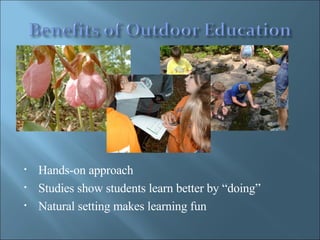
Hands-on approach  Studies show students learn better by “doing” Natural setting makes learning fun
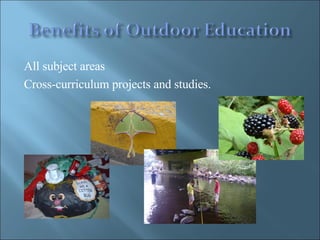
All subject areas  Cross-curriculum projects and studies.
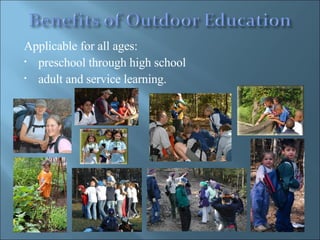
Applicable for all ages: preschool through high school  adult and service learning.
Great for all learning styles Incorporate TN Curriculum Standards Project WET  Project WILD Project Learning Tree
Building Life Skills:  Prepare for future Develop healthy and strong self-esteem Build skills in: Decision-making Teamwork  Communication  Leadership  Self-esteem  Citizenship
Outdoor classrooms are resources for: 4-H clubs FFA judging teams and other community organizations
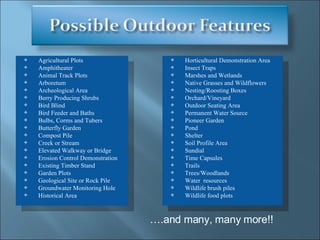
Agricultural Plots Amphitheater Animal Track Plots Arboretum Archeological Area Berry Producing Shrubs Bird Blind Bird Feeder and Baths Bulbs, Corms and Tubers Butterfly Garden Compost Pile Creek or Stream Elevated Walkway or Bridge Erosion Control Demonstration Existing Timber Stand Garden Plots Geological Site or Rock Pile Groundwater Monitoring Hole Historical Area Horticultural Demonstration Area Insect Traps Marshes and Wetlands Native Grasses and Wildflowers Nesting/Roosting Boxes Orchard/Vineyard Outdoor Seating Area Permanent Water Source Pioneer Garden Pond Shelter Soil Profile Area Sundial Time Capsules Trails Trees/Woodlands Water  resources Wildlife brush piles Wildlife food plots … .and many, many more!!
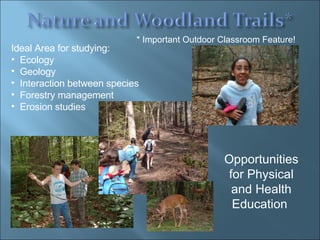
* Important Outdoor Classroom Feature! Opportunities for Physical and Health Education  Ideal Area for studying: Ecology  Geology  Interaction between species Forestry management Erosion studies
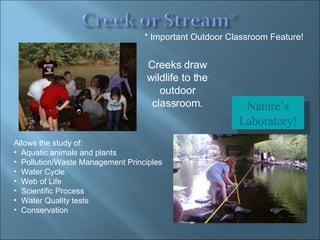
Creeks draw wildlife to the outdoor classroom. * Important Outdoor Classroom Feature! Nature’s Laboratory! Allows the study of: Aquatic animals and plants Pollution/Waste Management Principles Water Cycle Web of Life Scientific Process Water Quality tests Conservation
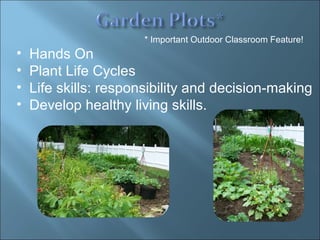
Hands On Plant Life Cycles Life skills: responsibility and decision-making  Develop healthy living skills. * Important Outdoor Classroom Feature!
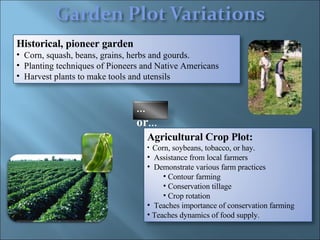
Agricultural Crop Plot: Corn, soybeans, tobacco, or hay.  Assistance from local farmers Demonstrate various farm practices Contour farming  Conservation tillage  Crop rotation  Teaches importance of conservation farming  Teaches dynamics of food supply. Historical, pioneer garden  Corn, squash, beans, grains, herbs and gourds.  Planting techniques of Pioneers and Native Americans  Harvest plants to make tools and utensils … or …
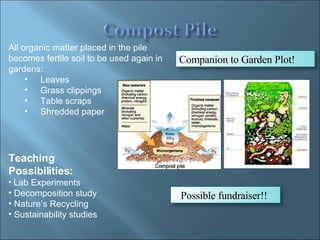
All organic matter placed in the pile becomes fertile soil to be used again in gardens: Leaves  Grass clippings Table scraps Shredded paper Teaching Possibilities:  Lab Experiments Decomposition study Nature’s Recycling Sustainability studies Companion to Garden Plot! Possible fundraiser!!
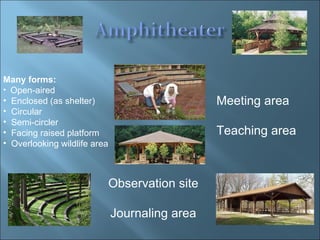
Many forms: Open-aired  Enclosed (as shelter)  Circular Semi-circler Facing raised platform Overlooking wildlife area Meeting area  Teaching area Observation site Journaling area
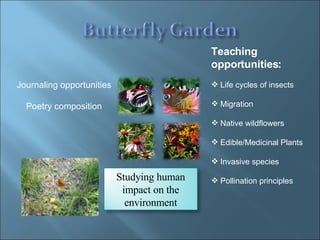
Teaching opportunities: Life cycles of insects Migration Native wildflowers Edible/Medicinal Plants Invasive species Pollination principles Journaling opportunities Poetry composition Studying human impact on the environment
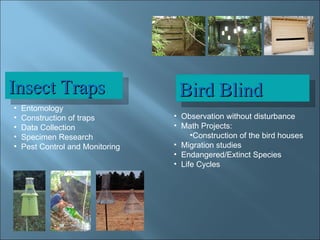
Bird Blind Insect Traps Entomology  Construction of traps Data Collection Specimen Research Pest Control and Monitoring Observation without disturbance Math Projects:  Construction of the bird houses Migration studies Endangered/Extinct Species Life Cycles
Art  Math  Physical and Life Science  Social Studies  History  Music  Physical Education  Family and Consumer Sciences  Technology  Life Skills  Vocational Agriculture  English and Language Arts
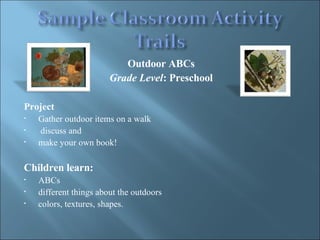
Outdoor ABCs  Grade Level : Preschool  Project Gather outdoor items on a walk discuss and  make your own book!  Children learn: ABCs different things about the outdoors  colors, textures, shapes.
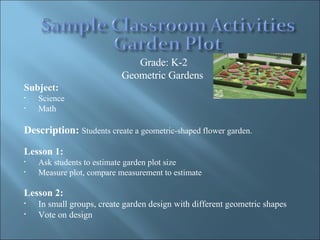
Grade: K-2 Geometric Gardens  Subject:  Science Math Description:  Students create a geometric-shaped flower garden. Lesson 1: Ask students to estimate garden plot size Measure plot, compare measurement to estimate Lesson 2:   In small groups, create garden design with different geometric shapes Vote on design
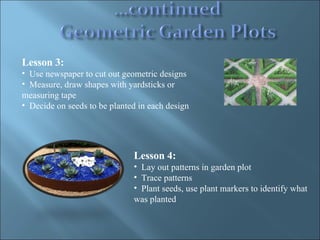
Lesson 3:  Use newspaper to cut out geometric designs Measure, draw shapes with yardsticks or measuring tape Decide on seeds to be planted in each design Lesson 4: Lay out patterns in garden plot Trace patterns Plant seeds, use plant markers to identify what was planted
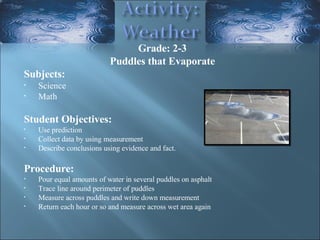
Grade: 2-3 Puddles that Evaporate Subjects: Science Math Student Objectives:  Use prediction  Collect data by using measurement  Describe conclusions using evidence and fact.  Procedure: Pour equal amounts of water in several puddles on asphalt Trace line around perimeter of puddles Measure across puddles and write down measurement Return each hour or so and measure across wet area again
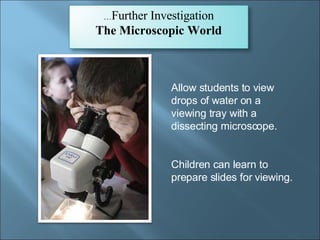
Allow students to view drops of water on a viewing tray with a dissecting microscope.  Children can learn to prepare slides for viewing. … Further Investigation The Microscopic World
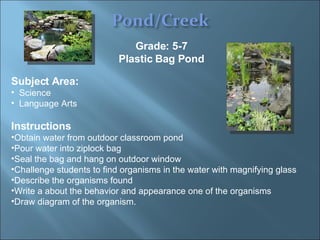
Grade: 5-7 Plastic Bag Pond Subject Area:  Science  Language Arts Instructions Obtain water from outdoor classroom pond  Pour water into ziplock bag Seal the bag and hang on outdoor window Challenge students to find organisms in the water with magnifying glass Describe the organisms found Write a about the behavior and appearance one of the organisms Draw diagram of the organism.
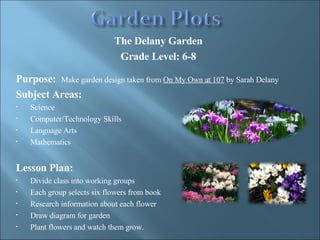
The Delany Garden Grade Level: 6-8   Purpose:   Make garden design taken from  On My Own at 107  by Sarah Delany  Subject Areas: Science Computer/Technology Skills Language Arts Mathematics Lesson Plan: Divide class into working groups Each group selects six flowers from book Research information about each flower  Draw diagram for garden Plant flowers and watch them grow.
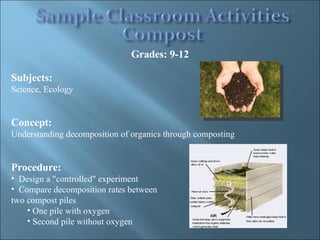
Grades: 9-12 Subjects: Science, Ecology Concept:  Understanding decomposition of organics through composting Procedure: Design a "controlled" experiment  Compare decomposition rates between  two compost piles One pile with oxygen Second pile without oxygen
Who are we? Environmental Education Center What do we do? Assistance in creating sustainable outdoor classrooms Development of recycling programs Outdoor Classroom Services: Grant-writing On-site Classes for Students Teacher Training Assistance in Developing Maintenance Plans
PTO Sub-committee/Planning Committee Parents Teachers Administrators Invite Community Participation and Connect to our Community’s Resources County Officials 4-H Members/Leaders Community Organizations Natural Resource Agency Personnel
 

Spencer Outdoor Classroom

  • 1.
    Spencer Elementary School2008-2009 PTO Project
  • 2.
    Hands-on approach Studies show students learn better by “doing” Natural setting makes learning fun
  • 3.
    All subject areas Cross-curriculum projects and studies.
  • 4.
    Applicable for allages: preschool through high school adult and service learning.
  • 5.
    Great for alllearning styles Incorporate TN Curriculum Standards Project WET Project WILD Project Learning Tree
  • 6.
    Building Life Skills: Prepare for future Develop healthy and strong self-esteem Build skills in: Decision-making Teamwork Communication Leadership Self-esteem Citizenship
  • 7.
    Outdoor classrooms areresources for: 4-H clubs FFA judging teams and other community organizations
  • 8.
    Agricultural Plots AmphitheaterAnimal Track Plots Arboretum Archeological Area Berry Producing Shrubs Bird Blind Bird Feeder and Baths Bulbs, Corms and Tubers Butterfly Garden Compost Pile Creek or Stream Elevated Walkway or Bridge Erosion Control Demonstration Existing Timber Stand Garden Plots Geological Site or Rock Pile Groundwater Monitoring Hole Historical Area Horticultural Demonstration Area Insect Traps Marshes and Wetlands Native Grasses and Wildflowers Nesting/Roosting Boxes Orchard/Vineyard Outdoor Seating Area Permanent Water Source Pioneer Garden Pond Shelter Soil Profile Area Sundial Time Capsules Trails Trees/Woodlands Water resources Wildlife brush piles Wildlife food plots … .and many, many more!!
  • 9.
    * Important OutdoorClassroom Feature! Opportunities for Physical and Health Education Ideal Area for studying: Ecology Geology Interaction between species Forestry management Erosion studies
  • 10.
    Creeks draw wildlifeto the outdoor classroom. * Important Outdoor Classroom Feature! Nature’s Laboratory! Allows the study of: Aquatic animals and plants Pollution/Waste Management Principles Water Cycle Web of Life Scientific Process Water Quality tests Conservation
  • 11.
    Hands On PlantLife Cycles Life skills: responsibility and decision-making Develop healthy living skills. * Important Outdoor Classroom Feature!
  • 12.
    Agricultural Crop Plot:Corn, soybeans, tobacco, or hay. Assistance from local farmers Demonstrate various farm practices Contour farming Conservation tillage Crop rotation Teaches importance of conservation farming Teaches dynamics of food supply. Historical, pioneer garden Corn, squash, beans, grains, herbs and gourds. Planting techniques of Pioneers and Native Americans Harvest plants to make tools and utensils … or …
  • 13.
    All organic matterplaced in the pile becomes fertile soil to be used again in gardens: Leaves Grass clippings Table scraps Shredded paper Teaching Possibilities: Lab Experiments Decomposition study Nature’s Recycling Sustainability studies Companion to Garden Plot! Possible fundraiser!!
  • 14.
    Many forms: Open-aired Enclosed (as shelter) Circular Semi-circler Facing raised platform Overlooking wildlife area Meeting area Teaching area Observation site Journaling area
  • 15.
    Teaching opportunities: Lifecycles of insects Migration Native wildflowers Edible/Medicinal Plants Invasive species Pollination principles Journaling opportunities Poetry composition Studying human impact on the environment
  • 16.
    Bird Blind InsectTraps Entomology Construction of traps Data Collection Specimen Research Pest Control and Monitoring Observation without disturbance Math Projects: Construction of the bird houses Migration studies Endangered/Extinct Species Life Cycles
  • 17.
    Art Math Physical and Life Science Social Studies History Music Physical Education Family and Consumer Sciences Technology Life Skills Vocational Agriculture English and Language Arts
  • 18.
    Outdoor ABCs Grade Level : Preschool Project Gather outdoor items on a walk discuss and make your own book! Children learn: ABCs different things about the outdoors colors, textures, shapes.
  • 19.
    Grade: K-2 GeometricGardens Subject: Science Math Description: Students create a geometric-shaped flower garden. Lesson 1: Ask students to estimate garden plot size Measure plot, compare measurement to estimate Lesson 2: In small groups, create garden design with different geometric shapes Vote on design
  • 20.
    Lesson 3: Use newspaper to cut out geometric designs Measure, draw shapes with yardsticks or measuring tape Decide on seeds to be planted in each design Lesson 4: Lay out patterns in garden plot Trace patterns Plant seeds, use plant markers to identify what was planted
  • 21.
    Grade: 2-3 Puddlesthat Evaporate Subjects: Science Math Student Objectives: Use prediction Collect data by using measurement Describe conclusions using evidence and fact. Procedure: Pour equal amounts of water in several puddles on asphalt Trace line around perimeter of puddles Measure across puddles and write down measurement Return each hour or so and measure across wet area again
  • 22.
    Allow students toview drops of water on a viewing tray with a dissecting microscope. Children can learn to prepare slides for viewing. … Further Investigation The Microscopic World
  • 23.
    Grade: 5-7 PlasticBag Pond Subject Area: Science Language Arts Instructions Obtain water from outdoor classroom pond Pour water into ziplock bag Seal the bag and hang on outdoor window Challenge students to find organisms in the water with magnifying glass Describe the organisms found Write a about the behavior and appearance one of the organisms Draw diagram of the organism.
  • 24.
    The Delany GardenGrade Level: 6-8   Purpose: Make garden design taken from On My Own at 107 by Sarah Delany Subject Areas: Science Computer/Technology Skills Language Arts Mathematics Lesson Plan: Divide class into working groups Each group selects six flowers from book Research information about each flower Draw diagram for garden Plant flowers and watch them grow.
  • 25.
    Grades: 9-12 Subjects:Science, Ecology Concept: Understanding decomposition of organics through composting Procedure: Design a "controlled" experiment Compare decomposition rates between two compost piles One pile with oxygen Second pile without oxygen
  • 26.
    Who are we?Environmental Education Center What do we do? Assistance in creating sustainable outdoor classrooms Development of recycling programs Outdoor Classroom Services: Grant-writing On-site Classes for Students Teacher Training Assistance in Developing Maintenance Plans
  • 27.
    PTO Sub-committee/Planning CommitteeParents Teachers Administrators Invite Community Participation and Connect to our Community’s Resources County Officials 4-H Members/Leaders Community Organizations Natural Resource Agency Personnel
  • 28.