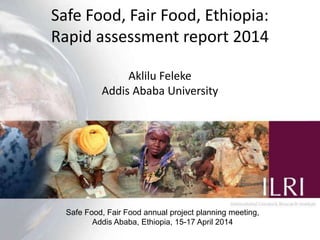
Safe Food, Fair Food, Ethiopia:
Rapid assessment report 2014
Safe Food, Fair Food annual project planning meeting
Addis Ababa, Ethiopia, 15-17 April 2014
Barbara Szonyi, Tamsin Dewe and Aklilu Feleke
Contents
• Shoat value chain of Ethiopia
• Site selection and studies
• Value chain map
• Situational policy review
• What hazards are present
• Big questions
• Recommendations
The sheep and goat value chain in Ethiopia
• Ethiopia is home to 92 million people
– Over 80% of the human population lives in rural areas, where subsistence
farming is common
• The shoats population of Ethiopia is about 66 million although estimates
vary greatly
• Shoats provide about 46% of the national meat consumption and 58% of
the value of hide and skin production
• They function as walking liquid assets that can be exchanged for cash
during times of financial strain
• Low productivity due to feed shortages, lack of appropriate breeding
programs, a high disease burden, and market difficulties
• There is increasing demand for small ruminant meat both domestically
and for export
– Chilled small ruminant meat exports from Ethiopia have increased rapidly over
the last ten years . The primary targets are the United Arab Emirates (UAE) and
Saudi Arabia
Highland production system
• Highlands cover 40%
of the total area of the
country and host
about 60% of the total
livestock population
• The average livestock
holding in smallholder
mixed crop-livestock
systems has less than
four head each of
cattle and small
ruminants
Lowland production system
• Pastoralist flocks are larger and constitute 40% of the
total livestock population in Ethiopia, although
pastoralists themselves make up only 12 to 15% of the
human population
• Pastoral and agro pastoral areas own 40% of the goat,
40% of sheep, 20% of cattle, and 100% of the camel
population of the country
Study areas in Ethiopia
# VCs District Sites/villages/
communities
Region
Highlands
1 Sheep 1 Atsbi 1. Habes
2. Golgol na’ele
Tigray
2 Sheep 2 Doyogena 1. Serea
2. Bkafa
SNNP
3 Sheep 3 Menz 1. Molale
2. Mehal Meda
Amhara
4 Sheep 4 Horro/Shambu 1. Gitlo
2. Lakku Iggu
Oromia
5 Goat 1 Abergelle 1. Sazba (Amhara)
2. Felegehiwot (Tigray)
Amhara/Ti
gray
Lowlands
6 Goat 2 Yabello (Borana) 1. Eleweya
2. Darito
Oromia
7 Goat/Sheep Shinelle 1. Gad
2. Degah Jebis
Somalia
The movement of animals within the small
ruminant value chain in Ethiopia
Situational analysis of regulatory frameworks
• The main government organs responsible for
food safety in Ethiopia are the Ministry of Health
(MoH), Ministry of Agriculture and Rural
Development (MoARD) and the Quality and
Standardization Authority of Ethiopia (QSAE)
• Several rules and regulations
• There is overlap of the responsibilities and
mandates
• There is little close cooperation or co-ordination
between the three institutions
MoARD mandate
Centers on control of animal diseases:
– inspection of premises where animals (or their
products or by-products) are kept including domestic
and export abattoirs.
– Taking samples from animal products and by-products
for the identification of disease or disease-causing
agents
– establishing quarantine stations and entrance and exit
posts to control the safety of animal-source food that
is being imported and exported
– issuing international sanitary certificates for exported
food or require the same for imported food products
MoH mandate
• The MoH control the safety and quality of food:
– set food standards
– issue licenses to trans-regional food companies
– control the import, export, distribution, and storage of food
– control the quality of food laboratories
– issue, renew, suspend and revoke licenses of food processing
plants and food importers or exporters
– The MoH has appointed inspectors who are empowered to
enter any food establishment and inspect its compliance with
these laws
– published manuals and guidelines on food hygiene and safety
– Imported and exported food items are required to be
accompanied by a food safety certificate
QSAE mandate
• The QSAE is also empowered to set food
standards
• The QSAE has developed a number of
standards related to quality assurance and the
safety of animal-source food, which are
supposed to be followed by all stakeholders -
the implementing authorities as well as
producers, traders and other middle-men,
processors and retailers
Main hazards in the value chain
• Fecal pathogens: Salmonella spp., toxigenic Escherichia coli and
Campylobacter, and Giardia duodenalis and Cryptosporidium
• Ongoing studies addressing first 3 and hygiene practices at slaughter;
ante and post-mortem procedures in meat inspection
• Toxoplasma gondii and Bacillus anthracis can be transmitted by eating
infected meat
• Brucella melitensis and Mycobacterium bovis can be transmitted by milk
• Potential non-biological hazards:
• Heavy metals, due to the use of particular cooking utensils
• Carcinogens produced during cooking or preservation of meat
• Agrochemicals and drug residues, particularly in internal organs like liver
and kidney or in milk
• Aflatoxins in meat and dairy products
Questions
• What are the real risks in this value chain regarding food
safety and nutrition?
– Nutritional deficiencies due to low consumption of ASF
– Biological hazards due to improper food preparation techniques
• Deep-rooted cultural practices
– Consumption of raw meat, including sheep and goat meat
– Taboo for women drinking whole milk
• Poor herd health due to inadequate veterinary services
– High-level ministry policies – what can ILRI do?
• Poor harvesting techniques and hygiene
– How can it be improved?
• First training completed
• Pilot interventions?

Safe Food, Fair Food, Ethiopia: Rapid assessment report 2014

  • 1.
    Safe Food, FairFood, Ethiopia: Rapid assessment report 2014 Safe Food, Fair Food annual project planning meeting Addis Ababa, Ethiopia, 15-17 April 2014 Barbara Szonyi, Tamsin Dewe and Aklilu Feleke
  • 2.
    Contents • Shoat valuechain of Ethiopia • Site selection and studies • Value chain map • Situational policy review • What hazards are present • Big questions • Recommendations
  • 3.
    The sheep andgoat value chain in Ethiopia • Ethiopia is home to 92 million people – Over 80% of the human population lives in rural areas, where subsistence farming is common • The shoats population of Ethiopia is about 66 million although estimates vary greatly • Shoats provide about 46% of the national meat consumption and 58% of the value of hide and skin production • They function as walking liquid assets that can be exchanged for cash during times of financial strain • Low productivity due to feed shortages, lack of appropriate breeding programs, a high disease burden, and market difficulties • There is increasing demand for small ruminant meat both domestically and for export – Chilled small ruminant meat exports from Ethiopia have increased rapidly over the last ten years . The primary targets are the United Arab Emirates (UAE) and Saudi Arabia
  • 4.
    Highland production system •Highlands cover 40% of the total area of the country and host about 60% of the total livestock population • The average livestock holding in smallholder mixed crop-livestock systems has less than four head each of cattle and small ruminants
  • 5.
    Lowland production system •Pastoralist flocks are larger and constitute 40% of the total livestock population in Ethiopia, although pastoralists themselves make up only 12 to 15% of the human population • Pastoral and agro pastoral areas own 40% of the goat, 40% of sheep, 20% of cattle, and 100% of the camel population of the country
  • 6.
  • 7.
    Study areas inEthiopia # VCs District Sites/villages/ communities Region Highlands 1 Sheep 1 Atsbi 1. Habes 2. Golgol na’ele Tigray 2 Sheep 2 Doyogena 1. Serea 2. Bkafa SNNP 3 Sheep 3 Menz 1. Molale 2. Mehal Meda Amhara 4 Sheep 4 Horro/Shambu 1. Gitlo 2. Lakku Iggu Oromia 5 Goat 1 Abergelle 1. Sazba (Amhara) 2. Felegehiwot (Tigray) Amhara/Ti gray Lowlands 6 Goat 2 Yabello (Borana) 1. Eleweya 2. Darito Oromia 7 Goat/Sheep Shinelle 1. Gad 2. Degah Jebis Somalia
  • 8.
    The movement ofanimals within the small ruminant value chain in Ethiopia
  • 9.
    Situational analysis ofregulatory frameworks • The main government organs responsible for food safety in Ethiopia are the Ministry of Health (MoH), Ministry of Agriculture and Rural Development (MoARD) and the Quality and Standardization Authority of Ethiopia (QSAE) • Several rules and regulations • There is overlap of the responsibilities and mandates • There is little close cooperation or co-ordination between the three institutions
  • 10.
    MoARD mandate Centers oncontrol of animal diseases: – inspection of premises where animals (or their products or by-products) are kept including domestic and export abattoirs. – Taking samples from animal products and by-products for the identification of disease or disease-causing agents – establishing quarantine stations and entrance and exit posts to control the safety of animal-source food that is being imported and exported – issuing international sanitary certificates for exported food or require the same for imported food products
  • 11.
    MoH mandate • TheMoH control the safety and quality of food: – set food standards – issue licenses to trans-regional food companies – control the import, export, distribution, and storage of food – control the quality of food laboratories – issue, renew, suspend and revoke licenses of food processing plants and food importers or exporters – The MoH has appointed inspectors who are empowered to enter any food establishment and inspect its compliance with these laws – published manuals and guidelines on food hygiene and safety – Imported and exported food items are required to be accompanied by a food safety certificate
  • 12.
    QSAE mandate • TheQSAE is also empowered to set food standards • The QSAE has developed a number of standards related to quality assurance and the safety of animal-source food, which are supposed to be followed by all stakeholders - the implementing authorities as well as producers, traders and other middle-men, processors and retailers
  • 13.
    Main hazards inthe value chain • Fecal pathogens: Salmonella spp., toxigenic Escherichia coli and Campylobacter, and Giardia duodenalis and Cryptosporidium • Ongoing studies addressing first 3 and hygiene practices at slaughter; ante and post-mortem procedures in meat inspection • Toxoplasma gondii and Bacillus anthracis can be transmitted by eating infected meat • Brucella melitensis and Mycobacterium bovis can be transmitted by milk • Potential non-biological hazards: • Heavy metals, due to the use of particular cooking utensils • Carcinogens produced during cooking or preservation of meat • Agrochemicals and drug residues, particularly in internal organs like liver and kidney or in milk • Aflatoxins in meat and dairy products
  • 14.
    Questions • What arethe real risks in this value chain regarding food safety and nutrition? – Nutritional deficiencies due to low consumption of ASF – Biological hazards due to improper food preparation techniques • Deep-rooted cultural practices – Consumption of raw meat, including sheep and goat meat – Taboo for women drinking whole milk • Poor herd health due to inadequate veterinary services – High-level ministry policies – what can ILRI do? • Poor harvesting techniques and hygiene – How can it be improved? • First training completed • Pilot interventions?