Writing A
Literary Essay
Focused on “Tsotsi”
EXAMPLE OF A LITERARY ESSAY TOPIC:
Tsotsi’s decisions are justified by his environment.
Discuss the truth of this statement in an essay of 300 - 350 words.
(2 - 2½ pages)
OR
The theme of Apartheid plays a significant role in Tsotsi.
Discuss the validity of the above statement in an essay of 300 – 350
words.
(2 – 2 ½ pages)
PRACTICE LITERARY ESSAY TOPICS:
Tsotsi’s decisions are justified by his environment.
Discuss the truth of this statement in an essay of 250 - 350 words.
(1 - 2 pages)
AND
The theme of Apartheid plays a significant role in Tsotsi.
Discuss the validity of the above statement in an essay of 250 – 350
words.
(1 – 2 pages)
STEP ONE:
ANALYSIS OF THE TOPIC:
• The topic usually has 2 or more components:
1. THE STATEMENT/QUESTION:
Tsotsi’s decisions are justified by his environment.
OR
The theme of Apartheid plays a significant role in
Tsotsi.
HOW DO YOU HANDLE THE
STATEMENT/QUESTION?
 The statement is the platform from which your essay
begins.
 You will need to PROVIDE EVIDENCE from the novel
to either support, reject or equally evaluate the
statement.
 You need to read the rest of the question in order to
understand how to plan/focus your research…
STEP ONE:
ANALYSIS OF THE TOPIC (PART 2)
• The ‘instruction’ tells you how to approach your essay.
• 2. INSTRUCTION:
Discuss the truth of this statement in an essay of 300 - 350 words.
(2 - 2½ pages)
Or
Discuss the validity of the above statement in an essay of 300 – 350 words.
(2 – 2 ½ pages)
HOW DO YOU FOLLOW THE INSTRUCTION?
• This instruction relates directly to the manner in which you structure
your research.
 i.e. Discuss the truth of this statement.
• Your essay will not need to ‘take a side’ – this instruction requires you to consider all
options, before deciding whether or not the statement is true/false.
EXAMPLES OF OTHER INSTRUCTIONS:
 Compare these two characters/scenes…….etc
▪ Your research will need to be focused on finding similar information
on both aspects in order to COMPARE.
• Contrast these two characters/scenes…….etc
• Your research will need to be focused on finding different
information on both aspects in order to CONTRAST.
• Examine the role a character plays in……
• Focus your research on the specific character AND how
they contributed to the events/outcome of the novel.
EXAMPLES OF OTHER INSTRUCTIONS:
• Discuss something specific e.g. a character
• Focus on the details related to the character and only the
character – be focused
• How do the female characters differ from….e.g.
modern day women
• Focus on the characters and collect information on them and
the other aspect of the question as well.
RESEARCH
 You will be required to include evidence from the
relevant sections of the novel in your essay.
▪ Examples of evidence:
▪ Summaries of important sections
• e.g. Reference to events in which Tsotsi’s
environment is discussed.
▪ Quotes that link to the statement
• e.g. “Life had taught him no other.” –
Tsotsi (Chapter 1)
HOW TO QUOTE:
 When quoting, always remember that the quote should
“fit” into the sentence in a flowing manner.
 e.g. It is clear that Tsotsi is a product of his environment. As he
says in chapter 1, “life had taught him no other.”
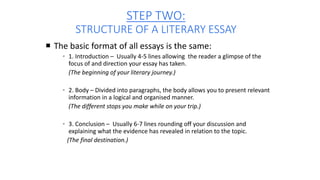
STEP TWO:
STRUCTURE OF A LITERARY ESSAY
 The basic format of all essays is the same:
▪ 1. Introduction – Usually 4-5 lines allowing the reader a glimpse of the
focus of and direction your essay has taken.
(The beginning of your literary journey.)
▪ 2. Body – Divided into paragraphs, the body allows you to present relevant
information in a logical and organised manner.
(The different stops you make while on your trip.)
▪ 3. Conclusion – Usually 6-7 lines rounding off your discussion and
explaining what the evidence has revealed in relation to the topic.
(The final destination.)
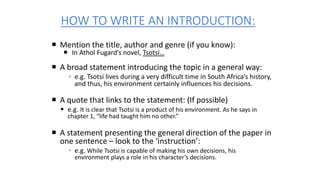
HOW TO WRITE AN INTRODUCTION:
 Mention the title, author and genre (if you know):
 In Athol Fugard’s novel, Tsotsi…
 A broad statement introducing the topic in a general way:
▪ e.g. Tsotsi lives during a very difficult time in South Africa’s history,
and thus, his environment certainly influences his decisions.
 A quote that links to the statement: (If possible)
 e.g. It is clear that Tsotsi is a product of his environment. As he says in
chapter 1, “life had taught him no other.”
 A statement presenting the general direction of the paper in
one sentence – look to the ‘instruction’:
▪ e.g. While Tsotsi is capable of making his own decisions, his
environment plays a role in his character’s decisions.
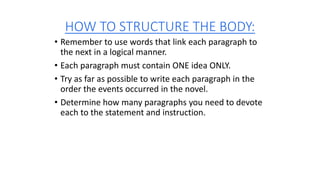
HOW TO STRUCTURE THE BODY:
• Remember to use words that link each paragraph to
the next in a logical manner.
• Each paragraph must contain ONE idea ONLY.
• Try as far as possible to write each paragraph in the
order the events occurred in the novel.
• Determine how many paragraphs you need to devote
each to the statement and instruction.
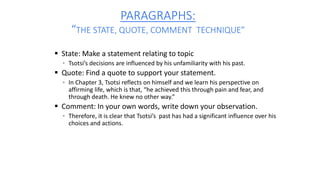
PARAGRAPHS:
“THE STATE, QUOTE, COMMENT TECHNIQUE”
 State: Make a statement relating to topic
▪ Tsotsi’s decisions are influenced by his unfamiliarity with his past.
 Quote: Find a quote to support your statement.
▪ In Chapter 3, Tsotsi reflects on himself and we learn his perspective on
affirming life, which is that, “he achieved this through pain and fear, and
through death. He knew no other way.”
 Comment: In your own words, write down your observation.
▪ Therefore, it is clear that Tsotsi’s past has had a significant influence over his
choices and actions.
CONCLUSION:
• It answers the "so what?" question, i.e. You have introduced the
essay, presented the evidence…so what?
• The conclusion ends your argument with a final decision – the
meaning of all that you have written in relation to the topic.
• You must link your conclusion to the information you have provided in
the body of your essay.
STRUCTURE OF THE CONCLUSION:
First sentence:
• Part 1 - Link to essay:
• Based on the evidence above…
• In light of the above discussion…
• As per the points mentioned in the essay above…
• Part 2 – concluding statement:
• … one may conclude that…
• … one can see that…
• … it is clear that…
Second sentence:
• Mention the points discussed in your essay
• Tsotsi’s past, the Apartheid system, the darkness within Tsotsi, the lack of memories etc
Third sentence:
• What does this show us – final statement/decision
IMPORTANT REMINDERS:
1. Do NOT use “I” statements
2. Your personal opinion is irrelevant
3. Do not judge the character’s actions or viewpoints
4. Use the text, and only the text, to support your statements.
5. Write in the present tense.
6. Structure your essay properly
7. DO NOT tell the story

Literary essay - Tsotsi

  • 1.
  • 2.
    EXAMPLE OF ALITERARY ESSAY TOPIC: Tsotsi’s decisions are justified by his environment. Discuss the truth of this statement in an essay of 300 - 350 words. (2 - 2½ pages) OR The theme of Apartheid plays a significant role in Tsotsi. Discuss the validity of the above statement in an essay of 300 – 350 words. (2 – 2 ½ pages)
  • 3.
    PRACTICE LITERARY ESSAYTOPICS: Tsotsi’s decisions are justified by his environment. Discuss the truth of this statement in an essay of 250 - 350 words. (1 - 2 pages) AND The theme of Apartheid plays a significant role in Tsotsi. Discuss the validity of the above statement in an essay of 250 – 350 words. (1 – 2 pages)
  • 4.
    STEP ONE: ANALYSIS OFTHE TOPIC: • The topic usually has 2 or more components: 1. THE STATEMENT/QUESTION: Tsotsi’s decisions are justified by his environment. OR The theme of Apartheid plays a significant role in Tsotsi.
  • 5.
    HOW DO YOUHANDLE THE STATEMENT/QUESTION?  The statement is the platform from which your essay begins.  You will need to PROVIDE EVIDENCE from the novel to either support, reject or equally evaluate the statement.  You need to read the rest of the question in order to understand how to plan/focus your research…
  • 6.
    STEP ONE: ANALYSIS OFTHE TOPIC (PART 2) • The ‘instruction’ tells you how to approach your essay. • 2. INSTRUCTION: Discuss the truth of this statement in an essay of 300 - 350 words. (2 - 2½ pages) Or Discuss the validity of the above statement in an essay of 300 – 350 words. (2 – 2 ½ pages)
  • 7.
    HOW DO YOUFOLLOW THE INSTRUCTION? • This instruction relates directly to the manner in which you structure your research.  i.e. Discuss the truth of this statement. • Your essay will not need to ‘take a side’ – this instruction requires you to consider all options, before deciding whether or not the statement is true/false.
  • 8.
    EXAMPLES OF OTHERINSTRUCTIONS:  Compare these two characters/scenes…….etc ▪ Your research will need to be focused on finding similar information on both aspects in order to COMPARE. • Contrast these two characters/scenes…….etc • Your research will need to be focused on finding different information on both aspects in order to CONTRAST. • Examine the role a character plays in…… • Focus your research on the specific character AND how they contributed to the events/outcome of the novel.
  • 9.
    EXAMPLES OF OTHERINSTRUCTIONS: • Discuss something specific e.g. a character • Focus on the details related to the character and only the character – be focused • How do the female characters differ from….e.g. modern day women • Focus on the characters and collect information on them and the other aspect of the question as well.
  • 10.
    RESEARCH  You willbe required to include evidence from the relevant sections of the novel in your essay. ▪ Examples of evidence: ▪ Summaries of important sections • e.g. Reference to events in which Tsotsi’s environment is discussed. ▪ Quotes that link to the statement • e.g. “Life had taught him no other.” – Tsotsi (Chapter 1)
  • 11.
    HOW TO QUOTE: When quoting, always remember that the quote should “fit” into the sentence in a flowing manner.  e.g. It is clear that Tsotsi is a product of his environment. As he says in chapter 1, “life had taught him no other.”
  • 12.
    STEP TWO: STRUCTURE OFA LITERARY ESSAY  The basic format of all essays is the same: ▪ 1. Introduction – Usually 4-5 lines allowing the reader a glimpse of the focus of and direction your essay has taken. (The beginning of your literary journey.) ▪ 2. Body – Divided into paragraphs, the body allows you to present relevant information in a logical and organised manner. (The different stops you make while on your trip.) ▪ 3. Conclusion – Usually 6-7 lines rounding off your discussion and explaining what the evidence has revealed in relation to the topic. (The final destination.)
  • 13.
    HOW TO WRITEAN INTRODUCTION:  Mention the title, author and genre (if you know):  In Athol Fugard’s novel, Tsotsi…  A broad statement introducing the topic in a general way: ▪ e.g. Tsotsi lives during a very difficult time in South Africa’s history, and thus, his environment certainly influences his decisions.  A quote that links to the statement: (If possible)  e.g. It is clear that Tsotsi is a product of his environment. As he says in chapter 1, “life had taught him no other.”  A statement presenting the general direction of the paper in one sentence – look to the ‘instruction’: ▪ e.g. While Tsotsi is capable of making his own decisions, his environment plays a role in his character’s decisions.
  • 14.
    HOW TO STRUCTURETHE BODY: • Remember to use words that link each paragraph to the next in a logical manner. • Each paragraph must contain ONE idea ONLY. • Try as far as possible to write each paragraph in the order the events occurred in the novel. • Determine how many paragraphs you need to devote each to the statement and instruction.
  • 15.
    PARAGRAPHS: “THE STATE, QUOTE,COMMENT TECHNIQUE”  State: Make a statement relating to topic ▪ Tsotsi’s decisions are influenced by his unfamiliarity with his past.  Quote: Find a quote to support your statement. ▪ In Chapter 3, Tsotsi reflects on himself and we learn his perspective on affirming life, which is that, “he achieved this through pain and fear, and through death. He knew no other way.”  Comment: In your own words, write down your observation. ▪ Therefore, it is clear that Tsotsi’s past has had a significant influence over his choices and actions.
  • 16.
    CONCLUSION: • It answersthe "so what?" question, i.e. You have introduced the essay, presented the evidence…so what? • The conclusion ends your argument with a final decision – the meaning of all that you have written in relation to the topic. • You must link your conclusion to the information you have provided in the body of your essay.
  • 17.
    STRUCTURE OF THECONCLUSION: First sentence: • Part 1 - Link to essay: • Based on the evidence above… • In light of the above discussion… • As per the points mentioned in the essay above… • Part 2 – concluding statement: • … one may conclude that… • … one can see that… • … it is clear that… Second sentence: • Mention the points discussed in your essay • Tsotsi’s past, the Apartheid system, the darkness within Tsotsi, the lack of memories etc Third sentence: • What does this show us – final statement/decision
  • 18.
    IMPORTANT REMINDERS: 1. DoNOT use “I” statements 2. Your personal opinion is irrelevant 3. Do not judge the character’s actions or viewpoints 4. Use the text, and only the text, to support your statements. 5. Write in the present tense. 6. Structure your essay properly 7. DO NOT tell the story