maths
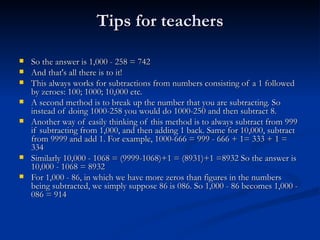
Tips for teachers So the answer is 1,000 - 258 = 742 And that's all there is to it! This always works for subtractions from numbers consisting of a 1 followed by zeroes: 100; 1000; 10,000 etc. A second method is to break up the number that you are subtracting. So instead of doing 1000-258 you would do 1000-250 and then subtract 8. Another way of easily thinking of this method is to always subtract from 999 if subtracting from 1,000, and then adding 1 back. Same for 10,000, subtract from 9999 and add 1. For example, 1000-666 = 999 - 666 + 1= 333 + 1 = 334 Similarly 10,000 - 1068 = (9999-1068)+1 = (8931)+1 =8932 So the answer is 10,000 - 1068 = 8932 For 1,000 - 86, in which we have more zeros than figures in the numbers being subtracted, we simply suppose 86 is 086. So 1,000 - 86 becomes 1,000 - 086 = 914
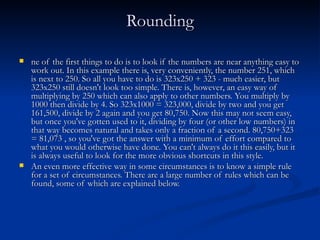
Rounding ne of the first things to do is to look if the numbers are near anything easy to work out. In this example there is, very conveniently, the number 251, which is next to 250. So all you have to do is 323x250 + 323 - much easier, but 323x250 still doesn't look too simple. There is, however, an easy way of multiplying by 250 which can also apply to other numbers. You multiply by 1000 then divide by 4. So 323x1000 = 323,000, divide by two and you get 161,500, divide by 2 again and you get 80,750. Now this may not seem easy, but once you've gotten used to it, dividing by four (or other low numbers) in that way becomes natural and takes only a fraction of a second. 80,750+323 = 81,073 , so you've got the answer with a minimum of effort compared to what you would otherwise have done. You can't always do it this easily, but it is always useful to look for the more obvious shortcuts in this style. An even more effective way in some circumstances is to know a simple rule for a set of circumstances. There are a large number of rules which can be found, some of which are explained below.
Multiplication by 11 77 x 11 = 847 This involves a carry figure because 7 + 7 = 14 we get 77 x 11 = [7][14][7]. We add the 1 from 14 as carry over to 7 and get 77x11=847 Similarly, 84x11 can be written as [8][8+4][4]=[8][12][4]. The 1 from 12 carries over, giving 84x11=924 For 3 digit numbers multiplied by 11: 254 x 11 = 2794 We put the 2 and the 4 at the ends. We add the first pair 2 + 5 = 7. and we add the last pair: 5 + 4 = 9. So we can write 254 x 11 as [2][2+5][5+4][4] i.e. 254x11=2794 Similarly, 909x11 can be written as [9][9+0][0+9][9] i.e. 909x11=9999
Other mental maths perhaps one of the more useful tricks to mental math is memorization. Although it may seem an annoyance to need to memorize certain math facts, such as perfect squares and cubes (especially powers of two), prime factorizations of certain numbers, or the decimal equivalents of common fractions (such as 1/7 = .1428...). Many are simple, such as 1/3 = .3333... and 2^5 = 32, but speed up your calculations enormously when you don't have to do the division or multiplication in your head. For example, trying to figure out 1024/32 is much easier knowing that that is the same as 2^10/2^5, or which, subtracting exponents, gives 2^5, or 32. Many of these are memorized simply by frequent use; so, the best way to get good is much practice. [By VHV'] My dad insisted that I memorize 3 x 17 = 51. We can extend this to 6 x 17 = 102. If we round these numbers 3 x 17 is approx 50, 6 x 17 is approx 100, 9 x 17 is approx 150, and so on. These are very helpful in estimating since in 3, 6, 9, 50, 100 ... are common numbers. I haven't got time to write any more at the moment (hopefully some other people will be able to contribute though) so I wont add any more for now, but the ideas I have shown can often be applied to more areas and help in most mental maths. I haven't mentioned addition or subtraction, which seem to be strange things to overlook, but there are much fewer shortcuts for these activities. If anyone edits this I suggest that is the first thing to talk about.

Maths 1

  • 1.
  • 2.
    Tips for teachersSo the answer is 1,000 - 258 = 742 And that's all there is to it! This always works for subtractions from numbers consisting of a 1 followed by zeroes: 100; 1000; 10,000 etc. A second method is to break up the number that you are subtracting. So instead of doing 1000-258 you would do 1000-250 and then subtract 8. Another way of easily thinking of this method is to always subtract from 999 if subtracting from 1,000, and then adding 1 back. Same for 10,000, subtract from 9999 and add 1. For example, 1000-666 = 999 - 666 + 1= 333 + 1 = 334 Similarly 10,000 - 1068 = (9999-1068)+1 = (8931)+1 =8932 So the answer is 10,000 - 1068 = 8932 For 1,000 - 86, in which we have more zeros than figures in the numbers being subtracted, we simply suppose 86 is 086. So 1,000 - 86 becomes 1,000 - 086 = 914
  • 3.
    Rounding ne ofthe first things to do is to look if the numbers are near anything easy to work out. In this example there is, very conveniently, the number 251, which is next to 250. So all you have to do is 323x250 + 323 - much easier, but 323x250 still doesn't look too simple. There is, however, an easy way of multiplying by 250 which can also apply to other numbers. You multiply by 1000 then divide by 4. So 323x1000 = 323,000, divide by two and you get 161,500, divide by 2 again and you get 80,750. Now this may not seem easy, but once you've gotten used to it, dividing by four (or other low numbers) in that way becomes natural and takes only a fraction of a second. 80,750+323 = 81,073 , so you've got the answer with a minimum of effort compared to what you would otherwise have done. You can't always do it this easily, but it is always useful to look for the more obvious shortcuts in this style. An even more effective way in some circumstances is to know a simple rule for a set of circumstances. There are a large number of rules which can be found, some of which are explained below.
  • 4.
    Multiplication by 1177 x 11 = 847 This involves a carry figure because 7 + 7 = 14 we get 77 x 11 = [7][14][7]. We add the 1 from 14 as carry over to 7 and get 77x11=847 Similarly, 84x11 can be written as [8][8+4][4]=[8][12][4]. The 1 from 12 carries over, giving 84x11=924 For 3 digit numbers multiplied by 11: 254 x 11 = 2794 We put the 2 and the 4 at the ends. We add the first pair 2 + 5 = 7. and we add the last pair: 5 + 4 = 9. So we can write 254 x 11 as [2][2+5][5+4][4] i.e. 254x11=2794 Similarly, 909x11 can be written as [9][9+0][0+9][9] i.e. 909x11=9999
  • 5.
    Other mental mathsperhaps one of the more useful tricks to mental math is memorization. Although it may seem an annoyance to need to memorize certain math facts, such as perfect squares and cubes (especially powers of two), prime factorizations of certain numbers, or the decimal equivalents of common fractions (such as 1/7 = .1428...). Many are simple, such as 1/3 = .3333... and 2^5 = 32, but speed up your calculations enormously when you don't have to do the division or multiplication in your head. For example, trying to figure out 1024/32 is much easier knowing that that is the same as 2^10/2^5, or which, subtracting exponents, gives 2^5, or 32. Many of these are memorized simply by frequent use; so, the best way to get good is much practice. [By VHV'] My dad insisted that I memorize 3 x 17 = 51. We can extend this to 6 x 17 = 102. If we round these numbers 3 x 17 is approx 50, 6 x 17 is approx 100, 9 x 17 is approx 150, and so on. These are very helpful in estimating since in 3, 6, 9, 50, 100 ... are common numbers. I haven't got time to write any more at the moment (hopefully some other people will be able to contribute though) so I wont add any more for now, but the ideas I have shown can often be applied to more areas and help in most mental maths. I haven't mentioned addition or subtraction, which seem to be strange things to overlook, but there are much fewer shortcuts for these activities. If anyone edits this I suggest that is the first thing to talk about.