By Lv Flowers, Jill Pettit and Michael Rosenthal
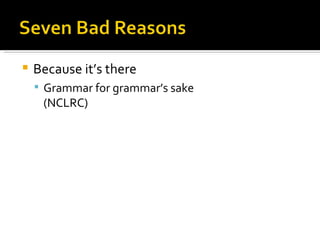
Because it’s there Grammar for grammar’s sake (NCLRC)
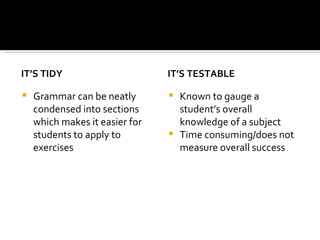
IT’S TIDY Grammar can be neatly condensed into sections which makes it easier for students to apply to exercises IT’S TESTABLE Known to gauge a student’s overall knowledge of a subject Time consuming/does not measure overall success
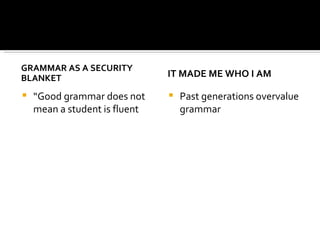
GRAMMAR AS A SECURITY BLANKET “ Good grammar does not mean a student is fluent IT MADE ME WHO I AM Past generations overvalue grammar
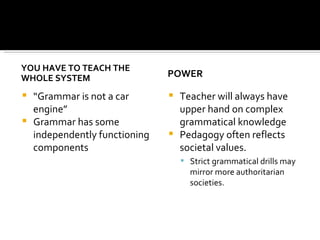
YOU HAVE TO TEACH THE WHOLE SYSTEM “ Grammar is not a car engine” Grammar has some independently functioning components POWER Teacher will always have upper hand on complex grammatical knowledge Pedagogy often reflects societal values.  Strict grammatical drills may mirror more authoritarian societies.
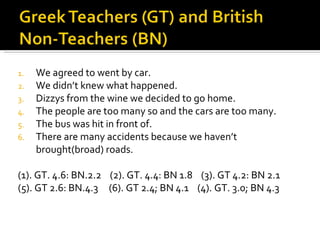
We agreed to went by car. We didn’t knew what happened. Dizzys from the wine we decided to go home. The people are too many so and the cars are too many. The bus was hit in front of. There are many accidents because we haven’t brought(broad) roads. (1). GT. 4.6: BN.2.2  (2). GT. 4.4: BN 1.8  (3). GT 4.2: BN 2.1 (5). GT 2.6: BN.4.3  (6). GT 2.4; BN 4.1  (4). GT. 3.0; BN 4.3
Students able to conjugate all verb forms but cannot use the language in helpful contexts Knowledge gained is strictly declarative and is lacking in implicit knowledge Self-esteem issues in language use
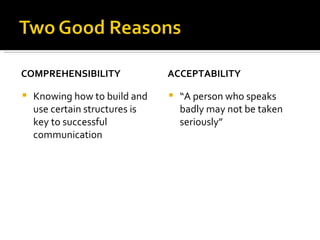
COMPREHENSIBILITY Knowing how to build and use certain structures is key to successful communication ACCEPTABILITY “ A person who speaks badly may not be taken seriously”
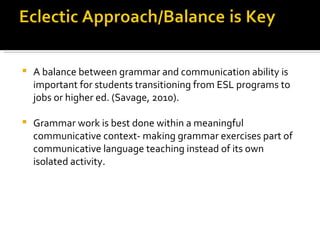
A balance between grammar and communication ability is important for students transitioning from ESL programs to jobs or higher ed. (Savage, 2010).  Grammar work is best done within a meaningful communicative context- making grammar exercises part of communicative language teaching instead of its own isolated activity.
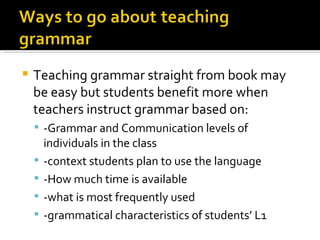
Teaching grammar straight from book may be easy but students benefit more when teachers instruct grammar based on: -Grammar and Communication levels of individuals in the class -context students plan to use the language -How much time is available -what is most frequently used -grammatical characteristics of students’ L1
Should we use grammar test to evaluate the student’s progress in the language? Will incorporating more communication activities in a classroom and less grammar yield different results? Have you seen an imbalance in the teaching of grammar in your learning of Spanish?
Savage, K.L., Bitterlin G., &Price, D. (2010). Grammar Matters: Teaching Grammar in Adult ESL Programs.  Cambridge University Press . NCLRC.  The Essentials of Language Learning, 2003.  web.  8 Feb.  2012.

Seven bad reasons for teaching grammar

  • 1.
    By Lv Flowers,Jill Pettit and Michael Rosenthal
  • 2.
    Because it’s thereGrammar for grammar’s sake (NCLRC)
  • 3.
    IT’S TIDY Grammarcan be neatly condensed into sections which makes it easier for students to apply to exercises IT’S TESTABLE Known to gauge a student’s overall knowledge of a subject Time consuming/does not measure overall success
  • 4.
    GRAMMAR AS ASECURITY BLANKET “ Good grammar does not mean a student is fluent IT MADE ME WHO I AM Past generations overvalue grammar
  • 5.
    YOU HAVE TOTEACH THE WHOLE SYSTEM “ Grammar is not a car engine” Grammar has some independently functioning components POWER Teacher will always have upper hand on complex grammatical knowledge Pedagogy often reflects societal values. Strict grammatical drills may mirror more authoritarian societies.
  • 6.
    We agreed towent by car. We didn’t knew what happened. Dizzys from the wine we decided to go home. The people are too many so and the cars are too many. The bus was hit in front of. There are many accidents because we haven’t brought(broad) roads. (1). GT. 4.6: BN.2.2 (2). GT. 4.4: BN 1.8 (3). GT 4.2: BN 2.1 (5). GT 2.6: BN.4.3 (6). GT 2.4; BN 4.1 (4). GT. 3.0; BN 4.3
  • 7.
    Students able toconjugate all verb forms but cannot use the language in helpful contexts Knowledge gained is strictly declarative and is lacking in implicit knowledge Self-esteem issues in language use
  • 8.
    COMPREHENSIBILITY Knowing howto build and use certain structures is key to successful communication ACCEPTABILITY “ A person who speaks badly may not be taken seriously”
  • 9.
    A balance betweengrammar and communication ability is important for students transitioning from ESL programs to jobs or higher ed. (Savage, 2010). Grammar work is best done within a meaningful communicative context- making grammar exercises part of communicative language teaching instead of its own isolated activity.
  • 10.
    Teaching grammar straightfrom book may be easy but students benefit more when teachers instruct grammar based on: -Grammar and Communication levels of individuals in the class -context students plan to use the language -How much time is available -what is most frequently used -grammatical characteristics of students’ L1
  • 11.
    Should we usegrammar test to evaluate the student’s progress in the language? Will incorporating more communication activities in a classroom and less grammar yield different results? Have you seen an imbalance in the teaching of grammar in your learning of Spanish?
  • 12.
    Savage, K.L., BitterlinG., &Price, D. (2010). Grammar Matters: Teaching Grammar in Adult ESL Programs. Cambridge University Press . NCLRC. The Essentials of Language Learning, 2003. web. 8 Feb. 2012.